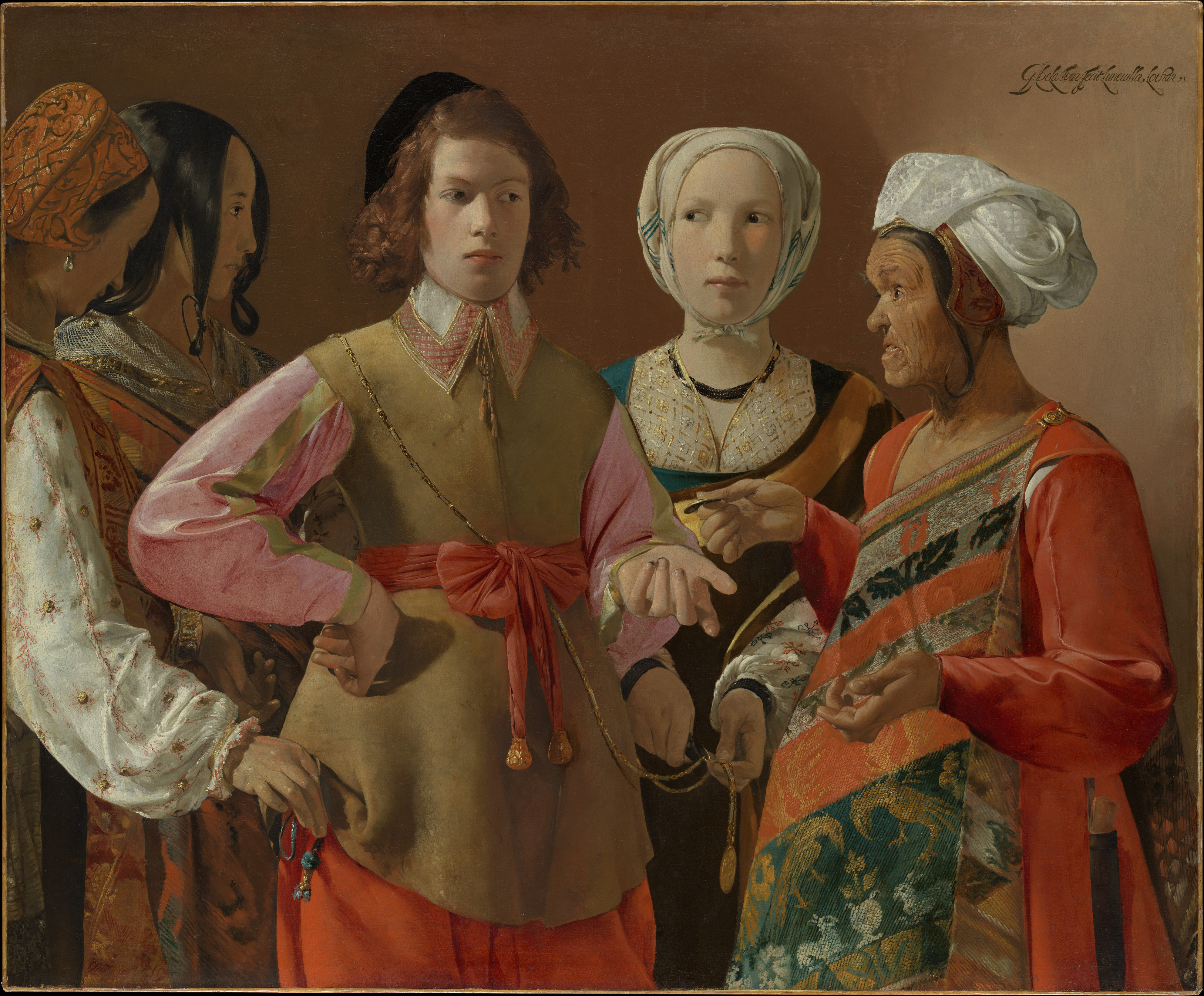
The Fortune-Teller
Probably 1630s · Oil on canvas
The Metropolitan Museum of Art, New York
 French, of Lorraine · 1593-1652
The Fortune-Teller The picture behind the site's linked object record and the most publicly contested attribution of La Tour's career, fought over in print and on American television between 1970 and 1982 before an 1879 probate inventory settled it. Oil on canvas, probably 1630s. Metropolitan Museum of Art, 60.30. No verified portrait. No securely identified likeness of this maker is known under a free licence. We do not publish a face we cannot verify.
The Metropolitan Museum of Art, New York| Full name | Georges de La Tour (also recorded as Georges du Mesnil de La Tour) |
|---|---|
| Worked as | Painter |
| Born | 13 March 1593 · Vic-sur-Seille, in the diocese of Metz, on the border of... |
| Died | 30 January 1652 · Luneville, duchy of Lorraine |
| Nationality | French, of Lorraine |
| Movement | Baroque |
| In this archive | 1 artwork |
| Sources | 22 cited |
| Last verified | 17 September 2026 |
About this page 1 artwork in the archive · Last verified 17 September 2026 · 22 sources cited
La Tour is the clearest case in European painting of a reputation that stopped existing and was rebuilt from nothing. He was rich, locally resented, and painter to the King of France in his own lifetime, and then for more than two and a half centuries his pictures hung in other men's names, mistaken for Dutch and Flemish painters, a Le Nain, once even for the wrong century. The German art historian Hermann Voss reassembled him as an artistic personality in 1915, and the corpus has kept moving ever since: the number of paintings now accepted as his is still argued over, most recently by a Paris exhibition that closed in January 2026.
What a reader needs to know that they probably do not: no confirmed self-portrait of La Tour survives, so this page carries no portrait, and that absence is itself a fact about how completely he was lost. What does survive is scattered across a French provincial museum, three Paris and Louvre rooms, and half a dozen American collections that acquired him only after 1915, when his pictures had gone from worthless to expensive inside a single working art-historical career. Fewer than fifty paintings are now generally accepted as his; several of the best-known subjects survive in two or more versions, by his own hand, his son's, or a later copyist, and telling them apart is most of what modern La Tour scholarship actually does.
Born 13 March at Vic-sur-Seille, second of seven children of the baker Jean de La Tour and Sybille de La Tour.18
Marries Diane Le Nerf, from a family connected to the Lorraine ducal mint.18
Establishes his studio at Luneville; received as a bourgeois of the town and granted ducal letters of exemption carrying noble-level privileges.181
Employed by the dukes of Lorraine.1
Given the title of painter to the king of France, Louis XIII, while remaining based at Luneville.1
Dies 30 January at Luneville in a dysentery epidemic; his wife Diane and a servant die of the same illness within days.18
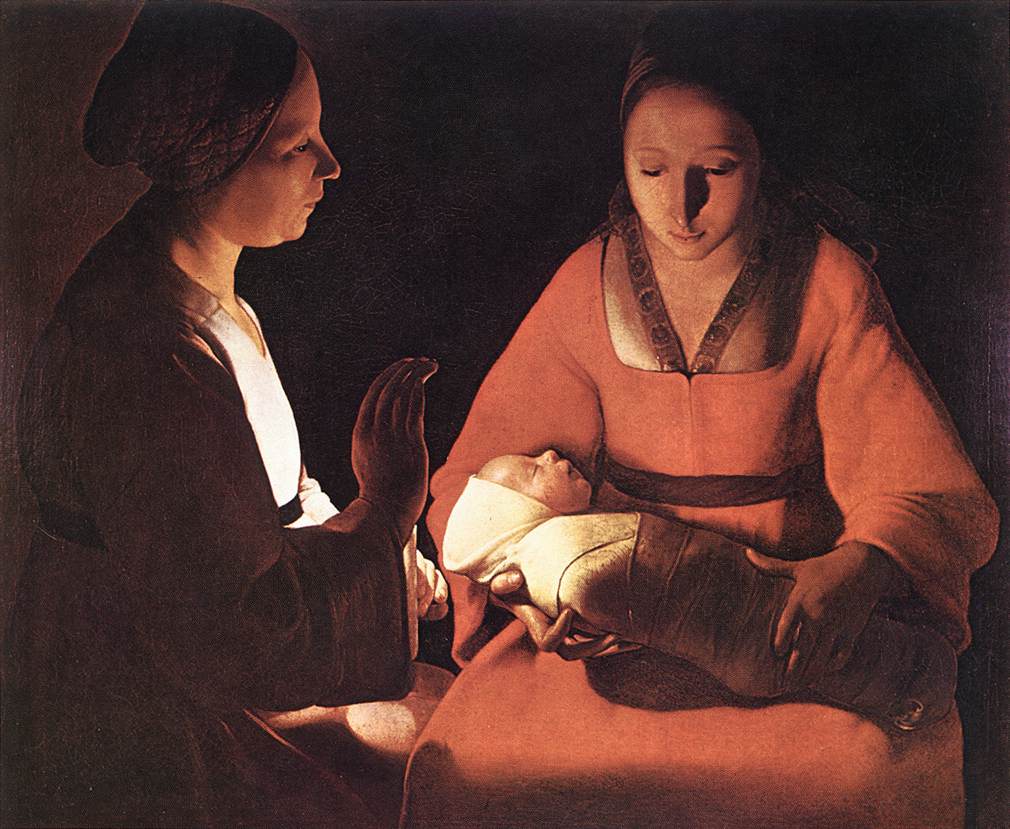
The New-born enters the Musee des Beaux-Arts de Rennes through the revolutionary seizure of an unidentified emigre's property, catalogued first as a Schalken and later as a Le Nain.17
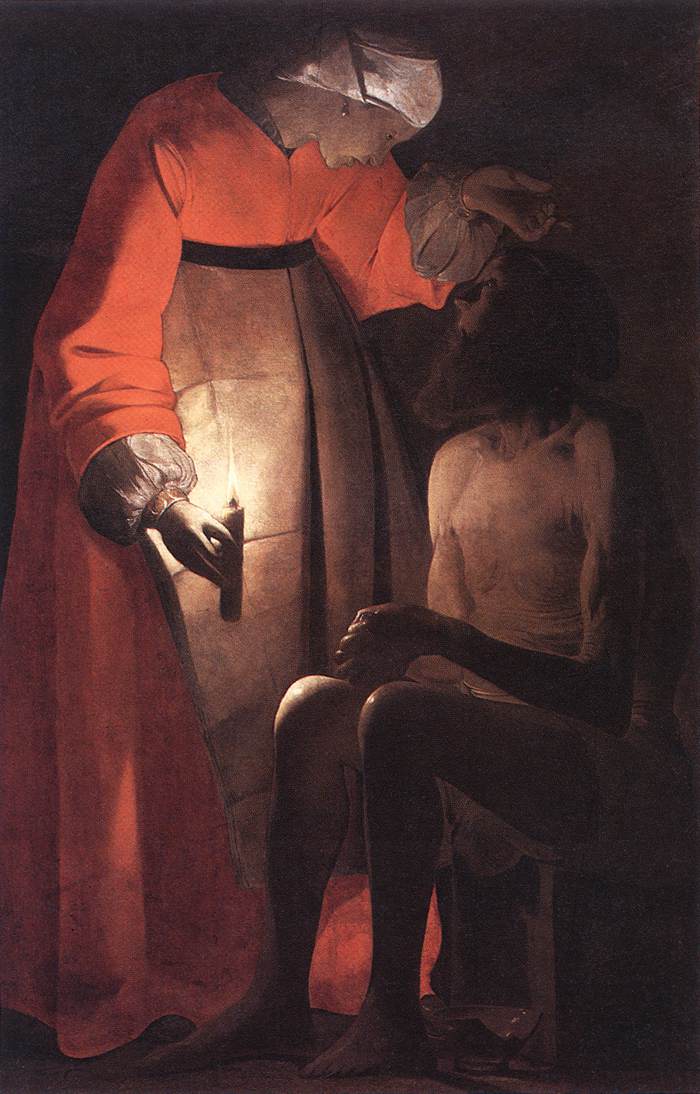
Job Mocked by his Wife is bought by the museum at Epinal as the work of an unidentified seventeenth-century Italian painter.19
Hermann Voss publishes his identification of La Tour as a distinct artistic personality, reclaiming works previously given to Dutch and Spanish painters.1812
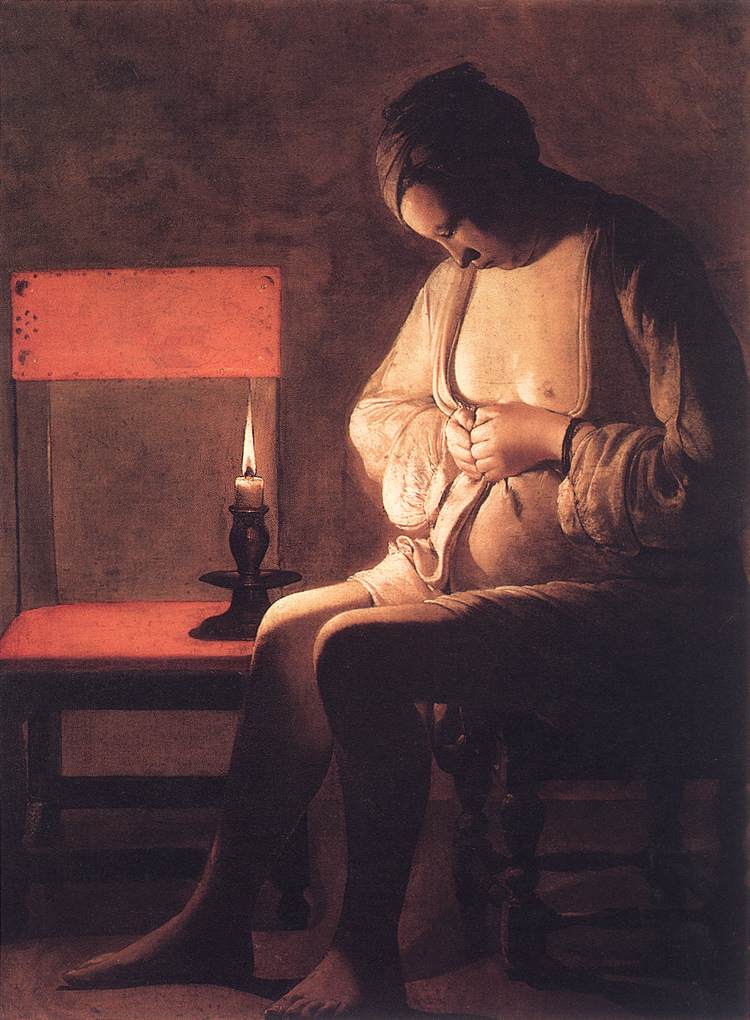
Woman Catching Fleas is bought in Orleans by General Dalbiez as a work by Gerrit van Honthorst.13
Job Mocked by his Wife is reattributed to La Tour at Epinal.19
Percy Moore Turner gives Saint Joseph the Carpenter to the Louvre in memory of Paul Jamot.7
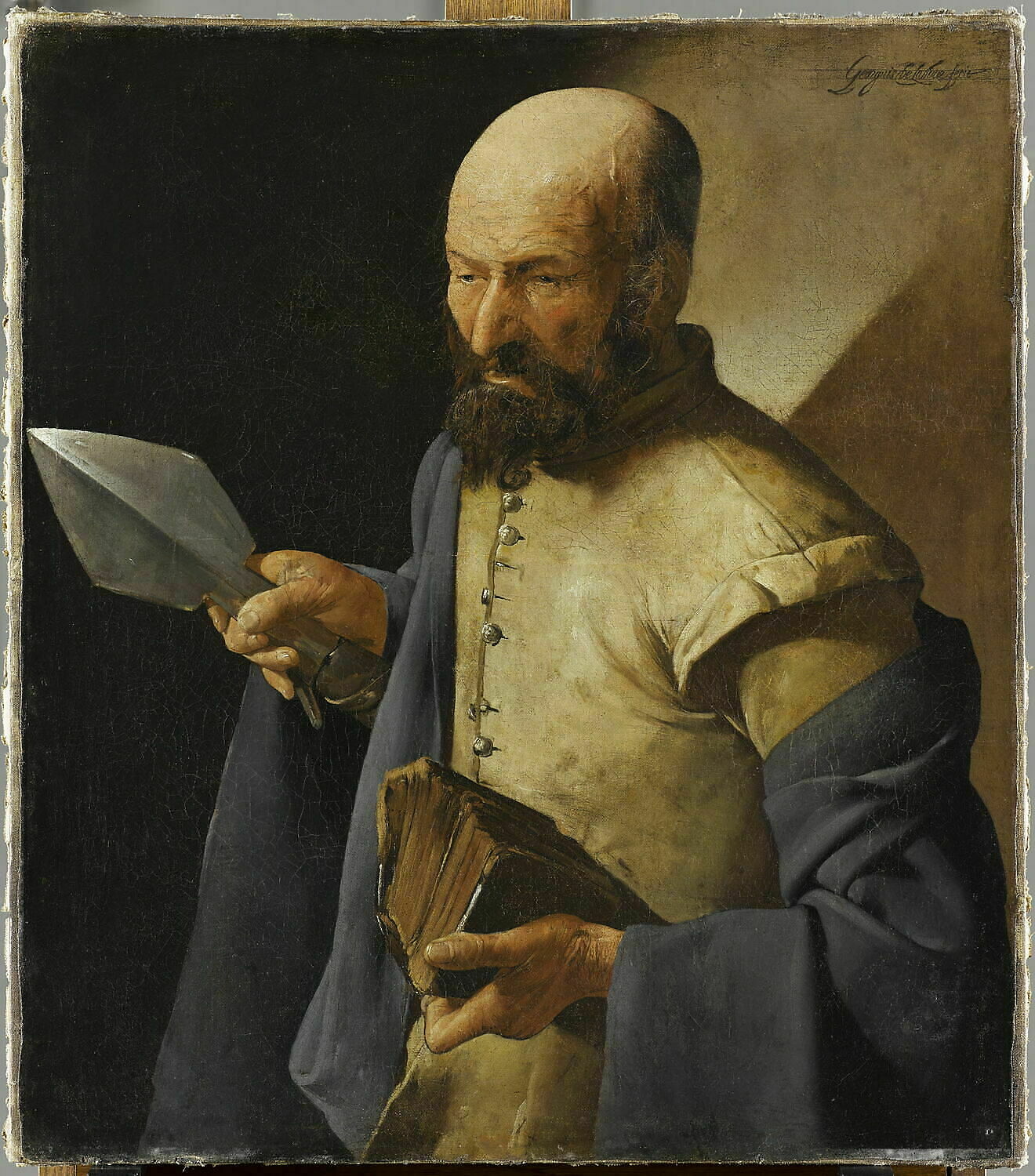
Madeleine Pre discovers the Louvre's Saint Thomas at the chateau de Gallerande in the Sarthe.9
Woman Catching Fleas is recognised as a La Tour and bought by public subscription for the Musee Lorrain, Nancy.13
The Louvre buys The Cheat with the Ace of Diamonds from the dealer Pierre Landry; the same year, restoration at Epinal uncovers La Tour's signature on Job Mocked by his Wife, confirming its 1922 reattribution.819
The National Gallery of Art, Washington, buys The Repentant Magdalen.4
The Los Angeles County Museum of Art receives The Magdalen with the Smoking Flame as a gift of the Ahmanson Foundation.5
The Kimbell Art Museum acquires The Cheat with the Ace of Clubs from the Belgian dealer Andree Stassart, out of the Pictet family collection of Geneva.10
The Louvre buys Saint Thomas by public subscription, with the Societe des Amis du Louvre and the legacy of Mme Granday-Prestel.9
The Kimbell Art Museum acquires Saint Sebastian Tended by Irene from the Nelson-Atkins Museum, Kansas City.11
A Saint James the Great from the Albi apostle series sells at Sotheby's New York for a reported USD 3,223,000, well above a USD 1.5-2 million estimate.16
A Girl Blowing on a Brazier sells at Lempertz, Cologne, for EUR 3.6 million hammer, EUR 4.3 million with fees, the highest price then paid for an Old Master at auction in Germany.14
A Saint Andrew from the same apostle series sells at Christie's London for a reported GBP 4.28 million including fees, a new auction record for the artist.15
Musee Jacquemart-Andre, Paris, mounts Georges de La Tour: entre ombre et lumiere (11 September 2025 - 25 January 2026), curated by Pierre Curie and Gail Feigenbaum, working from a corpus of 48 accepted paintings and arguing for a more commercial, studio-based reading of his workshop.12
Confirmed public auction sales of autograph La Tour paintings are rare enough that the sources consulted for this page turned up only three in the last two decades, each one reported individually in the trade press rather than tracked as part of a routine market. Two of the three are apostles from the largely-lost Albi series, resurfacing thirteen years apart; the third is a nocturne described at the time of sale as the only La Tour candlelit night scene left outside a museum. None of the three prices below should be read against each other as a trend line - there are too few data points and, for two of the three, the sources consulted do not separate the hammer price from the buyer's premium, which is recorded here as a gap rather than resolved by assumption.
| Date | Sale | Work | Result | Note |
|---|---|---|---|---|
| 24 January 2008 | Sotheby's, New York | Saint James the Great (from the Albi apostle series) | Hammer Not separately published in the sources consulted With premium Reported total USD 3,223,000 USD | Estimate USD 1.5-2 million; described in the trade press as a rediscovered work from the Albi series. |
| 8 December 2020 | Lempertz, Cologne | A Girl Blowing on a Brazier (La Fillette au braisier), 1646-1648 | Hammer EUR 3,600,000 With premium EUR 4,300,000 with fees EUR | Estimate EUR 3-4 million. Reported as the only La Tour candlelit nocturne then outside a museum collection and as unusually signed. Provenance traced to a 1975 Christie's London purchase by Hinrich Bischoff for GBP 17,850. Reported at the time as the most expensive Old Master painting sold at auction in Germany. |
| 8 July 2021 | Christie's, London | Saint Andrew (from the Albi apostle series), early 1620s, oil on canvas, 62 x 50.5 cm, lot 42 | Hammer Not separately published in the sources consulted With premium Reported total GBP 4,280,000 including fees GBP | Estimate GBP 4-6 million; a new auction record for the artist at the time. Described by dealer commentary as one of the last autograph La Tours remaining in private hands. |
Hammer is the price at which the bidding stopped; with premium adds the fee the house charges the buyer on top. Hammer price and buyer's premium in the glossary.
| Institution | City | Holdings | Note |
|---|---|---|---|
| Musee du Louvre | Paris | Saint Joseph the Carpenter (RF 1948 27); The Cheat with the Ace of Diamonds (RF 1972 8); Saint Thomas (RF 1988 15) | All three on display in the Georges de La Tour and the Le Nain brothers room, Aile Sully, second floor, as of the sources consulted. |
| The Metropolitan Museum of Art | New York | The Fortune-Teller (60.30); The Penitent Magdalen (1978.517) | See the linked object record for the Fortune-Teller's own authenticity dispute and export history. |
| National Gallery of Art | Washington, D.C. | The Repentant Magdalen (1974.52.1) | West Building, Main Floor, Gallery M37, as of the sources consulted. |
| Los Angeles County Museum of Art | Los Angeles | The Magdalen with the Smoking Flame (M.77.73) | Gift of the Ahmanson Foundation, 1977. |
| Kimbell Art Museum | Fort Worth | The Cheat with the Ace of Clubs; Saint Sebastian Tended by Irene (attributed, authorship disputed) | The museum's own site could not be reached directly for this page (see notes_for_editor); details drawn from the museum's own text as mirrored via Google Arts and Culture. |
| Musee des Beaux-Arts | Rennes | The New-born | In the city's collection since 1794. |
| Musee departemental d'art ancien et contemporain | Epinal | Job Mocked by his Wife | Bought 1829, reattributed to La Tour 1922, confirmed 1972. |
| Musee Lorrain | Nancy | Woman Catching Fleas | Bought by public subscription in 1955; property of the Societe d'histoire de la Lorraine et du Musee lorrain. |
| Musee Georges-de-La-Tour | Vic-sur-Seille | A museum dedicated to the artist in his birthplace | Named for the artist; its individual holdings were not catalogued for this page. |
La Tour was born at Vic-sur-Seille, the second of seven children of a baker, Jean de La Tour, and Sybille de La Tour, nee Molian.
La Tour was born at Vic-sur-Seille, the second of seven children of a baker, Jean de La Tour, and Sybille de La Tour, nee Molian. Nothing is documented about his training; he may have studied with the Nancy printmaker and painter Jacques Bellange, and his early work absorbs Caravaggism at second hand, through the Dutch Caravaggisti of Utrecht rather than through any documented trip to Italy. In 1617 he married Diane Le Nerf, daughter of a family connected to the ducal mint at Nancy, and in 1620 he set up his studio in her home town, Luneville, in the independent duchy of Lorraine.
He did not stay a provincial craftsman. In 1620 Luneville received him as a bourgeois of the town and the duke granted him letters of exemption carrying privileges normally reserved for the nobility. He worked for the dukes of Lorraine in 1623 and 1624, and in 1638 he was given the title of painter to the king of France, Louis XIII, while continuing to live and work in Luneville rather than at court.
The tax privileges bought him enemies, and the record of it survives in an unlikely place: a complaint preserved in the Luneville town archives, addressed by local citizens to the Duke of Lorraine...
The tax privileges bought him enemies, and the record of it survives in an unlikely place: a complaint preserved in the Luneville town archives, addressed by local citizens to the Duke of Lorraine, accusing La Tour of keeping a large pack of dogs and setting them to run hares across the farmers' fields, doing serious damage to the harvest. The period was one of famine and war for Lorraine's peasantry generally - the duchy was fought over and occupied through the Thirty Years War, and Luneville itself endured plague years in 1631, 1633 and 1636 - which sharpens the contrast the complaint documents, though the sources consulted for this page do not themselves connect La Tour to grain profiteering, and no such claim is made here.
This is not myth or later legend; it is an archival grievance against a specific, named, tax-exempt individual, and it belongs in any honest account of who La Tour was locally: not a struggling provincial painter but one of Luneville's wealthiest residents, and one whose wealth and privilege were resented while he was alive to be resented. The document has not been directly examined for this page and its precise date is not established in the sources consulted; that is recorded here as a gap rather than smoothed into a year.
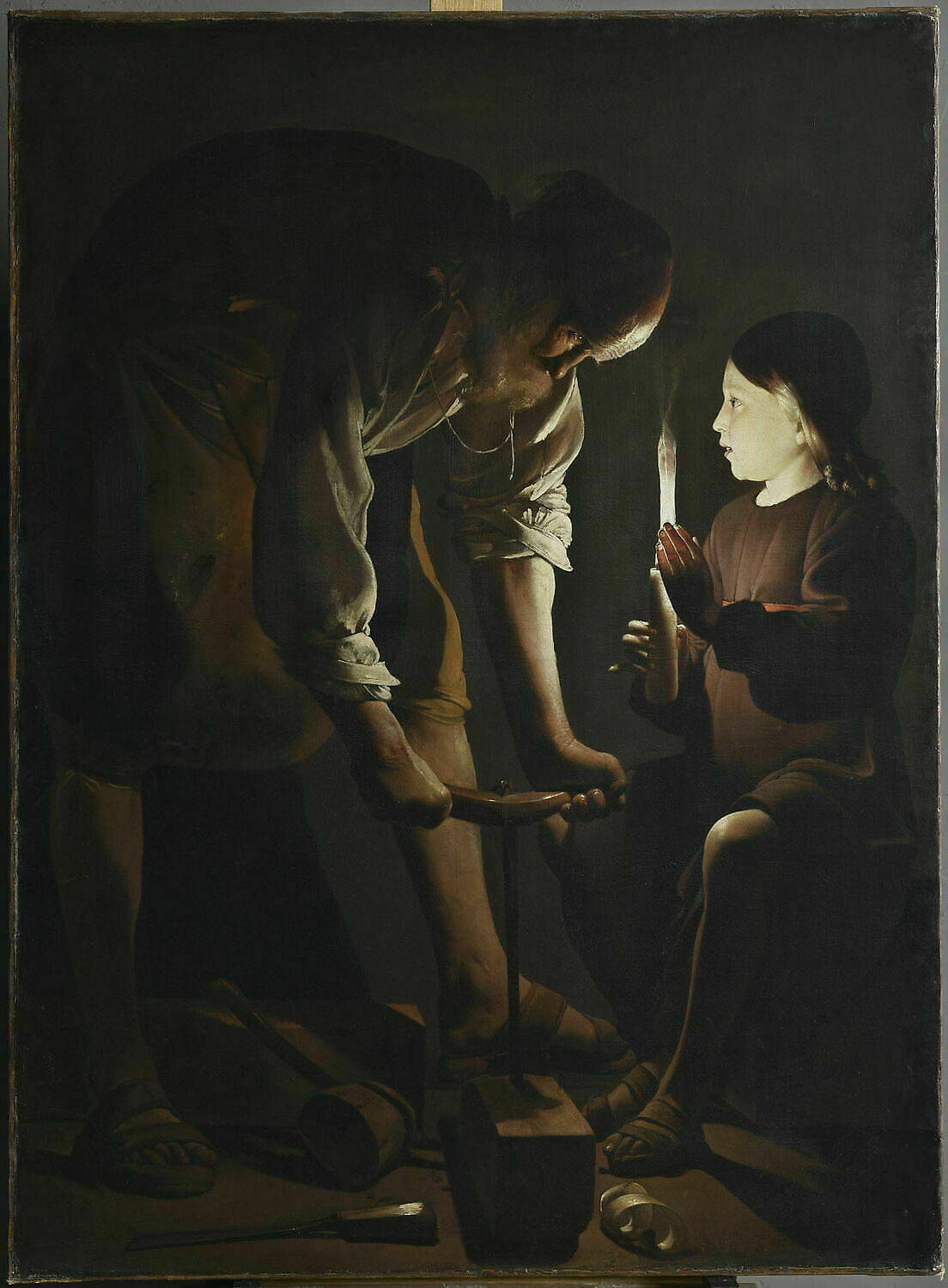
Saint Joseph the Carpenter, now in the Louvre, shows Joseph bent over his work by candlelight while the boy Christ holds the light and watches him.
Saint Joseph the Carpenter, now in the Louvre, shows Joseph bent over his work by candlelight while the boy Christ holds the light and watches him. The Louvre's own catalogue entry places the subject inside a documented current: Emile Male identified the revival of devotion to Saint Joseph, from 1932, as one of the important currents of the new Counter-Reformation spirituality, part of an ambition to reach ordinary hearts through everyday, comprehensible piety rather than doctrine. That is documented context for why a carpenter's workshop was a live devotional subject in the 1640s, not a claim about what La Tour personally believed.
A further, narrower claim is Henri Tribout de Morembert's 1973 hypothesis that the Louvre Saint Joseph was painted for the Carmelite friars of Metz around the time their convent was established in 1644 - a Carmelite commission, specifically argued by a named scholar, not established as fact and not universally accepted. Anthony Blunt went further still, proposing on stylistic grounds that La Tour made a trip to Italy around 1640 that would explain the picture's echoes of Caravaggio's Conversion of Saint Paul in Santa Maria del Popolo; no document attests any such journey, and Blunt's proposal remains exactly that, a proposal, weighed against Jacques Thuillier's preference for a Lorraine-only career.
La Tour's mature technique is diagnostic in ways that go beyond mood.
La Tour's mature technique is diagnostic in ways that go beyond mood. His night scenes construct the whole composition around a single interior light source, most often a candle, frequently held so that a hand or an object partly screens the flame from the viewer while still letting its light model every face in the scene - the device that gives Saint Joseph the Carpenter its two contrasts, the old man's wrinkles raked by grazing light against the child's smooth, luminous skin, and the father's powerful tool-gripping hand against the child's thin, near-transparent fingers.
The late work also simplifies. Pierre Rosenberg and Jacques Thuillier, writing on the Louvre Saint Joseph in 1972, described a picture that has given up the pleasures of colour entirely, a monochrome composition without even the relief of one cool accent, built from volumes drowned in a living shadow. That shift toward monochrome, geometric simplification and an increasingly brutal, unmodulated light is one of the few chronological anchors scholars agree on, even where they disagree by years about exactly when any single canvas was painted.
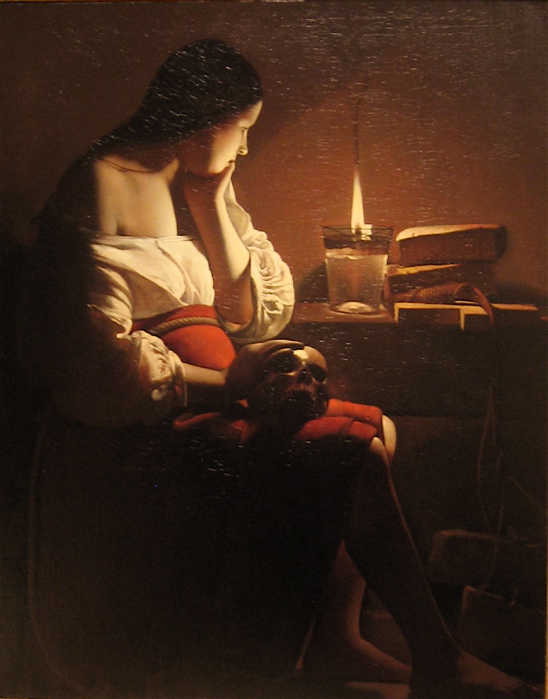
La Tour painted the penitent Magdalen repeatedly, and at least four autograph versions are now recognised in public collections: the Metropolitan Museum's Penitent Magdalen, the National Gallery of...
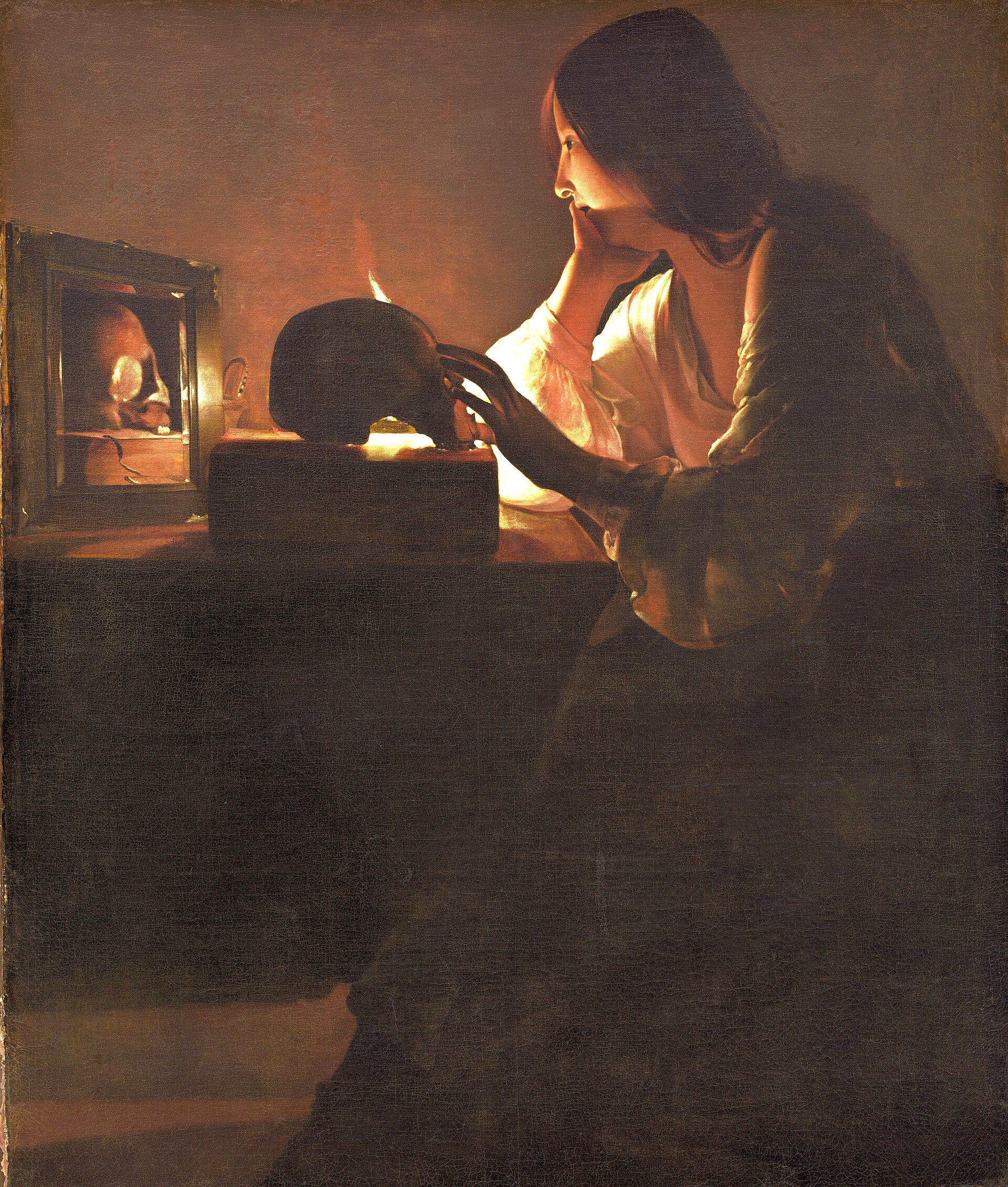
La Tour painted the penitent Magdalen repeatedly, and at least four autograph versions are now recognised in public collections: the Metropolitan Museum's Penitent Magdalen, the National Gallery of Art's Repentant Magdalen (Ailsa Mellon Bruce Fund, 1974, accession 1974.52.1), the Los Angeles County Museum of Art's Magdalen with the Smoking Flame (Gift of the Ahmanson Foundation, 1977, accession M.77.73), and the Louvre's Magdalene with the Two Flames. The Metropolitan Museum organised an exhibition in 1998 explicitly titled Conversion by Candlelight: The Four Magdalens, and the Los Angeles County Museum had already built one around the same group in 1993 and 1994 - proof that the multiplicity is not a modern cataloguing headache but a subject the museums themselves treat as the point.
The National Gallery's own version has a provenance that starts only in 1877, on the evidence of a dealer's stencil on the stretcher belonging to the Parisian restorers Etienne-Francois and Henri Haro; before that it is untraced. Distinguishing which Magdalen is which, and which flame, skull, mirror or scourge belongs to which canvas, is exactly the kind of version-safety problem this page exists to keep straight, and any caption that does not name the specific holding collection and accession number for a La Tour Magdalen should be treated as unreliable.
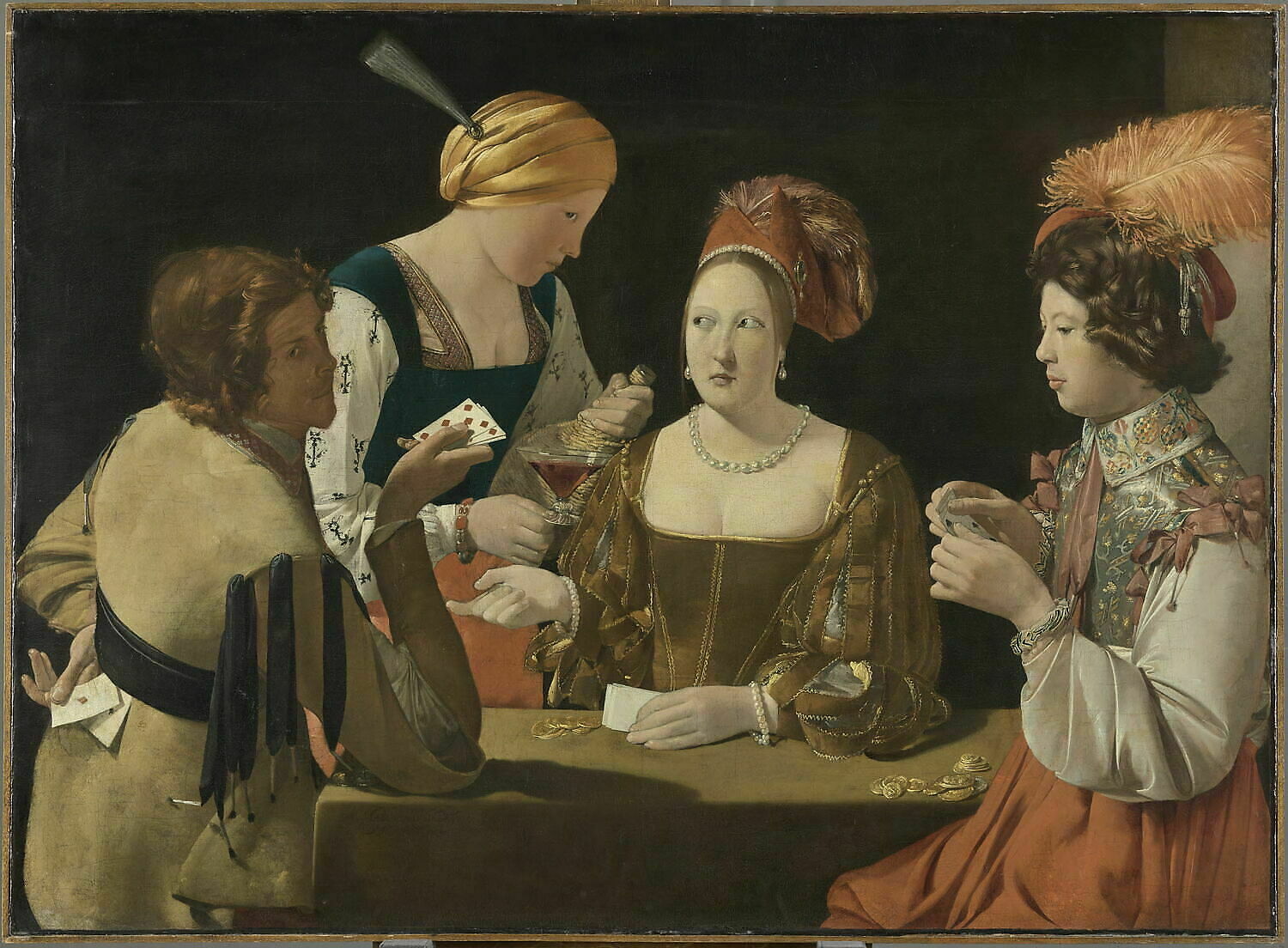
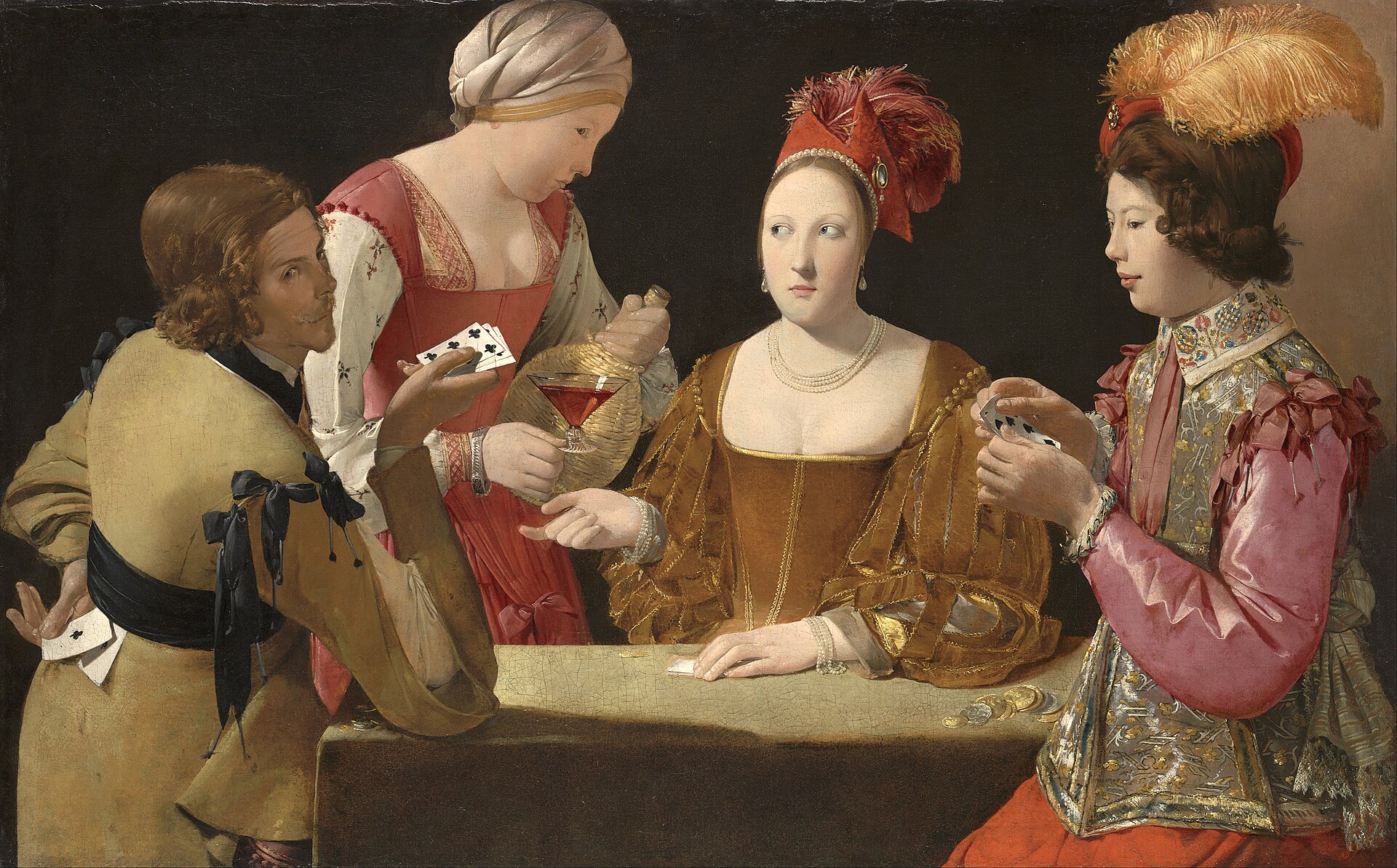
La Tour painted The Cheat at cards twice: The Cheat with the Ace of Diamonds, signed Georgius De La Tour fecit, in the Louvre (RF 1972 8, oil on canvas, 106 by 146 cm, bought from the dealer Pierre...
La Tour painted The Cheat at cards twice: The Cheat with the Ace of Diamonds, signed Georgius De La Tour fecit, in the Louvre (RF 1972 8, oil on canvas, 106 by 146 cm, bought from the dealer Pierre Landry in 1972 out of an untraced Paris collection first documented around 1926), and The Cheat with the Ace of Clubs at the Kimbell Art Museum in Fort Worth (oil on canvas, 97.8 by 156.2 cm, in the Pictet family of Geneva by tradition from around 1746 until 1981, when the Kimbell acquired it). The two pictures share a cast, a subject and a composition, and scholars have dated them anywhere from the 1620s to the early 1640s depending on which of them is read as the model for the other.
Radiography of the Louvre canvas resolved part of the argument physically rather than stylistically. Under the paint surface, the artist first repeated the exact pose of the kneeling maidservant from the Kimbell version before changing it, and pigment analysis showed her bodice was originally painted red, as in the Kimbell picture, before being repainted a dark blue-green (the analysis is credited to Rioux, 1993, in the Louvre's own catalogue entry). That sequence indicates the Louvre Cheat was painted after the Kimbell one, whatever the exact years attached to each. Pierre Rosenberg, writing in 1982, separated the two on grounds of handling as well: the searching, nervous touch of the Fort Worth picture recalls an early brawl scene in Malibu, while the broader technique, graver atmosphere and harsher light of the Louvre picture already anticipate the dated nocturnes of the mid-1640s. Anthony Blunt disagreed with placing either picture inside a normal stylistic development at all, and proposed instead that both belong to two hypothetical stays in the Netherlands around 1616 to 1625 - a minority position, not a consensus.
La Tour is credited with a series of thirteen half-length apostles and a Blessing Christ, of which the bulk of what can still be seen hangs in the Musee Toulouse-Lautrec at Albi as old copies after...
La Tour is credited with a series of thirteen half-length apostles and a Blessing Christ, of which the bulk of what can still be seen hangs in the Musee Toulouse-Lautrec at Albi as old copies after La Tour, not as autograph work. The autograph originals are rare enough that their reappearance is a market event: a Saint James the Great sold at Sotheby's New York on 24 January 2008, described in the trade press as a rediscovered work from the series, against a published estimate of USD 1.5 to 2 million, for a reported USD 3,223,000 - the sources consulted for this page do not separate that figure into hammer and premium. A Saint Andrew followed at Christie's London on 8 July 2021 (lot 42, oil on canvas, 62 by 50.5 cm, painted in the early 1620s), reported at a total of GBP 4.28 million including fees against an estimate of GBP 4 to 6 million; again, no source consulted separates hammer from premium for this sale, and that gap is recorded rather than guessed at. One dealer's account at the time described the picture as one of the very last La Tours left in private hands.
The distance between the Albi copies and these two autograph survivors is the plainest illustration on this page of how thin La Tour's surviving autograph corpus really is, set against how many derivative and workshop versions of his compositions exist.
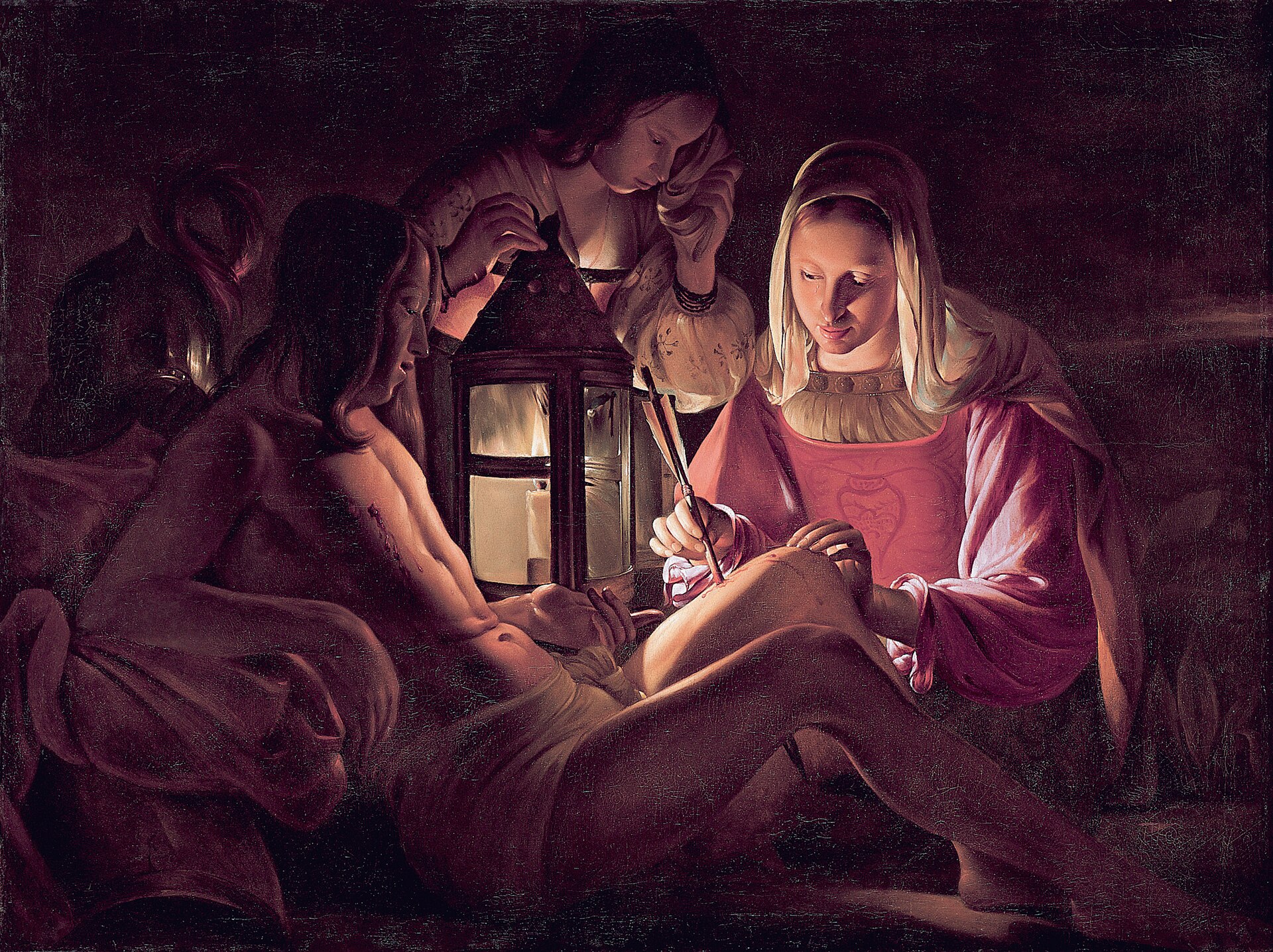
Saint Sebastian Tended by Irene was, by a wide margin, La Tour's most reproduced subject in his own century: more than ten versions in the horizontal format are known today, of widely varying quality...
Saint Sebastian Tended by Irene was, by a wide margin, La Tour's most reproduced subject in his own century: more than ten versions in the horizontal format are known today, of widely varying quality and condition, and La Tour is reported to have presented a version to Louis XIII, who is said to have admired it enough to have every other painting removed from his room, a story credited with spreading the composition further. The Kimbell Art Museum holds one version, attributed to La Tour but with authorship genuinely divided: most scholars now classify the Kimbell canvas as a copy, while others argue it may be an original, possibly the very picture given to Duke Charles IV of Lorraine. Its own provenance starts in a convent near Marseille before 1918, passes through the Amsterdam dealer Pieter de Boer in 1949 and the Nelson-Atkins Museum in Kansas City from 1954, and reaches the Kimbell in 1993.
The subject had a specific local resonance worth recording rather than assuming: Sebastian was venerated as protection against plague, and Lorraine spent much of La Tour's working life under exactly that threat. A saint invoked against epidemic disease, painted and copied across a duchy repeatedly struck by plague, is a documented function, not a speculative one - whoever painted this particular canvas.
La Tour's son Etienne (1621-1692) trained as his pupil and worked in his studio, and separating father from son in later or duplicate versions of a La Tour composition is difficult enough that, by...
La Tour's son Etienne (1621-1692) trained as his pupil and worked in his studio, and separating father from son in later or duplicate versions of a La Tour composition is difficult enough that, by convention, it is the first question asked of any contested picture rather than the last. The 2025-2026 exhibition at the Musee Jacquemart-Andre in Paris, curated by Pierre Curie and Gail Feigenbaum, argued for a still more commercial reading of the workshop: that numerous surviving copies should be reattributed to La Tour's own studio production rather than to independent later copyists, describing what the exhibition's own account called a near-commercial strategy on the studio's part, twenty years on from the previous Paris retrospective's more restrictive view of what the studio actually produced.
That reattribution has direct consequences for the corpus count below: a copy moved from anonymous imitator to studio production changes which number is correct, and by how much, without changing what is on the canvas.
After his death La Tour disappears from the written record almost completely until Hermann Voss identified him as a distinct artistic personality in a 1915 article, restoring to him a group of...
After his death La Tour disappears from the written record almost completely until Hermann Voss identified him as a distinct artistic personality in a 1915 article, restoring to him a group of pictures that had been circulating under the names of Dutch and Spanish painters, principally Zurbaran, Ribera and Velazquez. The disappearance was not a matter of a few misattributed canvases; it was total enough that individual works kept surfacing under wrong names for decades after 1915, not only before it.
The New-born, now in the Musee des Beaux-Arts de Rennes, entered that museum's collection in 1794 through the revolutionary seizure of an emigre's property; its owner before the seizure is unknown, and it was catalogued first as a work by the Dutch painter Godfried Schalken and later as a Le Nain before Voss's rediscovery allowed it to be given to La Tour. Job Mocked by his Wife, now in the Musee departemental d'art ancien et contemporain at Epinal, was bought by that museum in 1829 as the work of an unidentified seventeenth-century Italian painter; it was not reattributed to La Tour until 1922, and that reattribution was only confirmed in 1972, when a restoration uncovered the artist's signature under later overpaint. Woman Catching Fleas, now in the Musee Lorrain at Nancy, was bought in the 1920s by a General Dalbiez in Orleans as a work by the Dutch Caravaggist Gerrit van Honthorst; only in 1955, when his heirs consulted the curator of the Rennes museum about the damaged canvas, was it recognised as a La Tour and bought by public subscription for the Musee Lorrain, where it remains the property of the Societe d'histoire de la Lorraine.
Three separate provincial French museums, three separate wrong attributions - Schalken, an unidentified Italian, Honthorst - two of them corrected only decades after Voss had already done the work of putting the artist back together. The rediscovery of the man and the recovery of the individual pictures were not the same event, and the second one took most of a century longer than the first.
La Tour died at Luneville on 30 January 1652, in a dysentery epidemic that struck the town that winter; his wife Diane and a servant are recorded as dying of the same illness within days of him.
La Tour died at Luneville on 30 January 1652, in a dysentery epidemic that struck the town that winter; his wife Diane and a servant are recorded as dying of the same illness within days of him. No formal authenticating committee rules on his corpus today - there is no equivalent of a closed foundation board - and the accepted count has instead moved with each major exhibition and each generation's re-reading of the workshop question. The Musee Lorrain's own published account of its Woman Catching Fleas describes a corpus of 46 accepted paintings; a dealer's account tied to the 2021 Christie's sale put the figure at 47 works remaining, worldwide, including those in private hands; the Musee Jacquemart-Andre exhibition that closed in January 2026 worked from a figure of 48, several of them newly reassigned from independent copyist to La Tour's own studio rather than newly discovered outright. None of these three figures is wrong in the sense of being fabricated; they are simply not the same count, taken within five years of each other, which is the most honest single fact this page can offer about how settled the La Tour corpus actually is.
The standard reference catalogue remains Pierre Rosenberg and Marina Mojana's Georges de La Tour: catalogue complet des peintures (Bordas, Paris, 1992), itself building on Jacques Thuillier's earlier Tout l'oeuvre peint de Georges de La Tour (Flammarion, Paris, 1973). Both are cited repeatedly in the Louvre's own online catalogue entries for its three La Tour paintings, which treats them as the working standard even though neither functions as a closed, final authority the way a single-artist foundation board would.
Painter. 1593-1652.
Born 13 March 1593, Vic-sur-Seille, in the diocese of Metz, on the border of the independent duchy of Lorraine; died 30 January 1652, Luneville, duchy of Lorraine.
Musee du Louvre (Paris); The Metropolitan Museum of Art (New York); National Gallery of Art (Washington, D.C.); Los Angeles County Museum of Art (Los Angeles); Kimbell Art Museum (Fort Worth); Musee des Beaux-Arts (Rennes).
Confirmed public auction sales of autograph La Tour paintings are rare enough that the sources consulted for this page turned up only three in the last two decades, each one reported individually in the trade press rather than tracked as part of a routine market. Two of the three are apostles from the largely-lost Albi series, resurfacing thirteen years apart; the third is a nocturne described at the time of sale as the only La Tour candlelit night scene left outside a museum.
What was La Tour's actual training, and did he ever travel to Italy? No document attests either; Blunt's proposed Italian journey around 1640 is a stylistic hypothesis, not a documented fact, and Thuillier's Lorraine-only alternative is equally unproved.
Across 1,322 provenance events in this archive nineteen name a woman, and four of those give her no personal name at all.
11 min read
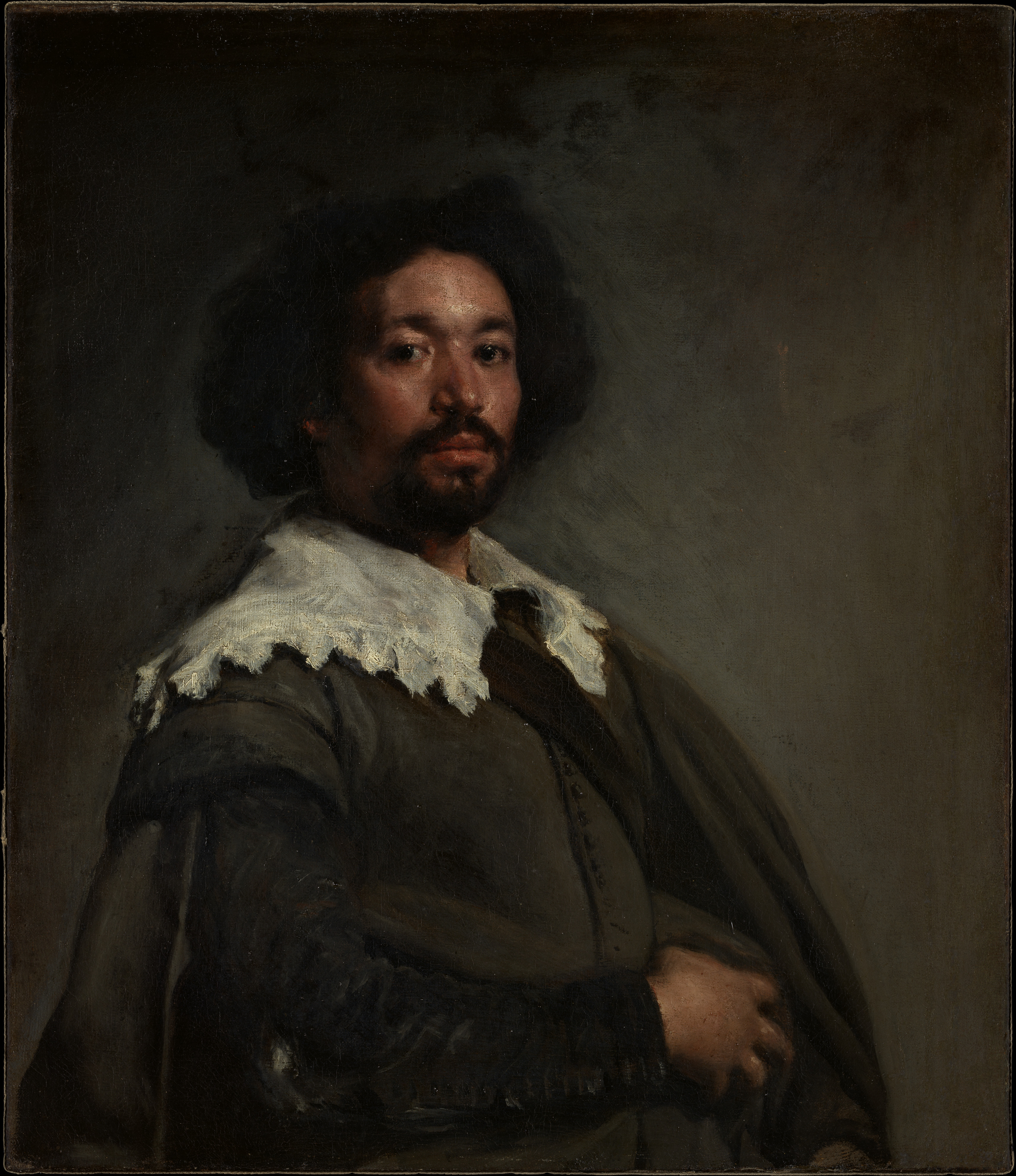
Of 187 auction results in this archive, 106 state a currency and they use sixteen different descriptions of it.
11 min read
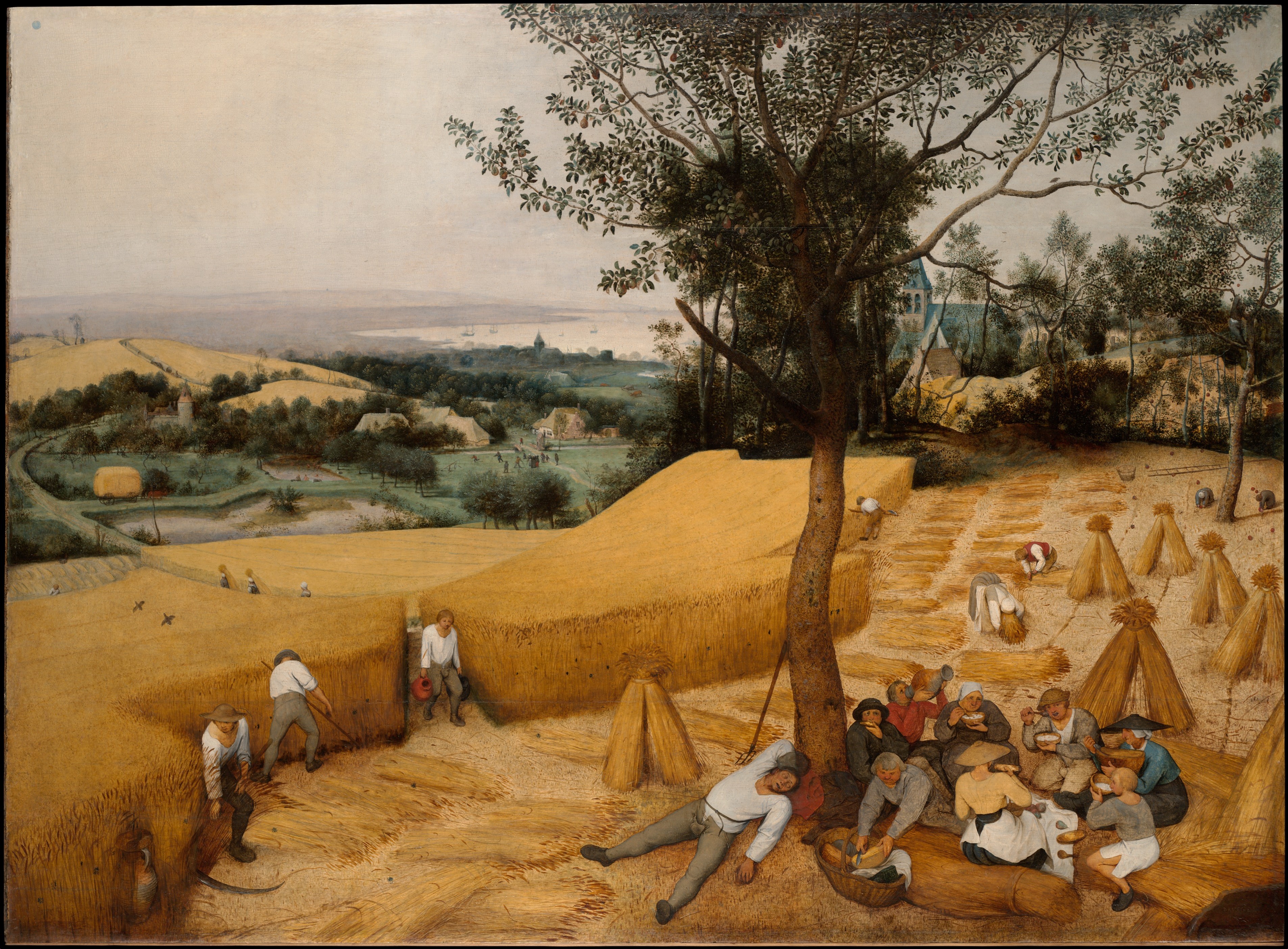
Thirty-two objects in this archive were bought on the income of six named endowment funds, and in every case the person named had...
10 min read
Last verified 17 September 2026
One artwork and its story every Tuesday, with the picture: who owned it, what it made, and what closes soon in the exhibition calendar. No promotion, and nothing we cannot cite.
We send one email to confirm the address and keep nothing else. Every letter carries a one-click unsubscribe. How we handle your data.