The Fortune-Teller
Georges de La Tour · Probably 1630s
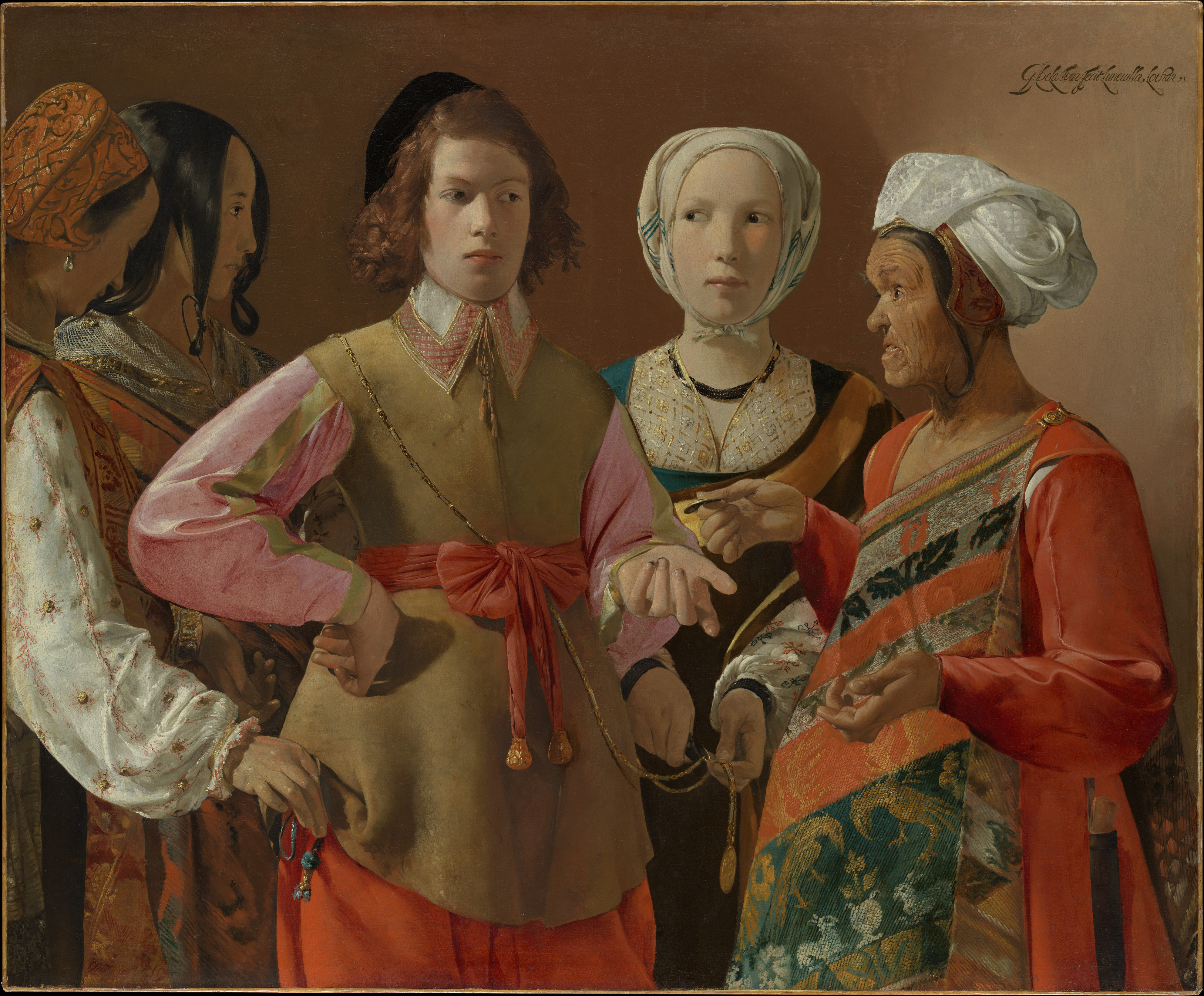
The record subject. Oil on canvas, 101.9 x 123.5 cm, probably 1630s, signed at upper right for Luneville in Lorraine. The Metropolitan Museum of Art, 60.30, published by the museum as open access.
| Artist | Georges de La Tour |
|---|---|
| Date | Probably 1630s |
| Medium | Oil on canvas |
| Dimensions | 101.9 x 123.5 cm (40 1/8 x 48 5/8 in.) |
| Where it is now | The Metropolitan Museum of Art, New Yorklast confirmed 4 August 2026 |
| Inventory number | 60.30 |
| Attribution | AcceptedSigned and accepted, but the subject of the most public authenticity fight of the twentieth-century old master market. Full note |
| Object type | Painting |
| Period | French, seventeenth century |
| Cases | Rediscovered |
| Inscriptions | Signed and inscribed at upper right: G. de La Tour Fecit Luneuilla Lothar: (Luneville, Lorraine). On the young man's watch chain: AMOR and FIDES. |
| Owners on record | 8 links6 documented, 2 disputed |
| Sources | 4 cited |
About this record Last verified 8 September 2026 · 4 sources cited · Change log
On this page 10 sections
ContentsClose
Five figures, one dupe, and a picture that has been fought over twice. A rich young man has his palm read by an old woman while three younger ones cut his purse and lift the medal from his chain. It is signed at the upper right with the painter's name and his town, Luneville in Lorraine, and it carries the words AMOR and FIDES on the victim's watch chain.
It surfaced in a chateau in the Sarthe after the Second World War, was bought in 1949 by Georges Wildenstein for 7,500,000 francs over the head of the Louvre, and left France for New York in 1960. How it left became a matter for the National Assembly, where Andre Malraux had to account for it; the export licence had been signed by Germain Bazin, the Louvre's own head of old master paintings. Twenty years later Christopher Wright and Diana de Marly declared it a modern forgery in the Connoisseur, CBS put the charge on television, and the Met answered with pigments, x-rays and a French probate inventory of 1879.
Provenance
Each link is graded. Documented: a cited source supports it. Disputed: the identification is argued but not established. Unknown: no owner for that span, and the gap is not smoothed into a narrative. The grades in the glossary.
- before 1650 - 1650Jean-Baptiste de Bretagne, Parisdisputed
The Met records this link with a question mark. Bretagne's posthumous inventory of 1650 lists at no. 14 a large picture on canvas with a gilt flat frame representing fortune tellers, an original by La Tour, valued at 30 livres. Jacques Thuillier proposed in 1992 that the present work is that picture. The valuation was among the highest in an inventory that contained five La Tours, which is itself evidence about how the painter was regarded in Paris in the year of his death.1
- before 1802 - 1802The last marquis de Scepeaux, chateau de Moulin Vieux, Asnieres sur Vegre, Sarthedisputed
Also carried with a question mark by the Met. In 1802 the entire chateau was sold or given fully furnished to the Lemonnier de Loriere family, and the Met's catalogue entry notes it is possible the La Tour was already in the house when it changed hands. Nothing separates the picture from the furniture in that transaction, which is precisely why the link cannot be graded documented.1
- by 1879 - 1879Edouard Lemonnier de Loriere, chateau de Moulin Vieux, Asnieres sur Vegre, Sarthedocumented
His posthumous inventory of 1879 lists a large picture signed G. de La Tour representing the Bonaventure, valued at two hundred and fifty francs. This inventory is the single most consequential document attached to the painting: Pierre Rosenberg produced it in the Burlington Magazine in August 1981 as conclusive proof that the picture is not a modern forgery, on the ground that no nineteenth-century forger would have painted a false La Tour when La Tour had no market and almost no reputation.1
- 1879 - 1921Madame de Gastines, chateau de la Denisiere, near Coulans, Sarthedocumented
Daughter of Edouard Lemonnier de Loriere. The picture moves from one Sarthe chateau to another within the family.1
- 1921 - 1948General Jacques de Gastines, La Vagotiere, Degre, Sarthedocumented
Her son. Benedict Nicolson wrote to Everett Fahy in May 1971 that he had interviewed Dom de Laborde, a monk of the abbey of Solesmes in the Sarthe, who could account for the painting's whereabouts as far back as the nineteenth century. Solesmes is about twenty kilometres from Asnieres sur Vegre; local memory, in this case, is a provenance instrument.1
- 1948 - 1949The heirs of General de Gastinesdocumented
Sold to Wildenstein for 7,500,000 francs. The Louvre had opened negotiations to buy the picture after a priest identified it, and was outbid. This is a private treaty sale and no hammer price exists for it.13
- 1949 - 1960Wildenstein, Paris and New Yorkdocumented
Eleven years in dealer's stock. Charles Sterling noted in 1951 that the owner did not wish the picture to be published just yet, which is a dealer holding a discovery back. Daniel Wildenstein's own memoir with Yves Stavrides, Marchands d'art (Paris, 1999, pp. 152-62), sets out the politics behind the purchase, the sale, the export and what he calls the defamation of the picture.1
- 1960 - presentThe Metropolitan Museum of Art, New Yorkdocumented
Rogers Fund, accession 60.30. The price has not been published; contemporary reporting described a very high sum. Art News announced it in the summer of 1960 under the headline Spectacular Buy for the Metropolitan, and Weltkunst reported a storm of indignation over the acquisition in July of the same year.123
Prices realised
This painting has never been sold at public auction. Every figure attached to it comes from an inventory or a private treaty sale, and none of them is a hammer price. The recorded numbers are: 30 livres, the valuation in Jean-Baptiste de Bretagne's posthumous inventory of 1650; 250 francs, the valuation in Edouard Lemonnier de Loriere's posthumous inventory of 1879; 7,500,000 francs, the price paid by Georges Wildenstein to the de Gastines heirs in 1949, which outbid the Louvre; and an undisclosed sum paid by the Metropolitan Museum in 1960. Because there is no auction there is also no premium question, and any database entry offering a hammer figure for this picture is reporting something that never happened.
Technical evidence
| Attribution note | Signed and accepted, but the subject of the most public authenticity fight of the twentieth-century old master market. Diana de Marly questioned it in the Burlington Magazine in 1970 on costume grounds; Christopher Wright and de Marly published a frontal attack in the Connoisseur in September 1980 under the title Fake?, arguing among other things that the word MERDE was hidden in the embroidery and that the young man's face was a woman's of about 1940. John Pope-Hennessy, John Brealey and Pieter Meyers, Pierre Rosenberg, Philippe de Montebello and Anthony Blunt all rejected the claim between 1980 and 1982, on pigment analysis, x-radiography and the survival of an 1879 French inventory naming a signed La Tour Bonaventure. Blunt wrote in November 1982 that the matter was definitely settled in the picture's favour. |
|---|---|
| Support | Canvas. The left edge has been trimmed and a strip of about 6 cm has been added at the top, above the signature. Nicolson and Wright reported in 1974 that the canvas had originally been folded over at the top by about 5 cm.1 |
| Medium | Oil on canvas.12 |
| Dimensions | 101.9 x 123.5 cm (40 1/8 x 48 5/8 in.), in the present altered format.12 |
| Signature | Signed and inscribed at upper right: G. de La Tour Fecit Luneuilla Lothar:, naming Luneville in Lorraine.1 |
| Inscriptions in the image | AMOR and FIDES appear on the young man's watch chain, the object being stolen from him as the words are read.1 |
| Scientific examination | John Brealey and Pieter Meyers published pigment analysis and an x-radiograph in the Burlington Magazine in July 1981, concluding that the work is of considerable age and refuting the forgery claim.1 |
| The graffito | The word MERDE, alleged by Wright and de Marly in 1980 to be inscribed on the collar of the left-hand figure. Philippe de Montebello stated in 1982 that it is the work of a mischievous restorer who joined up several original decorative brushstrokes after isolating the original paint under varnish.1 |
| Open access | The Metropolitan Museum publishes the primary photograph of this painting as open access under CC0, verified against the museum's own isPublicDomain flag at fetch time.2 |
Images
The record in full
Chapter 1What is happening in the picture
Oil on canvas, 101.9 by 123.5 centimetres.
Oil on canvas, 101.9 by 123.5 centimetres. Five three-quarter-length figures crowd the whole width of the frame with almost no space behind them. A young man in a slashed doublet and a broad collar holds out a coin to an old woman who is reading his palm and telling him his fortune. While he looks at her, the three younger women around him work: one cuts the purse strings, one takes the medal from the chain across his chest, one watches the door.
La Tour has made the theft legible and the victim's face oblivious, and he has given the young man's watch chain two words in gold: AMOR and FIDES, love and faith. They are being lifted off him as they are read.
The picture is a daylight subject, not one of the candlelit night scenes La Tour is best known for. That is part of why it took the twentieth century so long to place it in his work, and part of why it was attacked when it was.
Chapter 2The signature is a place, and the place is a date
At the upper right the canvas is signed G.
At the upper right the canvas is signed G. de La Tour Fecit Luneuilla Lothar. That is: made by G. de La Tour at Luneville in Lorraine. La Tour set up his studio in Luneville in 1620 and died there in 1652, and the inscription is the only one of its kind in his surviving work that names the town in that form.
Francois-Georges Pariset, publishing the picture in the Metropolitan Museum of Art Bulletin in March 1961, built a date on that inscription. He argued the picture must precede 1633, the year the duchy of Lorraine came under French domination, on the ground that La Tour would not have advertised himself as a Luneville artist of Lorraine after that. He read the signature as a kind of shop sign put out soon after the studio opened. Benedict Nicolson and Christopher Wright reached the same conclusion from the other end in 1974: that La Tour was unlikely to boast of being a Luneville artist once he was established there, and dated the picture about 1620 to 1621.
The Met's own catalogue entry now says it has been variously dated between 1620 and 1639 and is most likely from the 1630s. The signature is therefore evidence that everybody agrees on and nobody can convert into a year.
Chapter 3A prisoner of war, a monograph and a priest
The picture has no recorded modern discovery in a saleroom.
The picture has no recorded modern discovery in a saleroom. The account that circulates, and that the Met's own literature does not contradict, is that a French prisoner of war saw La Tour's work reproduced in a monograph, recognised the resemblance to a picture hanging in a relative's chateau, and that a priest who knew what he was looking at identified it and told the Louvre.
Hermann Voss had only rediscovered La Tour as an artistic personality in 1915. A painter who had been effectively invisible for two and a half centuries acquired a literature within one generation, and the literature is what allowed a soldier to recognise a picture on a wall. That sequence matters for the forgery argument that followed: the picture emerged in the narrow window between La Tour becoming identifiable and La Tour becoming expensive.
Vitale Bloch put the first note into print in his 1950 book on La Tour, recording that there was a Waarzegster, a fortune teller, in France, and suggesting it was the pendant to the Cheat now in the Louvre. Charles Sterling, reviewing him in 1951, added the detail that gives the game away about who then controlled it: the owner did not wish the picture to be published just yet.
Chapter 4The Louvre was outbid
The Louvre entered negotiations to buy the painting from the de Gastines heirs.
The Louvre entered negotiations to buy the painting from the de Gastines heirs. Georges Wildenstein outbid the museum and bought it in 1949 for 7,500,000 francs.
That is the whole of the French grievance in one sentence, and it is worth stating plainly because the subsequent scandal is usually told as though the picture were smuggled. It was not taken from a museum. It was bought in open competition from a private family by a dealer with more money than the national museum, in a country still rebuilding, and it then sat in his stock for eleven years.
Chapter 5How it left France, and who signed
In 1960 the Metropolitan Museum bought it from Wildenstein for a sum that has never been published.
In 1960 the Metropolitan Museum bought it from Wildenstein for a sum that has never been published. The French press treated the export as a scandal. Andre Malraux, then Minister of Culture, had to explain to the National Assembly why the picture had not ended up in the Louvre.
The answer, when it emerged, was awkward. The export licence had been signed by Germain Bazin, the head of old master paintings at the Louvre itself. Christopher Wright, who twenty years later would argue the picture was a fake, speculated that Bazin had enough doubt about it not to want it for his own museum. That speculation is Wright's, it is unproved, and it is recorded here as his rather than as a finding.
The contemporary paper trail is thick and easy to check. Art News announced the purchase in the summer of 1960 as a spectacular buy for the Metropolitan. Weltkunst reported in July 1960 on a storm of indignation over the museum's new acquisition. Connaissance des arts ran a piece in August 1960 on the exile of works of art, following up an article of the previous February. Three trade journals in three languages, all within three months.
Chapter 6The costume attack, 1970
Diana de Marly opened the authenticity case in the Burlington Magazine in June 1970.
Diana de Marly opened the authenticity case in the Burlington Magazine in June 1970. Her argument was specialist and, on its face, strong: the costume details in the Fortune-Teller are completely at variance with the dress of the 1620s, she wrote, and she listed anachronisms. Her conclusion was that the picture was unlikely to have been executed by La Tour at any time in his career.
The Met's response was to bring in other costume specialists rather than to argue style. Donald King replied in the Burlington in October 1970 that the old woman's patterned mantle was technically unexceptionable and rendered so accurately that the painter must have studied the actual textile. Emma Mellencamp published a refutation in 1971 arguing that the costumes are demonstrably consistent with the art of the period. Stella Blum, head of the Met's own Costume Institute, later demonstrated that many of the details de Marly criticised appear in other, unquestioned La Tours.
The costume argument is a good illustration of a general rule in attribution disputes: an expert in one discipline can produce a devastating objection inside their field which turns out, when other people in the same field are asked, not to be the consensus of that field at all.
Chapter 7Fake?, 1980, and the word in the embroidery
In September 1980 Christopher Wright and Diana de Marly published Fake?
In September 1980 Christopher Wright and Diana de Marly published Fake? in the Connoisseur, with the picture in colour on the cover. They argued the picture was psychologically weak, unlike La Tour's other work, that the signature was suspect, that the details of costume were wrong, and that the face of the young man was in fact a woman's face of about 1940.
Their single most quotable point was that the word MERDE had been painted into the collar of the figure on the left. A vulgarity concealed in the embroidery of a seventeenth-century picture is not the sort of claim that stays inside a specialist journal, and it did not. CBS took it to television.
The rebuttals came from several directions at once. John Pope-Hennessy disputed the whole thesis in Apollo in November 1980. John Brealey and Pieter Meyers published the technical case in the Burlington in July 1981, with colour plates and an x-radiograph, stating that scientific examination and pigment tests convincingly demonstrated the work to be of considerable age. Philippe de Montebello, the Met's director, wrote a piece in the Connoisseur in June 1982 headed Where 60 Minutes Erred, in which he said he had no doubt the picture is autograph and offered a specific account of the graffito: a mischievous restorer, having isolated the original paint under a layer of varnish, had joined up several original decorative brushstrokes. Richard Spear wrote privately in March 1982 that the CBS coverage was irresponsible and misleading and listed its disregard for available evidence. Brian Sewell, in the Burlington in September 1981, remained unconvinced by the technical evidence, and Wright returned to the charge in the Connoisseur in November 1982.
Chapter 8The document that ended it
What settled the argument was not a pigment.
What settled the argument was not a pigment. It was a French probate inventory.
Pierre Rosenberg published in the Burlington Magazine in August 1981 the 1879 posthumous inventory of Edouard Lemonnier de Loriere, which lists a large picture signed G. de La Tour representing the Bonaventure, valued at two hundred and fifty francs. His argument was short. It is inconceivable, he wrote, that a forger could have painted a false La Tour in the nineteenth century. In 1879 Georges de La Tour was a name almost nobody knew; Hermann Voss would not reassemble the artist for another thirty-six years. There was no market to forge into.
Anthony Blunt, reviewing the literature of the previous ten years in the Burlington in November 1982, wrote that the controversy seemed definitely settled in the picture's favour by three things: the 1879 inventory, the museum's technical evidence, and the hanging of the picture next to the Cheat with the Ace of Clubs at the Grand Palais, which he said proved beyond doubt that the two are by the same hand.
The chain of documents that saved the attribution is the same chain that this record grades as provenance. That is the argument for keeping provenance properly, made by the object itself.
Chapter 9The canvas was cut, and it has been added to
The picture is not the shape La Tour left it.
The picture is not the shape La Tour left it. The left side of the canvas has been trimmed, and a strip roughly 6 centimetres deep has been added at the top, above the signature. Nicolson and Wright reported in 1974 that the canvas had originally been folded over at the top by some five centimetres and that the balance of the composition has been upset by the loss of a strip along the left-hand side. Daniel Wildenstein's memoir states that it was cut at the left so that it would fit its frame.
That last detail is the ordinary, unglamorous way pictures are damaged: not by war or theft but by a frame that was the wrong size and a household that preferred to alter the painting. It also bears directly on the pendant question, because the picture's original proportions would have been closer to those of the two Cheats.
Chapter 10The pendant question
La Tour painted the same moral situation twice more, in the Cheat with the Ace of Diamonds now in the Louvre and the Cheat with the Ace of Clubs now in the Kimbell Art Museum in Fort Worth.
La Tour painted the same moral situation twice more, in the Cheat with the Ace of Diamonds now in the Louvre and the Cheat with the Ace of Clubs now in the Kimbell Art Museum in Fort Worth. A young man is fleeced at cards in both. The proposal that the Fortune-Teller was conceived as a pendant to one of them has been made repeatedly, first by Bloch in 1950.
The evidence is inconclusive and the objections are precise. Wolfgang Prohaska pointed out in 1987 that the Cheat with the Ace of Diamonds and the Fortune-Teller are signed differently, and considered them an unlikely pair; he added that if the Kimbell picture seems the closer match it may only be because the two had recently been restored by the same hand. Hugh Brigstocke reported in 1982 that John Brealey found the technique of the Louvre Cheat identical to that of the Fort Worth version and of this picture.
Restoration history contaminating a stylistic judgement is a hazard that applies to a great many pendant claims and is almost never stated as openly as Prohaska stated it here.
Chapter 11Who the women are, and what the picture is doing
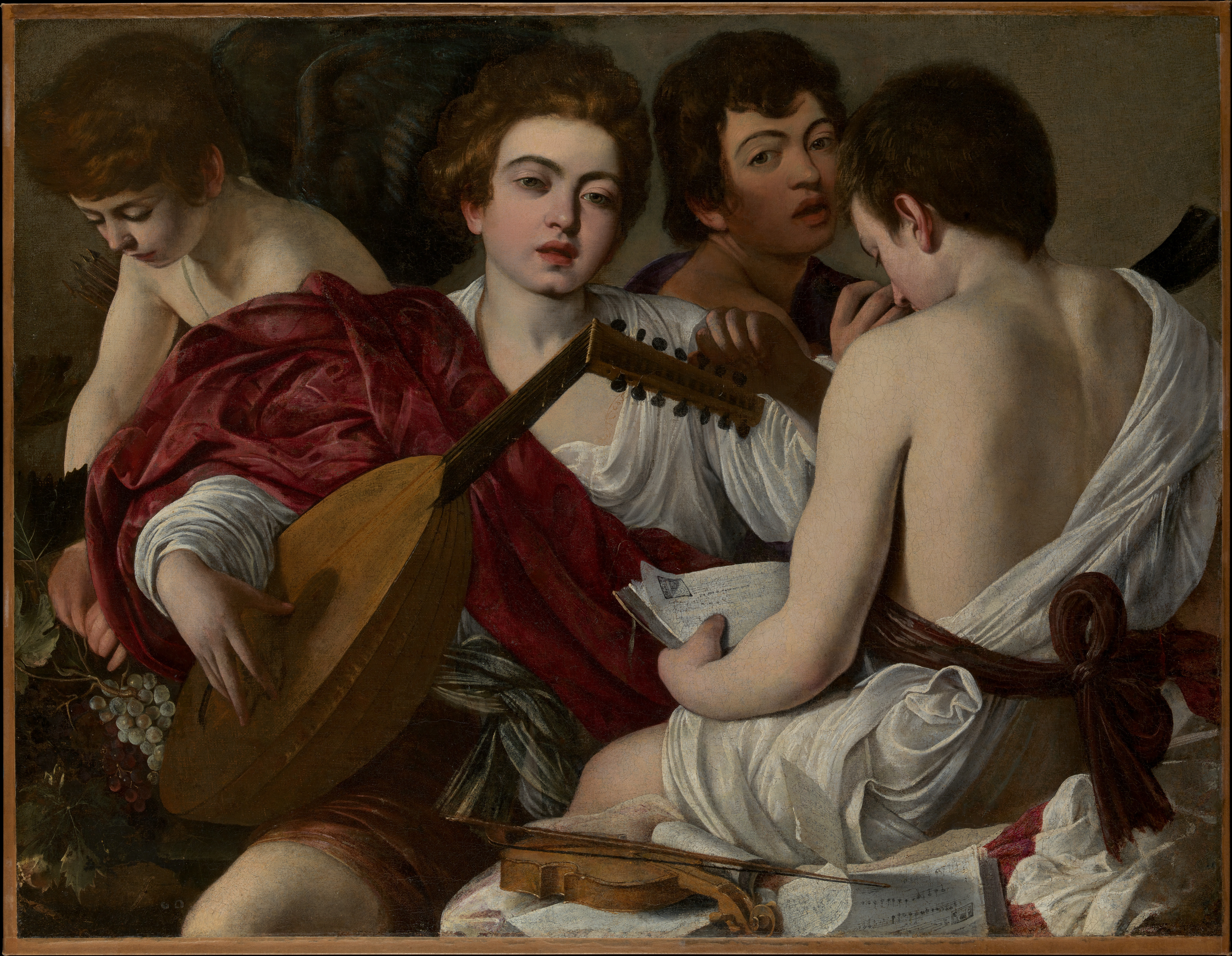
The subject was common across sixteenth and seventeenth-century Europe and Caravaggio made it famous in this half-length format; two of his versions survive, in the Pinacoteca Capitolina in Rome and...
The subject was common across sixteenth and seventeenth-century Europe and Caravaggio made it famous in this half-length format; two of his versions survive, in the Pinacoteca Capitolina in Rome and the Louvre. La Tour's composition, however, comes out of prints rather than out of Caravaggio. Pariset identified the woman on the right as derived from an etching by Jacques de Bellange and the old woman from an engraving by Jasper de Isaac, and Edward Sullivan later compared the costumes to Jacques Callot's series Les Bohemiens.
The figures are Roma. The Met's own catalogue entry now says so, and notes that the word used in the historical titles and in most of the literature on this picture is a slur. The entry is also explicit about what the image does: it played into a kind of internal European ethnography that othered populations seen as not essentially French or Italian, and it was built to make the viewer both attracted and repelled at once, by the clothes and the young women on one hand and by the old woman's face and the theft on the other.
Several writers have read the scene as an episode from the parable of the Prodigal Son, and as an animated vanitas. Raymond Picard argued this in 1972 and Francois Solesmes in 1973 in relation to this picture and the Cheat. That is an argued reading held by named scholars. What the picture certainly is, in the terms of its own century, is a moral lesson delivered as an anecdote, which is how Theodore Rousseau described it and the Cheat together in the Splendid Century catalogue in 1960.
Chapter 12Where it has been since
For a picture whose export caused a parliamentary question, the Fortune-Teller has spent a great deal of the last sixty-five years back in Europe on loan.
For a picture whose export caused a parliamentary question, the Fortune-Teller has spent a great deal of the last sixty-five years back in Europe on loan. It went to the Orangerie in 1972, to the Pushkin in Moscow in 1975, to the Grand Palais in 1982 and again in 1997, to the Kunsthistorisches Museum in Vienna in 1987 for an exhibition built around this one painting, to Washington and Fort Worth in 1996 and 1997, to the Grand Palais for Bohemes in 2012, to the Prado in 2016 and to Brisbane, Osaka and Tokyo in 2021 and 2022.
The Vienna show of 1987 is the striking one. Seventeen years after de Marly first questioned it and seven years after Wright called it a fake, a major European museum built an exhibition around the disputed picture alone. Loan history is an underused index of institutional confidence, and this one records the moment the doubt stopped mattering.
The artist
Georges de La Tour
La Tour is the clearest case in European painting of a reputation that ceased to exist and was then rebuilt from nothing. He was successful in his lifetime, held the title of painter to the king of France from 1638, and then vanished so completely that when Hermann Voss reassembled him in 1915 the pictures were scattered under other men's names. Everything difficult about this record follows from that gap. A painter with no continuous reputation has no continuous provenance, no unbroken catalogue tradition and no market for a forger to imitate, which is simultaneously why his pictures are hard to trace and why the forgery charge against this one failed.
Related works
| Work | Relation | Where it is |
|---|---|---|
| The Cheat with the Ace of Diamonds Georges de La Tour | Proposed pendant, rejected by some on the evidence of the signature Bloch proposed the pairing in 1950. Prohaska noted in 1987 that the two pictures are signed differently and considered them an unlikely pair. | Musee du Louvre, Paris |
| The Cheat with the Ace of Clubs Georges de La Tour | The other candidate pendant Hung beside the Fortune-Teller at the Grand Palais, which Anthony Blunt said proved the two are by the same hand. Prohaska warned that both had recently been restored by the same person. | Kimbell Art Museum, Fort Worth |
| The Fortune Teller Caravaggio | The precedent that made the subject famous in this format The Met's entry states that La Tour's composition derives from prints rather than from Caravaggio directly. | Pinacoteca Capitolina, Rome, and a second version in the Musee du Louvre, Paris |
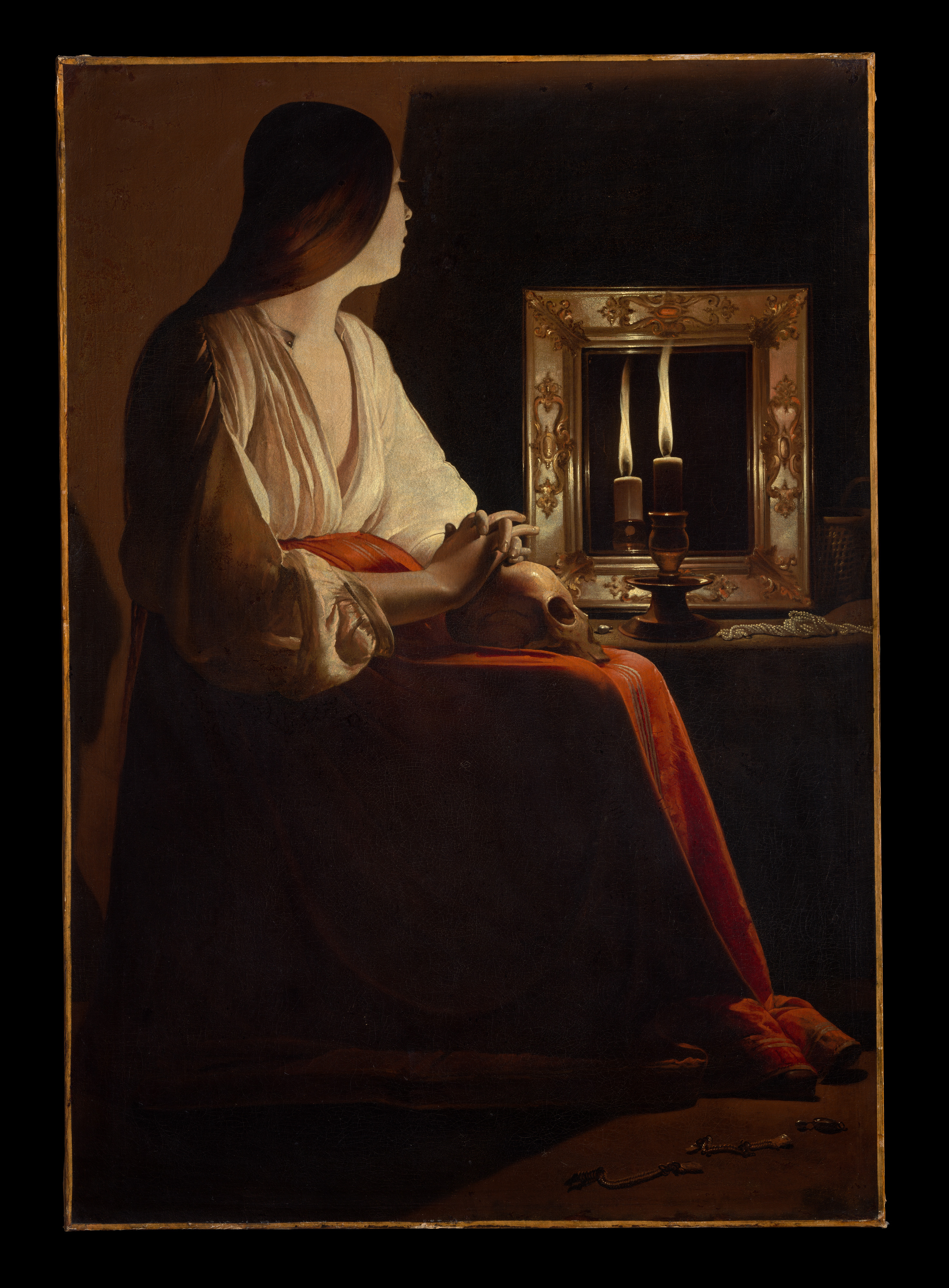
| The Penitent Magdalen Georges de La Tour | By the same painter, in the same museum, in the night manner Given by Mr and Mrs Charles Wrightsman in 1978. The contrast with the daylight Fortune-Teller is the whole of the problem the 1970s attribution debate was about. | The Metropolitan Museum of Art, New York, 1978.517 |
| The Flea Catcher Georges de La Tour | Linked to this picture by a repeated ornament Pariset noted in 1961 that the courtesan's necklace of black beads is identical to the bracelet in the Flea Catcher and suggested the two were painted at the same time. | Musee Historique Lorrain, Nancy |
Open questions
- What did the Metropolitan Museum pay Wildenstein in 1960? The figure has never been published and contemporary reports say only that it was very high.
- Is the Met picture the fortune tellers listed at no. 14 in Jean-Baptiste de Bretagne's posthumous inventory of 1650? Thuillier proposed it in 1992 and the Met carries the link with a question mark.
- How did the painting reach the chateau de Moulin Vieux, and was it there before 1802 when the house was transferred fully furnished to the Lemonnier de Loriere family?
- How much canvas was lost from the left edge, and does the original format resolve the pendant question with either of the two Cheats?
- Was the MERDE graffito removed, and when? De Montebello described it in 1982 as a restorer's mischief over original brushstrokes, but the sources consulted do not record what was done about it.
- Why did Germain Bazin, the Louvre's own head of old master paintings, sign the export licence? Wright's suggestion that he doubted the picture is a speculation and remains unproved.
- Does a record survive of the priest's identification and the prisoner of war's recognition, or is the discovery story oral tradition repeated in the literature?
Questions about this object
What is The Fortune-Teller?
The Fortune-Teller is a painting, dated probably 1630s. Medium: Oil on canvas.
Who made The Fortune-Teller, and is the attribution settled?
The attribution to Georges de La Tour is recorded here as accepted. Signed and accepted, but the subject of the most public authenticity fight of the twentieth-century old master market. Diana de Marly questioned it in the Burlington Magazine in 1970 on costume grounds; Christopher Wright and de Marly published a frontal attack in the Connoisseur in September 1980 under the title Fake?, arguing among other things that the word MERDE was hidden in the embroidery and that the young man's face was a woman's of about 1940. John Pope-Hennessy, John Brealey and Pieter Meyers, Pierre Rosenberg, Philippe de Montebello and Anthony Blunt all rejected the claim between 1980 and 1982, on pigment analysis, x-radiography and the survival of an 1879 French inventory naming a signed La Tour Bonaventure. Blunt wrote in November 1982 that the matter was definitely settled in the picture's favour.
Where is The Fortune-Teller now?
The Metropolitan Museum of Art, New York. Inventory number 60.30. Last confirmed 4 August 2026. Rogers Fund, 1960; bought from Wildenstein.
What is still unknown about The Fortune-Teller?
What did the Metropolitan Museum pay Wildenstein in 1960? The figure has never been published and contemporary reports say only that it was very high.
Sources
- 1The Metropolitan Museum of Art, object record 436838, Georges de La Tour, The Fortune-Teller, accession 60.30. Consulted for the tombstone, the signature and inscriptions, the catalogue entry by Xavier F. Salomon revised by David Pullins, the full provenance, the exhibition history and the bibliography, which supplies Bloch 1950, Sterling 1951, Pariset 1961, de Marly 1970, King 1970, Mellencamp 1971, Nicolson 1971, Nicolson and Wright 1974, Wright and de Marly 1980, Pope-Hennessy 1980, Brealey and Meyers 1981, Rosenberg 1981, Sewell 1981, de Montebello 1982, Spear 1982, Blunt 1982, Prohaska 1987, Thuillier 1992 and Wildenstein and Stavrides 1999. metmuseum.org/art/...
- 2The Metropolitan Museum of Art Open Access API, object 436838. Consulted for isPublicDomain, primaryImage, medium, dimensions, accession number and credit line. collectionapi.metmuseum.org/public/...
- 3Wikipedia, 'The Fortune Teller (La Tour)'. Tertiary. Used for the prisoner-of-war discovery account, the 1949 Wildenstein purchase at 7,500,000 francs over the Louvre, the undisclosed 1960 Met price, and the export controversy including Andre Malraux at the National Assembly and Germain Bazin's signature on the export licence. Replace with Wildenstein and Stavrides, Marchands d'art (Paris, 1999), pp. 152-62, and with the French parliamentary record. en.wikipedia.org/wiki/...
- 4Wikipedia, 'Georges de La Tour'. Tertiary. Used for the birth and death dates and places, the Luneville studio from 1620, the title of painter to the king in 1638, the ducal employment of 1623-24, Hermann Voss's rediscovery in 1915 and the pupil son Etienne. Replace with Thuillier's monograph and the 1997 Grand Palais catalogue. en.wikipedia.org/wiki/...
Last verified 8 September 2026 · Published 4 August 2026
Change log
4 August 2026 - Record created at the house standard: researched narrative, technical evidence, maker dossier, graded provenance chain, prices with hammer and premium separated, related works, open questions and sources.
8 September 2026 - Re-verified. No change to location, attribution or ownership: still the Metropolitan Museum of Art, on view Gallery 622, Rogers Fund 1960, object 60.30, Public Domain per the Met's own object page, dated 'probably 1630s'. Checked via a live browser session (metmuseum.org 429'd a plain WebFetch, so the in-app browser was used instead, per house rule on bot-blocks). No new scholarship, technical study, sale or litigation found addressing any of the record's seven open questions (the 1960 purchase price, the 1650 Bretagne inventory identification, the pre-1802 chateau history, the lost canvas at the left edge, the MERDE graffito's removal, Bazin's export licence, the discovery-story oral tradition). Christopher Wright's forgery doubt, cross-checked against Colby College's 'Copies, Fakes and Forgeries' project page, remains the same standing minority position with no new development. One observable change on the Met's own page, noted as a finding rather than a provenance fact: the museum's current audio commentary explicitly reframes the sitter as 'Roma (formerly identified with the derisive term Gypsy)' and adds curatorial discussion of the painting's stereotyping - a change in interpretive framing, not in attribution or ownership. All 4 source URLs re-checked; the two Met URLs resolve, Wikipedia URLs resolve.