Frans Hals
 1582/83-1666
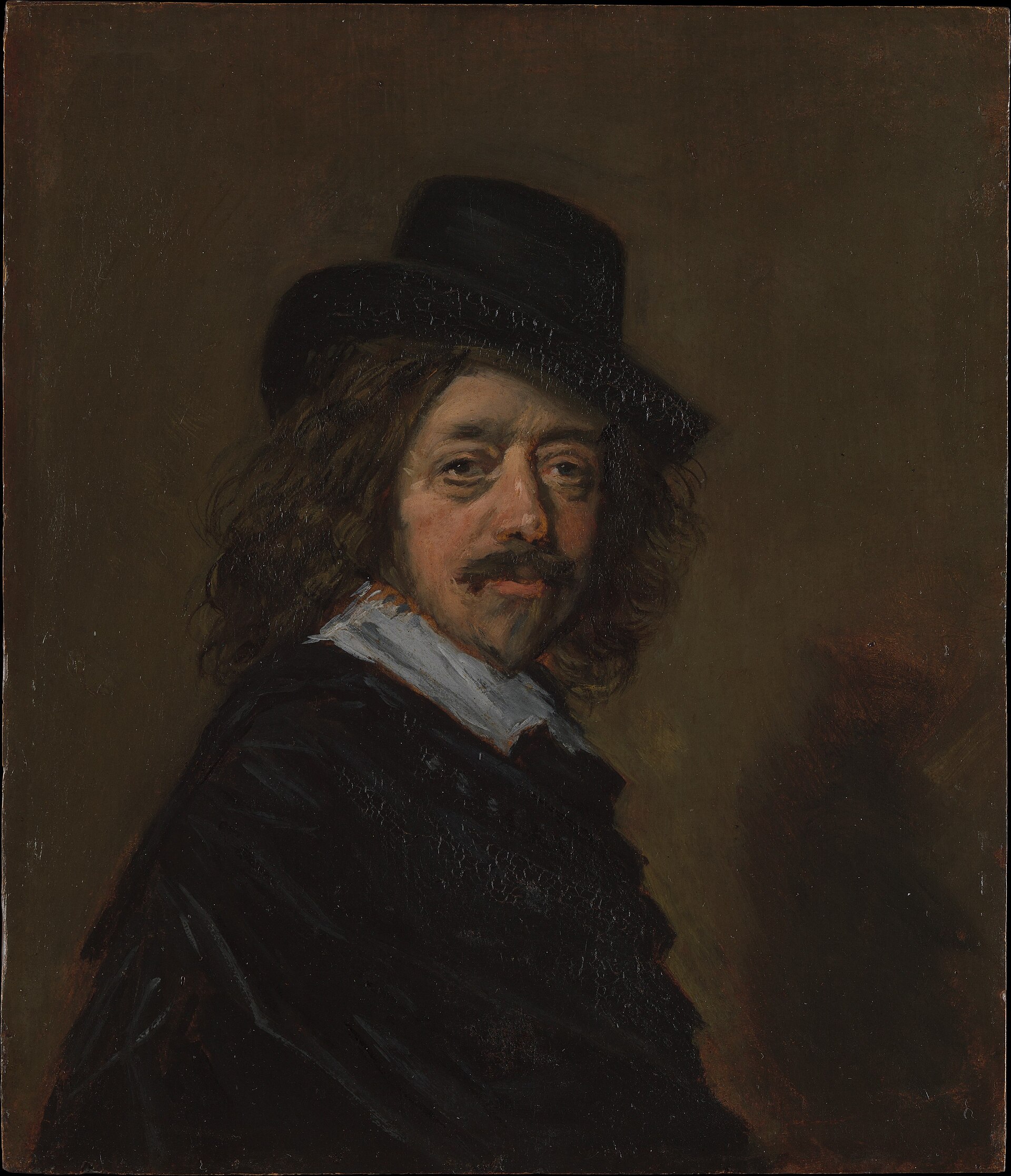
Portrait of Frans Hals, a version after a lost self-portrait of about 1648-50, Metropolitan Museum of Art, New York (32.100.8). Grimm's catalogue lists eight surviving versions of the type, B17a to B17h; this is B17c. The identification as Hals rests on the resemblance to the one secure likeness, the figure in the 1639 civic guard group, on a watercolour by Cornelis van Noorde and on Grimm's acceptance of the lost original as a self-portrait; I found no document that names it so, and the Met picture is not by Hals's hand.
The Metropolitan Museum of Art, New York, The Friedsam Collection, Bequest of Michael Friedsam, 1931 (CC0)| Full name | Frans Hals (the Elder), also written Frans Hals I |
|---|---|
| Worked as | Painter, Portraitist, Genre painter, Picture restorer and valuer |
| Born | 1582 or 1583 (exact day not recorded in the sources I... · Antwerp, Spanish Netherlands |
| Died | buried 1 September 1666 (the day of death is not given in... · Haarlem, Dutch Republic |
| Nationality | Dutch (born in Antwerp, worked in Haarlem) |
| Movement | Dutch Golden Age |
| Sources | 41 cited |
| Last verified |
About this page Last verified · 41 sources cited
On this page 13 sections
ContentsClose
Few painters have been counted down as hard as Frans Hals. In 1910 Cornelis Hofstede de Groot listed more than 400 works. By 1974 Seymour Slive accepted 222 surviving paintings, in 1989 Claus Grimm accepted 145 and Slive's revised edition of 2014 accepted 233. Anna Tummers, whose 2024 book reports the technical work on Hals begun in 2016, writes that the two men disagreed about no less than a third of the oeuvre. There is no authentication board. What exists instead is Grimm's study and catalogue of 2023 and 2024 for the Netherlands Institute for Art History (RKD), which stops asking which pictures are autograph and sorts the output of a workshop instead.
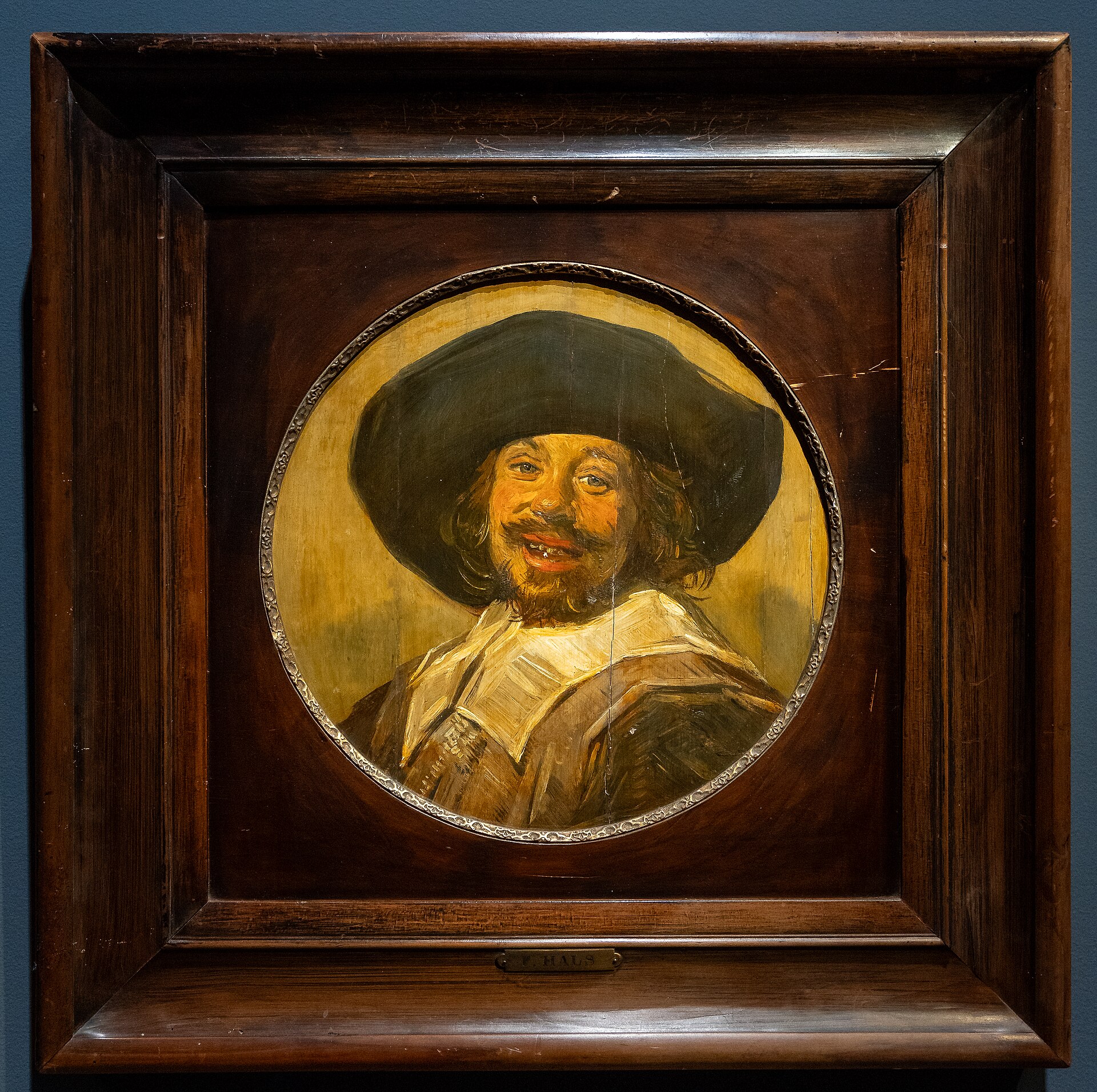
The most useful thing in that catalogue for a buyer is its last section, ten entries of modern imitations. Number X10 is the half-length portrait of a man in black, monogrammed FH, that Sotheby's sold privately in 2011 for US$10.75m, took back in 2016 after laboratory tests found modern pigment, and that an English court in 2019 declined to rule on one way or the other. Grimm dates it to the late twentieth or early twenty-first century. The Art Newspaper reported in April 2019 that the dealer who sold it still called it a masterwork by Hals. Two earlier cases are a roundel of about 1923 and a Malle Babbe of the 1930s. The roundel, catalogued as a Laughing Cavalier and made in the manner of the Merry Drinker, was sold for fl. 50,000 on a certificate by Cornelis Hofstede de Groot, who then bought it himself for the full price and so ended the lawsuit.
The biography needs similar care. The drunk who died in the poorhouse was written by Arnold Houbraken in 1718 and, according to the Metropolitan Museum's Walter Liedtke, is contradicted by the documents. What the archive shows is a lifetime of small debts, a baker who took the contents of his house in 1654 and, from 1663, a municipal stipend of 200 guilders a year, which was only a little below what a carpenter earned. The Laughing Cavalier did not get that name until 1888; it sold for 180 guilders in 1770 and for 51,000 francs in 1865.
Images
Chronology
- 1582 or 1583
Born in Antwerp, eldest son of the cloth weaver Franchois Hals of Mechelen; baptised a Catholic.4
- 1585-86
The family leaves Antwerp after the city falls to Spanish troops on 15 August 1585 and is in the north before July 1586.4
- 1610
Enrolled in the Haarlem guild of St Luke at about 28; first dated work is the 1611 portrait of Jacobus Hendricksz. Zaffius.4
- 1616
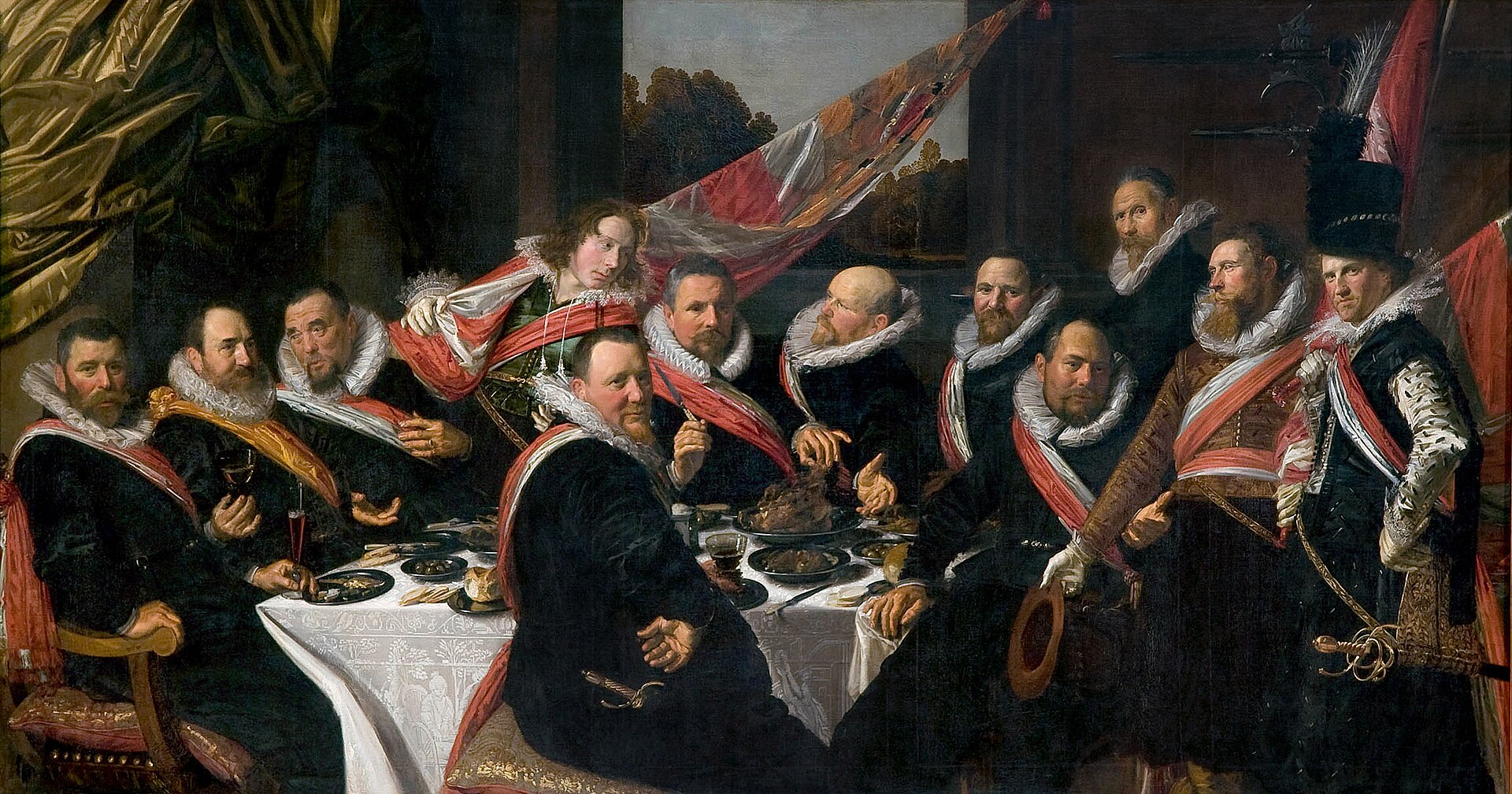
Banquet of the officers of the St George civic guard, his first major group portrait; Liedtke dates a study trip to Antwerp from about early August to mid November.428
- 1617
Marries Lysbeth Reyniersdr. at Spaarndam on 12 February; eleven children of the marriage are known by name.4
- 1624
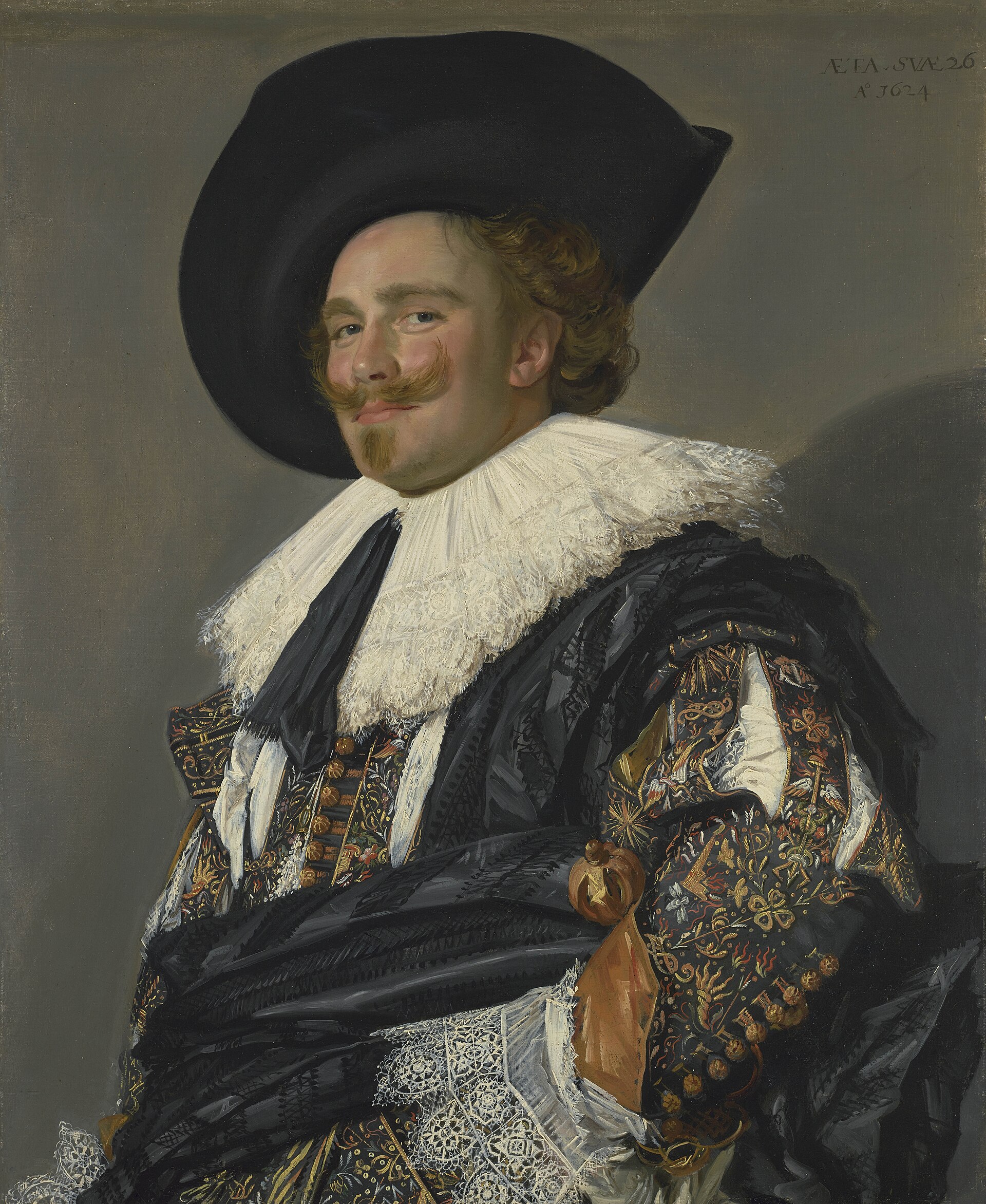
The Laughing Cavalier, inscribed AETA SVAE 26 and dated 1624, now in the Wallace Collection.10
- 1629
Paid 24 guilders by Haarlem to refresh paintings from the dissolved convent of St John; asked with two colleagues to report on whether Torrentius's prison cell could serve as a studio.4
- 1633
Amsterdam guardsmen pay 60 guilders on account, plus a promised 6 guilders a head, for a full-length group portrait: the only price known for a Hals commission of that kind.4
- 1639
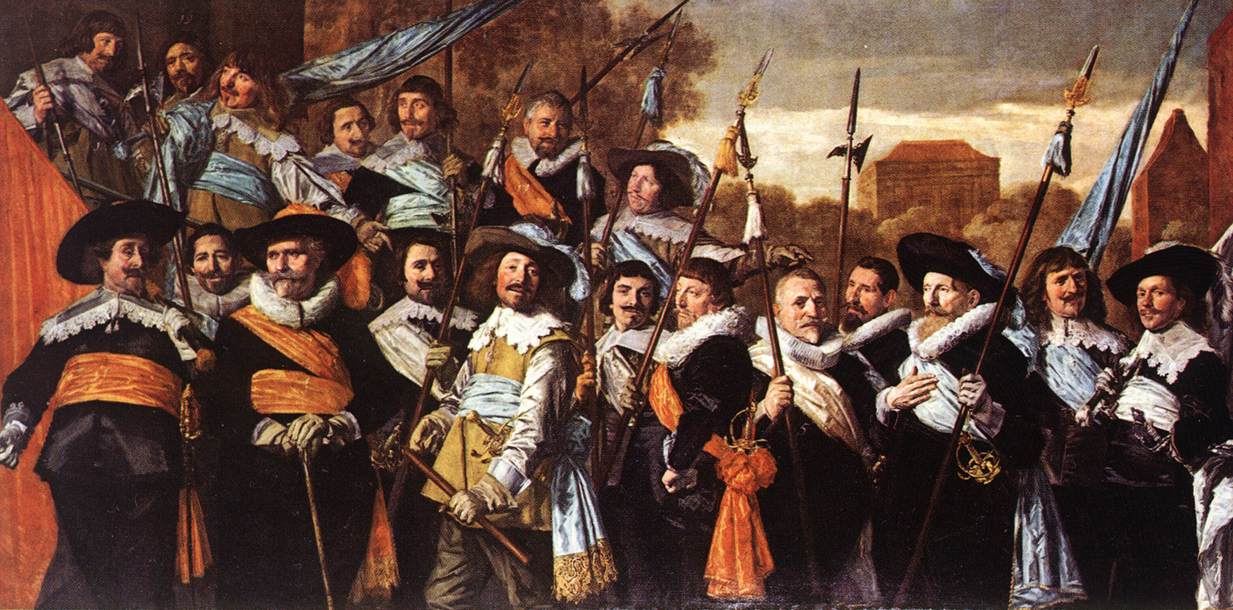
Officers and sergeants of the St George civic guard, in which the town permitted him to include his own likeness.57
- 1644
Elected a board member of the guild of St Luke for one year.4
- c. 1648-1650
Date given for the lost self-portrait known in eight surviving versions.78
- 1653
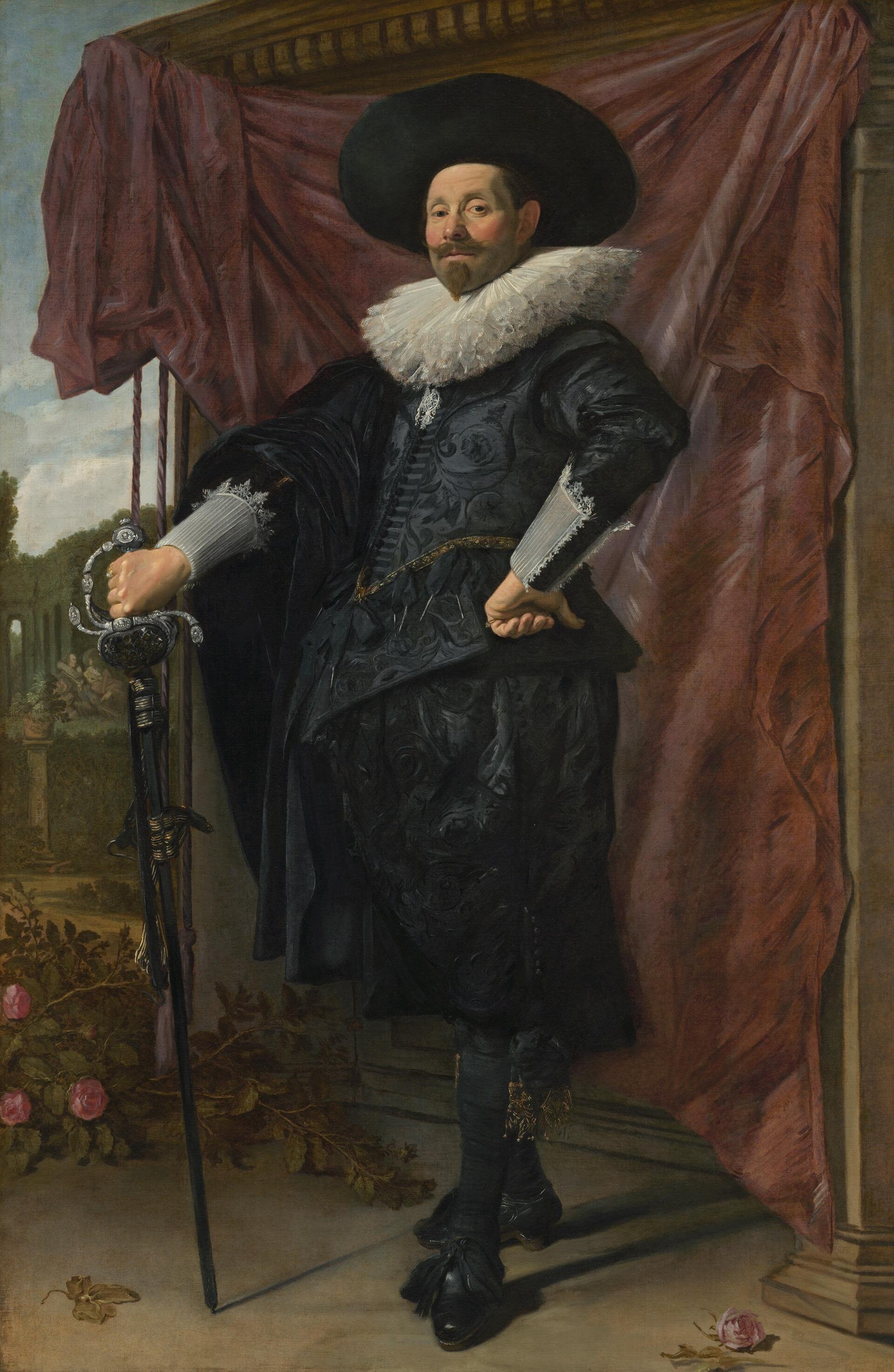
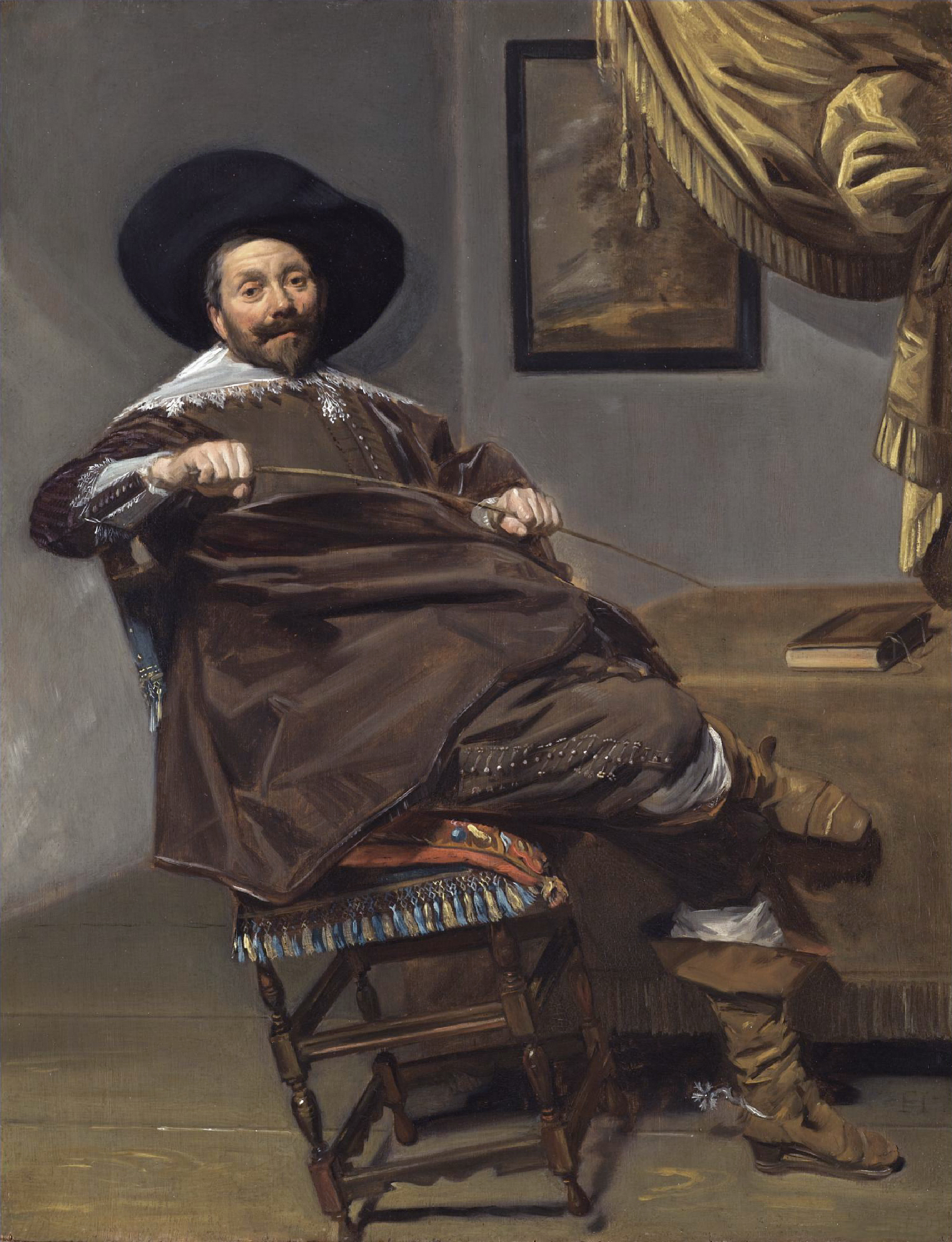
A receipt records 36 guilders paid to Hals for the portrait of Willem van Heythuysen in the Heythuysen almshouse; the same year 65 guilders is recorded for 'Malle Babbe in the workhouse'.411
- 1654
The baker Jan Ykesz. takes the contents of Hals's home and five pictures against a debt of 200 guilders (the English Wikipedia says 1652).441
- 1655
Converts to the Reformed church, which Grimm infers from his Catholic baptism.4
- 1662-63
On 9 September 1662 Haarlem grants him support after a written request; from 1663 he receives 200 guilders a year until his death.4
- c. 1664
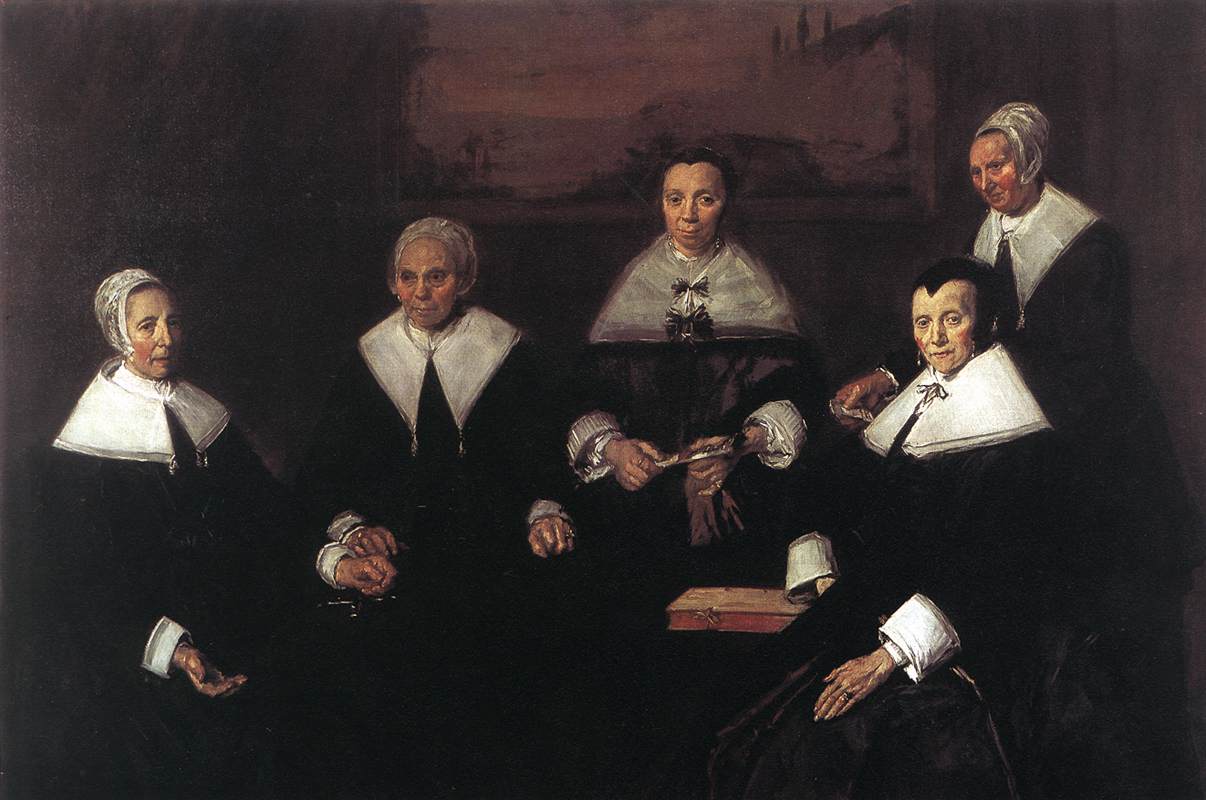
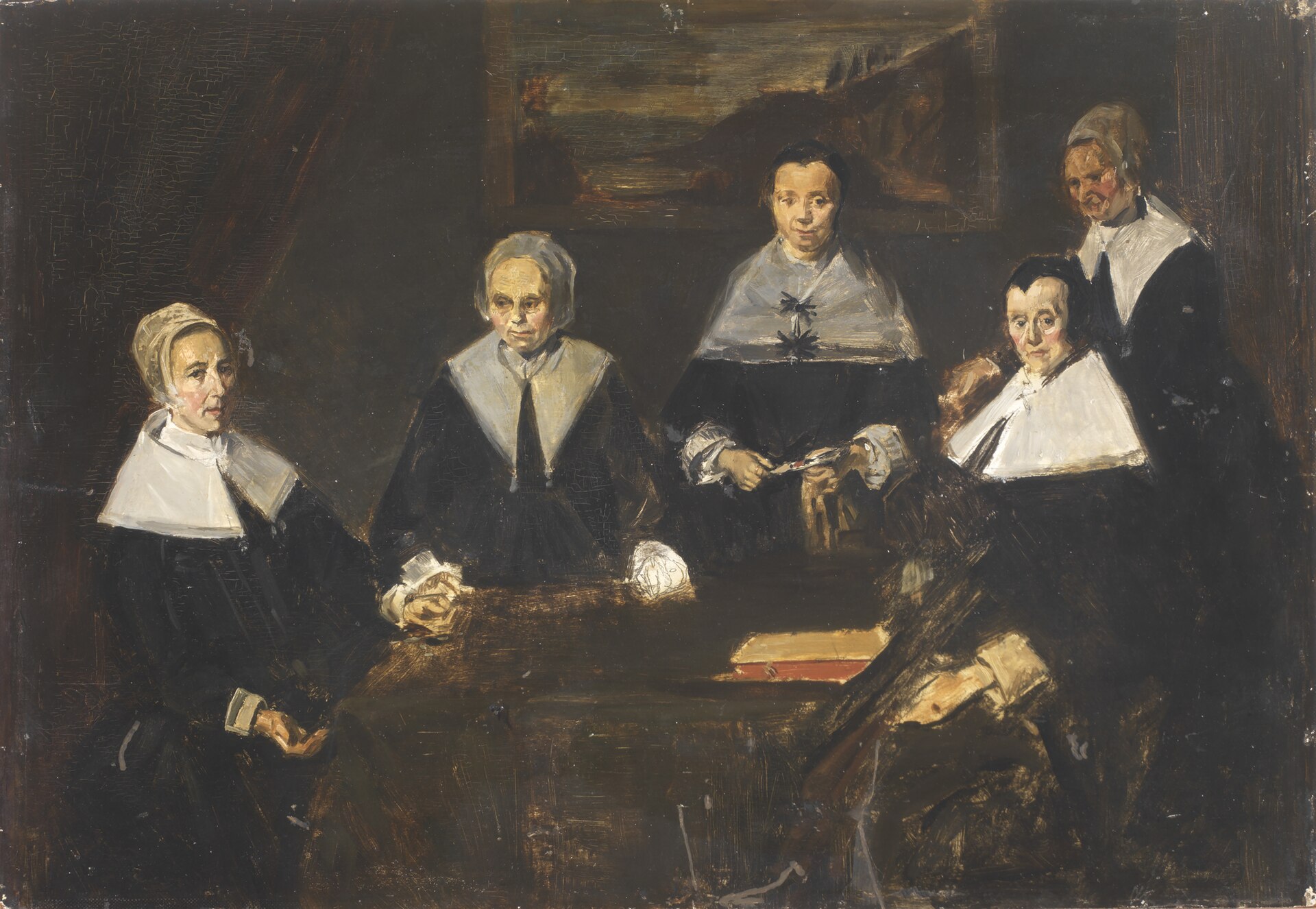
Regents and regentesses of the Old Men's Almshouse, his last large group portraits.2831
- 1666
Buried on 1 September in the choir of St Bavo, Haarlem, in the grave of his first wife's grandfather; his name was cut on the slab in 1918.5
- 1675
His widow is granted 14 stuivers a week, 36 guilders a year; the dealer Gerrit Uylenburgh values a Hals fool at 30 guilders.45
- 1718
Arnold Houbraken's biography originates the story of a drinker and of rapid painting; Liedtke says documents contradict it.28
- 1770-1865
The Laughing Cavalier sells for 180 guilders (1770), 247 (1783), 300 (1800), 700 (1822) and 51,000 francs (1865).1027
- 1868
Theophile Thore-Burger's 'rediscovery' of Hals.15
- 1872
Edouard Manet visits the Haarlem museum and copies the regentesses.30
- 1910
Hofstede de Groot lists more than 400 works.1
- 1923-1925
The Laughing Cavalier roundel is certified by Hofstede de Groot, sold for fl. 50,000, exposed by chemical tests and nails, and bought back by him; Fred. Muller and Co. sue H.A. de Haas on 9 December 1923.149
- 1937
Haarlem exhibition of 116 paintings; Maurits van Dantzig accepts only 33 as by Hals himself.2
- 1945
Police searching Han van Meegeren's workshop in France seize his Malle Babbe, now in the Rijksmuseum.169
- 1970-1974
Seymour Slive's three-volume catalogue: 222 authentic paintings, 20 lost, 81 doubtful.12
- 1989
Grimm's catalogue accepts 145 paintings; Slive edits the catalogue of the Washington, London and Haarlem exhibition of 1989-90.2
- 2008
First recorded appearance of the half-length portrait later sold by Sotheby's; on 9 July Sotheby's sells the seated Willem van Heythuysen for GBP 7,097,250.1824
- 2010-2011
Fairlight and Weiss buy the portrait from Giuliano Ruffini for EUR 3,000,000 on 7 June 2010 and sell it through Sotheby's in June 2011 for US$10,750,000.1918
- 2014
Slive's revised edition appears after his death; the portrait is published as a Hals in The Burlington Magazine.1518
- 2016
Sotheby's determines on 11 July that the portrait is counterfeit and returns the price; the project Frans Hals or not Frans Hals begins.1815
- 2019
On 11 December the High Court orders Fairlight to repay Sotheby's but declines to decide whether the painting is by Hals; Court of Appeal dismisses the appeal in November 2020.181921
- 2023-2024
Frans Hals exhibitions at the National Gallery, London (30 September 2023 to 21 January 2024) and the Rijksmuseum (16 February to 9 June 2024); Grimm's RKD catalogue is published online in 2023 and 2024.271
- 2026
On 2 September Paris prosecutors ask for Ruffini to be tried; on 6 November the Frans Hals Museum opens Hals-Rembrandt.2232
The market
In the rows below, portraits and pairs made GBP 5.7m to GBP 10m with fees between 2008 and 2024, a small pair of genre panels made US$7.98m in 2025 on a tertiary report, and a picture catalogued as follower's work made EUR 571,120 in 2004. The price follows the attribution in a way that is unusually visible: the seated Heythuysen made EUR 571,120 as follower work in 2004 and GBP 7,097,250 as a Hals in 2008, and the Weiss portrait that was sold as a Hals for US$10.75m in 2011 was returned in 2016.
The record price known to me for a single Hals is not established here. Sotheby's said in 2008 that its GBP 7,097,250 was the second highest price for a Hals at auction at that date, so a higher single-picture result existed that I did not find. The pair of 1637 portraits sold by Christie's in 2018 for GBP 10,021,250 with fees was called an artist record for two works. Press figures usually include the buyer's premium; I give the hammer only where a source printed one, and say so where none was found.
For scale, Grimm gives the annual income of a carpenter or bricklayer in Hals's lifetime as 250 to 300 guilders. Hals was paid 36 guilders in 1653 for the portrait in the Heythuysen almshouse and 60 guilders on account for a full-length guard portrait in 1633. The Laughing Cavalier made 180 guilders in 1770 and 51,000 francs in 1865.
| Date | Sale | Work | Result | Note |
|---|---|---|---|---|
| 1770, The Hague | Sale of the Van Heemskerck family (as reported by Grimm) | The Laughing Cavalier, 83 by 67.3 cm | Hammer 180 guilders (basis not stated) With premium not stated guilders | The same sale: a Berchem at 1,265 guilders, a Van Huysum still life at 2,100. |
| 1783, 1800 and 1822 | Auctions in the Netherlands (as reported by Grimm) | The Laughing Cavalier | Hammer 247 guilders (1783); 300 guilders in Amsterdam (1800); 700 guilders (1822); basis not stated With premium not stated guilders | In 1783 a Berchem in the same auction made 3,000. |
| 1865, Paris | Pourtales-Gorgier sale | The Laughing Cavalier | Hammer 51,000 francs (basis not stated) With premium not stated francs | Bought by the 4th Marquess of Hertford, outbidding Baron James de Rothschild; more than six times the estimate per the Wallace Collection. Grimm notes the guilder and franc were at almost parity. |
| 8 May 1865, Paris | Sale of Baron van Brienen | Portrait of Willem van Heythuysen, seated (lot 10) | Hammer 35,000 francs (basis not stated) With premium not stated francs | To Rothschild. Earlier: 152 guilders in Amsterdam on 10 March 1817 and 850 guilders on 14 May 1832, from the provenance in Sotheby's catalogue. |
| 12 October 2004, Vienna | Kinsky (Wiener Kunst Auktionen), lot 2 | Heythuysen, as Studio or Follower of Frans Hals | Hammer not stated With premium EUR 571,120 as printed in Sotheby's provenance; whether it includes premium is not stated EUR | Anonymous sale from a private collection in Austria. |
| 9 July 2008, London | Sotheby's Old Master Paintings Evening Sale, lot 26 | Portrait of Willem van Heythuysen, seated on a chair and holding a hunting crop | Hammer not published in the sources I opened With premium GBP 7,097,250 (USD 13,995,067; EUR 8,934,029) as printed in Sotheby's release; basis not stated GBP | Estimate GBP 3,000,000 to 5,000,000. Sotheby's called it the second highest price for a Hals at auction at that date. |
| June 2011, private treaty through Sotheby's | Sotheby's for Mark Weiss Ltd and Fairlight; buyer EPC Nevada LLC (Richard Hedreen) | Portrait of a Gentleman, half-length, wearing black, oak panel, 13.5 by 10.5 inches, monogram FH | Hammer not applicable (private treaty); net to the sellers US$10,750,000 With premium buyer's price US$11,287,500 under the contract, which is 5 per cent above the net USD | Bought by Fairlight and Weiss from Giuliano Ruffini on 7 June 2010 for EUR 3,000,000. Sotheby's declared it counterfeit on 11 July 2016 and returned the price. Weiss settled for US$4.2m; Fairlight was ordered to pay US$6,550,000 principal. A court declined to decide authorship. |
| 6 December 2018, London | Christie's, Eric Albada Jelgersma Collection, Old Masters Evening Sale | Portrait of a Gentleman, aged 37 and Portrait of a Lady, aged 36, 1637, a pair, each 93 by 68.5 cm | Hammer GBP 8,700,000 (The Art Newspaper) With premium GBP 10,021,250 with fees (Christie's price realised) GBP | Estimate GBP 8m to 12m. Called an artist record for two works. Bought by Jelgersma from Robert Noortman in 1996. |
| July 2024, London | Christie's, Old Masters Evening Sale | Portrait of a gentleman of the de Wolff family, possibly Joost de Wolff, half-length | Hammer not found; The Art Newspaper says it was knocked down for GBP 5.7m, which may include fees With premium GBP 5,715,000 as printed by Christie's and reproduced by a blog (tertiary) GBP | Estimate GBP 4m to 6m; from Cowdray Park; sold to a telephone bidder. |
| 21 May 2025, New York | Sotheby's | Boy, possibly Frans Hals (II), playing the violin; Girl, possibly Sara Hals, singing, oil on panel, 26.7 by 26.7 cm | Hammer not stated With premium US$7.98m as reported by a market newsletter (tertiary); basis not stated USD | Last sold at Christie's New York on 13 January 1987 for US$520,000 per the same source. |
Hammer is the price at which the bidding stopped; with premium adds the fee the house charges the buyer on top. Hammer price and buyer's premium in the glossary.
Where to see the work
| Institution | City | Holdings | Note |
|---|---|---|---|
| Frans Hals Museum | Haarlem | The civic guard banquets and the 1639 Officers and Sergeants of the St George guard, and the Regents of the Old Men's Alms House (ca. 1664, inv. OS I-115, 204.5 by 288.5 cm). | The museum has been in the former Old Men's Almshouse since 1913 (tertiary source). Exhibition Hals-Rembrandt, 6 November 2026 to 28 February 2027. |
| The Wallace Collection | London | The Laughing Cavalier, 1624, P84. | Lent for the first time since 1888 to the National Gallery and the Rijksmuseum in 2023 to 2024. |
| Rijksmuseum | Amsterdam | The Merry Drinker (SK-A-135); also Han van Meegeren's forged Malle Babbe (SK-A-4242). | The Van Meegeren was obtained by the museum after the war. |
| Gemaldegalerie, Staatliche Museen zu Berlin | Berlin | Malle Babbe (801C) and the Portrait of a Woman of about 1632-35 (801), which has been there since 1841. | The Portrait of a Woman is the most intensively examined Hals. |
| The Metropolitan Museum of Art | New York | Merrymakers at Shrovetide, Young Man and Woman in an Inn, The Smoker, Paulus Verschuur, Portrait of a Man possibly Nicolaes Duyst van Voorhout and others; the copy after the lost self-portrait (32.100.8). | The disputed Malle Babbe (71.76) is also in the collection. |
| Musee du Louvre | Paris | The Gipsy Girl and the Portrait of Paulus van Beresteyn. | |
| Kenwood, the Iveagh Bequest | London | Portrait of Pieter van den Broecke, 1633. | |
| Alte Pinakothek | Munich | Full-length portrait of Willem van Heythuysen, about 1625. | The seated version sold in 2008 is not in a public collection that I could confirm. |
| Mauritshuis | The Hague | Portrait of Jacob Pietersz. Olycan, 1625. |
Forgeries and misattributions
- The Laughing Cavalier roundel, 1923
- A panel roundel 36 cm across in the manner of the Merry Drinker, certified by Cornelis Hofstede de Groot in 1923 and published by him in The Burlington Magazine as a Hals. Sold through Fred. Muller and Co. for fl. 50,000; the buyer sought repayment and Muller sued H.A. de Haas on 9 December 1923. Hofstede de Groot bought it himself for the full price to end the case and published Echt of onecht? Oog of chemie? in 1925. The RKD assigns it to Han van Meegeren about 1923; Tummers says only that it was made before 1923. A report by Sir Charles Holmes, Wilhelm Martin and F.E.C. Scheller: paint that softened with a wet cotton ball and could be brushed off; artificial ultramarine (1826); cobalt blue; zinc white; and two machine-made nails seen on X-ray. The restorer Theo van Wijngaarden admitted hammering in the nails and said he owned a secret product that made old oil paint water-soluble.149
- Amused Smoker, Groninger Museum 1931.0108
- Bought by Hofstede de Groot in 1923 as Hals and defended by him after it was declared a forgery; bequeathed to the Groninger Museum in 1931. Attributed to Van Meegeren about 1923, but the RKD says the attribution is not entirely certain. Declared a forgery for containing water-soluble paint; its entry to the market matches Van Meegeren's methods.9
- Malle Babbe by Han van Meegeren, Rijksmuseum SK-A-4242
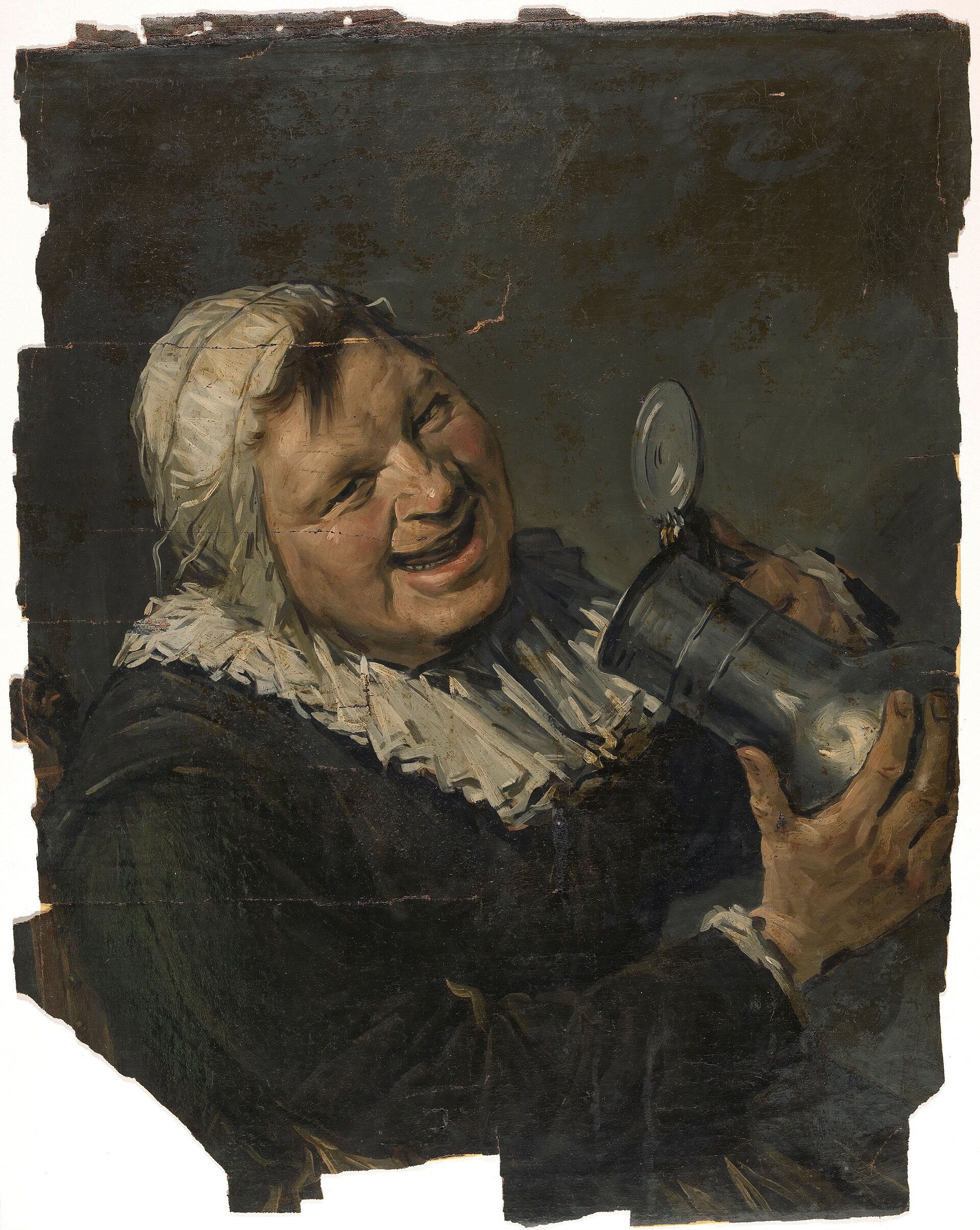
- Oil on canvas, 76 by 60 cm, made in the 1930s on the Berlin picture and the Metropolitan Museum's version, found after the war in his workshop in France and now in the Rijksmuseum. Positive for a phenol formaldehyde resin in the 1945-46 trial; modern analysis found its lead white isotopes outside the Hals cluster, while the gas chromatography test gave a false negative.916
- Portrait of a Gentleman, Sotheby's private sale of 2011
- Half-length man in black, oak panel, 13.5 by 10.5 in, monogram FH; unrecorded before 2008; bought from Giuliano Ruffini for EUR 3m in 2010 and sold for US$10.75m in 2011; Grimm's 2024 catalogue lists it as X10, an imitation of the late twentieth or early twenty-first century. A court did not decide authenticity, the dealer disputes the laboratory results and Paris prosecutors list it among 13 works they hold to be fakes. Orion Analytical and a second laboratory, Art Analysis and Research, found synthetic pigment in the ground and under the figure, not used before the second quarter of the twentieth century; the RKD names copper phthalocyanine, invented in 1927. Grimm also rejected it from photographs and in person on style.1819922
- Laughing Boy, Baltimore Museum of Art 1938.204
- First reported at a Cologne sale in 1906, published as authentic by Bode and Binder, accepted with reservations by Valentiner and shown as Hals in Haarlem in 1937. Slive put it among the doubtful pictures. The RKD lists it as the work of an unidentified imitator of the late nineteenth century. A 1957 analysis found zinc white in parts of the original paint layer; the RKD says that pigment was available to artists only from the early nineteenth century, while Tummers dates zinc white from 1781.914
- Portrait of a young man, Sotheby's New York, 27 January 2012, lot 435
- Authenticated as a Hals by Hofstede de Groot in March 1929 and sold several times as one in the nineteenth century; sold in 2012 as by a follower. Grimm's X1, an unidentified imitator before 1809. Style: an implausible turn of the head, foreshortened collar and unconvincing modelling.9
- Two Fisherboys, Christie's 6 July 2017, lot 28: a false alarm
- Called a nineteenth-century English forgery by Van Dantzig in 1937, a nineteenth-century painting in Hals's style by Slive from photographs, and a Van Meegeren by his son Jacques in 1965. Its provenance goes back only to 1935. Cleared by lead isotopes inside the Hals cluster, by indigo over red typical of Hals's studio and by ribbon touches; Tummers, Wallert and De Keyser conclude it is by Hals and his studio.16
- The Metropolitan Museum's Malle Babbe, 71.76: attribution disputed, forgery not shown
- Bought in 1871 as a Hals, called a free repetition by Frans Hals the Younger by Bode in 1883, a forgery by Van Dantzig in 1937, 'invention of a gifted follower or a copy after a lost original' by Slive, and a workshop picture by Grimm in 2024. The Met catalogue of 2007 calls it style of Frans Hals. Technical research for the 2024 study is described in its abstract; I did not read its conclusions on this picture.17
The essay
Chapter 1Counting Hals: more than 400, then 33, then 222 or 145
The size of the oeuvre has gone down and up with whoever was counting.
The size of the oeuvre has gone down and up with whoever was counting. Hofstede de Groot's catalogue of 1910 listed more than 400 works. Wilhelm Valentiner's of 1923 had 309 entries, which included seven engravings and three drawings after lost pictures. The first overview exhibitions came in the 1930s, 50 works in Detroit in 1935 and 116 paintings in Haarlem in 1937. In the same year the restorer Maurits van Dantzig published Frans Hals: Echt of Onecht and accepted only 33 of the Haarlem pictures as by Hals himself. Numas Trivas in 1941 listed 109 paintings, dropping many without explanation.
Seymour Slive's three volumes of 1970 to 1974 put many of them back. He listed 222 authentic paintings, 20 lost pictures and 81 'doubtful and wrongly attributed paintings'. Claus Grimm's own first catalogue of 1972 had 168 autograph entries plus 37 copies and prints after lost works. The 1974 Montagni catalogue, which Grimm calls a compromise between his strict list and Slive's, had 184 painting entries, or 214 with 30 reproductions of lost works. Grimm's 1989 catalogue then cut to 145 paintings, of which 135 are also in Slive's list. The art historian Eddy de Jongh summed up the gap by saying the two seemed to be writing about different artists.
Slive's revised edition appeared a few months after his death in 2014. Tummers counts 233 accepted paintings in it. Grimm, in the RKD study, describes it differently: an incomplete selection from what Slive had considered autograph, with the 1974 catalogue of doubtful pictures left out. Both statements can be true of one book, and I record them as two readings of it, not as one number.
Grimm's own latest count cannot be stated as a single figure either. In a note of 2019 Tummers reported that his forthcoming catalogue would accept 199 works as by the master, including works made in collaboration with the studio. The catalogue as published in 2024 is numbered in groups: by the last numbers in its contents list, A1 (paintings by Hals throughout or reworked by him) runs to 132, A2 (Hals with other masters) to 12 plus an 8A, A3 (Hals and workshop assistants) to 64, and A4 (made in the workshop under his supervision) to 131 across portraits, genre pictures and small portraits. That is my arithmetic from the numbering, not a total Grimm states, and I could not make it match 199. Grimm himself says roughly 300 paintings survive that can be attributed to different persons in his sphere, once weaker variants and copies are set aside.
Chapter 2Who decides now
No foundation or committee issues opinions on Hals.
No foundation or committee issues opinions on Hals. Attribution rests on a handful of people and on one institution's database. The Court of Appeal in the Sotheby's case recorded it as common ground that in June 2011 there were three leading scholars of Hals: Seymour Slive (died 2014), Claus Grimm (born 1940) and Dr Peter Biesboer. Their opinions are what an auction house or a dealer cites, and the 2019 trial turned on whether the opinions of those three amounted to a generally accepted view of scholars within the meaning of Sotheby's authenticity guarantee; the judge held that on 27 June 2011 they did not.
Since 2016 a different kind of evidence has been collected by the project Frans Hals or not Frans Hals, a collaboration of the Frans Hals Museum, the Rijksmuseum, the Gemaldegalerie in Berlin, the Metropolitan Museum, the University of Amsterdam and Delft University of Technology; the 2024 book is by Anna Tummers and colleagues. It has applied X-ray, infrared reflectography, macro X-ray fluorescence scanning, hyperspectral imaging, neutron autoradiography and lead isotope analysis to Hals and to doubtful pictures. Its open-access results were published as a book in 2024.
Grimm's 2024 catalogue changes the question. He argues that the modern idea of an autograph work was not the working rule of a seventeenth-century workshop, that Hals was the head of a team that might have been himself, a pigment grinder and one or two others, and that assistants did heads, hands and backgrounds under his direction. In his scheme a monogram marks the responsible master and does not prove the hand. Every picture in the catalogue has a record in the RKD Images database with its attribution history, which is the place a specialist should check an opinion against. Where Grimm and others differ, the database lists the most recent published opinion first, and Grimm's own opinion is listed first for that reason.
Chapter 3The man in the record
Grimm, drawing on the documents Irene van Thiel-Stroman published in 1989, calls the picture of the historical Hals vague and incomplete.
Grimm, drawing on the documents Irene van Thiel-Stroman published in 1989, calls the picture of the historical Hals vague and incomplete. He was probably born in Antwerp in 1582 or 1583, the eldest son of the cloth weaver Franchois Hals from Mechelen. The family left after Antwerp fell to Spanish troops on 15 August 1585 and had gone before July 1586. His brother Dirck, also a painter, was baptised in the Reformed church in Haarlem on 19 March 1591. The father was still listed as a Catholic in Antwerp, and Hals was baptised a Catholic, which is why Grimm reasons that he had to convert to the Reformed faith in 1655.
Karel van Mander's biography, added to his book in 1618, names Hals as his pupil, probably around 1600 to 1603. In 1610, aged about 28, Hals entered the Haarlem guild of St Luke. His first dated picture is the 1611 portrait of Jacobus Hendricksz. Zaffius, and what he did in the seven years between is unknown. He married Anneke Harmensdr. Abeels in 1610 or 1611. She was buried on 31 May in the paupers' grave of the Chapel of the Holy Ghost, which Grimm reads as a sign of poor circumstances (his text gives the year as 1613 in one place and as 1615 in another, so I give no year), and only the first child, Harmen, survived of the children of that marriage. On 12 February 1617 he married Lysbeth Reyniersdr. at Spaarndam outside the Haarlem banns. She could not write and signed with a cross. Eleven children of this marriage are known by name.
Hals never bought a house. The documented addresses are all rented: Peuzelaarsteeg in 1617, Groot Heiligland in 1636, Lange Begijnestraat in 1640, Kleine Houtstraat in 1642, Oude Gracht from 1643 to 1650 and Ridderstraat from 1654 to 1660. Grimm points out that the houses were small and narrow and that there is no record of where he painted, so the large civic guard pictures may have been done in rooms at the companies' headquarters. He served in a company of the St George civic guard from 1612 to 1625, made, in Liedtke's dating, a study trip to Antwerp from about early August to mid November 1616, and was elected a board member of the guild in January 1644, serving one year where colleagues served several terms. He was buried on 1 September 1666 in the choir of St Bavo in the grave of his first wife's grandfather, Nicolaas Joppen Gijblant, without his name on the slab. The name was cut in 1918 and a new slab put down for the museum's centenary in 1962.
Chapter 4Debt, the baker and the stipend: what the poverty record shows
The legend of Hals the drunk goes back to Arnold Houbraken in 1718.
The legend of Hals the drunk goes back to Arnold Houbraken in 1718. Liedtke says it was derived from the genre paintings and is unsupported, indeed contradicted, by the documents, and he puts Hals's money troubles down to a large family and the fact that few Dutch portraitists were well paid. What the archive does show is a debt record that Grimm says runs through his life from 1616 onwards. In 1616 the woman who had cared for his children from his first marriage sued him three times for her expenses. In March 1634 the baker Bouwen Fransz was owed 23 guilders 17 stuivers and two pennies for bread and held a painting as security; two colleagues were to value it, which tells us the picture was worth more than the debt.
The worst blow came in 1654 according to Grimm. The baker Jan Ykesz. took possession of the contents of Hals's home and five pictures to cover 200 guilders, a loan plus bread bought on credit. The English Wikipedia, citing the 1911 Britannica, dates a baker's seizure to 1652 and I follow Grimm's 1654. In 1661 the guild of St Luke suspended his annual dues of six stuivers because of his age. After a written request from Hals the town of Haarlem granted him support on 9 September 1662, and from 1663 until his death he received an annual stipend of 200 guilders. In 1664 he twice received three wagon loads of peat and help with his rent.
Grimm gives a frame for the stipend. It was far above the usual level of poor relief and only slightly below the 250 to 300 guilders a year that a carpenter or bricklayer earned. The municipal secretary of Haarlem was paid 272 guilders in 1625. The widow of Hals, from 26 June 1675, received 14 stuivers a week, which makes 36 guilders a year. Grimm reads the support as the city's wish to honour an esteemed citizen, though he notes it fell short of the honours given to Goltzius, whose burial in 1617 was marked by the bells of St Bavo ringing for half an hour. In January 1665 he was still able to stand surety for 458 guilders 11 stuivers for his son-in-law, which Grimm calls unusual for the old painter after a lifetime of small claims.
The few prices that survive show how modest the work was. The Amsterdam civic guardsmen paid 60 guilders on account in 1633 plus a promised 6 guilders a head for a full-length portrait, the only price known for a Hals commission of that kind. A receipt of 1653 records 36 guilders to Hals for the portrait of Willem van Heythuysen in the regents' room of the Heythuysen almshouse, roughly an eighth to a seventh of the annual income Grimm gives for a carpenter, by my arithmetic. On a lottery price list of April 1634, compiled by Hals, his brother Dirck and a third painter, a vanitas by Hals stood at 34 guilders, and two heads on the same list, not named as his, at 16 each. An appraisal of 1648 put a fool at 10 guilders and a Lute Player in 1669 at 15 guilders, and in 1675 the Amsterdam dealer Gerrit Uylenburgh valued a fool, possibly the Peeckelhaering, at 30 guilders in an inventory whose top picture, a Rubens, was 650.
Chapter 5How the paint went on
Tummers and colleagues call the Berlin and New York Malle Babbe pictures wet-in-wet, in the so-called alla prima technique, and their examination of the Berlin Portrait of a Woman shows what that...
Tummers and colleagues call the Berlin and New York Malle Babbe pictures wet-in-wet, in the so-called alla prima technique, and their examination of the Berlin Portrait of a Woman shows what that meant in practice. Tummers and colleagues examined the Portrait of a Woman of about 1632 to 1635 in Berlin, a picture that has been in that museum since 1841 and is accepted by every Hals scholar, with X-radiography, infrared, macro X-ray fluorescence, hyperspectral imaging and neutron autoradiography. The canvas was pre-primed and cut down in the workshop, and Hals scratched a line into the ground to mark the size of the image. The ground is sand-coloured, made of lead white and a manganese brown (umber), and was spread with a spatula and left without an imprimatura. He started with a very sparse, loose sketch in bone black. The colour of the ground was then used as the shadow in hair and flesh under thin glazes.
The speed was real but it was organised. Hals worked areas up as separate islands, which leaves a halo of bare ground around the heads and cuffs; the clothing and background were painted while the head and collar dried, and the hands and cuffs while the dress was still wet, so that wet paints would not smear. Blacks were built from charcoal black mixed with umber, with bone black kept for the deepest accents, and azurite was used in surprising amounts to turn greys cool. The face has vermilion in the flesh and the hands red ochres, so what looks like one pink was made twice. A hallmark is the so-called ribbon touch, a line of paint with a raised edge on each side, and the wet-in-wet hatching that makes eyebrows and hats look drawn with the brush.
Liedtke is blunt that the old idea of Hals painting a picture in an afternoon, which Houbraken began in 1718, is nonsensical to conservators and close viewers: almost every stroke in the face does modelling work and the effect was calculated for a normal viewing distance in a seventeenth-century interior. Samuel van Hoogstraten in 1678 gave the contemporary explanation of the rough manner, that a trained eye completes a loosely painted picture the way it recognises a friend at a distance or in twilight. Maurits van Dantzig suspected in 1937 that Hals used more than oil as a binder, and when the St Elisabeth Hospital regents of 1641 were restored a black brushstroke in the underpainting was found to have nearly dissolved because it had been bound in an aqueous medium.
Two pigment facts are diagnostic. Hals was the first in the northern Netherlands to use indigo in the top layer of important commissions, around 1627, and he mixed it with pure and coarse lead white with particles of 32 to 70 micrometres, where his Haarlem contemporaries used a cheaper chalk-extended white. And lead isotope ratios from nine paintings made between 1616 and 1663 to 1664 form a cluster, against which Han van Meegeren's lead white falls clearly outside.
Chapter 6The workshop
Grimm's central claim of 2023 and 2024 is that the picture of Hals as a lone virtuoso is a nineteenth-century idea.
Grimm's central claim of 2023 and 2024 is that the picture of Hals as a lone virtuoso is a nineteenth-century idea. Assistants ground the pigments, painted backgrounds and clothing and did parts of heads and hands, and the master was paid for the whole. He argues that a Utrecht guild rule of 1644 forbade assistants to work in a style different from their master's or to sign their own contributions, and that the master's monogram marks who was responsible. The differences show most clearly in heads and hands, and in his scheme the A3 group, Hals and his workshop, is the most interesting: sections that are strikingly loose and confident beside weaker areas, as in the Louvre's late Portrait of a Woman, where the face stands out. He makes the same point of the Louvre's Portrait of Paulus van Beresteyn (A2.1, which he gives to Hals with Pieter Soutman), where the hands are far above the rest.
The people are known only in part. Sons recorded as painters include Jan, Frans the Younger and Claes. Jan Hals is tied to five well-preserved signed portraits, and his latest documented work was for the ribbon weaver Nicolaas van der Gon, who had himself and his wife painted by Frans Hals in 1651 or soon after; the couple's inventory of 1665 says Jan executed three life-size portraits of the family. Frans Hals the Younger, born in 1618, is recorded as a painter several times and Grimm notes that not a single picture by him is documented. Claes, who joined the guild in 1655 and became a warden, painted landscapes and cityscapes in his own manner. Pieter van Roestraeten, baptised in 1630, had worked with Hals for a long time before his marriage to Hals's daughter Adriaentje in 1654, and Houbraken reports that Vincent van der Vinne was a pupil. The German painter Matthias Scheits wrote in 1679 that Philips Wouwerman had trained with him.
Grimm names one collaboration between independent painters: Salomon de Bray was brought in to complement Hals's early family portrait. He adds that other painters mostly supplied landscape backgrounds. I found no source that names a woman in the Hals workshop. The RKD database records the reattributions entry by entry.
Chapter 7Haarlem, the guild and what the pictures were for
Haarlem had more than 40,000 inhabitants in 1622 and was the second largest town in the northern Netherlands, and with few exceptions Hals's clients stayed inside it.
Haarlem had more than 40,000 inhabitants in 1622 and was the second largest town in the northern Netherlands, and with few exceptions Hals's clients stayed inside it. The civic guard companies were his way in. Their higher ranks were sought-after honorary posts held by members of wealthy families, and Hals himself served in a St George company from 1612 to 1625. Its officers gave him his first major group commission, the banquet of 1616, and two more followed from the same guard in 1626 to 1627 and in 1639, with the St Adrian guard commissioning pictures in 1626 to 1627 and 1632 to 1633. Grimm suggests he may have owed the first to Job Gijbland, the rich uncle of his first wife and an officer of the St George guard, although Gijbland had his own portrait painted by Frans Pietersz. de Grebber in 1611. Liedtke counts about ten large group portraits for public institutions, the last two being the regents and the regentesses of the Old Men's Almshouse of about 1664, when Hals was around eighty-two.
A portrait in this world was understood as a statement of the sitter's standing as much as a likeness. Several scholars and clergymen sat for Hals with engravings in mind, with eulogistic verses printed beneath: Theodorus Schrevelius, engraved by Matham in 1618, and the preacher Samuel Ampzing, engraved by Jan van de Velde after his death in 1632. Grimm argues that for such commissions Hals made drawings and coloured sketches on paper, and that the small painted versions on copper or panel were repetitions of those sketches made by workshop assistants. He stresses that what looks like a cheap support to us, imported oak, copper or primed canvas, was valuable material which seventeenth-century invoices list separately. Two sitters were also godparents to his daughters in 1623 and 1634, the merchant and envoy to Russia Isaac Massa and the VOC captain and merchant in oriental goods Pieter van den Broecke, and Grimm adds that the request was partly made for the generous baptismal gift that could be expected.
Hals's reading and belief are thinly documented, and the pieces that exist are small. From 1616 to 1624 he was a beminnaer, a supporting member, of the Haarlem chamber of rhetoric De Wijngaertrancken, which gave him contact with poems and plays. In 1629 Haarlem paid him 24 guilders to refresh and alter paintings from the dissolved convent of St John. On 22 January 1629 he, Pieter de Molijn and Jan van de Velde were asked for a written report to the town on whether the prison cell of the painter Johannes Torrentius was suitable as a studio. Grimm says Torrentius was held for membership of the banned Rosicrucian brotherhood. I have not checked the trial record, and the point is the town's charge and what it asked of Hals; nothing links Hals himself to that circle. His own religion is documented only as a Catholic baptism and a conversion to the Reformed church in 1655. I found no inventory of his books.
Chapter 8Laughing, drinking and the owl
The Laughing Cavalier is dated 1624 and inscribed that the sitter was in his twenty-sixth year.
The Laughing Cavalier is dated 1624 and inscribed that the sitter was in his twenty-sixth year. The name first appears in the catalogue of the 1888 Royal Academy exhibition, and Grimm calls the picture a commissioned portrait of a wealthy young man in expensive clothes, with many embroidered emblems on the slashed sleeve. The sitter is unidentified. Pieter Biesboer proposed Tieleman Roosterman (1597 to 1672) on grounds of age and dating, and Grimm replies that the nose, eyes, brows, hair and eye colour differ from Roosterman's portrait of 1634 in Cleveland. Marieke de Winkel proposed instead the poet Johan van Heemskerck, born in 1597, whose family sold the painting at The Hague in 1770. She argues that all the love emblems on the sleeve follow Heemskerck's Minne-kunst, his Dutch version of Ovid's Ars amatoria, so closely that the sitter must have known it, and that the caduceus with flames stands for Heemskerck's belief that eloquence is the main weapon of love. This is argued in print by one scholar and I grade it argued, not documented. The Wallace Collection's own press release says that despite his fame we know little about the picture's creation or the sitter.
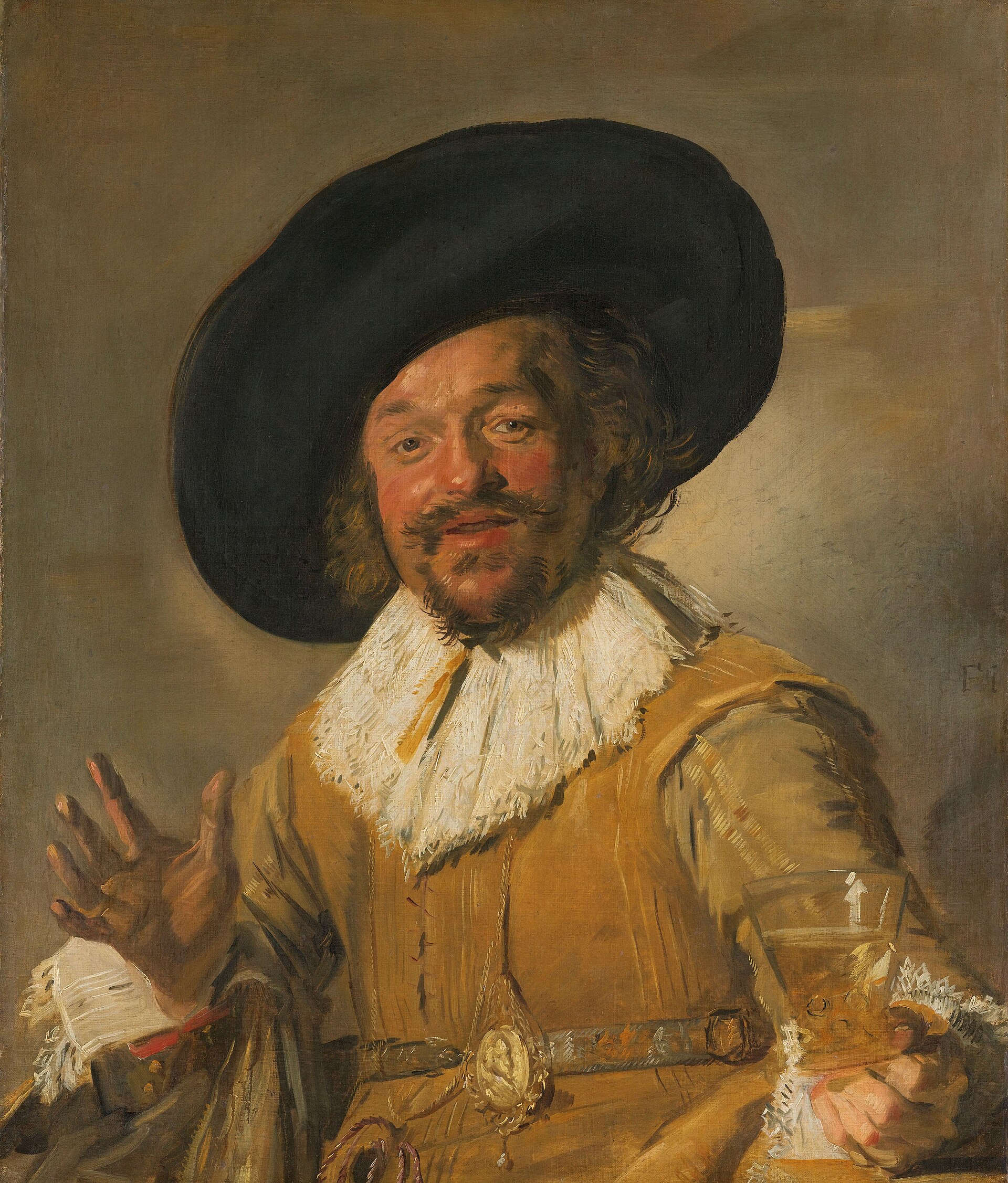
The laughing drinkers and merry companies raise the same question. Liedtke argues that Hals's scenes of everyday life are highly conventionalised essays on social custom: the Young Man and Woman in an Inn of 1623 and The Smoker of about 1625 both address the theme of the Modern-Day Prodigal Son, the title of a Dutch play of 1630. Grimm reads the smiling children and the laughing and grinning drinkers as probably a characterisation of the human senses and of unbridled emotion, if not even a sign of transience. Both are argued readings by modern scholars. Grimm infers from their character that these half-lengths were made for the open market and not on commission, and notes that several closely related versions exist by different hands.
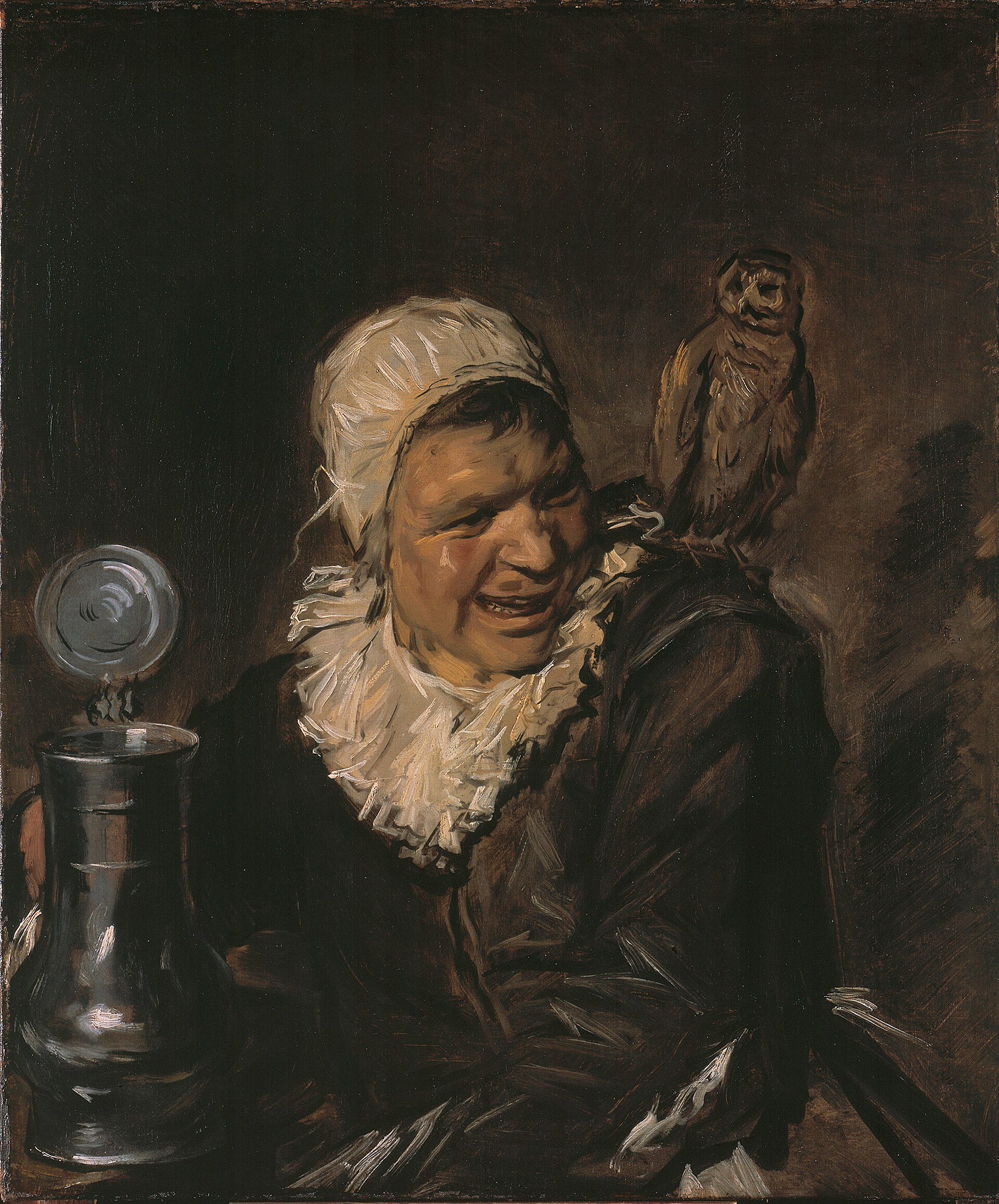
Malle Babbe is the one genre sitter whom the archive identifies, on Tummers' reading. The Berlin picture, 78.5 by 66.2 cm, carries an old stretcher inscription that reads Malle Babbe van Haerlem ... Frans Hals, which earlier literature misread as Hille Bobbe. In 2013 the curator Floris Mulder found a record of 17 February 1646 that a woman called Barbar alias Malle Barbar had been brought to the Haarlem workhouse by the captain of the night watch to prevent further disgrace; from 1656 she is named Barbara Claes, a payment of 65 guilders a year is recorded for her care, and the last payment of 1663 carries the marginal note obiit. Tummers identifies this woman as the sitter of the Berlin picture. The workhouse was both asylum and prison, and Hals's own son Pieter was confined there from 1642, supported with 35 guilders, according to Tummers. Grimm dates the painting no earlier than 1639 on its brown-grey palette. The owl on her shoulder is a common attribute of fools in the period, and Grimm adds that it can also point to occult sayings and the wisdom of fools who laugh at life. I treat the owl as an argued reading and the workhouse record as documented.
Chapter 9His own face
Hals studied his own likeness as an exception.
Hals studied his own likeness as an exception. Grimm identifies one secure appearance, a discreet but recognisable figure in the background of the 1639 portrait of the officers and sergeants of the St George guard, which the town permitted him to include. He says the features were taken from a mirror, describes the modelling of the nose and eyes as soft and careful, with schematic strokes on the eyelids, and finds Hals's typical stroke in the moustache, goatee and nostrils. The picture is so heavily cracked that it is hard to read.
The familiar image, a bust of a man in a high black hat, comes from a lost self-portrait of about 1648 to 1650. Grimm's catalogue lists eight surviving versions of it, B17a to B17h, among them one in Indianapolis, one at the Metropolitan Museum (the one used on this page), a small roundel in the Frans Hals Museum and one in Helsinki, and says the features resemble the 1639 figure and a watercolour by Cornelis van Noorde. Van Noorde also made a mezzotint of the type in 1754 inscribed ipse pinxit, an eighteenth-century statement and not a seventeenth-century one. Liedtke suggested that collectors wanted pictures of famous artists, which could explain the number of copies; Grimm doubts this, because Hals was not seen as a towering figure in his lifetime and artists' self-portraits were not widely collected in Holland. What is secure is therefore only the 1639 figure. Grimm accepts the lost original as a self-portrait on the grounds of the resemblance to it, and I found no document that names the lost bust as a self-portrait.
Chapter 10From 180 guilders to 51,000 francs: the price record
The Laughing Cavalier has the best price ladder.
The Laughing Cavalier has the best price ladder. Grimm records 180 guilders at an auction in The Hague in 1770, when a landscape by Berchem made 1,265 guilders and a still life by Van Huysum 2,100. It brought 247 guilders in 1783, 300 in Amsterdam in 1800 and 700 in 1822. At the Pourtales-Gorgier sale in Paris in 1865 the 4th Marquess of Hertford paid 51,000 francs, outbidding Baron James de Rothschild, which the Wallace Collection says was more than six times the estimate; Grimm notes that the guilder and franc were at almost parity. The sources do not say whether the 1865 figure includes any fee. The Wallace Collection lent it in 2023 for the first time since 1888.
Willem van Heythuysen shows how an attribution moves a price. The seated picture of Heythuysen, on a single oak panel that two dendrochronology reports say was available by about 1635, was sold in Amsterdam in 1817 for 152 guilders and in 1832 for 850 guilders, then in Paris in 1865 for 35,000 francs to Rothschild. At Kinsky in Vienna on 12 October 2004 it was lot 2 as 'Studio or Follower of Frans Hals' and made EUR 571,120. At Sotheby's London on 9 July 2008, estimated at GBP 3m to 5m, it made GBP 7,097,250, which Sotheby's called the second highest price for a Hals at auction. Sotheby's catalogue note, which is the seller's advocacy, puts the change down to a cleaning by Martin Bijl, study by Bijl and Biesboer and a consensus among scholars including Grimm that it is the prime version. The Brussels version, which came from the Heythuysen almshouse, is by Sotheby's account a later replica by Hals, and by Grimm's the work of an assistant.
The recent record is of pairs and portraits. The Albada Jelgersma pair of 1637, Portrait of a Gentleman aged 37 and Portrait of a Lady aged 36, made GBP 8.7m at the hammer and GBP 10,021,250 with fees at Christie's London on 6 December 2018, an artist record for two works. In July 2024 the Portrait of a gentleman of the de Wolff family, estimated at GBP 4m to 6m, was knocked down to a telephone bidder for GBP 5.7m, and Christie's price realised was GBP 5,715,000. A small panel of a boy playing the violin and a girl singing sold at Sotheby's New York on 21 May 2025 for US$7.98m according to a market newsletter, against US$520,000 at Christie's in 1987.
Two cautions on all of this. Press figures usually include the buyer's premium and many do not say which basis they use, so each row below states what was printed. And attribution doubt runs through the biggest results: the seated Heythuysen was sold as follower work in 2004, and the portrait that Sotheby's sold in 2011 was returned in 2016.
Chapter 11The forgeries, from the Laughing Cavalier to the 1930s
The RKD says free imitations began only after Hals was discovered as an artist in the modern sense and his pictures became expensive; the many late nineteenth and early twentieth century fakes are...
The RKD says free imitations began only after Hals was discovered as an artist in the modern sense and his pictures became expensive; the many late nineteenth and early twentieth century fakes are, in its words, easy to recognise and verifiable by their materials. It lists ten in its imitations section and omits the rest. The oldest named case is also the best documented.
In 1923 Hofstede de Groot recognised a small roundel, 36 cm across, as an authentic Hals and gave a certificate. It passed through H.A. de Haas to the auction house Frederik Muller and Co., which sold it to a private collector for fl. 50,000, which Tummers puts at fourteen years of an average man's salary (the basis is in a footnote I could not read). A few months later the buyer demanded his money back as it was a forgery, and Muller commissioned a report from Sir Charles Holmes of the National Gallery, Wilhelm Martin of the Mauritshuis and F.E.C. Scheller, a chemist at Delft. The paint softened under a cotton ball dipped in water and could be brushed off; the examiners found artificial ultramarine, first made in 1826, cobalt blue, zinc white and two machine-made nails hammered in from the front that showed on X-ray. Muller sued de Haas on 9 December 1923 in what Tummers calls the first Dutch court case that used chemical evidence on an attribution. After a year and a half Hofstede de Groot bought the picture himself for the full fl. 50,000, which ended the case, and published Echt of onecht? Oog of chemie? in 1925, arguing that the eye outweighed chemistry. The RKD adds that he declared himself as certain of it as of the attribution of the Night Watch to Rembrandt.
He went back to the restorer who had brought him the picture, Theo van Wijngaarden, who admitted hammering the nails in and said he had a secret product that made old oil paint soluble in water. Van Wijngaarden is better known as the mentor and business associate of Han van Meegeren. The RKD gives the roundel to Van Meegeren about 1923 and records it in a Dutch private collection in 2023; Tummers dates it before 1923 and names no maker, so the maker is attributed and not proven. The Groninger Museum's Amused Smoker of about 1923, which Hofstede de Groot also bought as Hals and bequeathed in 1931, is attributed to Van Meegeren with the RKD's reservation that this is not entirely certain.
Van Meegeren's Hals of the 1930s is the Malle Babbe now in the Rijksmuseum, 76 by 60 cm, which the police seized in his French workshop in 1945 and which tested positive for a phenol formaldehyde resin in the 1945 to 1946 trial. Van Meegeren modelled it on the Berlin picture and on the Metropolitan Museum's version. The Tummers study, published in 2024, found that its lead white has isotope ratios entirely outside the Hals cluster, which the authors say could be explained by twentieth-century lead imported from Australia or the United States. The same study found that the standard gas chromatography test for the resin gave a false negative on this picture, so isotopes were used instead.
Not every alarm was right. Two Fisherboys was offered at Christie's in London on 6 July 2017, lot 28. Van Dantzig had called it a nineteenth-century English forgery in 1937, Slive had called it a nineteenth-century painting in Hals's style from photographs, and the son of Han van Meegeren, Jacques, claimed in a Dutch newspaper in 1965 that it was a forgery by his father. The owners had it tested. Its lead isotope ratios fall inside the Hals cluster, and its blue hats are indigo over red; natural indigo had gone out of use as a pigment by the nineteenth century, so a nineteenth-century forger would not have reached for it. Tummers, Wallert and De Keyser concluded that it is by Hals and his studio, not a forgery. The provenance only goes back to 1935 when, the Illustrated London News said, it was bought at a south-coast sale for GBP 3 and resold for 2,800 guineas at Christie's.
Chapter 12The Sotheby's portrait
A half-length portrait of a man in black, oil on oak panel, 13.5 by 10.5 inches, monogrammed FH lower right, was unrecorded before 2008.
A half-length portrait of a man in black, oil on oak panel, 13.5 by 10.5 inches, monogrammed FH lower right, was unrecorded before 2008. The English Court of Appeal says that in 2008 the French government declared it a national treasure and refused an export licence until 2011; the RKD instead says the Louvre had it added to the national treasure list in 2010 and appealed for donations, and The Art Newspaper reports the Louvre was trying to buy it for EUR 5m. I give both dates and could not reconcile them. On 7 June 2010 Fairlight, the company of the investor David Kowitz, bought it in Paris from Giuliano Ruffini for EUR 3,000,000, acting for itself and for Mark Weiss Ltd according to the Court of Appeal. The Weiss gallery then went to Sotheby's, which found a buyer, Richard Hedreen's company EPC Nevada LLC, for US$10,750,000 net to the sellers; the buyer's price in the contract was US$11,287,500, which is 5 per cent more, the fee The Art Newspaper reports.
As of 27 June 2011 the picture had little behind it: no forensic testing, and one publication, a catalogue that Weiss had commissioned from Biesboer. Slive had seen only photographs, and in a private letter of 2008, written from a black and white one, said that it could very well be by Hals; he never saw it in person, which the judge noted was against his working practice. Biesboer, the third leading scholar, said it was by Hals. Grimm, who first judged from photographs and saw it in July 2011, rejected it on the sketchy technique: an array of dots and excessive strokes, no diagonal rhythm, no focus on the sitter's eye. The picture was published as a Hals by Q. Buvelot and B. Ducos in the Burlington Magazine in 2014, and it is included in Slive's posthumous second edition, though the judge declined to infer from that that Slive approved its inclusion.
In April 2016, after press reports raising concerns about its authenticity (a Cranach whose source was Ruffini had been seized by French police that year), Sotheby's asked Nevada to hand over the panel for testing. Orion Analytical's James Martin, in a report of 24 May 2016 peer-reviewed by John Twilley, found synthetic pigment in the ground and paint, including under the figure, not in use until the second quarter of the twentieth century. A report dated 24 May 2016 from Art Analysis and Research, which Weiss had commissioned, confirmed synthetic pigment not in use in the seventeenth century and said that the picture was either a modern pastiche or had undergone invasive treatment so that substantial passages were of recent origin. The RKD names copper phthalocyanine, invented in 1927. On 11 July 2016 Sotheby's decided it was counterfeit and returned the price.
What the court did and did not decide matters. Mr Justice Knowles ruled on 11 December 2019 that Fairlight must reimburse Sotheby's, found that on 27 June 2011 there was no generally accepted view of scholars and experts, and said that his judgment does not determine whether the painting is by Hals; to do so, he wrote, could have collateral impact on its value. Weiss had settled on 18 March 2019 for US$4.2m, and the principal ordered against Fairlight was US$6,550,000, reduced by set-off to a net US$5,375,000. The Court of Appeal dismissed Fairlight's appeal in November 2020. The Art Newspaper reported in April 2019 that Weiss still maintained the picture was a masterwork by Hals, supported by a forensic examination he had commissioned from Erhard Jaegers, whose statement casting doubt on the Orion report was put before the court; neither man testified or was cross-examined. The Art Newspaper reported in September 2026 that Paris prosecutors have asked for Ruffini to be tried for commercial deception and money laundering over a group of 13 works they hold to be fakes, this portrait among them, and that they say that in 2021 his son received EUR 2.3m from the proceeds of the sale of the so-called Hals. A judge must confirm the indictment, and a trial could come in 2027. Ruffini has always denied wrongdoing.
Chapter 13Rediscovery and the present
Hals was out of fashion for two centuries.
Hals was out of fashion for two centuries. Tummers dates his rediscovery by Theophile Thore-Burger to 1868 and Liedtke says that from the 1860s the pictures in his home town made Haarlem a destination for painters including Courbet, Manet, Monet, Van Gogh, Sargent and Whistler. Edouard Manet visited the Haarlem museum in 1872 and made a copy of the regentesses, which was thought lost until an Italian art historian wrote to the Frans Hals Museum early in 2018; it was in a private collection in Rome, and the museum put it in the exhibition Hals and the Moderns in October 2018. Courbet's copy of Malle Babbe, dated 1869, is in Hamburg. In October 1885 Van Gogh wrote to his brother Theo that Frans Hals has no less than twenty-seven blacks, an argument that black could be used as a colour. Haarlem put up a monument to Hals in 1900, with two scantily clad bronze muses on the plinth; Grimm calls both the muses and the monument unthinkable for the historical Hals.
What a reader can check now is this. The Wallace Collection sent the Laughing Cavalier to the National Gallery in London for the exhibition Frans Hals from 30 September 2023 to 21 January 2024 and to the Rijksmuseum from 16 February to 9 June 2024. Grimm's full catalogue is online in the RKD Studies and the RKD Images database, with each entry's attribution history. The open-access book of the technical project is published by Springer, and the Frans Hals Museum's exhibition Hals-Rembrandt runs from 6 November 2026 to 28 February 2027. The Paris case has not gone to trial.
What is documented
Technique
The surviving work
- What is accepted
- There is no single settled figure. Slive accepted 222 paintings in 1970-74 and 233 in the revised edition of 2014 (Tummers' count); Grimm accepted 145 in 1989, 135 of them also in Slive's list. In 2024 Grimm catalogued the whole Hals group in tiers and no longer counts autograph pictures alone: his numbers run to A1.132 (Hals throughout), A2.12 plus an 8A (Hals with other masters), A3.64 (Hals and assistants) and, in A4 (workshop under his supervision), A4.1.18, A4.2.58 and A4.3.55, plus ten modern imitations in section X. Those totals are my count from the numbering, not Grimm's statement, and he writes that roughly 300 paintings survive that can be attributed to different hands in his circle, weaker variants and copies aside. Tummers wrote in 2019, before Grimm's RKD catalogue appeared, that no catalogue raisonne had been published since those of Slive and Grimm. Position as of 17 November 2026.
- What is contested
- Hofstede de Groot listed more than 400 in 1910, Valentiner 309 entries in 1923, Van Dantzig accepted 33 of the 116 pictures at the 1937 Haarlem exhibition, Trivas 109 in 1941. Slive re-admitted many and Grimm cut again, and the two disagreed about no less than a third of the oeuvre. Grimm's 2024 section X lists, among others, the Weiss Gallery portrait (X10), the Baltimore Laughing Boy (X2), Van Meegeren's Laughing Cavalier roundel, Amused Smoker and Malle Babbe (X4, X3, X5) and a portrait that Sotheby's sold as a follower's in 2012 after Hofstede de Groot had authenticated it in 1929 (X1).
- Who rules on attribution
- No authentication board or foundation that I found. In June 2011 the Court of Appeal recorded it as common ground that the three leading Hals scholars were Slive, Grimm and Biesboer; Slive died in 2014. The working authorities now are Grimm's RKD catalogue and its RKD Images database, Slive's 2014 edition and the technical project Frans Hals or not Frans Hals begun in 2016 by the Frans Hals Museum, the Rijksmuseum, the Berlin Gemaldegalerie, the Metropolitan Museum and the Universities of Amsterdam and Delft. Courts do not decide attribution: the 2019 judge expressly declined to.
Catalogue raisonne
- Cornelis Hofstede de Groot, Beschreibendes und kritisches Verzeichnis der Werke der hervorragendsten Hollandischen Maler des XVII. Jahrhunderts, Esslingen, 1907-1928. The 1910 volume lists more than 400 works by Hals; the 1923 Valentiner catalogue (Frans Hals: des Meisters Gemalde, Berlin) has 309 entries.12
- Seymour Slive, Frans Hals, 3 volumes, London: Phaidon, 1970-1974; revised edition, Phaidon, 2014. 222 authentic paintings, 20 lost, 81 doubtful or wrongly attributed in 1970-74; Tummers counts 233 accepted in 2014; Grimm says the 2014 edition is an incomplete selection from the autograph list and drops the doubtful catalogue. Excludes some pictures that were shown as Hals in museums.215
- Seymour Slive (ed.), Frans Hals, exhibition catalogue, Washington, National Gallery of Art; London, Royal Academy; Haarlem, Frans Hals Museum, 1989-1990. Slive's entries repeat his earlier list and extend the discussion; contains the technical examination by Groen and Hendriks and Irene van Thiel-Stroman's documents.2415
- Claus Grimm, Frans Hals. Das Gesamtwerk, Stuttgart and Zurich, 1989 (English translation New York: Abrams, 1990); earlier catalogue 1972; E.C. Montagni and C. Grimm, L'opera completa di Frans Hals, Milan, 1974. 145 autograph paintings in 1989, 135 of them in Slive's list; 168 autograph entries in 1972; 184 painting entries in the 1974 compromise.215
- Claus Grimm, Frans Hals and his workshop, RKD Studies, The Hague, 2023 (study) and 2024 (catalogue raisonne), online at rkdstudies.nl with entries in the RKD Images database. Catalogues the whole Hals group in tiers, including copies, prints, drawings and modern imitations; each entry has an RKD Images record with attribution history.11213
Questions about Frans Hals
Who was Frans Hals?
Painter; Portraitist; Genre painter; Picture restorer and valuer; Art dealer (sideline). 1582/83-1666.
When did Frans Hals live?
Born 1582 or 1583 (exact day not recorded in the sources I opened), Antwerp, Spanish Netherlands; died buried 1 September 1666 (the day of death is not given in the sources I opened), Haarlem, Dutch Republic.
How are fakes and misattributions of Frans Hals detected?
The Laughing Cavalier roundel, 1923. A panel roundel 36 cm across in the manner of the Merry Drinker, certified by Cornelis Hofstede de Groot in 1923 and published by him in The Burlington Magazine as a Hals. Sold through Fred.
Where can you see work by Frans Hals?
Frans Hals Museum (Haarlem); The Wallace Collection (London); Rijksmuseum (Amsterdam); Gemaldegalerie, Staatliche Museen zu Berlin (Berlin); The Metropolitan Museum of Art (New York); Musee du Louvre (Paris).
What does the market for Frans Hals look like?
In the rows below, portraits and pairs made GBP 5.7m to GBP 10m with fees between 2008 and 2024, a small pair of genre panels made US$7.98m in 2025 on a tertiary report, and a picture catalogued as follower's work made EUR 571,120 in 2004. The price follows the attribution in a way that is unusually visible: the seated Heythuysen made EUR 571,120 as follower work in 2004 and GBP 7,097,250 as a Hals in 2008, and the Weiss portrait that was sold as a Hals for US$10.75m in 2011 was returned in 2016.The record price known to me for a single Hals is not established here.
What is still unresolved about Frans Hals?
Who is the sitter of the Laughing Cavalier? Biesboer proposed Tieleman Roosterman and Grimm rejects that on physiognomy, while Marieke de Winkel proposed the poet Johan van Heemskerck from the Minne-kunst emblems and the 1770 sale.
Open questions
- Who is the sitter of the Laughing Cavalier? Biesboer proposed Tieleman Roosterman and Grimm rejects that on physiognomy, while Marieke de Winkel proposed the poet Johan van Heemskerck from the Minne-kunst emblems and the 1770 sale. No document names a sitter.
- Is the half-length portrait sold by Sotheby's in 2011 a twentieth-century creation, as Grimm's catalogue and Orion Analytical's report (which the English judge found reliable) hold and as the French prosecutors contend, or a genuine Hals, as the dealer who sold it has maintained? The report Weiss commissioned from Art Analysis and Research allowed either a modern pastiche or invasive treatment. The English court expressly left authorship undecided, and no judgment from a criminal trial exists yet.
- Is the Brussels Heythuysen of 1653 by Hals, as Sotheby's catalogue note has it, or by an assistant, as Grimm has it? Both agree the seated panel in the 2008 sale is the earlier prime version.
- How many paintings did Hals paint with his own hand? Slive 222 or 233, Grimm 145 in 1989 and a tiered catalogue since, with roughly a third of the oeuvre disputed; Grimm's published 2024 numbering cannot be reduced to one figure.
- What is the status of the Metropolitan Museum's Malle Babbe (71.76), which has been given to Hals, his son, a follower, a forger and Hals's workshop?
- Did Hals ever paint a self-portrait as a separate picture? The lost original of about 1648-50 is inferred from eight copies, and the one secure likeness is the figure in the 1639 civic guard group.
- Where did Hals paint, and who worked for him? No document locates a studio, the rented houses were small, and only a few assistants are named, none documented as a woman.
- What is the day of his death? The sources I opened give only the burial on 1 September 1666.
- Where is the seated Heythuysen now? The sources I opened do not say who bought it in 2008.
Sources
- 1Ellis Dullaart, Editor's note, in Claus Grimm, Frans Hals and his workshop (RKD Studies, The Hague, 2023-2024). Primary for the 1910, 1974 and 1989 counts and for the structure of the 2024 catalogue. frans-hals-and-his-workshop.rkdstudies.nl/frans-hals-and-...
- 2Claus Grimm, 'The fat versus the thin Frans Hals', catalogue chapter 2 in Frans Hals and his workshop (RKD Studies). Source for the 1923, 1937, 1941, 1970-74, 1972, 1974, 1989 and 2014 counts. frans-hals-and-his-workshop.rkdstudies.nl/catalogue/...
- 3Claus Grimm, 'The workshop theory', catalogue chapter 3 in Frans Hals and his workshop (RKD Studies). frans-hals-and-his-workshop.rkdstudies.nl/catalogue/...
- 4Claus Grimm, '3.3 The personal circumstances of the painter Frans Hals', in Frans Hals and his workshop (RKD Studies). Built on Irene van Thiel-Stroman's documents in the 1989-90 exhibition catalogue. frans-hals-and-his-workshop.rkdstudies.nl/3-frans-hals-in...
- 5Claus Grimm, '3.7 Patrons, supporters, maecenases', in Frans Hals and his workshop (RKD Studies). Source for the municipal stipend, the carpenter's wage comparison and the burial. frans-hals-and-his-workshop.rkdstudies.nl/3-frans-hals-in...
- 6Claus Grimm, '3.2 Changing perceptions of Frans Hals', in Frans Hals and his workshop (RKD Studies). frans-hals-and-his-workshop.rkdstudies.nl/3-frans-hals-in...
- 7Claus Grimm, '2.8 What did Frans Hals look like?', in Frans Hals and his workshop (RKD Studies). frans-hals-and-his-workshop.rkdstudies.nl/2-by-his-own-ha...
- 8Claus Grimm, catalogue entries B11-B20 (documentary workshop replicas, copies and variants, including the versions of the lost self-portrait B17a-h), RKD Studies. frans-hals-and-his-workshop.rkdstudies.nl/b-documentary-w...
- 9Claus Grimm, catalogue section X, Imitations, entries X1-X10, RKD Studies. Primary for the modern imitations and for the Weiss Gallery portrait as X10. frans-hals-and-his-workshop.rkdstudies.nl/x-imitations/...
- 10Claus Grimm, catalogue entries A1.13-A1.23, including A1.16 The laughing cavalier (Wallace Collection P84) with its price ladder, RKD Studies. frans-hals-and-his-workshop.rkdstudies.nl/a1-paintings-fr...
- 11Claus Grimm, catalogue entries A1.101-A1.110, including A1.103 Malle Babbe (Berlin 801C), RKD Studies. frans-hals-and-his-workshop.rkdstudies.nl/a1-paintings-fr...
- 12Claus Grimm, '5 The structure of the catalogue', in Frans Hals and his workshop (RKD Studies). frans-hals-and-his-workshop.rkdstudies.nl/catalogue/...
- 13Frans Hals and his workshop, Contents page and sub-pages for A4.1, A4.2 and A4.3 (RKD Studies). Used only to count catalogue numbers. frans-hals-and-his-workshop.rkdstudies.nl/contents
- 14Anna Tummers, 'Frans Hals Connoisseurship', chapter 2 in Frans Hals or not Frans Hals (Cultural Heritage Science, Springer, 2024; open access). Source for the 1923-25 Laughing Cavalier lawsuit and for the Slive-Grimm disagreement over a third of the oeuvre. link.springer.com/chapter/...
- 15Anna Tummers, Arie Wallert and others, 'Case Study 1: Portrait of a Young Woman: Assessing New Technologies', chapter 3 in Frans Hals or not Frans Hals (Springer, 2024; first published in The Burlington Magazine 161, 2019). Source for the technique findings and for Slive 222/233 and Grimm 145/135. link.springer.com/chapter/...
- 16Anna Tummers, Arie Wallert and Nouchka De Keyser, 'Case Study 3: A Recent Riddle: The Story of the Two Fisherboys', chapter 5 in Frans Hals or not Frans Hals (Springer, 2024). Lead isotope, indigo and Van Meegeren findings. link.springer.com/chapter/...
- 17Anna Tummers, Arie Wallert and others, 'Case Study 2: The New York Malle Babbe', chapter 4 in Frans Hals or not Frans Hals (Springer, 2024). Archive record of Malle Babbe and the attribution history of the Metropolitan Museum picture. link.springer.com/chapter/...
- 18Sotheby's v Mark Weiss Ltd and others [2019] EWHC 3416 (Comm), Robin Knowles J, 11 December 2019. Primary. caselaw.nationalarchives.gov.uk/ewhc/...
- 19Sotheby's v Mark Weiss Ltd and others [2020] EWCA Civ 1570, Court of Appeal, 23 November 2020 (appeal by Fairlight Art Ventures LLP). Primary; states the 2010 purchase price, the 2008 French national treasure declaration and the settlement figures. caselaw.nationalarchives.gov.uk/ewca/...
- 20Vincent Noce, 'Frans Hals court case may be settled but it raises questions over science, scholars and contracts', The Art Newspaper, 26 April 2019. theartnewspaper.com/2019/...
- 21Vincent Noce, 'Sotheby's wins case over alleged forged Frans Hals', The Art Newspaper, 11 December 2019. theartnewspaper.com/2019/...
- 22Vincent Noce, 'Paris prosecutors seek trial for Giuliano Ruffini over allegedly forged Old Master paintings', The Art Newspaper, 2 September 2026. theartnewspaper.com/2026/...
- 23Sotheby's London, Old Master Paintings Evening Sale, 9 July 2008, lot 26, Portrait of Willem van Heythuysen: provenance, literature and catalogue note. Seller-side catalogue; results hidden behind login. sothebys.com/en/...
- 24'Hals and Turner shine at Sotheby's old masters auction, July 2008', theartwolf.com, reproducing Sotheby's press release of 9 July 2008. Secondary reproduction of a primary release. theartwolf.com/news/...
- 25Christie's, 'Astonishing for its overarching quality: The Eric Albada Jelgersma Collection', price realised for the Hals pair, 6 December 2018. christies.com.cn/en/...
- 26Melanie Gerlis, 'Jump-bidding for Rembrandt's fingerprints and a tale of two Van Dycks', The Art Newspaper, 7 December 2018. Source for the hammer figure of the Hals pair. theartnewspaper.com/2018/...
- 27The Wallace Collection, 'The Wallace Collection lends The Laughing Cavalier' (press release, 2022-23). wallacecollection.org/documents/...
- 28Walter A. Liedtke, 'Frans Hals (1582/83-1666)', Heilbrunn Timeline of Art History, The Metropolitan Museum of Art, August 2011. metmuseum.org/toah/...
- 29Vincent van Gogh to Theo van Gogh, Nuenen, second half of October 1885, in the R.G. Harrison translation published at webexhibits.org (letter 428 in that numbering). webexhibits.org/vangogh/...
- 30NOS Nieuwsuur, 'Zoek geraakte Manet nu te zien in Haarlem, met dank aan Frans Hals', 12 October 2018. nos.nl/nieuwsuur/...
- 31Frans Hals Museum, Haarlem, collection page for Regents of the Old Men's Alms House, ca. 1664, inv. OS I-115. franshalsmuseum.nl/en/...
- 32Frans Hals Museum, Haarlem, home page, announcing the exhibition Hals-Rembrandt, 6 November 2026 to 28 February 2027 (read 17 November 2026). franshalsmuseum.nl
- 33Frans Hals Museum, Wikipedia. en.wikipedia.org/wiki/...
- 34HENI News, 'Frans Hals The Elder Work Sells for $7.98m', 4 June 2025. heni.com/news/...
- 35Art History News, 'Frans Hals at Auction', 13 December 2025 (blog). arthistorynewsreport.blogspot.com/2025/...
- 36Melanie Gerlis, 'Muted Old Master evening sales in London provided plenty of bargains but few fireworks', The Art Newspaper, 4 July 2024. theartnewspaper.com/2024/...
- 37Wikimedia Commons file pages and API ( LicenseShortName) for every plate on this page, checked 17 November 2026. commons.wikimedia.org/wiki/...
- 38Claus Grimm, '1.21 Hals's assistants during his later career', in Frans Hals and his workshop (RKD Studies). Sons and pupils. frans-hals-and-his-workshop.rkdstudies.nl/1-a-visit-to-th...
- 39Claus Grimm, '3.5 Hals's recognition by his contemporaries', in Frans Hals and his workshop (RKD Studies). frans-hals-and-his-workshop.rkdstudies.nl/3-frans-hals-in...
- 40Claus Grimm, '1.15 A presumably more expensive commission', in Frans Hals and his workshop (RKD Studies). Ampzing portrait and engraving. frans-hals-and-his-workshop.rkdstudies.nl/1-a-visit-to-th...
- 41Frans Hals, English Wikipedia. en.wikipedia.org/wiki/...
Last verified