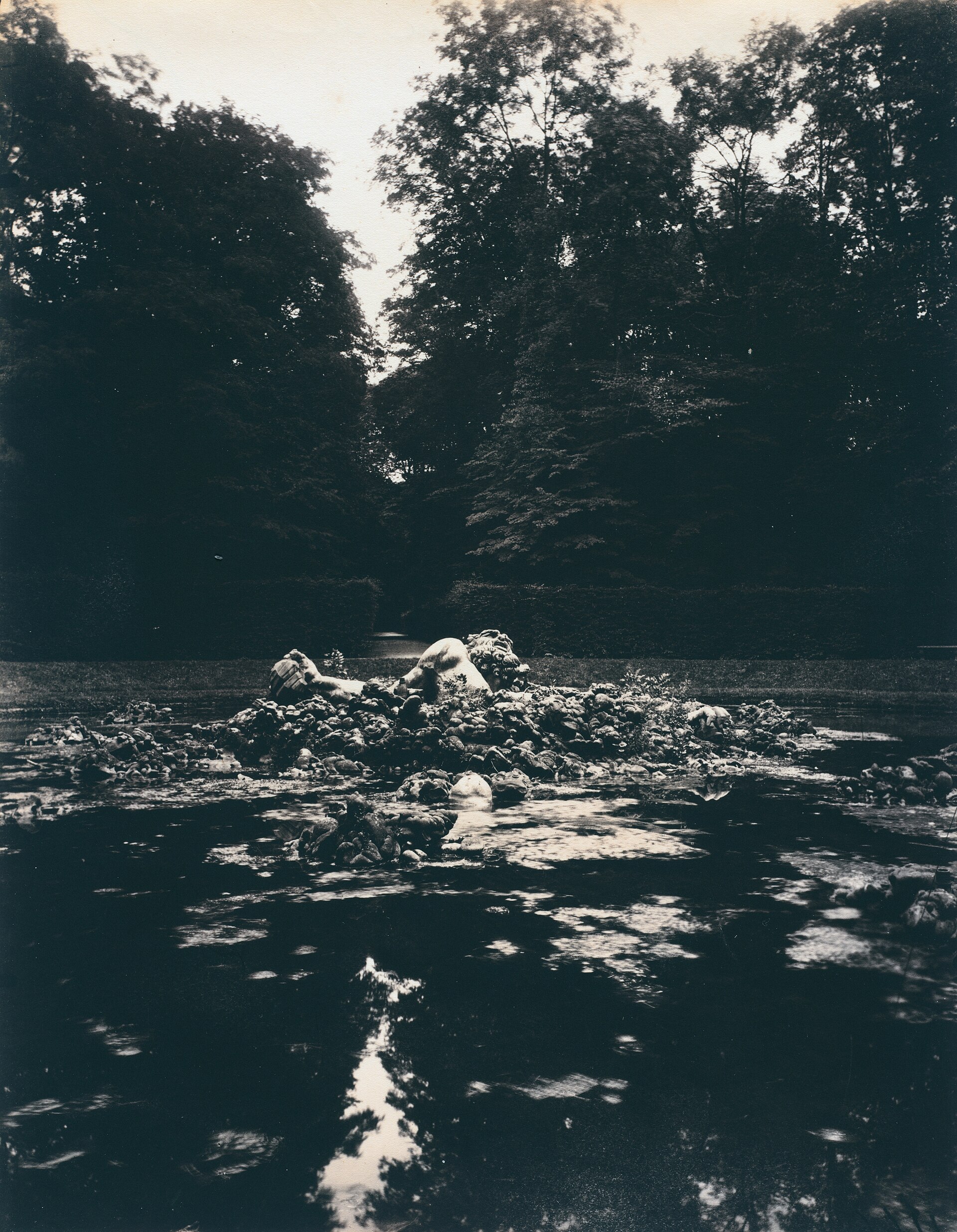
Versailles, Fountain of Enceladus
1922-1923 · Albumen print
Cleveland Museum of Art, Cleveland, Ohio
 French · 1857-1927
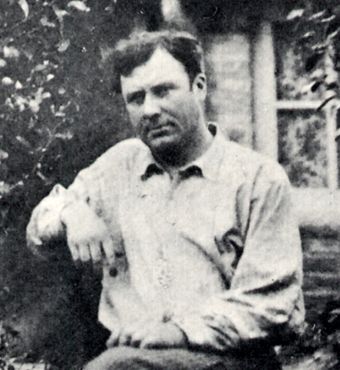
A photograph of Eugene Atget made around 1890, two years after his first dated photographs (Amiens and Beauvais, 1888) and about eight years before he began advertising his Paris business as Documents pour Artistes. The photographer is not identified in the source record. Held by the Bibliotheque nationale de France and published on the Library's own Atget exhibition pages. This is the earliest reasonably secure image of him found in the sources consulted; the better-known portraits of Atget in old age, made by Berenice Abbott in 1927, remain in copyright (Estate of Berenice Abbott, per the Getty Museum's own catalogue record for its impression) and could not be used on this page.
Bibliotheque nationale de France| Full name | Jean Eugene Auguste Atget |
|---|---|
| Worked as | Photographer |
| Born | 12 February 1857 · Libourne, near Bordeaux, France |
| Died | 4 August 1927 · Paris, France |
| Nationality | French |
| Movement | Documentary photography, applied retrospectively |
| In this archive | 1 artwork |
| Sources | 19 cited |
| Last verified |
About this page 1 artwork in the archive · Last verified · 19 sources cited
Eugene Atget spent almost his entire working life selling photographs as reference material, not as art, and he said so in writing. The reputation that now surrounds his name was built after his death by people who were not him: an American photographer who bought what was left of his studio, a New York dealer who helped her keep it through the Depression, and a museum curator who hung it on a wall forty years later and called it genius. Reading any claim about Atget as an artist, including the ones on this page, means reading it through that gap between what he thought he was doing and what later viewers decided he had done.
The thing most worth knowing about him is not any single photograph but the shape of the archive itself. He made roughly ten thousand negatives across about three decades and organized them into his own named series; no single institution holds them all. Roughly 2,600 went to the French state outright in 1920, another 2,000 or so went to the state at his death in 1927, and the largest single remaining block, 1,415 negatives and nearly 8,000 vintage prints, was sold by Berenice Abbott and Julien Levy to the Museum of Modern Art in 1968. A catalogue that treats the MoMA share as the whole of Atget is treating one wing of the archive as the building.
There is also a real, working authenticity problem behind the pictures on gallery and museum walls, and it is not about who made the negative. It is about who made the PRINT. Abbott printed extensively from Atget's glass negatives after his death, and institutions that hold both his own lifetime prints and her later ones, most explicitly the Philadelphia Museum of Art, distinguish them deliberately, because a vintage Atget print and a posthumous exhibition print of the identical image are different objects with different histories and different prices.
Born 12 February in Libourne, near Bordeaux.9
Makes his first dated photographs, of Amiens and Beauvais, at about age thirty-one, some years before he took up photography as a trade.9
A photograph of Atget, held today by the Bibliotheque nationale de France, is made by an unidentified photographer; this is the earliest reasonably secure image of him found in the sources consulted.1
By this date he advertises his business with a sign reading Documents pour Artistes, Documents for Artists.9
Sets up in Montparnasse; the Musee Carnavalet and the Bibliotheque Historique de la Ville de Paris begin buying individual prints from him.9
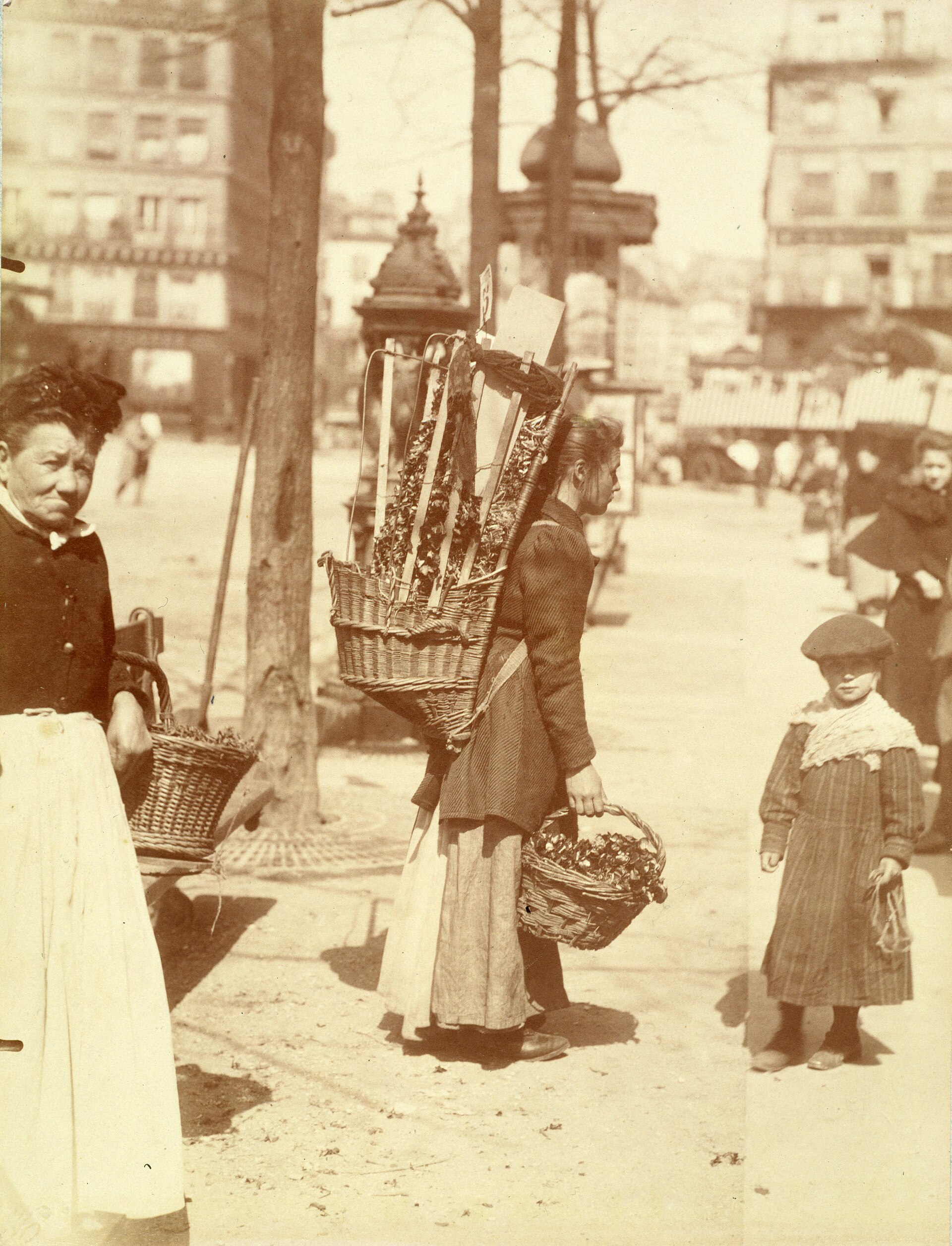
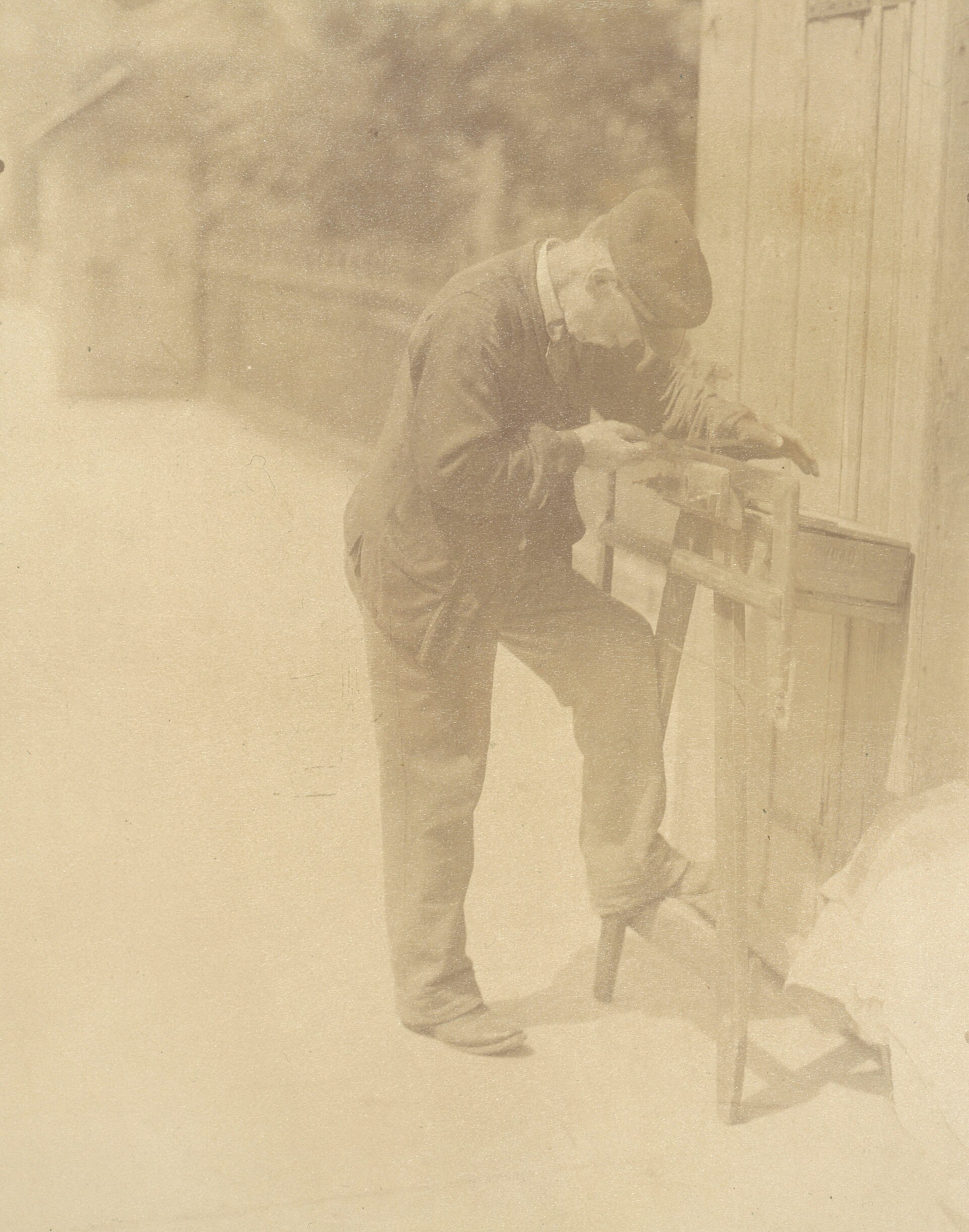
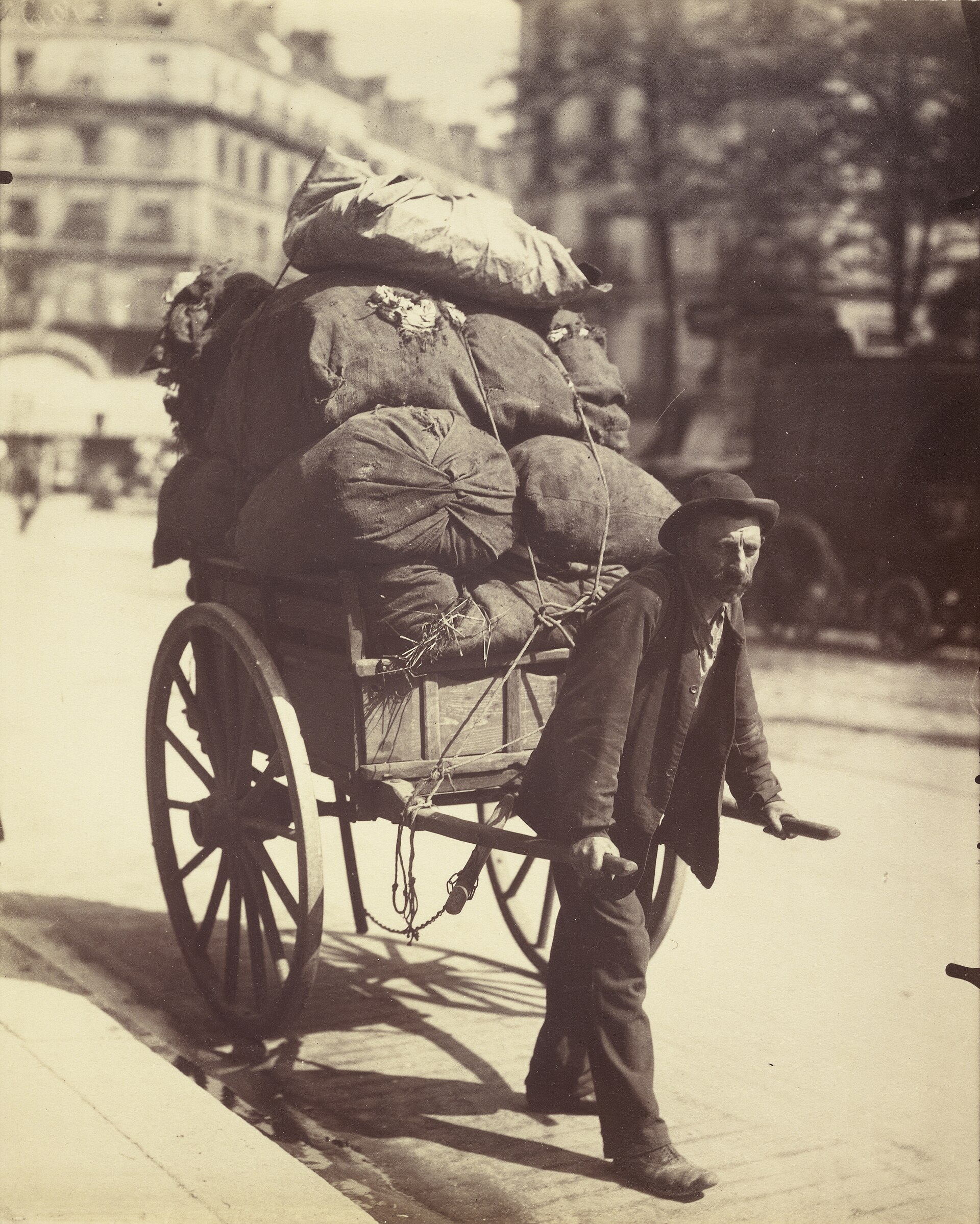
Makes his Petits Metiers, Small Trades, series, documenting street vendors and tradespeople including knife-grinders and ragpickers.245
Begins photographing the gardens of Versailles, Saint-Cloud and Sceaux, a subject he returns to for more than two decades.79
The Bibliotheque Historique de la Ville de Paris gives him a standing commission to record old Parisian buildings systematically before demolition.9
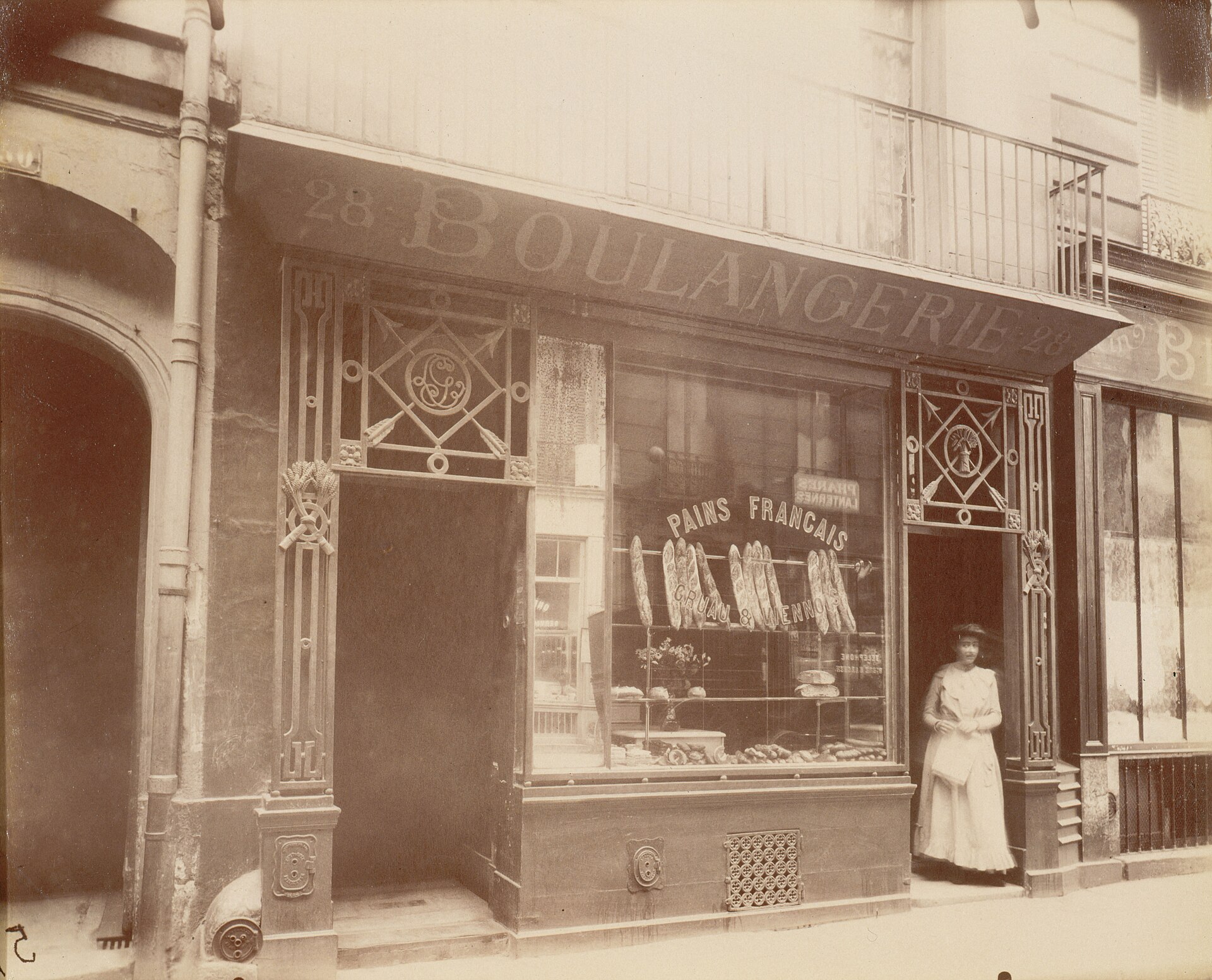
The Bibliotheque Nationale begins buying whole albums of his subject series; the same year he photographs a bakery at 28 rue des Blancs-Manteaux.39
Photographs the crowd watching the solar eclipse of 17 April at the Colonne de Juillet, later titled Pendant l'eclipse.9
Sells 2,600 negatives outright to the French state for 10,000 francs, one of the largest sales of his working life; the buying office is named as the Service Photographique des Monuments Historiques by the Smithsonian's National Museum of American History.919
Writes to Paul Leon of the French fine-arts administration summing up more than twenty years of work documenting old Paris as, in his own words, finished.9
Returns to Versailles in his sixties and photographs the Fountain of Enceladus, among other subjects from this later garden campaign.7
Berenice Abbott, then an assistant to Man Ray, visits Atget and begins buying prints from him.9
Man Ray buys about fifty Atget photographs and publishes several in La Revolution surrealiste, issue 7 of 15 June; Atget asks him not to be credited by name.9
Valentine Compagnon, his longtime companion, dies in June.918
Atget dies in Paris on 4 August.9
Andre Calmettes divides the studio's contents: roughly 2,000 old-Paris negatives go to the French state, the rest are sold to Berenice Abbott.9
Abbott publishes Atget, Photographe de Paris, the first monograph devoted to his work.9
During the Depression, Abbott sells half her Atget holding to the dealer Julien Levy to raise money.9
Abbott and Levy sell the remaining collection, 1,415 glass negatives and nearly 8,000 vintage prints from more than 4,000 distinct negatives, to the Museum of Modern Art.910
The Museum of Modern Art opens Atget, curated by John Szarkowski, on 1 December; a hundred duplicate prints from the collection go on sale the same month at the Robert Schoelkopf Gallery.10
The Philadelphia Museum of Art acquires the Julien Levy Collection: 361 photographs printed by Atget himself and 83 exhibition prints made posthumously by Berenice Abbott from his negatives.9
Christie's sells a print of Joueur d'Orgue for $686,500, from the collection of Tristan Tzara, an auction record for Atget.11
Sotheby's sells 48 of 60 Museum of Modern Art deaccession lots online for a $311,900 total, well below the aggregate presale low estimate.12
Atget's market has two tiers that behave very differently. A small number of documented, well-provenanced vintage prints of striking or rare subjects trade for six figures: a print of Joueur d'Orgue, from the collection of Tristan Tzara and one of only four known impressions, brought $686,500 at Christie's in 2010, still the artist's auction record. The much larger base of the market is the routine vintage or study print of a common Parisian view or garden subject, and it behaves differently: when the Museum of Modern Art itself deaccessioned sixty photographs through Sotheby's in October 2024, the sale totaled $311,900 against a presale low estimate of $764,000, and most lots sold below their individual low estimate. Institutional provenance and a well-known subject did not, on that evidence, guarantee a strong result.
| Date | Sale | Work | Result | Note |
|---|---|---|---|---|
| 15 April 2010 | Christie's | Joueur d'Orgue (Organ Grinder), c. 1898-1899, gelatin silver chloride printing-out paper print | Hammer Not published separately With premium $686,500 total price realized (source does not separate hammer from buyer's premium) USD | From the Baio Collection sale; estimate $100,000-150,000; from the collection of Tristan Tzara; one of four known impressions of this image, two in French collections and a fine impression in the Gilman Collection at the Metropolitan Museum of Art; the artist's auction record. |
| 18 October 2024 | Sotheby's | Parc de Sceaux (avril, 7 heures du matin) (statue), 1925, top lot of a 60-lot online sale, The World of Eugene Atget: Photographs from the Museum of Modern Art | Hammer Not published separately With premium $28,800 for the top lot; $311,900 total for the sale, inclusive of buyer's premium USD | Museum of Modern Art deaccession; 48 of 60 lots sold; presale estimate for the sale as a whole was $764,000-$1,180,000, quoted exclusive of premium; the large majority of lots sold below their individual low estimate. |
Hammer is the price at which the bidding stopped; with premium adds the fee the house charges the buyer on top. Hammer price and buyer's premium in the glossary.
| Institution | City | Holdings | Note |
|---|---|---|---|
| Bibliotheque nationale de France | Paris | Whole albums of his subject series, bought from about 1910 onward | |
| Musee Carnavalet / Bibliotheque Historique de la Ville de Paris | Paris | Individual prints bought from 1898; a standing commission from about 1906 to record old Paris before demolition | |
| Service Photographique des Monuments Historiques (French state) | Paris | 2,600 negatives bought outright in 1920, one of his largest lifetime sales | Buying office named per the Smithsonian's National Museum of American History; not independently confirmed against the office's own records this session. |
| Museum of Modern Art | New York | 1,415 glass negatives and nearly 8,000 vintage prints from more than 4,000 distinct negatives, bought from Berenice Abbott and Julien Levy in 1968 | Has since deaccessioned part of the holding through Sotheby's, most recently October 2024 |
| Philadelphia Museum of Art | Philadelphia | The Julien Levy Collection, acquired 2001: 361 photographs printed by Atget himself, 83 exhibition prints made posthumously by Berenice Abbott, and three albums Atget assembled himself | |
| Cleveland Museum of Art | Cleveland | Two Atget Versailles prints bought in 1985 with the John L. Severance Fund | Includes the Fountain of Enceladus print |
| Art Institute of Chicago | Chicago | Versailles material acquired independently of the 1968 MoMA purchase, including a Bassin de Neptune print accessioned in 1963 | |
| J. Paul Getty Museum | Los Angeles | Vintage Atget prints including Petits Metiers subjects, and separately a 1927 Berenice Abbott portrait of Atget | |
| Library of Congress | Washington, D.C. | About 20 prints made by Abbott from Atget's negatives in 1956 | The Library states it could not determine ownership of these prints |
| Metropolitan Museum of Art | New York | More than 140 objects under Atget's name in the museum's own online collection search |
Atget worked first as a sailor, then tried acting with a travelling troupe in the Paris suburbs and the provinces, where he met the actress Valentine Delafosse Compagnon.
Atget worked first as a sailor, then tried acting with a travelling troupe in the Paris suburbs and the provinces, where he met the actress Valentine Delafosse Compagnon. A vocal-cord infection ended his acting career in 1887, and he moved to the provinces and attempted painting without success. His first dated photographs, of Amiens and Beauvais, were made in 1888, when he was about thirty. That is a decade before the more commonly repeated story that he took up photography at forty-one, once he had settled in Montparnasse and begun advertising his services there; the 1888 negatives show that photography was already underway as a private pursuit well before it became his trade.
Some modern scholarship goes further and treats the standard picture of Atget as a poor, obscure eccentric with some suspicion. Sources consulted for this page note that his financial hardship may itself be partly a later invention, one that suited the romantic-outsider story told about him once he became famous, rather than a fact established from his own accounts. This page does not resolve that dispute; it records that it exists.
By 1891 Atget had a sign at his door reading Documents pour Artistes, Documents for Artists, and he used that description of his own work for the rest of his life.
By 1891 Atget had a sign at his door reading Documents pour Artistes, Documents for Artists, and he used that description of his own work for the rest of his life. The Musee Carnavalet and the Bibliotheque Historique de la Ville de Paris were buying individual prints from him from 1898; the Bibliotheque Historique gave him a standing commission around 1906 to record old Parisian buildings systematically before demolition, and the Bibliotheque Nationale began buying whole albums of his series from about 1910. A count credited to Alain Fourquier records 182 reproductions of 158 of his images across 29 publications from 1900 onward, and sales that sometimes exceeded 1,000 individual prints a year between 1898 and 1927 to institutional buyers alone.
One of the largest transactions of his working life, though sources consulted for this page do not establish it was the single largest, was not to an artist or a private collector. In 1920 he proposed, and by most institutional accounts completed, selling 2,600 negatives outright to the French state for 10,000 francs; several institutions, including the National Museum of American History, name the buying office as the Service Photographique des Monuments Historiques, though this record's own primary source for the sale, Atget's own 1920 approach to Paul Leon, confirms the proposal and the figures but not that specific office's name. No reliable period-wage comparison for the 10,000-franc figure has been found in the sources consulted for this page, and none is offered here rather than guessed at. Two years later, in a further letter to Paul Leon of the French fine-arts administration, Atget summed up more than twenty years of work in his own words: he had built, alone and on his own initiative, a collection of large-format negatives documenting the old streets of Paris, and by his own account the task was, at that point, finished.
The literature repeats a figure of about 10,000 negatives across Atget's career, organized by Atget himself into thirteen named series: Landscape Documents, Picturesque Paris, Art in Old Paris...
The literature repeats a figure of about 10,000 negatives across Atget's career, organized by Atget himself into thirteen named series: Landscape Documents, Picturesque Paris, Art in Old Paris, Environs, Topography of Old Paris, Tuileries, Vieille France, Interiors, Saint-Cloud, Versailles, Parisian Parks, Sceaux, and a smaller series on costumes and religious art. That figure is a synthesis across sources rather than a single archive's own count, and the reason is structural: the corpus was never assembled in one place.
The 2,600 negatives bought by the Monuments Historiques in 1920 sit in French state hands. A further roughly 2,000 negatives documenting old Paris were given to the French state by his friend Andre Calmettes at Atget's death in 1927. The Bibliotheque Nationale and the Musee Carnavalet hold what they bought as albums during his life. The largest remaining block, 1,415 glass negatives and nearly 8,000 vintage prints drawn from more than 4,000 distinct negatives, was sold to the Museum of Modern Art in 1968 by Berenice Abbott and the dealer Julien Levy. On the arithmetic available in the sources consulted, those three documented transfers account for something over 6,000 negatives against an estimated corpus of about 10,000; where the remaining share sits, and how much of it survives as a physical glass plate rather than only as a print, is not answered anywhere in the sources consulted for this page.
Valentine Delafosse Compagnon was a fellow actor Atget met while performing in small travelling troupes that toured the French countryside, and the sources consulted describe her as his lifelong...
Valentine Delafosse Compagnon was a fellow actor Atget met while performing in small travelling troupes that toured the French countryside, and the sources consulted describe her as his lifelong companion from that point on. She died in June 1926, a little over a year before Atget's own death on 4 August 1927. This page notes the order deliberately: an easy misreading of the record would have her outliving him, and the sources consulted do not support that.
Beyond her death date and her profession, the documented record of Valentine Compagnon's own life and role is thin. No source consulted for this page establishes that she managed sales of his prints to institutions or to the artists who bought from him; those sales, where documented, are recorded as Atget's own. No source consulted gives a precise figure for how many years the two were together, only that the companionship lasted from the acting years until her death. What is recorded is narrower and still worth stating: she did not live to see any part of what followed his own death the next year.
Man Ray lived on the same Montparnasse street as Atget, Rue Campagne-Premiere, and by 1925 his assistant Berenice Abbott had begun visiting Atget and buying prints from him.
Man Ray lived on the same Montparnasse street as Atget, Rue Campagne-Premiere, and by 1925 his assistant Berenice Abbott had begun visiting Atget and buying prints from him. Man Ray himself bought about fifty Atget photographs and collected them into an album embossed with Atget's name and his own, dated 1926. He published several of them that year in his journal La Revolution surrealiste, most famously in issue seven, 15 June 1926, where a photograph Atget had titled Pendant l'eclipse, showing a crowd watching the solar eclipse of 17 April 1912, ran under the invented caption Les Dernieres Conversions, The Last Conversions.
When Man Ray asked to use the picture, Atget's answer, as Man Ray later recalled it in a 1975 interview, was direct: "Don't put my name on it. These are simply documents I make." Atget did not regard himself as a Surrealist, and more than one scholar cited in the sources consulted treats that self-description as a considered position rather than modesty. Man Ray and Abbott read the same negatives differently: Man Ray proposed that Atget's staircases, doorways, ragpickers and especially his photographs of shop-window reflections, where foreground and background merge and mannequins look ready to step into the street, had a Dada or Surrealist quality. That reading was never Atget's own, and this page keeps the two apart rather than letting one stand in for the other: what Atget said his pictures were, on the record, and what people who admired them decided the pictures meant.
After Atget's death, Andre Calmettes divided the contents of the studio.
After Atget's death, Andre Calmettes divided the contents of the studio. Roughly 2,000 negatives documenting old Paris went to the French state; the remaining negatives and surviving prints were sold to Abbott. She spent the following four decades promoting the work in the United States through exhibitions, articles and books, at a time when Atget was still known chiefly to the small circle of artists and institutions who had bought from him directly. During the Depression she sold half her holding to the New York dealer Julien Levy to raise money; Levy found the prints hard to sell and, in practice, let Abbott keep access to them. In 1968 Abbott and Levy together sold what remained, 1,415 glass negatives and nearly 8,000 vintage prints, to the Museum of Modern Art, with the aid of a gift from Shirley C. Burden.
MoMA opened the exhibition Atget, curated by John Szarkowski, on 1 December 1969, and the museum's own press release for that show offers the closest thing to an institutional verdict this page can cite directly: "His pictures are as plain and transparent and precious as water. Individually they are like short beautiful sentences made of small and common words. Collectively they are a testament to the simplicity of genius." That same month, a hundred duplicate original prints from the collection went on sale at the Robert Schoelkopf Gallery in New York, a plausible route by which vintage Atget prints reached other American collections through the 1970s and 1980s.
Because Atget did not use an enlarger, every print he made himself is the same size as its negative, contact-printed onto commercially bought printing-out paper: true albumen paper for most of his...
Because Atget did not use an enlarger, every print he made himself is the same size as its negative, contact-printed onto commercially bought printing-out paper: true albumen paper for most of his career, and after the First World War, when that stock grew scarce, matte albumen or gelatin printing-out paper sold as aristotype, then gold-toned. Abbott printed from the same negatives after his death, on her own materials and by her own hand, to make exhibition prints for shows Atget never saw.
The clearest documented case of institutions telling the two apart is the Philadelphia Museum of Art's Julien Levy Collection, acquired in 2001: 361 of its Atget photographs were printed by Atget himself, many purchased by Levy directly from the photographer, while a separate 83 prints in the same collection were made posthumously by Abbott as exhibition prints, produced directly from Atget's glass negatives. That is not a case of forgery; nobody has hidden what Abbott's prints are. It is a case of the market and the scholarship needing to keep two categories straight that a museum wall label can easily blur, because a lifetime Atget print and a later Abbott print of the identical image carry different histories and, when either comes to market, different prices. No documented forgery case involving Atget's work has been found in the sources consulted for this page; the real authenticity question here is print generation, not fabricated authorship.
Atget's auction record is $686,500, paid at Christie's on 15 April 2010 for a print of Joueur d'Orgue, an organ grinder photographed around 1898 to 1899, against a presale estimate of $100,000 to...
Atget's auction record is $686,500, paid at Christie's on 15 April 2010 for a print of Joueur d'Orgue, an organ grinder photographed around 1898 to 1899, against a presale estimate of $100,000 to $150,000. The sheet came from the collection of Tristan Tzara and is one of only four known impressions of the image, two in French collections and a fine impression in the Gilman Collection at the Metropolitan Museum of Art; the source consulted does not separate a hammer price from the total with buyer's premium, and this page notes that rather than assuming one figure is the other.
That price sits far above the ordinary market for Atget. When the Museum of Modern Art itself deaccessioned part of its holding through an online sale at Sotheby's, 18 October 2024, titled The World of Eugene Atget, the result told a different story: 48 of 60 lots sold, for a total of $311,900 inclusive of buyer's premium, against a presale low-to-high estimate of $764,000 to $1.18 million quoted exclusive of premium. The top lot, a 1925 view of a statue in the Parc de Sceaux, brought $28,800, and the large majority of lots sold below their individual low estimate. A famous name, a MoMA provenance and a garden subject did not, on that evidence, guarantee a strong result; the rare, well-provenanced, singular print is a different market from the routine study print, and this page keeps them separate rather than quoting one price as if it stood for the whole body of work.
The Library of Congress holds about 20 prints made by Abbott from Atget's negatives in 1956, and states that it has been unable to determine the ownership of those prints, which makes them, in...
The Library of Congress holds about 20 prints made by Abbott from Atget's negatives in 1956, and states that it has been unable to determine the ownership of those prints, which makes them, in practical terms, orphan works. Abbott's own copyright over the selection and arrangement of Atget's photographs in her books is now held by Commerce Graphics. The Museum of Modern Art, which owns the largest surviving block of negatives, has reported that Atget left no heirs and that rights in the underlying negatives may have expired. None of that resolves the arithmetic gap noted above between the roughly 10,000 negatives commonly attributed to his career and the smaller number that can be traced through the documented institutional transfers; this page records the gap rather than closing it with an estimate.
Photographer. 1857-1927.
Born 12 February 1857, Libourne, near Bordeaux, France; died 4 August 1927, Paris, France.
Bibliotheque nationale de France (Paris); Musee Carnavalet / Bibliotheque Historique de la Ville de Paris (Paris); Service Photographique des Monuments Historiques (French state) (Paris); Museum of Modern Art (New York); Philadelphia Museum of Art (Philadelphia); Cleveland Museum of Art (Cleveland).
Atget's market has two tiers that behave very differently. A small number of documented, well-provenanced vintage prints of striking or rare subjects trade for six figures: a print of Joueur d'Orgue, from the collection of Tristan Tzara and one of only four known impressions, brought $686,500 at Christie's in 2010, still the artist's auction record.
Of the roughly 10,000 negatives commonly attributed to Atget's career, the documented institutional transfers found in the sources consulted account for something over 6,000 (2,600 to the Monuments Historiques in 1920, roughly 2,000 to the French state in 1927, 1,415 to the Museum of Modern Art in 1968). Where is the remainder, and how much of it survives as a physical glass plate rather than only as a print?
Last verified
One artwork and its story every Tuesday, with the picture: who owned it, what it made, and what closes soon in the exhibition calendar. No promotion, and nothing we cannot cite.
We send one email to confirm the address and keep nothing else. Every letter carries a one-click unsubscribe. How we handle your data.


