Andrea Mantegna
c. 1431-1506
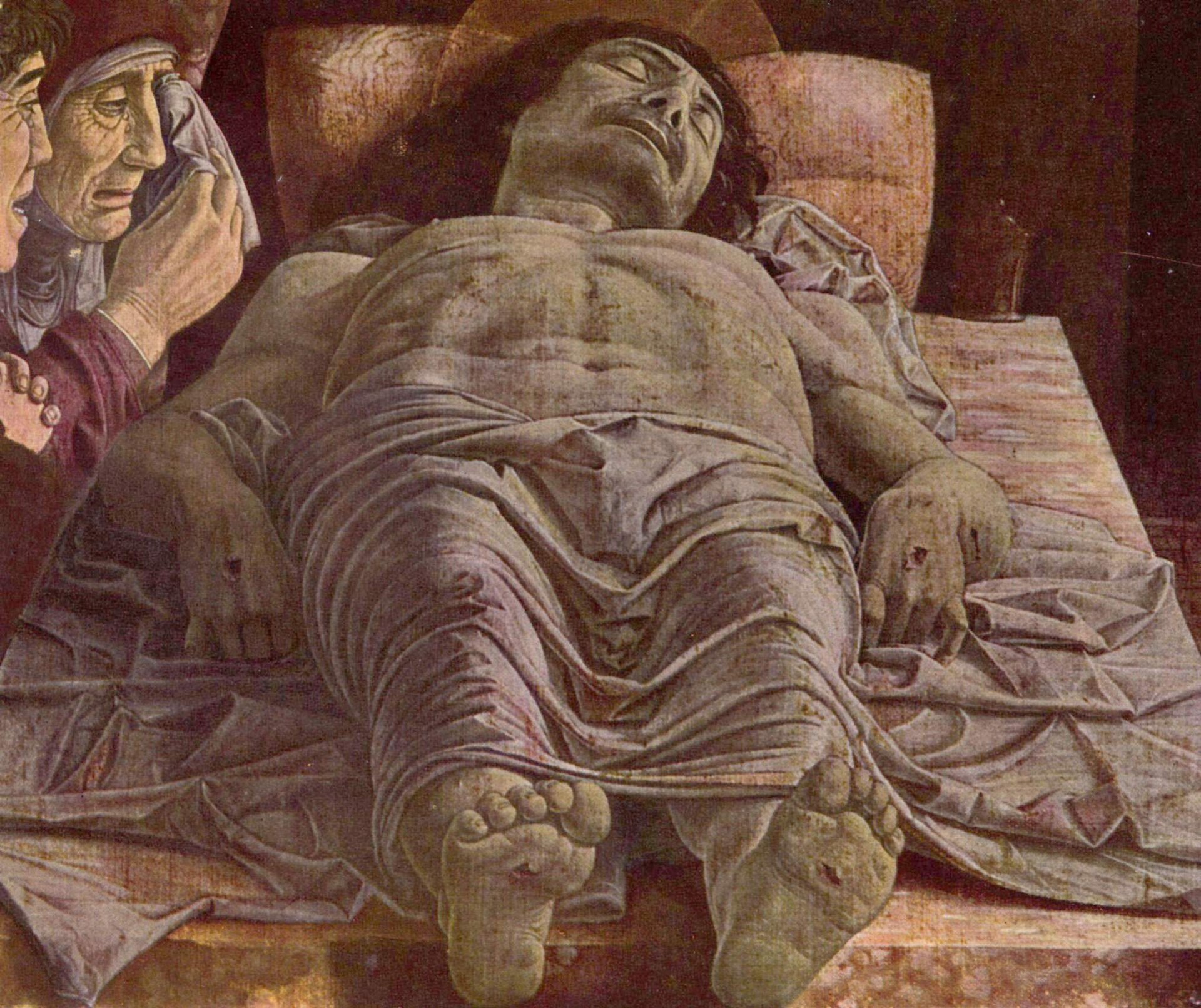
Lamentation over the Dead Christ Distemper on canvas, Pinacoteca di Brera, Milan. The most famous foreshortening in Italian painting, with deliberately small feet; the date is argued between about 1470 and 1501. No verified portrait. No securely identified likeness of this maker is available under a free licence. We do not publish a face we cannot verify.
Pinacoteca di Brera, Milan| Worked as | Painter, Engraver, Draughtsman, Court artist |
|---|---|
| Born | c. 1431 · Isola di Cartura, near Padua, Venetian Republic |
| Died | 13 September 1506 · Mantua |
| Nationality | Italian (Paduan, in Gonzaga service at Mantua from 1460) |
| Movement | Early Renaissance (Padua and Mantua) |
| Sources | 25 cited |
| Last verified |
About this page Last verified · 25 sources cited
On this page 13 sections
ContentsClose
Andrea Mantegna was a carpenter's son from the countryside near Padua who became the court painter of three generations of the Gonzaga at Mantua and the first great European artist to make prints. He is the painter of the foreshortened Dead Christ in the Brera, of the only room of his that survives complete, the Camera Picta in the Ducal Palace at Mantua, and of the nine canvases of the Triumphs of Caesar, which have hung at Hampton Court since the 1630s.
The point a reader probably does not know is how little of this can be counted. No authentication board exists, and none of the sources I could read gives one agreed number for his surviving paintings. Sotheby's put his known drawings at approximately 20 in 2020. The prints are worse: the usual reckoning gives his workshop about thirty plates, and a current view holds that he engraved seven himself, or none. The most famous set of prints that carries his name, the Mantegna Tarocchi, is not by him at all.
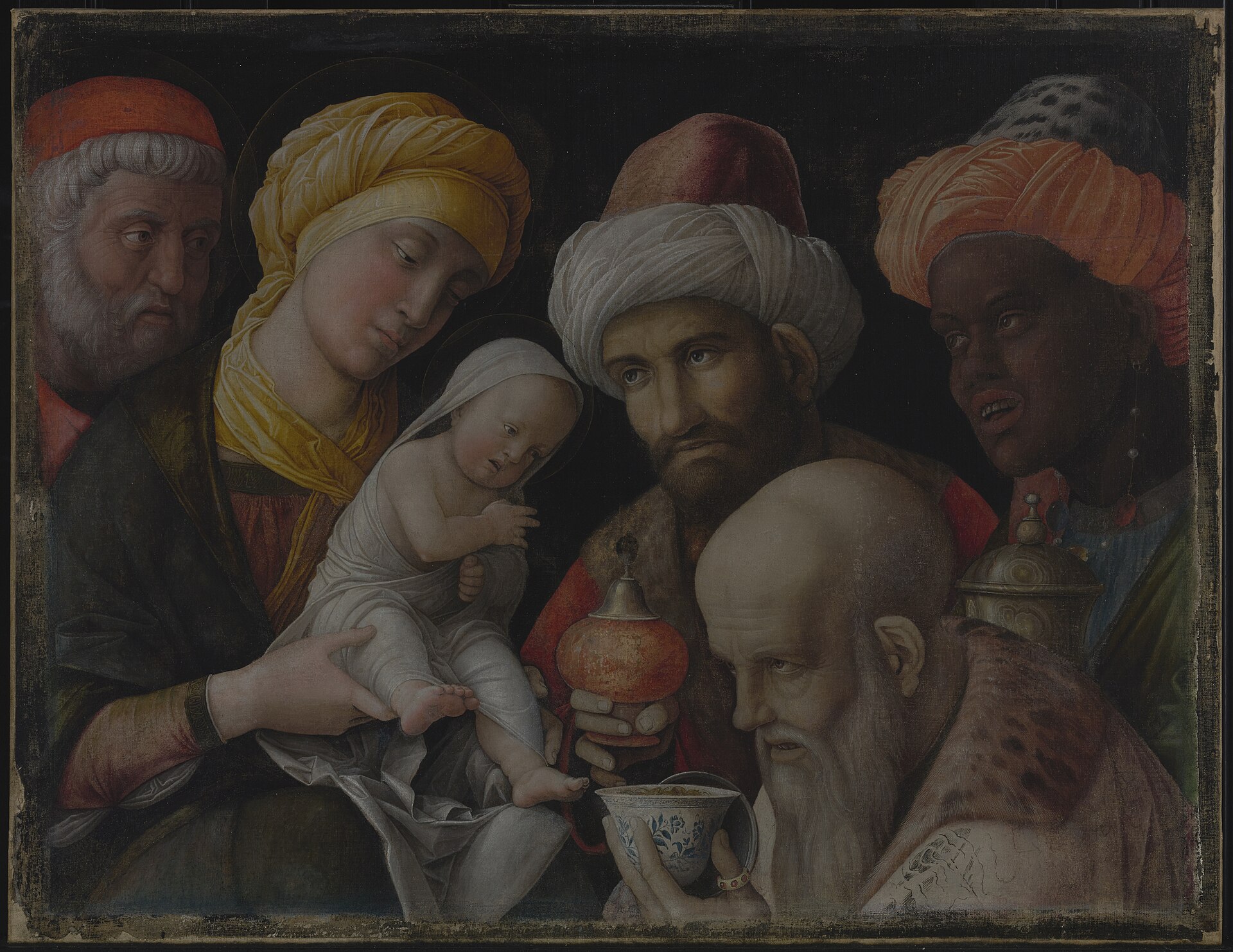
What exists instead is a documentary base (Kristeller, 1901), a monograph with a catalogue (Lightbown, 1986), a 1992 exhibition catalogue whose entries disagree with Lightbown on individual pictures, and a market in which the two highest painting prices I could find are the Getty Adoration of the Magi in 1985 (GBP 8.1 million, or USD 10.4 million to 10.45 million) and the Descent into Limbo in 2003 (USD 28.6 million in one report, USD 25.5 million in another). His most fragile pictures are distemper on thin linen, which is why so many are worn and darkened, and why a small Adoration of the Magi in the Getty Museum, once in an English country house, is one of the best preserved.
Images
Chronology
- c. 1431
Born at Isola di Cartura near Padua, the second son of a carpenter, Biagio; an inscription on a lost picture of 1448 said he was seventeen.67
- c. 1441
Adopted by the Paduan painter Francesco Squarcione, whose workshop held a collection of antique fragments for pupils to copy.123
- 1448
A document records his departure from Squarcione; in the same year he signs a lost altarpiece for Santa Sofia and contracts with three other artists for the Ovetari Chapel.612
- 1452
Painted the lunette over the west door of the basilica of Sant'Antonio at Padua; the lintel inscription names him and gives the date 22 July 1452.6
- 1453
Marries Nicolosia, daughter of Jacopo Bellini; on 10 August the abbot of Santa Giustina commissions the St Luke altarpiece for 50 gold ducats, finished by November 1454.67
- 1457
Ovetari frescoes finished; the widow of Antonio degli Ovetari sues him over the Assumption (eight of twelve Apostles, azurite for ultramarine) and the suit fails.622
- 1458
Ludovico Gonzaga offers him a salary of 180 ducats a year, a house, firewood and grain (per one source; another gives 75 lire a month).67
- 1460
Enters Gonzaga service at Mantua; moves his family there in December 1466.37
- 1464
Boat excursion on Lake Garda with Felice Feliciano, Samuele da Tradate and Giovanni da Padova, recorded by Feliciano.3
- 1465-1474
Paints the Camera Picta in the Castello di San Giorgio, Mantua: the date 1465 on a window jamb, a dedicatory inscription of 1474 over the door.611
- 1475
On 15 September Simone Ardizzoni writes to the Marquess accusing Mantegna of threats and violence over prints made for Zoan Andrea.2
- 1486
The Duke of Ferrara sees the Triumphs of Caesar 'which Mantegna is painting' in the old Gonzaga palace, the first mention of the series.46
- 1488-1490
In Rome for Innocent VIII, decorating a Vatican chapel destroyed in 1780.63
- 1495-1496
Paints the Madonna della Vittoria for 110 ducats; on 6 July 1496 it is carried in procession to its new church.6
- 1497
Parnassus completed for Isabella d'Este's studiolo; the Pala Trivulzio is signed and dated 15 August.6
- 1504
Acquires the rights to a funerary chapel in Sant'Andrea, Mantua.6
- 1505
Cornaro commissions the Introduction of the Cult of Cybele (March); Isabella writes that he must be satisfied if he is to finish her pictures.64
- 1506
Dies at Mantua on 13 September; the Triumphs are being prepared for a room at San Sebastiano.47
- 1516
His sons set up a monument to him in Sant'Andrea.7
- 1627-1629
Gonzaga picture sale to Charles I of England; the Triumphs probably reach Hampton Court in 1630 (sources date the sale 1627, 1628 or 1629; the National Gallery and most scholarly sources say 1629).3461721
- 1797
French forces take the San Zeno altarpiece, the Madonna della Vittoria and the St Luke altarpiece to Paris and Milan; the San Zeno main panels return in 1815.6
- 1944
The Ovetari Chapel frescoes are destroyed in an air raid on Padua; about ten per cent of the surface is later recovered in fragments.67
- 1962
John Brealey begins a twelve-year cleaning of the Triumphs under Anthony Blunt, after earlier restorations including paraffin wax.46
- 1985
The Getty Museum buys the Adoration of the Magi at Christie's, London, from the Marquess of Northampton's collection (18 April, lot 16).115
- 1992
Mantegna exhibition at the Royal Academy, London, then the Metropolitan Museum, New York; the catalogue edited by Jane Martineau.3
- 2003
The Descent into Limbo sells at Sotheby's, New York, on 23 January for USD 28.6 million as a total in one source (USD 25.5 million in another, possibly the hammer), from Barbara Piasecka Johnson's collection.61023
- 2018
A Resurrection panel in the Accademia Carrara, Bergamo, is identified as the top fragment of the Descent into Limbo.610
- 2020
Sotheby's sells the only known drawing for the Triumphs for USD 11.7 million; a Deposition is found at Pompei.5617
- 2023
Six of the nine Triumphs go on loan to the National Gallery, London, while the Hampton Court gallery is refurbished; the loan has been extended into 2026.86
The market
Very few Mantegnas come to market and the evidence is thin: the Getty bought the Adoration of the Magi at Christie's in 1985, the Descent into Limbo made USD 28.6 million at Sotheby's New York on 23 January 2003 (USD 25.5 million in another report, which may be the hammer), and the only known drawing for the Triumphs made USD 11.7 million at Sotheby's in January 2020, the fifth highest price for an Old Master drawing at auction. Sotheby's said only two other Mantegna drawings had reached auction in the previous half century. At the other end, a Dead Christ without the mourners, a version once supported as Mantegna's own model, made USD 416,000 at Christie's in 2016 as circle of Mantegna.
The price is set by attribution and medium more than anything else. A picture in good condition on linen with an unbroken English country-house history sold for a world record; a drawing bought for under USD 1,000 in Germany sold for USD 11.7 million after specialist examination; and the works most often damaged, the distemper canvases, rarely appear. None of the sources I read separates hammer from premium except by derivation, and each row below says so.
| Date | Sale | Work | Result | Note |
|---|---|---|---|---|
| 18 April 1985 | Christie's, London | Adoration of the Magi (distemper on linen, c. 1500), lot 16 of the Northampton sale; bought by the J. Paul Getty Museum | Hammer not separated in any source read With premium not separated; total reported as GBP 8.1 million (tertiary catalogue) or USD 10.4 million to 10.45 million GBP and USD, as reported | A then-record for an Old Master picture (Judd Tully) or for any picture (tertiary catalogue). Provenance per the Getty: Baroness Ashburton by 1871, then by inheritance in the Compton family to the 7th Marquess of Northampton. |
| 23 January 2003 | Sotheby's, New York | Descent into Limbo (tempera and gold on panel, 1492), from the Barbara Piasecka Johnson collection | Hammer USD 25.5 million (DERIVED reading: Wikipedia gives this figure without saying whether premium is included; the split is not published in anything I could open) With premium total USD 28.6 million (tertiary catalogue; 'more than USD 28 million' in The Art Newspaper); implied premium about USD 3.1 million, DERIVED by subtraction USD | Earlier owner Sir Stephen Courtauld; bought by Piasecka Johnson in 1988; a Frick Collection loan is mentioned by Wikipedia without a source. Buyer not identified in the sources read. The Bergamo Resurrection was later matched to its upper part. |
| 29 January 2020 | Sotheby's, New York (Old Master Drawings sale) | The Triumph of Alexandria (pen and ink, 26.6 by 26.6 cm), study for the second canvas of the Triumphs of Caesar | Hammer not stated in Sotheby's release; none found in any source I could open With premium total USD 11.7 million (Sotheby's); USD 11.65 million in a trade article and in the tertiary catalogue USD | Fifth most expensive Old Master drawing sold at auction and the most expensive in the United States; a trade report says it first appeared at a small German sale for under USD 1,000 (Sotheby's provenance lists a 1942 Leipzig sale as workshop of Mantegna, then a German private collection by descent); authorship established with infrared examination. |
| 2016-04 | Christie's, New York | Dead Christ without the mourners, a version once supported as Mantegna's modello, offered as circle of Mantegna | Hammer not separated With premium USD 416,000 total as reported USD | Shows the discount for attribution to the circle; from the Countess Nadia de Navarro collection. |
| 1912 | Berlin sale of the estate of Eduard Weber (auctioneer not named in the source) | Holy Family with a female saint, now at the Metropolitan Museum of Art | Hammer not separated With premium USD 160,000, described as a huge price USD | Weber had bought it in 1903 from a London dealer for GBP 4,000; it reached the Metropolitan Museum with the Altman bequest. |
Hammer is the price at which the bidding stopped; with premium adds the fee the house charges the buyer on top. Hammer price and buyer's premium in the glossary.
Where to see the work
| Institution | City | Holdings | Note |
|---|---|---|---|
| Palazzo Ducale (Castello di San Giorgio) | Mantua | The Camera Picta (Camera degli Sposi), 1465-1474 | The only complete room by him. Closed for almost three years after the May 2012 earthquake; check opening. |
| Royal Collection, Hampton Court Palace (six canvases on loan to the National Gallery) | London (Hampton Court) | The nine Triumphs of Caesar | The Mantegna Gallery in the Lower Orangery is being refurbished and six of the nine were loaned to the National Gallery from September 2023, with the loan extended into 2026 per Wikipedia; the National Gallery says the refurbishment is planned for completion in 2026. Check dates before travelling. |
| Pinacoteca di Brera | Milan | Lamentation over the Dead Christ, St Luke Altarpiece, Madonna and Child with Cherubs, San Bernardino | The Dead Christ was rehung at eye level after a 2013 low display. |
| Musee du Louvre | Paris | Parnassus, Minerva Driving the Vices, Madonna della Vittoria, the Crucifixion from the San Zeno predella and the Aigueperse St Sebastian | The Parnassus and the Minerva came from Isabella d'Este's studiolo via Richelieu. |
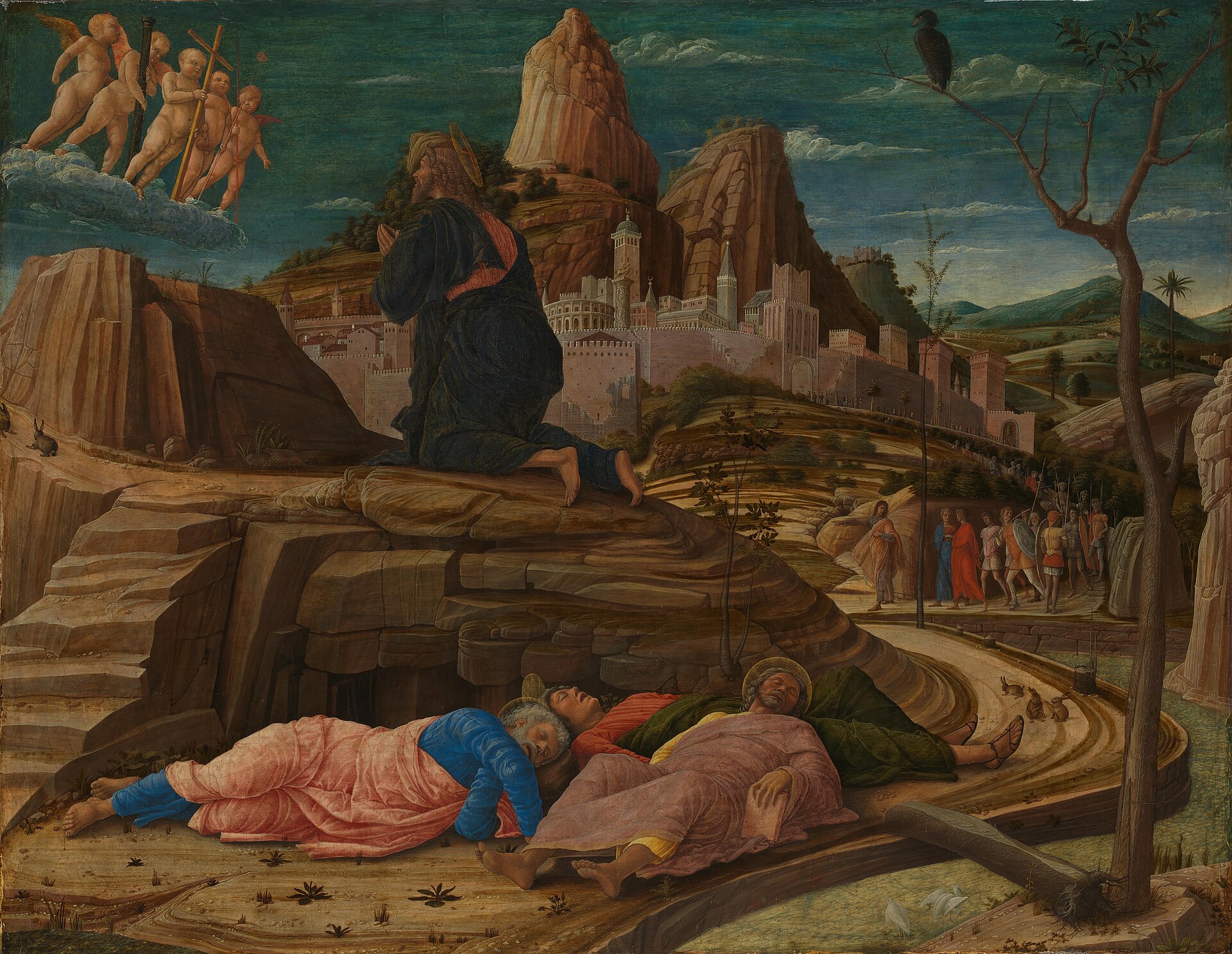
| National Gallery | London | Agony in the Garden, Madonna with Saints John the Baptist and Mary Magdalene, Introduction of the Cult of Cybele, Samson and Delilah, Tuccia and Sophonisba, Holy Family | The best British holding of his work outside the Royal Collection. |
| J. Paul Getty Museum | Los Angeles | Adoration of the Magi, distemper on linen | Not currently on view according to its online record. |
| Basilica of San Zeno Maggiore | Verona | San Zeno altarpiece (main panels and original frame) | The predella is in Paris and Tours; copies stand in its place. |
| Uffizi Gallery | Florence | Triptych of the Adoration of the Magi, Ascension and Circumcision; male portrait; Madonna of the Stonecutters | Different from the Getty Adoration. |
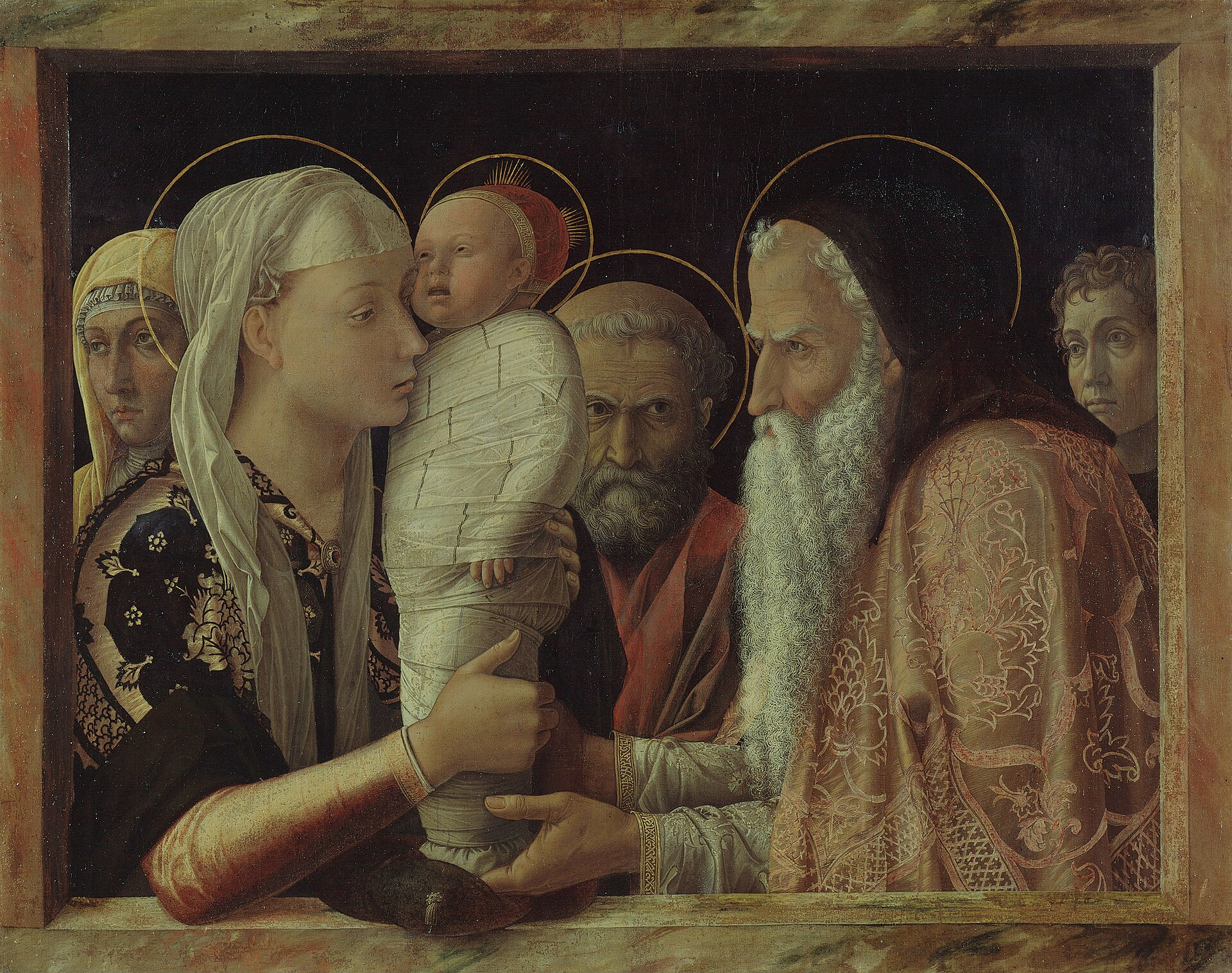
| Gemaldegalerie, Staatliche Museen | Berlin | Presentation in the Temple, Cardinal Ludovico Scarampi, Virgin and Sleeping Child | |
| Basilica of Sant'Andrea, Mantegna chapel | Mantua | His funerary chapel, the bronze bust, the unfinished Holy Family and pupil frescoes | Trevor-Roper notes a work from this chapel stayed in Mantua because he made it for himself, not the Gonzaga. |
| Chiesa degli Eremitani, Ovetari Chapel | Padua | Reconstructed fragments of the frescoes | Destroyed in 1944; only a fraction recovered. |
| Metropolitan Museum of Art | New York | Adoration of the Shepherds, Holy Family with a Female Saint, Madonna with Seraphim and Cherubim | |
| Statens Museum for Kunst | Copenhagen | Dead Christ with Two Angels (Man of Sorrows) |
Forgeries and misattributions
- Eric Hebborn and the Mantegna manner
- Hebborn (1934-1996), an English draughtsman, is listed by Wikipedia among the old masters, Mantegna among them, whose style he copied; his drawings were sold through auction houses including Christie's and Sotheby's. Hebborn's wider operation began to unravel in 1978 when Konrad Oberhuber of the National Gallery of Art, Washington, noticed the same paper in two drawings bought from Colnaghi (one given to Sperandio, one to Francesco del Cossa); Colnaghi told curators privately that Hebborn was the source, and he admitted to a number of forgeries in 1984. No individual Mantegna fake or its detection is documented in the sources I could open.14
- The 'Mantegna Tarocchi'
- Fifty-print sets in the style of the Ferrarese court, long given to Mantegna and later to Baccio Baldini, are by two anonymous masters and are not a playing deck. Style and sources: similarity to the Salone dei Mesi in the Palazzo Schifanoia, Ferrara, and A. M. Hind's case for the E series as the older. The misattribution came from confusion with the card game.13
- A circle-of Dead Christ without the mourners
- A canvas first recorded in 1941 with the New York dealer Jacob Heimann once attracted support as Mantegna's original modello; Christie's sold it in 2016 as circle of Mantegna. Not a forgery. The market resolved it with an attribution to the circle and a price of USD 416,000.6
The essay
Chapter 1No board rules on him, and the counts depend on who is counting
There is no single authoritative figure for Mantegna's surviving paintings in anything I could open, and no living committee issues one.
There is no single authoritative figure for Mantegna's surviving paintings in anything I could open, and no living committee issues one. The numbers that do exist belong to other media. Sotheby's said in January 2020 that his known drawings number approximately 20, that all but two are in major museums and that only two other Mantegna drawings had appeared at auction in the previous half century. For prints, the reckoning that has come down is about thirty plates from his workshop; the current Wikipedia summary of the debate reports a view that he engraved only seven himself, or none, and that another hand from the workshop, usually identified as Giovanni Antonio da Brescia (Zoan Andrea), made several. The best-known set of prints under his name, the Mantegna Tarocchi, is two sets of fifty engravings by two anonymous masters, and art historians no longer believe Mantegna engraved any of them.
The catalogue everyone argues with is Ronald Lightbown's Mantegna, with a complete catalogue of paintings, drawings and prints (Phaidon and Christie's, 1986). Paul Kristeller's monograph of 1901 is still the documentary base: Nicholas Penny, reviewing Lightbown in 1987, complained that scholars still had to go back to Kristeller for the archive documents because Lightbown quoted them only in translation. The 1992 exhibition catalogue edited by Jane Martineau (Royal Academy of Arts, London, then the Metropolitan Museum, New York) is where Keith Christiansen's dissenting entries sit, and the disagreements are specific. A damaged profile portrait in the Poldi Pezzoli in Milan was attributed to Mantegna by Roberto Longhi in 1962, rejected by Lightbown in 1986 and accepted by Christiansen in 1992 at a date of about 1448-50; the Cavallini to Veronese catalogue adds that Nicholas Penny asked whether it might be by Ercole de' Roberti (I could not find where Penny says this, so it rests on that tertiary page). A Holy Family with a female saint in the Castelvecchio, Verona, is a clearly autograph late work to Lightbown and, to Christiansen, a shop work of strikingly mediocre quality.
The count therefore moves with the scholar. The Cavallini to Veronese catalogue page, a tertiary list I used for locations, runs to roughly seventy entries once workshop pictures, grisailles of doubtful hand and fragments are included, and flags a good many of them as contested. That is a list of works that have been called Mantegna, not a count of works that are.
Chapter 2A carpenter's son, an adopted apprentice and a lawsuit over blue
Mantegna was the second son of a carpenter named Biagio.
Mantegna was the second son of a carpenter named Biagio. An inscription recorded on a lost picture said he was seventeen in 1448, which puts the birth in 1430 or 1431. He was apprenticed to Francesco Squarcione of Padua, and the Squarcione entry on Wikipedia says he was adopted around 1441, one of several talented pupils Squarcione adopted and, the same source suggests, put to work on commissions in Squarcione's name; a document of 1448 implies Mantegna left because of unreasonable exploitation. Hugh Trevor-Roper, reviewing the 1992 exhibition, describes the break as a legal separation from a possessive adoptive father; Cavallini to Veronese dates his freedom to January 1448, after a legal battle. In the last of the Ovetari frescoes, Trevor-Roper adds, Mantegna put a portrait of Squarcione as an ugly, pot-bellied executioner.
In 1448 he also contracted with three other artists to decorate the Ovetari Chapel in the church of the Eremitani at Padua, work that ran until early 1457, and in 1453 he married Nicolosia, a daughter of Jacopo Bellini and so the sister of Giovanni and Gentile. The chapel gave him a lawsuit that shows what a pigment meant in money. In 1457 the widow of Antonio degli Ovetari sued him over the fresco of the Assumption, claiming he had defrauded her by painting only eight of the twelve Apostles and by using azurite instead of the more expensive ultramarine for the blue of the Virgin's mantle. The two charges come from two tertiary sources: the Wikipedia article on the chapel gives the Apostles charge and says two Milanese painters, Pietro da Milano and Giovanni Storlato, were called in and accepted Mantegna's choice because of the lack of space, and the Cavallini to Veronese catalogue gives the azurite charge and says the suit failed. I have not seen the documents themselves, which are in Kristeller.
The chapel is also the clearest measure of what one raid can do to a painter's output. On 11 March 1944 a stick of bombs from an Allied air raid of 11 March 1944 on the adjacent railway yard destroyed nearly all of the frescoes. The Assumption and two Christopher scenes, detached in the 1880s, had been taken to Venice for safety; the rest became some eighty thousand fragments, and the partial reconstruction of 2000-06 could place only a small fraction of them, perhaps ten per cent of the original surface. A full set of black-and-white photographs taken days before the raid and nineteenth-century watercolour copies in the Victoria and Albert Museum are now the record of what Goethe saw.
Chapter 3The Paduan antiquaries and a boat on Lake Garda
The intellectual world Mantegna came from can be documented better than most painters'.
The intellectual world Mantegna came from can be documented better than most painters'. Squarcione, whose own work is thinly attested (only two signed pictures are known), kept a collection of antique statues, reliefs and casts that his pupils were taught to draw, and Padua, as Trevor-Roper puts it, was the city of Livy and Petrarch with a university that drew German and Hungarian scholars. Mantegna learned Latin, picked up some Greek and is credited with the illumination of at least one manuscript, a Latin translation of Eusebius executed at Padua in 1450. He signed the small Saint Sebastian now in Vienna in Greek letters on the pillar of the triumphal arch, which is a documented trace of his Greek, and his friends hailed him as the Apelles of his age.
The best-documented episode of his antiquarian life is an outing in 1464. The antiquary Felice Feliciano wrote an account of a party of four who sailed Lake Garda in a boat festooned with greenery, visiting churches and looking for Roman remains. They gave themselves Roman titles: the painter Samuele da Tradate was emperor, and Giovanni da Padova and Feliciano's 'incomparable friend' Mantegna were consuls. They copied inscriptions, thought they had identified a temple of Diana, and then, in Trevor-Roper's summary of Feliciano, went into a church to thank the Virgin and her Son for the idea of seeing the relics of antiquity. The account is documented, and it is evidence for Mantegna's epigraphic habits and for the way Christian devotion and pagan archaeology sat in one day without friction. It is not evidence of any doctrine.
Scholars disagree about what the antiquarianism meant. Bernard Berenson called Mantegna an archaist and, in Trevor-Roper's paraphrase, a purely pagan spirit with no religious sense; Ronald Lightbown, according to the same review, praises him for moving beyond antiquarian study to grasp the principles of classical sculpture; Sir Ernst Gombrich found very little pagan sensuality in him and much Christian devotion. These are positions argued in print by named scholars, and Trevor-Roper gives all three without choosing. The documented ground is narrower: Mantegna copied inscriptions, collected antique Roman busts (Wikipedia says some were given to Lorenzo de' Medici when Lorenzo visited Mantua in 1483) and, on the same source's account, openly avowed that ancient art was superior to nature because it was more selective in form.
Chapter 4What he was paid, and what the sources disagree about
The terms of the Gonzaga engagement are given two ways.
The terms of the Gonzaga engagement are given two ways. Wikipedia says Ludovico Gonzaga paid him 75 lire a month and calls that a sum large enough to mark the regard in which his art was held; the Cavallini to Veronese catalogue says that in April 1458 Ludovico offered him 180 ducats a year, a house, firewood and enough grain to feed a family of six. A third reading, from a course-material page found in a search and not used as a source here, gives fifteen ducats a month from 1459. The figures are in different units and none of the pages cites its document, so I have recorded them and not converted them. He entered Gonzaga service in 1460 and moved his family to Mantua in December 1466.
Picture prices that survive are specific. The St Luke altarpiece for Santa Giustina at Padua was commissioned on 10 August 1453 by the abbot, Mauro dei Folperti, for 50 Venetian gold ducats and finished by November 1454. The Madonna della Vittoria was painted between November 1495 and July 1496 for 110 ducats. For the Introduction of the Cult of Cybele, commissioned in March 1505 through a letter to Francesco Gonzaga by the Venetian Francesco Cornaro, a price of 150 ducats for the canvases of the series was agreed and Mantegna later demanded more. Those figures come from a tertiary catalogue; I found no source that puts any of them against a period wage or the price of a house, and have not invented a comparison.
The complaint side is as well recorded as the pay. Trevor-Roper notes that Isabella d'Este, a ruthless collector who drove hard bargains with Mantegna as with everyone, exploited him when he was old and in debt to secure at a knockdown price a marble bust of a Roman matron; Wikipedia names that bust as the Faustina and says the sale came very shortly before his death. In 1505, according to Charles Hope, Isabella wrote to her husband that 'If we want him to live and finish our pictures it is necessary that Your Excellency should satisfy him.' The honours also have a disputed record. Trevor-Roper says the Gonzaga knighted him and the Emperor made him a count palatine; Wikipedia says the knighthood came from Federico; the Cavallini catalogue reads the letters 'CP' after his name on a National Gallery picture as Comes Palatinus and dates the knighthood to 1469. Those three do not fit together without a document, and I have not supplied one.
Chapter 5The Camera Picta: a flattering room that records a meeting that never took place
The only room of Mantegna's that survives complete is a small square tower chamber in the Castello di San Giorgio, part of the Ducal Palace at Mantua, painted between 1465, the date on a window jamb...
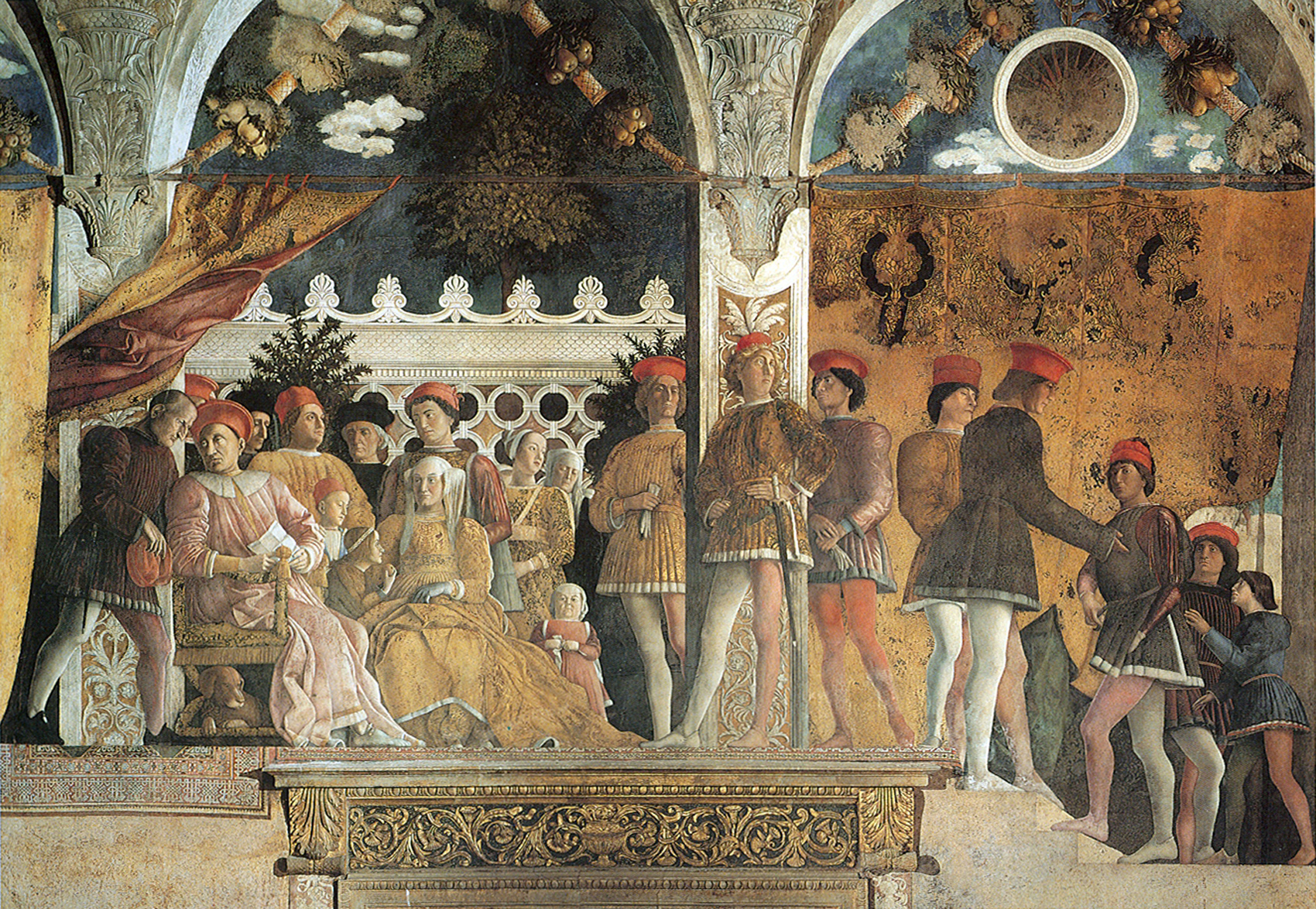
The only room of Mantegna's that survives complete is a small square tower chamber in the Castello di San Giorgio, part of the Ducal Palace at Mantua, painted between 1465, the date on a window jamb, and 1474, the date on Mantegna's dedicatory inscription over the door. Penny notes that Lightbown prefers the original name Camera Picta to the traditional Camera degli Sposi, 'bridal chamber'. The Cavallini catalogue says it was an audience chamber and not a bedroom; the Wikipedia article says it served several private and semi-private functions including as a bed chamber for Ludovico, and records that the hooks for a bed canopy are still in the ceiling. I have kept both readings.
Its function was political. Wikipedia's account is that the Gonzaga, who kept Mantua's autonomy against stronger neighbours such as Milan and Venice by hiring out their military support, wanted cultural credibility, and Ludovico reportedly sat in front of his own portrait in the Court Scene when he received distinguished visitors so that its non-idealised likeness would vouch for the rest. Penny reports that for Lightbown the chief theme is how a husband and wife rule their family and, behind them, the state; Lightbown is also the first, Penny says, to read the servants peering down from the ceiling with a huge potted plant balanced beside them as about to drop it on the viewer as a joke. The Meeting Scene shows Ludovico greeting his son Francesco, who ten days earlier had become a cardinal, with the Emperor Frederick III and King Christian I of Denmark among the figures; Wikipedia says the meeting itself never took place. The ceiling carries busts of the first eight Caesars and an oculus onto a painted sky, the first trompe l'oeil on record according to Trevor-Roper's review.
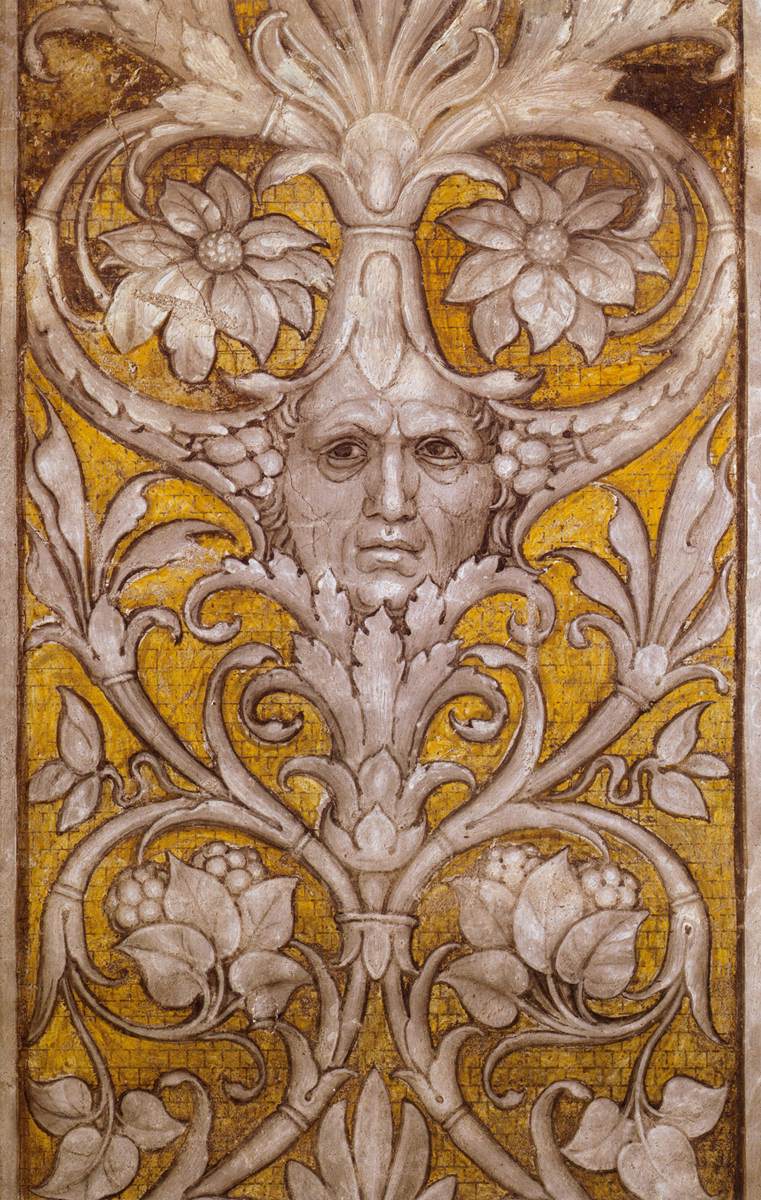
Cavallini to Veronese adds a small tradition that the plate on this page illustrates: among the foliage on a pilaster Mantegna has put a tiny self-portrait. That is the usual description of the grotesque mask on the pilaster, and no document names it, so it should be read as a tradition of attribution, not a fact. The room's condition history is also unusually detailed: the Meeting Scene was painted largely a secco on dry plaster and is in poorer condition; restoration by his sons was needed by 1506; imperial troops damaged it in the Sack of Mantua in 1630; it was badly restored under the Austrians in 1790, treated again in 1876-77, stripped of repaint in 1938-41 and given a last major restoration completed in 1991. It was closed for almost three years after the May 2012 earthquake reopened an old crack through the figure of the secretary.
Chapter 6The Triumphs of Caesar: who ordered them is still argued
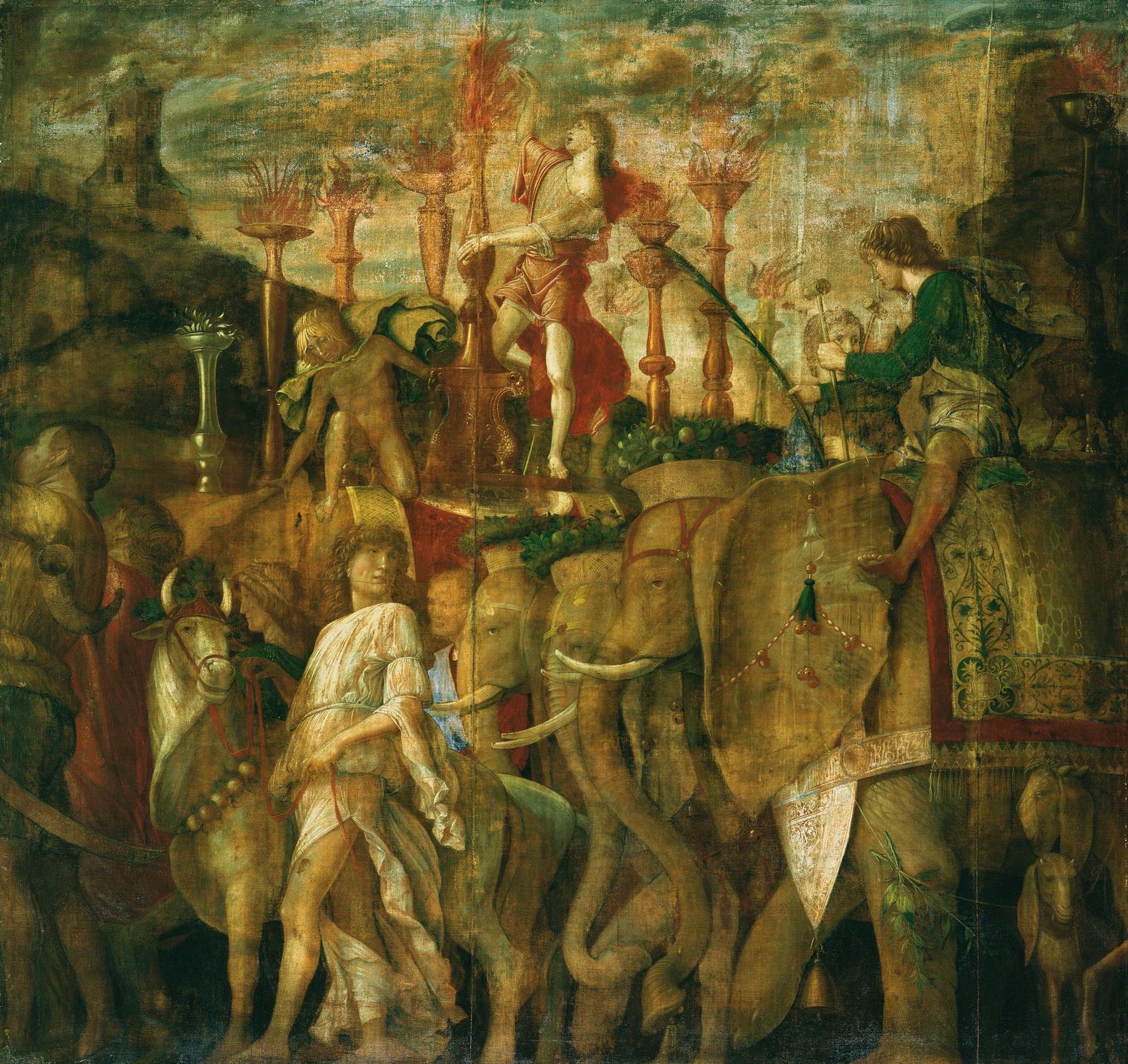
Nine canvases, each about 2.7 by 2.8 metres, show a single Roman triumph and are painted in egg and glue tempera on canvas.
Nine canvases, each about 2.7 by 2.8 metres, show a single Roman triumph and are painted in egg and glue tempera on canvas. They were Mantegna's most famous work for centuries: Hope notes that his name, alone among his contemporaries, kept appearing in lists of the greatest modern painters throughout the sixteenth century, principally on the strength of the Triumphs, and that a complete set of woodcuts after them was still being published in 1599.
The documentary evidence is, in Hope's word, sparse. They are first mentioned in 1486, when the Duke of Ferrara saw 'the Triumphs of Caesar which Mantegna is painting' in the old Gonzaga palace. Mantegna went to Rome in 1488-90 and was still working on them in 1492. A Ferrarese visitor in 1501 saw six of them used as scenery in a temporary theatre; in April 1506, five months before his death, preparations were being made to install the whole series in a purpose-built room in the new Palazzo di San Sebastiano. Hope infers from this that only six may have been finished by 1501 and the series completed late.
The patron is argued. Andrew Martindale, in his 1979 study of the series at Hampton Court, chose Ludovico Gonzaga, who died in 1478, because Ludovico alone is known without doubt to have had the learning to plan the subject. Hope, reviewing Martindale in 1980, preferred Ludovico's grandson Francesco, a soldier and horse-lover, partly because the Triumphs contain no allusion to the Gonzaga family and so read, he says, as a commission to let Mantegna show his gifts, and partly because Francesco is known to have written to the artist that they were a glory to have in his house and to have built a room for them. The Wikipedia page gives the commission as Federico or, more likely, Francesco. I did not find a document that settles it.
The programme is a small test of the rule that a resemblance is not a source. Martindale suggested hidden meaning in the frieze of sacrificial objects on the arch behind Caesar's chariot, reading it as a hieroglyphic inscription; Hope replies that nothing in Biondo or any ancient writer supports it and that Alberti, whom Mantegna had known, said sacrificial objects were simply frieze decoration on classical buildings. Hope's account of the sources is that Mantegna worked from Flavio Biondo's Roma Triumphans, published at Mantua; the Cavallini catalogue adds that Biondo transcribes Plutarch's account of the triumph of Aemilius Paulus and Appian's of Scipio Africanus. He then drew on drawings of Roman monuments for armour and insignia, and his anachronisms are those of an artist, not an archaeologist. That is an argued position, and it is the plainer one.
Chapter 7From the Gonzaga sale to Charles I, and then ruin and wax
The Gonzaga sale of paintings to Charles I of England is dated three ways in what I read: Trevor-Roper writes of the Mantuan sales to Charles I and his agents in 1627 and 1628, the Wikipedia...
The Gonzaga sale of paintings to Charles I of England is dated three ways in what I read: Trevor-Roper writes of the Mantuan sales to Charles I and his agents in 1627 and 1628, the Wikipedia biography of Mantegna gives 1628, and Hope, the Cavallini catalogue, the Wikipedia article on the Triumphs and the National Gallery's own page give 1629, with the canvases probably arriving at Hampton Court in 1630. The weight of the museum and scholarly sources is on 1629; 1627 and 1628 fit as the years of negotiation. The agent was the courtier Daniel Nys. The whole Gonzaga purchase is given as GBP 25,000 in Wikipedia, with no breakdown for the Triumphs.
After Charles was executed in 1649 the Triumphs were offered in the Commonwealth sale with a high reserve of GBP 1,000 (Cavallini; Wikipedia says they were valued at that sum) and, with the Raphael Cartoons, were withheld by Parliament, probably so they could be copied as tapestries; Wikipedia adds that Cromwell had Francis Cleyn prepare designs. They never left Hampton Court except for a few years at the Mortlake tapestry factory. Their condition did what their reputation had not. Louis Laguerre repainted them in 1701-02 and further restorations were, in Hope's description, disastrously misconceived, ending in a decision to immerse them in paraffin wax, which the Cavallini catalogue dates to the early 1930s. Roger Fry began repainting The Picture Bearers in 1910; Frances Spalding, quoted by Wikipedia, says one of his changes turned the Black standard-bearer into a white man, and Fry called the whole undertaking one of his maddest follies.
A new campaign began in 1962 under John Brealey with Anthony Blunt supervising, and ran for twelve years. One canvas, The Captives, was judged too damaged to restore. Blunt's judgment, as Wikipedia quotes him, was that the Triumphs may be a ruin but a noble one. Six of the nine have been on loan to the National Gallery in London since September 2023 while the Hampton Court gallery is refurbished, and Wikipedia says the loan was extended into 2026; the National Gallery's page says only that the Hampton Court refurbishment is planned to finish in 2026. A search summary of the Hampton Court site gave a reopening in spring 2027, which I could not open; confirm the dates before travelling.
The Triumphs also left one of the most surprising modern price stories in drawings. The only known preparatory study, a small pen-and-ink sheet for the second canvas, the Standard Bearers and Siege Equipment, 26.6 by 26.6 cm, first appeared at a small auction in Germany and sold for less than USD 1,000, according to a trade report (Sotheby's own provenance lists only a 1942 Leipzig sale, as workshop of Mantegna, then a German private collection by descent, so the date of the cheap sale is not stated in anything I read); it was unknown to scholars until it appeared in the Mantegna and Bellini exhibitions of 2018-19, and Cristiana Romalli at Sotheby's found a hidden figure of Helios under filtered infrared light that she said proved Mantegna's authorship. Sotheby's sold it in New York in January 2020 for USD 11.7 million.
Chapter 8Painted sculpture: distemper on thin linen and why it does not last
Mantegna's hardest technical problem is also the one that explains most of what survives.
Mantegna's hardest technical problem is also the one that explains most of what survives. Unusually for an Italian painter, according to the Cavallini catalogue, he often used distemper, water-soluble paint bound with animal glue or vegetable gum, on thin canvas or linen, and distemper paintings on canvas are especially fragile, so that many of his are damaged and darkened. The Getty Adoration of the Magi is the counter-example: it is distemper on fine linen, given by the Getty as an image size of 48.6 by 65.6 cm on a stretcher of 54.6 by 69.5 cm, and the Cavallini catalogue calls it unusually well preserved, while Lightbown in 1986 described it as rather worn and its support as fine canvas, as Penny notes. A tertiary source and a primary reviewer therefore weigh its condition differently, and a buyer should look at the picture, not the sentence.
The same material produced the pictures that shaped his later reputation, the monochromes. Penny describes them as monochrome paintings on fine linen, feigned reliefs of marble or gilded bronze set against a patterned alabaster ground, and ties them to Poliziano's contemporary habit of describing gems carved with the loves of the gods. They include the Samson and Delilah in the National Gallery, London (bought from the Duke of Marlborough in 1883 for 2250 guineas), the Judith in Dublin and the Introduction of the Cult of Cybele, also in London (bought in 1873 for GBP 1,500). The series are mostly not intact: the Judith and Dido at Montreal and the Tuccia and Sophonisba at London are thought to come from larger sets now split or lost, though the link is conjecture, and some pictures in the same manner, such as the Mucius Scaevola in Munich, are called a feeble pupil's attempt in the 1992 catalogue.
His other signature is foreshortening. The Lamentation over the Dead Christ in the Brera is famous for the virtuoso foreshortening of the body, and Trevor-Roper calls it wonderfully, and inexactly, foreshortened. The Cavallini catalogue notes that the inconsistencies of perspective seem deliberate, that without the small feet they would have hidden much of the body and appeared larger than the head, and that a suspicion that the three mourners were a later addition by another hand is unsupported by technical evidence. The date is argued: the Brera picture is 'about 1470-85' in the tertiary catalogue, 'between 1475 and 1501, probably in the early 1480s' in the Wikipedia article, and Wikimedia Commons labels it 1470-74. Nothing documents a commission. Competing explanations in the catalogue are a private exercise in perspective, a processional banner for a confraternity of Corpus Christi, a picture for his own funeral and a devotional picture for Cardinal Sigismondo Gonzaga, who claimed 'un Cristo in scurto' from the studio after his death. It was bought for the Brera in 1824 from the heirs of the painter Giuseppe Bossi, who had acquired it in Rome in 1806, and in December 2013 it was hung without its frame, 67 cm from the floor, in a black display case designed by Ermanno Olmi; it has since returned to eye level.
Chapter 9Prints: first drypoint, later engraving, and a workshop whose names were erased
Mantegna was, in Penny's phrase, the first great European artist to make prints, and also one of the first to make highly finished drawings as works in their own right.
Mantegna was, in Penny's phrase, the first great European artist to make prints, and also one of the first to make highly finished drawings as works in their own right. How the prints were made is still an open question. Wikipedia says he never signed or dated a plate except for one disputed instance of 1472, that Vasari's story of him starting to engrave in Rome after seeing Florentine prints is now thought most unlikely and that the technique of the workshop is marked by parallel hatching. Penny reports a more specific argument by David Landau in 1979, building on an unpublished 1977 Courtauld report by Godfrey Evans: early, richly printed impressions of Mantegna's prints, seen under magnification, are drypoints and not engravings, so only a very few could be taken, and the plates would have become worthless unless a specialist with a burin reworked them. Landau read a documented quarrel in the light of that.
The quarrel is a letter of 15 September 1475 from Simone Ardizzoni of Reggio, a painter and engraver, to the Marquess. Simone said that Mantegna, who had offered him work, turned 'indemoniato' when Simone spent four months remaking prints for Zoan Andrea, and that Mantegna sent a Florentine to threaten him, organised a gang that tried to murder him and Zoan Andrea and then got crooks to accuse him of sodomy, a capital offence, so that he fled to Verona. Lightbown, according to Penny, suggested only that Mantegna was anxious to recruit Simone to engrave his designs. Landau's proposal was that the plates Simone was working on were Mantegna's own, sold off as exhausted and reworked into engravings. Penny's judgement is that Lightbown did not engage with the technical observations on which this depends. The state of the question is: documented letter, argued reconstruction, no settlement.
The labour behind the name is the standard attribution-erasure problem. Wikipedia names the workshop's second engraver as Giovanni Antonio da Brescia, also called Zoan Andrea. Penny thinks it more likely than not that there is only one Zoan Andrea in Mantegna's circle, against Lightbown's caution about identifying the man in the letter with the later signer of engravings after Mantegna's designs. The Madonna and Child known as the Madonna della Tenerezza survives in only two first-state impressions, one in the British Museum and one in the Albertina, and David Landau called it arguably the most beautiful print of the Italian Renaissance; a miniature on parchment replicating it, now on loan to the Padua museums, was argued in 2006 by Lionello Puppi to be by Mantegna himself, against the alternative of a skilled imitator. Prints also carried the Triumphs around Europe: seven prints of three of the compositions were in circulation by the late 1490s or early 1500s, according to the tertiary catalogue.
Chapter 10Isabella d'Este's rooms: the Parnassus, the Minerva and a patron saint
After 1497 Mantegna worked for Isabella d'Este, who had married Francesco Gonzaga by proxy on 11 February 1490, with the wedding celebrations following on 15 February (Trevor-Roper's review dates the...
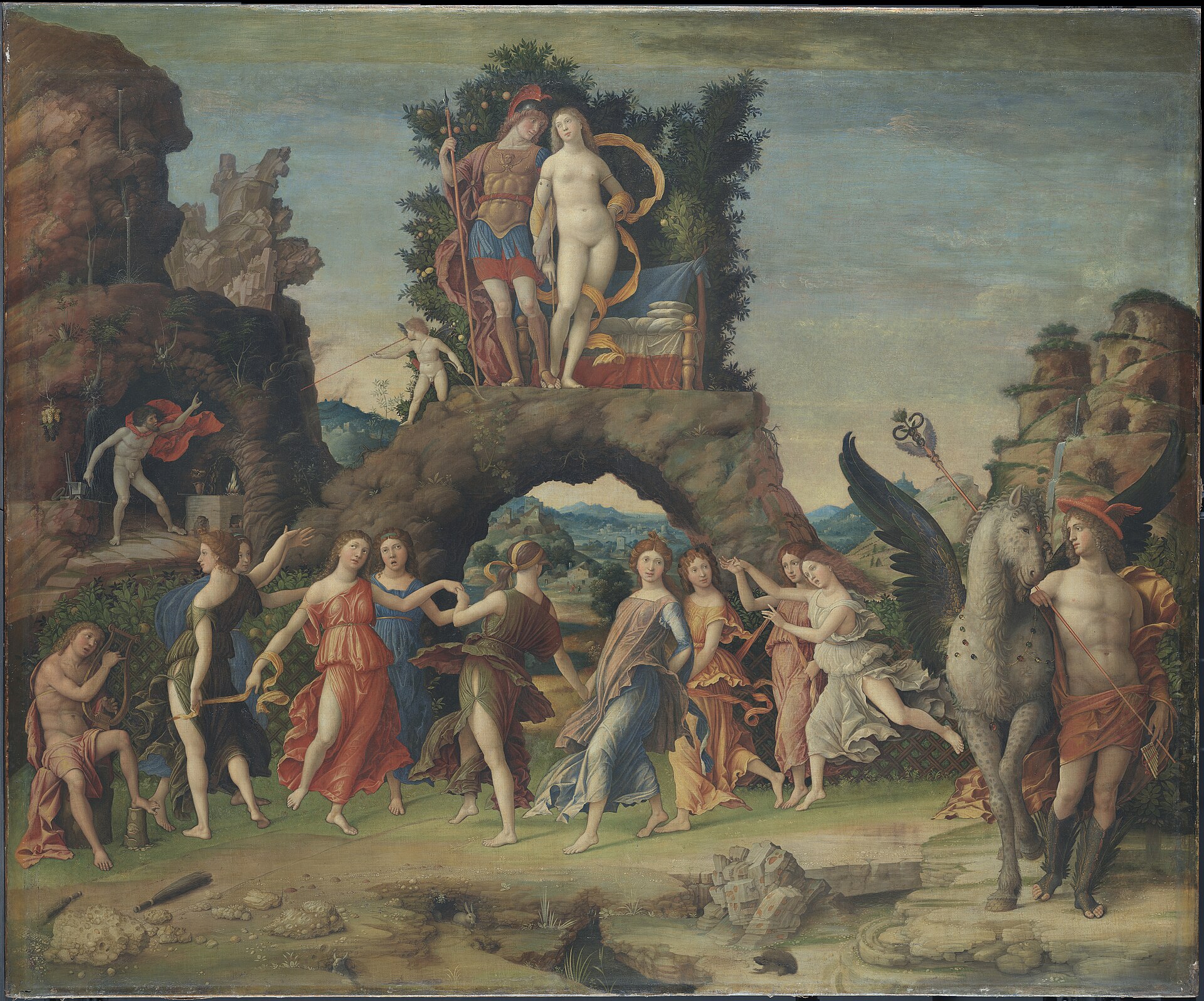
After 1497 Mantegna worked for Isabella d'Este, who had married Francesco Gonzaga by proxy on 11 February 1490, with the wedding celebrations following on 15 February (Trevor-Roper's review dates the marriage to 1486, which does not agree with the other sources), on paintings for her first studiolo in the Castello di San Giorgio. The Parnassus, completed by July 1497, and the Minerva Driving the Vices from the Garden of Virtue, probably complete by 1502, were followed by a Comus left unfinished at his death, and the series was filled out by Perugino, Costa and later Correggio. The Cavallini catalogue says that the seven pictures from the studiolo were probably given by the last Duke of Mantua to Cardinal Richelieu, hung at the Chateau de Richelieu by the 1630s and are now all in the Louvre. Trevor-Roper notes that Isabella gave strict and detailed orders to artists and scholars.
The meaning of the Parnassus is contested, and the contest is a good example of how not to read a painting. The documented evidence is a poem by Battista Fiera addressed to Isabella, which Penny describes as alluding to an earlier poem in which Fiera had taken the painting of Venus with Mars as a portrait of Isabella; he then apologises, because the presence of the jealous Vulcan in the background shows that Venus was not portrayed respectably. Lightbown, by Penny's account, read the picture through a Platonic allegory of two Venuses, celestial and earthly, and found in it the extinction of sensual lust; Penny objected that Fiera, who knew both patron and painter, plainly did not read it that way, and that the arrow is far too long for the boy's bow. Roger Jones argued the Fiera reading in the Journal of the Warburg and Courtauld Institutes in 1981, and Janet Cox-Rearick proposed in 1984 an astrological reading that the picture alludes to the date of Isabella's wedding, 11 February 1490, when Mars, Venus, Mercury and the star of Pegasus stood in Aquarius. These are proposals made in print by named scholars; none is established, and the idea that the central Muse is a portrait of the pregnant Isabella is traced to Bernard Berenson in the tertiary catalogue, with nothing earlier behind it.
The Madonna della Vittoria is the opposite kind of case, where the patron's function is documented and the reading is not. It was carried in procession on 6 July 1496, the first anniversary of the battle of Fornovo, to the new church of Santa Maria della Vittoria in Mantua. The cost of the picture and of the church was extracted from a Jewish banker, Daniele de Norsa, whom the tertiary catalogue says had destroyed a frescoed Madonna on his house, as an expiation. Penny, summarising Lightbown, gives a different cause, that the banker had inadvertently excited popular hatred, and adds that Francesco was persuaded by his brother Sigismondo and clerical advisers to force the payment and to let them demolish the house. The two accounts of the reason do not agree, and I have not seen the document. Lightbown argued that St Elizabeth and the infant Baptist beside the throne allude to baptism, the rite that separates Christians from Jews. Penny's counter-argument, from other scholars, is that Elizabeth was Isabella's own patron saint, kneeling opposite Francesco because Isabella's own portrait had been proposed for that place; he judges it most unlikely that she was removed in the interest of such an allusion. Antisemitism, Penny agrees, lies behind the commission; whether it is in the picture is a different question.
Chapter 11After 1506: the chapel, the studio and a bust nobody can place
Mantegna bought the rights to a funerary chapel in the church of Sant'Andrea at Mantua in 1504 and was buried there.
Mantegna bought the rights to a funerary chapel in the church of Sant'Andrea at Mantua in 1504 and was buried there. The Cavallini catalogue records that his Holy Family for its altar was left in his studio at his death and is much abraded, that some critics think pupils finished it, and that the frescoes in the chapel, probably planned by him, were executed entirely by pupils including his son Francesco and, according to tradition, the young Correggio; Wikipedia states outright that Correggio decorated the dome. Wikipedia dates the monument his sons set up to 1516.
The studio's contents were contested at once. The tertiary catalogue says Cardinal Sigismondo Gonzaga claimed a Dead Christ in foreshortening from the studio, that the Saint Sebastian now in the Ca d'Oro was claimed by Ludovico Gonzaga, then Bishop of Mantua, and that the Cybele canvas was initially taken by Sigismondo and later restored to its rightful owner, the Cornaro commission. Before his death he had also had to part with an antique bust (Wikipedia: the Faustina), which Trevor-Roper describes as a marble bust of a Roman matron that Isabella took at a knockdown price. Pictures labelled after Mantegna were often given to his son Francesco, but the same catalogue says no documented work by Francesco survives, and that Gianfrancesco Caroto, some of whose work Vasari says Mantegna passed off as his own, and Francesco Bonsignori were among the assistants.
The one portrait of him with a claim to authority is the bronze bust set on a disc of porphyry in a carved stone frame in that chapel; the Commons record dates it to the 1510s. Its maker is argued three ways in what I read. The Cavallini catalogue says it was probably made by Mantegna himself, and Trevor-Roper calls it his bronze bust of himself; the caption of Kristeller's 1901 plate, reproduced on Wikimedia Commons, attributes it to Gian Marco Cavalli with a question mark; and an old photograph in the Fondazione Zeri archive is captioned with the sculptor Sperandio's name. Trevor-Roper adds that a coloured plaster cast was in the 1992 exhibition and reports two readings of the face by museum scholars: to Keith Christiansen a Roman stoic philosopher, disdainful of the world; to Lawrence Gowing, 'stony hostility'. None of this is evidence of what Mantegna looked like in life.
Chapter 12Napoleon, thieves and the pictures that were found
Mantegna's altarpieces were scattered by war and then by theft.
Mantegna's altarpieces were scattered by war and then by theft. Napoleon's agents took the San Zeno altarpiece from Verona to Paris in 1797; the main panels were returned in 1815 and the predella stayed, with the Crucifixion in the Louvre and two panels in Tours, replaced at San Zeno by copies. The Madonna della Vittoria was taken to Paris the same year and hung in the Tuileries; it was not returned after Napoleon's fall because, according to the tertiary catalogue, the Austrian government was reluctant to embarrass the French king. The French removed the St Luke altarpiece from the abbot's private rooms at Padua in 1797 and sent it to Milan, and a small Judgement of Solomon from the Duke of Modena was surrendered to Napoleon under an armistice. The Cavallini catalogue also reports the left panel of the San Zeno altarpiece being stolen in 1973 and returned after a ransom of eight million lire, and the Castelvecchio in Verona losing seventeen works in November 2015, among them a Holy Family, all recovered some six months later.
The corpus also moves the other way. In 2018 Italian press reports said a small Resurrection in the Accademia Carrara at Bergamo, bequeathed in 1866 and long given to the workshop or to Francesco Mantegna, was the top fragment of the Descent into Limbo, identified through a tiny cross that continues the staff held by Christ. In 2020 a battered canvas of the Deposition was found in a corridor of the Sanctuary at Pompei and was tied to a Mantegna altarpiece mentioned in 1524 at San Domenico in Naples; the tertiary catalogue says it was the focus of an exhibition at the Vatican Museums in 2025. A Gardner Museum sacra conversazione carries a signature and is nevertheless sometimes given to the school, and a Head of Christ at Correggio, inscribed as painted by Andrea Mantegna out of charity on 5 January 1493, was acquired under dubious circumstances, harshly cleaned and published in 1916; the owners reclaimed it in a lawsuit in 1917.
Chapter 13What the market has paid, and why the sale prices are so few
Most of the pictures sit in institutions, so the evidence is thin and the three public yardsticks are far apart in kind.
Most of the pictures sit in institutions, so the evidence is thin and the three public yardsticks are far apart in kind. The Getty Adoration of the Magi was sold by the 7th Marquess of Northampton at Christie's, London, on 18 April 1985 as lot 16 and bought by the J. Paul Getty Museum; the Getty's own provenance runs back through the Northampton line, by inheritance from the Baroness Ashburton of Grange Park, Hampshire, who held it by 1871. Judd Tully reported the price as USD 10.45 million, a then-unheard-of figure for an Old Master; the tertiary catalogue gives GBP 8.1 million and calls it then a world record for any picture. None of the sources I read separates hammer from premium for that sale.
The 2003 sale of the Descent into Limbo (the picture formerly owned by Sir Stephen Courtauld, bought in 1988 by Barbara Piasecka Johnson) at Sotheby's New York took place on 23 January 2003 according to a search summary of Artprice, which I could not open. The Cavallini to Veronese catalogue gives USD 28.6 million and The Art Newspaper says it sold for more than USD 28 million; Wikipedia gives USD 25.5 million without saying whether that includes the premium. The reading that 25.5 million is the hammer and 28.6 million the total is DERIVED from the pair (the gap is about USD 3.1 million, in line with a premium on a hammer of that size) and I have not seen a Sotheby's statement or the premium schedule; the split is unpublished in anything I could open. In 2020, as above, Sotheby's gave the drawing as USD 11.7 million and called it the fifth most expensive Old Master drawing sold at auction and the most expensive in the United States; I did not find a hammer figure in any source I could open, and the Antiques Trade Gazette report on the sale was behind a paywall.
The cheap end is the opposite lesson. A version of the Dead Christ without the mourners, which had some support as Mantegna's original modello, sold at Christie's New York in April 2016 for USD 416,000 with an attribution to Mantegna's circle, against a Brera picture that the trade press calls one of the best-known symbols of the Italian Renaissance. Older sales show how prices have moved: the National Gallery paid 1072 guineas for a Madonna in 1855, 1700 guineas for the Tuccia and Sophonisba in 1882 and 2250 guineas for the Samson and Delilah in 1883; Dresden paid 40,000 marks in 1876 for the Holy Family bought in Venice by Eastlake; and a Holy Family with a female saint fetched USD 160,000, called a huge price, in the 1912 Berlin sale of Eduard Weber's estate before reaching the Metropolitan Museum with the Altman bequest.
Chapter 14Forgeries, look-alikes and what has been taken out of the corpus
Mantegna's reputation has been used in two different ways to sell things that are not his.
Mantegna's reputation has been used in two different ways to sell things that are not his. The first is outright forgery. Eric Hebborn, the English draughtsman who died in 1996 after being found with head injuries in a Rome street, listed Mantegna among the old masters whose style he copied, and the Wikipedia account of his career says the fakes began to unravel in 1978, when Konrad Oberhuber of the National Gallery of Art in Washington noticed the same kind of paper in two drawings bought from the dealer Colnaghi, one given to Savelli Sperandio and one to Francesco del Cossa; Hebborn is said to have made at least 500 more drawings between 1978 and 1988 and admitted to a number of forgeries in 1984. I could not open the catalogue record of any Hebborn drawing in Mantegna's style (the one I tried sat behind a bot challenge, which I did not try to get past), so no individual Mantegna fake is described here.
The second is misattribution by name. The so-called Mantegna Tarocchi are the best case: the name is a mistaken confusion with the card game, the prints are educational images of social classes and abstractions, and each set is by an anonymous master, with Ferrara around 1465 for the E series and 1470-75 for the S series considered most likely, though place and dates remain debated. The Washington Judith, in colour, is called by Keith Christiansen the work of a miniaturist pasticheur and has been tentatively given by David Alan Brown to Giulio Campagnola; the Mucius Scaevola in Munich was accepted by Morelli, Berenson and Cruttwell and then judged a feeble pupil's attempt. The Saint Euphemia in Naples, signed and dated 1454, is a real picture, but the life-size statue of the same saint at Irsina, which Clara Gelao published as Mantegna's only known sculpture in 1996, was given to Pietro Lombardo by Matteo Ceriana the next year.
What is documented
Technique
The surviving work
- What is accepted
- No source I could open gives one agreed figure for the surviving paintings, and I have not supplied one. What is stated: approximately 20 known drawings (Sotheby's, January 2020, all but two in major museums); about thirty engraved plates traditionally from his workshop, of which a current view allows him seven, or none; roughly seventy entries, including workshop pictures, fragments and contested grisailles, on the Cavallini to Veronese tertiary list. The count of autograph paintings depends on whose catalogue is used.
- What is contested
- Individual attributions swing between Lightbown (1986) and Christiansen in the 1992 exhibition catalogue: the Poldi Pezzoli profile portrait (Longhi accepted 1962; Lightbown rejected; Christiansen accepted at c. 1448-50; the tertiary catalogue says Penny wondered about Ercole de' Roberti), the Castelvecchio Holy Family (autograph to Lightbown, a mediocre shop work to Christiansen), the Washington Judith (a miniaturist's pastiche to Christiansen and to David Alan Brown, who tentatively names Giulio Campagnola) and the Mucius Scaevola in Munich (a pupil's attempt). The Tarocchi prints were removed from him in the nineteenth century. The Bergamo Resurrection was moved into the corpus in 2018 as part of the Descent into Limbo.
- Who rules on attribution
- No authority and no authentication board. Attribution is argued case by case in museum catalogues and exhibition catalogues against Lightbown (1986) and Martineau (1992). Sotheby's relied on its own specialist, Cristiana Romalli, with infrared examination, for the 2020 drawing.
Catalogue raisonne
- Ronald Lightbown, Mantegna, with a complete catalogue of the paintings, drawings and prints (Oxford: Phaidon and Christie's, 1986; 512 pp.). The standard modern catalogue. Penny (LRB, 1987) praises the amount of reliable information in the catalogue and asks for more consistent attention to technique and condition, and notes that the documents still have to be read in Kristeller.2
- Paul Kristeller, Andrea Mantegna (English edition, 1901). The documentary base, with an appendix of archive documents that Lightbown quotes only in translation; the 1901 plate of the Sant'Andrea bust comes from it.218
- Jane Martineau (ed.), Andrea Mantegna, exhibition catalogue, Royal Academy of Arts, London, and the Metropolitan Museum of Art, New York, 1992 (Olivetti/Electa, 499 pp.). Entries by Keith Christiansen and others; the place where several of Lightbown's attributions are reversed.3
- Andrew Martindale, The Triumphs of Caesar by Andrea Mantegna in the Collection of Her Majesty the Queen at Hampton Court (London: Harvey Miller, 1979). The reference monograph on the series. Hope (LRB, 1980) disagrees with its patron (Ludovico) and with its reading of hidden meaning.48
- Mauro Lucco, 2015 monograph on Mantegna (cited by the tertiary catalogue; not seen). Not examined; recorded as the most recent monograph named in the sources.6
Questions about Andrea Mantegna
Who was Andrea Mantegna?
Painter; Engraver; Draughtsman; Court artist; Antiquarian. c. 1431-1506.
When did Andrea Mantegna live?
Born c. 1431, Isola di Cartura, near Padua, Venetian Republic; died 13 September 1506, Mantua.
How are fakes and misattributions of Andrea Mantegna detected?
Eric Hebborn and the Mantegna manner. Hebborn (1934-1996), an English draughtsman, is listed by Wikipedia among the old masters, Mantegna among them, whose style he copied; his drawings were sold through auction houses including Christie's and Sotheby's.
Where can you see work by Andrea Mantegna?
Palazzo Ducale (Castello di San Giorgio) (Mantua); Royal Collection, Hampton Court Palace (six canvases on loan to the National Gallery) (London (Hampton Court)); Pinacoteca di Brera (Milan); Musee du Louvre (Paris); National Gallery (London); J. Paul Getty Museum (Los Angeles).
What does the market for Andrea Mantegna look like?
Very few Mantegnas come to market and the evidence is thin: the Getty bought the Adoration of the Magi at Christie's in 1985, the Descent into Limbo made USD 28.6 million at Sotheby's New York on 23 January 2003 (USD 25.5 million in another report, which may be the hammer), and the only known drawing for the Triumphs made USD 11.7 million at Sotheby's in January 2020, the fifth highest price for an Old Master drawing at auction. Sotheby's said only two other Mantegna drawings had reached auction in the previous half century.
What is still unresolved about Andrea Mantegna?
How many surviving paintings are by his own hand? No source I could open gives a figure; the answer depends on whether workshop pictures, grisailles and fragments are admitted, and whose catalogue is followed.
Open questions
- How many surviving paintings are by his own hand? No source I could open gives a figure; the answer depends on whether workshop pictures, grisailles and fragments are admitted, and whose catalogue is followed.
- Who commissioned the Triumphs of Caesar and when? Martindale favoured Ludovico Gonzaga and Hope favoured Francesco; the first record is only 1486.
- What is the Parnassus about? Fiera's poem shows contemporaries could not agree; Lightbown's Platonic reading, Roger Jones's 1981 argument and Cox-Rearick's astrological date of 1490 remain proposals.
- When, for whom and for what was the Dead Christ painted? Datings run from 1470 to 1501 and the commission is unknown.
- Did Mantegna engrave any plate himself? Estimates run from about thirty from the workshop to seven, or none; Landau's drypoint hypothesis and the Zoan Andrea question are unsettled.
- Who made the bronze bust in Sant'Andrea, and is it a likeness from life? Mantegna himself, Gian Marco Cavalli and Sperandio have each been named.
- Where was the Getty Adoration before 1871, and was an export licence application ever made in 1985? The Getty record begins with Baroness Ashburton by 1871 and I found no export-licence record.
- What were the real hammer and premium figures for the 2003 Descent into Limbo and the 2020 drawing, and who bought them? Only totals are published in the sources I opened.
- How much was a ducat worth in a Padua or Mantua craftsman's wage? I found no sourced comparison and have not made one.
- Were the pay terms 75 lire a month or 180 ducats a year? The two figures are not reconciled in any source I read, and Trevor-Roper's date of 1486 for Isabella's marriage disagrees with the 1490 given by Wikipedia's Isabella d'Este article and the catalogue.
Sources
- 1J. Paul Getty Museum, Collection Online, Andrea Mantegna, Adoration of the Magi, 85.PA.417 (record and provenance), read 23 November 2026. getty.edu/art/...
- 2Nicholas Penny, 'Mantegna's Revenge', London Review of Books 9:15, 3 September 1987 (review of Lightbown). lrb.co.uk/v09/...
- 3Hugh Trevor-Roper, 'Mantegna', New York Review of Books, 28 May 1992 (review of the Royal Academy and Metropolitan Museum exhibition). nybooks.com/articles/...
- 4Charles Hope, 'Mantegna's Classical World', London Review of Books 2:12, 19 June 1980 (review of Martindale). lrb.co.uk/v02/...
- 5Sotheby's press release, Masters Week auctions in New York achieve USD 94.3 million, 31 January 2020 (Primary: the auction house; hammer not stated). sothebys.com/en/...
- 6'Mantegna', Cavallini to Veronese (online catalogue of Italian paintings; , replace with museum and catalogue entries). cavallinitoveronese.co.uk/mantegna
- 7Wikipedia, 'Andrea Mantegna' (; replace with Britannica or a printed monograph). en.wikipedia.org/wiki/...
- 8Wikipedia, 'Triumphs of Caesar (Mantegna)' (; Royal Collection Trust entry and Martindale 1979). en.wikipedia.org/wiki/...
- 9Wikipedia, 'Adoration of the Magi (Mantegna)', the Uffizi triptych (). en.wikipedia.org/wiki/...
- 10Wikipedia, 'Descent into Limbo (Mantegna)' (; Sotheby's 2003 sale record). en.wikipedia.org/wiki/...
- 11Wikipedia, 'Camera degli Sposi' (; Palazzo Ducale entry). en.wikipedia.org/wiki/...
- 12Wikipedia, 'Francesco Squarcione' (). en.wikipedia.org/wiki/...
- 13Wikipedia, 'Mantegna Tarocchi' (; British Museum and National Gallery of Art catalogue entries). en.wikipedia.org/wiki/...
- 14Wikipedia, 'Eric Hebborn' (). en.wikipedia.org/wiki/...
- 15Judd Tully, 'Old Master Nets Record $35 Million; Pontormo Portrait Sold to Getty Museum' (market report that gives Mantegna's Adoration of the Magi at Christie's, London, April 1985, as USD 10.45 million). juddtully.net
- 16'Mantegna: Adoration of the Magi', Art at All Prices blog, 18 December 2007 (; gives USD 10.4 million). priceofart.blogspot.com/2007/...
- 17'A Newly Discovered Drawing by Renaissance Master Andrea Mantegna Fetches US$11.65m at Auction', TheValue.com, 2020 (trade article). en.thevalue.com/articles/...
- 18Wikimedia Commons, File:Mantegna Bronze Bust San Andrea Mantua.png (Autotype Company plate, 1901, from Kristeller; public domain). commons.wikimedia.org/wiki/...
- 19Wikimedia Commons, File:Mantegna Andrea, Ritratto di Andrea Mantegna, 107193.jpg (Fondazione Zeri photograph; caption attributes the bust to Sperandio). commons.wikimedia.org/wiki/...
- 20Wikipedia, 'Lamentation of Christ (Mantegna)' (). en.wikipedia.org/wiki/...
- 21The National Gallery, London, 'Andrea Mantegna, The Triumphs of Caesar' (museum page: acquired from the Gonzaga collection by Charles I in 1629; six canvases on display; Hampton Court refurbishment planned for 2026), read 23 November 2026. nationalgallery.org.uk/paintings/...
- 22Wikipedia, 'Ovetari Chapel' (; the Imperatrice Ovetari suit of 1457, eight Apostles instead of twelve, settled in Mantegna's favour by two Milanese painters). en.wikipedia.org/wiki/...
- 23The Art Newspaper, 'Italian museum discovers painting by Renaissance master Andrea Mantegna in its collection' (Bergamo Resurrection; the Descent into Limbo sold for more than USD 28m at Sotheby's New York in 2003). theartnewspaper.com/news/...
- 24Wikipedia, 'Isabella d'Este' (; proxy marriage 11 February 1490, celebration 15 February). en.wikipedia.org/wiki/...
- 25Sotheby's, lot page 'Andrea Mantegna, The Triumph of Alexandria' (Old Master Drawings, 29 January 2020; provenance and 266 by 266 mm; infrared note on Helios). sothebys.com/en/...


Last verified