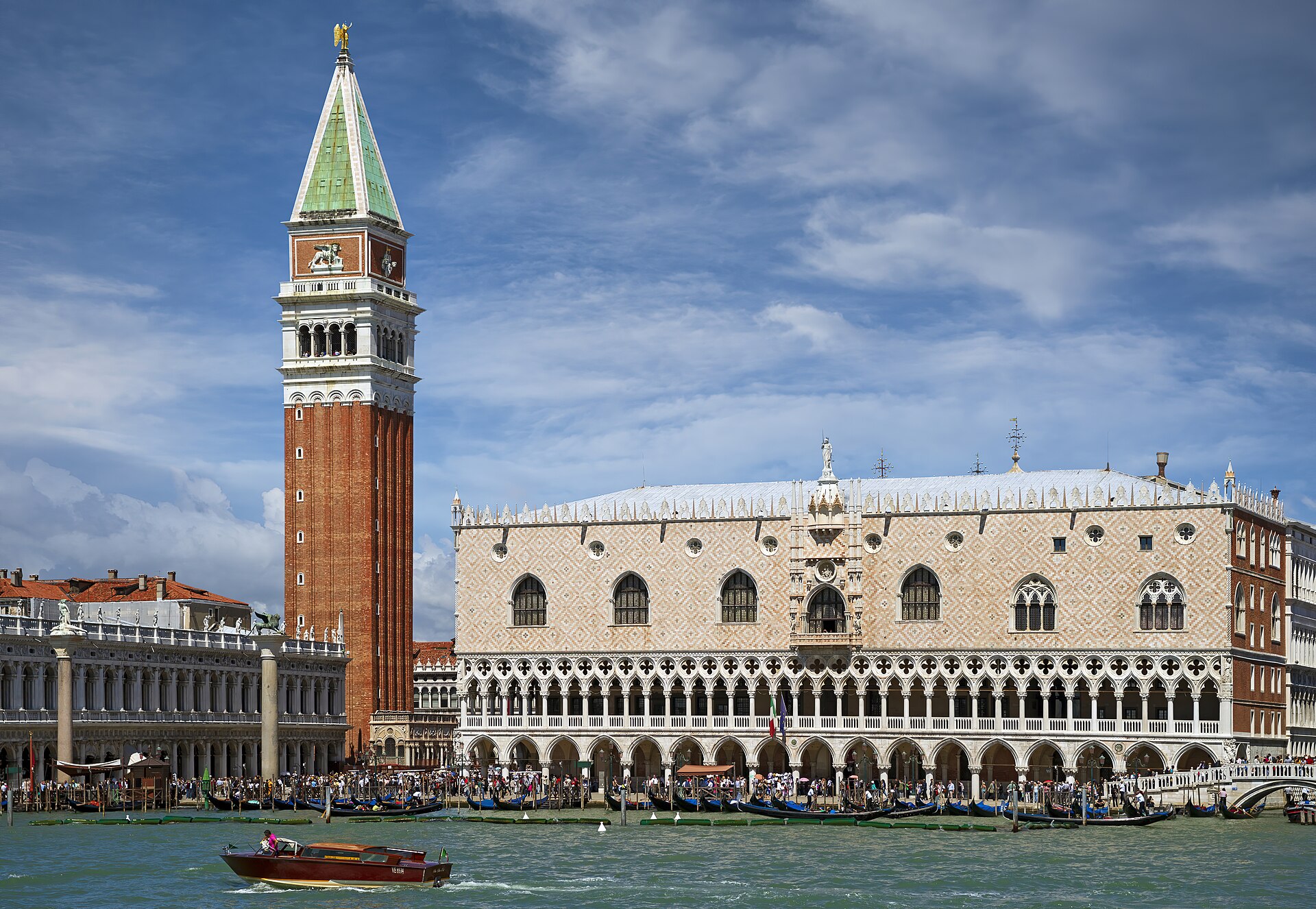
The Palace's distinctive pink-and-white diamond-patterned facade and Gothic arcading, seen from the lagoon beside St Mark's Campanile.
Photograph by Didier Descouens, CC BY-SA 4.0 · Photograph by ArchaeodontosaurusDoge's Palace
Palace · Palazzo Ducale · Founded 1340
Open, admission and hours confirmed 24 August 2026 · 6 sources
On this page 14 sections
ContentsClose
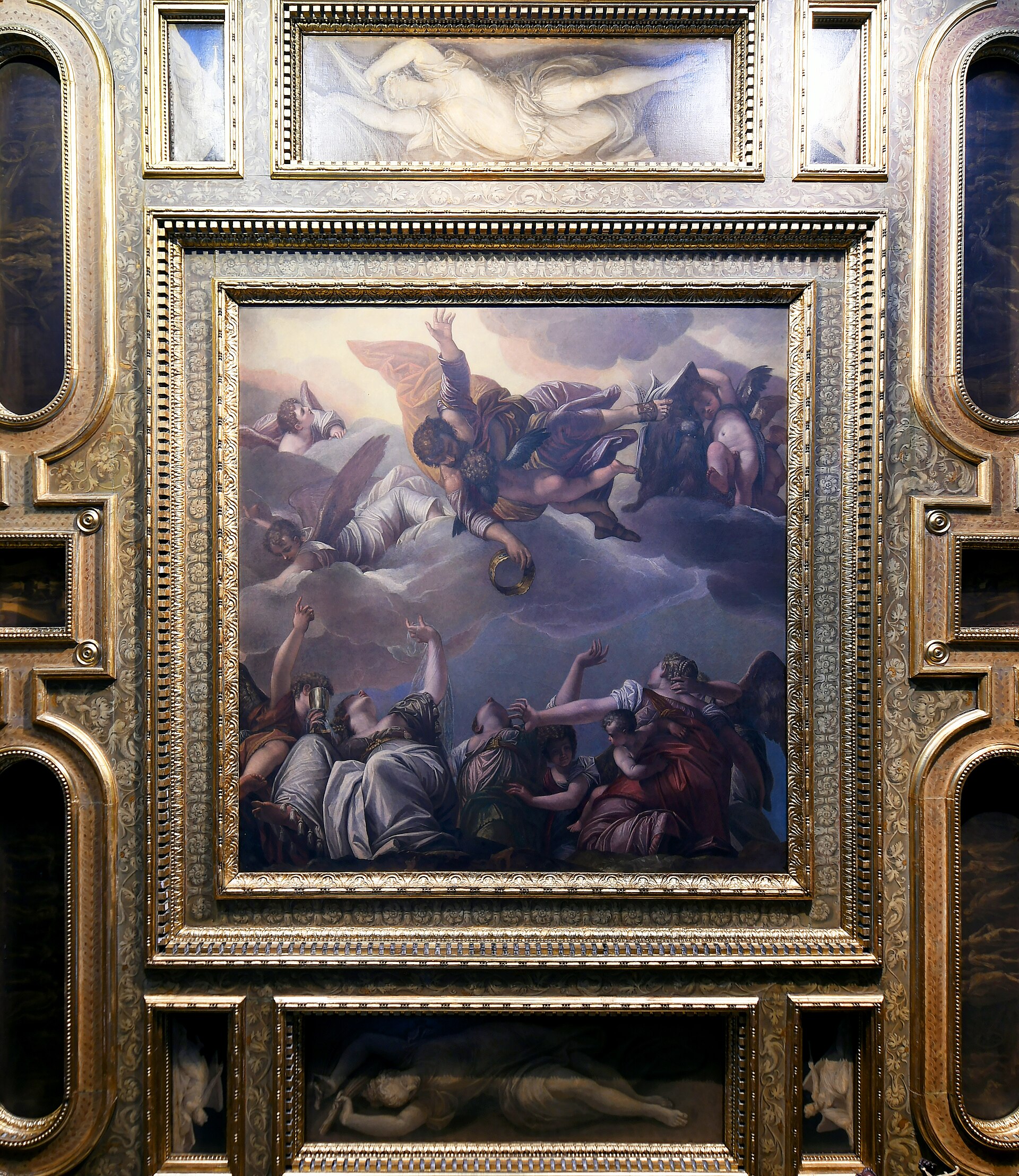
The Doge's Palace is not primarily a collection assembled by acquisition; it is the seat of Venetian government itself, decorated over three centuries by the Republic's most important artists as a working expression of state power, and the paintings, ceilings and sculpture on this page are almost all still in the rooms they were made for. The strength is therefore contextual as much as art-historical: Bellini, Carpaccio, Titian, Veronese and Tintoretto are all present, but the more distinctive holding is the sheer density of civic and judicial decoration - the frieze of Doges, the allegories of good government, the carved capitals, the bocche di leone - built specifically to explain and legitimise a millennium-old republic to the people who worked inside the building. The Picture Gallery adds a smaller body of easel paintings, including private-collection pieces, but the building's real center of gravity is the Institutional Chambers and the Great Council Chamber in particular.
| Local name | Palazzo Ducale |
|---|---|
| Kind | Palace |
| Founded | Origins in the 9th century; present Gothic structure begun 1340 |
| City and country |  Venice, Italy Venice, Italy |
| Address | San Marco 1, 30124 Venezia, Italy |
| Website | palazzoducale.visitmuve.it |
| Status | Open, confirmed |
| Record last verified |
Visiting
- Hours
- Every day, summer season (1 April to 31 October)09:00 to 19:00Last admission 18:00
- Every day, winter season (1 November to 31 March)09:00 to 18:00Last admission 17:00
- Fridays and Saturdays, 1 May to 26 September 202609:00 to 23:00Summer extended opening; last admission 22:00. Museum closing procedures begin 30 minutes before the stated closing time on any day
- Admission
- St Mark's Square Museums ticket, Standard, GeneralEUR 35This is the ONLY way to enter the Doge's Palace: there is no Doge's Palace-only ticket. One ticket admits to four sites together - the Doge's Palace, the Correr Museum, the National Archaeological Museum of Venice, and the Monumental Rooms of the Marciana National Library - and includes the MUVE App audio guide
- St Mark's Square Museums ticket, Standard, ReducedEUR 15Children 6-14, students 15-25, visitors over 65, Rolling Venice Card holders, ISIC holders
- St Mark's Square Museums ticket, Online (bought 30+ days ahead), GeneralEUR 30Same 4-site combined ticket; the discount applies only to online purchases made at least 30 days before the visit date
- Museum Pass (all Musei Civici di Venezia sites), GeneralEUR 50Valid 6 months, one admission to each of 12 connected sites including the Doge's Palace, Ca' Rezzonico, Palazzo Mocenigo, Ca' Pesaro, the Glass and Lace Museums and others; the Clock Tower is not included
- Museum Pass, ReducedEUR 25
- Secret Itineraries Tour (guided) or The Doge's Hidden Treasures Tour (guided), GeneralEUR 40Each is a separate reserved guided tour of restricted areas, and each also includes unguided entry to the same 4-site St Mark's Square combination
- Secret Itineraries Tour or Doge's Hidden Treasures Tour, ReducedEUR 20
- School groupsEUR 5.50Per student, 1 September to 15 March only, with teacher-supplied name list; also covers up to two accompanying adults per group
Free entry: Free for Venetian citizens and residents, at any time, on the museum's own current ticket page. 'Musei in Festa' days: free admission to the Musei Civici of Venice for residents of all 44 municipalities of the Metropolitan City of Venice plus Mogliano Veneto, on dates announced separately. Also free: ICOM members, children 0-5, disabled visitors with a helper, licensed Italian tourist guides accompanying groups, up to two accompanying teachers per school group, MUVE ordinary partners and Friend Card holders, and holders of certain named foundation membership cards (Art Pass Venice International Foundation, Venetian Heritage Foundation, Save Venice Inc Fellows, Amici dei Musei e Monumenti Veneziani)- Tickets
- palazzoducale.visitmuve.it/en/informazioni-pr... The museum's own ticket page.
- Do I need to book?
- Not required for the standard combined ticket, though online purchase 30+ days ahead is cheaper; the Secret Itineraries and Doge's Hidden Treasures tours are reserved, guided, and limited-capacity
- Address
- San Marco 1, 30124 Venezia, Italy MapVaporetto Lines 1 and 2 to Vallaresso or San Zaccaria (or Giardinetti for line 2); lines 4.1 and 5.1 to San Zaccaria; from the Lido, line 1 to Vallaresso/San Zaccaria or line 5.2 to San Zaccaria
On foot Public entrance at the Porta del Frumento, on the Piazzetta San Marco side of the building, between St Mark's Basilica and the waterfront - Website
- palazzoducale.visitmuve.it
- Telephone
- +39 041 2715911
- [email protected]
Before you go how long, access, photography, bags, eating, shop
- How long to allow
- Not stated by the museum in the sources read for this page
- Access
- Detailed accessibility information is published on a dedicated page (Services and Accessibility) and an official accessibility statement; not itemised further here
- Photography
- Not stated in the sources read for this page
- Bags
- Not stated in the sources read for this page
- Eating
- Palazzo Ducale Caffe operates on site, per Google's own listing for the building
- Shop
- Museum Store, on site, referenced in the palace's own navigation menu
Prices and hours change. We take them from the institution's own pages and print the day we read them, and you can check the current position at the source we used. Confirm before you travel.
What is inside
Courtyard and the Loggias
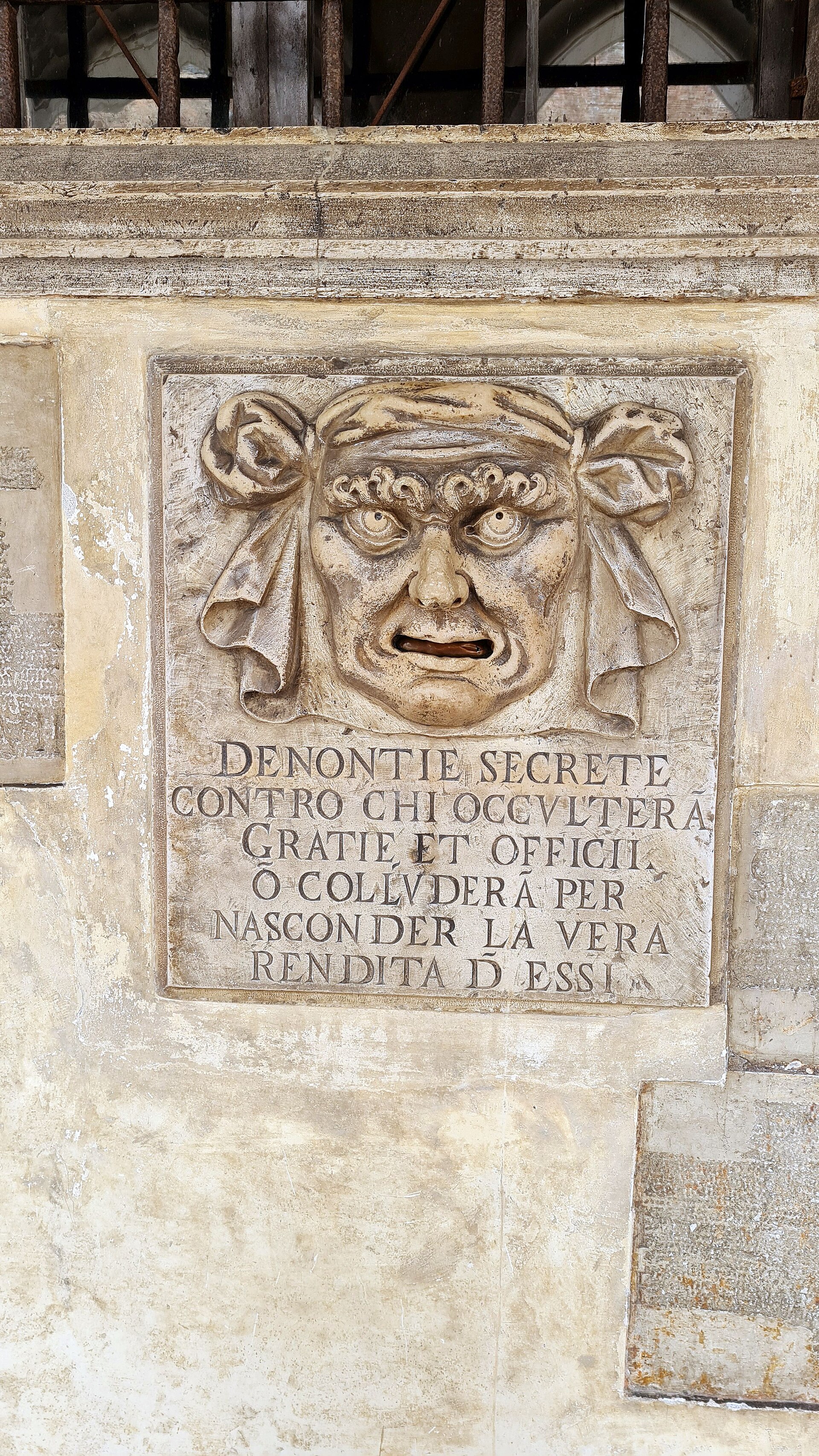
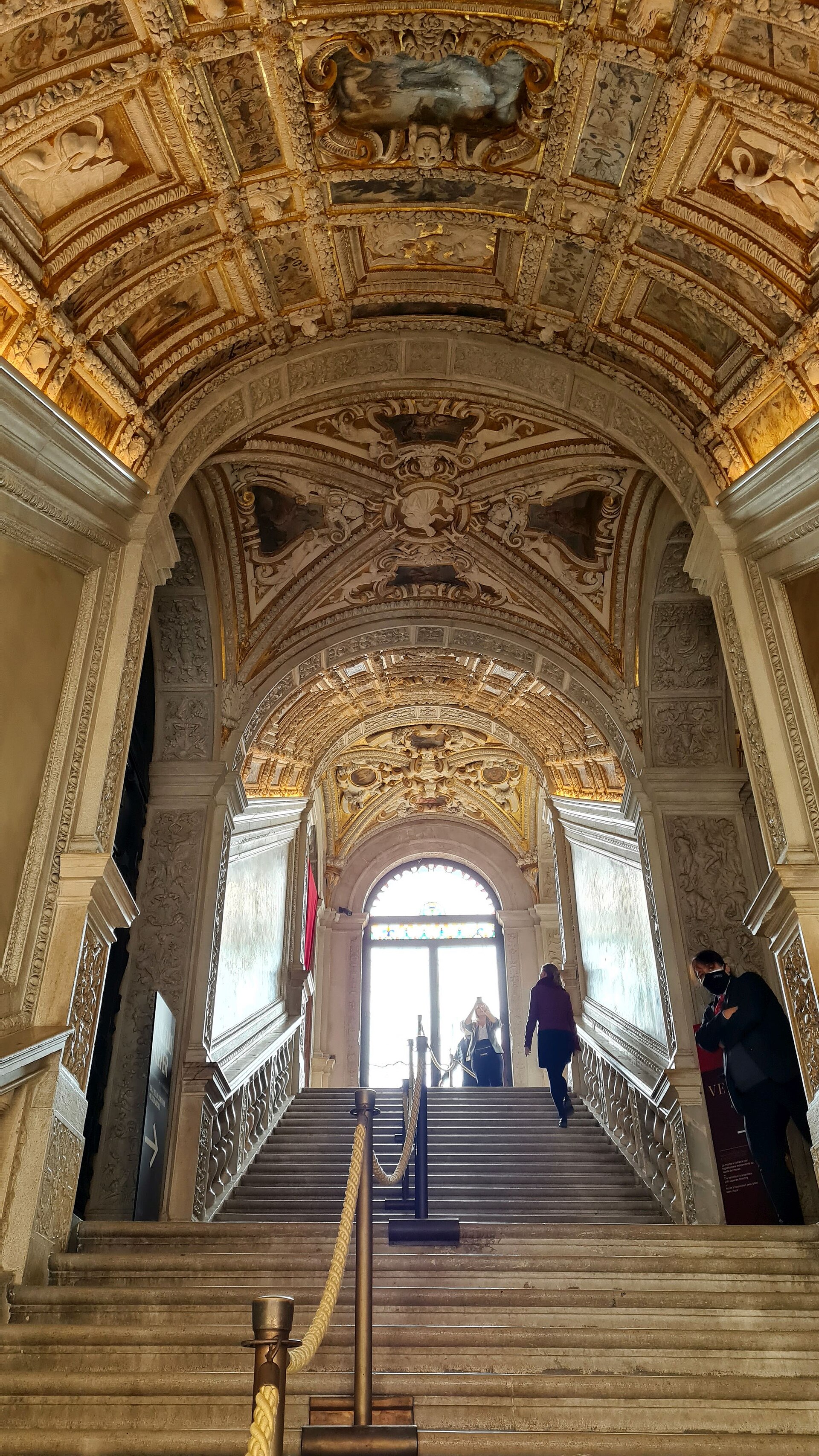
The internal courtyard, showing the two oldest, plainer wings alongside the richly decorated Renaissance wing, which culminates in the Giants' Staircase (Scala dei Giganti), designed by Antonio Rizzo, topped by Sansovino's colossal 1565 statues of Mars and Neptune. The first-floor loggia runs along the facade past several embedded bocche di leone, slots for anonymous denunciations of crimes or corruption in use from the late 16th century.
Institutional Chambers
The working rooms of the Republic's government and courts across the first and second floors: the Great Council, the Senate, the Collegio and judicial bodies including the Council of Ten and the Quarantie. The largest is the Chamber of the Great Council itself, 53 metres long and 25 metres wide, one of the largest rooms in Europe, dominated by Tintoretto's Il Paradiso and a frieze of 76 painted Doge portraits in which the traitor Doge Marino Faliero is represented only by a black cloth.
Picture Gallery (Quadreria)
Easel paintings from the Palace's own institutional decoration and from private collections, including works by Giovanni Bellini, Vittore Carpaccio, Titian and Giambattista Tiepolo, alongside a rare Flemish survival, an Apocalyptic Vision once attributed to Civetta and now given to an anonymous follower of Bosch.
Prisons: the Piombi, the Pozzi and the New Prisons
The older Piombi (under the roof) and Pozzi (at water level) cells inside the Palace itself, and the purpose-built New Prisons across the canal, reached by the Bridge of Sighs; the museum's own description calls the New Prisons among the earliest purpose-built standalone state prison buildings in Europe, designed with larger, lighter cells than the older ones they supplemented.
Armoury
A collection of weapons and armour with a core documented since the 14th century, once under the control of the Council of Ten and kept ready for the Palace guard; more than 2,000 pieces survive after the collection was partly dispersed following the fall of the Republic in 1797.
What to see first
Il Paradiso
Tintoretto and workshop, 1588-1592Painted for the wall behind the Doge's throne in the Chamber of the Great Council after the 1577 fire destroyed the previous decoration; said to be the widest canvas painting in the world.4
Frieze of the Doges, with the veiled portrait of Marino Faliero
Workshop of Tintoretto (mainly his son Domenico), after 1577A painted frieze of the first 76 Doges runs below the ceiling of the Great Council Chamber; where Doge Marino Faliero's portrait would be, a plain black cloth is painted instead, marking his 1355 attempt at a coup d'etat and execution for treason.4
The Giants' Staircase and Sansovino's Mars and Neptune
Staircase by Antonio Rizzo; statues by Jacopo Sansovino, 1565The ceremonial entrance stair at the far end of the courtyard, where Doges were once crowned; the two colossal statues give the staircase its name.3
The Bridge of Sighs and the New Prisons
16th-17th centuryThe enclosed bridge linking the Palace's courts to the New Prisons across the Rio di Palazzo; the New Prisons themselves are described by the museum as among the earliest purpose-built, standalone state prison structures in Europe.3
Bocche di leone (lion's mouths)
From the late 16th centuryCarved stone letterboxes set into the palace walls where citizens could submit anonymous denunciations of crimes or corruption to the authorities; several survive along the loggia route.3
The Museo dell'Opera's original facade capitals
14th and 15th century Venetian sculptorsWhen the exterior facades were restored from 1876, 42 badly weathered original capitals were removed from the ground-floor arcade and upper loggia and replaced on the building with copies; the originals are now displayed indoors on their own columns, a straightforward case of the object a visitor sees outside not being the medieval original.3
Past exhibitions here
- Closed6 Mar to 29 Sep 2026Confirmed · check before you travel
Three fires and a rebuilding that chose to stay Gothic
The palace standing today is not one building campaign but the product of at least three major disasters. The lagoon-facing wing was rebuilt from 1340. Doge Francesco Foscari extended the rebuilding to the Piazzetta wing from 1424, completing the Porta della Carta in 1442. A fire in 1483 destroyed part of the canal-side wing holding the Doge's own apartments, and the architect Antonio Rizzo rebuilt it in the new Renaissance style then current, a stylistic break from the Gothic exterior that is still visible today if a visitor knows to look for the join. Two further fires, in 1574 and 1577, did more damage: the 1577 fire destroyed both the Scrutinio Room and the Great Council Chamber itself, along with paintings by Gentile da Fabriano, Pisanello, Alvise Vivarini, Carpaccio, Bellini, Pordenone and Titian, all lost. The Republic's own building authorities then rejected a neoclassical replacement design submitted by Andrea Palladio, one of the most influential architects of the age, and rebuilt the damaged rooms to their original Gothic layout instead - a deliberate conservatism about how the seat of government should look, over the fashionable classicism Palladio was offering.
A room built to hold every adult male patrician in the city, and the painting behind the throne
The Chamber of the Great Council, restored after the 1577 fire and finished by 1579-80, is 53 metres long and 25 metres wide, one of the largest rooms in Europe: it had to be, since the Great Council was made up of every male member of the patrician Venetian families over 25, regardless of individual wealth or standing, which the Republic itself treated as a structural guarantee of a kind of equality among its ruling class even as the Senate steadily took over more of its practical power. The wall behind the Doge's own throne is occupied by Il Paradiso, painted by Tintoretto and his workshop between 1588 and 1592 and said to be the widest canvas painting in the world. Immediately below the ceiling runs a painted frieze of the Republic's first 76 Doges, commissioned from Tintoretto though mostly executed by his son Domenico. One frame in that frieze holds no portrait at all: Doge Marino Faliero, who attempted to seize absolute power in a 1355 coup and was executed for it, is represented only by a plain black cloth, the Republic's own chosen way of writing a Doge out of its official memory rather than erasing the frame entirely.
A prison built to be better than the one it replaced
The Palace held its own prisoners for centuries in the Piombi, cramped cells under the lead roofing, and the Pozzi, at water level. In the 16th and 17th centuries the Republic built the New Prisons on the far side of the Rio di Palazzo, connected to the Palace by the enclosed Bridge of Sighs, and the museum's own account describes the New Prisons as among the earliest purpose-built, standalone state prison buildings anywhere in Europe, designed specifically to give prisoners larger, lighter, better-ventilated cells than the older accommodation. It is a genuinely early instance of a state building a prison as a distinct architectural type with the prisoners' physical conditions as an explicit design consideration, rather than simply repurposing cellars and attics, even though the building's later reputation, fixed by Romantic-era writers, is almost entirely about confinement and dread rather than reform.
A building that is also a machine for anonymous accusation
Set into the walls along the loggia route are several bocche di leone, carved stone slots shaped as a lion's open mouth, in use from the late 16th century for citizens to submit written, unsigned denunciations of crimes or corruption to the relevant magistracy. One such slot, preserved with its original inscription, warns that secret denunciations against anyone concealing favours or offices, or colluding to hide their true income, are welcome - the mechanism institutionalised anonymous accusation as an ordinary tool of Venetian administration, not a wartime or crisis measure. It sits within a building whose entire decorative programme, from the frieze of Doges to the allegories of Good Government painted on nearly every ceiling, was designed to explain and justify the Republic's power to the people who worked and were judged inside it.
Visiting today means buying into a four-site (or twelve-site) ticket, not the Palace alone
There is no ticket that admits only to the Doge's Palace. The standard route in is the St Mark's Square Museums ticket, which bundles the Palace with the Correr Museum, the National Archaeological Museum of Venice and the Monumental Rooms of the Marciana National Library on one admission, at a standard price of 35 euros full or 30 euros if bought online at least 30 days ahead, 15 euros reduced either way. A broader Museum Pass, 50 euros full or 25 reduced, adds entry to eleven further sites across the Fondazione Musei Civici di Venezia network, valid for six months with one visit to each. Two further guided-only routes, the Secret Itineraries Tour and the Doge's Hidden Treasures Tour, each cost 40 euros full or 20 reduced and include the same four-site combination on top of the guided portion. Venetian residents, by contrast, enter free at any time on production of identification, a policy that sits alongside a long list of other free categories (ICOM members, licensed guides, accompanying teachers, several named foundation membership cards) that a visitor comparing prices online is unlikely to find summarised in one place before arriving.
What visitors say
We publish no visitor review prose and cite no single review as representative. Google's own aggregate sits at a very strong 4.7 from a large sample. Visitors consistently name the Bridge of Sighs, the prisons, and Tintoretto's Paradiso as the elements they remember most, and several recommend allowing at least two hours. A recurring practical note across accounts concerns Venice's acqua alta: at least one visitor specifically warns that the building and the surrounding piazza can flood.
What is praised, what is criticised
- Praised: the scale and detail of the Institutional Chambers, in particular the ceiling paintings and the Great Council Chamber
- Praised: the carved capitals on the exterior arcade, which several visitors specifically recommend looking at closely rather than walking past
- Praised: the Bridge of Sighs and prison route as the most memorable single sequence of the visit
- Praised: being able to buy same-day tickets on site without a long queue, on at least one recent account
- Criticised: there is no way to buy entry to the Doge's Palace alone; every ticket bundles it with at least three other MUVE sites, which some visitors have found confusing when they only wanted to see this one building
- Criticised: at least one account describes unprofessional service and an inability to accommodate a food allergy at the on-site cafe
- Criticised: Venice's seasonal flooding (acqua alta) can affect access to the building and the surrounding piazza, a risk visitors are advised to check for directly rather than assume away
- Criticised: the recommended tour route is not a simple floor-by-floor sequence but doubles back and crosses levels multiple times, which the museum's own site acknowledges explicitly
Ratings on other platforms
Google: 4.7 from 39,302 ratings, read 7 August 2026
A platform average is a tertiary source: it moves, it is not audited, and we quote no visitor's words.
Questions about Doge's Palace
Where is Doge's Palace?
San Marco 1, 30124 Venezia, Italy.
How much does it cost to visit?
St Mark's Square Museums ticket, Standard, General: EUR 35; St Mark's Square Museums ticket, Standard, Reduced: EUR 15; St Mark's Square Museums ticket, Online (bought 30+ days ahead), General: EUR 30; Museum Pass (all Musei Civici di Venezia sites), General: EUR 50; Museum Pass, Reduced: EUR 25. As confirmed 24 August 2026.
When is it open?
Every day, summer season (1 April to 31 October) 09:00-19:00; Every day, winter season (1 November to 31 March) 09:00-18:00; Fridays and Saturdays, 1 May to 26 September 2026 09:00-23:00. As confirmed 24 August 2026.
How do you get there?
Vaporetto: Lines 1 and 2 to Vallaresso or San Zaccaria (or Giardinetti for line 2); lines 4.1 and 5.1 to San Zaccaria; from the Lido, line 1 to Vallaresso/San Zaccaria or line 5.2 to San Zaccaria; On foot: Public entrance at the Porta del Frumento, on the Piazzetta San Marco side of the building, between St Mark's Basilica and the waterfront.
What should you see first?
Il Paradiso (Tintoretto and workshop, 1588-1592); Frieze of the Doges, with the veiled portrait of Marino Faliero (Workshop of Tintoretto (mainly his son Domenico), after 1577); The Giants' Staircase and Sansovino's Mars and Neptune (Staircase by Antonio Rizzo; statues by Jacopo Sansovino, 1565); The Bridge of Sighs and the New Prisons (16th-17th century); Bocche di leone (lion's mouths) (From the late 16th century); The Museo dell'Opera's original facade capitals (14th and 15th century Venetian sculptors).
What we could not confirm
- The exact identification and current attribution of the Flemish Apocalyptic Vision in the Picture Gallery (once given to 'Civetta', now to an anonymous follower of Bosch) was described only briefly on the museum's own site; the full attribution history was not established from a source read for this page.
- Whether the 30-day-advance online discount and the various combined-ticket prices are adjusted seasonally, or hold constant year-round, was not confirmed from the pages read for this record.
- The precise current opening status and hours of the Secret Itineraries Tour and Doge's Hidden Treasures Tour (both reservation-only, capacity-limited) were referenced but not scheduled in the sources read for this page.
- Whether the Museo dell'Opera's 42 replaced facade capitals include any of the specific carvings most often reproduced in guidebooks was not established from a source read here.
Images
Sources
- 1Palazzo Ducale (MUVE), official site: Visitor information - opening hours, special openings, tickets, contact and how to get there. Read 7 August 2026. palazzoducale.visitmuve.it/en/informazioni-pratiche/
- 2Palazzo Ducale (MUVE), official site: Building and history - construction phases, fires, and the palace's transition to a public museum in 1923 and the MUVE network in 1996. Read 7 August 2026. palazzoducale.visitmuve.it/en/la-sede-e-la-storia/
- 3Palazzo Ducale (MUVE), official site: Layout and collections - Museo dell'Opera, Courtyard and Loggias, Institutional Chambers, Picture Gallery, Prisons, Armoury. Read 7 August 2026. palazzoducale.visitmuve.it/en/percorsi-e-collezioni/
- 4English Wikipedia, 'Doge's Palace': construction history, the 1577 fire and Palladio's rejected design, the Great Council Chamber's dimensions, Il Paradiso, and the veiled portrait of Doge Marino Faliero. en.wikipedia.org/wiki/Doge%27s_Palace
- 5Wikidata, Q189883, Doge's Palace: identity, coordinates, instance-of. wikidata.org/wiki/Q189883
- 6Google Maps listing, Doge's Palace: aggregate rating 4.7 from 39,302 ratings, on-site cafe, extended Friday/Saturday summer hours. google.com/maps/search/Doge%27s+Palace+Venice