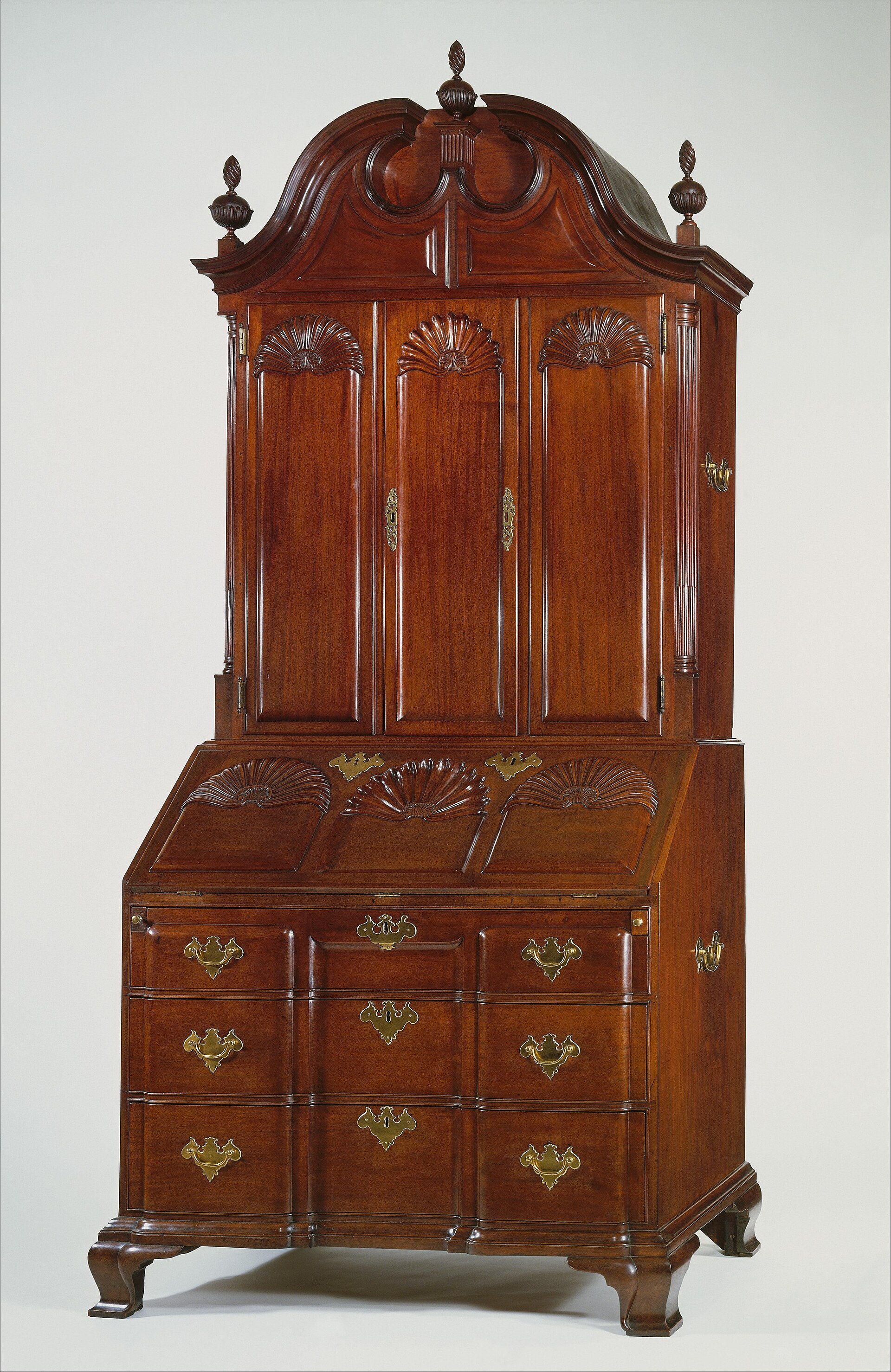
Desk and Bookcase
1760-90 · Mahogany
Metropolitan Museum of Art, New York
 active 1725-1830
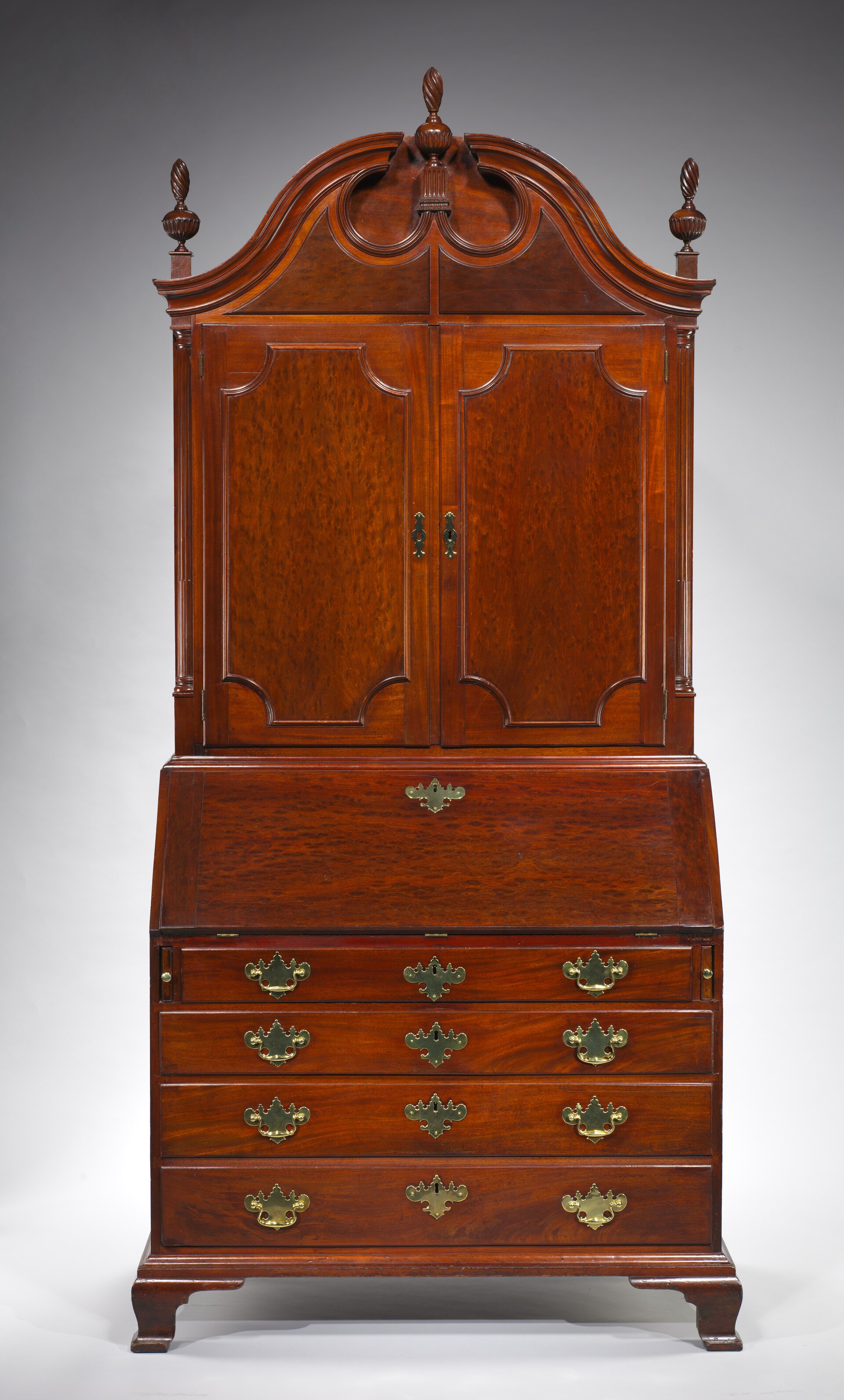
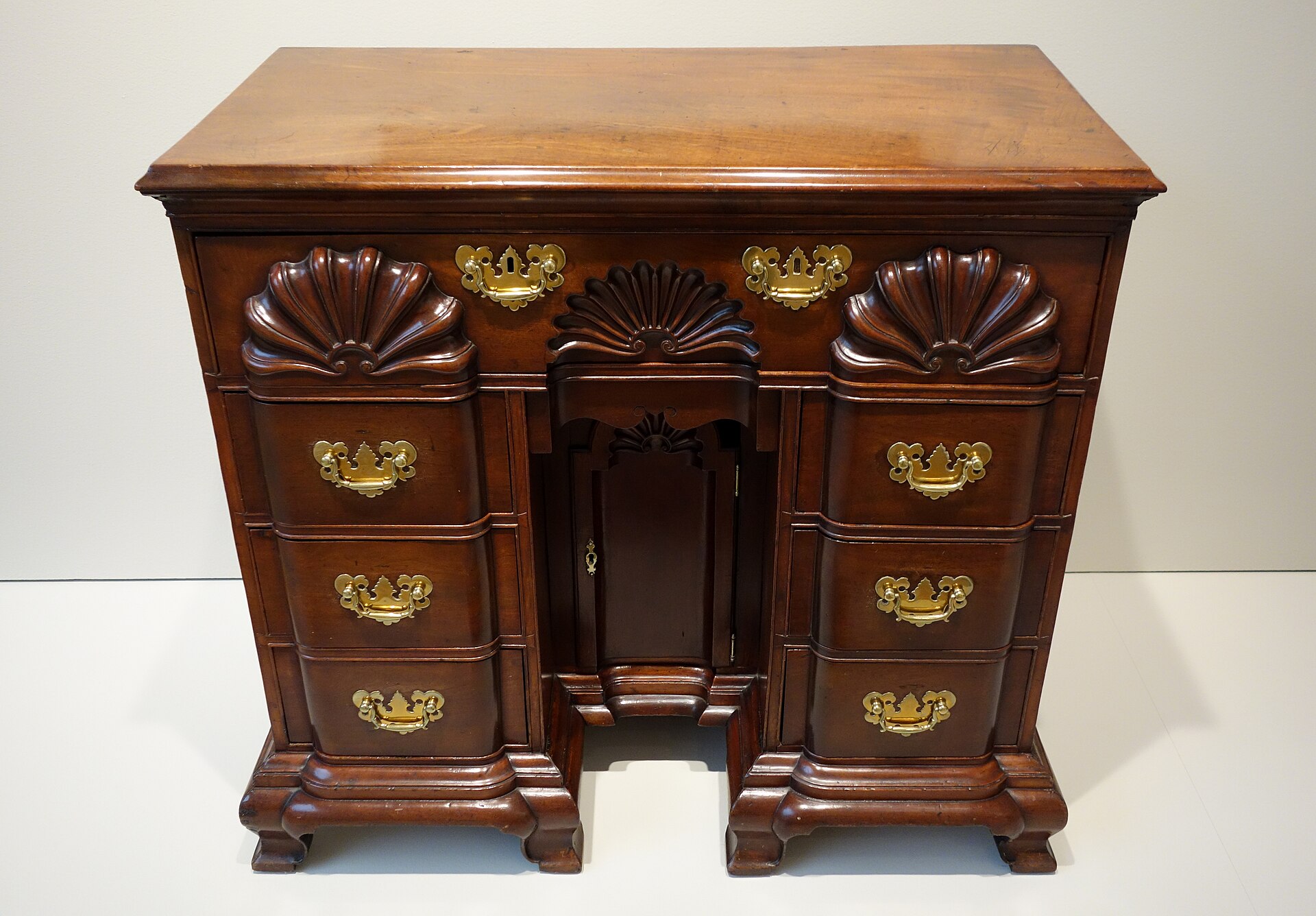
Desk and bookcase, attributed to John Townsend Mahogany desk and bookcase, Newport, Rhode Island, about 1780-1795, attributed (not signed) to John Townsend and likely made for Oliver Wolcott Sr., a signer of the Declaration of Independence and later governor of Connecticut. Descended through Wolcott's family to the interior designer Dorothy Draper before reaching the Cleveland Museum of Art in 2012. Shown here as a documented commission for a named, historically significant patron, of the kind this family's shops routinely produced. No verified portrait. No painted or photographic likeness of any Goddard or Townsend cabinetmaker, confirmed or disputed, was located for this record. None would be expected before the invention of photography for a working artisan family rather than a portrait-sitting merchant class, and the family's own Quaker testimony of simplicity, documented above, discouraged exactly this kind of self-display in any case. The closest documented equivalent to a likeness is textual rather than visual: John Townsend's own furniture labels, in a chosen typeface he also had cut into his family's gravestones, which this record treats in the narrative and technique sections rather than substituting for a portrait that does not exist.
Cleveland Museum of Art| Full name | The Goddard and Townsend cabinetmaking families of Newport, Rhode Island |
|---|---|
| Worked as | Cabinetmakers, Joiners |
| Nationality | American (colonial and early federal Rhode Island) |
| Movement | Newport Colonial (Queen Anne through Chippendale to Federal) |
| In this archive | 1 artwork |
| Sources | 19 cited |
| Last verified |
About this page 1 artwork in the archive · Last verified · 19 sources cited
No individual made the object this name is attached to. The Goddard and Townsend families were two intermarried Quaker joiner clans clustered on a few blocks of Bridge Street and Easton's Point in Newport, Rhode Island, who between about 1725 and the 1830s put a name on roughly twenty-one working cabinetmakers across three or four generations. What survives from their shops includes the single most expensive form of American colonial furniture ever sold, the block-and-shell desk-and-bookcase, and a construction-based census of the nine Newport-attributed examples of that form (two more are attributed to Providence) that, as of 2001, could not put a confirmed maker's name on most of them at all.
The thing this page exists to correct is a name problem that runs the other way from most artist pages. Where a painter's oeuvre gets thinned by connoisseurship, the Goddard-Townsend corpus has spent a century being thickened: a single 1913 sentence by the collector-scholar Luke Vincent Lockwood assigned the whole block-and-shell form to John Goddard on the strength of one letter mentioning costly and ornamental furniture, and that single attribution held the trade's imagination for decades after the physical evidence stopped supporting it. The family's own record book runs the other direction. Only about thirty-five surviving pieces by any Townsend or Goddard carry an actual signature or label; the desk that set the American furniture auction record in 1989 does not, and the one inscription in the entire surviving group that names John Goddard was written by his son twenty-eight years after Goddard died, on a piece Goddard's own construction cannot be proven to have touched.
What is genuinely documented is a family, a neighborhood, a construction method distinctive enough to separate one unnamed shop from another, and a market that has paid more for the right name on this furniture than for almost anything else America made in the eighteenth century. This page follows the evidence rather than the legend, and says plainly, section by section, where the two currently disagree.
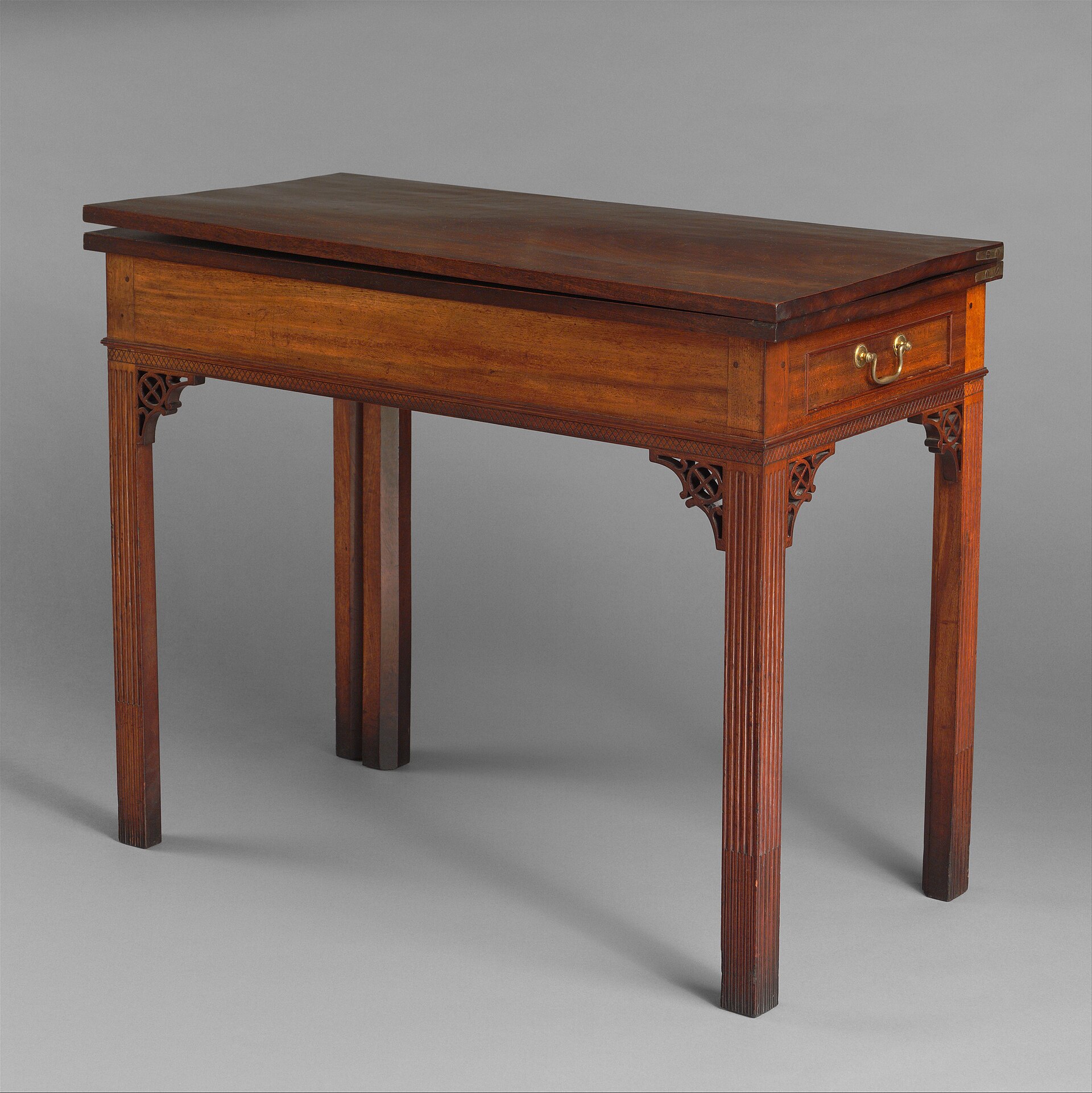
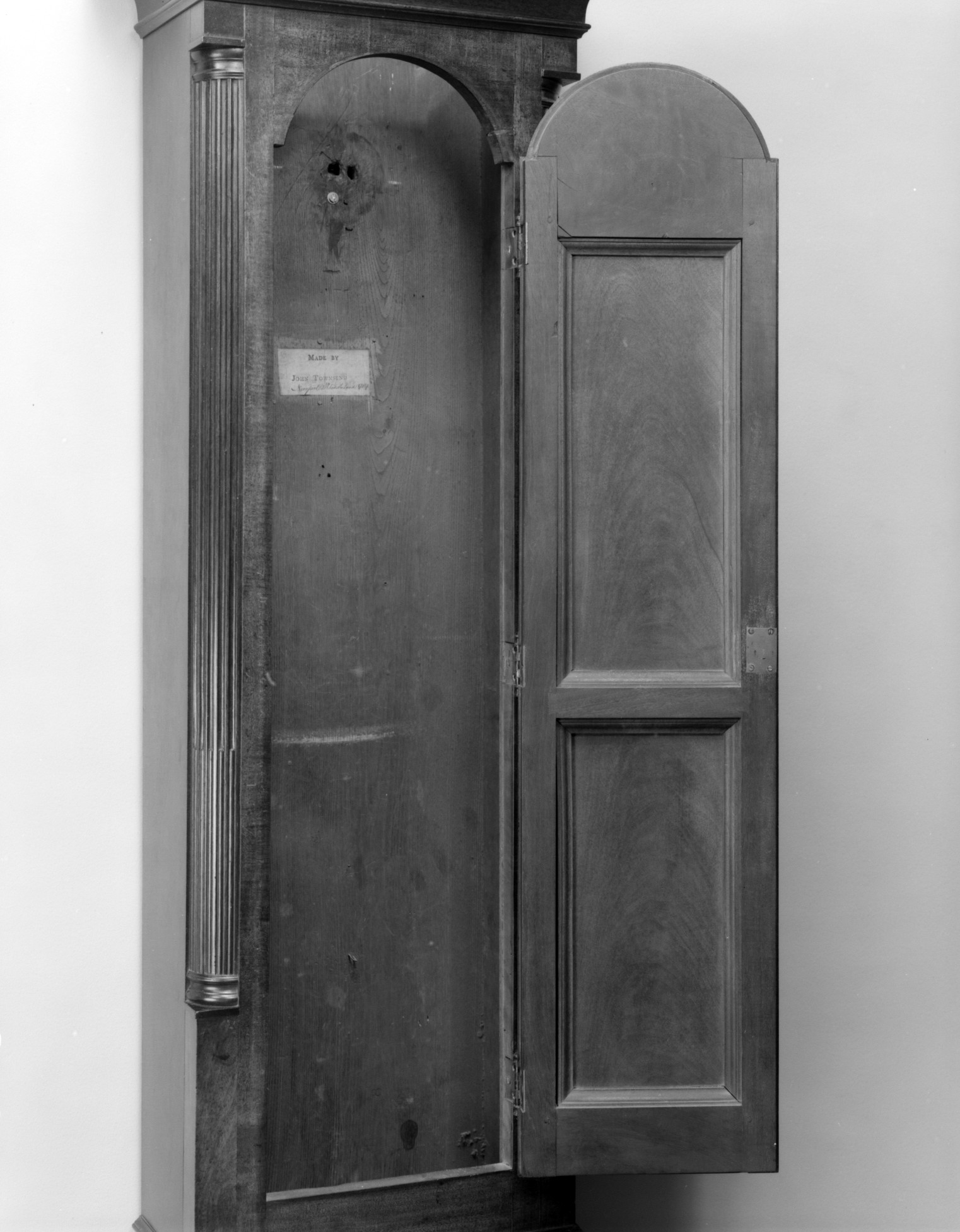
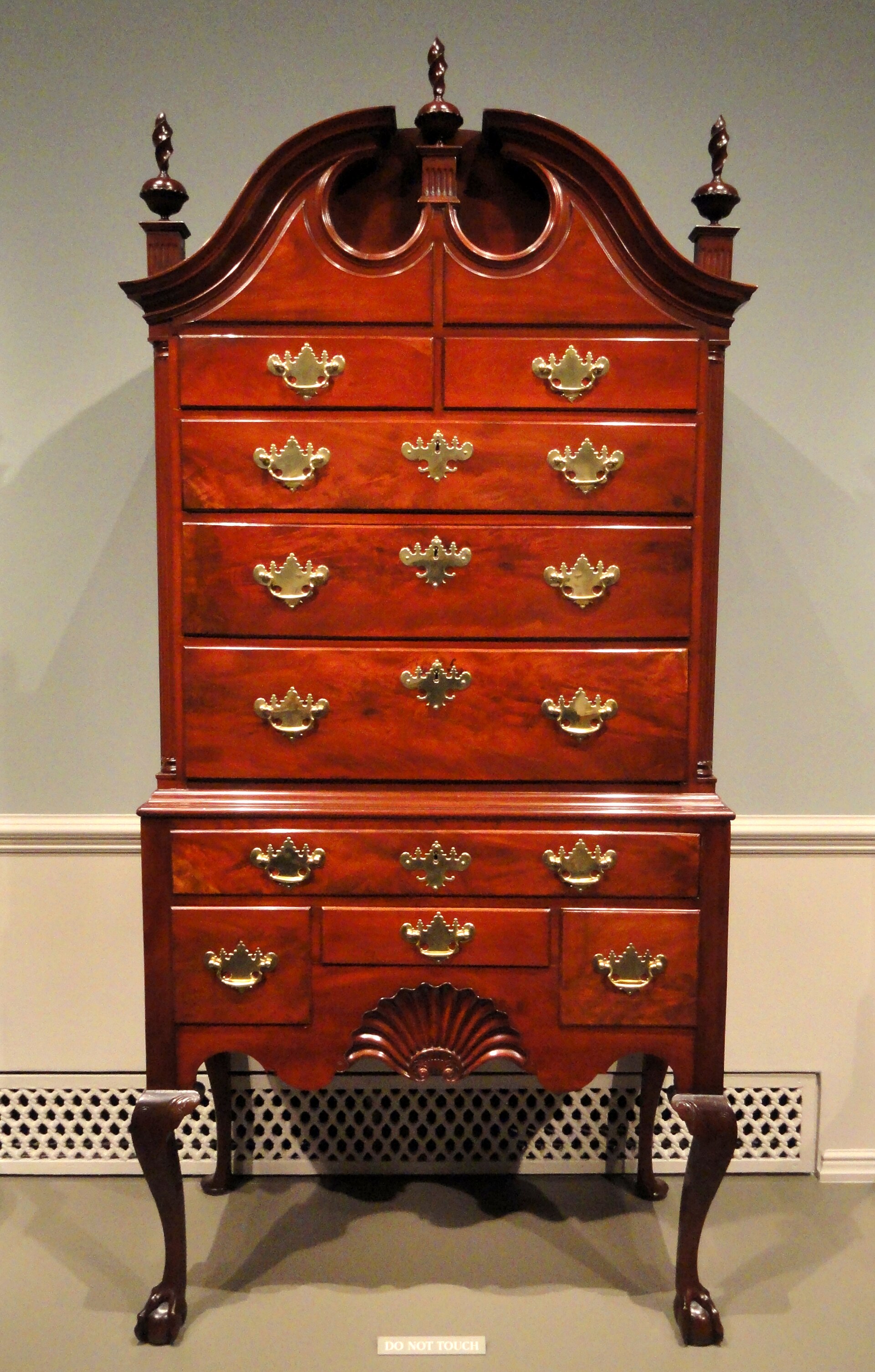
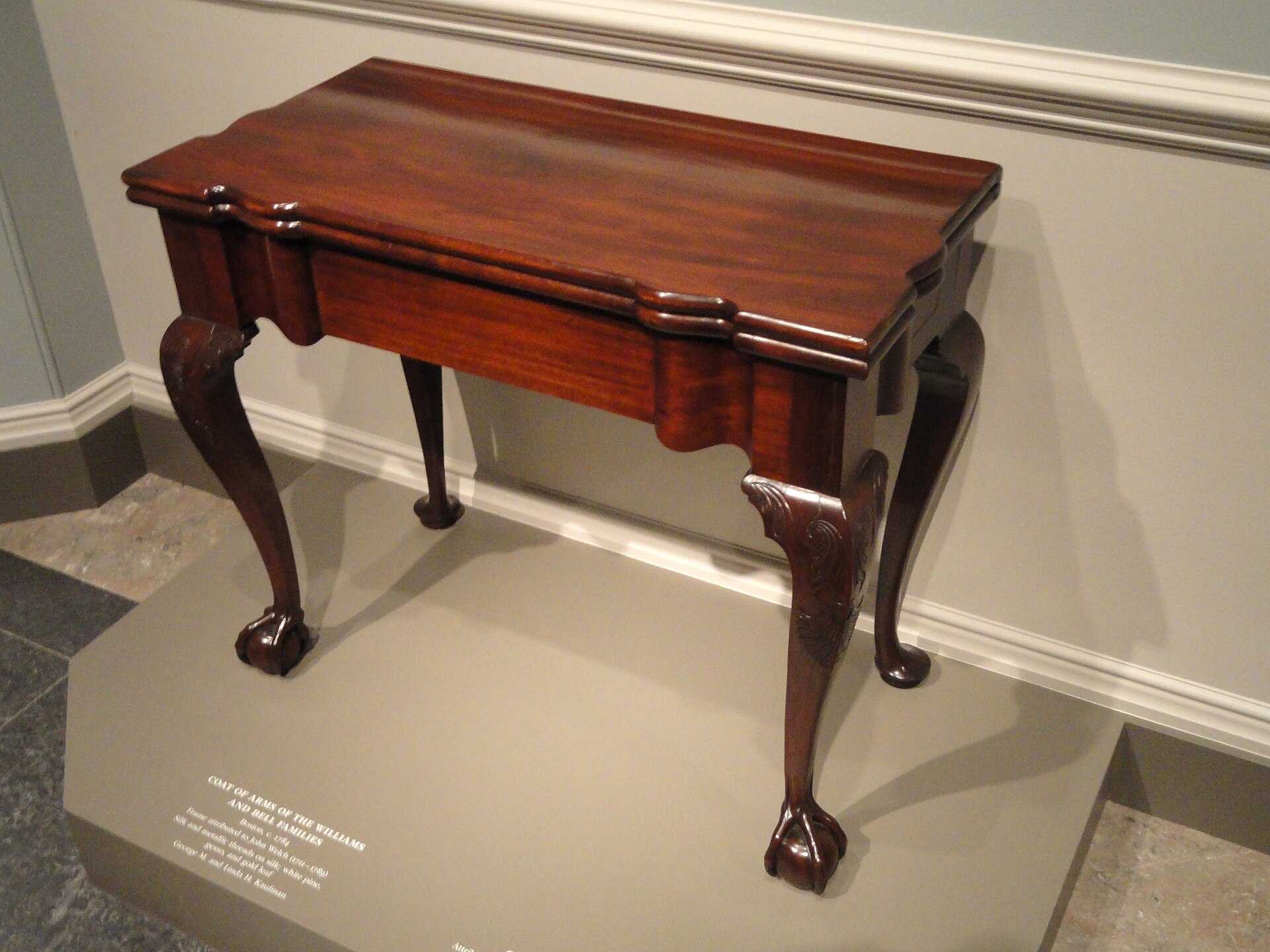
The Townsend family, including six-year-old Christopher and eight-year-old Job, moves from Oyster Bay, New York, to Newport, Rhode Island.23
Easton's Point, bequeathed to the Quaker congregation, is laid out into building lots specifically offered to Newport artisans.3
Christopher Townsend buys the corner lot on Bridge Street and builds the house and workshop where he lives until his death; Job Townsend acquires a lot across the street the same year.3
Daniel Goddard, a Quaker shipwright, settles in Newport from Dartmouth, Massachusetts.2
John Goddard and his brother James are apprenticed to Job Townsend, joiner; both later marry Job's daughters.1
John Goddard's earliest documented work, a slant-front desk, is labeled in full: 'Made by John Goddard of Newport on Rhoad Island in New England in the year of our Lord 1745.'1
A desk inscribed 'Benjamin Almy | Made 1748' with a shell-carved interior is newly attributed to Christopher Townsend in 2022 scholarship, on matched drawer-interior handwriting.12
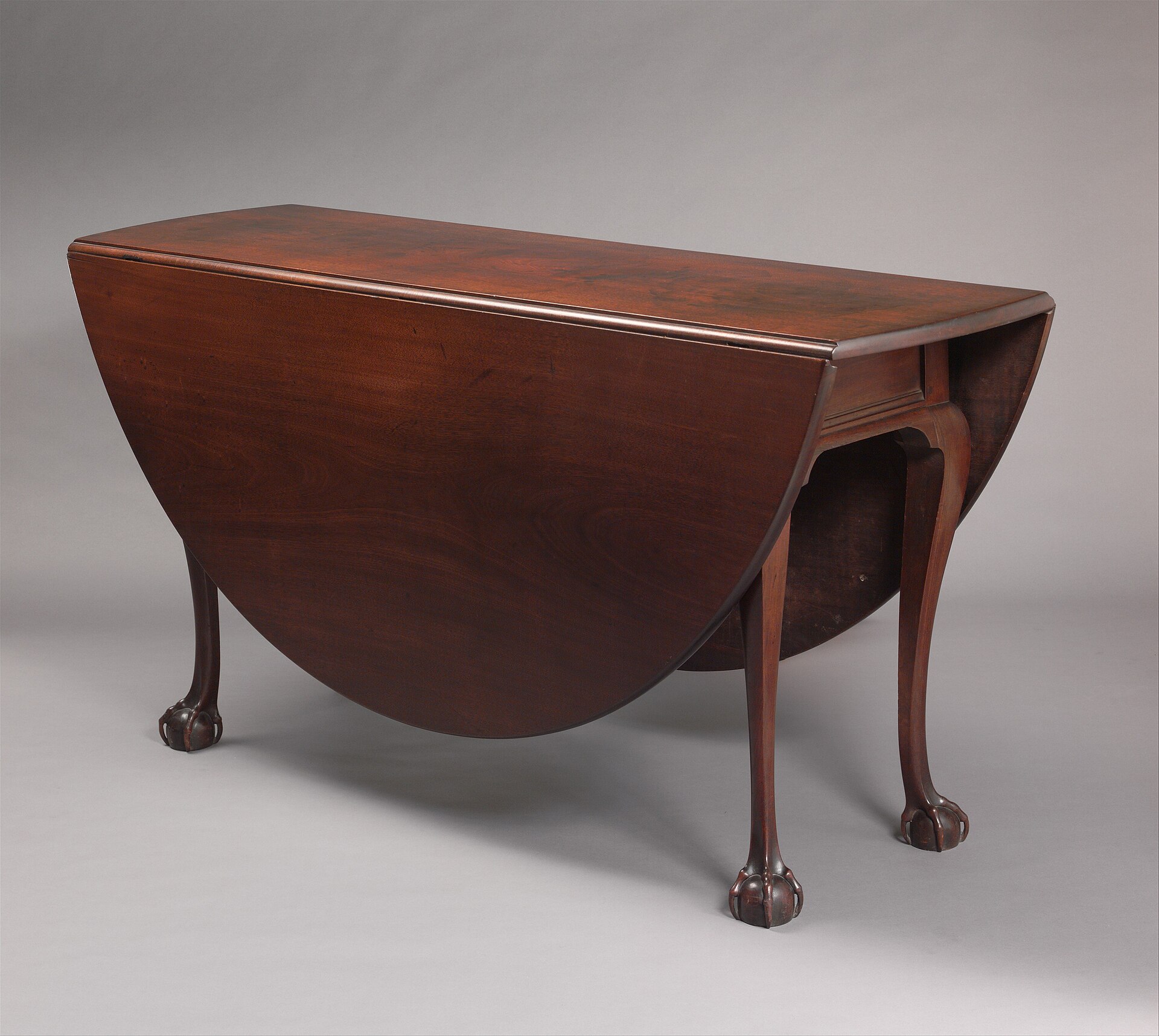
John Townsend, aged twenty-four, signs and dates a dining table, his earliest surviving signed work.34
The date inscribed, decades later, on the Lisle desk-and-bookcase as John Goddard's year of manufacture; Brock Jobe's construction study finds his authorship of this piece unproven.1
John Goddard writes to Moses Brown describing a chest on chest of drawers as 'Costly as well as ornimental.'1
John Townsend labels a four-drawer block-and-shell chest 'Made by / John Townsend / Rhode Island / 1765,' and the family workshops begin applying the carved shell to blocked case forms.34
John Goddard writes to Nicholas Brown, a letter preserved with the Brown family's business papers at the John Carter Brown Library.1
John Townsend marries Philadelphia Feke, daughter of the portrait painter Robert Feke.34
The Newport census records three black residents in John Townsend's household, understood by Brock Jobe's 2001 study to have been enslaved.13
British occupation of Newport collapses the town's population and commerce.13
John Townsend is imprisoned aboard the British ship Lord Sandwich for refusing to sign an allegiance pledge.3
As Newport's insolvent town treasurer, John Townsend is committed to gaol over an unpaid judgment; he spends 122 days in prison over the following two years.3
John Goddard dies, his estate insolvent, in a Newport still recovering from the occupation.1
John Townsend begins using a printed paper label reading 'Made by / John Townsend / NEWPORT,' set in Caslon type.3
John Townsend dies; his probate inventory lists six workbenches and objects valued at just over USD 1,000.3
Thomas Goddard inscribes the Lisle desk-and-bookcase, claiming his father John Goddard made it in 1761, the only inscription naming Goddard anywhere in the surviving group.1
The Metropolitan Museum of Art purchases an unattributed Newport block-and-shell desk-and-bookcase from the estate of the gambler and collector Richard Canfield, held elsewhere in this archive as its own record.1
The desk-and-bookcase made for the Providence merchant John Brown is sold to the collector Francis P. Garvan.1
The architect Norman Isham discovers the Goddard inscription in the Lisle desk-and-bookcase and publishes it, accepting it at face value.1
Ima Hogg acquires a Newport block-and-shell desk-and-bookcase for Bayou Bend, now part of the Museum of Fine Arts, Houston.1
Michael Moses publishes 'Master Craftsmen of Newport: The Townsends and Goddards,' the field's standard connoisseurship-based survey.1
Christie's sells the Nicholas Brown desk-and-bookcase, catalogued as by John Goddard, for a reported USD 12.1 million, a world record for a piece of furniture.78
Sotheby's sells a Newport desk-and-bookcase signed by Christopher Townsend for USD 8,250,500.1
Brock Jobe's construction-based census of the nine Newport-attributed surviving desk-and-bookcases (of eleven known) finds them the work of at least four, and possibly five, unidentified Newport shops.1
Sotheby's sells a Nicholas Brown family tea table attributed to John Goddard for a hammer price of USD 7.5 million (USD 8,416,000 with premium), part of a fifty-lot Goddard family sale.9
Yale University Art Gallery's Rhode Island Furniture Archive exhibition attributes the John Brown desk-and-bookcase to Daniel Spencer, John Goddard's nephew, on infrared-revealed chalk and graphite marks.10
A Chipstone Foundation study attributes further early pieces, including a signed 1748 desk, to Christopher Townsend on matched handwriting.12
This is one of the most valuable categories in American decorative arts, and the price a piece commands still tracks the confidence of its attribution more than almost any other factor. The Nicholas Brown desk-and-bookcase set the all-time American furniture auction record at a reported USD 12.1 million at Christie's in 1989, cataloged at the time as the work of John Goddard, an attribution this record's own research cannot confirm and that has not, so far as located, been tested by the same construction-based method applied to the rest of the surviving group. A signed Christopher Townsend desk-and-bookcase, by contrast, a documented rather than a legendary attribution, brought USD 8,250,500 at Sotheby's a decade later. Neither 1989 press coverage nor any source consulted for this record separates the 1989 hammer price from the buyer's premium; this record states the reported total and does not manufacture a split its sources do not provide.
| Date | Sale | Work | Result | Note |
|---|---|---|---|---|
| 22 January 2005 | Sotheby's, New York (Goddard family property, 50 lots) | Nicholas Brown family tea table, attributed to John Goddard | Hammer USD 7,500,000 With premium USD 8,416,000 USD | The second-highest price then paid for American furniture at auction. Bought by dealer Albert Sack. The same sale saw two roundabout chairs attributed to Goddard bought by Leigh Keno for USD 1,584,000 and USD 1,696,000; the fifty-lot sale totaled just over USD 13.1 million. |
Hammer is the price at which the bidding stopped; with premium adds the fee the house charges the buyer on top. Hammer price and buyer's premium in the glossary.
| Institution | City | Holdings | Note |
|---|---|---|---|
| Metropolitan Museum of Art | New York | An unattributed Newport block-and-shell desk-and-bookcase (Rogers Fund, 1915, ex Richard Canfield), plus signed and attributed work by John Townsend including his 1756 dining table and a card table of about 1786 | The desk-and-bookcase is held elsewhere in this archive as its own record. |
| Yale University Art Gallery | New Haven, Connecticut | The John Brown desk-and-bookcase, now attributed to Daniel Spencer; base collection for the Rhode Island Furniture Archive research project | |
| Rhode Island School of Design Museum | Providence, Rhode Island | Two of the nine Newport-attributed examples: the Lisle desk-and-bookcase, the only one inscribed with Goddard's name, and the Charles Pendleton desk-and-bookcase | The Lisle piece is from the bequest of Martha B. Lisle. |
| Museum of Fine Arts, Boston | Boston, Massachusetts | Two of the nine Newport-attributed desk-and-bookcases, from the Helme/Potter family and the M. and M. Karolik Collection | |
| Museum of Fine Arts, Houston (Bayou Bend Collection) | Houston, Texas | A Newport-attributed block-and-shell desk-and-bookcase acquired by Ima Hogg in 1952 | |
| Rhode Island Historical Society | Providence, Rhode Island | The Joseph Brown desk-and-bookcase, one of the two examples Cooper and Gleason (1999) attribute to Providence rather than Newport and exclude from Jobe's nine-piece Newport census | Displayed in the John Brown House. |
| National Gallery of Art | Washington, D.C. | A high chest attributed to John Townsend and a card table attributed to John Goddard, both on stylistic grounds | |
| Cleveland Museum of Art | Cleveland, Ohio | A desk-and-bookcase attributed to John Townsend, likely made for Oliver Wolcott Sr. | Gift of Harvey Buchanan, 2012. |
The Newport branch of the Townsend family descends from three immigrant brothers, John, Richard and Henry Townsend, of a family connected to the Townshends of Raynham Hall in Norfolk, England.
The Newport branch of the Townsend family descends from three immigrant brothers, John, Richard and Henry Townsend, of a family connected to the Townshends of Raynham Hall in Norfolk, England. Henry was a member of the Religious Society of Friends, and Rhode Island's guarantee of religious freedom is the reason the family settled there. Solomon Townsend, grandson of the immigrant John, married Catherine Almy of Newport; their sons Job (1699-1765) and Christopher (1701-1787) were the first Townsends to become cabinetmakers in the town, arriving from Oyster Bay, New York, with their parents in 1707. Daniel Goddard (1697-1764), a Quaker shipwright, moved to Newport by 1727 from Dartmouth, Massachusetts.
The two families were bound together by the second generation. Job Townsend apprenticed the young John Goddard (1723 or 1724-1785), Daniel's son, and Goddard then married Job's daughter Hannah; Goddard's brother James married another of Job's daughters, Susannah. Christopher Townsend's son John Townsend (1732 or 1733-1809) was therefore John Goddard's first cousin by marriage as well as a rival cabinetmaker three doors away. Across the following decades the two families intermarried repeatedly and produced, on the trade's own count, some twenty-one working cabinetmakers over roughly one hundred and twenty years, sharing training, tools and, on the evidence of the surviving furniture, forms closely enough that construction detail rather than carving style is now the only reliable way to separate one shop's output from another's.
They worked, almost without exception, inside a few square blocks. Easton's Point, the low spit of land at the north end of Newport harbor, had belonged to the Society of Friends since Nicholas Easton's widow bequeathed it to the Quaker congregation; it was laid out into building lots in 1724 specifically to be sold to artisans, and it remained a predominantly Quaker neighborhood through the Goddard-Townsend century. Christopher Townsend bought the corner lot on Bridge Street in 1725, two years after his marriage, and built the house and workshop where he lived until his death; Job Townsend built diagonally across the street the same year. John Goddard broke the pattern: rather than build on Bridge Street with his in-laws, he put up his own house and shop several blocks north on the waterfront, where lumber could be unloaded and furniture loaded for export directly from his own small wharf.
Around 1765, on the Metropolitan Museum's own reckoning of John Townsend's development, the family workshops began applying large, boldly lobed carved shells, alternating convex and concave, to the...
Around 1765, on the Metropolitan Museum's own reckoning of John Townsend's development, the family workshops began applying large, boldly lobed carved shells, alternating convex and concave, to the block-fronted case furniture that Boston shops had already been making for a generation. The blocking itself, solid-wood drawer fronts sawn with projecting sections at either side and a recessed section in the middle, was not a Newport invention; Boston cabinetmakers had used it since about 1740. The shell was. Brock Jobe's 2001 construction survey of the surviving desk-and-bookcases calls the resulting form, on the evidence of the objects themselves, a rigid and tightly controlled aesthetic unlike the wide range of options Boston or Philadelphia shops offered the same clientele: Newport patrons wanted a handful of specific designs and Newport craftsmen supplied them, with only minor variation, for decades.
Even the claim that no printed source lay behind the form is now argued rather than settled. The Metropolitan Museum's own scholarship states that Newport's block-and-shell case pieces have no known parallel in European furniture or in contemporary pattern books, and Thomas Chippendale's Director, which shaped a great deal of the period's American furniture, shaped nothing about this one. But Gerald Ward's 1999 historiographic study of how Newport furniture's reputation was built records that R. Peter Mooz and other scholars, from 1971 on, identified Boston precedents for the blocked case form that complicate the story of a purely American, purely Newport invention. What is not disputed is the shell, and what is not disputed is that Newport's version of the ball-and-claw foot, with an open space carved between talon and ball, is a local signature distinctive enough on its own to help separate the region's work from Boston's or Philadelphia's.
The materials carry their own regional signature. Primary wood was mahogany imported exclusively from the West Indies: the densest, darkest, heaviest San Domingo or Island mahogany commanded a steep premium over the lighter Bay or Honduras wood, and John Townsend reserved the costlier Island mahogany for his best pieces, sometimes distinctively enough that pieces made from the same log can still be traced across different objects by grain pattern alone. For secondary, interior wood the Newport shops consistently reached for native chestnut, tulip poplar and white pine rather than the Boston or Salem norm, and John Townsend was, in Brock Jobe's account, rigorously consistent about which wood went where; a bureau table's chestnut drawer bottoms running side to side rather than front to back is, on their own, diagnostic enough to sort the nine surviving desk-and-bookcases into separate workshop traditions.
Signed and labeled work exists in this family, and it is the exception rather than the rule.
Signed and labeled work exists in this family, and it is the exception rather than the rule. John Townsend is, in the Metropolitan Museum's own words, unique among his Newport peers in habitually signing and dating his finest work: starting with a dining table he signed at twenty-four in 1756, he went on to sign or label and date some thirty-five surviving pieces over forty-four years. His labels changed twice. The earliest are handwritten in ink in copperplate script directly on the wood or on a pasted paper slip; a chest of 1765 reads, in full, Made by / John Townsend / Rhode Island / 1765. From the mid-1780s he switched to a printed paper label set in Caslon type, reading Made by / John Townsend / NEWPORT; a later, second printed version, used from about 1793, capitalizes the B of By, adds punctuation after Townsend and Newport, and raises the S in Townsend slightly, a typographic detail fine enough that specialists use it to date undated pieces to before or after 1793. Even so, John Townsend went more than twenty years, from the mid-1760s to the mid-1780s, without signing anything at all that survives, for reasons no source consulted for this record explains.
Other family members labeled occasionally rather than habitually. Thomas Townsend signed and dated a chest-on-chest in 1772; Edmund Townsend's name appears in graphite on the underside of a drawer divider on a bureau table, discovered only in recent decades; Christopher Townsend signed at least one desk-and-bookcase outright, matched to related pieces by comparing the calligraphic letterforms he used on drawer interiors. John Goddard's earliest known work, a plain slant-front desk of 1745, carries the label Made by John Goddard of Newport on Rhoad Island in New England in the year of our Lord 1745, written out in full for a piece the wording itself suggests was intended for export rather than local sale. None of this is decoration. The Townsend family's own coat of arms, inherited from the Townshends of Raynham Hall in Norfolk, bears three silver escallops, scallop shells, a device the family's own modern cataloguers note is akin to the block-and-shell motif that became the shop tradition's signature; whether that heraldic echo was a conscious choice by the family or a coincidence noticed only afterward is not established in any source consulted, and this record does not resolve it either way.
Eleven desk-and-bookcases in the block-and-shell form are known to survive.
Eleven desk-and-bookcases in the block-and-shell form are known to survive. Two, per Wendy Cooper and Tara Gleason's 1999 study, have been convincingly tied to Providence rather than Newport shops and fall outside this census. The remaining nine are the subject of Brock Jobe's 2001 construction-based study, the discipline that finally moved the group past style-based guessing: it sorts them by joinery, partition profile, secondary wood and dovetail pattern rather than by the carving that the trade had used for a century to call the whole group Goddard or Townsend, and concludes that the nine Newport-attributed objects represent the output of at least four, and possibly five, separate and currently unidentified Newport shops. John Townsend, whose signed work sits at the summit of the family's craftsmanship, is explicitly excluded: none of the nine desk-and-bookcases is built like his documented work or carries the pencil or chalk assembly marks he characteristically used. Job and Christopher Townsend, Goddard's own master and father-in-law and his master's brother, are proposed only as better candidates than the alternatives for some of the group, not as confirmed makers of any specific piece.
The single inscription anywhere in the entire surviving group that names Goddard is not contemporary with the object. It sits inside the desk-and-bookcase that descended to the Rhode Island antiquarian Thomas Mawney Potter and later to Arthur Lisle, now at the Rhode Island School of Design, and reads, in full: Made by John Goddard 1761 and repaired by Thomas Goddard his Son 1813, Health Officer of the Town of Newport. Handwriting analysis matching Thomas Goddard's documented hand from the 1820s confirms that the son, not a later dealer, wrote it, which establishes only that Thomas believed his father made the desk in 1761. Jobe's own verdict, examining the piece's actual joinery against Goddard's three surviving plain desks, is that Goddard's construction of even this one object, the sole Goddard-inscribed piece in the group, cannot be proven at this time.
The attribution history keeps moving, in both directions, after 2001. Yale's Rhode Island Furniture Archive, under Patricia Kane, used infrared photography to find chalk and graphite maker's marks inside the desk-and-bookcase made for the Providence merchant John Brown, held at Yale University Art Gallery, and matched them to marks on other objects to identify the previously obscure Daniel Spencer, John Goddard's own nephew, as its maker. That finding is solid: it rests on physical marks inside the object, independently matched. Dealer literature citing the same Rhode Island Furniture Archive research (Levy Galleries, and Artsy following it) also lists the Nicholas Brown Desk and Bookcase, a different object entirely, the one that set the 1989 auction record, among pieces now attributed to Spencer. No Yale publication located for this record makes that specific claim about the Nicholas Brown piece, as distinct from his brother John's; the two Brown desks are exactly the pair the literature has confused before, and this record flags the claim rather than repeating it as settled. Separately, a 2022 Chipstone Foundation study matched drawer-interior handwriting to attribute two dressing tables and a signed 1748 desk to Christopher Townsend, the earliest documented generation, using the same letterform-comparison method Kane used on Spencer. The identities behind most of this group's most valuable objects are still being discovered, not merely debated.
The workshop unit behind this furniture was never one man alone.
The workshop unit behind this furniture was never one man alone. John Goddard's own shop at his death in 1785 held five workbenches; at least four of his and Hannah's sixteen children learned cabinetmaking and worked at some of them. John Townsend's 1809 probate inventory lists six workbenches, and the 1774 Newport census records his household as including two unidentified adult males who may have been live-in apprentices or journeymen, in addition to his own sons. Subcontracting between family shops is directly documented: the lesser-known Newport joiner Benjamin Baker's own surviving account book records making chair frames, coffins and shop fittings for John Townsend across the second half of 1782, and a bonnet-top high chest carries Baker's name on a backboard while its carved shell is modeled on one John Townsend had signed in 1759, evidence read by the Metropolitan's own curators as a genuine collaboration between two shops rather than a single hand's work. Job Townsend, Jr. and his brother Edmund jointly billed a customer for one large desk in 1767; Daniel Goddard signed a bureau table's drawer back His Draught, suggesting he designed a piece that other hands helped build.
Attribution erasure in this group is not confined to which Townsend or Goddard gets the credit. Both John Goddard's household, per his own 1785 estate inventory, and John Townsend's, per the 1774 Newport census, included enslaved people; Brock Jobe's 2001 study states plainly that Goddard's workforce included at least one slave and that his cousin John Townsend had three slaves in his household in 1774, and calls it altogether plausible that one or more of them worked in the cabinet shop itself rather than only in the house, on the reasoning that a business of Townsend's modest scale, unlike Newport's grandest merchant establishments, had no separate category of purely domestic labor to draw on. No source consulted for this record names any of these three people, states what work they actually did, or records how they came into the household. That silence is itself the finding: a family whose own signed labels name the maker down to the exact printer's typeface leaves the people who very plausibly stood at some of those five or six workbenches completely unnamed.
The Religious Society of Friends holds, as one of its oldest and best-documented testimonies, that fanciness in dress, speech and material possession distracts a person from both the discipline of...
The Religious Society of Friends holds, as one of its oldest and best-documented testimonies, that fanciness in dress, speech and material possession distracts a person from both the discipline of waiting on direct guidance and from attention to one's neighbor; Quakers who followed the testimony strictly limited their possessions to what they needed rather than accumulating luxuries. Every founding member of both families was, on the record the family's own modern cataloguers cite, a member of the Society of Friends, and the neighborhood that trained and housed three generations of them, Easton's Point, was Quaker-founded land laid out specifically for Quaker artisans.
The furniture this record covers is the opposite of that testimony's plain material culture, and the tension is not this record's editorializing: it is what the surviving prices say. Brock Jobe's account of the surviving order books puts a plain mahogany desk at roughly eighty-five pounds in the 1760s and 1770s, while a full desk-and-bookcase of the kind this page is built around ran from two hundred to over three hundred pounds, a price Jobe states outright exceeded the reach of all but the richest customers in the colony. Those customers included the Society of Friends' own most prosperous merchants, and, on the documentary list of John Townsend's thirteen known clients, at least one man whose fortune came directly from the trade the family's own faith is usually read as standing against: Aaron Lopez, the Sephardic Jewish Newport merchant whose ships carried enslaved people across the Atlantic, is named in Townsend family correspondence as a customer, alongside Anglican, Baptist, patriot and loyalist Newporters. The Quaker cabinetmakers of the Point built the most expensive furniture their colony produced for a clientele that was defined by wealth rather than by faith, and did so inside a religious culture that formally discouraged exactly that kind of display. No source consulted records any member of either family commenting on the contradiction in his own words; this record states the documented fact of the tension and does not supply the missing reflection.
The surviving documentary record of John Townsend's own clientele runs to just thirteen names, and it is a genuine cross-section of colonial Newport rather than a single social class: the clockmaker...
The surviving documentary record of John Townsend's own clientele runs to just thirteen names, and it is a genuine cross-section of colonial Newport rather than a single social class: the clockmaker Thomas Claggett, for whom Townsend built cases; Peleg Bunker, a ship's captain ordering venture cargo for the West Indies trade; Sarah Slocum, whose 1792 marriage to Thomas Hammond can be dated from the bans published that September and whose name and the date appear together on a labeled chest, letting a specific commission be reconstructed from the object alone; the Anglicans Christopher Champlin and Archimedes George; the Jewish merchant Aaron Lopez; the patriots William Channing and Dr. Isaac Senter; and the loyalist Joseph Wanton. John Goddard's patron list, reconstructed by Jobe from tax and correspondence records, reads, in his own words, like a Who's Who of colonial Rhode Island: Governors Stephen Hopkins and Gideon Wanton, the merchants John Banister, Aaron Lopez and Jabez Bowen, and, above all, the four Brown brothers of Providence.
Each of the four Brown brothers, Nicholas, Joseph, John and Moses, owned his own version of the block-and-shell desk-and-bookcase, and their four objects illustrate survival as its own kind of history. Moses Brown's was lost in a fire. Joseph Brown's descended to the Rhode Island Historical Society and is now attributed, on construction grounds, to an unidentified Providence rather than a Newport shop. John Brown's, sold in 1918 to the collector Francis P. Garvan, is now at Yale University Art Gallery and is the object whose maker Yale's own infrared research has identified as Daniel Spencer. Nicholas Brown's descended in his family for five generations before the Brown family consigned it to Christie's in 1989 to benefit the John Nicholas Brown Center for the Study of American Civilization, and it remains, so far as any source consulted for this record establishes, in private hands. Real correspondence between maker and patron survives from this relationship: Goddard wrote to Moses Brown in 1763 describing a chest on chest of drawers and swelld front which are costly as well as ornimental, and a further letter from Goddard to Nicholas Brown, dated 3 October 1766, is held with the Brown family's own business papers at the John Carter Brown Library.
The Revolutionary War broke the economic base this furniture depended on.
The Revolutionary War broke the economic base this furniture depended on. The British occupied Newport from December 1776 to October 1779, and the town's population and commerce collapsed under it. John Townsend was imprisoned aboard the British ship Lord Sandwich in 1777, with sixty-one other Newport citizens, for refusing to sign a pledge of allegiance to the king; he petitioned for release alongside a fellow Quaker, Gideon Wanton. After the war, serving as the insolvent town's treasurer, Townsend was himself committed to gaol in February 1782 over a judgment the town could not pay, and spent a total of one hundred twenty-two days in prison over the following two years before the City Council voted him eighty pounds in 1784 in compensation for, in the council's own phrase, his being impressed.
John Goddard did not recover. He died in 1785 leaving an insolvent estate, financially broken by the same collapse in Newport's commerce that the occupation had caused; three of his sixteen children later relocated to Nova Scotia. John Townsend fared better, remaining, on the evidence of his tax bills, a successful man of business second only to his own father in what he paid; at his 1809 death his daughter Mary inherited an extensive assemblage of family furniture and silver, and his estate was valued at just over a thousand dollars. When his son Christopher died at twenty in 1801, John Townsend commissioned a slate headstone from the Newport stonecutting firm of John Stevens, established in 1705 and still in business under that name in the twenty-first century; the capital letters on that stone, and on the headstones that followed it for Townsend's wife Philadelphia in 1802, his daughter Sarah in 1803 and his mother-in-law Eleanor Feke in 1806, are cut in Caslon, the identical typeface used on Townsend's own furniture labels. The family that put its name on its furniture in a specific, chosen typeface put the same typeface on its graves.
The desk-and-bookcase made for Nicholas Brown sold at Christie's in New York on 3 June 1989 for a reported total of USD 12.1 million, four times the previous auction record for any piece of furniture...
The desk-and-bookcase made for Nicholas Brown sold at Christie's in New York on 3 June 1989 for a reported total of USD 12.1 million, four times the previous auction record for any piece of furniture and, at the time, the highest price ever paid at auction for any object other than a painting. Christie's had estimated the piece at USD 5 million; the winning bid, after a three-way contest that lasted about a minute, came from the New York dealer Harold Sack, applauded by the room as he was named. Press coverage at the time, and every source consulted for this record, reports the USD 12.1 million as a single total figure and does not separately state the hammer price against the buyer's premium; this record does not manufacture a split that its sources do not provide. The desk was catalogued by Christie's, in the language of its own trade description, as the work of John Goddard, an attribution this record's own research into the surviving group's construction evidence does not confirm and cannot confirm, since the object has not, so far as located, been subjected to the same construction-based study Jobe applied to the other eight.
The comparison prices from the same UPI wire report are worth keeping, because they show how fast this specific market moved: the previous furniture auction record had stood at USD 3 million, paid at Sotheby's London in November 1988 for a Louis XVI console table; the previous record for any piece of American furniture was USD 2.75 million, paid in 1987 for a Philadelphia Chippendale armchair; American furniture had not even reached USD 1 million until a Philadelphia Chippendale tea table sold for USD 1.045 million in 1986. A decade later, on 16-17 January 1999, Sotheby's sold a Newport desk-and-bookcase signed by Christopher Townsend, the first-generation founder rather than his more famous son or nephew, for USD 8,250,500, a figure Brock Jobe's own 2001 article cites directly to the sale catalogue. In January 2005 Sotheby's sold a Nicholas Brown family tea table attributed to John Goddard, part of a fifty-lot Goddard family property sale that totaled just over USD 13.1 million, for a hammer price of USD 7.5 million and USD 8,416,000 with the buyer's premium, to the dealer Albert Sack; the same sale saw Leigh Keno buy two roundabout chairs attributed to Goddard for USD 1,584,000 and USD 1,696,000. No source consulted for this record documents a confirmed forgery of any Goddard-Townsend piece; the failure mode this market has actually produced, repeatedly and on the highest-value objects in the group, is over-attribution to a famous name rather than outright fabrication.
The Goddard name entered the scholarly record in a single sentence.
The Goddard name entered the scholarly record in a single sentence. Luke Vincent Lockwood's 1913 Colonial Furniture in America called the block-and-shell form probably as fine pieces of cabinet work as are found in the country and linked the whole group to John Goddard on the strength of one 1763 letter in which Goddard described furniture to a Brown family patron as costly as well as ornimental. Gerald Ward's 1999 historiographic study, published by the Chipstone Foundation, traces what happened next: Antiques magazine, founded in 1922, ran Walter Dyer's monograph on John Goddard and His Block-Fronts that same decade, cementing Goddard's name as the form's author before any construction evidence had been examined; Malcolm Norton countered soon after with evidence for John Townsend's equal importance; and Wallace Nutting's widely reprinted Furniture Treasury, from 1928 on, fixed both men's legend in place, placing them, in Nutting's own framing, in the same select category as Duncan Phyfe and other named masters of American furniture, illustrated with reproduced genealogical documents that read as proof to generations of readers who never checked the joinery.
The corpus of accepted attributions has moved twice since. Once from single-authorship romance toward a broader circle of skilled kin, as scholars including R. Peter Mooz challenged the claim that the blocked case form was a purely American invention and began identifying Boston precedents from 1971 on; and a second time, more recently, from broad-brush connoisseurship toward physical, matched evidence, as Michael Moses's 1984 Master Craftsmen of Newport developed a systematic method comparing construction, ornament and documentation across the group, a method Brock Jobe's 2001 study shows to be probabilistic rather than definitive, and as Yale's Rhode Island Furniture Archive and the 2022 Chipstone study on Christopher Townsend have gone further still, matching actual handwriting on hidden interior surfaces to put specific, previously obscure names on specific objects. The direction of travel across a century of scholarship has been consistently away from a single celebrated genius and toward an economic system of workshops, subcontractors and unlabeled hands, which is the least romantic and the most accurate way to describe what this page is actually about.
The nine Newport-attributed block-and-shell desk-and-bookcases in Jobe's census are dispersed across major American institutions and one private collection: the Rhode Island School of Design (the...
The nine Newport-attributed block-and-shell desk-and-bookcases in Jobe's census are dispersed across major American institutions and one private collection: the Rhode Island School of Design (the Lisle example, the only one carrying any inscription naming Goddard, and the Charles Pendleton example), Winterthur Museum, the Museum of Fine Arts, Boston (two examples), Yale University Art Gallery (the John Brown desk, attributed to Daniel Spencer), the Metropolitan Museum of Art (the Canfield example, held elsewhere in this archive as its own record), the Museum of Fine Arts, Houston, at Bayou Bend, and the Nicholas Brown desk, still in private hands. The two Providence-attributed examples that Cooper and Gleason excluded from this census sit apart; one is at the Rhode Island Historical Society (the Joseph Brown example, displayed in the John Brown House), and this record has not established the location of the second from the sources consulted. Individual pieces by named or attributed family hands are held far more widely, including the National Gallery of Art, the Cleveland Museum of Art, the Chazen Museum of Art and the Dayton Art Institute, several of whose objects illustrate this page.
What remains genuinely unresolved is not a minor footnote to an otherwise settled story; it is most of the story. Who built eight of the nine surviving Newport desk-and-bookcases is not known. Whether the Nicholas Brown desk itself, as distinct from its Yale sibling, belongs to Daniel Spencer, to one of the Townsends, or to a maker not yet identified, is asserted by dealer literature and not, on the evidence located for this record, confirmed by the Yale research it cites. The names, work and fate of the enslaved people documented in the Goddard and Townsend households, and plausibly at their workbenches, are not recorded anywhere located for this record. This page states what is settled as settled and what is not as not, which is the only honest way to describe a body of work whose central historical fact is that its makers, far more often than not, chose or were forced to remain unnamed.
Cabinetmakers; Joiners. Active c. 1725-1830s, Newport and Providence, Rhode Island (three to four generations).
No confirmed forgery documented. No source consulted for this record documents a confirmed physical forgery, fake label or fabricated signature on a Goddard-Townsend piece. The failure mode this market has actually produced, repeatedly and on its highest-value objects, is over-attribution of genuine period Newport furniture to a more famous family name than the construction evidence supports, not the fabrication of fake objects.
Metropolitan Museum of Art (New York); Yale University Art Gallery (New Haven, Connecticut); Rhode Island School of Design Museum (Providence, Rhode Island); Museum of Fine Arts, Boston (Boston, Massachusetts); Museum of Fine Arts, Houston (Bayou Bend Collection) (Houston, Texas); Rhode Island Historical Society (Providence, Rhode Island).
This is one of the most valuable categories in American decorative arts, and the price a piece commands still tracks the confidence of its attribution more than almost any other factor. The Nicholas Brown desk-and-bookcase set the all-time American furniture auction record at a reported USD 12.1 million at Christie's in 1989, cataloged at the time as the work of John Goddard, an attribution this record's own research cannot confirm and that has not, so far as located, been tested by the same construction-based method applied to the rest of the surviving group.
Who built eight of the nine surviving block-and-shell desk-and-bookcases? Brock Jobe's 2001 construction census can sort them into at least four or five shop groups but cannot put a confirmed name on any of those groups.
Last verified
One artwork and its story every Tuesday, with the picture: who owned it, what it made, and what closes soon in the exhibition calendar. No promotion, and nothing we cannot cite.
We send one email to confirm the address and keep nothing else. Every letter carries a one-click unsubscribe. How we handle your data.