What Counts as a Photograph She Made
Julia Margaret Cameron registered 508 photographs and never attached a specimen to any of them. Her authorship is a question about prints and paperwork, not about images.
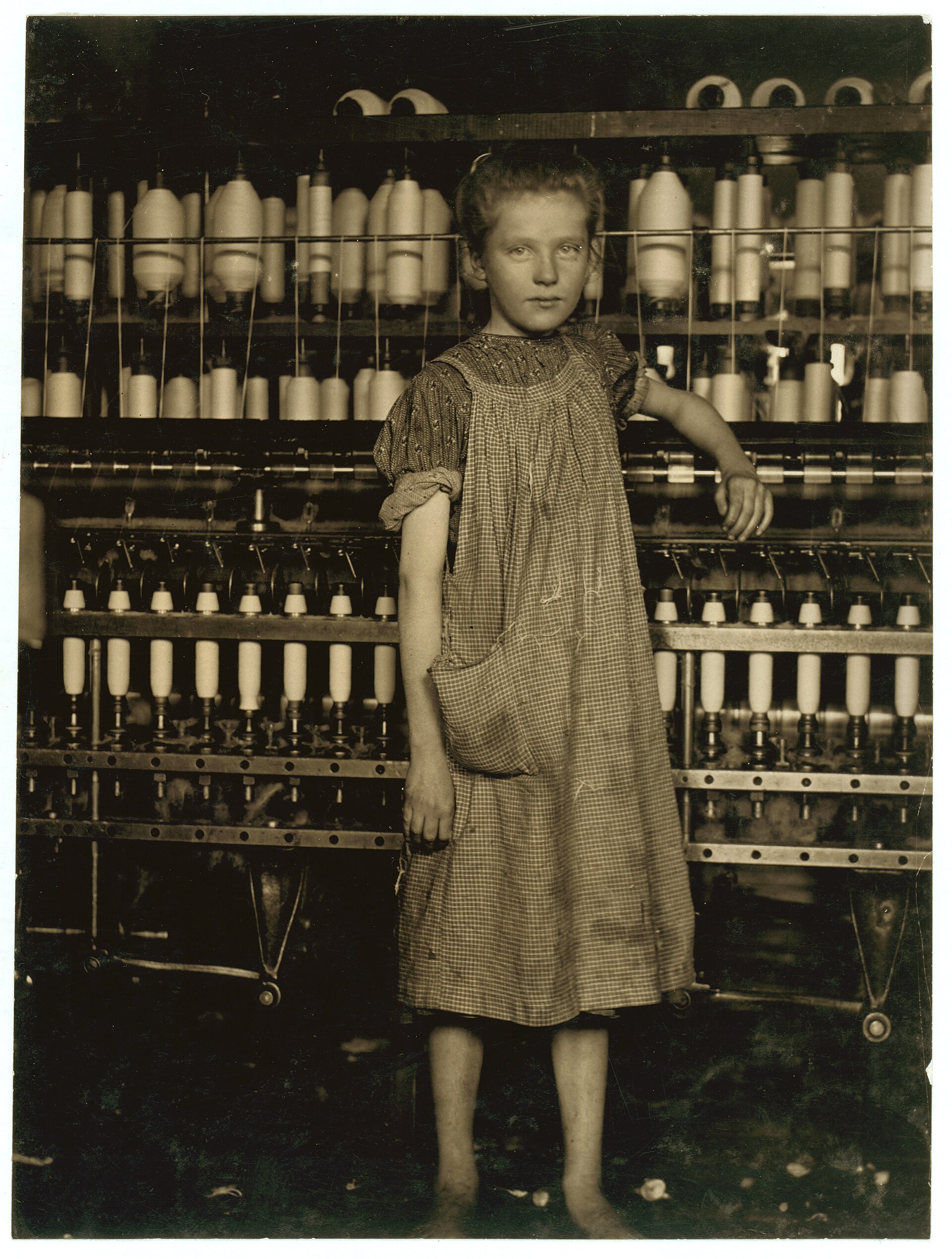
Records in this piece: Sir John Herschel, Addie Card, 12 years. Spinner in North Pownal Cotton Mill, The Critic
On this page 9 sections
ContentsClose
In short
- Julia Margaret Cameron registered 508 of her photographs for copyright at Stationers' Hall between 1864 and 1875. The office allowed her to attach a specimen print to each entry and she never once did it, so the legal record of her authorship is a file of written descriptions with no photographs in it.
- For more than four and a half years, from February 1866 until October 1870, the entry forms were signed by an agent rather than by her, as Edward Stowell for Julia Margaret Cameron, with three forms she signed herself in March 1866.
- Her last applications, sent on 18 October 1875 as she was leaving for Ceylon, were not for new work. They were for Autotype carbon copies of five of her earlier portraits of famous men, which is the same question this piece asks, asked by her.
- This archive shows three objects from one 1867 sitting: the albumen print she made, a carbon print in the Museum of Modern Art made by another process and other hands, and a digital restoration of the first made by a volunteer in this century. Only the first is a print she made, and the carbon prints were her own commission, made from copy transparencies, retouched, and stamped by the printer rather than by her.
- When the question became money, the test turned out to be the paper. The disputed Hine prints tested in 1999 were modern prints from genuine negatives, and they were caught by optical brightening agents that photographic paper did not carry before about 1945, not by anything visible in the picture.
The author of a photograph is a question about the print
A photograph can be printed again by anybody who holds the negative, which is why the authorship of a photograph is decided by the object and the paperwork rather than by the image.
The Winterthur Museum, introducing a case of disputed prints, puts the problem in one sentence: in a field where multiple copies of an image can be produced by a photographer, the issue of unauthorized copies can be problematic, and it is not difficult for an experienced photographer to create new prints from original negatives. Museums and collectors value the artistry of the original photographer. The negative does not care who is holding it.
For a woman who worked in the nineteenth century this is not an abstraction, because the people who held her negatives afterwards were usually men, and the objects they produced carry her name. This archive holds three photographic records where the question is live, and one of them holds three different answers to it inside a single gallery.
One sitting, three objects, in this archive alone
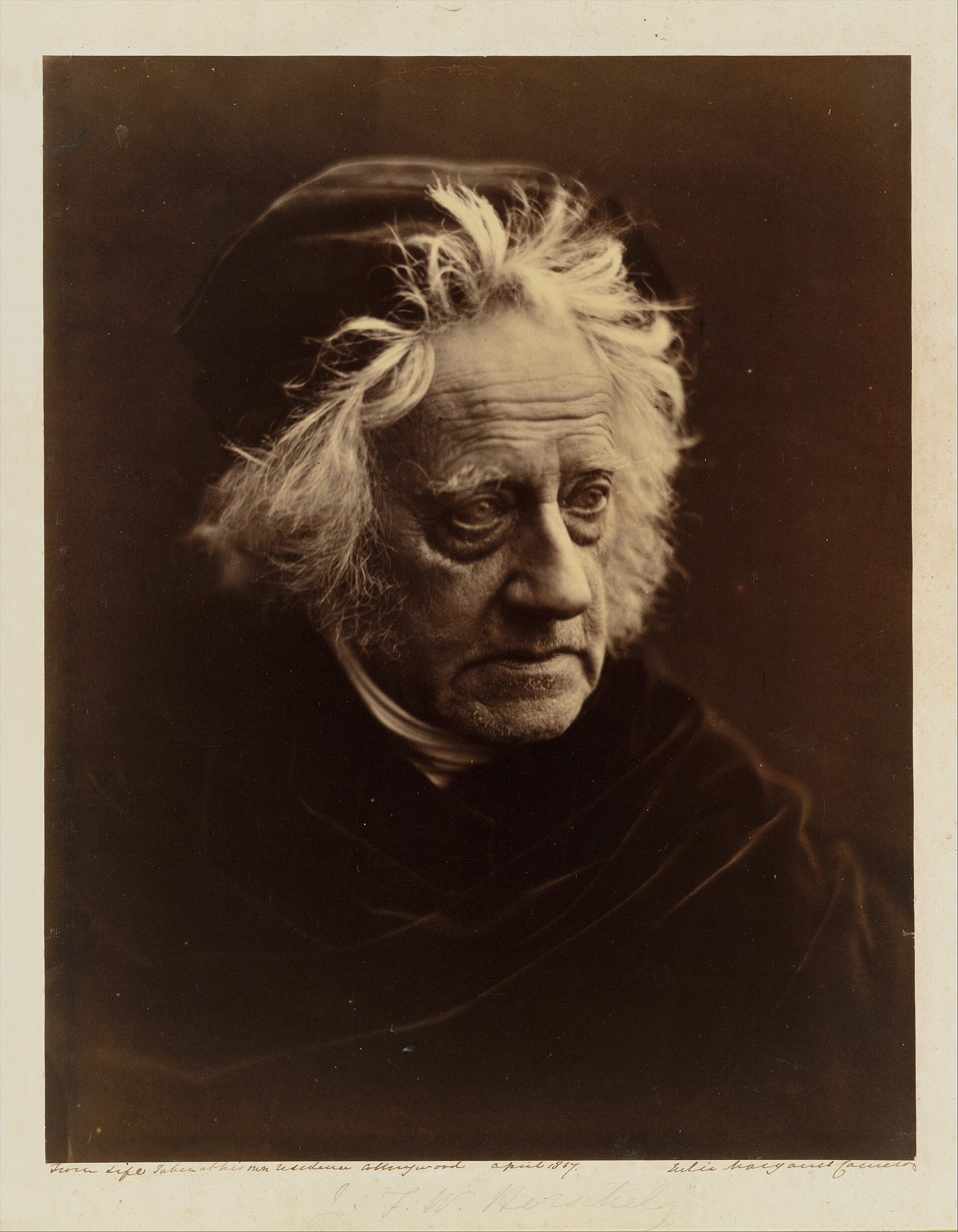
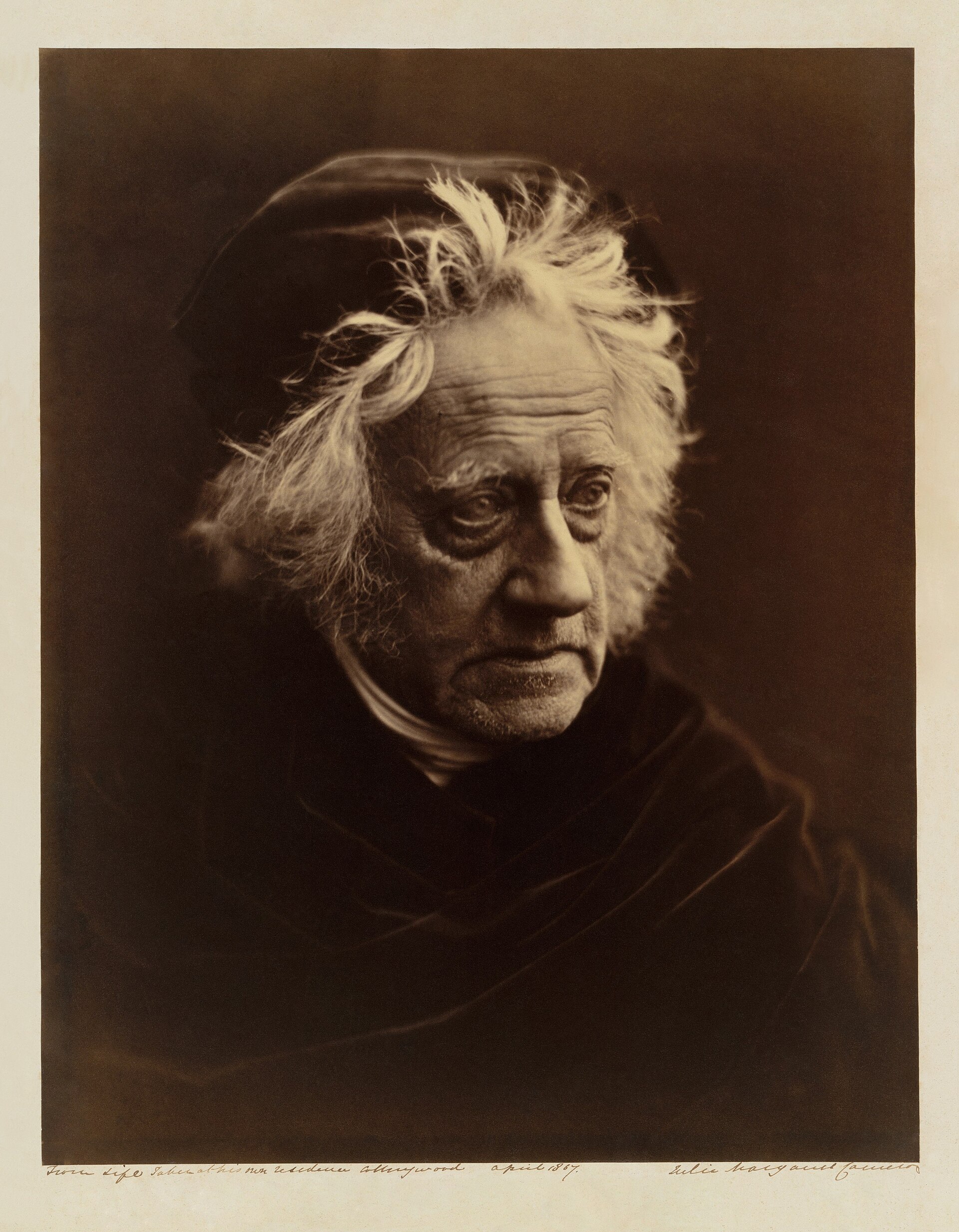
Cameron photographed the astronomer Sir John Herschel at his home in Kent in April 1867, and this archive shows three different objects that descend from that sitting.
She registered the work at once. All four Herschel studies, plus a double portrait with the Honourable Mrs Gordon, were entered for copyright on 9 April 1867, and she put them on sale at Colnaghi's at twenty shillings, a price the Athenaeum that June called very moderate. The Metropolitan Museum's albumen print, Gilman Collection, accession 2005.100.25, carries her inscription on the mount in ink, From life Taken at his own residence, Collingwood, April 1867, Julia Margaret Cameron, and below it, in pencil, the sitter's own signature. Two hands on one mount, and both of them deliberate.
The second object is a carbon print in the Museum of Modern Art, from the same 1867 sitting, made by another process and by other hands, which our record captions as a different object rather than as the same picture. The third is a digital restoration of the Metropolitan print, made by a Wikimedia volunteer who removed the dust, the scratches and the stains, and it sits in our gallery labelled as a modern derivative. Three objects, one negative, and a descending scale of her involvement. She made the first. The Museum of Modern Art gives its carbon print a flat 1867 and names no printer and no printing date, so that she did not make it is an inference from her carbon work being contracted out, not something a document states. Nobody living when she died could have made the third.
Her own hand is the evidence, and it disagrees with itself
The dating of this composition rests on Cameron's own handwriting on the mounts, and her handwriting gives two different years.
Some surviving prints of the pose are dated 1867 and some 1869, both in her hand, and the standard catalogue raisonne, Julian Cox and Colin Ford's Julia Margaret Cameron: The Complete Photographs of 2003, lists the two groups under separate numbers, 674 for the 1867-dated group and 675 for the 1869-dated one. The Metropolitan's print belongs to the 1867 group. Whether that reflects two real sittings or one sitting misremembered on later mounts is not settled. One print carries an inscription added six years after the sitting, noting that the glass negative was by then damaged. She scratched into negatives, printed from cracked glass, and let her sons and her dealers circulate the results under her name. A maker's own hand is the best evidence there is, and in her case it produces a population of objects rather than one fixed thing.
The physical measurements say the same. These are prints of the same composition, in four collections and two salerooms, trimmed by hand around a single negative's image with no fixed template and mounted on whatever card was to hand or judged right for the recipient.
| Holder | Size in centimetres, as each holder records it | Note |
|---|---|---|
| Metropolitan Museum of Art | 31.8 by 24.9 | The print our record describes |
| Victoria and Albert Museum | 32.1 by 24.2 | On a smaller mount |
| National Gallery of Victoria | 32.4 by 23.8, image and sheet | Dated 1869 in her hand, with the word Copyright |
| Bonhams, 18 May 2004, lot 20 | 35.5 by 27 | Dated 1869, Colnaghi blindstamp |
| Sotheby's, 9 December 2022, lot 1027 | 33 by 25.7 | Dated 1867, Colnaghi blindstamp |
| Metropolitan Museum, 35.85.3 | Image 33.8 by 26.2, mount 58.3 by 46.2 | A second Met print, on a much larger mount, with the Colnaghi blindstamp |
Nothing in that spread suggests a second negative. It is one image and six objects, and a reader who assumes that the Herschel photograph names one fixed thing is wrong before they start.
She registered descriptions, and never attached a picture
Cameron registered 508 of her photographs for copyright between 1864 and 1875, and not one of those registrations has a photograph attached to it.
The law she was using is the Fine Arts Copyright Act 1862, which required the register to record the name and abode of the proprietor, the name and abode of the author and a short description of the nature and subject of the work, and which made a specimen optional, to be supplied only if the person registering shall so desire. The fee was one shilling an entry. Her forms begin in her own words: I, Julia Margaret Cameron of Freshwater Bay Isle of Wight do thereby certify, That I am entitled to the Copyright in the undermentioned Work. In the column for the proprietor of the copyright and in the column for the author of the work, the same answer is written twice: J. M. Cameron.
R. Derek Wood, who worked through the forms at Kew, established the total of 508 over eleven and a half years, and established that the specimen option was one she never used. Julian Cox and Colin Ford reached the same conclusion from the other end, noting that none of her prints survives with the forms. So the file that proves her authorship contains her handwriting and no pictures, and the consequence is measurable: of the 508 works she registered, Cox and Ford could match only 249 to a known image. More than half of what she formally claimed cannot now be connected to any surviving print.
Two further facts from the same registers cut against the tidy story of a woman taking her own business in hand. She signed personally only in 1864 and 1865, about two hundred forms; after that an agent signed for her, and Wood reads the signature as Edward Stowell for Julia Margaret Cameron. How long that lasted is disputed: Wood has it ending in October 1870, while Cox and Ford describe two different agents running to August 1871 and suggest, hedging it themselves, that they acted for her publisher Colnaghi. And her last applications, sent to Stationers' Hall on 18 October 1875 as she and her husband left for Ceylon, were not for new photographs. They were for Autotype carbon copies of five earlier portraits of famous men, Darwin, Joachim, Tennyson, Herschel and Watts.
Where the test turned out to be the paper
When a great deal of money rested on whether a print was made by the photographer, the question was settled by chemistry.
Lewis Hine died in financial difficulty in 1940. His prints and negatives went to the Photo League, then into the home of one of its members, the photographer Walter Rosenblum, and eventually to the George Eastman Museum. In 1999 the collector Michael Mattis, who had paid between three and eight thousand dollars each for prints he believed were vintage Hine, had them tested. The testing developed for the case classified paper fibre, texture, gloss and fluorescence, and documented the manufacturers' logos printed on the backs of photographic papers. The decisive finding was optical brighteners, additives that photographic paper did not carry until about 1945, a decade after Hine's death, and which fluoresce under ultraviolet light. The disputed prints failed. They were modern prints made from Hine's own negatives.
What followed has to be stated exactly, because a named man's reputation is in it. Walter Rosenblum, who had held the negatives and who with his wife Naomi gave prints to museums, was accused of having printed and sold hundreds of modern versions of Hine's work to six dealers. Winterthur records the rest: the case was settled out of court in 2001, it would not have been illegal for him to sell prints made from Hine's negatives had he identified himself as the printer, and he maintained that the photographs had been printed by Hine. He admitted no wrongdoing and the terms remain confidential. The prints are not fakes in the ordinary sense either: they come from authentic Hine negatives, and what they are not is prints Hine made.
The connoisseurship that failed belongs on the page beside the chemistry that worked. Winterthur notes that experts hold that genuine vintage Hine prints generally have low contrast and are in somewhat ragged condition, while most of the unauthorised reprints identified so far tend to have higher contrast and to be in pristine condition, so the reprints looked better than the prints Hine made. Hine rarely signed a print, though he was prolific about writing captions on the back in pencil. And Winterthur's caption for the Greenville print reads, in the only honest form available: Powerhouse Mechanic, Lewis Hine, printed by Walter Rosenblum from the original negative by Lewis Hine.
Two crops, and a negative nobody can produce
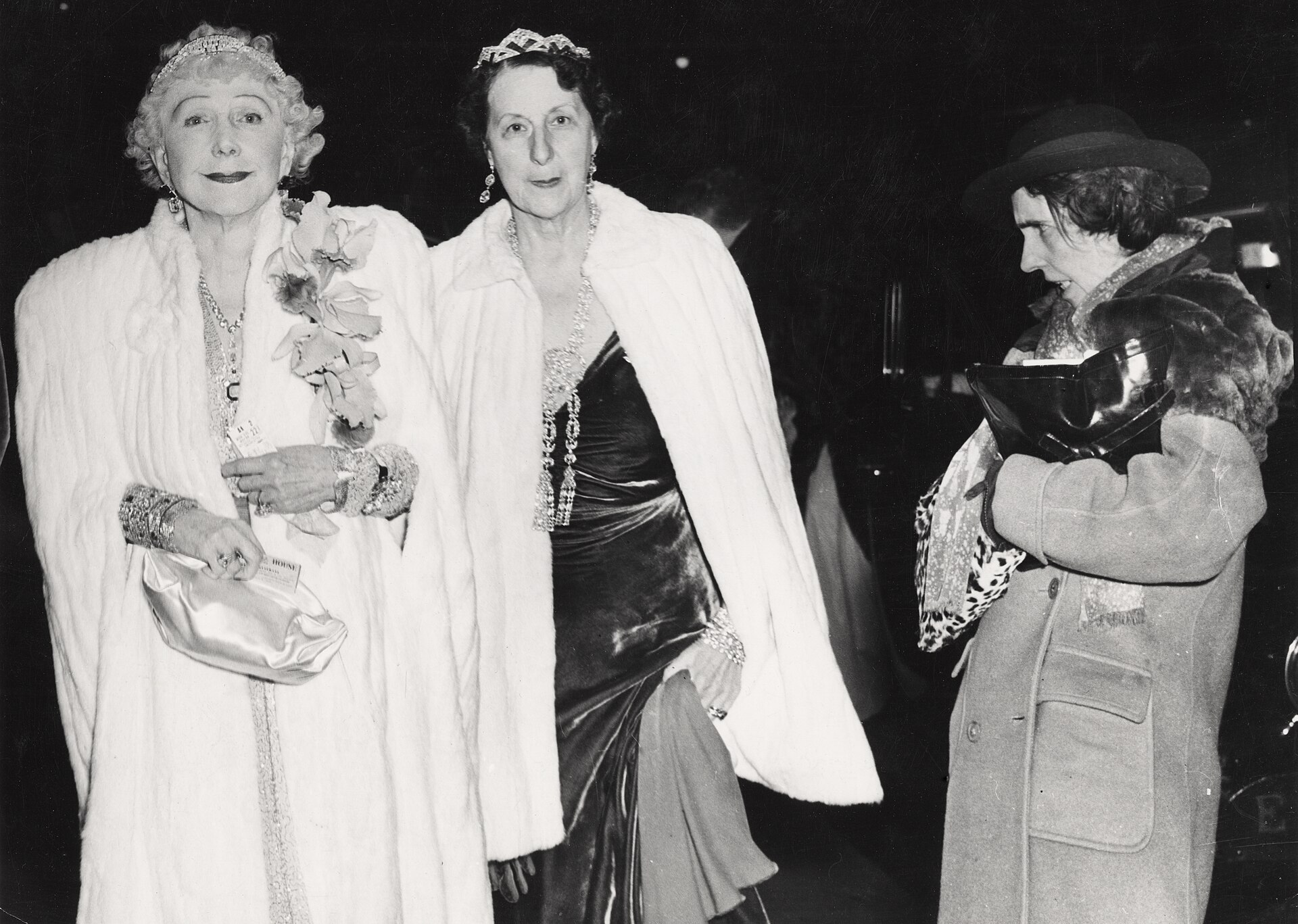
Weegee's The Critic exists in at least two different crops across the institutions that hold it, and the whereabouts of the original negative is an open question.
The prints came mostly through the estate of Weegee's companion Wilma Wilcox to the International Center of Photography, which catalogues more than one of them separately. Our record for the picture records genuinely unresolved questions about where the original negative is, about the photograph's first publication and about its current copyright status. The image everyone knows is the tight three-figure composition reproduced since Weegee's 1945 book. Whether the wider print is an uncropped print from the same negative or a separate exposure from the same staged sequence is not established in any source our record could reach, and the wider one is itself a posthumous print from the authorised portfolio of 1980.
So the same three questions come back in a twentieth-century case with a named, famous author. Which object is the work: the crop that made the picture famous, or the fuller frame. Who made this particular print. And what is the document that answers either question. A photograph with an undisputed author can still have a disputed body of work.
And one object that nobody alive in 1879 could have made
The third Cameron object in our gallery was made by a volunteer, in this century, out of the first one.
It is the Metropolitan print with the dust, the scratches and the stains digitally removed, and our record captions it as a modern derivative rather than as a Cameron. Keeping it is right, because the cleaned version is the one a reader is most likely to meet elsewhere, and showing it beside the unretouched digitisation is the only way to make the difference visible. Labelling it is not optional, and it is the same duty Winterthur's caption discharged by naming the printer.
The carbon prints are the harder case, and they are not a posthumous problem. Cameron commissioned them herself. She approached the Autotype Company of Ealing shortly before leaving for Ceylon in 1875 to carbon-print about seventy of her most successful images, at two guineas a negative, to retail at seven shillings and sixpence, and she then fell into what she called a fierce controversy with the company, which took forty per cent on every print sold. Cox and Ford describe how those prints were made, and every step of it matters here: not from the original negative in a printing frame but from positive transparencies copied from it, with spots and flaws carefully retouched out, and marked at the lower right with the printer's stamp rather than hers. Two objects complicate it further. The Victoria and Albert holds a carbon Herschel that names its printer, J. B. Obernetter, and separates the dates, photographed April 1867 and printed about October 1875. And the Getty holds a carbon print of this sitting inscribed by Cameron herself, in her usual formula and then three more words: From Life Registered Photograph Copyright Julia Margaret Cameron Imperishable Carbon Printing. Her hand, on somebody else's print, attesting the process.
The institutions that hold these objects have not settled it either. The Museum of Modern Art dates its Herschel carbon simply 1867. The Art Institute of Chicago dates its Herschel carbons 1867, printed 1875. Princeton and Yale say printed later. Harvard's record is the only one anywhere that raises the possibility in as many words: 1867, possibly printed posthumously. Five collections, the same class of object, and the field where a reader would look says something different in each. There is a genuinely posthumous state as well: in 1893, fourteen years after her death, her son Henry Herschel Hay Cameron published an album of photogravures after her negatives, and the Art Institute catalogues its Herschel plate from it as 1867, printed about 1893. One sitting, and at least four printing states across sixty years.
What to ask before calling a print a Cameron
Ask who coated the paper, who held the negative on the day the print was made, and what document says so.
Those questions are answerable more often than they are asked. For the Metropolitan's Herschel the answers are good: the process is albumen, the mount carries her hand, and the Gilman Collection provenance is published. For a carbon print of the same pose the honest answer is that it is a print of a Cameron photograph, which is a different sentence. For the digital restoration the answer is in our own caption. For a Hine bought in 1998 the answer took a laboratory.
None of this diminishes what she did. It is the opposite. Cameron took up a camera at forty-eight, made roughly nine hundred photographs in about twelve years, sold them through a London dealer, sent blank mounts to sitters for their autographs because, as she wrote to Herschel in March 1868, the photograph of him was to her idea doubled in value by his genuine autograph, and she had marked the place in pencil for his name, and filed 508 copyright registrations in her own name, though Wood notes she did not seek copyright for all her work. On the evidence of the forms she treated a photograph as a piece of property that had to be claimed, and she claimed it 508 times. The gap she left, and could not have closed, is that she claimed it in writing and never once attached the picture.
Why this archive is free to read
We do this for everyone who loves art. The people who have studied it for years, and the people who just stopped to look. Iconotheca exists so that what we learn belongs to all of them.
Nobody pays us for this. No ads, no sponsors, no commercial interest. These works belong to all of us, and we would rather share them with as many people as we can than keep them to ourselves.
If it gave you something today, tell us to keep going. Follow us, leave a like, or write a positive comment. We read every one, and they are what keeps us going.
Questions
508, over eleven and a half years from 1864 to 1875, at the Copyright Office at Stationers' Hall in London. The entry forms survive at the National Archives in the class COPY 1. The office allowed a specimen print to be attached to an entry and she never did so, so the registrations describe her photographs in words without reproducing them.
Only at first. She signed personally in 1864 and 1865, and then from early 1866 until October 1870 the forms were signed by an agent as Edward Stowell for Julia Margaret Cameron, with three forms she signed herself on 23 March 1866. She returned to signing her own from 1871.
It depends on who made it and when, and the honest description names both. This archive holds an albumen print of her Herschel portrait that she made and a later carbon print of the same pose in the Museum of Modern Art, and captions them differently. Cameron herself registered copyright in Autotype carbon copies of five earlier portraits in October 1875, so she claimed the image even where she had not made the object.
By testing the paper rather than by looking at the pictures. Analysis of paper fibre, of the manufacturers' logos printed on the backs of photographic papers and of optical brightening agents, which photographic paper did not carry before about 1945 and which fluoresce under ultraviolet light, showed that the disputed prints were modern. They had been printed from Hine's own negatives after his death.
Because the cleaned version is the one most readers meet elsewhere, and putting it beside the unretouched digitisation is the only way to make the difference visible. It is captioned as a modern derivative image and not as a photograph Cameron made.
Sources
- 1R. Derek Wood, "Julia Margaret Cameron's copyrighted photographs" (May 1996), a study of the Copyright Office entry forms at the National Archives, class COPY 1, pieces 6 to 31, for the text of the entry form, the total of 508 registrations between 1864 and 1875, the specimen option she never used, the agent signing as Edward Stowell, and the final applications of 18 October 1875 for Autotype copies. The 1996 PDF is the clean text; the HTML version of the same study renders several years wrongly. web.archive.org/web/...
- 2Metropolitan Museum of Art, collection record for Julia Margaret Cameron, Sir John Herschel, April 1867, albumen print, Gilman Collection, accession 2005.100.25. metmuseum.org/art/...
- 3Victoria and Albert Museum, collection record for J.F.W. Herschel by Julia Margaret Cameron, one of the prints of the same composition in a public collection. collections.vam.ac.uk/item/...
- 4Victoria and Albert Museum, "Julia Margaret Cameron's working methods", on her printing practice, her use of damaged negatives and her commercial arrangements. vam.ac.uk/articles/...
- 5National Gallery of Victoria, Melbourne, collection record for Sir J.F.W. Herschel by Julia Margaret Cameron, the 1869-dated print with the Colnaghi blindstamp. ngv.vic.gov.au/explore/...
- 6Bonhams, London, 18 May 2004, sale 11255, lot 20, Julia Margaret Cameron, J.F.W. Herschel, 1869, for the sheet size and the Colnaghi blindstamp of that print. bonhams.com/auction/...
- 7Sotheby's, New York, Age of Wonder, 9 December 2022, lot 1027, Julia Margaret Cameron, J.F.W. Herschel, for the sheet size and the 1867 date of that print. sothebys.com/en/...
- 8Winterthur Museum, "Treasures on Trial: The Art and Science of Detecting Fakes", the Hine Photograph case, for the statement of the reprinting problem, the provenance of the Greenville print, the contrast and condition tells, Hine's pencil captions on the verso, and the label naming Walter Rosenblum as the printer. treasuresontrial.winterthur.org/evidence/...
- 9International Center of Photography, collection object record for Weegee, The Critic, accession 7229.1993, one of the separately catalogued prints of the image. icp.org/browse/...
- 10Wikimedia Commons, category of portraits of John Herschel by Julia Margaret Cameron, for the file pages and licence metadata of the plates used here, including the volunteer restoration credited to Adam Cuerden. commons.wikimedia.org/wiki/...
- 11Julia Margaret Cameron, "Annals of My Glass House", written about 1874 and first published in 1889, her own account of taking up photography and of her working method. infolio.es/articulos/...
- 12Fine Arts Copyright Act 1862, 25 and 26 Vict. c. 68, sections 4 and 5, for what the register had to record, for the specimen being supplied only if the person registering shall so desire, and for the fee of one shilling an entry. legislation.gov.uk/ukpga/...
- 13The National Archives, Kew, series description for COPY 1, Copyright Office: Entry Forms, 1837 to 1912, the class in which Cameron's registrations are held. discovery.nationalarchives.gov.uk/details/...
- 14Art Institute of Chicago, collection record for Sir John Herschel, photogravure, 1867, printed about 1893, plate 11 of Alfred, Lord Tennyson and his Friends, the album published by her son Henry Herschel Hay Cameron after her negatives. artic.edu/artworks/...
- 15Museum of Modern Art, collection record for Julia Margaret Cameron, Sir John F. W. Herschel, carbon print, dated 1867 with no separate printing date, object 832.1965. moma.org/collection/...
- 16Julian Cox and Colin Ford, Julia Margaret Cameron: The Complete Photographs (Los Angeles: J. Paul Getty Museum, 2003), the catalogue raisonne, for the four Herschel studies as catalogue numbers 674 to 677 all copyrighted on 9 April 1867, the price of twenty shillings for the signed portraits, the Autotype contract of 1875 and how the carbon prints were made, the agents signing the registrations, and the finding that only 249 of the 508 registered works can be matched to a known image. getty.edu/publications-reports/...
- 17Art Institute of Chicago, collection record for Sir John Herschel, carbon print, dated 1867, printed 1875, Alfred Stieglitz Collection 1949.878, one of the few carbon prints of this sitting catalogued with a printing year. artic.edu/artworks/...
- 19Victoria and Albert Museum, collection record for a carbon print from a copy negative of Herschel, museum number 12-1939, which names the printer J. B. Obernetter and separates the dates, photographed April 1867 and printed about October 1875. collections.vam.ac.uk/item/...
- 19Princeton University Art Museum, collection record for John Herschel, carbon print, dated 1867, printed later, object 2010-177, from the Clarence H. White Collection. artmuseum.princeton.edu/collections/...
- 21Yale University Art Gallery, collection record for Herschel, photogravure, dated 1867, printed later, object 2016.101.36. artgallery.yale.edu/collections/...
- 21"Intrigue in the World of Photography: The Fake Lewis Hine Prints", read in the Internet Archive capture of 21 August 2025 after the live page returned , for the collector Michael Mattis having the prints tested in 1999, the prices of three to eight thousand dollars, the verso stamp from paper stock issued after Hine's death, and the record that the affair settled out of court and that Rosenblum admitted no wrongdoing. web.archive.org/web/...
- 23Malcolm Daniel, "Julia Margaret Cameron (1815-1879)", Heilbrunn Timeline of Art History, Metropolitan Museum of Art, for her taking up the camera at forty-eight and producing perhaps 900 images in a dozen years, and for her vigorous copyrighting, exhibiting, publishing and marketing of her work. metmuseum.org/essays/...
More in The Women Behind the Art
The partThe Woman Whose Money the Vermeers Lived On
Three Vermeers in this archive were painted in the years Vermeer worked in Maria Thins's household.
Who She Was, and Who Owned the Picture of Her
Four famous photographs of women in this archive. Only one of the four is named on the picture, by herself, and she is the only one who owned the...
The Queen Who Never Saw the Watch That Carries Her Name
Breguet No. 160 is called the Marie-Antoinette. Nothing from the queen's lifetime connects her to it: the firm's records call it a gold watch, and...