Sir John Herschel
Julia Margaret Cameron · April 1867
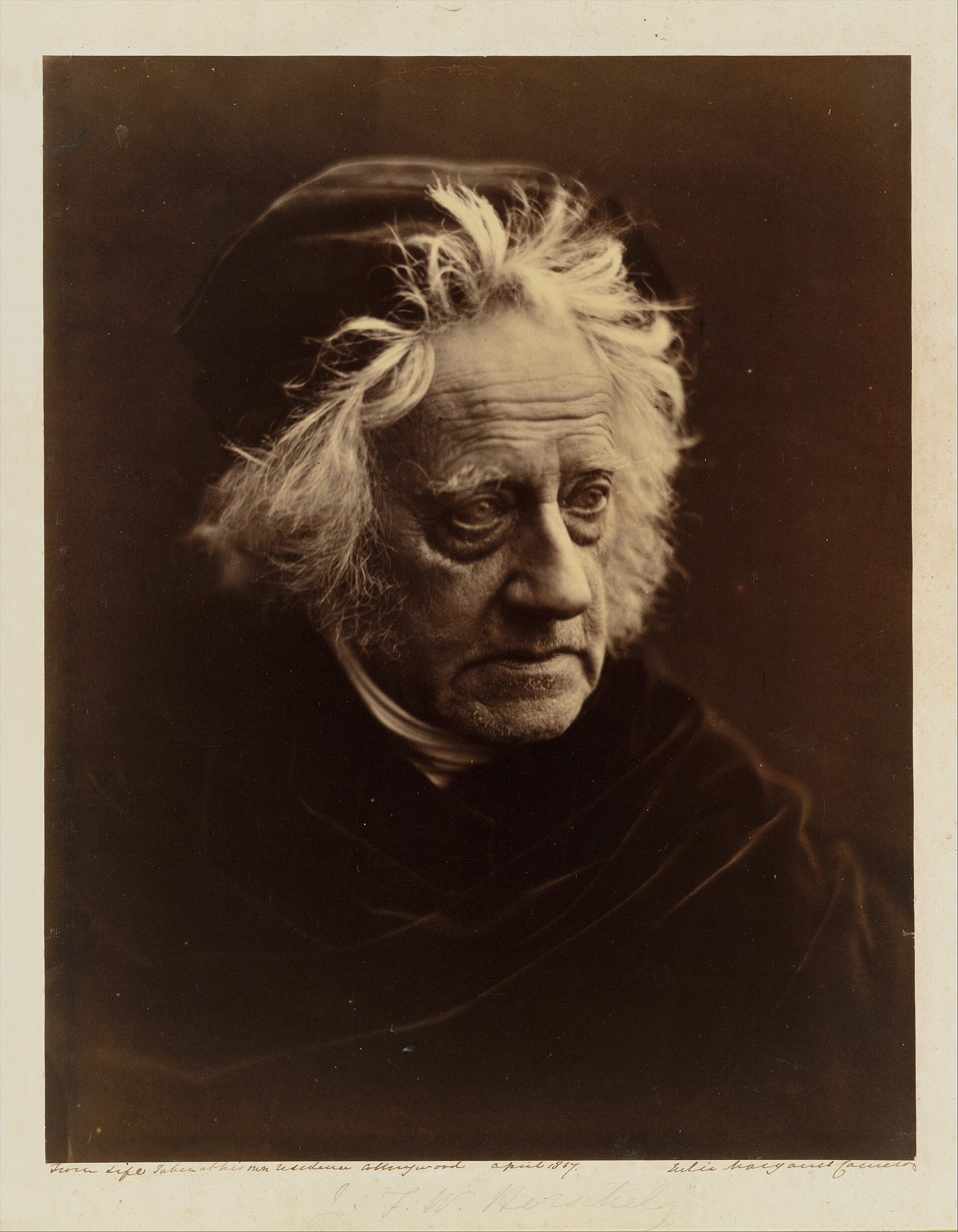
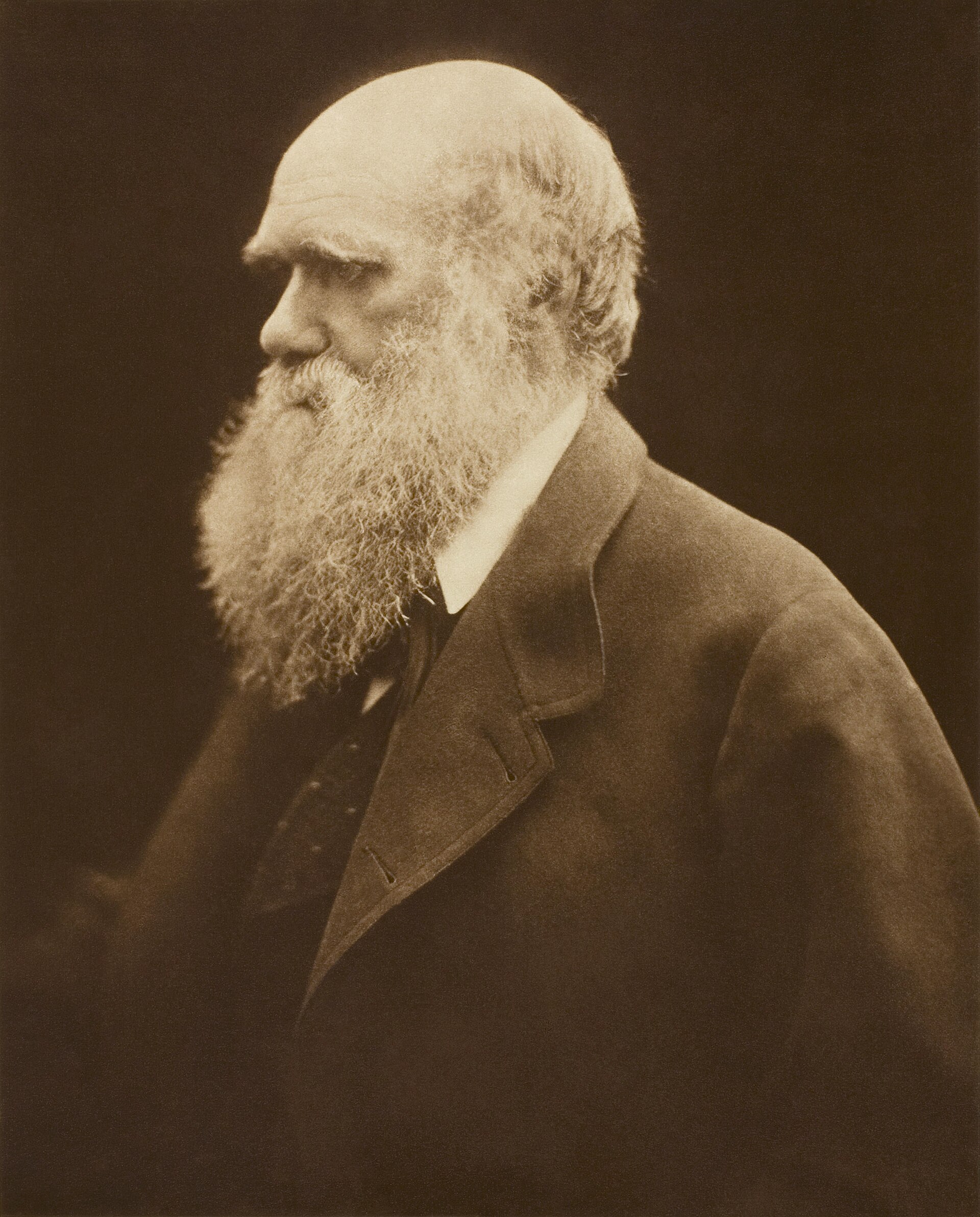
The object described in this record: the Metropolitan Museum's albumen print, April 1867, Gilman Collection, accession 2005.100.25. An unretouched digital scan, shown here in preference to the retouched version below because it best represents the print's actual current surface.
| Artist | Julia Margaret Cameron |
|---|---|
| Date | April 1867 |
| Medium | Albumen silver print from a wet collodion glass negative |
| Dimensions | Image 31.8 x 24.9 cm (12 1/2 x 9 13/16 in.); mount 39.9 x 32.9 cm (15 11/16 x 12 15/16 in.), corners clipped |
| Where it is now | Metropolitan Museum of Art, New York, Department of Photographslast confirmed |
| Inventory number | 2005.100.25 |
| Attribution | AcceptedCameron's authorship is not in question; the print is catalogued as hers by every institution that holds a version of it. Full note |
| Object type | Photograph |
| Period | British, nineteenth century |
| Cases | Has a provenance gap |
| Inscriptions | Not independently verified for this exact mount: the Metropolitan Museum's own transcription could not be retrieved past a persistent HTTP 429 rate limit on repeated attempts. Sibling prints from the same 1867-dated group carry Cameron's autograph inscription reading, in substance, 'From Life Registered Photograph taken at his own residence Collingwood,' signed and dated by her, with a P. and D. Colnaghi dealer blindstamp on the mount (recorded on the Sotheby's example of 9 December 2022, lot 1027). This record does not assert that the Metropolitan's own mount carries identical wording. |
| Owners on record | 5 links4 documented, 1 unknown |
| Sources | 16 cited |
About this record Last verified · 16 sources cited · Change log
On this page 9 sections
ContentsClose
A close, soft-focus head-and-shoulders portrait of the astronomer and chemist Sir John Herschel, made by Julia Margaret Cameron at his home in Kent and inscribed by her as April 1867. It is one of at least half a dozen surviving prints of this sitting, now scattered across the Metropolitan Museum, the Victoria and Albert Museum, the National Gallery of Victoria, and private collections, and no two of them are quite the same object.
Some are dated 1867, some 1869, on Cameron's own handwriting; the standard catalogue lists the two groups as different entries. One surviving print carries an inscription, added six years after the sitting, noting that the glass negative was by then damaged. Cameron scratched into negatives, printed from cracked glass, and let her sons and dealers circulate the results under her name and copyright, which is exactly the kind of practice that turns a single famous image into a population of individually contestable objects. This page is about the Metropolitan's print specifically, and about what can and cannot be said to distinguish it from its siblings.
Provenance
Each link is graded. Documented: a cited source supports it. Disputed: the identification is argued but not established. Unknown: no owner for that span, and the gap is not smoothed into a narrative. The grades in the glossary.
- April 1867 -Julia Margaret Cameron, makerdocumented
Photographed at Herschel's home, Collingwood, near Hawkhurst, Kent. The Metropolitan Museum dates its print April 1867; related prints of the same pose carry an alternative Cameron-inscribed date of April 1869, discussed in the narrative and graded there as a separate, unresolved dispute rather than folded into this line.13567
- 1867 - c. 1977Unknownunknown
No ownership record for this specific print was found for the roughly one-hundred-year interval between the sitting and the print's appearance in the Gilman Paper Company Collection. This is recorded as an open gap rather than bridged with an assumed sale through Colnaghi or any other plausible but unsourced route.
- c. 1977 - 1998Howard Gilman, chairman of the Gilman Paper Company, advised by Pierre Apraxinedocumented
Assembled as part of the Gilman Paper Company Collection, formed over roughly two decades and widely regarded as the finest collection of photographs then in private hands. Gilman died in 1998.1112
- 1998 - 2005The Howard Gilman Foundationdocumented
The collection remained with Gilman's foundation until its acquisition by the Metropolitan Museum was completed.11
- 2005 - presentMetropolitan Museum of Art, New Yorkdocumented
Acquired as part of the roughly 8,500-object Gilman Collection in a combined purchase and gift arrangement, following seven years of negotiation and nine months of fundraising; the Museum sold duplicate or lower-priority material from the collection to help fund the purchase. This print's credit line, Gilman Collection, Purchase, Robert Rosenkranz Gift, 2005, records a purchase underwritten in part by a named donor's gift of funds.111
Technical evidence
| Attribution note | Cameron's authorship is not in question; the print is catalogued as hers by every institution that holds a version of it. What is unresolved is which sitting and which of Cameron's own dated inscriptions is correct. Prints of this composition circulate with two different Cameron-inscribed dates, April 1867 and April 1869, and the standard catalogue raisonne (Julian Cox and Colin Ford, Julia Margaret Cameron: The Complete Photographs, 2003) lists them under separate numbers, catalogue 674 for the 1867-dated group and catalogue 675 for the 1869-dated group. The Metropolitan's print belongs to the 1867-dated group. Whether that reflects two real sittings four years apart, at the same house, in the same pose, or a slip on Cameron's part when she inscribed mounts long after the exposure, is not resolved in the sources consulted. |
|---|---|
| Negative | Wet collodion process on a glass plate of approximately 12 by 10 inches, the standard negative size Cameron used in this period of her career.89 |
| Print process | Albumen silver print, printed out by contact under sunlight directly from the glass negative.18 |
| Dimensions of this print | Image 31.8 x 24.9 cm (12 1/2 x 9 13/16 in.); mount 39.9 x 32.9 cm (15 11/16 x 12 15/16 in.), with the mount corners clipped.1 |
| Lens | A Jamin of Paris portrait lens, Petzval-type design, fixed aperture of f/3.6, with a rack-and-pinion focusing mount; a lens of this type used by Cameron survives in the Royal Photographic Society Collection at the V&A (RPS.2467-2017, given by Alvin Langdon Coburn). Its chromatic aberration is the usual technical explanation for the soft focus of prints like this one.4 |
| Exposure | Not separately recorded for this sitting; Cameron's wet collodion portrait exposures at this period are documented as typically running three to seven minutes.9 |
| Comparative print sizes | Across the known surviving prints of this pose, image or sheet sizes range from about 31.8 x 24.9 cm (this print) to 35.9 x 27.9 cm (Metropolitan, Rubel Collection print, accession 2013.1116), with a matching spread in mount size; the variation is consistent with individually hand-trimmed and mounted prints from one negative rather than a fixed edition format.1235 |
| Dating inscriptions across the print population | Surviving mounts of this composition carry two conflicting Cameron-inscribed sitting dates, April 1867 and April 1869. Julian Cox and Colin Ford's 2003 catalogue raisonne lists the two groups as separate entries, catalogue 674 and catalogue 675, rather than resolving them to one date.13567 |
| Negative condition, 1873 | A related print (National Gallery of Victoria, PH67-1977) carries a Cameron inscription dated 1873 stating that the glass negative was by then injured. This record could not establish whether the Metropolitan's print shows evidence of that damage.5 |
Images
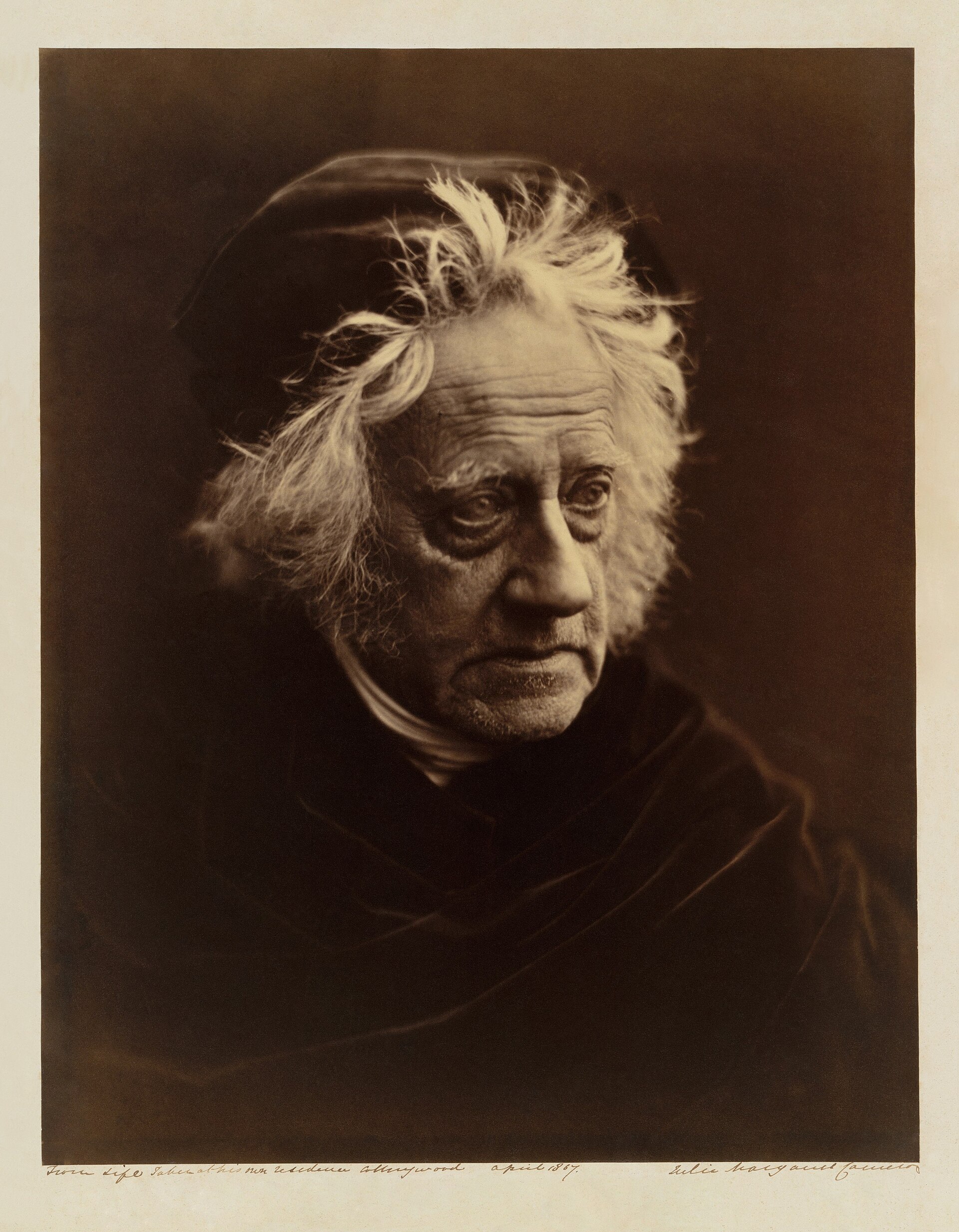
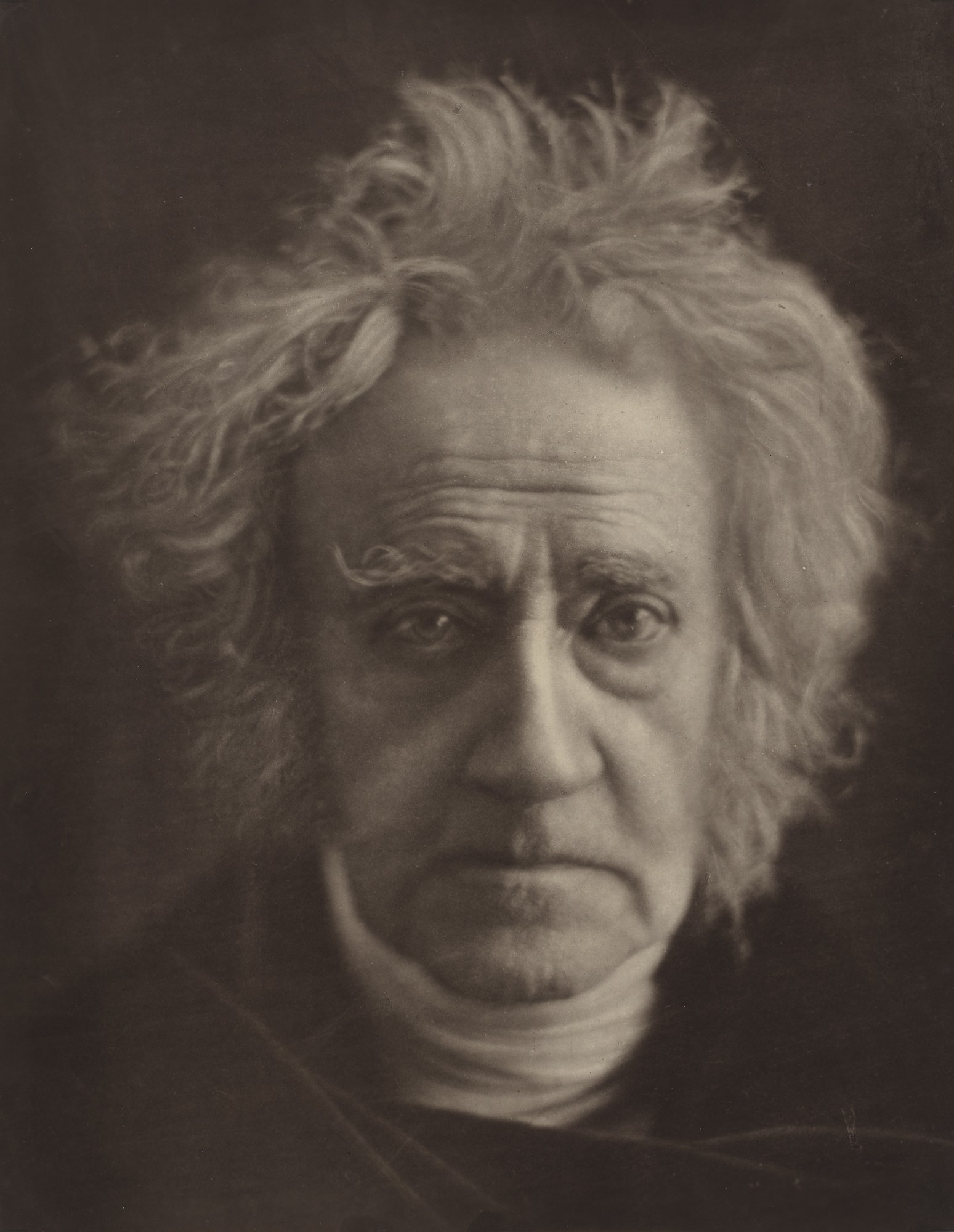
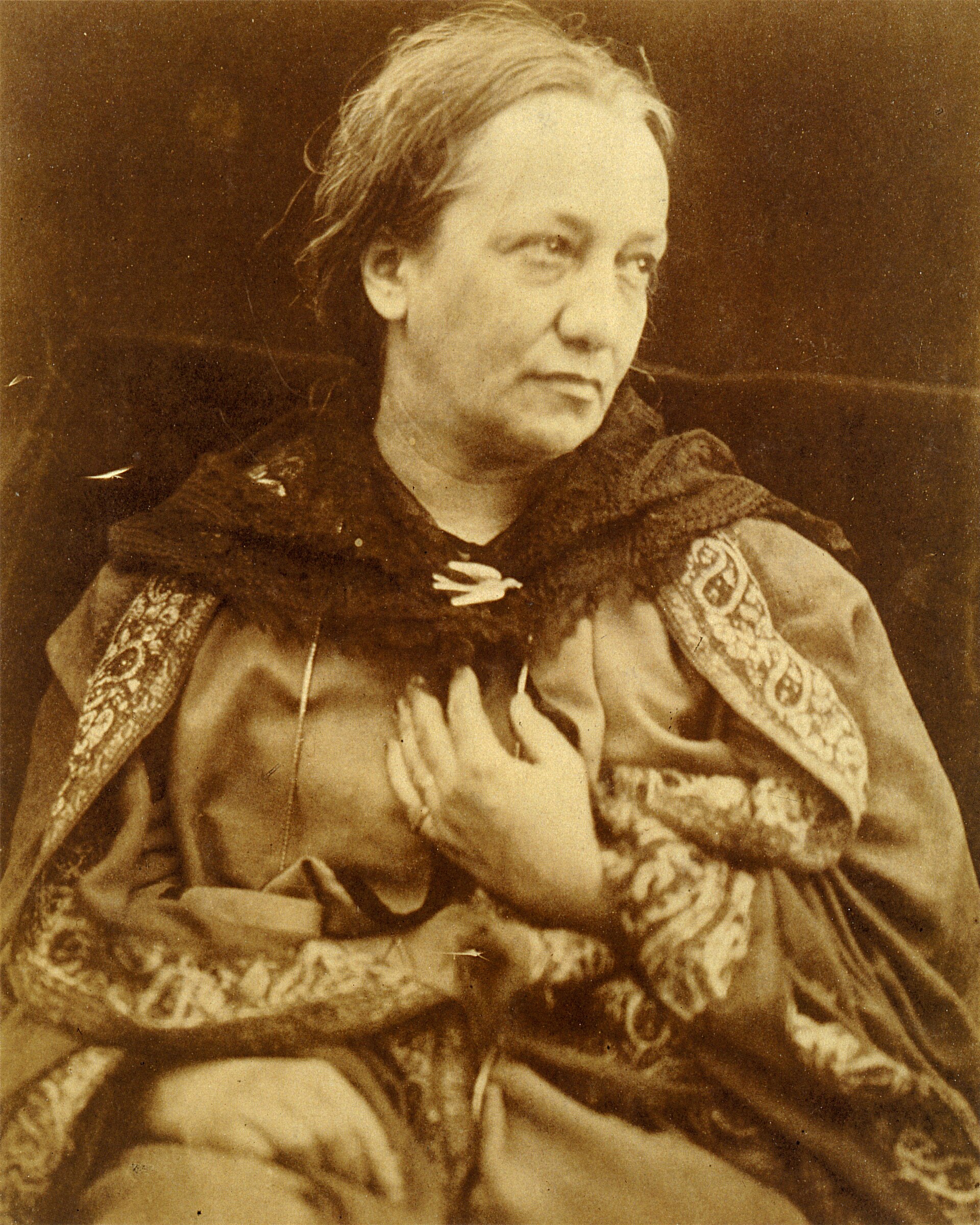
The record in full
Chapter 1What the object is
An albumen silver print, image 31.8 by 24.9 centimetres, laid on a larger mount, 39.9 by 32.9 centimetres, whose corners have been clipped.
An albumen silver print, image 31.8 by 24.9 centimetres, laid on a larger mount, 39.9 by 32.9 centimetres, whose corners have been clipped. It shows the head and upper shoulders of an elderly man with a mass of unruly white hair and beard, lit from one side, emerging from an undifferentiated dark ground. There is no armchair, no book, no instrument, nothing that a conventional studio portraitist of 1867 would have used to signal that the sitter was a scientist. The image is close enough, and soft enough in focus, that the effect is closer to an apparition than a record.
The sitter is Sir John Frederick William Herschel, astronomer, chemist and mathematician, son of the astronomer William Herschel, then in his mid-seventies and in the last years of his life; he died in 1871. Cameron photographed him at his home, Collingwood, near Hawkhurst in Kent, where she went specifically to make his portrait. The print now in the Metropolitan Museum of Art is one of several known prints of this exact pose from this sitting, and this record is about that print: what is documented about it, what is only documented about its siblings, and where the two are at risk of being confused.
Chapter 2The sitter, and why Cameron wanted him
Cameron and Herschel had known each other since 1835, when she convalesced near him at the Cape of Good Hope.
Cameron and Herschel had known each other since 1835, when she convalesced near him at the Cape of Good Hope. He told her about the invention of photography in 1839, within months of its announcement in London and Paris, and in 1842 he sent her some of the first photographic images she ever saw, calotypes and daguerreotypes, years before she owned a camera herself. He stood godfather to her first child. By the time she photographed him in 1867 the friendship was, in her own count, thirty-one years old.
Cameron's own description of the sitting survives in her short memoir Annals of My Glass House, written not long before her death and first published posthumously. She did not treat this as a routine commission. Herschel was, to her, a teacher, and the portrait was conceived as an act of record for the nation, not a private keepsake. The full passage is used below as this record's artist quotation, because it states in her own words what she thought she was doing when she made this photograph, as distinct from what any modern reading of the image might supply.
The choice of sitter also carries a specific irony worth stating plainly rather than treating as a coincidence: Herschel is credited with coining the English words 'photography,' 'negative,' 'positive' and 'snapshot,' and with describing the fixing process that made a photographic image permanent. Cameron photographed, with a technique he had helped name, the man who named the technique.
Chapter 3How the sitting and the print were made
Cameron worked in the wet collodion process on glass negatives of roughly 12 by 10 inches at this date, moving to a 15 by 12 inch format later in her career.
Cameron worked in the wet collodion process on glass negatives of roughly 12 by 10 inches at this date, moving to a 15 by 12 inch format later in her career. The plate had to be coated, sensitised, exposed and developed while still wet, which meant the darkroom, a converted coal-house and glazed henhouse at her home on the Isle of Wight, had to be within a few minutes' reach of the camera; on location at Collingwood, that logistics problem had to be solved on Herschel's own property. Exposures at this period commonly ran three to seven minutes, long enough that any small movement by the sitter registered as blur.
Her first lens, from the Paris maker Jamin, was a Petzval-type portrait lens with a fixed aperture of about f/3.6 and pronounced chromatic aberration; an example belonging to her, given to the Royal Photographic Society by the photographer Alvin Langdon Coburn, now survives in the V&A's Royal Photographic Society Collection. That aberration, combined with her habit of working close to the lens's minimum focus distance and declining to stop it down for greater depth of field, is the optical explanation usually given for the soft, non-photographic quality contemporary critics objected to and that this print exhibits.
By her own account, and by the account of visitors, Cameron prepared her sitters physically for the image she wanted rather than simply pointing a camera at them as she found them. Herschel is reported to have washed and tousled his white hair before the sitting so that it would catch the light exactly as it appears in the print, an unusually active piece of direction for a Victorian portrait sitting of an eminent man by an amateur.
Chapter 4Two dates for one photograph
This is the central problem this record exists to state clearly.
This is the central problem this record exists to state clearly. Prints of this same pose, at very close to this same size, survive with two different dates written on them in what is, in both cases, presented as Cameron's own hand.
The Metropolitan's print, the Victoria and Albert Museum's print (museum number 1144-1963), and a print sold at Sotheby's in London on 9 December 2022 (lot 1027, from the Age of Wonder sale) are each dated April 1867. The National Gallery of Victoria's print (accession PH67-1977) and a print sold at Bonhams in London on 18 May 2004 (lot 20) are each inscribed as taken 'at his own residence Collingwood' in 1869. Julian Cox and Colin Ford's 2003 catalogue raisonne, Julia Margaret Cameron: The Complete Photographs, treats these as two separate catalogue entries, 674 for the 1867 group and 675 for the 1869 group, rather than resolving them to a single date.
What that means in practice is that the standard reference on Cameron's work does not claim to know whether Herschel sat for this composition once, in 1867, with a small number of later prints mistakenly or deliberately dated two years on; or twice, in a near-identical pose four years apart, on each occasion producing a small edition of prints. Either is possible from a woman who scratched corrections directly into her negatives and inscribed mounts, by her own admission, well after the fact. This record follows the Metropolitan's own cataloguing and dates its print April 1867, while stating that the wider print population carries a genuine, unresolved dating conflict that a reader comparing prints across institutions needs to know about before assuming any two copies are interchangeable.
Chapter 5The inscription that dates the damage
The National Gallery of Victoria's 1869-dated print carries a second inscription, in addition to the sitting date, added later still: a note stating that the picture is 'a National portrait of...
The National Gallery of Victoria's 1869-dated print carries a second inscription, in addition to the sitting date, added later still: a note stating that the picture is 'a National portrait of inestimable value as the negative glass is now injured,' dated 1873 in Cameron's hand. The same mount also records that the print was given to a named recipient (recorded by the museum as '(...) Hollis') as a gift from Cameron.
Two things follow from this, and it is worth separating them. First, it is direct, dated, primary evidence that Cameron continued to write on mounts of this image years after any of the sittings under discussion, which is exactly the practice that makes dating any single undated print from style alone unsafe. Second, it establishes that the glass negative for this composition was already damaged by 1873, which means that any print that can be shown to derive from a flawed impression of the negative was made from 1873 onward at the earliest. Cameron is independently documented as having printed from cracked and broken negatives rather than discarding them, so a damage-based print made after 1873 would not necessarily read as a rejected or lesser copy in her own practice.
No condition report or high-resolution negative-flaw comparison for the Metropolitan's print was located in the sources consulted for this record, so this record does not claim to know whether the Metropolitan's print shows or lacks the 1873 damage. That is exactly the kind of physical, comparative examination a specialist with the print in hand, not a documentary record built from published catalogue descriptions, would be needed to settle.
Chapter 6No two prints alike
Beyond the date written on the mount, the surviving prints of this composition differ from each other physically in ways ordinary to Cameron's practice and easy to miss if a reader assumes 'the...
Beyond the date written on the mount, the surviving prints of this composition differ from each other physically in ways ordinary to Cameron's practice and easy to miss if a reader assumes 'the Herschel photograph' names one fixed object. The Metropolitan's own print measures 31.8 by 24.9 centimetres. The Victoria and Albert's measures 32.1 by 24.2 centimetres on a smaller mount. The National Gallery of Victoria's measures 32.4 by 23.8 centimetres. The Bonhams print measured 35.5 by 27 centimetres. The Sotheby's 2022 print measured 33 by 25.7 centimetres. A second print of the same date held by the Metropolitan itself, from the Rubel Collection (accession 2013.1116), is mounted on a sheet of 55.3 by 45.1 centimetres, much larger than any of the others.
None of these differences is large enough to suggest a different negative was used for most of them; they are consistent with Cameron and her printers hand-trimming albumen paper around a single negative's image with no fixed template, then mounting the results on whatever card was to hand or judged appropriate for the recipient or buyer, sometimes plain and sometimes on the ruled and blindstamped mounts she used for sale through her dealer. The Rubel print's unusually large mount is the one outlier worth flagging on its own terms: a reader assuming a Cameron carte or cabinet-sized mount as standard would be wrong for that print specifically.
Chapter 7Registering copyright, selling through Colnaghi
Cameron treated her photography as a business as well as an art, and the paper trail from that business is part of what makes prints like this one identifiable at all.
Cameron treated her photography as a business as well as an art, and the paper trail from that business is part of what makes prints like this one identifiable at all. Starting in 1864, the year she took up the camera, she began registering individual photographs for copyright at the Copyright Office at Stationers' Hall in London, a legal step most contemporary amateur and even most professional photographers did not bother with. Over roughly eleven and a half years, to October 1875, she registered 508 of her photographs this way; the surviving Copyright Entry Forms, held in the Public Record Office's COPY 1 class, show her signing them personally only in 1864 and 1865, after which an agent, recorded as Edward Stowell, signed on her behalf for more than four years.
From her first year she also arranged for prints to be sold through the London art dealers P. and D. Colnaghi, and the Colnaghi blindstamp appears on several of the surviving Herschel mounts, including the 1867-dated Sotheby's print and the 1869-dated Bonhams and National Gallery of Victoria prints. She is also recorded as sending signed mounts directly to sitters, Herschel among them, specifically to raise a print's resale desirability, an unusually candid piece of evidence that Cameron thought about her photographs as saleable commercial objects and not only as private tributes to friends.
Chapter 8Critical reception at the time
The soft focus and visible imperfection that give this print its character were not accidental limitations that Victorian critics excused; they were the single most contested feature of Cameron's...
The soft focus and visible imperfection that give this print its character were not accidental limitations that Victorian critics excused; they were the single most contested feature of Cameron's work while she was alive. The Photographic Journal, reviewing her work in 1865, dismissed it as smudged, torn, dirty and undefined, a judgement aimed squarely at the kind of chromatic blur and shallow focus produced by her Jamin lens. The Illustrated London News took the opposite position, praising her images as the nearest approach photography had made to fine art.
Cameron's own framing of the dispute, recorded in Annals of My Glass House, was that she aimed to capture the inner character of a sitter rather than a mechanically sharp record of his features, and that she measured her portraits of eminent men against the example of painters such as Titian and Raphael rather than against the technical standard of the commercial photographic trade. Whatever the merits of that position in 1867, it is the reason a portrait of a scientist carries no scientific attributes at all: Cameron was not illustrating what Herschel had discovered, she was trying to picture what kind of man she believed had discovered it.
Chapter 9From Cameron's hands to the Gilman Collection
Documented provenance for the Metropolitan's specific print begins again only in the late twentieth century.
Documented provenance for the Metropolitan's specific print begins again only in the late twentieth century. It was one of more than 8,500 photographs assembled between roughly 1977 and 1997 by Howard Gilman, chairman of the Gilman Paper Company, working with the art historian Pierre Apraxine as his adviser; the resulting Gilman Paper Company Collection was, by the time it was finished, widely regarded as the finest collection of photographs in private hands anywhere. Gilman died in 1998, after which the collection was held by the Howard Gilman Foundation.
In 2005, after seven years of negotiation and nine months of fundraising, the Metropolitan Museum of Art acquired the collection in a combined purchase and gift arrangement, with the Museum able to deaccession and sell duplicate or lower-priority material to help fund the purchase. The Metropolitan's credit line for this print, 'Gilman Collection, Purchase, Robert Rosenkranz Gift, 2005,' records that mechanism: it is a purchase, underwritten in part by a named donor's gift of funds, rather than an outright donation of the object itself.
How the print reached the market that fed the Gilman Collection between Cameron's death in 1879 and the collection's formation a century later is not documented in the sources consulted for this record. That gap, of roughly a hundred years, is recorded here as unknown rather than filled with a plausible-sounding but unsourced chain of ownership.
Chapter 10The market for Cameron's Herschel, and what it is not evidence of
Because the Gilman Collection reached the Metropolitan as a bulk acquisition rather than a single lot at public auction, this print itself has no individual hammer price or premium to report, and...
Because the Gilman Collection reached the Metropolitan as a bulk acquisition rather than a single lot at public auction, this print itself has no individual hammer price or premium to report, and none is invented here. What auction evidence exists concerns different physical prints of the same composition and needs to be read as exactly that, evidence about the market for this image in general, not a price history for this object.
The 1869-dated print with the Colnaghi blindstamp and the inscription naming a Mr. Charles Hogan as an earlier recipient was offered at Bonhams in London on 18 May 2004 (lot 20) with an estimate of 2,000 to 3,000 pounds sterling; the price realised was not available in the auction record consulted. A 1867-dated print, also Colnaghi blindstamped and possibly bearing an ink autograph of Herschel himself, was offered at Sotheby's New York on 9 December 2022 as part of the Age of Wonder sale (lot 1027) with an estimate of 30,000 to 50,000 US dollars; the hammer price was behind a login wall not accessed for this record. Both figures are given here only to establish that individual prints of this sitting do circulate and sell, and roughly at what level, not as a valuation of the Metropolitan's own print.
The artist
Julia Margaret Pattle Cameron
Cameron took up photography at forty-eight, on a Christmas gift of a camera from her daughter and son-in-law, and worked at it for barely twelve years before failing eyesight, her husband's finances and a move to Ceylon ended her practice. In that time she produced roughly 900 photographs, registered 508 of them for copyright in her own name, sold through a London dealer, and made portraits of most of the eminent men she could reach a camera toward. She was ridiculed by the professional photographic press of her own day for exactly the qualities now most admired in her work.
Related works
| Work | Relation | Where it is |
|---|---|---|
| Sir J.F.W. Herschel Julia Margaret Cameron | Same pose and composition, inscribed by Cameron as taken in 1869 rather than 1867, and separately inscribed in 1873 noting the negative was by then damaged Felton Bequest, 1977. Cited above as the primary evidence for both the dating conflict and the negative-damage inscription; do not treat this as the same physical object as the Metropolitan's print. | National Gallery of Victoria, Melbourne, accession PH67-1977 |
| J.F.W. Herschel Julia Margaret Cameron | Same pose, inscribed 1869, sold with a Colnaghi blindstamp and a note recording an earlier owner, Charles Hogan Estimated GBP 2,000-3,000; the price realised was not available in the source consulted. | Private collection (sold Bonhams, London, 18 May 2004, lot 20) |
| J.F.W. Herschel Julia Margaret Cameron | Same pose, inscribed 1867, possibly with Herschel's own ink autograph on the mount Catalogued by Sotheby's as Cox 674, the same catalogue number as the Metropolitan's print. Estimated USD 30,000-50,000; the hammer price was not accessed. | Private collection (sold Sotheby's, New York, Age of Wonder, 9 December 2022, lot 1027) |
| Sir John Herschel Julia Margaret Cameron | Second print of the same date held by the same museum, on a markedly larger mount The Rubel Collection, Gift of William Rubel, 2013. Illustrates that print-population variation is not confined to different institutions; the Metropolitan holds two physically distinct prints of this image itself. | Metropolitan Museum of Art, New York, accession 2013.1116 |
| The Herschel Album Julia Margaret Cameron | A separate, complete object: an album of about 94 Cameron portrait photographs presented by her to Sir John Herschel, begun in 1864 and revised in 1867 Not to be confused with any single print discussed on this page. The album is its own object with its own export and acquisition history; this record makes no claim about which, if any, print of this specific Herschel portrait it contains. | National Portrait Gallery, London (published and exhibited in association with the Science Museum) |
| Charles Darwin Julia Margaret Cameron | A comparable Cameron portrait of another eminent scientist, exposed circa 1868 but printed as a carbon print in 1875 Included as comparanda for Cameron's documented practice of printing a negative years after it was exposed, the same practice that complicates dating the Herschel prints. | Art Institute of Chicago, Alfred Stieglitz Collection, reference 1949.881 |
Open questions
- Was there one sitting for this pose, in April 1867, with some later prints mistakenly or deliberately dated 1869; or two sittings, four years apart, producing near-identical results? Cox and Ford's catalogue raisonne records the conflict by cataloguing the two date-groups separately rather than resolving it.
- How did the Metropolitan's specific print travel between Cameron's lifetime and its appearance in the Gilman Paper Company Collection, formed roughly a century later? No ownership record for that interval was found in the sources consulted.
- Does the Metropolitan's print show the negative damage that a related print's 1873 inscription records? This would require direct physical or high-resolution comparison with the National Gallery of Victoria's print and was outside what this record could establish from published sources.
- What price, if any, was separately allocated to this individual print within the Metropolitan's 2005 acquisition of the roughly 8,500-object Gilman Collection? Bulk collection acquisitions of this kind typically do not publish per-object prices, and none was found.
- Was this specific print made by Cameron's own hand, by a household assistant under her direction, or through her dealer Colnaghi's studio? Cameron's working methods are documented in general terms; nothing found for this record identifies who physically produced this particular sheet of albumen paper.
Questions about this object
What is Sir John Herschel?
Sir John Herschel is a photograph, dated april 1867. Medium: Albumen silver print from a wet collodion glass negative.
Who made Sir John Herschel, and is the attribution settled?
The attribution to Julia Margaret Cameron is recorded here as accepted. Cameron's authorship is not in question; the print is catalogued as hers by every institution that holds a version of it. What is unresolved is which sitting and which of Cameron's own dated inscriptions is correct. Prints of this composition circulate with two different Cameron-inscribed dates, April 1867 and April 1869, and the standard catalogue raisonne (Julian Cox and Colin Ford, Julia Margaret Cameron: The Complete Photographs, 2003) lists them under separate numbers, catalogue 674 for the 1867-dated group and catalogue 675 for the 1869-dated group. The Metropolitan's print belongs to the 1867-dated group. Whether that reflects two real sittings four years apart, at the same house, in the same pose, or a slip on Cameron's part when she inscribed mounts long after the exposure, is not resolved in the sources consulted.
Where is Sir John Herschel now?
Metropolitan Museum of Art, New York, Department of Photographs. Inventory number 2005.100.25. Last confirmed 11 August 2026. Gilman Collection, Purchase, Robert Rosenkranz Gift, 2005.
What is still unknown about Sir John Herschel?
Was there one sitting for this pose, in April 1867, with some later prints mistakenly or deliberately dated 1869; or two sittings, four years apart, producing near-identical results? Cox and Ford's catalogue raisonne records the conflict by cataloguing the two date-groups separately rather than resolving it.
Sources
- 1Metropolitan Museum of Art, collection record for Julia Margaret Cameron, 'Sir John Herschel,' April 1867, accession 2005.100.25 (Gilman Collection, Purchase, Robert Rosenkranz Gift, 2005). metmuseum.org/art/...
- 2Metropolitan Museum of Art, collection record for Julia Margaret Cameron, 'Sir John Herschel,' April 1867, accession 2013.1116 (The Rubel Collection, Gift of William Rubel, 2013). metmuseum.org/art/...
- 3Victoria and Albert Museum, collection record for 'J.F.W. Herschel,' Julia Margaret Cameron, museum number 1144-1963, citing Julian Cox and Colin Ford, Julia Margaret Cameron: The Complete Photographs (2003), catalogue no. 674. collections.vam.ac.uk/item/...
- 4Victoria and Albert Museum, Royal Photographic Society Collection, record for the Jamin portrait lens belonging to Julia Margaret Cameron, RPS.2467-2017. collections.vam.ac.uk/item/...
- 5National Gallery of Victoria, Melbourne, collection record for 'Sir J.F.W. Herschel,' Julia Margaret Cameron, accession PH67-1977 (Felton Bequest, 1977). ngv.vic.gov.au/explore/...
- 6Bonhams, sale 11255, lot 20, 'Julia Margaret Cameron, J.F.W. Herschel, 1869,' London, 18 May 2004. bonhams.com/auction/...
- 7Sotheby's, 'Age of Wonder,' New York, 9 December 2022, lot 1027, 'Julia Margaret Cameron, J.F.W. Herschel.' sothebys.com/en/...
- 8Victoria and Albert Museum, 'Julia Margaret Cameron's working methods.' vam.ac.uk/articles/...
- 9Wikipedia, 'Julia Margaret Cameron,' for biographical dates, the Herschel friendship, the camera gift, the Photographic Society and South Kensington Museum purchases, exposure times, the Ceylon move and death, and the posthumous revival. en.wikipedia.org/wiki/...
- 10National Portrait Gallery, London, collection record for 'Sir John Frederick William Herschel, 1st Bt,' NPG P213, for the passage from Cameron's Annals of My Glass House and the record of four exposures made at the sitting. npg.org.uk/collections/...
- 11Metropolitan Museum of Art, press release, 'Metropolitan Museum Acquires World-Renowned Collection of Photographs from The Howard Gilman Foundation,' 2005. metmuseum.org/press-releases/...
- 12Wikipedia, 'Gilman Paper Company collection.' ; flagged the Metropolitan's own acquisition file or Pierre Apraxine's published catalogue essays. en.wikipedia.org/wiki/...
- 13R. Derek Wood, midley.co.uk, 'Julia Margaret Cameron's copyrighted photographs,' summarising the Stationers' Hall Copyright Entry Forms in Public Record Office class COPY 1, pieces 6-31. Verified 2026-08-11 via Wayback Machine snapshot (the live page is currently unreachable); used only for the checkable facts of the registration count and dates, not for any direct quotation. web.archive.org/web/...
- 14Art Institute of Chicago, collection record for Julia Margaret Cameron, 'Charles Darwin,' Alfred Stieglitz Collection reference 1949.881, for the circa 1868 negative date and 1875 print date. artic.edu/artworks/...
- 15Wikimedia Commons, file information and for the images used in this record's gallery, verified individually for LicenseShortName. commons.wikimedia.org/wiki/...
- 16Julia Margaret Cameron, 'Annals of My Glass House' (written c. 1874, first published 1889), full text as transcribed at infolio.es, for the exact wording of the artist quotation used in this record. infolio.es/articulos/...
Last verified · Published
Change log
11 August 2026 - Record created at the house standard: researched narrative, technical evidence, maker dossier, graded provenance chain, prices with hammer and premium separated, related works, open questions and sources.