The Woman Whose Money the Vermeers Lived On
Three Vermeers in this archive were painted in the years Vermeer worked in Maria Thins's household. The Delft wealth register of 1674 assesses her at 26,000 guilders and does not list Vermeer at all.
Records in this piece: The Concert, Girl with a Pearl Earring, The Astronomer
On this page 10 sections
ContentsClose
In short
- Three Vermeers in this archive were painted inside one household, which Maria Thins headed: The Concert, Girl with a Pearl Earring and The Astronomer all fall between the family's documented arrival on the Oude Langendijk and Vermeer's death in December 1675.
- The Delft wealth register of 1674 and 1675 assesses Maria Thins on a personal capital of 26,000 guilders and places her 186th in the town. Vermeer does not appear in it at all, because he and his wife did not own a thousand guilders, which was true of about seventy per cent of Delft.
- She refused to sign the consent to her daughter's marriage in April 1653, and the refusal is physically in the books: the Delft betrothal entry of 5 April was struck through and written in again after two of Vermeer's acquaintances called on her. She never signed that consent, and she and her sister ratified the marriage only in 1661.
- Her capital was not hers to give. A testament of 27 November 1603, made by her mother's sister, tied the estate so that each generation took only the income and the capital passed to the grandchildren, which is how Vermeer's children were provided for before Vermeer was born.
- The house was rented, not owned. The family lived in the Papenhoek in property bought by wealthy Delft Catholics for the use of the suppressed Jesuit mission and let out mostly to unmarried or widowed Catholic women. Which of the two corner houses it was is still argued in print.
- Vermeer was buried in a grave that belonged to her, and the parish could collect nothing from his estate. Her money is the reason his widow and the eight under-age children he left were not destitute, and she spent four years in court to keep it.
Three pictures in this archive were painted inside one household
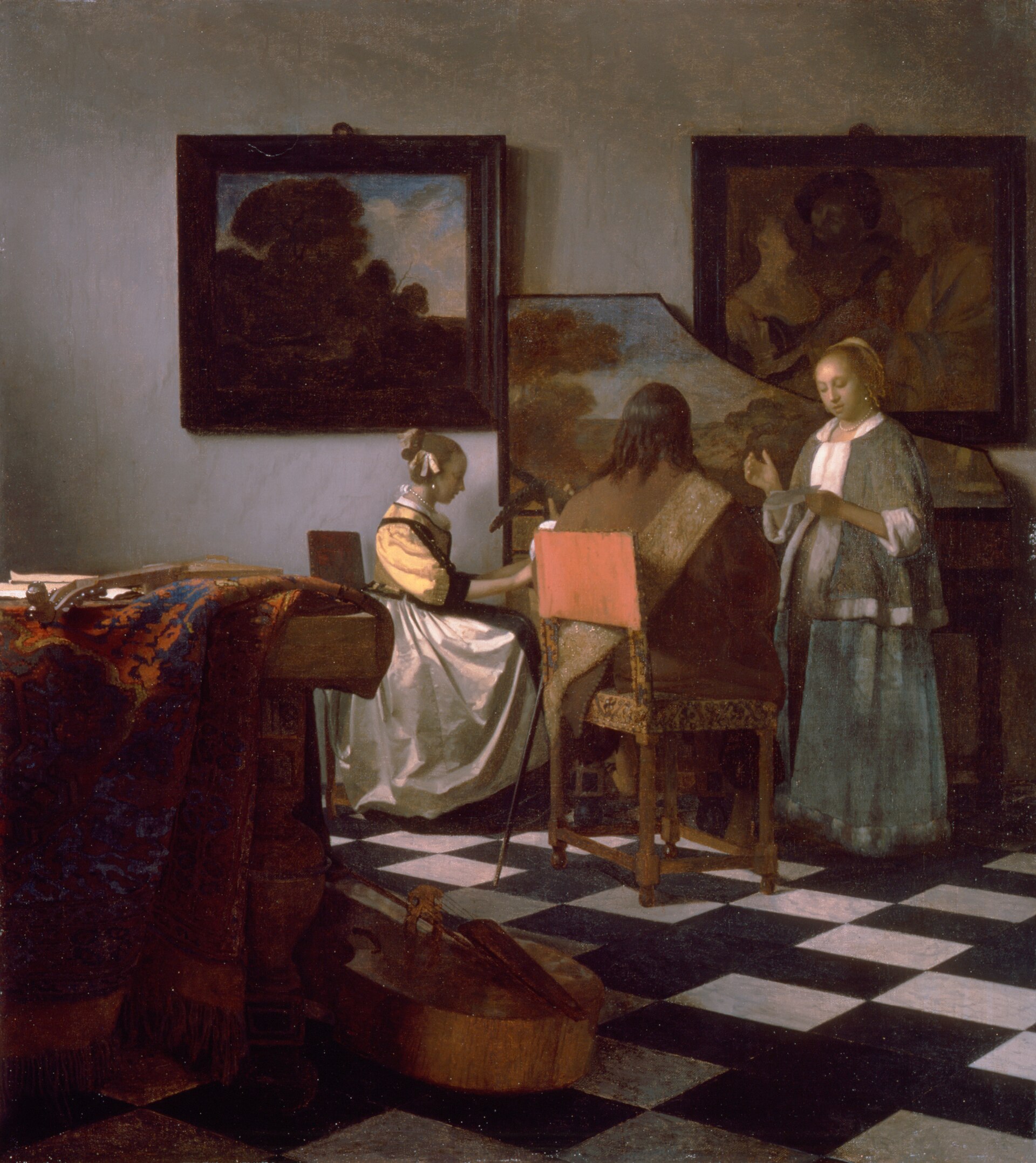
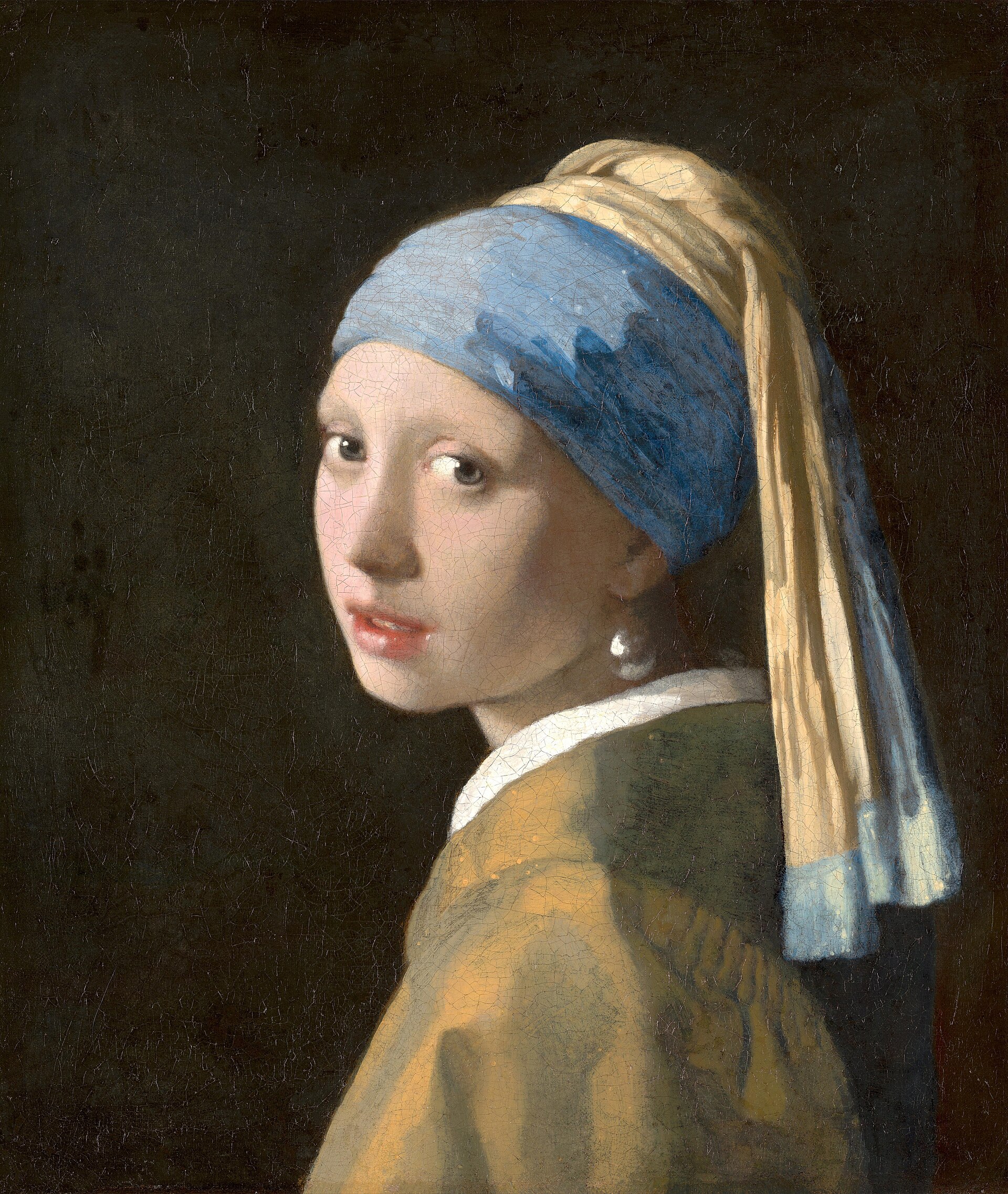
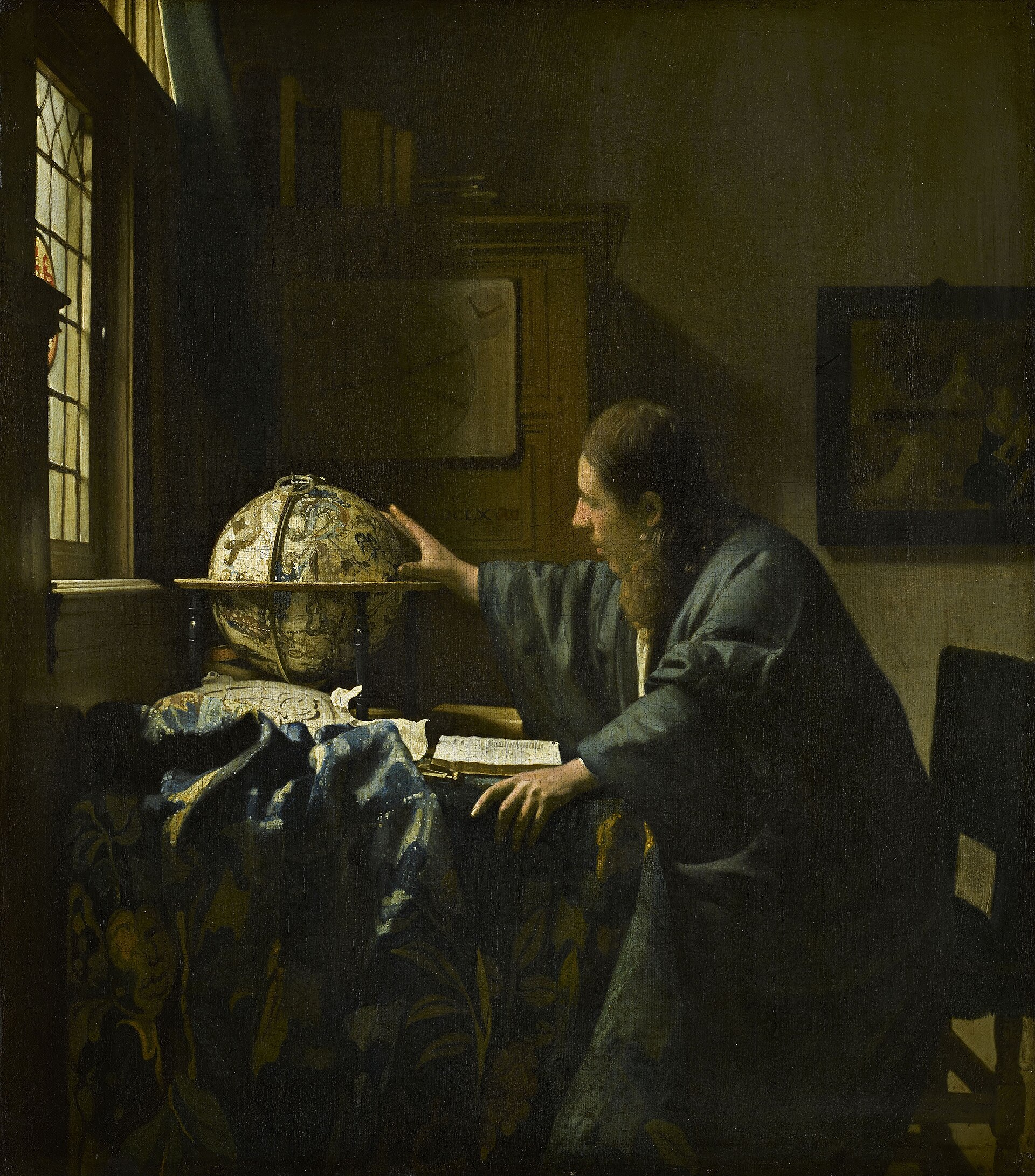
The Concert, Girl with a Pearl Earring and The Astronomer were all painted in the years when Vermeer lived and worked in the household Maria Thins headed on the Oude Langendijk in Delft.
The window is documented at both ends. The first record placing Vermeer at that address is the burial of one of his children on 27 December 1660, and he died there in December 1675. The Gardner's Concert is dated by the catalogue literature to about 1663 to 1666, the Mauritshuis gives about 1665 for the Girl, and The Astronomer is signed and dated 1668. All three sit inside the window. Neither the Mauritshuis nor the Louvre says anything about the house in its own entry, so for those two the connection is chronological inference, and we mark it as that rather than dressing it as a document.
What follows is not an argument that a woman secretly painted these pictures, or that she chose their subjects. It is narrower and better evidenced than that. Vermeer left no letters and no personal writing. Maria Thins generated legal paper for forty years, and a great deal of what we know about how these paintings came to exist we know because she was in court, before a notary or on a tax roll.
The tax register assesses her at 26,000 guilders and does not list him
In the Delft wealth register for 1674 and 1675, Maria Thins is entered on a personal capital of 26,000 guilders and Johannes Vermeer is not entered at all.
The register is the Groot Familiegeld, and the entry reads Maria Tins, wife of Rijnier Bolnes. She stands at number 186 on the Delft list, inside the richest five per cent of the town, on a capital that would ordinarily have yielded something like 1,300 guilders a year. Frans Grijzenhout, working from Kees van der Wiel's identification of the entry, is careful about what the painter's absence means: Vermeer is not mentioned at that address because he was not taxed, and he was not taxed because he and his wife did not own more than a thousand guilders, which was equally true of about seventy per cent of Delft.
That is the asymmetry in one line of a tax roll, and it beats any anecdote. The household had money and the painter did not have it. He was also not idle with hers: in May 1667 she gave him a power of attorney to collect 3,400 guilders and interest secured on a brickworks she had sold, together with 250 guilders owed to her as her sister's heir, a thousand guilders from the regents of Moordrecht and 289 guilders and 10 stuivers from the sale of osier land, and she empowered him to reinvest it according to his own judgement and discretion. In March 1675, nine months before he died, she authorised him again, as Johannes Vermeer constryck schilder, to act for her in the division of her late husband's estate.
She would not sign, and the register still shows the refusal
Maria Thins refused to sign the consent to her daughter's marriage, and the Delft betrothal register carries the refusal as a physical fact.
On the evening of 4 April 1653 the notary Johannes Ranck went to her house with two acquaintances of Vermeer, Captain Bartholomeus Melling, about fifty-nine years old, and the painter Leonaert Bramer, about fifty-eight. They asked her to sign an act permitting the banns. She would not. What she would do, in the standard reading of the deed, is undertake not to obstruct the publication of the banns and to tolerate it, and she said so more than once. The betrothal was entered on 5 April, and the Delft city archive describes what the book looks like: the entry was first struck through and later entered again, because the bride's mother had not agreed with her daughter's choice, and after two of Vermeer's acquaintances had spoken with her she dropped her resistance. The marriage was blessed on 20 April at Schipluiden.
The consequence is not sentimental. Paul Begheyn points out that Vermeer was not yet twenty-five and was therefore legally a minor, and that marriage made him at a stroke competent to act, to run the family art dealing and to be a breadwinner. Her signature, or her withholding of it, sat on the gate of his legal capacity to trade. Why she refused is argued: the popular accounts say religion, a recent study using old Dutch law argues difference of rank and finds no sign of a personal quarrel between mother and daughter, and there is no archival evidence at all for the conversion that is usually attached to the story. We record the dispute and do not settle it.
The house was rented, and from whom is the interesting part
The Thins and Vermeer household did not own the house on the Oude Langendijk. It rented.
This corrects a thing often said loosely, including in the shorthand that Vermeer lived in his mother-in-law's house. The quarter was the Papenhoek, and the houses in it had been bought by wealthy Delft Catholics, among them Machtelt van Beest and Pieter van der Dussen, to support a Catholic community that was legally suppressed, and were let out mostly to unmarried or widowed women of that community. Maria Thins, separated from her husband, was one of those tenants. The house Jan Geensz Thins bought in 1641 for 2,400 guilders, whom Grijzenhout calls her cousin and Montias her presumed brother, and which older accounts treat as the family house, is agreed by both sides of the current argument not to be the family house. Which building held the hidden Jesuit church is itself disputed: Grijzenhout places it there, while Slager reads the documents as putting the church in the fourth and fifth houses along, and several authors have followed him.
Which of the two corner houses the family occupied is unresolved and both cases are in print. Grijzenhout argues for Groot Serpent on the east corner, owned by Pieter van der Dussen, reading the order in which the tax collector of 1674 walked the street and wrote the names down. Slager, and Pieter Roelofs in the Rijksmuseum's 2023 catalogue, argue for Trapmolen on the west corner, owned by Machtelt van Beest, from the fit between the 1676 inventory and the surviving building. One rich Catholic woman and one rich Catholic man are the landlords in the running, and the painter is a tenant's son-in-law in every version.
The picture on the back wall is an identification, not a fact
The brothel scene hanging behind the musicians in The Concert has been identified with a painting listed among Maria Thins's goods in 1641, and an identification is not a title deed.
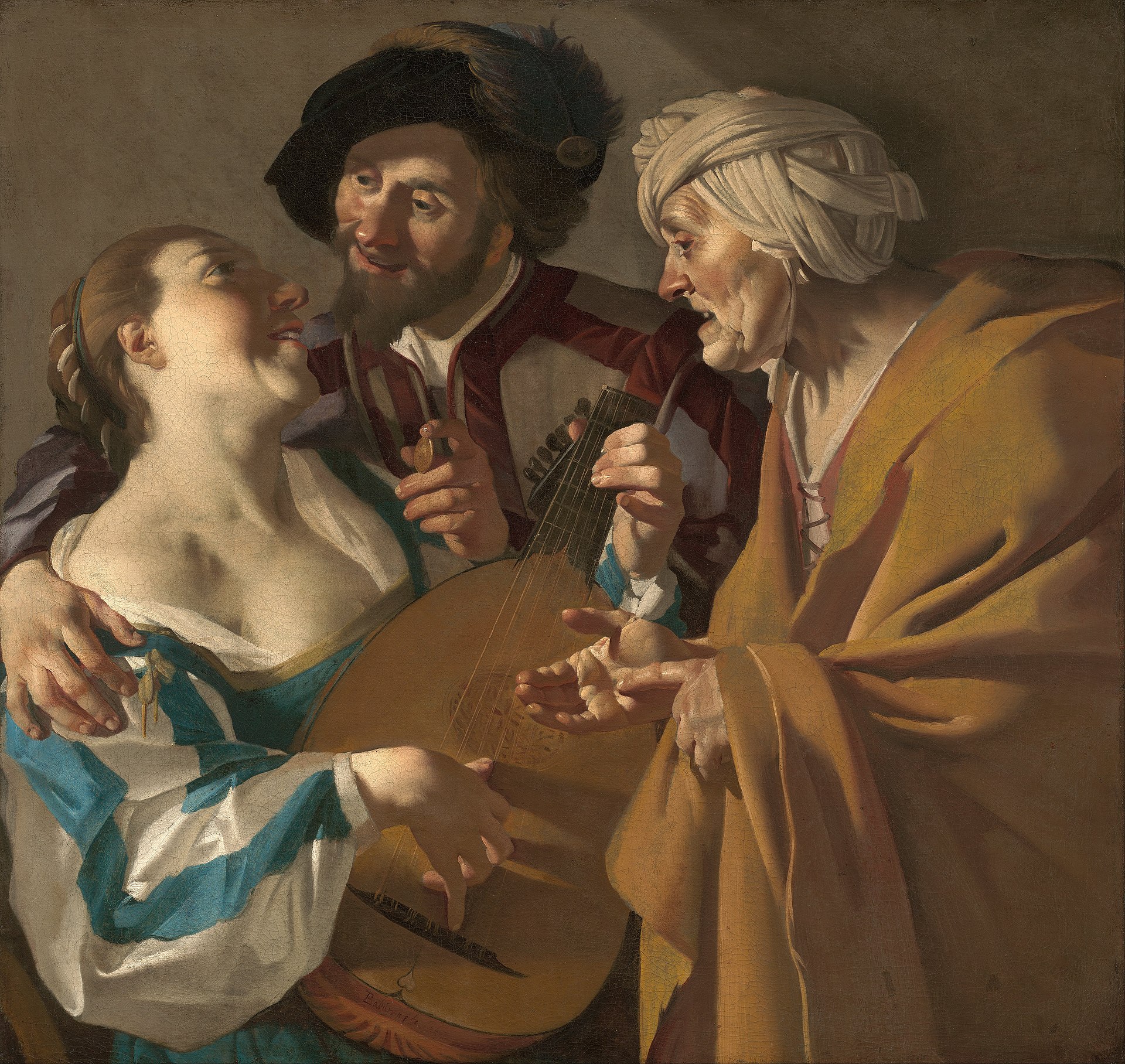
The document is the division of the marital property of Maria Thins and Reynier Bolnes, dated 27 November 1641, which lists a painting of a procuress pointing with her hand. Albert Blankert identified that entry with Dirck van Baburen's Procuress of 1622, now in the Museum of Fine Arts in Boston, and the identification has been repeated ever since. Wayne Franits, in the Baburen catalogue raisonne of 2013, has argued instead that the family owned a replica of the Boston picture. The three museums with an interest do not agree with each other: Boston says the painting or a copy of it was owned by Vermeer's family and hedges its own provenance line with the word possibly; the Gardner says the Procuress was in fact owned by Vermeer's family; the National Gallery in London says flatly that a copy of the painting was owned by Vermeer's mother-in-law. None of the three says that Maria Thins owned the Boston canvas.
So the honest version is narrower and still remarkable. A picture answering that description was in the family's goods, and Vermeer put a picture answering that description into two of his own interiors, The Concert and the National Gallery's A Young Woman seated at a Virginal. The same caution kills a neater claim we would have liked to make. No document makes the painting on the back wall of The Astronomer hers: the Louvre reads it as a Finding of Moses attributed to Peter Lely and suggests it may have come from Vermeer's own collection. One household property in one picture is what the documents support.
Her capital was entailed before Vermeer was born
The money that kept this household was tied up by a testament of 27 November 1603, and Maria Thins held only a life interest in part of it.
That testament was made by her mother's sister, Diewertge van Hensbeeck. It stipulated that the assets divided among the three principal heirs were to remain intact, that only the income was to be consumed and that the capital was to pass in freehold to those heirs' children's children. In plain terms, after Maria Thins and her mother had taken the income, the capital belonged to Catharina Bolnes and her children. Vermeer's children were the beneficiaries of an instrument drawn up nearly thirty years before Vermeer was born, and he knew it: in September 1673 he appeared before the magistrates of Gouda, set out the arrangement and asked in his wife's name and with his mother-in-law's approval for half the capital, 5,183 guilders, promising to hand the interest to her. They allotted him about 2,500 guilders in obligations, and in January 1674 he sold two of them worth 800 guilders.
Her own testaments run the same way. In the first we know of, made at Gouda on 18 June 1657, the clothing, jewellery and silver go to Catharina and 200 guilders to her goddaughter Maria Vermeer, her son Willem gets a bed and bedding, and everything else goes to the children of Willem and Catharina, with the parents taking only the usufruct for their lives. In the testament of 27 September 1667 she leaves Catharina five sixths and offers Willem income in place of his legitimate share on the express condition that he is given no power of disposal over the capital, which is vested in Catharina and after her in her children. She made six wills in all. Every one of them treats the capital as something to be passed through the generation in front of her rather than handed to it.
The inventory everybody reads cannot show what was hers
The estate inventory taken after Vermeer's death is in two parts, and neither of them is a list of Maria Thins's property.
The act was drawn up by the notary Johannes van Veen on the last day of February 1676, at the widow's own request, and Catharina Bolnes signed it. The first part records the effects in the house that belonged to Catharina, including what Vermeer had owned until his death. The second is headed as a specification of household goods of which one half belonged to Maria Thins and one half to her daughter. There is no third part. Anything that was Maria Thins's alone is invisible in the document by design, which is why the absence of any procuress from its rooms settles nothing about the Baburen.
It is also why the inventory reads poorer than the household was, and the people closest to the document have said so. Montias thought some of her best things had been put away, or the clerk had been told they were hers outright, and noted that Vermeer's Art of Painting had been formally transferred from daughter to mother days before the inventory was taken, with an eye to the petition for relief from her debts that Catharina was about to make. The Delft city archive puts the same reading in its own voice, saying that real luxury is absent and that many researchers suspect the more expensive things had been moved to Maria Thins. What the inventory does place in the great hall, among the goods held half and half, is ten portraits of the Thins lineage in plain black frames. Her ancestors were on the wall of the room a client would have waited in.
What the documents actually establish, instrument by instrument
Set the instruments in order and the household resolves into a series of acts by one woman.
| Date | Instrument | What it establishes |
|---|---|---|
| 27 November 1603 | Testament of Diewertge van Hensbeeck | The capital passes to the grandchildren; each generation takes income only |
| 27 November 1641 | Division of her marital property with Reynier Bolnes | Lists a painting of a procuress pointing with her hand, identified by Blankert with the Boston Baburen and doubted by Franits |
| March 1649 | Settlement of the separation | She receives 15,616 guilders as her part |
| 4 and 5 April 1653 | Attestation before notary Ranck; Delft betrothal register | She refuses to sign the consent; the register entry is struck through and re-entered |
| 18 June 1657 | Her first known testament | Grandchildren take the estate, parents the usufruct |
| 10 May 1667 | Power of attorney to Vermeer | He collects 3,400 guilders and other sums for her, and may reinvest at his discretion |
| 1674 to 1675 | Groot Familiegeld, Delft, folio 30 | She is assessed at 26,000 guilders and ranked 186th; he is not listed |
| 15 December 1675 | Burial register, Oude Kerk, folio 29v | Vermeer is laid in the grave she owned |
| 25 November 1676 | Settlement before the Delft aldermen | She takes over her son's debts and pays 500 guilders and 60 guilders of costs |
| 3 July 1679 | Sentence of the court | She is awarded status as a preferential creditor of Vermeer's estate |
Read down that column and the pattern is not patronage in the usual sense. She commissioned nothing, and no document has her choosing a subject or paying for a canvas. What she did was carry the household's legal weight for twenty-two years, and then carry its debts.
Even the grave was hers
Vermeer was buried on 15 December 1675 in a grave that belonged to his mother-in-law, with the coffin of one of his dead children placed on top of his.
The parish could collect nothing from him. Against his name in the register of the poor-relief levy on the best cloak stands the phrase niet te halen, nothing to collect. His widow petitioned for relief from his debts on 30 April 1676; Antony van Leeuwenhoek, born in Delft in the same year as Vermeer, was appointed curator of the estate that September. Maria Thins then spent four years in and around court. In November 1676 she settled her dead son's affairs by taking on his debts and paying 500 guilders and 60 guilders of costs. In March 1677 she served a formal notice on Leeuwenhoek to stop him selling The Art of Painting, which her daughter had transferred to her against what was owed; he answered the next day that he had only got the picture back by litigation and by paying 342 guilders for it, and that he intended to sell it anyway. The estate sale was set for 15 March 1677 at the guild chamber. No record of that sale survives, and whether the picture was sold in it is unknown; Erik de Visser reads her manoeuvres as having bought enough time to keep it. In July 1679 a court awarded her the status of preferential creditor, and in October she swore that the money spent on Vermeer's death debts had been her own and that she had never been repaid.
Two readings of that record are in print and both are by people who have read the documents. Montias wrote that there was little doubt in his mind that she was a contentious, domineering and vindictive woman. Erik de Visser reads the same acts as a matriarch acting solely to secure the future of her grandchildren. We are not going to adjudicate a character from probate filings. What the filings establish is narrower and is not in dispute: the money in that household was hers, the legal machinery was hers, the grave was hers, and eight under-age children whose father died insolvent were provided for out of an estate she spent her last years defending.
Why this archive is free to read
We do this for everyone who loves art. The people who have studied it for years, and the people who just stopped to look. Iconotheca exists so that what we learn belongs to all of them.
Nobody pays us for this. No ads, no sponsors, no commercial interest. These works belong to all of us, and we would rather share them with as many people as we can than keep them to ourselves.
If it gave you something today, tell us to keep going. Follow us, leave a like, or write a positive comment. We read every one, and they are what keeps us going.
Questions
Maria Thins, about 1593 to 1680, was the mother of Catharina Bolnes and therefore Johannes Vermeer's mother-in-law. She came from a Gouda family, separated from her husband Reynier Bolnes and received 15,616 guilders in the settlement in March 1649, and headed the Delft household in which Vermeer lived and worked from at latest 1660 until his death in 1675.
He lived in the household she headed, but the house was rented rather than owned. The property lay in the Papenhoek, the Catholic quarter of Delft, in buildings bought by wealthy Catholics to support a suppressed community and let mostly to unmarried or widowed Catholic women. Which of two corner houses it was is still argued between Frans Grijzenhout and the reading followed by the Rijksmuseum.
A painting of a procuress pointing with her hand is listed in the division of her marital property of 27 November 1641, and Albert Blankert identified that entry with Dirck van Baburen's Procuress in Boston. Wayne Franits has argued the family owned a replica instead. Boston, the Gardner Museum and the National Gallery in London each describe the relationship differently, and none of them states that she owned the Boston canvas.
The Delft Groot Familiegeld for 1674 and 1675 assesses her on a personal capital of 26,000 guilders and ranks her 186th in the town, within the richest five per cent. Vermeer is not in the register, because he and his wife did not own a thousand guilders, which was also true of roughly seventy per cent of Delft.
Catharina Bolnes petitioned for relief from his debts on 30 April 1676 and Antony van Leeuwenhoek was appointed curator of the estate that September. Maria Thins took on her dead son's debts for 500 guilders and 60 guilders of costs in November 1676, served formal notice on Leeuwenhoek in March 1677 to stop him selling The Art of Painting, with no record surviving of what the sale did, and was awarded the status of preferential creditor by a court on 3 July 1679.
Sources
- 1Frans Grijzenhout, "Finding Vermeer: Back to the Molenpoort" (April 2024), for the Groot Familiegeld of 1674 to 1675 assessing Maria Thins at 26,000 guilders as number 186 in Delft, for Vermeer's absence from the register because the couple did not own a thousand guilders, for the renting of the house from Catholic owners in the Papenhoek, and for the case for Groot Serpent on the east corner. Cites Nationaal Archief, 3.01.28, inv. no. 15, folio 30. essentialvermeer.com/misc/...
- 2J. M. Montias, "Vermeer and his Milieu: Conclusion of an Archival Study", Oud Holland 94 (1980), digitised by the RKD, for the separation settlement of 15,616 guilders in March 1649, the powers of attorney of 10 May 1667 and 5 March 1675, the testaments of 18 June 1657 and 27 September 1667, the Hensbeeck testament of 27 November 1603 recited in the act of 2 June 1668, and Vermeer's application to the Gouda magistrates in September 1673. rkddb.rkd.nl/rkddb/...
- 3Stadsarchief Delft, "Johannes Vermeer", the city archive's own presentation of the documents it holds, for the attestation of 4 April 1653 and Maria Thins not signing the consent, for the betrothal entry of 5 April struck through and entered again, for the burial of Vermeer in the grave she owned (Archief 445, inv. 1907, folio 29v), for the niet te halen entry in the poor-levy register, and for the front room of the 1676 inventory holding the easels and palettes. stadsarchiefdelft.nl/uitgelicht/...
- 4Paul Begheyn SJ, "Johannes Vermeer en de jezuieten te Delft", Oud Holland 121 (2008), digitised by the RKD, for the move from Gouda at the end of 1641, the company present at the evening visit of 4 April 1653 and the deed drawn up on 5 April, the blessing of the marriage at Schipluiden on 20 April, and the point that marriage made the under-age Vermeer legally competent to trade. rkddb.rkd.nl/rkddb/...
- 5Museum of Fine Arts, Boston, object record for Dirck van Baburen, The Procuress, 1622, accession 50.2721, whose provenance note quotes the entry in the division of marital property of 27 November 1641, cites Blankert's identification and records Wayne Franits's argument that the family owned a replica. collections.mfa.org/objects/...
- 6National Gallery, London, entry for Johannes Vermeer, A Young Woman seated at a Virginal, NG2568, stating that a copy of Baburen's Procuress was owned by Vermeer's mother-in-law, in whose house he lived and worked. nationalgallery.org.uk/paintings/...
- 7Isabella Stewart Gardner Museum, collection entry for Vermeer's The Concert, stating that the Procuress hanging on the wall at the right was owned by Vermeer's family, citing Alan Chong in Eye of the Beholder (2003), 149. gardnermuseum.org/experience/...
- 8Lens on Leeuwenhoek, transcription of the act of 30 September 1676 appointing Antony van Leeuwenhoek curator of the estate of Catharina Bolnes, ORA Delft inv. 171, folio 113. lensonleeuwenhoek.net/content/...
- 9Lens on Leeuwenhoek, transcription of the settlement of 25 November 1676, ORA Delft inv. 171, folio 125, in which Maria Thins takes over her son Willem's debts and pays 500 guilders and 60 guilders of costs. lensonleeuwenhoek.net/content/...
- 10Lens on Leeuwenhoek, transcription of the notarial insinuatie of 12 and 13 March 1677, ONA Delft inv. 2211, folios 23 and 23v, in which Maria Thins demands that Leeuwenhoek stop the sale of The Art of Painting and he answers that he had recovered it by litigation for 342 guilders and intended to sell. lensonleeuwenhoek.net/content/...
- 11Essential Vermeer, transcription of the estate inventory of the last day of February 1676, notary Johannes van Veen, Archief 161, inv. 2224, including its two-part structure and the ten Thins family portraits in the great hall, with Pieter Roelofs's heading of the second section from the Rijksmuseum catalogue of 2023. essentialvermeer.com/inventory.html
- 12Musee du Louvre, collection entry for The Astronomer, RF 1983 28, for the signature and date of 1668 and for the reading of the picture on the rear wall as a Finding of Moses attributed to Peter Lely. collections.louvre.fr/en/...
- 13Erik de Visser, "The Puzzle Solved? Notes on the Early Provenance of Vermeer's The Art of Painting", citing Montias by document number throughout, for the transfer of The Art of Painting from Catharina Bolnes to Maria Thins in February 1676, her oath of 11 December 1676, the sentence of 3 July 1679 awarding her preferential creditor status and her procuration of 23 October 1679, and for the reading of her acts as a matriarch securing her grandchildren's future. essentialvermeer.com/history/...
More in The Women Behind the Art
The partWhat Counts as a Photograph She Made
Julia Margaret Cameron registered 508 photographs and never attached a specimen to any of them.
Who She Was, and Who Owned the Picture of Her
Four famous photographs of women in this archive. Only one of the four is named on the picture, by herself, and she is the only one who owned the...
The Queen Who Never Saw the Watch That Carries Her Name
Breguet No. 160 is called the Marie-Antoinette. Nothing from the queen's lifetime connects her to it: the firm's records call it a gold watch, and...