The Name the Print Never Printed: Elizabeth Needham in A Harlot's Progress
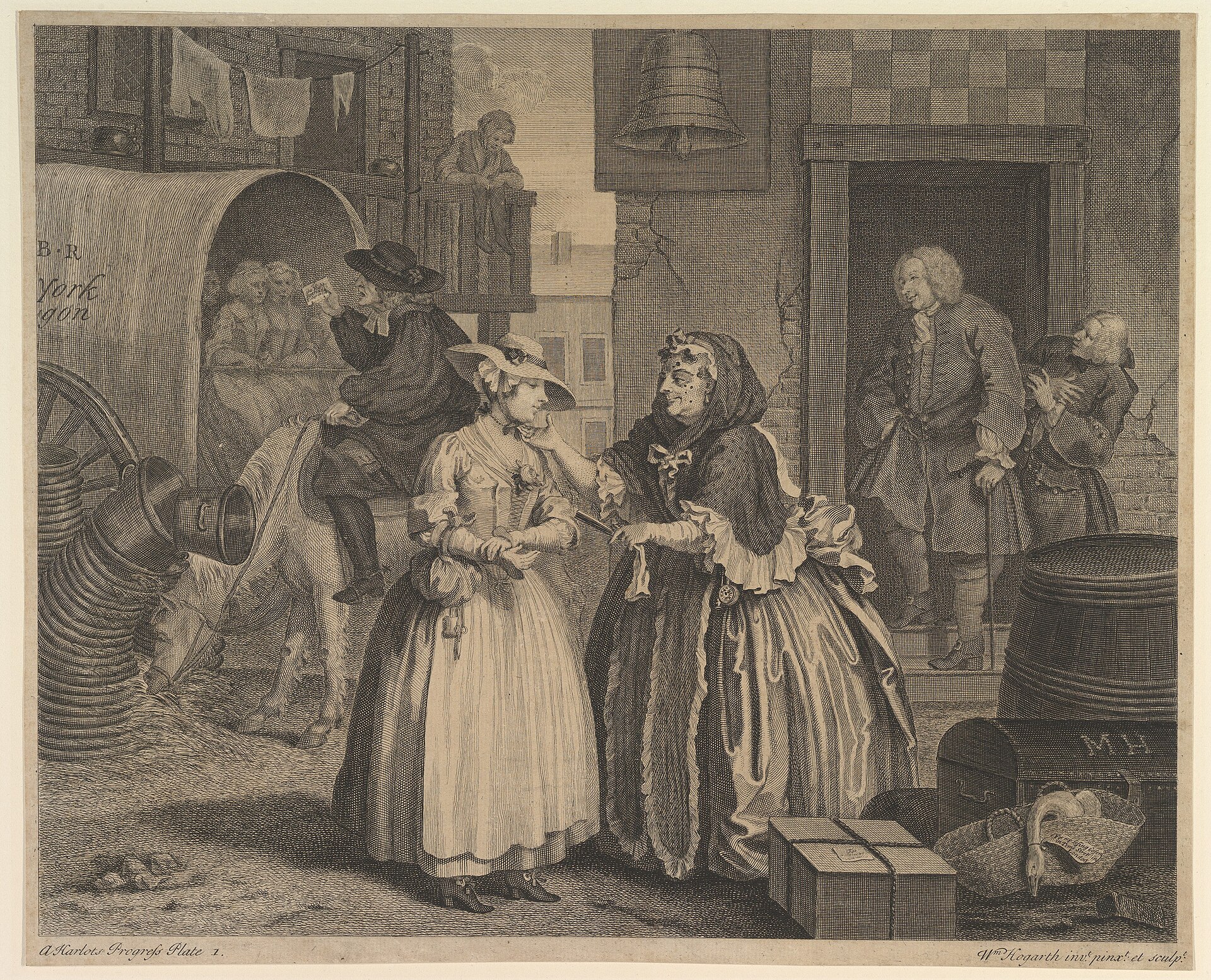
Elizabeth Needham is named as the procuress in plate 1 of A Harlot's Progress. The print names nobody, and the earliest text we could open that names her is from 1781.
Records in this piece: A Harlot's Progress, Plate 1, Little Dancer Aged Fourteen, Destitute pea pickers in California. Mother of seven children. Age thirty-two. Nipomo, California
On this page 5 sections
ContentsClose
In short
- The earliest text I could open that names Elizabeth Needham as the procuress in plate 1 is the 1781 first edition of Nichols's Biographical Anecdotes, 49 years after the print. The 1782 edition adds the newspaper paragraphs and the argument from her notoriety. I could not read several earlier leads (Fielding, Cibber, a 1732 verse key), so earlier evidence may exist.
- Rouquet, writing in 1746, says the old man in the doorway was drawn from life and describes the old woman as a type found at coach offices. He names neither.
- Needham's own record is solid: committed in March 1731, convicted in late April, pilloried on 30 April and dead on 3 May, reported by five London papers.
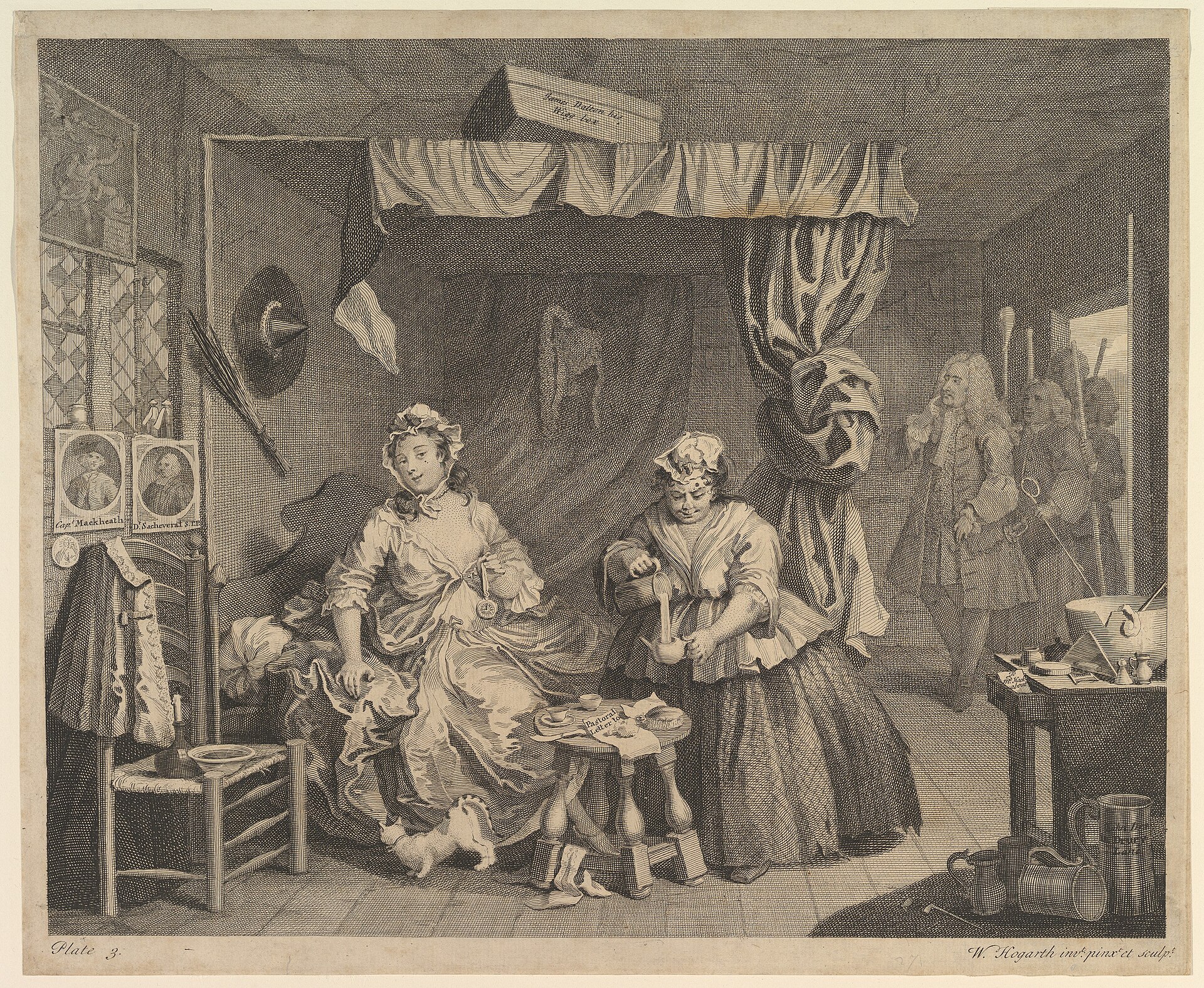
- Hogarth lettered real names elsewhere in the series, such as James Dalton's wig box in plate 3. Nothing marks the figure in plate 1.
No label in the print names her
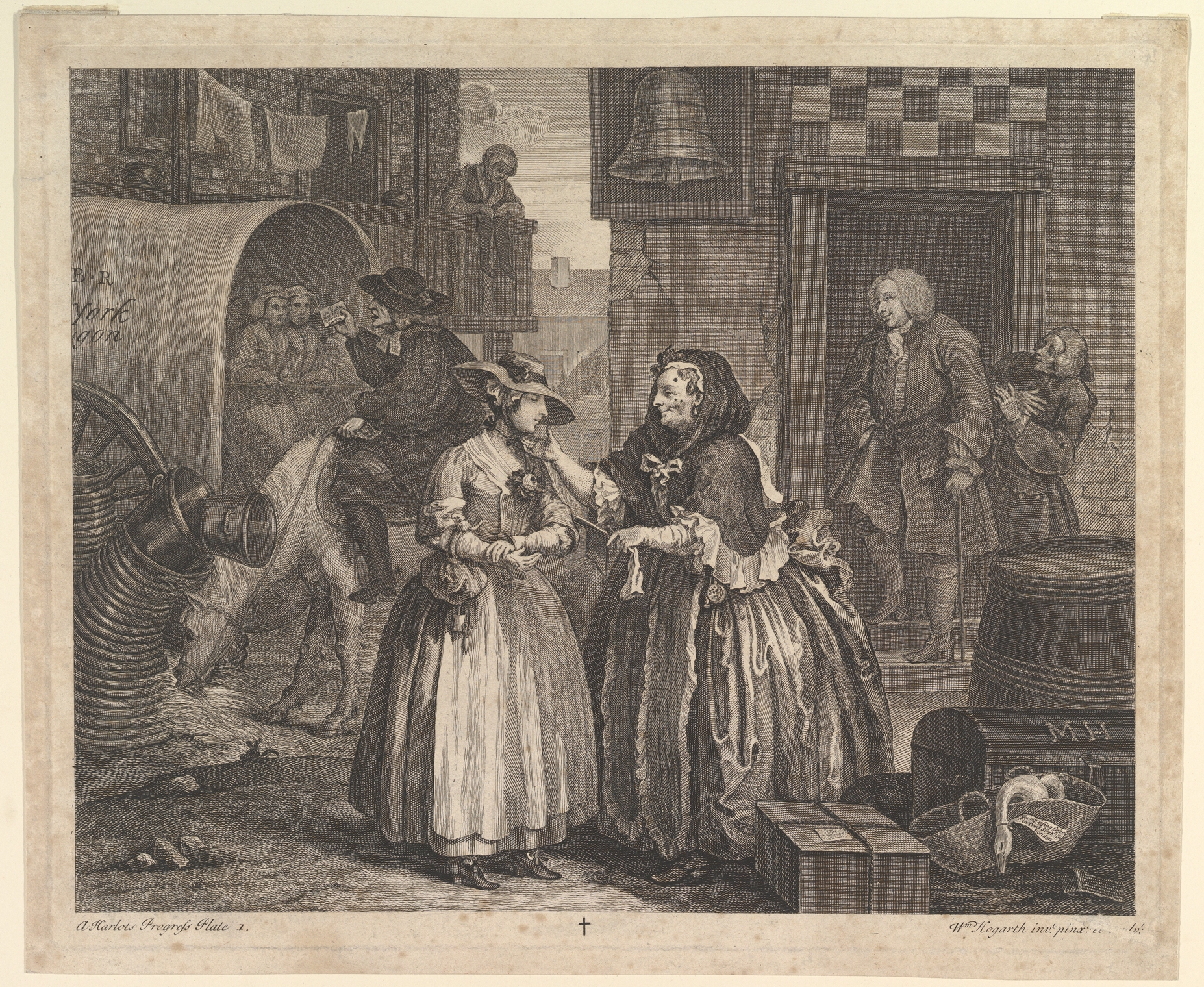
Nothing printed on plate 1 of A Harlot's Progress names the old woman who is taking the country girl by the chin. The lettering on the sheet is ordinary: the plate number, Hogarth's credit line, the words York Waggon on the cart, a tag on a goose addressed to a cousin in Thames Street and a trunk marked MH. Of all the figures, only the heroine gets even initials.
Hogarth could label a real person when he wanted to. In plate 3 a box sitting on the tester of the bed is lettered James Dalton his Wigg box, naming a highwayman. John Nichols, who catalogued Hogarth's prints, says Dalton was hanged on 12 May 1730 (Wikipedia gives 11 May) and that the magistrate bursting into the same room is Sir John Gonson. His proof for Gonson is on the page: in the next plate a figure chalked on a Bridewell door carries the initials Sir J. G.
Plate 1 has no such mark on either figure. The identification of the procuress as Elizabeth Needham, a London brothel-keeper who died in 1731, has to come from somewhere else. This piece follows it back to the earliest printed texts I could open, and sets out what is documented about Needham herself. I have not read Ronald Paulson's modern catalogue entries, so I can't say what they add.
What the papers recorded about her
Elizabeth Needham is well documented as a defendant and thinly documented as a person. The London papers followed her through three arrests over seven years, and the table gives each step with the paper that carried it.
The papers don't agree on every detail. Most settle on Friday 30 April for the pillory, but the report of her last words puts the crowd's treatment of her on a Wednesday. A footnote in the Ireland and Nichols reprint of Hogarth's Works puts the pillory on 5 May 1734, three years out. Nichols's own text, the Dictionary of National Biography and the newspapers all say 1731, and I've gone with them.
| When | What was reported | Where I read it |
|---|---|---|
| 20 July 1724 | Committed to Newgate with Mother Bird. The Daily Journal calls it the first public correction she had received. | Rictor Norton's newspaper extracts |
| 1 September 1724 | Fire at a Conduit Street house lately inhabited by her. A French half-pay officer, Captain Barbute, died in it. | Norton, from the Weekly Journal of 5 September and the Daily Post of 7 September |
| Reported 10 April 1725 | Taken up again for a disorderly house. The paper gives the aliases Bird, Howard and Blewit. | Norton, from the Weekly Journal |
| March 1731 | Committed to the Gatehouse by Justice Railton. The paper adds that she had been reported dead for some time, to screen her from prosecutions. | Nichols, quoting the Grub-street Journal of 25 March |
| Late April 1731 | Convicted of keeping a disorderly house in Park Place. Fined one shilling, sentenced to two turns in the pillory and bound to good behaviour for three years. | Grub-street Journal, 29 April, in both Norton and Nichols |
| 30 April 1731 | Stood at the pillory facing Park Place. She lay along on her face and was pelted anyway. The papers thought she would die. | Norton, from five London papers |
| 3 May 1731 | Died. One paper reports her last words as dread of the second pillory, set for the next day at New Palace Yard. | Norton; the Dictionary of National Biography |
The pillory sentence needs a word of explanation, because the reports are specific about it. The London Evening Post, as Norton prints it, says she was screened by a crowd of hired men and lay on her face, which evaded the law, since the law required that her face be shown. The Dictionary of National Biography adds that beadles and others had been paid to protect her. It did not work. The Post-Boy wrote that she was so ill she lay along under the pillory, and that she was severely pelted all the same.
The Grub-street Journal closed the story with a dry line that the populace had acted very ungratefully, considering how much she had done to oblige them. That tone tells you who was writing. The reports were written for a public that came to watch and some of it came to jeer, so they record what she was charged with and how she ended. They say little about her as a person.
The papers tie her death to the pillory, and so does Pope. A note in his Dunciad says she was ill used by the populace so that it put an end to her days, and calls her a matron of great fame who was very religious in her way. I found nothing in these sources about her age, her looks or what she thought. I won't supply any.
The oldest comments name the man and type the woman
The oldest dated explanation of the plates that I could read is Jean-Andre Rouquet's Lettres, printed in London in 1746, fourteen years after the series. On plate 1 he says the old man in the doorway is drawn from life: a very rich officer, famous in those days for this kind of conquest, who always kept in his pay women of the trade of the one coaxing the newcomer. He gives no name. Of the old woman he says only that coach offices were thought to be full of women of her profession. He treats her as a type.
A second early witness is a verse key printed under the earliest pirated copies, which Nichols reprinted. It calls the man a lewd old rogue and says the girl is betrayed to vile Francisco. The Dictionary of National Biography records a 1732 satire in which Charteris appears as Don Francisco, so the name points at him. The same verses describe the bawd as one who screens her designs with godly airs and talks of homilies and prayers. They don't call her Needham.
The first text I found that names her is Nichols's first edition of 1781, 49 years after the print. It says in the first plate is a portrait of Colonel Chartres, Mother Needham and a pimp, and that the face of the bawd was much altered for the worse. The 1782 edition adds the newspaper paragraphs from the table, introduced as sufficient to prove she was notorious enough to deserve Hogarth's satire. That is an argument from fame. I read the passage quoted in the 1785 third edition as well. He cites no note, letter or label from Hogarth's circle. I could not read several earlier leads: Fielding's Covent Garden Tragedy of 1732, Cibber's 1733 pantomime, the 1732 satire Don Francisco's Descent that pairs Needham with Charteris, and a 1732 verse key to the six prints. Any of them might name her earlier. A later reprint of Ireland's text says the old woman is the portrait of a woman infamous in her day, and a footnote names her.
The religious detail is weaker evidence than it looks. Nichols himself adds a note that comic writers always gave a bawd some pretence to religion, and cites Dryden's Mother du Lake as an example. Godly airs could belong to the stock character as easily as to Needham. Museum labels are firmer than any of this. The Metropolitan Museum's page for its 1891 impression says flatly that the bawd is Mother Needham. Its page for the 1932 impression, the one in our record, carries no description at all.
Other names in the series were guesses too
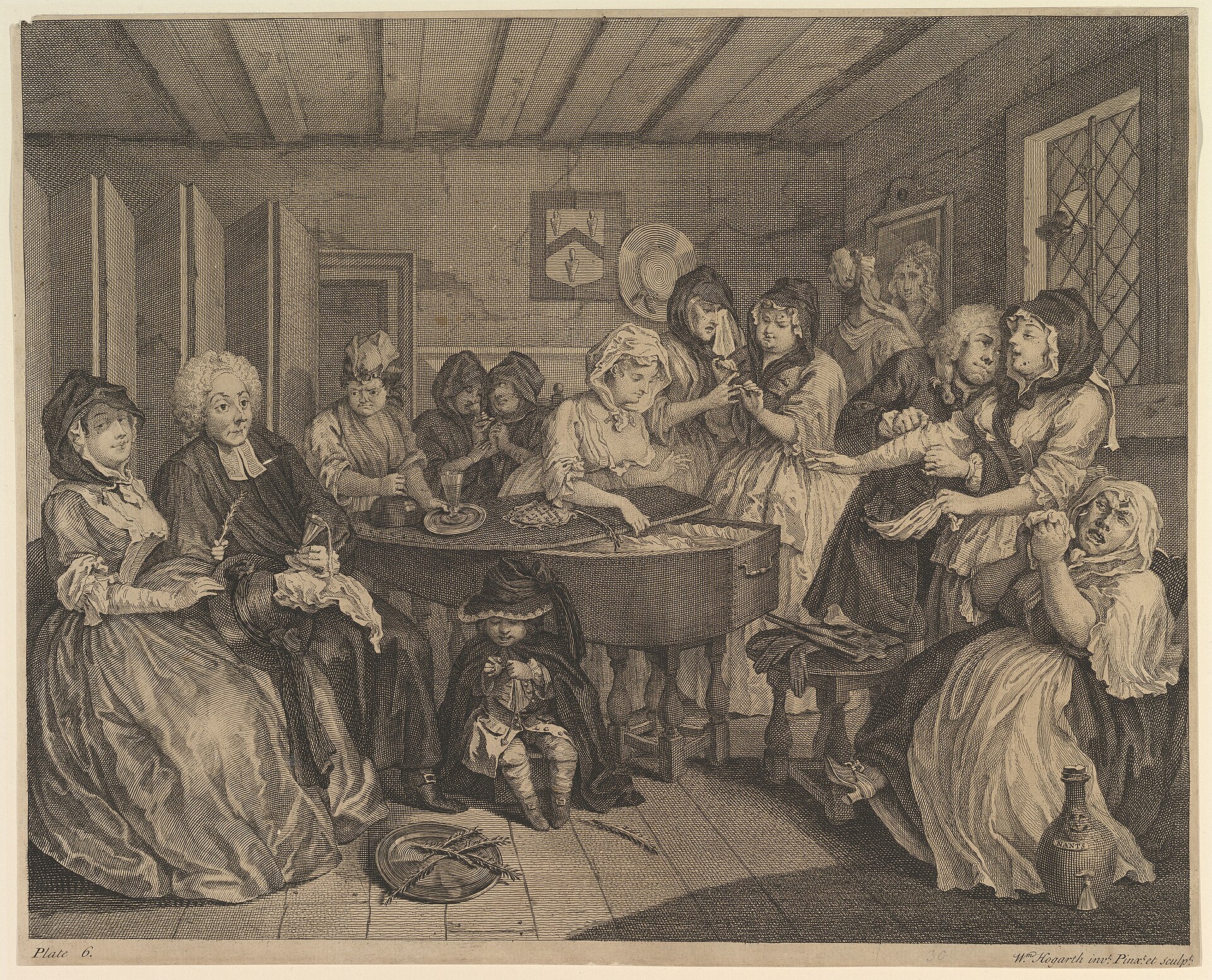
Needham isn't the only figure given a name from outside the print. In plate 6 the woman whom Nichols's verse key calls the bawd, drinking and howling at the right of the funeral table, is, Nichols says, designed for Mother Bentley if we may trust a 1732 poem published under the name Joseph Gay, and he calls that poem a wretched metrical performance. That is a separate text from the pirate verses he reprints, which name the doctors Meagre and Squab and never say Bentley. Nichols was not always cautious: he also says the woman in plate 6 was designed for Elizabeth Adams, executed in 1737.
The heroine is a similar case. Nichols quotes the Grub-street Journal of 6 August 1730 on a Kate Hackabout, a woman noted in the hundreds of Drury whose brother had lately been hanged at Tyburn, and says Hogarth took the name for his girl. The print itself gives only the initials MH on a trunk in plate 1. Ireland and the Metropolitan Museum call her Mary. The print says only MH, and Nichols's verse key calls her Polly and Molly.
Which leaves a pattern. Hogarth put real, recognisable people into his scenes, and readers from 1732 on put names to the figures he left unlabelled. Some of those names have held for centuries and some are open to doubt. Needham's has held, and the fullest early argument in the sources I read, Nichols in 1782, is from fame.
What can be said, and what can't
Three levels of confidence apply here, and they shouldn't be blended. The documented level is Needham's own history: arrests in 1724, 1725 and 1731, conviction in April 1731, the pillory on 30 April and death on 3 May. Each 1731 step is in more than one paper or reference.
The probable level is that Hogarth meant a famous London procuress and that Needham was the obvious candidate. The papers had called her the celebrated Mother Needham as early as 1724, and Pope had put her in the Dunciad. A girl arriving by the York wagon and meeting a bawd at the coach office was a recognised London story, which Rouquet's remark about coach offices supports. I'd put the odds well in favour, helped by a 1732 satire that pairs Needham with Charteris, and I'd still describe it as an inference.
The traditional level is the flat statement on a museum label or in a catalogue that the figure is Needham. It goes back to Nichols in 1781, and his own argument in 1782 was her fame. I can't rule out that earlier evidence exists, in Hogarth's papers or in a source I couldn't open. If it does, it would be worth finding. Until then, the safe wording is that the procuress has been identified as Needham in print since at least 1781, and that nothing in the print confirms it.
The same caution applies to the man. Rouquet's 1746 remark that the old man was drawn from life is much closer to Hogarth's own time, and it supports a real person without naming one. Nichols, Ireland and the Dictionary all name Charteris, and the Francisco of the verse key points the same way.
Questions
She has been identified as the procuress since at least 1781, when Nichols named her in the first edition of his Biographical Anecdotes. The print itself carries no label, the 1746 commentator Rouquet treats the old woman as a type, and Nichols's argument in 1782 is that Needham was notorious enough to deserve the satire. It is a reasonable inference and not a documented fact.
She died on 3 May 1731, three days after standing at the pillory facing Park Place, where London papers reported she was pelted badly enough that she might die. One paper gave her last words as dread of a second pillory the next day. Pope's Dunciad note says the treatment put an end to her days.
Only some of them. Nichols says a lettered wig box shows James Dalton in plate 3 and the initials Sir J. G. mark the magistrate Sir John Gonson in plate 4. Neither the procuress nor the man in the doorway of plate 1 carries a name.
No source I read documents a real woman as the model. The print gives the initials MH on a trunk. Nichols quotes a 1730 newspaper on a Kate Hackabout and says Hogarth borrowed her name, so the heroine carries a real woman's surname. Nichols's verse key calls her Polly and Molly, and the print says only MH.
Sources
- 1Rictor Norton, Early Eighteenth-Century Newspaper Reports: A Sourcebook, 'Mother Needham'. Extracts from the Daily Journal, Weekly Journal, Daily Post, Post-Boy, Courant, London Evening Post, Whitehall Evening Post and Grub-street Journal, 1724 to 1731. Read in an Internet Archive capture of the page. grubstreet.rictornorton.co.uk/needham.htm
- 2John Nichols, Biographical Anecdotes of William Hogarth, first edition (London, 1781, read at the Internet Archive), second edition (1782) and third edition (London, 1785), catalogue entry for A Harlot's Progress, with the Rouquet quotation, the Grub-street Journal paragraphs and the reprinted verse key. Project Gutenberg ebook 52862, read through an Internet Archive capture. The 1781 edition: https://archive.org/details/bim_eighteenth-century_biographical-anecdotes-o_nichols-john_1781 gutenberg.org/ebooks/...
- 3John Ireland and John Nichols, Hogarth's Works, First Series (London, Chatto and Windus), description of plate 1 and its footnotes. Project Gutenberg ebook 51821, read through an Internet Archive capture. gutenberg.org/ebooks/...
- 4Thomas Seccombe, 'Needham, Elizabeth', Dictionary of National Biography, volume 40 (1894), citing the Daily Advertiser of 1 May 1731, the Grub-street Journal and Nichols and Steevens. Read as the Wikisource transcription of pages 161 and 162. en.wikisource.org/wiki/...
- 5Jean-Andre Rouquet, Lettres de Monsieur *** a un de ses amis a Paris, pour lui expliquer les estampes de Monsieur Hogarth (London: Dodsley and Cooper, 1746), first letter. Read in the Internet Archive scan and its text layer. archive.org/details/...
- 6Metropolitan Museum of Art, object pages for A Harlot's Progress, Plate 1: 399540 (fourth state, 91.1.128, with description) and 401166 (first state, 32.35(2), with no description). Read in the in-app browser. metmuseum.org/art/...
More in The Women Behind the Art
The partWho Stitched the Bayeux Tapestry? What the Documents Say About English Women's Embroidery
No document names who stitched the Bayeux Tapestry. What Domesday, the 1476 inventory and the Queen Matilda story show about English women's...
The Two Women in the Oseberg Ship, and the Queen Nobody Named
Two women lay in the Oseberg ship in 834. What the bones, isotopes and DNA show, and how a queen and a servant were read into a grave that no text...
The Name on the Rim: What Documents Say About Projecta
The Projecta Casket names its bride in one line of Latin. What the British Museum, Dalton 1901, an epitaph and Parliament say about her, and what is...