Who Stitched the Bayeux Tapestry? What the Documents Say About English Women's Embroidery
No document names who stitched the Bayeux Tapestry. What Domesday, the 1476 inventory and the Queen Matilda story show about English women's embroidery, and where the evidence stops.
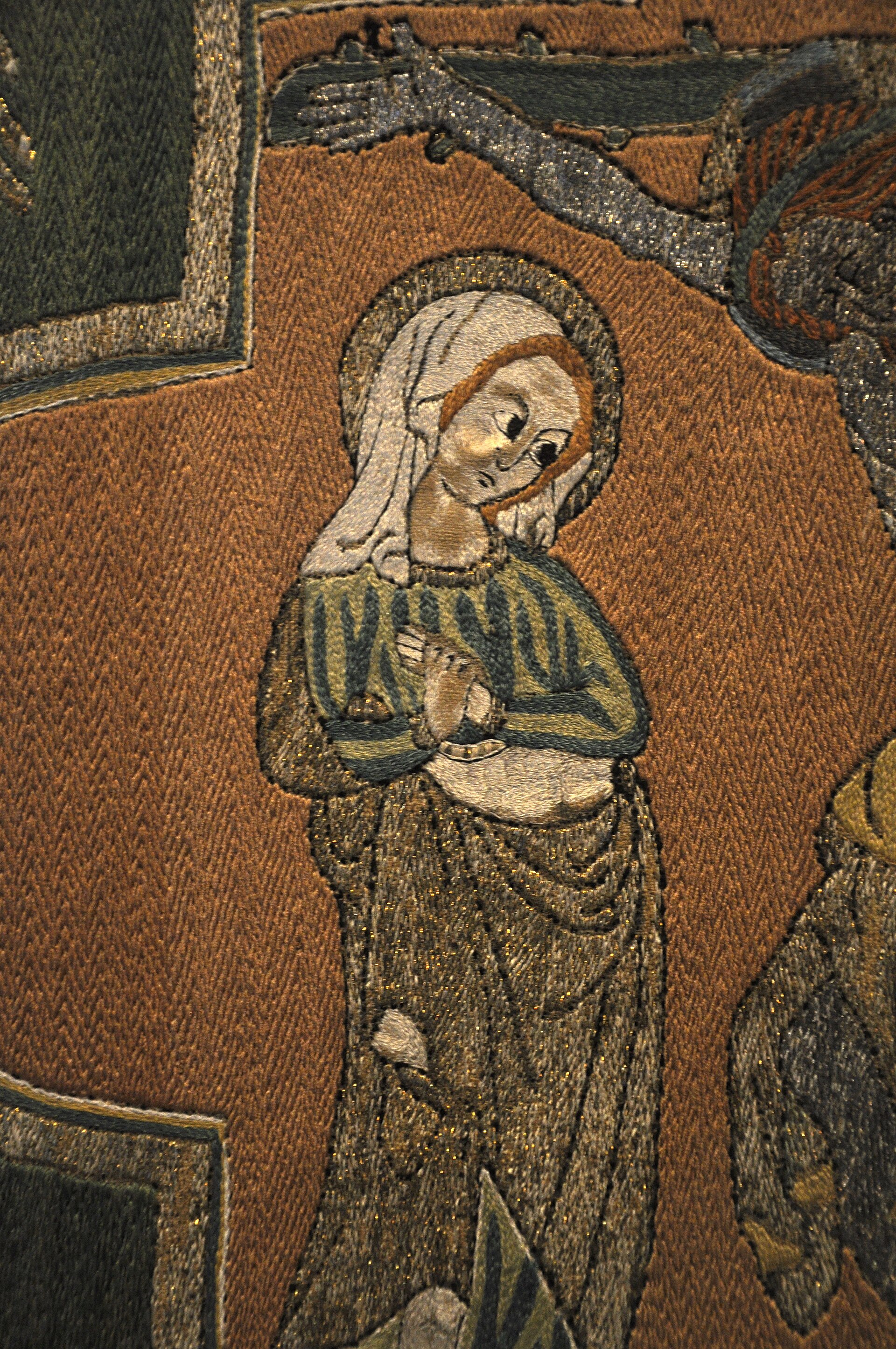
Records in this piece: The Bayeux Tapestry, The Syon Cope
On this page 5 sections
ContentsClose
In short
- No document, inscription or signature names a stitcher of the Bayeux Tapestry. The 1476 cathedral inventory calls it a long narrow hanging of embroidery of the Conquest and names no maker, and the Bayeux Museum says no one knows for sure who created it.
- Two English women are on record for gold work for the court in the same generation: Domesday Book, in the translation we read, has Aelfgyth teaching a sheriff's daughter gold embroidery at Oakley before 1066, and Leofgeat doing gold work for the king and queen at Knook in 1066 and 1086. Both did gold work and neither entry mentions the Tapestry.
- The Queen Matilda story appears in Montfaucon's engravings of 1729 and 1730, as Fowke reports, as a tradition that she had it made. By Fowke's account the retellings made it a work she stitched herself with her women.
- The claim that English women stitched it is an inference from where it was designed, from spelling and technique and from the reputation of English needlework. The British Museum curators write that many scholars presume it, and the evidence for place says nothing about the gender of the stitchers.
- A group of women who signed their stitching, the Leek Embroidery Society team of 1885 to 1886 under Elizabeth Wardle, made a full-size copy that Reading Museum holds.
No document names who stitched this one
No inscription, contract, receipt or signature names anyone who stitched the Bayeux Tapestry. The Bayeux Museum, the Normandy home of the work, says so in one line on its own website: no one knows for sure who created it.
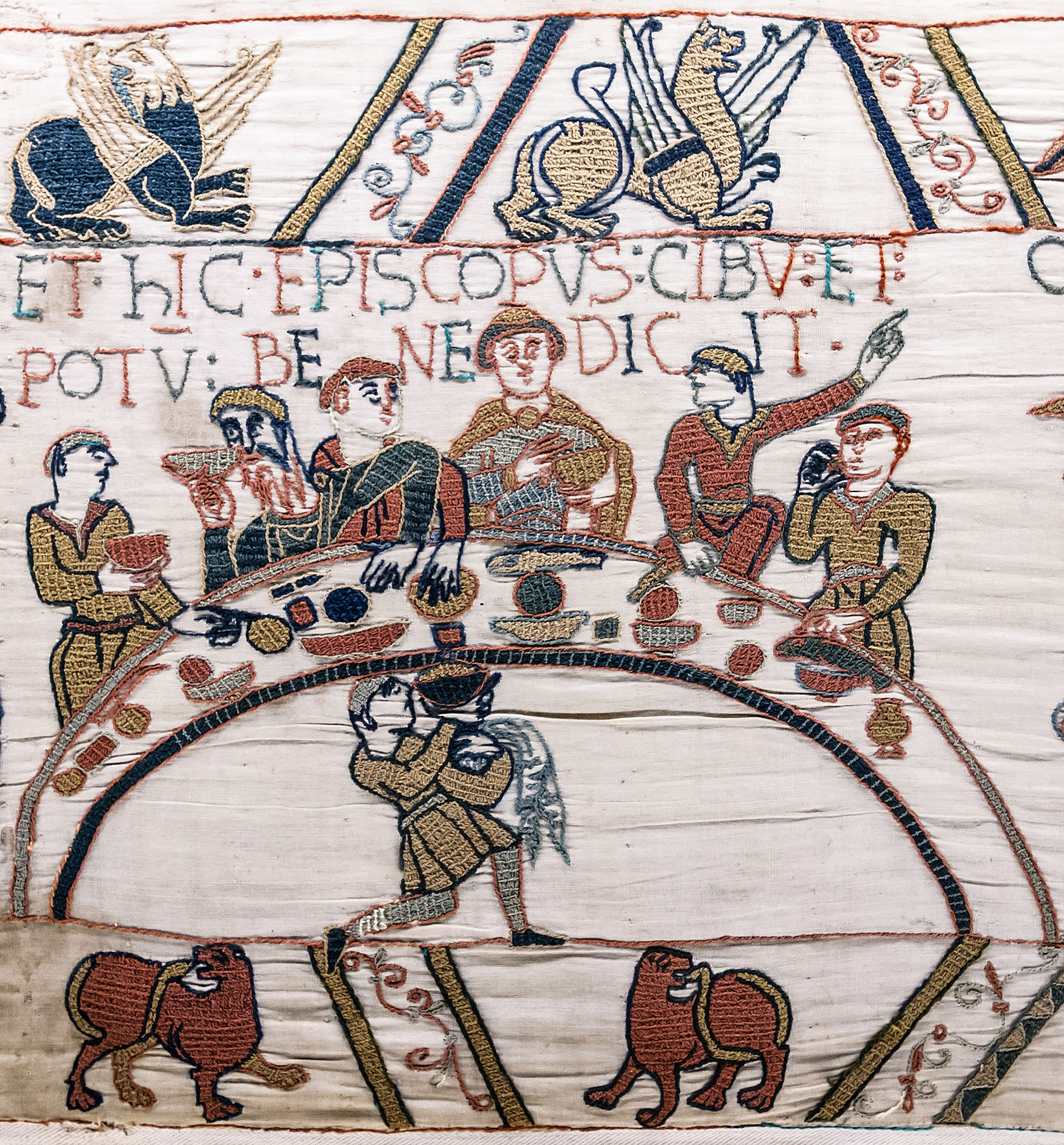
What is known is about the object. It is an embroidery, worked in wool thread on linen cloth, in nine joined panels. The museum names four stitches (stem stitch, chain stitch, split stitch and the couching it calls the Bayeux stitch) and reads the regular lines of the wool as showing that guide marks, perhaps drawings, were made on the cloth first. The British Museum's curators, writing in May 2026 as it came to London, say the same about the design: someone who knew manuscript drawing must have transferred outlines to the linen, and we do not know who.
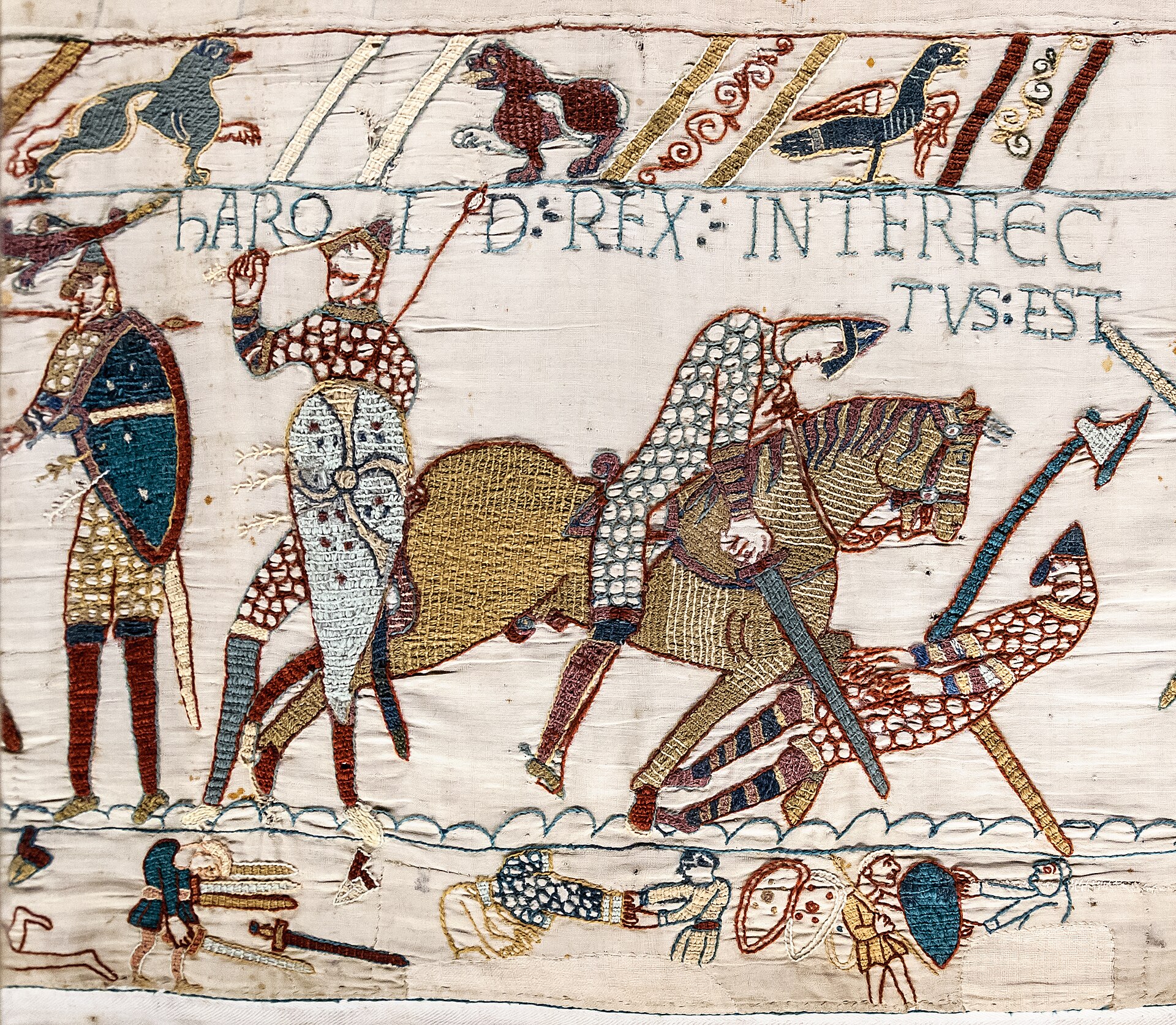
The oldest document we could read that describes the work is the inventory of Bayeux Cathedral taken in 1476, about four centuries after it was made. Fowke's opening page calls it the earliest known mention, though his closing page also cites an inventory of 1369 that we could not open. Frank Rede Fowke printed its entry in 1898, and we read it in the raw text of his book: une tente tres longue et etroite de telle a broderie de ymages et escripteaulx faisans representation du conquest d'Angleterre, hung round the nave on the day of the Relics and through its octave. The canons call it a long narrow hanging of embroidery with images and inscriptions that represents the conquest of England. They name no maker and no patron, and they do not say who sewed it.
Three jobs have to be kept apart: the person who paid, the person who drew and the people who stitched. The British Museum curators list Bishop Odo of Bayeux as the patron most historians favour, with Queen Matilda, Queen Edith and the monks of St Augustine's in Canterbury as other names offered. They give the designer as unknown. For the stitchers they write that many scholars today presume it was made by English women. That is a presumption, and the rest of this piece asks what it is built from.
Domesday Book names two English women who did gold work for the court
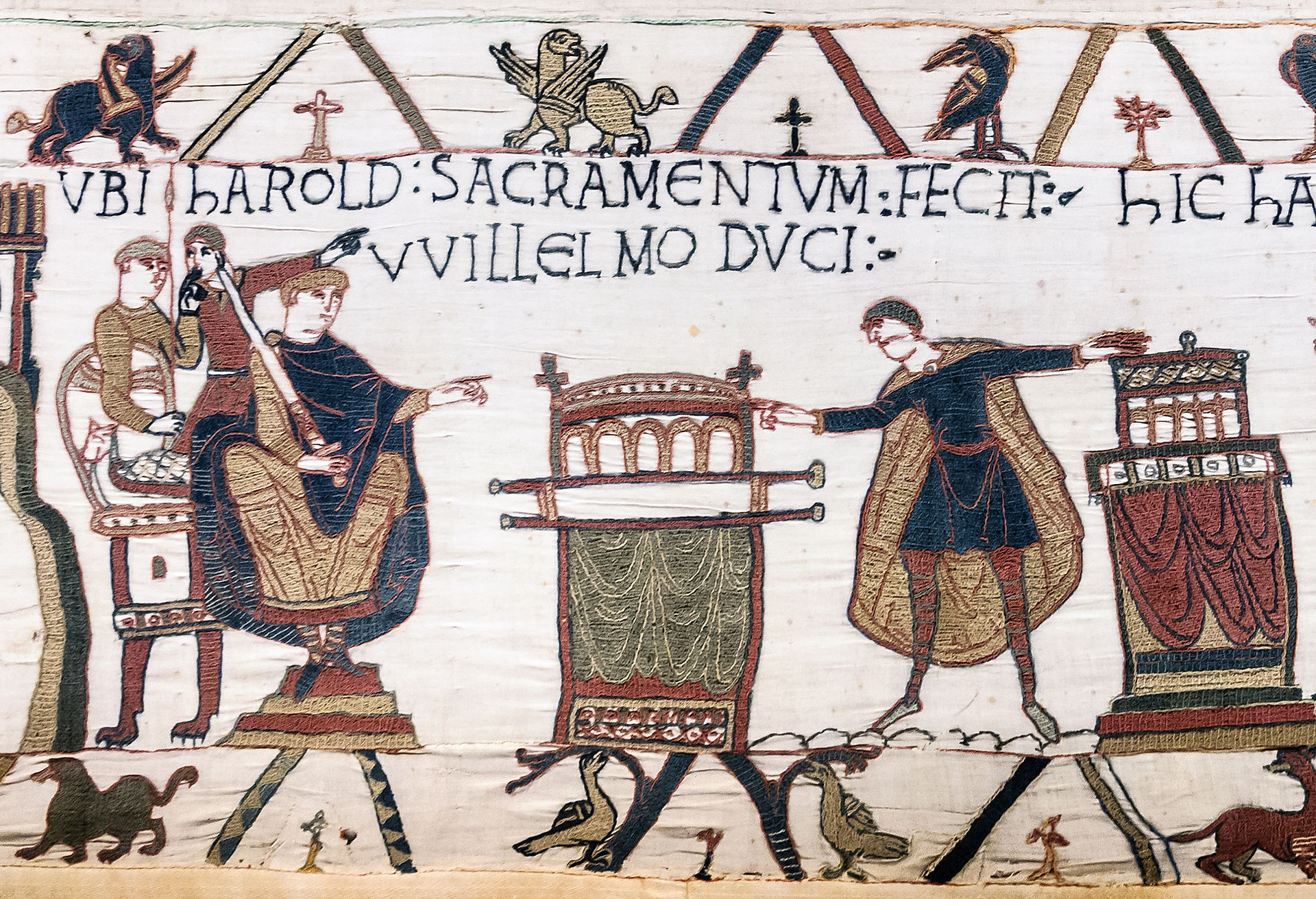
Domesday Book of 1086 credits two English women with gold work for the court, the two that writers on women's history point to, and neither entry mentions the Bayeux Tapestry. They are the clearest written evidence we found that embroidery was a recognised skill of women in the generation of the Conquest.
The first is Aelfgyth, at Oakley in Buckinghamshire. In the English translation we read, the entry calls her Aelfgyth mother of Godwin, a girl, who held two hides of the manor, which she could grant or sell to whom she would. It adds that she had a further half hide from King Edward's household revenue, which Godric the sheriff assigned to her for as long as he should be sheriff, so that she might teach his daughter gold embroidery. The arrangement belongs to the years before 1066, and by 1086 the land had passed to Robert son of Walter. So the survey itself shows a person described as a girl, paid in land, to teach a sheriff's daughter a needle skill. The entry is in the translation's words, not the Latin we saw.
The second is Leofgeat at Knook in Wiltshire, listed among the king's servants and thegns. Pauline Stafford, in her 1989 study of women in Domesday, reports that Leofgeat held three and a half hides that her husband had held in 1066, and that Domesday adds one of its random details: in 1086 as in 1066 she did gold embroidery for the king and queen. The Latin word is aurifrisium, which the Phillimore and Alecto translations give as gold fringe. Stafford and Margaret Wade Labarge call it gold embroidery, and the Prosopography of Anglo-Saxon England database says the sense could include gold embroidery or gold braid. We did not read the Latin ourselves. Either way it is gold work for the royal household.
Three limits apply. Both women are gold workers, and the Tapestry is wool, so the entries show a trade and not a hand. Domesday records land, so a skill appears only when it explains a holding, and Stafford stresses that few women appear in the survey at all. We also did not search Domesday for men described as embroiderers, so we cannot say how typical these two entries are. Two further sources are usually cited here. Modern writers quote William of Poitiers, who wrote probably in the 1070s, praising English women's gold needlework, and the British Museum curators say Norman sources praised it after the Conquest. We did not open the Gesta Guillelmi and quote none of it. Labarge adds that Anglo-Saxon wills mention bed-clothes and wall-hangings, and we did not open the wills either.
The Queen Matilda story appears in the eighteenth century
The earliest report we found that Queen Matilda was behind the Tapestry dates from the 1720s and 1730s, some 650 years after the work, and the story changed as it was retold. We read the sequence in Fowke's 1898 history, which prints the quotations, and we have not seen the eighteenth-century books themselves.
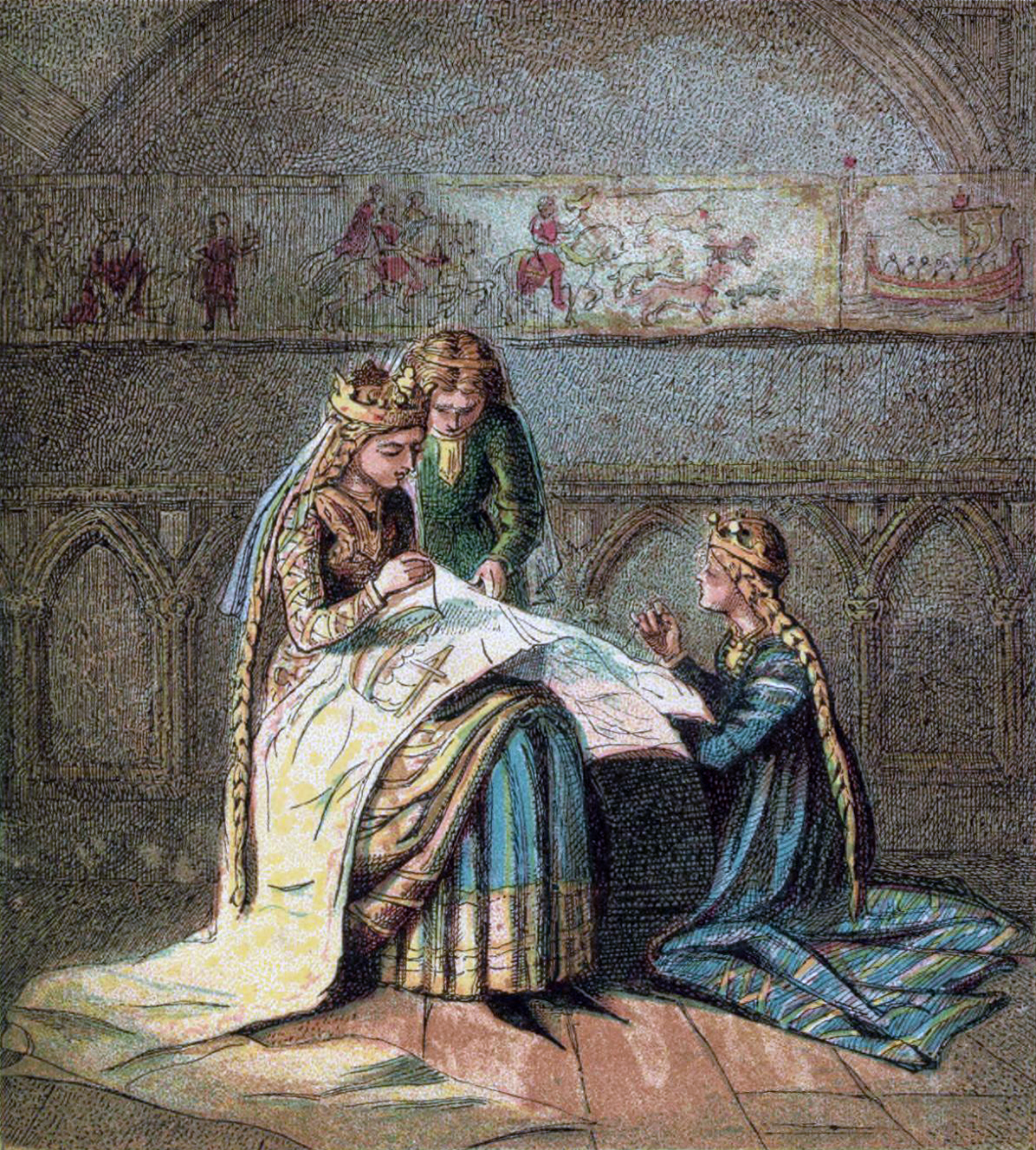
Fowke says Bernard de Montfaucon, whose engravings appeared in 1729 and 1730, recorded what Fowke calls a tradition then current in Bayeux, that Queen Matilda had it made (qui la fit faire). Fowke doubts the tradition was even current, since it was confined to a place where nearly everything was ascribed to William and his Duchess. In Fowke's account Antoine Lancelot turned that into a claim that she wove it herself with her women, and Sir Joseph Ayloffe in English into a work done by her own hands with the ladies of her court. A report that she ordered a work became a report that she and her women sewed it. Fowke adds that names recorded at Bayeux for the cloth included the Telle du Conquest, the Toilette de Saint-Jean and the Toilette du duc Guillaume, and that it was called Queen Matilda's tapestry only after it was shown in Paris.
The Paris display of 1803 put her name in a state museum's handbook and in a letter from its director. Fowke prints the title of the handbook that Vivant Denon, the director of the Musee Napoleon, had prepared, Notice historique sur la Tapisserie brodee de la reine Mathilde, and the line in Denon's letter dated 30 Pluviose year XII, which is 20 February 1804 (Fowke gives 18 February) that returns the tapestry embroidered by Queen Matilda, wife of William the Conqueror (la tapisserie brodee par la reine Mathilde). A one-act comedy at the Vaudeville showed her with her women stitching her husband's deeds. The Abbe de la Rue then argued in 1812 that the Matilda in question was the Empress, and Bolton Corney attacked the tradition in 1836.
Fowke's own verdict was that Queen Matilda had no part in it. He pointed out that neither William on his deathbed nor Matilda in her will mentions the hanging. He then proposed that Bishop Odo ordered it and that Norman workpeople made it at Bayeux, a view the British Museum's curators say most scholars no longer hold, since they place the work in England. The Bayeux Museum now calls the Matilda story a romantic belief, and in the British Museum's list she is one of several people proposed as patron. No source we read offers a document for her.
What the case for English women is built from
The case that English women stitched the Tapestry rests on where it was designed, on the look of the stitching and spelling and on what English needlework was known for, and none of its parts is a document naming a stitcher. Setting them side by side shows how far each goes.
The place comes from the pictures. The British Museum curators say most scholars place the work in England, probably in or around Canterbury, because its design echoes manuscripts made in or owned by monastic libraries there; the ships resemble those in two Old English manuscripts, the Hexateuch and Junius 11. That fixes a design source. It does not say who held the needle.
The step to women is an inference from the trade. In 2008 a reader of the New York Review of Books quoted Charles Gibbs-Smith's 1973 introduction: the work was designed and embroidered in England by English craftswomen, a conclusion he based on manuscripts, other pictures and the English spelling of names in the Latin inscriptions. Spelling and drawing style say where a workshop stood, not who in it held the needle, unless the technique argument supplies more. Ingrid Rowland, whose essay had said Norman noblewomen embroidered it, answered that English seamstresses, perhaps in Canterbury, almost certainly did, and that they reveal themselves in their spelling of the Latin labels and in their technique. We have not seen the technical studies that would test that. In July 2026 a public essay by Stephanie Brown, a University of Hull lecturer in criminology, called it almost certainly women's work like most medieval embroidery.
The hedge hardens even within one page. The British Museum's question-and-answer says that many scholars presume English women made it. Further down the same page, in the section on the women shown in the design, the text begins from the premise that it was likely made by English women. No new evidence is offered between the two statements.
| Source and date | What it says | What it rests on |
|---|---|---|
| Bayeux Cathedral inventory, 1476 | A long narrow hanging of embroidery of the Conquest | An inventory; no maker named |
| Montfaucon, 1729-30 (as reported by Fowke, 1898) | Tradition says Queen Matilda had it made | Local report, no document |
| Fowke, 1898 | Odo ordered it and Norman workpeople made it at Bayeux | Names, dialect, the length of the nave |
| Gibbs-Smith, 1973 (as quoted 2008) | Embroidered in England by English craftswomen | Manuscript comparisons and the spelling of names |
| Bayeux Museum website | No one knows for sure who created it | Absence of evidence |
| British Museum curators, 2026 | Many scholars presume English women | Admired English needlework and Norman praise |
The women who certainly sewed a Bayeux copy, and a trade that kept names
One group of stitchers of a Bayeux Tapestry copy is documented by their own signatures: the Leek Embroidery Society women who made the full-size replica from 1885, finished in 1886 by Wikipedia's dating. Under Elizabeth Wardle they worked from tracings of images from the South Kensington Museum (Brown; Wikipedia says a watercolour facsimile). Brown counts 35 women, and an encyclopaedia entry says about 37, so we rest nothing on the number. Brown reports that each woman stitched her name into the lower border of the copy that Reading Museum now holds. The copy shows that a group of women could do the work in about a year, and it is a copy. It supplies no names for the eleventh century.
When English embroidery is documented as a trade, names do appear. Labarge describes the London workshops of the thirteenth century as a core of embroiderers, both men and women, with women predominating, and reports that Mabel of Bury St Edmunds appears in royal records between 1239 and 1244 for vestments and a banner made for Henry III. In 1256 the king gave her cloth and a fur robe because she had long served him and the queen in making church ornaments. That rests on Labarge alone, and an encyclopaedia entry citing the Grove Dictionary of Art says the names of various male embroiderers appear in the Westminster royal accounts. The two descriptions may not match, and neither is the Grove text itself, which we did not open.
The Syon Cope in the Victoria and Albert Museum shows the limit of even that record. Made around 1300 to 1320 in a documented London trade, it carries no maker's name or mark, and our record notes that no surviving contract or account can be matched to it. A trade with royal accounts still failed to leave a name on its finest surviving piece, so a missing name on the Bayeux hanging is by itself no reason to conclude that its makers were not women, or that they were.
Questions
No document names the makers. Most historians think Bishop Odo of Bayeux commissioned it, most scholars place it in England and probably Canterbury, and the stitchers are unnamed. The Bayeux Museum says no one knows for sure who created it.
No eleventh-century source says so. Fowke reports that Montfaucon recorded the tradition in 1729-30 as a story that she had it made, and the claim that she stitched it with her ladies came later. The Bayeux Museum calls the idea romantic and unlikely.
No. It is an embroidery in wool thread on linen cloth. The Bayeux Museum names four stitches, and the regular lines of the wool show that guide marks were laid on the cloth before it was sewn.
Domesday Book names two, in the translations we read. Aelfgyth at Oakley in Buckinghamshire held land and a half hide for teaching a sheriff's daughter gold embroidery, and Leofgeat at Knook in Wiltshire did gold work for the king and queen. Both worked in gold, and neither entry mentions the Tapestry.
The women of the Leek Embroidery Society, led by Elizabeth Wardle, who made a full-size copy from 1885, finished in 1886, that is now in Reading Museum. Brown reports that each stitched her name in the lower border. It copies the original.
Sources
- 1Musee de la Tapisserie de Bayeux, 'The Bayeux Tapestry is an embroidery': technique, four stitches, guide marks, who made it, the names it has carried. Read as raw page text. bayeuxmuseum.com/en/...
- 2Michael Lewis, Millie Horton-Insch and Sue Brunning, 'Everything you need to know about the Bayeux Tapestry', British Museum blog, 22 May 2026: where it was made, who made it, the patron candidates, Canterbury manuscripts. Read in the in-app browser. britishmuseum.org/blog/...
- 3Frank Rede Fowke, The Bayeux Tapestry: A History and Description (London, 1898): the 1476 inventory entry, Montfaucon, Lancelot and Ayloffe on Queen Matilda, Denon's handbook and letter, the Abbe de la Rue, Bolton Corney and Fowke's own verdict. Read as raw OCR text. archive.org/details/...
- 4Pauline Stafford, 'Women in Domesday', Reading Medieval Studies 15 (1989), pp. 75-94: Leofgeat at Knook. Read as the author's published PDF. centaur.reading.ac.uk/85224
- 5Domesday Book, Buckinghamshire, folio 149, English translation: the entry for Aelfgyth, mother of Godwin, at Oakley. Read as raw page text. 1066.co.nz/Mosaic%20DVD/...
- 6The Domesday Book Online, Wiltshire E-O and Buckinghamshire N-Z gazetteer entries for Knook and Oakley. Read as raw page text. domesdaybook.co.uk/wiltshire2.html
- 7Margaret Wade Labarge, 'Stitches in Time: Medieval Embroidery in its Social Setting', Florilegium 16 (1999): Domesday embroiderers, London workshops, Mabel of Bury St Edmunds. Read as the published PDF. journals.lib.unb.ca/index.php/...
- 8Jean Mallinson and Ingrid D. Rowland, letters, 'Who Embroidered the Bayeux Tapestry?', New York Review of Books, 17 July 2008, quoting Gibbs-Smith (1973). Read as raw page text. nybooks.com/articles/...
- 9Stephanie Brown, 'The Bayeux tapestry and the hidden history of the women who embroidered it', The Conversation, republished by Global Comment, 7 July 2026: the Leek replica and its signatures. A public essay, not a peer-reviewed study. Read as raw page text. globalcomment.com/the-bayeux-tapestry-and-the-hidden-hist...
- 10Wikipedia, 'Opus Anglicanum' and 'Bayeux Tapestry', read as wikitext: used only for the statement, citing the Grove Dictionary of Art, that embroiderers named in the Westminster accounts are male, and for the Leek count of about 37. en.wikipedia.org/wiki/...
More in The Women Behind the Art
The partThe Two Women in the Oseberg Ship, and the Queen Nobody Named
Two women lay in the Oseberg ship in 834. What the bones, isotopes and DNA show, and how a queen and a servant were read into a grave that no text...
The Name on the Rim: What Documents Say About Projecta
The Projecta Casket names its bride in one line of Latin. What the British Museum, Dalton 1901, an epitaph and Parliament say about her, and what is...
The Jewels Isabella Pawned, and the Offer She Made for Columbus
Isabella pawned jewels at Valencia in 1489 for the Granada war. The Columbus offer is conditional in Hernando Colon and Las Casas, and Santangel's...