The Two Women in the Oseberg Ship, and the Queen Nobody Named
Two women lay in the Oseberg ship in 834. What the bones, isotopes and DNA show, and how a queen and a servant were read into a grave that no text mentions.
Records in this piece: Oseberg Tapestry Fragments, The Overhogdal Tapestries
On this page 5 sections
ContentsClose
In short
- No written source mentions the Oseberg mound, so the name Queen Asa, and the ranking of one woman as mistress and the other as servant, come from twentieth-century readings, and no document of the period backs them.
- The measured facts are modest: ages of about 80 and about 50 as reported by Per Holck (the sources we saw do not say which woman is which), terminal cancer in the elder woman, a land-based diet for both and no evidence that violence caused either death.
- The one ancient DNA result, haplogroup U7 from the younger woman, comes from a single 2006 paper, and the elder woman's sample was too contaminated to read. We found no later study in the sources we opened that confirms the Black Sea inference.
- Unn Pedersen argues that the hierarchy of a distinguished woman and a thrall was a premise of 1906 that studies kept as a result, and her answer is to ask about the whole community around the grave, including Sigrid, whose name is on a runic bucket from the burial.
The grave holds two women and no written source names either
The Oseberg ship burial of 834 contained two women, and no text from the period or later mentions the mound at all. Unn Pedersen of the University of Oslo makes the point in her paper on the burial in Viking Special Volume 3: the mound or the ritual is not mentioned in any written source, which she calls noteworthy in itself. Everything said about who these women were therefore comes from bones, objects and the later habit of reading the grave against saga names.
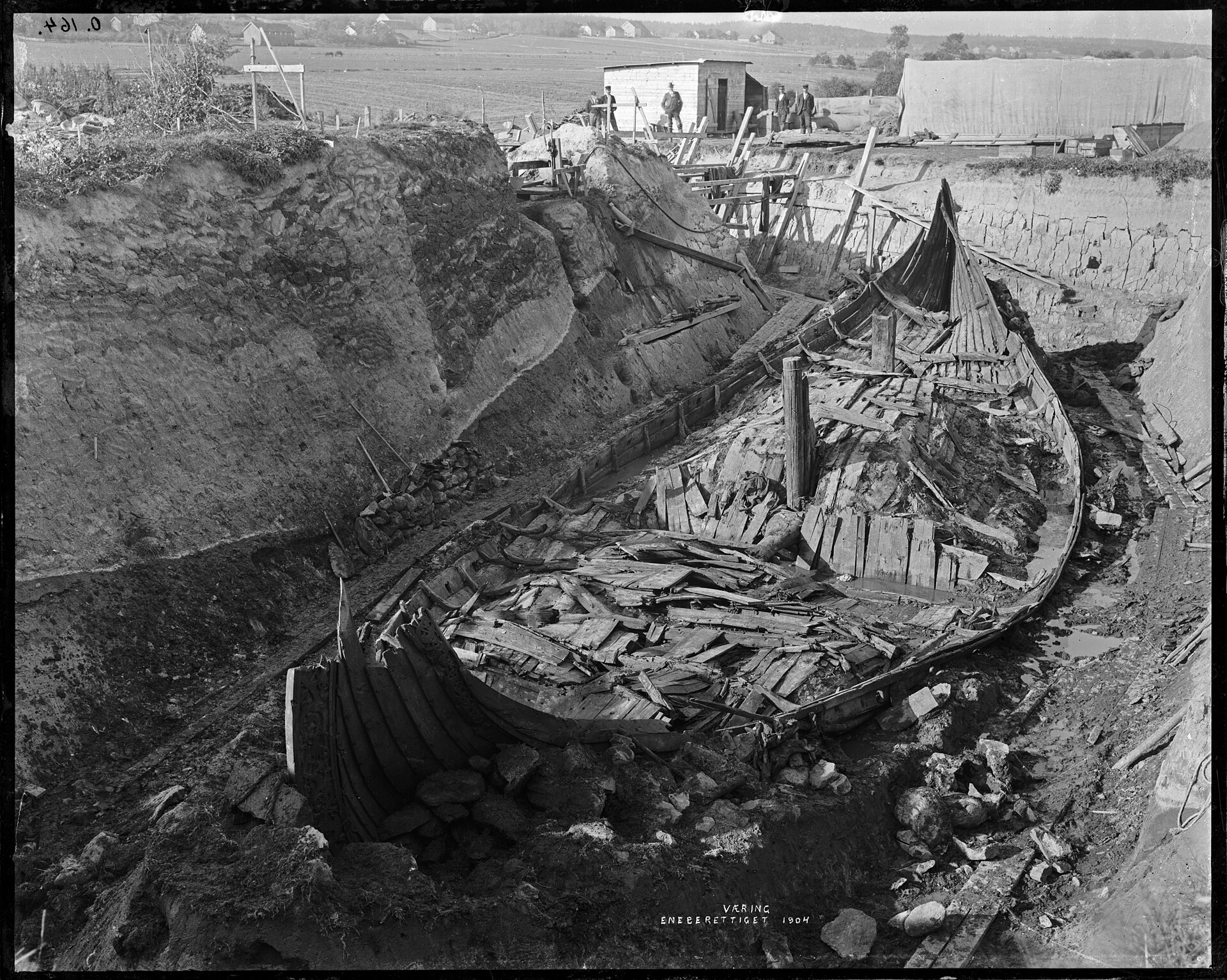
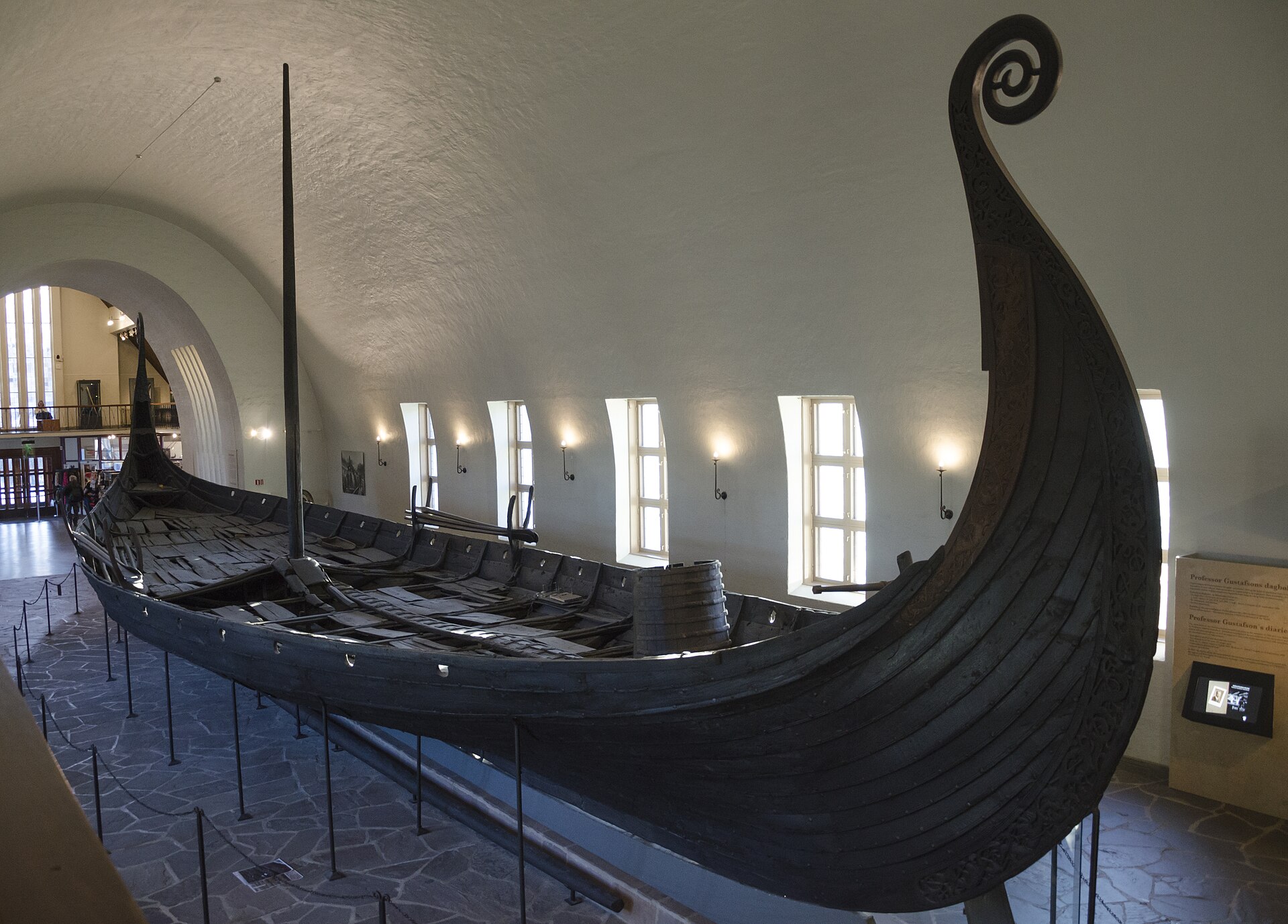
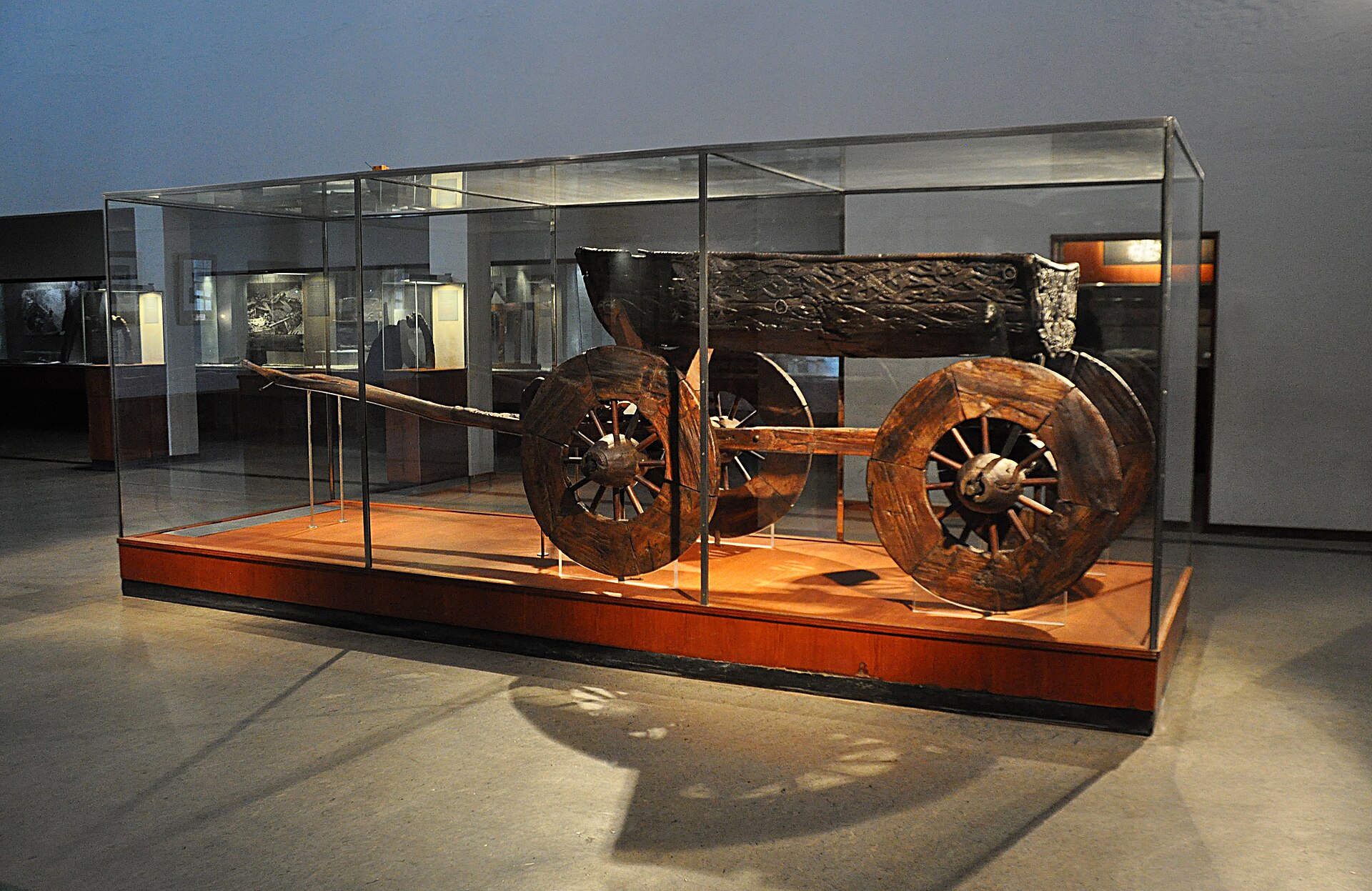
The mound stands on a farm in Vestfold, Norway. Gabriel Gustafson of the University Museum of Antiquities was brought a carved fragment of oak by a farmer, Oskar Rom, in 1903 and dug the mound in 1904. The ship was almost intact. Buried with the two women were fifteen horses, two oxen and four dogs according to Pedersen, a cart, sleighs, a carved bucket with runes and the tools of textile work. Neil Price, writing in 2022, adds that the burial was opened again and its human remains disturbed within about a century, a reopening dated to 953-90 by Bill and Daly in 2012. So even the bodies reached the archaeologists incomplete.
That is the situation this piece starts from. One of the women is often called the Oseberg queen, and the other is often left unnamed. Both labels came from twentieth-century readers, not from the grave.
What the bones and the lab results actually give
The measurable facts about the two women are few, and the best of them come from a small set of bone fragments that were kept back when the skeletons were reburied in 1948. Per Holck, an anatomist at the University of Oslo, radiocarbon dated those fragments to 1220 and 1230 years before present, each with an error of 40 years, which is consistent with the date of 834 that Pedersen and Price give for the burial. Both samples gave a carbon isotope value near minus 21 per mil, which Holck reads as a diet mostly of land food and little fish.
Reuters, reporting Holck in 2008 after the skeletons had been exhumed in 2007, gave the ages as about 80 and about 50. The older woman's bones showed cancer. Holck is quoted there as saying "We have no reason to think violence was the cause of death", and Reuters reported the suspicion of a ritual killing dispelled. The younger woman had a collarbone fracture that had been healing, which Holck says is no sign of a killing. The skeletons are incomplete, so the bones cannot rule out everything. Both women ate a meat-rich diet, and the younger woman's teeth showed wear from a metal toothpick, a luxury in the ninth century.
| Item | Result | Reported by |
|---|---|---|
| Age of the elder woman | About 80 at death | Holck, via Reuters 2008 |
| Age of the younger woman | About 50 at death | Holck, via Reuters 2008 |
| Radiocarbon on kept fragments | 1220 and 1230 BP, each plus or minus 40 | Holck 2006 |
| Carbon isotope value | About minus 21.6 and minus 21.0 per mil, mainly land food | Holck 2006 |
| Ancient DNA | Younger woman: haplogroup U7. Elder woman: too contaminated | Holck 2006; Pedersen (2025, on Holck 2006) |
| Cause of death | Terminal cancer in the elder woman (Holck is 'pretty sure' it caused her death). Younger woman: a healing collarbone fracture, no evidence of killing | Holck, via Reuters 2008 |
The DNA result is the least settled line in the table. Holck wrote that Tom Gilbert at the Panum Institute in Copenhagen obtained a profile from the younger woman only, that it fell in haplogroup U7 and that this lineage is nearly absent in modern Europeans but common in Iranians, where Holck's footnote puts it at nearly 10%. He tied the \"perhaps\" to Snorri's account of a migration from the Black Sea region. He said this "perhaps" meant her ancestors came from near the Black Sea. We did not find a later paper in the sources we could open that confirms or refutes it, and Reuters reported there was not enough DNA to say whether the two women were related.
This piece found no 2016 to 2023 isotope or ancient DNA study of the Oseberg women in anything we read. If one exists, it is the first thing a reader should check against this table.
How a premise turned into a queen
The idea that one woman was a queen and the other her servant began as a premise in 1906, and later studies kept it. Gustafson described them that year as a distinguished woman, fornem kvinde, and a thrall-woman or servant, and wrote that it was not inconceivable that the second had to follow her mistress in death. Pedersen shows that the osteological studies by Guldberg in 1907 and Schreiner in 1927 confirmed two female individuals of different ages, although the two early experts reached rather different conclusions about the women and agreed only that there was a substantial age gap. The ranking of the two, she writes, was "a premise and not a conclusion" in those studies.
On the question of gender, the sources we read agree and name their basis. The excavators first assumed a woman because of the textile tools in the chamber, which Gustafson called female tools. The anatomists then judged both skeletons to be female. We found no source that disputes that assessment of either skeleton, though the bones are incomplete and the earliest age estimates were revised, as Price notes. Reuters also reports that the older woman had a hormonal condition, Morgagni's syndrome, that gave her a man-like appearance; Reuters does not link this to any doubt about her sex, and we found no study that does. The one challenge to the usual picture we read is a suggestion by the archaeologist Androshchuk in 2005 that the grave was first made for a man whose body vanished, which Price says is not widely accepted.
The identification with Queen Asa, mother of Halfdan the Black and grandmother of Harald Fairhair, came into the story alongside that ranking. Holck's own abstract says many people like to believe one of the women could be Asa, and Reuters says historians had long suspected it. Haakon Shetelig, in his 1920 study of the carved wood, treated the carved objects as a queen's collection of art. By 1948 the older woman had been hailed as Queen Asa, as World Archaeology puts it, and the two skeletons were reburied in one sealed coffin with one placed at the other's feet. When a memorial stone was raised in 1961 the other woman was excluded from it, a consequence Pedersen draws from Elisabeth Arwill-Nordbladh's work, in which the second woman was excluded.
Queen, seeress, or both women at once
Scholars who accept a powerful woman in the grave still disagree about what kind of power she held. Price lists the main readings: the resting place of a queen, or a person with cultic and sorcerous functions possibly tied to the worship of Freyja, readings Price attributes to Anne Stine Ingstad in 1992 and 1995. Price joins them with and/or, so the readings are not exclusive, and no source we read says the grave goods force a choice.
Pedersen's paper moves the argument somewhere else. She writes that it is now broadly accepted that at least one of the women was a powerful ruler, in line with the men described as kings, petty kings or chieftains, and that what is missing is attention to everyone else the burial shows. She sees the burial as an account of joint effort: craftspeople, a large funeral crowd and a leader able to attract them. Within that account she raises a question about Sigrid, whose name is carved in runes on a bucket from the grave, and asks who she was and how she related to the two buried women. We have not read the runic inscription itself, so we cannot say more than Pedersen does.
Pedersen notes that the reopening obscured essential details, and that both corpses were removed from the chamber and are only partly preserved.
The cloth that may show the two women, and may have been made by them
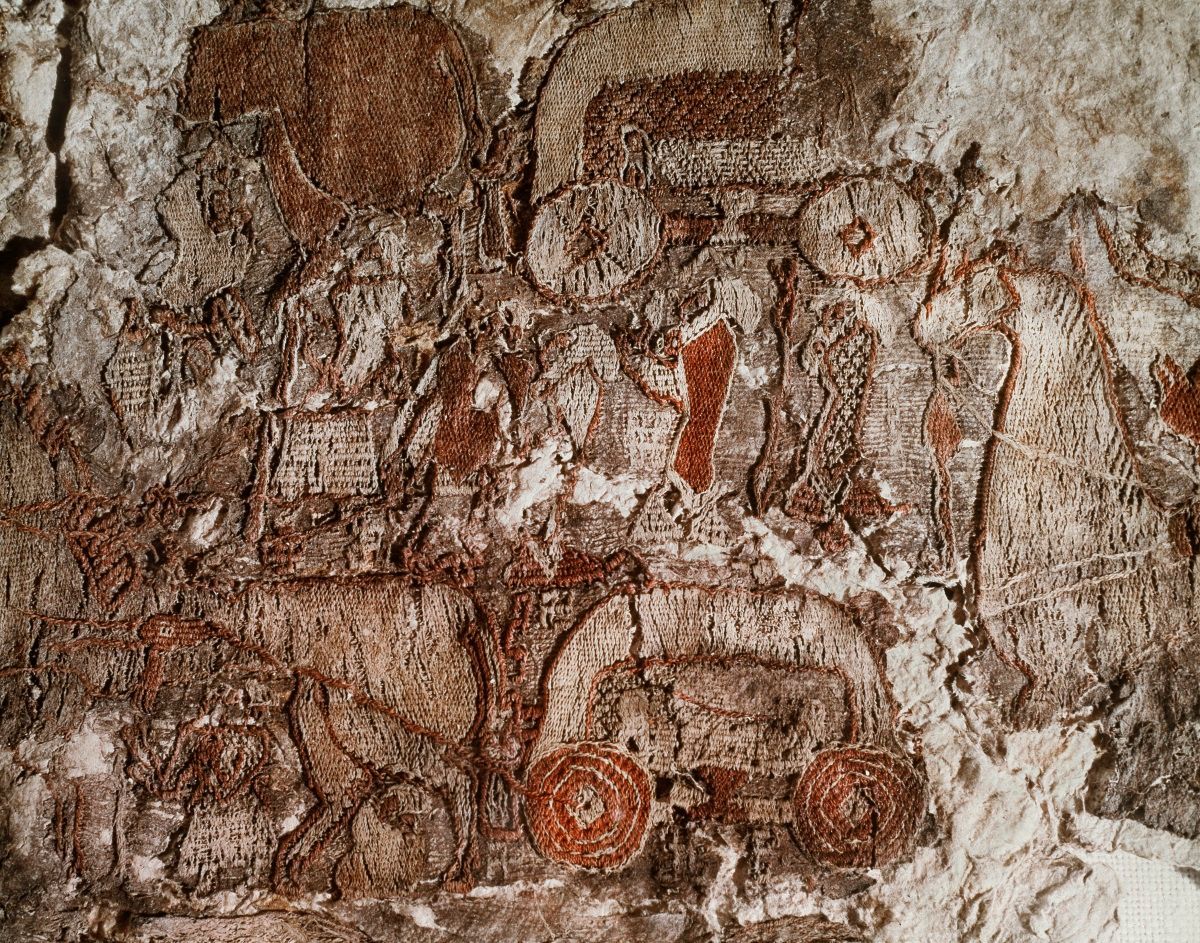
The Oseberg tapestry fragments may carry a picture of the two women, though two specialists read the wagon scenes differently. Price describes Fragments 1 and 2 as showing three wagons clearly, one with a female driver and the others with what look like made-up beds, and he asks whether these are the bodies of the two women, noting that the wagons face in different directions. Pedersen describes a scene of a horse and carriage with two seated women and says it is tempting to read them as the two buried women.
Price holds that the tapestries were almost certainly made by women, on the argument that textile work was largely women's work, He adds that textile work was an arena of women's agency, the power to shape a narrative that others would see, and that this is likely true for Oseberg too, not least in the context of funeral rites for two women. That sentence is his argument from general patterns, since no weaver is named. A loom was among the items placed in the burial chamber, which Pedersen cites alongside the suggestion that the tapestries might even have been made by the buried women. The suggestion is hers, not a finding.
More than 80 fragments survive, according to the university's TexRec project, and the project's own key question is how they fit together. The Overhogdal hangings in Sweden, which Price names alongside Oseberg as a main source of Viking Age narrative imagery, are another picture-weave whose weaver and patron are unnamed. For Oseberg the question of who wove the cloth and for whom is still open.
Questions
Two women, buried in 834 according to Pedersen and Price, with radiocarbon on kept bone fragments reported by Per Holck in 2006 that is consistent with that date. Their names are unknown. The idea that the elder was Queen Asa is a tradition from the early twentieth century, not a result of any inscription or text.
Per Holck gave about 80 for the elder and about 50 for the younger, as reported by Reuters in 2008. Reuters does not say which age belongs to which woman. Neil Price notes that the relative ages and apparent rank of the two women have been revised.
Holck said after studying the exhumed bones that there was no reason to think violence caused the death of either woman, and that a healing collarbone fracture in the younger one was no sign of killing. The older view that one woman followed the other in death goes back to Gabriel Gustafson's 1906 report, which called it not inconceivable.
In the sources we read, both skeletons were judged female by the anatomists Guldberg and Schreiner, after the excavators had assumed a woman from the textile tools. We found no source that disputes it, although Reuters reports a hormonal condition in the older woman that gave her a man-like appearance. One archaeologist, Androshchuk, proposed in 2005 that the grave was first made for a man, which Neil Price says is not widely accepted.
Sources
- 1Per Holck, 'The Oseberg Ship Burial, Norway: New Thoughts on the Skeletons from the Grave Mound', European Journal of Archaeology 9 (2-3), 2006, pp. 185-210; abstract and notes read on the publisher's page. journals.sagepub.com/doi/...
- 2Reuters report, 'Vikings acquitted in ancient murder mystery', quoting Per Holck on the 2007 exhumation, NBC News, 2008. nbcnews.com/id/...
- 3Unn Pedersen, 'The Oseberg ship burial: commemorating leadership and joint effort', Viking Special Volume 3, 2025, pp. 211-230. journals.uio.no/vikingspecialvolumes/...
- 4Neil Price, 'Performing the Vikings: From Edda to Oseberg', Religionsvidenskabeligt Tidsskrift 74, 2022, pp. 63-88. tidsskrift.dk/rvt/...
- 5'Norway: the Oseberg ladies', extract from World Archaeology issue 45, Current Publishing. world-archaeology.com/features/...
- 6Museum of Cultural History, University of Oslo, 'TexRec' project page (over 80 tapestry fragments). khm.uio.no/english/...
More in The Women Behind the Art
The partWho Stitched the Bayeux Tapestry? What the Documents Say About English Women's Embroidery
No document names who stitched the Bayeux Tapestry. What Domesday, the 1476 inventory and the Queen Matilda story show about English women's...
The Name on the Rim: What Documents Say About Projecta
The Projecta Casket names its bride in one line of Latin. What the British Museum, Dalton 1901, an epitaph and Parliament say about her, and what is...
The Jewels Isabella Pawned, and the Offer She Made for Columbus
Isabella pawned jewels at Valencia in 1489 for the Granada war. The Columbus offer is conditional in Hernando Colon and Las Casas, and Santangel's...