The Name on the Rim: What Documents Say About Projecta
The Projecta Casket names its bride in one line of Latin. What the British Museum, Dalton 1901, an epitaph and Parliament say about her, and what is only argument.
Records in this piece: The Projecta Casket, The Blacas Ewer
On this page 5 sections
ContentsClose
In short
- The only text on the Projecta Casket that names her is SECVNDE ET PROIECTA VIVATIS IN CHRISTO, a wish with a plural verb addressed to two people, so it does not say who gave or commissioned the casket.
- Dalton's 1901 British Museum catalogue calls the casket a wedding gift and reports that parts of the inscription are restored, including the last three letters of CHRISTO, as the scan reads.
- The link between the casket's Projecta and a girl of 16 years 9 months 25 days named in an epitaph of 30 December 383 is Cameron's argument, which Shelton rejects. Dalton and Marucchi do not make it.
- The certainty about her family changes with the source: Dalton's Asterii, Visconti's PROIECTA TVRCI monograms, a museum label that says the Turcii owned it and a Seuso page that says only "perhaps".
One line of Latin names her, and it speaks to two people
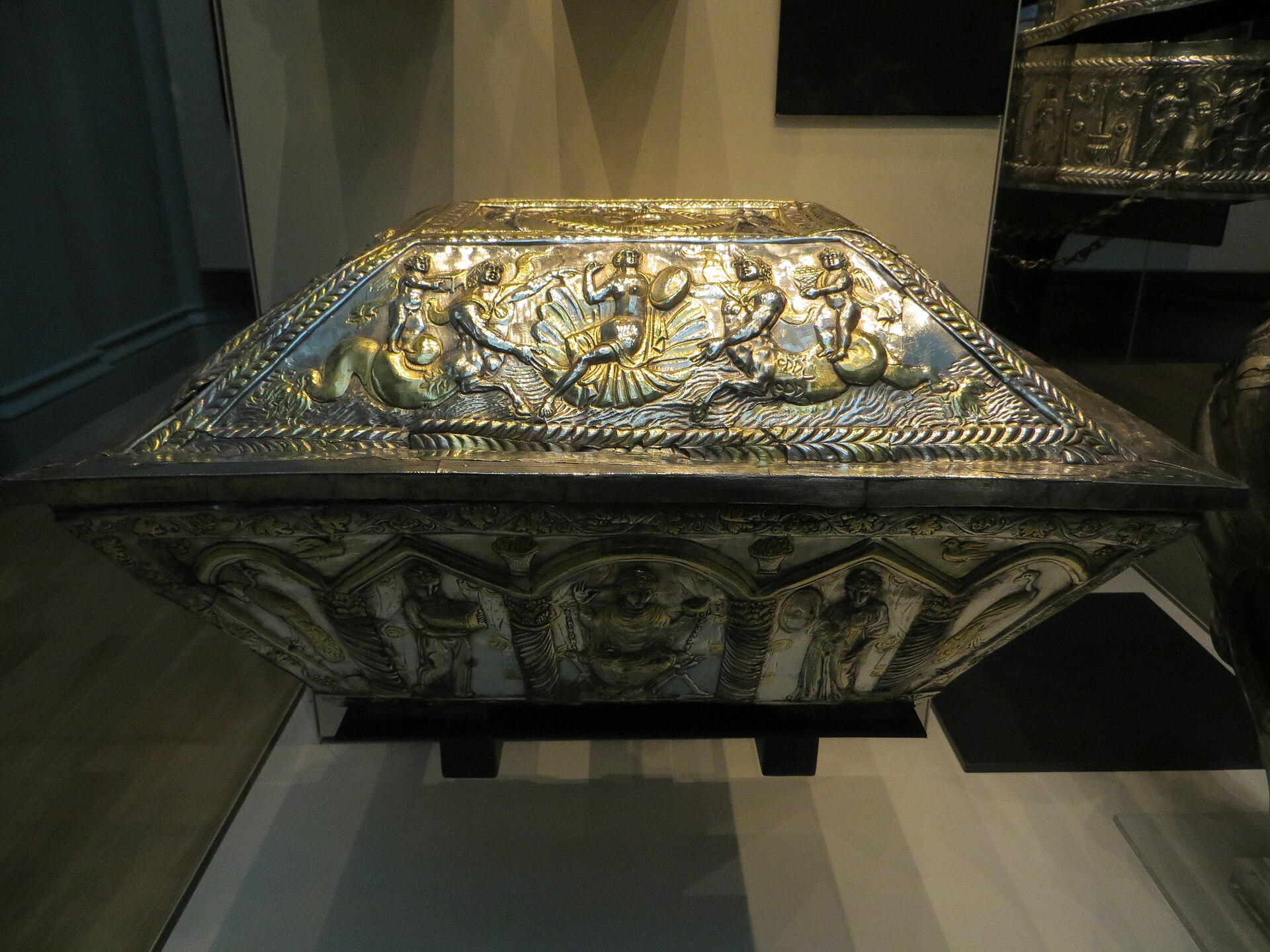
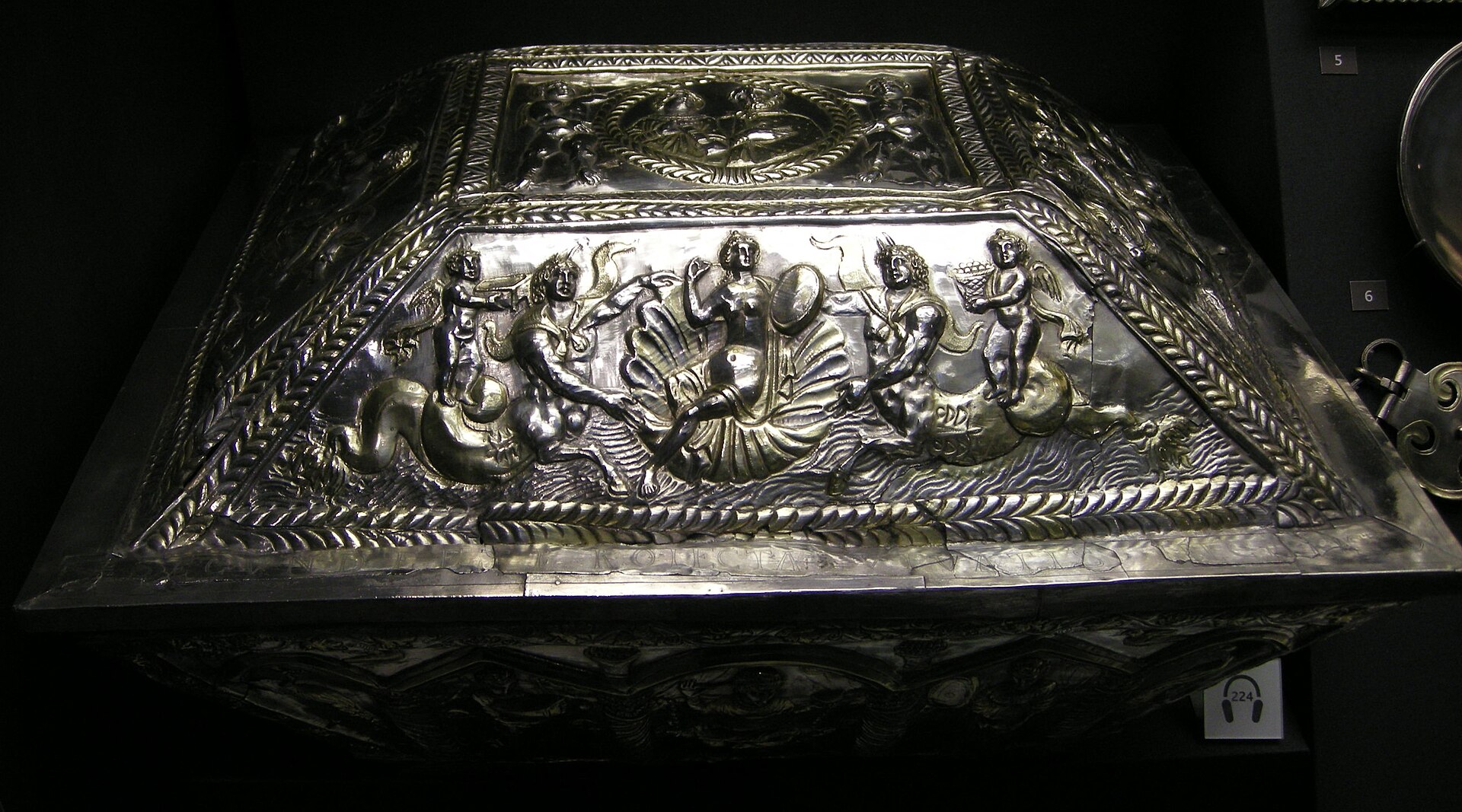
The only text on the Projecta Casket that names her is a wish addressed to a pair: SECVNDE ET PROIECTA VIVATIS IN CHRISTO. The British Museum's catalogue entry gives it as "Secundus and Proiecta, live in Christ", records it as a dedicatory inscription in large engraved capitals on the rim of the lid, and spells her name with the I that the Latin has. The verb is plural, so the line speaks to both people at once. It does not say who gave the casket, who ordered it, who paid, how old either of them was or what family they came from.
That leaves the casket with a recipient and no commissioner. The museum's curatorial note, quoting a 1997 catalogue by Blurton, says the decoration suggests a toilet casket given as a wedding present. The 1901 British Museum catalogue by O. M. Dalton says the same thing in four words, "a wedding gift". Both describe a wedding gift, and the 2014 label adds "to the couple". Neither gives a donor, and nothing on the object does either.
Dalton adds a detail that later summaries drop. He reports that part of the inscription is restored: the left side of the monogram, the lower halves of two letters in VIVATIS and the last three letters of CHRISTO, as the scan of his catalogue reads. The names are not on his list. The Christian word at the end is, and the scan also lists the lower part of an I, which it places between VIVATIS and CHRISTO. He also writes that "it is not necessary to suppose that the inscription with the Christian monogram is later than the casket itself", which tells us the question had already been asked in 1901.
What the silver shows of the bride, and who disagrees about the back
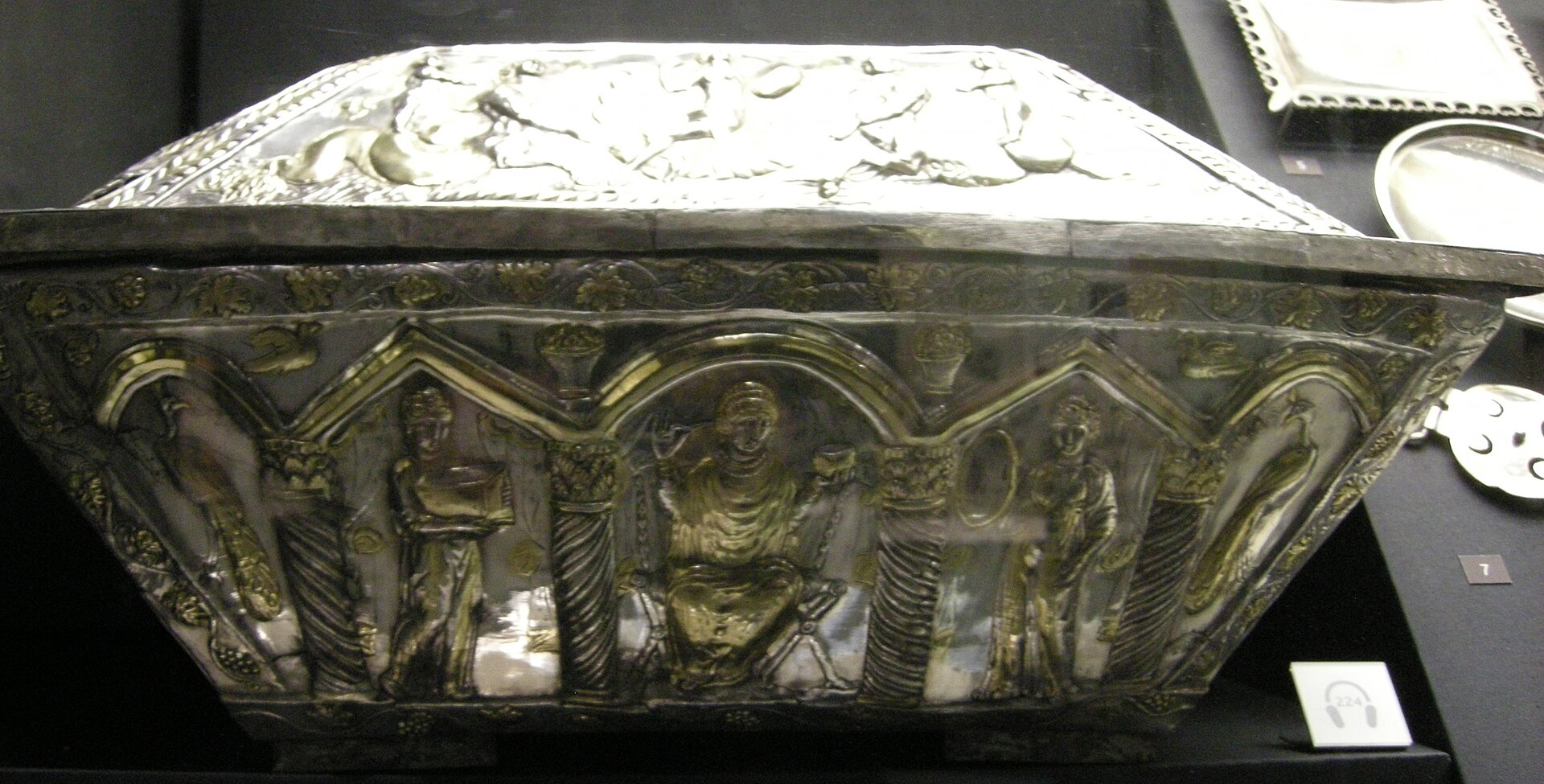
The casket pictures a bride at her toilet and a wedding procession, and it shows a woman, which is not the same as showing a named person. Dalton's 1901 description runs panel by panel. On the top of the lid, inside a wreath held by two genii, he sees "a husband and wife" in half length, and the wife "holds with both hands a roll, perhaps the volumen nuptiale". On the front of the body he sees "the bride seated full face upon a cushioned chair", holding a fillet for her hair and a cylindrical unguent box, with an attendant holding a mirror. The lid's long panel has Venus dressing her hair in a shell.
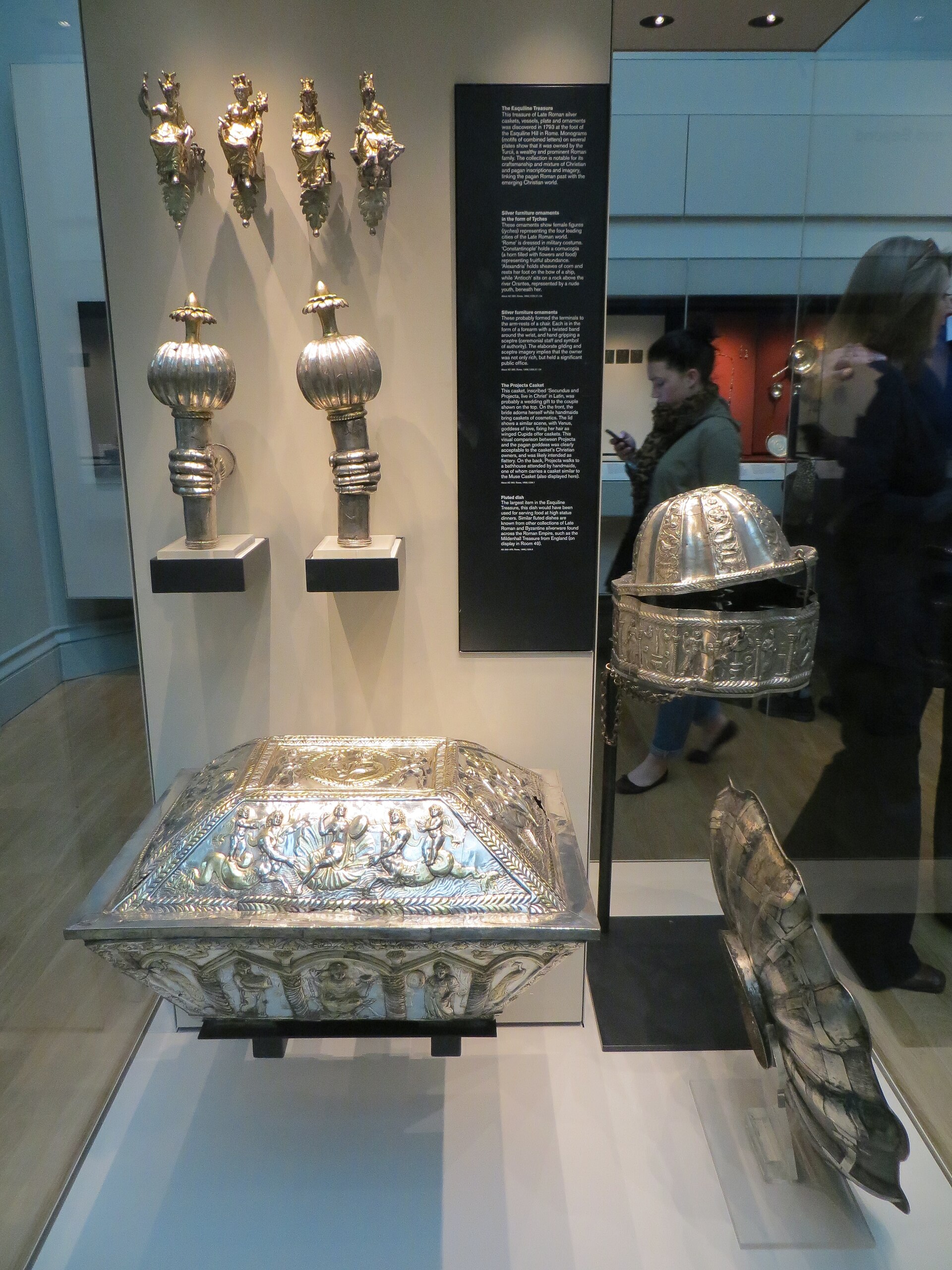
The back is where readings part. Dalton calls the lid's back panel "the deductio of the bride", the ceremonial leading of a bride to her new home, with a palace of domes in the centre, and he notes that Dr O. Pelka (1901) suggests the domes are really arches at the back of an inner court. The museum's wall label, as photographed in the gallery in 2014, reads a back scene differently: "On the back, Projecta walks to a bathhouse attended by handmaids". The label does not say whether it means the lid or the body, and the museum's own record describes the lid's back panel as a bath procession. So the label and the museum's database name the figure Projecta. Dalton's description never does and calls her the bride, and the label also calls the front figure "the bride". The museum's online record lists Proiecta as "named in inscription & portrayed", so the museum treats the identification as settled while Dalton's text does not.
The same label reads the Venus panel as a comparison between the bride and the goddess that "was likely intended as flattery". That is a modern reading of intention, offered as likely, and no document from the household supports or contradicts it.
A second document names a Projecta, and the link between them is an argument
A funerary poem attributed to Pope Damasus names a young married woman called Projecta, and whether she is the casket's Projecta is a scholarly proposal, not a fact on either object. Marucchi's 1912 handbook of Christian epigraphy prints the poem, which records that she lived sixteen years, nine months and twenty-five days and was buried on 30 December 383, in the consulship of Merobaudes and Saturninus. It names her father, Florus, and says she had been joined to a husband, marito, with the word primo beside it. Marucchi works out a birth date of 5 March 367. Neither Marucchi's passage nor Dalton's catalogue entry connects the poem to the casket.
The connection appears in the 1985 pair of articles in the American Journal of Archaeology by Alan Cameron and Kathleen Shelton, which we could not open and know only through a Wikipedia summary that cites them. On that summary, Cameron holds that the epitaph's Projecta is the casket's and that her husband was L. Turcius Secundus, reading primo as wordplay by Damasus on Secundus. Shelton rejects the identification and takes Primus as the husband's name in the epitaph. The Latin allows at least those two readings: primo can be a man's name or the word for first.
The arithmetic shows how much rides on the choice. The museum dates the casket about 380 and gives the Muse Casket from the same find 330 to 370. If the epitaph's girl is the bride, she was about thirteen when the casket was made and died three years later. If she is not, the epitaph tells us nothing about the casket.
| Document | Date | What it says | What it leaves out |
|---|---|---|---|
| Lid inscription, British Museum 1866,1229.1 | about 380 (museum) | A wish addressed to Secundus and Proiecta, both | Donor, commissioner, ages, family |
| Monograms on dishes, as read by Visconti in Dalton | date not given in Dalton | PROIECTA TVRCI | Whether she is the bride |
| Epitaph, as printed by Marucchi | 30 December 383 | A Projecta, 16 years 9 months 25 days, daughter of Florus | The casket; the husband is disputed |
| Dalton's catalogue entry 304 | 1901 | Wife of a member of the Asterii, perhaps Apronianus Asterius, Prefect of Rome in 363 | The epitaph |
| House of Commons debate | 18 February 1867 | "a Roman lady" | Any name at all |
Secundus, the Turcii and the monograms
In three of the four sources the stated basis for the Turcii is monograms on dishes. The Seuso page instead says "on the basis of the inscription on the Proiecta casket". Dalton's catalogue lists a group of silver dishes from the find whose central gold monogram "is read by Visconti as PROIECTA TVRCI". Dalton and the monogram reading overlap rather than conflict. Dalton, in 1901, writes that "Projecta must have been the wife of some member of the great family of the Asterii, perhaps of L. Turcius Rufius Apronianus Asterius, Prefect of Rome in 363". By Marucchi's reckoning the Projecta of the epitaph was born four years after that prefecture, and Dalton does not use the epitaph at all, so his candidate husband is unconnected to the epitaph's husband. Cameron, through the Wikipedia summary, names Secundus as a Turcius.
The certainty also changes with the audience. The museum's gallery label of 2014 says monograms on several plates "show that it was owned by the Turcii, a wealthy and prominent Roman family". The Hungarian Seuso project's page on the same find says the treasure can "perhaps be connected to the Turcii". The Wikipedia summary adds that not every monogram fits one couple, and that the silver may be family plate of more than one generation, which it also gives as Shelton's reading.
What none of these gives us is her own voice, her own property or any act of hers. A woman is named in a wish, drawn at her toilet and possibly mourned in a poem, and in each case someone else did the naming. Dalton adds that the Asterii family, on inscriptions, "did not embrace Christianity till quite late in the 4th century", so the Christian wish on the rim sits in a household whose family religion Dalton's sources leave unclear.
Who found it, who owns it, and a Roman lady left unnamed
The casket is owned by the British Museum, which bought it in 1866 from the Duc de Blacas d'Aulps as part of his whole collection. The museum's entry records the Esquiline Hill convent of San Francesco di Paola ai Monti as the findspot, lists Monsignor Giulio Maria della Somaglia and Baron von Schellerscheim among earlier owners, and gives the acquisition date as 1866. Nothing in those fields explains how the silver came to be in the ground, and the archive's record of the Blacas Ewer shows the same purchase carrying other objects into the museum.
On 18 February 1867 the Chancellor of the Exchequer asked the House of Commons to vote the money. He said Mr Newton had offered 45,000 pounds for the whole collection, that this was refused and that 48,000 pounds was agreed within twenty-four hours. He added that duplicates the Museum could sell reduced the sum by 2,221 pounds, and he moved 45,721 pounds. The printed figures differ by 58 pounds and Hansard does not explain the gap.
He then picked out one object. It was found on the Esquiline in 1793, he said, and it was "a copper casket of considerable size ornamented with silver, and holds the entire toilette service in solid silver of a Roman lady". Copper does not match either silver casket, and a casket that holds a toilet service fits the Muse Casket as well as the Projecta Casket. If it was Projecta's, then the House of Commons was told her box was so unique that nothing in Rome itself approaches it, and was not told her name.
Questions
The casket names her only in the line SECVNDE ET PROIECTA VIVATIS IN CHRISTO and shows a bride at her toilet. The British Museum and Dalton (1901) both call it a wedding gift. Who she was beyond that is argued, from monograms on dishes and from an epitaph.
No document says so. The inscription is a wish addressed to Secundus and Projecta, and the museum describes the casket as a probable wedding gift, so the donor is unrecorded and she appears as a recipient.
That is Alan Cameron's argument of 1985, as summarised on Wikipedia, and Kathleen Shelton rejects it in the same journal issue. The epitaph records a Projecta who died on 30 December 383 aged 16 years 9 months 25 days, but it never mentions a casket.
The British Museum, museum number 1866,1229.1. It bought the casket in 1866 from Louis, Duc de Blacas d'Aulps with his whole collection, and it is on display in Room 41.
Sources
- 1British Museum, Collection Online, 'The Projecta Casket', museum number 1866,1229.1: inscription, translation, curator's comments (Blurton 1997), dating, acquisition and previous-owner fields, read directly in a browser. britishmuseum.org/collection/...
- 2British Museum, Collection Online, 'Muse Casket', museum number 1866,1229.2: production date 330-370, read directly in a browser. britishmuseum.org/collection/...
- 3O. M. Dalton, Catalogue of Early Christian Antiquities and Objects from the Christian East in the British Museum (London, 1901), no. 304 (casket of Projecta) and nos. 312 and 316 (monogram dishes), read in the Internet Archive full-text scan. archive.org/details/...
- 4Orazio Marucchi, Christian Epigraphy (English edition, Cambridge, 1912), Part II ch. IX, pp. 407-408: text of the Damasus epitaph for Projecta, read in the Internet Archive full-text scan. archive.org/details/...
- 5House of Commons, Supply: Purchase of the Blacas Collection, Hansard, 18 February 1867, vol. 185 cc. 491-494 (the vote runs to 513). api.parliament.uk/historic-hansard/...
- 6Wikipedia, 'Esquiline Treasure' (raw wikitext), read for its summary of Alan Cameron and Kathleen Shelton, American Journal of Archaeology 89 (1985), 135-145 and 147-155. en.wikipedia.org/wiki/...
- 7Seuso Research Project (Hungarian National Museum), 'The Esquiline treasure': summary of the find and of the Turcii connection. seuso.mnm.hu/en/...
More in The Women Behind the Art
The partWho Stitched the Bayeux Tapestry? What the Documents Say About English Women's Embroidery
No document names who stitched the Bayeux Tapestry. What Domesday, the 1476 inventory and the Queen Matilda story show about English women's...
The Two Women in the Oseberg Ship, and the Queen Nobody Named
Two women lay in the Oseberg ship in 834. What the bones, isotopes and DNA show, and how a queen and a servant were read into a grave that no text...
The Jewels Isabella Pawned, and the Offer She Made for Columbus
Isabella pawned jewels at Valencia in 1489 for the Granada war. The Columbus offer is conditional in Hernando Colon and Las Casas, and Santangel's...