A Harlot's Progress, Plate 1
William Hogarth · before April 1732 (first state); designed 1731
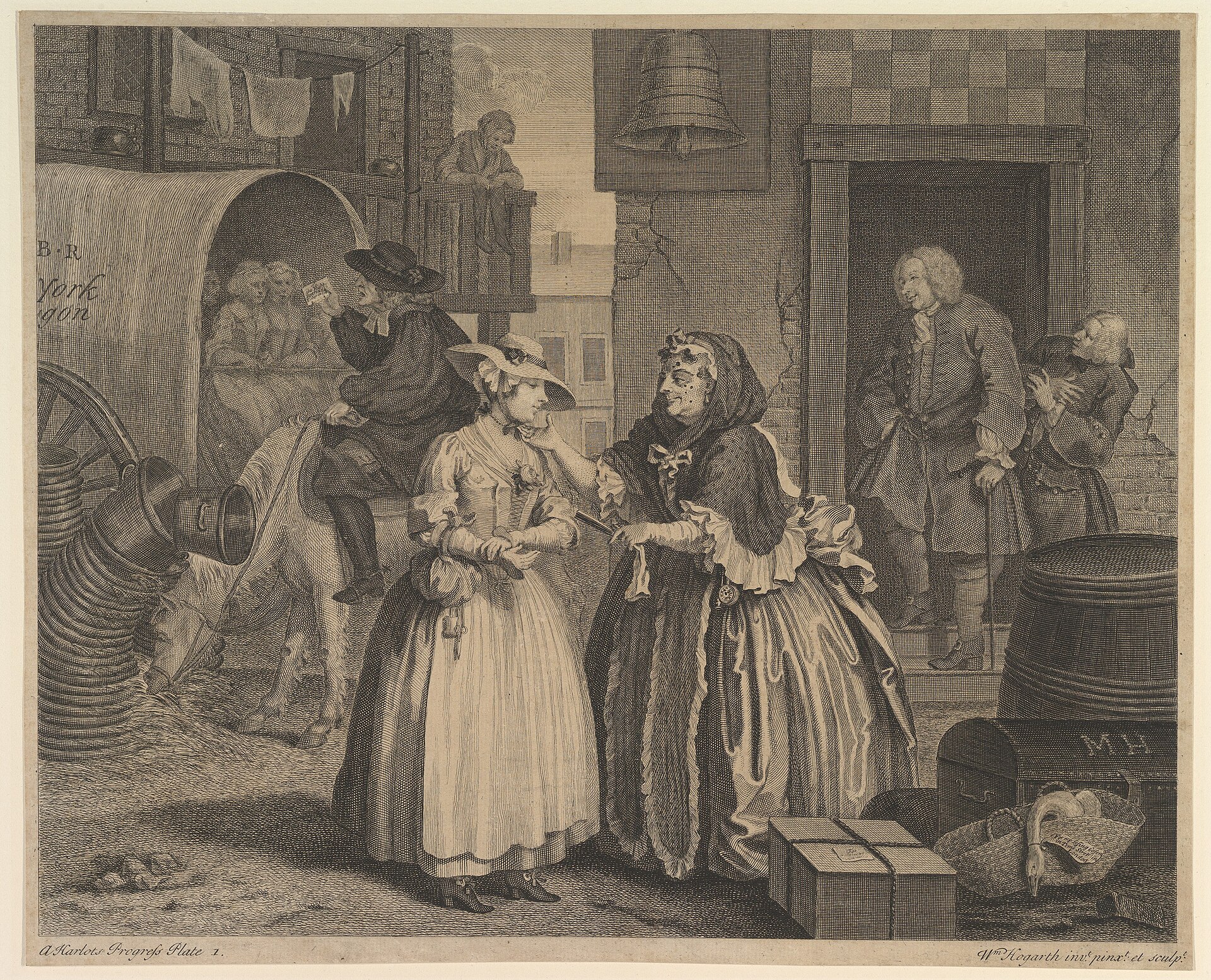
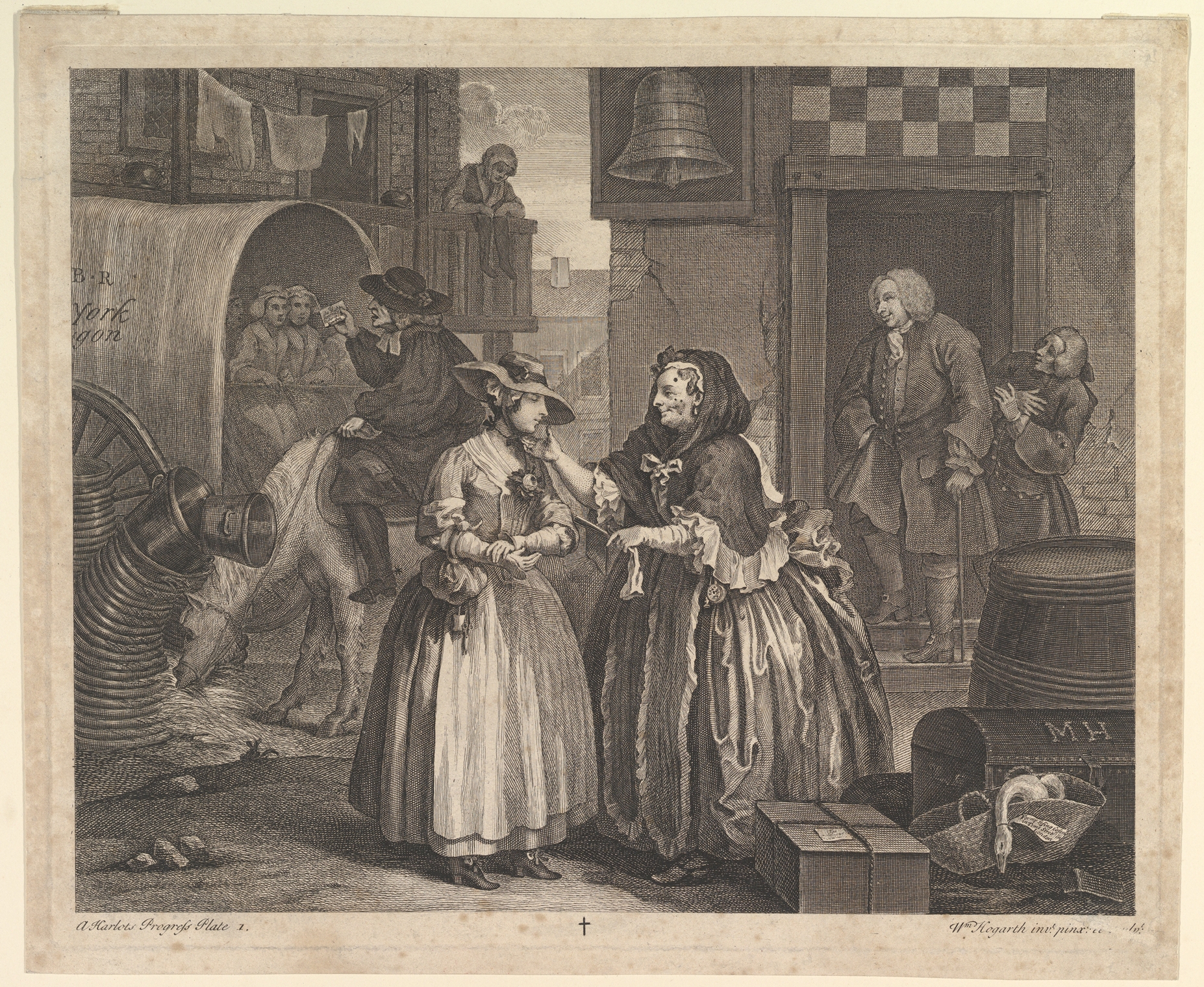
The record subject: Metropolitan Museum of Art accession 32.35(2), first state of four, etching and engraving, before April 1732. Moll Hackabout has just stepped off the York wagon into a London inn yard and is being appraised by a procuress while a well-dressed older man looks on from a doorway. Purchased with the Harris Brisbane Dick Fund, 1932.
| Artist | William Hogarth |
|---|---|
| Date | before April 1732 (first state); designed 1731 |
| Medium | Etching and engraving on laid paper |
| Dimensions | Sheet 12 5/16 x 15 1/8 in. (31.3 x 38.4 cm) |
| Where it is now | Metropolitan Museum of Art, New York, Department of Drawings and Printslast confirmed |
| Inventory number | Accession number 32.35(2) |
| Attribution | AcceptedUniversally accepted as designed, etched and engraved by William Hogarth. Full note |
| Object type | |
| Period | British, eighteenth century |
| Cases | Has a provenance gap |
| Inscriptions | Engraved title and publication line in the lower margin, in the form standard to the series: the plate number, title, and Hogarth's name as designer, painter and engraver, with the date of publication. The first state, to which this impression belongs, lacks the small cross that Hogarth added to the lower margin of the plate for the second state issued more than a decade later. |
| Owners on record | 8 links7 documented, 1 unknown |
| Sources | 19 cited |
About this record Last verified · 19 sources cited · Change log
On this page 10 sections
ContentsClose
The opening plate of William Hogarth's six-part invented genre, the "modern moral subject": a country girl named Moll Hackabout steps off the York wagon into a London courtyard and, within the same engraved frame, is measured up by a procuress while a notorious rake looks on from a doorway. This impression, Metropolitan Museum of Art accession 32.35(2), is a first-state impression, pulled before Hogarth reworked the plate more than a decade after its original 1732 publication, and it entered the Museum's Department of Prints in 1932 through the Harris Brisbane Dick Fund as part of a complete first-state set of all six plates.
The engravings survive; the paintings that Hogarth made first, in 1731, do not. They burned in 1755 in a fire at Fonthill House, the Wiltshire seat of the London alderman William Beckford, and the six plates in the Museum's 32.35 series are among the closest surviving witnesses to what those paintings looked like. The print's own history carries a second, separate story: pirated copies of A Harlot's Progress appeared within weeks of its 1732 publication, with no law to stop them, and Hogarth's response reshaped English copyright law for every visual artist who followed him.
Provenance
Each link is graded. Documented: a cited source supports it. Disputed: the identification is argued but not established. Unknown: no owner for that span, and the gap is not smoothed into a narrative. The grades in the glossary.
- 1731 - 1731William Hogarthdocumented
Hogarth painted a series of six pictures illustrating the fall of a country girl into London prostitution and her death, his first venture into what he later called the "modern moral subject". The paintings were his invention entire: no commission is recorded, and the series appears to have been made speculatively, ahead of any buyer, specifically so that it could be engraved and sold by subscription. Elizabeth Needham, the London brothel-keeper long identified with the procuress in Plate 1, died on 3 May 1731, apparently of injuries from a public pillorying; Hogarth was reportedly still finishing the series when she died, which places the paintings' completion in the same year.123
- 1731 - 1732William Hogarthdocumented
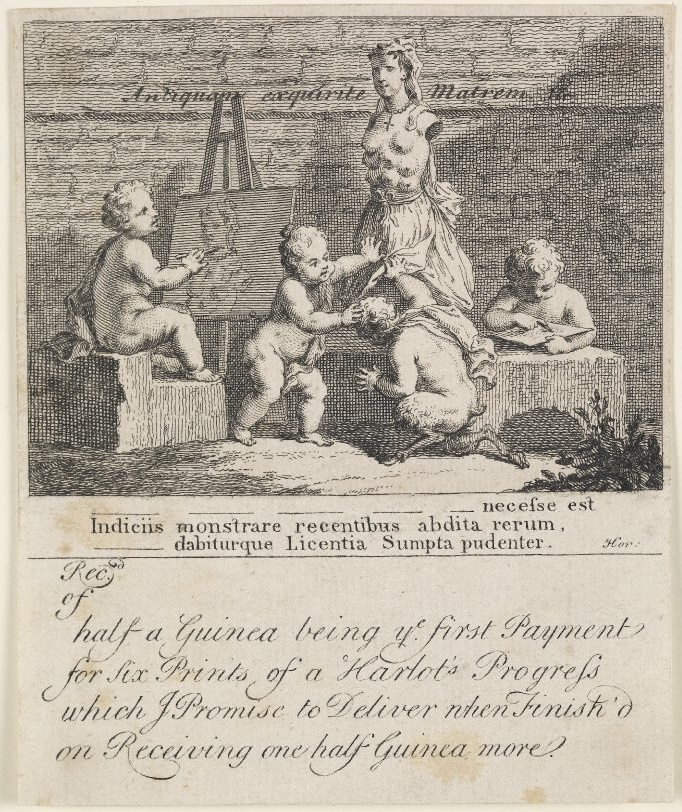
Hogarth etched and engraved all six plates himself, working from his own paintings, combining etched outline with engraved shading. He advertised a subscription: 1,240 sets of six plates were sold at one guinea each, with a further half-guinea due on delivery. Subscribers first received a separate print, Boys Peeping at Nature, as their receipt and admission ticket; the finished plates were delivered in April 1732. This impression, accession 32.35(2), is described by the Metropolitan Museum as a first-state impression, meaning it predates Hogarth's later reworking of the plate.1456
- 1732 - 1735William Hogarth (rights holder, unprotected)documented
Unauthorized copies of A Harlot's Progress reached the market almost immediately after the 1732 delivery, undercutting Hogarth's subscription price and returning him no income. There was no legal remedy: English copyright statute covered books, not engraved images. Hogarth organized a petition of designers, engravers and etchers presented to the House of Commons on 7 February 1735; a committee reported the allegations proven on 14 February 1735; the resulting Act (8 Geo. 2, c. 13), popularly called Hogarth's Act, received royal assent on 15 May 1735 and came into force on 24 June 1735. Hogarth deliberately withheld his next series, A Rake's Progress, already advertised for subscription in 1733, until the Act was law, publishing it the day after the Act took effect so that it would be the first series protected by the statute he had lobbied for.78910
- 1744 - 1764William Hogarth, then his widow Jane Hogarthdocumented
Hogarth issued a second state of the series more than a decade after first publication, distinguished chiefly by a small cross added to the lower margin of each plate along with other minor retouching; this impression, being first state, predates that change. Hogarth died on 26 October 1764; his widow Jane Hogarth (nee Thornhill) continued to print and sell impressions from the original stock and the original coppers for the rest of her life.1611
- 1755 - 1755William Beckford (1709-1770), Fonthill House, Wiltshiredocumented
The original Harlot's Progress paintings had by this date passed into the collection of Alderman William Beckford at Fonthill House. On 12-13 February 1755 workmen finishing a new ceiling in the north wing left a fire unattended in a disused chimney; the resulting blaze destroyed most of the north range including the great hall. The Harlot's Progress paintings were lost in the fire. Hogarth's own Rake's Progress paintings, also at Fonthill at the time, survived. This event has no bearing on the print itself, which by 1755 existed independently in thousands of engraved impressions, but it is the reason the print is now the only complete record of the original composition.121314
- 1789 - 1921John Boydell, then Baldwin, Cradock and Joy, then Henry Bohn, then Bernard Quaritchdocumented
This chain concerns the physical copperplates, not the paper impression described in this record, and is included because it explains why later-state and posthumous impressions of the series exist and circulate alongside first-state impressions like this one. Jane Hogarth sold the plates to the print publisher John Boydell in 1789; they passed to the printsellers Baldwin, Cradock and Joy in 1818; Henry Bohn acquired them in 1835 and issued further pulls; Bernard Quaritch sold them in 1921. They are reported to be in the Edison Dick collection, Chicago. No restrikes from this later ownership are part of the object described in this record.16
- 1732 - 1932unrecordedunknown
No owner, dealer or intermediate sale is recorded in the sources available for this research for the specific two-hundred-year span between the plate's first printing and its 1932 purchase by the Metropolitan Museum. The Museum's public catalogue record gives the acquisition fund and year but does not name a seller or an intervening collection. Given that the sheet is a first-state impression pulled at or close to the 1732 publication, it in principle could descend from an original 1732 subscriber's set, but this is not documented and should not be asserted.51519
- 1932 - presentMetropolitan Museum of Art, New Yorkdocumented
Purchased in 1932 with the Harris Brisbane Dick Fund as one of six plates (accessions 32.35(2) through 32.35(7)) acquired together as a first-state set. The Fund derives from the 1916 gift and bequest of the paper manufacturer Harris Brisbane Dick, whose donation of some 3,500 prints and an accompanying purchase endowment led directly to the Museum establishing its own independent Department of Prints under William M. Ivins Jr. The plate has remained in the Museum's Department of Drawings and Prints without recorded exhibition loan or deaccession since 1932.51516
Prices realised
| Date | Sale | Estimate | Result | Note |
|---|---|---|---|---|
| 2 June 2023 | Bonhams Prints and Multiples, Knightsbridge, London, lot 7, lot 7 | not stated in the source consulted | Hammer not disclosed separately With premium GBP 2,048 total price including buyer's premium GBP | This sale is a market comparable for the print type and state, not a sale of the Metropolitan Museum's impression. It was a complete set of all six plates of A Harlot's Progress, described by the house as fine first-state impressions trimmed to the image and engraved text. Bonhams' published result gives only the all-in total price; the hammer and premium are not broken out separately in the source consulted, and that conflation is noted rather than resolved. The Metropolitan Museum's own impression, accession 32.35(2), has been institutional property since 1932 and has no market sale history: it has not been offered, sold, deaccessioned or exchanged since the Museum's 1932 purchase, so far as the sources available to this research show. |
Hammer is the price at which the bidding stopped; with premium adds the fee the house charges the buyer on top. Hammer price and buyer's premium in the glossary.
Technical evidence
| Attribution note | Universally accepted as designed, etched and engraved by William Hogarth. The plate carries his engraved imprint and the work is documented throughout his lifetime in his own subscription scheme, his account books and contemporary press notices. The only genuine uncertainty in this record concerns not authorship but identification of two background figures as real Londoners of 1730-31, which is a matter of scholarly reading rather than attribution. |
|---|---|
| Support | Laid paper, hand-made, with a chain-line structure typical of English and Dutch papers used by London print publishers in the early 1730s. No watermark has been identified in the sources consulted for this record.35 |
| Process | Etching and engraving in combination: the plate was first bitten with acid through an etching ground for the finer linear work, then reworked with a burin for deeper engraved lines and shading, the standard hybrid technique Hogarth used across the series.16 |
| State | First state of four. This impression predates the small engraved cross that Hogarth added to the lower margin of the plate for the second state, issued more than a decade after the original 1732 publication, and predates all later reworking of the copper after it left Hogarth family ownership in 1789.3511 |
| Dimensions | Sheet 12 5/16 x 15 1/8 in. (31.3 x 38.4 cm), as measured and published by the Metropolitan Museum of Art.3 |
| Date | Described by the Metropolitan Museum as "before April 1732", consistent with a first-state impression pulled at or ahead of the general April 1732 subscriber delivery.35 |
| Accession and credit line | Accession 32.35(2); credit line "Harris Brisbane Dick Fund, 1932"; Department of Drawings and Prints, classification Prints.35 |
| Companion accessions | Acquired together with the remaining five plates of the same set, accessioned sequentially as 32.35(3) through 32.35(7), all bearing the same 1932 Harris Brisbane Dick Fund credit line.18 |
Images
The record in full
Chapter 1What this impression is
This is a single sheet of laid paper, 12 5/16 by 15 1/8 inches, carrying an etched and engraved image printed from a copperplate that William Hogarth cut himself.
This is a single sheet of laid paper, 12 5/16 by 15 1/8 inches, carrying an etched and engraved image printed from a copperplate that William Hogarth cut himself. It is catalogued by the Metropolitan Museum of Art as accession 32.35(2), the first state of four states the plate went through in Hogarth's lifetime and after, and it entered the Museum's Department of Drawings and Prints in 1932, purchased with the Harris Brisbane Dick Fund as one of a complete set of all six plates of the series bought together.
Being a first-state impression matters. It was pulled at or close to the plate's original 1732 publication, before Hogarth went back to the copper more than a decade later to add a small engraved cross to the lower margin and make further minor changes for what collectors call the second state. Later states again, made from the same copper after it passed out of Hogarth's family in 1789, carry their own history of wear and re-touching. This sheet predates all of that: it is close to what a subscriber received in 1732, not a later reprint.
Chapter 2The scene
The setting is a coaching-inn yard at the edge of the City of London, identified in period accounts as outside the Bell Inn.
The setting is a coaching-inn yard at the edge of the City of London, identified in period accounts as outside the Bell Inn. A young woman, later named on a coffin lid in Plate 6 as M. Hackabout, has just climbed down from the York wagon: her clothes, a pincushion and a pair of scissors tied at her waist, mark her out as a country girl who came to town meaning to find work as a seamstress. A rose is tucked into her bosom, a period sign of virginity about to be lost.
She is being appraised, not welcomed. A well-dressed older woman leans in close, admiring her looks with one hand, while an older man watches from a doorway behind them with evident interest. Behind the whole group, entirely unaware, a clergyman on a horse lets his mount wander into a stack of pans, an emblem of religious authority looking everywhere except where the moral damage is actually happening. Every element in the print is doing narrative work: nothing in a Hogarth composition of this kind is decorative.
Chapter 3Two real Londoners, read into the frame
Modern curatorial practice, repeated at the Metropolitan Museum, the Royal Collection Trust and the Art Gallery of New South Wales among others, identifies the older woman as Elizabeth Needham, a...
Modern curatorial practice, repeated at the Metropolitan Museum, the Royal Collection Trust and the Art Gallery of New South Wales among others, identifies the older woman as Elizabeth Needham, a London brothel-keeper notorious enough that Hogarth's own description of her - "a handsome old Procuress... well dressed in silk" - was read by contemporaries as an obvious likeness. Needham was convicted of keeping a disorderly house in April 1731 and sentenced to stand twice in the pillory; she died on 3 May 1731, reportedly of injuries from the first pillorying, before her second punishment was carried out. Hogarth was, by report, still working on the painted series when she died, so she never saw herself put into it.
The man in the doorway is conventionally identified as Colonel Francis Charteris, a Scottish soldier and gambler known in the London press as the "Rape-Master General" after his conviction, in February 1730, for the rape of his servant Anne Bond. Charteris was sentenced to death and then pardoned by George II two months later. He died in February 1732, weeks before this plate was published.
Both identifications should be held at the correct level of confidence. Neither figure is named in the engraving, and no contemporary printed key naming them for this specific plate has turned up in the sources consulted for this record. What supports the identification is convergence: Hogarth's own physical description of the procuress, the timing (both real figures were fresh in the London news in 1730-31, just as Hogarth was composing the paintings), and unbroken institutional repetition since. Ronald Paulson, the leading modern Hogarth scholar, has gone further and proposed that the real-life model behind Moll Hackabout herself may have been Anne Bond, Charteris's own victim, rather than a generic type - a reading that, if correct, would tie Plate 1 directly to the same 1730 court case that made Charteris notorious enough to put in a doorway a year later. This record treats the Needham and Charteris identifications as an argued scholarly reading with strong contemporary plausibility, not as a documented fact stated by Hogarth himself.
Chapter 4The paintings that came first, and are gone
The engraving reproduces a painting, not the other way round.
The engraving reproduces a painting, not the other way round. In 1731 Hogarth painted a set of six pictures telling Moll Hackabout's story from arrival to death, apparently without a buyer lined up: this was Hogarth working on speculation, using his own money to make a product he intended to sell not as unique paintings to one patron but as an edition of engravings to hundreds of subscribers. It was, in effect, a publishing venture built around paintings rather than paintings made for a wall.
The paintings eventually passed into the collection of William Beckford, the London alderman and West India merchant, at his Wiltshire seat, Fonthill House. On 12-13 February 1755, workmen who had been finishing a new ceiling in the house's north wing left a fire unattended in a chimney that was not in regular use. The resulting blaze destroyed most of the north range, including the great hall. Hogarth's Harlot's Progress paintings were among the losses. By an accident of timing that says something about how contingent survival is, his Rake's Progress paintings, also then at Fonthill, escaped the same fire. Nobody planned for the prints to become the only complete record of the earlier series; that is simply what happened.
Chapter 5Selling a scandal by subscription
Hogarth did not simply have the paintings engraved and put on sale.
Hogarth did not simply have the paintings engraved and put on sale. He financed the entire project through a subscription scheme, a method already used for expensive illustrated books but not, before this, for a set of secular narrative prints aimed at a broad audience rather than scholars or bibliophiles. Subscribers paid a deposit against a first, separate print - Boys Peeping at Nature, showing three putti sketching the many-breasted statue of Diana of Ephesus, one drawing honestly from the model and one turning away to invent from imagination - which doubled as both an advertisement for the coming series and the subscriber's receipt. The full set of six plates followed on payment of the balance.
The scheme worked. Hogarth sold 1,240 sets at one guinea each, a striking commercial result for a printmaker who was, at this point in his career, still better known as a jobbing engraver of shop cards and book illustrations than as a painter. A Harlot's Progress made Hogarth's reputation and his income in one stroke, and it established a subscription-and-delivery model he would reuse, with the same Boys Peeping at Nature ticket recycled for later series in 1737.
Chapter 6Piracy, and the law that piracy produced
The series' commercial success drew imitators immediately.
The series' commercial success drew imitators immediately. Pirated copies of the six plates were on sale within weeks of the 1732 delivery, made by other engravers who had never paid Hogarth anything and who could undercut his price because they had none of his production costs to recover. English law offered him nothing: the only copyright statute in force, the Statute of Anne of 1710, protected printed books, and nobody had extended the same protection to engraved images.
Hogarth organized the response himself. He brought together a group of fellow engravers - contemporary sources name George Vertue, George Lambert, Isaac Ware, John Pine, Gerard Vandergucht and John Goupy alongside Hogarth - and presented a petition, "the case of designers, engravers, etchers, etc.", to the House of Commons on 7 February 1735. A committee reported on 14 February that the petitioners' allegations were fully proved, and a bill followed. The resulting statute, formally "An Act for the Encouragement of the Arts of Designing, Engraving, and Etching Historical and other Prints" (8 Geo. 2, c. 13) and universally known since as Hogarth's Act, received royal assent on 15 May 1735 and came into force on 24 June 1735. It gave engravers and the inventors of original designs, for the first time in English law, a statutory property right in their own images, with a term of years during which copying without consent was unlawful.
Hogarth then made the point as visibly as he could. He had already been advertising and taking subscriptions for his next series, A Rake's Progress, since 1733, but he held its actual publication back until the Act took effect, releasing the plates on 25 June 1735, the day after the statute became law. The Rake's Progress was consequently the first series ever published under the protection of the Act that its own author had lobbied into existence. It is worth being precise about the sequence, because it is often collapsed: it was A Harlot's Progress, already printed and already pirated, that supplied the grievance and the political case; it was A Rake's Progress, not the Harlot, whose publication Hogarth deliberately timed to the new law.
Chapter 7States and reprints: what changed after 1732
Because the plate remained a saleable object for more than a century and a half after 1732, impressions of Plate 1 exist in several distinct forms, and knowing which one a given sheet is matters for...
Because the plate remained a saleable object for more than a century and a half after 1732, impressions of Plate 1 exist in several distinct forms, and knowing which one a given sheet is matters for both authenticity and value. The first state, to which this Museum impression belongs, is the plate as delivered to the original 1732 subscribers. More than ten years later Hogarth issued a second state, distinguished by a small cross engraved into the lower margin along with minor retouching elsewhere on the plate; the Metropolitan Museum's own catalogue records list further states beyond that, with a fourth and final state representing the most reworked and latest form of the plate that Hogarth himself sanctioned.
The plate's life did not end with Hogarth. His widow Jane Hogarth continued to print and sell from the original coppers until her own death in 1789, when she sold them to the print publisher John Boydell. They passed afterward to the printsellers Baldwin, Cradock and Joy in 1818, to the print dealer Henry Bohn in 1835, and were sold on by Bernard Quaritch in 1921; they are reported to survive today in a private Chicago collection. Every one of those later owners printed further impressions from the worn copper, and posthumous nineteenth-century pulls are correspondingly softer and less crisp than an impression struck in or close to 1732. The Museum's own second impression of this plate, accession 91.1.128, a gift of 1891 and catalogued as a fourth-state impression, sits at the far end of that spectrum from the sheet described in this record; the two should never be treated as interchangeable, even though they show the identical design.
Chapter 8Into the Metropolitan Museum
This impression's institutional history begins in 1932, when the Museum purchased a complete first-state set of all six plates of A Harlot's Progress with the Harris Brisbane Dick Fund, giving them...
This impression's institutional history begins in 1932, when the Museum purchased a complete first-state set of all six plates of A Harlot's Progress with the Harris Brisbane Dick Fund, giving them the sequential accession numbers 32.35(2) through 32.35(7) (plate one carries the second number in that sequence for cataloguing reasons unrelated to its place in the story). The fund itself has a specific institutional history: Harris Brisbane Dick, a paper manufacturer, gave the Museum some 3,500 mostly nineteenth-century etchings in 1916 along with an endowment for further purchases, a gift substantial enough that the Museum trustees used it to justify establishing an independent Department of Prints for the first time, hiring William M. Ivins Jr. to build the collection. The 1932 Hogarth purchase falls squarely within that department's early buying programme.
What is not recoverable from the sources available for this research is who the Museum bought the set from in 1932: no dealer, auction, or intermediate private owner is named in the Museum's own public catalogue data for this object. The two centuries between the plate's original 1732 printing and its 1932 purchase are, for this specific sheet, undocumented. That is recorded here as a gap rather than bridged with a guess.
Chapter 9What the print is worth at market
This particular institutional impression has no market sale history: it has been Metropolitan Museum property continuously since the 1932 purchase and has not been offered for sale, deaccessioned, or...
This particular institutional impression has no market sale history: it has been Metropolitan Museum property continuously since the 1932 purchase and has not been offered for sale, deaccessioned, or exchanged since. For a sense of what impressions of this kind trade for, the closest documented comparable found in this research is a complete set of all six plates, described as fine first-state impressions, sold at Bonhams in London on 2 June 2023 (Prints and Multiples sale, lot 7) for a total price of GBP 2,048 including buyer's premium. Bonhams' published result does not separate the hammer price from the premium, a gap in the source rather than in this record's reporting of it, and the estimate is not stated in the material consulted. That figure covers a full set of six sheets, not a single plate, and single first-state impressions of individual plates from the series can be found in the market at a small fraction of that per-plate figure when sold outside a complete set, though no single documented sale of an isolated Plate 1 first-state impression, with a disclosed price, was located in this research.
Chapter 10The man who made it
Hogarth did not simply illustrate a story; he said, in his own words, that he built one.
Hogarth did not simply illustrate a story; he said, in his own words, that he built one. In notes he kept about his own working method, later published from his manuscripts, he wrote of "painting and engraving modern moral subjects... to treat my subjects as a dramatic writer; my picture was my stage." That sentence is the clearest statement of what makes this print different from earlier English narrative engraving: Hogarth conceived a sequence of scenes the way a playwright conceives acts, with recurring props, foreshadowing and a moral arc running start to finish, rather than a single static allegory. A Harlot's Progress, published a year before he turned thirty-five, was the first full outing of that idea, and its commercial success let him repeat the formula for the rest of his career.
The artist
William Hogarth
Hogarth trained as an engraver, not a painter, and that training shows in everything he made afterward. Apprenticed as a boy to the silversmith-engraver Ellis Gamble to cut trade cards and shop signs, he later studied under Sir James Thornhill, England's leading history painter, whose daughter Jane he married in a private, disapproved-of ceremony in 1729. By the time he painted the Harlot's Progress series in 1731 he was already a working engraver of a decade's standing; the series is the moment he turned that trade skill toward an entirely new kind of picture-making of his own invention.
Related works
| Work | Relation | Where it is |
|---|---|---|
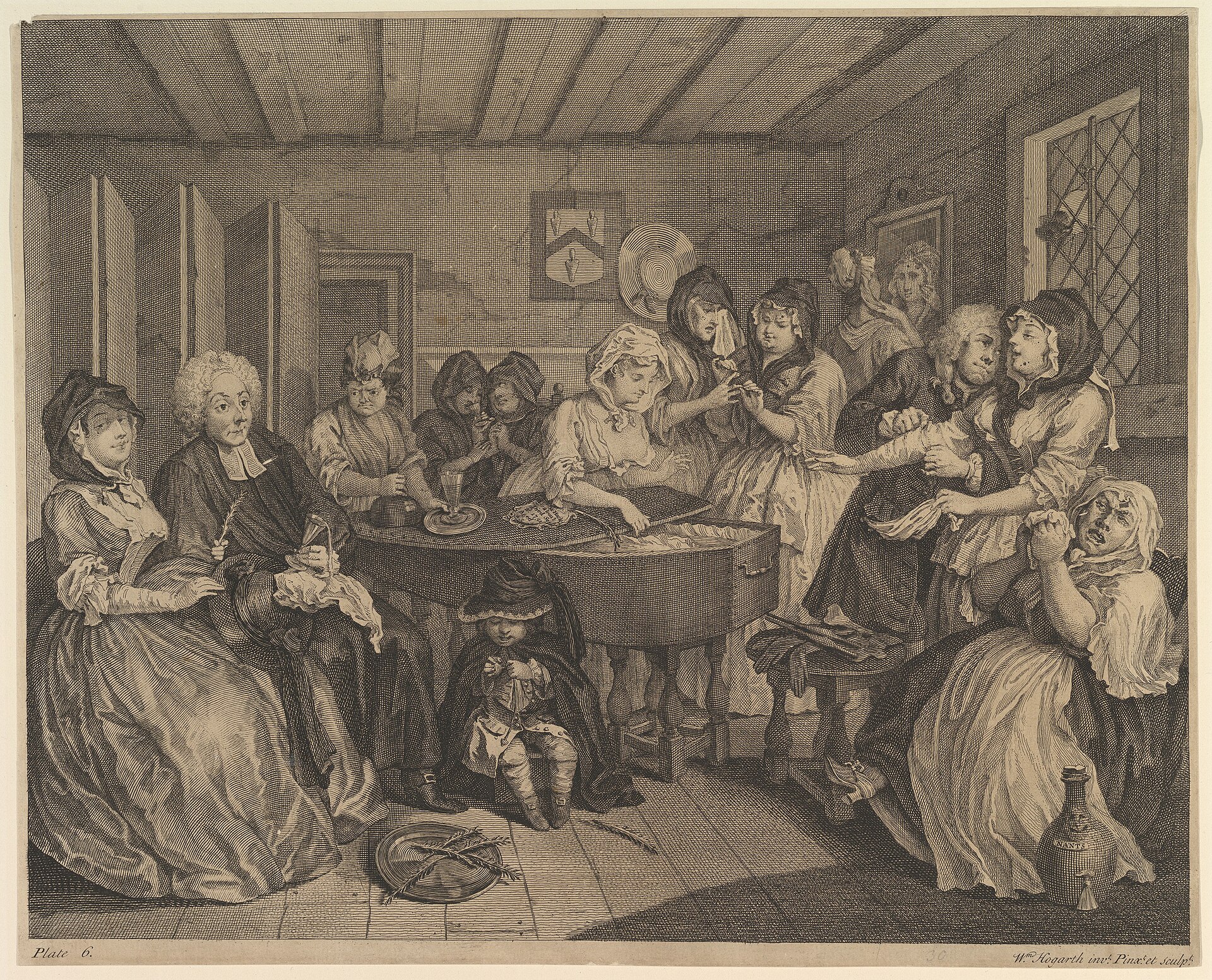
| A Harlot's Progress, Plates 2 through 6 William Hogarth | The remaining five plates of the same six-plate series, telling the rest of Moll Hackabout's story through to her death and funeral Different scenes and different moments in the narrative; none should be captioned as Plate 1 or as this record's object. | Metropolitan Museum of Art, New York (accessions 32.35(3) through 32.35(7), the same 1932 first-state set as this record's plate) |
| A Harlot's Progress, Plate 1, fourth state William Hogarth | A separate, later-state Metropolitan Museum impression of the identical design Same composition, different physical sheet, different state, different acquisition history. Not to be confused with, or have its facts blended into, this record's object. | Metropolitan Museum of Art, New York (accession 91.1.128, Gift of Sarah Lazarus, 1891) |
| A Rake's Progress William Hogarth | Hogarth's next "modern moral subject" series, whose publication he deliberately delayed until the Engraving Copyright Act took effect on 24 June 1735, releasing it the following day Direct legal and commercial sequel to the piracy of A Harlot's Progress; also survived the 1755 Fonthill fire that destroyed the Harlot paintings. | Multiple institutional collections, including Sir John Soane's Museum, London (the original paintings) and the Metropolitan Museum |
| Boys Peeping at Nature William Hogarth | The 1731 subscription ticket and receipt print used to sell A Harlot's Progress Not part of the six-plate narrative; a paratextual object documenting how the series was financed and distributed. | British Museum, London, and other print collections |
Open questions
- Who did the Metropolitan Museum purchase this impression from in 1932? No dealer, auction, or intermediate owner is named in the Museum's available public catalogue data.
- Where was this specific sheet between its original printing (before April 1732) and its 1932 purchase? Two centuries are undocumented for this exact impression.
- Is the identification of the procuress with Elizabeth Needham and of the doorway figure with Francis Charteris a reading Hogarth himself intended, or a contemporary inference later generations have simply repeated without independent verification against a printed key?
- Did Hogarth or his publisher issue any contemporary printed key naming the real-life figures in Plate 1, of the kind known to exist for some other satirical prints of the period? None was located in the sources consulted for this record.
- What did the lost 1731 Harlot's Progress paintings actually look like in passages where the engraving process (reversal, line simplification, loss of colour) might have departed from the paintings? With the paintings destroyed in 1755, this cannot now be checked against the original.
Questions about this object
What is A Harlot's Progress, Plate 1?
A Harlot's Progress, Plate 1 is a print, dated before April 1732 (first state); designed 1731. Medium: Etching and engraving on laid paper.
Who made A Harlot's Progress, Plate 1, and is the attribution settled?
The attribution to William Hogarth is recorded here as accepted. Universally accepted as designed, etched and engraved by William Hogarth. The plate carries his engraved imprint and the work is documented throughout his lifetime in his own subscription scheme, his account books and contemporary press notices. The only genuine uncertainty in this record concerns not authorship but identification of two background figures as real Londoners of 1730-31, which is a matter of scholarly reading rather than attribution.
Where is A Harlot's Progress, Plate 1 now?
Metropolitan Museum of Art, New York, Department of Drawings and Prints. Inventory number Accession number 32.35(2). Last confirmed 30 August 2026. Purchased with the Harris Brisbane Dick Fund, 1932.
What has A Harlot's Progress, Plate 1 sold for?
Hammer not disclosed separately; with premium, GBP 2,048 total price including buyer's premium. Bonhams, 2023-06-02.
What is still unknown about A Harlot's Progress, Plate 1?
Who did the Metropolitan Museum purchase this impression from in 1932? No dealer, auction, or intermediate owner is named in the Museum's available public catalogue data.
Sources
- 1Wikipedia, 'A Harlot's Progress', consolidating the 1731 paintings, the Fonthill fire, the subscription publication, the copperplate ownership chain after Hogarth's death, and the identification of Moll Hackabout, Elizabeth Needham and Francis Charteris. en.wikipedia.org/wiki/...
- 2Wikipedia, 'Elizabeth Needham', for her dates, her 1731 conviction and death, and the scholarly status of her identification with the procuress of Plate 1, including the alternative model proposed by Ronald Paulson. en.wikipedia.org/wiki/...
- 3Metropolitan Museum of Art Collection API, object record for accession 32.35(2), object ID 401166, queried 2026-08-30: accession number, date, medium, state, dimensions, credit line and public domain status. collectionapi.metmuseum.org/public/...
- 4Wikimedia Commons, File:William Hogarth - Boys Peeping at Nature (2nd state).jpg, British Museum, for the subscription-ticket mechanism used to sell A Harlot's Progress by subscription in 1731-32. commons.wikimedia.org/wiki/...
- 5Metropolitan Museum of Art, object page for accession 32.35(2) (object ID 401166), for the acquisition credit line (Harris Brisbane Dick Fund, 1932) and catalogue description. metmuseum.org/art/...
- 6Art Gallery of New South Wales, catalogue entry for A Harlot's Progress: Plate 1, accession 324.2006.1, for the scene description (Bell Inn, York stagecoach, the clergyman's oblivious horse) and dimensions. artgallery.nsw.gov.au/collection/...
- 7Wikipedia, 'Engraving Copyright Act 1734' (also known as Hogarth's Act, 8 Geo. 2 c. 13), for the petition date, committee report, royal assent and commencement dates, and the Act's legal scope. en.wikipedia.org/wiki/...
- 8Britannica-derived and secondary summaries of the Hogarth Act and its relationship to the piracy of A Harlot's Progress and the deliberate delay of A Rake's Progress until the Act's commencement, cross-checked against the Wikipedia Engraving Copyright Act entry. en.wikipedia.org/wiki/...
- 9Open Book Publishers, 'Circulation and Control', chapter on the first copyright case under the 1735 Engravings Act, for context on how the Act was tested and used shortly after passage. books.openbookpublishers.com/10.11647/...
- 10Wikipedia, 'William Hogarth', for the subscription mechanics (1,240 sets at one guinea), the 'modern moral subject' formulation, his engraving apprenticeship under Ellis Gamble, his training under James Thornhill, his marriage to Jane Thornhill in 1729, The Analysis of Beauty (1753), his Foundling Hospital governorship, his Freemasonry, and the direct quotation on treating his pictures as a dramatic stage. Paulson's three-volume life). en.wikipedia.org/wiki/...
- 11Search-summarized museum curatorial descriptions (Art Institute of Chicago and National Gallery of Victoria collection notes) describing the small cross added to the lower margin of each plate for the second state of the series, issued more than a decade after the first 1732 publication. artic.edu/artworks/...
- 12Apollo Magazine, 'Hogarth's paintings fail to go the whole hog', and related search-summarized accounts of the February 1755 Fonthill House fire, its cause (an unattended fire left by workmen completing a ceiling), and the loss of the Harlot's Progress paintings alongside the survival of the Rake's Progress paintings from the same fire. apollo-magazine.com/hogarths-paintings-fail-to-go-the-who...
- 13Wikipedia, 'Fonthill Splendens', for background on the Beckford family's Wiltshire house referred to as Fonthill House at the time of the 1755 fire, distinct from the later Fonthill Abbey built by William Thomas Beckford. en.wikipedia.org/wiki/...
- 14Wikipedia, 'Francis Charteris (rake)' (also catalogued as 'Francis Charteris (rapist)'), for his baptism and death dates, the 1729 assault on Anne Bond, his February 1730 Old Bailey conviction and royal pardon, his nickname 'the Rape-Master General', and his identification with the leering figure in the doorway of Plate 1. en.wikipedia.org/wiki/...
- 15Metropolitan Museum of Art Collection API, object record for accession 91.1.128, object ID 399540, queried 2026-08-30, used only to confirm that this is a distinct impression (fourth state, Gift of Sarah Lazarus, 1891) from the accession 32.35(2) impression that is the subject of this record, and not to source any claim made about this record's object. collectionapi.metmuseum.org/public/...
- 16Search-summarized institutional history of the Harris Brisbane Dick Fund, established from Dick's 1916 gift of prints and an accompanying purchase endowment, which led the Metropolitan Museum to establish an independent Department of Prints under William M. Ivins Jr. metmuseum.org/about-the-met/...
- 17Bonhams, Prints and Multiples sale, Knightsbridge, London, 2 June 2023, lot 7: William Hogarth, A Harlot's Progress, the complete set of six etchings and engravings, first state, sold for GBP 2,048 total including buyer's premium. bonhams.com/auction/...
- 18Wikimedia Commons file description page for File:A Harlot's Progress, Plate 1 MET DP826942.jpg, confirming accession 32.35(2), credit line 'Harris Brisbane Dick Fund, 1932', first-state description, and CC0 1.0 Universal licensing independent of the Museum's own API flag. commons.wikimedia.org/wiki/...
- 19Wikimedia Commons file description page for File:A Harlot's Progress, Plate 1 MET DP825199.jpg, confirming accession 91.1.128, credit line 'Gift of Sarah Lazarus, 1891', fourth-state description, and CC0 1.0 Universal licensing, used only to distinguish this second Met impression from the object of this record. commons.wikimedia.org/wiki/...


Last verified · Published
Change log
30 August 2026 - Record created at the house standard: researched narrative, technical evidence, maker dossier, graded provenance chain, prices with hammer and premium separated, related works, open questions and sources.