A Textile's Provenance Begins on the Day Someone Wrote It Down
The Lady and the Unicorn, the Overhogdal hangings, the Syon Cope and the Emperor's Carpet each have centuries before the first document. What the first entry was, and what it left out.
Records in this piece: The Lady and the Unicorn, The Overhogdal Tapestries, The Syon Cope, The Emperor's Carpet
On this page 6 sections
ContentsClose
In short
- The Lady and the Unicorn tapestries are documented at the Chateau de Boussac by 1814 and inventoried there by Prosper Merimee in July 1841, and nothing records where they were between about 1600 and 1814.
- The Overhogdal hangings were found among discarded boards in 1909, three radiocarbon campaigns place them between the 9th and 12th centuries, and no custodian is documented for the centuries before the find.
- The Syon Cope was made as a chasuble and cut into a cope later, and the route from the Bridgettine nuns to the South Kensington Museum in 1864 is documented only in parts.
- The Emperor's Carpet is traditionally said to have passed from Peter the Great to Leopold I, but its documented life begins with a museum sale in 1925 and Christie's on 5 July 1928.
Four textiles, four first entries in the record
Four textiles in this archive each have a documented chain that begins late, on the day an authority took the object seriously enough to write it down. Before that day each one has centuries in which it was used, stored or stuffed into an outbuilding, and nobody recorded it. The first entry is a person acting: an inspector with a notebook, a county governor's wife with a cloth and a bucket, a vestment hunter's chaplain, a Viennese museum selling to a London dealer.
The table gives the first firm date and the silence that precedes it.
| Textile | Date of making | First firm entry | What precedes it | Holder |
|---|---|---|---|---|
| The Lady and the Unicorn | About 1480 to 1500 | At the Chateau de Boussac by 1814; inventoried July 1841 | Presumed at Boussac, no record from about 1600 to 1814 | Musee de Cluny, Paris |
| The Overhogdal Tapestries | 9th to 12th century, disputed | Found in 1909; cleaned in 1910 | No owner or custodian documented | Jamtli, Ostersund |
| The Syon Cope | About 1300 to 1320 | Bought in 1864 as 83-1864 | Chasuble made into a cope; route through the Bridgettine nuns hedged | Victoria and Albert Museum |
| The Emperor's Carpet | Second half of the 16th century | Sold by a Vienna museum in 1925 | Peter the Great to Leopold I tradition, undocumented | Metropolitan Museum of Art (43.121.1) |
The Lady and the Unicorn enters the record at a chateau that had become a sub-prefecture
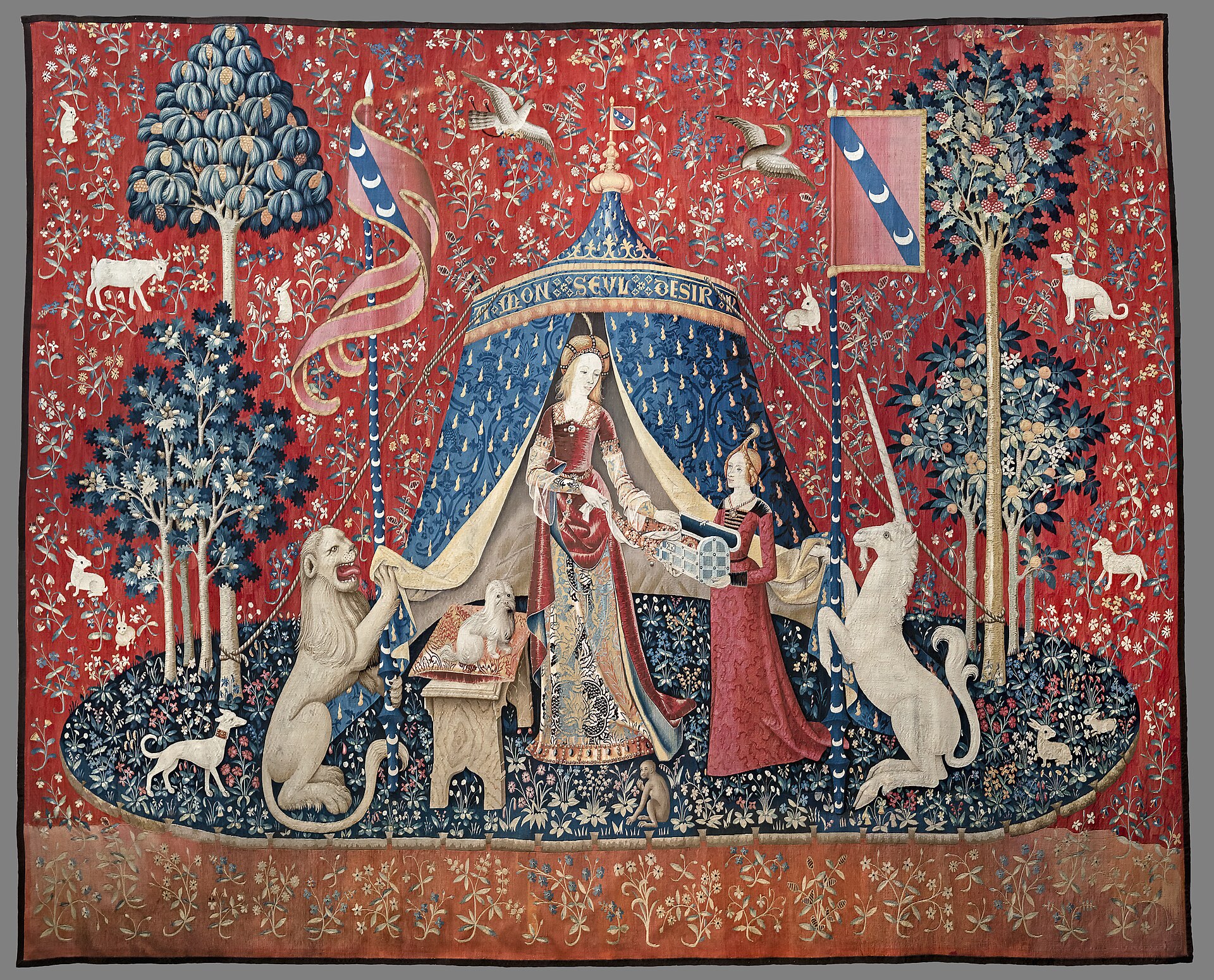
The six Lady and the Unicorn tapestries enter the written record at the Chateau de Boussac in the Creuse, where the Musee de Cluny's catalogue confirms them by 1814. The municipality bought the chateau in 1835 and it became the seat of the sub-prefecture in 1838. Prosper Merimee, Inspector General of Historic Monuments, visited in July 1841, reportedly on George Sand's information, found them damp-damaged and inventoried them, and Sand publicised them afterwards.
The municipality sold the set to Edmond du Sommerard, curator of the Musee de Cluny, on 17 July 1882 for 25,000 gold francs. Before 1814 the record is a presumption: the Le Viste arms appear in every panel, which ties the commission to that family, but which Le Viste commissioned it is disputed, and no source places the set between about 1600 and 1814.
The Overhogdal hangings are first recorded in a pile of discarded boards
The Overhogdal tapestries are first recorded in 1909, when five woven wool hangings were found among discarded boards in an outbuilding of Overhogdal church in Harjedalen, Sweden. Two accounts of the discovery conflict on its sequence. An artist scouting for the new county museum recognised their age in 1910, and Ellen Widen, wife of the county governor, cleaned them and championed them. They were shown at Jamtli from 1911 and are now in a purpose-built room designed to evoke a longhouse.
Radiocarbon testing in 1991, 2005 and 2013 gave ranges that run from roughly the 9th to the 12th century and only partly agree. The riders, ships and tree have been read as Ragnarok, as the Christian mission and as the Volsunga saga, and there is no consensus on any of those readings or on how many pieces survive.

The Syon Cope was a chasuble before it was a cope, and the route to the museum is partly missing
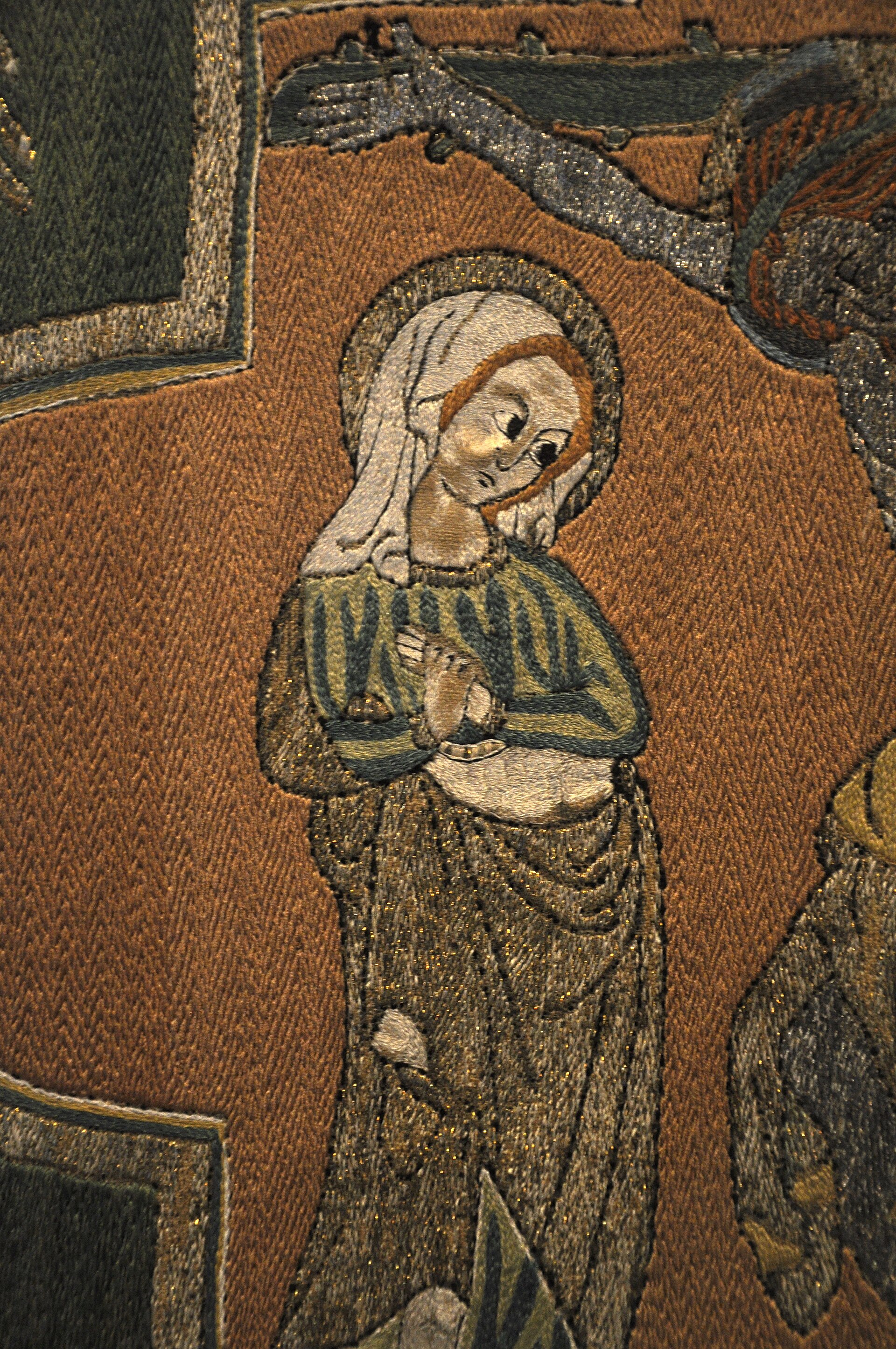
The Syon Cope in the Victoria and Albert Museum was made about 1300 to 1320 as a chasuble, an English ecclesiastical vestment embroidered in split stitch and underside-couched silver-gilt thread, and cut down into the cope shape later. The date and agent of that conversion are not given in any source the archive consulted, and the chasuble predates by about a century the founding of Syon Abbey in 1415, whose Bridgettine nuns gave it the name.
That the cope was with the nuns before the 1539 dissolution is stated consistently, but the claim that it was carried into continental exile rests on a hedged tradition. The documented line passes through the Catholic revival circle around John Talbot, 16th Earl of Shrewsbury, and his chaplain Dr Daniel Rock, then to James Brown, Bishop of Shrewsbury. The museum bought it in 1864 under number 83-1864, and no source the archive consulted gives the price or the immediate seller.
The Emperor's Carpet has a famous story and a documented life that starts in 1925
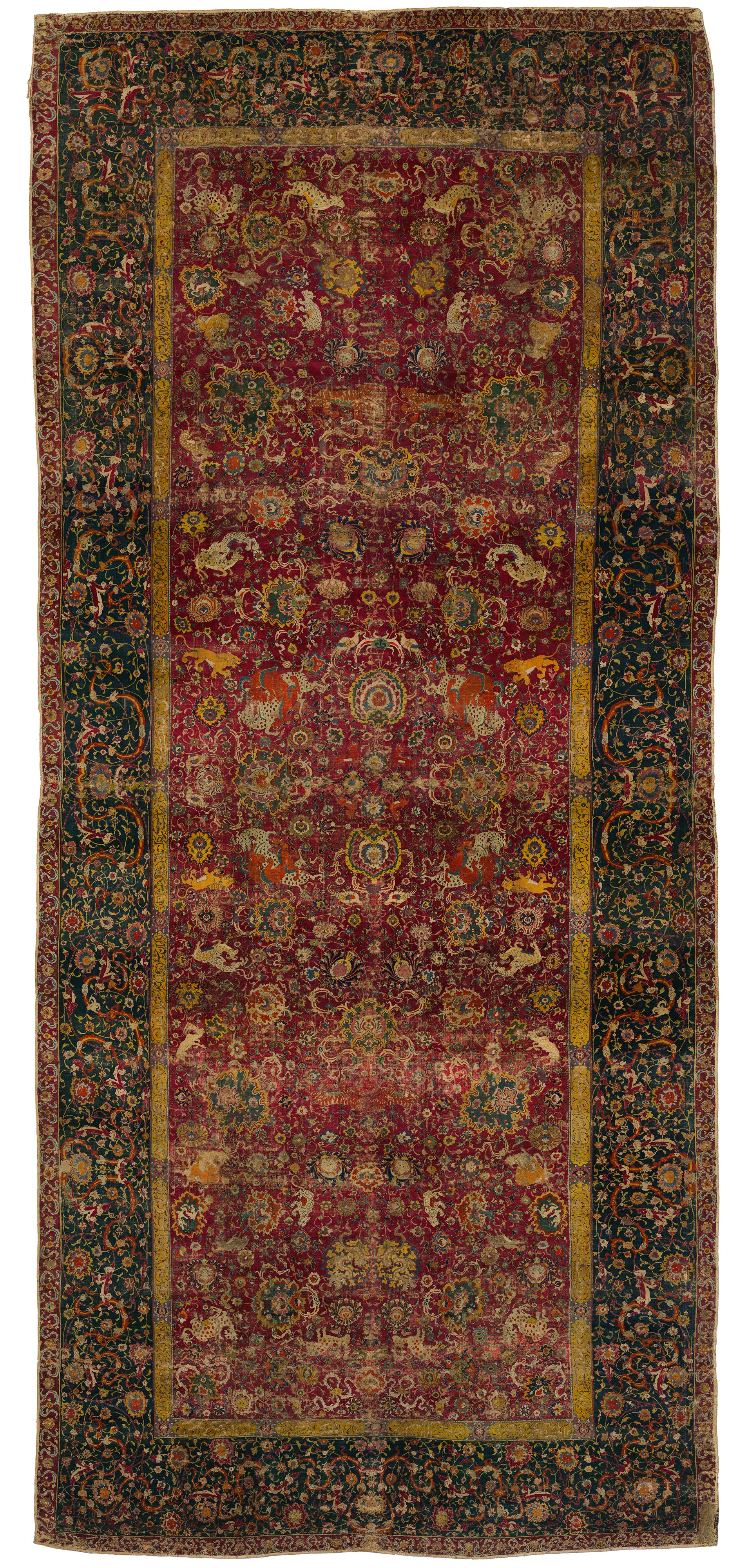
The Emperor's Carpet at the Metropolitan Museum is a Safavid court carpet of the second half of the 16th century, nearly 7.6 metres long, and it shares its name with a near-identical twin in Vienna. Both are traditionally said to have passed from Peter the Great to the Habsburg emperor Leopold I, but that is a tradition without documents. The firm record starts after the Habsburg monarchy fell, when the Vienna museum sold this carpet in 1925 to the London dealers Cardinal and Harford and kept the twin.
It was sold at Christie's on 5 July 1928 as lot 146, and Arthur Upham Pope bought it for the Chicago collector Edith Rockefeller McCormick. She lent it to the Royal Academy's exhibition of Persian art in 1931. The record is silent from her death in 1932 until the Met bought it from Pope in 1943 with the Rogers Fund, as 43.121.1.
The first entry in a chain says who looked, and the silence before it says what nobody did
In each of the four cases the first entry in the chain says who looked, and the silence before it records where nobody did. A researcher should read the first date as the earliest evidence and never as the earliest event, and should ask who wrote it down and why.
It also tells a buyer or a museum what the diligence can and cannot reach. For the Emperor's Carpet the 1925 sale is the floor, and the famous story is the ceiling. Where a textile has a loan history or a restoration history, those entries are as reliable as the first one and sometimes the only ones.
Questions
They are documented at the Chateau de Boussac by 1814, and Prosper Merimee inventoried them there in July 1841. The French state bought them for the Musee de Cluny in 1882 for 25,000 gold francs.
Radiocarbon testing in 1991, 2005 and 2013 places them between roughly the 9th and 12th centuries, and the three results only partly overlap.
A tradition says it passed from Peter the Great to Leopold I, but no document supports it. Its documented history begins with a Vienna museum sale in 1925.
Sources
- 1Ministere de la Culture (France), base Joconde, notice for the tenture de la Dame a la Licorne. pop.culture.gouv.fr/notice/...
- 2Jamtli, 'Overhogdalsbonaderna', exhibition page. jamtli.com/utstallningar/...
- 3Skoglund, Nockert and Holst, 'Viking and Early Middle Ages Northern Scandinavian textiles', Scientific Reports (Nature). nature.com/articles/...
- 4Victoria and Albert Museum, 'The Syon Cope', museum article. vam.ac.uk/articles/...
- 5Victoria and Albert Museum, collections entry O93171, museum number 83-1864. collections.vam.ac.uk/item/...
- 6Metropolitan Museum of Art, 'The Emperor's Carpet', collection record and open-access data. metmuseum.org/art/...
- 7Art Institute of Chicago, exhibition record, The Emperor's Carpet lent by Mrs. Edith Rockefeller McCormick. artic.edu/exhibitions/...
More in Provenance and Restitution
The partA Loan Is Not a Return
Three manuscripts went back to the places their stories point at, or were refused to them. What each loan did, and what it left alone.
The Taking Clustered in Two Decades and the Returning Has Not Finished
Half of the 46 takings in the archive start in the 1930s and 1940s. Only 8 of the 37 returns do. A decade table built from the records.
What Came Back in 1815, and What Did Not
Four objects in this archive were taken, held or borrowed in the Napoleonic wars. One was returned, one was swapped, one was ceded by treaty and one...