The Emperor's Carpet
Unidentified Safavid court carpet workshop · Second half of the 16th century (Metropolitan Museum dating: 1550-1599)
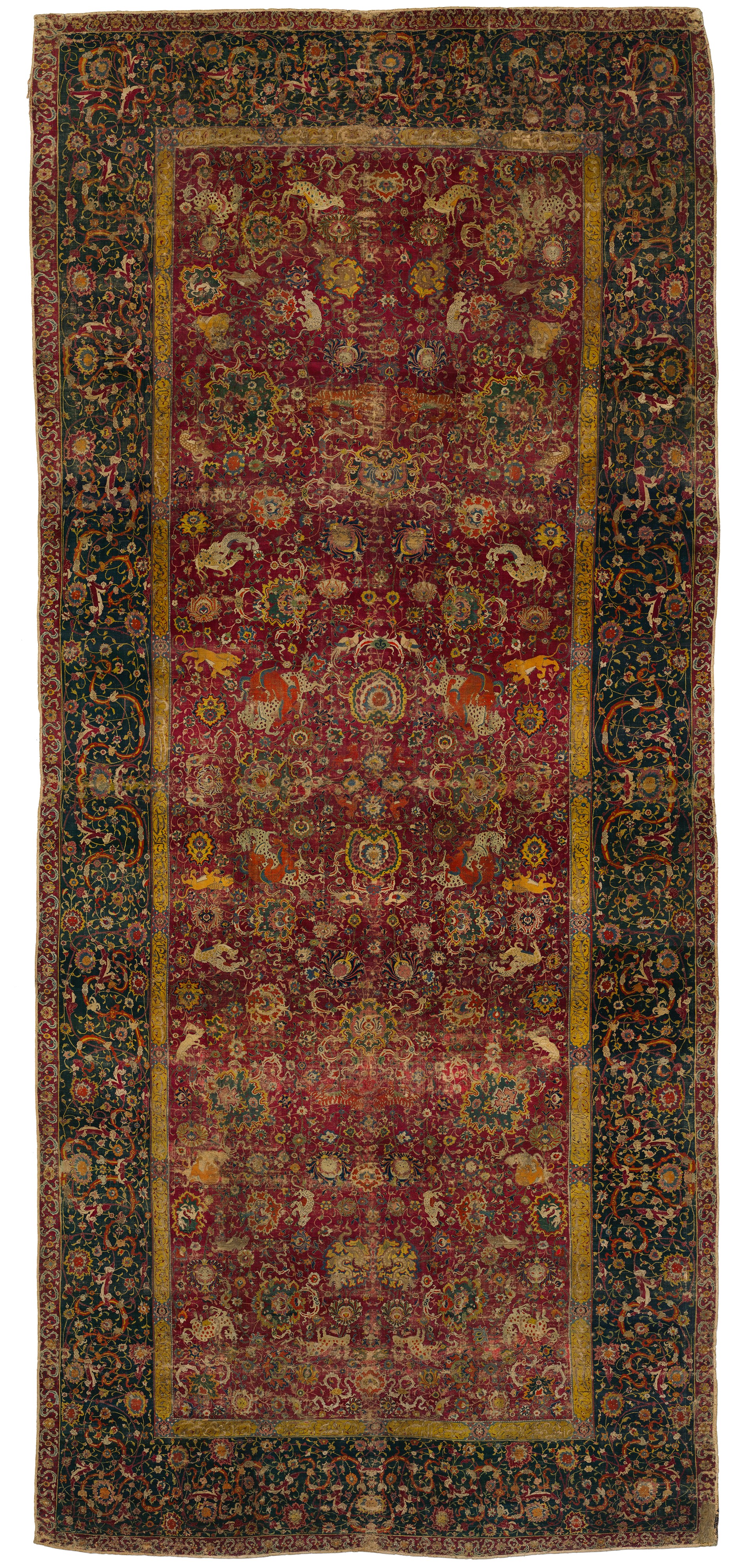
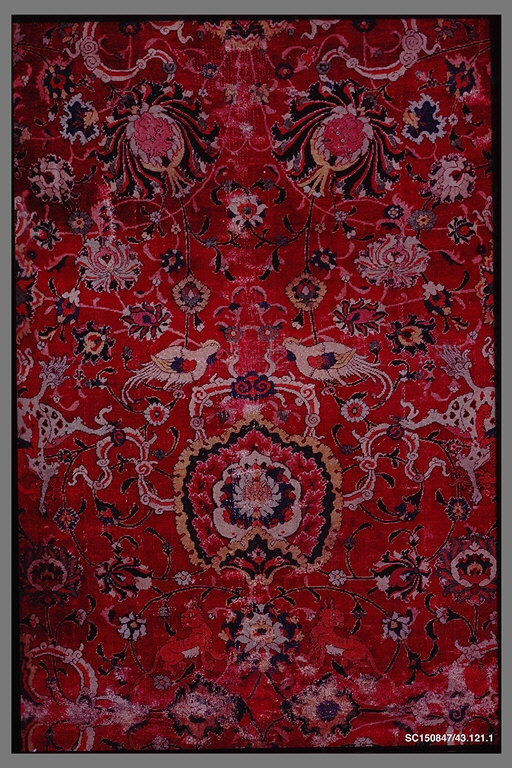
The whole carpet, 759.5 by 339.1 cm, photographed after the Metropolitan Museum's 2006-2009 conservation project. The dense medallion, animal-combat and floral-scroll field and the wide blue-green border are visible across the full length of the piece.
| Artist | Unidentified Safavid court carpet workshop |
|---|---|
| Date | Second half of the 16th century (Metropolitan Museum dating: 1550-1599) |
| Medium | Silk (warp and weft), wool (pile); asymmetrically knotted pile |
| Dimensions | 759.5 x 339.1 cm (299 x 133 1/2 in); approx. 65.3 kg (144 lbs, as measured on a 10-inch storage tube) |
| Where it is now | The Metropolitan Museum of Art, New Yorklast confirmed |
| Inventory number | 43.121.1 |
| Attribution | DisputedThe Metropolitan Museum's own catalogue record commits only to 'Iran' (geographyType: Attributed to), naming no city. Full note |
| Object type | Textile |
| Period | Safavid Iran, second half of the sixteenth century |
| Cases | Disputed attribution · Has a provenance gap |
| Inscriptions | A continuous Persian verse inscription runs around the inner guard band of the border, drawn from the poetry of Zahir al-Din Faryabi (the Metropolitan Museum's own material calls him a 13th-century poet; the wider literature, following his death date of 1201, more commonly places him in the 12th century). The verses liken the ruler's garden and dominion to the beauty of a springtime meadow and to the Garden of Paradise, in lines that open 'Come, for the breeze of spring has renewed the promise of the meadow, for the freshness of the beloved's cheek has returned to the meadow' and continue elsewhere, 'The meadow displays a thousand green tents of rosebuds at dawn, when the cloud pitches a tent over the rose garden.' The verses address a 'king of the world' without naming a specific ruler. |
| Owners on record | 8 links6 documented, 1 disputed, 1 unknown |
| Sources | 10 cited |
About this record Last verified · 10 sources cited · Change log
On this page 10 sections
ContentsClose
A silk-and-wool Safavid court carpet of the second half of the sixteenth century, nearly 7.6 meters long, its red field carrying a dense lattice of vines, palmettes and confronted animals in combat within a wide blue-green border inscribed with the verse of the twelfth-century poet Zahir al-Din Faryabi. It takes its name, and shares it, with a near-identical twin in Vienna: both carpets are traditionally, though not documentedly, said to have passed from Czar Peter the Great of Russia to the Habsburg emperor Leopold I after 1698 and to have furnished a Habsburg summer residence.
What is solidly documented begins later: the 1925 sale of this carpet by a Vienna museum to the London dealers Cardinal and Harford after the Habsburg monarchy's fall, its public sale at Christie's on 5 July 1928, its purchase soon after for the Chicago collector Edith Rockefeller McCormick by the dealer-scholar Arthur Upham Pope, and its exhibition at the Royal Academy in London and the Art Institute of Chicago, both in 1931. Pope, who had sold the carpet to McCormick, organized the exhibition that showed it and then published admiringly on its design, sold it again after her 1932 death, this time to the Metropolitan Museum, which acquired it with the Rogers Fund in 1943.
Where it was actually woven remains an open scholarly question: the Museum's own catalogue commits only to Iran, while the literature has placed the carpet and its Vienna twin variously at Tabriz, Kashan and Herat. The carpet arrived at the Museum in fragile condition and was shown publicly only twice in some sixty years before a three-year conservation project, begun in 2006, removed roughly seven hundred old patches and made it safe for the regular display it now receives in the Museum's Iranian galleries.
Provenance
Each link is graded. Documented: a cited source supports it. Disputed: the identification is argued but not established. Unknown: no owner for that span, and the gap is not smoothed into a narrative. The grades in the glossary.
- c. 1550-1600 -Safavid court workshop (city unresolved: Tabriz, Kashan and Herat all proposed)documented
Woven in Safavid Iran in the second half of the sixteenth century, per the Metropolitan Museum's own dating. The weaving city, patron and original setting are not documented in the sources consulted; see open_questions.16
- Habsburg imperial collection, Viennadisputed
This carpet and its twin are traditionally said to have entered Habsburg hands as a diplomatic gift passed from Czar Peter the Great of Russia to the Holy Roman Emperor Leopold I after 1698, and to have furnished a Habsburg summer residence. The Metropolitan Museum's own published material states this in hedged language ('said to have'). No primary Russian or Habsburg court document confirming the 1698 transfer was located in the sources consulted; the carpets' presence in the Habsburg imperial collection by some point before the twentieth century is better supported than the specific gift story.145
- 1918-1921 - 1925Austrian state museum custody, Vienna (successor to the Habsburg imperial collection)documented
With the fall of the Habsburg monarchy at the end of 1918, the former imperial collections, including this pair of carpets, passed into Austrian state museum custody in Vienna.4
- 1925 - 1928Cardinal and Harford, London (dealers)documented
In 1925, to raise funds, the Viennese museum sold this carpet (retaining its twin, which remains in Vienna) to the London dealers Cardinal and Harford.4
- 1928 - 1928Sold at auction; passed to Arthur Upham Pope, acting for Edith Rockefeller McCormickdocumented
Consigned by Cardinal and Harford and sold at Christie, Manson and Woods, London, 5 July 1928, lot 146. The carpet passed by or shortly after that sale to the American collector Edith Rockefeller McCormick of Chicago, acquired for her by the dealer and scholar Arthur Upham Pope. The hammer price is not given in the sources consulted.45
- 1928 - 1932Edith Rockefeller McCormick, Chicagodocumented
Lent by McCormick to the Royal Academy's International Exhibition of Persian Art, Burlington House, London, January-February 1931, and to the Art Institute of Chicago under the title 'The Emperor's Carpet lent by Mrs. Edith Rockefeller McCormick,' 4 April - 1 November 1931. McCormick died 25 August 1932.358
- 1932 - 1943Unknown (presumably the McCormick estate)unknown
The carpet's custody in the eleven years between McCormick's death and its sale to the Metropolitan Museum is not documented in the sources consulted. It does not appear to have been included in the general McCormick estate household-contents sales held in Chicago and Lake Forest in January 1934, which were dominated by furniture, books, linens, porcelain and silver rather than major carpets, though this record did not examine those sale catalogues in full.5
- 1943 - presentThe Metropolitan Museum of Art, New Yorkdocumented
Sold to the Museum by Arthur Upham Pope and purchased with the Rogers Fund, 1943; accessioned as 43.121.1. One secondary source states the carpet arrived at the Museum in 1941, two years before this accession date; that discrepancy is not resolved in the sources consulted.157
Prices realised
| Date | Sale | Estimate | Result | Note |
|---|---|---|---|---|
| 5 July 1928 | Christie, Manson and Woods | Not stated in the sources consulted | Hammer Not stated in the sources consulted With premium Not stated in the sources consulted Presumably GBP (London sale); not confirmed in the sources consulted | Sold in London as lot 146, consigned by the dealers Cardinal and Harford, who had held the carpet since its 1925 sale by the Vienna museum. This is the only public auction sale of this carpet located in the sources consulted for this record; it precedes the carpet's documented ownership by Edith Rockefeller McCormick and its eventual 1943 sale to the Metropolitan Museum, which was a private dealer sale by Arthur Upham Pope, not a second auction. |
Hammer is the price at which the bidding stopped; with premium adds the fee the house charges the buyer on top. Hammer price and buyer's premium in the glossary.
Technical evidence
| Attribution note | The Metropolitan Museum's own catalogue record commits only to 'Iran' (geographyType: Attributed to), naming no city. In the wider scholarly literature the carpet and its Vienna twin have been placed at Tabriz by Maurice Dimand, on stylistic grounds, as part of a larger group of early medallion carpets he assigned to that city as the Safavids' main artistic and court-design center. A separate, older and more traditional attribution places the group at Kashan, resting primarily on that city's fame as a silk-weaving center and on Kashan's later, early 17th-century production of comparably luxurious silk carpets, rather than on direct 16th-century documentation. A third possibility, weaving at Herat under the Timurid-to-Safavid court tradition of northeast Persia, has also been raised in the literature on this class of carpet. No signature, workshop mark, or court document ties this specific carpet to any of the three cities; this record treats the question as open and names the position of each proponent rather than adopting one. |
|---|---|
| Foundation | Warp and weft in silk.1 |
| Pile | Wool, asymmetrically knotted (the open or 'Persian' knot).1 |
| Dimensions | 759.5 x 339.1 cm (299 x 133 1/2 in).1 |
| Weight | Approx. 65.3 kg (144 lbs), as measured by the Museum on a 10-inch storage tube.1 |
| Classification | Textiles-Rugs; Department of Islamic Art, The Metropolitan Museum of Art.1 |
| Inscription | Continuous Persian verse inscription on the inner guard band, drawn from the poetry of Zahir al-Din Faryabi, addressing an unnamed 'king of the world' in imagery of a springtime garden.15 |
| Condition history | Extremely fragile on arrival at the Museum; shown publicly only twice in about sixty years before a three-year stabilization conservation project begun in 2006 removed some seven hundred old patches and made the carpet safe for regular display.7 |
| Credit line | Rogers Fund, 1943.1 |
| Accession year | 1943 (one secondary source states the carpet arrived at the Museum in 1941; this record has not been able to resolve the two-year discrepancy against the Museum's own 1943 accession date).17 |
| Current display | Gallery 462, the Sharmin and Bijan Mossavar-Rahmani Gallery, in the Museum's Arts of the Arab Lands, Turkey, Iran, Central Asia, and Later South Asia wing, reopened 2011.9 |
Images
The record in full
Chapter 1What it is
A silk-foundation, wool-pile court carpet nearly 7.6 meters long and 3.4 meters wide, woven in Safavid Iran in the second half of the sixteenth century.
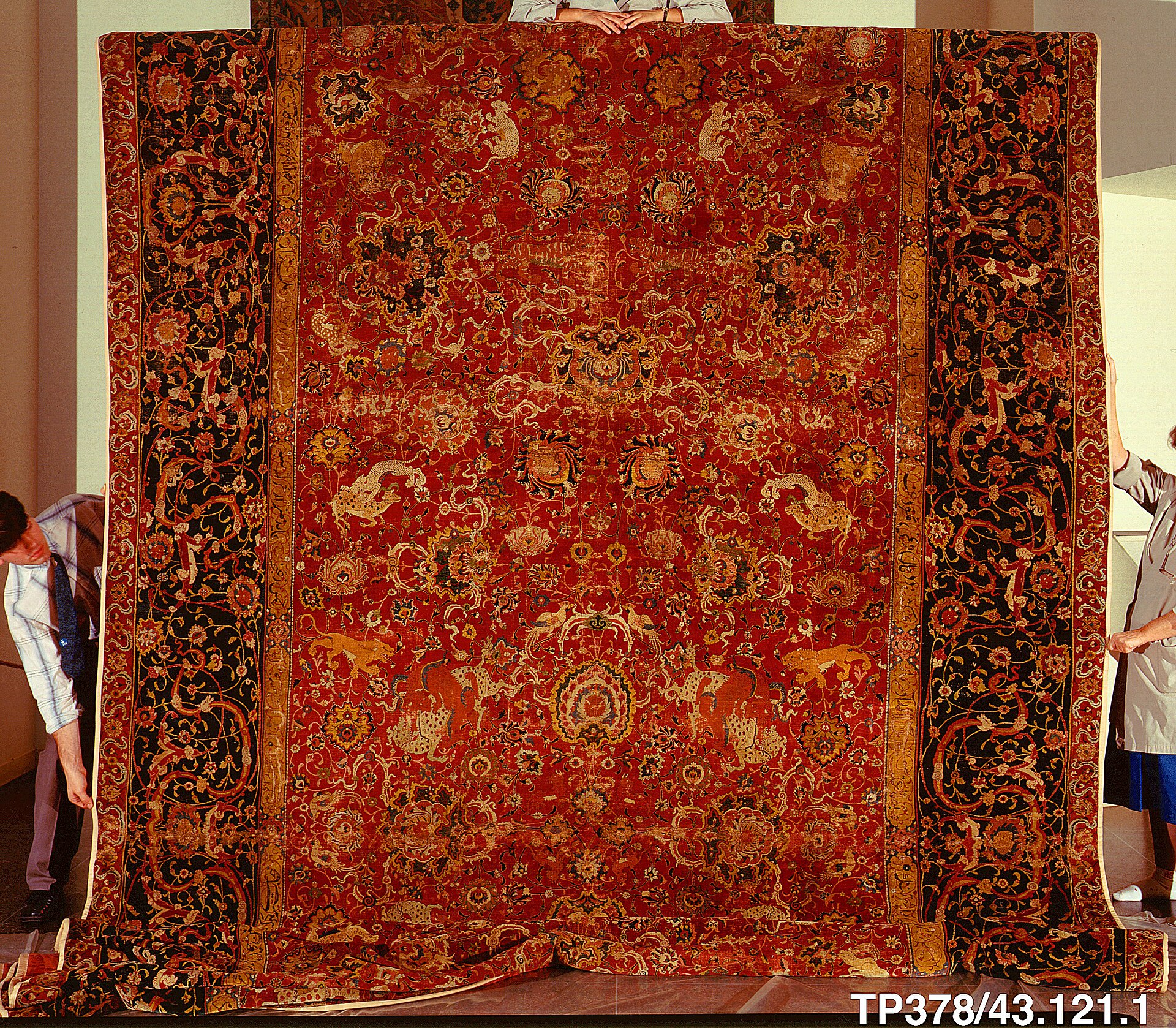
A silk-foundation, wool-pile court carpet nearly 7.6 meters long and 3.4 meters wide, woven in Safavid Iran in the second half of the sixteenth century. At roughly 65 kilograms it takes more than one person to lift, and the Metropolitan Museum's own handling photographs show it held up by two staff members with a third steadying it from behind, the carpet still dwarfing all three. This is not a small or domestic object; it is a court-scale floor covering meant to be seen from a distance as a single field of color and read up close as an almost inexhaustible field of individual motifs.
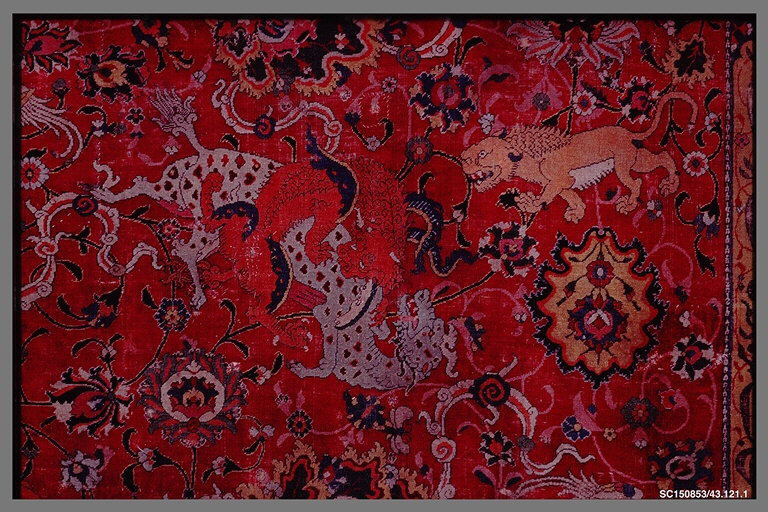
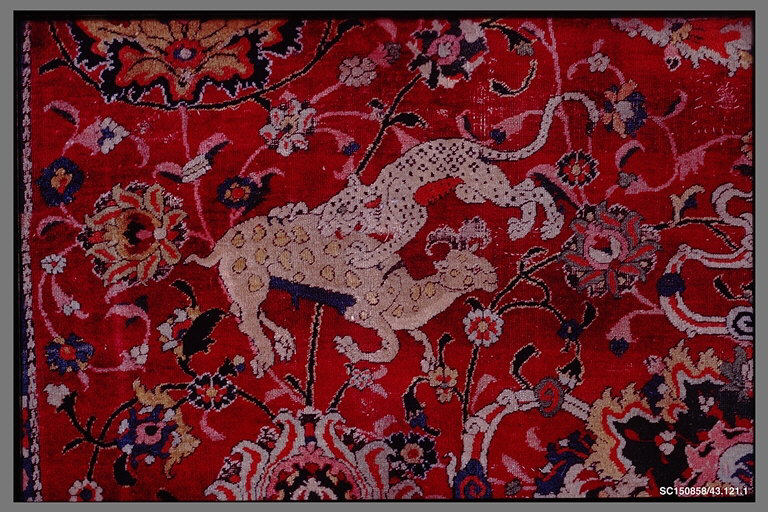
The ground is a deep red on which a dense lattice of scrolling vines, composite palmettes, cloud bands, buds and blossoms carries a full menagerie: dragons, lions, tigers, leopards, a Chinese antelope-like creature, ducks, pheasants and other birds, some locked in combat, others moving quietly through the foliage. A wide, dark blue-green border of matching density frames the field, separated from it by a narrow band of continuous script. The whole composition reads, at scale, as a single controlled surface rather than a repeating pattern, which is the effect the finest sixteenth-century Safavid medallion carpets were built to produce.
Chapter 2The design and the animals
The field is organized around a system of medallions and cartouches worked into the vine lattice rather than a single dominant central medallion; smaller rosette medallions recur at intervals along...
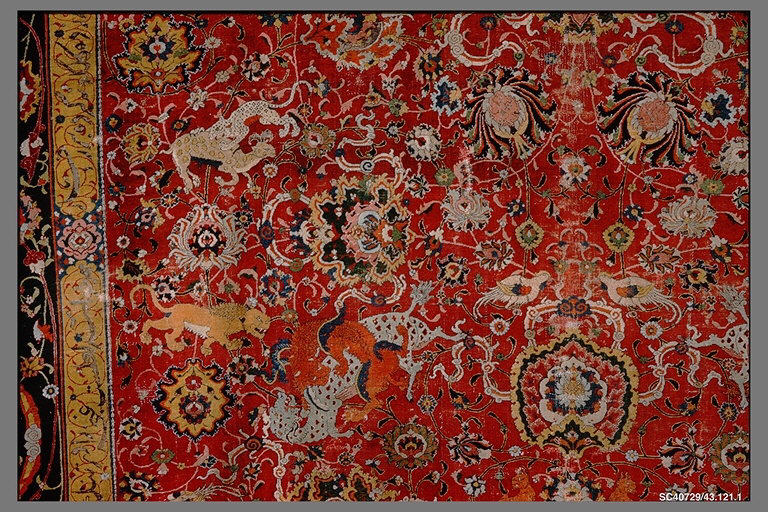
The field is organized around a system of medallions and cartouches worked into the vine lattice rather than a single dominant central medallion; smaller rosette medallions recur at intervals along the long axis, each treated as a self-contained roundel of concentric bands. Confronted and combatant animals are placed through the field in pairs and small groups: a golden lion brings down a spotted, deer-like creature in one passage; leopards, tigers and dragons appear elsewhere locked in the same kind of encounter, drawn with enough anatomical control that species can still be told apart at eight hundred knots to the square inch and more.
Birds appear more quietly, often flanking the small medallions in pairs, sometimes with stemmed floral pendants hanging between them in a way that has been read, on comparable Safavid court hangings and carpets, as an evocation of a suspended lamp. This record follows the discipline the subject requires: the animal-combat and lamp-like pendant motifs are a genuinely documented feature of the Safavid court medallion-carpet design vocabulary of this period, discussed by the Museum's own department and in the wider literature on this class of object, but no source consulted for this record ties a specific doctrinal or devotional reading to this individual carpet, as opposed to the type. What can be said without overreaching is narrower and more useful: a court patron who commissioned a carpet of this size, in silk and wool, carrying real and imagined animals in combat around a field addressed in verse to 'the king of the world,' was commissioning an object about sovereignty and dominion over the natural world, not a decorative textile in the modern sense.
Chapter 3The inscription
The inner guard band carries a continuous run of Persian verse drawn from the poetry of Zahir al-Din Faryabi, active in the second half of the twelfth century and dying in 1201 (the Metropolitan...
The inner guard band carries a continuous run of Persian verse drawn from the poetry of Zahir al-Din Faryabi, active in the second half of the twelfth century and dying in 1201 (the Metropolitan Museum's own material describes him as a thirteenth-century poet, a rounding this record notes rather than silently repeats). The verses are conventional courtly nature poetry, likening a ruler's spring garden to Paradise and his dominion to the freshness of the meadow after rain, and they address an unnamed 'king of the world.'
Putting a specific, older poet's verses on a court carpet rather than composing new text for the object was itself a choice: it borrows the authority of an established literary voice for the flattery being offered to whichever Safavid ruler the carpet was made for, rather than inventing praise that stood or fell on its own. No source consulted names the specific patron addressed by the inscription, and this record does not supply one.
Chapter 4Dating and the question of the patron
The Metropolitan Museum dates the carpet broadly to the second half of the sixteenth century, a window of some fifty years that runs from the later part of Shah Tahmasp's long reign (1524-1576)...
The Metropolitan Museum dates the carpet broadly to the second half of the sixteenth century, a window of some fifty years that runs from the later part of Shah Tahmasp's long reign (1524-1576) through the brief reigns of Isma'il II and Mohammad Khodabanda and into the early years of Shah Abbas I, who acceded in 1587. Secondary accounts of the carpet sometimes state that it was made for Tahmasp specifically, but none of the sources consulted for this record trace that claim to a document, an inventory, or a named scholar's published argument; it appears to rest on Tahmasp's long reign occupying most of the dating window and on his documented role as the Safavid ruler most associated with the flowering of the court design studio, rather than on evidence tied to this carpet. This record treats the identity of the commissioning shah, if the carpet was a royal commission at all rather than court-workshop production for a wider elite market, as unresolved.
Chapter 5Where it was made: Kashan or Tabriz
The Metropolitan Museum's own collection record commits only to Iran, marking the city of manufacture as unresolved.
The Metropolitan Museum's own collection record commits only to Iran, marking the city of manufacture as unresolved. The wider scholarly literature has not settled the question either, and this carpet, together with its twin now in Vienna, sits at the center of the dispute.
Maurice Dimand, the Metropolitan's own longtime curator of Near Eastern art, placed this group at Tabriz on stylistic grounds, treating it as part of a broader family of early Safavid medallion carpets he assigned to that city as the dynasty's main artistic and court-design center. Against that stands an older, more traditional attribution to Kashan, which rests chiefly on Kashan's established fame as a center of fine silk weaving and on the city's documented production, a generation or two later in the early seventeenth century, of carpets of comparably luxurious materials and technique; the traditional Kashan attribution for this particular sixteenth-century group is not supported by direct sixteenth-century documentation naming Kashan as the place of manufacture. A third city, Herat, has also been proposed in the wider literature on Safavid court carpets of this general type, reflecting Herat's own status as a major court-art center under the Timurids and into the early Safavid period. No signature, no workshop mark and no court record consulted for this record names a city for this specific carpet, and this record does not adopt one of the three positions over the others.
Chapter 6Materials and technique
The carpet is woven with a silk warp and weft and an asymmetrically knotted wool pile, the open or 'Persian' knot structure long associated with the finest Iranian court production, as opposed to the...
The carpet is woven with a silk warp and weft and an asymmetrically knotted wool pile, the open or 'Persian' knot structure long associated with the finest Iranian court production, as opposed to the symmetric knot more typical of Anatolian weaving. A silk foundation under a wool pile of this size and knot density represents a very large investment in the most expensive locally available fiber before a single dye is applied; the choice of silk for warp and weft, where a coarser cotton or wool foundation would have served structurally, is itself a statement about the resources a court workshop was prepared to commit to an object meant to be walked on.
None of the sources consulted for this record report a published pigment or dye analysis specific to this carpet. General accounts of Safavid court weaving describe natural dye sources such as madder for red tones and other vegetable and mineral dyes for the remaining palette, but this record does not attach an unsourced generic claim about dye chemistry to this individual object; a technical dye study, if one exists in the Museum's own conservation literature, was not located in the sources consulted and is recorded here as an open question rather than filled with an assumption.
Chapter 7Condition and conservation
The carpet reached the Metropolitan Museum in extremely fragile condition and, in the Museum's own account of its recent conservation program, was shown to the public only twice in the roughly sixty...
The carpet reached the Metropolitan Museum in extremely fragile condition and, in the Museum's own account of its recent conservation program, was shown to the public only twice in the roughly sixty years that followed, a direct consequence of how little handling and light exposure the textile could safely bear. Beginning in 2006 the Museum's Department of Textile Conservation undertook a three-year stabilization project aimed at making the carpet safe for regular display; published accounts of the project describe the removal of some seven hundred old patches accumulated over the carpet's working and museum life, along with the broader structural stabilization needed to support its own weight when hung or laid out.
The conservation project coincided with, and fed into, the Museum's 2006-2011 renovation of its galleries for the art of the Arab lands, Turkey, Iran, Central Asia and later South Asia, which reopened in 2011 with the carpet installed in Gallery 462 as one of the space's acknowledged highlights. In 2013 the Museum's exhibition 'Making the Invisible Visible' used conservation work of this kind, including on textiles from the Islamic Art department, to show the public what a conservator actually does to a fragile object of this scale before it can safely go back on view.
Chapter 8The name and the Habsburg tradition
The carpet is called the Emperor's Carpet, in the singular, but the name belongs properly to a pair: this carpet and a companion, near-identical in design, now in the Museum fur angewandte Kunst...
The carpet is called the Emperor's Carpet, in the singular, but the name belongs properly to a pair: this carpet and a companion, near-identical in design, now in the Museum fur angewandte Kunst (MAK) in Vienna. Both take the name from the same story, which the Metropolitan Museum's own published material states in careful, hedged language rather than as settled fact: the carpets are 'said to have' once belonged to Czar Peter the Great of Russia, who is supposed to have passed one or both to the Holy Roman Emperor Leopold I of Austria after 1698, after which they entered the Habsburg imperial collection and were used to furnish a Habsburg summer residence.
The wording matters. 'Said to have' is the Museum's own register for a tradition it has not independently verified against a Russian or Habsburg court document, not a claim it is making as established fact. This record follows that hedge rather than smoothing the Peter the Great and Leopold I story into settled history, because no primary Habsburg inventory or Russian court record confirming the 1698 transfer was located in the sources consulted. What is better supported is the carpet's presence in the Habsburg imperial collection by some point before the twentieth century and its use, at least by tradition, at an imperial residence; the specific mechanism by which it arrived there remains a named but unverified tradition, not a documented event, and this record grades it accordingly.
Chapter 9From the Habsburg collection to the London art market, 1921-1928
The Habsburg monarchy fell at the end of 1918, and the property of the former imperial house passed to the new Austrian Republic; carpets and other objects that had furnished the imperial residences...
The Habsburg monarchy fell at the end of 1918, and the property of the former imperial house passed to the new Austrian Republic; carpets and other objects that had furnished the imperial residences were transferred into Austrian state museum custody in the early 1920s. Sotheby's own catalogue note on a later, unrelated reproduction of the design states the sequence plainly for the pair under discussion here: in 1925, with the Habsburg monarchy gone, the Viennese museum holding the pair sold one of the two carpets, to raise funds, to the London dealers Cardinal and Harford, while keeping its twin, which remains in Vienna today.
Cardinal and Harford held the carpet in London from 1925 until 1928, when it was consigned to Christie, Manson and Woods and sold at auction in London on 5 July 1928 as lot 146. This is a genuine, documented public sale in the carpet's history, recorded in the bibliography of a later Sotheby's catalogue note in the standard auction-house citation form; no source consulted for this record gives the hammer price or the identity of every bidder, and this record does not invent either. What the sources agree on is the buyer's side of the transaction that followed close behind the sale: the carpet passed, by or shortly after 1928, to the American collector Edith Rockefeller McCormick of Chicago, acquired for her by the dealer and scholar Arthur Upham Pope.
Chapter 10Edith Rockefeller McCormick and Arthur Upham Pope
Edith Rockefeller McCormick (1872-1932) was the daughter of John D.
Edith Rockefeller McCormick (1872-1932) was the daughter of John D. Rockefeller and the wife of Harold Fowler McCormick, of the Chicago reaper and later International Harvester fortune; she was a major collector and patron in Chicago in the 1910s through early 1930s, with a country estate, Villa Turicum, in Lake Forest, Illinois. The Art Institute of Chicago's own exhibition records confirm that she lent the carpet to the museum under the title 'The Emperor's Carpet lent by Mrs. Edith Rockefeller McCormick,' on view from 4 April to 1 November 1931, a run that followed the carpet's appearance, earlier the same year, in the landmark International Exhibition of Persian Art at the Royal Academy of Arts in Burlington House, London, organized by Arthur Upham Pope and shown there from January to February 1931 under theatrical, tinted lighting chosen to intensify the carpet's colors for visitors.
Pope's role in this carpet's history is worth naming plainly, in the register this record's research standard requires for the people in a provenance chain, not only its owners. He was simultaneously a dealer who bought and sold Persian art, the organizer of the exhibition in which the carpet was shown, and the scholar who then published on its beauty, first in Art News and again, using his position as an advisor to the Art Institute of Chicago, in that museum's own Bulletin. He acquired the carpet for McCormick in 1928 and, after her death in 1932, was the dealer who arranged its sale onward, in 1943, to the Metropolitan Museum. A single figure functioning as agent, exhibitor and critic of the same object across fifteen years is a genuine conflict of roles by any modern standard, and this record states it rather than treating Pope's published praise of the carpet as disinterested scholarship.
Chapter 11To the Metropolitan Museum, 1943
Edith Rockefeller McCormick died on 25 August 1932.
Edith Rockefeller McCormick died on 25 August 1932. The carpet does not appear to have been part of the general household-contents sales of her estate held in Chicago and Lake Forest in January 1934, which were dominated by French furniture, books, linens, porcelain and silver rather than major carpets; this record did not locate the carpet in the sale catalogues checked, and the object's custody between 1932 and 1943 is not documented in the sources consulted. In 1943 Arthur Upham Pope, again acting as dealer, sold the carpet to the Metropolitan Museum of Art, which purchased it with the Rogers Fund; it was accessioned as 43.121.1. A second, related carpet, described by the Museum as a Vase carpet of the late sixteenth or early seventeenth century, was accessioned at the same time as 43.121.2, also through the Rogers Fund, which is consistent with both carpets having reached the Museum through the same 1943 transaction with Pope, though this record has not located a single acquisition document confirming that explicitly.
One secondary account states that the carpet arrived at the Museum in 1941, two years before the accession date the Museum's own record gives; this record has not been able to resolve that discrepancy and states it rather than silently adopting one date. The Museum's own accession number and credit line, verified against its own open-access catalogue record, are given above as the primary facts of the acquisition.
Chapter 12The Vienna twin
The carpet's companion remains in Vienna, in the Museum fur angewandte Kunst (MAK), part of a carpet collection built substantially from the former Habsburg imperial holdings and numbering some two...
The carpet's companion remains in Vienna, in the Museum fur angewandte Kunst (MAK), part of a carpet collection built substantially from the former Habsburg imperial holdings and numbering some two hundred pieces, of which roughly thirty are normally on public display. The two carpets were designed and, in all likelihood, woven as a related pair or at least a closely matched set, sharing the medallion, animal and border vocabulary this record describes above; MAK's own published material was not fetched directly for this record, and this record therefore does not state Vienna's current inventory number, having found more than one candidate number attributed to the piece in different indirect sources without being able to verify which is correct against the museum's own database. That verification is recorded here as an open task rather than guessed at.
Separating the two carpets in any account of this object matters for the same reason the site's own past errors on paired and twinned works matter: a caption, a dimension or a conservation detail that belongs to the Vienna carpet must never be silently presented as belonging to the New York carpet, or the reverse. This record describes only the Metropolitan's carpet, 43.121.1, in its technical and provenance detail, and treats the Vienna piece strictly as a named comparandum.
Chapter 13What is unresolved
The weight of the documented record here is real: a public sale at Christie's in 1928 with a lot number, a dated loan exhibition in Chicago in 1931 with a lender's name on the wall label, a named...
The weight of the documented record here is real: a public sale at Christie's in 1928 with a lot number, a dated loan exhibition in Chicago in 1931 with a lender's name on the wall label, a named dealer, a Rogers Fund purchase with an accession number the Museum's own database confirms. Set against that, the earlier and later ends of the chain remain genuinely open. The 1698 Peter the Great and Leopold I story is a named tradition, stated by the Museum itself in hedged language, not a documented transfer. The city of manufacture is a live, three-way scholarly disagreement that this carpet's own catalogue record declines to resolve. Eleven years of the object's history, between Edith Rockefeller McCormick's death in 1932 and its sale to the Museum in 1943, are undocumented in the sources this record was able to consult. This record states each of those gaps as a gap, in keeping with the standard the rest of this archive holds itself to, rather than bridging any of them with an invented owner, date or city.
The artist
Unidentified Safavid court carpet workshop (Kashan, Tabriz and Herat all proposed; unresolved)
No maker's name, workshop mark or court document ties this carpet to an individual or a specific city. What can be reconstructed is the kind of workshop a court object like this required: a design supplied by court draftsmen working in the same visual vocabulary used for manuscript illumination and bookbinding, executed by weavers skilled enough to hold an asymmetric knot count fine enough to render individually recognizable animal species across a field roughly seven and a half meters long, in a silk foundation that was itself among the most expensive materials the court could commit to a floor covering. This record covers that workshop tradition rather than inventing a named hand for it.
Related works
| Work | Relation | Where it is |
|---|---|---|
| Emperor's Carpet (Kaiserteppich), companion piece Unidentified Safavid court carpet workshop | The twin of this carpet; near-identical in design, formerly part of the same Habsburg imperial collection before the pair was separated in the 1920s. This record does not state a MAK inventory number, having found conflicting unverified candidates in indirect sources; the number should be confirmed against MAK's own database before use. | Museum fur angewandte Kunst (MAK), Vienna |
| Vase Carpet Unidentified Safavid court carpet workshop | A related, later Safavid carpet accessioned by the Metropolitan Museum in the same year, 1943, with the adjoining accession number, consistent with (though not independently confirmed as) arriving through the same transaction. Late 16th- to early 17th-century, cotton warp and weft with silk and wool weft and wool pile; a different design tradition (the vase-technique group) from this carpet's medallion-and-animal field. | The Metropolitan Museum of Art, New York, accession 43.121.2 |
| The Ardabil Carpet(s) Attributed to Maqsud of Kashan (signed and dated) | The one securely signed and dated pair of Safavid court carpets of comparable ambition, and the direct comparandum for how rare a signature is on a carpet of this class. Dated 1539-40, a generation earlier than this carpet; already a published record in this archive. | Victoria and Albert Museum, London (272-1893) and Los Angeles County Museum of Art (53.50.2) |
Open questions
- Was this carpet woven at Kashan, Tabriz or Herat? The Metropolitan Museum's own record does not commit to a city, and the scholarly literature is divided.
- Is the story that the carpet was a 1698 diplomatic gift from Peter the Great of Russia to the Holy Roman Emperor Leopold I a documented transfer or a later tradition? The Museum's own language hedges it as 'said to have' happened.
- What was the carpet's custody between Edith Rockefeller McCormick's death in August 1932 and its sale to the Metropolitan Museum in 1943? No source consulted documents those eleven years.
- What was the hammer price and who else bid when the carpet was sold at Christie, Manson and Woods, London, on 5 July 1928, lot 146?
- Did the carpet arrive at the Metropolitan Museum in 1941, as one secondary source states, or only in 1943, the Museum's own accession year? This record has not resolved the discrepancy.
- Was the carpet made for a specific, named Safavid shah, or produced by the court workshop for a wider elite market without a single royal commission? No source consulted names a patron.
- Has a technical dye or fiber analysis of this specific carpet been published by the Metropolitan Museum's own conservation department, comparable to studies published for other major Safavid carpets? None was located in the sources consulted.
Questions about this object
What is The Emperor's Carpet?
The Emperor's Carpet is a textile, dated second half of the 16th century (Metropolitan Museum dating: 1550-1599). Medium: Silk (warp and weft), wool (pile); asymmetrically knotted pile.
Who made The Emperor's Carpet, and is the attribution settled?
The attribution to Unidentified Safavid court carpet workshop is recorded here as disputed. The Metropolitan Museum's own catalogue record commits only to 'Iran' (geographyType: Attributed to), naming no city. In the wider scholarly literature the carpet and its Vienna twin have been placed at Tabriz by Maurice Dimand, on stylistic grounds, as part of a larger group of early medallion carpets he assigned to that city as the Safavids' main artistic and court-design center. A separate, older and more traditional attribution places the group at Kashan, resting primarily on that city's fame as a silk-weaving center and on Kashan's later, early 17th-century production of comparably luxurious silk carpets, rather than on direct 16th-century documentation. A third possibility, weaving at Herat under the Timurid-to-Safavid court tradition of northeast Persia, has also been raised in the literature on this class of carpet. No signature, workshop mark, or court document ties this specific carpet to any of the three cities; this record treats the question as open and names the position of each proponent rather than adopting one.
Where is The Emperor's Carpet now?
The Metropolitan Museum of Art, New York. Inventory number 43.121.1. Last confirmed 25 September 2026. Rogers Fund, 1943. On permanent display in Gallery 462, the Sharmin and Bijan Mossavar-Rahmani Gallery for the Art of the Later Persian and Turkic World, in the Museum's Arts of the Arab Lands, Turkey, Iran, Central Asia, and Later South Asia wing, reopened 2011.
What has The Emperor's Carpet sold for?
Hammer Not stated in the sources consulted; with premium, Not stated in the sources consulted. Christie, Manson and Woods, 1928-07-05.
What is still unknown about The Emperor's Carpet?
Was this carpet woven at Kashan, Tabriz or Herat? The Metropolitan Museum's own record does not commit to a city, and the scholarly literature is divided.
Sources
- 1The Metropolitan Museum of Art, collection object record and open-access API, 'The Emperor's Carpet,' accession 43.121.1, object ID 450509. metmuseum.org/art/...
- 2The Metropolitan Museum of Art, 'The Emperor's Carpet,' Heilbrunn Timeline of Art History, Department of Islamic Art. Flagged for direct re-verification. metmuseum.org/toah/...
- 3The Art Institute of Chicago, exhibition record, 'The Emperor's Carpet lent by Mrs. Edith Rockefeller McCormick,' exhibition 5521, 4 April - 1 November 1931, confirmed via the Art Institute of Chicago's own open API (api.artic.edu). artic.edu/exhibitions/...
- 4Sotheby's, Rugs and Carpets, sale L18873 (2018), lot 62 catalogue note, provenance and bibliography for the original 'Emperor' carpet pair cited as comparanda for a later reproduction. sothebys.com/en/...
- 5Caroline Mawer, 'The Emperor of Persian Carpets,' blog post, 14 November 2014. carolinemawer.com/emperor-persian-carpets
- 6Encyclopaedia Iranica, 'CARPETS ix. Flagged for direct re-verification. iranicaonline.org/articles/...
- 7The Quilt Show, 'Conserving the Emperor's Carpet at the Metropolitan Museum of Art,' blog newsletter, summarizing a Metropolitan Museum video on the carpet's 2006-2009 conservation project. thequiltshow.com/blog/...
- 8Royal Academy of Arts, exhibition catalogue record, '1931 - International Exhibition of Persian Art,' Burlington House, London. royalacademy.org.uk/art-artists/...
- 9The Metropolitan Museum of Art, press release, 'Metropolitan Museum to Open Renovated Galleries for the Art of the Arab Lands, Turkey, Iran, Central Asia, and Later South Asia' (2011). metmuseum.org/press-releases/...
- 10The Metropolitan Museum of Art, collection object record and open-access API, 'Vase Carpet,' accession 43.121.2, object ID 450510. metmuseum.org/art/...
Last verified · Published
Change log
25 September 2026 - Record created at the house standard: researched narrative, technical evidence, maker dossier, graded provenance chain, prices with hammer and premium separated, related works, open questions and sources.