The Lady and the Unicorn
Unknown weavers, southern Netherlands, after cartoons attributed to the circle of the Master of Anne of Brittany · c. 1480-1500, within a range disputed by different scholars; a minority reading narrows the commission to c. 1493
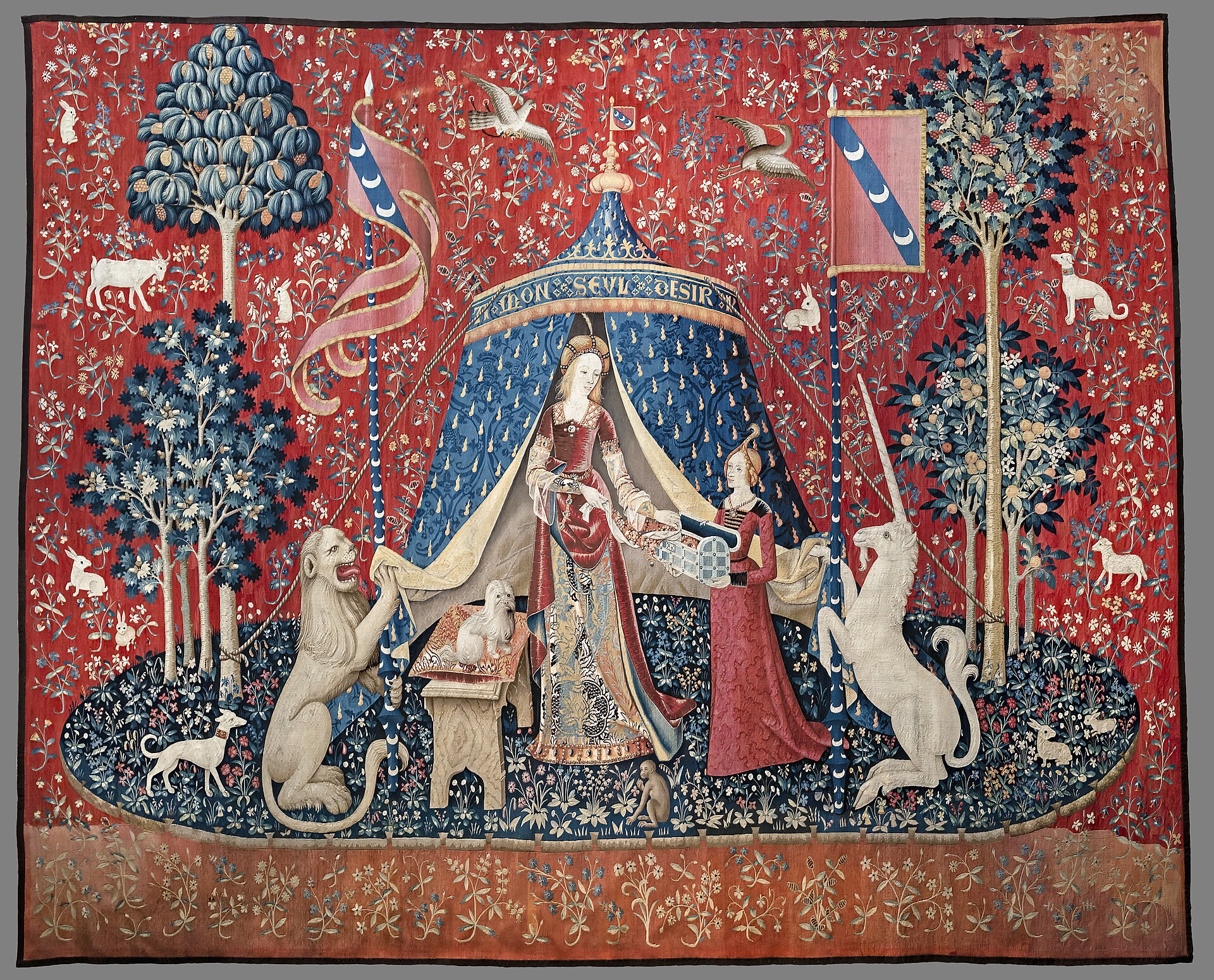
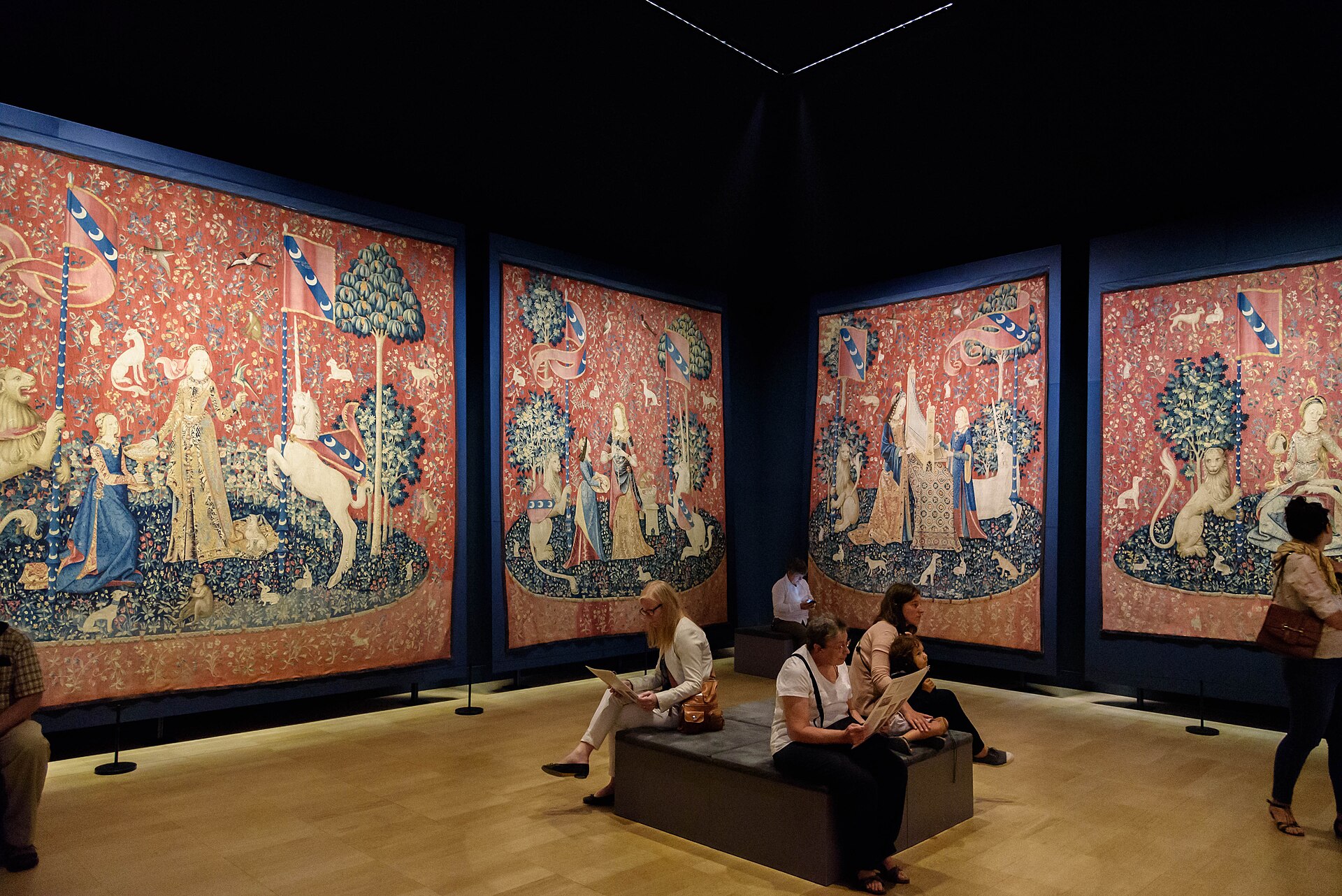
The sixth and largest panel, the one whose meaning is still disputed among scholars. Photographed at the Musee de Cluny.
| Artist | Unknown weavers, southern Netherlands, after cartoons attributed to the circle of the Master of Anne of Brittany |
|---|---|
| Date | c. 1480-1500, within a range disputed by different scholars; a minority reading narrows the commission to c. 1493 |
| Medium | Tapestry weave, wool warp with wool and silk weft (wool and silk) |
| Dimensions | Six panels ranging from approximately 3.10 x 2.90 m (Sight) to 3.80 x 4.64 m (A Mon Seul Desir); full panel-by-panel dimensions in the technical block |
| Where it is now | Musee de Cluny - musee national du Moyen Age, Paris, Francelast confirmed |
| Inventory number | Cl. 10831 (Taste), Cl. 10832 (Smell), Cl. 10833 (Hearing), Cl. 10834 (A Mon Seul Desir), Cl. 10835 (Touch), Cl. 10836 (Sight) |
| Attribution | DisputedThe commission is securely a Le Viste one: the arms (gules, a band of azure charged with three crescents argent) appear repeatedly across the six panels and are not seriously contested. Full note |
| Object type | Textile |
| Period | Franco-Flemish, late fifteenth century |
| Cases | Disputed attribution · Has a provenance gap |
| Inscriptions | A MON SEUL DESIR, woven above the entrance to the tent on the sixth panel |
| Owners on record | 8 links6 documented, 1 disputed, 1 unknown |
| Sources | 9 cited |
About this record Last verified · 9 sources cited · Change log
On this page 9 sections
ContentsClose
Six wool-and-silk tapestries woven around 1480 to 1500, five showing a lady with a lion and a unicorn enacting Taste, Hearing, Sight, Smell and Touch, the sixth inscribed A Mon Seul Desir and meaning something scholars still argue about. The arms woven into every panel belong to the Le Viste family, but which Le Viste commissioned the set is itself disputed. The set is not the other famous unicorn tapestry: the seven-panel Hunt of the Unicorn at the Met Cloisters in New York is a different, South Netherlandish hanging of similar date with a hunting narrative rather than a senses allegory, and the two are confused constantly enough that this record addresses it directly.
Found faded and damp-damaged at the Chateau de Boussac in 1841 by Prosper Merimee, publicised by George Sand, and bought for the French state in 1882 for 25,000 gold francs, the set has since been rewoven along its lower edge, hung through two world wars, described at length by Rainer Maria Rilke, and rehoused since 2013 in a purpose-built rotunda at the Musee de Cluny. It has never been sold at auction; its only recorded market transaction is the 1882 purchase from the municipality that then owned Boussac.
Provenance
Each link is graded. Documented: a cited source supports it. Disputed: the identification is argued but not established. Unknown: no owner for that span, and the gap is not smoothed into a narrative. The grades in the glossary.
- c. 1480-1500 -A member of the Le Viste family (Jean IV Le Viste, or on a competing reading his cousin Antoine II Le Viste)disputed
The Le Viste commission itself is not seriously contested, since the family arms recur across all six panels. Which individual commissioned the set, and in which decade, is disputed between at least two published scholarly positions; see the attribution field and narrative above.134
- - c. 1600By descent through the Robertet and La Roche-Aymon families to the Rilhac familydocumented
Reported in secondary literature as an inheritance chain rather than sale; this record has not independently verified the underlying genealogical documentation and flags it for replacement with primary genealogical sources.3
- c. 1600 - 1814Presumed held at the Chateau de Boussac, Creuse (Rilhac line and heirs); custody not documented in the sources consultedunknown
No source consulted documents where or with whom the tapestries were between roughly 1600 and 1814. The museum's own catalogue record confirms presence at Boussac by 1814; nothing establishes continuous custody by the Rilhac family for the two centuries before that, only that they were there by the time documentation resumes.1
- 1814 - 1835Chateau de Boussac, Creusedocumented
The museum's own catalogue record confirms documented presence of the tapestries at Boussac by 1814.1
- 1835 - 1838Municipality of Boussac (purchased the chateau from the Comtesse de Ribeyreix, born de Carbonnieres)documented
The chateau, with the tapestries inside it, passed to municipal ownership; in 1838 it became the seat of the sub-prefecture of the Creuse.3
- 1841 - 1841Municipality of Boussac (unchanged ownership)documented
Prosper Merimee, Inspector General of Historic Monuments, visited Boussac in July 1841, reportedly on George Sand's information, inventoried the six tapestries and set in motion their classification as a historic monument. Ownership did not change at this point.1356
- 1841 - 1882Municipality of Boussacdocumented
The tapestries remained municipal property for four decades after classification, at continued risk from damp. George Sand publicised them in 1844 and 1847. Whether the six surviving panels were themselves put to utilitarian use in this period, as opposed to other, separate tapestries once at Boussac, is not established; see open questions.35
- 17 July 1882 - presentFrench state, held at the Musee de Cluny (musee national du Moyen Age), Parisdocumented
The municipality of Boussac sold the six tapestries for 25,000 gold francs to Edmond du Sommerard, curator of the Musee de Cluny, acting for the French state. The tapestries have remained in the national collection since, currently inventoried Cl. 10831 to Cl. 10836.13
Technical evidence
| Attribution note | The commission is securely a Le Viste one: the arms (gules, a band of azure charged with three crescents argent) appear repeatedly across the six panels and are not seriously contested. Which member of the family commissioned the set is disputed. The traditional reading names Jean IV Le Viste, president of the Cour des Aides of Paris, commissioning in the 1480s or early 1490s to mark his rise at court. A 2010 rereading of the heraldry by Carmen Decu Teodorescu proposes instead his younger cousin Antoine II Le Viste, around 1493, with the set later read by some as a betrothal gift for his marriage to Jacqueline Raguier. Jean-Bernard de Vaivre's 2015 study rejects Teodorescu's heraldic method and defends the Jean IV attribution. Neither side has produced a contract, invoice or dated document naming a patron; both arguments rest on reading the coat of arms and its irregularities. The weavers themselves are anonymous and no city or workshop mark survives on the panels. |
|---|---|
| Materials and technique | Tapestry weave (wool warp, wool and silk weft), mille-fleurs ground, low-warp southern Netherlandish weaving after a Paris-designed cartoon.13 |
| Dimensions, Taste (Le Gout) | Approximately 3.75 x 4.60 m. Inventory Cl. 10831.12 |
| Dimensions, Smell (L'Odorat) | Approximately 3.67 x 3.22 m. Inventory Cl. 10832.12 |
| Dimensions, Hearing (L'Ouie) | Approximately 3.70 x 2.90 m. Inventory Cl. 10833.12 |
| Dimensions, A Mon Seul Desir | Approximately 3.80 x 4.64 m, the largest panel in the set. Inventory Cl. 10834.12 |
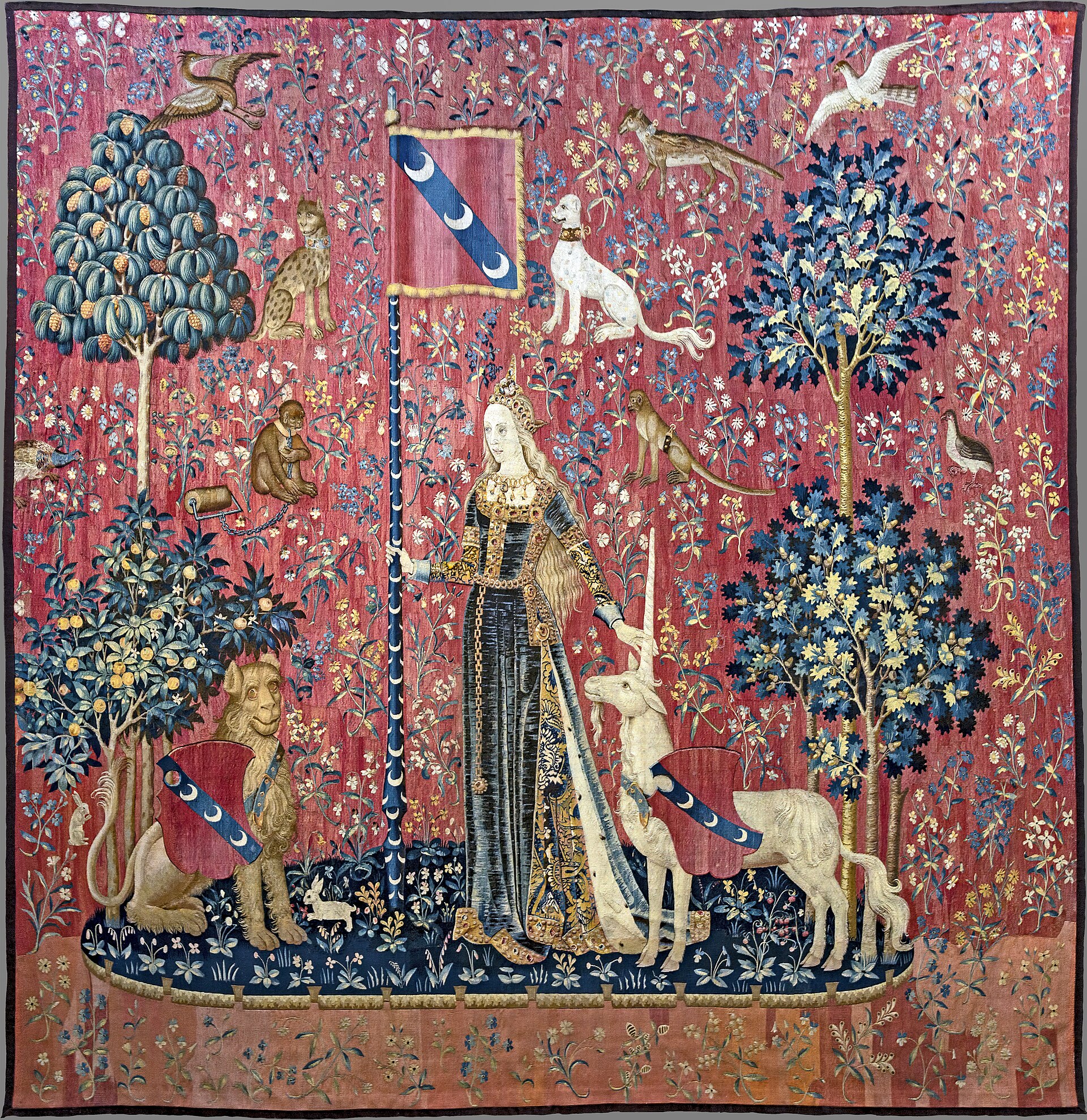
| Dimensions, Touch (Le Toucher) | Approximately 3.15 x 3.58 m. Inventory Cl. 10835.12 |
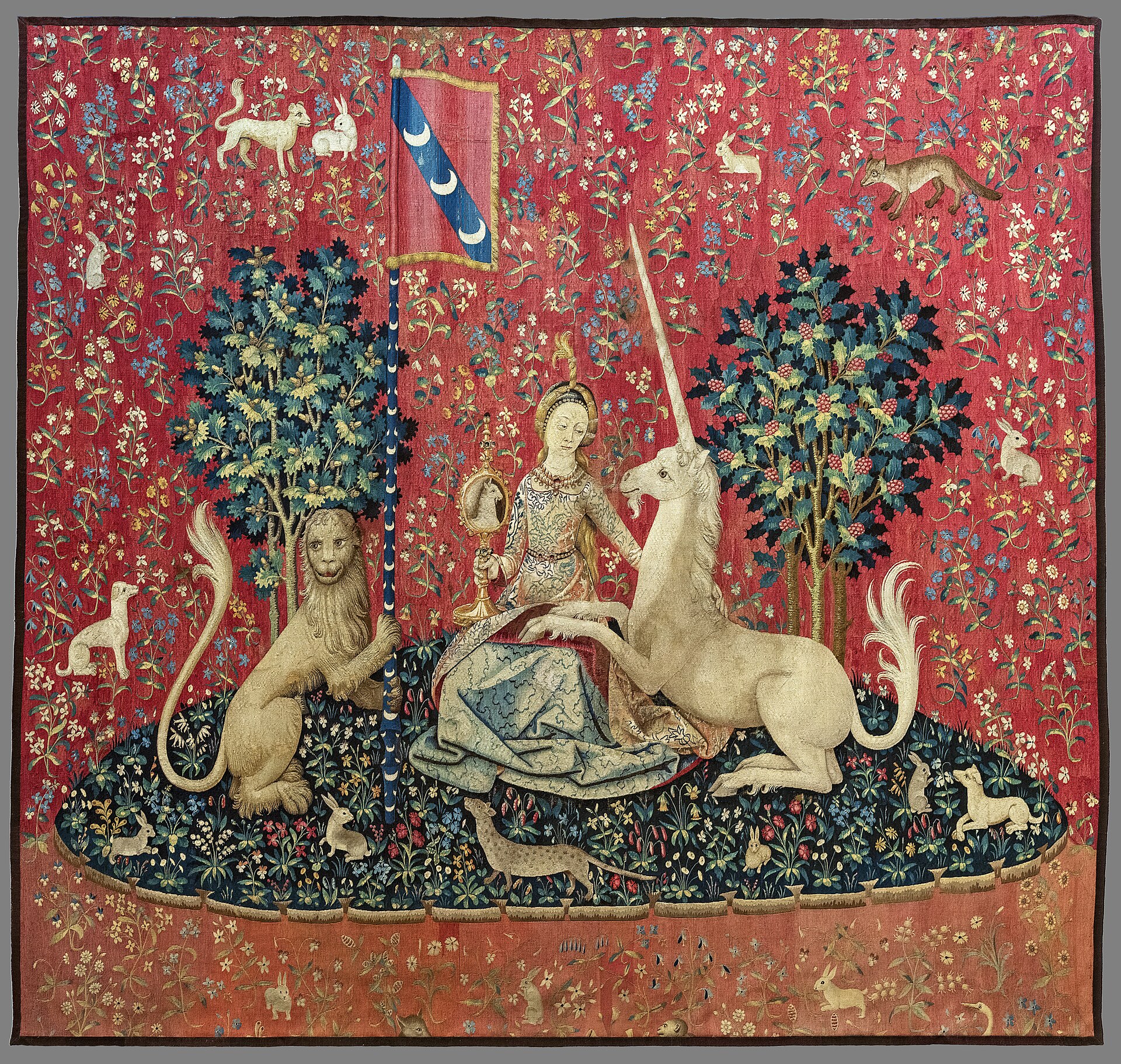
| Dimensions, Sight (La Vue) | Approximately 3.10 x 3.30 m, the smallest panel in the set. Inventory Cl. 10836.12 |
| Dyes identified | Madder for red, woad for blue, weld for yellow, and orcein from lichen for purple, identified in the medieval weaving during the 2012-2013 technical campaign; a later, non-original set of Gobelins dyes was used in the nineteenth-century reweave of the lower band.6 |
| Restoration record | Roughly a dozen conservation interventions since entering public ownership; a nineteenth-century campaign associated with the Gobelins manufactory rewove a damp-damaged horizontal band along the bottom of each panel; a ten-month campaign in 2012-2013 removed old linings and cleaned the panels ahead of a 2013 rehang; a CNRS-led hyperspectral and colorimetric study (Aurelie Mounier, with the Musee de Cluny and the Manufacture des Gobelins) is mapping original versus restored dye panel by panel as of the most recent published project material.37 |
Images
The record in full
Chapter 1What it is
Six tapestries, woven in wool with silk highlights in the mille-fleurs manner: a densely flowered dark blue or reddish-pink ground scattered with rabbits, dogs, birds, lambs and a monkey, against...
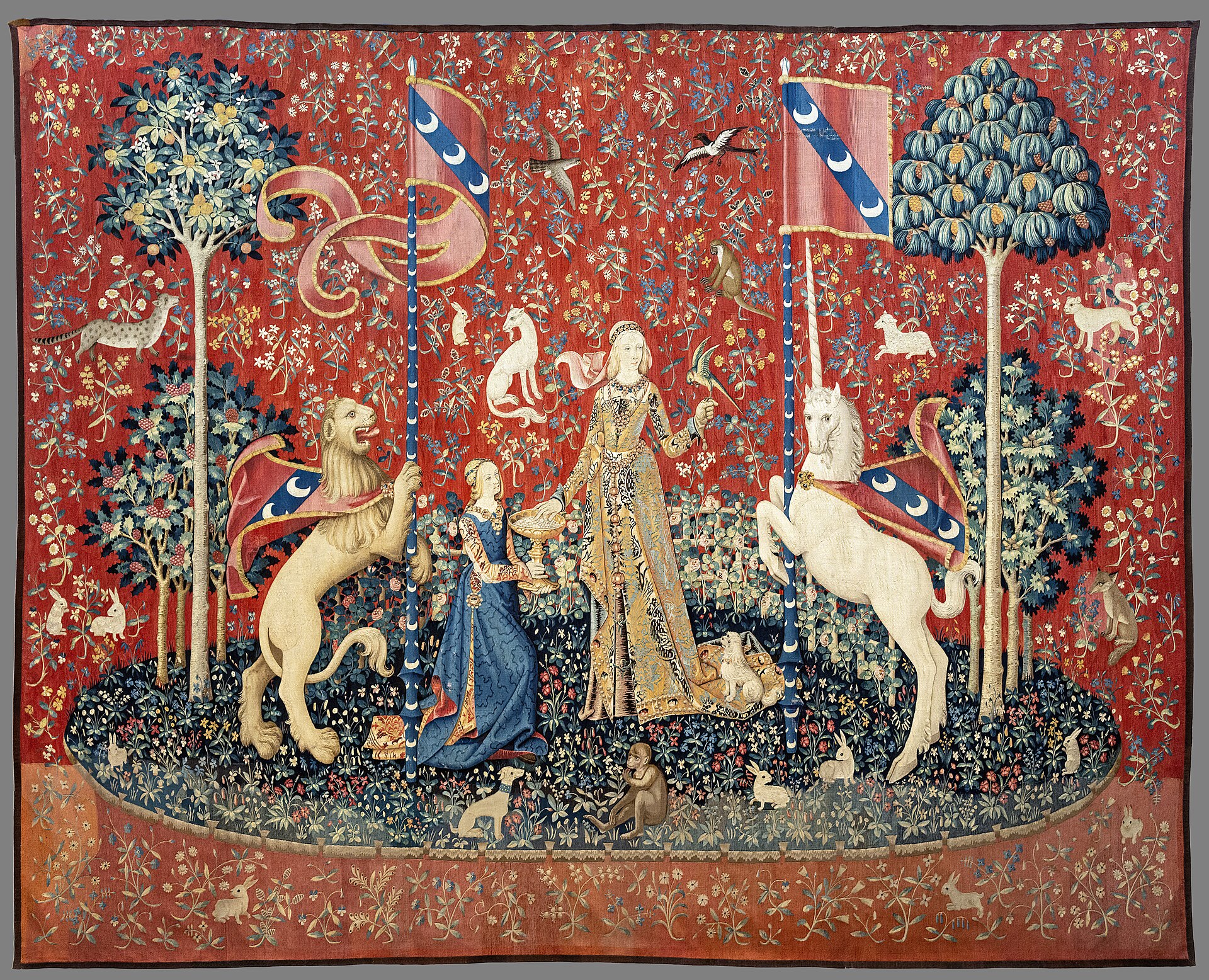
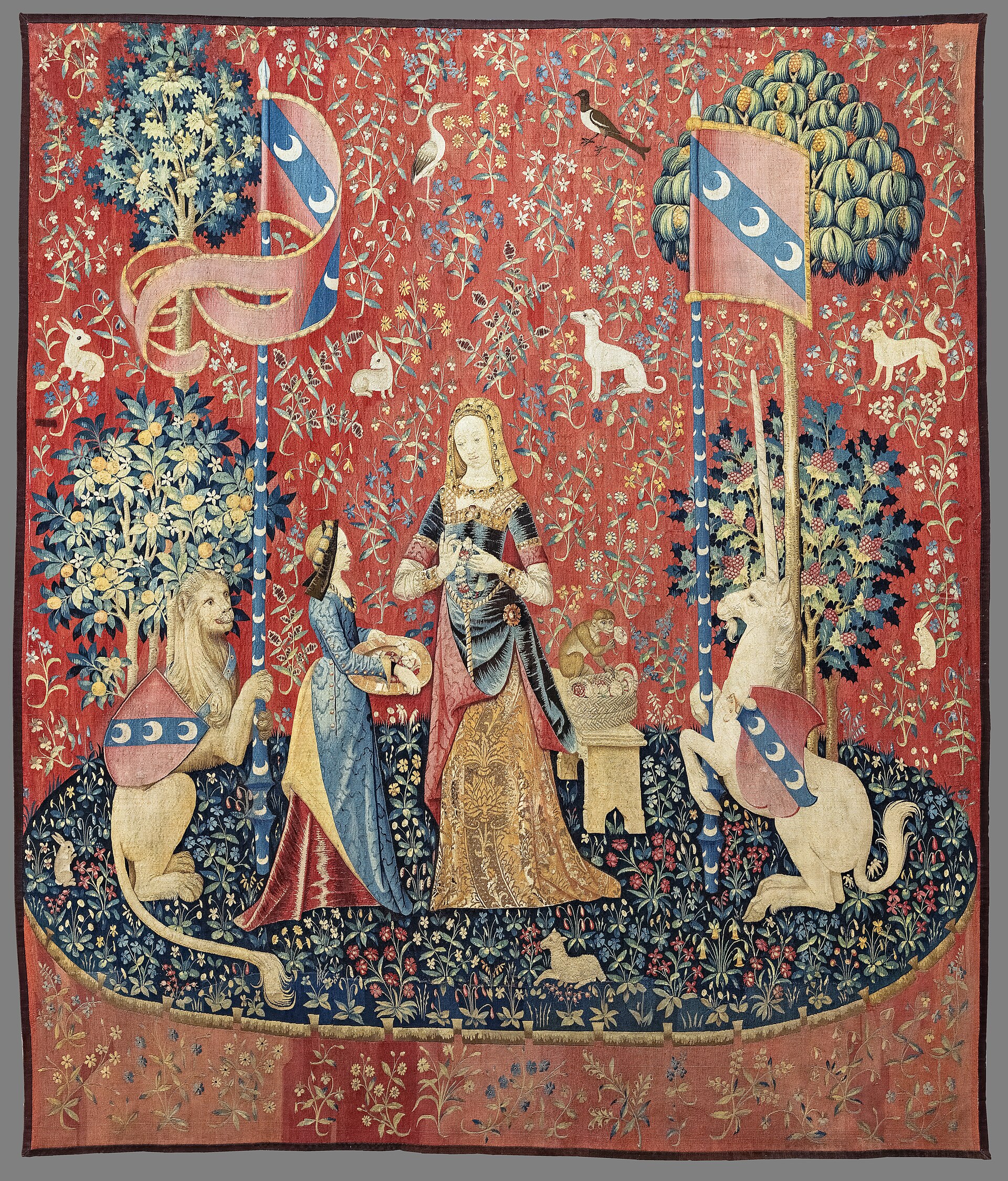
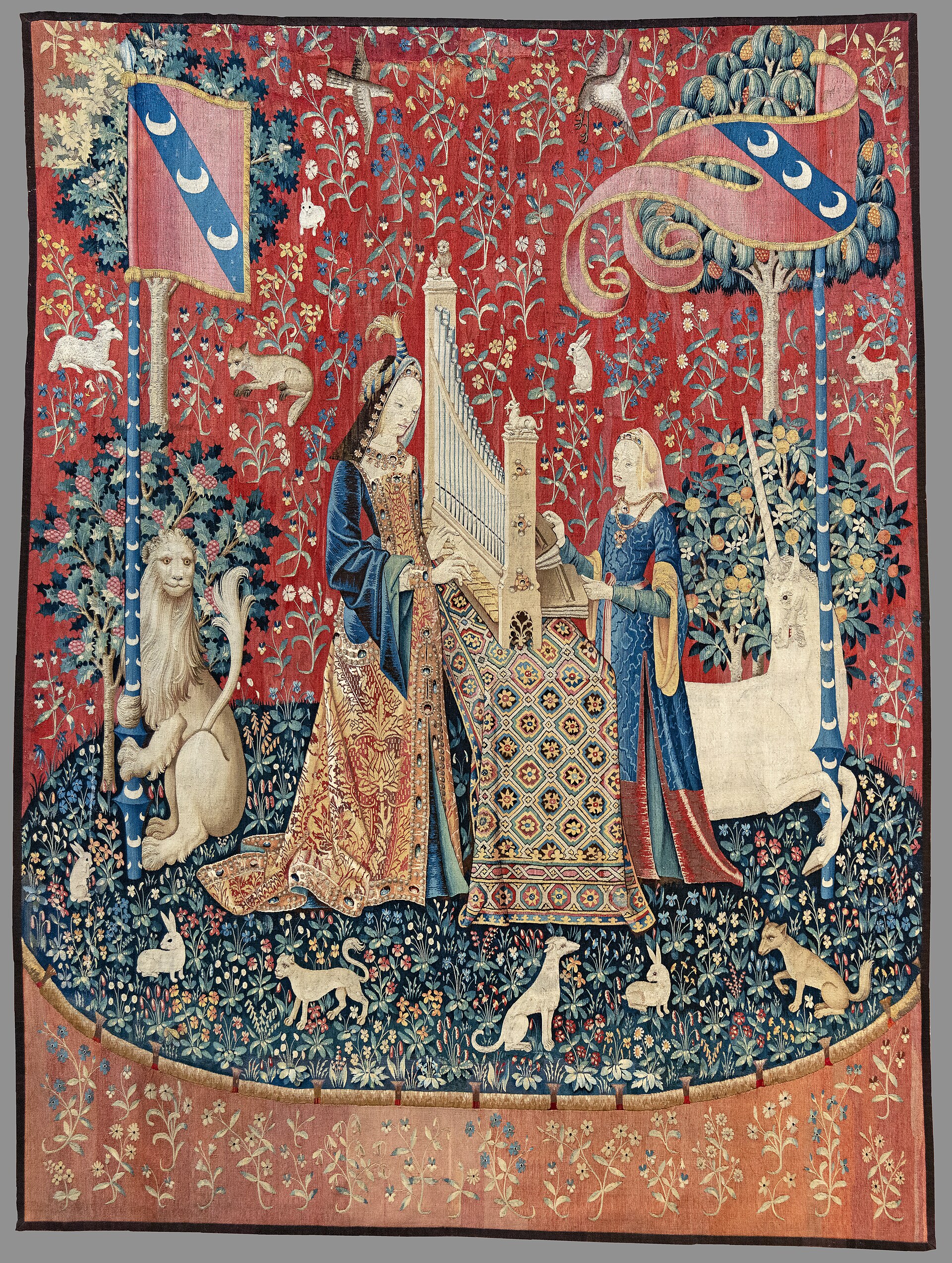
Six tapestries, woven in wool with silk highlights in the mille-fleurs manner: a densely flowered dark blue or reddish-pink ground scattered with rabbits, dogs, birds, lambs and a monkey, against which a young woman stands on a flowered island flanked by a lion on her right and a unicorn on her left. Five of the panels are read as the five senses. In Taste she takes a sweet from a dish held by her attendant; in Hearing she plays a portable organ; in Sight the unicorn rests its forelegs in her lap and looks into a mirror she holds; in Smell she weaves a garland of flowers while a monkey sniffs one; in Touch she holds the unicorn's horn with one hand and a banner pole with the other. The sixth panel shows her at the entrance to a tent embroidered with the words A MON SEUL DESIR, lifting a necklace of jewels from, or returning it to, an open casket held by her attendant.
Every panel repeats the same heraldry: a red banner and pennants charged with a blue band bearing three silver crescents, draped over the lion and the unicorn and flown on lances they hold upright. That coat of arms is the reason anything at all is known about who paid for the set, since no contract or invoice survives.
Chapter 2How it was made
The production pattern is the ordinary one for a high-end French tapestry commission of the period: a cartoon, or full-scale design, drawn by a Paris-based painter or illuminator's workshop, sent to...
The production pattern is the ordinary one for a high-end French tapestry commission of the period: a cartoon, or full-scale design, drawn by a Paris-based painter or illuminator's workshop, sent to a weaving workshop in the southern Netherlands to be executed in wool and silk on a low-warp loom. No weaver's mark or city mark survives on any of the six panels, which is not unusual for the date; the ordinances requiring Brussels tapestries to carry a city mark were not introduced until 1528, decades after this set was made.
The cartoon has been attributed by some scholars to the circle known as the Master of Anne of Brittany, an illuminator and designer active in Paris roughly 1480 to 1508, proposed to be Jean d'Ypres or his brother Louis, descendants of a documented workshop lineage running through Andre d'Ypres and Nicolas d'Amiens, the Master of Coetivy. Charles Sterling, among others, has resisted folding this set into the same hand as the related Hunt of the Unicorn tapestry group now sometimes called La Chasse a la Licorne, arguing the two belong to different anonymous masters. Neither attribution rests on a signed drawing or a documented commission naming an artist; both are style arguments, and this record treats them as arguments rather than facts.
Chapter 3Reading the senses
The five-senses reading of Taste, Hearing, Sight, Smell and Touch is not seriously contested and follows a scholastic commonplace: five bodily senses through which the soul receives the world, a...
The five-senses reading of Taste, Hearing, Sight, Smell and Touch is not seriously contested and follows a scholastic commonplace: five bodily senses through which the soul receives the world, a subject painted and carved constantly in the fifteenth century. What is contested is how deliberately philosophical the programme is meant to be. One line of interpretation, following the Aristotelian idea that the senses are the route by which appetite (epithymia) is elevated into willed, reasoned desire (boulesis), reads the cycle as a staged ascent from the animal senses toward something higher, which the sixth panel then names.
A different, more recent argument, made by Marie-Elisabeth Bruel, proposes that the six panels correspond not to a scholastic sense scheme but to six courtly virtues drawn from Guillaume de Lorris's Roman de la Rose: Sight as Oiseuse, Touch as Richesse, Taste as Franchise, Hearing as Liesse, Smell as Beaute, and the sixth panel as Largesse. This is a named scholar's argument in a citable publication, not a settled reading, and it competes directly with the senses-plus-heart interpretation below. Readers should treat both as arguments, not as the tapestries' agreed meaning; the museum's own presentation uses the senses reading as the frame and treats the rest as open.
Chapter 4A Mon Seul Desir: the sixth panel
The sixth tapestry is the one every account of this object has to address and none can close.
The sixth tapestry is the one every account of this object has to address and none can close. Unlike the other five it depicts no sense organ in use; the lady's action, taking up or setting down a necklace, is deliberately ambiguous in the weaving itself, and which reading you take changes the whole meaning of the cycle.
Jean-Patrice Boudet, working from sermons of the Paris theologian Jean Gerson (d. 1429), argues the panel represents the heart as a sixth, internal sense that governs and directs the other five toward Christian charity, a reading with a real textual source behind it even though Gerson predates the tapestries by half a century. A different courtly-love reading, closer to Olivier de la Marche's 1501 poem to Eleanor of Austria, takes the gesture as renunciation: the lady setting aside the jewels of the senses to let free will and the heart's true desire govern her. A third reading takes the opposite gesture, the lady putting the necklace on rather than taking it off, and reads the panel as an embrace of desire rather than its renunciation. Alain Erlande-Brandenburg's 1977 study is usually cited as the first to argue explicitly for renunciation of the senses as the panel's subject.
None of these is a documented fact about what the Le Viste patron intended; each is a named scholar's argument built on the same ambiguous gesture and the same six-word inscription, and this record has not found a document that settles it. The absence of a settled reading is itself the honest answer.
Chapter 5The Le Viste commission and its disputed patron
The Le Viste were a family on the rise rather than an old noble house: origins in Lyon, wealth and standing built through law and royal administration rather than land or war.
The Le Viste were a family on the rise rather than an old noble house: origins in Lyon, wealth and standing built through law and royal administration rather than land or war. Jean IV Le Viste became a counsellor to the Parlement of Paris in 1464, served Louis XI and then Charles VIII, and became a president of one of the royal courts of justice in 1489; he died in 1500. His arms, and the unicorn itself, plausibly carry a pun: in Old French viste meant swift, and the unicorn was held to be the swiftest of animals, a visual joke on a family name that a newly arrived legal dynasty had every reason to want repeated six times over in silk and wool.
The competing theory, argued by Carmen Decu Teodorescu from a 2010 rereading of the heraldry, proposes Jean IV's cousin Antoine II Le Viste, who succeeded Jean as head of the family in 1500 and who married Jacqueline Raguier. On this reading the arms are deliberately displayed with a cadency mark proper to a junior branch, the commission dates to around 1493, and the set has sometimes been proposed as connected to the marriage, with the sixth panel's inscription read as bracketing the couple's initials. Jean-Bernard de Vaivre's 2015 study rejects Teodorescu's method and restates the case for Jean IV in the 1480s or early 1490s, arguing the supposedly irregular heraldry is legitimate variant usage documented elsewhere in the family. The two published positions disagree on the decade, the individual, and the occasion, and this record has found no later study that resolves the dispute either way.
Chapter 6Two tapestry sets called unicorn tapestries
This set is routinely confused with a different one, and the confusion is common enough to name directly.
This set is routinely confused with a different one, and the confusion is common enough to name directly. The Hunt of the Unicorn, also widely called the Unicorn Tapestries, is a seven-panel South Netherlandish hanging of roughly the same period, c. 1495 to 1505, showing a hunting party pursuing and killing a unicorn. It has been at the Met Cloisters in New York since the 1930s, from the collection of John D. Rockefeller Jr., and it carries different arms, a different design, and no connection to the Le Viste family or to Boussac.
The set described in this record is French: six panels, a senses allegory rather than a hunt, made for the Le Viste family, and held at the Musee de Cluny in Paris since 1882. The two hangings share only a species and a period. Museum labels, press coverage and casual conversation collapse them into one another often enough that a reader arriving at either object under the wrong name is common, and this record exists in part to stop that happening for this one.
Chapter 7From Lyon to Boussac: the chain before 1841
The tapestries descended by inheritance from the Le Viste family through the Robertet and La Roche-Aymon families to the Rilhac family, who by one account had brought them to the Chateau de Boussac...
The tapestries descended by inheritance from the Le Viste family through the Robertet and La Roche-Aymon families to the Rilhac family, who by one account had brought them to the Chateau de Boussac in the Creuse by around 1600; the museum's own catalogue record confirms the tapestries were documented at Boussac by 1814, well before their public rediscovery. Almost nothing is documented about their two and a half centuries in the chateau beyond that they survived, deteriorating, hung or stored in rooms that were not built to preserve them.
In 1835 the chateau was sold by the Comtesse de Ribeyreix, born de Carbonnieres, a distant heir, to the municipality of Boussac; in 1838 it became the seat of the sub-prefecture of the Creuse. It was as municipal, administrative property, not as a private collection, that the tapestries were sitting when they were noticed by two visitors in the years that followed.
Chapter 8Rediscovery: Prosper Merimee, 1841
Prosper Merimee, better known now as a novelist but at the time serving as Inspector General of Historic Monuments, visited Boussac in July 1841, reportedly alerted by George Sand, who had been a...
Prosper Merimee, better known now as a novelist but at the time serving as Inspector General of Historic Monuments, visited Boussac in July 1841, reportedly alerted by George Sand, who had been a regular presence at the chateau's sub-prefecture apartments since around 1835. Merimee inventoried the six tapestries and set in motion the process that would eventually classify them as a historic monument, the mechanism that kept them from being dispersed or destroyed over the following four decades even though it did not immediately move them into public conservation.
Local legend at Boussac had already attached a colourful, unsupported story to the tapestries: that they had decorated the captivity of the Ottoman prince Djem (Zizim), held for a time in France in the late fifteenth century, and had passed afterward to Pierre d'Aubusson, Grand Master of the Knights of Rhodes and lord of Boussac. George Sand repeated the Zizim story in her own writing; it has no documentary support and is not the accepted account of the tapestries' origin, but it illustrates how much invented history had already accumulated around the panels before scholarship caught up with the Le Viste arms.
Chapter 9George Sand and the tapestries
Sand wrote about the tapestries more than once and over several decades, not in a single publicity piece.
Sand wrote about the tapestries more than once and over several decades, not in a single publicity piece. Her 1844 novel Jeanne, written partly at Boussac, describes them as the finest decoration of the chateau's salon and as curious, enigmatic work; she repeats the Zizim legend there as local colour rather than established fact. In 1847 she published an illustrated article, Un coin du Berry et de la Marche, in the magazine L'Illustration, with engravings after drawings by her son Maurice; that article, unusually, describes eight tapestries rather than the six now known, a discrepancy no later source in this record's research has resolved. She returned to them again in 1871 in her wartime Journal d'un voyageur pendant la guerre. Her dating of the panels to the late fifteenth century, reached by reading the costumes, has held up against later scholarship.
What Sand's own writing does not do, on the sources available for this record, is state plainly that the six surviving Lady and Unicorn panels themselves had been cut up and used as horse blankets, cart covers or floor rugs. That specific claim traces to Prosper Merimee's correspondence, which records being told by the mayor of Boussac that other tapestries at the chateau, described to him as more beautiful than the surviving six, had been cut up by a previous owner, a Comte de Carbonnieres, to cover carts and make floor coverings. Merimee's own account leaves open whether those cut-up hangings were part of the same Le Viste set or a separate tapestry lost from the record entirely. Several modern popular accounts, including regional press coverage of the tapestries' history, apply the floor-covering and horse-blanket story to the six surviving panels without that caveat. The one fact that is solidly documented about the surviving six is duller and more specific: their lower edges suffered damage from damp and had to be rewoven when they entered public conservation, which is a different and better-supported claim than the picturesque one.
Chapter 10The 1882 purchase and Edmond du Sommerard
The tapestries remained municipal property at Boussac for four decades after Merimee's visit, at risk from damp and neglect despite their historic-monument classification.
The tapestries remained municipal property at Boussac for four decades after Merimee's visit, at risk from damp and neglect despite their historic-monument classification. On 17 July 1882 the municipality of Boussac sold the six panels for 25,000 gold francs to Edmond du Sommerard, curator of the Musee de Cluny, acting for the French state. Edmond du Sommerard had taken over direction of the museum after the death of his father Alexandre du Sommerard, the collector whose private house and collection at the Hotel de Cluny had become the founding core of the museum in 1843; by 1882 Edmond had spent nearly two decades building the national collection his father began.
This record has not found a published account describing the sale as contested, competitive, or resisted by the municipality; the available sources describe a negotiated purchase rather than a public auction, which is the reason there is no auction record, hammer price or premium to separate for this object. Whether the 25,000-franc price reflected a fair market valuation of a fifteenth-century tapestry set, a below-market municipal sale to secure state conservation, or something in between is not addressed in the sources consulted for this record, and is recorded here as an open question rather than assumed either way.
Chapter 11Restoration, then and now
The tapestries have undergone roughly a dozen conservation interventions since entering public ownership, the most significant a nineteenth-century campaign, associated with the Gobelins manufactory...
The tapestries have undergone roughly a dozen conservation interventions since entering public ownership, the most significant a nineteenth-century campaign, associated with the Gobelins manufactory, that rewove a horizontal band along the bottom edge of each panel where damp had destroyed the original weaving. That band was rewoven, apparently using salvaged wool, with dyes developed in the Gobelins dye workshop rather than the medieval vegetable dyes used in 1500. The consequence has become visible with time rather than at the moment of restoration: the nineteenth-century dyes have proved less stable than the medieval ones, and the restored band now reads as a visibly lighter, more faded stripe against the better-preserved original weaving above it, an outcome nobody intended and conservators are still studying.
A ten-month conservation campaign in 2012 to 2013 removed old linings, vacuum-cleaned the panels by micro-aspiration, repaired weak points, and preceded the tapestries' move into a purpose-built rotunda gallery at the Musee de Cluny, reopened in December 2013. Separately, and more recently, a CNRS-funded research project led by Aurelie Mounier, in partnership with the Musee de Cluny and the Manufacture des Gobelins, has used hyperspectral imaging, colorimetry and fluorimetry, all non-contact or micro-invasive, to map exactly where original medieval dye survives against nineteenth-century synthetic and semi-synthetic replacement, building a reference database of period dye recipes to compare against. That project is a direct, ongoing answer to the question of how much of the surviving cloth is 1500 material rather than nineteenth-century repair: the honest answer, on present evidence, is that it varies panel by panel and is concentrated in a defined lower band rather than spread evenly across the six hangings, and that the precise proportion is still being measured rather than settled.
Chapter 12Afterlife: Rilke and the making of a reputation
Rainer Maria Rilke saw the tapestries in Paris in the first years of the twentieth century, while working on his study of Rodin, and gave them one of the most quoted descriptions any museum object in...
Rainer Maria Rilke saw the tapestries in Paris in the first years of the twentieth century, while working on his study of Rodin, and gave them one of the most quoted descriptions any museum object in France has received from a major writer. In his 1910 novel The Notebooks of Malte Laurids Brigge he has his narrator walk his correspondent Abelone past the six panels one by one: There are tapestries here, Abelone, wall tapestries. I imagine you before them, six tapestries there are: come, let us pass slowly before them. The passage that follows describes the blue island floating on its red flowered ground, the lion and the unicorn bearing the same banner high above them, gules with a band of azure and three moons of silver, in language close enough to the actual heraldry that Rilke was plainly working from careful looking rather than memory.
That description, translated and anthologised for a century, did more than any museum label to fix the tapestries in a wider literary imagination beyond France, in the same decades that the panels were being catalogued, studied and eventually rehoused by the museum that had bought them a generation before Rilke ever saw them.
The artist
No individual maker is named or documented. Design attributed by some scholars to the circle known as the Master of Anne of Brittany; weaving attributed to an unidentified southern Netherlandish workshop.
Nothing about the makers of this tapestry set is documented directly. No contract, invoice or workshop mark survives. What is known is the ordinary production pattern of a great French tapestry commission around 1500: a cartoon drawn by a Paris-based design workshop, then sent to a weaving workshop in the southern Netherlands to be executed in wool and silk. Everything past that geography is attribution, built from style rather than record, and this record treats it accordingly.
Related works
| Work | Relation | Where it is |
|---|---|---|
| The Hunt of the Unicorn (also called the Unicorn Tapestries) Unknown South Netherlandish weavers | Not the same object. A different, seven-panel unicorn tapestry set of similar date, a hunting narrative rather than a senses allegory, with different heraldry and no Le Viste connection. Frequently confused with this record's subject in press and casual reference; distinguished at length in the narrative above. | The Met Cloisters, New York |
| La Chasse a la Licorne (Hunt of the Unicorn, alternative Franco-Flemish group) Attributed by some to the same design circle as this set, contested | Proposed by some scholars to share a cartoon designer with this record's subject; the attribution is disputed by Charles Sterling among others, who assigns the two groups to different anonymous masters. Cited here only as a scholarly attribution question, not as a located, verified companion object for this record. | Not held with this set |
| Petites Heures de la reine Anne de Bretagne Circle of the Master of Anne of Brittany | Illuminated manuscript proposed to share a designer or workshop tradition with this tapestry set, on stylistic grounds. Included to record the design-attribution argument, not as a confirmed sibling object. | Not verified in the sources consulted for this record |
Open questions
- Which Le Viste commissioned the set: Jean IV in the 1480s or early 1490s, or Antoine II around 1493 as a betrothal gift, remains disputed between named scholars (Teodorescu 2010 versus de Vaivre 2015) and no contract has surfaced to settle it.
- What A Mon Seul Desir actually means is unresolved: renunciation of the senses, an internal sixth sense of the heart following Jean Gerson, an allegory of courtly Largesse, or something else, with named scholars on more than one side and no single reading accepted as final.
- Whether the popular claim that the six surviving panels themselves were used as horse blankets or floor coverings is accurate, or whether that story properly belongs to other, separate tapestries once at Boussac that were cut up and lost, is not resolved by the primary correspondence available; this record treats it as unverified for the surviving six.
- George Sand's 1847 article describes eight tapestries rather than the six now known; whether this was an error, a reference to two further, now-lost panels of the same hanging, or something else, is not addressed in the sources consulted.
- The precise weaving location within the southern Netherlands has not been established in the sources reviewed; the region is agreed, the city or workshop is not.
- Whether the 25,000-gold-franc price paid in 1882 reflected an ordinary market valuation or a below-market municipal sale to secure state conservation is not addressed in the sources consulted.
- The exact proportion of each panel's surviving textile that is original 1500 weaving versus nineteenth-century reweaving has not been published as a settled figure; a CNRS-led hyperspectral study is actively measuring this panel by panel as of the most recent published material found.
Questions about this object
What is The Lady and the Unicorn?
The Lady and the Unicorn is a textile, dated c. 1480-1500, within a range disputed by different scholars; a minority reading narrows the commission to c. 1493. Medium: Tapestry weave, wool warp with wool and silk weft (wool and silk).
Who made The Lady and the Unicorn, and is the attribution settled?
The attribution to Unknown weavers, southern Netherlands, after cartoons attributed to the circle of the Master of Anne of Brittany is recorded here as disputed. The commission is securely a Le Viste one: the arms (gules, a band of azure charged with three crescents argent) appear repeatedly across the six panels and are not seriously contested. Which member of the family commissioned the set is disputed. The traditional reading names Jean IV Le Viste, president of the Cour des Aides of Paris, commissioning in the 1480s or early 1490s to mark his rise at court. A 2010 rereading of the heraldry by Carmen Decu Teodorescu proposes instead his younger cousin Antoine II Le Viste, around 1493, with the set later read by some as a betrothal gift for his marriage to Jacqueline Raguier. Jean-Bernard de Vaivre's 2015 study rejects Teodorescu's heraldic method and defends the Jean IV attribution. Neither side has produced a contract, invoice or dated document naming a patron; both arguments rest on reading the coat of arms and its irregularities. The weavers themselves are anonymous and no city or workshop mark survives on the panels.
Where is The Lady and the Unicorn now?
Musee de Cluny - musee national du Moyen Age, Paris, France. Inventory number Cl. 10831 (Taste), Cl. 10832 (Smell), Cl. 10833 (Hearing), Cl. 10834 (A Mon Seul Desir), Cl. 10835 (Touch), Cl. 10836 (Sight). Last confirmed 12 August 2026. Purchased for the French state in 1882 and held continuously in the national collection since; on permanent display in a dedicated rotunda built for the set in the museum's 2013 rehang.
What is still unknown about The Lady and the Unicorn?
Which Le Viste commissioned the set: Jean IV in the 1480s or early 1490s, or Antoine II around 1493 as a betrothal gift, remains disputed between named scholars (Teodorescu 2010 versus de Vaivre 2015) and no contract has surfaced to settle it.
Sources
- 1Ministere de la Culture (France), base Joconde, notice 'Tenture de la Dame a la Licorne', official catalogue record giving inventory numbers Cl. 10831 to Cl. 10836, materials, dating, acquisition date of 17 July 1882 and documented presence at Chateau de Boussac by 1814. pop.culture.gouv.fr/notice/...
- 2Wikipedia, 'The Lady and the Unicorn'. en.wikipedia.org/wiki/...
- 3Wikipedia (French), 'La Dame a la licorne'. fr.wikipedia.org/wiki/...
- 4Art Gallery of New South Wales, museum education resource, 'The Lady and the Unicorn: who were they made for?', on the Le Viste commission and the two competing patron theories. artgallery.nsw.gov.au/artboards/...
- 5Legendart.fr, 'George Sand et la Dame a la Licorne', on Sand's specific publications (Jeanne 1844, L'Illustration 1847, Journal d'un voyageur 1870-71) and Merimee's July 1841 visit. legendart.fr/george-sand-et-la-dame-a-la-licorne
- 6Medieval Histories (medieval.eu), 'Lady and the Unicorn', on the 2012-2013 restoration campaign, the dyes identified (madder, woad, weld, orcein), and Rilke's connection to the tapestries. medieval.eu/lady-unicorn
- 7Archeosciences Bordeaux (CNRS), project page, 'Les tapisseries de la Dame a la Licorne (XVe siecle): la couleur, l'esprit, le temps', on the ongoing hyperspectral and colorimetric study of original versus restored dye, led by Aurelie Mounier with the Musee de Cluny and the Manufacture des Gobelins. archeosciences-bordeaux.fr/Les-tapisseries-de-la-Dame-a-l...
- 8France 3 Nouvelle-Aquitaine (franceinfo regional), 'Elles servaient de tapis de sol! L'incroyable destin d'une des plus celebres series de tapisseries au chateau de Boussac'. Regional press account repeating the floor-covering and horse-blanket story; consulted via search summary only, full article text not independently retrieved (403 on direct fetch), so treated cautiously and flagged for direct verification. france3-regions.franceinfo.fr/nouvelle-aquitaine/...
- 9Rainer Maria Rilke, Les Cahiers de Malte Laurids Brigge (Paris, 1939 edition), pp. 117-121 and 185-190, the passage describing the six tapestries at length, consulted via secondary quotation rather than the original edition directly. ebooks-bnr.com/rilke-rainer-maria-les-cahiers-de-malte-la...
Last verified · Published
Change log
12 August 2026 - Record created at the house standard: researched narrative, technical evidence, maker dossier, graded provenance chain, prices with hammer and premium separated, related works, open questions and sources.