A Harvest of Death, Gettysburg, Pennsylvania
Timothy H. O'Sullivan · July 1863 (negative); print 1865-66; published 1866
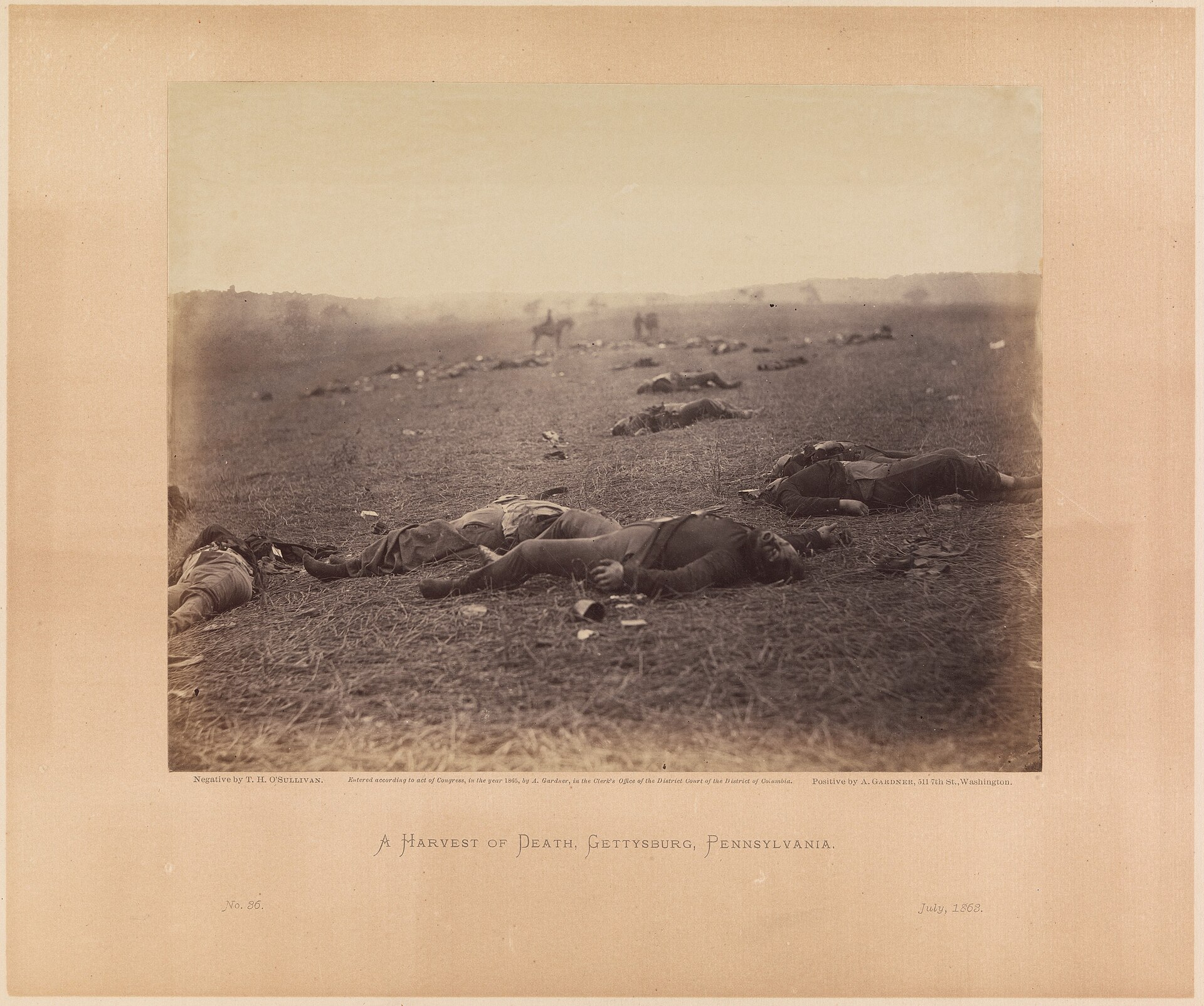
The Met's print, accession 2005.100.1201, Gilman Collection. Albumen silver print from a glass negative, July 1863. CC0.
| Artist | Timothy H. O'Sullivan |
|---|---|
| Date | July 1863 (negative); print 1865-66; published 1866 |
| Medium | Albumen silver print from a wet collodion glass negative |
| Dimensions | Image about 17.3 x 22.7 cm to 17.6 x 22.8 cm, mount 31.2 x 39.9 cm (Harvard, Library of Congress) |
| Where it is now | Metropolitan Museum of Art, New York (and other collections)last confirmed |
| Inventory number | Met 2005.100.1201; Harvard 2008.22; Library of Congress ppmsca.12557 |
| Attribution | AcceptedMuseum catalogues credit the negative to Timothy H. Full note |
| Object type | Photograph |
| Period | American, Civil War, nineteenth century |
| Cases | Has a provenance gap |
| Inscriptions | Printed on the mount: A Harvest of Death, Gettysburg, July, 1863; Incidents of the War; credit for negative and positive; copyright A. Gardner 1865; Philp and Solomons, Washington. |
| Owners on record | 8 links6 documented, 2 unknown |
| Sources | 20 cited |
About this record Last verified · 20 sources cited · Change log
On this page 10 sections
ContentsClose
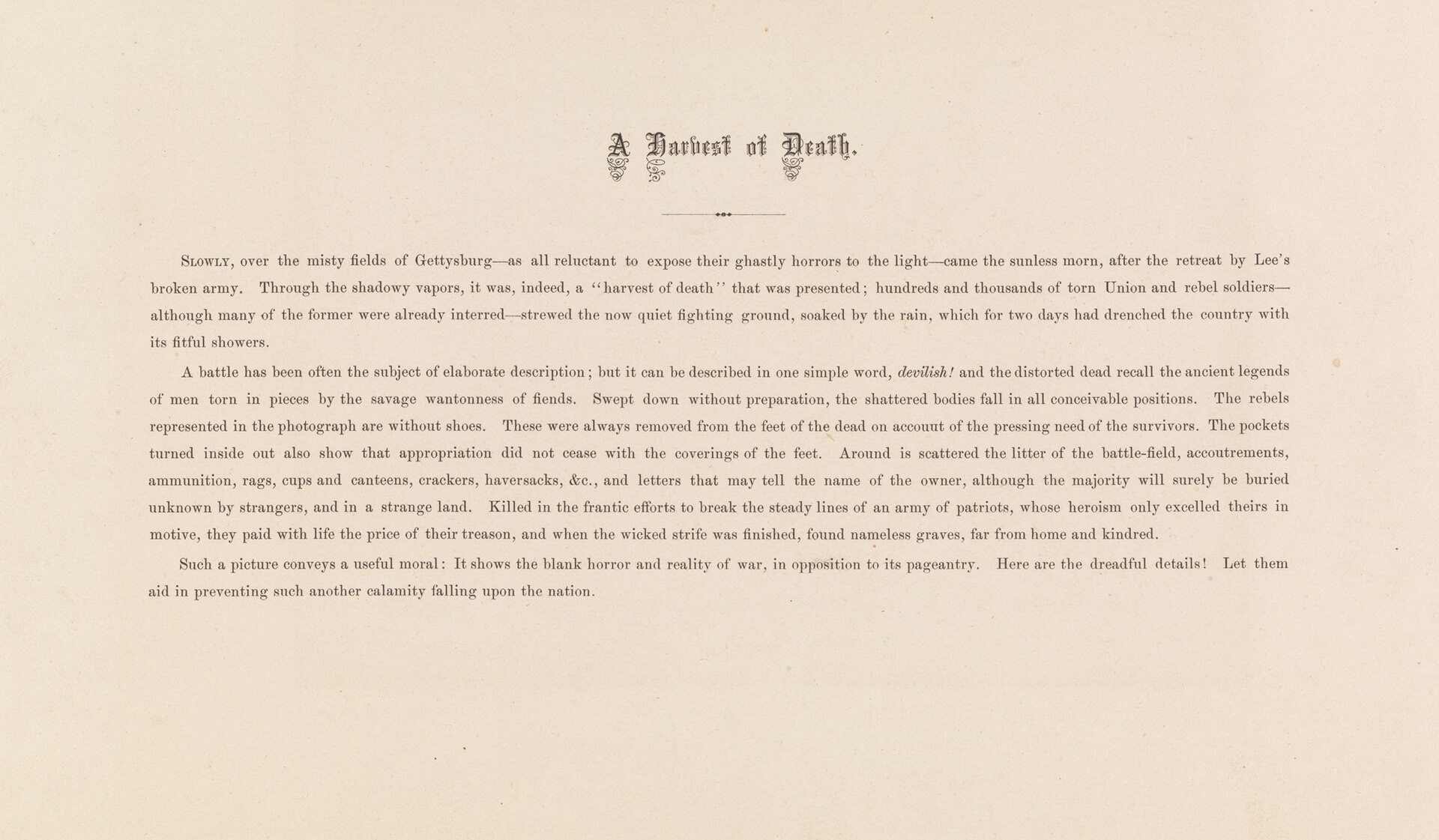
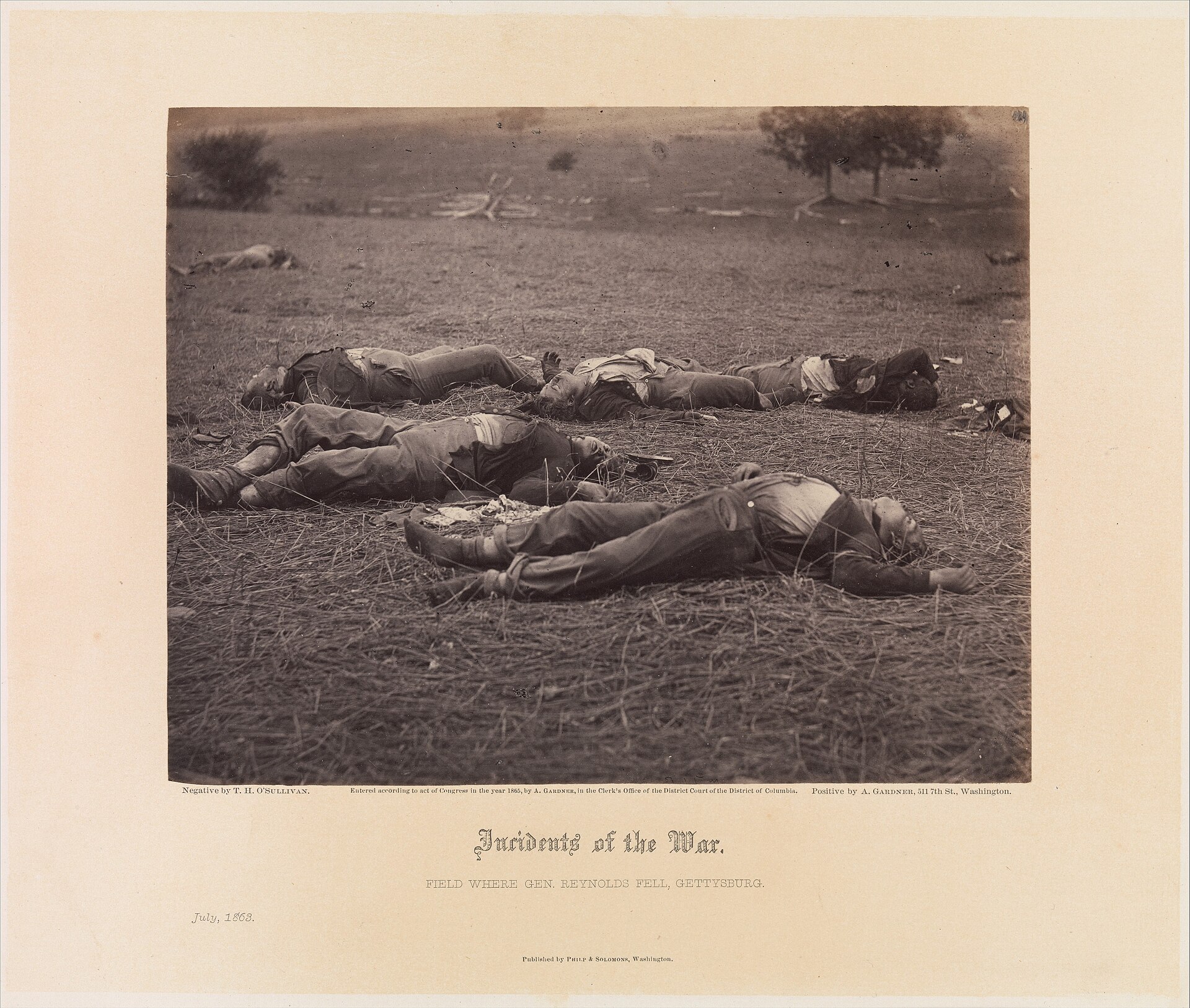
A wet collodion photograph exposed by Timothy H. O'Sullivan in the first week of July 1863 near Gettysburg, printed and published by Alexander Gardner and issued as plate 36 of his 1866 Sketch Book. Gardner's plate text called the dead Confederate; William Frassanito showed in 1975 that they are Union men of the Third Corps, photographed from two sides in plates 36 and 37.
Prints survive at the Met, Harvard and the Library of Congress, among others. A print on its Sketch Book mount sold for 916 dollars including premium in 2023. The location of the negative, the day and the exact field remain open.
Provenance
Each link is graded. Documented: a cited source supports it. Disputed: the identification is argued but not established. Unknown: no owner for that span, and the gap is not smoothed into a narrative. The grades in the glossary.
- July 1863 -Timothy H. O'Sullivan, working with Alexander Gardner's field partydocumented
The wet collodion negative was exposed in the first week of July 1863 near Gettysburg. The party reached the field on 5 July per the National Archives; catalogue dates for the negative run 4 to 7 July. Day and exact place are disputed (Frassanito: near the Rose farm and Emmitsburg Road; Coates: south of the Spangler farm).261418
- 1863 - 1866Alexander Gardner, Washingtondocumented
Gardner printed the picture, entered copyright in 1865 and issued it as plate 36 of the Sketch Book with Philp and Solomons in 1866. The printed mount credits O'Sullivan for the negative and Gardner for the positive.892
- 1866 - unknownUnknownunknown
The location of the original glass negative after Gardner's studio is not established in any source consulted. The Library of Congress holds a print and a copy series; no source consulted states that the original plate survives.26
- 1866 - 2005Unknown, then the Gilman Collectionunknown
The Met's Gilman prints (2005.100.1201 and the volume 1 copy, 2005.100.502.1) were purchased by the Museum in 2005; owners before that are not published on the pages consulted.34
- 2005 - presentMetropolitan Museum of Art, New Yorkdocumented
Accession 2005.100.1201, Gilman Collection, Museum Purchase, 2005; also plate 36 within volume 1 of the Sketch Book.34
- 2008 - presentHarvard Art Museums, Fogg Museumdocumented
Object 2008.22, Richard and Ronay Menschel Fund for the Acquisition of Photographs.8
- unknown - presentLibrary of Congress, Prints and Photographs Divisiondocumented
Print with digital ID ppmsca.12557 (LCCN 2006685384) and a copy series under reproduction number LC-B8184-7964-A. The date and route of acquisition were not available on the pages consulted.26
- unknown - 11 Oct 2023Unknown, then a private buyer at R&R Auctiondocumented
A Sketch Book print on a 15.75 by 12 inch mount, with its caption sheet missing, sold at R&R Auction on 11 October 2023. The prior owner is not stated.10
Prices realised
| Date | Sale | Estimate | Result | Note |
|---|---|---|---|---|
| 11 October 2023 | R&R Auction, Fine Autograph and Artifacts (#676), lot 331 | USD 800+ | Hammer Not published on the page retrieved With premium Included in the total; amount not stated USD | Sold for USD 916 including buyer's premium. Albumen print on a 15.75 x 12 in mount, original caption sheet missing, light foxing and toning. |
| 17 November 2017 | Cowan's Auctions, American History live salesroom, lot 88 | USD 500-700 | Hammer Not shown With premium 28% on hammer up to USD 250,000 USD | A late print, produced about the 1890s or after, not a Sketch Book print; result not shown on the page retrieved. |
Hammer is the price at which the bidding stopped; with premium adds the fee the house charges the buyer on top. Hammer price and buyer's premium in the glossary.
Technical evidence
| Attribution note | Museum catalogues credit the negative to Timothy H. O'Sullivan and the print to Alexander Gardner; the printed mount of the Harvard print says so. Gardner entered the copyright in his own name in 1865. |
|---|---|
| Process | Albumen silver print from a wet collodion glass negative.36720 |
| Negative | Wet collodion glass negative by Timothy H. O'Sullivan, July 1863; catalogue dates range from 4 to 7 July 1863. Location of the original plate not established; a Library of Congress copy series is LC-B8184-7964-A.26 |
| Albumen print by Alexander Gardner, 1865 or 1866 depending on the catalogue; printed mount credits O'Sullivan for the negative and Gardner for the positive, with an 1865 copyright entry and the Philp and Solomons imprint.867 | |
| Dimensions, Harvard print | Image 17.3 x 22.7 cm; mount 31.2 x 39.9 cm.8 |
| Dimensions, Library of Congress print | 17.6 x 22.8 cm.6 |
| Dimensions, Met record 2005.100.1201 | Catalogued as image 45.2 x 57.2 cm and mount 30.4 x 39.7 cm, which is internally impossible; treated as a data error.3 |
| Sketch Book plate | Plate 36 of the Sketch Book, vol. 1; the Met's copy of vol. 1 holds 50 prints, each about 17.8 x 22.8 cm, sheet 31.1 x 39.7 cm.42 |
| Inscriptions | Printed on the mount: title A Harvest of Death, Gettysburg, July, 1863; Incidents of the War; credit for negative and positive; copyright entry A. Gardner 1865; publisher Philp and Solomons, Washington.8 |
| Condition, auction print | Light foxing and faint toning; extended caption sheet missing (R&R, 2023).10 |
Images
The record in full
Chapter 1What it is, and which picture this record covers
A glass-plate photograph exposed in the first week of July 1863 on a field near Gettysburg, Pennsylvania, showing a line of dead soldiers lying in grass under a pale sky, with two men and horses...
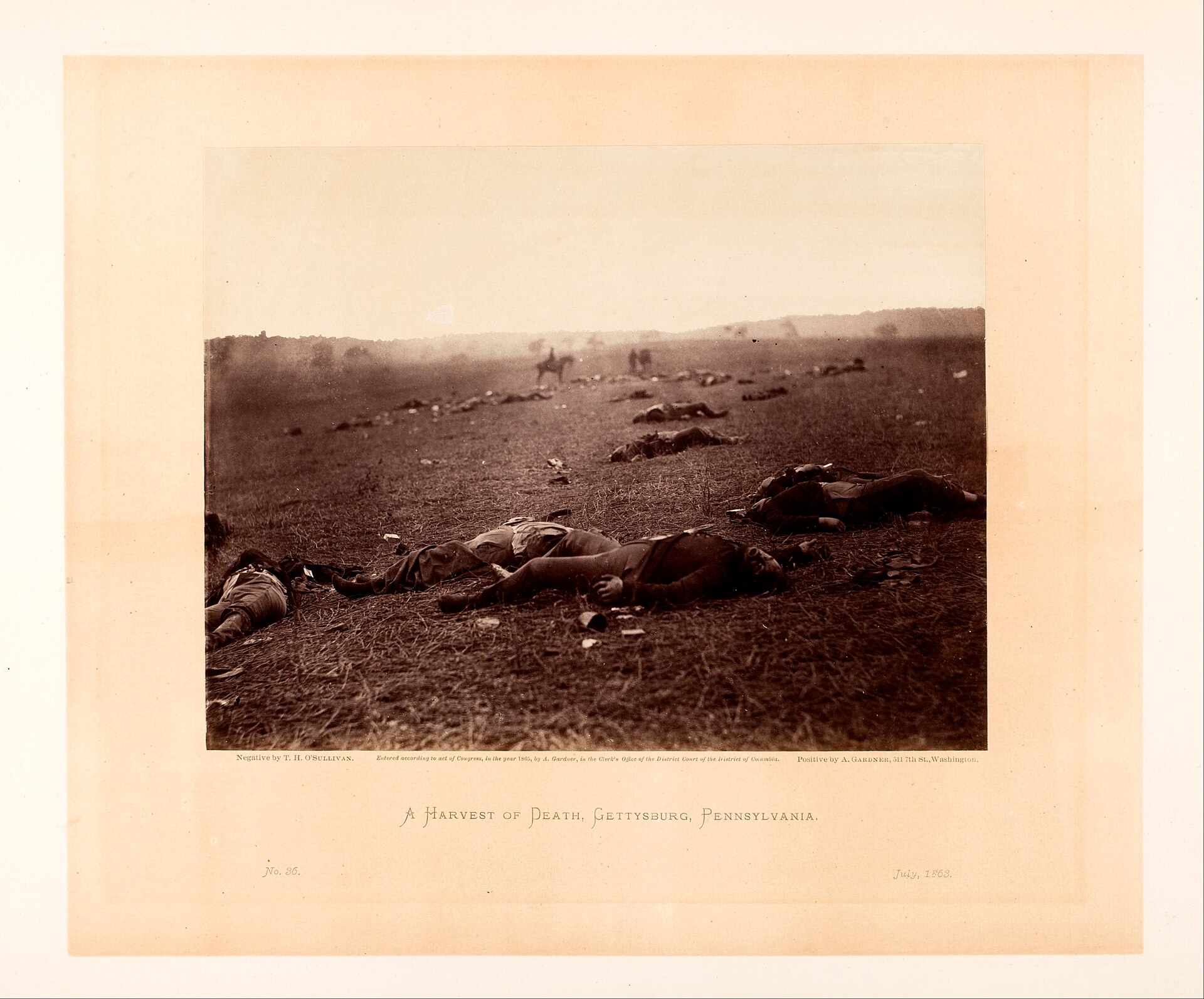
A glass-plate photograph exposed in the first week of July 1863 on a field near Gettysburg, Pennsylvania, showing a line of dead soldiers lying in grass under a pale sky, with two men and horses blurred in the far distance. It is credited to Timothy H. O'Sullivan, who exposed the negative, and to Alexander Gardner, who printed and published it. Museum catalogues give the process as albumen silver print from a wet collodion glass negative.
Three different things carry this title and they must be kept apart. The first is the glass negative of July 1863, which is a unique object whose present location this record could not establish. The second is the albumen print, made from it in Gardner's Washington studio and mounted with a printed credit line, of which many survive. The third is plate 36 of Gardner's Photographic Sketch Book of the War (1866), which is itself one of these prints tipped into an album beside a page of Gardner's text. This record describes the picture, the negative-to-print-to-plate sequence, and the market in prints. It does not cover Gardner's Home of a Rebel Sharpshooter, a different picture made at Devil's Den, which has its own record under the slug gardner-home-of-a-rebel-sharpshooter, or the Antietam photographs of 1862, which are a different campaign by a different team.
Chapter 2How it was made in the field
Wet collodion required the photographer to coat, sensitise, expose and develop a glass plate within minutes, so the work was done with a travelling darkroom and a horse-drawn wagon.
Wet collodion required the photographer to coat, sensitise, expose and develop a glass plate within minutes, so the work was done with a travelling darkroom and a horse-drawn wagon. Exposure times in the field ran from a few seconds to some twenty seconds in good light. The blur in this picture is part of the evidence: the two men and horses at the far edge of the field, and the mist or smoke that swallows the farther dead, are exposure effects of a plate left open long enough to record the near bodies sharply.
The National Archives dates the arrival of Gardner and O'Sullivan at Gettysburg to 5 July 1863, two days after the fighting ended. Emerging Civil War gives 6 July as the day they began. Catalogue dates for this negative run from 4 July to 7 July, and Jerry Coates argues from the ground that the long view was exposed on Sunday 5 July. No source consulted fixes the day, so this record gives July 1863, and the first week of that month where it must be narrower.
Chapter 3Whose picture it is: O'Sullivan, Gardner and the credit
Museum catalogues credit the negative to O'Sullivan and the positive to Gardner.
Museum catalogues credit the negative to O'Sullivan and the positive to Gardner. The Met lists O'Sullivan as the artist and Gardner as printer and publisher. Harvard's print carries a printed mount credit reading negative by Timothy H. O'Sullivan and positive by Alexander Gardner, with an 1865 copyright entry in Gardner's name and the Washington publisher's imprint. The Library of Congress print is catalogued the same way, as negative by T. H. O'Sullivan and positive by A. Gardner.
That credit is itself a historical fact. Gardner and O'Sullivan had left Mathew Brady's studio in 1863, in the account reproduced by Wikipedia over Brady's insistence on taking credit for all work issued under his name. Gardner's mount credits the cameraman separately from the printer, which was the opposite of the house practice they had left. This record has not been able to read Gardner's 1863 sales catalogue for Gettysburg itself, and states the point only as it appears on the 1865 mount. Whether another operator exposed any related plate at the same stop is not a question these sources raise for this picture, though it is raised for the sharpshooter series.
Chapter 4Who the dead were, and what the two captions said
The dead in this picture are not the dead Gardner's book says they are.
The dead in this picture are not the dead Gardner's book says they are. Plate 36 carries Gardner's text describing Confederate soldiers who, in his words, paid with life the price of their treason, buried by strangers far from home. Plate 37, Field Where General Reynolds Fell, carries text about Union dead of the first day. The Met's plate 37 is catalogued separately as accession 2005.100.502.1 (37).
William A. Frassanito's 1975 study Gettysburg: A Journey in Time, as summarised by the Library of Congress, concluded that the two plates show the same soldiers photographed from opposite sides, and that they are Union dead. The evidence he cited is a rumpled piece of clothing bearing a diamond badge worn only by soldiers of the Third Corps, features of the uniforms, and the positions of the bodies, which are numbered in the photographs. He placed the scene in open fields near the Rose farm and the Emmitsburg Road, where Dan Sickles's Third Corps suffered heavily on 2 July. Reynolds fell elsewhere, so the title of plate 37 does not describe the place of its picture.
The location is not settled. Jerry Coates places the group and the long view south of the Henry Spangler farm buildings, the camera looking northeast for the group view and southwest for the long view, on 5 July. Haskew gives a different identification, placing one such scene in McPherson's Woods and the dead as Confederates of the 53rd Georgia or the 15th South Carolina, and says that Gardner used one caption for two scenes; the Library of Congress account does not support that identification for this picture, and this record reports it as a conflict rather than adopting it. No man in the picture has been named. The Third Corps badge identifies a corps, not a person.
Chapter 5Burial, and what the dead were doing in the photograph
These soldiers were photographed before burial.
These soldiers were photographed before burial. Haskew says the field was still covered with bodies when Gardner's party arrived, and Coates says that burial details were working or about to work when O'Sullivan exposed the plate. Haskew reports that Gardner's own text noted that many of the Union dead had already been interred by the time he wrote, and that by the time Brady's team reached the field about a week later, the ground had been cleared. The bodies in the picture are swollen and several are without shoes, as the Wikipedia summary describes the image; Haskew says the Confederates had taken the shoes.
What happened to these particular men afterwards is not documented in any source this record could fetch, and no individual burial is claimed.
Chapter 6The Sketch Book plate, and why it sold so little
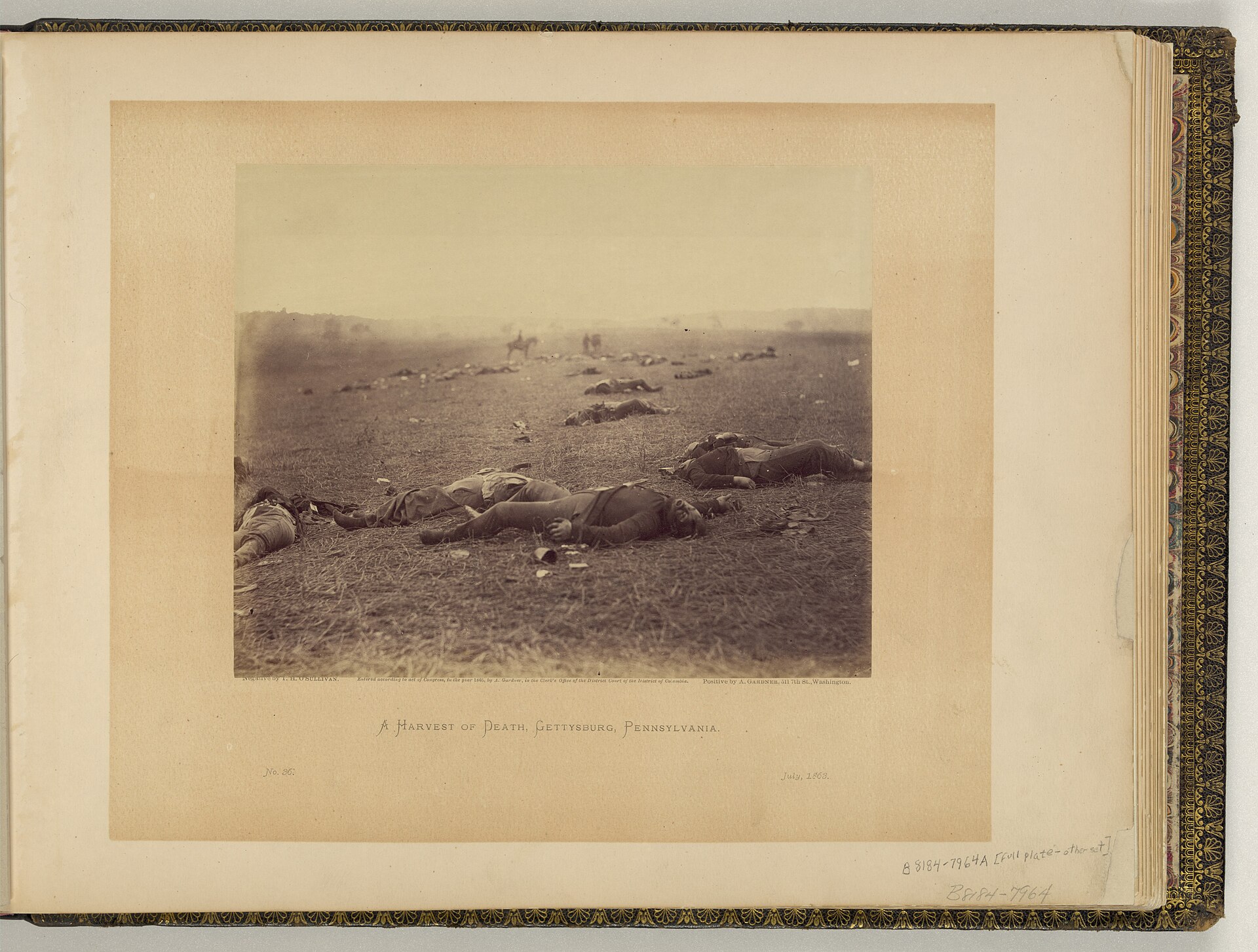
Gardner issued the picture as plate 36 of Gardner's Photographic Sketch Book of the War, two volumes of fifty mounted original prints each, published by Philp and Solomons of Washington.
Gardner issued the picture as plate 36 of Gardner's Photographic Sketch Book of the War, two volumes of fifty mounted original prints each, published by Philp and Solomons of Washington. The volumes became available to subscribers near the end of February 1866 and cost 150 dollars the pair, according to the cataloguer of a copy offered at Sotheby's in 2014. The same note records that the edition may have been as large as 200 sets, and that the scholar Anne Peterson had located evidence of 73, of which 51 were in institutions. The Met's Gilman copy of volume 1 contains fifty prints, each about 17.8 by 22.8 cm.
The set was not a commercial success. Some sources date the book 1865 and others 1866; the copyright entry on the printed mounts is 1865 and the subscription release is 1866, so both dates are correct for different acts, and this record uses 1866 for the book. In the book the picture is paired with plate 37 and the two carry contradictory captions about the same field, which is the source of the later confusion described above.
Each print was tipped in by hand, so every set holds its own prints. A printed caption leaf accompanied each plate. R&R Auction's 2023 print was sold without its extended caption sheet, which is the commonest way a loose print loses its context.
Chapter 7Where the prints are
The record sets out what has been verified.
The record sets out what has been verified. The Met holds the picture as accession 2005.100.1201, from the Gilman Collection, and as plate 36 within its volume 1 of the Sketch Book (2005.100.502.1), both purchased in 2005. The Library of Congress holds a print catalogued with digital ID ppmsca.12557 and a copy negative or copy series under reproduction number LC-B8184-7964-A. Harvard Art Museums bought a print in 2008 (2008.22). Others are reported at the Getty, the National Gallery of Art, the Museum of Modern Art, the Museum of Fine Arts Houston, the George Eastman Museum and the Smithsonian American Art Museum on the strength of search results; none of those catalogue pages could be fetched, so they are not asserted here.
Dimensions are not uniform and the differences matter to a cataloguer. Harvard gives the image as 17.3 by 22.7 cm on a mount of 31.2 by 39.9 cm. The Library of Congress print is 17.6 by 22.8 cm. R&R's print is described as 8.75 by 6.75 inches on a mount of 15.75 by 12 inches. The Met's record for accession 2005.100.1201 gives the image as 45.2 by 57.2 cm and the mount as 30.4 by 39.7 cm, which cannot be right because the mount is smaller than the image; Wikipedia repeats the 45.2 by 57.2 figure as the size of most prints. This record treats it as a conversion error in the Met's data and gives the ordinary size of 17 to 18 by 22 to 23 cm.
Chapter 8The market in prints
A print with its Sketch Book mount is a modestly priced object.
A print with its Sketch Book mount is a modestly priced object. R&R Auction sold an original albumen print mounted on a 15.75 by 12 inch card, published in the Sketch Book, with light foxing and toning and without its caption sheet, on 11 October 2023. The estimate was 800 dollars and up and the result was 916 dollars including buyer's premium; the page does not break out the premium or give the hammer price. Cowan's offered a late print, described as produced about the 1890s or after, with a 500 to 700 dollar estimate, on 17-18 November 2017; the result is not shown on the page retrieved.
For a comparison from the same book, Brunk Auctions sold plate 44, Slaughter Pen, Foot of Round Top, on 23 April 2026 for 2,600 dollars excluding buyer's premium against an estimate of 3,000 to 5,000 dollars, on 11 bids. That is a different picture and it is cited only to show that single plates from the set sell in the low thousands of dollars at most when they sell. A complete set is another matter: Sotheby's estimated a presentation copy of the two volumes at 100,000 to 150,000 dollars in 2014, and the page retrieved does not state the result. No sale of this plate above 1,000 dollars was found.
Chapter 9What the picture had to do with the Antietam photographs
Nothing documentary links the two campaigns except the public that bought them.
Nothing documentary links the two campaigns except the public that bought them. Oliver Wendell Holmes wrote in the July 1863 Atlantic Monthly that those who wished to know what war is should look at the Antietam series, which he attributed to Brady's gallery, and called the sight of the pictures a commentary on civilization of the kind a savage might triumphantly show to missionaries. The essay was published before the Gettysburg negatives existed and does not mention Gettysburg. Its value to a reader of this record is to show that when Gardner photographed the Gettysburg dead there was already a public that had been taught to read the dead as an argument. Gardner's own prefatory language for plate 36, which calls the scene the blank horror and reality of war in opposition to its pageantry, is the same argument made in his words.
Chapter 10A contested print: the sky and the horse
One recent argument holds that part of the picture was made in the darkroom.
One recent argument holds that part of the picture was made in the darkroom. John Cummings, writing on a personal blog in June 2015, said that on three surviving prints (at Cornell, the Library of Congress and the Chrysler Museum) pencil marks define a false horizon, that the sky was burned in below a mask, and that a standing figure and a riderless horse were begun in pencil on the print and are not real trees or sky in silhouette. He does not claim that Frassanito reached this conclusion. It is a single author's observation on prints, not a published conservation or imaging study, and no scholar named in this record endorses it. It is recorded because the question can be tested: an examination of the negative, if it can be found, would show whether the retouching is on the glass or on the print.
Chapter 11What is still unresolved
Four questions remain open. Where the negative is: the Library of Congress holds a copy series and a print, and no source consulted says that O'Sullivan's glass plate for this view survives.
Four questions remain open. Where the negative is: the Library of Congress holds a copy series and a print, and no source consulted says that O'Sullivan's glass plate for this view survives. Where exactly the dead lay, and on which day: Frassanito's Rose farm location, Coates's Spangler farm location and Haskew's McPherson's Woods all appear in print. Whether the retouched sky is on the negative or only on prints. And who the men were: the Third Corps badge narrows the field to one corps without naming anyone.
The artist
Timothy H. O'Sullivan
O'Sullivan was born about 1840 and died of tuberculosis on Staten Island on 14 January 1882. As a teenager he worked for Mathew Brady, then for Alexander Gardner, and in July 1863 he photographed Gettysburg for Gardner. This is the photograph by which he is most often known, though most of his later work was in the American West.
Related works
| Work | Relation | Where it is |
|---|---|---|
| Field Where General Reynolds Fell, Gettysburg Timothy H. O'Sullivan | Plate 37 of the Sketch Book; Frassanito showed it is the same group of dead photographed from the opposite side Gardner's text labels these dead Union and the text of plate 36 labels them Confederate. | Metropolitan Museum of Art (2005.100.502.1 (37)); Library of Congress copy LC-B8171-0234 |
| Home of a Rebel Sharpshooter Alexander Gardner, with O'Sullivan credited in the literature | A different picture from the same days at Gettysburg, plate 41; its body was moved and posed. Not to be conflated with this record. See the record gardner-home-of-a-rebel-sharpshooter. | Library of Congress; National Archives |
| A Sharpshooter's Last Sleep Alexander Gardner | Plate 40; the same dead soldier before he was moved A different picture; the staging dispute belongs to this series, not to A Harvest of Death. | National Archives; Smithsonian |
| Gardner's Photographic Sketchbook of the War, Volume 1 Alexander Gardner and others | The album that contains plate 36 Fifty prints; the Met's copy is the Gilman volume. | Metropolitan Museum of Art (2005.100.502.1 (1-50)) |
| Slaughter Pen, Foot of Round Top, Gettysburg O'Sullivan and Gardner | Plate 44 of the same book; a market comparison USD 2,600 excluding premium. | Sold at Brunk Auctions, 23 April 2026 |
| Antietam photographs of 1862 Gardner, Gibson and others, shown at Brady's gallery | A different campaign; the subject of Holmes's July 1863 essay Not this picture and not by this team at this place. | Various |
Open questions
- Does the original glass negative survive, and where is it? No source consulted places it; the Library of Congress holds a copy series and a print.
- On what day and at what exact place was the negative exposed? Frassanito's Rose farm and Emmitsburg Road location, Coates's Spangler farm location with a 5 July date, and the McPherson's Woods placement in popular accounts all appear in print.
- Why did Gardner's book label the dead on plate 36 Confederate and the same dead on plate 37 Union? Frassanito corrected the identification; his reasons for the original captions are not documented in the sources consulted.
- Is the sky on the surviving prints retouched on the negative or on each print, as Cummings argues? Only an examination of the negative or a comparison of several prints under magnification would show.
- Who were the men in the picture? The Third Corps badge identifies a corps, not a person, and no individual has been named.
- How many prints survive and what did each sell for? The Sotheby's note counts sets of the book, not prints of this plate, and the market data found here is two sales and one comparison.
- What did Gardner's 1863 sales catalogue say about this view, and who did it credit? The catalogue was not available to this research.
Questions about this object
What is A Harvest of Death, Gettysburg, Pennsylvania?
A Harvest of Death, Gettysburg, Pennsylvania is a photograph, dated july 1863 (negative); print 1865-66; published 1866. Medium: Albumen silver print from a wet collodion glass negative.
Who made A Harvest of Death, Gettysburg, Pennsylvania, and is the attribution settled?
The attribution to Timothy H. O'Sullivan is recorded here as accepted. Museum catalogues credit the negative to Timothy H. O'Sullivan and the print to Alexander Gardner; the printed mount of the Harvard print says so. Gardner entered the copyright in his own name in 1865.
Where is A Harvest of Death, Gettysburg, Pennsylvania now?
Metropolitan Museum of Art, New York (and other collections). Inventory number Met 2005.100.1201; Harvard 2008.22; Library of Congress ppmsca.12557. Last confirmed 15 November 2026. Museum catalogue records.
What has A Harvest of Death, Gettysburg, Pennsylvania sold for?
Hammer Not published on the page retrieved; with premium, Included in the total; amount not stated. R&R Auction, Fine Autograph and Artifacts (#676), lot 331, 2023-10-11.
What is still unknown about A Harvest of Death, Gettysburg, Pennsylvania?
Does the original glass negative survive, and where is it? No source consulted places it; the Library of Congress holds a copy series and a print.
Sources
- 1Wikipedia, 'A Harvest of Death'. en.wikipedia.org/wiki/...
- 2Library of Congress, 'The Case of Confused Identity', Does the Camera Ever Lie?, Civil War Glass Negatives and Related Prints, Articles and Essays. Gives plates 36 and 37, reproduction numbers LC-B8184-7964-A and LC-B8171-0234, Gardner's plate text and Frassanito's analysis, pp. 222-229. loc.gov/static/...
- 3Metropolitan Museum of Art, open access record, 'A Harvest of Death, Gettysburg, Pennsylvania', Timothy H. O'Sullivan, accession 2005.100.1201, Gilman Collection, Museum Purchase, 2005 (object 285644). collectionapi.metmuseum.org/public/...
- 4Metropolitan Museum of Art, open access record, 'Gardner's Photographic Sketchbook of the War, Volume 1', accession 2005.100.502.1 (1-50), Gilman Collection (object 283195). collectionapi.metmuseum.org/public/...
- 5Metropolitan Museum of Art, open access record, 'Field Where General Reynolds Fell, Gettysburg', accession 2005.100.502.1 (37), Gilman Collection (object 286882). collectionapi.metmuseum.org/public/...
- 6Wikimedia Commons, file description for the Library of Congress print (digital ID ppmsca.12557, LCCN 2006685384): negative by T. H. O'Sullivan, positive by A. Gardner, negative July 1863, print 1866, albumen print 17.6 x 22.8 cm, public domain. commons.wikimedia.org/wiki/...
- 7Encyclopedia Virginia, 'A Harvest of Death, Gettysburg, Pennsylvania' (Library of Congress image page): negative July 1863, print about 1865, albumen silver print, used in the Sketch Book (1866), two volumes, 100 mounted photographs. encyclopediavirginia.org/1050hpr_cf098226fcc7d5c
- 8Harvard Art Museums, 'A Harvest of Death', object 2008.22, Fogg Museum, Richard and Ronay Menschel Fund for the Acquisition of Photographs: albumen silver print, image 17.3 x 22.7 cm, mount 31.2 x 39.9 cm, printed mount text with 1865 copyright entry. harvardartmuseums.org/art/...
- 9Sotheby's, Photographs sale 2014 (N09130), lot 25, Gardner's Photographic Sketch Book of the War, two volumes, Philp and Solomons, 1866: essay on subscription, price and surviving sets (after Anne Peterson). sothebys.com/en/...
- 10R&R Auction, Fine Autograph and Artifacts (#676), lot 331, 'Gettysburg, A Harvest of Death, Original Albumen Silver Print', closed 11 October 2023: sold for USD 916 including buyer's premium. rrauction.com/auctions/...
- 11Cowan's Auctions via Bidsquare, American History live salesroom auction, 17-18 November 2017, lot 88, 'A Harvest of Death at Gettysburg': late print, estimate USD 500-700, result not shown on the page. bidsquare.com/online-auctions/...
- 12Brunk Auctions, 23 April 2026, lot 530, Sketch Book plate 44 'Slaughter Pen, Foot of Round Top, Gettysburg' (a different plate): estimate USD 3,000-5,000, sold for USD 2,600 excluding buyer's premium, 11 bids. Cited as a market comparison only. live.brunkauctions.com/online-auctions/...
- 13Michael E. Haskew, 'Gettysburg in Black and White', Warfare History Network. Secondary popular source; its location and unit claims conflict with the Library of Congress account and are reported here as a conflict. warfarehistorynetwork.com/article/...
- 14Gettysburg Daily, 'Historian Jerry Coates: Harvest of Death Part 3': Coates's location argument (south of the Henry Spangler farm buildings) and his dating of the views to 5 July 1863. gettysburgdaily.com/historian-jerry-coates-harvest-of-dea...
- 15John Cummings, 'Iconic Photograph of Gettysburg Dead is a Contrivance: A Harvest of Death - Gardner's Artistry', Spotsylvania Civil War Blog, 30 June 2015. A single-author blog argument about darkroom work on the sky of the print; not peer reviewed. spotsylvaniacw.blogspot.com/2015/...
- 16Emerging Civil War, 'Uncovering Fake News at the Battle of Gettysburg, July and November, 1863' (14 August 2024): dates of the Gardner and O'Sullivan work, 6 July 1863 start, and the staged sharpshooter series. emergingcivilwar.com/2024/...
- 17Oliver Wendell Holmes, 'Doings of the Sunbeam', Atlantic Monthly, vol. 12, no. 69 (July 1863), part 2 as reproduced in the Photo Criticism archive of historic texts. Discusses the Antietam photographs; does not mention Gettysburg. nearbycafe.com/photocriticism/...
- 18US National Archives, Prologue blog, 'The true story behind the Gettysburg sharpshooter' (20 June 2013, Bruce Bustard): Gardner and O'Sullivan arrived at Gettysburg on 5 July 1863. prologue.blogs.archives.gov/2013/...
- 19Wikipedia, 'Timothy H. O'Sullivan'. en.wikipedia.org/wiki/...
- 20Wikimedia Commons API search and licence metadata for the files listed in images (licence read per file from LicenseShortName; Met files CC0, Library of Congress and Google Art Project files public domain). commons.wikimedia.org/w/...

Last verified · Published
Change log
15 November 2026 - Record created at the house standard: researched narrative, technical evidence, maker dossier, graded provenance chain, prices with hammer and premium separated, related works, open questions and sources.