Interior of the Secundra Bagh after the Slaughter of 2,000 Rebels by the 93rd Highlanders and 4th Punjab Regiment
Felice Beato · 1858
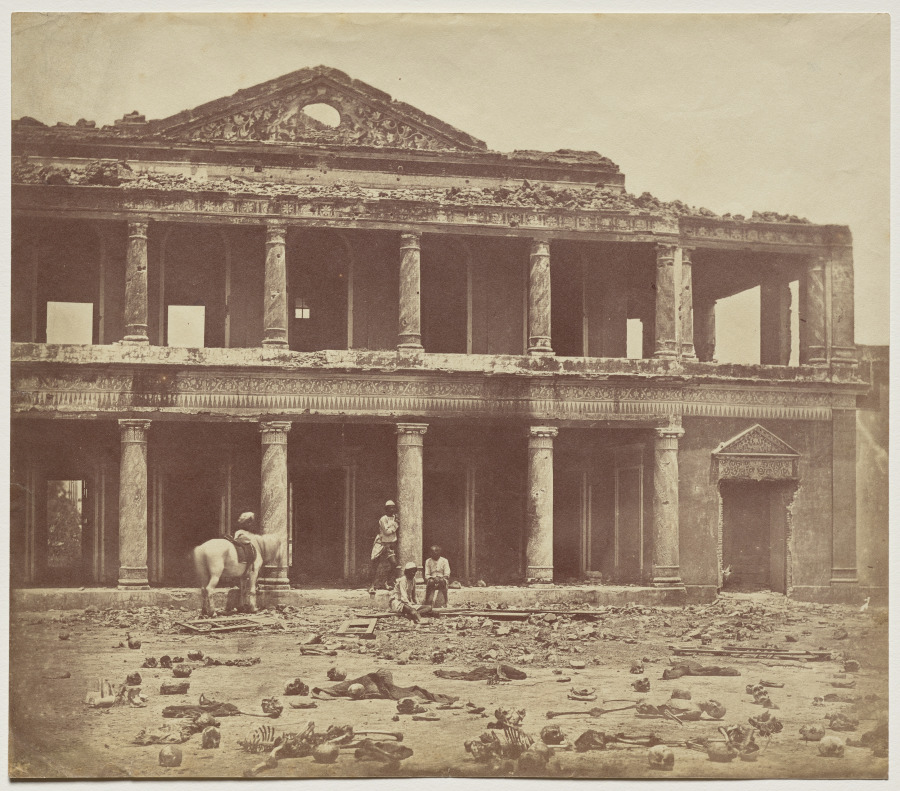
The record subject. Albumen print, 25.4 x 30.5 cm, 1858, by Felice Beato. Cleveland Museum of Art, 2019.170.3, Severance and Greta Millikin Purchase Fund, CC0.
| Artist | Felice Beato |
|---|---|
| Date | 1858 |
| Medium | Albumen print |
| Dimensions | Image: 25.4 x 30.5 cm (10 x 12 in.) |
| Where it is now | Cleveland Museum of Art, Cleveland, Ohiolast confirmed |
| Inventory number | 2019.170.3 |
| Attribution | AcceptedCatalogued by Cleveland as by Felice A. Full note |
| Object type | Photograph |
| Period | British, 19th century (Indian Rebellion of 1857-58) |
| Cases | Has a provenance gap |
| Inscriptions | None recorded by Cleveland. |
| Owners on record | 10 links7 documented, 3 unknown |
| Sources | 30 cited |
About this record Last verified · 30 sources cited · Change log
On this page 10 sections
ContentsClose
A single albumen print of 1858 by Felice Beato, showing the courtyard of the Sikandar Bagh in Lucknow, where Indian soldiers were killed by the 93rd Highlanders and the 4th Punjab Infantry on 16 November 1857. Cleveland bought it in 2019 as 2019.170.3, one of a set of 38 Beato prints of Lucknow, from the London dealer Prahlad Bubbar.
The picture is known for the skulls and bones in the foreground. Museum notes and scholars say Beato may have had them uncovered, scattered or rearranged; the two eyewitness texts usually cited for this, by Sir George Campbell and William Howard Russell, are examined here and say less than the summaries of them. The set's own history is better documented than the print's: Sir William Russell, 2nd Baronet, then Christie's in 1993 (GBP 8,050 for 38 prints) and again in 2001 (GBP 11,162).
Several prints of the view are in other collections, and their captions, sizes and numbers differ. This record assigns to the Cleveland print only what a source ties to 2019.170.3.
Provenance
Each link is graded. Documented: a cited source supports it. Disputed: the identification is argued but not established. Unknown: no owner for that span, and the gap is not smoothed into a narrative. The grades in the glossary.
- March 1858 -Felice Beato, Lucknowdocumented
Negative made at the Sikandar Bagh, Lucknow. The British Library cites Fraser (1981) for March 1858; Harrington gives Beato's arrival at Lucknow as late March 1858. Cleveland dates the print 1858. The date the Cleveland print itself was made is a separate and unrecorded fact (see next link).14231
- 1858 -Maker of this particular print (Beato's studio, or Henry Hering if printed in 1862)unknown
Cleveland records 1858 only. The Getty credits Hering with printing a number of its Lucknow views in 1862. No source ties 2019.170.3 to either.
- Sir William Russell, 2nd Baronetdocumented
Named as first owner in Cleveland's six-entry provenance and in the 2001 Christie's lot page, which adds 'by descent'. No date, document or means of acquisition is given. The identification with the 7th Hussars officer (1822-1892) is an inference from the name and his Lucknow service.2369
- - 1993By descent to the estate of Lady Jewel Magnus-Allcroftunknown
The 2001 Christie's provenance line says 'by descent' and names the 1993 consignor as 'the late Lady Jewel Magnus-Allcroft'. The intermediate owners between Russell (died 1892) and Lady Magnus-Allcroft are not given.67
- 20 October 1993 - 1993Christie's, London (Photographs sale 5055, lot 70)documented
38 light albumen prints, each about 10 x 12 in., numbered in pencil or ink on the verso; estimate GBP 6,000 to 8,000, price realised GBP 8,050. Hammer and premium are not separated. Cleveland lists this sale without lot or price.53
- 1993 - 2001Buyer at the 1993 sale; possibly the Kanwardip Gujral collectionunknown
The 2001 sale was titled for the Gujral Collection and the set appears in it, which suggests but does not prove that Kanwardip Gujral bought it in 1993. No source names the buyer.
- 27 September 2001 - 2001Christie's, London (19C Indian Photographs from the Kanwardip Gujral Collection, sale 6455, lot 74)documented
38 albumen prints, 1858, each about 10 x 12 in. (25.4 x 30.5 cm), numbered on the verso; estimate GBP 8,000 to 12,000, price realised GBP 11,162, to an order bidder per iPhotoCentral. Hammer and premium are not separated. The identity of these 38 with Cleveland's 38 is inferred from count, size and named owners.683
- 2001 - 2019Private collection, United Kingdomdocumented
Cleveland's own entry. The owner is unnamed; whether the order bidder of 2001 is the same party is not recorded.3
- 2019 - 9 September 2019Prahlad Bubbar Indian and Islamic Art, Londondocumented
Cleveland's own entry. The price is not published.3
- 9 September 2019 - presentCleveland Museum of Art, Cleveland, Ohiodocumented
Severance and Greta Millikin Purchase Fund, 2019.170 (38 prints), the print here being 2019.170.3. Accession date 9 September 2019 per the API. Reproduced in Tannenbaum, Acquisitions 2019: Photography, Cleveland Art 60, no. 2 (March/April 2020), p. 25. Not on view.1234
Prices realised
Prices below are for the 38-print set of which Cleveland's print is understood to be one (the identity is inferred, see the provenance chain), not for the single print. Every figure is a price realised as published; none of the sources separates hammer from premium, so they are not treated as hammer prices. Other prices in the market for Beato's Lucknow views are for other prints.
| Date | Sale | Estimate | Result | Note |
|---|---|---|---|---|
| 20 October 1993 | Christie's, London | GBP 6,000 - 8,000 | Hammer Not published With premium Included in the price realised; not itemised GBP | Photographs sale 5055, lot 70, India after the Siege of Lucknow, 1857-58, 38 light albumen prints. Price realised GBP 8,050 (derived: about GBP 212 a print). Buyer unknown. |
| 27 September 2001 | Christie's, London | GBP 8,000 - 12,000 | Hammer Not published With premium Included in the price realised; not itemised GBP | Sale 6455, 19C Indian Photographs from the Kanwardip Gujral Collection, lot 74, Lucknow after the Siege, 38 albumen prints. Price realised GBP 11,162 (derived: about GBP 294 a print), to an order bidder. The lot page notes VAT at 17.5 per cent on the buyer's premium; iPhotoCentral says its figures include premium. |
Hammer is the price at which the bidding stopped; with premium adds the fee the house charges the buyer on top. Hammer price and buyer's premium in the glossary.
Technical evidence
| Attribution note | Catalogued by Cleveland as by Felice A. Beato. Whether James Robertson worked with Beato on the Lucknow series is discussed in the sources (the 1993 Christie's lot essay thought it possible; Harrington says it is unclear; Wikipedia says it is generally accepted that Robertson did not go to India) and is open. |
|---|---|
| Object | Albumen print, Lucknow After the Siege series, accession 2019.170.3 (one of 38 items in 2019.170)13 |
| Medium | Albumen print (Cleveland). Whether the sheet is a lightly albumenized or an albumen paper, its toning and any mount are not recorded in the sources found.12 |
| Image size | 25.4 x 30.5 cm (10 x 12 in.), the museum's figure for the image; the same figure is given for all 38 prints of the album, so it is likely nominal.126 |
| Negative process | Not stated by Cleveland; Khorakiwala's page says the collodion process preserved the bone fragments, which implies wet collodion on glass.24 |
| Inscriptions | None recorded by Cleveland. The Christie's lot pages say the prints of the 38-print set are numbered in pencil or ink on the verso; no number is tied to 2019.170.3.256 |
| Series title | Lucknow After the Siege (Cleveland). Getty uses Lucknow - After the Mutiny for its set; Christie's 1993 used India after the Siege of Lucknow, 1857-58.1512 |
| Date | 1858 (Cleveland). British Library, citing Fraser, dates the exposure to March 1858; Getty dates its Beato and Hering prints 1858-1862, with the Hering printing in 1862.11214 |
| Rights | Public domain and Open Access under the museum's Open Access Initiative; CC0 recorded by the Cleveland API (share_license_status), no Nazi-era provenance flag.12 |
| Acquisition | Severance and Greta Millikin Purchase Fund, accessioned 9 September 201923 |
| Location | Cleveland Museum of Art; not on view1 |
Images
The record in full
Chapter 1A single albumen print, one of 38 in a set Cleveland bought in 2019
This record describes one object: the albumen print accessioned as 2019.170.3 in the Cleveland Museum of Art, titled by the museum Interior of the Secundra Bagh after the Slaughter of 2,000 Rebels by...
This record describes one object: the albumen print accessioned as 2019.170.3 in the Cleveland Museum of Art, titled by the museum Interior of the Secundra Bagh after the Slaughter of 2,000 Rebels by the 93rd Highlanders and 4th Punjab Regiment and dated 1858. Cleveland gives the image size as 25.4 by 30.5 cm (10 by 12 in.) and catalogues it under the series title Lucknow After the Siege. It is one of 38 numbered items in the album-level record 2019.170, bought with the Severance and Greta Millikin Purchase Fund and accessioned on 9 September 2019. The museum lists it as not on view, with no exhibition history and no curatorial description on its object page. Its alt text describes a ruined two-storey palace with shattered pediments and a courtyard strewn with skulls and bones, with four men standing and sitting near a white horse.
The image field is the only dimension the museum gives, and it is the same figure, 25.4 by 30.5 cm, that it gives for all 38 prints of the set; the 2001 Christie's lot page for the 38 prints gives the same nominal 10 by 12 in. Prints of this view in other collections measure differently (see the section on other prints below), so the Cleveland figure reads as a nominal plate size rather than a measurement of this sheet. Nothing fetched for this record says what mount, if any, the print carries, whether it is signed or numbered, or what is written on its back. The Christie's lot pages state that the prints of the 38-print set were numbered in pencil or ink on the verso; no source ties a particular number to 2019.170.3. Everything about caption, mount and numbering in the sections that follow therefore belongs to other prints of the view and is reported as comparison, not as a fact about this one.
Chapter 2The place: the Sikandar Bagh and the action of 16 November 1857
The Sikandar Bagh (spelled Secundra Bagh, Secunderbagh, Sikandarbagh and Sikandrah Bagh in the sources used here) is a walled garden that Russell, who rode over to it on 12 March 1858, describes as a...
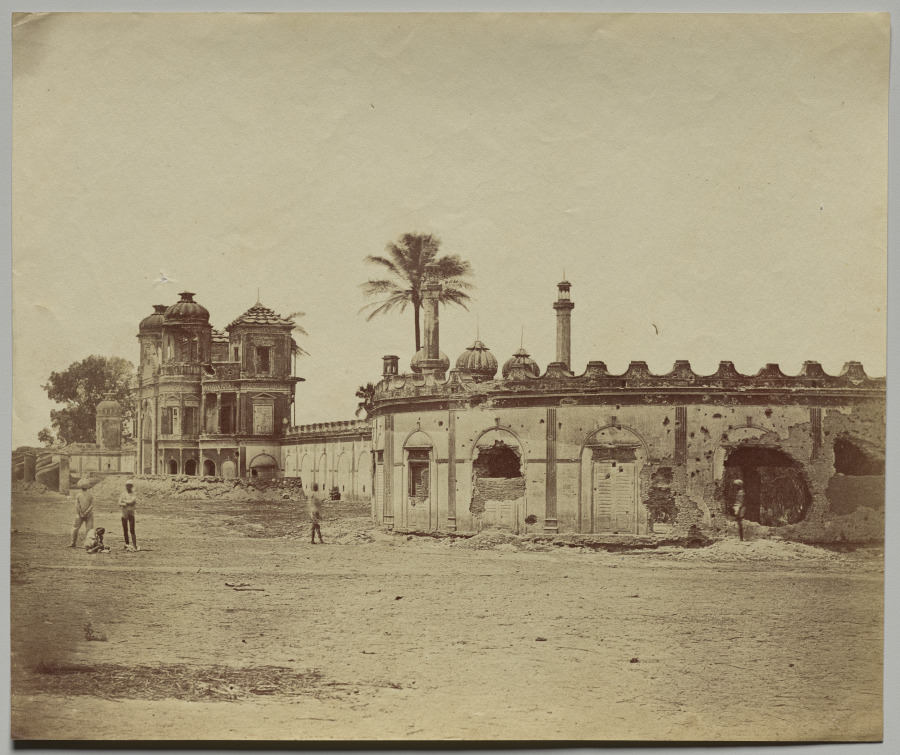
The Sikandar Bagh (spelled Secundra Bagh, Secunderbagh, Sikandarbagh and Sikandrah Bagh in the sources used here) is a walled garden that Russell, who rode over to it on 12 March 1858, describes as a large square enclosure with turrets at the angles and a garden inside with kiosks and summer-houses. It stood on the route Sir Colin Campbell, the British commander-in-chief, took to relieve the besieged Residency in November 1857. Wikipedia, which is a tertiary source and is cited here for the outline of the action, says the garden was stormed on 16 November 1857 by men of the 93rd Highlanders and the 4th Punjab Infantry, that about 2,200 Indian soldiers died inside, that the British and Punjabi dead were buried in a trench, and that the rebel dead were afterwards dragged out and lightly covered. It draws on Kaye and Malleson, Hibbert, Lord Roberts and a regimental history of the 4th Punjab. The caption on Beato's prints rounds the figure to 2,000.
The caption wording varies print by print. Cleveland and the Wellcome Collection give the regiments as the 93rd Highlanders and the 4th Punjab Regiment or Rifles. The National Gallery of Victoria print carries a label naming the 73rd Highlanders and the 24th Punjab Infantry, with the regiment names corrected in pencil. The Getty has a print captioned with the 93rd Highlanders and the 4th Panjal N.I. These are differences in the captions of other prints; Cleveland's own title is the only caption that can be assigned to 2019.170.3.
Chapter 3Beato in Lucknow, March 1858
Felice Beato (c. 1832-1909) was an Italian-born British photographer who had worked with James Robertson in Constantinople and the Crimea.
Felice Beato (c. 1832-1909) was an Italian-born British photographer who had worked with James Robertson in Constantinople and the Crimea. Peter Harrington, curator of the Anne S. K. Brown Military Collection at Brown University, writes in MHQ (Spring 2018) that the British War Department sent Beato to record the Mutiny, that he reached Lucknow in late March 1858 weeks after the city was retaken, and that he made more than 60 images there, including a panorama from a mosque balcony. The Brown catalogue note for its own album says he was possibly commissioned by the War Office to document damage to the buildings of Lucknow. The British Library record for its print of this view cites John Fraser's 1981 article in the Journal of the Society for Army Historical Research as showing that Beato did not make this photograph until March 1858 and not, as the caption implies, in November 1857.
Cleveland's curator of photography, Barbara Tannenbaum, writing in the museum's members' magazine Cleveland Art (March/April 2020, pp. 24-26, with this print reproduced on p. 25), says Beato arrived four months after the second siege ended, calls the Lucknow pictures among the earliest systematic photographic records of the human toll of armed conflict, and says that Interior of the Secundra Bagh may be the first war photograph to show corpses. The Getty's exhibition text for its own print says Beato arrived about four months after the November killing, by which time vultures had stripped the bodies. These accounts do not agree on what the four months are counted from, and the Cleveland essay is hedged with the word may.
Chapter 4The bones: what is claimed, by whom, and what the texts say
The claim that Beato arranged the remains in this view is repeated in museum labels and encyclopaedia entries, often without a named source.
The claim that Beato arranged the remains in this view is repeated in museum labels and encyclopaedia entries, often without a named source. It is worth separating who says what.
The Getty Research Institute's online exhibition text for print 84.XO.1168.7 reports that Beato had the skeletons of the rebels scattered about to meet the public's appetite for images of savage conflict. The Getty Museum's own entry for print 2007.26.208.7, as reproduced on Google Arts and Culture, says historians believe Beato and his assistants may have rearranged some of the skeletons in the foreground to heighten the dramatic effect. The British Library record, summarising Fraser, says the remains appear to have been uncovered beforehand for dramatic effect. The Brown catalogue note says Sir George Campbell, a British official, wrote in his memoirs that Beato probably had the bones uncovered, and sets beside it a statement that William Howard Russell of The Times saw many skeletons still lying about in April 1858. Wikipedia and the Hoax Photo Database, both tertiary, repeat the claim in the stronger form that Beato had the bones dug up and scattered.
The two eyewitness texts can be read directly, and they say less than the secondary summaries. In Campbell's Memoirs of My Indian Career (1893), volume 2, chapter 7 on Oude, pp. 3-4, Campbell recalls a photographer in attendance at Lucknow taking the scenes and says one very horrible scene was the Shah Najaf, where the great pile of bodies had been decently covered over before the photographer could take them, but the photographer insisted on having them uncovered before they were finally disposed of. In the pages read for this record the passage names neither Beato nor the Sikandar Bagh. Harrington reaches the same reading: he writes that Campbell's account concerns the Shah Najaf, a different site. The Cleveland album includes two prints titled for that mosque (2019.170.34 and 2019.170.38).
Russell's My Diary in India in the Year 1858-9 (1860), volume 1, has an entry that the printed text heads 12 March 1858, in which he rides to the Secunderbagh, finds the 53rd Regiment huddled in one corner away from the smell of the rotting bodies of the sepoys killed there, and walks as far as he can among the skeletons. That is the date Harrington gives for the same diary. The text read here does not contain an April 1858 statement of the kind Brown reports, and the two dates are left as the sources give them. A third passage in the same diary, volume 2, records Russell dining at Cawnpore on 18 October with a Mr. Beato, described as a well-known photographer formerly with Robertson of Constantinople, which fixes Beato in the Mutiny country in 1858 but says nothing about this picture.
The result is a disputed question with three distinct positions, none arbitrated here. One position, in the Getty Research Institute text, is that Beato had the skeletons scattered. A second, in the Getty Museum entry and the British Library note, is that the remains were uncovered or rearranged for the picture. A third, in Harrington, is that most bones were probably buried by the time Beato arrived, that this led to the accusation that he faked the scene, and that the two eyewitnesses usually cited do not settle it. Gernsheim, Ritchin, Chaudhary, Pinney, Hannavy and Harris were not read for this record and no position is assigned to them here. Fraser (1981) is cited only as the British Library note summarises him, and Khorakiwala (2013) only as her own web page describes the essay.
Chapter 5How the picture has been read
Later readings are kept apart from what the picture was made for.
Later readings are kept apart from what the picture was made for. Ateya Khorakiwala, in Thresholds 41 (2013), reads the photograph as a war ruin strewn with debris and places it in the picturesque tradition of image-making in India, noting that the collodion process preserved the bone fragments. The Getty Research Institute reads the picture against the market for images of violence. Tannenbaum, writing for Cleveland, says the bare, dismembered skeletons in a normally peaceful garden and villa convey the slaughter and the completeness of British victory, and that Lucknow, the site of two lengthy sieges, became an iconic symbol of British resolve. The Getty's Google Arts and Culture text adds the rumour that rifle cartridges were greased with pork and beef lard as a cause of the revolt. Each is a statement about how the image works, made by a scholar or a museum, and none is a statement of Beato's own purpose, for which no letter or note was found in the sources used.
No hidden programme was found and none is asserted. The documented function of the print was ordinary for its moment: an Indian view of a famous British action, sold and exhibited in Britain.
Chapter 6A set of views, a catalogue number and many captions
The British Library's record places its print as No.
The British Library's record places its print as No. 13 in Beato's published catalogue of Lucknow and Cawnpore views and gives the caption as Interior of the Secundra Bagh after the slaughter of 2,000 rebels, first attack of Sir Colin Campbell in November 1857. The Canadian Centre for Architecture print is numbered 13 in graphite on the recto and carries a verso inscription that reads No 12 [sic]. A Bonhams lot sold in 2020 numbers its Secundra Bagh view L12. The numbers differ between prints and none is recorded for 2019.170.3.
The record of one print has also been catalogued under the wrong building: the Victoria and Albert Museum's print PH.2086-1905 is titled as the Sikandra Bagh but its physical description says it shows the Bada Imambada, and the museum record does not explain the difference. Any index that searches by title alone can attach details from one of these records to another print. Cleveland's own file for 2019.170.3 gives no inscription, no caption beyond its title, and no state or edition.
Chapter 7How the views reached Britain
Harrington writes that Beato saw a chance to profit by supplying real photographs in place of the imagined scenes produced by printmakers and painters, and that the Photographic Society of London...
Harrington writes that Beato saw a chance to profit by supplying real photographs in place of the imagined scenes produced by printmakers and painters, and that the Photographic Society of London showed 26 of his Lucknow photographs, including the panorama, in February 1859, a show that the Photographic News and the Journal of the Photographic Society praised and that Queen Victoria is reported to have taken an interest in. He also quotes an 1862 reviewer who described the scene as strewn with dried corpses and stark skeletons. The Getty's checklist for its Lucknow prints credits Henry Hering (1814-1893) as printer for a number of them and dates the Hering prints to 1862, which is why Getty gives the album as Beato and Hering, 1858-1862, in contrast to the single 1858 date Cleveland gives. Wikipedia, tertiary, says Beato sold some 400 photographs of India and China to Hering in the winter of 1861-62.
Cleveland dates 2019.170.3 to 1858 and does not say whether it was printed in 1858 or later. No source tied this print to Hering or to the 1858-59 exhibition prints.
Chapter 8The Beato-Robertson question
Robertson, Beato and Co. was formed in Constantinople, possibly in 1853 or 1854 according to Wikipedia, and Robertson was Beato's brother-in-law, which is part of why the two names travel together.
Robertson, Beato and Co. was formed in Constantinople, possibly in 1853 or 1854 according to Wikipedia, and Robertson was Beato's brother-in-law, which is part of why the two names travel together. The Christie's 1993 lot essay for the 38-print set says Beato is known to have been in India with James Robertson, then official photographer to the British military forces, and that although the series is generally credited to Beato it is possible the two worked together. Harrington writes that it is unclear whether Robertson went to India and that he is credited with some Mutiny photographs exhibited in England later in 1858. Wikipedia says there is no hard evidence Robertson went to India and that it is now generally accepted he did not. Cleveland credits Beato alone.
Chapter 9The chain of ownership: the Russell album, two Christie's sales and a London dealer
Cleveland records six links for the album and repeats them on the page for 2019.170.3: Sir William Russell, 2nd Baronet, with no date; Christie's London on 20 October 1993; Christie's London on 27...
Cleveland records six links for the album and repeats them on the page for 2019.170.3: Sir William Russell, 2nd Baronet, with no date; Christie's London on 20 October 1993; Christie's London on 27 September 2001; a private collection in the United Kingdom from 2001 to 2019; the London dealer Prahlad Bubbar Indian and Islamic Art in 2019; and Cleveland, from 9 September 2019. The museum notes that provenance on its pages may not be currently accurate.
Christie's own lot pages give the first part of this in more detail. The 1993 sale was a Photographs sale in London (sale 5055). Lot 70 was India after the Siege of Lucknow, 1857-58, 38 light albumen prints, each about 10 by 12 in., numbered in pencil or ink on the verso, estimated at GBP 6,000 to 8,000 and realising GBP 8,050. Other Beato lots in the same sale sold for GBP 9,775 (lot 67, 34 Indian and military portraits, headed as the property of the late Lady Jewel Magnus-Allcroft), GBP 1,265 (lot 68, Delhi) and GBP 6,900 (lot 69, a panorama of Delhi). The 2001 sale, 19C Indian Photographs from the Kanwardip Gujral Collection (sale 6455, 27 September 2001), offered the 38 prints again as lot 74, Lucknow after the Siege, estimated GBP 8,000 to 12,000 and realising GBP 11,162. Its provenance line reads Sir William Russell, 2nd Baronet, by descent, then Christie's London, Photographs, the Property of the Late Lady Jewel Magnus-Allcroft, 20 October 1993, lot 70. A newsletter report on the sale, iPhotoCentral no. 34 (17 October 2001), says lot 74 sold for GBP 11,162 to an order bidder and that all prices in the report include the buyer's premium. Other lots in the Gujral sale carry the same Russell provenance and the same 1993 sale, including Hodson's Horse and a group of seven Indian portraits.
Two inferences sit inside this chain and are labelled as inferences. First, the identity of the 38 prints of 1993 and 2001 with Cleveland's 38 prints of 2019.170 rests on the identical count, the identical nominal size and the identical named owners and sales; no source states it in terms and none lists the Secundra Bagh interior by title as an item of the lot. Second, the identity of Sir William Russell, 2nd Baronet, with Lieutenant-General Sir William Russell (1822-1892), who commanded the 7th Hussars at Alumbagh and Lucknow in the Mutiny and was a Member of Parliament, rests on the name and the Mutiny service; neither Christie's nor Cleveland says which Sir William Russell is meant. The descent from 1892 to Lady Magnus-Allcroft is not documented in the sources found.
Chapter 10Money and the cohort of other prints
All of the following are prices realised as published, and none separates hammer from premium.
All of the following are prices realised as published, and none separates hammer from premium. The 1993 and 2001 Christie's lot pages give a single price realised and a note that, for the 2001 sale, VAT at 17.5 per cent is added to the buyer's premium; the 2001 iPhotoCentral report says its figures include the premium. As a derived figure and not a recorded one, GBP 8,050 for 38 prints in 1993 is about GBP 212 a print and GBP 11,162 in 2001 about GBP 294 a print.
A later comparison is Bonhams London, 19 August 2020 (sale 26014, lot 159): twenty-four Beato photographs of Lucknow with two parts of a panorama, lightly albumenized prints about 240 by 300 mm, numbered in the negative, including a view numbered L12 for the Secundra Bagh, sold for GBP 16,312.50 including premium, with no hammer price given. That lot is a different group of prints; the page does not say whether its Secundra Bagh view shows the interior. A Bonhams lot of March 2022 titled for Secundra is Akbar's tomb at Secundra near Agra, a different place, and is not a comparison. Sotheby's offered a Beato album of 75 Lucknow photographs, which had appeared at Sotheby's London on 4 May 2000, at a GBP 40,000 to 60,000 estimate in a 2008 sale; the result is not shown on the page fetched.
No sale of a single Secundra Bagh interior print, with its own price, was located. Cleveland has not published what it paid Prahlad Bubbar in 2019.
Chapter 11The same view elsewhere
Prints of this view are held at the J. Paul Getty Museum (2007.26.208.7, 26.2 by 29.9 cm, from the series Lucknow - After the Mutiny, with other Getty prints credited to Beato and Hering and a...
Prints of this view are held at the J. Paul Getty Museum (2007.26.208.7, 26.2 by 29.9 cm, from the series Lucknow - After the Mutiny, with other Getty prints credited to Beato and Hering and a separately accessioned print 84.XO.1168.7); the Anne S. K. Brown Military Collection at Brown University (26.2 by 29.8 cm, in an album of 26 prints); the Wellcome Collection (569457i, sheet 25.7 by 29.9 cm, with a duplicate 574533i); the British Library (Photo 27(2), a loose print with other copy negatives B.1120 and B.9336 noted); the New Orleans Museum of Art (77.67, 25.24 by 29.85 cm); the National Gallery of Victoria (PH5-1979, 25.6 by 29.4 cm); and the Canadian Centre for Architecture (PH1982:0301:013, image 26.2 by 30.2 cm, sheet 37.3 by 48.3 cm). The Victoria and Albert Museum print is described above. A search listing shows a George Eastman Museum object of the same title, but its page was bot-blocked and is not described. These are other prints of the same negative or of copy negatives and none of them is the object of this record.
The spread of measurements, from 25.2 to 26.2 cm in height and 29.4 to 30.2 cm in width, is consistent with separately trimmed sheets. No source fetched discusses whether Beato made this view in more than one state of the negative, and the question is left open.
Chapter 12What is not known
The date this print was made, what is written on its verso, whether it ever had a mount, and its catalogue number in Beato's list are not recorded in the sources found.
The date this print was made, what is written on its verso, whether it ever had a mount, and its catalogue number in Beato's list are not recorded in the sources found. The descent from the Russell family to the 1993 sale is not documented. The buyer at the 1993 sale and the order bidder of 2001 are unnamed. The positions of the named scholars on the arranging of the bones are described above only through museum notes and the authors' own summaries, not their texts. These gaps are listed as open questions.
The artist
Felice A. Beato
Felice Beato (c. 1832-1909) is known as a pioneer of war photography. Cleveland's biography calls him a pioneer photojournalist with strong ties to Britain, born in Italy, and notes that he photographed the Crimea and the Indian Mutiny, then China, Japan, Sudan and Burma. His work in India is the source of the image in this record, and his relationship with James Robertson is the starting point for the question of who made the Lucknow pictures.
Related works
| Work | Relation | Where it is |
|---|---|---|
| Interior of the Secundrabagh after the Slaughter of 2,000 Rebels, Lucknow Felice Beato | Another print of the same view Albumen silver print, 26.2 x 29.9 cm; a different object from the Cleveland print. | J. Paul Getty Museum, 2007.26.208.7 |
| Sikandrah Bagh after the Slaughter of the Rebels by the 93rd Highlanders of 4th Panjal N.I. Felice Beato | Another print of the same view The Getty Research Institute exhibition text for this print is where the scattered-skeletons claim appears in its starkest form. | J. Paul Getty Museum, 84.XO.1168.7 |
| Interior of the Secundra Bagh after the Slaughter of 2,000 Rebels by the 93rd Highlanders and 4th Punjab Regiment. First Attack of Sir Colin Campbell in November 1857, Lucknow Felice Beato | Another print of the same view 26.2 x 29.8 cm, in an album of 26 albumen prints. | Anne S. K. Brown Military Collection, Brown University |
| Photo 27(2), The inside of the Secundra Bagh where 2000 men were killed Felice Beato | Another print; carries the Fraser note on date and remains Loose print; No. 13 in Beato's published catalogue; copy negatives B.1120 and B.9336. | British Library |
| The Secundra Bagh, Showing the Breach and Gateway Felice Beato | Same album, different view Shows the exterior of the same enclosure. Not the object described in this record. | Cleveland Museum of Art, 2019.170.37 |
| Shah Najaf and The Shah Nyjuff or Najaf Felice Beato | Same album; the site named in Campbell's memoir passage Included because the Campbell passage about uncovered bodies concerns this mosque, not the Sikandar Bagh. | Cleveland Museum of Art, 2019.170.34 and 2019.170.38 |
Open questions
- Does the verso of 2019.170.3 carry a number or inscription, and does it match the No. 13 of Beato's catalogue (British Library, CCA graphite) or the L12 of the Bonhams 2020 set? Cleveland's record lists no inscription.
- Was Cleveland's print made in 1858 or printed later, for example by Hering in 1862? No source fetched assigns this print to a printing date.
- Which Sir William Russell, 2nd Baronet, is the first owner of the set? The 7th Hussars officer of 1822-1892 fits by name and Mutiny service, but neither Christie's nor Cleveland names him.
- How did the set pass from that owner (died 1892) to the estate of Lady Jewel Magnus-Allcroft before 20 October 1993?
- Who bought lot 70 in 1993 and who was the order bidder for lot 74 in 2001? Did the Gujral collection hold the set in between? No source names the buyers.
- What do John Fraser's 1981 article (Journal of the Society for Army Historical Research, 59, pp. 51-55) and the Getty essay by Fred Ritchin say in full about the date and the arrangement of the bones? Both were read only through catalogue summaries.
- Does the Russell statement that Brown dates to April 1858 exist as a separate report in The Times, or is it the 12 March diary entry cited with another month? The diary text read for this record contains no April statement about the Secunderbagh.
- Did Beato make this view in more than one state or exposure? No source fetched says so, and the measurement spread in other collections may reflect only trimming.
Questions about this object
What is Interior of the Secundra Bagh after the Slaughter of 2,000 Rebels by the 93rd Highlanders and 4th Punjab Regiment?
Interior of the Secundra Bagh after the Slaughter of 2,000 Rebels by the 93rd Highlanders and 4th Punjab Regiment is a photograph, dated 1858. Medium: Albumen print.
Who made Interior of the Secundra Bagh after the Slaughter of 2,000 Rebels by the 93rd Highlanders and 4th Punjab Regiment, and is the attribution settled?
The attribution to Felice Beato is recorded here as accepted. Catalogued by Cleveland as by Felice A. Beato. Whether James Robertson worked with Beato on the Lucknow series is discussed in the sources (the 1993 Christie's lot essay thought it possible; Harrington says it is unclear; Wikipedia says it is generally accepted that Robertson did not go to India) and is open.
Where is Interior of the Secundra Bagh after the Slaughter of 2,000 Rebels by the 93rd Highlanders and 4th Punjab Regiment now?
Cleveland Museum of Art, Cleveland, Ohio. Inventory number 2019.170.3. Last confirmed 20 November 2026. Severance and Greta Millikin Purchase Fund, accessioned 9 September 2019. Open access CC0 per the Cleveland API (share_license_status = CC0; is_nazi_era_provenance = false), retrieved 2026-11-20. Not on view.
What is still unknown about Interior of the Secundra Bagh after the Slaughter of 2,000 Rebels by the 93rd Highlanders and 4th Punjab Regiment?
Does the verso of 2019.170.3 carry a number or inscription, and does it match the No. 13 of Beato's catalogue (British Library, CCA graphite) or the L12 of the Bonhams 2020 set? Cleveland's record lists no inscription.
Sources
- 1Cleveland Museum of Art, object page for 2019.170.3, Interior of the Secundra Bagh after the Slaughter of 2,000 Rebels (credit line, dimensions, rights, location). clevelandart.org/art/...
- 2Cleveland Museum of Art Open Access API, record for accession 2019.170.3 (id 367990): provenance entries, accession date, licence status, inscriptions, exhibitions. openaccess-api.clevelandart.org/api/...
- 3Cleveland Museum of Art, album-level record for 2019.170, Lucknow After the Siege (38 albumen prints, six provenance entries, Beato biography). openaccess-api.clevelandart.org/api/...
- 4Barbara Tannenbaum, 'Acquisitions 2019: Photography', Cleveland Art 60, no. 2 (March/April 2020), pp. 24-26, as published online by the museum. clevelandart.org/articles/...
- 5Christie's London, Photographs, 20 October 1993 (sale 5055), lot 70, India after the Siege of Lucknow, 1857-58, 38 prints, estimate and price realised. christies.com/en/...
- 6Christie's London, 19C Indian Photographs from the Kanwardip Gujral Collection, 27 September 2001 (sale 6455), lot 74, Lucknow after the Siege, 38 prints, provenance, estimate and price realised. christies.com/en/...
- 7Christie's, same Gujral sale, lot 4, Hodson's Horse, showing the same Russell provenance and the 1993 sale (lot 67, part lot). christies.com/en/...
- 8iPhotoCentral newsletter no. 34 (17 October 2001), report on the Christie's Gujral Collection sale: lot 74 and total, premium note. iphotocentral.com/news/...
- 9Wikipedia, 'Sir William Russell, 2nd Baronet' (): dates 1822-1892, 7th Hussars, Alumbagh and Lucknow. en.wikipedia.org/wiki/...
- 10Getty Research Institute, Irresistible Decay online exhibition, Beato, Sikandrah Bagh after the Slaughter of the Rebels (84.XO.1168.7), commentary on the skeletons. getty.edu/research/...
- 11J. Paul Getty Museum, Felice Beato exhibition page for Interior of the Secundrabagh after the Slaughter of 2,000 Rebels, Lucknow (2007.26.208.7). getty.edu/art/...
- 12Getty Museum, Felice Beato: A Photographer on the Eastern Road, exhibition checklist (Getty prints, Hering as printer, series title Lucknow - After the Mutiny, dimensions). getty.edu/art/...
- 13Google Arts and Culture, Getty Museum entry for Beato and Hering, Interior of Secundrabagh After the Massacre (historians believe skeletons may have been rearranged). artsandculture.google.com/asset/...
- 14British Library, Photo 27(2), The inside of the Secundra Bagh where 2000 men were killed: catalogue No. 13, Fraser research note, copy negatives. searcharchives.bl.uk/catalog/...
- 15Brown University Library, Anne S. K. Brown Military Collection, Beato Lucknow album: caption, size, Fraser, Campbell and Russell note. library.brown.edu/info
- 16Wellcome Collection 569457i, photograph of the Secundra Bagh interior, with duplicate 574533i. wellcomecollection.org/works/...
- 17New Orleans Museum of Art, 77.67, Interior of the Secundra Bagh, Lucknow, after the Indian Mutiny of 1857-1858. noma.org
- 18National Gallery of Victoria, PH5-1979, Interior of the Secundra Bagh after the slaughter of 2000 rebels by H. M. 73rd Highlanders, Lucknow, 24th Punjab Infantry. ngv.vic.gov.au/explore/...
- 19Canadian Centre for Architecture, PH1982:0301:013, Sikandarbagh Palace ruins, Lucknow (inscriptions 13 and No 12 [sic]). cca.qc.ca/en/...
- 20Victoria and Albert Museum, PH.2086-1905, Interior of the Sikandra Bagh (description refers to the Bada Imambada). api.vam.ac.uk/v2/...
- 21Sir George Campbell, Memoirs of My Indian Career, vol. 2 (London, 1893), ch. 7, 'Oude', pp. 3-4 (full text, Internet Archive). archive.org/details/...
- 22William Howard Russell, My Diary in India in the Year 1858-9 (London, 1860), vol. 1 (entry headed 12 March; the Secunderbagh, p. 314) and vol. 2 (18 October, Cawnpore, Beato named). Full text, Internet Archive. archive.org/details/...
- 23Peter Harrington (curator, Anne S. K. Brown Military Collection), 'Front Man', MHQ: The Quarterly Journal of Military History 30, no. 3 (Spring 2018), online at HistoryNet. historynet.com/front-man
- 24Ateya Khorakiwala, 'Staging the Modern Ruin: Beato's Sikander Bagh, Lucknow', Thresholds 41 (April 2013); author's web page (abstract and caption only; full text not read). cargocollective.com/ateyakhorakiwala/...
- 25Wikipedia, 'Sikandar Bagh' (): the action of 16 November 1857, units, losses, burial. en.wikipedia.org/wiki/...
- 26Wikipedia, 'Felice Beato' (): biography, Robertson, India, Hering. en.wikipedia.org/wiki/...
- 27Bonhams, Fine Books, Atlases, Manuscripts and Historical Photographs, London, 19 August 2020 (sale 26014), lot 159, Beato, twenty-four photographs of Lucknow with two parts of a panorama: GBP 16,312.50 including premium. bonhams.com/auction/...
- 28Bonhams, 2 March 2022 (sale 27372), lot 87, Beato, five views of Delhi, Secundra and Lucknow (Secundra here is Akbar's tomb near Agra): GBP 3,570 including premium. Cited only to prevent confusion. bonhams.com/auction/...
- 29Sotheby's London, Photographs 2008, lot 18, Beato, Lucknow, 1858, album of 75 photographs, estimate GBP 40,000-60,000 (result not shown on the page; provenance cites Sotheby's, 4 May 2000, lot 12). sothebys.com/en/...
- 30Hoax Photo Database (), 'Interior of the Secundra Bagh': a summary repeating the Campbell and Times accounts. hoaxes.org/photo_database/...
Last verified · Published
Change log
20 November 2026 - Record created at the house standard: researched narrative, technical evidence, maker dossier, graded provenance chain, prices with hammer and premium separated, related works, open questions and sources.