The Blacas Ewer
Shuja ibn Man'a al-Mawsili · Rajab 629 AH / April-May 1232 CE
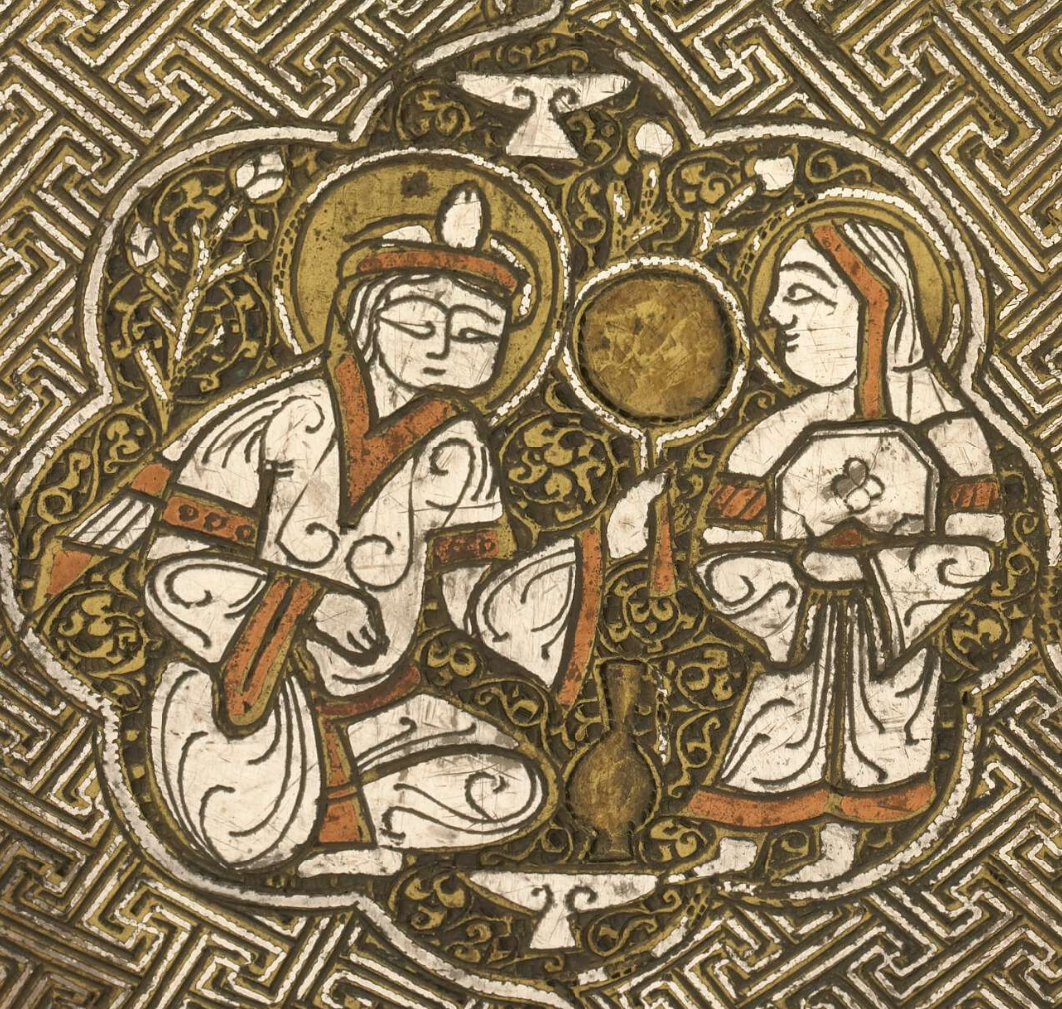
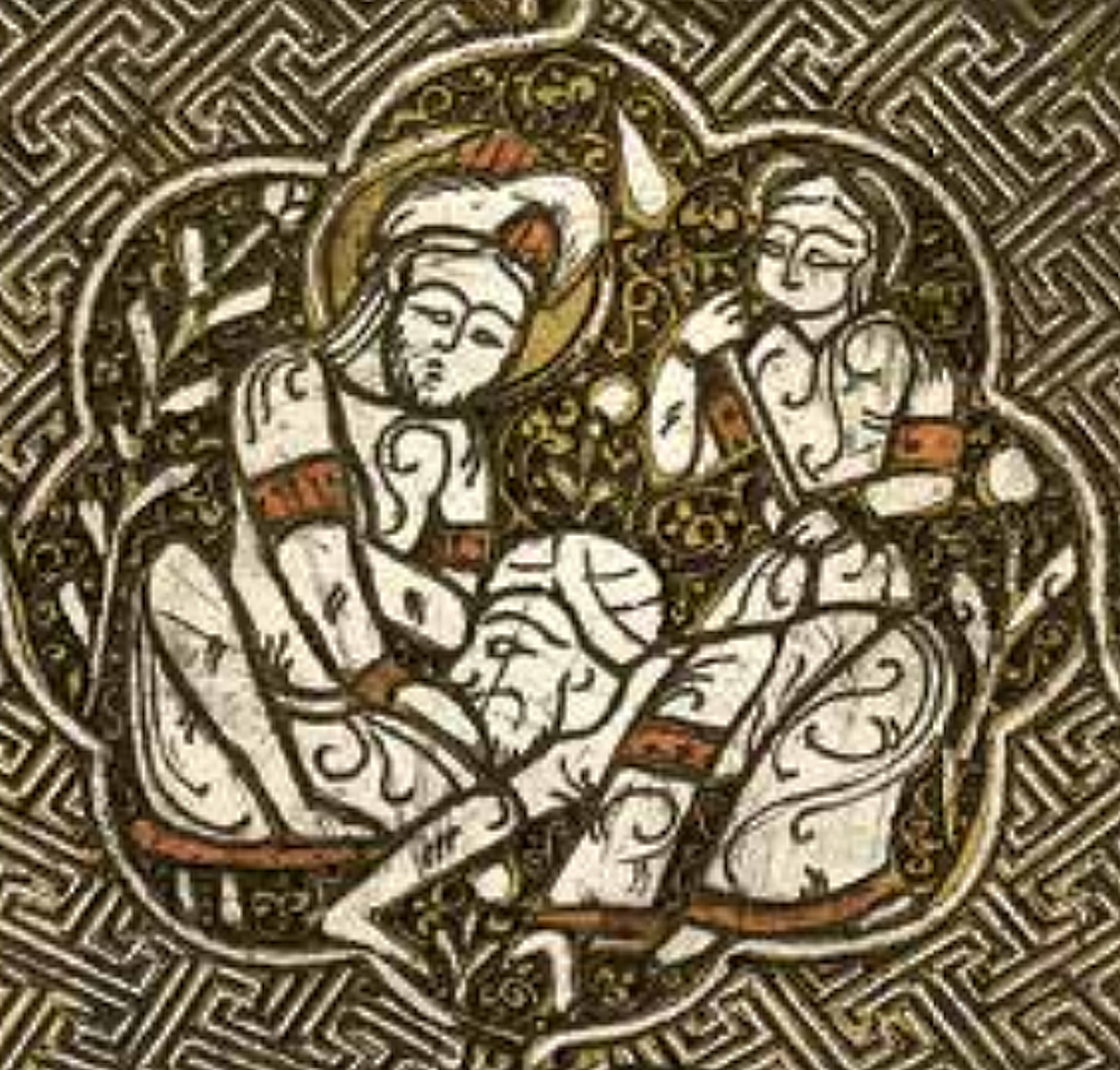
Detail of the Blacas Ewer showing a woman admiring herself in a mirror held by an attendant, one of the courtly-life medallions that cover the body. No full-object photograph of this ewer carrying a Public Domain or CC0 licence could be located on Wikimedia Commons at the time of writing; the only whole-object photographs found are licensed CC BY-SA 4.0 and are excluded from this record under the CC0/Public-domain-only image rule. This detail is used as the lead image instead because it is independently confirmed as a genuine photograph of this exact object.
| Artist | Shuja ibn Man'a al-Mawsili |
|---|---|
| Date | Rajab 629 AH / April-May 1232 CE |
| Medium | Sheet brass, hammered to a faceted body, engraved and inlaid with silver and copper |
| Dimensions | 30.4 x 22 x 21.5 cm (height x width x depth) |
| Where it is now | British Museum, Londonlast confirmed |
| Inventory number | 1866,1229.61 |
| Attribution | AcceptedSigned and dated by the maker in the inscription band on the object itself: 'Shuja ibn Man'a al-Mawsili', with the date Rajab 629 AH (April-May 1232 CE). Full note |
| Object type | Islamic metalwork |
| Period | Zengid/early Ayyubid Jazira, thirteenth century |
| Cases | Has a provenance gap |
| Inscriptions | A signature and date band naming the metalworker Shuja ibn Man'a al-Mawsili and giving Rajab 629 AH (April-May 1232 CE). The complete Arabic text and a full published English translation were not located in the sources this record was able to consult directly; see open_questions. |
| Owners on record | 5 links4 documented, 1 unknown |
| Sources | 13 cited |
About this record Last verified · 13 sources cited · Change log
On this page 9 sections
ContentsClose
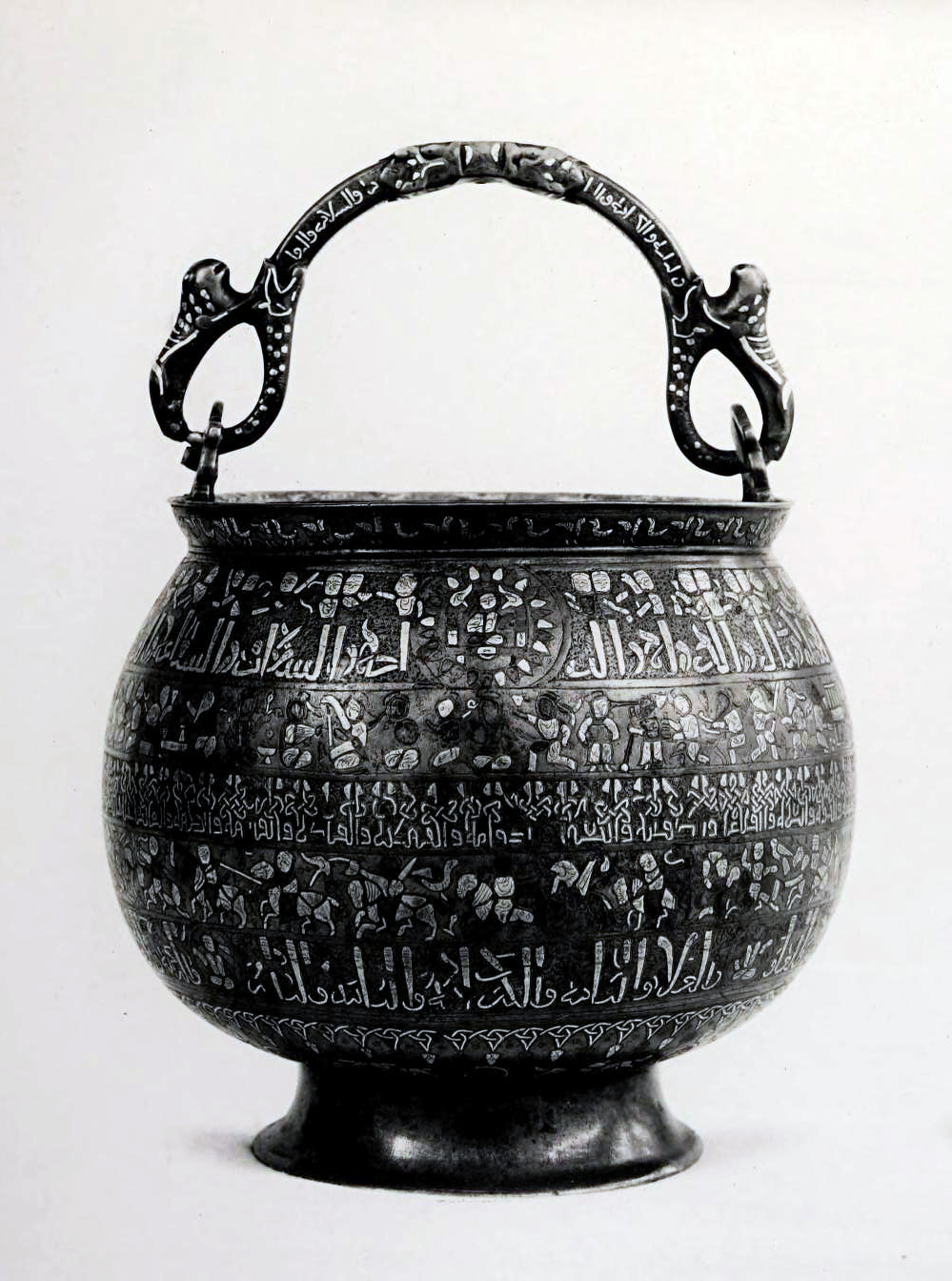
A brass ewer hammered to a faceted body and inlaid with silver and copper, made in Mosul and signed and dated by its maker, Shuja ibn Man'a al-Mawsili, to Rajab 629 AH (April-May 1232 CE). Nothing else is known of him beyond this one inscription. The ewer's medallions carry the standard courtly repertoire of the period, hunting, feasting, music and a scene from the Persian Shahnama, cut across a fretwork ground, and it is missing its original spout and foot.
It entered the British Museum in 1866-67 as part of the wholesale purchase of the Blacas family's collection of antiquities, a deal negotiated in France by Charles Newton and funded by a Parliamentary vote of just under 46,000 pounds. Its documented history before that reaches back only to a Blacas-owned publication of 1828; the roughly six centuries before that are unrecorded.
Because it combined a firm date, a named maker and an explicit Mosul origin, all on the object itself, it became one of the fixed points D.S. Rice used from 1949 onward to build the chronology now associated with the term 'Mosul school'. That category is no longer treated as settled: Julian Raby's 2012 reassessment tested the corpus attribution by attribution rather than accepting the school as a single unit, and a second Mosul-inscribed object, a pen box of 1255-56, ended this ewer's uniqueness as the sole example in 1997. What the ewer actually says, and where exactly it says it, remains only partly recovered in the sources available to this record; the maker's name and the date are certain, the full inscription text is not.
Provenance
Each link is graded. Documented: a cited source supports it. Disputed: the identification is argued but not established. Unknown: no owner for that span, and the gap is not smoothed into a narrative. The grades in the glossary.
- Rajab 629 AH / 1232 CE -Made by Shuja ibn Man'a al-Mawsili, Mosuldocumented
Date and maker are given in the object's own signed inscription. Any original patron or first owner is not named on the object and is not documented.124
- 1232 - by 1828Unknownunknown
No owner, location or transaction is documented for approximately six centuries between the ewer's manufacture and its appearance in a Blacas-owned publication.4
- by 1828 - 1866The Blacas d'Aulps family collection, most probably assembled or held at this date by Pierre-Louis de Blacas d'Aulps, 1st Duc de Blacas d'Aulps (1770/71-1839)documented
The ewer's presence in the Blacas cabinet by 1828 rests on Wikipedia's account of the ewer (citing Raby 2012), which this record read; this record independently confirmed the existence, title, publisher and date of Reinaud's 1828 catalogue of the Blacas cabinet but did not read that catalogue's text directly to confirm the ewer's specific entry. Attribution to the 1st Duc rather than his son (2nd Duc, 1815-1866, aged 13 in 1828) follows from the son's age and the catalogue's title-page attribution to 'M. le duc de Blacas', but is not itself independently documented and secondary sources are inconsistent on the two men's names; see open_questions.4679
- 1866 - 1866-67Heirs of Louis, 2nd Duc de Blacas d'Aulps (d. Venice, 1866)documented
The 2nd Duc died in Venice in 1866; his heirs sold the family's antiquities, coins, gems and vases as a single collection. Secondary literature gives the price to the family as 1,200,000 French francs; this record did not independently reconcile that figure against the sterling figures in the Parliamentary record.67
- 1866-67 - presentBritish Museum, Londondocumented
Purchased by the British Museum following an examination of the collection in France by Charles Newton. An initial government offer of 45,000 pounds was refused; the sale concluded at 48,000 pounds, reduced by 2,221 pounds for reserved duplicates, for a final recorded expenditure of 45,721 pounds, debated in the House of Commons on 18 February 1867. Registered under the Museum's Blacas-collection accession numbers; this object is 1866,1229.61.8
Technical evidence
| Attribution note | Signed and dated by the maker in the inscription band on the object itself: 'Shuja ibn Man'a al-Mawsili', with the date Rajab 629 AH (April-May 1232 CE). This is the only object known to bear his signature; nothing else survives by his hand and nothing is recorded of his life beyond this one inscription. The attribution of the ewer's commission to the ruler Badr al-Din Lu'lu' is a separate, unsigned claim and is graded 'argued', not documented, in this record. |
|---|---|
| Support and forming technique | Sheet brass, hammered to a faceted (many-sided) body rather than a smooth curve.2 |
| Decorative technique | Engraved throughout; fine silver wire set into grooved outlines, and shaped pieces of silver and copper set into cut recesses for the larger figural and geometric fields.12 |
| Dimensions | 30.4 cm high x 22 cm wide x 21.5 cm deep.23 |
| Condition | The ewer now lacks its original spout and foot. The date and circumstances of this loss are not documented in any source this record could access.14 |
| Inscription | A signature and date band naming Shuja ibn Man'a al-Mawsili and giving Rajab 629 AH (April-May 1232 CE). Exact placement on the vessel (neck versus body band) and the full inscription text were not confirmed against a source this record was able to read directly.124 |
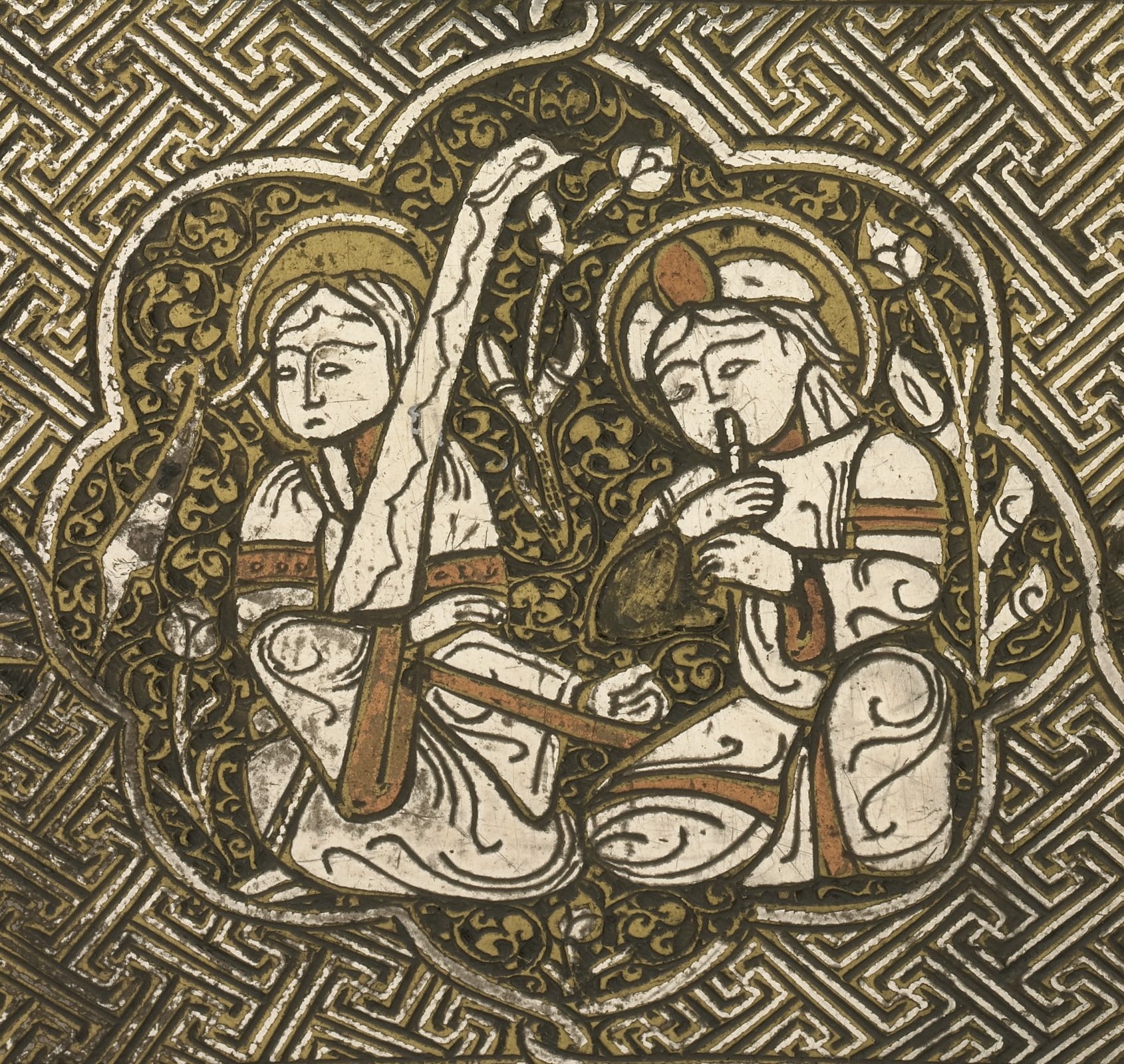
| Decorative programme | A geometric fretwork ground interrupted by figural medallions of varying size showing hunting, combat, feasting, music, a camel caravan, and a literary scene (Bahram Gur and Azadeh, from the Shahnama).124 |
| Niello | Not confirmed on this object. Niello (a black metal-sulphide inlay) was used elsewhere in Islamic metalwork of the period, but none of the sources consulted for this record documents niello, present or lost, on the Blacas Ewer specifically. Treat any such claim as unverified pending the Museum's own technical file.4 |
| Possible workshop mark | An octagonal device filled with geometric strapwork has been proposed by Julian Raby as a possible workshop or guild mark, on comparison with related motifs on other Mosul-attributed pieces. Argued, not documented.4 |
Images
The record in full
Chapter 1A signed, dated brass ewer from Mosul
The Blacas Ewer is a brass jug, 30.4 cm high, hammered to a faceted body and covered almost edge to edge with engraved and inlaid decoration in silver and copper.
The Blacas Ewer is a brass jug, 30.4 cm high, hammered to a faceted body and covered almost edge to edge with engraved and inlaid decoration in silver and copper. It is missing its original spout and foot; when or how these were lost is not recorded in any source consulted for this record. What survives is still one of the most complete and most closely studied pieces of thirteenth-century Islamic inlaid metalwork anywhere.
Its importance does not rest on rarity of form. Inlaid brass ewers of this general type were made across the Jazira and Iran in the thirteenth century. It rests on two words carved into the metal: a name and a date. The inscription band names the maker as Shuja ibn Man'a al-Mawsili and dates the work to Rajab 629 AH, April or May 1232 CE. A signed, precisely dated object from this period and region is unusual enough that this single ewer became one of the pilings on which an entire field of scholarship was built.
Chapter 2How it was made
The body was raised from sheet brass and hammered into a faceted, many-sided profile rather than left as a smooth curve, a working choice that multiplies the flat surfaces available for decoration.
The body was raised from sheet brass and hammered into a faceted, many-sided profile rather than left as a smooth curve, a working choice that multiplies the flat surfaces available for decoration. Onto this the decorator cut recesses following the design, then set fine silver wire into the grooved outlines and small shaped pieces of silver and copper into the larger recessed fields, a technique standard to Mosul-region brass of the period and requiring a separate specialist hand from the coppersmith who raised the vessel.
The wider Mosul tradition of the period is documented as using gold as well as silver inlay on brass and bronze, and some Islamic metalwork of this era also carried niello, a black metallic sulphide compound set into recesses for contrast. The sources this record was able to consult describe the Blacas Ewer's own decoration consistently as silver and copper inlay on engraved brass; none of them documents niello on this specific object, and this record does not assert it. Readers should treat any claim of niello, present or lost, on this particular ewer as unconfirmed until checked against the British Museum's own technical file.
Chapter 3The inscription and the maker
Shuja ibn Man'a al-Mawsili is known from nothing except this one signature.
Shuja ibn Man'a al-Mawsili is known from nothing except this one signature. No other work carries his name, no biographical notice mentions him, and no dates of birth or death survive. His nisba, al-Mawsili, states only that he was of Mosul, which the ewer's own findspot in scholarship independently confirms: an inscribed place and date of production, on the object itself, rather than inferred from style.
That combination, a name plus a firm date plus an explicit place, is the rarity. Most inlaid brass of the period is undated, unsigned, or both, and is placed in time and place by comparing its decoration to a small number of pieces that do carry this information. The Blacas Ewer is one of that small number, and for a long stretch of the twentieth century it was treated as the single most load-bearing example.
Chapter 4The decorative programme
The surface is organized as a geometric fretwork ground interrupted by small and large multi-lobed medallions, each carrying a figural scene.
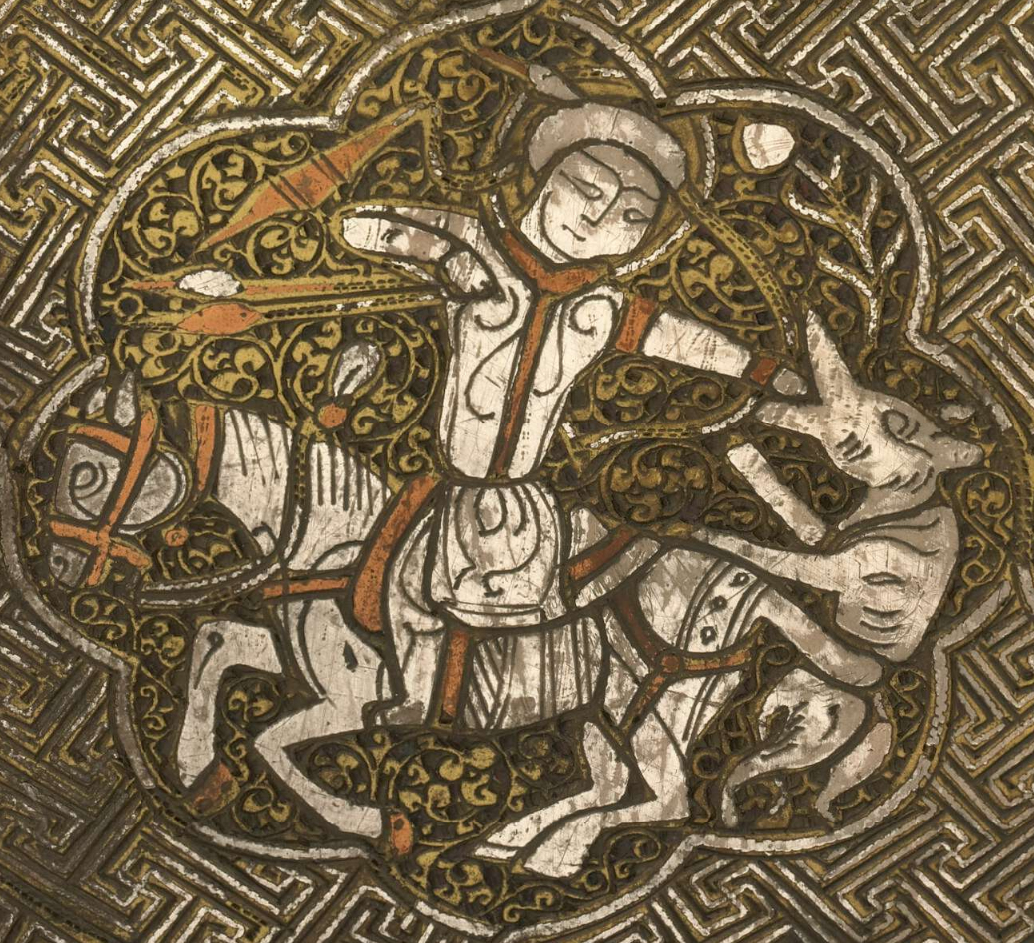
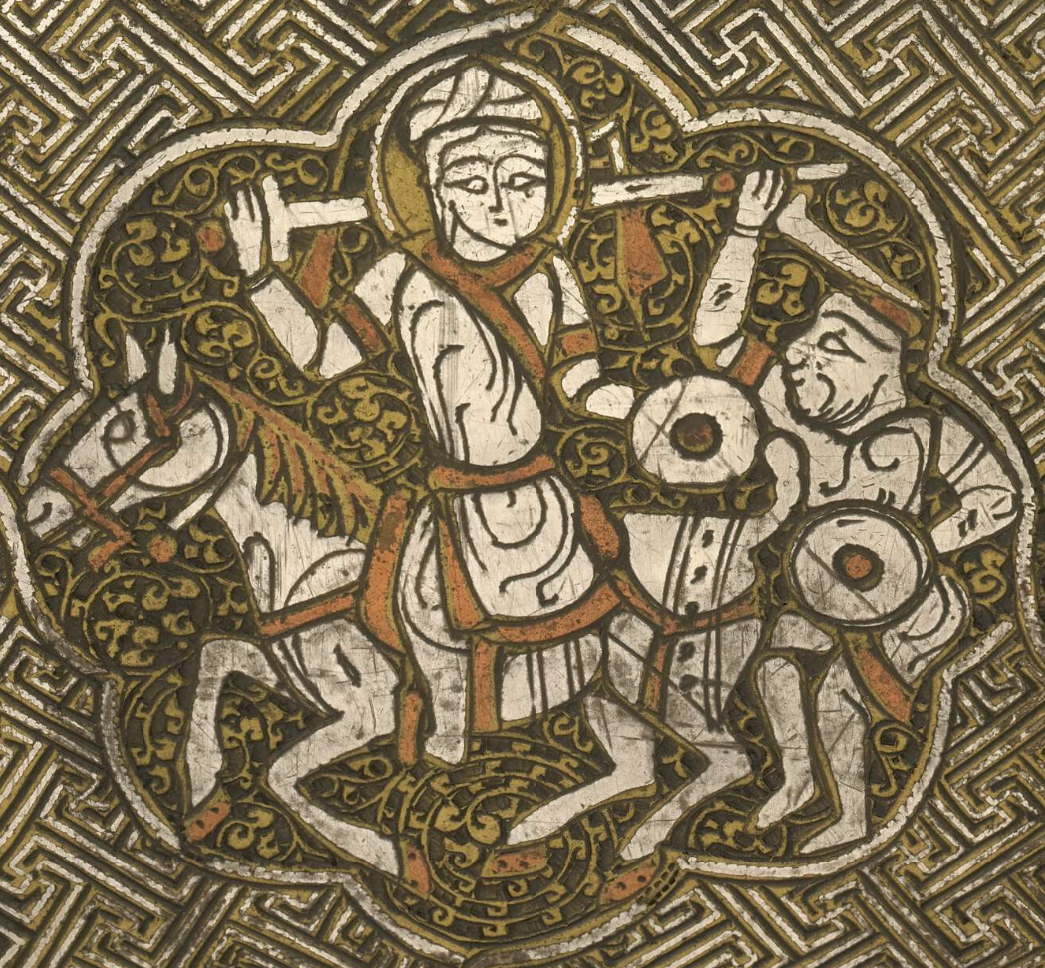
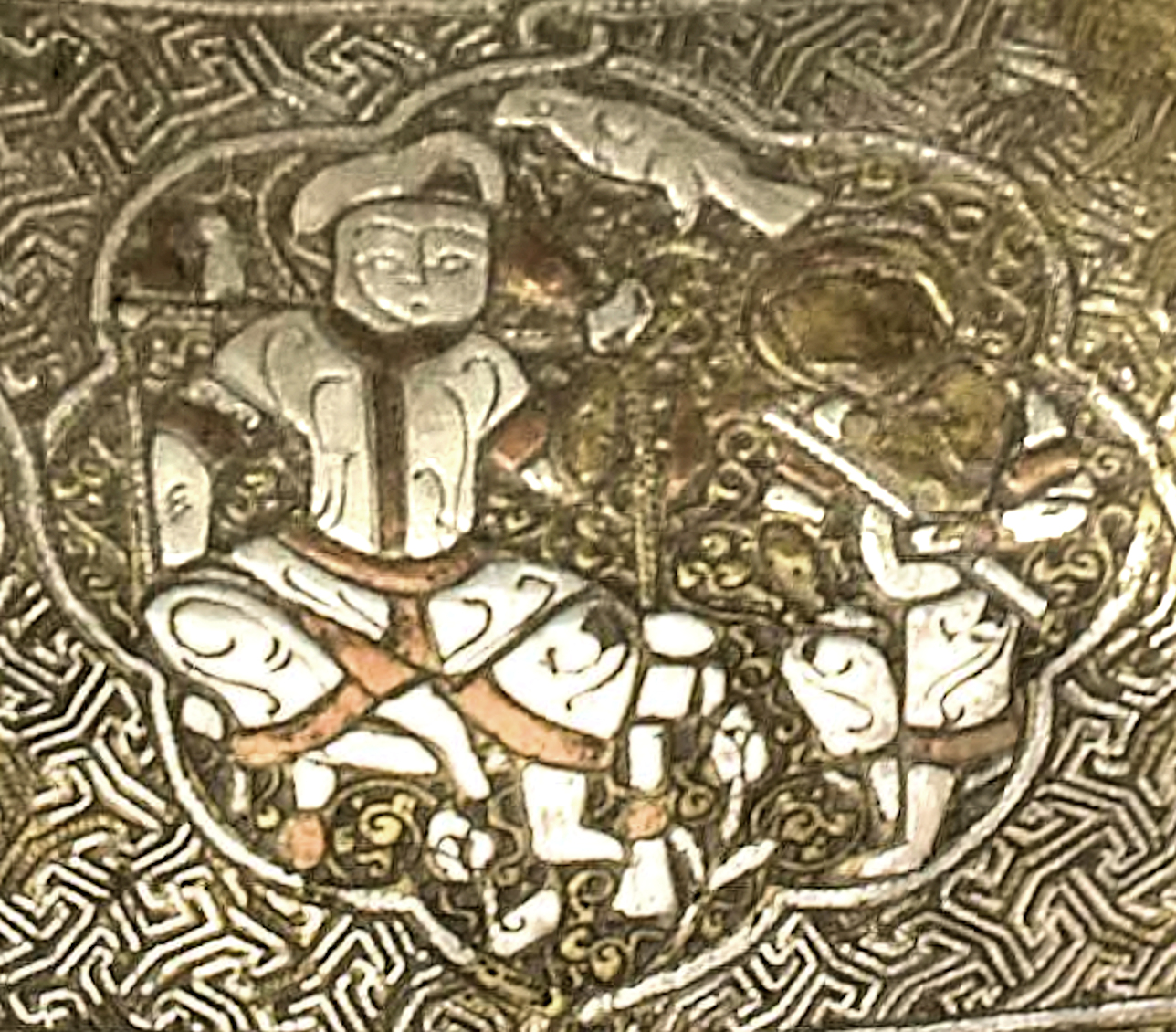
The surface is organized as a geometric fretwork ground interrupted by small and large multi-lobed medallions, each carrying a figural scene. The subjects are the standard repertoire of princely life current across Islamic figural metalwork of the period: horsemen hunting, a rider with a cheetah seated on the horse's rump, cavalry and infantry in combat, musicians and dancers at a feast, a camel caravan, and a woman seated cross-legged admiring herself in a mirror held by an attendant while another woman chooses jewels from a casket. One medallion illustrates a specific literary scene: Bahram Gur hunting on camelback while his companion Azadeh plays a harp beside him, an episode from Ferdowsi's Shahnama, the Persian national epic, showing that the workshop and its patron expected the vessel's audience to recognize a text, not only a generic courtly type.
This is the ordinary, well-attested courtly-cycle programme of the period: hunting, music, feasting, and the display of status through female attendants and mirrors, standing for the magnificence of whoever owned the vessel. Nothing in the sources consulted for this record argues for a hidden or esoteric reading of this cycle, and none is proposed here. The absence of a secret programme is itself the honest finding: this is a luxury object whose imagery says exactly what it appears to say, that its owner commanded wealth, leisure, martial skill, and cultivated taste.
One decorative element is read differently. An octagonal device filled with geometric strapwork, distinct from the figural medallions, has been proposed by Julian Raby as a possible workshop or guild mark rather than a purely ornamental motif, on the grounds that a closely related octagon appears on other Mosul-attributed pieces he groups with the ewer. This is an argued reading, made by a named scholar on comparative evidence, not a documented one; it is not confirmed by any inscription and should be reported as a proposal, which is how it is treated here.
Chapter 5Whose ewer was it made for
The ewer is commonly said to have been made for Badr al-Din Lu'lu', the former slave-soldier who by the 1230s controlled Mosul in all but name and who eliminated the last Zengid figurehead ruler to...
The ewer is commonly said to have been made for Badr al-Din Lu'lu', the former slave-soldier who by the 1230s controlled Mosul in all but name and who eliminated the last Zengid figurehead ruler to take the city formally for himself, receiving the title al-Malik al-Rahim from the Abbasid caliph. This is a plausible and widely repeated claim, and this record repeats it, but it should be graded precisely: nothing on the ewer itself names Badr al-Din Lu'lu' as patron or owner. The inscription that survives names only the maker and the date. The link to Badr al-Din Lu'lu' is a scholarly inference built from the ewer's date, its quality, and its grouping alongside other Mosul metalwork that does carry his name and titles, not from anything written on this object. It should be read as argued, not documented, and a reader who wants a firmly patron-attributed piece should look at the group of vessels that actually name him, not at this one.
Sources also do not agree precisely on when Badr al-Din Lu'lu' passed from de facto to formal rule; figures of 1233 and 1234 both appear in the literature consulted. Either way the ewer was made in the years immediately around that transition, which is part of why it has been read as a possible marker of a new ruler's court rather than settled proof of one.
Chapter 6Into the Blacas cabinet
The ewer's documented modern history begins with the French orientalist Joseph-Toussaint Reinaud's catalogue of the Islamic holdings in the cabinet of the Duc de Blacas, published in two volumes by...
The ewer's documented modern history begins with the French orientalist Joseph-Toussaint Reinaud's catalogue of the Islamic holdings in the cabinet of the Duc de Blacas, published in two volumes by the Imprimerie Royale in Paris in 1828 under the title Description des monumens musulmans du cabinet de M. le duc de Blacas. Secondary scholarship (Wikipedia's account of the ewer, itself citing Raby 2012) places the ewer as part of the collection covered by that 1828 publication. This record was able to confirm the existence, exact title, publisher and date of Reinaud's catalogue independently, but was not able to read its text or plates directly to confirm that the ewer itself appears on a specific page; that confirmation rests on the secondary citation, not on this record's own examination of Reinaud's volumes.
The 1828 date matters for the question of which Blacas holder assembled the piece. Two men held the title Duc de Blacas d'Aulps in the nineteenth century: Pierre-Louis de Blacas d'Aulps, 1st Duc (1770/71-1839), a diplomat and minister to Louis XVIII and a noted antiquarian in his own right, and his son, the 2nd Duc (1815-1866), who continued and expanded the collection after his father's death. In 1828 the son was thirteen years old and held no title; the collection catalogued by Reinaud that year, described on its title page as belonging to 'M. le duc de Blacas', can only have been the 1st Duc's. This record therefore treats the ewer's entry into the Blacas collection as most probably having occurred under the 1st Duc, Pierre-Louis, with the caveat below.
The caveat: secondary sources are not internally consistent on this point. The Wikipedia article on the ewer names the collector as 'Pierre Louis Jean Casimir de Blacas', while the Wikipedia article on the Blacas family gives that same string of names, in the same order, as the 1st Duc's full name, and a separate Wikipedia article on the 2nd Duc calls him 'Louis Charles Pierre Casimir de Blacas d'Aulps'. The overlapping given names across father and son, combined with inconsistent Wikipedia sourcing, make this a genuine point of confusion in easily available reference material rather than a settled fact. This record's own reasoning from the 1828 date is the most reliable basis available to it, but a specialist genealogy of the Blacas family or a direct reading of Reinaud (1828) would be needed to close the question fully, and it is recorded as open below rather than resolved by assertion.
Nothing is documented about where or how the ewer was acquired before it entered the Blacas cabinet. The roughly six centuries between its manufacture in 1232 and its appearance in a Blacas-owned publication in 1828 are a complete gap in this record, and are reported as one.
Chapter 7From Vienna to Bloomsbury: the 1866-67 purchase
The 2nd Duc de Blacas died in Venice in 1866.
The 2nd Duc de Blacas died in Venice in 1866. His heirs offered the family's antiquities, coins, gems and vases for sale, and the British government moved quickly. Charles Newton, the British Museum archaeologist most associated with the recovery of the Mausoleum at Halicarnassus, was sent to France to examine the collection and report on it. On his recommendation the government chose to negotiate the purchase of the entire collection rather than risk it being broken up at public auction or lost to a rival European institution; the Hansard record of the debate notes explicitly that the French state itself had a committee working to keep the collection intact and that no comparable opportunity was expected to recur.
The government's initial offer of 45,000 pounds was refused; the sale was concluded at 48,000 pounds and then reduced by 2,221 pounds after the British Museum reserved the right to sell back items it already held in duplicate, for a final recorded expenditure of 45,721 pounds. This is recorded in Parliament as a Vote for the Blacas purchase debated in the Commons on 18 February 1867. Secondary literature gives the price actually paid to the family as 1,200,000 French francs, a figure broadly consistent with the sterling total at contemporary exchange rates, though this record has not independently reconciled the two currency figures against a single primary account and flags that as worth checking.
The acquisition covered roughly 900 engraved gems, Roman coins and medals, some 500 fictile vases from Magna Graecia, and a small number of celebrated individual pieces including the Roman sardonyx cameo of Augustus now known as the Blacas Cameo, an object that shares this collection's name and origin but is otherwise unrelated to this ewer: different culture, different material, different date by more than a thousand years, and it should never be treated as evidence about this record's subject. The ewer itself, as a piece of Islamic metalwork within a collection whose Parliamentary case for purchase was made almost entirely on the strength of its classical gems and vases, appears to have travelled into the national collection as part of the wider lot rather than as a named highlight of the negotiation; none of the sources this record could access quote the Blacas ewer by name in the Parliamentary debate. It was registered under the Museum's 1866 accession numbers for the Blacas collection, 1866,1229.61, where it has remained since.
Chapter 8D.S. Rice and the building of a chronology
The scholar most associated with turning this ewer, and a handful of comparably dated pieces, into a working chronology for thirteenth-century Islamic metalwork was David Storm Rice.
The scholar most associated with turning this ewer, and a handful of comparably dated pieces, into a working chronology for thirteenth-century Islamic metalwork was David Storm Rice. Between 1949 and the late 1950s Rice published a series of studies, most under the running title 'Studies in Islamic Metal Work' in the Bulletin of the School of Oriental and African Studies, that combined close epigraphic reading of inscriptions with detailed physical examination of individual objects, in place of the looser stylistic comparison that had dominated the field before him. His 1950 BSOAS article 'The Brasses of Badr al-Din Lu'lu'' (vol. 13, pp. 627-634) discusses the Blacas Ewer specifically alongside other metalwork associated with that ruler's Mosul, and his 1957 Ars Orientalis study of the workshop of Ahmad al-Dhaki al-Mawsili assembled a comparative list of the small corpus of dated Mosul-attributed metalwork, of which the Blacas Ewer was one of the earliest and most secure entries. This record was able to confirm the existence, titles, journals and page ranges of these articles through library and publisher records, but was not able to read their full text directly; the characterization of their argument here rests on how later scholarship, in particular Julian Raby's 2012 reassessment discussed below, describes and engages with them, and should be checked against Rice's original text before being treated as a verbatim account of his reasoning.
The method Rice is credited with, in the secondary literature this record could access, was to anchor a chronology on the small number of objects that carried both a date and, ideally, a maker's or patron's name, and then to place the far larger number of undated, unsigned pieces around those anchors by comparing technique, composition and specific decorative motifs. A signed, precisely dated, well-preserved ewer such as this one, with a named maker whose nisba ties him to Mosul, was exactly the kind of fixed point that method needed. That is the basis of the claim that the Blacas Ewer helped establish the 'Mosul school' as a scholarly category: not that it proves a school existed, but that its combination of certainties let later scholars build outward from it with more confidence than the material otherwise allowed.
Chapter 9A contested category
The phrase 'Mosul school' is now treated in the specialist literature as a contested unit of analysis rather than a settled fact, and this record follows that literature rather than presenting Rice's...
The phrase 'Mosul school' is now treated in the specialist literature as a contested unit of analysis rather than a settled fact, and this record follows that literature rather than presenting Rice's mid-twentieth-century framework as final. The most substantial published reassessment identified for this record is Julian Raby's 2012 essay 'The Principle of Parsimony and the Problem of the Mosul School of Metalwork', published in Metalwork and Material Culture in the Islamic World: Art, Craft and Text, edited by Venetia Porter and Mariam Rosser-Owen (London: I.B. Tauris, 2012), pp. 11-85.
This record was not able to obtain the full text of Raby's essay directly; access to it was blocked at every source attempted. Its argument is characterized here through a published review of it by Bulle Tuil-Leonetti in Abstracta Iranica, which this record did read. According to that review, Raby's approach is not simply to declare the 'Mosul school' a fiction, but to re-examine the corpus of attributed pieces with fresh epigraphic analysis, to identify specific, recurring workshop marks across objects, and to compare the core Mosul-attributed group against metalwork produced in derivative or related workshops in Damascus and Cairo and against Mosul manuscript illumination of the same century, in order to test which attributions to a Mosul milieu actually hold up on documentary and comparative evidence, and which were assigned there by default. The reviewer describes the resulting summary tables of the corpus as a genuinely useful tool, and separately notes that Raby's essay does not incorporate the technical, metallurgical criteria that have been developed for related Iranian metalwork, which the reviewer considers a gap worth filling in future work.
Until 1997 the Blacas Ewer was, on the account given by Wikipedia's article on the ewer (itself citing Raby 2012, pp. 12 and 23), the only known piece of metalwork bearing an inscription that explicitly states it was made in Mosul, which is precisely why it carried so much chronological weight for so long. The article states that this changed with an inlaid pen box made by Ali ibn Yahya in Mosul, dated 653 AH (1255-56 CE), acquired by the David Collection in Copenhagen; this record has not independently verified the pen box's own accession details and flags that as unconfirmed, but records the claim as the article states it. Even a single second example changes the argument: a chronology built on one explicitly located fixed point is a different kind of evidence than one built on two, and the broader effect of the Raby-era reassessment has been to insist that each attribution to Mosul be argued on its own documentary and comparative merits rather than absorbed into a single named school by resemblance.
Chapter 10What is unresolved
No twenty-first-century technical or conservation study of this specific ewer, published or otherwise, was located in the course of this research.
No twenty-first-century technical or conservation study of this specific ewer, published or otherwise, was located in the course of this research. The British Museum's own object pages for the piece describe its material, technique and decoration but were not accessible to this record in full (repeated attempts to fetch them directly from britishmuseum.org and research.britishmuseum.org returned access errors); what this record reports about the object's physical description is drawn instead from the Museum's Islamic Gallery microsite, from the partner Discover Islamic Art project, and from Google Arts and Culture's British Museum-sourced entry, all of which were readable. A reader who needs the Museum's full internal catalogue entry, condition report, or any recent scientific examination should go to the Museum directly; this record cannot confirm what that file currently says about the state of the silver and copper inlay, whether any cleaning or conservation campaign has taken place recently, or whether the loss of the spout and foot has ever been dated.
The complete Arabic text of the inscription and a full published English translation were likewise not found in any source this record could access; only the maker's name and the date are consistently reported across every source consulted. This is a genuine gap in an otherwise well-documented object, not an oversight, and it is the single most important thing a future editor of this record should chase down, ideally directly against Rice's 1950 article or the Museum's own epigraphic file.
The artist
Shuja ibn Man'a al-Mawsili
Shuja ibn Man'a al-Mawsili exists in the historical record as a single signature. He is not mentioned in any chronicle, biographical dictionary, or other inscription located for this record; everything known about him is inferred from the one object he signed and dated. That is the correct frame for reading any claim about him, including the ones on this page: an attribution to Shuja ibn Man'a is an attribution to a name on a single dated ewer, not to a documented career.
Related works
| Work | Relation | Where it is |
|---|---|---|
| Bobrinski Bucket Muhammad ibn Abd al-Wahid (caster) and Mas'ud ibn Ahmad (decorator) | Earlier comparandum, not a Mosul-school piece: an inlaid brass vessel made in Herat, dated Muharram 559 AH (1163 CE), roughly 70 years before the Blacas Ewer. Frequently cited as an early landmark of the inlay technique that later migrated west to the Jazira. Do not present this object's facts, maker or inscription as belonging to the Blacas Ewer; it is a different object by different makers in a different city. | State Hermitage Museum, St Petersburg |
| Wade Cup Unattributed workshop, western Iran | Contemporary comparandum from the 1230s, cited alongside the Blacas Ewer as an early example of fully animated human-headed inscriptions in Islamic inlaid metalwork of the same decade. A separate object; not part of the Mosul-attributed corpus discussed in this record's provenance. | Cleveland Museum of Art |
| Freer Canteen Unattributed workshop, Ayyubid Syria or northern Iraq | Comparandum frequently discussed within the same 'Mosul school' historiographical debate addressed in this record's narrative. A different object entirely; do not conflate its imagery or inscriptions with the Blacas Ewer's. | Freer Gallery of Art, Smithsonian Institution, Washington DC |
| Ewer of 1232 attributed to the circle of Ahmad al-Dhaki al-Mawsili Workshop associated with Ahmad al-Dhaki al-Mawsili, possibly Qasim ibn Ali | A second Mosul-attributed inlaid vessel dated to the same year, 1232, but signed by a different hand and, on the account located for this record, made for a different patron (Shihab al-Din Tughrul). A close comparandum, not a duplicate of this record's subject. Version-safety note: this is a distinct object from the Blacas Ewer despite the shared date, city and general type. Not fully verified for this record beyond secondary characterization; flagged for direct confirmation before reuse. | Freer Gallery of Art, Smithsonian Institution, Washington DC |
| The 'Munich tray' Unattributed | Linked to the Blacas Ewer by Julian Raby on the basis of a shared octagonal motif, proposed as a possible workshop mark. Argued connection, made by a named scholar; not documented by any inscription. | Not confirmed for this record |
| Pen box of Ali ibn Yahya Ali ibn Yahya | Dated 653 AH (1255-56 CE) and inscribed with Mosul as its place of manufacture; on the account in Wikipedia's article on the ewer, the second known piece of Mosul-inscribed metalwork after the Blacas Ewer, acquired in 1997 and ending the ewer's decades of uniqueness in that respect. This record has not independently verified the pen box's accession details; reported as the secondary source states it. | The David Collection, Copenhagen |
Open questions
- What is the complete Arabic text of the inscription, and what published English translation exists? Only the maker's name and the date are consistently reported across the sources this record could access; no full transcription or translation was located.
- Which Duke of Blacas actually assembled or held the ewer before 1828? Reasoning from the 1828 date of Reinaud's catalogue points to the 1st Duc, Pierre-Louis de Blacas d'Aulps (1770/71-1839), but secondary sources give overlapping names for father and son and this record could not resolve the ambiguity from a specialist genealogy or a direct reading of Reinaud.
- Where was the ewer, and in whose hands, between its manufacture in 1232 and its appearance in a Blacas-owned publication in 1828? No owner is documented for roughly six centuries.
- Was the ewer in fact made for or connected to Badr al-Din Lu'lu'? No inscription on the object names a patron; the attribution is a scholarly inference from date, quality and comparison to other Mosul metalwork that does carry his name, and should not be read as settled.
- When and how did the ewer lose its original spout and foot? Not documented in any source consulted.
- Does niello appear anywhere on this object, and if so what is its current condition? The sources consulted describe silver and copper inlay only; niello is documented elsewhere in Mosul-period metalwork but not confirmed here either way.
- What does the British Museum's own current catalogue and conservation file say about the piece? This record could not access britishmuseum.org or research.britishmuseum.org directly and relied on the Museum's Islamic Gallery microsite and partner projects instead; a fuller check against the Museum's own record is needed.
- What did Rice's 1950 and 1957 articles actually argue, in his own words? This record could confirm their existence, titles and place of publication but could not read their full text, and relied on how later scholarship describes them.
Questions about this object
What is The Blacas Ewer?
The Blacas Ewer is an islamic metalwork, dated rajab 629 AH / April-May 1232 CE. Medium: Sheet brass, hammered to a faceted body, engraved and inlaid with silver and copper.
Who made The Blacas Ewer, and is the attribution settled?
The attribution to Shuja ibn Man'a al-Mawsili is recorded here as accepted. Signed and dated by the maker in the inscription band on the object itself: 'Shuja ibn Man'a al-Mawsili', with the date Rajab 629 AH (April-May 1232 CE). This is the only object known to bear his signature; nothing else survives by his hand and nothing is recorded of his life beyond this one inscription. The attribution of the ewer's commission to the ruler Badr al-Din Lu'lu' is a separate, unsigned claim and is graded 'argued', not documented, in this record.
Where is The Blacas Ewer now?
British Museum, London. Inventory number 1866,1229.61. Last confirmed 13 August 2026. Permanent collection, acquired 1866 as part of the bulk purchase of the Blacas collection; held in the Museum's Islamic art holdings.
What is still unknown about The Blacas Ewer?
What is the complete Arabic text of the inscription, and what published English translation exists? Only the maker's name and the date are consistently reported across the sources this record could access; no full transcription or translation was located.
Sources
- 1British Museum, Islamic Gallery collection microsite, 'The Blacas ewer', object RRM9747. islamicworld.britishmuseum.org/collection/...
- 2Museum With No Frontiers, Discover Islamic Art virtual museum, 'Ewer' [the Blacas Ewer], entry attributed to Emily Shovelton (2014), object ISL;uk;Mus01;12;en. islamicart.museumwnf.org/database_item.php
- 3Google Arts and Culture, 'The Blacas Ewer', British Museum partner content. artsandculture.google.com/asset/...
- 4Wikipedia, 'Blacas ewer', consolidating and citing Deniz Beyazit, 'The Blacas ewer', in Court and Cosmos: The Great Age of the Seljuqs (New York: Metropolitan Museum of Art, 2016), p. 75; Julian Raby, 'The Principle of Parsimony and the Problem of the Mosul School of Metalwork', in Metalwork and Material Culture in the Islamic World, ed. Porter and Rosser-Owen (London: I.B. Tauris, 2012), pp. 11-85; and Jonathan Bloom and Sheila Blair, Islamic Arts (London: Phaidon, 1997), p. 275. en.wikipedia.org/wiki/...
- 5Wikipedia, 'Badr al-Din Lu'lu'', for his rise to power, the date of his formal rule, and the Ibn Sa'id quotation on Mosul's inlaid-brass export trade. en.wikipedia.org/wiki/...
- 6Wikipedia, 'Blacas', for the family's names, titles and life dates across the 1st and 2nd Ducs. en.wikipedia.org/wiki/...
- 7Wikipedia, 'Louis, Duke of Blacas', for the 2nd Duc's death in Venice in 1866 and the sale of the collection to the British Museum in 1867 for 1,200,000 francs. en.wikipedia.org/wiki/...
- 8UK Parliament, Historic Hansard, House of Commons, 'Supply considered in Committee', 18 February 1867 - the Parliamentary debate and Vote for the purchase of the Blacas collection. api.parliament.uk/historic-hansard/...
- 9Bibliotheque nationale de France, Catalogue general, bibliographic record for Joseph-Toussaint Reinaud, Description des monumens musulmans du cabinet de M. le duc de Blacas (Paris: Imprimerie Royale, 1828), 2 vols. Consulted for the catalogue's existence, exact title, publisher and date only; its text and plates were not read for this record. catalogue.bnf.fr/ark:/...
- 10Bulle Tuil-Leonetti, review of Julian Raby, 'The Principle of Parsimony and the Problem of the Mosul School of Metalwork', in Abstracta Iranica. journals.openedition.org/abstractairanica/...
- 11Wikipedia, 'Bobrinski Bucket', for the comparandum object's maker, date, and place of manufacture (Herat, 1163 CE). en.wikipedia.org/wiki/...
- 12Bibliographic record for D.S. Rice, 'The Brasses of Badr al-Din Lu'lu'', Bulletin of the School of Oriental and African Studies, vol. 13 (1950), pp. 627-634. Existence, title, journal and pagination confirmed via library and publisher indexes; full text not read for this record. cambridge.org/core/...
- 13Bibliographic record for D.S. Rice, 'Inlaid Brasses from the Workshop of Ahmad al-Dhaki al-Mawsili', Ars Orientalis, vol. 2 (1957), pp. 283-326. Existence, title, journal and pagination confirmed via library indexes; full text not read for this record. jstor.org/stable/...
Last verified · Published
Change log
13 August 2026 - Record created at the house standard: researched narrative, technical evidence, maker dossier, graded provenance chain, prices with hammer and premium separated, related works, open questions and sources.