Basin with Figural Imagery
Unidentified metalworking workshop, Ilkhanid Iran · early 14th century (ca. 1300-1325)
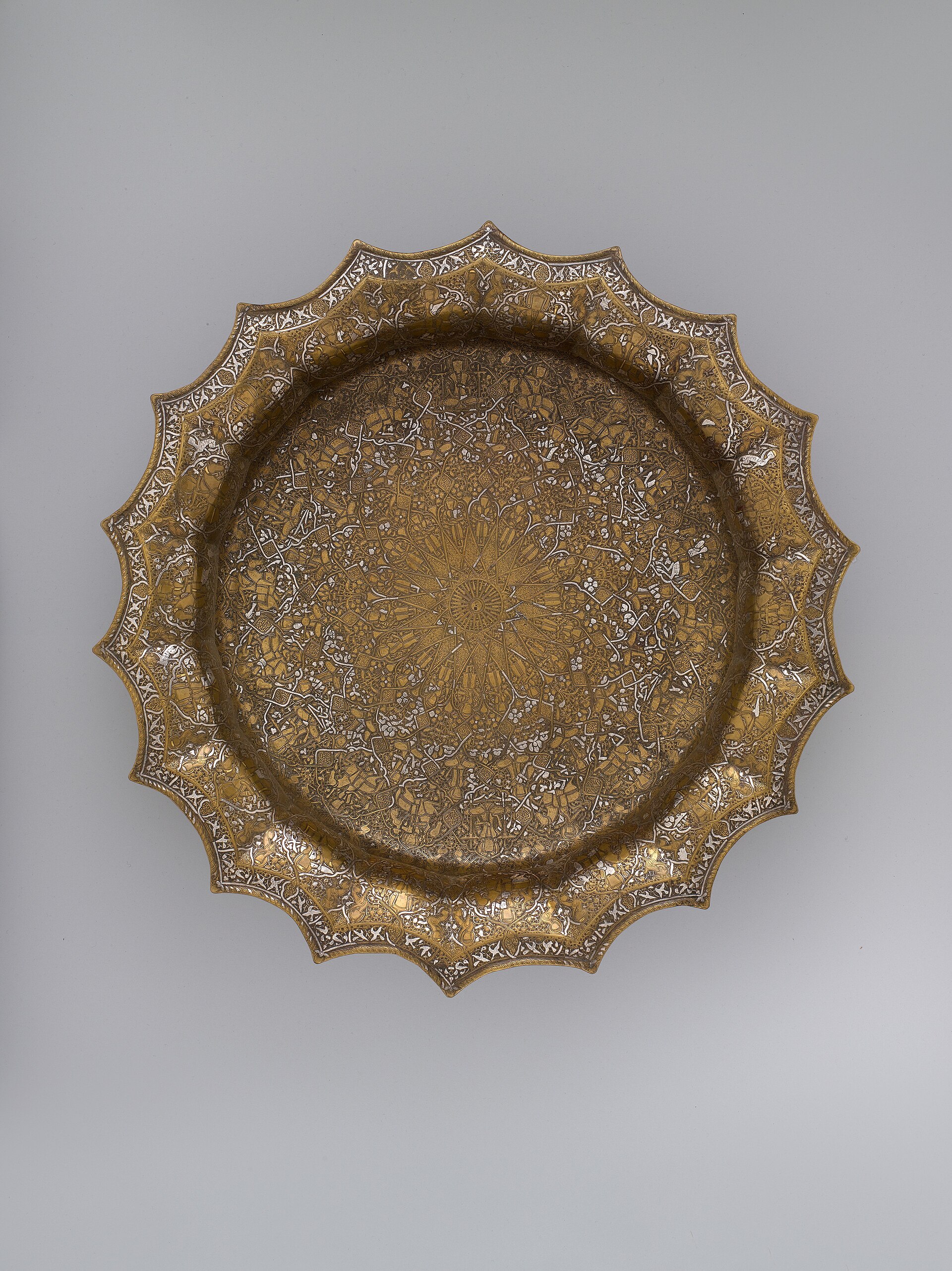
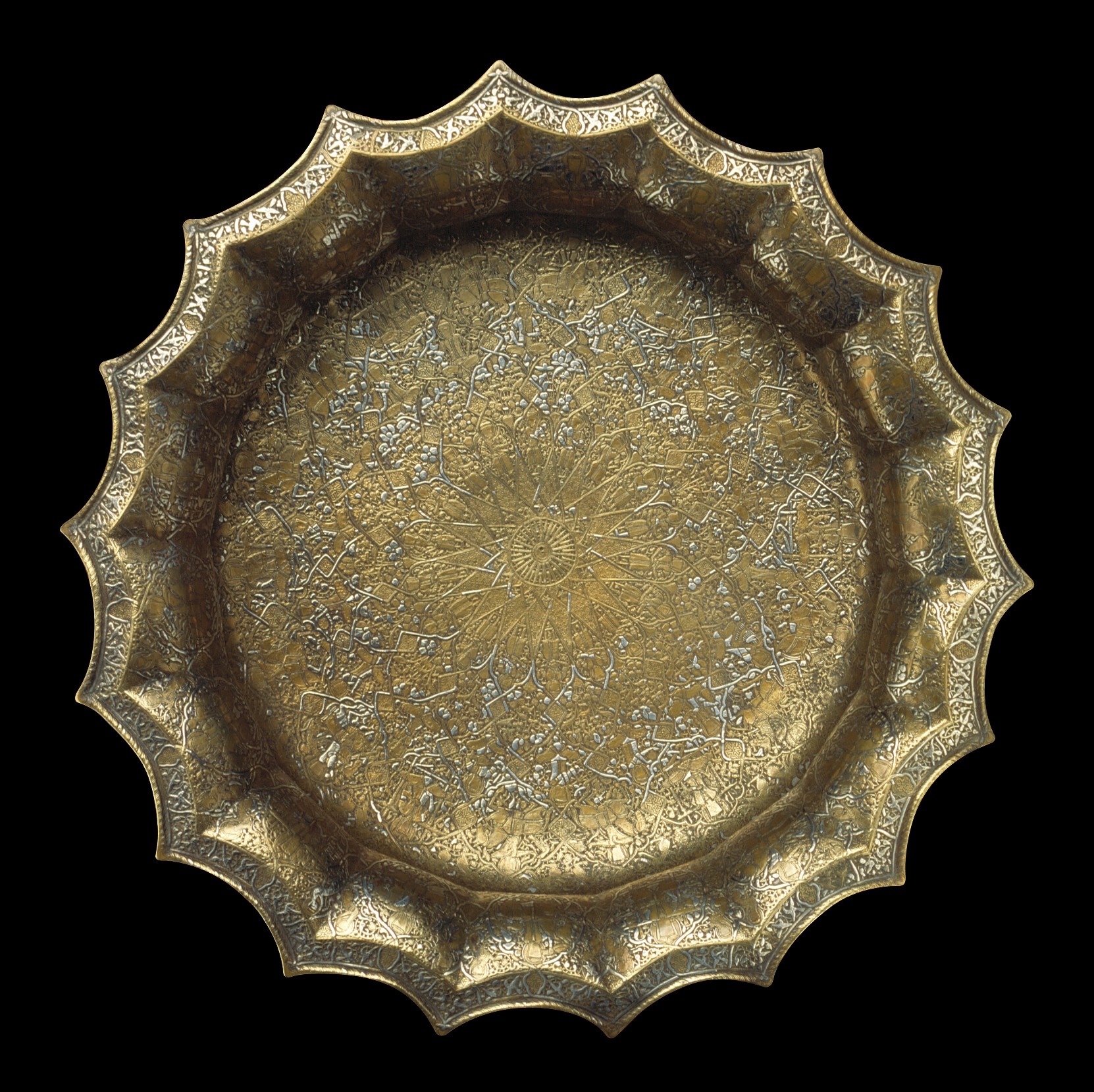
The basin photographed from directly above, showing the scalloped rim and the full inlaid interior decoration in concentric bands radiating from the central medallion. This is the Museum's own primary photograph of the object.
| Artist | Unidentified metalworking workshop, Ilkhanid Iran |
|---|---|
| Date | early 14th century (ca. 1300-1325) |
| Medium | Brass; raised, engraved, and inlaid with silver and gold |
| Dimensions | H. 5 1/8 in. (13 cm); Diam. 20 1/2 in. (51.1 cm) |
| Where it is now | The Metropolitan Museum of Art, New York, Islamic Art department, on view in Gallery 455 at The Met Fifth Avenuelast confirmed |
| Inventory number | Accession number 91.1.521 (object ID 444523) |
| Attribution | AcceptedAttributed to Ilkhanid Iran, early fourteenth century, on stylistic grounds; no signature or inscription survives to name a maker, patron, or place of manufacture. Full note |
| Object type | Islamic metalwork |
| Period | Ilkhanid Iran, early fourteenth century |
| Cases | Has a provenance gap |
| Inscriptions | None recorded. The Museum's online object record carries no Signatures, Inscriptions, and Markings tab for this piece, unlike some comparable Museum holdings of the same broad type, indicating either that none survive or that none has been published. |
| Owners on record | 4 links3 documented, 1 unknown |
| Sources | 12 cited |
About this record Last verified · 12 sources cited · Change log
On this page 9 sections
ContentsClose
A scalloped brass basin, hammered up from a single blank and inlaid over its whole interior in silver and gold with musicians, courtiers, enthroned figures, polo players, and addorsed griffins - the standard cast of Ilkhanid courtly imagery, made for a patron the object itself never names. No maker's name survives, and no owner is documented between its manufacture in early fourteenth-century Iran and its appearance in the New York collection of Edward C. Moore, the silversmith who ran Tiffany and Co.'s design studio for more than two decades.
Moore left the basin, and roughly four hundred other objects from the Islamic world, to the Metropolitan Museum of Art on his death in 1891 - still the largest single body of Islamic-world material the Museum has ever received in one gift. His wider collecting, drawn from Greece and Rome, Asia, Europe and the Islamic world alike, is documented to have directly shaped the silver Tiffany produced under his direction in the 1870s and 1880s. Nothing in the sources consulted ties this particular basin to any specific Tiffany design; the connection that is documented runs at the level of the collection as a whole, not this one object.
The piece has been in print continuously since 1930 and has not moved between departments, countries, or centuries in that time - a stability that is itself worth recording, since a Metropolitan sibling from the same 1891 bequest, catalogued as a candlestick, has had its own country and date revised by the Museum within the last decade.
Provenance
Each link is graded. Documented: a cited source supports it. Disputed: the identification is argued but not established. Unknown: no owner for that span, and the gap is not smoothed into a narrative. The grades in the glossary.
- early 14th century -Unrecordeddocumented
Made in Ilkhanid Iran, early fourteenth century, for an unrecorded patron. No inscription names a commissioner or owner.14
- - by 1891Unknownunknown
No owner, dealer, or country of export is documented between the basin's manufacture and its presence in Edward C. Moore's New York collection by the time of his death in 1891. General accounts of Moore's collecting describe purchases through auctions in Paris and London, world's fairs, and dealers including Siegfried Bing and Samuel P. Avery, but none of the sources consulted names this basin specifically among such transactions.159
- - 1891Edward C. Moore, New Yorkdocumented
Held by Moore, a silversmith and Tiffany and Co.'s chief silver designer from 1868 until his death, until his death on August 2, 1891.169
- 1891 - presentMetropolitan Museum of Art, New Yorkdocumented
Bequeathed to the Museum on Moore's death as part of a gift of more than two thousand objects, including approximately four hundred from the Islamic world - the largest single body of Islamic-world material the Museum has ever received in one gift. Accessioned as 91.1.521, Edward C. Moore Collection.125
Technical evidence
| Attribution note | Attributed to Ilkhanid Iran, early fourteenth century, on stylistic grounds; no signature or inscription survives to name a maker, patron, or place of manufacture. The Metropolitan Museum's published references have described the piece consistently as Persian or Iranian since Maurice Dimand's 1930 Handbook of Muhammedan Decorative Arts. The current online catalogue entry, written by Islamic Art curator Francesca Leoni for the Museum's 2011 volume Masterpieces from the Department of Islamic Art, retains that attribution, places the object within the Ilkhanid dynasty specifically, and compares its distinctive scalloped rim to a closely related basin in the Victoria and Albert Museum (no. 546-1905), datable to about 1300-1320. No published reattribution of country, period, or dynasty has been found in the sources consulted - a contrast with a related Metropolitan Islamic-metalwork record from the same Edward C. Moore bequest, the Tripod Candlestick (accession 91.1.572), whose country and date the Museum's own cataloguing has revised. |
|---|---|
| Material and technique | Brass, raised from a single blank, then engraved and inlaid with silver and gold hammered into the carved recesses.124 |
| Dimensions | Height 5 1/8 in. (13 cm); diameter 20 1/2 in. (51.1 cm).12 |
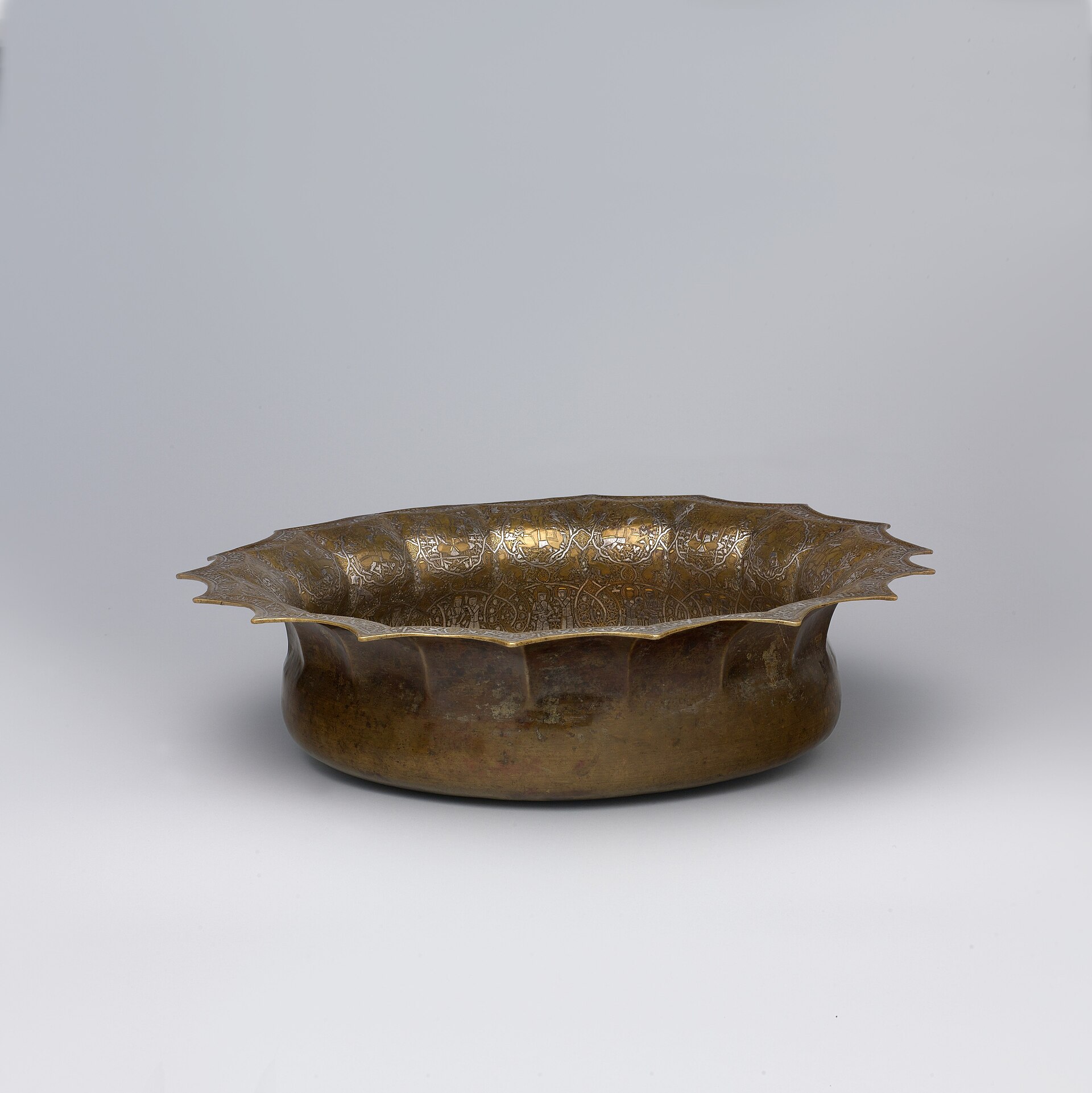
| Form | A shallow hand basin with a distinctive scalloped, crenellated rim, a profile the Museum's catalogue identifies as characteristic of a limited group of basins produced under the Ilkhanid dynasty specifically, comparable to a basin of about 1300-1320 in the Victoria and Albert Museum (no. 546-1905).1 |
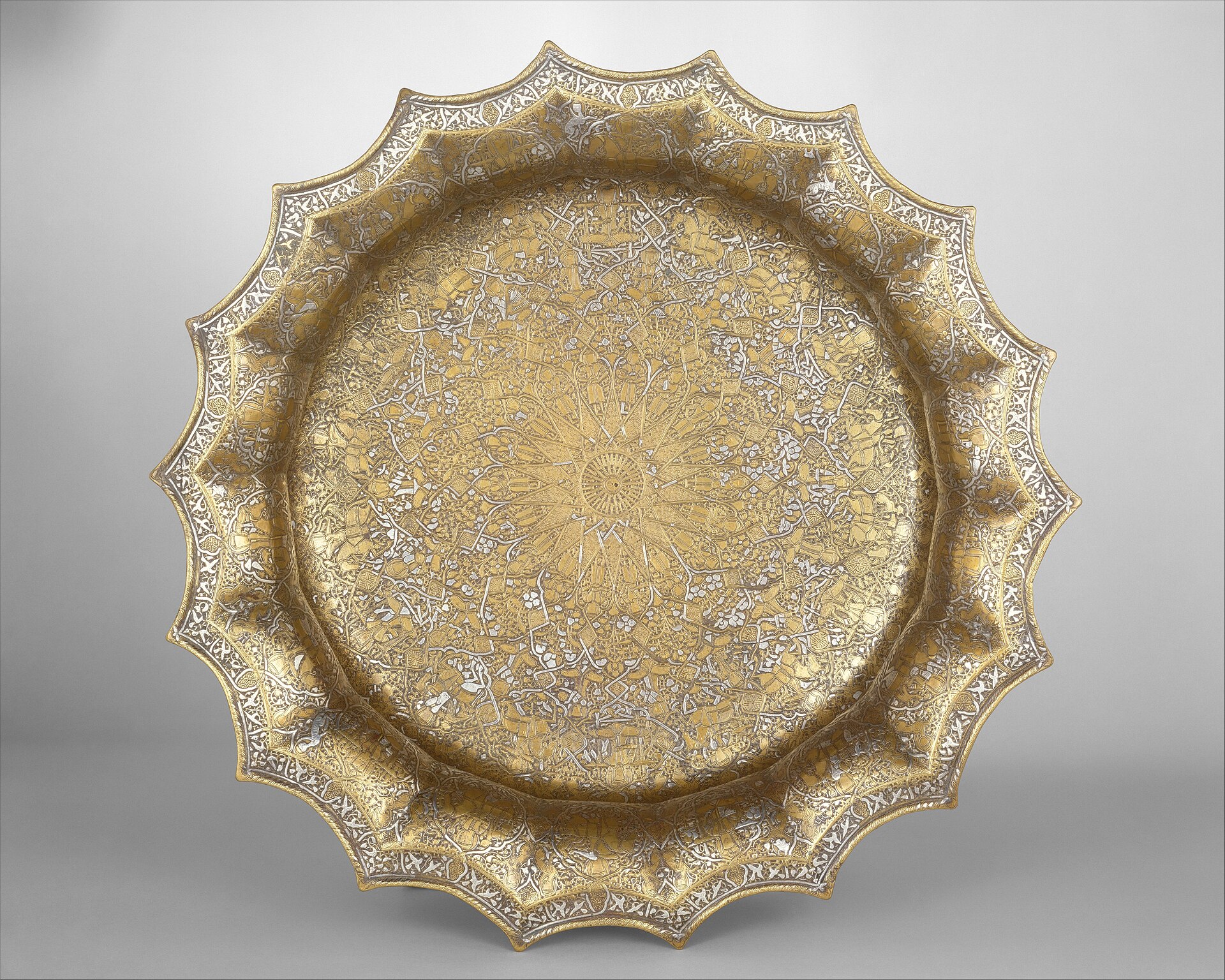
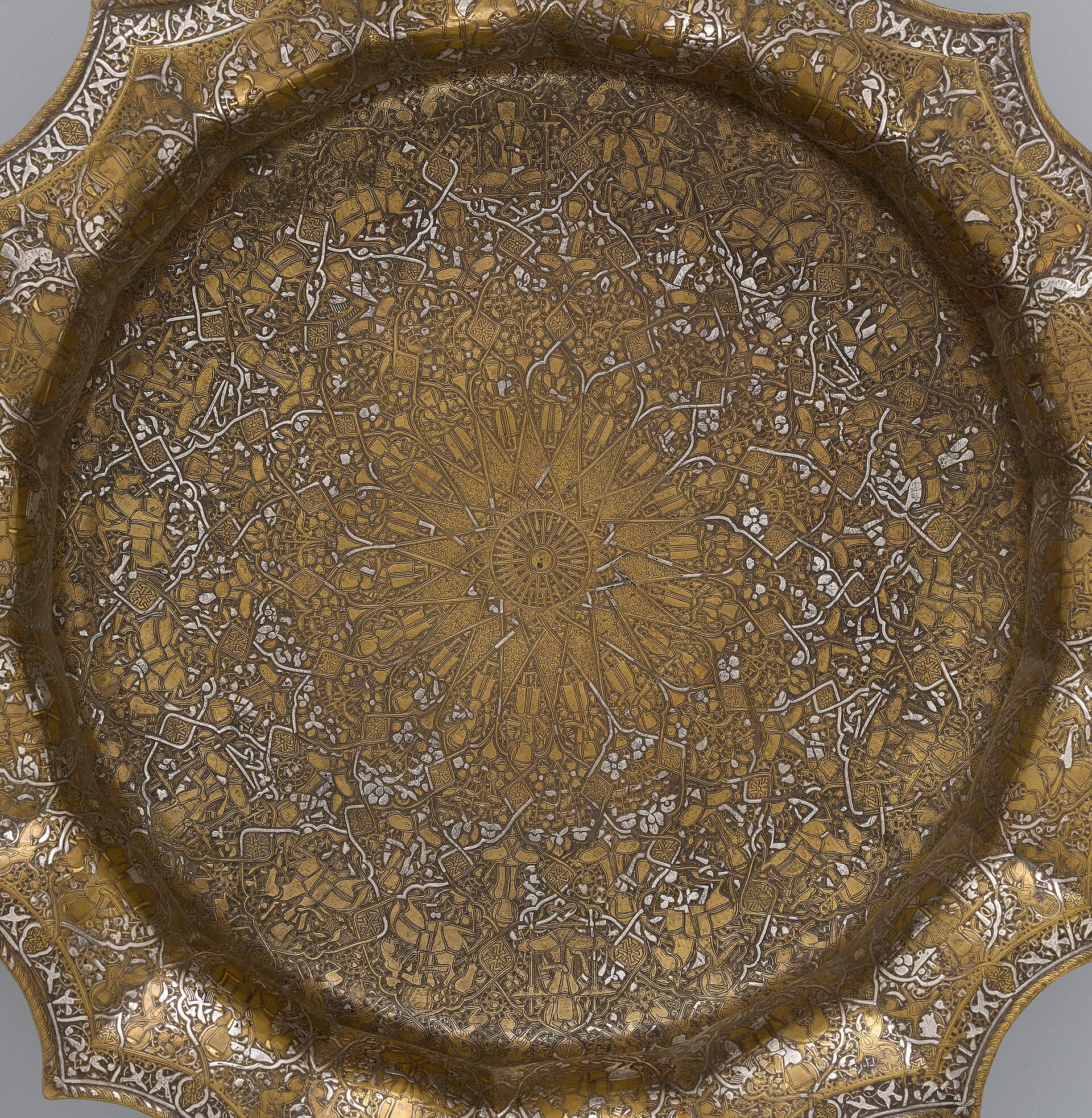
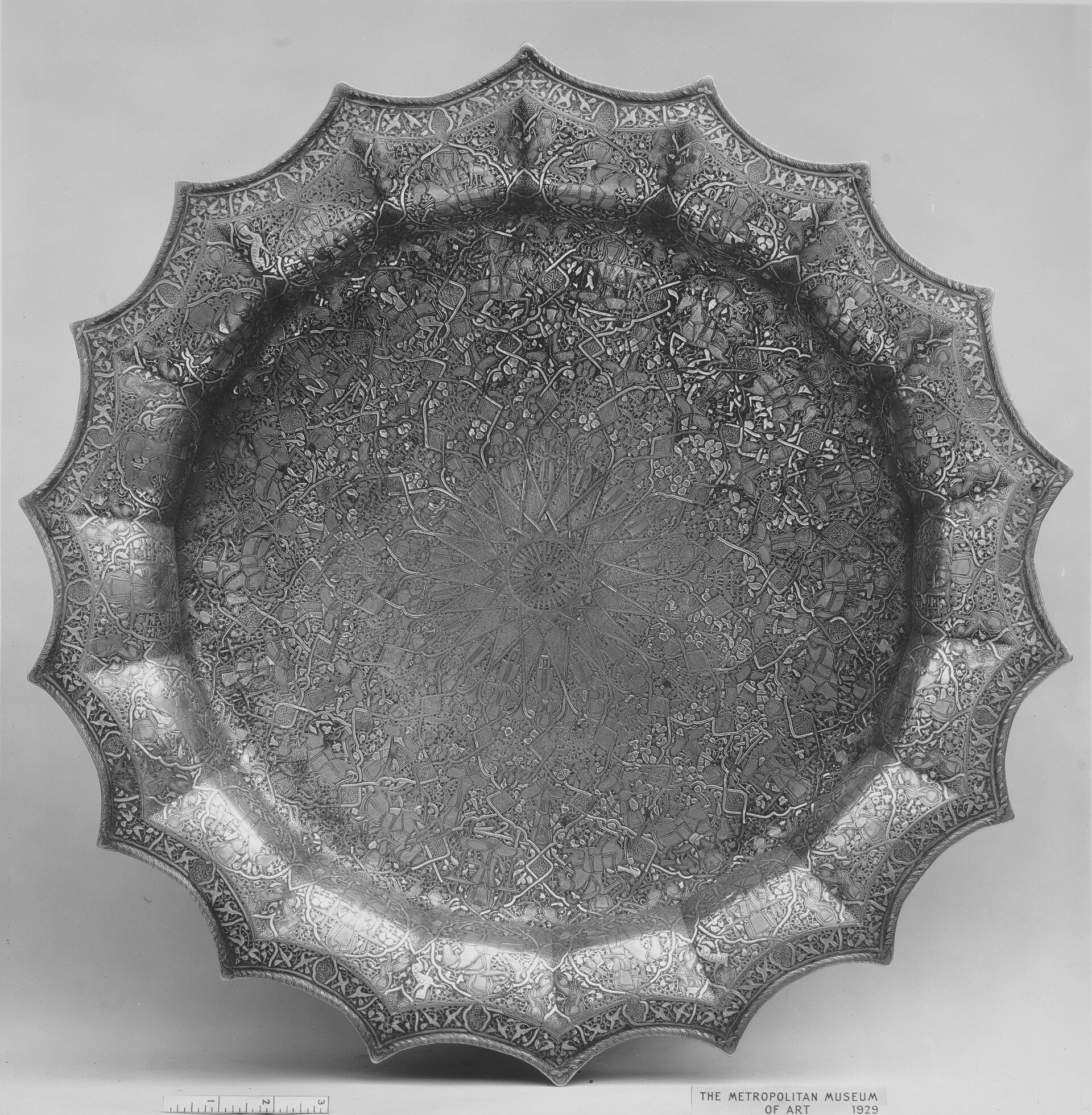
| Decorative structure | Concentric bands of figural and ornamental decoration radiate from a central sun-shaped medallion, framed by an underlying geometric grid; registers include servants, musicians, courtiers, five enthroned figures flanked by hunters and polo players (repeated on both the base and the wall of the vessel), birds on the crenellated border, addorsed griffins, human-headed winged animals, and tall flowering plants in the interstices.1 |
| Inscriptions | None recorded in the sources consulted; the Museum's online record for this object carries no inscriptions tab.1 |
| Attribution basis | No signature or dedicatory inscription survives. Date and place are assigned on stylistic grounds and by comparison with the Victoria and Albert basin (no. 546-1905), a related Berlin basin signed by 'Ali ibn 'Abdallah al-'Alawi al-Naqqash al-Mawsili (Museum fur Islamische Kunst, Staatliche Museen zu Berlin, no. I-6581), and a fourteenth-century tray in the Museum of Fine Arts, Tbilisi (no. 48/I).1 |
| Condition of the inlay | Not established for this specific object in the sources consulted. The Museum's Heilbrunn Timeline essay on Ilkhanid courtly art states that gold and silver inlay on metalwork of this general class has, in many surviving examples, mostly disappeared over time, and cites this basin's accession number when making that point; the Museum's own overview description of this object, by contrast, describes an intricately inlaid surface without noting loss. This record does not resolve the discrepancy and lists it below as an open question.14 |
Images
The record in full
Chapter 1A basin built for a hand, not a table
The object is a large, shallow hand basin, 20 1/2 inches (51.1 cm) across and only 5 1/8 inches (13 cm) high, raised from a single sheet of brass and finished with a distinctive scalloped...
The object is a large, shallow hand basin, 20 1/2 inches (51.1 cm) across and only 5 1/8 inches (13 cm) high, raised from a single sheet of brass and finished with a distinctive scalloped, crenellated rim. Basins of this general kind are called tasht in Persian and lagan in Arabic, and large hand basins under those names are documented in the eastern Islamic world from the late twelfth century onward. This specific scalloped profile, however, appears to be a narrower phenomenon: the Metropolitan's own catalogue entry identifies it as a form produced under the Ilkhanid dynasty specifically, citing a closely comparable basin in the Victoria and Albert Museum, London (no. 546-1905), datable to about 1300-1320.
A basin of this size and elaboration was not a plain washstand fixture. Paired historically with a matching ewer, it belonged to the furniture of hospitality and courtly ceremony - brought out for guests to rinse their hands before or after a meal, in a setting where the vessel itself was as much a display of the host's standing as the ritual it served.
Chapter 2How it was made
The body was raised - hammered up from a flat brass blank into its bowl shape - then engraved with the decorative scheme before the engraved recesses were inlaid with silver and gold, hammered gently...
The body was raised - hammered up from a flat brass blank into its bowl shape - then engraved with the decorative scheme before the engraved recesses were inlaid with silver and gold, hammered gently into the carved indentations. This inlay technique, used across the piece's whole interior surface, was expensive and demanding, and the Metropolitan's own Heilbrunn Timeline essay on Ilkhanid courtly art singles out this basin's accession number when describing how such inlays were worked into bronze or brass. The same essay notes that on Ilkhanid inlaid metalwork generally, a large proportion of the original gold and silver has been lost over the centuries to wear and cleaning; whether that applies to this particular basin, whose Museum overview page describes an intricately inlaid surface without qualification, is not stated either way in the sources consulted, and is recorded below as an open question rather than resolved by inference.
Little survives about who actually did this work. The Museum's own essay on Ilkhanid courtly art states plainly that direct evidence of court sponsorship and named workshops is scarce, because few surviving objects of the period carry dedications or signatures, and proposes that the best metalworkers from two older centers - Mosul in northern Iraq and Shiraz in southern Iran, both established seats of the inlaid-brass tradition before the Mongol conquest - relocated to the new Ilkhanid capital at Tabriz to work for the court. No inscription or record ties this basin to Tabriz, Mosul, or Shiraz specifically; the proposal is offered by the Museum as context for the type, not as a documented fact about this object.
Chapter 3What is pictured on it
The decoration, organized in concentric bands radiating from a central sun-shaped medallion, covers the whole interior.
The decoration, organized in concentric bands radiating from a central sun-shaped medallion, covers the whole interior. Reading outward, the registers hold servants; seated musicians playing instruments; courtiers and attendants; and five enthroned figures flanked by hunters and polo players, a motif that recurs twice - once on the basin's base and once on its wall. Around the crenellated border are birds, and worked into the spaces created by an underlying geometric grid are addorsed griffins, human-headed winged animals, and tall flowering plants.
Francesca Leoni, writing the Museum's own catalogue entry, identifies this imagery collectively as the princely cycle - a standard repertoire of scenes illustrating royal life and pastimes that recurs across inlaid Ilkhanid-period brasses and ceramics made for aristocratic patrons. She distinguishes two ways this repertoire could be used: in a small number of cases, decoration was drawn directly from a specific literary text, as on the comparable Victoria and Albert basin, whose scenes illustrate the story of Bahram Gur as told in both Firdausi's Shahnama and Nizami's Khamsa. In most instances, Leoni writes, the decoration instead combines standardized formulas - enthronement scenes, musical entertainment, outdoor pursuits - without illustrating a single named story, and she places this basin in that second, generic group rather than reading it as an illustration of a specific narrative. On the strength of the subject matter, the quality of the drawing, and the choice of costly materials, she argues that the basin was probably produced in a royal workshop; that conclusion is an argued reading in a citable, named publication, not a documented fact established by any mark on the object itself.
The imagery is a useful corrective to the common shorthand that Islamic art avoids figural representation. That avoidance applied most consistently to religious contexts - mosques, Qurans, devotional objects - and did not extend with the same force to secular courtly luxury goods. Figural imagery tied to kingship and courtly life is documented across Ilkhanid metalwork and ceramics of exactly this kind, produced for exactly this kind of patron, and this basin's crowded registers of musicians, hunters, and enthroned rulers are a standard example of that secular figural tradition rather than an anomaly within it.
Chapter 4The attribution and how stable it has been
The Museum's published references have called this basin Persian or Iranian consistently since the earliest reference located, Maurice Dimand's 1930 Handbook of Muhammedan Decorative Arts, through...
The Museum's published references have called this basin Persian or Iranian consistently since the earliest reference located, Maurice Dimand's 1930 Handbook of Muhammedan Decorative Arts, through Arthur Upham Pope's 1930 Introduction to Persian Art, the 1931 Burlington House Persian Art exhibition catalogue, Dimand's revised 1944 Handbook of Muhammadan Art, Umberto Scerrato's 1966 Metalli islamici, the Museum's own 1970 Masterpieces of Fifty Centuries, Stuart Cary Welch's 1987 volume on the Islamic World, Linda Komaroff's 1992 study The Golden Disk of Heaven, and the current entry in the 2011 Masterpieces from the Department of Islamic Art. Across eight decades and at least nine separate publications, the country and dynasty assigned to the piece have not moved.
That stability is worth stating plainly because it is not universal even within this same bequest. A tripod candlestick from the same 1891 Edward C. Moore gift, accession 91.1.572, was exhibited in 1981-82 as Egyptian work of the first half of the fourteenth century and has since been redated by the Museum's current cataloguing to the second half of the thirteenth century and reattributed to Syria or northern Iraq, on stylistic grounds. No comparable revision has been published for this basin. A record that only reported the present attribution without checking for a reattribution history would not be able to say that; checking both pieces from the same bequest side by side is what makes the comparison possible.
Chapter 5Edward C. Moore
Edward Chandler Moore was born in New York City on August 30, 1827, and died at his summer residence in Hastings-on-Hudson, New York, on August 2, 1891.
Edward Chandler Moore was born in New York City on August 30, 1827, and died at his summer residence in Hastings-on-Hudson, New York, on August 2, 1891. He trained in his father John Chandler Moore's silversmithing shop, became a partner in John C. Moore and Son in 1849, and took over the family firm when his father retired. Tiffany, Young and Ellis - the firm that became Tiffany and Co. - secured exclusive retail rights to Moore's silver in 1851, and in 1868 Moore's manufactory was transferred into Tiffany and Co. itself in exchange for cash and shares in the newly incorporated company. He served as the firm's chief silver designer and artistic director from then until his death, and his work for Tiffany won a gold medal at the 1867 Exposition Universelle, a medal at the 1876 Centennial Exhibition in Philadelphia, a special gold medal in Paris in 1878, and the Legion of Honor in 1889.
Alongside his design work, Moore assembled a personal collection of more than two thousand objects spanning ancient Greece and Rome, the Islamic world, East Asia, and Europe, acquired through private sales, public auctions in Paris and London, world's fairs, and relationships with dealers including Siegfried Bing and Samuel P. Avery. He set up a design room at Tiffany where this collection and an extensive library were made available to the firm's apprentices and craftsmen, with the explicit purpose, as The Studio reported in 1891, of supplying design standards for American industrial art. His approximately four hundred Islamic-world objects - ceramics, glass, textiles, jewelry and metalwork spanning the 1100s to the 1800s and Spain to India - remain, in the Museum's own words, the largest and most comprehensive collection of that material ever to enter the Metropolitan in a single gift.
Chapter 6How the collection shaped Tiffany's silver
The influence of Moore's Islamic holdings on Tiffany's output in the 1870s and 1880s is documented at the level of the collection and the firm's design vocabulary, not as a claim tied to any single...
The influence of Moore's Islamic holdings on Tiffany's output in the 1870s and 1880s is documented at the level of the collection and the firm's design vocabulary, not as a claim tied to any single object. Tiffany's own company records from the period describe lines of work as "Moresque," "Persian," and "Saracenic," and the Museum's own account of the collection states that the mixed-metal wares Moore acquired inspired Tiffany's experiments with what the firm called chromatically decorated silver - pieces inlaid with reddish copper and black niello - while the firm's enameling successes recall the colorful enameled glass and Iznik ceramics also in his collection. A silver pitcher of about 1874-75, accented with a cast elephant head, is cited by the Museum specifically as an example of Tiffany's engagement with Islamic and Indian sources.
Nothing in the sources consulted for this record connects this basin, individually, to any specific piece of Tiffany silver. That is stated here deliberately rather than left implied: the documented influence is broad and collection-wide, resting on the mixed-metal and enameled wares as a class, and extending a documented, collection-level fact to one particular object without a source that makes that specific link would be exactly the kind of invented connection this record exists to avoid.
Chapter 7The 1891 bequest and what happened to it
On Moore's death his family gave more than two thousand objects and five hundred books to the Metropolitan Museum.
On Moore's death his family gave more than two thousand objects and five hundred books to the Metropolitan Museum. Before this gift, a Museum visitor interested in art from the Islamic world would have found little of relevance on display; Islamic-period objects the Museum already held were shown scattered among unrelated material, described by material rather than by culture. Moore's bequest was one of the first individual collections whose donors required their gifts to be shown together, and it gave the Museum, for the first time, a space in which a visitor could see Islamic-world woodwork, glass, and metalwork unified and labeled as such. The collection was displayed as a single unit until 1942, after which it was dispersed to the specialized curatorial departments that had grown up around it in the intervening decades - among them Islamic Art, where this basin is now held.
Curator Maurice Dimand, who built the Museum's Near Eastern department from 1923 until his retirement in 1959, drew heavily on the Moore collection for his 1930 Handbook of Muhammedan Decorative Arts and its 1944 revision - the works in which this basin first appears in print. No source consulted for this record documents any contemporary or later controversy specifically over the Moore bequest's entry into the Museum; the pattern that does emerge is the ordinary one of a Gilded Age industrial collector's holdings gradually being absorbed into, and helping to define, a new academic department. In 2024 the Museum mounted an exhibition, Collecting Inspiration: Edward C. Moore at Tiffany and Co. (June 9-October 20, 2024, Gallery 199), reuniting more than 180 objects from Moore's collection alongside seventy pieces of Tiffany silver made under his direction. This basin does not appear among the objects listed for that exhibition in the sources consulted, and this record does not claim it was shown there.
Chapter 8Provenance before Moore: a gap, not a chain
The Metropolitan's own published provenance for this object begins and ends with one name: Edward C.
The Metropolitan's own published provenance for this object begins and ends with one name: Edward C. Moore, American, New York, until his death in 1891, when the piece was bequeathed to the Museum. No earlier owner, dealer, or country of export is recorded in the Museum's provenance field or in any other source consulted for this record.
How the basin left Iran, when, through whose hands, and by what route it reached New York by 1891 at the latest is simply not documented anywhere this research reached. General accounts of Moore's collecting describe purchases at auctions in Paris and London, at world's fairs, and through dealers such as Siegfried Bing and Samuel P. Avery - but none of those general accounts names this basin specifically, and attaching one of those routes to this object without a source that does so would be an invented provenance link of exactly the kind this record's house rules forbid. The gap is recorded as a gap.
Chapter 9Two basins and a candlestick: what else Moore kept
This was not an isolated purchase within a single-example collection.
This was not an isolated purchase within a single-example collection. The same 1891 bequest also included a second basin of comparable date, catalogued by the Museum as Basin with Zodiac Signs and Royal Titles (accession 91.1.553, late 13th-early 14th century), and a third, later basin from a different Islamic dynasty and region, the Ablutions Basin of Yemeni Sultan al-Mujahid Sayf al-Din 'Ali (accession 91.1.589, ca. 1321-63), made for a named Rasulid ruler of Yemen. It also included a tripod candlestick, accession 91.1.572, from the Syrian or northern Iraqi metalworking tradition, discussed above for its own reattribution history. Reading this basin alongside those pieces shows a collector with a sustained, comparative interest in inlaid metalwork of this specific form and period, not a single souvenir purchase - a pattern consistent with the design-reference purpose the Museum's own account gives for Moore's collecting as a whole.
Chapter 10Publication and exhibition history
The basin has been shown publicly at least three times since entering the Museum: in London, at the Royal Academy's International Exhibition of Persian Art at Burlington House, January 7-February 28...
The basin has been shown publicly at least three times since entering the Museum: in London, at the Royal Academy's International Exhibition of Persian Art at Burlington House, January 7-February 28, 1931 (catalogue no. 222D); in New York, in the Metropolitan's own Masterpieces of Fifty Centuries, November 14, 1970-June 1, 1971 (no. 165); and in New York again, in The Nature of Islamic Ornament, Part III: Geometric Patterns, March 17-July 18, 1999, an exhibition mounted without a printed catalogue. It has been reproduced or discussed in print in at least nine publications between 1930 and 2011, listed above under attribution history, giving it a continuous eighty-year documentary record independent of any single scholar's reading.
The artist
Unidentified metalworking workshop, Ilkhanid Iran
The maker of this basin left no name. Like the great majority of inlaid brasses produced for Ilkhanid patrons in early fourteenth-century Iran, it carries no signature, dedication, or workshop mark, and no document identifies the craftsman, or the workshop capable of work at this level, by name. What can be said comes from the object itself and from a small number of comparable, sometimes signed, pieces that place the tradition, if not this particular hand, within a documented lineage of metalworking centers.
Related works
| Work | Relation | Where it is |
|---|---|---|
| Basin with Zodiac Signs and Royal Titles Unidentified workshop, Islamic world | Comparable basin from the same 1891 Edward C. Moore bequest Late 13th-early 14th century, brass engraved and inlaid with silver and black compound. | Metropolitan Museum of Art, New York (accession 91.1.553) |
| Ablutions Basin of Yemeni Sultan al-Mujahid Sayf al-Din 'Ali Unidentified workshop, Rasulid Yemen | Comparable basin form from a different Islamic dynasty and region, same 1891 Edward C. Moore bequest Ca. 1321-63, made for a named Rasulid sultan of Yemen, showing the same basin form used for an identifiable royal patron elsewhere in the Islamic world. | Metropolitan Museum of Art, New York (accession 91.1.589) |
| Basin Unidentified workshop, Ilkhanid Iran | The closest formal comparandum cited in the Metropolitan's own catalogue entry for this object Datable to about 1300-1320, sharing this basin's distinctive scalloped rim; decorated with scenes from the Bahram Gur story as told in Firdausi's Shahnama and Nizami's Khamsa. | Victoria and Albert Museum, London (no. 546-1905) |
| Basin 'Ali ibn 'Abdallah al-'Alawi al-Naqqash al-Mawsili | Signed comparandum cited by the Metropolitan's catalogue entry, showing the same broad tradition with a named maker Late 13th century. | Museum fur Islamische Kunst, Staatliche Museen zu Berlin (no. I-6581) |
| Tripod Candlestick Unidentified metalworking workshop in the al-Mawsili tradition | Islamic metalwork from the same 1891 Edward C. Moore bequest, already published on this site Illustrates a genuine reattribution history absent from this basin's own record: the Museum's own cataloguing has revised this candlestick's country and date since it was last exhibited in 1981-82. | Metropolitan Museum of Art, New York (accession 91.1.572) |
Open questions
- How and when did Edward C. Moore acquire this specific basin? No purchase record, dealer, or auction has been found for this object individually.
- By what route did the basin leave Iran and reach New York by 1891 at the latest? Nothing documents its movement between manufacture and Moore's ownership.
- Has this basin's original gold and silver inlay survived largely intact, or has most of it been lost, as the Metropolitan's own Heilbrunn Timeline essay states has happened to comparable Ilkhanid metalwork generally while citing this object's accession number? The Museum's own overview description of the piece does not address the question directly.
- Was this basin made in Tabriz, the Ilkhanid capital the Museum proposes as the destination for metalworkers from Mosul and Shiraz, or elsewhere in Ilkhanid territory? No inscription or record ties the object to a specific city.
- What did Moore pay for the basin, and through which dealer, auction house, or private sale, if any? No price or acquisition record for this object has been located.
Questions about this object
What is Basin with Figural Imagery?
Basin with Figural Imagery is an islamic metalwork, dated early 14th century (ca. 1300-1325). Medium: Brass; raised, engraved, and inlaid with silver and gold.
Who made Basin with Figural Imagery, and is the attribution settled?
The attribution to Unidentified metalworking workshop, Ilkhanid Iran is recorded here as accepted. Attributed to Ilkhanid Iran, early fourteenth century, on stylistic grounds; no signature or inscription survives to name a maker, patron, or place of manufacture. The Metropolitan Museum's published references have described the piece consistently as Persian or Iranian since Maurice Dimand's 1930 Handbook of Muhammedan Decorative Arts. The current online catalogue entry, written by Islamic Art curator Francesca Leoni for the Museum's 2011 volume Masterpieces from the Department of Islamic Art, retains that attribution, places the object within the Ilkhanid dynasty specifically, and compares its distinctive scalloped rim to a closely related basin in the Victoria and Albert Museum (no. 546-1905), datable to about 1300-1320. No published reattribution of country, period, or dynasty has been found in the sources consulted - a contrast with a related Metropolitan Islamic-metalwork record from the same Edward C. Moore bequest, the Tripod Candlestick (accession 91.1.572), whose country and date the Museum's own cataloguing has revised.
Where is Basin with Figural Imagery now?
The Metropolitan Museum of Art, New York, Islamic Art department, on view in Gallery 455 at The Met Fifth Avenue. Inventory number Accession number 91.1.521 (object ID 444523). Last confirmed 1 September 2026. The Museum's own object page and Open Access API record for object 444523, both current as of this record's research.
What is still unknown about Basin with Figural Imagery?
How and when did Edward C. Moore acquire this specific basin? No purchase record, dealer, or auction has been found for this object individually.
Sources
- 1Metropolitan Museum of Art, online collection catalogue for 'Basin with Figural Imagery,' object number 444523 (Overview, Catalogue Entry by Francesca Leoni, Provenance, Exhibition History, and References tabs, all consulted). metmuseum.org/art/...
- 2Metropolitan Museum of Art, Open Access Collection API record for object 444523. collectionapi.metmuseum.org/public/...
- 3Ekhtiar, Maryam, Priscilla P. Soucek, Sheila R. Canby, and Navina Haidar, eds. Masterpieces from the Department of Islamic Art in The Metropolitan Museum of Art. New York: The Metropolitan Museum of Art, 2011, no. 87, pp. 132-133, catalogue entry by Francesca Leoni. Consulted via the Museum's own online reproduction of the entry (source 1); flagged for confirmation against the printed volume. metmuseum.org/art/...
- 4Carboni, Stefano, and Qamar Adamjee. 'Courtly Art of the Ilkhanids.' Heilbrunn Timeline of Art History. New York: The Metropolitan Museum of Art, October 2003. metmuseum.org/essays/...
- 5Metropolitan Museum of Art, exhibition page, 'Collecting Inspiration: Edward C. Moore at Tiffany and Co.' metmuseum.org/exhibitions/...
- 6Metropolitan Museum of Art, press release, 'The Met to Present Exhibition of Edward C. Moore's Collection of Decorative Arts,' November 29, 2023. metmuseum.org/press/...
- 7The Magazine Antiques, 'Cosmopolitan Craftsman' (Edward C. Moore, Tiffany and Co.). themagazineantiques.com/article/...
- 8Lindsey, Rebecca. 'Displaying Islamic Art at the Metropolitan: A Retrospective Look.' The Metropolitan Museum of Art, Perspectives, February 2, 2012. metmuseum.org/articles/...
- 9Wikipedia, 'Edward C. Moore at Tiffany and Co. en.wikipedia.org/wiki/...
- 10Metropolitan Museum of Art, online collection record for 'Basin with Zodiac Signs and Royal Titles,' object 444553, accession 91.1.553. metmuseum.org/art/...
- 11Metropolitan Museum of Art, online collection record for 'Ablutions Basin of Yemeni Sultan al-Mujahid Sayf al-Din 'Ali,' object 444589, accession 91.1.589. metmuseum.org/art/...
- 12Metropolitan Museum of Art, Open Access Collection API records for objects 444553 and 444589. collectionapi.metmuseum.org/public/...
Last verified · Published
Change log
1 September 2026 - Record created at the house standard: researched narrative, technical evidence, maker dossier, graded provenance chain, prices with hammer and premium separated, related works, open questions and sources.