Mosque Lamp
Attributed to Philippe-Joseph Brocard (possible) · Late 1800s (earlier catalogued as about 1315)
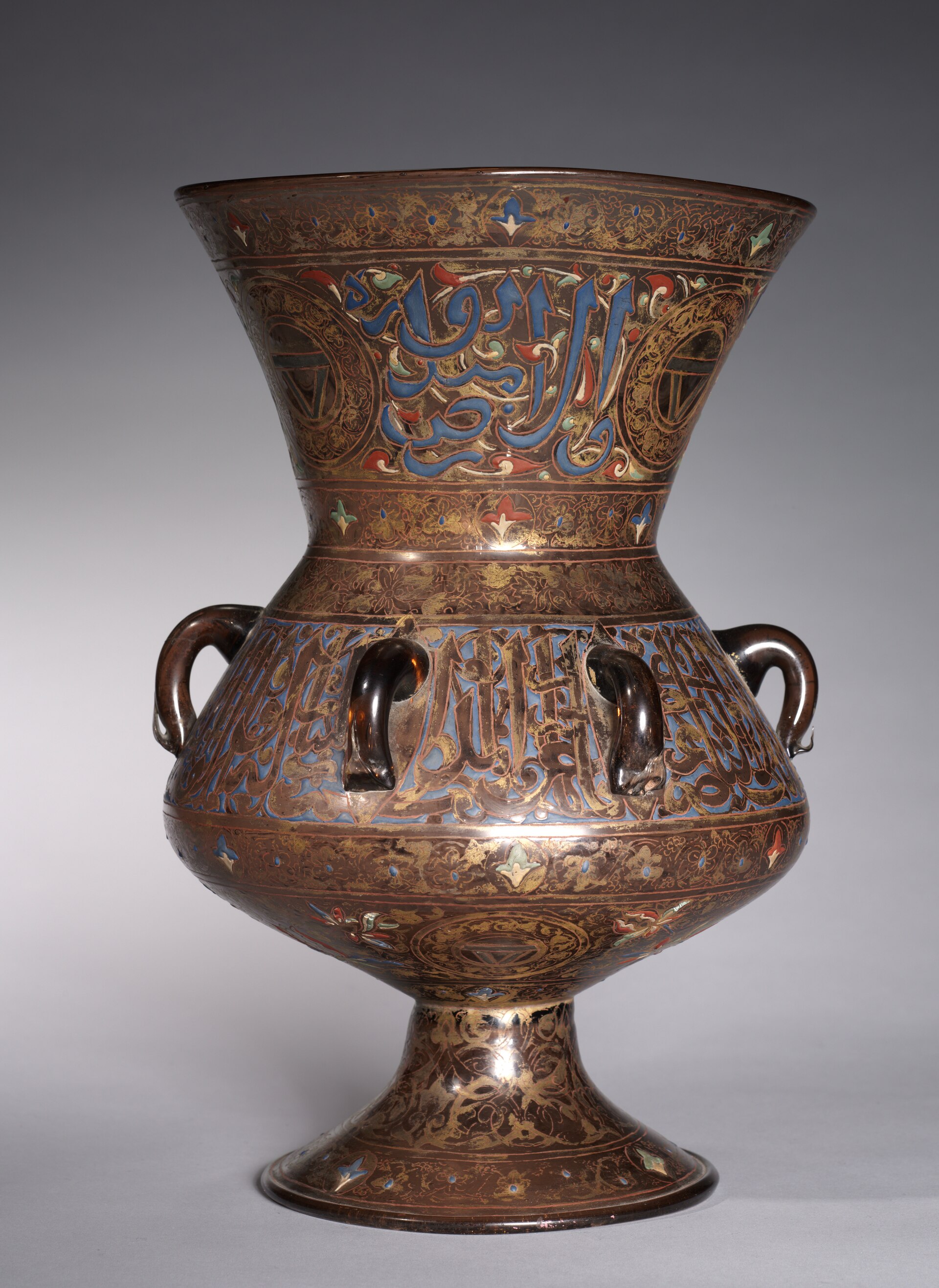
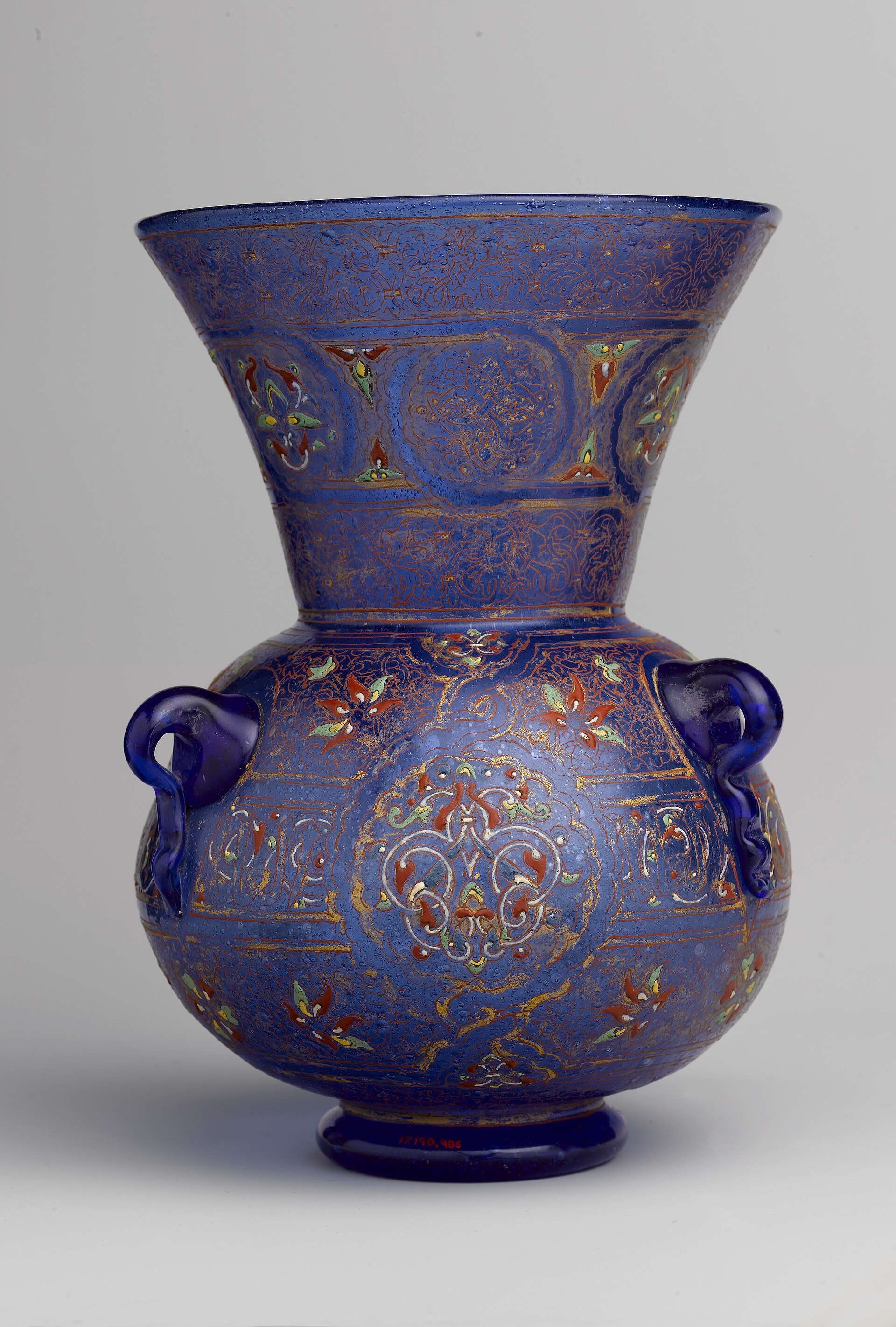
The object described in this record: glass with enameled and gilded decoration, 39.5 cm high, six handles, splayed foot. Cleveland Museum of Art, John L. Severance Fund. The Commons file title still carries the superseded attribution 'Syria or Egypt, Mamluk Dynasty'.
| Artist | Attributed to Philippe-Joseph Brocard (possible) |
|---|---|
| Date | Late 1800s (earlier catalogued as about 1315) |
| Medium | Glass with enameled and gilded decoration |
| Dimensions | Overall height 39.5 cm (15 9/16 in.) |
| Where it is now | Cleveland Museum of Art, Gallery 116 (Islamic), Cleveland, Ohiolast confirmed |
| Inventory number | 1981.10 |
| Attribution | DisputedCleveland catalogues the lamp as made in France in the late 1800s and says it was in Philippe-Joseph Brocard's collection and that it is possible he made it. Full note |
| Object type | Glass |
| Period | French, late nineteenth century, in the Mamluk style |
| Cases | Disputed attribution · Has a provenance gap |
| Inscriptions | Arabic bands on neck and body; the top inscription is Qur'anic and likens divine light to a shining glass lamp. The earlier museum text read the body inscription as naming a theological school founded about 1315 and the titles of the sultan Muhammad ibn Qala'un. Not independently read. |
| Owners on record | 8 links5 documented, 1 disputed, 2 unknown |
| Sources | 21 cited |
About this record Last verified · 21 sources cited · Change log
On this page 9 sections
ContentsClose
A 39.5 cm brown-glass mosque lamp in Cleveland that the museum's data called a Mamluk work of about 1315 as recently as March 2019 and now catalogues as French, late 1800s, formerly in the collection of the Paris glass-enameller Philippe-Joseph Brocard and possibly made by him. The museum bought it from Spink and Son in 1981; its ownership chain runs Brocard, Georges Demotte, a dealer or collector named Ispenian, Spink, Cleveland, with undated links and long gaps.
It is one of three Cleveland pieces of enameled glass, bought across thirty-seven years, that were published as medieval and are now classed as European revival work. No laboratory analysis of this lamp has been published, so the attribution is a judgment from provenance and style, not a finding.
Provenance
Each link is graded. Documented: a cited source supports it. Disputed: the identification is argued but not established. Unknown: no owner for that span, and the gap is not smoothed into a narrative. The grades in the glossary.
- late 1800s -Made in France according to Cleveland's current catalogue; possibly by Philippe-Joseph Brocarddisputed
Cleveland now dates the lamp to the late 1800s and places it in France, with the statement that it is possible Brocard made it. Until at least March 2019 Cleveland data described it as Mamluk work of about 1315 from Syria or Egypt. No analysis settles the question; the present reading is the museum's judgment.123
- late 1800s -Philippe-Joseph Brocard (1831-1896), Parisdocumented
Listed first in Cleveland's provenance, dated only late 1800s. No document is published. Ownership is consistent with Brocard having made the lamp, with his having collected a medieval one or with his having restored one.129
- 1896 - by 1923Unknownunknown
Nothing links Brocard (d. 1896) to Demotte (d. 1923). The interval, up to twenty-seven years, holds no named owner.1217
- undated - 1923 at the latestGeorges Demotte (1877-1923), New Yorkdocumented
Listed second in Cleveland's provenance as of New York; undated. Demotte kept galleries in Paris and New York. The date and place of acquisition are not recorded.1217
- 1923 - before 1981Unknownunknown
No owner is recorded between Demotte's death and the owner called Ispenian. Demotte's galleries passed to his son Lucien according to a tertiary source; whether the lamp was among their stock is not recorded.1217
- undated - 1981Ispenian (surname only; public page gives dates as unknown to 1981)documented
Cleveland gives a surname only. A Paul Ispenian of Paris appears in the provenance of a different, genuine Mamluk lamp now in Qatar; no source read here ties him to this lamp.1218
- before 1981 - 1981Spink and Son, Ltd., Londondocumented
Listed as the dealer that sold the lamp to the Cleveland Museum of Art. No invoice, date within 1981 or price is published.12
- 1981 - presentCleveland Museum of Art, Cleveland, Ohiodocumented
Purchased through the John L. Severance Fund in 1981 (accession 1981.10); on view in Gallery 116. The price is not published.12
Technical evidence
| Attribution note | Cleveland catalogues the lamp as made in France in the late 1800s and says it was in Philippe-Joseph Brocard's collection and that it is possible he made it. Until at least March 2019 the museum's data gave Syria or Egypt, Mamluk Dynasty, about 1315. No analysis of the glass or enamels has been published; the museum's current wording stops at possible. |
|---|---|
| Object type and title | Mosque lamp (glass lamp shade of the Mamluk type, hung by chains). Museum title: Mosque Lamp.12 |
| Date and place, current | Late 1800s, France.12 |
| Date and place, earlier catalogue text | Circa 1315, Syria or Egypt, Mamluk Dynasty (1250-1517), as preserved in a Wikimedia Commons upload of 15 March 2019 from the museum's data. Superseded.3 |
| Medium | Glass with enameled and gilded decoration. Dark brown glass per the museum's image caption.12 |
| Dimensions | Overall height 39.5 cm (15 9/16 in.). Diameter, weight and wall thickness not published.12 |
| Form | Flared neck, bulbous body, six small applied handles, pedestal foot splayed to a wide rim. Museum note: hung by its six handles, stands on its foot when lowered to refill.2 |
| Decoration | Arabic inscription bands in blue on the neck and body, gold floral scrollwork, circular medallions, small red, green and white leaf motifs (museum caption); decoration continues on the inside of the lip and the underside of the foot (open-access photographs).21 |
| Inscription | Top inscription is Qur'anic and likens divine light to a shining glass lamp (the Light Verse, Qur'an 24:35, as named in the earlier text). Earlier text also read the body inscription as naming a theological school founded about 1315 and the titles of the sultan Muhammad ibn Qala'un. Not independently read for this record. No inscription field in the current record.23 |
| Accession and identifiers | Cleveland Museum of Art 1981.10; John L. Severance Fund; Open Access id 150188; Wikidata Q79932444. A Commons upload truncated the number to 1981.1.13 |
| Technical analysis | None published in the sources consulted. Criteria for distinguishing Mamluk from nineteenth-century enameled glass are set out in the Brooklyn lamp study.919 |
| Gallery | On view in Gallery 116 (Islamic) per the museum page.2 |
Images
The record in full
Chapter 1A mosque lamp that Cleveland has moved from the Mamluk fourteenth century to nineteenth-century France
The Cleveland Museum of Art owns a glass lamp, accession 1981.10, that is 39.5 centimeters high, has six handles on a flared body over a splayed foot, and is painted in gold and enamels with Arabic...
The Cleveland Museum of Art owns a glass lamp, accession 1981.10, that is 39.5 centimeters high, has six handles on a flared body over a splayed foot, and is painted in gold and enamels with Arabic inscriptions. It is catalogued today as Mosque Lamp, made in France in the late 1800s, with a note that it once belonged to the Parisian glass-enameller Philippe-Joseph Brocard and that it is possible he made it. Until at least March 2019 the same museum's data described it as Syrian or Egyptian work of the Mamluk dynasty, about 1315, made for a theological school and bearing the titles of the sultan Muhammad ibn Qala'un. Nothing about the glass changed in between. What changed was a judgment about it.
That reversal is the subject of this record, and it is an unusually clean case of the thing the publication exists to track: an object whose name, date and place were each revised after acquisition, whose ownership chain begins with the man who may have made it, and whose earlier label still survives in the bibliography the museum lists beside it. The lamp was bought in 1981 through the John L. Severance Fund from Spink and Son of London. It is on view in Gallery 116, the Islamic gallery. The museum's own object page now says it is representative of a nineteenth-century revival of Mamluk glass, and the same museum has re-dated two older Islamic-glass purchases of 1944 in the same direction.
No published laboratory analysis of this lamp was found. That means the present attribution rests on provenance, on the museum's stylistic judgment and on the pattern of its sister pieces, not on measurement. The record sets out what each of those rests on, where the chain of owners is documented only by the museum's own entry and where it is silent.
Chapter 2What the object is, physically
Cleveland gives the medium as glass with enameled and gilded decoration and the overall height as 39.5 centimeters (15 9/16 inches).
Cleveland gives the medium as glass with enameled and gilded decoration and the overall height as 39.5 centimeters (15 9/16 inches). The museum's description of the photograph is of a dark brown glass lamp with a flared neck, a bulbous body, six small handles and a pedestal foot. That matches the open-access photographs, which show glass of a deep amber-brown tone, near black where it is thick at the handles and the rim of the foot, and a surface almost entirely covered by gold decoration.
The photographs show the decorative scheme clearly. The neck carries a band of Arabic in blue enamel outlined in red, set against fine gilded scrolling and tied together by small red, green and white leaf forms, between two roundels that each enclose a geometric device. Below it a narrow band of gilded floral work leads to the shoulder, where six curved handles stand out from the wall. On the body between the handles a second inscription band is gilded in a thin, tall script against a blue enamel ground. Under that, in the lower body, a frieze of small enameled flowers in red, green and blue alternates with gilded roundels, and the stem and foot are covered in gilded foliage with small enameled blossoms. A view from above shows the same decoration continuing on the inside of the flared lip. A view from below shows a roughly circular pontil-type scar at the centre of the underside of the foot.
The published record lists no maker's mark, signature or inscription field. The museum page states only that the top inscription is Qur'anic and likens divine light to a shining glass lamp, which is the sense of the Light Verse, Qur'an 24:35. The earlier Cleveland text preserved on Wikimedia Commons names that verse directly. This record has not independently read the Arabic from the photographs and does not claim to. Weight, wall thickness and foot diameter are not published.
The museum's visitor note says the lamp would have hung by its six handles and that when lowered to refill its oil it could stand securely on its splayed foot. That is a statement about the type as the museum reads it. A published study of a Brooklyn Museum lamp (see below) records that the Mamluk form usually took a smaller glass vessel holding the oil and wick inside the larger enameled shell, and that such lamps hung from ceilings by chains hooked through the integral handles.
Chapter 3The label that moved: how Cleveland's own description of this lamp changed
The strongest evidence that this lamp's identity is contested comes from the museum itself.
The strongest evidence that this lamp's identity is contested comes from the museum itself. On 15 March 2019 the lamp's open-access photograph was uploaded to Wikimedia Commons from the museum's data. The file name the uploader gave it was Syria or Egypt, Mamluk Dynasty - Mosque Lamp - 1981.10. The embedded description read that the inscription on the neck reproduces the Verse of Light from the Qur'an and that the inscription on the body records that the lamp was produced for a theological school founded about 1315 and gives the titles of the sultan Muhammad ibn Qala'un, who ruled the Mamluk kingdom on three occasions between 1293 and 1340. The date field read about 1315 and the place of creation read Syria or Egypt, Mamluk Dynasty (1250-1517). The accession number field in that upload was truncated to 1981.1, a clerical slip on Commons and not a second object.
The museum's current record, fetched for this research and showing an update stamp of 2 June 2026 in the open-access data, dates the lamp to the late 1800s, gives France as the place and carries a quite different description. It says that in late-nineteenth-century Europe there was a renewed interest in the art of the Islamic world, that Mamluk mosque lamps from the 1300s were particularly prized, that Philippe-Joseph Brocard, a Parisian collector and craftsman, is renowned for reviving the Mamluk technique of enameling and gilding glass and produced many lamp reproductions, that this lamp used to be in his collection and that it is possible that it was made by him. The exact date of the change in the museum's catalogue is not recorded in anything this research could read; it falls between 15 March 2019 and 2 June 2026.
Two things follow. First, the older text was not a vague guess. It read an inscription and gave a founding date for an institution and the regnal titles of a named sultan. That is the kind of specificity a Mamluk original would carry, and it is also exactly what a careful nineteenth-century reproduction of an original would copy. Second, the current text is carefully hedged. It does not say Brocard made the lamp. It says the lamp was once in his collection and that his authorship is possible. A reader should hold the attribution at that strength.
The record's reference list was not rewritten with the label. It still cites Gaston Wiet, Catalogue general du Musee arabe du Caire: Lampes et bouteilles en verre emaille (Cairo, 1929), page 156, and L. A. Mayer, Saracenic Heraldry: A Survey (Oxford, 1933), page 213. Both are works about authentic Mamluk lamps and heraldic blazons. The museum's record does not say what either page says about this lamp, and neither was read for this record. Their presence is consistent with the lamp having been entered in 1981 as a Mamluk piece, but that is an inference from the bibliography and the Commons snapshot, not something the museum's current text states.
Chapter 4The same museum, the same reversal: the 1944 bottle and basin
Cleveland's handling of the lamp cannot be understood without two earlier purchases.
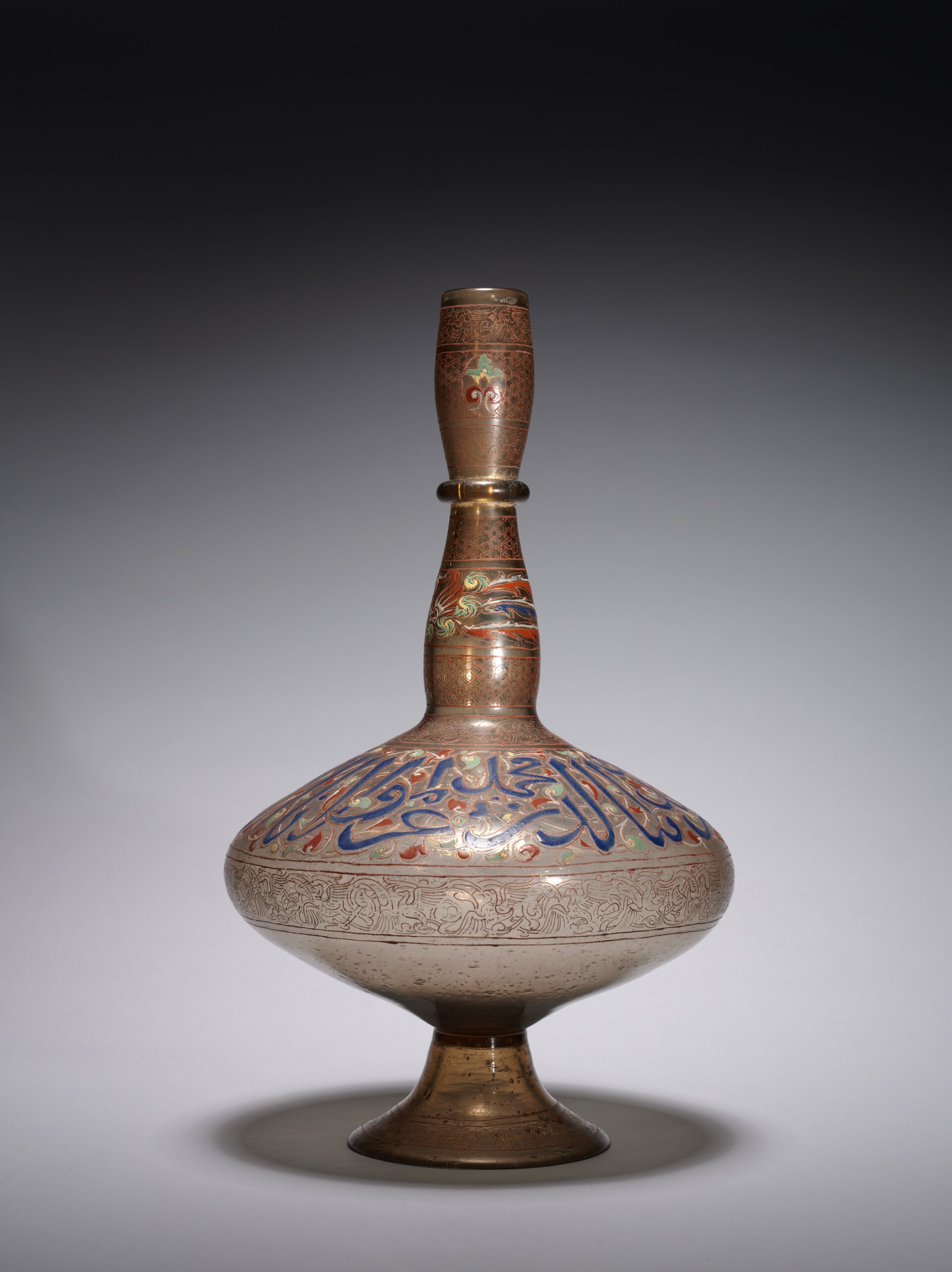
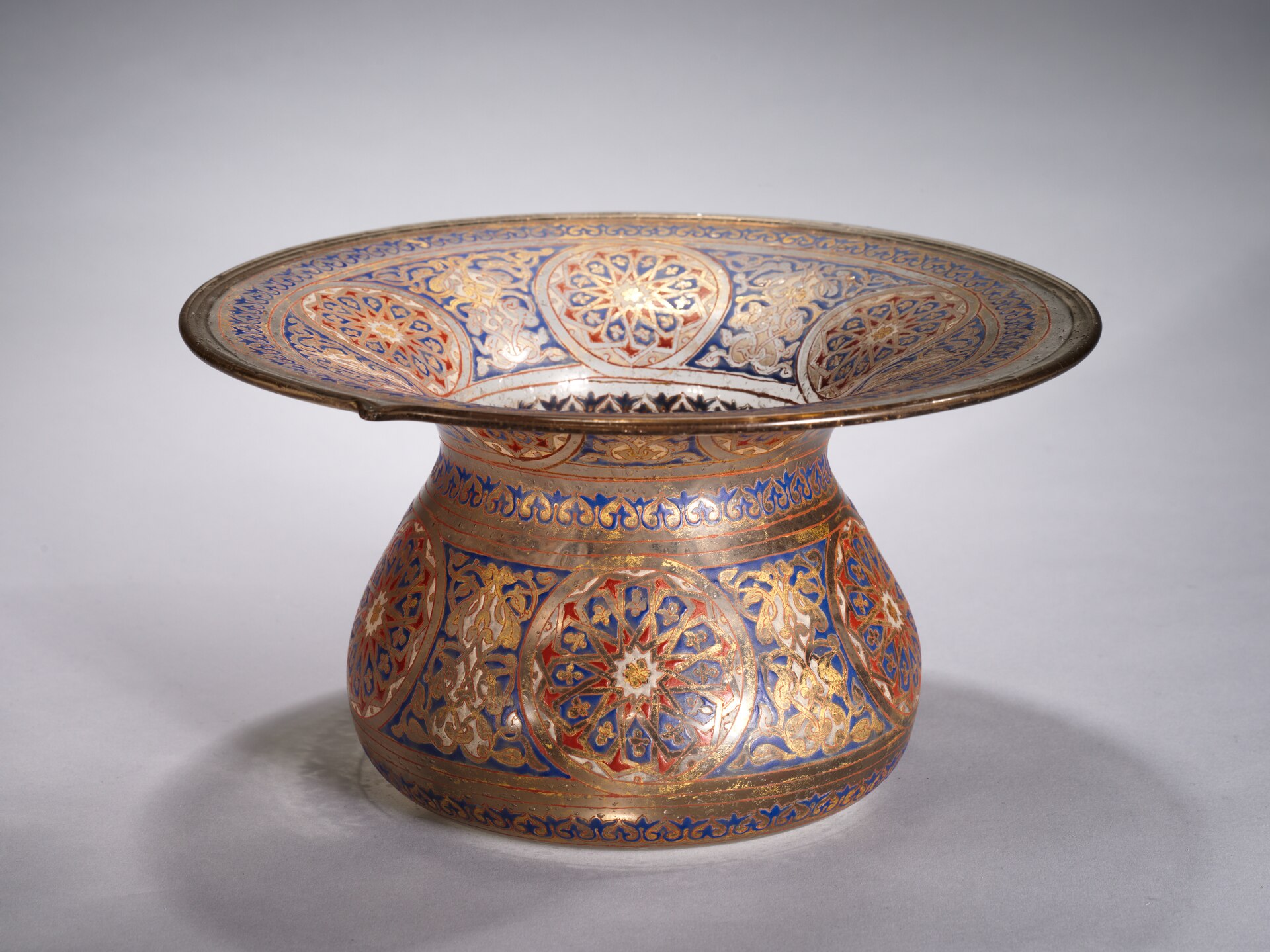
Cleveland's handling of the lamp cannot be understood without two earlier purchases. In 1944 the museum acquired two enameled glass objects for the J. H. Wade Collection, a bottle (accession 1944.488) and a basin (1944.235), and the Cleveland Museum of Art Bulletin for December 1945 published them in an article by Howard Hollis titled Two Examples of Arabic Enameled Glass. The bottle's provenance footnote reads: Dikran G. Kelekian, the Museum of the University of Pennsylvania, H. Kevorkian. The basin's footnote says it was purchased from the sale of the J. P. Morgan Collection, Parke-Bernet Galleries, New York, March 1944, number 120. The museum's current open-access provenance for the basin names Heeramaneck Galleries, New York, as the dealer that sold it to Cleveland; the two accounts need not conflict, since a dealer may have bought at the sale and resold, but the intermediary is not named in the 1945 footnote.
Hollis treated both as Mamluk. The bottle's cover caption read: made for Sultan Malik an-Nasir Muhammad, Syro-Egyptian, Mamluk, early fourteenth century. He wrote that the inscription showed it was made for the sultan who ruled at Cairo three times from 1293 to 1340, and that its high quality seemed to assign it to Damascus. He dated the basin to about the middle of the fourteenth century on the strength of a tray in the Metropolitan Museum with the same rosette and arabesque design. In a footnote he made a remark that deserves quoting for what it records: the basin's shape is evidently unique in Mamluk glass. The only parallel he could cite was a basin, presumably of metal, shown on a page of a Persian anthology, the Munis al-Ahrar, dated 1340.
Later Cleveland publications kept the Mamluk labels. The Handbook of 1978 lists the bottle as enameled glass, Egypt or Syria, Mamluke period, fourteenth century, height 44.1 centimeters, accession 44.488, and the bowl as 44.235 with the same attribution. The basin appears in the Hayward Gallery's The Arts of Islam (London, 1976, catalogue number 143, page 146) and in Esin Atil's Renaissance of Islam: Art of the Mamluks (Smithsonian, 1981, number 51, page 132), according to the museum's own citation list. It is also cited in Carboni and Whitehouse's Glass of the Sultans (2001, number 135, pages 272-273), but this research did not read that catalogue and does not say how it classed the basin.
Today the museum catalogues the bottle as Europe, about 1900, and the basin as Europe, late 1800s. The museum's entry for each now says the piece is, like mosque lamp 1981.10, representative of reproductions of Mamluk glass prominent in Europe in the late 1800s, a period of resurgence of interest in Islamic art when collectors and artists revived the techniques of enameling and gilding. The two older purchases and the 1981 lamp are therefore now presented as a group: three Cleveland pieces bought across thirty-seven years, each at some stage published or catalogued as medieval, each now understood as a European revival piece. For a collector the lesson is the base rate. In this museum's Islamic enameled glass the reversal is not an outlier.
Chapter 5Philippe-Joseph Brocard, the man the record names
Brocard is the one named person in the current attribution, and what is firmly documented about him comes from museum records and one scientific paper, with a handful of biographical details from...
Brocard is the one named person in the current attribution, and what is firmly documented about him comes from museum records and one scientific paper, with a handful of biographical details from tertiary sources. He was born, by one account, on 21 June 1831 at Lens-Saint-Servais in Belgium (the article's infobox also gives Liege as a possible birthplace) and died on 29 March 1896 at Meudon. The 2016 Heritage Science paper that examined a Brooklyn lamp states the years 1831-1896 and describes him as a French glassmaker inspired by enameled Mamluk mosque lamps, who collected such lamps and was especially gifted at creating successful facsimiles of Islamic enameled glass. The same paper says he is also known to have restored enamels on genuine medieval examples. That statement matters for this lamp, as the next section explains.
He began as a restorer of art objects and antiquities. Museum-collection sources place his public debut at the Paris Exposition Universelle of 1867, a date this research could not confirm from a primary account. The Victoria and Albert Museum holds a standing bowl designed by him for the Brocard glassworks, which the museum records as received from M. Brocard on 18 March 1869 for the sum of seven pounds four shillings. It holds two goblets of 1873-78 signed Brocard in enamel, and a mosque lamp of 1889. The Rijksmuseum lent-collection record of a mosque lamp in smoke-colored glass names him as the designer, dates it about 1880, gives its size as 26.3 by 19.5 centimeters and states that it is signed on the underside. The Brooklyn Museum's bequest from William H. Herriman included a lamp signed Brocard, Paris, June 1871.
The V&A lamp of 1889 is the most useful single record for the question at issue. The museum bought it from the Paris shop of E.-B. Leveille and F.-E. Rousseau, La Maison Rousseau-Leveille, 74 Boulevard Haussmann, as a reproduction of a Damascus lamp, and its record says the lamp is by Brocard and is based on original lamps of the 1300s made for the Mameluke sultans of Egypt and their high officials for mosques in Damascus and Cairo. So the trade in Brocard's lamps was a trade in reproductions that said so, sold in a Paris shop and acquired by a South Kensington museum in his lifetime. The ambiguity that Cleveland now faces arrives later, when pieces lose their labels and pass through hands that no longer need to say so.
He also patented a process. The French Wikipedia article states that on 20 August 1891 he filed patent number 215619 for a new process of applying enamels to glass and foil, and that he developed a cloisonne technique for setting the enamels. That article is a tertiary source and the patent should be checked against the French industrial-property register before it is cited.
Chapter 6Why a Brocard provenance does not settle who made the lamp
Cleveland's provenance begins with Brocard, and a reader could assume that this closes the matter: if he owned it, he probably made it.
Cleveland's provenance begins with Brocard, and a reader could assume that this closes the matter: if he owned it, he probably made it. The scientific literature says otherwise. Salvant and colleagues state that Brocard collected Mamluk lamps and restored enamels on genuine medieval examples as well as making facsimiles. Ownership by Brocard is therefore consistent with three different histories: a lamp he made and kept; a medieval lamp he acquired as a collector; and a medieval lamp he acquired and restored or completed. The museum's careful wording, that it is possible he made it, reflects that ambiguity and no more.
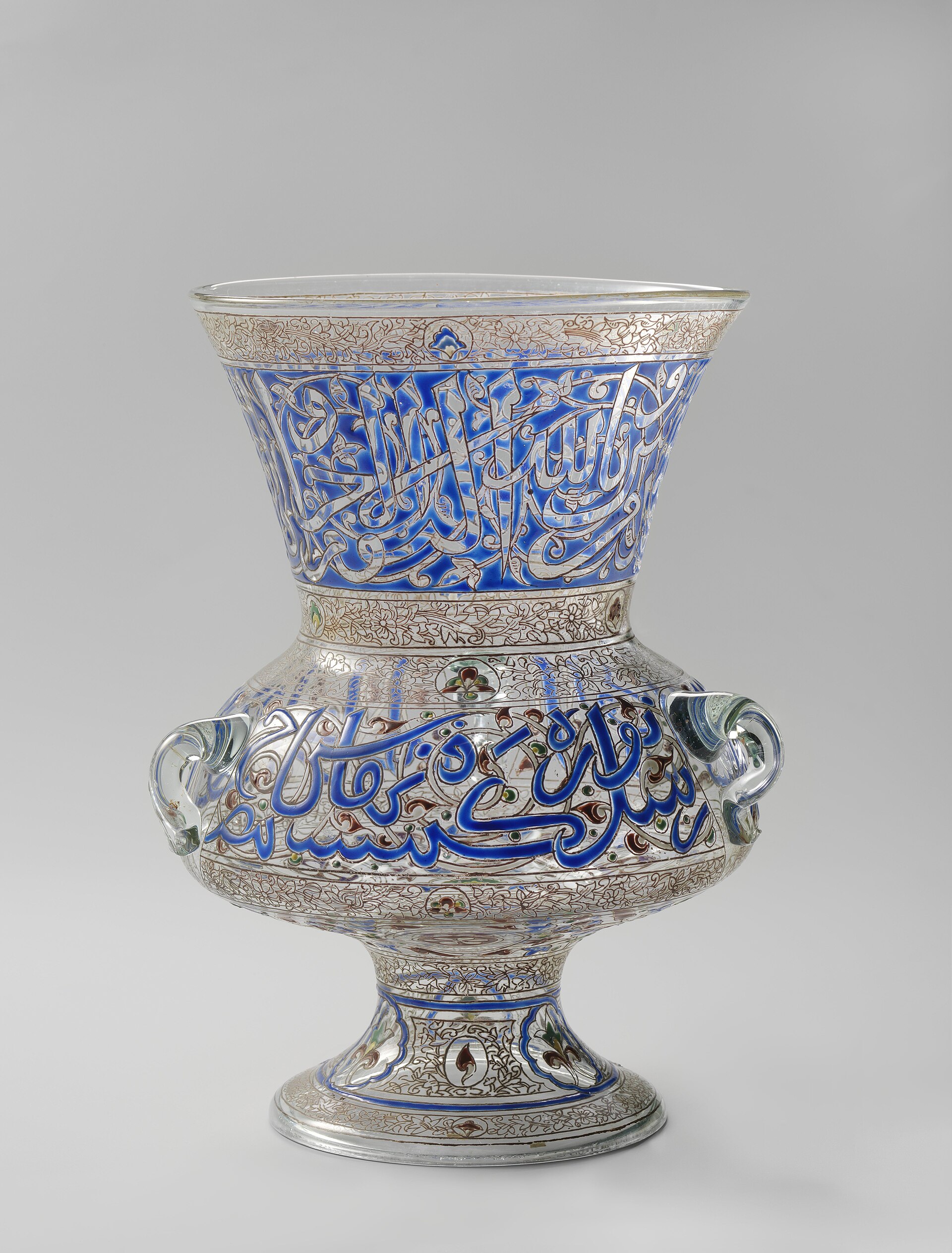
A second consideration is the object's own claim. If the neck and body inscriptions carry a sultan's titles and a founding date, as the earlier Cleveland text recorded, that tells you what the maker wanted a viewer to see, not when it was made. The Christie's catalogue entry for a nineteenth-century Mamluk-style blue lamp from the Rothschild collection, almost certainly from a Parisian workshop, reads its two main inscriptions as a formula in the name of the sultan al-Nasir, and the cataloguer argues that this lamp, the previous lot and the Metropolitan Museum's lamp 17.190.986 came from the same Paris manufactory. The same lamp was exhibited at the Musee des arts decoratifs in Paris in 1903 as Syria, fourteenth to fifteenth century. A reproducer copies the formula with the lamp. The text can date the prototype and say nothing about the copy.
A third consideration is what the surface of the thing says. This research has seen only the museum's photographs, not the lamp, and cannot judge enamel, gilding or glass from an image. Two visible features are worth recording because a reader with the object in front of them could test them. The glass is a smoky, near-black amber, and the Rijksmuseum's signed Brocard lamp of about 1880 is also described as smoke-colored glass. The underside has a central scar. Neither observation proves anything. Both are the kind of detail on which a specialist's eye, and then a laboratory, would begin.
Chapter 7How a nineteenth-century reproduction is told from a Mamluk original
The best published account of the problem is a 2016 paper in Heritage Science by Salvant, Schussler, McKenna, Bruno, Ganio and Walton, which investigated Brooklyn Museum lamp 21.484.
The best published account of the problem is a 2016 paper in Heritage Science by Salvant, Schussler, McKenna, Bruno, Ganio and Walton, which investigated Brooklyn Museum lamp 21.484. The lamp had entered that museum in 1921 in William H. Herriman's bequest, along with two other Islamic-style mosque lamps, one signed Brocard, Paris, June 1871. Brooklyn's records had carried differing scholarly assessments for decades. In 1991 Rachel Ward, then of the British Museum, noted a glass funnel wick-holder known to her in medieval Persian lamps but not in Mamluk lamps, and thought the handles characteristic of nineteenth-century France. In 1992 Stefano Carboni, then at the Metropolitan Museum, instead thought it might be a thirteenth- or fourteenth-century example and doubted a nineteenth-century date overall.
The paper used portable X-ray fluorescence, scanning electron microscopy with energy-dispersive spectrometry and Raman spectroscopy, and concluded that the Brooklyn lamp's body, handles and wick-holder are Mamluk and its foot a later addition. The criteria it applied are the useful part for anyone looking at another lamp. In Mamluk production the vessel glass is soda-lime-silica glass with significant magnesia and potash, consistent with a plant-ash flux. Nineteenth-century European glass has various compositions but generally lower magnesia and potash, or mixed alkali. The Mamluk enamels were not all alike: red and blue enamels were low in lead and the white, yellow and green ones lead-rich, whereas every nineteenth-century enamel color identified in the literature is lead-rich. The Mamluk white was tin oxide, where nineteenth-century objects used lead arsenate. The Mamluk yellow and green were opacified with lead stannate, where later European work used uranium trioxide or lead chromate for yellows and chromium compounds for greens. The Mamluk blue was colored with crushed lapis lazuli, identified by Raman as lazurite.
The paper also gives a technological test that needs no laboratory. A double pontil mark on the base is characteristic of a vessel put back into the furnace on a pontil rod to fuse the gilding and enamels, a technology consistent with Mamluk production, whereas kiln-firing of enamels was, in the paper's account, not practiced until the nineteenth century. The authors caution that quantifying manganese would be needed to further evidence Mamluk production, and they record that small amounts of manganese oxide are also reported in some nineteenth-century glass.
None of that has been applied to Cleveland 1981.10 in anything this research could find. The Northwestern University Center for Scientific Studies in the Arts project page that summarises the Brooklyn work does not mention Cleveland, and no analytical report on 1981.10 was located in the museum's published citations. The photograph of the underside shows a scar at the centre of the foot. Whether that is a single pontil mark, a double one, or the trace of a different procedure cannot be read from an image, and the museum's record is silent on it. This is the cheapest open question in the record and the most decisive: the same analysis that reversed the Brooklyn lamp's doubt could confirm or overturn Cleveland's current reading.
Chapter 8The chain of owners: Brocard, Demotte, Ispenian, Spink, Cleveland
The museum's provenance lists five entries.
The museum's provenance lists five entries. The first is Philippe-Joseph Brocard (1831-1896), Paris, dated only late 1800s. The second is Georges Demotte (1877-1923), New York. The third is a single name, Ispenian, with the dates in the museum's public page given as unknown to 1981. The fourth is Spink and Son, Ltd., London, which sold the lamp to the Cleveland Museum of Art, dated to 1981. The fifth is the museum, from 1981. None of the intervals is dated and none of the transfers cites a document in the published record. The museum's own page notes that provenance information may not be current.
Georges Demotte is the one link a reader can place. Wikipedia, a tertiary source, describes him as a Belgian-born dealer in medieval French art who ran galleries at 27 rue de Berri in Paris and 8 East 57th Street in New York, who acquired the Great Mongol Shahnameh about 1910 and sold its miniatures separately, and who died in 1923 when he was accidentally shot by the dealer Otto Wegener on the way back from a boar hunt. It also says he sued the dealer Sir Joseph Duveen for slander in 1923 after Duveen declared a medieval statuette Demotte sold to be a fake. That dispute is about a different object and is recorded here only because it shows a dealer in the middle of this chain who was himself accused of selling a forgery. It is not evidence about this lamp. When Demotte held the lamp, and whether he bought it in Paris or New York, is not recorded. The chain between Brocard's death in 1896 and Demotte's death in 1923 is therefore a gap of up to twenty-seven years with a single named intermediary at the far end.
Ispenian is the least documented link. The Cleveland record gives only the surname. A page from the dealer Oliver Hoare on a genuine Mamluk lamp now in the Museum of Islamic Art, Qatar, lists Paul Ispenian, Paris, in that lamp's provenance after a nineteenth-century English owner who lent it to the Burlington Fine Arts Club in 1885. Whether this is the same Ispenian as the one in Cleveland's chain is not established by anything read here, and the record does not treat it as the same. The Cleveland page's date range for Ispenian ends in 1981, which would make the owner or the estate the seller to Spink in the year of acquisition, but that is read from a question-mark range in a public page and nothing more.
Spink and Son, the London dealer that sold the lamp, is documented only through Cleveland's provenance entry. No price is published. The museum's credit line is the John L. Severance Fund, a purchase fund established, according to the Cleveland handbook of 1978, in 1942. A reader should not infer a sum from the fund's name. The acquisition was reported in the museum's Bulletin for 1982, in Sherman E. Lee's The Year in Review for 1981, mentioned at page 78 and reproduced at page 68, and in Journal of Glass Studies volume 24 (1982), Recent Important Acquisitions, reproduced at page 90, number 12. Neither article could be read for this record, and what either said about the lamp's date and origin in 1982 is the missing piece of the catalogue history.
Chapter 9What was paid, and what the money meant
No price for this lamp has been published in anything consulted.
No price for this lamp has been published in anything consulted. Cleveland's entry names the fund and the seller and nothing else, and no auction record for the lamp was found in the sources consulted. The comparison most useful to a collector is therefore a sale of the type. The Christie's entry for a Mamluk-style blue enameled lamp of 25.5 centimeters, dated second half of the nineteenth century and almost certainly Parisian, belonged to Baron Alphonse de Rothschild, passed to Baron Edouard de Rothschild, was confiscated by the Einsatzstab Reichsleiter Rosenberg after May 1940, recovered at Alt Aussee, repatriated to France on 31 July 1946, passed to Baroness Batsheva de Rothschild in Tel Aviv, and was sold at Christie's London on 14 December 2000 (lot 11) and was later offered as lot 34 of a Christie's live auction. The page that was fetched gave that history but no estimate or result, so this record states no price for it.
The only period price in the research file is small and concerns Brocard's own work at the time: the V&A's purchase of a Brocard standing bowl on 18 March 1869 for seven pounds four shillings. It is a precise figure and a poor guide, since a nineteenth-century museum purchase directly from the maker is not a dealer's market price for a lamp, and no wage or comparable-object conversion for that year has been sourced. This record gives no modern equivalent.
Chapter 10Naming, numbers and the version problem
The lamp has carried one stable title and several attached descriptions.
The lamp has carried one stable title and several attached descriptions. The museum's title is Mosque Lamp. The Commons file of March 2019 carries Syria or Egypt, Mamluk Dynasty - Mosque Lamp - 1981.10 - Cleveland Museum of Art as its name. The inventory number is 1981.10; Cleveland's open-access object identifier is 150188; the Wikidata item is Q79932444; the museum also deposited its images in an Internet Archive item named clevelandart-1981.10-mosque-lamp.
The numbers that cause trouble are neighbours. Cleveland 1944.488 is a bottle and 1944.235 a basin, both once published as Mamluk and now catalogued as European reproductions. The Metropolitan Museum's 17.190.986 is a blue mosque lamp catalogued there as nineteenth century, given by J. Pierpont Morgan in 1917, and 17.190.987 is a different lamp. Brooklyn 21.484 is a lamp that, unlike these, analysis found to be Mamluk. A reader who hears that a Cleveland lamp had its date changed from Mamluk to French should check which of these objects the statement concerns. Several of them were, or were assumed to be, in the same predicament.
The Commons upload of the Cleveland lamp truncated the accession number to 1981.1. That is a different number from 1981.10 and not a separate object. The Commons file is useful as a dated snapshot of the older Cleveland description and as a free copy of the museum's photograph, and it should not be cited for the lamp's present attribution.
Chapter 11What is happening to it now, and what remains open
The lamp is on view in Gallery 116, the Islamic gallery, per the museum's current page.
The lamp is on view in Gallery 116, the Islamic gallery, per the museum's current page. Its exhibition history in the record is short: The Year in Review for 1981, 17 February to 21 March 1982, and Art of the Islamic World (Islamic art rotation), 21 May 2021 to 31 May 2022. The open-access record carries an update stamp of 2 June 2026, and the museum's page says that provenance may not be current and invites corrections. No conservation report, technical study or restitution claim was found.
What would settle the question is specific. A laboratory reading of the vessel glass for magnesia, potash and manganese; of the enamels for lead, tin, arsenic, uranium and chromium; and an examination of the underside and foot for the number and character of pontil marks, each following the criteria in the Brooklyn paper. A reading of the inscriptions that names the sultan and school the earlier Cleveland text recorded, and a comparison with the Cairo lamp or lamps of which this would be a copy if it is one. The 1929 and 1933 pages the museum cites. The 1982 acquisition articles. A document for the Brocard, Demotte, Ispenian and Spink links. Each is a finite task, and until one is done the lamp's present attribution is the museum's careful judgment and not a finding.
For a collector, a scholar or a curator reading this page the practical position is plain. The object is real, the photograph is free, the provenance is the museum's own list, and the attribution has moved once in living memory by a margin of about six centuries. A record that stopped at the current label would give the reader a tidy answer. This one gives the reader the sequence of answers, because that sequence is how the next person will know what to test.
The artist
Philippe-Joseph Brocard (1831-1896)
Brocard is the one person named in Cleveland's current attribution, and the record can say with documents that he existed as a maker and dealer in Mamluk-style enameled glass, that his lamps were sold as reproductions and signed, and that he also collected and restored genuine medieval pieces. It cannot say that he made this lamp. The museum's own wording is that this lamp was in his collection and that it is possible he made it.
Related works
| Work | Relation | Where it is |
|---|---|---|
| Bottle Unknown, Europe, c. 1900 (once published as Mamluk, early 14th century) | Cleveland sister piece bought in 1944 and published by Hollis in 1945 as made for Sultan al-Nasir Muhammad; now catalogued as a reproduction, with a description that cites this lamp. Provenance in the 1945 article: Dikran G. Kelekian, the University of Pennsylvania Museum, H. Kevorkian. | Cleveland Museum of Art, 1944.488 |
| Ceremonial Spittoon or Basin Unknown, Europe, late 1800s (once published as Mamluk, mid-14th century) | Second 1944 Cleveland purchase with the same reversal; Hollis noted its shape was evidently unique in Mamluk glass. Morgan sale, Parke-Bernet, March 1944, no. 120, per Hollis; Heeramaneck Galleries per the current record. | Cleveland Museum of Art, 1944.235 |
| Mosque lamp, signed Philippe-Joseph Brocard, c. 1880 | Signed Brocard comparandum in smoke-colored glass, dated about 1880; the closest published match to this lamp's glass color. Height 26.3 cm, diameter 19.5 cm; signed underneath. | Rijksmuseum, Amsterdam, BK-C-2000-1 (on loan from the Nationaal Glasmuseum) |
| Mosque lamp Philippe-Joseph Brocard, 1889 | Brocard lamp sold in his lifetime as a reproduction of a Damascus lamp. Purchased from La Maison Rousseau-Leveille, 74 Boulevard Haussmann, Paris. | Victoria and Albert Museum, 71-1890 |
| Mosque lamp Philippe-Joseph Brocard (labeled 1883-1884) | Second Brocard lamp, photographed under that label. Date and attribution as given on the photographer's file title; the museum's own record was not read. | Wadsworth Atheneum, Hartford |
| Mosque lamp Unknown, catalogued 19th century | Blue lamp given by J. Pierpont Morgan in 1917; Christie's argues it came from the same Paris manufactory as a Mamluk-style lamp of its own lot. Dimensions per Commons import: H. 10 in. (25.4 cm), rim diameter 6 3/4 in. | Metropolitan Museum of Art, 17.190.986 |
| Mosque lamp, 21.484 Mamluk, 13th to 14th century (body, handles, wick-holder); foot later | The lamp the 2016 paper analysed and found Mamluk, after Ward and Carboni disagreed; the same bequest held a lamp signed Brocard, Paris, June 1871. The reference case for method, not a lamp from the same hand. | Brooklyn Museum, Bequest of William H. Herriman, 21.484 |
| Mamluk-style enameled and gilt blue glass mosque lamp Almost certainly a Parisian workshop, second half of the 19th century | Rothschild-provenance lamp copying the sultan al-Nasir's inscription, shown in 1903 as 'Syria XIV-XV century'. Estimate and result not shown on the page read. | Christie's, lot 34, live auction 11898 |
Open questions
- What do the Cleveland acquisition entries of 1982 (Sherman E. Lee, The Year in Review for 1981, p. 78 no. 8, ill. p. 68; Journal of Glass Studies 24, p. 90 no. 12) say the lamp was when it was bought, and on whose authority?
- What do Wiet 1929 p. 156 and Mayer 1933 p. 213, which Cleveland still cites for this lamp, actually describe, and is it this lamp or a Cairo lamp it may copy?
- On what date and for what reason did Cleveland change the lamp from Syria or Egypt, c. 1315, to France, late 1800s? The change falls between 15 March 2019 and 2 June 2026 and no note of it was found.
- Do the vessel glass and enamels match the Mamluk criteria set out for the Brooklyn lamp (magnesia and potash, low-lead red and blue enamel, tin-oxide white, lead-tin yellow, lazurite blue) or the nineteenth-century ones (uniformly lead-rich enamels, lead arsenate white, uranium or chromium colorants)? No analysis of 1981.10 has been published.
- Is the central mark on the underside of the foot a single or double pontil scar, and does the lamp carry a signature or mark that the open-access photographs and the record do not show?
- What does the body inscription actually read, and which sultan and school does it name? The earlier text said Muhammad ibn Qala'un and a school founded about 1315; which Cairo or other lamp is the model if it is a copy?
- Who is the Ispenian of the chain, are he or she the Paul Ispenian of Paris listed with a genuine lamp now in Qatar, and when did the lamp leave his or her hands?
- When did Georges Demotte hold the lamp, in Paris or New York, and what was the document that tied it to Brocard?
- What did Spink and Son charge, and what did Cleveland pay from the Severance Fund in 1981?
- What does Carboni and Whitehouse, Glass of the Sultans (2001), no. 135, pp. 272-273, say about the basin 1944.235, and does it comment on lamp 1981.10?
Questions about this object
What is Mosque Lamp?
Mosque Lamp is a glass, dated late 1800s (earlier catalogued as about 1315). Medium: Glass with enameled and gilded decoration.
Who made Mosque Lamp, and is the attribution settled?
The attribution to Attributed to Philippe-Joseph Brocard (possible) is recorded here as disputed. Cleveland catalogues the lamp as made in France in the late 1800s and says it was in Philippe-Joseph Brocard's collection and that it is possible he made it. Until at least March 2019 the museum's data gave Syria or Egypt, Mamluk Dynasty, about 1315. No analysis of the glass or enamels has been published; the museum's current wording stops at possible.
Where is Mosque Lamp now?
Cleveland Museum of Art, Gallery 116 (Islamic), Cleveland, Ohio. Inventory number 1981.10. Last confirmed 17 November 2026. Purchased 1981 through the John L. Severance Fund from Spink and Son, London; on view per the museum page.
What is still unknown about Mosque Lamp?
What do the Cleveland acquisition entries of 1982 (Sherman E. Lee, The Year in Review for 1981, p. 78 no. 8, ill. p. 68; Journal of Glass Studies 24, p. 90 no. 12) say the lamp was when it was bought, and on whose authority?
Sources
- 1Cleveland Museum of Art Open Access API, object record for 1981.10 Mosque Lamp (id 150188): tombstone, description, provenance, citations, exhibitions, images, CC0 flag; update stamp 2026-06-02. openaccess-api.clevelandart.org/api/...
- 2Cleveland Museum of Art, print page for Mosque Lamp, 1981.10 (late 1800s, France): description, Did You Know note, provenance list with Ispenian, citations, exhibition history, Gallery 116. clevelandart.org/print/...
- 3Wikimedia Commons, file page and upload history for 'Syria or Egypt, Mamluk Dynasty - Mosque Lamp - 1981.10 - Cleveland Museum of Art.tif' (file history timestamp 2019-03-15; CC0): preserves the earlier Cleveland description, date circa 1315 and place Syria or Egypt, Mamluk Dynasty. commons.wikimedia.org/wiki/...
- 4Cleveland Museum of Art Open Access API, object record for 1944.488 Bottle (id 123992): c. 1900, Europe, Kevorkian provenance, citation list, description linking it to lamp 1981.10. openaccess-api.clevelandart.org/api/...
- 5Cleveland Museum of Art Open Access API, object record for 1944.235 Ceremonial Spittoon or Basin (id 123703): late 1800s, Europe, Morgan and Heeramaneck provenance, citation list including Hayward 1976, Atil 1981 and Carboni and Whitehouse 2001. openaccess-api.clevelandart.org/api/...
- 6Hollis, Howard. 'Two Examples of Arabic Enameled Glass.' Bulletin of the Cleveland Museum of Art 32, no. 10 (December 1945), pp. 179-181 (full text read at the Internet Archive). archive.org/details/...
- 7Islamic Art: Selected Examples from the Loan Exhibition of Islamic Art at the Cleveland Museum of Art. Cleveland Museum of Art, 1944 (page 38 caption for the enameled glass bottle, lent by H. Kevorkian; full text read at the Internet Archive). archive.org/details/...
- 8Handbook of the Cleveland Museum of Art, 1978 (list of illustrations entries 44.488 and 44.235 as Mamluke period; history of the John L. Severance Fund established 1942; full text read at the Internet Archive). archive.org/details/...
- 9Salvant, J., Schussler, S., McKenna, C., Bruno, M., Ganio, M. and Walton, M. 'Investigation of an enameled glass mosque lamp: a 13th-14th-century Mamluk example or 19th-century European version?' Heritage Science 4, article 5 (2016). Full text read. doi.org/10.1186/...
- 10Victoria and Albert Museum, object record 71-1890, mosque lamp by Philippe-Joseph Brocard, 1889 (V&A collections API, system number O121900): object history, bought as 'reproduction of a Damascus lamp'. collections.vam.ac.uk/item/...
- 11Victoria and Albert Museum, object record 1777-1869, standing bowl designed by Philippe-Joseph Brocard, c. 1869 (system number O399): received from M. Brocard 18 March 1869; museum paid 7 pounds 4 shillings. collections.vam.ac.uk/item/...
- 12Victoria and Albert Museum, object records 415-1878 and 416-1878, goblets designed and decorated by Philippe-Joseph Brocard, 1873-78, signed 'Brocard' in enamel (system numbers O994 and O995). collections.vam.ac.uk/item/...
- 13Rijksmuseum, Amsterdam, BK-C-2000-1, Moskeelamp van rookkleurig glas, designer Philippe-Joseph Brocard, c. 1880, signed underneath (loan from the Nationaal Glasmuseum); description read from the museum's text on the Wikimedia Commons file page. commons.wikimedia.org/wiki/...
- 14Christie's, lot 34 (Exceptional Sale, live auction 11898), Mamluk-style enameled and gilt blue glass mosque lamp, second half of the 19th century, almost certainly from a Parisian workshop: provenance, literature (Wiet 1929 p. 162 no. 40), 1903 exhibition, lot essay. Page read; estimate and result not shown on the page. christies.com.cn/en/...
- 15To be replaced by the French archive records and patent register it cites. fr.wikipedia.org/wiki/...
- 16No external citations given on the page; to be replaced. mus-col.com/en/...
- 17To be replaced by the Time, New York Times and Iranica references it cites. en.wikipedia.org/wiki/...
- 18Oliver Hoare Ltd, 'A Mosque Lamp' (a different lamp, 1373-1376, Museum of Islamic Art, Qatar): provenance listing Paul Ispenian, Paris. oliverhoareltd.com
- 19Northwestern University Center for Scientific Studies in the Arts, project page 'Mamluk lamp' (Brooklyn Museum lamp 21.484; XRF, Raman, SEM-EDS). No mention of Cleveland. scienceforart.northwestern.edu/projects-proposals/...
- 20Wikimedia Commons, file page 'Mosque lamp, by Phillipe Joseph Brocard, 1883-1884, glass - Wadsworth Atheneum - Hartford, CT' (public domain; photograph by Daderot; museum label as titled by the uploader). commons.wikimedia.org/wiki/...
- 21Wikimedia Commons, file page 'Mosque Lamp MET DP155253.jpg' (Metropolitan Museum of Art 17.190.986, Gift of J. Pierpont Morgan, 1917; date 19th century; CC0), imported from the Met's Open Access data. commons.wikimedia.org/wiki/...


Last verified · Published
Change log
17 November 2026 - Record created at the house standard: researched narrative, technical evidence, maker dossier, graded provenance chain, prices with hammer and premium separated, related works, open questions and sources.