The Massacre of the Innocents
Peter Paul Rubens · c. 1611-1612
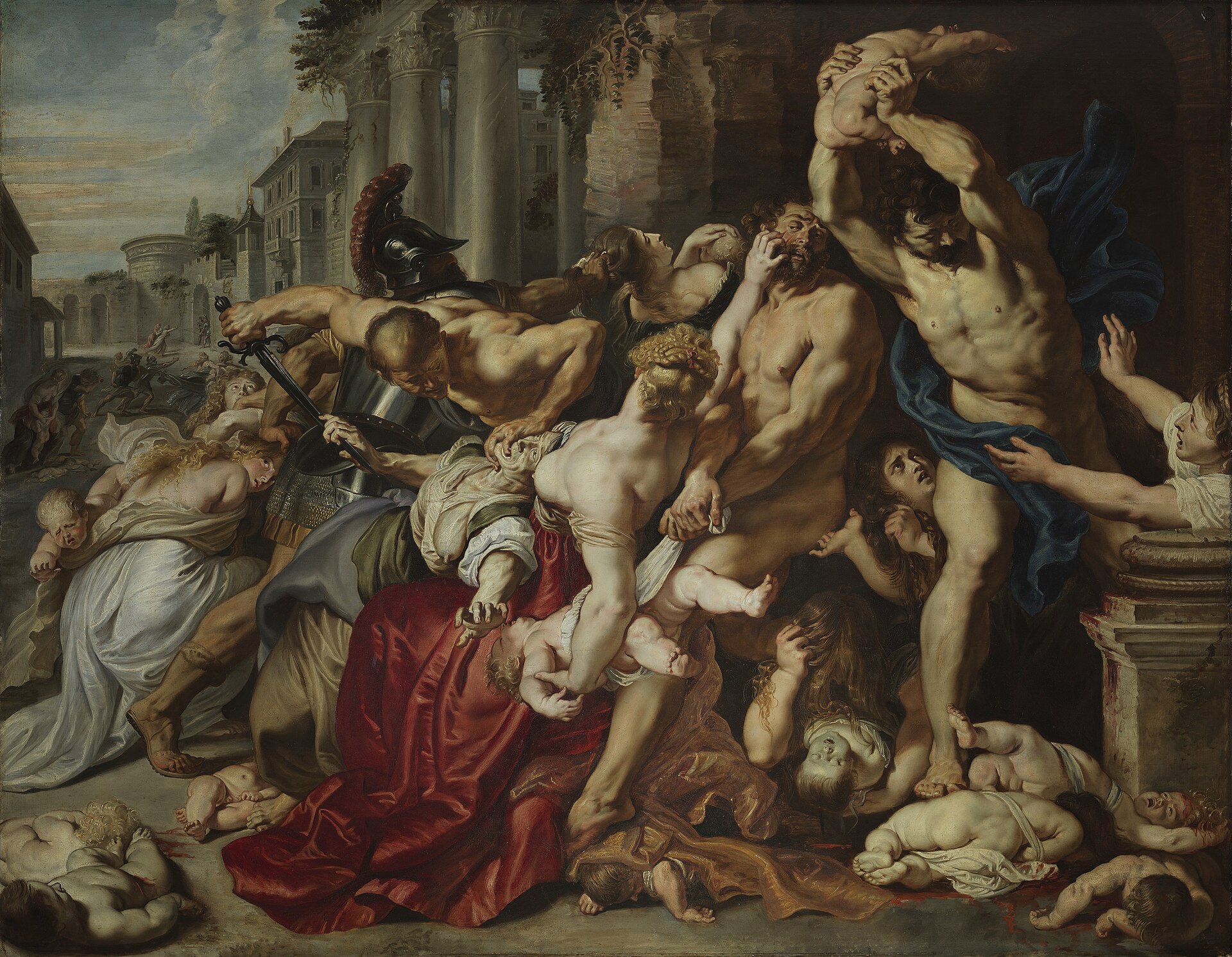
The record subject. Oil on oak panel, 142 x 183 x 1.9 cm, c. 1611-1612. Catalogued as Jan van den Hoecke after Rubens from 1780 until 2001. Reproduced from the Art Gallery of Ontario's own open image viewer.
| Artist | Peter Paul Rubens |
|---|---|
| Date | c. 1611-1612 |
| Medium | Oil on oak panel |
| Dimensions | 142 x 183 x 1.9 cm. Weight 93.9 kg. |
| Where it is now | Art Gallery of Ontario, Toronto. The Thomson Collection.last confirmed 4 September 2026 |
| Inventory number | 2014/1581 |
| Attribution | AcceptedCatalogued by Vincenzio Fanti in 1767 as Franciscus de Neve II, and in an anonymous Liechtenstein inventory of 1780 as Jan van den Hoecke, after Rubens. Full note |
| Object type | Painting |
| Period | Flemish Baroque, seventeenth century |
| Cases | Has a provenance gap · Rediscovered |
| Inscriptions | Carries the Liechtenstein family seal from its time in the princely collection. |
| Owners on record | 5 links4 documented, 1 unknown |
| Sources | 10 cited |
About this record Last verified 4 September 2026 · 10 sources cited · Change log
On this page 10 sections
ContentsClose
An oak panel of about 1611, bought around 1700 by the Prince of Liechtenstein together with the Samson and Delilah now in the National Gallery in London, catalogued in 1767 under a name almost nobody recognises and by 1780 as the work of a Rubens assistant, sold out of the princely collection in 1920 to an Austrian family, and lent from 1923 to a monastery in upper Austria by an owner who disliked it. In 2001 George Gordon of Sotheby's saw it and gave it back to Rubens. On 10 July 2002 it made 45 million pounds at the hammer, 49.5 million with fees, then the highest price ever paid at auction for a work of art in the United Kingdom and for any Old Master anywhere.
This is the best documented case there is of an auction house creating value by changing an attribution, and it inverts the usual sleeper story. Here the house that stood to earn the commission made the reattribution before the sale, so the gain went to the elderly consignor rather than to a dealer who had spotted something in a saleroom. The finder took no risk and captured no margin; the seller captured all of it.
The pair matters as much as the picture. Both Rubens paintings bought from the Forchondt brothers around 1700 were reduced in the same Liechtenstein inventories to the same assistant, Jan van den Hoecke. One was recovered in 1929 by Ludwig Burchard; this one waited another seventy-two years. And the attribution of the picture that authenticated this one has been under sustained attack for four decades. This record leaves both positions standing.
Provenance
Each link is graded. Documented: a cited source supports it. Disputed: the identification is argued but not established. Unknown: no owner for that span, and the gap is not smoothed into a narrative. The grades in the glossary.
- c. 1611 -Painted in Antwerp; first owner unrecordedunknown
Painted within a few years of Rubens's return from Italy in 1608. No commission document, patron or original location is known, and nothing is documented for the eighty or ninety years before the Forchondt sale.
- c. 1700 - 1920The Princes of Liechtenstein, Viennadocumented
Sold to Johann Adam Andreas I, Prince of Liechtenstein, by the Forchondt brothers of Antwerp, together with the Samson and Delilah now in the National Gallery, London. Both received the Liechtenstein family seal. Drawings of 1815 show the two hanging side by side in the Garden Palace in Vienna. Catalogued by Vincenzio Fanti in 1767 as Franciscus de Neve II, and in an anonymous inventory of 1780 as Jan van den Hoecke, after Rubens. The Samson was reduced to the same assistant in the same period.56
- 1920 - 2002An Austrian familydocumented
Sold out of the Liechtenstein collection in 1920. Lent in 1923 to Stift Reichersberg, an Augustinian monastery in upper Austria, where it remained for close to eighty years. The consignor in 2002 was an eighty-nine-year-old woman who had inherited the picture and disliked it, which is the stated reason for the loan.25
- 2002 - 2008Kenneth Thomson, 2nd Baron Thomson of Fleetdocumented
Bought at Sotheby's, London, 10 July 2002, at a hammer of 45 million pounds, 49.5 million with fees. Bid in the room by the Mayfair dealer Sam Fogg acting for Thomson. Lent afterwards to the National Gallery, London, where it hung near the Samson and Delilah on which its attribution rests. Thomson died in 2006.145
- 2008 - presentArt Gallery of Ontario, Toronto. The Thomson Collection.documented
Transferred to the AGO in 2008 as the museum reopened after its rebuilding. Accession 2014/1581. Lent to the Rubenshuis in Antwerp in 2018 and 2019, its first return to the city where it was painted, and shown at the AGO in Early Rubens from October 2019, an exhibition organised with the Fine Arts Museums of San Francisco.35
Prices realised
| Date | Sale | Estimate | Result | Note |
|---|---|---|---|---|
| 10 July 2002 | Sotheby's Old Master Paintings, London | Reported at the time as at least 10 million dollars; no sterling estimate located | Hammer GBP 45,000,000 With premium GBP 49,500,000 total, of which the fee is about GBP 4,500,000 GBP | The distinction matters here more than almost anywhere. GBP 45 million is the hammer, reported as such by the Antiques Trade Gazette on the day and in its headline. GBP 49.5 million is the total with fees and is the figure almost every later source quotes without saying so. The two dollar equivalents in circulation are these same two numbers converted at the July 2002 rate: 69.69 million dollars is the hammer, 76.8 million is the total. A fee of about 4.5 million on a 45 million hammer is consistent with the Sotheby's London schedule then in force of 19.5 per cent on the first GBP 70,000 and 10 per cent above, which gives a premium of GBP 4,506,650 and a total of GBP 49,506,650; that schedule is DERIVED here and has not been checked against a printed chart for July 2002. Bidding jumped from 3.8 to 6 million pounds in one step and then rose in increments of a million. Knocked down in the room to Sam Fogg for Kenneth Thomson. Then the highest auction price for any work of art in the United Kingdom and for any Old Master anywhere, and still the highest price paid for a rediscovered painting. |
Hammer is the price at which the bidding stopped; with premium adds the fee the house charges the buyer on top. Hammer price and buyer's premium in the glossary.
Technical evidence
| Attribution note | Catalogued by Vincenzio Fanti in 1767 as Franciscus de Neve II, and in an anonymous Liechtenstein inventory of 1780 as Jan van den Hoecke, after Rubens. Restored to Rubens in 2001 by George Gordon of Sotheby's, on the ground of its correspondence with the Samson and Delilah then in the National Gallery, London, which had come out of the same Liechtenstein collection and which had itself carried the same wrong name in the same inventories. David Jaffe of the National Gallery is also credited with making the connection. The attribution of the Toronto panel has not been publicly challenged. The picture used as its yardstick has been: Euphrosyne Doxiadis, Michael Daley of ArtWatch UK and Kasia Pisarek dispute the Samson and Delilah, and in September 2021 an analysis by Art Recognition reported a 91 per cent probability that it is not by Rubens. A dendrochronological examination of the Samson panel confirms a date in the right period, and most of the scholarly community accepts it. The National Gallery maintains its attribution. |
|---|---|
| Support | Oak panel, 1.9 cm thick. The frequently repeated description of the picture as oil on canvas is wrong; the Art Gallery of Ontario, which owns it, catalogues it as oil on panel, and the contemporaneous trade report of the 2002 sale called it a panel painting.135 |
| Dimensions and weight | 142 x 183 x 1.9 cm. 93.9 kg. The picture is also cited at 142 x 182 cm; the AGO gives 183.35 |
| Condition | Described at the time of the 2002 sale as superbly preserved, which is exceptional for a panel of this size and date and materially affected both the attribution argument and the price.1 |
| Marks | Carries the Liechtenstein family seal, applied during its time in the princely collection from about 1700. The companion Samson and Delilah received the same seal.5 |
| Working method | Rubens used ecorche figures, anatomical models with the skin removed, to study the musculature of the struggling bodies.5 |
| Technical work on the companion picture | No technical dossier on this panel has been published. The Samson and Delilah by contrast was cleaned and investigated at the National Gallery in 1983, is noted for the absence of blue pigments, and uses carmine lake, lead-tin-yellow, vermilion and ochres with lead white and charcoal black. Its panel has been dendrochronologically dated to the right period.6 |
| The workshop version | Oil on canvas, 162.5 x 234 cm, Royal Museums of Fine Arts of Belgium, Brussels, bought in 1902 from Edmond Huybrechts of Antwerp as a work by Antoon Sallaert and now given to the workshop of Rubens.7 |
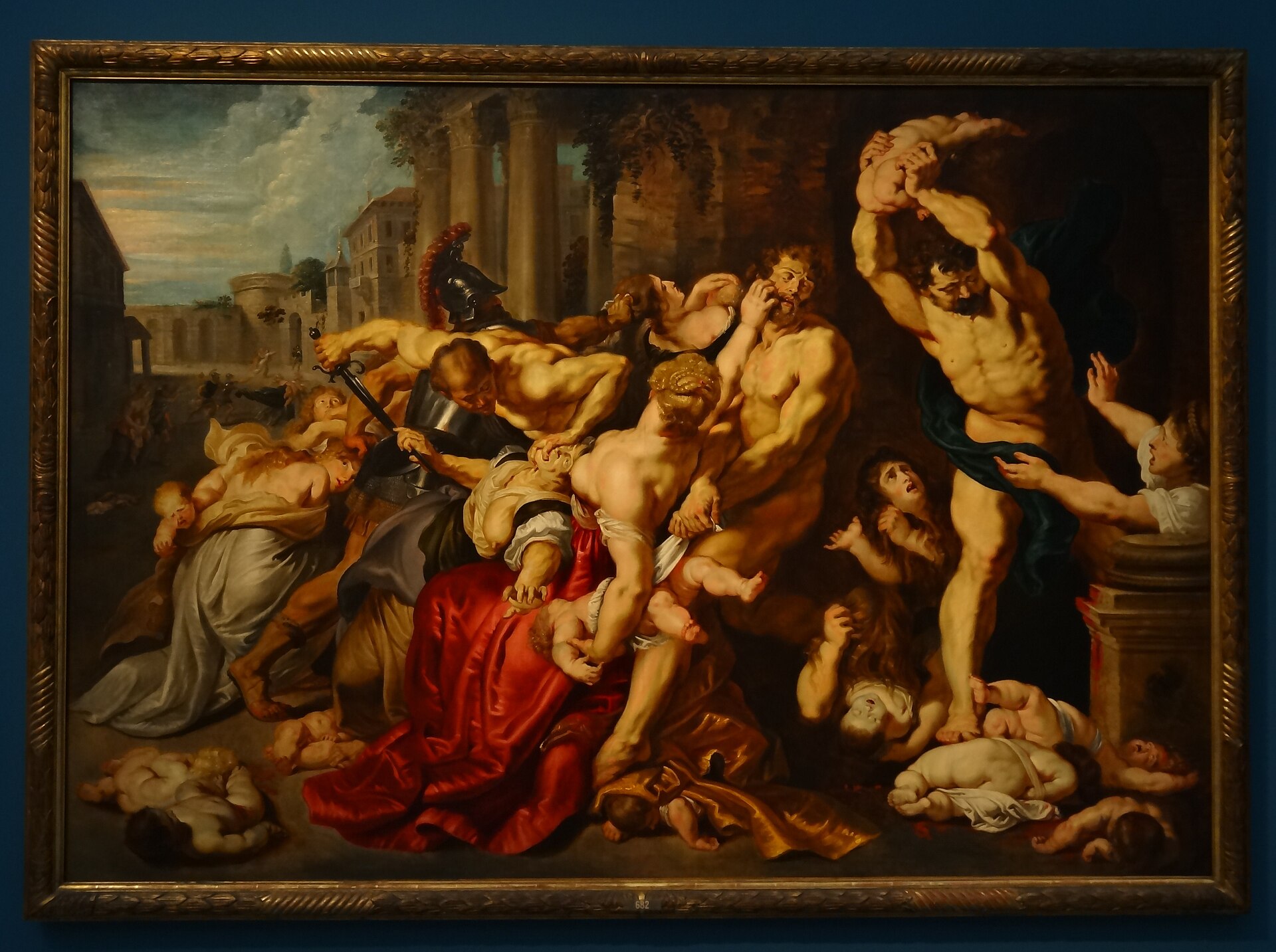
| Digital access | The highest-resolution public reproduction of the panel derives from the Art Gallery of Ontario's own open image viewer, which is the source recorded on the Wikimedia Commons file page.8 |
Images
The record in full
Chapter 1What it is, and the error that keeps being copied
An oak panel, 142 by 183 centimetres and 1.9 centimetres thick, weighing 93.9 kilograms, showing about twenty figures in a compressed shallow space: soldiers seizing and killing infants, mothers...
An oak panel, 142 by 183 centimetres and 1.9 centimetres thick, weighing 93.9 kilograms, showing about twenty figures in a compressed shallow space: soldiers seizing and killing infants, mothers clawing at them, a dead child in the foreground, a classical architecture of columns and an arch closing the scene at the back.
It is on panel. That has to be said flatly because the most widely consulted free reference on the picture states that it is oil on canvas, in the same infobox in which it records a thickness of 1.9 centimetres and a weight of 93.9 kilograms, neither of which describes a canvas. The Art Gallery of Ontario, which owns it, captions it oil on panel. The Antiques Trade Gazette, reporting the sale on the day, called it a superbly preserved panel painting. Support is not a detail. It governs dendrochronology, the single most powerful dating tool available for a Flemish picture of this date, and a record that gets it wrong forecloses the strongest evidence there is. It is also the test that was applied to the companion picture in London, where dendrochronology confirmed a date in the right period.
The condition is the second thing worth knowing, and it is unusual. Panels of this size and age are normally thinned, cradled, cut down or transferred. This one was described in 2002 as superbly preserved, which is part of why the price went where it did. An attribution argument is much easier to win on a surface that has not been repainted.
Chapter 2Why a painter in Antwerp in 1611 painted a massacre
The subject is from the Gospel of Matthew, chapter 2, verses 16 to 18: Herod, deceived by the Magi, orders the killing of every male child in Bethlehem under two years old.
The subject is from the Gospel of Matthew, chapter 2, verses 16 to 18: Herod, deceived by the Magi, orders the killing of every male child in Bethlehem under two years old. It is a few verses of text and it produced one of the most physically violent subjects in Christian art.
Rubens had returned to Antwerp in 1608 after eight years in Italy, where he had looked hard at Caravaggio, and he painted this within three or four years of coming home. Antwerp in 1611 was two years into the Twelve Years Truce that had frozen the war with the northern provinces. The city had been the site of real massacre: in a single year more than eight thousand of its citizens had been killed by Calvinist and Catholic forces alike as Spain fought to hold the Netherlands. A hundred miles north, the rebel Prince Maurits had commissioned Cornelis van Haarlem to paint the same biblical subject for the town hall at Haarlem, as propaganda about Spanish atrocity. Antwerp remained Catholic and became a centre of Counter-Reformation thought, and Rubens painted the subject for a Catholic city that had been on the receiving end of the thing depicted.
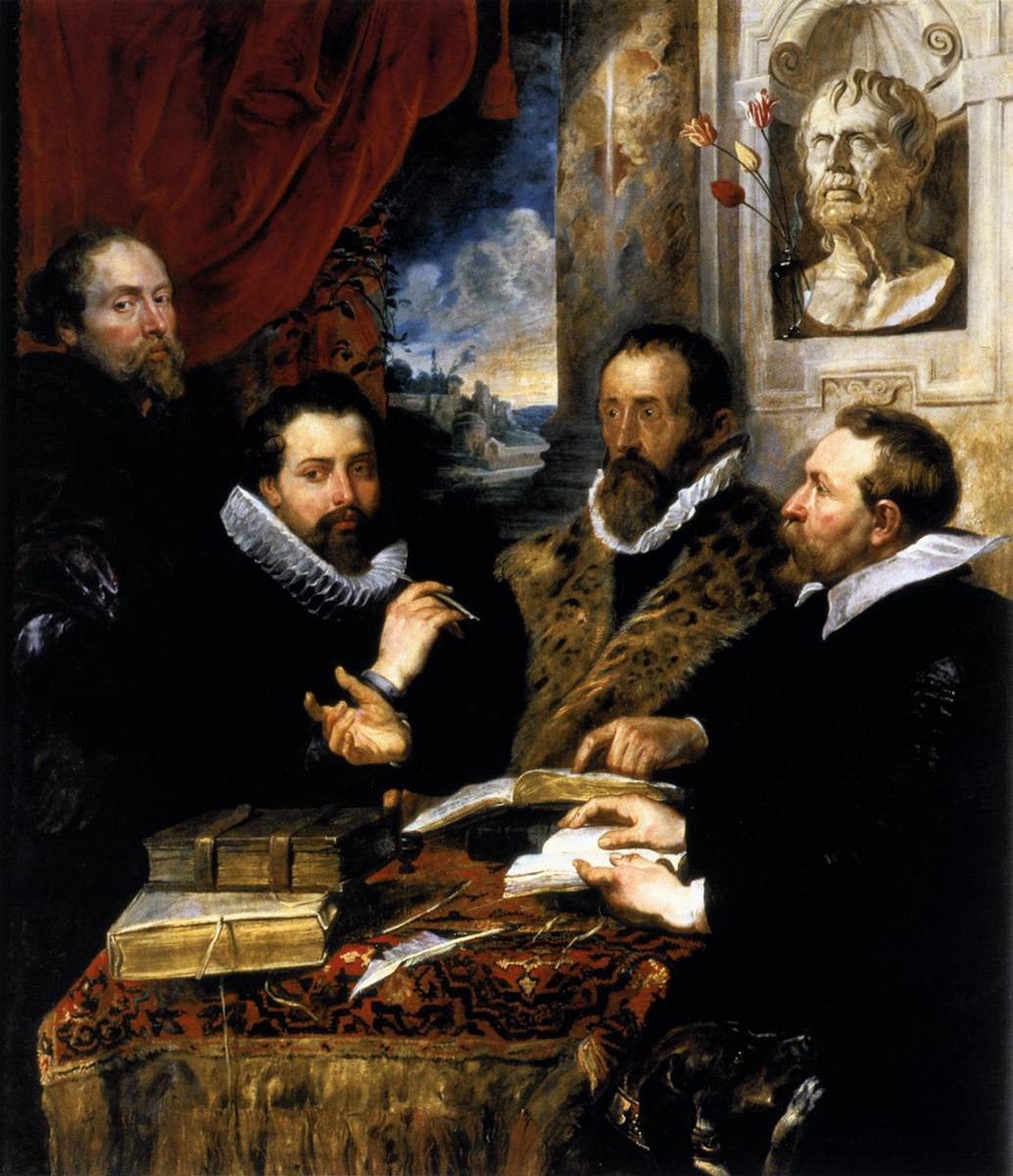
The bodies are studied, not invented. Rubens worked from ecorche figures, anatomical models with the skin removed, which is why the musculature of the soldiers reads as it does. He was also a man of a particular intellectual formation. His brother Philip had been a pupil of the Leiden neostoic Justus Lipsius, and at almost exactly the moment of this picture Rubens painted the four of them, himself, Philip, Lipsius and Jan Woverius, seated under a bust then believed to be Seneca. A painting of the slaughter of children, made by a man whose household reading was Lipsius on constancy under public calamity, in a city that had buried eight thousand of its own, is not horror staged for its own sake. It is a Catholic subject about innocent suffering, painted where innocent suffering had lately been a municipal fact, by someone who had a philosophical vocabulary for it.
Chapter 3The catalogue history, which is the attribution history
The sequence of catalogue entries on this panel is the record.
The sequence of catalogue entries on this panel is the record. Each successive description is a dated statement of what the best-informed people around the object believed, and the errors are as informative as the corrections.
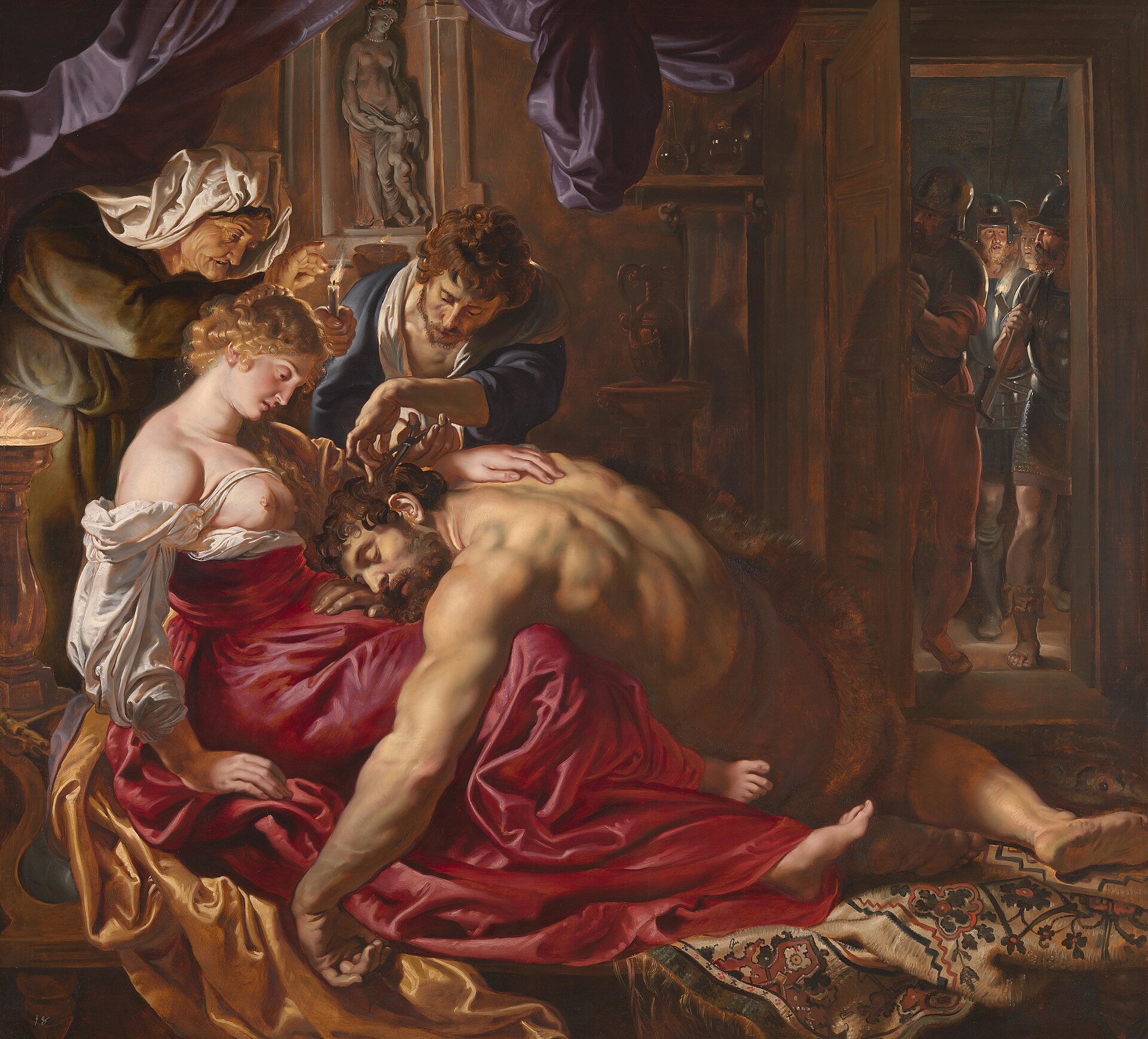
Around 1700 the Forchondt brothers, Antwerp dealers, sold two Rubens paintings to Johann Adam Andreas I, Prince of Liechtenstein, whom they knew through his father Karl Eusebius. One was this Massacre. The other was the Samson and Delilah now in the National Gallery in London. Both received the Liechtenstein family seal, and drawings of 1815 show them hanging side by side in the Garden Palace in Vienna.
In 1767 Vincenzio Fanti catalogued the collection and gave the Massacre to Franciscus de Neve the younger. In an anonymous Liechtenstein inventory of 1780 it was given instead to Jan van den Hoecke, one of Rubens's assistants, and described as after Rubens. That is the wording that mattered: not a wrong master, but a demotion from invention to repetition. A picture described as after Rubens by an assistant is, in market terms, a copy, and it is filed, priced, lent and forgotten as one.
The same thing happened to its companion. When the Samson and Delilah was in the Liechtenstein collection in the eighteenth century, its painter too was identified as Jan van den Hoecke. Two autograph Rubens paintings, bought together, hung together, and reduced together to the same assistant by the same cataloguing apparatus. The Samson was sold in Paris in 1880 and recognised again by Ludwig Burchard in 1929. The Massacre had to wait another seventy-two years.
It was sold out of the princely collection to an Austrian family in 1920 and lent in 1923 to Stift Reichersberg, an Augustinian monastery in upper Austria, where it stayed for close to eighty years. The consignor in 2002 was an eighty-nine-year-old Austrian woman who had inherited it and had always disliked it, which is the stated reason it was in a monastery rather than in her house.
Chapter 4The copy that stood in for it, under a third wrong name
While the panel hung in the monastery, the composition itself was not lost.
While the panel hung in the monastery, the composition itself was not lost. It was known from a large workshop version, oil on canvas, 162.5 by 234 centimetres, which the Royal Museums of Fine Arts of Belgium bought in 1902 from Edmond Huybrechts of Antwerp as a work by Antoon Sallaert.
So for most of the twentieth century the situation was this. The autograph panel was in an Austrian monastery catalogued as Jan van den Hoecke after Rubens. The workshop canvas was in a Brussels national museum catalogued as Antoon Sallaert. Between them the composition carried three names and none of them was Rubens. The Brussels picture is still in Brussels and is now given to the workshop of Rubens; it did not move, and its catalogue entry changed instead.
Two objects, one design, and the whole difference in their fates is a line of text in a catalogue.
Chapter 5What George Gordon did in 2001
George Gordon joined Sotheby's in London in 1980 in Old Master Drawings and moved to Old Master Paintings in 1990.
George Gordon joined Sotheby's in London in 1980 in Old Master Drawings and moved to Old Master Paintings in 1990. In 2001 he saw the Massacre and concluded that it was by Rubens himself.
The argument was comparative rather than technical. The Samson and Delilah, painted around 1609 to 1610 and by then in the National Gallery in London, had come out of the same Liechtenstein collection and had hung beside this picture in Vienna. Set the two together and the handling, the palette and the compression of figures against a shallow architectural back wall belong to the same hand at the same moment. David Jaffe of the National Gallery is credited with recognising the connection as well, on the same basis. Sotheby's has since described the picture as having been unknown for nearly 250 years, which dates the loss from the 1767 catalogue rather than from the 1780 inventory.
What did not happen is as important as what did. There is no published dendrochronological report on this panel, no technical dossier and no committee. The reattribution that produced the highest price ever paid for a rediscovered painting was, on the public record, an act of connoisseurship by one specialist standing in front of a picture in Austria, corroborated by a second scholar making the same comparison. That is the honest description of the mechanism, and it is worth stating plainly in a decade when attribution is increasingly discussed as though it were a laboratory procedure.
Chapter 7The inversion: who captured the value
A sleeper, in the ordinary sense, is a picture a dealer buys cheaply because he knows something the cataloguer did not, and the gain accrues to the finder while the seller learns about it in the...
A sleeper, in the ordinary sense, is a picture a dealer buys cheaply because he knows something the cataloguer did not, and the gain accrues to the finder while the seller learns about it in the newspaper. That is the distributional complaint Ben Lewis has made in print, and it is the reason the practice is argued about at all.
This case runs the other way and is the strongest available answer to the complaint. The reattribution was made by the auction house that was going to sell the picture, before it was catalogued, in the ordinary course of preparing a consignment. Sotheby's therefore raised the value of an object it was about to sell on behalf of an elderly woman who had inherited it, disliked it, and lent it to a monastery to be rid of it. The entire difference between a van den Hoecke copy and an autograph Rubens went to her. Sotheby's took its commission on the larger number, which is a fee for work done rather than a margin on a purchase.
No finder bought this cheaply, restored it at his own expense and resold it. There is no injured consignor and no one to write a resale right for. When the practice is defended, this is the example, and it is the reason a record of it belongs beside the ones where a dealer paid five hundred pounds in a regional saleroom.
Chapter 8The yardstick is itself under attack
An attribution built on a comparison is only as strong as the picture it is compared with.
An attribution built on a comparison is only as strong as the picture it is compared with. The Massacre was given back to Rubens because it matched the National Gallery's Samson and Delilah. That picture has been contested for as long as the National Gallery has owned it.
It was commissioned by Nicolaas II Rockox, lord mayor of Antwerp and a personal friend of the painter, to hang above a seven-foot mantelshelf in his house, which is why the composition is built to be seen from below. It was sold for charity when Rockox died in 1640 to a purchaser who is not recorded. A Samson and Delilah bought by Hans-Adam I of Liechtenstein in 1700 is probably it. It went through Paris in 1880, was recognised by Ludwig Burchard in 1929, and was bought by the National Gallery at Christie's in 1980. That price is reported both as 2.5 million pounds and as 5 million dollars; at the 1980 rate those are the same figure in two currencies, not two prices.
Euphrosyne Doxiadis, an artist and scholar of the Fayum portraits, argues that the picture differs in detail from copies made in Rubens's lifetime, that it does not use the layered glazing Rubens had mastered, and that its provenance cannot be documented between 1641 and 1929. The detail most often cited is at the edges: Frans Francken the Younger's Banquet at the House of Burgomaster Rockox, painted between 1630 and 1635, shows the picture above the mantelpiece with Samson's foot wholly inside the frame and three soldiers in the doorway, where the National Gallery painting is cropped at both sides and has five. Michael Daley of ArtWatch UK and the independent researcher Kasia Pisarek have made related arguments. In September 2021 the Swiss company Art Recognition, with Carina Popovici, trained a classifier on Rubens paintings and reported a 91 per cent probability that the Samson and Delilah is not by him. Against all of that, dendrochronology of the panel confirms a date in the right period, and the attribution is accepted by most of the scholarly community. The National Gallery maintains it.
Iconotheca does not adjudicate. It records the structural fact, which no side disputes: the reattribution that produced the highest price ever paid for a rediscovered painting was anchored on a picture whose own authorship is denied by named scholars and by a published machine analysis. If the Samson and Delilah were ever downgraded, nothing physical about the Toronto panel would change and every argument made about it in 2001 would have to be restated from a different starting point. The two came out of the same collection, bought together from the same dealers, hung together in Vienna and demoted together to the same assistant. Whatever is decided about one is evidence about the other.
Chapter 9Kenneth Thomson, and where the panel went
Kenneth Thomson, second Baron Thomson of Fleet, inherited a newspaper and information business from his father Roy Thomson and was for a period the richest man in Canada.
Kenneth Thomson, second Baron Thomson of Fleet, inherited a newspaper and information business from his father Roy Thomson and was for a period the richest man in Canada. He collected on a scale that produced a named collection rather than a house full of pictures, and he had already committed that collection to the Art Gallery of Ontario in Toronto.
After the sale the panel was lent to the National Gallery in London, where it hung near the Samson and Delilah that had authenticated it. Thomson died in 2006. In 2008, as the AGO reopened after its rebuilding, the picture was transferred to Toronto, where it carries the accession number 2014/1581 in the Thomson Collection.
In 2018 and 2019 it went back to Antwerp, on loan to the Rubenshuis, the house in which it was painted, for the first time since it left the city. It returned to Toronto for Early Rubens, an exhibition of the artist's work of 1609 to 1621 organised with the Fine Arts Museums of San Francisco, which opened at the AGO in October 2019 with fifty paintings, prints and drawings, alongside the AGO's oil sketch of the Raising of the Cross and loans from the Metropolitan Museum, LACMA, the Rijksmuseum, the British Museum and the Getty.
The AGO publishes the panel through an open image viewer, which means a student anywhere can examine the surface at high magnification without asking anyone's permission. For an object that spent eighty years hanging in a monastery under the wrong name, that is the most consequential change of all.
Chapter 10What an attribution is worth, measured on one composition
Three objects carry this design and their histories are close to a controlled experiment in the value of a name.The panel in Toronto was catalogued as a copy by an assistant and hung in a monastery...
Three objects carry this design and their histories are close to a controlled experiment in the value of a name.
The panel in Toronto was catalogued as a copy by an assistant and hung in a monastery because its owner did not want it. Recatalogued as Rubens, it made 45 million pounds at the hammer in a single afternoon, and it is now the centrepiece of a national gallery's collection, lent to the artist's own house in Antwerp and published in high resolution to anyone who wants it.
The canvas in Brussels was bought in 1902 as an Antoon Sallaert, is now given to the workshop of Rubens, and has stayed exactly where it was. Its catalogue entry changed and nothing else did.
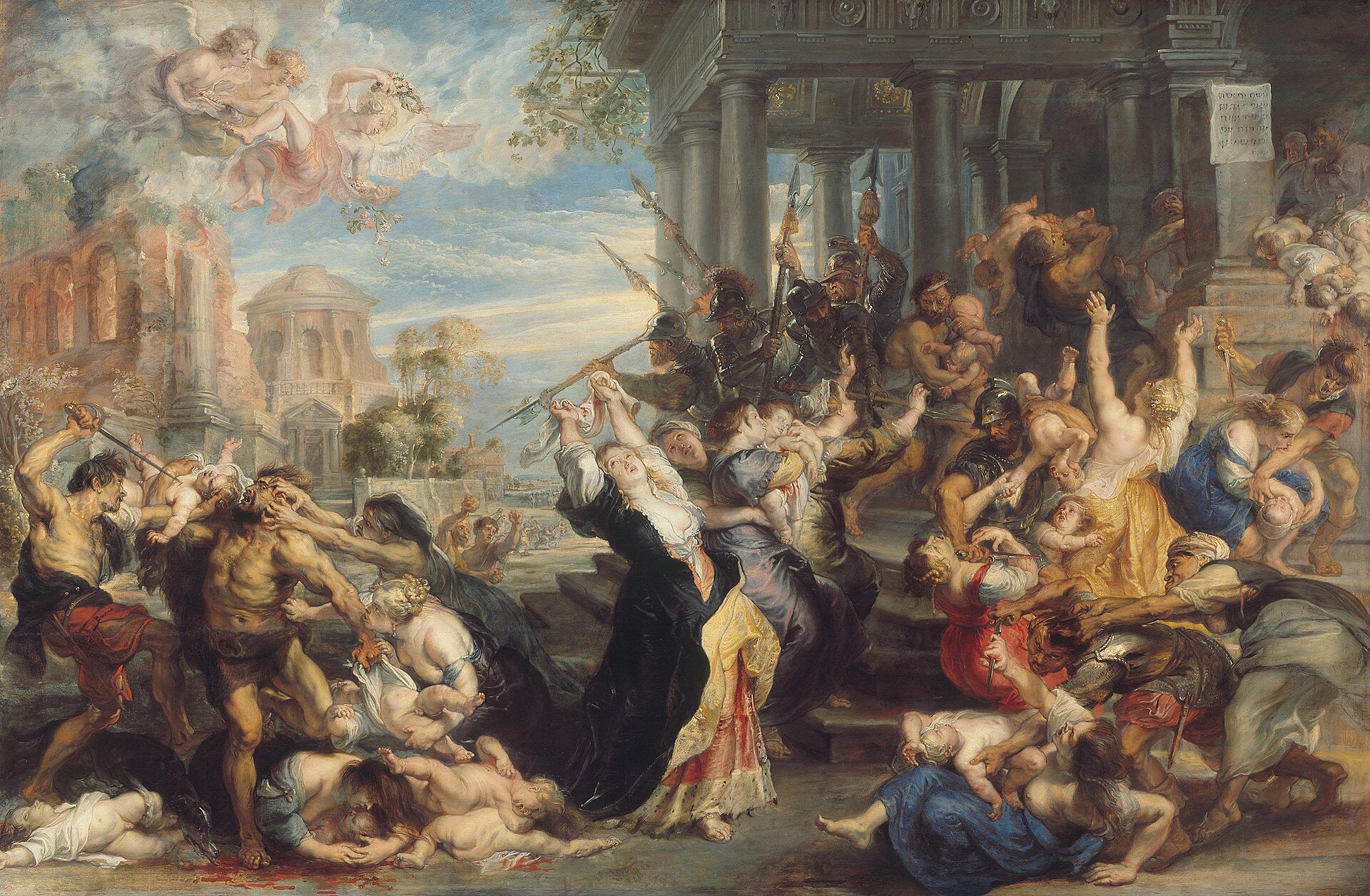
The second Massacre, painted by Rubens between 1636 and 1638, twice the size and also on panel, has been in Munich since 1706 and has never been in doubt. It has therefore never been news, has never made a price, and is the only one of the three whose story consists of hanging on a wall.
Nothing about the physical object in Toronto changed between 1780 and 2002. Its price changed by a factor that no measurement of the object could produce, because what was bought in 2002 was not the panel. It was the sentence attached to it.
The artist
Peter Paul Rubens
Rubens is the wrong artist to treat as a single pair of hands, and he said so himself. He ran the largest painting business in northern Europe, employed specialists, and priced his own pictures according to how much of each he had actually painted, setting that grading out in writing to a client. Any question about whether a given Rubens is by Rubens is therefore one he had already anticipated and answered commercially, four hundred years before it became an auction problem.
Related works
| Work | Relation | Where it is |
|---|---|---|
| Samson and Delilah Peter Paul Rubens, disputed | The comparison on which this picture's reattribution rests; bought from the same dealers into the same collection around 1700 and reduced to the same assistant in the same inventories Oil on wood, about 185 x 205 cm, c. 1609-1610. Commissioned by Nicolaas II Rockox for a chimneypiece in Antwerp; sold for charity in 1640; probably the panel bought by Hans-Adam I of Liechtenstein in 1700; sold in Paris in 1880; recognised by Ludwig Burchard in 1929; bought by the National Gallery at Christie's in 1980, a price reported both as 2.5 million pounds and as 5 million dollars. Disputed by Euphrosyne Doxiadis, Michael Daley and Kasia Pisarek; Art Recognition reported in September 2021 a 91 per cent probability that it is not by Rubens; dendrochronology supports the date and the National Gallery maintains the attribution. | The National Gallery, London |
| The Massacre of the Innocents Workshop of Rubens | The workshop version through which the composition was known while the original was in a monastery Oil on canvas, 162.5 x 234 cm. Bought in 1902 from Edmond Huybrechts of Antwerp as a work by Antoon Sallaert. | Royal Museums of Fine Arts of Belgium, Brussels |
| The Massacre of the Innocents Peter Paul Rubens | The artist's second treatment of the same subject, twenty-five years later Oil on panel, 198.5 x 302.2 cm, 1636-1638. In Munich since 1706. Engraved by Paulus Pontius in 1643. Never disputed and never at auction. In August 2022 two Letzte Generation activists glued themselves to its frame, causing about 11,000 euros of damage to the frame; they were fined 2,400 euros each in May 2023. | Alte Pinakothek, Munich, 572 |
| The Four Philosophers Peter Paul Rubens | Painted at almost the same moment; the intellectual context of this picture Rubens with his brother Philip, the neostoic Justus Lipsius and Jan Woverius, beneath a bust then identified as Seneca. | Galleria Palatina, Palazzo Pitti, Florence |
| The Massacre of the Innocents Cornelis van Haarlem | The same subject painted for the other side of the same war Commissioned by the Protestant rebel leader Prince Maurits as propaganda about Spanish atrocity against the Dutch, about a hundred miles north of Catholic Antwerp. | Town hall, Haarlem |
| Banquet at the House of Burgomaster Rockox Frans Francken the Younger | Evidence in the dispute over the picture that authenticated this one Painted between 1630 and 1635. Shows the Samson and Delilah above the mantelpiece with Samson's foot wholly within the frame and three soldiers in the doorway, against the National Gallery picture's cropped edges and five soldiers. | Alte Pinakothek, Munich |
| Portrait of a Man as Mars Peter Paul Rubens | Held the artist's auction record immediately before this sale Sold January 2000 at 7.5 million dollars. | Private collection |
Open questions
- For whom was it painted, and where did it hang between about 1611 and about 1700? No patron, commission or early location is documented; the chain begins with the Forchondt brothers selling it to Liechtenstein.
- Has the oak panel ever been dendrochronologically dated? No report has been published, although the support makes it possible and it would independently test the dating of about 1611 to 1612. The companion picture in London has been dated this way.
- Why did Vincenzio Fanti give it to Franciscus de Neve the younger in 1767, and on what basis was that changed to Jan van den Hoecke by 1780? Neither the reasoning nor the identity of the 1780 compiler is known.
- What did the picture make when the Liechtenstein collection sold it in 1920, and who bought it? The purchaser is described in the sources only as an Austrian family.
- Was any technical examination carried out before the 2002 sale? The published account of the reattribution is comparative and no technical dossier has been released.
- Was an export licence application triggered by the 2002 sale? The picture left the United Kingdom for Canada after a period on loan to the National Gallery; the licence position has not been reported in the sources consulted.
- What is the exact premium-inclusive total? The sources consulted report 49.5 million pounds and no more precise figure has been located in a printed Sotheby's result.
- What is the lot number and the sterling pre-sale estimate? Only a dollar estimate of at least 10 million has been found.
Questions about this object
What is The Massacre of the Innocents?
The Massacre of the Innocents is a painting, dated c. 1611-1612. Medium: Oil on oak panel.
Who made The Massacre of the Innocents, and is the attribution settled?
The attribution to Peter Paul Rubens is recorded here as accepted. Catalogued by Vincenzio Fanti in 1767 as Franciscus de Neve II, and in an anonymous Liechtenstein inventory of 1780 as Jan van den Hoecke, after Rubens. Restored to Rubens in 2001 by George Gordon of Sotheby's, on the ground of its correspondence with the Samson and Delilah then in the National Gallery, London, which had come out of the same Liechtenstein collection and which had itself carried the same wrong name in the same inventories. David Jaffe of the National Gallery is also credited with making the connection. The attribution of the Toronto panel has not been publicly challenged. The picture used as its yardstick has been: Euphrosyne Doxiadis, Michael Daley of ArtWatch UK and Kasia Pisarek dispute the Samson and Delilah, and in September 2021 an analysis by Art Recognition reported a 91 per cent probability that it is not by Rubens. A dendrochronological examination of the Samson panel confirms a date in the right period, and most of the scholarly community accepts it. The National Gallery maintains its attribution.
Where is The Massacre of the Innocents now?
Art Gallery of Ontario, Toronto. The Thomson Collection. Inventory number 2014/1581. Last confirmed 4 September 2026. Bought by Kenneth Thomson at Sotheby's, London, 10 July 2002; transferred to the Art Gallery of Ontario in 2008.
What has The Massacre of the Innocents sold for?
Hammer GBP 45,000,000; with premium, GBP 49,500,000 total, of which the fee is about GBP 4,500,000. Sotheby's, 2002-07-10.
What is still unknown about The Massacre of the Innocents?
For whom was it painted, and where did it hang between about 1611 and about 1700? No patron, commission or early location is documented; the chain begins with the Forchondt brothers selling it to Liechtenstein.
Sources
- 1Antiques Trade Gazette, 'Rubens masterpiece joins the world record holders at 45m', reporting the sale of 10 July 2002. Gives the hammer of GBP 45m, the buyer in the room as Sam Fogg, the description of the object as a superbly preserved panel painting, and George Gordon as the discoverer. Paywalled after the opening paragraph; read to that point in the browser. antiquestradegazette.com/news/...
- 2HENI, 'The Painting That Set Rubens' Auction Record After Years in the Shadows'. Gives the 69.69 million dollar figure, the previous Rubens record of 7.5 million dollars set by Portrait of a Man as Mars in January 2000, the van den Hoecke attribution, and the eighty-nine-year-old Austrian consignor who disliked the picture and lent it to a monastery. heni.com/news/...
- 3Art Gallery of Ontario, 'The Massacre's triumphant return', 30 November 2018. The museum's own caption gives oil on panel, 142 x 183 x 1.9 cm, The Thomson Collection at the Art Gallery of Ontario, and the article records the loan to the Rubenshuis and the Early Rubens exhibition of October 2019. ago.ca/agoinsider/...
- 4Sotheby's, biography of George Gordon, Deputy Chairman, Sotheby's Europe and Co-Chairman Old Masters Worldwide. Gives his arrival at Sotheby's in 1980, his move to Old Master Paintings in 1990, the nearly 250 years of obscurity, the 49.5 million pound price, and the claim that it remains the highest price paid anywhere for a rediscovered painting. sothebys.com/en/...
- 5Wikipedia, 'Massacre of the Innocents (Rubens)', consolidating the Forchondt sale to Liechtenstein, the Fanti catalogue of 1767, the anonymous inventory of 1780, the 1920 sale and 1923 loan to Stift Reichersberg, the accession number 2014/1581, the Munich version and the 2022 Letzte Generation action. TERTIARY: flagged for replacement with the Sotheby's 2002 catalogue entry and the AGO Thomson Collection catalogue. NOTE: its infobox gives oil on canvas, which is contradicted by the AGO and by its own thickness and weight figures, and is corrected in this record. en.wikipedia.org/wiki/...
- 6Wikipedia, 'Samson and Delilah (Rubens)', for the Rockox commission and chimneypiece, the 1640 charity sale, the 1700 Liechtenstein purchase and the eighteenth-century attribution to Jan van den Hoecke, the 1880 Paris sale, Burchard's 1929 recognition, the 1980 Christie's purchase, Doxiadis's grounds, the Francken evidence, the 1983 National Gallery cleaning and pigment analysis, the dendrochronology and the Art Recognition result of September 2021. TERTIARY: flagged for replacement with the National Gallery Technical Bulletin vol. 7 (1983), the Burlington Magazine provenance article of 2004 and Doxiadis's own publications. en.wikipedia.org/wiki/...
- 7Wikimedia Commons file page for the Brussels workshop version, carrying the museum reference, the dimensions and the 1902 acquisition from Edmond Huybrechts of Antwerp as an Antoon Sallaert. commons.wikimedia.org/wiki/...
- 8Wikimedia Commons file page for the lead plate, recording the Art Gallery of Ontario's own image viewer as the source of the reproduction and the 2018-19 Rubenshuis loan. commons.wikimedia.org/wiki/...
- 9Journal of the History of Collections, 'The ambassador and the artist: Sir Dudley Carleton's relationship with Peter Paul Rubens: connoisseurship and art collecting at the court of the early Stuarts', on the 1617-1618 exchange of pictures for antique statues. Abstract read; the full text is behind a subscription and the 1618 letter itself has not been read in the original here. academic.oup.com/jhc/...
- 10Iconotheca, 'What a Sleeper Is, and Why They Still Happen', the market article this record extends, for the distributional argument and the Thwaytes v Sotheby's holding. iconotheca.com/market/...


Last verified 4 September 2026 · Published 4 August 2026
Change log
4 August 2026 - Record created at the house standard: researched narrative, technical evidence, maker dossier, graded provenance chain, prices with hammer and premium separated, related works, open questions and sources.
4 September 2026 - Re-verified. Fresh searches found no new development since 2026-08-04: no dendrochronology report on the oak panel has been published (still an open question), no export-licence record for the 2002 UK departure has surfaced, and no auction result more precise than the reported GBP 49.5m premium-inclusive total has been located. Current location (AGO, Thomson Collection, inventory 2014/1581) is unchanged and confirmed against the museum. Two of the four cited web sources (antiquestradegazette.com, ago.ca) returned HTTP 403 to a direct fetch at re-verification time; this is a bot-block consistent with their behaviour at original research (not a rotted or removed page) and was not re-tested via a browser this run.