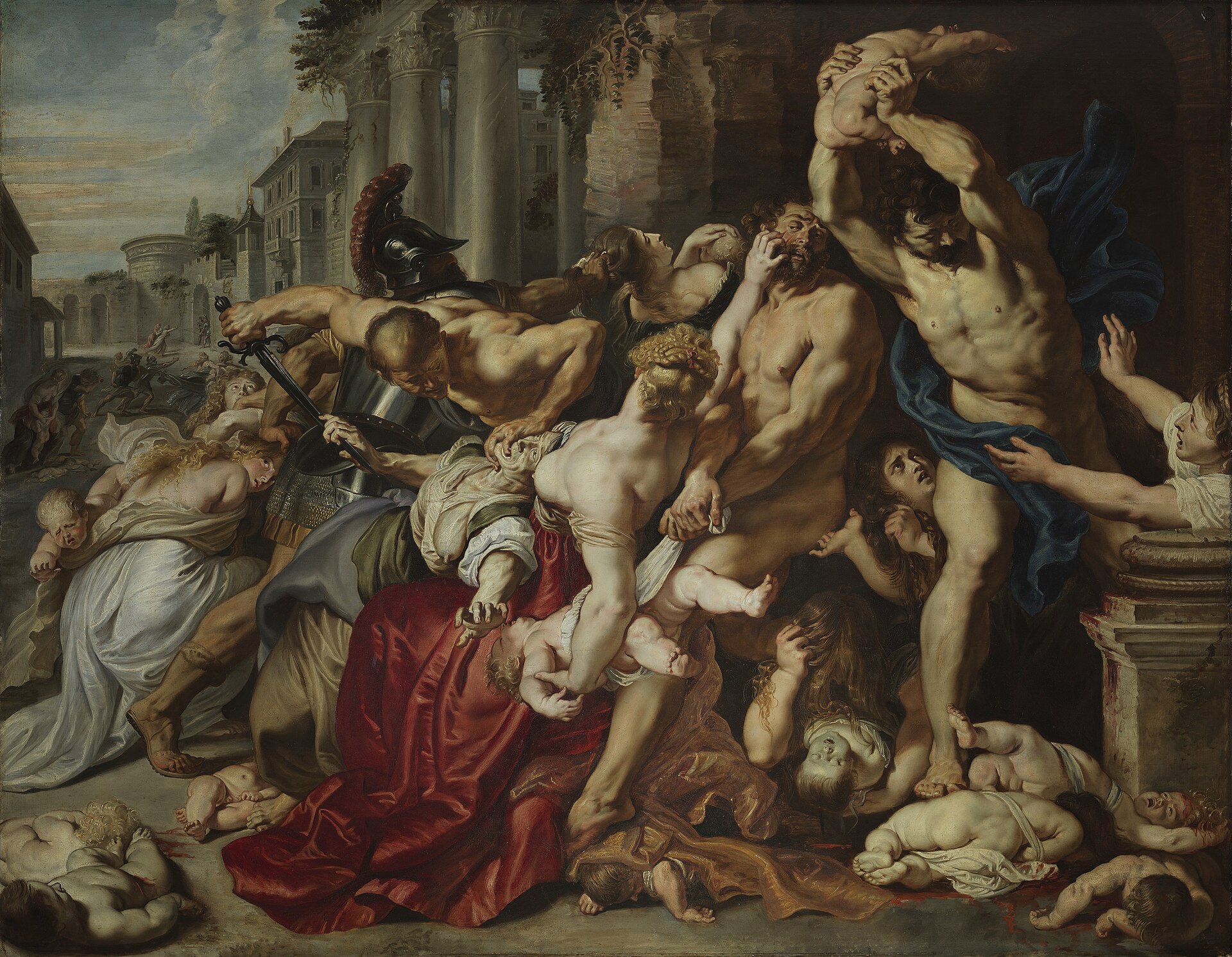
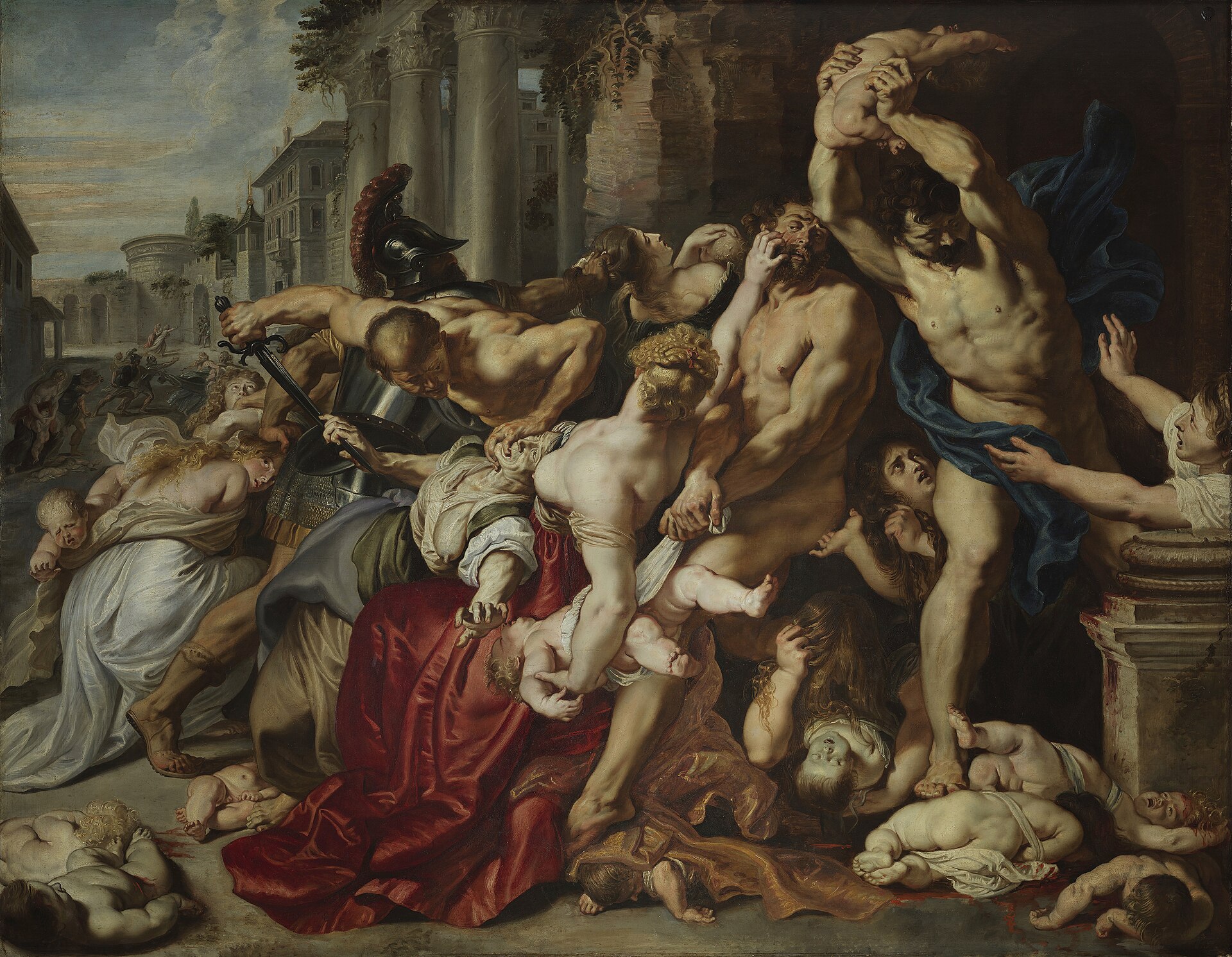
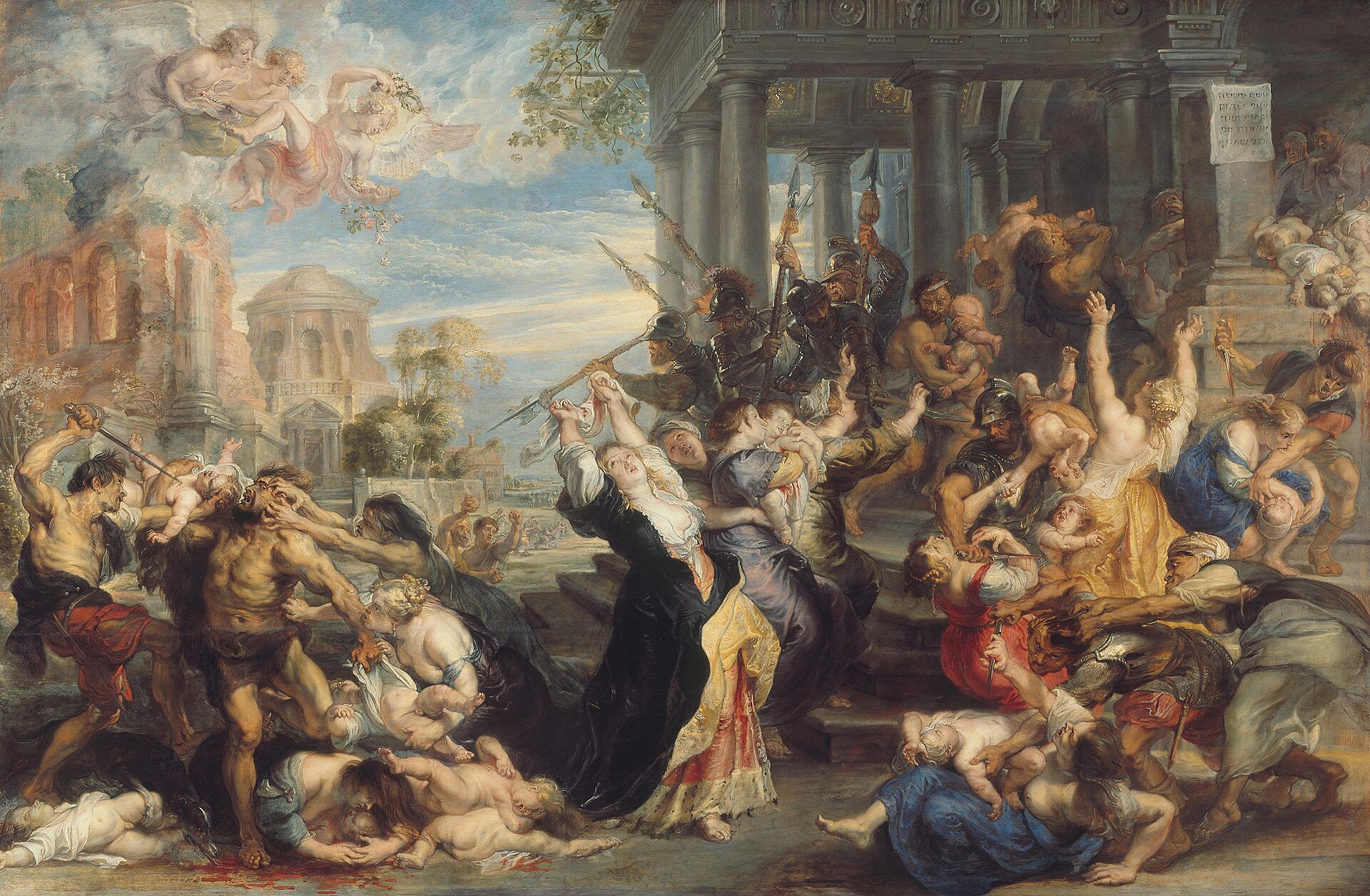
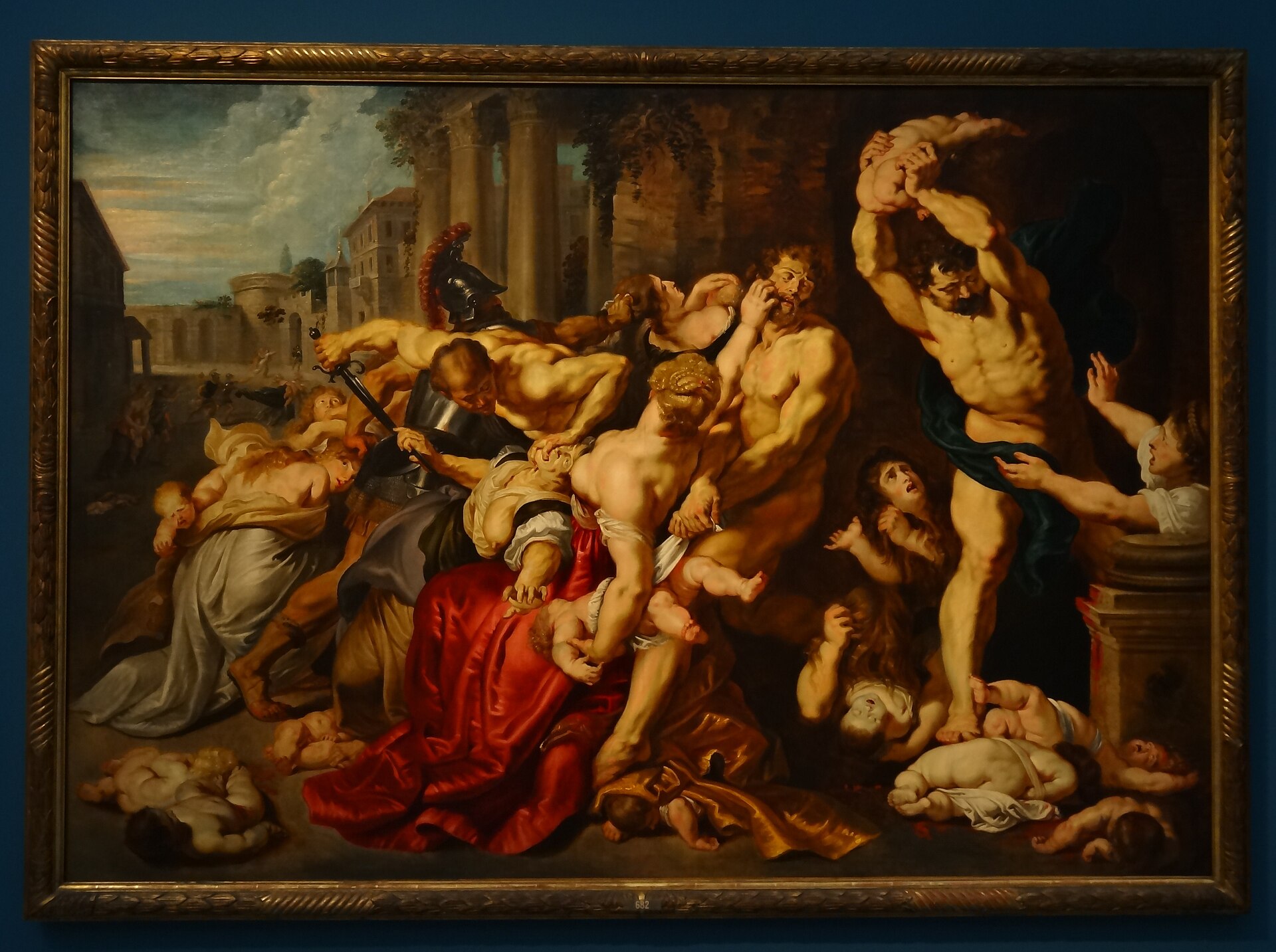
The Massacre of the Innocents
c. 1611-1612 · Oil on oak panel
Art Gallery of Ontario, Toronto. The Thomson Collection
 Flemish · 1577-1640
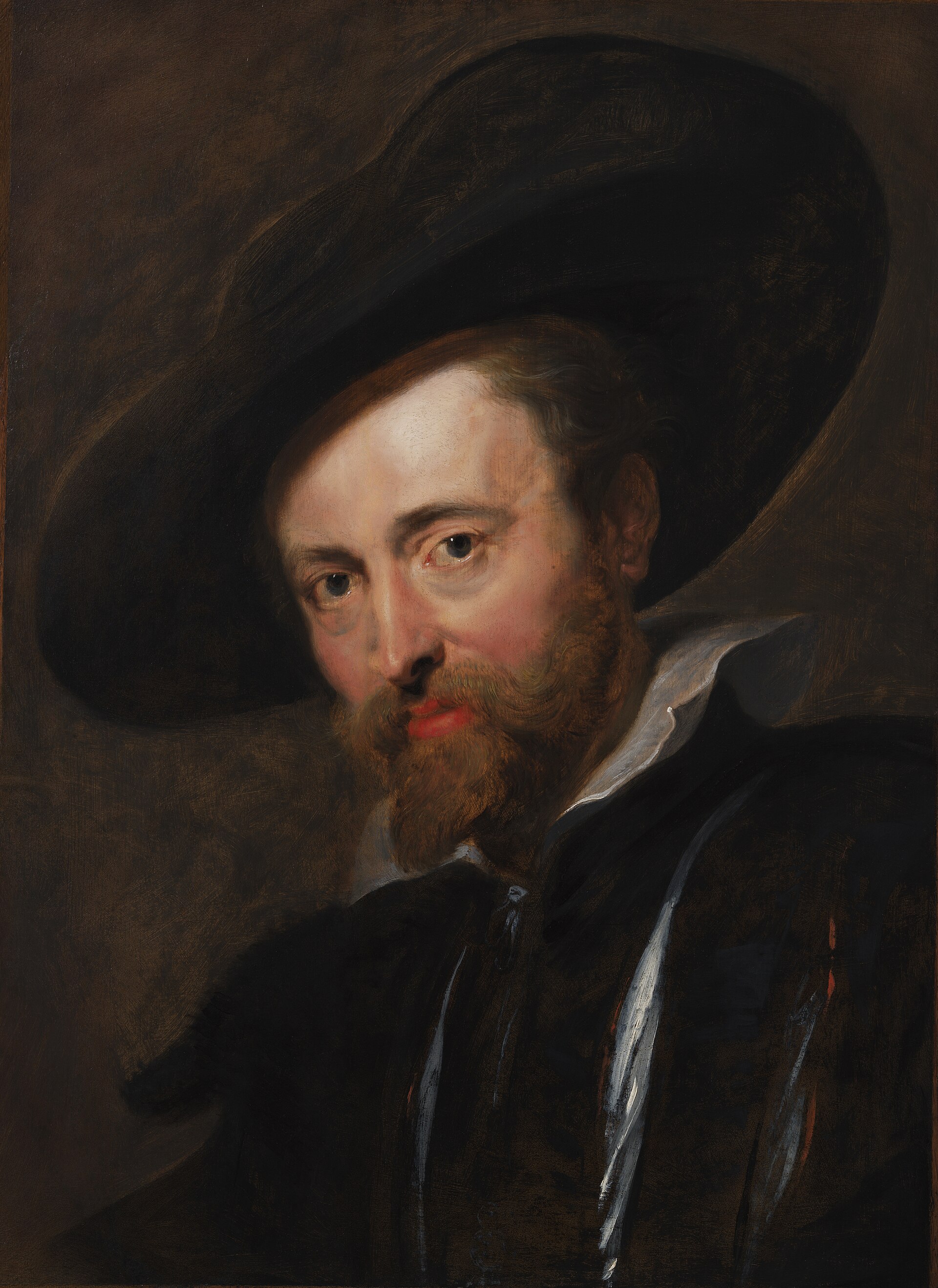
Self-portrait, oil on panel, c. 1630, held by the Rubenshuis, the artist's own house and workshop in Antwerp. The identification is secure: it is the museum's own catalogued self-portrait, painted in the decade of his second marriage and his knighthood by Charles I.
Rubenshuis, Antwerp| Full name | Pieter Pauwel Rubens (Peter Paul Rubens) |
|---|---|
| Worked as | Painter, Draughtsman, Diplomat |
| Born | 28 June 1577 · Siegen, Nassau-Dillenburg, Holy Roman Empire (now Germany) |
| Died | 30 May 1640 · Antwerp, Spanish Netherlands |
| Nationality | Flemish |
| Movement | Flemish Baroque |
| In this archive | 1 artwork |
| Sources | 25 cited |
| Last verified | 17 September 2026 |
About this page 1 artwork in the archive · Last verified 17 September 2026 · 25 sources cited
Rubens is the wrong artist to picture as a single pair of hands, and he said so himself, in writing, to a buyer. By the early 1610s he was running the largest painting business in northern Europe: named specialists painted the animals, the flowers and the landscapes in pictures that carry only his name, and in 1618 he set out for the English diplomat Sir Dudley Carleton exactly how much of a given canvas was his own work and how much was not. Any question a saleroom asks today about whether a picture is really by Rubens is a question he had already answered commercially, four hundred years before it became an auction problem.
The single most important thing a reader probably does not know is that there is no settled number for how many paintings that leaves. The Corpus Rubenianum Ludwig Burchard, the standing scholarly catalogue, was begun in 1968 and is still being published volume by volume; the last time anyone attempted a single complete count, Michael Jaffe's catalogue of 1989, the answer was 1,403 paintings, and nothing has replaced that figure since, only individual pictures moving in and out of the corpus one at a time. The picture that holds his own auction record was itself catalogued as a copy by an assistant for two hundred and twenty-one years before a Sotheby's specialist put it back.
This page covers what a biography usually skips: how the workshop actually divided labour and how a specialist tells the difference, what the technical evidence can and cannot prove, the two knighthoods and the diplomatic career that ran alongside the painting, the collection of antiquities he bought and sold as seriously as he painted, the commission that was his largest and is now completely gone, and what the market has actually paid across three sales spread over two decades, with the hammer kept separate from the premium.
Born 28 June in Siegen, Nassau-Dillenburg, to the exiled Antwerp lawyer Jan Rubens and Maria Pypelincks.1
Completes training under Tobias Verhaecht, Adam van Noort and Otto van Veen; enters the Guild of St Luke as an independent master.1
Travels to Italy and enters the service of Vincenzo I Gonzaga, Duke of Mantua.1
Sent by Gonzaga on a diplomatic mission to the Spanish court in Madrid, studying the royal collection of Titian and Raphael while there.1
Returns to Antwerp on his mother's death, ending eight years in Italy.1
Appointed court painter to the Archdukes Albert and Isabella; marries Isabella Brant on 3 October.1
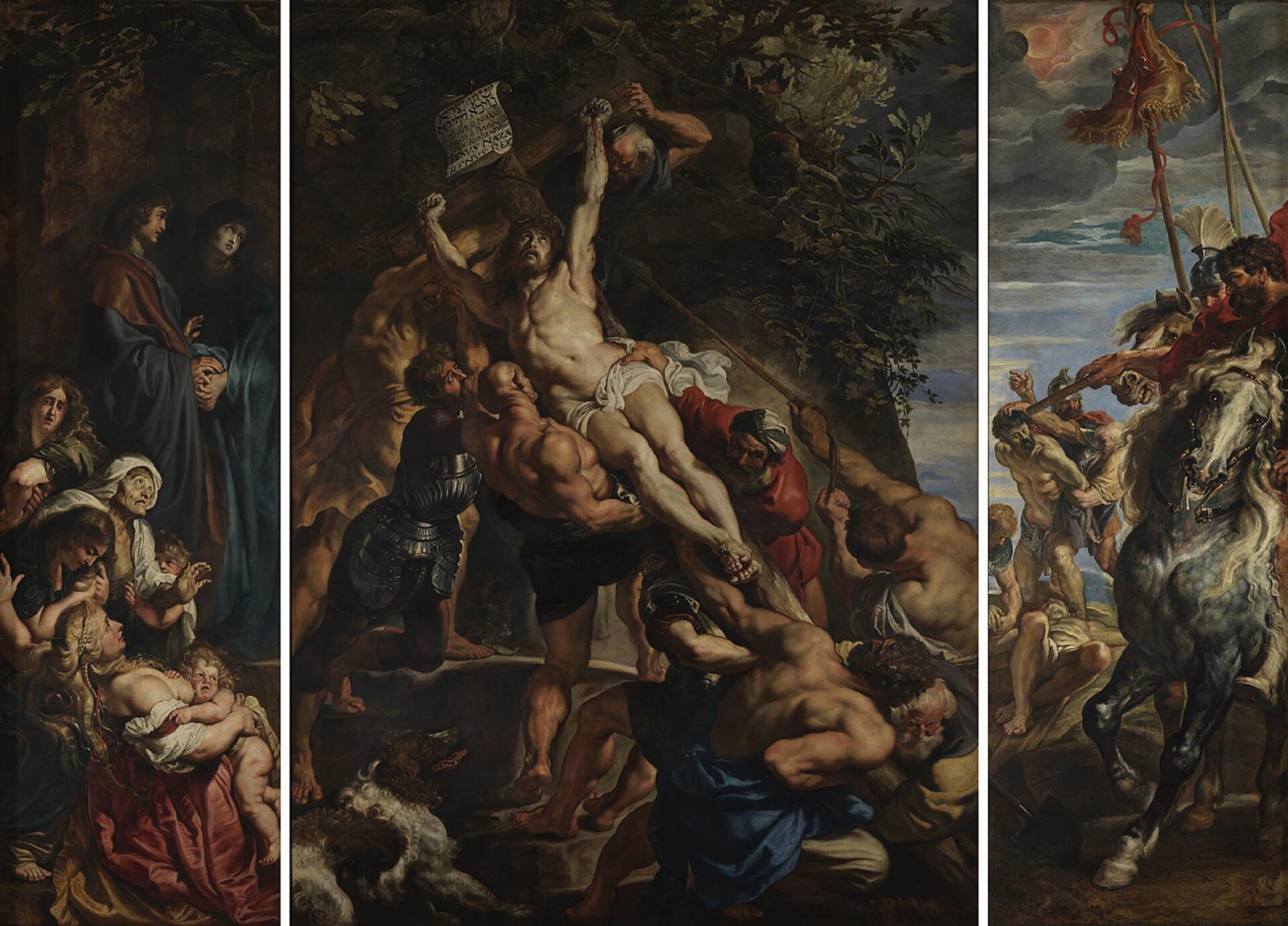
Builds the Rubenshuis, his combined house, workshop and antiquities gallery, in Antwerp; commissioned to paint The Elevation of the Cross for St Walburga's church.119
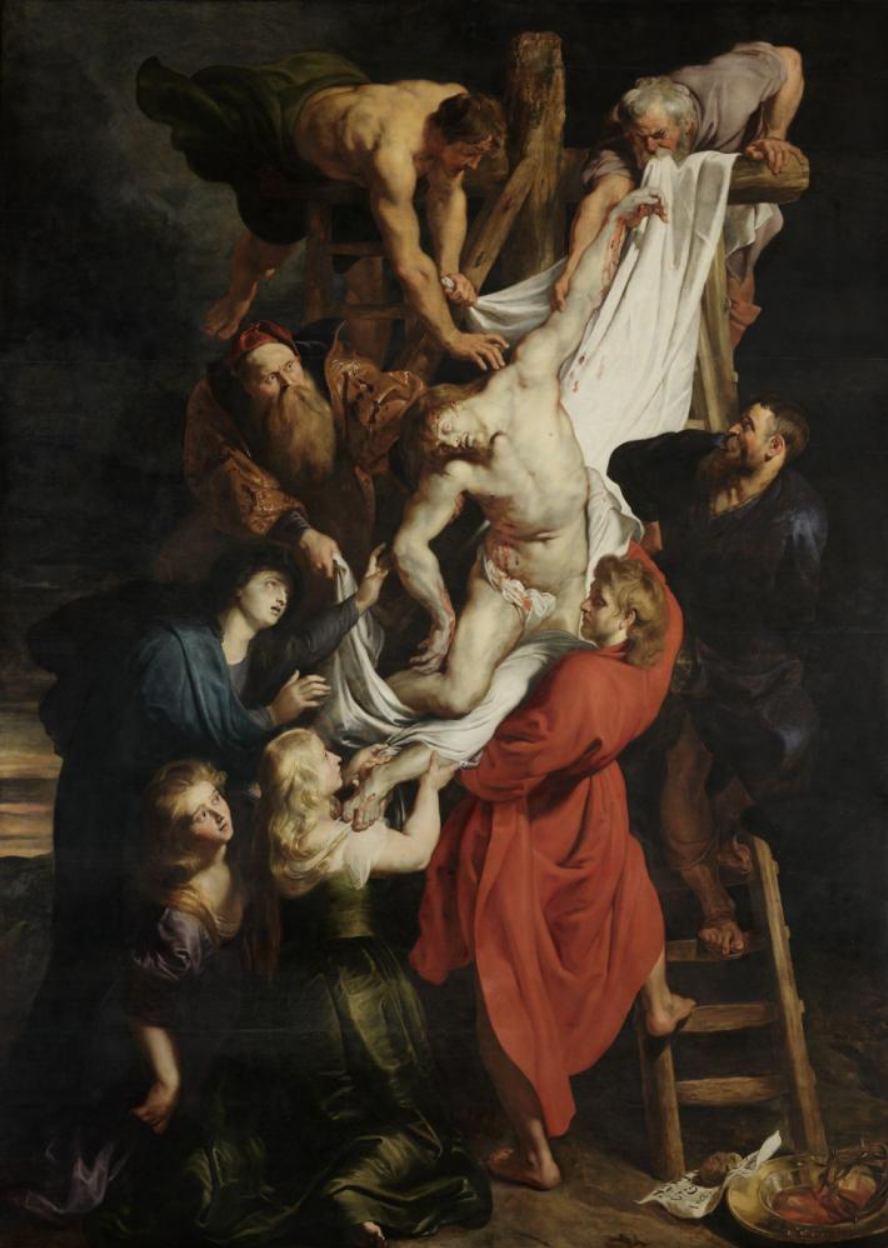
Commissioned on 7 September by the Confraternity of the Arquebusiers to paint The Descent from the Cross for their chapel in Antwerp Cathedral, completed 1614.20
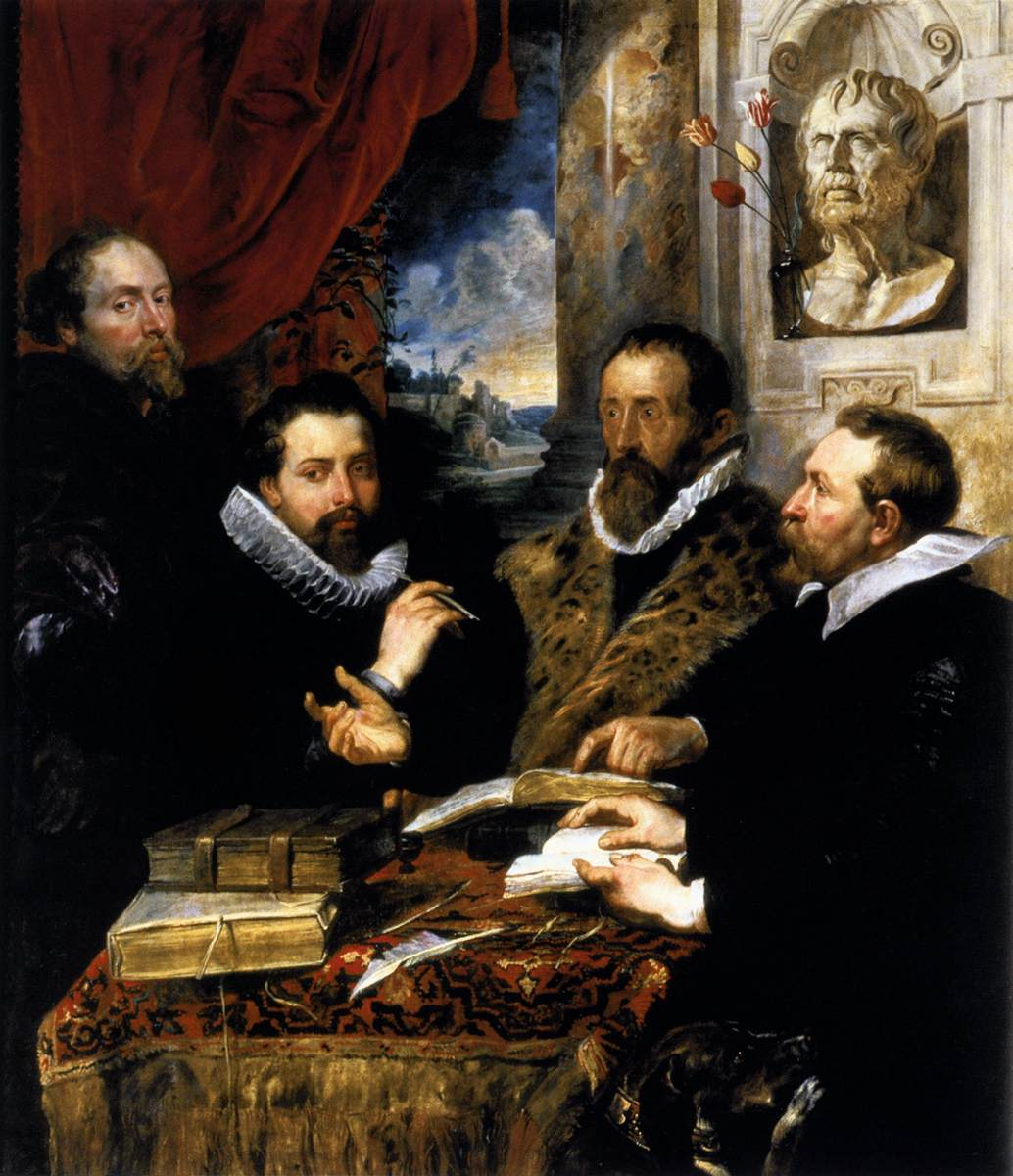
Paints The Four Philosophers, a group portrait of himself, his brother Philip, Justus Lipsius and Jan Woverius.21
Anthony van Dyck, then about seventeen, enters the workshop as an assistant.7
Exchanges paintings for a collection of antique marbles with the English diplomat Sir Dudley Carleton, setting out in writing how much of each picture is his own hand.5
Designs and executes thirty-nine ceiling paintings for the newly built Jesuit church in Antwerp, his largest commission to that date, finished for the church's 1621 consecration.16
Isabella Brant dies; Rubens begins selling paintings and antiquities from his own collection to George Villiers, Duke of Buckingham, through the agents Balthasar Gerbier and Michel Le Blond.111
Undertakes a diplomatic mission between the Spanish and English courts; lodges at York House in London from June 1629; receives an honorary Cambridge Master of Arts; is knighted by Charles I with a diamond-set sword at his final audience at the Banqueting House before returning to Antwerp in January 1630.81025
Marries Helena Fourment.1
Completes the nine ceiling canvases for Inigo Jones's Banqueting House at Whitehall, commissioned by Charles I around 1629-1630; paid 3,000 pounds and a gold chain.89
Buys the country estate of Het Steen outside Antwerp.1
The Whitehall ceiling is installed in London; chronic gout has kept Rubens from ever travelling to see it in place.89
Dies 30 May in Antwerp of heart failure linked to chronic gout; an estate inventory lists several hundred paintings, of which around 120 can still be identified today.111
Lightning strikes the Jesuit church in Antwerp on 18 July; the resulting fire destroys all thirty-nine of Rubens's ceiling paintings, which survive only through his own oil sketches and later copies.16
The Toronto Massacre of the Innocents, catalogued since 1780 as a copy by the assistant Jan van den Hoecke, is reattributed to Rubens by George Gordon of Sotheby's.23
The Massacre of the Innocents sells at Sotheby's, London, for a hammer of 45 million pounds, still the standing Rubens and Old Master auction record.2324
Lot and His Daughters sells at Christie's, London, for a premium-inclusive 44,882,500 pounds, then the most expensive Old Master sold at that house.13
The Head of Saint John the Baptist Presented to Salome sells at Sotheby's, New York, for a hammer of 23.5 million dollars.12
The VU Amsterdam art historian Charlotte Rulkens defends a dissertation piloting a structured consensus method for Rubens and Rembrandt attribution, tested on the Enthroned Madonna in Antwerp.4
The three results on file below span fourteen years and sit in a narrower price band, from the mid twenties to the high seventies in dollar terms, than the swings in Rubens's attribution history alone would suggest. What appears to move the price is not condition or size so much as the story attached to the attribution and the provenance: the record lot was a rediscovery restored from a wrong name; the second-placed lot had been openly known in private hands for decades with no dispute attached; the most recent result was a picture whose subject, a severed head presented on a platter, most buyers would never hang in a dining room, sold anyway because the hand was never in question, only the price a confirmed Rubens with strong provenance could reach twenty-five years after its previous sale.
| Date | Sale | Work | Result | Note |
|---|---|---|---|---|
| 10 July 2002 | Sotheby's, London | The Massacre of the Innocents | Hammer GBP 45,000,000 With premium GBP 49,500,000 total (about GBP 4,500,000 in fees) GBP | The standing Rubens and Old Master auction record. Reattributed from Jan van den Hoecke to Rubens by George Gordon of Sotheby's in 2001; now Art Gallery of Ontario, Toronto. Iconotheca's dedicated record on this picture carries the full provenance and attribution history. |
| 7 July 2016 | Christie's, London | Lot and His Daughters | Hammer Not separately published in the sources consulted With premium GBP 44,882,500 total (reported as USD 58,167,720 at the day's rate) GBP | Then the most expensive Old Master sold at Christie's. Previously in the collections of Holy Roman Emperor Joseph I and the first Duke of Marlborough; sold after fourteen minutes of bidding. Press reporting gives the premium-inclusive total; no separately published hammer figure has been located. |
| 26 January 2023 | Sotheby's, New York | The Head of Saint John the Baptist Presented to Salome | Hammer USD 23,500,000 With premium USD 26,900,000 total USD | From the collection of Mark Fisch and Rachel Davidson. The same painting had sold at Sotheby's New York in January 1998 for USD 5,500,000, a roughly fourfold rise in twenty-five years for a picture whose attribution was never in dispute. |
Hammer is the price at which the bidding stopped; with premium adds the fee the house charges the buyer on top. Hammer price and buyer's premium in the glossary.
| Institution | City | Holdings | Note |
|---|---|---|---|
| Cathedral of Our Lady | Antwerp | The Elevation of the Cross (1610-1611) and The Descent from the Cross (1611-1614) | Both altarpieces were painted for other Antwerp churches and moved here after those churches were lost or demolished; the Descent remains in its original chapel, that of the Confraternity of the Arquebusiers. |
| Rubenshuis | Antwerp | The artist's own house, studio and garden, and the self-portrait (RH.S.180) used as the portrait on this page | Rebuilt as a museum on the site Rubens designed and worked in from 1610. |
| Royal Museum of Fine Arts (KMSKA) | Antwerp | A major Rubens holding including works central to the 2026 Attribution Expert Consensus Meeting pilot study | |
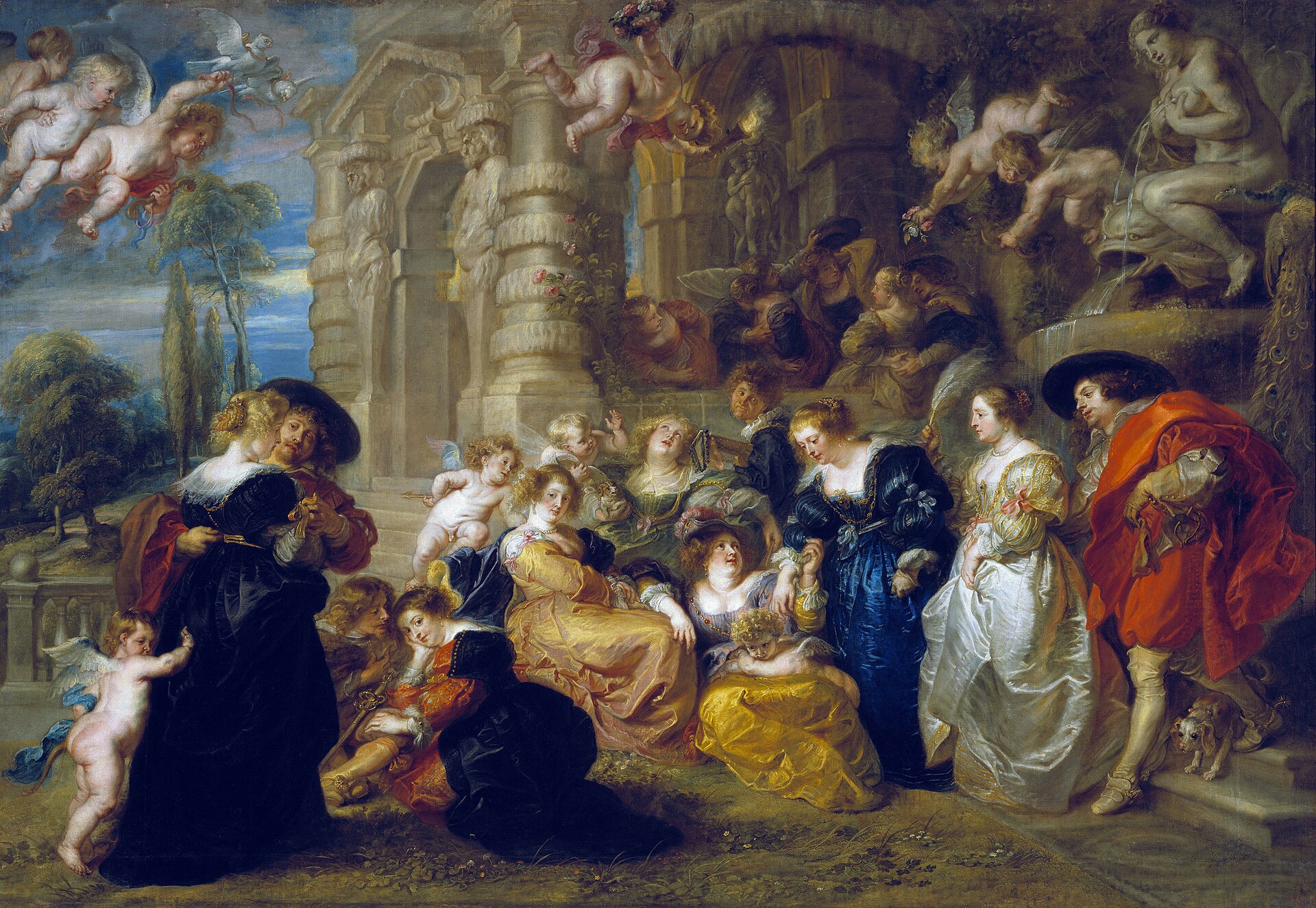
| Museo del Prado | Madrid | The largest single Rubens collection anywhere, including The Garden of Love and The Three Graces | |
| Alte Pinakothek | Munich | The 1636-1638 Massacre of the Innocents, painted twenty-five years after the Toronto panel and never disputed | |
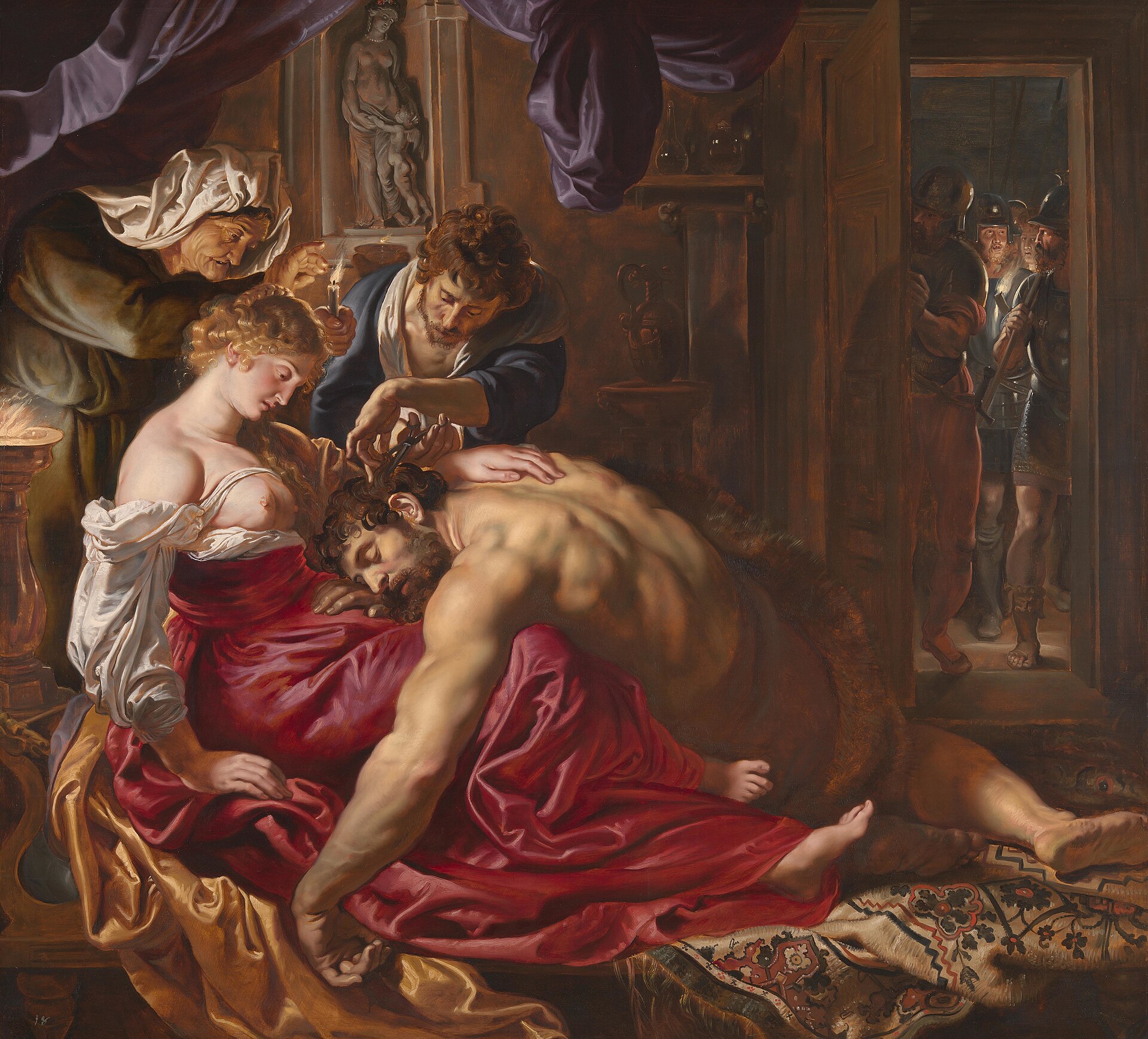
| The National Gallery | London | Samson and Delilah, among other works | The attribution of Samson and Delilah is disputed; see the corpus section of this page. |
| Art Gallery of Ontario | Toronto | The Massacre of the Innocents (c. 1611-1612), the Thomson Collection | The picture that set the standing Rubens auction record in 2002. |
| Galleria Palatina, Palazzo Pitti | Florence | The Four Philosophers and The Consequences of War |
By the early 1610s Rubens was receiving more commissions than one person could physically paint, from kings, cardinals, aristocrats and civic guilds across Europe at once.
By the early 1610s Rubens was receiving more commissions than one person could physically paint, from kings, cardinals, aristocrats and civic guilds across Europe at once. His answer was a workshop with a real division of labour: trained assistants executed backgrounds, drapery and secondary figures from his designs, while specialist painters were brought in for whole categories of subject matter he did not paint himself. The pictures that came out of the Wapper street house still carry only his name, which is exactly the gap that makes the word "Rubens" a graded category rather than a single fact.
He made that grading explicit himself. In 1618, negotiating an exchange of paintings for a collection of antique marbles with Sir Dudley Carleton, then English ambassador at The Hague, Rubens set out in a letter how much of each offered picture was his own hand against how much was assisted. Carleton wanted only work painted entirely by Rubens; the two settled on a mix of paintings and cash. It is among the earliest documented instances anywhere of an artist pricing his own participation by degree, and it is the direct ancestor of every autograph-versus-workshop argument that still happens in a saleroom today.
Rubens trained successively under the landscape painter Tobias Verhaecht, the Romanist Adam van Noort for about four years, and finally Otto van Veen, who by 1598 had shaped him into what the period...
Rubens trained successively under the landscape painter Tobias Verhaecht, the Romanist Adam van Noort for about four years, and finally Otto van Veen, who by 1598 had shaped him into what the period called a pictor doctus, an educated painter versed in classical literature and theory rather than a craftsman only. He entered the Guild of St Luke as an independent master that same year. The distinction mattered for the rest of his career: patrons who wanted a painter who could also read Seneca in Latin and correspond with scholars in several languages had, in Rubens, exactly that.
He left for Italy in 1600 and did not return for eight years. He entered the service of Vincenzo I Gonzaga, Duke of Mantua, copying Renaissance masterworks for the ducal collection; studied Titian, Veronese and Tintoretto in Venice; spent extended periods in Rome absorbing classical sculpture, Michelangelo, Raphael and, decisively, Caravaggio; and worked in Genoa long enough to produce the portrait drawings later published as the Palazzi di Genova in 1622. In 1603 Gonzaga sent him to Madrid on a diplomatic errand, delivering gifts to the Spanish court and studying the royal collection of Titian and Raphael while he was there. It was his first taste of the statecraft he would later practise in his own name, not an employer's.
Rubens returned to Antwerp in 1608 on the death of his mother, ending the Italian years.
Rubens returned to Antwerp in 1608 on the death of his mother, ending the Italian years. Within a year he had been appointed court painter to the Archdukes Albert and Isabella and married Isabella Brant, daughter of the humanist Jan Brant, on 3 October 1609. In 1610 he built the Rubenshuis, a house designed on Italian principles that combined a residence, a working studio and a gallery for his own growing collection of antiquities in a single Antwerp property. It functioned as a showroom as much as a home.
The demand that followed was not organic growth so much as an immediate flood. Major public commissions came within a year or two of his return, and the workshop had to scale to match a volume of orders that made the earlier apprenticeship model, one master and a handful of pupils learning by imitation, obsolete for his own output almost immediately.
Certain names recur because certain hands were trusted with certain things.
Certain names recur because certain hands were trusted with certain things. Jan Brueghel the Elder painted landscapes, flowers and animal passages in pictures where Rubens supplied the figures, a genuine partnership between equals rather than a master directing a subordinate, and the pairing produced some of the most sought-after collaborative works either artist made. Frans Snyders became the preferred specialist for animals and still life across the Antwerp studios generally, working with Rubens, Anthony van Dyck and Jacob Jordaens in turn rather than exclusively for any one of them. Van Dyck himself entered the workshop as an assistant in 1616, in his late teens, and was given responsibility unusual for so young a painter before leaving to build an independent career that would eventually rival his master's.
None of this is inferred from style alone; it is what the 1618 Carleton letter documents directly, an artist stating in his own hand which parts of a commercial transaction were his and which were not. It is also where attribution erasure becomes a live question rather than an abstract one: a picture sold and catalogued for centuries as simply "Rubens" may owe its finest passages to Brueghel's brush or Snyders's, credited nowhere on the object itself.
There is no single number the field currently treats as settled, and that is itself the finding.
There is no single number the field currently treats as settled, and that is itself the finding. The Corpus Rubenianum Ludwig Burchard, built from the research notes of the Rubens scholar Ludwig Burchard and administered since the 1960s by the non-profit Centrum Rubenianum in Antwerp, is the standing scholarly catalogue: more than forty of a planned near-thirty parts, some running to multiple volumes, had appeared by 2017, with roughly ten still to come, and it covers paintings, drawings, prints and tapestry designs made under Rubens's supervision rather than autograph paintings alone. Even within a single subject the project can be years from finished: the mythological-subjects volume published by 2017 catalogued some fifty paintings across more than four hundred illustrations and still only reached as far as the letter G, with four further instalments needed to complete the alphabet.
The last time a single author attempted a complete count of the paintings alone, Michael Jaffe's catalogue of 1968, revised in 1989, the figure was 1,403 works, excluding workshop copies. Nothing has superseded that total with a newer one; the CRLB instead moves individual pictures in and out of the corpus volume by volume, which is a more rigorous process and a much harder one to summarise in a single sentence.
There is also no standing authentication board, unlike the Rembrandt Research Project, which closed after its own internal disputes. The nearest thing to an institutional authority is the scholar who has written the relevant CRLB subject volume. In 2026 the VU Amsterdam art historian Charlotte Rulkens piloted a more transparent alternative, the Attribution Expert Consensus Meeting, in which a panel of specialists records individual confidence levels on a picture before any group discussion, reducing the tendency of one strong voice to pull the room. Tested on the Enthroned Madonna at the Royal Museum of Fine Arts, Antwerp, it produced an average confidence of 93.8 per cent that Rubens painted at least part of the picture himself, alongside recorded, visible disagreement about which parts. It is a pilot study on one altarpiece, not a replacement for the volume-by-volume system, but it is evidence that a discipline built on individual connoisseurship is now trying to make its own reasoning checkable rather than simply asserted.
Rubens worked almost exclusively on oak panel for smaller and mid-sized commissions through the 1610s and 1620s, moving to canvas for his largest and most portable work.
Rubens worked almost exclusively on oak panel for smaller and mid-sized commissions through the 1610s and 1620s, moving to canvas for his largest and most portable work. The panel's own thickness is a diagnostic tool in its own right: boards run around 1.2 centimetres in the 1610s and thin to about 0.6 centimetres by the 1630s as lighter Baltic stock became standard practice, which makes panel thickness, alongside dendrochronology of the wood itself, one of the few physical checks available on a proposed date independent of style.
Underneath the paint is typically a double ground: a chalk-and-glue gesso base topped with a second, streaky priming layer, an imprimatura, of yellow or brown earths and sometimes charcoal black, toned mid-value rather than left white. Rubens is credited as the first painter to make the small oil sketch, the modello or bozzetto, a standing part of his working method rather than an occasional aid: a rapid, alla prima panel worked up to show a patron for approval, then handed into the workshop as the template for enlargement to full scale. That handoff is also where the division between his own hand and an assistant's typically begins.
His palette used indigo for the darkest blues and, more often after his return to Antwerp, the cheaper mineral smalt for brighter blue passages rather than pure ultramarine; lead-tin yellow, vermilion and ochres sit against a lead-white ground, with charcoal black favoured over the ivory or bone blacks common elsewhere. In a disputed attribution, connoisseurs read the flesh passages first: Rubens's own brushwork in heads and hands tends to be comparatively rapid and confident against more even, laboured drapery or background more often left to an assistant. It remains, in most contested cases, a comparative judgement rather than a chemical test, which is exactly why physical evidence like panel thickness and pigment analysis matters as much as it does when it is available at all.
The Elevation of the Cross was commissioned in 1610 for the parish church of St Walburga in Antwerp, secured for Rubens by the churchwarden and spice merchant Cornelis van der Geest, who bore most of...
The Elevation of the Cross was commissioned in 1610 for the parish church of St Walburga in Antwerp, secured for Rubens by the churchwarden and spice merchant Cornelis van der Geest, who bore most of the cost himself. St Walburga's was later demolished, and the triptych moved to Antwerp Cathedral after the Napoleonic Wars, where it hangs today alongside work it was never designed to share a building with.
The Descent from the Cross followed close behind: commissioned on 7 September 1611 by the Confraternity of the Arquebusiers, the guild of Antwerp's civic militia, for their chapel in Antwerp Cathedral, where it remains in its original setting. The dedication is not incidental. The guild's patron saint was Christopher, whose name means Christ-bearer, and their altarpiece shows Christ's body being physically carried down from the cross, a documented fit between subject and patron rather than a modern reading imposed afterward. Nicolaas Rockox, burgomaster of Antwerp and dean of the guild at the time, appears among the figures at the base of the cross; the same Rockox would later commission Rubens's Samson and Delilah as a private picture for his own house, which makes him a patron connecting two of the artist's most consequential religious and secular commissions.
What can be documented is narrower than what has been argued, and the two should not be run together.
What can be documented is narrower than what has been argued, and the two should not be run together. Documented: Rubens's brother Philip studied in Leiden under the neostoic scholar Justus Lipsius, who thought highly enough of him to want Philip as his own successor in the chair at Leuven before Philip chose Italy instead and Lipsius used his own connections to help him get a post in Rome. Documented: around 1611 to 1612 Rubens painted The Four Philosophers, a group portrait showing himself, Philip, Lipsius and the scholar Jan Woverius gathered beneath a bust then believed to be Seneca, a real, named, identifiable group rather than an invented allegorical scene.
Argued: the classicist Mark Morford, in a dedicated study of the pair, contends that through this circle Rubens himself was schooled in Lipsius's synthesis of Stoic philosophy and Christian belief, and that the neostoic reading of constancy under public calamity shaped how Rubens approached his own most violent religious subjects. That is a scholarly interpretation of what the documented facts permit, not a documented fact in its own right, and this record keeps the two apart rather than presenting Morford's reading as something Rubens stated himself.
In 1620 and 1621 Rubens designed and executed thirty-nine ceiling paintings for the newly built Jesuit church in Antwerp, now the church of St Charles Borromeo: twenty-one images of saints and...
In 1620 and 1621 Rubens designed and executed thirty-nine ceiling paintings for the newly built Jesuit church in Antwerp, now the church of St Charles Borromeo: twenty-one images of saints and eighteen scenes from the Old and New Testament, filling both levels of the nave galleries. It was the most extensive single commission he had received up to that point in his career, delivered in time for the church's consecration in 1621, the same year he wrote to the English agent William Trumbull that no undertaking, however vast, had ever surpassed his courage.
On 18 July 1718 lightning struck the church. The fire destroyed every one of the thirty-nine ceiling paintings, though the choir, the high altarpieces, the side chapels and the facade survived. What is known of the cycle today comes entirely from Rubens's own surviving oil sketches and grisaille modelli, together with contemporary copies made by other artists before the fire, which is enough to reconstruct the iconography and the overall design but nothing that restores the paintings themselves. It is the starkest illustration on record of how contingent survival is even for an artist working at the top of the market in his own lifetime.
Rubens was raised to the nobility by Philip IV of Spain in 1624, a full six years before his better-known English honour.
Rubens was raised to the nobility by Philip IV of Spain in 1624, a full six years before his better-known English honour. Between 1627 and 1630 he undertook a genuine diplomatic mission, travelling between the Spanish and English courts in an attempt to broker peace between the two crowns, arriving in London in June 1629 and lodging at York House, the former residence of the Duke of Buckingham, on the Strand. Cambridge awarded him an honorary Master of Arts that year. He remained in England longer than planned, waiting for the arrival of the Spanish ambassador, and did not leave until January 1630. At his final audience with Charles I, held at the Banqueting House itself, he was knighted and given a diamond-set sword.
Few painters of his rank were trusted with substantive statecraft rather than simply feted at court, and Rubens was explicit that he did not treat the two roles as equivalent distractions from each other. Diplomacy funded and protected the painting business; the painting business, in turn, gave him standing at courts that had reason to distrust an ordinary emissary.
The commission for the ceiling of Inigo Jones's Banqueting House at the Palace of Whitehall had first been raised under James I before his death in 1625, and was formally commissioned by Charles I...
The commission for the ceiling of Inigo Jones's Banqueting House at the Palace of Whitehall had first been raised under James I before his death in 1625, and was formally commissioned by Charles I around 1629 to 1630, during the same diplomatic visit that ended in Rubens's English knighthood. He was paid 3,000 pounds and a gold chain for the work, delivered after an initial two-year delay. The nine canvases, covering roughly 225 square metres of ceiling and glorifying the reign of James I, were completed in Antwerp by May 1633 and installed in London by early 1636.
Rubens never travelled to see them in place. Chronic gout, which would eventually contribute to the heart failure that killed him, kept him from making the journey. The Whitehall ceiling remains the only surviving in-situ ceiling cycle by Rubens anywhere: a direct counterpoint to the Jesuit church ceiling in Antwerp, his other great decorative scheme of the same decade, which survives nowhere at all except in sketches and copies.
Rubens bought and sold art and antiquities as a serious secondary business rather than a private enthusiasm.
Rubens bought and sold art and antiquities as a serious secondary business rather than a private enthusiasm. The 1618 exchange with Sir Dudley Carleton, paintings for a collection of antique marbles, is only the best documented instance; his correspondence with the French scholar and collector Nicolas-Claude Fabri de Peiresc shows a sustained, working interest in engraved gems and ancient coins specifically, including a planned but never completed joint publication on the subject. Contemporaries and later cataloguers describe him as someone who would trade his own paintings for a desirable antiquity but paid cash outright for rarities he did not want to wait to negotiate for.
The largest single transaction came in 1626 and 1627, after Isabella Brant's death, when Rubens sold a substantial part of his own collection of paintings and antiquities to George Villiers, Duke of Buckingham, the favourite of Charles I, negotiated through the agents Balthasar Gerbier and Michel Le Blond rather than face to face. No total price for the sale has been located in the sources consulted for this record, which is recorded as an open question below rather than estimated.
The clearest illustration of what an attribution is worth in cash terms is a picture already covered in full elsewhere in this archive.
The clearest illustration of what an attribution is worth in cash terms is a picture already covered in full elsewhere in this archive. The Massacre of the Innocents, an oak panel of about 1611 to 1612, was catalogued in 1767 under a name almost nobody now recognises and by 1780 as the work of the assistant Jan van den Hoecke, after Rubens; it spent close to eighty years of the twentieth century hanging in an Austrian monastery under that demotion. In 2001 the Sotheby's specialist George Gordon, corroborated by David Jaffe of the National Gallery, restored it to Rubens on comparison with the National Gallery's own Samson and Delilah, which had come from the same Liechtenstein collection and been reduced to the same assistant's name in the same eighteenth-century inventories. It sold in July 2002 for a hammer of 45 million pounds, 49.5 million with the buyer's premium, still the standing auction record for Rubens and for any Old Master painting. Iconotheca's dedicated record on the picture carries the full provenance, the catalogue history and the sale in detail; it is not repeated here.
What belongs on this page is the structural point the record-level entry cannot make about the artist as a whole: the comparison that authenticated the highest-priced rediscovered painting in history is itself contested. The National Gallery's Samson and Delilah has been disputed since the 1990s by the scholar Euphrosyne Doxiadis, and more recently by Michael Daley of ArtWatch UK and the independent researcher Kasia Pisarek, on grounds including its undocumented provenance between 1641 and 1929 and its divergence from copies made in Rubens's own lifetime. In September 2021 the Swiss firm Art Recognition, applying a machine-learning classifier trained on Rubens's accepted works, reported a 91 per cent probability that the painting is not by him. Dendrochronology of the panel supports the proposed date, and the National Gallery maintains the attribution, as does most of the scholarly community. Iconotheca does not adjudicate between these positions. It records only the fact that neither side disputes: two paintings bought from the same dealers into the same collection around 1700, demoted together by the same eighteenth-century cataloguer, remain joined at the hip in the historical record, and whatever is eventually decided about one is direct evidence about the other.
The most consequential Rubens forgeries were not paintings but drawings, sold through the respected London dealer Colnaghi by Eric Hebborn, one of the most prolific forgers of the twentieth century...
The most consequential Rubens forgeries were not paintings but drawings, sold through the respected London dealer Colnaghi by Eric Hebborn, one of the most prolific forgers of the twentieth century, using genuinely old paper and ink so that no chemical test could date the sheet itself as modern. The fakes were caught by comparison rather than chemistry: a curator at the National Gallery of Art in Washington noticed that two drawings catalogued to entirely different artists shared an identical hand and the same type of paper, and a curator at the Morgan Library, alerted to the discovery, found the same problem in a drawing there. Roughly a dozen more drawings Hebborn had sold to Colnaghi, including works attributed to Rubens, Tiepolo and Augustus John, were recalled and re-examined, and were found to share an overabundance of crosshatching, overly curly hair and a washed-out look consistent with paper that had been artificially aged rather than genuinely old despite being, in fact, genuinely old paper. Because the physical materials were authentic, the forgery itself could never be proven in a way that would survive a court, and Colnaghi never brought a public case for fear of a libel suit if the accusation failed.
The episode is a useful corrective to any assumption that scientific analysis has made connoisseurship obsolete. Panel thickness, dendrochronology and pigment analysis can rule pictures out with real confidence; a sufficiently disciplined forger working in period materials can still defeat every one of them, which is precisely why the field still depends, in the end, on the trained eye, and why projects built to make that eye's reasoning transparent, from the Corpus Rubenianum to Charlotte Rulkens's 2026 consensus pilot, matter as much as any laboratory test.
Painter; Draughtsman; Diplomat. 1577-1640.
Born 28 June 1577, Siegen, Nassau-Dillenburg, Holy Roman Empire (now Germany); died 30 May 1640, Antwerp, Spanish Netherlands.
Eric Hebborn's drawings sold through Colnaghi. The prolific forger Eric Hebborn (1934-1996) sold drawings in the manner of Rubens and other old masters into major private and museum collections through the respected London dealer Colnaghi, using genuinely old paper and ink so that no straightforward chemical test could date the sheet itself as modern.
Cathedral of Our Lady (Antwerp); Rubenshuis (Antwerp); Royal Museum of Fine Arts (KMSKA) (Antwerp); Museo del Prado (Madrid); Alte Pinakothek (Munich); The National Gallery (London).
The three results on file below span fourteen years and sit in a narrower price band, from the mid twenties to the high seventies in dollar terms, than the swings in Rubens's attribution history alone would suggest. What appears to move the price is not condition or size so much as the story attached to the attribution and the provenance: the record lot was a rediscovery restored from a wrong name; the second-placed lot had been openly known in private hands for decades with no dispute attached; the most recent result was a picture whose subject, a severed head presented on a platter, most buyers would never hang in a dining room, sold anyway because the hand was never in question, only the price a confirmed Rubens with strong provenance could reach twenty-five years after its previous sale.
What is the current total of paintings the field would call autograph Rubens? Michael Jaffe's figure of 1,403 (1989) has not been superseded by any later single-author total, and the Corpus Rubenianum has not published a consolidated count.
Last verified 17 September 2026
One artwork and its story every Tuesday, with the picture: who owned it, what it made, and what closes soon in the exhibition calendar. No promotion, and nothing we cannot cite.
We send one email to confirm the address and keep nothing else. Every letter carries a one-click unsubscribe. How we handle your data.