What a Sleeper Is, and Why They Still Happen
A GBP 524.80 picture catalogued as a follower of Ibbetson turned out to be Turner's first exhibited oil. The finder's edge is time, and the English courts have said so.
Records in this piece: The Rising Squall, Hot Wells, from St Vincent's Rock, Bristol
On this page 6 sections
ContentsClose
In short
- The Turner was catalogued at Dreweatts as a follower of Julius Caesar Ibbetson and cost GBP 524.80 with fees; fifteen months later it hammered at GBP 1.5 million.
- An Artemisia Gentileschi bought at Hampel in Munich for EUR 104,000 in 2018 sold at Sotheby's for GBP 1.6 million hammer in 2025.
- In Thwaytes v Sotheby's the High Court held the house had no obligation to run infrared analysis on a lot catalogued as a follower.
- Around thirty other versions of Caravaggio's Cardsharps were offered at auction between 1988 and 2012, two of them during the trial itself.
The definition, and who profits from it
James Marrone and Silvia Beltrametti, writing in the International Journal of Cultural Property in 2020, define sleepers as artworks or collectibles that are undervalued because one or more characteristics go unrecognised. That formulation is deliberately neutral: it covers a misattribution, an unrecognised subject, an overlooked date. The buyer who identifies the unrecognised characteristic captures the difference.
The practice is not marginal. Ben Lewis, writing in The Art Newspaper in 2024, put it as flatly as anyone in the trade will: the Old Masters market is built on the buying and selling of sleepers. Dealers attend regional sales expecting that an Italian School picture may, under the grime and dark varnish, turn out to be workshop of Botticelli, follower of Caravaggio, or better.
The term carries a faint suggestion of sharp practice, which is only partly fair. The knowledge that makes a sleeper visible is expensive to acquire and the risk is real, since most pictures that look like sleepers are exactly what the catalogue says. The distributional question, which is a genuine one, arises after the fact rather than in the definition.
Why they still exist
Cataloguing is a volume business on thin margins. Ian Butchoff of Butchoff Antiques gave the mechanism in a single sentence: auction houses do not have the time to research properly, they have a deadline and need to catalogue things, and in the end, being a dealer, you have the time. The economics guarantee that some lots are described quickly, and no individual has been careless.
Category matters as much as speed. Sleepers cluster in areas considered niche or unfashionable, where the lack of ready scholarship, or even of interest, produces thin provenance and outright misidentification. A field with active specialists and a strong market is combed constantly; a field with neither is not.
The physical conditions that hide a picture are entirely ordinary: discoloured varnish, old overpaint, a bad frame, a dirty surface, poor photography in an online catalogue. The Artemisia Gentileschi David with the Head of Goliath that surfaced at Hampel in Munich in 2018 was so dirty that the bold signature on the sword was concealed. Nothing about that requires an error of judgement, only an absence of cleaning.
The Turner, with the record corrected
The clearest recent case has been widely misreported in two respects, and the accurate version is more interesting. Turner's The Rising Squall, Hot Wells from St Vincent's Rock, Bristol, painted in 1792 when he was seventeen and exhibited at the Royal Academy in 1793, was sold at Dreweatts Donnington Priory in Newbury on 4 April 2024 as lot 23. It was catalogued as by a follower of Julius Caesar Ibbetson and titled House by the Water in a Stormy Sky. It cost GBP 524.80 including fees and VAT.
The two corrections matter to anyone reasoning from the case. The catalogued attribution was Ibbetson; the frequently repeated detail that the buyer suspected Philip James de Loutherbourg is not corroborated in the primary reporting and should be treated as unverified. The price was GBP 524.80, not a GBP 500 hammer, so the celebrated comparison runs from one fee-inclusive figure to another.
During conservation, Turner's signature was discovered. The picture returned to Sotheby's London on 2 July 2025 as lot 28, estimated at GBP 200,000 to 300,000, and sold to a UK private collector at a hammer of GBP 1.5 million, GBP 1.9 million with fees, after competition from five active bidders. Bristol Museum and Art Gallery, in the city where the painting was made, was the second highest bidder.
Four more, with the figures attached
The Artemisia Gentileschi David with the Head of Goliath was bought at Hampel Fine Art Auctions in Munich for EUR 104,000 in 2018, catalogued as by a seventeenth-century painter of the school of Caravaggio, with the attribution changed online to Gentileschi shortly before that sale. At Sotheby's on the same July 2025 evening as the Turner it made GBP 1.6 million at the hammer, GBP 2 million with fees. A second Gentileschi was bought at a Danish auction house in September 2022 for GBP 30,000 and sold at Christie's less than a year later for GBP 1.9 million.
The Cimabue Mocking of Christ was found by the auctioneer Philomene Wolf during a house clearance near Compiegne; the family thought it was an icon. It hammered at EUR 19.5 million at Senlis on 27 October 2019, EUR 24.18 million with fees. The Frans Post view of Olinda came out of a barn attic in 1998, and George Wachter of Sotheby's has described it as filthy, black and dirty, jet black, with the conservator Nancy Krieg opening a tiny window in the sky that turned blue and white. It sold at Sotheby's in May 2025 at USD 6 million hammer, USD 7.3 million with fees, a record for the artist.
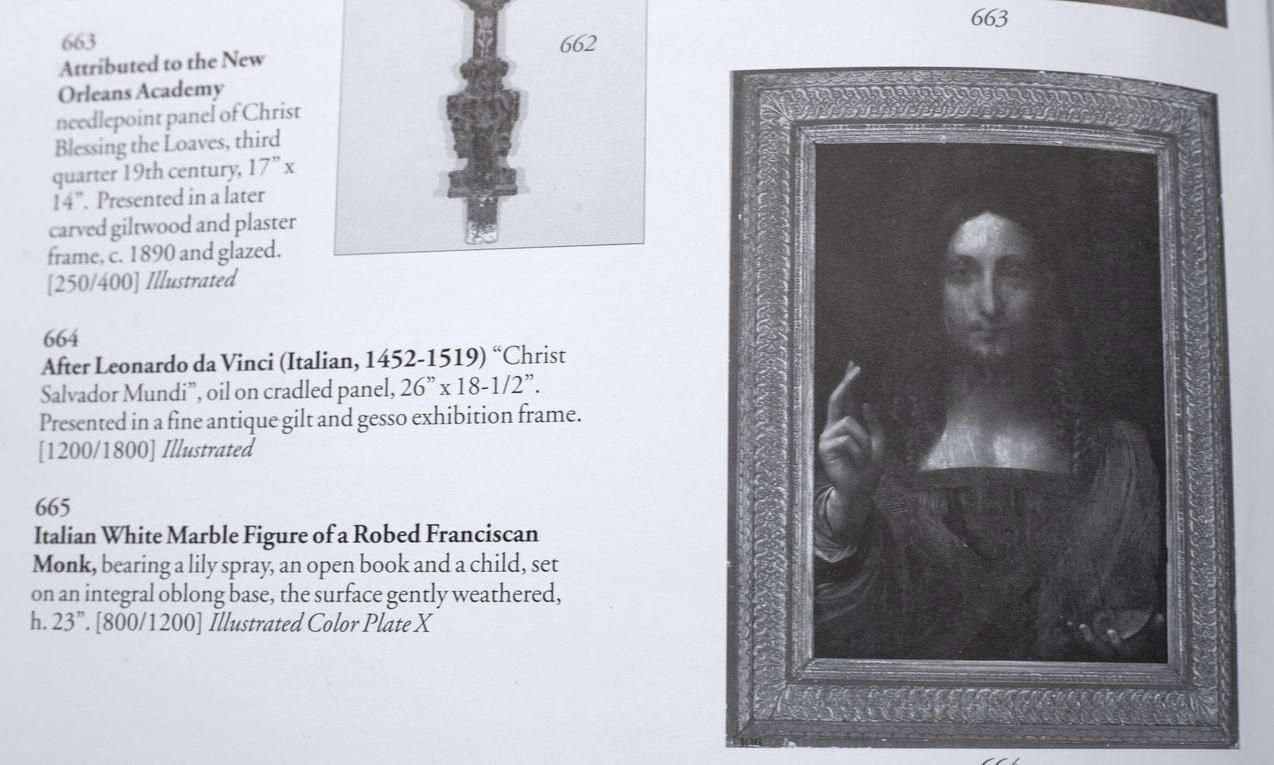
The Salvator Mundi is the extreme case and its figures are the least reliable. It was consigned to St Charles Gallery in New Orleans and sold in April 2005 as lot 664, After Leonardo da Vinci, oil on cradled panel, against an estimate of USD 1,200 to 1,800, having been appraised in the estate as Continental School, nineteenth century, in poor condition, at USD 750. Reported prices for that sale conflict across sources; the house's own prices-realised sheet gives an aggregate of USD 1,175 and the buyer has described his winning bid as USD 1,000. Twelve years later Christie's sold it at a hammer of USD 400 million.
What the finder risks, and what the courts have held
A sleeper hunter buys on an opinion nobody else holds, pays before it is tested, and then funds cleaning and research that may destroy the thesis. Philip Mould gambled USD 1.76 million at Sotheby's New York in January 2009 on a Titian portrait, betting that cleaning and restoration would confirm the attribution. Most such bets fail, and no published figure exists for the rate at which they do, which is itself worth knowing before quoting one.
The seller's remedy has been tested in England and it failed. In Thwaytes v Sotheby's, Mrs Justice Rose dismissed the claim on 16 January 2015. Sotheby's had sold a second version of Caravaggio's The Cardsharps on 5 December 2006 for GBP 42,000 plus buyer's commission, catalogued as by a Follower of Caravaggio. It was bought on behalf of Sir Denis Mahon, who had it cleaned and announced it in November 2007 as an autograph replica by Caravaggio, supported by Mina Gregori. The court found Sotheby's not negligent: they were entitled to rely on their specialists' connoisseurship, reasonably concluded the quality was not high enough to indicate Caravaggio, and were under no obligation to carry out infrared analysis or to advise the seller to arrange it.
The judgment also supplies the market context. About thirty versions of that composition other than the disputed picture were offered at auction between 1988 and 2012, more than half through Christie's or Sotheby's, and during the first week of the trial two more sold in London, one at Bonhams for GBP 1,250 and one at Christie's as After Caravaggio for GBP 10,000. French law has been more sympathetic to sellers: in the Saint-Arroman affair the Cour de cassation held on 13 December 1983 that proof produced after the signature of a contract cannot be excluded if it establishes the reality of a mistake made at that moment.
The side of the transaction nobody prints
Ben Lewis's argument, made in The Art Newspaper in 2024, is that these are stories with losers as well as winners and that the losers are rarely heard from. His examples are concrete: an Annunciation by Caterina Angela Pierozzi, bought for EUR 7,800 at Millon and unveiled by Colnaghi with a six-figure price, left the original owner with a little over EUR 6,500. He proposes a Sleeper Resale Right modelled on the artist's resale right, at a fraction of a per cent, running for a hundred years.
Whether that is workable is a separate question, and the objection to it is the same one that justifies the practice: the finder took the risk and the seller did not. What is not in dispute is that the asymmetry is real and that it operates on people who did not know they were in the market. The Camden portrait's hammer was eighty times its estimate, and the Turner's was almost three thousand times what the previous owner received.
None of that makes the practice illegitimate, and the English courts have declined to treat it as such. It does mean the trade's own framing of these events as miracles is a choice. A sleeper is the gap between what a picture is worth to someone who has looked at it for thirty seconds and what it is worth to someone who has spent thirty years learning where to look, and somebody on the other side of that gap sold at the first valuation.
Questions
Not in itself, and English law has declined to unwind such a sale. The buyer takes a real risk on an opinion nobody else holds and funds the research that may destroy it. The contested question is distributional rather than legal, and it concerns what the original owner receives.
In England the leading attempt failed: Thwaytes v Sotheby's, dismissed in January 2015, held the house was entitled to rely on its specialists and had no duty to commission infrared analysis. French law has been more receptive, with the Cour de cassation in 1983 admitting evidence produced after the contract to establish a mistake.
Regional and provincial salerooms, house clearances, barn and attic finds, and small local houses. The Turner came from Newbury, the Gentileschi from Munich, the Cimabue from a house clearance near Compiegne, the Frans Post from a barn attic and the Salvator Mundi from a New Orleans estate sale.
No published figure exists, and anyone quoting a rate is estimating. What is documented is that dealers describe the model as requiring many small bets and the discipline to write off failures, and that individual gambles run to seven figures before any confirmation exists.
Sources
- 1James Marrone and Silvia Beltrametti, 'Sleeper Antiquities: Misattributions in Sales of Ancient Art', International Journal of Cultural Property vol. 27 no. 1, February 2020. cambridge.org/core/...
- 2Ben Lewis, 'It's time to end the predatory practices of sleeper hunters', The Art Newspaper, 14 March 2024. theartnewspaper.com/2024/...
- 3Sallie Brady, 'Finders, Sleepers', Art and Antiques Magazine, 1 July 2010, with Ian Butchoff and Philip Mould. artandantiquesmag.com/finders-sleepers
- 4Gareth Harris, 'Newly attributed Turner painting previously sold for 500 pounds goes under the hammer at Sotheby's', The Art Newspaper, 9 June 2025, giving the Dreweatts attribution to a follower of Ibbetson and the GBP 524.80 figure. theartnewspaper.com/2025/...
- 5Anna Brady, 'Turner painting bought last year for 500 pounds sells for almost 2m pounds at Sotheby's', The Art Newspaper, 4 July 2025, giving the GBP 1.5m hammer and the Gentileschi figures. theartnewspaper.com/2025/...
- 6Sotheby's, lot page for The Rising Squall, Old Master and 19th Century Paintings Evening Auction L25033, 2 July 2025, with the Dreweatts provenance line. sothebys.com/en/...
- 7Anna Brady, 'Kitchen Cimabue sells for 24.1m euros', The Art Newspaper, 27 October 2019. theartnewspaper.com/2019/...
- 8Julie Belcove, 'Frans Post Painting Found in a Barn, Sold for Over $7 Million', ARTnews, 29 May 2025, with George Wachter and Nancy Krieg. artnews.com/art-news/...
- 9Dianne Dwyer Modestini, 'History of the Salvator Mundi', Salvator Mundi Revisited, giving the St Charles Gallery lot description and the USD 750 estate appraisal. salvatormundirevisited.com/History-of-the-Salvator-Mundi
- 10St Charles Gallery, New Orleans, Prices Realized sheet for the April 2005 sale, listing lot 664 at an aggregate of 1,175. web.archive.org/web/...
- 11Thwaytes v Sotheby's [2015] EWHC 36 (Ch), Mrs Justice Rose, 16 January 2015, full judgment. caselaw.nationalarchives.gov.uk/ewhc/...
- 12Cour de cassation, first civil chamber, 13 December 1983, Saint-Arroman, English translation published by the University of Texas School of Law, Foreign Law Translations. law.utexas.edu/transnational/...
More in The Market
The partThe Lot That Did Not Sell
Six objects in this archive were offered at auction and not sold. An unsold lot is a price nobody paid and a date the object went quiet, and in one...
The Estimate Is the Newest Part of an Auction Record
Of 214 auction results in this archive, 52 carry a published pre-sale estimate. None of the 29 dated before 1900 do, and the estimate began life as a...
The record price is usually the last price
Four auction records in this archive were set by a buyer who took the object into a museum within seven years.