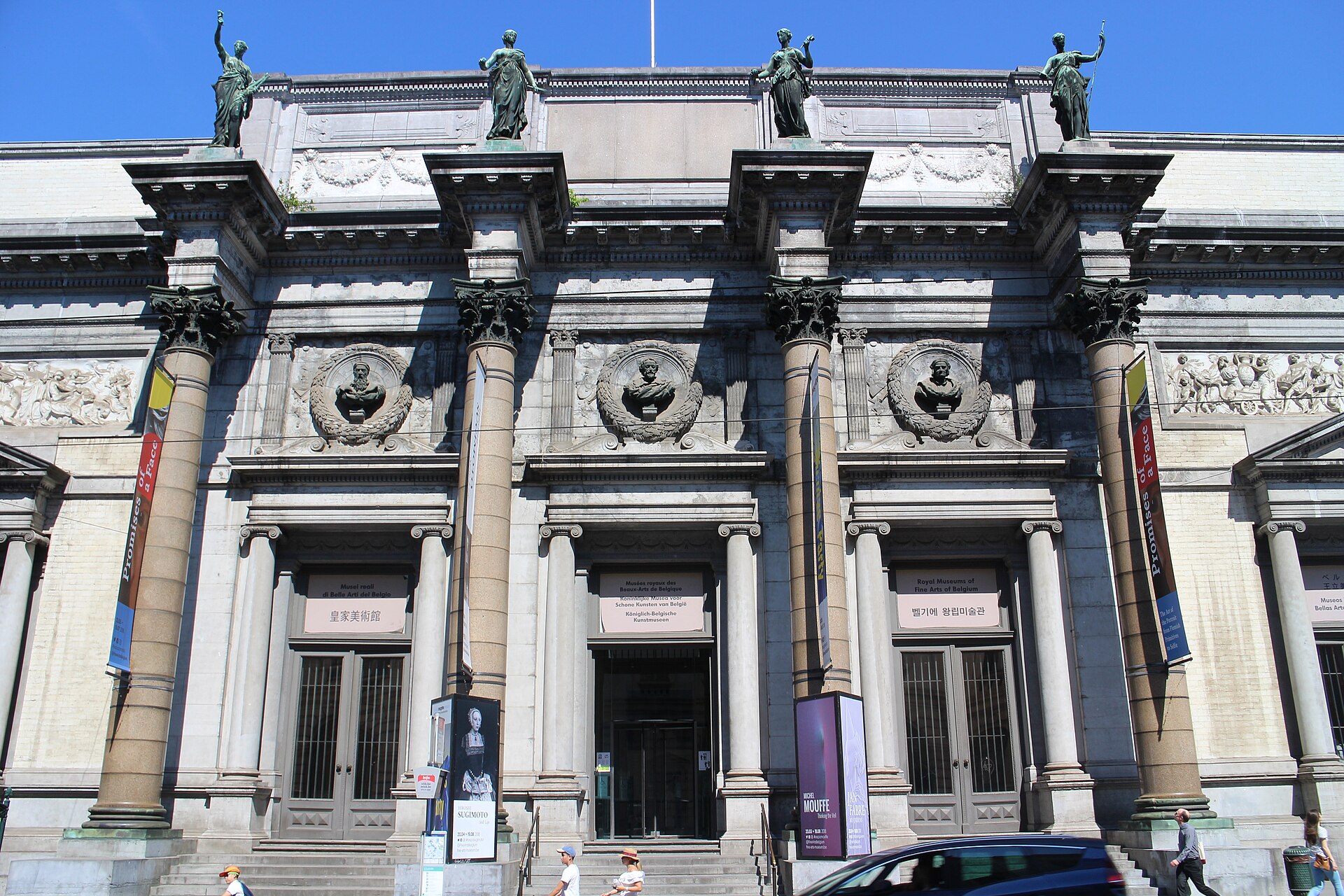
The neoclassical facade of the Balat building on Rue de la Regence, the shared entrance to the Old Masters and Fin-de-Siecle Museums.
Suicasmo, CC BY-SA 4.0Royal Museums of Fine Arts of Belgium
Museum · Musees royaux des Beaux-Arts de Belgique / Koninklijke Musea voor Schone Kunsten van Belgie · Founded 1801
Open, admission and hours confirmed 14 September 2026 · 20 sources
On this page 16 sections
ContentsClose
The Rue de la Regence complex is built around two things Belgium's national collection is genuinely strong in: Flemish and Netherlandish painting from the 15th to 18th century, anchored by a Bruegel holding often described as the world's second-largest and a dedicated Rubens room, and a near-complete record of Brussels as a European centre of Symbolism and Art Nouveau between 1868 and 1914, assembled with a breadth - painting, sculpture, decorative art, literature, opera, early photography - that few single-period museums attempt. Across all six sites the wider institution holds more than 20,000 works; the two museums this page covers hold the historical core that gives the rest of the collection its context.
| Local name | Musees royaux des Beaux-Arts de Belgique / Koninklijke Musea voor Schone Kunsten van Belgie |
|---|---|
| Kind | Museum |
| Founded | 1801 (Bonaparte's Chaptal decree of 1 September 1801, museum opened to the public 1803); the Rue de la Regence building dates to 1880, with the Old Masters collection installed there from 1887 |
| City and country |  Brussels, Belgium Brussels, Belgium |
| Address | Rue de la Regence 3, 1000 Brussels, Belgium |
| Website | fine-arts-museum.be |
| Status | Open, confirmed |
| Record last verified |
Visiting
- Hours
- Tuesday-Friday10:00 to 17:00ticket office closes at 16:30
- Saturday-Sunday11:00 to 18:00ticket office closes at 17:30
- Closed
- Monday. 1 January. 1 May. 1 and 11 November. 25 December. 24 and 31 December the museums close early, at 15:00. 8 January the museums open late, at 11:00.
- Admission
- Adult (Old Masters Museum)EUR 13the Fin-de-Siecle Museum levels have been closed to the public since 8 January 2024 for construction works, so this ticket no longer routinely covers a distinct Fin-de-Siecle Museum visit; the institution's own site says modern and contemporary sections are being reintroduced into the Old Masters Museum route gradually since 2025, with full integration targeted for end of 2026, and that some Fin-de-Siecle works appear in rotating temporary exhibitions in the meantime
- Senior, 65+EUR 10
- Young person, 18-25EUR 5
- Group adult, minimum 15 peopleEUR 10per person
- Child, 0-17Freefree, non-group
- Combined ticket, Old Masters + Magritte Museum, adultEUR 20Magritte Museum is a separate building on Place Royale, not covered by this page
- Combined ticket, Old Masters + Magritte Museum, seniorEUR 15
- Combined ticket, Old Masters + Magritte Museum, young person 18-25EUR 8
Free entry: First Wednesday of the month from 13:00, all museums, does not apply to temporary exhibitions- Tickets
- fine-arts-museum.be/en/visit/planning-my-visi... The museum's own ticket page.
- Do I need to book?
- No, though online booking is recommended and required for the separate Magritte Museum entrance on Place Royale
- Address
- Rue de la Regence 3, 1000 Brussels, Belgium MapMetro Lines 1 and 5, Parc or Gare Centrale stations
Tram Lines 92 and 93, Royale stop
Bus Lines 33, 38, 71, 95 to Royale; lines 29, 63, 65, 66 to Parc or Gare Centrale
Rail Brussels Central station (Gare Centrale), short walk
Car Car parks at Albertine, 2 Portes and Poelaert, all within walking distance - Website
- fine-arts-museum.be
- Telephone
- +32 (0)2 508 32 11
- [email protected]
Before you go how long, access, photography, bags, eating, shop
- How long to allow
- Two to three hours for the Old Masters and Fin-de-Siecle galleries together
- Access
- The museum publishes a dedicated accessibility statement and a visitors-requiring-assistance service; one visitor review noted the lift to the upper galleries is reached through the auditorium and is not clearly signed from the main stair
- Photography
- Not stated on the pages fetched for this page
- Bags
- Extra security checks at the entrance; suitcases are accepted in the cloakroom only if smaller than 55x50x35 cm and staff may refuse any object judged a risk
- Eating
- Two restaurants on site
- Shop
- A museum shop and a separate Magritte shop
Prices and hours change. We take them from the institution's own pages and print the day we read them, and you can check the current position at the source we used. Confirm before you travel.
What is inside
Flemish Primitives and Early Netherlandish Painting
The founding core of the Old Masters Museum: 15th- and 16th-century panel painting from the Low Countries, including Rogier van der Weyden, Hieronymus Bosch and Hans Memling, the material the original 1801 collection was built around before the Balat building existed to hold it.
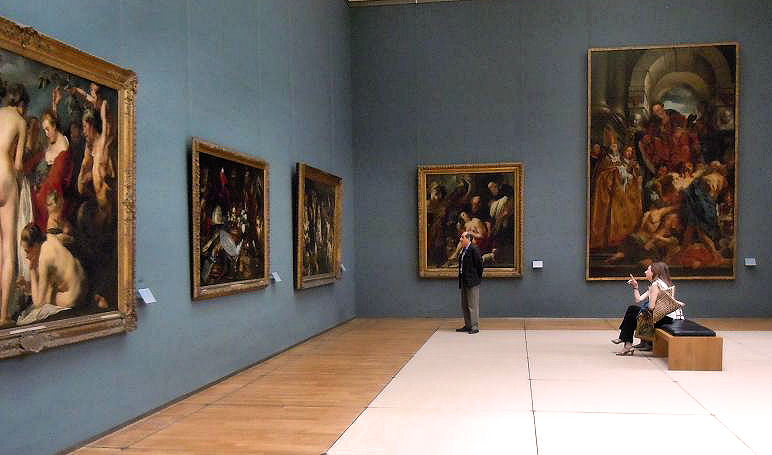
Photograph by Carolus · CC BY 3.0 The Rubens Room and Flemish Baroque
A room built around more than twenty canvases by Peter Paul Rubens, alongside Anthony van Dyck and Jacob Jordaens; Bruegel the Elder's Fall of the Rebel Angels (1562) and Census at Bethlehem hang in the same sequence of galleries, part of a Bruegel holding often described in art-press coverage as the world's second-largest, after Vienna's Kunsthistorisches Museum, though the museum's own collection pages make no such ranking claim.
French Neoclassical and 18th-19th Century European Painting
Jacques-Louis David's Death of Marat (1793), in the museum's own collection since 1893 and the subject of a dedicated technical study exhibited by the museum in recent years, anchors a run of French and Italian 18th-century painting including Le Lorrain and Tiepolo. The painting was away from Brussels on loan to the Louvre in Paris from 15 October 2025, and the institution's own site confirms it returned to the Old Masters Museum in early February 2026.
Fin-de-Siecle Museum: Realism to Symbolism
Opened 6 December 2013 in the basement of the same building, spiralling from level -5 to level -8 around a central light well. Covers Belgian art from 1868 to 1914: Realism and Social Realism, the avant-garde exhibiting societies Les XX and La Libre Esthetique, a large room of James Ensor paintings, Neo-Impressionism (Seurat, Signac, Theo van Rysselberghe), and Symbolism built around Fernand Khnopff. The Fin-de-Siecle Museum has been closed to the public since 8 January 2024 for construction works, per the institution's own closure notice; the institution's current museums listing no longer shows it as a separate open site. The Old Masters Museum page says modern and contemporary sections are being reintroduced into its route gradually since 2025, with full integration targeted for end of 2026, and that some works from this collection appear in rotating temporary exhibitions in the meantime.
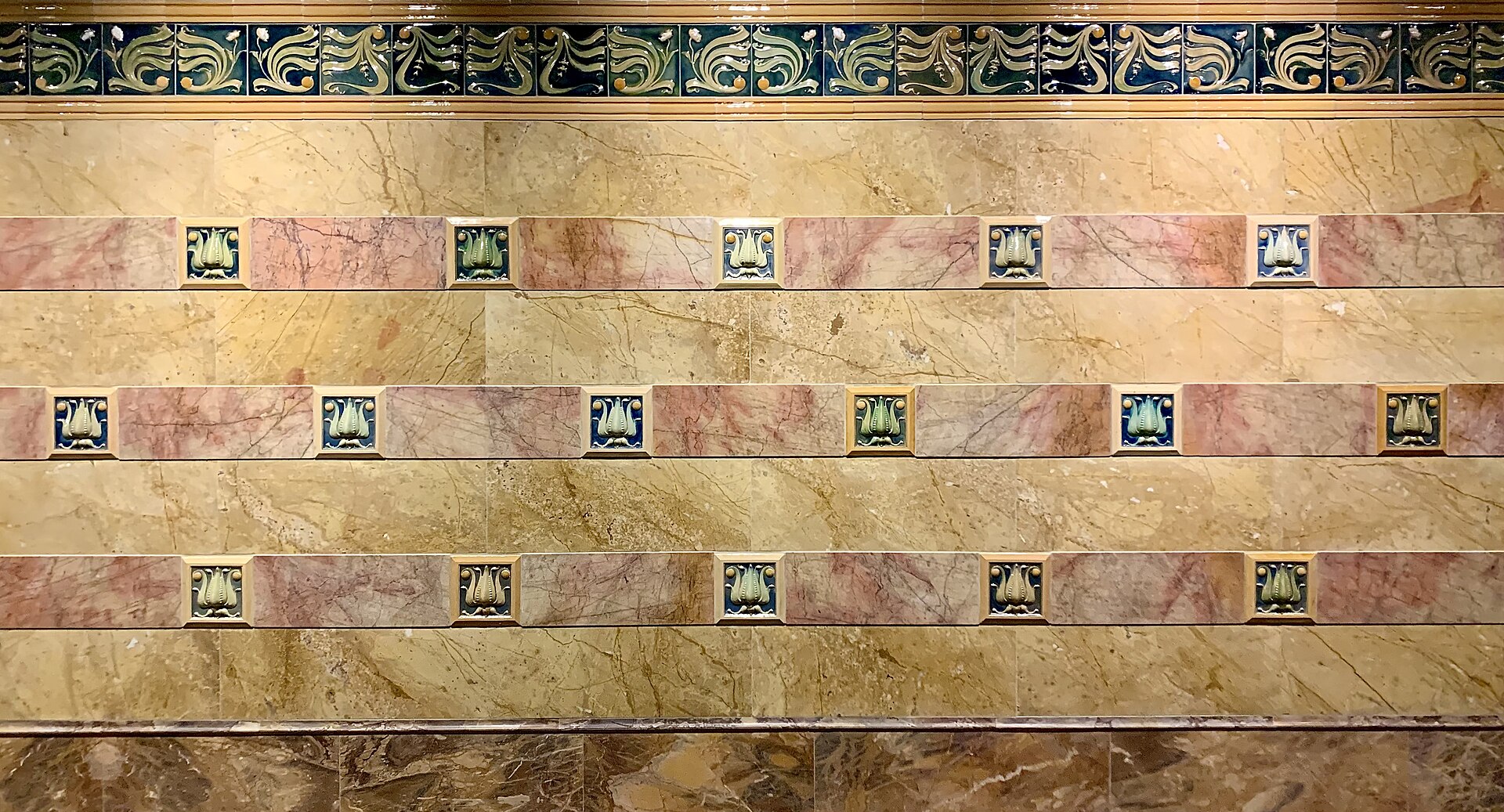
Photograph by Neoclassicism Enthusiast · CC BY-SA 4.0 Fin-de-Siecle Museum: Art Nouveau and the Gillion Crowet Collection
At level -8, over two hundred Art Nouveau decorative-art objects from the Gillion Crowet donation, including Alphonse Mucha, Victor Horta, Emile Galle and Louis Majorelle, shown as furniture-and-object tableaux; the final rooms pair Leon Spilliaert's works on paper with George Minne's sculpture as the museum's own chosen closing statement on 'the road to modernity'. This level has been closed to the public since 8 January 2024 along with the rest of the Fin-de-Siecle Museum; see the note on the Realism-to-Symbolism wing above.
What to see first
The Fall of the Rebel Angels
Pieter Bruegel the Elder, 1562Oil-on-oak centrepiece of a Bruegel holding often described in art-press coverage as the world's second largest after Vienna, though the museum's own collection page makes no such ranking claim, calling the artist simply 'beautifully represented'.14
The Census at Bethlehem
Pieter Bruegel the ElderA second major Bruegel panel in the same run of Flemish rooms.12
The Rubens Room
Peter Paul RubensMore than twenty Rubens canvases gathered in one dedicated gallery, the single largest concentration in the Old Masters Museum.6
Death of Marat
Jacques-Louis David, 1793In the museum's collection since 1893, and given a dedicated technical-study exhibition by the museum; art historian T. J. Clark called it the first modernist work, in his book Farewell to an Idea. On loan to the Louvre in Paris from 15 October 2025, confirmed back on display in Brussels from early February 2026.16
The James Ensor gallery
James EnsorA wide run of Ensor's work, including Skeletons Fighting over a Pickled Herring and The Bad Doctors, is what a named academic review singled out as most likely to appeal beyond specialists. Part of the Fin-de-Siecle Museum, closed to the public since 8 January 2024; see inside[] and open_questions.8
Memories (Lawn Tennis)
Fernand Khnopff, 1889The pastel anchoring the Fin-de-Siecle Museum's Symbolism room, paired there with Edward Burne-Jones's Psyche's Wedding. Part of the Fin-de-Siecle Museum, closed to the public since 8 January 2024; see inside[] and open_questions.8
The Seine at La Grande Jatte
Georges Seurat, 1888Centrepiece of the museum's Neo-Impressionist holding, shown with Signac and Van Rysselberghe. Part of the Fin-de-Siecle Museum, closed to the public since 8 January 2024; see inside[] and open_questions.8
The Gillion Crowet Collection
Alphonse Mucha, Victor Horta, Emile Galle and othersOver two hundred Art Nouveau decorative-art pieces at level -8, arranged as period tableaux rather than case by case. Part of the Fin-de-Siecle Museum, closed to the public since 8 January 2024; see inside[] and open_questions.8
Exhibitions on now
A museum born of a decree, a building built decades later to hold it
The institution predates its own building by nearly eighty years. Its origin lies in the French occupation: after the 1794 Battle of Fleurus, works of art from across what is now Belgium were requisitioned, some sent on to the Louvre, and the remainder gathered in Brussels under a curator, Guillaume Bosschaert, appointed in 1798. Bonaparte's consular decree of 1 September 1801 - the Chaptal decree, 14 Fructidor Year IX - formally established a museum in Brussels, which opened to the public in 1803 in fourteen rooms of the former Palace of Charles of Lorraine, known as the Old Court.
Ownership shifted with Belgium's own history. The city of Brussels held the collection from 1811; after independence in 1830 it passed to the new Belgian state, formalised by an 1842 agreement, and an 1845 royal decree directed that the museum receive the work of living and deceased Belgian artists. The institution's name changed twice more - to the Royal Museum of Fine Arts of Belgium in 1919, then to its current plural form in 1927 - before Belgium's 1993 federal reform recast it as a federal scientific institution, the status it still holds.
The Palais des Beaux-Arts on the Rue de la Regence
The building this page is about opened as the Palais des Beaux-Arts in 1880, on the Rue de la Regence, designed by the architect Alphonse Balat - better known for the royal greenhouses at Laeken. The Old Masters collection moved into it in 1887, giving the Netherlandish and Flemish paintings a purpose-built home for the first time. Architect Albert Van Huffel carried out a substantial renovation between 1923 and 1930. The Hotel Argenteau and the Hotel Gresham, historic townhouses on the Place Royale side of the site, were incorporated into the museum in 1967; a separate expansion of the Balat building itself, inaugurated in phases in 1972 and 1974, added fifty-three new rooms. In 1984 an underground extension opened as a Museum of Modern Art; that space was reorganised and reopened in December 2013 as the Fin-de-Siecle Museum, the form the basement galleries take today.
What this page covers, and what it does not
The Royal Museums of Fine Arts of Belgium is now an umbrella over several physically separate sites, and conflating them would misattribute both the building and the address. This page, its photograph, its coordinates and its address describe only the historic Balat complex at Rue de la Regence 3: the Old Masters Museum on the upper floors and the Fin-de-Siecle Museum in the basement levels below it, reached through the same entrance and, for most of their history, the same ticket desk.
The Musee Magritte Museum, opened in 2009 and holding the world's largest collection of Rene Magritte's work, is administered by the same federal institution but occupies a separate building, the former Hotel Altenloh on Place Royale, a short walk away; it has its own entrance for online-ticket holders. The Meunier Museum, the former house and studio of Constantin Meunier, and the Wiertz Museum, the former studio of Antoine Wiertz - itself temporarily closed for renovation since 11 October 2024 - are further satellite house-museums in the Brussels municipality of Ixelles, run by the same institution but architecturally and physically unrelated to the Rue de la Regence building. None of those three sites is the subject of this page.
The Flemish inheritance: Bruegel, Bosch and the Rubens Room
The Old Masters Museum's declared strength, and the reason most visitor accounts name it first, is Southern Netherlandish and Flemish painting from the 15th to the 18th century. The early core runs through Rogier van der Weyden, Hieronymus Bosch and Hans Memling; Pieter Bruegel the Elder is represented by, among other works, The Fall of the Rebel Angels (1562) and The Census at Bethlehem, part of a Bruegel holding often described in art-press coverage as the world's second largest, after Vienna's Kunsthistorisches Museum; the museum's own collection pages make no such ranking claim, describing the artist simply as 'beautifully represented'. A dedicated Rubens Room gathers more than twenty of his canvases alongside Anthony van Dyck and Jacob Jordaens - the room photographed for this page shows exactly that gallery, its walls close-hung in the Baroque manner the museum still uses for the collection.
The museum's holdings run forward from there: Jacques-Louis David's Death of Marat (1793) has been in the collection since 1893, and the museum's own 2022 exhibition paired the painting with new technical and X-ray research into how David built the image. The 1914 donation from Leon de Grez added more than four thousand drawings and prints, including work by Rembrandt and Hendrick Goltzius, giving the museum's holdings on paper a depth the painted collection alone would not suggest.
Turn-of-the-century Brussels: the Fin-de-Siecle Museum
Where the Old Masters galleries sit above ground, the Fin-de-Siecle Museum spirals downward - levels -5 to -8 - around a central light well, in the space that had been the Museum of Modern Art before its December 2013 reopening under the new name. Its subject is Belgian art of exactly one period, 1868 (the founding of the Societe Libre des Beaux-Arts) to 1914, and it is deliberately cross-disciplinary: painting and sculpture sit beside architecture, the decorative arts, literature, opera and early photography and cinema, assembled with partners including the Royal Library, the Monnaie opera house and the Royal Conservatory.
The display moves through Realism and Social Realism, into the exhibiting societies Les XX and La Libre Esthetique that made Brussels a genuine rival to Paris in the 1880s and 1890s, through a large room devoted to James Ensor, into Neo-Impressionism (Georges Seurat, Paul Signac, Theo van Rysselberghe) and Symbolism built around Fernand Khnopff and paired, in one gallery, with a Burne-Jones loan. At level -8 the Gillion Crowet Collection gathers more than two hundred Art Nouveau decorative objects - Alphonse Mucha, Victor Horta, Emile Galle, Louis Majorelle - shown as furniture tableaux rather than in individual cases, a deliberate attempt to present decorative art as equal in status to painting, which was the fin-de-siecle idea the whole museum takes its structure from. The closing rooms pair Leon Spilliaert's drawings with George Minne's sculpture as the museum's own chosen final statement on the period.
The one detailed academic review available of this specific installation, published in Nineteenth-Century Art Worldwide in 2015, is admiring of the range and the installation design but pointed about a real gap: the galleries carry almost no explanatory wall text, leaving even attentive visitors short of the context needed to follow the movements on display without buying the catalogue afterward.
Ownership, provenance and one restitution
As a federal institution built substantially from 19th- and early-20th-century acquisition and donation, the collection carries the same provenance questions as most European national galleries of comparable age. The one documented case on the public record is a restitution: on 10 February 2022 the museums returned Lovis Corinth's Flowers to the heirs of Gustav Mayer, a Jewish collector whose paintings were looted under Nazi occupation and seized in Brussels in 1942-43 - the institution's first formal restitution of this kind. No other open restitution claim against the Rue de la Regence collections is documented in the sources consulted for this page; that absence is noted here as a limit of current research, not as a clean bill.
Visiting the complex today
A single entrance at Rue de la Regence 3 serves both the Old Masters Museum and the Fin-de-Siecle Museum, and a single ticket - 13 euros for an adult at time of writing - covers both; the Magritte Museum, in its separate building, is sold as its own ticket or as a combined ticket with the Old Masters Museum. The building sits on the Mont des Arts, close to the Sablon and the Palace of Justice, with Metro lines 1 and 5 and tram lines 92 and 93 all within a short walk. Security checks at the entrance are routine and can cause a short queue; the cloakroom will not accept suitcases larger than 55x50x35 centimetres. Most visitor accounts put two to three hours on the Old Masters and Fin-de-Siecle galleries together, longer for anyone adding the Magritte Museum next door.
What visitors say
Visitors consistently rate this among Brussels's best museums and single out the Flemish core - Bruegel, Bosch, Rubens - as the reason to come, usually alongside David's Death of Marat. Many note it is calmer and less crowded than comparable national collections elsewhere in Europe. The most common friction is not about the art but the building: the complex now houses several branded museums behind one historic entrance, and several visitors describe being unsure at first which ticket covers which rooms, or how to find the lift.
What is praised, what is criticised
- Praised: The Flemish and Netherlandish core - Bruegel, Bosch, Van Dyck, Frans Hals, Jordaens and the dedicated Rubens Room
- Praised: David's Death of Marat, named repeatedly as a must-see
- Praised: A quieter, less crowded experience than equivalent major European collections
- Praised: Value of the combined ticket covering the Old Masters and Fin-de-Siecle levels together
- Praised: Friendly, unhurried staff and short or absent queues
- Criticised: Signage and wayfinding inside the building are described as poor, including a lift that is not clearly indicated from the main stair
- Criticised: The Fin-de-Siecle Museum has been reviewed as having almost no explanatory wall text, leaving visitors, in a named academic reviewer's words, needing more context than the labels give
- Criticised: First-time visitors are frequently confused about how many separate museums share the building and which ticket buys entry to which
Ratings on other platforms
Tripadvisor: 4.3 from 1,860 ratings, read 13 August 2026
A platform average is a tertiary source: it moves, it is not audited, and we quote no visitor's words.
Questions about Royal Museums of Fine Arts of Belgium
Where is Royal Museums of Fine Arts of Belgium?
Rue de la Regence 3, 1000 Brussels, Belgium.
How much does it cost to visit?
Adult (Old Masters Museum): EUR 13; Senior, 65+: EUR 10; Young person, 18-25: EUR 5; Group adult, minimum 15 people: EUR 10; Child, 0-17: free. As confirmed 14 September 2026.
When is it open?
Tuesday-Friday 10:00-17:00; Saturday-Sunday 11:00-18:00. Closed: Monday. 1 January. As confirmed 14 September 2026.
How do you get there?
Metro: Lines 1 and 5, Parc or Gare Centrale stations; Tram: Lines 92 and 93, Royale stop; Bus: Lines 33, 38, 71, 95 to Royale; lines 29, 63, 65, 66 to Parc or Gare Centrale; Rail: Brussels Central station (Gare Centrale), short walk.
What should you see first?
The Fall of the Rebel Angels (Pieter Bruegel the Elder, 1562); The Census at Bethlehem (Pieter Bruegel the Elder); The Rubens Room (Peter Paul Rubens); Death of Marat (Jacques-Louis David, 1793); The James Ensor gallery (James Ensor); Memories (Lawn Tennis) (Fernand Khnopff, 1889).
What we could not confirm
- This umbrella institution covers the Oldmasters Museum and Fin-de-Siecle Museum on Rue de la Regence (the main complex, this page's subject), plus the separately located Magritte Museum (since 2009, Place Royale, former Hotel Altenloh), the Meunier Museum and the Wiertz Museum (both in Ixelles), which are distinct buildings and out of scope for this page's building photograph and address.
- Only one restitution case (Lovis Corinth's Flowers, returned 2022) turned up in the sources checked for this page; a fuller provenance history of the Old Masters collection's 19th- and early-20th-century acquisitions was not researched here and should not be assumed clean.
- The current official site groups ticketing under an 'Old Masters Museum' brand that also opens the Fin-de-Siecle levels; whether the institution still markets 'Fin-de-Siecle Museum' as a fully separate public-facing brand, as it did at its 2013 opening, was not fully resolved and should be re-checked before this page is next updated.
- RE-CONFIRMED 2026-09-14: the Fin-de-Siecle Museum (inside[] wings 4 and 5 above, and the Ensor, Khnopff, Seurat and Gillion Crowet highlights) has been closed to the public since 8 January 2024 for construction; the institution's current museums page (fine-arts-museum.be/en/museums) lists only Magritte, Old Masters, Wiertz and Meunier and no longer shows Fin-de-Siecle as a separate open site. The Old Masters Museum page says modern and contemporary sections are being folded into its route gradually since 2025, with full integration targeted for end of 2026. This page's earlier write-ups described the Fin-de-Siecle wings as though open; that was not correct and is corrected here in inside[] and the admission note. Re-check at the next pass whether reintegration has completed and whether the museum has resumed marketing a separate Fin-de-Siecle visit.
Images
Sources
- 1Royal Museums of Fine Arts of Belgium, homepage fine-arts-museum.be/en
- 2Royal Museums of Fine Arts of Belgium, Opening hours fine-arts-museum.be/en/visit/planning-my-visit/opening-hours
- 3Royal Museums of Fine Arts of Belgium, Admission prices fine-arts-museum.be/en/visit/planning-my-visit/admission-prices
- 4Royal Museums of Fine Arts of Belgium, Historical background fine-arts-museum.be/en/the-institution/historical-background
- 5Royal Museums of Fine Arts of Belgium, Contact fine-arts-museum.be/en/contact
- 6Royal Museums of Fine Arts of Belgium, Wikipedia (, machine facts only) en.wikipedia.org/wiki/Royal_Museums_of_Fine_Arts_of_Belgium
- 7Wikimedia Commons, File:Royal Museums of Fine Arts of Belgium 20180629.jpg commons.wikimedia.org/wiki/File:Royal_Museums_of_Fine_Arts_of_Belgium_20180629.jpg
- 8Lisa Smit, 'Musee Fin-de-Siecle Museum, Brussels, Permanent Installation', Nineteenth-Century Art Worldwide 14, no. 3 (Autumn 2015) 19thc-artworldwide.org/autumn15/smit-reviews-musee-fin-de-siecle-museum-brussels-permanent-installation
- 9Tripadvisor, Royal Museums of Fine Arts of Belgium ( rating) tripadvisor.com/Attraction_Review-g188644-d265238-Reviews-Royal_Museums_of_Fine_Arts_of_Belgium-Brussels.html
- 10Royal Museums of Fine Arts of Belgium, Access fine-arts-museum.be/en/visit/planning-my-visit/access
- 11Royal Museums of Fine Arts of Belgium, Buy a ticket - Collections fine-arts-museum.be/en/visit/planning-my-visit/buy-a-ticket/collections
- 12Royal Museums of Fine Arts of Belgium, Musee Oldmasters Museum fine-arts-museum.be/en/museums/musee-oldmasters-museum
- 13Royal Museums of Fine Arts of Belgium, exhibition page for The Death of Marat fine-arts-museum.be/en/exhibitions/the-death-of-marat
- 14Finestre sull'Arte, 'On a virtual discovery of Bruegel's masterpieces at the Royal Museums of Fine Arts of Belgium' (states the museum's Bruegel holding 'is considered the second largest collection in the world' - press coverage, not the museum's own claim) finestresullarte.info/en/museums/on-a-virtual-discovery-of-bruegel-s-masterpieces-at-the-royal-museums-of-fine-arts-of-belgium
- 15Belgian Federal Science Policy Office (BELSPO), Royal Museums of Fine Arts of Belgium (KMSKB-MRBAB), federal scientific institution listing belspo.be/belspo/fsi/mrbabkmsb_en.stm
- 16J. Clark, Farewell to an Idea: Episodes from a History of Modernism, Yale University Press, 2001, p. 21, for the 'first modernist work' attribution) en.wikipedia.org/wiki/The_Death_of_Marat
- 17Royal Museums of Fine Arts of Belgium, news, 'The Fin-de-Siecle Museum temporarily inaccessible' (closed to the public from 8 January 2024 for construction works) fine-arts-museum.be/en/news/closure-of-the-fin-de-siecle-museum
- 18Royal Museums of Fine Arts of Belgium, Museums overview page, read 2026-09-14 (lists Magritte, Old Masters, Wiertz and Meunier as the institution's four sites; Fin-de-Siecle not listed separately) fine-arts-museum.be/en/museums
- 19Royal Museums of Fine Arts of Belgium, news, 'Marat Assassinated by Jacques-Louis David is on the move!' (loan to the Louvre, Paris, 15 October 2025 to early February 2026) fine-arts-museum.be/en/news/marat-assassinated-by-jacques-louis-davi
- 20Royal Museums of Fine Arts of Belgium, Plan of the exhibition rooms, read 2026-09-14 (current floor plan covers Old Masters, Modern and Magritte museums and temporary exhibition rooms; no Fin-de-Siecle levels shown) fine-arts-museum.be/en/visit/planning-my-visit/plan-of-the-exhibition-rooms
