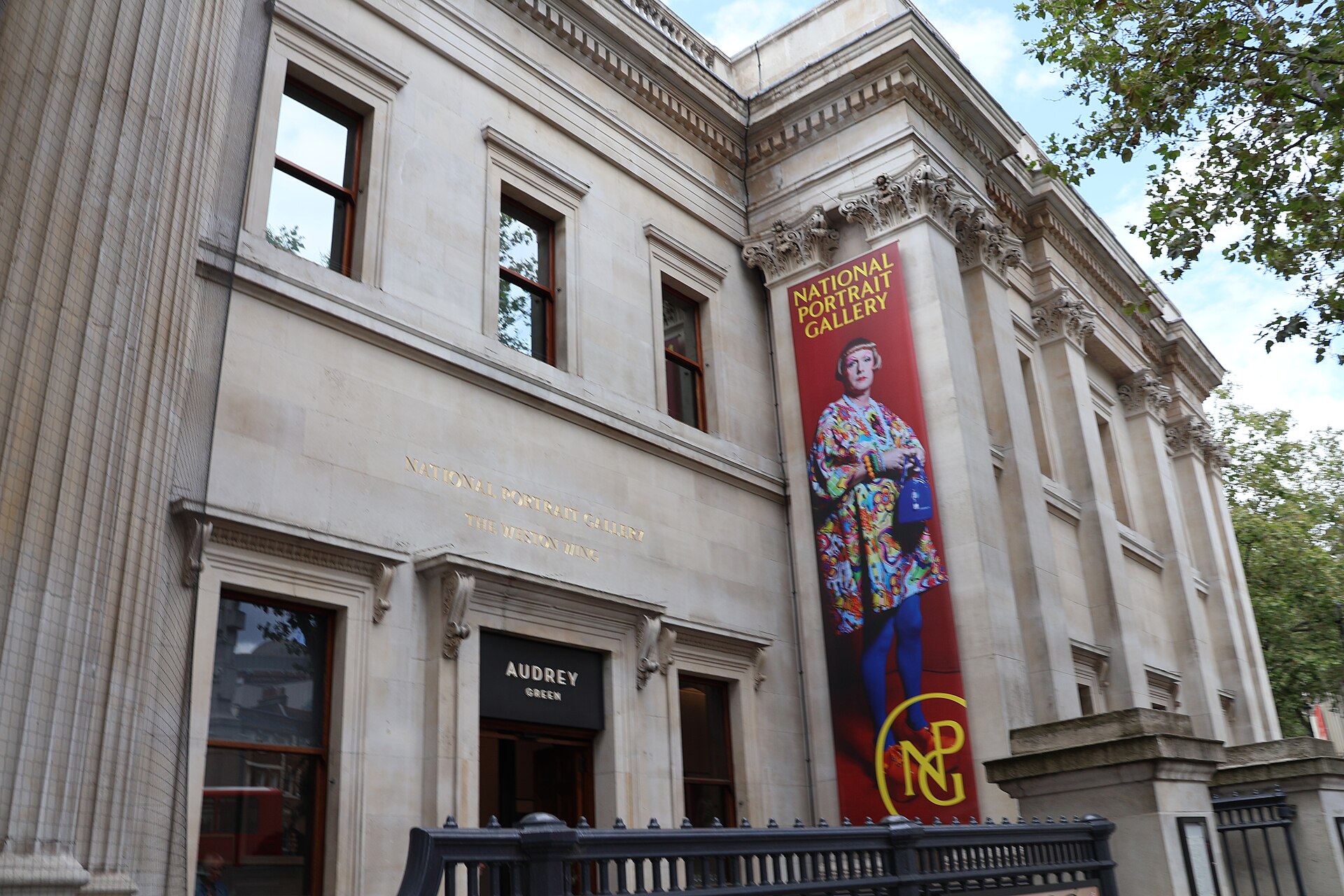
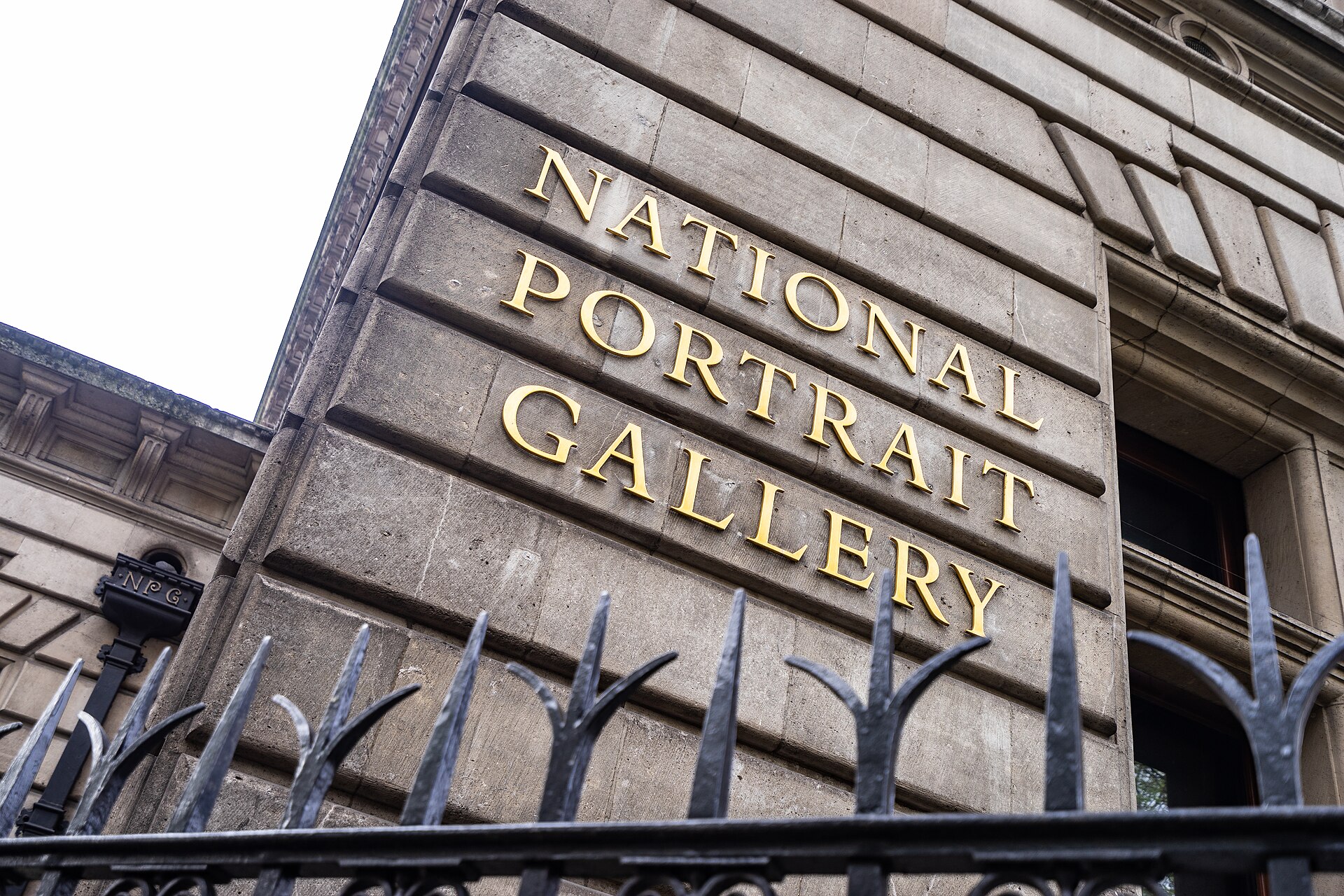
The Weston Wing facade at St Martin's Place, photographed in August 2023 shortly after the Inspiring People reopening, with the Gallery's name cut into the stone and an exhibition banner over the entrance.
DiscoA340, CC BY-SA 4.0National Portrait Gallery
Museum · Founded 1856
Open, admission and hours confirmed 5 September 2026 · 27 sources
On this page 15 sections
ContentsClose
The National Portrait Gallery's strength is depth of a specific kind: not the finest paintings by the greatest painters, but the widest run of documented likenesses of the people who made British history, from a single Tudor panel to same-decade photographic prints of contemporary public figures, held to one continuous chronological standard across roughly 195,000 works. Its holdings of nineteenth- and twentieth-century photography, at an estimated 250,000 prints, make it one of the largest photographic archives of named sitters anywhere, and its habit of collecting multiple portraits of the same person across media, drawing, oil, print, photograph, lets a researcher trace how a single public figure's image changed across a lifetime in one place.
| Kind | Museum |
|---|---|
| Founded | 1856; the St Martin's Place building opened in 1896 |
| City and country |  London, United Kingdom London, United Kingdom |
| Address | St Martin's Place, London, WC2H 0HE, United Kingdom |
| Website | npg.org.uk |
| Status | Open, confirmed |
| Record last verified |
Visiting
- Hours
- Sunday-Thursday10:30 to 18:00Last entry 17:30; last entry to exhibitions is one hour before closing
- Friday-Saturday10:30 to 21:00Last entry 20:30; last entry to exhibitions is one hour before closing
- Admission
- General admission (permanent Collection)FreeFree every day; a charge applies to some temporary exhibitions
- Exhibition ticket, off-peak (Mon-Thu), example rateGBP 25GBP 27.50 with an optional donation. Rate charged for Marilyn Monroe: A Portrait, 4 June-6 September 2026; exhibition ticket prices vary by show
- Exhibition ticket, peak (Fri-Sun), example rateGBP 27GBP 30.00 with an optional donation. Same exhibition and run as above
- 25 and under, exhibition ticket via CLUB NPGGBP 5Free to join CLUB NPG; discounted exhibition tickets for members aged 25 and under
- School groups (10+), exhibition ticketGBP 5Per student; one complimentary teacher ticket per 10 students
Free entry: The permanent Collection is free to everyone, every day the Gallery is open. Members enter all exhibitions free. Pay What You Can exhibition tickets are released weekly for Monday mornings, 10.30-14.00, intended for visitors who cannot pay full price- Tickets
- npg.org.uk/visit The museum's own ticket page.
- Do I need to book?
- No for the permanent Collection. Advance online booking is recommended for ticketed exhibitions, especially at weekends and in the exhibition's final weeks
- Address
- St Martin's Place, London, WC2H 0HE, United Kingdom MapRail Charing Cross station, about 320 metres from the Gallery
Underground Charing Cross, about 230 metres away; Leicester Square, about 195 metres; Embankment, about 490 metres (neither Charing Cross nor Leicester Square Underground has a lift)
Bus Services to Trafalgar Square; nearest stop is Bus Stop K
Car No on-site parking; a public car park is about 195 metres away at the corner of Whitcomb Street and Orange Street, and a limited number of Blue Badge bays are close by - Website
- npg.org.uk
- Telephone
- +44 (0)20 7306 0055
Before you go how long, access, photography, bags, eating, shop
- How long to allow
- Under 30 minutes with the free Bloomberg Connects digital guide; about an hour to concentrate on one period or one exhibition; two hours or more to see the whole chronological hang, Tudors to today, plus the shop and a cafe
- Access
- All entrances are step-free; the main entrance is on Ross Place, with the group entrance on St Martin's Place. Wheelchair users are advised to be dropped off at the corner of Orange Street and Charing Cross Road and to use the Ross Place ramp. A Changing Places toilet is on Floor -2. Three lifts serve the building, but a 2023 access review found their coverage confusing (no single lift reaches every floor) and one lift too small for a wheelchair user travelling with a companion; see reception below
- Photography
- Personal, non-commercial photography and filming are allowed in the main galleries; flash, tripods and monopods are prohibited at all times. Photography is restricted in some temporary exhibitions and loan displays, marked by signage
- Bags
- Backpacks and large bags (over 35 x 25 x 15cm) are not allowed in temporary exhibitions but can be left in the Floor 0 cloakroom (GBP 2.50-5.00, free for Members); folding bikes are not admitted
- Eating
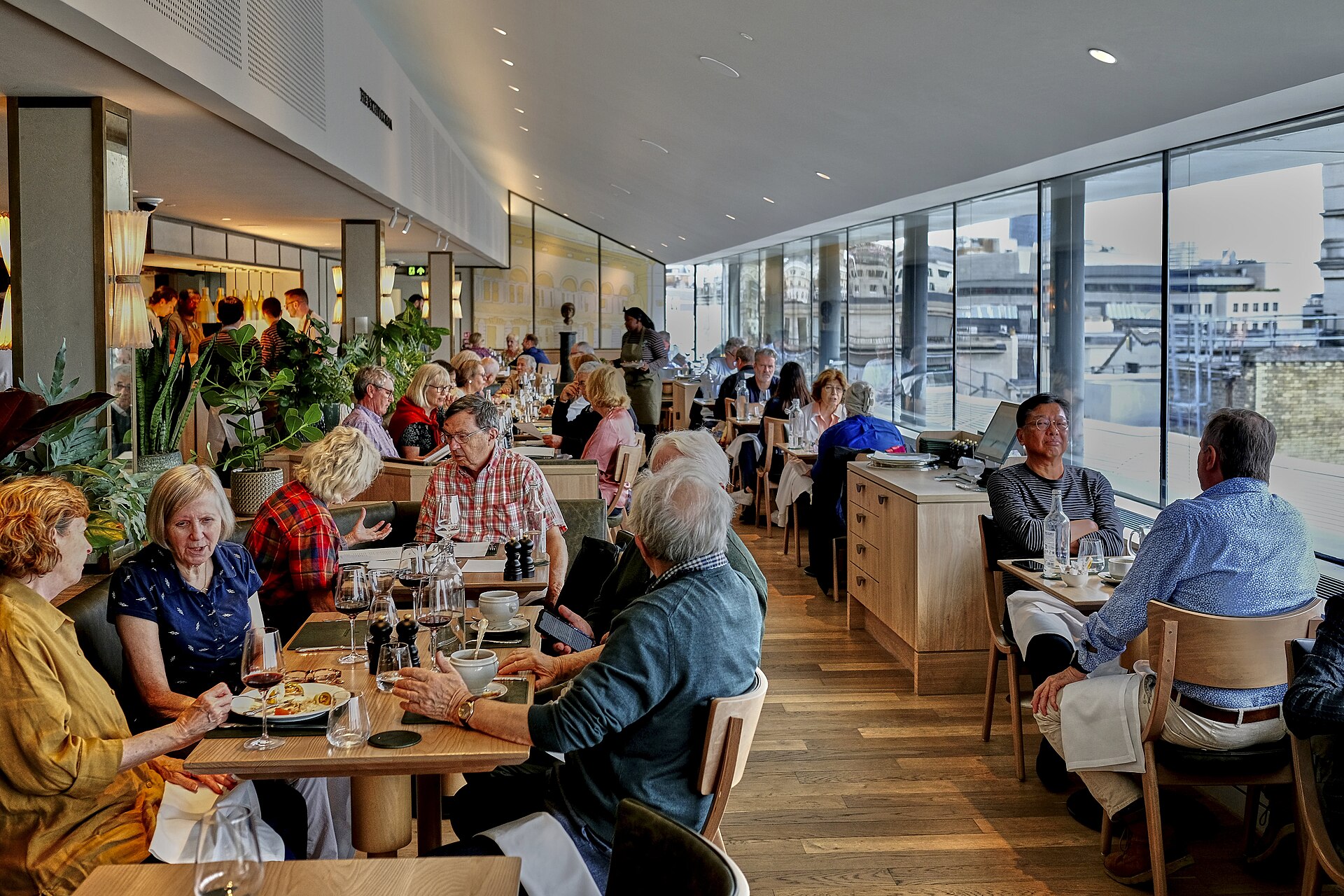
- The Portrait Restaurant on the top floor, with panoramic views over Trafalgar Square and the West End; Larry's dining and bar in the Weston Wing basement; Audrey Green cafe at street level; the Portrait Pavilion cafe opposite the main entrance at 11a Charing Cross Road
- Shop
- A Gallery shop on Floor 0 selling books, prints, postcards, jewellery and accessories inspired by the Collection, plus an online shop
Prices and hours change. We take them from the institution's own pages and print the day we read them, and you can check the current position at the source we used. Confirm before you travel.
What is inside
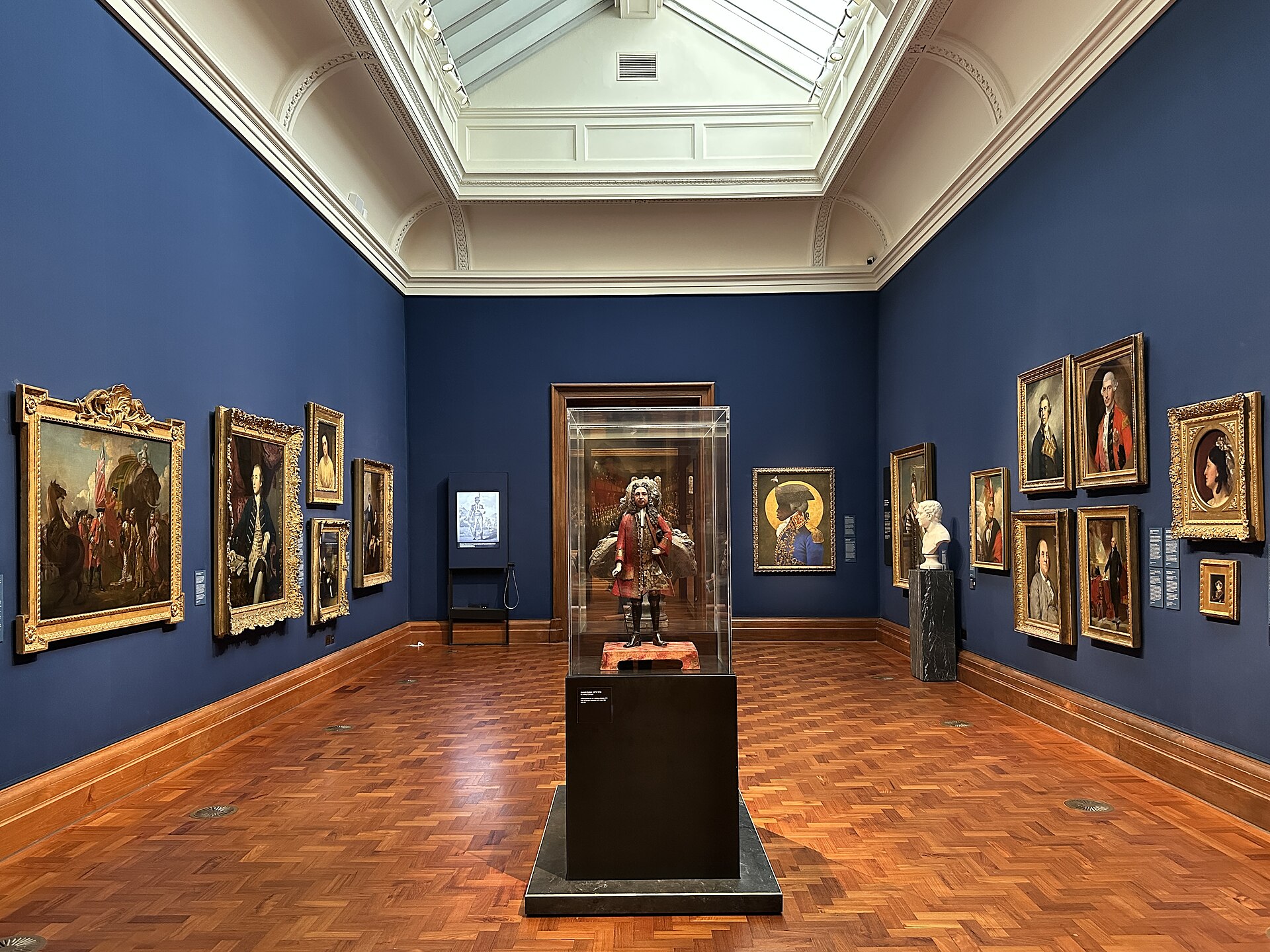
Photograph by APK · CC BY 4.0 The Duveen and Ondaatje Wings, Floor 3: 1500-1850
The top floor and the start of the chronological hang: Beginnings: The Tudors and Making Tudor Portraits; Uniting Kingdoms, 1603-1800; Civil War, Republic and the Return of the King; the Kit-cat Club portraits; Portraying Colonial Expansion and Experience; Radicals, Resistance and Reform; The Romantics; and a room on the exhibition culture of 1750-1850. This is where the Chandos Shakespeare and the Armada Portrait of Elizabeth I hang.
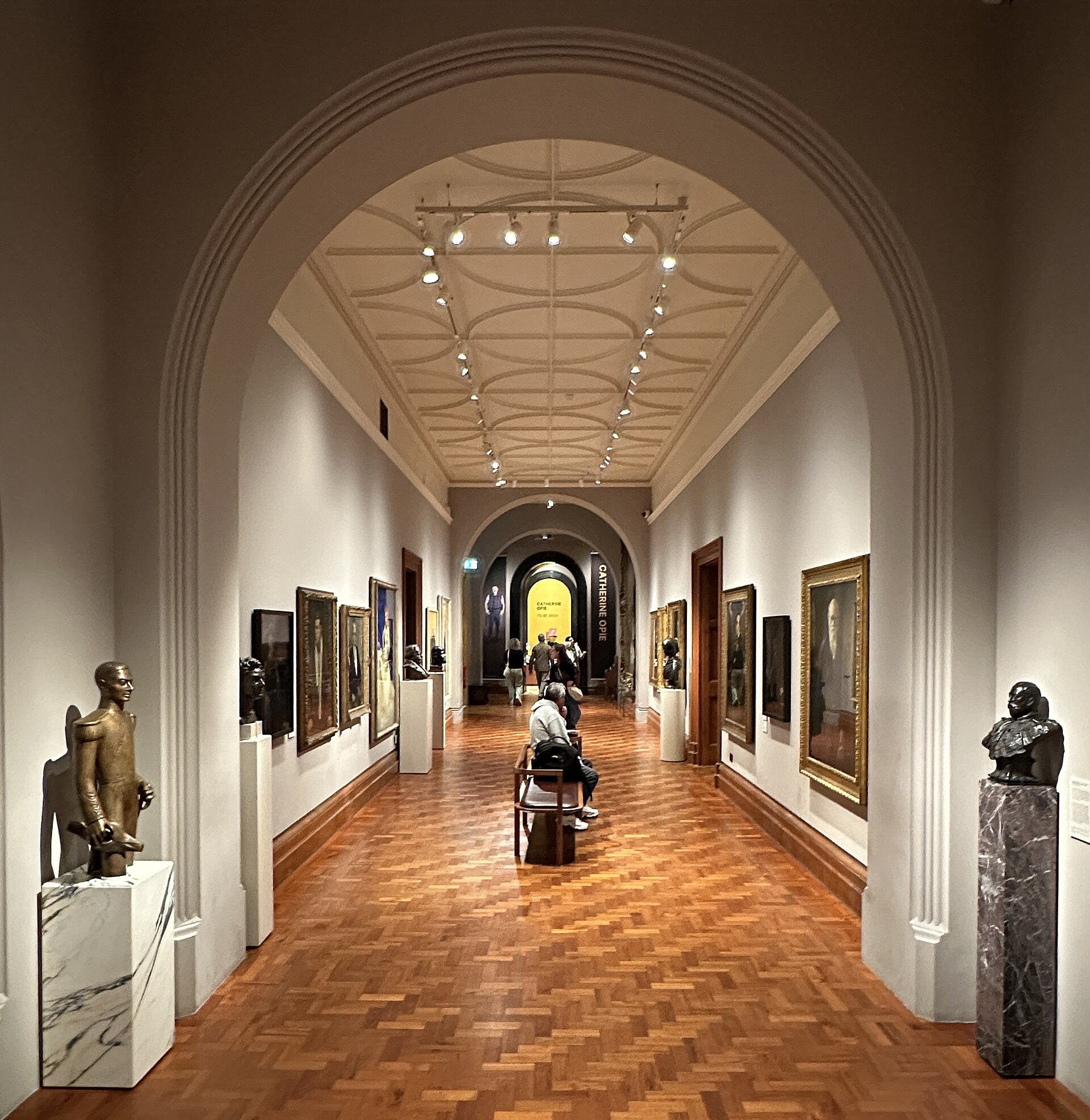
Photograph by APK · CC BY 4.0 The Blavatnik Wing, Floor 2: 1850-2000
Nine rooms added or reopened by the Inspiring People redevelopment, covering the Victorians to the late twentieth century: Inspiring People 1850-1950; The Factory of Femininity (studio photography by Lallie Charles and Rita Martin); Victorian Pioneers; The Hall of Fame; Empire and Resistance; Challenging Identities; The First World War to the Bright Young Things; The Making of an Artist, built around the Lucian Freud Archive; and Making the Modern World, 1945-2000.
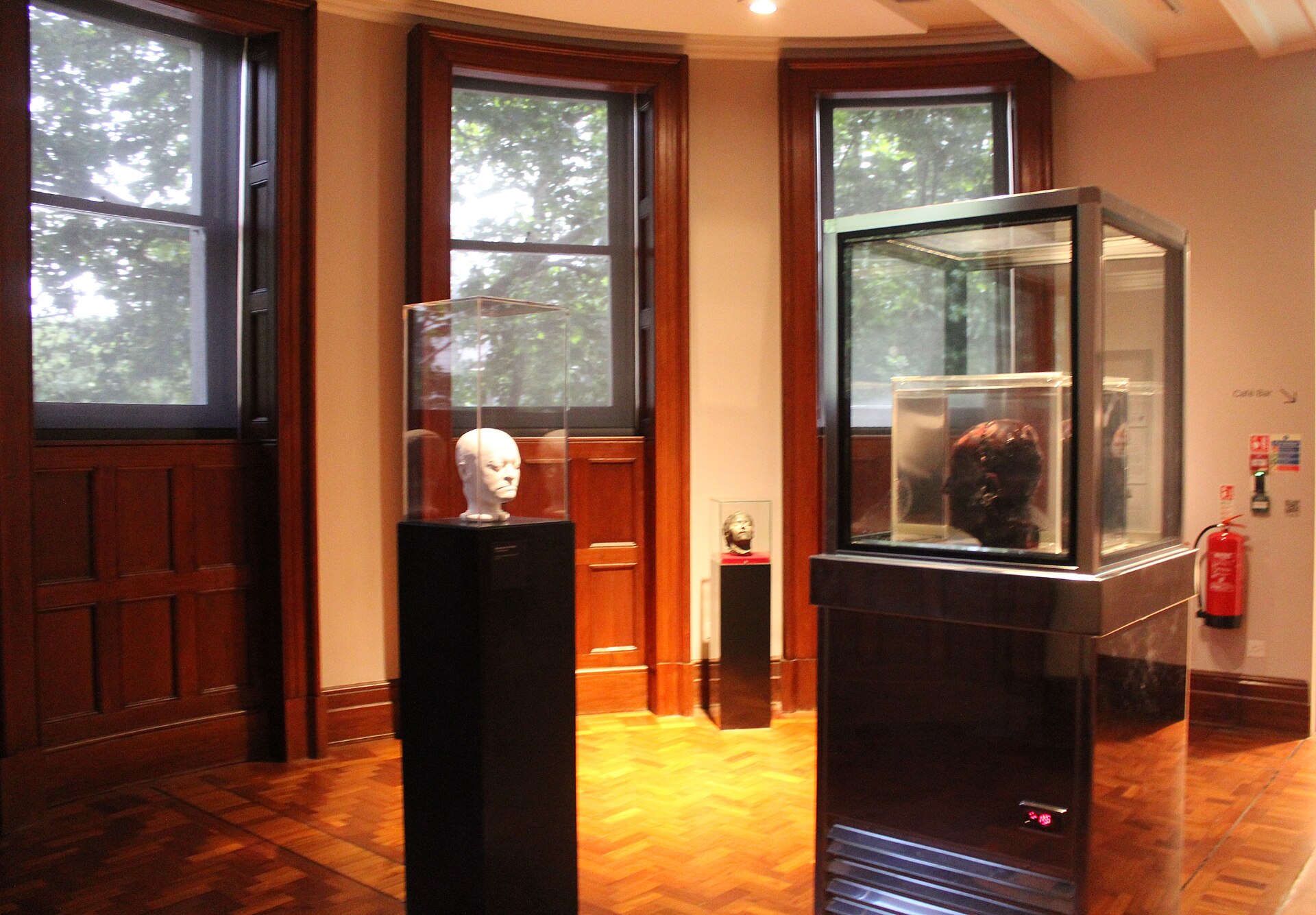
CC0 The Weston Wing, Floor 1: the Contemporary Collection, 2000 to today
The East Wing of the 1896 building, closed to the public for decades and reopened by Inspiring People as A Century of Self-portraits, Contemporary Conversations, Lines of Feeling (portrait drawing), and Life and Death: Masks, which sets historic life and death masks alongside works by Gillian Wearing, Tracey Emin and Marc Quinn. Rooms 30-32 close on a rolling basis for changeovers; check the Gallery's own notice before visiting.
Floor 0: the Entrance Hall, Room 33 and the exhibition space
The new Ross Place entrance hall, its doors carrying Tracey Emin's 45 bronze female faces; Room 33, History Makers Now, showing recent sitters such as the rapper Stormzy, the anti-racism campaigner Doreen Lawrence and the footballer Lucy Bronze; and the Gallery's main ticketed exhibition space, which held Marilyn Monroe: A Portrait from 4 June to 6 September 2026. No free-licence photograph of this specific room was verified for this entry; it carries no plate below.
Photograph by Anthony O'Neil · CC BY-SA 2.0 Eating, drinking and the Blavatnik Wing entrance
The Portrait Restaurant occupies the top floor with rooftop views toward Trafalgar Square and the West End; Larry's dining and bar sits in the Weston Wing basement; Audrey Green cafe is at street level. The Blavatnik Wing's own entrance, on Floor 2, is marked in gilt lettering above its doorway.
What to see first
William Shakespeare (the Chandos Portrait)
Associated with John TaylorOil on canvas, circa 1610; given by the 1st Earl of Ellesmere in 1856, it was the very first portrait the Gallery acquired on its foundation, and it is the only surviving portrait of Shakespeare with a credible claim to have been painted from life.9
Queen Elizabeth I (the Armada Portrait)
Unknown English artistOil on panel, circa 1588, commemorating the defeat of the Spanish Armada; the Queen's hand rests on a globe over the Americas. Transferred from the British Museum in 1879; two related full-length versions survive at Woburn Abbey and the National Maritime Museum.10
Jane Austen
Cassandra AustenPencil and watercolour, circa 1810, and the only portrait of the novelist drawn from life, sketched by her sister and left unfinished; it underlies the engraving reproduced on the Bank of England ten-pound note. As of this research the sheet was on loan and on display at the Shanghai Museum rather than in London, a reminder that a highlight in the collection is not always a highlight on the wall that week.11
The Bronte Sisters (Anne, Emily and Charlotte Bronte)
Patrick Branwell BronteOil on canvas, circa 1834, and the only surviving group portrait of the three novelist sisters; their brother painted himself out of the centre of the group, later rediscovered folded on top of a cupboard in 1914. Also on loan and on display at the Shanghai Museum at the time of this research, not in London.12
Winston Churchill ("The Roaring Lion")
Yousuf KarshBromide print, 1941, taken in the Canadian House of Commons in Ottawa moments after Karsh removed a lit cigar from Churchill's mouth; one of the most reproduced photographic portraits ever made. Given to the Gallery by the photographer in 1991.13
Charles Darwin
Marian Collier (nee Huxley)Pencil drawing, 1878, one of 36 Darwin portraits the Gallery holds; drawn five years before his death by the first wife of the painter John Collier, whose own oil portrait of Darwin is separately in the collection.14
The Doors (bronze entrance doors)
Tracey EminForty-five women's faces, drawn by Emin in acrylic and cast in bronze with her fingerprints left visible in the metal, made for the new Ross Place entrance and unveiled with the Gallery's 2023 reopening. Emin has said she wanted the faces to stand for every woman rather than any named sitter, a deliberate counterweight to the eighteen male figures carved into the building's Portland-stone exterior roundels since 1896.15
Exhibitions on now
- Opening soon5 Nov 2026 to 17 Jan 2027Confirmed , 6 weeks ago
A gallery of likenesses, not a gallery of art
The National Portrait Gallery was founded in 1856 on an argument that had nothing to do with brushwork: Philip Stanhope, 5th Earl Stanhope, working with the historian Thomas Babington Macaulay and the writer Thomas Carlyle, persuaded Parliament that Britain should hold a national collection of portraits of people who had shaped its history, chosen for what the sitter did rather than for who painted them or how well. Queen Victoria approved the founding grant of 2,000 pounds. The distinction still governs acquisition today, and it is the reason a visitor finds School photographs, terracotta busts, cartoons and Karsh's wartime press prints hanging beside oil portraits by named masters with no separation by medium or prestige, only by date.
The Gallery moved through several temporary premises before settling into the purpose-built structure at St Martin's Place, on the corner of Trafalgar Square, which opened in 1896. The architect was Ewan Christian, later President of the Royal Institute of British Architects; the building is faced in Portland stone and was built by Shillitoe and Son. Eighteen sculptural roundels set into the exterior name eighteen men associated with British art and letters, among them Horace Walpole, Anthony van Dyck and Joshua Reynolds. For 127 years the building's only public statement about whose faces mattered was carved in stone on the outside before a visitor ever got through the door.
Three years dark, and what Inspiring People changed
The Gallery closed to the public in spring 2020 for Inspiring People, the most extensive rebuilding project in its history, designed by Jamie Fobert Architects with the conservation architects Purcell. The scheme is reported at roughly 35.5 million pounds by contemporaneous trade coverage, funded chiefly by the Blavatnik Family Foundation, the National Lottery Heritage Fund, the Garfield Weston Foundation and the Ross Foundation, and it reopened to the public on 22 June 2023. The most visible change is a new entrance and forecourt on the building's north facade, cut through three former windows and named Ross Place after its principal donor; the old side-street entrance had for decades been the only way in.
Behind the new door, the entire Collection was rehung top to bottom in a single chronological sequence for the first time, and the East Wing of the 1896 building, out of public use for years as offices, reopened as the Weston Wing with new gallery, catering and retail space. A new Learning Centre replaced a single studio with three. On the doors themselves, Tracey Emin's 45 cast-bronze female faces, drawn in acrylic before being transcribed into the metal, were installed as an explicit counterweight to the building's all-male exterior roundels; Emin has said the faces represent no one sitter but every woman, of every age and background.
What is inside, floor by floor
The hang runs top to bottom by date. Floor 3, in the Duveen and Ondaatje Wings, opens with the Tudors and runs through the Civil War, the Kit-cat Club portraits, colonial expansion and the Romantics, ending around 1850. Floor 2, the Blavatnik Wing built for Inspiring People, covers the Victorians to the mid-twentieth century in nine rooms, including a room built around the Lucian Freud Archive of the artist's own sketchbooks and childhood drawings. Floor 1, the reopened Weston Wing, holds the Contemporary Collection from 2000 to today across four rooms: a century of self-portraits, contemporary portrait drawing, and Life and Death: Masks, which sets historic life and death masks, including casts associated with figures such as William Blake, beside recent works by Gillian Wearing, Tracey Emin and Marc Quinn that use masks to interrogate identity and mortality. Floor 0 holds the entrance hall, a room of recent history-maker sitters such as the campaigner Doreen Lawrence, the footballer Lucy Bronze and the musician Stormzy, and the Gallery's principal temporary exhibition space.
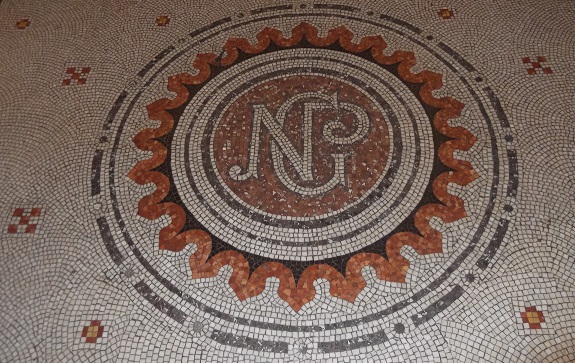
The building rewards more than a walk-through. The Portrait Restaurant sits on the top floor with a panoramic outlook toward Trafalgar Square and the West End; Larry's bar and dining room occupies the Weston Wing basement; and a monogrammed mosaic floor, in the building's own decorative tradition, marks at least one of its public spaces.
Beyond paint: photography, sculpture and a collection that keeps growing
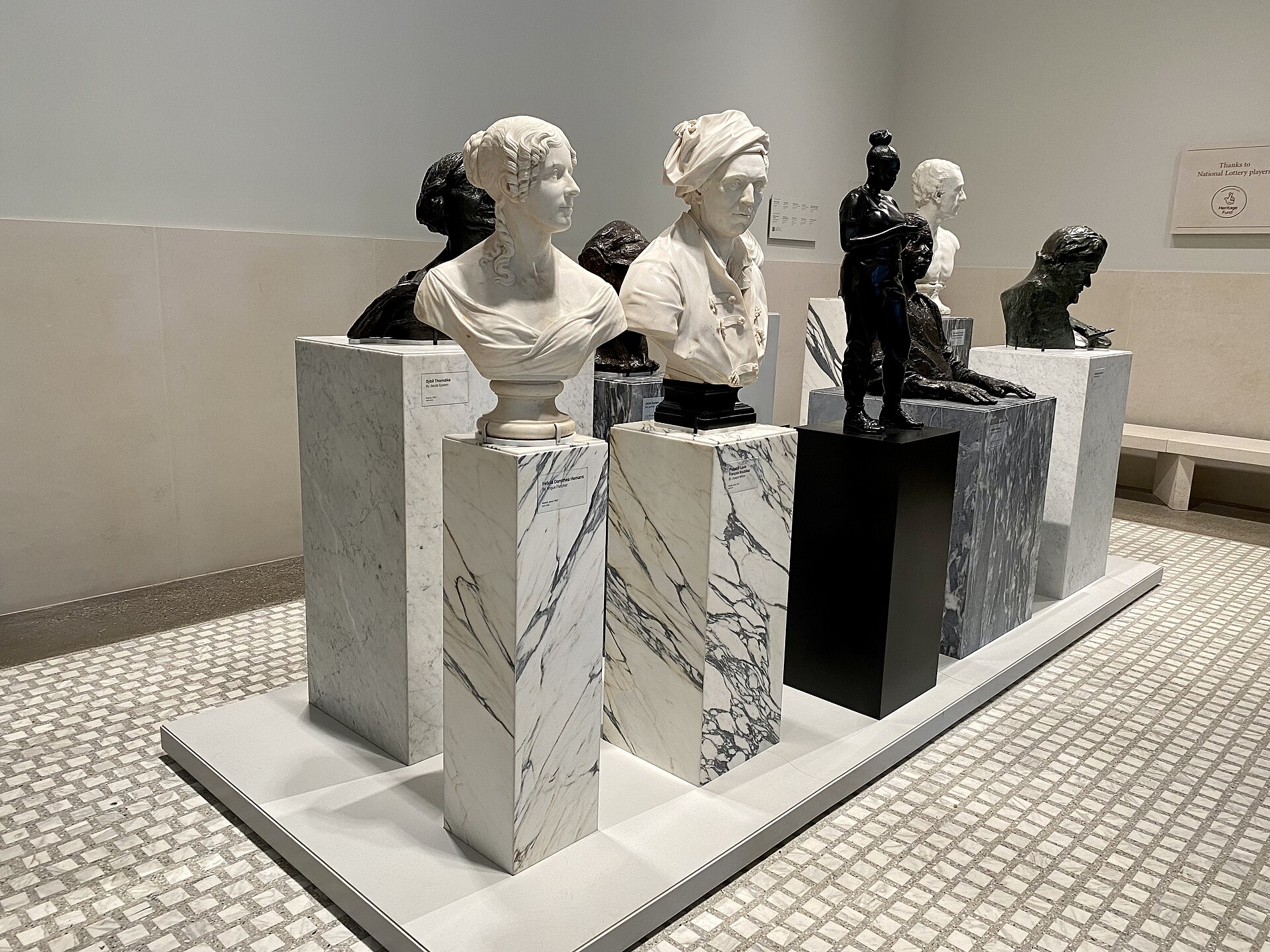
The Gallery describes its holdings as around 195,000 works, and its own account of the 2023 redisplay puts the photography holdings alone at roughly 250,000 prints ranging from 1840 to the present, a scale that makes the Gallery as much a photographic archive as a picture gallery. That balance shows on the walls: the rehang increased the share of photographic portraits on display, and named sitters recur across mediums, so a visitor can trace Charles Darwin, for instance, through a pencil drawing, an oil portrait and several photographic prints without leaving the same collection.
Some of the Gallery's best-known individual works are not always on the wall in London. Cassandra Austen's sketch of her sister Jane, and Branwell Bronte's group portrait of his three novelist sisters, were both on loan and on display at the Shanghai Museum at the time of this research rather than at St Martin's Place, a detail worth checking before planning a visit specifically to see either one. The Gallery routinely lends internationally as part of the national programme it ran throughout the 2020-2023 closure, when hundreds of portraits toured partner museums, schools and communities across the country while the building itself was shut.
Colonial expansion, empire and a rehang that answers for it
One of the new rooms created by Inspiring People, on Floor 3, is given over explicitly to Portraying Colonial Expansion and Experience, part of a wider curatorial decision, credited by the Gallery to chief curator Alison Smith, to keep contested and colonial-era sitters on display rather than remove them, while adding context about the wealth, trade and power that put them there. The Art Newspaper's contemporaneous reporting on the rehang recorded specific, cited increases in the proportion of women and ethnic-minority sitters shown in the post-1900 galleries, and noted the joint 25 million pound acquisition, with the J. Paul Getty Museum, of Joshua Reynolds' portrait of Mai (Omai), among the earliest British portraits of a named Pacific Islander. The Gallery's Windrush: Portraits of a Pioneering Generation display, marking the 75th anniversary of the Empire Windrush's arrival, sits in the same spirit: ten portraits of people who built new lives in Britain after 1948, shown as history makers in their own right rather than as an addendum to it.
Money, access and what critics still argue about
The economics are unusual for a national collection of this profile: the permanent Collection is free every day, and the Gallery earns its exhibition revenue instead from ticketed blockbuster shows, of which Marilyn Monroe: A Portrait, running through the centenary of the star's birth into September 2026, was a recent example, priced from 25 pounds on weekdays to 30 pounds at weekends with an optional donation, against free entry for Members and a Pay What You Can slot released weekly for Monday mornings. That structure lets the Gallery say every visitor can see the permanent Collection regardless of means, while asking the exhibition audience to fund the programme.
The building's second life has not gone unquestioned. A 2023 access review by the Museums Association praised the new entrance and gallery spacing but documented real friction for wheelchair users: three lifts covering different, overlapping parts of the building rather than one lift reaching every floor, one lift too small for a wheelchair user travelling with a companion, and only five disabled sitters identified among roughly 1,100 portraits on display, none of them in the contemporary Weston Wing. Writing in the New Statesman, critic Michael Prodger welcomed the architecture and the broadened representation but pressed a harder point: that a collection built to honour fame rather than artistic merit will always contain few indisputably great portraits, whatever else the redisplay gets right. Both criticisms sit alongside the praise rather than against it, and the Gallery's own public statements do not dispute either.
What visitors say
Visitors and critics both single out the 2023 reopening: a free, chronologically arranged collection that a reader can walk from the Tudors to the present day in a single visit, entered through a more generous new entrance after decades of a cramped side door. Specialist reviewers are warmer about the building and the redisplay's inclusiveness than about the intrinsic quality of everything now on the walls, and an access-focused review found real gaps between the architecture's ambition and how it works for a visitor using a wheelchair.
What is praised, what is criticised
- Praised: The free general admission and the chronological hang, which lets a visitor trace British portraiture, and British history, from the Tudors to today in one visit
- Praised: The new Ross Place entrance and forecourt, widely welcomed as a more dignified and legible way in after the old side-street entrance
- Praised: Specific rooms named favourably by reviewers: the Tudor galleries under altered lighting, the Lucian Freud Archive room, and the newly reopened Weston Wing
- Praised: The rehang's broadened representation: the Art Newspaper reported women rising from 37% to 48% and ethnic-minority sitters from 3% to 11% of the post-1900 galleries, alongside a joint GBP 25m acquisition with the Getty of Joshua Reynolds' portrait of Mai (Omai)
- Criticised: A 2023 Museums Association access review found wayfinding confusing, with three lifts each serving only part of the building and one lift too small for a wheelchair user travelling with a companion
- Criticised: The same review counted only five disabled sitters among roughly 1,100 portraits on display, none of them in the contemporary Weston Wing
- Criticised: Writing in the New Statesman, critic Michael Prodger argued the collection holds few indisputably great portraits because it selects for the sitter's fame rather than the picture's quality, and was unimpressed by Tracey Emin's new bronze entrance doors and by a dedicated room of female self-portraits he judged the work of minor painters
- Criticised: Two highlight objects in this record, the Cassandra Austen sketch of Jane Austen and the Bronte family group portrait, were on loan and on display at the Shanghai Museum rather than in London at the time of this research; a reader planning a visit around a specific object should check the Gallery's own display pages first
Ratings on other platforms
Tripadvisor: 4.5 from 5,995 ratings, read 5 September 2026
A platform average is a tertiary source: it moves, it is not audited, and we quote no visitor's words.
Questions about National Portrait Gallery
Where is National Portrait Gallery?
St Martin's Place, London, WC2H 0HE, United Kingdom.
How much does it cost to visit?
General admission (permanent Collection): free; Exhibition ticket, off-peak (Mon-Thu), example rate: GBP 25; Exhibition ticket, peak (Fri-Sun), example rate: GBP 27; 25 and under, exhibition ticket via CLUB NPG: GBP 5; School groups (10+), exhibition ticket: GBP 5. As confirmed 5 September 2026.
When is it open?
Sunday-Thursday 10:30-18:00; Friday-Saturday 10:30-21:00. As confirmed 5 September 2026.
How do you get there?
Rail: Charing Cross station, about 320 metres from the Gallery; Underground: Charing Cross, about 230 metres away; Leicester Square, about 195 metres; Embankment, about 490 metres (neither Charing Cross nor Leicester Square Underground has a lift); Bus: Services to Trafalgar Square; nearest stop is Bus Stop K; Car: No on-site parking; a public car park is about 195 metres away at the corner of Whitcomb Street and Orange Street, and a limited number of Blue Badge bays are close by.
What should you see first?
William Shakespeare (the Chandos Portrait) (Associated with John Taylor); Queen Elizabeth I (the Armada Portrait) (Unknown English artist); Jane Austen (Cassandra Austen); The Bronte Sisters (Anne, Emily and Charlotte Bronte) (Patrick Branwell Bronte); Winston Churchill ("The Roaring Lion") (Yousuf Karsh); Charles Darwin (Marian Collier (nee Huxley)).
What we could not confirm
- The reported cost of the Inspiring People redevelopment varies by source, from about 35.5 million pounds in contemporaneous trade reporting to a higher all-in figure of about 41 million pounds cited elsewhere; this record has not reconciled which figure reflects the construction cost alone versus the total project cost including the endowment and programme funding.
- Whether the Museums Association's 2023 lift and disabled-representation findings have since been addressed has not been independently re-confirmed for this record; a future re-check should look for a published update from the Gallery's own access pages.
- The current display location of several highlight objects, including the Cassandra Austen sketch of Jane Austen and the Bronte family portrait, should be re-checked before a visit, since both were recorded as on loan to the Shanghai Museum at the time of this research and touring loans move on their own schedule.
Images
Sources
- 1National Portrait Gallery, "Visit" (hours, admission, address, restaurant and cafe times), Wayback Machine capture 28 August 2026 web.archive.org/web/20260828081712/https://www.npg.org.uk/visit/
- 2National Portrait Gallery, "Contact us" (switchboard hours, phone numbers, address), Wayback Machine capture 25 August 2026 web.archive.org/web/20260825111643/https://www.npg.org.uk/about/contactus/
- 3National Portrait Gallery, "Inspiring People: Transforming our National Portrait Gallery" (reopening date, project scope, funders, architects), Wayback Machine capture 21 August 2026 web.archive.org/web/20260821014032/https://www.npg.org.uk/whatson/news2/inspiring-people/
- 4National Portrait Gallery, "Marilyn Monroe: A Portrait" exhibition page (ticket prices, dates, access notes), Wayback Machine capture 27 August 2026 web.archive.org/web/20260827153610/https://www.npg.org.uk/whatson/exhibitions/2026/marilyn-monroe-a-portrait
- 5National Portrait Gallery, Floor 3 floor plan (room list, Duveen and Ondaatje Wings), Wayback Machine capture 22 July 2026 web.archive.org/web/20260722011808/https://www.npg.org.uk/visit/floor-plans/floor-3/
- 6National Portrait Gallery, Floor 2 floor plan (room list, Blavatnik Wing), Wayback Machine capture 30 September 2025 web.archive.org/web/20250930234903/https://www.npg.org.uk/visit/floor-plans/floor-2
- 7National Portrait Gallery, Floor 1 floor plan (room list, Weston Wing), Wayback Machine capture 15 September 2025 web.archive.org/web/20250915015049/https://www.npg.org.uk/visit/floor-plans/floor-1
- 8National Portrait Gallery, Floor 0 floor plan (entrance hall, Room 33, exhibition space), Wayback Machine capture 25 June 2026 web.archive.org/web/20260625132944/https://www.npg.org.uk/visit/floor-plans/floor-0
- 9National Portrait Gallery collection record, NPG 1, William Shakespeare (the Chandos portrait), Wayback Machine capture 20 August 2026 web.archive.org/web/20260820143310/https://www.npg.org.uk/collections/search/portrait/mw11574/William-Shakespeare
- 10National Portrait Gallery collection record, NPG 541, Queen Elizabeth I (the Armada portrait), Wayback Machine capture 1 August 2025 web.archive.org/web/20250801063015/https://www.npg.org.uk/collections/search/portrait/mw02077/Queen-Elizabeth-I
- 11National Portrait Gallery collection record, NPG 3630, Jane Austen by Cassandra Austen, Wayback Machine capture 9 June 2026 web.archive.org/web/20260609054913/https://www.npg.org.uk/collections/search/portrait/mw00230/Jane-Austen
- 12National Portrait Gallery collection record, NPG 1725, The Bronte Sisters by Patrick Branwell Bronte, Wayback Machine capture 6 April 2026 web.archive.org/web/20260406064729/https://www.npg.org.uk/collections/search/portrait/mw00797/The-Bront-Sisters-Anne-Bront-Emily-Bront-Charlotte-Bront
- 13National Portrait Gallery collection record, NPG P490(16), Winston Churchill by Yousuf Karsh, Wayback Machine capture 8 December 2025 web.archive.org/web/20251208130249/https://www.npg.org.uk/collections/search/portrait/mw08607/Winston-Churchill
- 14National Portrait Gallery collection record, NPG 3144, Charles Darwin by Marian Collier, Wayback Machine capture 26 October 2021 web.archive.org/web/20211026080503/https://www.npg.org.uk/collections/search/portrait/mw01727/Charles-Darwin
- 15Designboom, "tracey emin carves 45 women portraits for new bronze doors of london's national portrait gallery", 19 June 2023 designboom.com/art/tracey-emin-45-women-portraits-london-national-portrait-gallery-new-bronze-doors-06-19-2023/
- 16New Statesman, Michael Prodger, "National Portrait Gallery review: mugshots of a nation", 30 June 2023 newstatesman.com/culture/art-design/2023/06/national-portrait-gallery-review-mugshots-nation
- 17Museums Journal (Museums Association), Aimee Fletcher and Matthew Hayhow, "Face value: National Portrait Gallery, London", 14 September 2023 museumsassociation.org/museums-journal/reviews/2023/09/face-value-national-portrait-gallery-london/
- 18The Art Newspaper, Hannah McGivern, "National Portrait Gallery reopens with a focus on the new faces of Britain", 1 June 2023 theartnewspaper.com/2023/06/01/national-portrait-gallery-reopens-with-a-focus-on-the-new-faces-of-britain
- 19The Art Newspaper, "London's National Portrait Gallery to reopen its doors in June 2023 after three-year closure", 15 December 2022 (redevelopment cost and architects) theartnewspaper.com/2022/12/15/londons-national-portrait-gallery-to-re-open-its-doors-next-june-after-three-year-closure
- 20National Portrait Gallery, "Photography policy", Wayback Machine capture 26 January 2026 web.archive.org/web/20260126201553/https://www.npg.org.uk/about/gallery-planning-and-policies/photography-policy
- 21National Portrait Gallery, "Your visit" (recommended visit lengths, special displays), Wayback Machine capture 29 February 2024 web.archive.org/web/20240229152431/https://www.npg.org.uk/visit/your-visit/
- 22Wikipedia, "National Portrait Gallery, London" (; founding history, architect, collection size), consulted 5 September 2026 en.wikipedia.org/wiki/National_Portrait_Gallery,_London
- 23Wikidata, Q238587 (; coordinates, inception date, official website), consulted 5 September 2026 wikidata.org/wiki/Special:EntityData/Q238587.json
- 24Tripadvisor, National Portrait Gallery listing ( aggregate rating), read 5 September 2026 tripadvisor.com/Attraction_Review-g186338-d188863-Reviews-National_Portrait_Gallery-London_England.html
- 25Wikimedia Commons, File:National Portrait Gallery, London (August 2023) 01.jpg (lead image licence verification) commons.wikimedia.org/wiki/File:National_Portrait_Gallery,_London_(August_2023)_01.jpg
- 26Wikimedia Commons, Category:Exterior of the National Portrait Gallery, London (image sourcing) commons.wikimedia.org/wiki/Category:Exterior_of_the_National_Portrait_Gallery,_London
- 27Wikimedia Commons, Category:Interior of the National Portrait Gallery, London (image sourcing) commons.wikimedia.org/wiki/Category:Interior_of_the_National_Portrait_Gallery,_London
_01.jpg)