Marine Timekeeper known as H5
John Harrison and Son, London · 1770 (movement signed and dated); tested and completed for its documented purpose in 1772
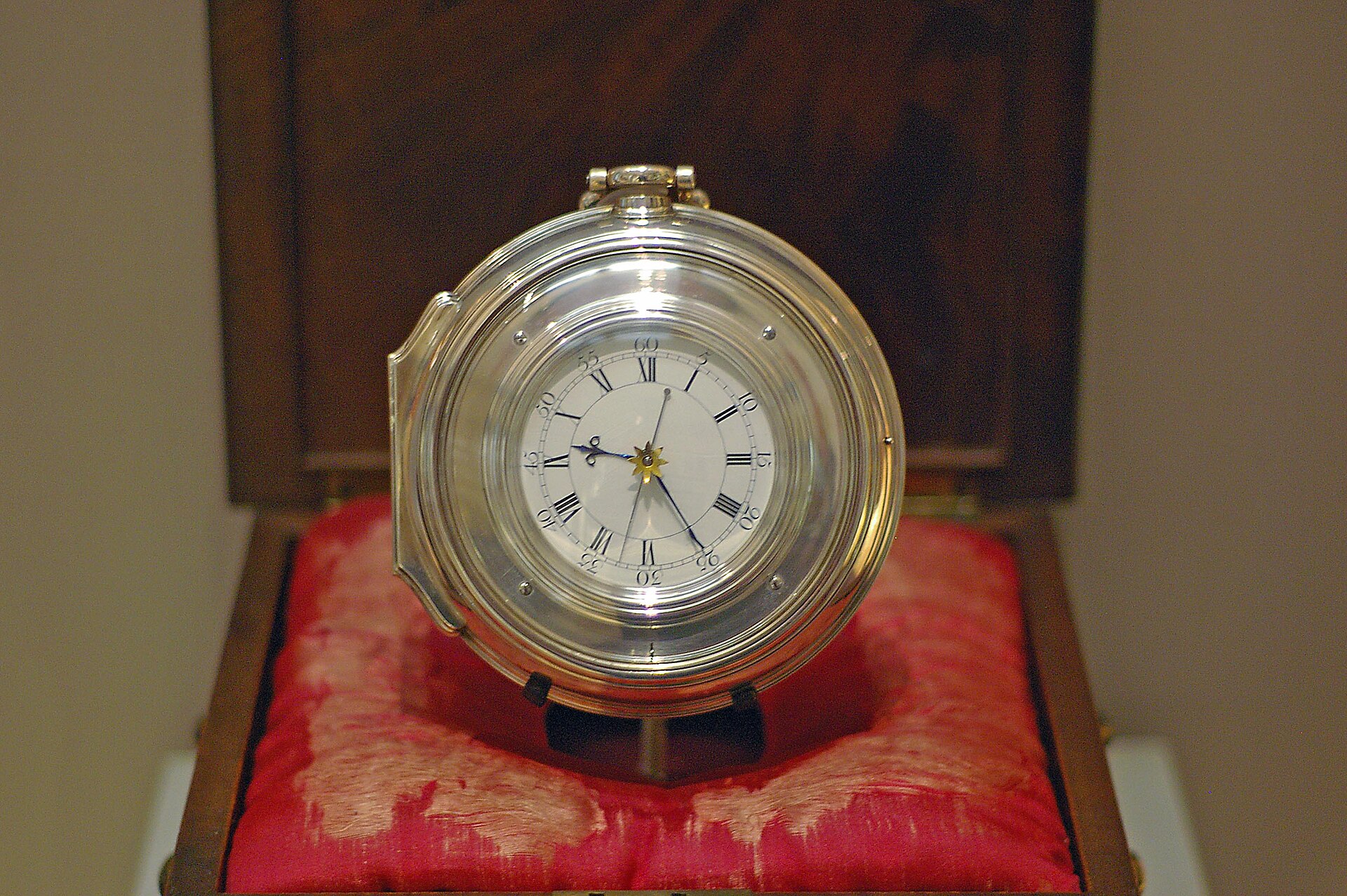
H5, signed on the movement 'John Harrison & Son London 1770 No. 2', shown in its mahogany carrying case on one of its silk cushions. The silver pair case and the gold star at the dial's centre, used for hand adjustment, match the Science Museum Group's own published description of the object and are the basis on which this record treats the photograph as genuinely showing H5 rather than the similar-looking H4.
Photograph by Racklever, CC BY 2.5, via Wikimedia Commons| Artist | John Harrison and Son, London |
|---|---|
| Date | 1770 (movement signed and dated); tested and completed for its documented purpose in 1772 |
| Medium | Silver, gold, enamel, ivory, diamond, brass and steel; silver pair case; mahogany carrying case with silk cushions |
| Dimensions | Not published in the Science Museum Group catalogue entry consulted for this record. Recorded here as unverified rather than guessed; H4, the closest comparator, has a dial diameter of 102 mm and overall case dimensions of 165 x 124 x 28 mm, and H5 is described in every source consulted as very similar in form, but that is not the same as a measurement of H5 itself. |
| Where it is now | Science Museum, London, Clockmakers' Museum gallery; the object is owned by the Worshipful Company of Clockmakers and lent to the Science Museum Grouplast confirmed |
| Inventory number | Clockmakers' Museum No. 598; Science Museum Group object number L2015-3480 (the cushion supporting it is separately numbered L2015-3480/2) |
| Attribution | AcceptedSigned on the movement 'John Harrison & Son London 1770 No. Full note |
| Object type | Clocks and instruments |
| Period | English, 1770 |
| Cases | Restituted or repatriated · Has a provenance gap |
| Inscriptions | Movement signed 'John Harrison & Son London 1770 No. 2'. Silver case hallmarked 1768-9 and stamped 'HT'. |
| Owners on record | 6 links5 documented, 1 unknown |
| Sources | 11 cited |
About this record Last verified · 11 sources cited · Change log
On this page 9 sections
ContentsClose
The watch that finished an argument the Board of Longitude refused to finish itself. John Harrison built H5 after 1765, while his prize-winning H4 sat confiscated in the Astronomer Royal's custody, because he had come to feel, in his own words, extremely ill used by the gentlemen he might have expected better treatment from. In 1772 King George III tested H5 personally at his private observatory for ten weeks and found it accurate to within a third of a second a day, then told Harrison to petition Parliament directly. A special Act paid him 8,750 pounds in 1773, about 44 percent of the 20,000 pound prize the 1714 Act had promised and never once paid out in full to anyone. Harrison was eighty.
H5 stayed with the Harrison family, never went to sea, and never became government property the way H1 to H4 did. It now belongs to the Worshipful Company of Clockmakers and is shown at the Science Museum's Clockmakers' Museum, a different institution and a different owner from the four machines at Greenwich that most accounts of Harrison's life fold it into without noticing the difference.
This record starts from a narrower problem than most: whether the one candidate photograph of H5 available under a free licence actually shows H5 at all, rather than H4, which looks similar enough by design to invite exactly that mistake.
Provenance
Each link is graded. Documented: a cited source supports it. Disputed: the identification is argued but not established. Unknown: no owner for that span, and the gap is not smoothed into a narrative. The grades in the glossary.
- 1770 - 1772John Harrison, and his son William Harrisondocumented
Built in London and signed on the movement 'John Harrison & Son London 1770 No. 2'. Made after the 1765 Act had already confiscated H4, while Harrison, then in his mid-seventies, was still contesting the Board of Longitude's refusal to treat H4's Barbados trial as conclusive proof. No source consulted documents a commission or a buyer for H5; it was made at Harrison's own initiative and remained his personal property.38
- 1772 - 1772King George III, on loan for testingdocumented
Harrison obtained an audience with the King, who tested H5 himself at his private observatory near Richmond over ten weeks of daily observation between May and July 1772, and found it accurate to within one third of a second per day. How the audience was arranged, and whether an intermediary was involved, is not stated in any source consulted for this record.13
- 1772 - 1776John Harrisondocumented
H5 was returned to Harrison after the royal trial; it was never surrendered to the Board of Longitude and never became government property, unlike H1 to H4. Harrison received 8,750 pounds from Parliament in June 1773 and died on 24 March 1776. No source consulted for this record states who held H5 at the moment of his death.3
- 1776 -Unknown intermediate handsunknown
No source consulted for this record documents how H5 passed from Harrison's estate, through whatever hands it passed through, into the ownership of the Worshipful Company of Clockmakers. The Company's own published museum history and the Science Museum Group's catalogue entry for the object both stop at stating current ownership; neither gives a date or a mechanism (purchase, gift, bequest) for the acquisition. This is a genuine and, on the evidence gathered here, an unresolved gap of at least several decades.156
- - 2015Worshipful Company of Clockmakersdocumented
The Company's Clockmakers' Museum was first established in 1813-14 and was housed at the Guildhall, London, from 1874 to 2014, making it, on the Company's own account, the oldest specific collection of clocks and watches in the world. H5 is listed among the collection's notable pieces. The exact date H5 joined the collection, as against the collection's founding date, is not given in the sources consulted.56
- 2015 - presentWorshipful Company of Clockmakers, on loan to the Science Museum Groupdocumented
The Clockmakers' Museum gallery at the Science Museum, South Kensington, was officially opened by Princess Anne on 22 October 2015. H5 is catalogued there as Science Museum Group object L2015-3480, with the Company retaining ownership and the Museum holding it on loan. It is a stated highlight of the gallery's guided tours.157
Technical evidence
| Attribution note | Signed on the movement 'John Harrison & Son London 1770 No. 2' and catalogued by the Science Museum Group, on behalf of the Worshipful Company of Clockmakers, as object L2015-3480, Clockmakers' Museum No. 598. 'And Son' records that Harrison's son William, an instrument maker in his own right, worked on it alongside his father; no source consulted for this record apportions the work between them more precisely. The attribution rests on an unbroken institutional record rather than on connoisseurship, the same basis as H1 to H4, but H5 was never surrendered to the Board of Longitude and so carries no Board minute of its own; the earliest documented event in its life is George III's trial of it in 1772. |
|---|---|
| Case | Silver pair case (a case within a case), hallmarked 1768-9 and stamped with the maker's mark 'HT'.1 |
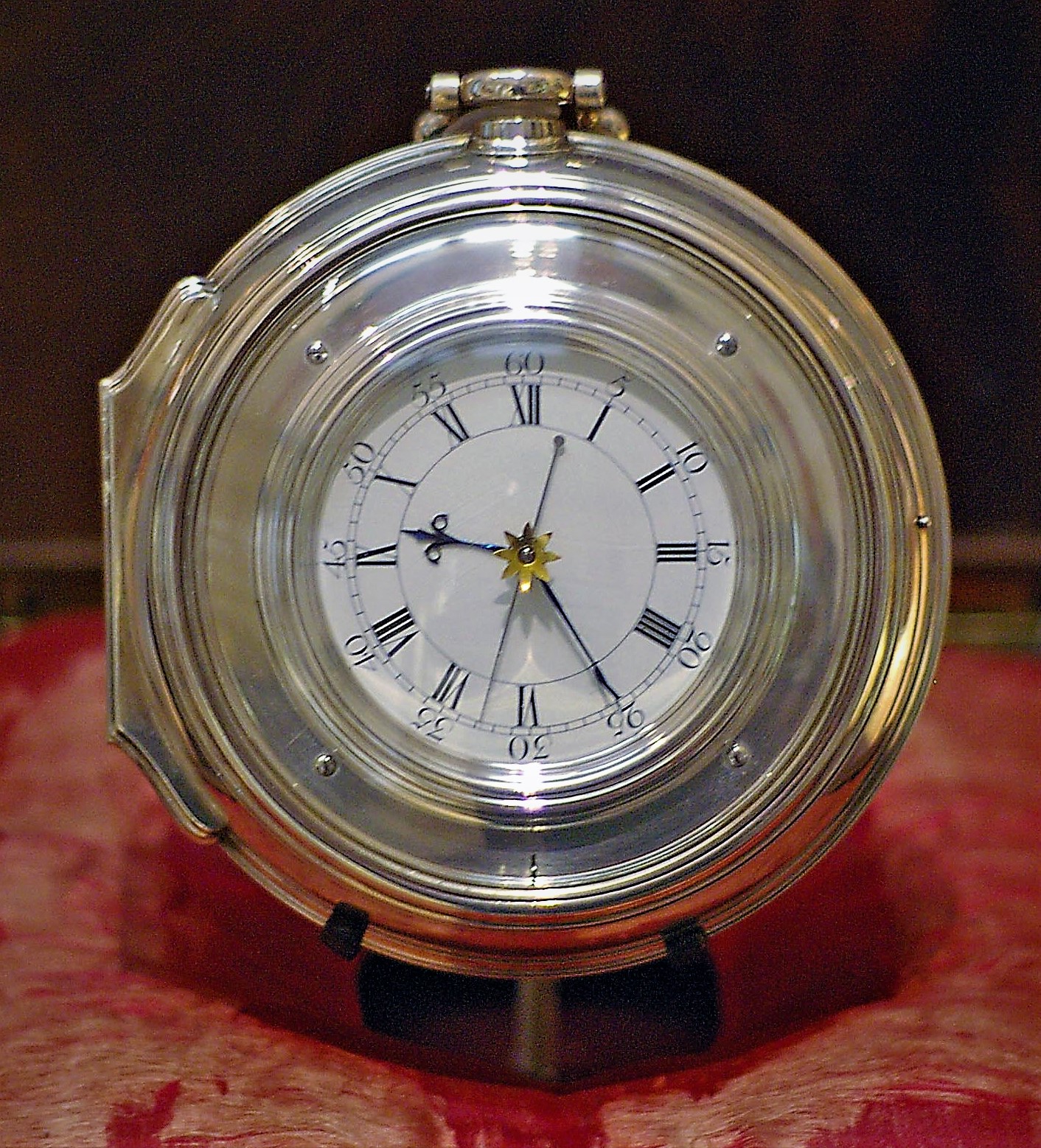
| Dial | White enamel, marked with Roman numerals, with a small gold star at the centre used to true up the hands.1 |
| Movement and escapement | Verge escapement fitted with Harrison's diamond pallets; steel balance and spring; fusee with maintaining power.1 |
| Remontoire | A 7.5-second remontoire acting on the fourth wheel, rewinding a small secondary spring at short intervals to even out the drive to the escapement.1 |
| Friction reduction and temperature compensation | Jewelled wheels from the third wheel onward; a bimetallic strip mounted on an adjustable frame to compensate for temperature change, the same principle Harrison developed for H3.1 |
| Inscription | Movement signed 'John Harrison & Son London 1770 No. 2'.1 |
| Materials | Silver, gold, enamel, ivory, diamond, brass, steel, with a mahogany carrying case and silk cushions.1 |
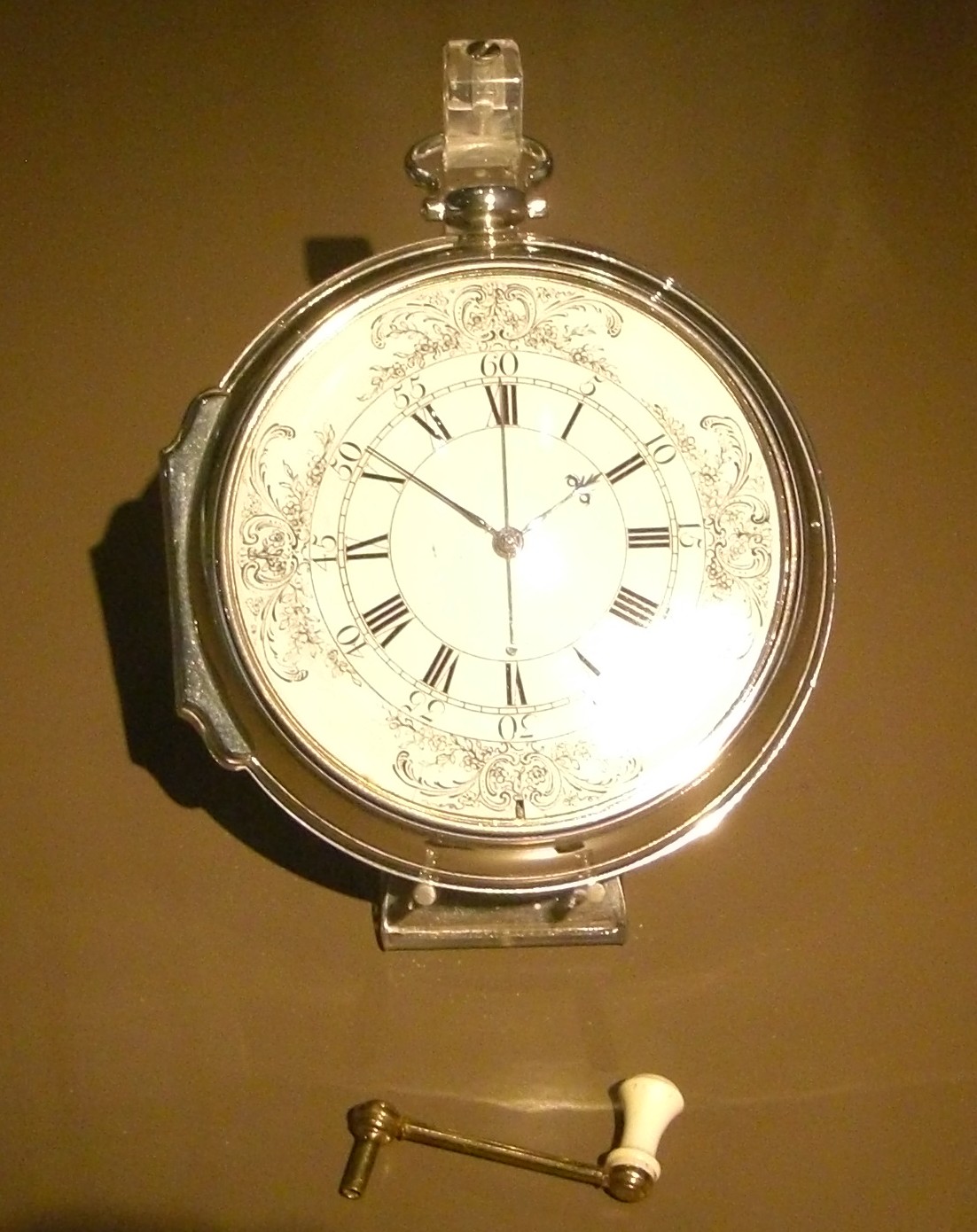
| Accessories | Original key and starting pin; mahogany carrying case fitted with three silk cushions, one separately catalogued as object L2015-3480/2.1 |
| Comparison to H4 | Described by the Science Museum Group's own catalogue as mechanically very similar to H4, Harrison's prize-winning longitude watch, now in the collections of the Royal Museums Greenwich. This is the source of the version-confusion risk this record was built to check.1 |
Images
The record in full
Chapter 1What it is
A silver pair-cased marine timekeeper, watch-sized rather than clock-sized, with a white enamel dial marked in Roman numerals and a small gold star at the centre used to true up the hands.
A silver pair-cased marine timekeeper, watch-sized rather than clock-sized, with a white enamel dial marked in Roman numerals and a small gold star at the centre used to true up the hands. The case is hallmarked 1768-9 and stamped with the maker's mark 'HT'. The movement, visible when the case is opened, is signed 'John Harrison & Son London 1770 No. 2' and uses a verge escapement fitted with diamond pallets, a steel balance and spring, a fusee with maintaining power so the watch keeps running while being wound, a remontoire that rewinds a small secondary spring every seven and a half seconds to smooth out the drive, jewelled bearings from the third wheel onward to cut friction, and a bimetallic strip mounted on an adjustable frame to compensate for temperature. It is shown with its original key, a starting pin, a mahogany carrying case, and three silk cushions that support it inside that case.
Every element of that description is mechanically the same idea as H4, Harrison's prize-winning watch of 1759, which is not a coincidence and is the whole reason H5 exists.
Chapter 2Why a fifth timekeeper, when the fourth had already worked
H4 had already solved the problem by the only test that mattered: it kept time well enough on the 1761-62 and 1764 sea trials to place a ship's longitude within the terms of the 1714 Act.
H4 had already solved the problem by the only test that mattered: it kept time well enough on the 1761-62 and 1764 sea trials to place a ship's longitude within the terms of the 1714 Act. Harrison did not need a better watch. He needed the Board of Longitude to admit that the one he had was good enough, and by the mid-1760s that admission was not coming.
The 1765 Act gave him 10,000 pounds against the promised 20,000, on condition that he dismantle H4, explain its construction to nominated experts, and surrender all four of his timekeepers to the Astronomer Royal, Nevil Maskelyne, for further testing. Harrison did this and, by his own account, felt the treatment was not what the result deserved. Ruth Burkholder's 1983 account of the dispute, cited by the secondary literature checked for this record, quotes Harrison as feeling 'extremely ill used by the gentlemen who I might have expected better treatment from'. Whether that is Harrison's own written phrase or a report of his words is not established by the source chain available here, and readers who need the exact wording verified against Harrison's own papers should treat it as reported speech pending that check.
H5 is the answer to that grievance. Built after H4 had already been taken from him, it let Harrison hold, in his own house, a second working proof that his method was reliable, independent of whatever the Board chose to do with the object it now controlled. He built it, in other words, because the Board's confiscation of H4 had made having only one such watch a strategic liability.
Chapter 3How this record checked the photograph
H1 through H3 are large sea clocks the height of a person's torso.
H1 through H3 are large sea clocks the height of a person's torso. H4 and H5 are both watch-sized, both silver-cased, both round, and both were built to the same mechanical principles by the same hand within a few years of each other. A photograph mislabelled as one for the other would not look obviously wrong to a non-specialist, which is precisely the failure mode this publication exists to catch.
The only image of H5 available on Wikimedia Commons under a free licence is identified solely by its filename and by a Commons category tag reading 'H5'; the uploader's own description field says only 'John Harrison's famous chronometer', with no museum reference, no catalogue number, and no linked source. On its own, that is an assertion, not a verification.
The Science Museum Group's own collection database describes H5 with specific, checkable features: a silver pair case hallmarked 1768-9 and stamped 'HT', a white enamel dial with a gold star at its centre used for hand adjustment, and a mahogany carrying case fitted with silk cushions. The Commons photograph shows exactly these features: a silver-cased round watch with a white enamel dial, a visible gold star at the dial's centre, sitting on a red silk cushion inside an open wooden carrying case with a visible wood-grained lid. A gold center-star and a silk-cushioned mahogany travelling case are specific, unusual, documented details, not generic features every eighteenth-century watch shares, and the photograph matches them. On that basis this record treats the photograph as genuinely showing H5, while recording plainly that the Commons file page itself provides no such verification and should not be relied on alone.
The Science Museum Group also holds its own eight photographs of H5, released under a Creative Commons Attribution-NonCommercial-ShareAlike licence. That licence's non-commercial condition places it outside this publication's image policy, so those photographs are not used here, but their existence and their institutional description are what make the independent check above possible.
Chapter 4The Board's case against H4, and the demand for a replica
The Board of Longitude did not dispute that H4 had performed well.
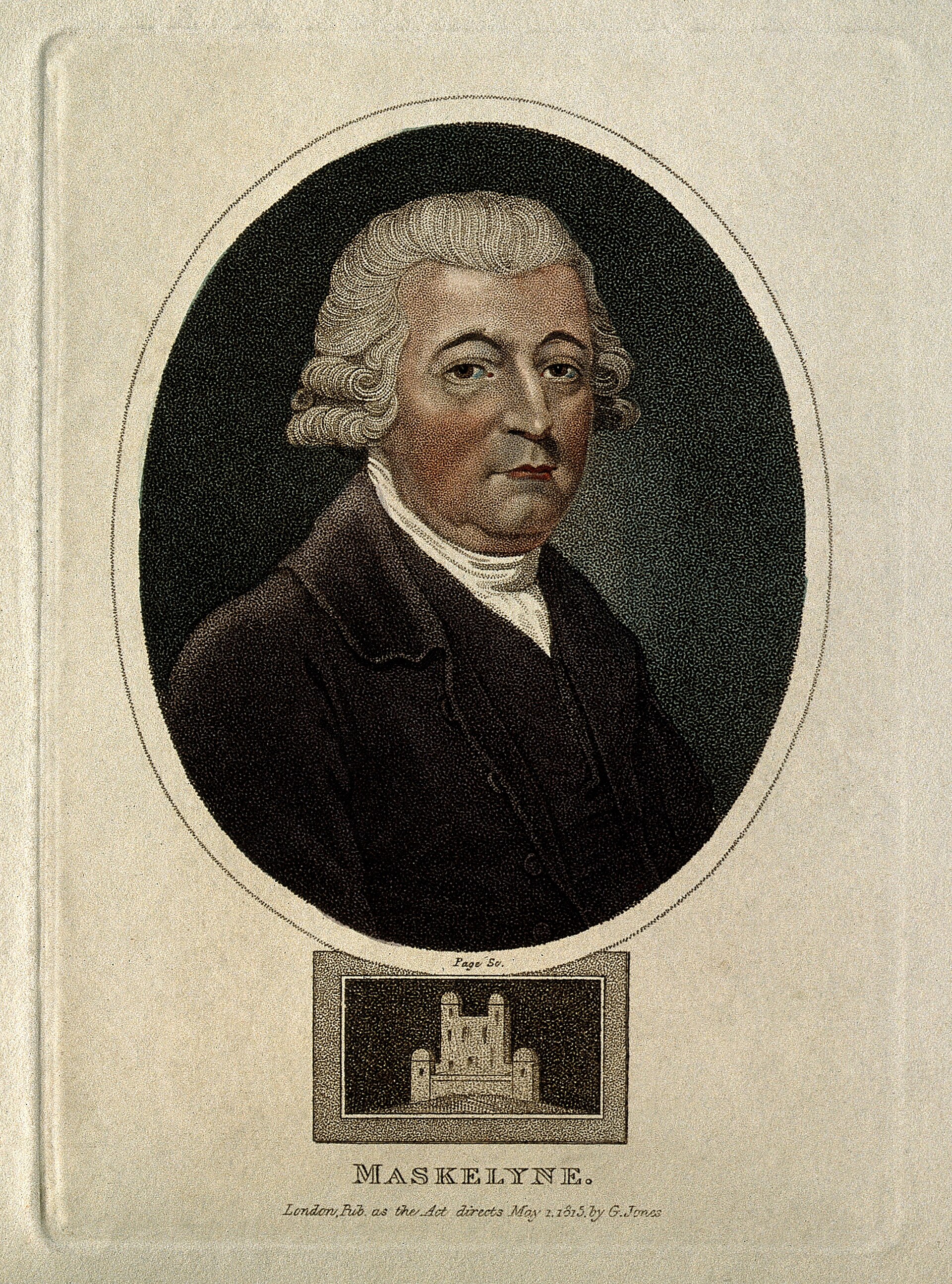
The Board of Longitude did not dispute that H4 had performed well. It disputed what the performance proved. Nevil Maskelyne, who conducted the astronomical observations against which H4 was judged at Barbados in 1764 and who became Astronomer Royal the following year, argued that the watch's good going rate could be the product of errors cancelling each other out rather than genuine accuracy, and the Board's own position, as recorded in the secondary literature consulted here, was that a single watch which had taken six years to build and belonged to one craftsman did not meet a reasonable standard of practicality for the Navy at large.
Their remedy was to require proof that Harrison's method could be reproduced by somebody else. The Board commissioned Larcum Kendall, who had trained under John Jefferys, to build a copy of H4; the result, K1, went to sea with Captain Cook on his second and third voyages and performed well enough that Cook's own published praise of it settled the practical argument inside the Navy. K1 is not part of this record, but it is the reason H4's success became a trade rather than staying a single man's unrepeatable achievement, and it is worth stating plainly here because K1 is also the object most often mistaken for Harrison's own watch in casual reproduction: it looks like H4 because it was built to.
Chapter 5The Richmond trial, 1772
Harrison obtained an audience with George III.
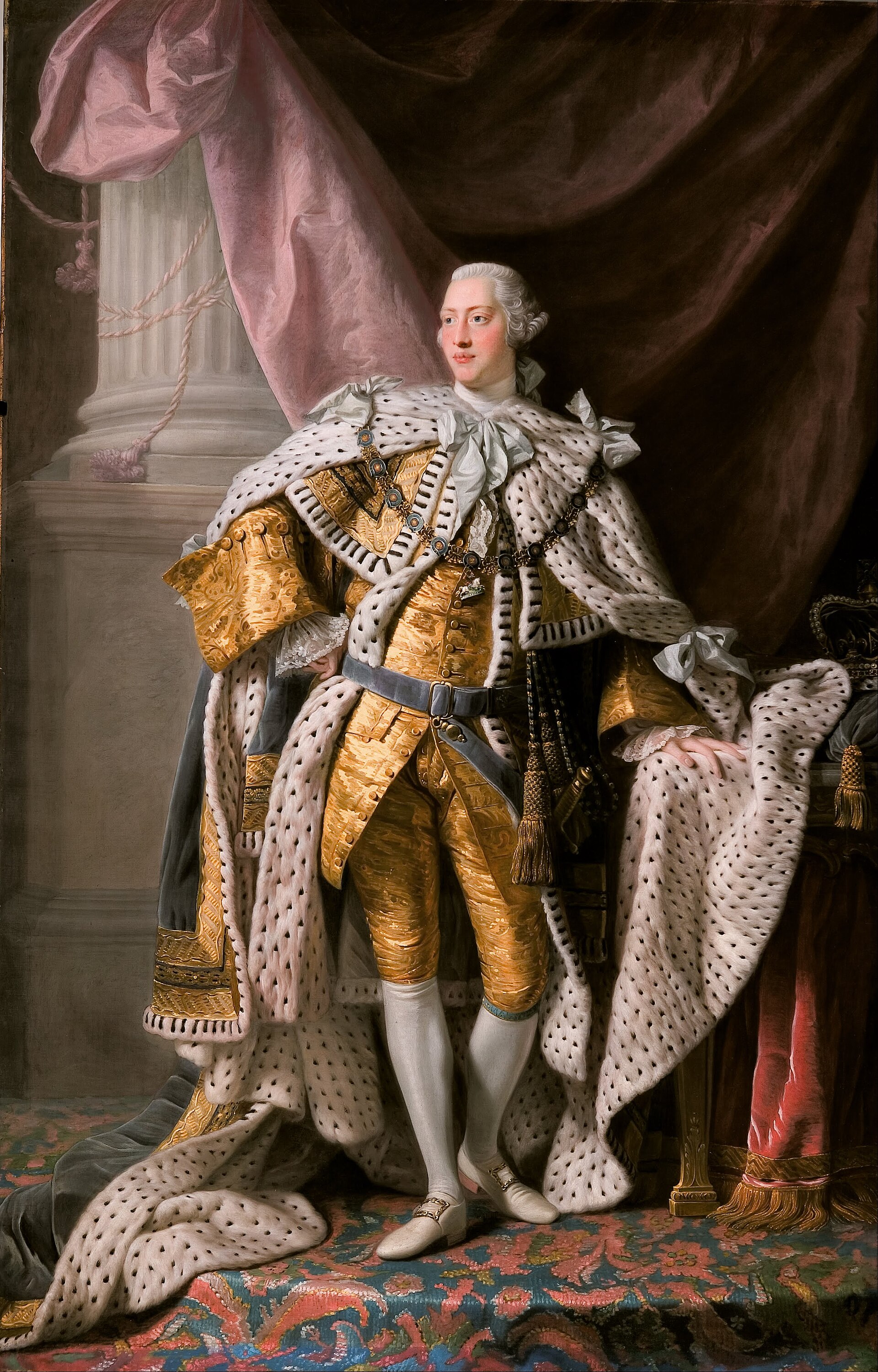
Harrison obtained an audience with George III. The King tested H5 himself at his private observatory near Richmond, with daily observations over roughly ten weeks between May and July 1772, and recorded it as accurate to within one third of a second a day. No source consulted for this record identifies how the audience was arranged or names an intermediary who might have brought Harrison and the King together, which is a real gap rather than an assumed one.
The result convinced the King that Harrison had been treated unfairly. He is reported to have threatened to appear before Parliament in person to argue Harrison's case if it was not resolved, and to have advised Harrison to petition Parliament directly rather than continue dealing with the Board. That advice is the reason H5's own trial, rather than H4's sea trials, is the event that finally broke the deadlock: it gave Harrison a royal endorsement to carry into Parliament that the Board could not simply overrule by committee.
Chapter 6A quotation that could not be verified
A widely repeated line has the King telling Harrison, 'By God, Harrison, I will see you righted.' This record could not find that quotation in any source checked, including the Wikipedia biography of...
A widely repeated line has the King telling Harrison, 'By God, Harrison, I will see you righted.' This record could not find that quotation in any source checked, including the Wikipedia biography of Harrison that does report the King's threat to confront Parliament and his advice to petition it. No primary letter, memoir, or contemporary account carrying those exact words turned up in the search conducted for this record, whether through the Commons file history, the Science Museum Group's own catalogue text, the Worshipful Company of Clockmakers' site, or the secondary accounts consulted.
The absence of a source is not proof the King never said something like it; eighteenth-century royal remarks made in private are exactly the kind of thing that survive, if at all, only in retellings written down later by people who were not in the room. But this record will not print a quotation it cannot trace, so it records the line here as a popular, frequently repeated anecdote attached to this object's history, graded unverified, and separate from the two things that are actually documented: that the King tested H5 personally over ten weeks, and that he told Harrison to take his case to Parliament.
Chapter 7The Act of 1773
Parliament voted Harrison 8,750 pounds by special Act in June 1773, when he was eighty years old.
Parliament voted Harrison 8,750 pounds by special Act in June 1773, when he was eighty years old. This is not the same thing as the Board of Longitude paying him the prize; it is Parliament acting directly, outside the Board's own mechanism, which the Board never invoked in Harrison's favour at any point in the dispute. Set against the 20,000 pounds the 1714 Act had offered for a method accurate to within half a degree of longitude, 8,750 pounds is very close to 44 percent of the full prize.
Across roughly forty years of instalments, discretionary encouragements, and this final Parliamentary award, Harrison received 23,065 pounds in total for his work on the marine timekeepers. The 20,000 pound figure that headlines almost every retelling of his story was never paid to him, or to anyone else, in the form the 1714 Act actually described; the Board of Longitude never made that payment to a single claimant under its own rules. Popular modern-currency conversions of these sums circulate in the millions of pounds, but they depend entirely on which historical-value method is used (retail price index, average earnings, or GDP share give substantially different answers for an eighteenth-century sum), and no source consulted for this record names its method plainly enough to repeat a converted figure here with confidence.
Chapter 8Harrison's other unfinished argument: music
In his final years Harrison wrote about a subject that had nothing to do with clocks on its surface: the mathematics of musical tuning.
In his final years Harrison wrote about a subject that had nothing to do with clocks on its surface: the mathematics of musical tuning. His pamphlet, generally known by the short title of its opening words as 'A Description Concerning Such Mechanism...', sets out a tuning system he derived from pi rather than from the conventional integer frequency ratios that had defined Western musical theory, and argues, against the accepted view, that harmonics built on his ratios would avoid the low-frequency beating that afflicts standard tuning. A further, previously unknown manuscript of his, 'A true and short, but full Account of the Foundation of Musick, or, as principally therein, of the Existence of the Natural Notes of Melody', turned up in the US Library of Congress in 2002, more than two centuries after his death.
His theory of bell manufacture, worked out using what he called 'Radical Numbers', remains, on the evidence of the sources checked for this record, not clearly understood by later scholars even now. Taken together, this is a documented, not speculative, feature of Harrison's intellectual life: a self-taught craftsman who spent his final years contesting an accepted mathematical orthodoxy in an entirely different field from the one that made him famous, on the same terms he had used against the Board of Longitude, by building or writing his own account and daring the establishment to refute it on its merits rather than on his lack of formal credentials.
Chapter 9Maskelyne, the lunar-distance method, and who gets the credit
At the time H4 and H5 were being tested, a rival method for finding longitude at sea was maturing alongside them: the method of lunar distances, which uses the Moon's own fast movement against the...
At the time H4 and H5 were being tested, a rival method for finding longitude at sea was maturing alongside them: the method of lunar distances, which uses the Moon's own fast movement against the fixed stars, roughly thirteen degrees a day, as a natural clock that requires no mechanism at all, only tables, an almanac, and a skilled observer with a sextant. Nevil Maskelyne was its leading advocate as well as Harrison's principal examiner on the Board, a dual role that put the man judging Harrison's invention in direct competition with it for the same prize money and the same claim to having solved the problem.
Maskelyne's own lunar-distance measurements during H4's Barbados trial were good, accurate to about thirty miles, but required extensive calculation to use at sea, where Harrison's watch needed only a subtraction. The lunar-distance method and the marine chronometer would go on to complement each other through the rest of the eighteenth century before the chronometer eventually displaced it in the nineteenth. The dispute between Harrison and the Board is, underneath the personal grievance, a dispute between a craft solution built by one man's hands and a mathematical-astronomical solution built by an institution that also happened to be judging the contest; H5's royal trial is the moment a third authority, the Crown, stepped in to settle an argument the scientific establishment had shown no interest in settling on Harrison's terms.
Chapter 10After Harrison: an unrecorded transfer
H5 was never surrendered to the Board of Longitude, so it never entered the trail of public custody, minutes, and Parliamentary Acts that put H1 to H4 into the National Maritime Museum's collection.
H5 was never surrendered to the Board of Longitude, so it never entered the trail of public custody, minutes, and Parliamentary Acts that put H1 to H4 into the National Maritime Museum's collection. It stayed private property. Harrison died on 24 March 1776; Wikipedia's biography, checked for this record and flagged there as needing better citation on its early-life material, gives his age at death as eighty-two, though the more commonly repeated popular claim, that he died on his own eighty-third birthday, would require a birth date this record cannot independently confirm from the sources checked. That small discrepancy is itself a minor case of the kind of imprecise retelling this publication tries to avoid.
What happened to H5 between 1776 and its documented appearance in the Worshipful Company of Clockmakers' collection is not stated in any source consulted here. The Company's own published account of its museum begins with the collection's founding in 1813-14 and does not say when H5 specifically joined it, whether by purchase, gift, or bequest, or from whom. This is a genuine gap of several decades at minimum, and this record states it as a gap rather than filling it with a plausible-sounding guess about family inheritance or a private sale.
Chapter 11The Clockmakers' Museum, and the move to South Kensington
The Worshipful Company of Clockmakers, one of the City of London livery companies, founded its collection in 1813-14; on its own account this makes it the oldest specific collection of clocks and...
The Worshipful Company of Clockmakers, one of the City of London livery companies, founded its collection in 1813-14; on its own account this makes it the oldest specific collection of clocks and watches in the world. For 140 years, from 1874 to 2014, it was displayed at the Guildhall in the City of London. In October 2015 it moved into a purpose-built gallery inside the Science Museum in South Kensington, opened officially by Princess Anne, where it remains on loan while the Company retains ownership.
H5 is one of the gallery's stated highlights. A blog account by a volunteer guide for the Antiquarian Horological Society, published after the Science Museum gallery had been running guided tours for some time, records that visitors are 'regularly drawn to John Harrison and his fight for recognition to win the Longitude Prize and then become fixated by H5'. The Company has stated it is working with the Science Museum to digitise and photograph its wider collection for online access, a project that had not, as of the sources checked for this record, produced a public catalogue entry giving H5's acquisition history.
Chapter 12Reproduction and the object's afterlife in popular culture
Harrison's story, with H4 and H5 as its climax, reached a much wider public through Dava Sobel's 1995 book Longitude, later adapted for television, which fixed the outline of the dispute (an...
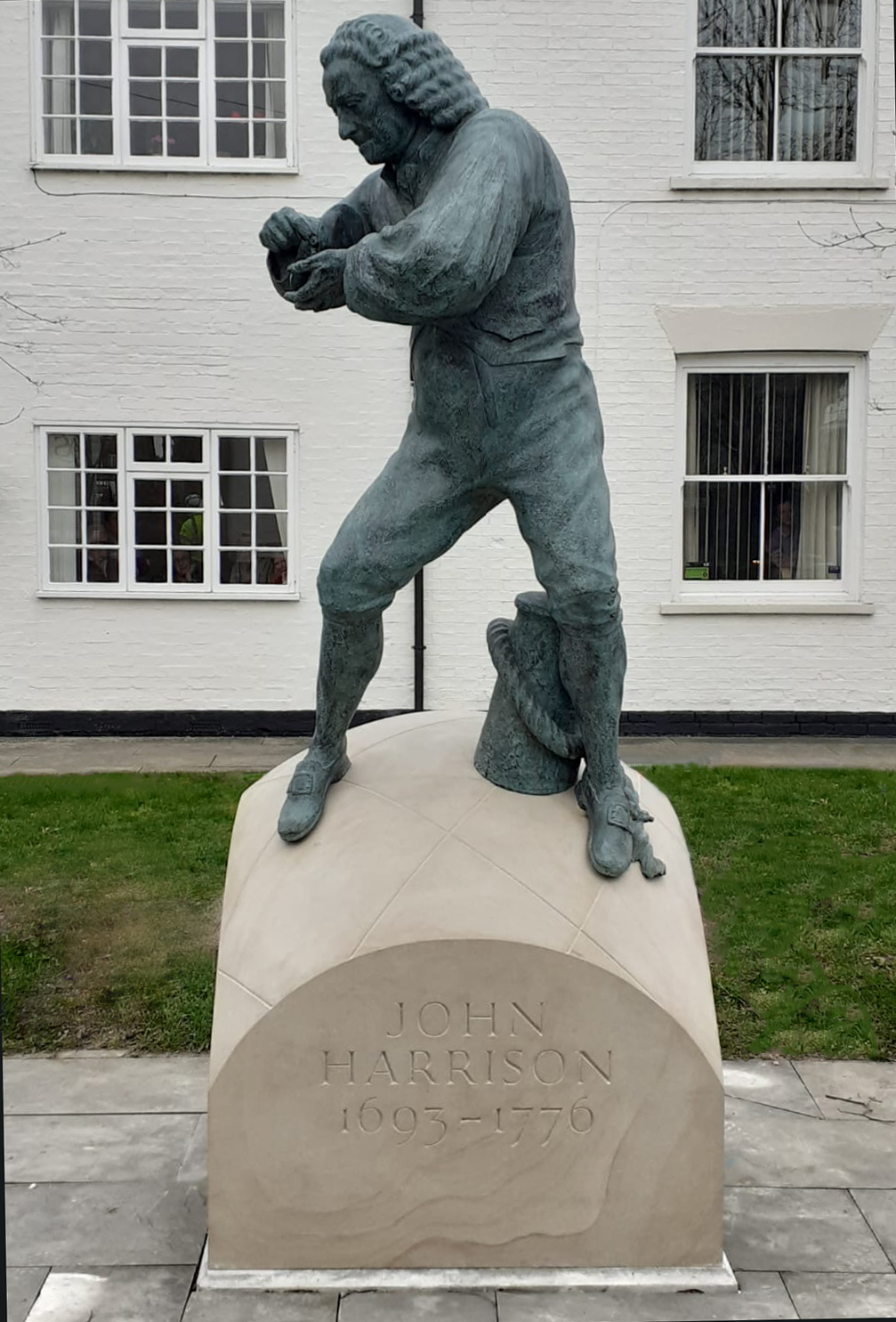
Harrison's story, with H4 and H5 as its climax, reached a much wider public through Dava Sobel's 1995 book Longitude, later adapted for television, which fixed the outline of the dispute (an unqualified craftsman defeats an indifferent scientific establishment) in the popular imagination well beyond horology. In 2014, the UK government marked the 300th anniversary of the 1714 Longitude Act by launching a new public prize, the Longitude Prize 2014, explicitly invoking Harrison's precedent as its namesake and its justification. A bronze statue of Harrison by the sculptor Marcus Cornish stands in Barrow upon Humber, Lincolnshire, the Harrison family's home area and the place where H1 was built; the date of its unveiling is not given in the source consulted for this record.
None of this reproduction touches H5 directly in the way that K1's manufacture touches H4, but it is the reason a general reader is likely to have heard of Harrison's watches at all, and it is why an image search for 'Harrison chronometer' returns H4, K1, and H5 mixed together with very little to distinguish them for a non-specialist. That mixing is the exact risk this record was built to check before writing anything else.
The artist
John Harrison
Harrison was a carpenter's son from Nottinghamshire who taught himself clockmaking, built his first longcase clocks largely out of wood, and spent most of his working life fighting an institution rather than a technical problem. By the time H5 was built he had already solved the problem the 1714 Act was written for. What H5 exists to prove is that the solution belonged to him.
Related works
| Work | Relation | Where it is |
|---|---|---|
| John Harrison's Marine Timekeepers, H1 to H4 John Harrison, with James Harrison on H1 and John Jefferys on the precursor watch to H4 | Harrison's four earlier timekeepers, made under direct Board of Longitude supervision and surrendered to the Board under statute A separate Iconotheca record. Government property since the 1760s, unlike H5, which stayed private. H4 in particular is the object H5 is most often confused with in casual reproduction, since both are watch-sized silver-cased marine timekeepers built to the same mechanical principle. | National Maritime Museum, Greenwich |
| K1 Marine Chronometer Larcum Kendall | The Board of Longitude's commissioned copy of H4, built to test whether Harrison's design could be reproduced by another maker A separate Iconotheca record. Went to sea with Captain Cook and is, on its own terms, the object that actually settled the Navy's practical argument for marine chronometry, though it is not Harrison's own work. | National Maritime Museum, Greenwich |
| Marine Chronometer by Thomas Earnshaw Thomas Earnshaw | A later marine chronometer maker whose simplified, cheaper detent escapement design made marine chronometry commercially practical at naval scale, in the generation after Harrison and Kendall A separate Iconotheca record. Represents the point at which the chronometer left the realm of unique handmade objects like H1 to H5 and became an ordinary article of naval and commercial equipment. | British Museum, London |
| A Description Concerning Such Mechanism... John Harrison | Harrison's own pamphlet, published in his final years, setting out his theory of musical tuning derived from pi Evidence for Harrison's late-life intellectual project outside horology. A further manuscript by Harrison on the same subject was rediscovered in the US Library of Congress in 2002. | Not an object in a collection covered by this record; referenced here for its documented content |
Open questions
- How and when did H5 pass from Harrison's estate into the ownership of the Worshipful Company of Clockmakers? No source consulted for this record gives a date or a mechanism (purchase, gift, bequest) for this transfer, a gap of at least several decades after Harrison's death in 1776.
- How did Harrison obtain his audience with George III in 1772? No source consulted names an intermediary or describes how the meeting was arranged.
- Is the quotation 'By God, Harrison, I will see you righted' genuinely attributable to George III, and if so, on what primary source? This record could not trace it and has recorded it as an unverified popular anecdote.
- Was Harrison's own 1920s-1933 restorer, Rupert Gould, ever involved with H5, given that he is documented as restoring 'the marine chronometers of John Harrison' without a source specifying whether that phrase covers H1 to H4 only (the Board of Longitude group at Greenwich) or H5 as well, which the Company, not the Board, owned throughout.
- What was H5's exact case and dial measurement (height, width, depth, weight)? Not published in the Science Museum Group catalogue entry consulted for this record.
- Precisely which building was 'the King's private observatory near Richmond' where the 1772 trial took place? Sources consulted give slightly different phrasing (one refers to testing 'at the palace'), and this record found no source that names a specific structure and confirms the 1772 trial took place there by name.
Questions about this object
What is Marine Timekeeper known as H5?
Marine Timekeeper known as H5 is a clocks and instruments, dated 1770 (movement signed and dated); tested and completed for its documented purpose in 1772. Medium: Silver, gold, enamel, ivory, diamond, brass and steel; silver pair case; mahogany carrying case with silk cushions.
Who made Marine Timekeeper known as H5, and is the attribution settled?
The attribution to John Harrison and Son, London is recorded here as accepted. Signed on the movement 'John Harrison & Son London 1770 No. 2' and catalogued by the Science Museum Group, on behalf of the Worshipful Company of Clockmakers, as object L2015-3480, Clockmakers' Museum No. 598. 'And Son' records that Harrison's son William, an instrument maker in his own right, worked on it alongside his father; no source consulted for this record apportions the work between them more precisely. The attribution rests on an unbroken institutional record rather than on connoisseurship, the same basis as H1 to H4, but H5 was never surrendered to the Board of Longitude and so carries no Board minute of its own; the earliest documented event in its life is George III's trial of it in 1772.
Where is Marine Timekeeper known as H5 now?
Science Museum, London, Clockmakers' Museum gallery; the object is owned by the Worshipful Company of Clockmakers and lent to the Science Museum Group. Inventory number Clockmakers' Museum No. 598; Science Museum Group object number L2015-3480 (the cushion supporting it is separately numbered L2015-3480/2). Last confirmed 3 September 2026. On long-term loan from the Worshipful Company of Clockmakers, whose collection has been displayed in a dedicated gallery at the Science Museum since it opened on 22 October 2015. Before that the collection was housed at the Guildhall, London, from 1874 to 2014. H5 is not National Maritime Museum property and has never been part of the Greenwich group of four (H1 to H4), a distinction sources on Harrison frequently blur.
What is still unknown about Marine Timekeeper known as H5?
How and when did H5 pass from Harrison's estate into the ownership of the Worshipful Company of Clockmakers? No source consulted for this record gives a date or a mechanism (purchase, gift, bequest) for this transfer, a gap of at least several decades after Harrison's death in 1776.
Sources
- 1Science Museum Group Collection, 'Marine Timekeeper known as H5 by John Harrison and Son 1770'. Object number L2015-3480, Clockmakers' Museum No. 598. Source for the case, dial, movement, materials, inscription, accessories, credit line, and the Museum's own statement that H5 is mechanically very similar to H4. collection.sciencemuseumgroup.org.uk/objects/...
- 2Source for the upload history, the uploader's own unsourced description, the categories, and the CC BY 2.5 / CC BY-SA 3.0 dual licensing. This record's identification check began from the fact that this page provides no museum reference for the identification. commons.wikimedia.org/wiki/...
- 3Wikipedia, 'John Harrison'. Source for the Board's stated reasons for refusing H4, the 1765 Act terms, the 1772 Richmond trial and its ten-week duration and one-third-second accuracy, the 1773 Act and the 8,750 pound award, Harrison's lifetime total of 23,065 pounds, the 'extremely ill used' quotation (citing Burkholder, Ruth, 'Solving the Problem of Longitude', Cook's Log 6(4), 1983, pp. 222-224), the Maskelyne rivalry and the lunar-distance method, Harrison's musical tuning pamphlet and the 2002 Library of Congress manuscript discovery, and his death on 24 March 1776 at a stated age of eighty-two. en.wikipedia.org/wiki/...
- 4Wikipedia, 'Board of Longitude'. Source for the statement that the 20,000 pound prize was never awarded to Harrison or to anyone else in the form the 1714 Act described, and for the Board's abolition in 1828. en.wikipedia.org/wiki/...
- 5Wikipedia, 'Worshipful Company of Clockmakers'. Source for the 1813-14 founding of the collection, its description as the oldest specific collection of clocks and watches in the world, the 1874-2014 Guildhall display period, the move to the Science Museum opened by Princess Anne on 22 October 2015, and the statement that H5 is part of the collection, without an acquisition date. en.wikipedia.org/wiki/...
- 6Worshipful Company of Clockmakers, own website, Museum Collection page. Source for the Company's own listing of H5 as a notable collection piece, the approximate size of the current gallery (around 720 objects), and the statement that the Company is working with the Science Museum to digitise and photograph the collection. clockmakers.org/museum-archive/...
- 7Antiquarian Horological Society, 'Inspiring people with horological collections: a guide's perspective'. Source for the description of visitors becoming 'fixated by H5' on guided tours of the Clockmakers' Museum gallery at the Science Museum, and for the museum's monthly tour programme running since July 2019. ahsoc.org/blog/...
- 8Royal Museums Greenwich, 'Harrison's clocks and the longitude problem'. Source for cross-reference detail on H4, Maskelyne's role in the Barbados trial and his custody of the confiscated timekeepers from 1766, used here to place H5 correctly outside the Greenwich group. This story page does not itself cover H5. rmg.co.uk/stories/...
- 9Wikipedia, 'Rupert Gould'. Source for Gould's 1920-1933 restoration of 'the marine chronometers of John Harrison', which this record notes does not specify by name whether H5 was included, since H5 was never Board of Longitude or National Maritime Museum property. en.wikipedia.org/wiki/...
- 10Wikipedia, 'King's Observatory'. Consulted to check the identity of 'the King's private observatory near Richmond'; this article, about the observatory built in 1769 at Kew within Richmond parish, does not itself mention Harrison, H5, or the 1772 trial, and its documented role testing chronometers is dated to the 1850s, decades later. This record therefore does not assert that this specific building was the site of the 1772 trial. en.wikipedia.org/wiki/...
- 11Also used to confirm that the Science Museum Group's own eight photographs of H5 are released under CC BY-NC-SA 4.0, a non-commercial licence not used in this record's gallery. commons.wikimedia.org/w/...

Last verified · Published
Change log
3 September 2026 - Record created at the house standard: researched narrative, technical evidence, maker dossier, graded provenance chain, prices with hammer and premium separated, related works, open questions and sources.