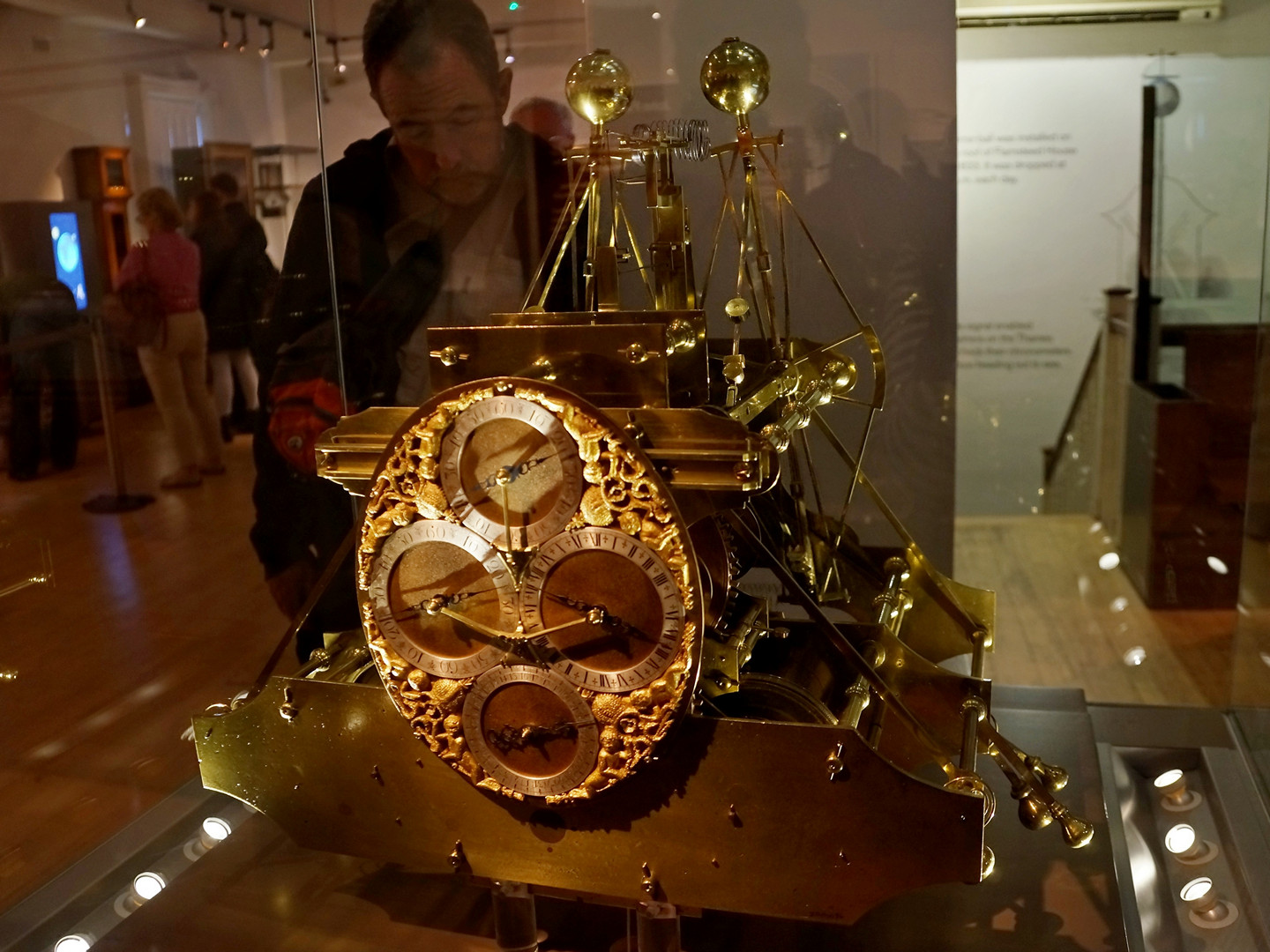
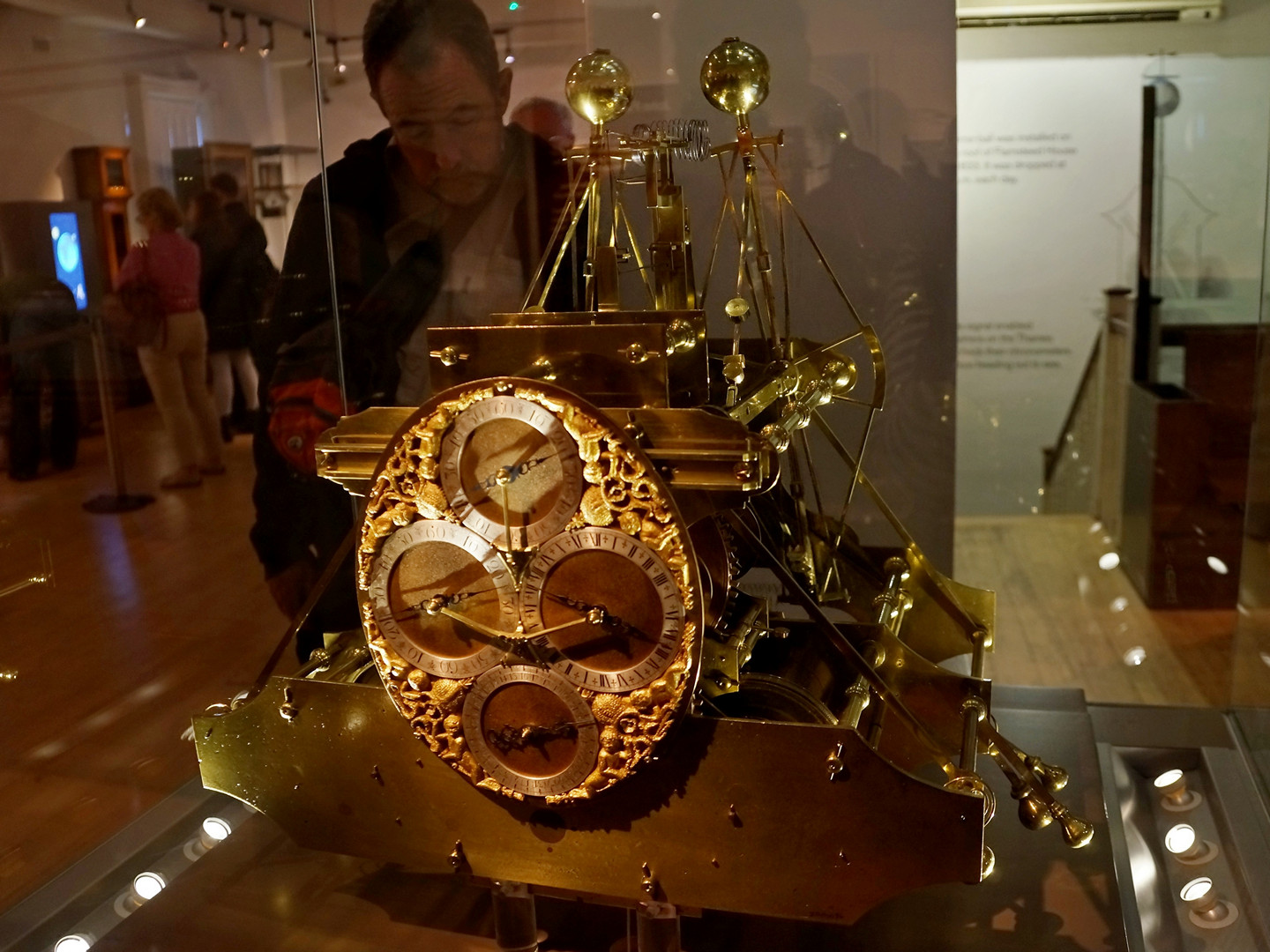
John Harrison's Marine Timekeepers, H1 to H4
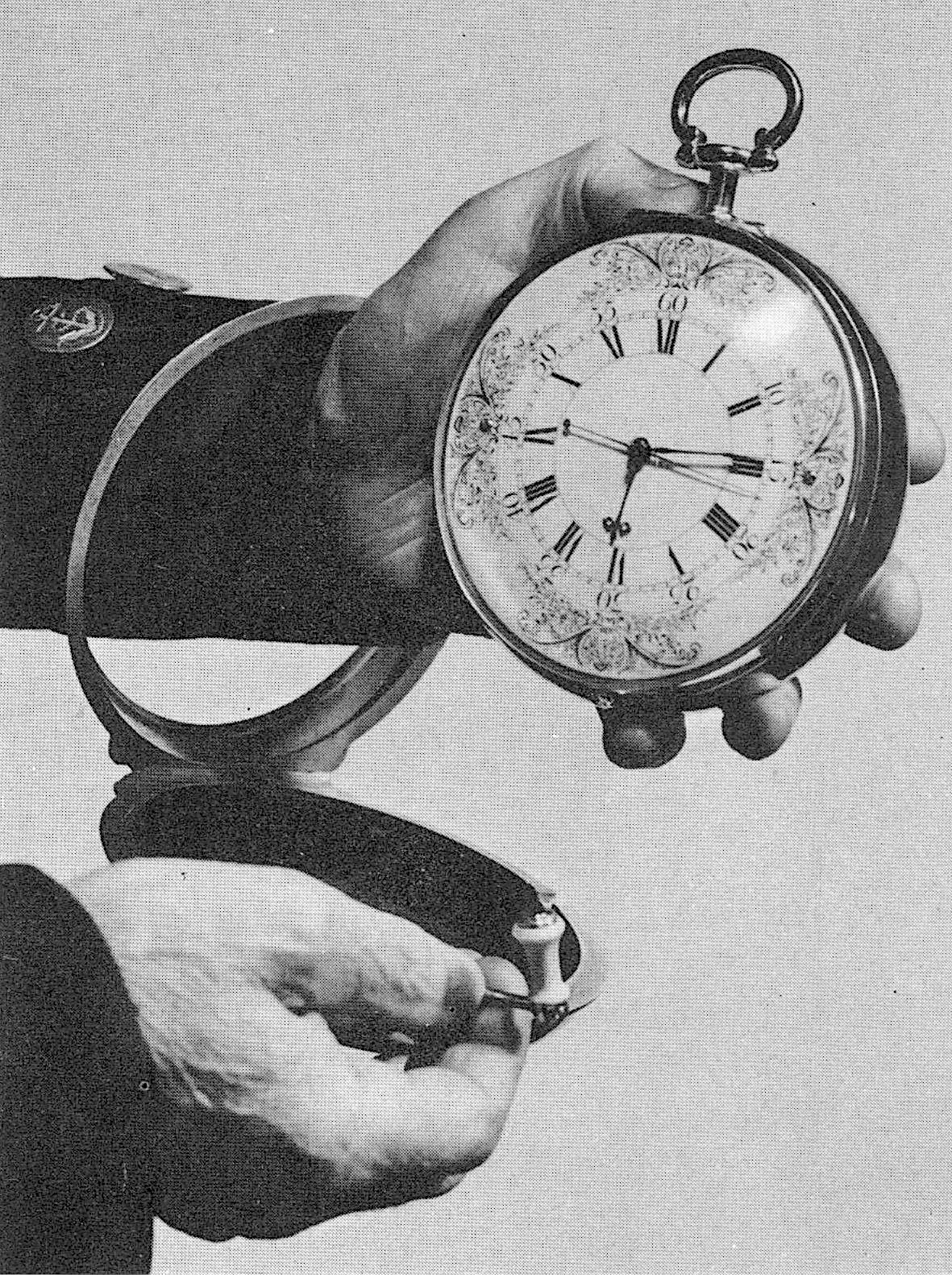
H1, 1730-1735. H2, 1737-1739. H3, begun 1740 and worked on... · H1
National Maritime Museum, Greenwich, on display at the Royal...
 English · 1693-1776
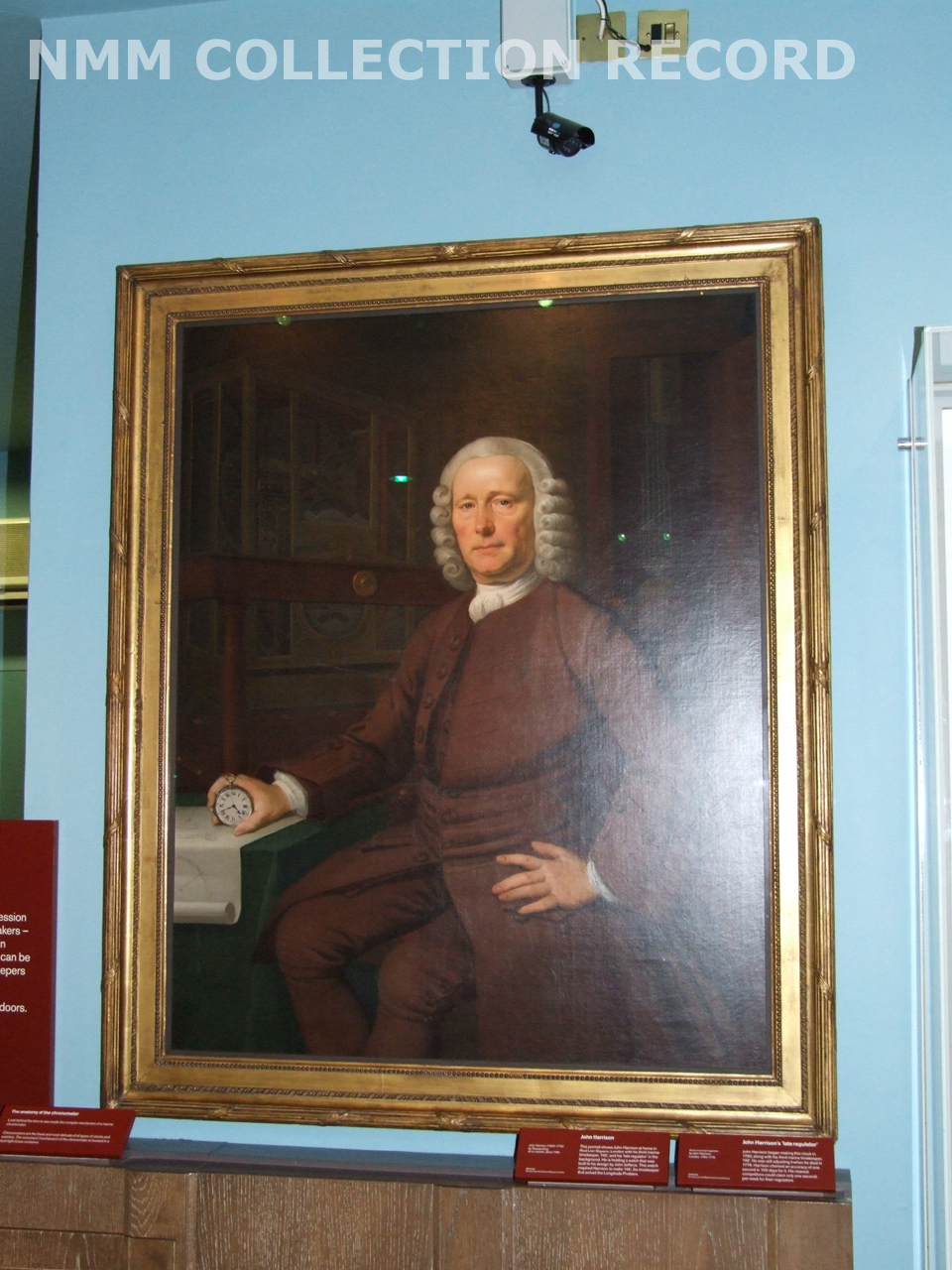
Thomas King's portrait of about 1767, oil on canvas, 1270 by 1020 mm, on display at the Royal Observatory Greenwich. This is the standard identified likeness and the sitter is catalogued as Harrison by the holding institution. It was painted in the years when the Board of Longitude was refusing to pay him: the Barbados trial was three years behind, the Act compelling him to take H4 apart two years behind, and the money still eight years ahead. Almost every other image of Harrison in circulation derives from it, including Philippe-Joseph Tassaert's mezzotint of 1768 and the enamel portrait on the watch his son-in-law John Barton made in 1771.
Royal Museums Greenwich| Worked as | Clockmaker, Watchmaker, Joiner and carpenter, Turret clock maker |
|---|---|
| Born | 3 April 1693 New Style, 24 March 1693 Old Style · Foulby, near Wakefield, West Riding of Yorkshire, England |
| Died | 24 March 1776 · 12 Red Lion Square, Holborn, London. |
| Nationality | English |
| Movement | English precision horology, first half of the eighteenth century |
| In this archive | 2 artworks |
| Sources | 31 cited |
| Last verified | 17 September 2026 |
About this page 2 artworks in the archive · Last verified 17 September 2026 · 31 sources cited
John Harrison is the most famous clockmaker in the English language and almost everything commonly said about him is a simplification of something more interesting. He was a joiner's son from a Yorkshire estate village who never served a clockmaking apprenticeship, built his first eight-day longcase clock at twenty with a movement made almost entirely of wood, and went on to make four marine timekeepers for a public reward scheme that his own machines had brought into existence. The Board of Longitude, created by statute in 1714, did not convene as a body until Harrison gave it something to convene about.
The single most useful correction a reader can carry away is that there was no Longitude Prize, and Harrison did not win it. The Longitude Act of 1714 used the word reward, not prize, and offered a graded scale of sums for a method proved to different accuracies. What Harrison received was a long series of payments, most of them development money, running from 1737 to 1773 and totalling 23,065 pounds in the usual accounting. The historian Rebekah Higgitt, who worked on the Board of Longitude papers with the Cambridge and Greenwich project team, has set out the arithmetic and named the other recipients, including Leonhard Euler, the widow of Tobias Mayer, and Edmond Halley's daughter. Harrison was the largest single beneficiary of the Longitude Acts. He was not the only one, and the astronomical method he is popularly said to have beaten was funded alongside his in the same Act of 1765.
What is genuinely singular about him sits elsewhere. He made timekeeping a problem in materials rather than in metalwork: wooden wheels, boxwood pinions, lignum vitae bearings that grease themselves, and an escapement designed so that no oil is needed anywhere, because eighteenth-century oil thickened, dried and made a clock's rate a function of the weather. Two of his inventions, the bimetallic strip and the caged roller bearing, are in general engineering use today and neither of them is a clock. A pendulum clock built in the twentieth century to his last and most ridiculed design lost five eighths of a second in a sealed hundred-day trial at Greenwich in 2015.
H1, 1730-1735. H2, 1737-1739. H3, begun 1740 and worked on... · H1
National Maritime Museum, Greenwich, on display at the Royal...
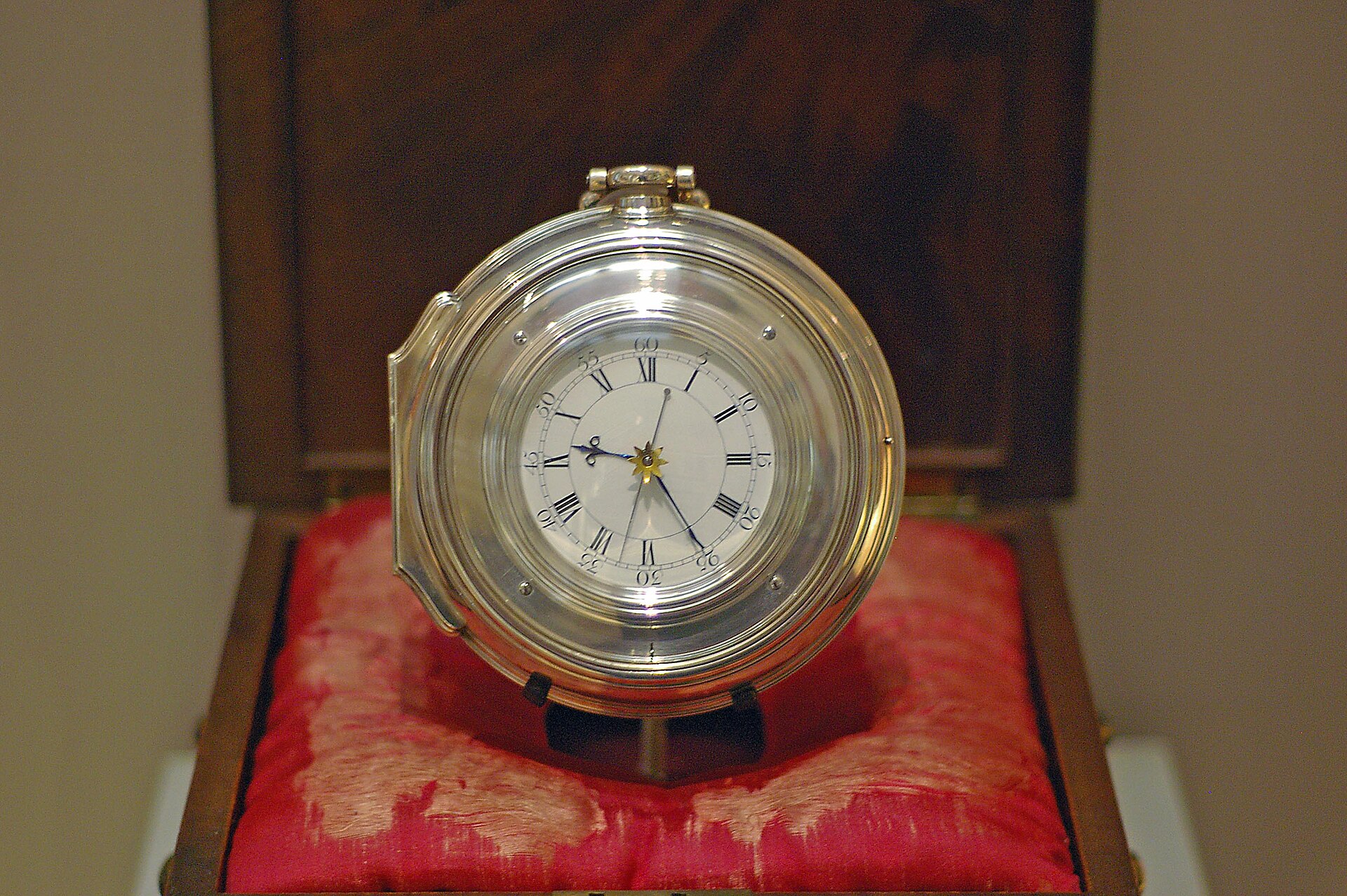
1770 · Silver
Science Museum, London, Clockmakers' Museum gallery
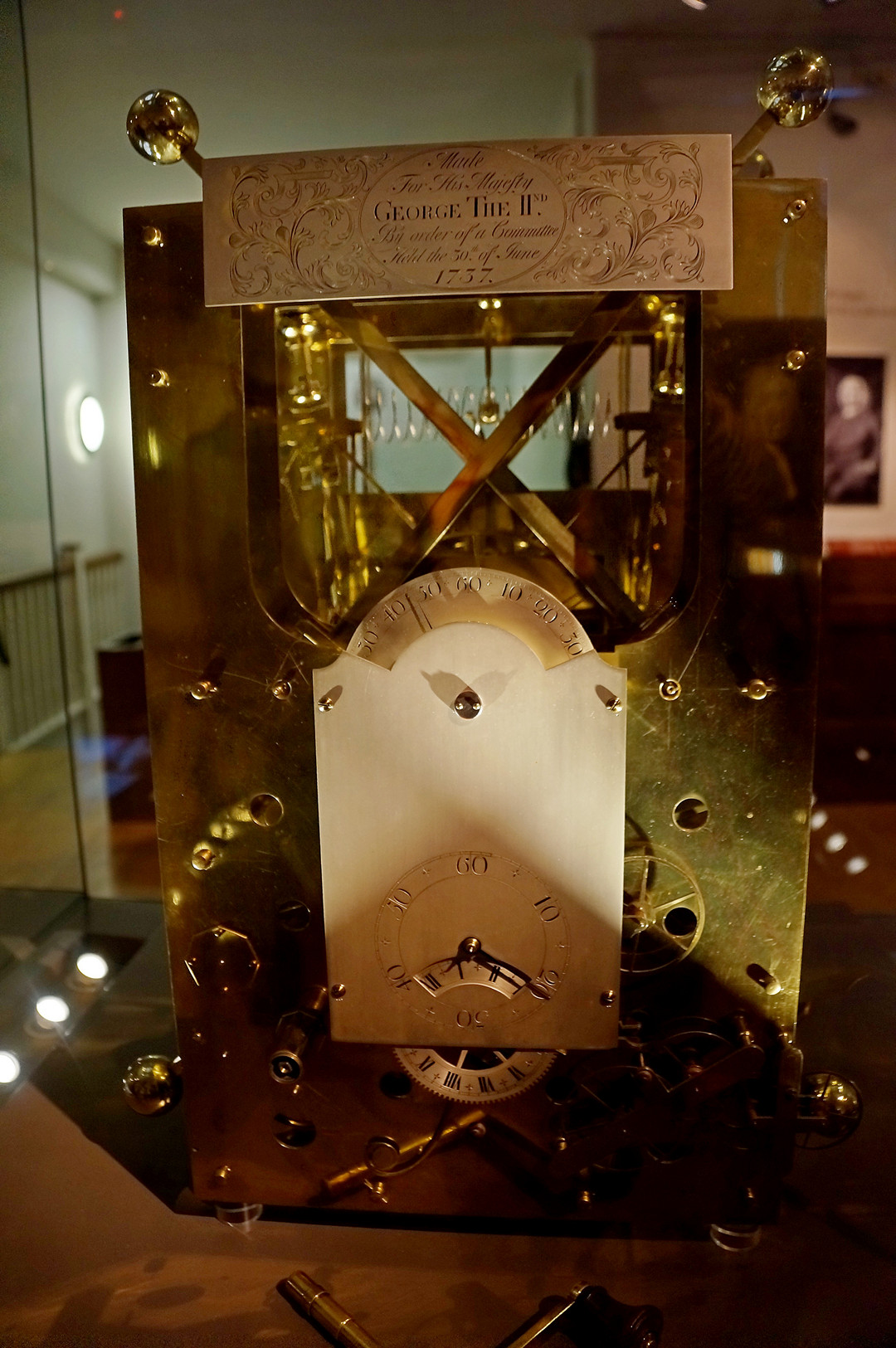
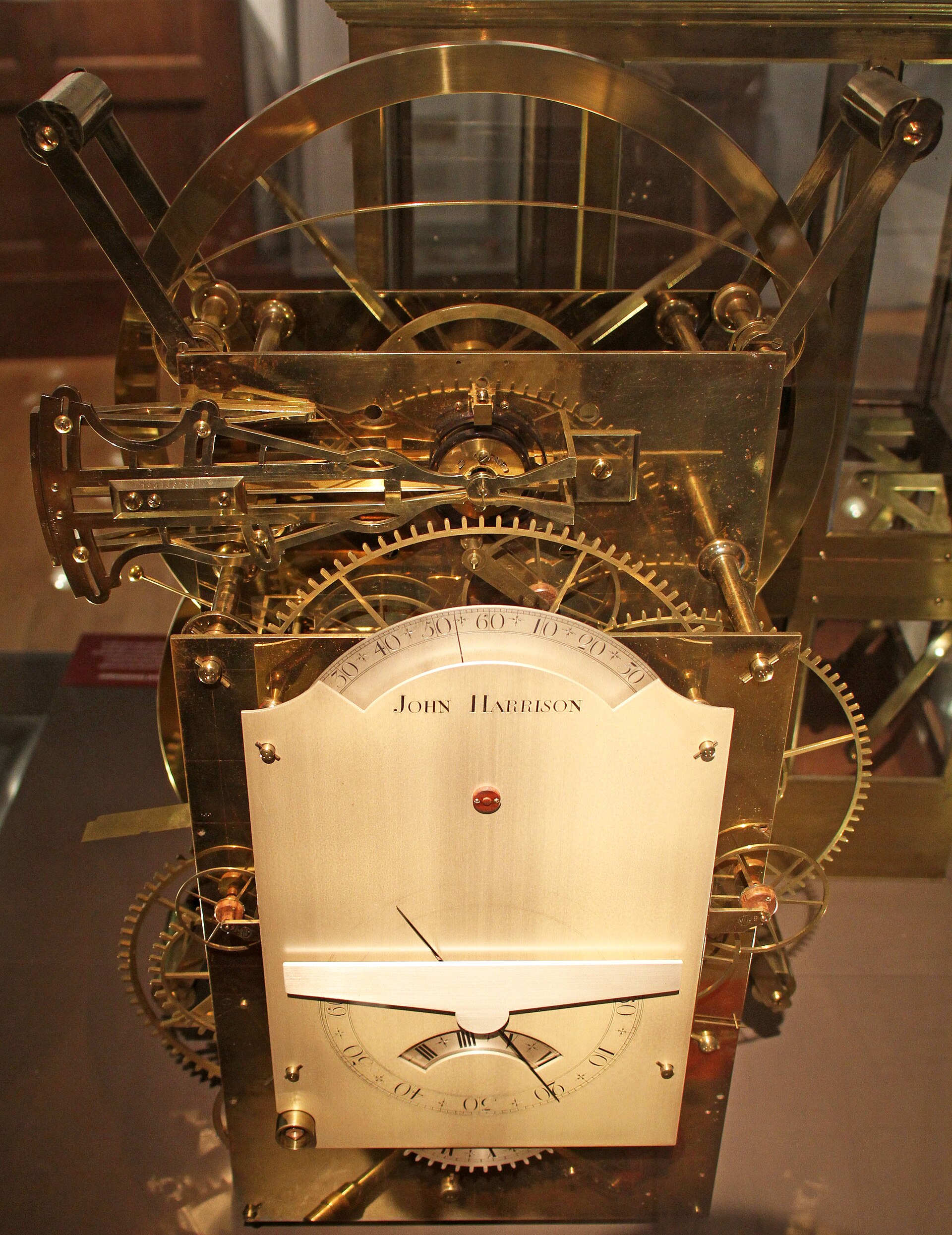
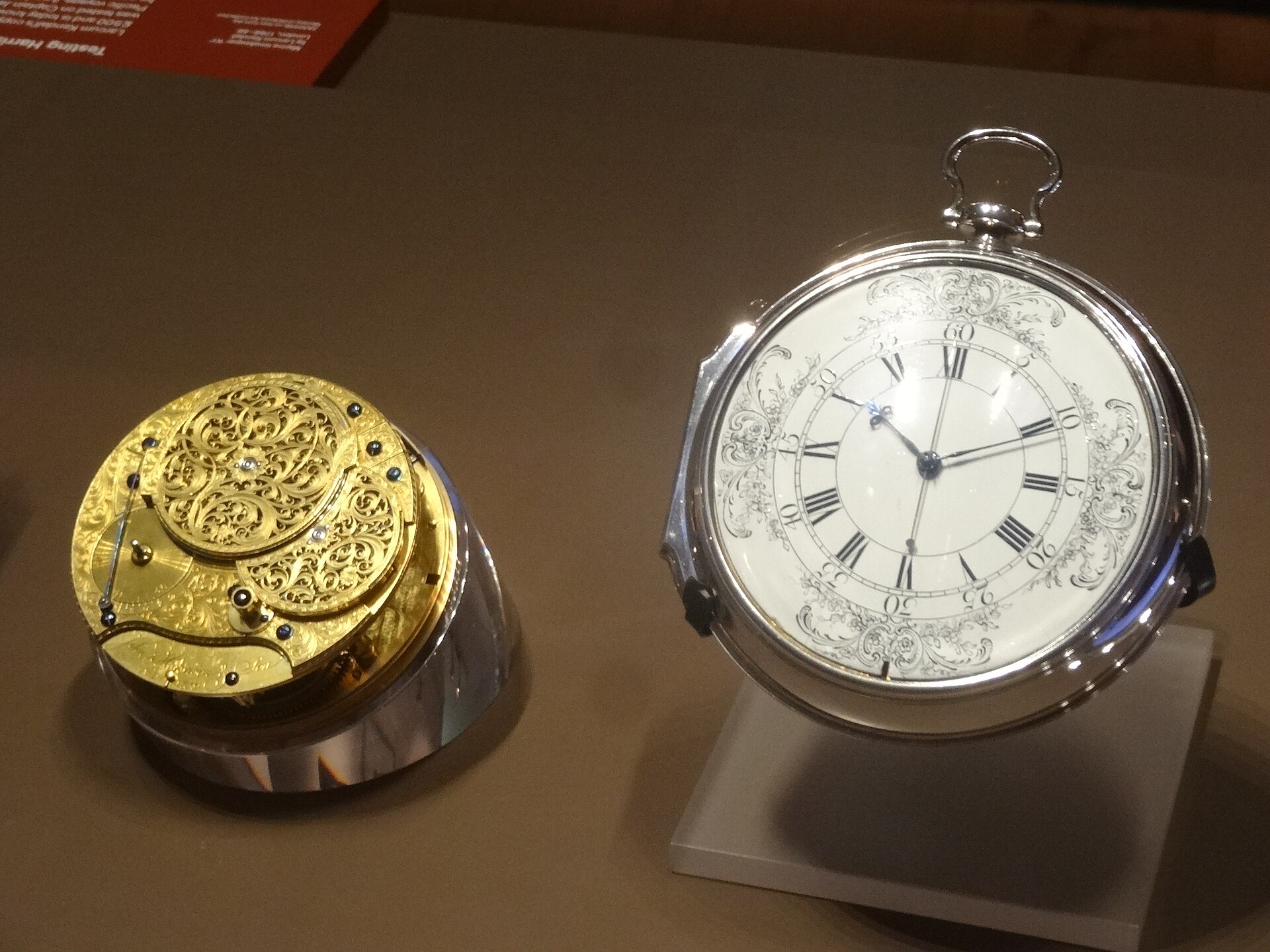
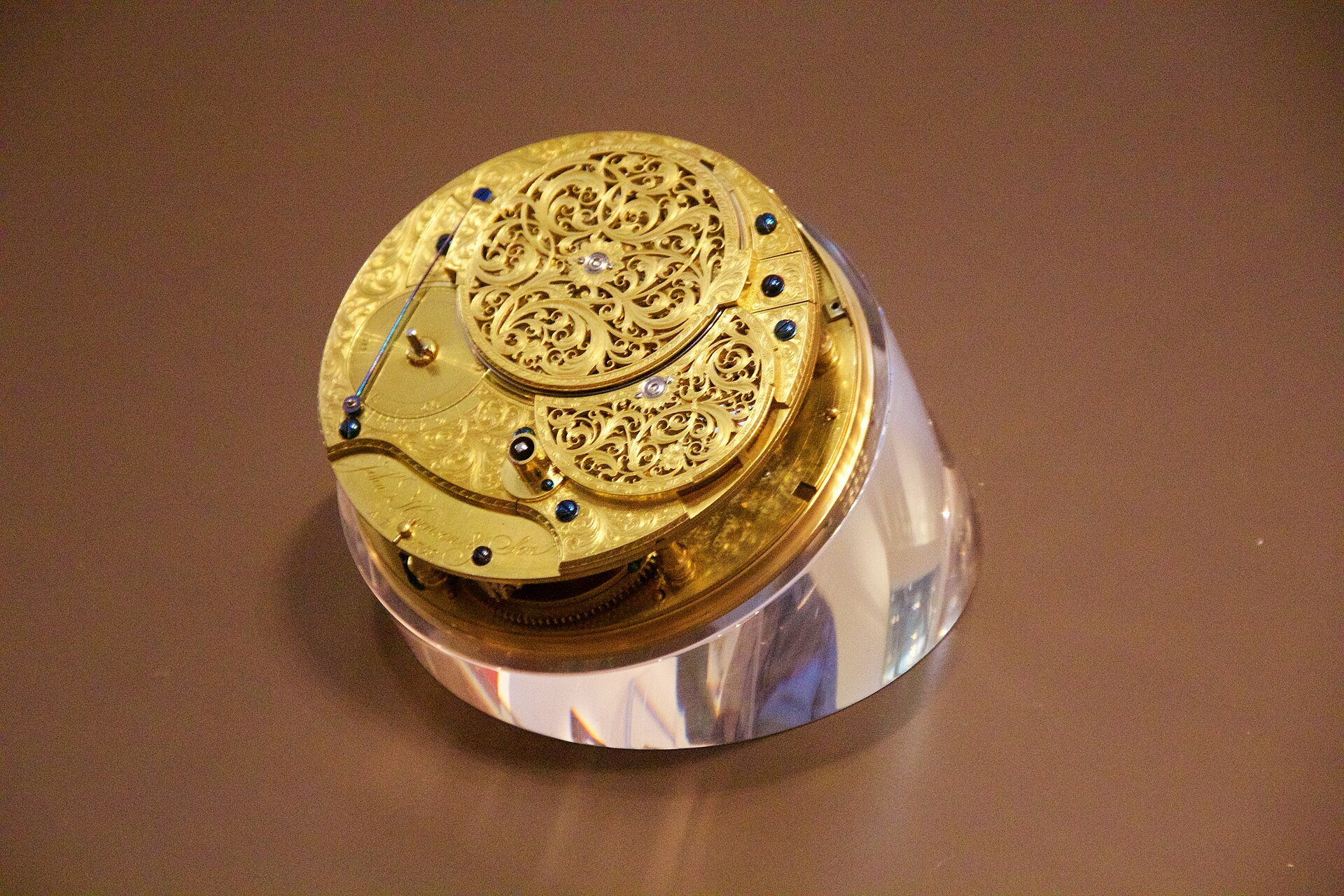
Born at Foulby near Wakefield on 3 April New Style, 24 March Old Style, eldest of five children of a carpenter working on the Nostell Priory estate.24
The family moves to Barrow upon Humber in Lincolnshire, where Harrison follows his father's trade as a joiner.24
Makes his first eight-day longcase movement at Barrow, aged twenty, almost entirely in wood. Signed on the chapter ring John Harrison, Barrow, fecit and in ink on the calendar wheel. It is the earliest known clock by him.5
The Longitude Act offers graded rewards of up to 20,000 pounds and creates a body of commissioners. Harrison is twenty-one. The commissioners will not meet as a group for over twenty years.39
Second surviving wooden longcase movement, now in the Clockmakers' Company collection at the Science Museum.45
Third surviving wooden movement, signed under the dial Jn Harrison 1717, now at Nostell Priory.8
Marries Elizabeth Barret at Barrow upon Humber on 30 August. She dies in 1726; he marries Elizabeth Scott at the same church on 23 November 1726.2
Makes the turret clock for the stable block at Brocklesby Park for Sir Charles Pelham, with a wooden movement of oak and lignum vitae and a grasshopper escapement. It is still running, unlubricated.24
With his brother James, makes at least three precision longcase regulators at Barrow with grasshopper escapements, cycloidal cheeks, maintaining power and the gridiron pendulum. Reported to keep to about one second a month.246
First recorded visit to London, carrying a manuscript account of his inventions. Presents his ideas to Edmond Halley, who sends him to George Graham; Graham lends him money to build a sea clock.2410
Brings H1 to London after five years' work. It is unveiled and, in the museum's phrase, becomes the toast of London.11
H1 sails to Lisbon aboard HMS Centurion in May and returns aboard the Orford. On the return leg Harrison correctly identifies a landfall as the Lizard where the ship's master reckoned the Start, about sixty miles out.12
On 30 June the Commissioners of Longitude meet on a submission for the first time and vote Harrison 500 pounds, 250 of it paid at once, against a promise of a better machine within two years.13
H2 completed and land-tested, but never sent to sea. War with Spain, and then Harrison's own discovery of a fault in the bar balances under yaw, stop it. A further 500 pounds granted.212
Begins H3, which will occupy him for nineteen years and produce the bimetallic strip and the caged roller bearing.113
Awarded the Copley Medal of the Royal Society. Martin Folkes's address describes a natural and uncommon genius. Harrison declines the offer of a Fellowship and asks that it go to his son William instead.1020
John Jefferys makes a precision pocket watch to Harrison's design, with a frictional rest escapement, temperature compensation and a miniature going fusee. Its performance reverses the direction of Harrison's whole project.2414
Begins H4.14
H4 completed, signed John Harrison and Son, Number 1, AD 1759.214
H4 sails to Jamaica aboard HMS Deptford with William Harrison. Corrected at its rate it is five seconds slow on arrival, an error of about one nautical mile. The Board declares the trial void on the uncertain longitude of Jamaica and the watch's rate.29
Maskelyne sets out for Portsmouth on 9 September for the Barbados trial of three methods: Irwin's marine chair, Mayer's lunar tables and Harrison's watch. James Short appears for Harrison before a Commons committee.910
At Barbados H4 keeps to within 39 seconds, an error in the longitude of Bridgetown of under ten miles. Mayer's tables give about thirty miles. Only the marine chair fails.29
In February the Board accepts that H4 has met the Act's terms. The Act of 10 May awards 7,500 pounds on disclosure, makes a further 10,000 conditional on other makers reproducing the watch, and requires Harrison to surrender all the timekeepers.13
On 5 May Maskelyne receives H4 from the Secretary of the Admiralty, locked in a box sealed with three seals, and tests it for ten months, publishing a poor result that Harrison disputes. H2 is taken from Harrison's house in the same year.112
The Board publishes The Principles of Mr Harrison's Time-Keeper, with Plates of the Same. A French edition appears the same year. The method becomes public property.2
Larcum Kendall completes K1, an exact copy of H4, for 450 pounds; it is presented to the Board on 13 January 1770 and Kendall is given a further 50 pounds.1516
H5, the second sea watch, completed by John Harrison and Son, signed and numbered 2.7
George III tests H5 himself at his Richmond observatory over ten weeks between May and July and finds it accurate to a third of a second a day, then advises Harrison to petition Parliament.247
Parliament votes Harrison 8,750 pounds. He is eighty. The 20,000 pound reward of the 1714 Act is never awarded to anyone in the form the Act described.23
Publishes A Description Concerning Such Mechanism, covering pendulums, the lunar method and his theory of musical tuning. The Monthly Review states that he is utterly unqualified to explain his own notions in writing; his claim to be able to build a clock accurate to a second in a hundred days is derided.1019
Dies at 12 Red Lion Square, Holborn, on 24 March, his eighty-third birthday less ten days. Buried at St John-at-Hampstead.2
The Board of Longitude abolished, having disbursed more than 100,000 pounds since 1714. Its papers survive complete as RGO 14.322
The Worshipful Company of Clockmakers restores Harrison's tomb, although he had never been a member of the Company.2
Rupert Gould finds the four timekeepers decrepit at the Royal Observatory and restores them without payment, assigning the designations H1 to H5 that are now universal.2
Gould publishes The Marine Chronometer: Its History and Development, still the standard account.2
The 1717 wooden clock passes to the National Trust at Nostell through Acceptance in Lieu, settling a tax liability rather than being sold.8
Regulator number 1 of about 1726 is sold at Sotheby's New York, Masterpieces from the Time Museum, lot 535, estimated 500,000 to 1,000,000 dollars and reported as realising more than 1.57 million dollars.1617
A memorial tablet is unveiled in Westminster Abbey on 24 March, engraved as a meridian line in two metals in reference to the bimetallic strip.220
Nesta launches a 10 million pound Longitude Prize for the tercentenary of the 1714 Act; on 25 June the public vote selects antibiotic resistance. Regulator number 2 goes on permanent display at Leeds City Museum on 23 January.2123
Martin Burgess's Clock B, built to Harrison's 1775 design, is sealed at the Royal Observatory on 6 January and runs untouched for 100 days to 17 April, losing five eighths of a second. Guinness World Records names it the most accurate mechanical clock with a pendulum swinging in free air.19
Marcus Cornish's bronze statue of Harrison unveiled at Barrow upon Humber in February. Oxford University Press publishes Harrison Decoded, edited by Rory McEvoy and Jonathan Betts.224
There is effectively no market in John Harrison. Every timekeeper he signed is in a public collection, the four sea machines have been state property since 1766, and nothing autograph has come to auction in living memory. What trades is the material immediately around him: clocks made with his brother, objects made by his family and successors, his own printed book, and modern recreations. Those four categories produce the only real price evidence there is, and it is worth keeping them apart, because a collector who reads a Harrison headline price without noticing which of the four it belongs to will be badly misled.
The highest measured result for an object connected to Harrison is the precision regulator of about 1726, signed Jno Harrison Barrow, sold at Sotheby's New York in the Masterpieces from the Time Museum sale of October 2004. It was estimated at 500,000 to 1,000,000 dollars and reported as realising more than 1.57 million dollars in a sale that totalled 18.2 million. Whether that figure is hammer or includes the buyer's premium is not stated in the trade report consulted here, and Sotheby's own lot page no longer publishes the result, so this record does not assert which it is.
Below that sits the family and commemorative material. Sotheby's London built a whole sale round the name in July 2016, Celebration of the English Watch Part II: John Harrison's Enduring Discovery, whose lot 37 was a gold pair-cased verge watch of 1771 to 1772 by John Barton, who had married Harrison's daughter Elizabeth, carrying an enamel portrait of Harrison attributed to George Michael Moser after James Tassie and a case engraved with globes, navigational instruments and a gridiron pendulum. It was estimated at 200,000 to 400,000 pounds. The result was not published in any source reached for this record.
His own book is the only thing he made that a private buyer can realistically expect to own. A first edition of the 1775 Description Concerning Such Mechanism appeared at Forum Auctions in London on 30 January 2025 as lot 215, defective and rebacked, estimated at 2,000 to 3,000 pounds and hammered at 2,000, with a buyer's premium of 26 per cent including value added tax on the first 20,000 pounds, giving a total of about 2,520 pounds. The catalogue could trace only three copies at auction, the previous one in 1998.
Modern recreations are the fourth category and the one most likely to confuse. Andrew King's recreation of one of the wooden regulators, begun in 1977 and completed in 1996, its case built from pews taken out of Holy Trinity at Barrow upon Humber, made 31,250 pounds including premium at Bonhams on 12 December 2018. A full-size working replica of H1 by Leonard A. Salzer, completed 1984, was in the same 2004 Time Museum sale as the regulator. These are honest, documented recreations by named makers, and they are not Harrison.
The most useful price evidence of all is not modern. It is the contract series for Larcum Kendall's copies, because it is the same object simplified in stages under a public contract: 450 pounds for K1 in 1769 with a further 50 as a bonus, about 200 pounds for K2 in 1771 to 1772, 100 pounds for K3 in 1774. H4 itself is reckoned to have cost about 400 pounds to build in 1750 terms, some thirty per cent of the value of a ship. By the early nineteenth century a marine chronometer cost 25 to 100 pounds, which David Landes measures as half a year to two years of a skilled worker's wages. That collapse in price, from a third of a ship to a few months' wages, is the whole point of the 1765 Act and the clearest evidence that its harsh second condition achieved what it was written for.
| Date | Sale | Work | Result | Note |
|---|---|---|---|---|
| 2004-10 | Sotheby's, New York | John and James Harrison, precision longcase regulator, ebonised case, about 1726, 11 and three quarter inch dial with silvered chapter ring signed Jno Harrison, Barrow, grasshopper escapement, oak wheels and lignum vitae lantern pinions, 6 ft 11 and a half inches high. Lot 535, Masterpieces from the Time Museum. | Hammer Not separately published in the sources consulted With premium Reported as realising more than USD 1,570,000; the report does not state whether that includes the buyer's premium USD | Estimated USD 500,000 to 1,000,000. From the Time Museum, Rockford, Illinois, which closed in 2000. The sale as a whole made 18.2 million dollars. This is the highest price recorded here for any object connected with Harrison, and it is a joint work with his brother, not a solo one. |
| 12 December 2018 | Bonhams, London, New Bond Street | Andrew King, recreation of one of John Harrison's wooden longcase pendulum clocks of 1725 to 1728, begun 1977 and completed 1996. Pine case, 12 inch break arch dial of ebonised oak, eight-day movement with oak frame and Harrison's grasshopper escapement, 220 cm high. Lot 135, Fine Clocks. | Hammer Not separately published on the lot page With premium GBP 31,250 including buyer's premium GBP | A modern recreation by a named maker, not a Harrison. Commissioned jointly by the vendor and the horological writer Charles Allix and delivered to Allix in 1996; the case was made from pews out of the Church of Holy Trinity, Barrow upon Humber. It has appeared in two documentary films about Harrison, which is exactly how such an object comes to be mistaken for the real thing in later photographs. |
| 30 January 2025 | Forum Auctions, London | John Harrison, A Description Concerning Such Mechanism as Will Afford a Nice, or True Mensuration of Time, first edition, printed for the author, 1775. Half-title present, final errata leaf lacking, silked repairs, damp-staining to head, modern half calf, 8vo. Lot 215. | Hammer GBP 2,000 With premium Buyer's premium 26 per cent including VAT on the first GBP 20,000, giving a total of about GBP 2,520 GBP | Estimated GBP 2,000 to 3,000, so sold at the bottom of estimate. The catalogue note records that only three copies can be traced at auction, the previous one in 1998. This is the only thing Harrison himself produced that a private collector can expect to acquire, and it costs less than a fifth of what a modern recreation of one of his clocks costs. |
| 1769-1774 | Board of Longitude, contract prices rather than sales | Larcum Kendall, K1, K2 and K3, copies and simplifications of H4. | Hammer Not applicable, no sale took place With premium GBP 450 for K1 with a further GBP 50 on presentation; about GBP 200 for K2; GBP 100 for K3 GBP | The most useful price series in the whole subject, because it is one object simplified in three documented stages under public contract. Kendall refused to make further exact copies at K1 prices on the ground that they would remain out of reach for general use. H4 itself is reckoned to have cost about GBP 400 to build in 1750 terms, roughly thirty per cent of the value of a ship; by the early nineteenth century a chronometer cost GBP 25 to 100. |
| 13 May 2010 | Not a sale. Reported valuation. | John and James Harrison, precision pendulum clock number 2, about 1727, Leeds Museums and Galleries. | Hammer Not applicable With premium Reported as thought to be worth at least GBP 2,000,000 GBP | A press-reported valuation with no stated basis and no valuer named, on an object in public ownership that cannot be sold. Recorded here because it is the only figure ever attached to an autograph Harrison clock, and flagged as a valuation and not a price. The same report states that the clock was left to Leeds by William Wyrill Sissons in 1973 and that the documents accompanying the bequest have been lost, so its ownership between 1727 and 1973 is undocumented. |
Hammer is the price at which the bidding stopped; with premium adds the fee the house charges the buyer on top. Hammer price and buyer's premium in the glossary.
| Institution | City | Holdings | Note |
|---|---|---|---|
| Royal Observatory Greenwich, Royal Museums Greenwich | London | The four marine timekeepers H1 (ZAA0034), H2 (ZAA0035), H3 (ZAA0036) and H4 (ZAA0037), and Larcum Kendall's K1 (ZAA0038). Also the Thomas King portrait of Harrison of about 1767. | The display state should be checked before travelling and the museum's own pages do not currently agree. Read on 25 August 2026, the catalogue entries for H1, H2 and H3 all give the display location as Display, ROG, while the entry for H4 gives Not on display. The museum's own narrative page on Harrison's timekeepers states the opposite arrangement: that a replica H1 stands in the gallery while the original is under conservation at the Prince Philip Maritime Collections Centre, with H2, H3 and H4 original on show. H4 is in any case kept stopped rather than running, because unlike the first three it needs oil and running it degrades it. |
| Science Museum, Clockmakers' Museum Gallery, holding the collection of the Worshipful Company of Clockmakers | London | The earliest known Harrison clock, an eight-day wooden longcase movement of 1713 (L2015-3435); a second wooden movement of 1715; the precision longcase regulator of 1728 by James and John Harrison (L2015-3438); H5, the second sea watch, of 1770 (L2015-3480); and the fire-damaged Jefferys watch of about 1752 to 1753. | The Company's collection moved to the Science Museum from the Guildhall in 2015. This is the single richest concentration of Harrison's early work and the only place his beginning and his end can be seen together. The Company restored his tomb in 1879 despite his never having been a member. |
| Leeds City Museum, Leeds Museums and Galleries | Leeds | The precision pendulum clock number 2 of about 1727 by John and James Harrison. | On permanent display since 23 January 2014 in a display titled John Harrison, the clockmaker who changed the world, described at the time as the only such display outside London. It reached Leeds by bequest from William Wyrill Sissons in 1973 and spent years in a mock period shop at Abbey House Museum before anyone on the staff recognised what it was. |
| Nostell, National Trust | Wakefield, West Yorkshire | The wooden longcase clock of about 1717, NT 959830, signed under the dial Jn Harrison 1717 and on the chapter ring John Harrison, Barrow. | Nostell is the estate where Harrison's father worked and beside which Harrison was born, so the object and the place are connected by more than convenience. Its nineteenth-century case has glazed panels in the hood so that the wooden movement can be inspected. It came to the Trust in 1986 through Acceptance in Lieu, settling a tax liability, having descended from Mary Marris of Winterton and Roxby to the Reverend John Cross and then most likely to the second Baron St Oswald. |
| Brocklesby Park | North Lincolnshire | The stable turret clock of the early 1720s, wooden movement of oak and lignum vitae with a grasshopper escapement. | Privately owned and not a public museum; access is not routine. It is the only Harrison machine that has simply gone on running where it was installed, unlubricated, for close to three centuries, and it is therefore the best surviving evidence that his materials argument was right. |
| Westminster Abbey | London | Memorial tablet, unveiled 24 March 2006. | A meridian line worked in two metals, so that the memorial is a bimetallic strip, engraved with the longitude of the spot it occupies, 0 degrees 7 minutes 35 seconds West. Harrison is not buried here; his grave is at St John-at-Hampstead. George Graham, who lent him the money for H1, and Thomas Tompion are buried in the Abbey. |
| St John-at-Hampstead | London | The grave of John Harrison, his second wife Elizabeth and their son William. | Restored in 1879 by the Worshipful Company of Clockmakers. |
| Cambridge University Library, Royal Greenwich Observatory Archives | Cambridge | The papers of the Board of Longitude, RGO 14, complete from 1714 to the Board's abolition in 1828 and still in their original bindings. | Digitised in full and published free through the Cambridge Digital Library as part of the joint Cambridge and National Maritime Museum project of 2010 to 2015. Every payment to Harrison, every minute, and every scheme the Board rejected can be read against what has been written about him, which is why the standard account of this maker has moved so far in the last fifteen years. |
| Barrow upon Humber | North Lincolnshire | The Church of Holy Trinity, where Harrison was choirmaster and where he married both his wives, and a bronze statue by Marcus Cornish unveiled in February 2020. | The village where he lived from about 1700 and where H1 was built. The case of Andrew King's 1996 recreation of a Harrison regulator was made from pews taken out of this church. |
The popular Harrison arrives through Dava Sobel's Longitude of 1995, subtitled the true story of a lone genius who solved the greatest scientific problem of his time, and through the 1999 Channel 4...
The popular Harrison arrives through Dava Sobel's Longitude of 1995, subtitled the true story of a lone genius who solved the greatest scientific problem of his time, and through the 1999 Channel 4 dramatisation that followed it. It is a story of an outsider craftsman against an obstructive astronomical establishment personified by Nevil Maskelyne. It is readable, it made horology a bestselling subject for the first time, and historians of science have spent thirty years correcting it.
The corrections are specific rather than general. First, the reward was not a prize and was not won. The 1714 Act offered graded sums for a method proved to one degree, to forty minutes of arc, and to half a degree of longitude, and gave the commissioners power to advance up to 2,000 pounds for promising work that met none of those thresholds. Rebekah Higgitt, working from Derek Howse's published analysis of the Board's finances, records that between 1714 and 1828 rewards accounted for only about a third of what the Board spent, against overheads, expeditions and publications, and that of 52,534 pounds paid out in rewards, 22,000 pounds went to Harrison.
Second, the two methods were not rivals in the way the story requires. The Act of 1765 that Harrison found so punitive is the same Act that paid 3,000 pounds to Tobias Mayer's widow for his lunar tables, 300 pounds to Leonhard Euler for the mathematics behind them, 100 pounds to Catherine Price for her father Edmond Halley's manuscripts, and committed the Board to publishing the Nautical Almanac. The Board backed both solutions because they answered different needs: a watch tells you the time at the reference meridian until it stops, and only astronomy can tell you what the time is when it does. Isaac Newton's much-quoted remark that longitude is not to be found by clockwork alone is usually cited as the great man getting it wrong. Higgitt argues that it was correct, and remained correct until wireless time signals arrived.
Third, Maskelyne. Higgitt's assessment, given in a Royal Society talk on his posthumous reputation and repeated on her blog, is that Harrison's belief that Maskelyne was prejudiced against him and his watch has become the dominant version of the story and is not backed by the evidence, and that the image of Maskelyne as an obstructive elitist predates Sobel and comes out of nineteenth and twentieth century horological writing that ignored the context. None of this makes the Board's treatment of Harrison reasonable. It makes it a policy dispute about what the public had bought, conducted between men who each had a defensible position, rather than a morality play.
This page treats the corrected account as the current scholarly position and says who holds it. It does not treat Harrison as diminished by it. A man who could not explain his own work in writing, had no metropolitan training and no institutional standing, and who nonetheless extracted 23,065 pounds and a statutory settlement out of the British state over thirty-six years, is a more remarkable figure than a martyr.
Harrison was born at Foulby, on the Nostell Priory estate near Wakefield, on 3 April 1693 by the modern calendar, 24 March 1693 by the one in use at the time.
Harrison was born at Foulby, on the Nostell Priory estate near Wakefield, on 3 April 1693 by the modern calendar, 24 March 1693 by the one in use at the time. He was the eldest of five children. His father was a carpenter working on the Nostell estate; the family moved about 1700 to Barrow upon Humber in Lincolnshire, and John and his younger brother James both followed the trade. A frequently repeated story has him given a watch to amuse him at the age of six while he lay in bed with smallpox, and spending hours listening to it and taking in how it worked. It descends from Rupert Gould's 1923 book and is recorded here as a story about Harrison rather than as a documented event.
What is documented is the object. The earliest known clock by Harrison, an eight-day striking longcase movement completed at Barrow upon Humber in 1713, when he was twenty, survives in the collection of the Worshipful Company of Clockmakers. It is signed on the chapter ring John Harrison, Barrow, fecit, and signed again in ink on the calendar wheel with the date 1713. Nearly all of it, the plates, the wheels, the frame, is wood rather than the brass and steel a trained clockmaker would have used. A second wooden movement of 1715 is in the same collection. A third, of 1717, is at Nostell Priory, signed under the dial Jn Harrison 1717 and on the chapter ring John Harrison, Barrow.
The absence of an apprenticeship is the fact that explains the rest of the career. Harrison did not inherit the assumptions of the London trade because he was never taught them. He came to precision timekeeping as a woodworker who had to solve, from first principles and with the materials to hand, every problem that a trained man would have solved by convention. That is why his wheels are cut in oak, why his pinions are boxwood or lignum vitae, and why he never joined the Clockmakers' Company. The Company restored his tomb in 1879 anyway, and now holds three of his clocks and H5.
The reason a Harrison clock is made of timber is not thrift and not sentiment.
The reason a Harrison clock is made of timber is not thrift and not sentiment. It is a solution to lubrication.
Eighteenth-century clock oils were animal and vegetable. They thickened in cold, thinned in heat, gummed as they oxidised and had to be renewed. A clock whose rate depends on the viscosity of its oil is a clock whose rate depends on the weather and on how long it has been since it was serviced, which is precisely the variable a navigator cannot tolerate. Harrison did not improve the oil. He removed the requirement for it.
He did this in two ways at once. The bearing surfaces are lignum vitae, a dense tropical hardwood whose own resin makes it self-lubricating, so a wooden bush running a steel arbor greases itself for as long as the wood lasts. And the escapement, the part that takes the blow every beat and needs oil most, was redesigned so that its pallets barely rub at all. The mechanism now universally called the grasshopper escapement, developed out of the anchor escapement, releases the train through pivoted arms that engage and disengage almost without friction, and its pallets were made of wood. Harrison did not use the name grasshopper; it appears in the horological literature only in the later nineteenth century.
The proof that this works is not an argument but an object that is still going. In the early 1720s Sir Charles Pelham commissioned Harrison to make a turret clock for the stable block at Brocklesby Park in North Lincolnshire. It has a wooden movement of oak and lignum vitae, it incorporates the grasshopper escapement, and it has run for around three centuries with only a brief nineteenth-century interruption for refurbishment, having never been oiled. Almost every claim about eighteenth-century precision rests on a museum measurement of a stopped machine. This one rests on a clock in a stable turret that has not stopped.
Between 1725 and 1728 John and James Harrison made at least three precision longcase clocks at Barrow, and these are the objects on which the reputation should rest rather than the sea clocks.
Between 1725 and 1728 John and James Harrison made at least three precision longcase clocks at Barrow, and these are the objects on which the reputation should rest rather than the sea clocks. Their movements and their cases are oak and lignum vitae. They carry the grasshopper escapement, adjustable cycloidal cheeks at the pendulum suspension, maintaining power so that the clock keeps going while it is wound, and the gridiron pendulum.
The gridiron is Harrison's answer to the second great enemy of a rate, which is temperature. A steel pendulum rod lengthens as it warms and the clock loses; the standard remedies of the period were a mercury jar or a wooden rod. Harrison built the rod as an assembly of alternating brass and iron rods pinned so that the brass, which expands more, pushes the bob back up by exactly as much as the iron drops it. The effective length does not change and the correction is mechanical rather than approximate. He was doing this in a Lincolnshire village while the London trade was still arguing about the problem.
The performance claimed for these clocks is the reason horologists take them seriously. They are described as holding to within about one second in a month, which the Royal Museums Greenwich account puts at the mid 1720s, and the Antiquarian Horology survey notes that they are thought by some specialists to have been the most accurate clocks in the world at the time, better even than H4. The Science Museum entry for the third of them records a further detail worth having: inside the case door is a window showing a table for the equation of time in John Harrison's own hand, corrected for the change to the Gregorian calendar in 1752, which means the clock was still being maintained by the family a quarter of a century after it was made.
Where they are now is a study in how differently three objects of one date can end up. Number 1 was in the Time Museum in Rockford, Illinois, until that museum closed in 2000, and was sold at Sotheby's in 2004 into a private collection. Number 2 was left to the city of Leeds by a local man, William Wyrill Sissons, in 1973, sat for years in a mock period shop at Abbey House Museum because the service had no clock specialist, and went on permanent display at Leeds City Museum in January 2014. Number 3 is in the Clockmakers' Company collection at the Science Museum.
The question every attribution on this maker turns on is what to do about James.James Harrison, the younger brother, was a skilled joiner and a clockmaker in his own right, and his name is what is...
The question every attribution on this maker turns on is what to do about James.
James Harrison, the younger brother, was a skilled joiner and a clockmaker in his own right, and his name is what is actually engraved on the dials of the precision regulators that the world calls John Harrison's. The Science Museum's example of 1728 is signed in the arch of the dial Barrow, James Harrison and again on the calendar wheel James Harrison 3rd 1728 Barrow. The Brocklesby turret clock is signed Harrison with no forename at all. The Sotheby's entry for number 1 records a restored dial with a silvered chapter ring signed Jno Harrison, Barrow. So of the earliest group of Harrison precision clocks, some carry one brother's name, some the other's, and one carries neither.
Two readings of that are current and this record does not arbitrate between them. The museum position, stated by the Science Museum for the 1728 clock, is that the clocks were made by James and John jointly. The horological position most often met in the literature is that John was the designing intelligence and permitted the craftsmen working under his direction to sign their own names on the dials, so that James's signature records who executed the work rather than who conceived it. What can be said without choosing is that anyone reading a dial signature on an early Harrison clock as a statement of authorship is reading it wrongly, and that the standard shorthand of calling these objects John Harrison's erases a second maker whose name is the one physically on the object.
The same problem shadows the sea clocks. The Royal Museums Greenwich catalogue records that H1 was probably made with James's help, and for H2 states plainly that it is probable Harrison, by then living in London, had some help in making parts of it. For H4 he was aided by some of London's finest workmen, and the watch that gave him the idea was made by another man entirely. Not one of these people is named on any of the four objects.
Harrison first came to London about 1730, carrying a manuscript account of his horological inventions, and returned in 1735 with H1.
Harrison first came to London about 1730, carrying a manuscript account of his horological inventions, and returned in 1735 with H1. He had no connections and, on the evidence, very little ability to explain himself. Jim Bennett, writing in the Science Museum Group Journal in 2014, puts it bluntly: Harrison's difficulty with communicating cogently and expressing himself coherently was probably the principal reason his published tracts were substantially prepared by others. On the one occasion in 1775 when a tract was not, the Monthly Review wrote that anyone who reads but a single page of the pamphlet will be convinced that Mr H is utterly unqualified to explain, by writing, his own notions, or to give a tolerable idea of his own inventions, and then reprinted passages with translations.
What he had instead was advocates, and they are the part of the story the lone-genius frame deletes. Edmond Halley, then Astronomer Royal, heard him out and sent him to George Graham, the leading London maker, who lent him money to build H1 and went on assisting him. The Royal Society spoke for him to the Board of Longitude. Martin Folkes, President of the Royal Society and a founding Vice-President of the Foundling Hospital, was among his strongest supporters. The optician James Short, a Scot trained in the Edinburgh of Colin MacLaurin and a friend of David Hume and Benjamin Franklin, defended Harrison's priority, helped write his case, appeared for him before a Commons committee in 1763, and was the only member of the commission appointed that year who sided with him. Bennett records what it cost Short: when the post of Astronomer Royal fell vacant in 1764 he was a candidate, and Lord Morton, by then President of the Royal Society and Short's former patron, opposed him for it. Maskelyne got the job.
In 1749 the Royal Society gave Harrison the Copley Medal, its highest award. Folkes's address is worth reading in full because it is the most precise contemporary statement of what educated London thought it was looking at: a man not originally brought up to the business he now professes, directed to it by curiosity and inclination and by the strong impulses of a natural and uncommon genius, of the kind that has sometimes been found to carry those possessed of it much further than they could have been led by the most elaborate precepts and rules of art. Harrison was offered a Fellowship of the Royal Society and declined it, asking that it be given instead to his son William. That was not how Fellowships worked, and William was elected later on his own account. It is the single most revealing thing Harrison ever did about his relations with the learned world, and this record notes that the offer and the refusal come to us through the Royal Society's own literature rather than through an independent record.
H1 was built at Barrow between 1730 and 1735, in brass, bronze and steel with oak, mahogany and lignum vitae, 620 millimetres high and 680 wide as displayed.
H1 was built at Barrow between 1730 and 1735, in brass, bronze and steel with oak, mahogany and lignum vitae, 620 millimetres high and 680 wide as displayed. In place of a pendulum, which no ship will allow, it has two dumbbell balances swinging in opposition and coupled by springs, so that the motion of the sea acts on both and cancels. It compensates for temperature. It runs without lubrication. The museum's own careful phrase is that it was the first relatively successful marine timekeeper of any kind, and that it was the toast of London when Harrison unveiled it in 1735.
It went to sea once. In May 1736 it sailed to Lisbon aboard HMS Centurion and came home aboard the Orford. On the return leg Harrison, reading H1, identified a landfall as the Lizard where the ship's master had reckoned the Start, and was right; the master's own calculations had put the ship about sixty miles east of where it was. The Commissioners of Longitude, meeting on a submission for the first time in the twenty-three years since the Act created them, voted 500 pounds on 30 June 1737, half of it paid at once, against Harrison's undertaking to build something better within two years.
H2 was ready by 1741, three years in the building and two in on-shore trial, larger and heavier at 40 kilogrammes and with a remontoire added to even out the drive. It never sailed. Britain was at war with Spain and the machine was thought too valuable to risk, and then Harrison withdrew it himself, having realised that the period of his bar balances could be disturbed by the ship yawing as it came about. The Board granted him another 500 pounds and he began again.
H3 took him nineteen years from 1740, with circular balances instead of bars, and it never reached the accuracy he wanted. The reason was not workmanship. It was that nobody in the eighteenth century understood the behaviour of the spring controlling a balance well enough to make its period independent of amplitude, and the engineering world would not fully understand it for another two hundred years. Harrison was trying to solve a physics problem with better joinery.
What came out of those nineteen years is the reason H3 is not a failure. The bimetallic strip, two metals of different expansion bonded so that the compound bends with temperature, is in thermostats worldwide. The caged roller bearing, which stops rolling elements rubbing against each other, is in nearly all modern mechanical engineering. Both were made for a machine that never won anything, and both have outlived every clock in this record.
Around 1751 to 1753 Harrison had a precision centre-seconds pocket watch made for his own use by the London watchmaker John Jefferys, to his design.
Around 1751 to 1753 Harrison had a precision centre-seconds pocket watch made for his own use by the London watchmaker John Jefferys, to his design. It carried a frictional rest escapement, temperature compensation, and the first miniature going fusee of Harrison's devising, which lets a watch keep running while it is being wound. It performed far better than the size of it had any right to allow, and it told him that twenty years of work had been pointed in the wrong direction. The answer was not a larger machine with slower balances but a small one with a fast, heavy, wide-swinging balance, whose momentum makes it indifferent to the movement of a ship. Harrison had also, by then, noticed that some watches by Graham's successor Thomas Mudge were keeping time as well as his own sea clocks, which was probably possible because of the crucible steel Benjamin Huntsman had begun producing in the early 1740s.
He began H4 in 1755 and completed it in 1759. It is signed John Harrison and Son, marked Number 1 and dated AD 1759. It is a watch 165 by 124 by 28 millimetres with a dial 102 millimetres across, and it weighs 1.45 kilogrammes. It beats five times a second. Its escapement pallets are diamond, D-shaped, about two millimetres long with a curved face of 0.6 millimetre radius, which as a piece of lapidary work in 1759 is close to unbelievable. The jewelling runs from the third wheel onward, there is a seven and a half second remontoire on the third wheel, maintaining power in the fusee, a balance brake that stops the watch half an hour before it runs down so the remontoire does not unwind, and a bimetallic compensation curb that Harrison called a Thermometer Kirb. The Greenwich materials list for it reads brass, steel, silver, diamond, ruby, enamel, copper and glass, which is why a marine instrument is catalogued in the vocabulary of jewellery.
The Jefferys watch is the reason this record insists on the distinction between what Harrison designed and what Harrison made. Its own later history is a good story badly ended: at the end of the nineteenth century a dealer offered it to the Worshipful Company of Clockmakers, who wanted it and thought the price too high; it passed into the stock of a London jeweller named Rust whose shop was bombed during the Second World War, fell several storeys into the basement and burned overnight. The watch survived with its enamel dial blackened and its gearing softened past running, and reached the Clockmakers' collection in that state. Sir George White, keeper of the Clockmakers' Museum collections, has said of it that it is a miracle Mr Rust did not throw it away, since he had no way of knowing the watch would come to have monumental importance.
H4 went to Jamaica aboard HMS Deptford in November 1761 in the care of Harrison's son William, then sixty-eight-year-old Harrison's representative in everything.
H4 went to Jamaica aboard HMS Deptford in November 1761 in the care of Harrison's son William, then sixty-eight-year-old Harrison's representative in everything. Rated before departure at a loss of twenty-four ninths of a second a day, it accumulated a loss of three minutes and thirty-six and a half seconds over eighty-one days and five hours; corrected at its rate, it was five seconds slow against the known longitude of Kingston, an error of about one and a quarter minutes of arc, or roughly one nautical mile. That is inside the top tier of the 1714 Act several times over.
The Board did not pay, and the reason usually given, that they simply called it luck, is not the whole of it. The longitude of Jamaica was itself uncertain, and so was the watch's rate, so the trial was declared void; the commissioners also doubted whether a timekeeper that had taken six years to build met the Act's requirement that a method be practicable and useful. Parliament offered 5,000 pounds. The Harrisons refused it and a second trial was ordered.
That trial went to Barbados. Nevil Maskelyne, then a young curate and Fellow of Trinity College, set out for Portsmouth on 9 September 1763 to test three competing methods on the same voyage: Christopher Irwin's marine chair for observing the satellites of Jupiter at sea, the latest lunar tables of Tobias Mayer, and Harrison's watch, which travelled separately with William. H4 kept time to within thirty-nine seconds, an error in the longitude of Bridgetown of under ten miles. Mayer's tables gave about thirty miles and required hours of calculation. Only the marine chair failed. In February 1765 the Board accepted that the watch had met the terms of the Act.
It then declined to pay the reward. The Act of 10 May 1765 imposed a new bargain: 10,000 pounds, less what had already been paid, once Harrison disclosed the principles of H4 to nominated experts; a second 10,000 pounds only when other makers had produced timekeepers of comparable performance; and the surrender of all his timekeepers. The second condition is the one no inventor can satisfy by his own effort, because it makes payment contingent on other people's work. The Board's defence, which is a real one, was that the nation had commissioned a method and not a single irreplaceable object. The effect was that a man of seventy-two had to take his watch apart in front of a committee and explain every part of it to collect a sum he had already earned.
The itemised arithmetic, as published, runs like this: 250 pounds in 1737 with a further 250 to follow; about 2,000 pounds spread across 1741 to 1755 for H2 and H3; 2,865 pounds between 1760 and 1765 for the building and trials of H4; 7,500 pounds under the 1765 Act, that being 10,000 less what he had received in 1762 and 1764; and 8,750 pounds voted directly by Parliament in 1773, when he was eighty, after George III had tested H5 himself over ten weeks in the summer of 1772 and found it accurate to within a third of a second a day. The usual total quoted is 23,065 pounds across thirty-six years. That finer, five-part breakdown does not itself sum to 23,065 in any source consulted here; a coarser breakdown also in circulation (about 4,315 pounds in increments, plus 10,000, plus the 8,750 of 1773) does sum to it exactly, so the total is reconcilable at that level of detail even though the finer itemisation above is not. Higgitt's figure from Howse's accounts is 22,000 pounds, the difference being that the 1773 payment did not pass through the Board's books at all because Parliament made it outside the commissioners' decision. Any account that gives one clean number for what Harrison was paid is concealing a real question about what counts.
The 20,000 pounds of the 1714 Act was never awarded to anyone, for any method, in the form the Act described.
The 1765 Act is usually read as spite. It is better read as the first serious attempt in Britain to convert a craftsman's embodied skill into transferable public knowledge, and that is why it...
The 1765 Act is usually read as spite. It is better read as the first serious attempt in Britain to convert a craftsman's embodied skill into transferable public knowledge, and that is why it hurt.
Bennett's account frames the problem exactly. Everyone agreed that Harrison had a natural genius, in the eighteenth-century sense of an untaught intuitive faculty. That was the compliment Folkes paid him with the Copley Medal, and it was also the objection. If the watch worked because of something in one man's hands, then buying the watch bought the nation nothing, because the man was seventy-two and there was one watch. The commission appointed in 1763 was called, in the language of the day, the Commissioners for the Discovery of Mr Harrison's Watch, and discovery there means uncovering: taking it apart to find out what was inside. Short was one of its members. The task, in Bennett's phrase, was one of transforming individual genius into a generally useful practice, and it was a political and social question before it was a mechanical one.
The disclosure produced a book. In 1767 the Board of Longitude published The Principles of Mr Harrison's Time-Keeper, with Plates of the Same, and a French edition, Principes de la montre de M. Harrison, appeared the same year. A private method became a public specification by statute. That is why the H4 escapement is documented at all, why the French makers Ferdinand Berthoud and Pierre Le Roy could argue with it, and why Larcum Kendall could build a copy.
Kendall's copies are the proof that the policy worked, and their prices are the most useful market series anyone has for this material because they are contract prices for the same object simplified in stages. K1, an exact copy of H4, cost 450 pounds, was engraved 1769 and presented to the Board on 13 January 1770, at which point Kendall was given a further 50 pounds. Asked for more, he refused on the ground that copies at that price would stay out of reach for general use, and offered a simpler watch at around 200 pounds: that is K2, made in 1771 and finished in 1772. K3, simpler again, cost 100 pounds in 1774 and was not as accurate. James Cook carried K1 on his second and third voyages, called it in his log the trusty friend the watch and the never failing guide, and reported to the Admiralty in 1775 that Kendall's watch had exceeded the expectations of its most zealous advocate. K2 went to William Bligh in the Bounty, was kept by the mutineers, and did not come back from Pitcairn until 1808.
The trade followed. Thomas Mudge received 500 pounds in 1777 and 3,000 in 1793; Thomas Earnshaw 3,000; John Arnold 300 in increments, and it was Arnold from about 1783, and then Earnshaw after Arnold's patents lapsed at the end of the 1790s, who made the chronometer into a manufactured article rather than a masterpiece. H4 had cost about 400 pounds to build in 1750 terms, something like thirty per cent of the value of a ship. By the early nineteenth century a chronometer cost between 25 and 100 pounds, which David Landes puts at half a year to two years of a skilled worker's wages. That fall is what the 1765 Act was for.
Harrison's intellectual life did not stop at clocks and the part of it that mattered most to him is the part nobody reads.
Harrison's intellectual life did not stop at clocks and the part of it that mattered most to him is the part nobody reads. He was choirmaster at the Church of Holy Trinity at Barrow upon Humber, and he spent the last years of his life on the mathematics of musical tuning and of bell founding.
The result was published in 1775, the year before he died, as A Description Concerning Such Mechanism as Will Afford a Nice, or True Mensuration of Time; Together With Some Account of the Attempts for the Discovery of the Longitude by the Moon; and also An Account of the Discovery of the Scale of Musick. It is a book about pendulums, about the lunar method he disliked, and about a system of tuning, and its three subjects are one subject to its author: a theory of proportion that governs a pendulum, a bell and a musical scale alike. The tuning system he sets out is a meantone temperament derived from pi, which denies the orthodox view that harmonics stand at whole-number frequency ratios and therefore makes every chord beat slightly. His theory of bell mathematics, which he built on what he called radical numbers, is still not clearly understood. A further manuscript, A true and short, but full Account of the Foundation of Musick, was rediscovered in the Library of Congress in 2002.
It is also the book that destroyed his standing as a writer. The Monthly Review demolished it in 1775, and The London Review of English and Foreign Literature called it one of the most unaccountable productions we have ever met with. Buried in the same pages was a claim treated as the proof of his decline: that he could build a land clock accurate to within a second over a hundred days. Contemporaries considered that an incoherence and absurdity little short of the symptoms of insanity, and it is a fair measure of how far his credit had fallen that a man who had already put a watch across the Atlantic to within a nautical mile could not be believed about a pendulum.
The book itself has become a rare object. The first edition of 1775 appeared at Forum Auctions in London on 30 January 2025 as lot 215, estimated at 2,000 to 3,000 pounds and knocked down at 2,000 pounds hammer, on a buyer's premium of 26 per cent including value added tax up to 20,000 pounds. The catalogue note records that only three copies can be traced at auction, the previous one in 1998.
The four timekeepers passed into official custody in 1765 and 1766 and then into neglect.
The four timekeepers passed into official custody in 1765 and 1766 and then into neglect. After the First World War a retired naval officer, Lieutenant Commander Rupert Gould, found them at the Royal Observatory in a decrepit state and spent years documenting, dismantling and restoring all of them, unpaid and on his own time. It is Gould who gave them the designations H1 to H5, which means that the names by which the world knows these objects are a twentieth-century invention and not Harrison's. His The Marine Chronometer: Its History and Development, published in 1923, remains the standard work.
Modern conservation opinion is not uncritical of him. Gould made repairs and modifications that would not meet present museum standards, and Jonathan Betts, whose 2006 biography of Gould is the authority on the episode, sets that beside the fact that most Harrison scholars credit him with ensuring the objects survived as working mechanisms at all. Both things are true and this record keeps them together.
The last chapter belongs to the ridiculed pendulum clock. Harrison drew the design in his 1775 book and never built it. In 1970 the clockmaker Martin Burgess set out to build it as drawn, and produced two: Clock A, which became the Gurney Clock given to Norwich in 1975, and Clock B, which lay unfinished in his workshop for decades until Donald Saff acquired it in 2009 and it went to Greenwich for study. It uses duralumin and invar, materials Harrison could not have had, and the geometry is his. After a first trial overseen by the Worshipful Company of Clockmakers and the National Physical Laboratory, Clock B was sealed in a transparent case with wax seals across the fixing bolts on 6 January 2015 and left to run untouched apart from winding. At the start it was a quarter of a second behind Greenwich Mean Time. On 17 April, a hundred days later, it read seven eighths of a second behind. It had lost five eighths of a second. Rory McEvoy, curator of horology at Royal Museums Greenwich, called it a quite extraordinary achievement and a complete vindication of Harrison, who suffered ridicule over his claim to be able to achieve such accuracy. Guinness World Records recorded Clock B as the most accurate mechanical clock with a pendulum swinging in free air. The research behind it, forty years of it, was published by Oxford University Press in 2020 as Harrison Decoded: Towards a Perfect Pendulum Clock, edited by McEvoy and Betts.
Harrison's own output is small, almost entirely institutional, and effectively unpurchasable.
Harrison's own output is small, almost entirely institutional, and effectively unpurchasable. The four marine timekeepers are National Maritime Museum property and have been public since 1766. H5 belongs to the Worshipful Company of Clockmakers and has been shown at the Science Museum since 2015, along with the 1713 and 1715 wooden movements, the 1728 regulator and the burnt Jefferys watch. The 1717 clock is at Nostell Priory, and the way it got there matters for anyone tracking how English objects move: it passed from Mary Marris of Winterton and Roxby, who died in 1872, to the Reverend John Cross, and probably on his death in 1897 to the second Baron St Oswald, and reached the National Trust in 1986 through Acceptance in Lieu, which is to say it settled a tax liability rather than being sold. The Antiquarian Horology survey states flatly that every watch signed by John Harrison is in a public collection, and that of the watches made by his son William only two survive, one public and one in a private British collection.
So the market for Harrison is a market in adjacent things, and there are four measurable points. The regulator number 1 of about 1726, signed Jno Harrison Barrow, was sold at Sotheby's New York in the Masterpieces from the Time Museum sale of October 2004, lot 535, estimated at 500,000 to 1,000,000 dollars and reported as realising more than 1.57 million dollars, in a sale totalling 18.2 million dollars. Sotheby's London built an entire watch sale round the name in July 2016, Celebration of the English Watch Part II: John Harrison's Enduring Discovery, whose lot 37 was a gold pair-cased verge watch of 1771 to 1772 by John Barton, who had married Harrison's daughter Elizabeth, with an enamel portrait of Harrison attributed to George Michael Moser after James Tassie and a case engraved with globes, navigational instruments and a gridiron pendulum, estimated at 200,000 to 400,000 pounds. Harrison's own 1775 book made 2,000 pounds hammer in January 2025. And a modern recreation of one of the wooden regulators by Andrew King, begun in 1977 and finished in 1996, its case built from pews out of Holy Trinity at Barrow upon Humber, made 31,250 pounds including premium at Bonhams on 12 December 2018.
Against those, the only figure ever attached to an autograph Harrison in public ownership is a notional one. The Yorkshire Post reported in May 2010 that Leeds Museums and Galleries held regulator number 2 and that it was thought to be worth at least two million pounds. That is a valuation and not a price, no basis for it was published, and the object cannot be sold. It is recorded here as what it is.
Harrison's reputation has moved further after his death than most makers' move in their lifetime, and each stage is datable.
Harrison's reputation has moved further after his death than most makers' move in their lifetime, and each stage is datable. He was buried at St John's, Hampstead, in 1776, with his second wife Elizabeth and later their son William. The Worshipful Company of Clockmakers restored the tomb in 1879, having never admitted him as a member. Gould rebuilt the machines in the 1920s and named them. Sobel made him a household figure in 1995. A memorial tablet was unveiled in Westminster Abbey on 24 March 2006, two hundred and thirty years to the day after his death, engraved with a meridian line in two metals so that the memorial is itself a bimetallic strip, and carrying the longitude of the spot it occupies, 0 degrees 7 minutes 35 seconds West. He is now in the Abbey with George Graham and Thomas Tompion, who are buried there. Marcus Cornish's bronze statue of him was unveiled at Barrow upon Humber in February 2020.
The most consequential afterlife is a policy one. In 2014, for the tercentenary of the 1714 Act, Nesta launched a 10 million pound Longitude Prize and put its subject to a public vote; on 25 June 2014 antibiotic resistance won, and Lord Rees, chairing the committee, said he hoped the prize would speed up progress by stimulating invention and innovation and especially out of the box thinking. It is an eighteenth-century instrument of government revived on the strength of a story about Harrison, and the historians closest to the papers were sceptical about the premise even as it launched. Higgitt, who briefed Nesta, put her own view of whether the 1714 Act sped anything up at sort of, possibly, probably no: the Spanish, Dutch and French schemes were already running, twenty years passed before the commissioners even met as a group, and nothing useful reached ordinary navigators for a century. Her judgement is that the Act's real achievement was later and duller, in the sustained investment after 1765 in the Nautical Almanac, in trials, in training and in further rewards, that made both methods usable.
The surviving evidence for all of it is unusually open. The Board of Longitude's papers, RGO 14 in the Royal Greenwich Observatory archives at Cambridge University Library, survive as a complete run in their original bindings from 1714 to the abolition of the Board in 1828, and were digitised in full and put online by the Cambridge Digital Library as part of the joint Cambridge and National Maritime Museum project led by Simon Schaffer, with Richard Dunn and Rebekah Higgitt for Greenwich, that ran from 2010 to 2015. Anyone who wants to check a payment, a minute or a rejected scheme against what is written about Harrison can do it from a desk. Very little else in this archive can be said of.
Clockmaker; Watchmaker; Joiner and carpenter; Turret clock maker; Instrument maker; Writer on horology and musical tuning. 1693-1776.
Born 3 April 1693 New Style, 24 March 1693 Old Style, Foulby, near Wakefield, West Riding of Yorkshire, England; died 24 March 1776, 12 Red Lion Square, Holborn, London. Buried at St John-at-Hampstead, north London.
The Warrington Harrison. From at least 1825, local historians compiling lists of eminent Warringtonians included John Harrison, and the town went on to claim him as a resident and clockmaker of Bridge Street, display a picture of his supposed house and workshop, and erect a commemorative sculpture. The man they had was Edward Harrison, of a Warrington clockmaking family active around 1769.
Royal Observatory Greenwich, Royal Museums Greenwich (London); Science Museum, Clockmakers' Museum Gallery, holding the collection of the Worshipful Company of Clockmakers (London); Leeds City Museum, Leeds Museums and Galleries (Leeds); Nostell, National Trust (Wakefield, West Yorkshire); Brocklesby Park (North Lincolnshire); Westminster Abbey (London).
There is effectively no market in John Harrison. Every timekeeper he signed is in a public collection, the four sea machines have been state property since 1766, and nothing autograph has come to auction in living memory.
Which of H1 to H4 is actually in the gallery at the Royal Observatory today. Read on 25 August 2026, the museum's own catalogue gives H1, H2 and H3 as on display at the Royal Observatory and H4 as not on display, while the museum's narrative page on Harrison states that a replica H1 stands in for the original, which is under conservation, and that H2, H3 and H4 are shown.
Degas made one Little Dancer and never sold it. The 41.6 million dollars paid in 2022 was for a bronze cast a decade after his...
12 min read
A committee valued the Staffordshire Hoard at 3,285,000 pounds and nobody bid.
9 min read
Last verified 17 September 2026
One artwork and its story every Tuesday, with the picture: who owned it, what it made, and what closes soon in the exhibition calendar. No promotion, and nothing we cannot cite.
We send one email to confirm the address and keep nothing else. Every letter carries a one-click unsubscribe. How we handle your data.