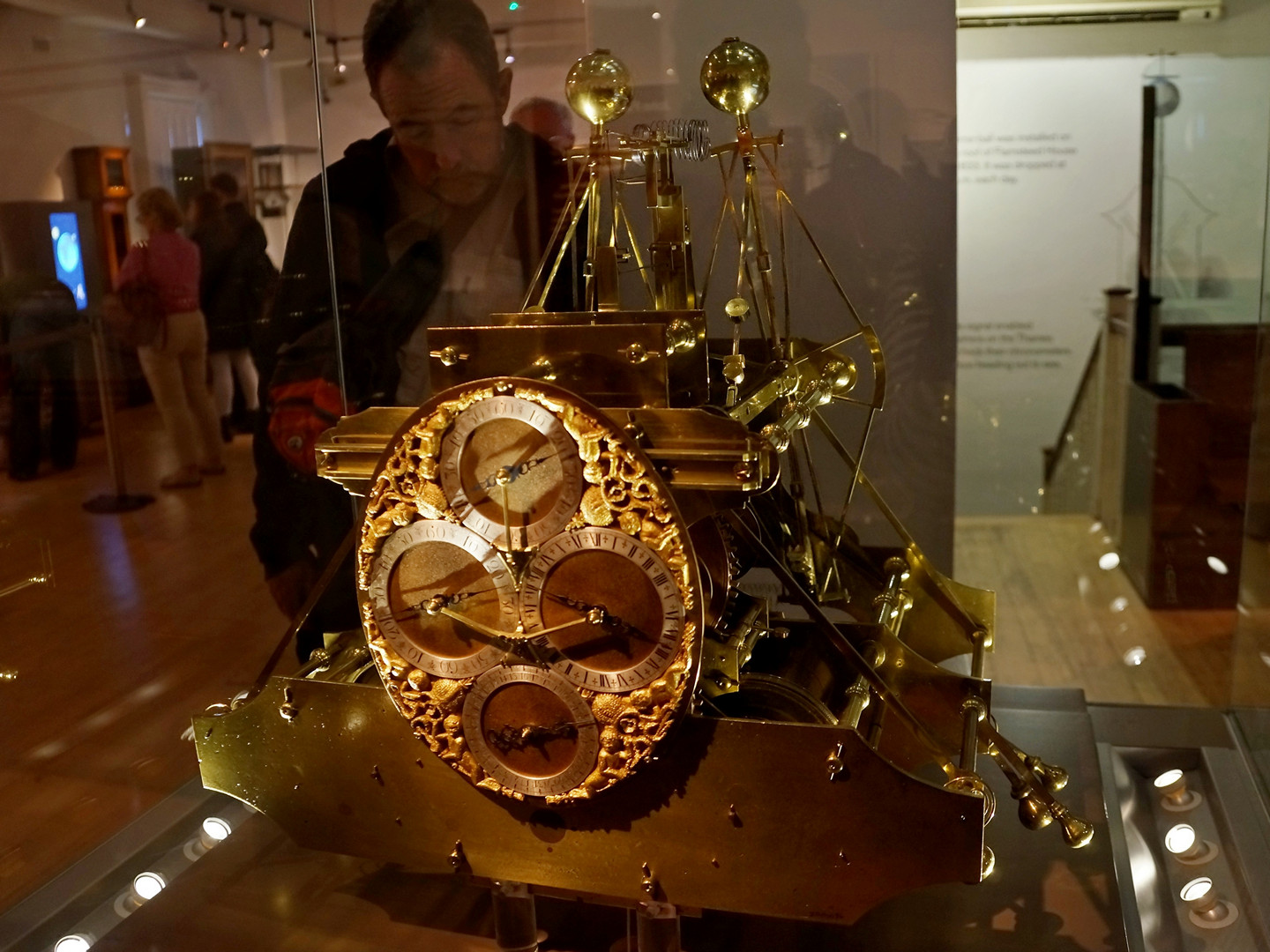
John Harrison's Marine Timekeepers, H1 to H4
H1, 1730-1735. H2, 1737-1739. H3, begun 1740 and worked on... · H1
National Maritime Museum, Greenwich, on display at the Royal...
Museum · Founded 1934
Open, admission and hours confirmed 11 September 2026 · 23 sources
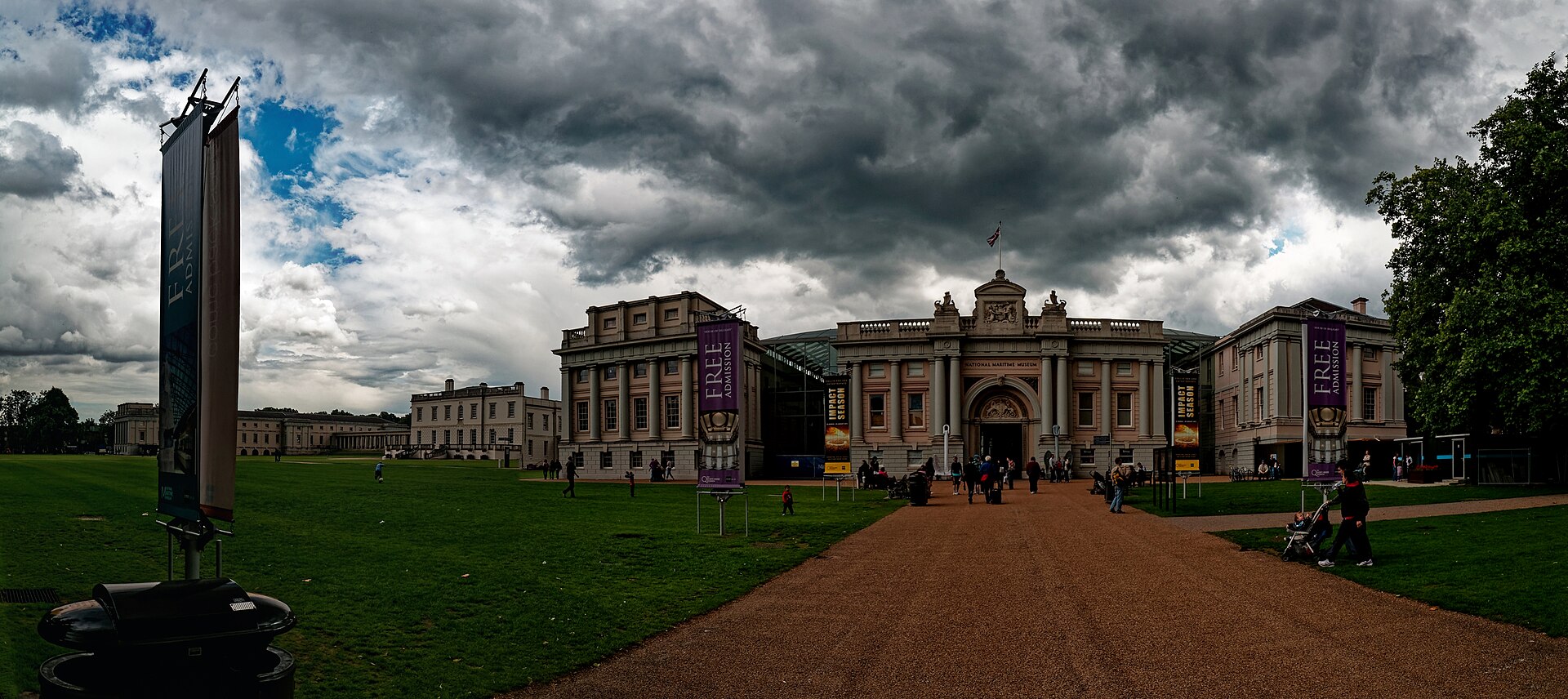
More than two million objects, described by the museum and by outside guides alike as the largest maritime collection in the world: paintings, ship models, navigational instruments, charts, manuscripts and uniforms spanning Britain's naval and mercantile history from the Tudor period to the present. It is not a collection built around a single artist or period the way a picture gallery is; it is built around a subject, and the subject is the sea as Britain used it, fought over it and was shaped by it, with the consequences for the countries on the other side of that history given their own galleries rather than left out of the building.
| Kind | Museum |
|---|---|
| Founded | Founded by the National Maritime Museum Act 1934 and opened to the public by King George VI on 27 April 1937. Its oldest buildings, the west and east wings and colonnades, were built in 1807-1816 by Daniel Alexander as an extension to the Royal Naval Asylum, later the Royal Hospital School. |
| City and country |  London, United Kingdom London, United Kingdom |
| Address | Romney Road, Greenwich, London SE10 9NF, United Kingdom |
| Website | rmg.co.uk/national-maritime-museum |
| Status | Open, confirmed 11 September 2026 |
| Record last verified | 11 September 2026 |
Prices and hours change. We take them from the institution's own pages and print the day we read them, and you can check the current position at the source we used. Confirm before you travel.
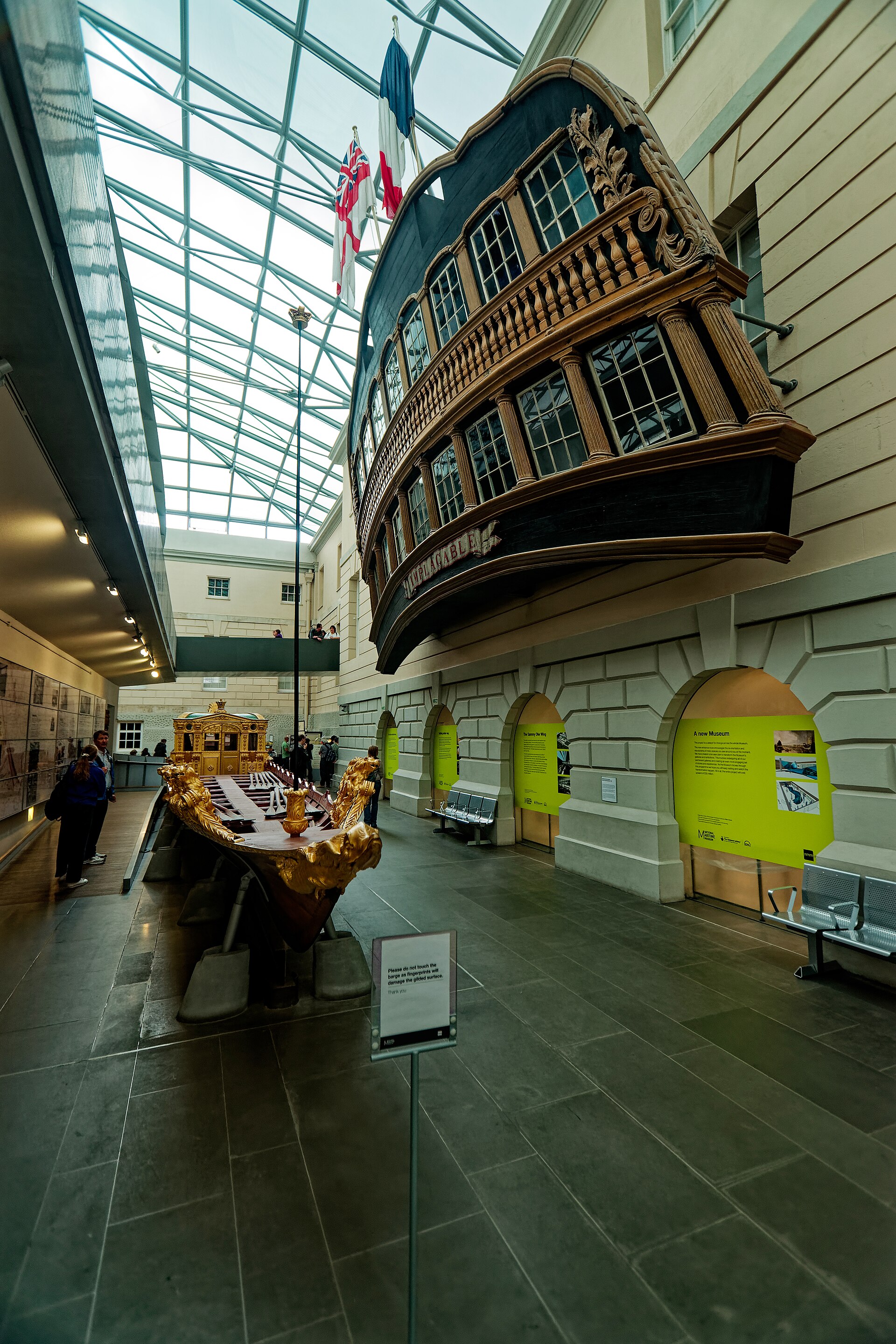
The glass-roofed central court of the museum, redeveloped from a covered courtyard in 1996-1999 and refitted again through the early 2020s, finishing in 2025, when it was renamed from Neptune Court to Ocean Court and repainted with a mural of deep-sea currents. Its centrepiece is the Ocean Map (renamed from the Great Map in the same 2025 refit), a 440-square-metre walk-on printed floor map built from digital seafloor survey data and set out on the Spilhaus Projection, a cartographic system centred on the connected ocean rather than the continents; with the gilded Prince Frederick's Barge of 1732 moored beside it and the reconstructed stern of HMS Implacable, captured at Trafalgar, suspended above, and the museum's own current page for the court names both as returning objects.
The museum's account of the 18th-century navy and Horatio Nelson, built around the uniform coat he was wearing when he was fatally wounded at Trafalgar in 1805, alongside the story of the navy's rise as an instrument of British power.
Opened in 2007 to mark 200 years since the abolition of the British transatlantic slave trade, this gallery covers the triangular trade, the Middle Passage and the resistance and abolition movements, naming figures including Olaudah Equiano, Mary Prince, Nanny of the Maroons and Sanite Belair among the enslaved and formerly enslaved, alongside the slave trader John Hawkins and the abolitionists William Wilberforce and Thomas Clarkson. The museum updated its content and interpretation again in 2024-25 with an expert advisory board, adding a digital trail on women's roles in resistance and installing a database of documented shipboard revolts.
Two hundred and fifty years of trade between Britain and Asia conducted through the East India Company, presented alongside the Company's colonial reach and the disputes that trade produced.
Pacific islander history and material told with Pacific communities rather than about them, centred on Adi Yeta, a Fijian sailing drua built in 2014-15 by a Fijian team, and taonga made by Ngati Rangiiwaho of Aotearoa New Zealand. Its own text panels raise, without resolving, the question of whether Pacific objects held in European museums should be returned.
Arctic and Antarctic exploration history told alongside Inuit and other indigenous perspectives on the same places, including contemporary video and music, and framed against present-day climate change in the polar regions.
The clocks that solved the problem of finding longitude at sea. H2, H3 and H4 are the originals; H1 is undergoing conservation at the Prince Philip Maritime Collections Centre and a replica stands in its place. All four are displayed at the Royal Observatory Greenwich, not in the main museum building.8
Full record in this archiveThe coat Nelson was wearing when he was fatally wounded aboard HMS Victory at Trafalgar, and the centrepiece of the Nelson, Navy, Nation gallery.6
A gilded royal ceremonial barge built for Frederick, Prince of Wales, on loan to the museum from King George VI since 1951 and now moored beside the Ocean Map in Ocean Court.16
Fought at Trafalgar under the French flag, escaped, and was captured a month later; her carved stern was saved at the museum's own founding donor Sir James Caird's expense and finally displayed, reassembled, when Neptune Court opened in 1999.15
A 440-square-metre walk-on floor map set out on the Spilhaus Projection, an ocean-centred cartographic system devised in the 1940s, at the heart of Ocean Court; visitors can walk and run across it and hunt for 20 hidden sea creatures set into the design.17
A Fijian sailing drua built for the museum's Pacific Encounters gallery by Fijian builders, one of the few objects in the museum made specifically for it rather than collected.6
Turner's largest painting and the biggest picture in the Royal Museums Greenwich collection, commissioned for St James's Palace and controversial on its first showing for compressing several moments of the battle into one scene. The museum's own object record lists its display location as the Queen's House, not this building; a visitor who wants to see it in person needs the free Queen's House next door, not the National Maritime Museum galleries.19
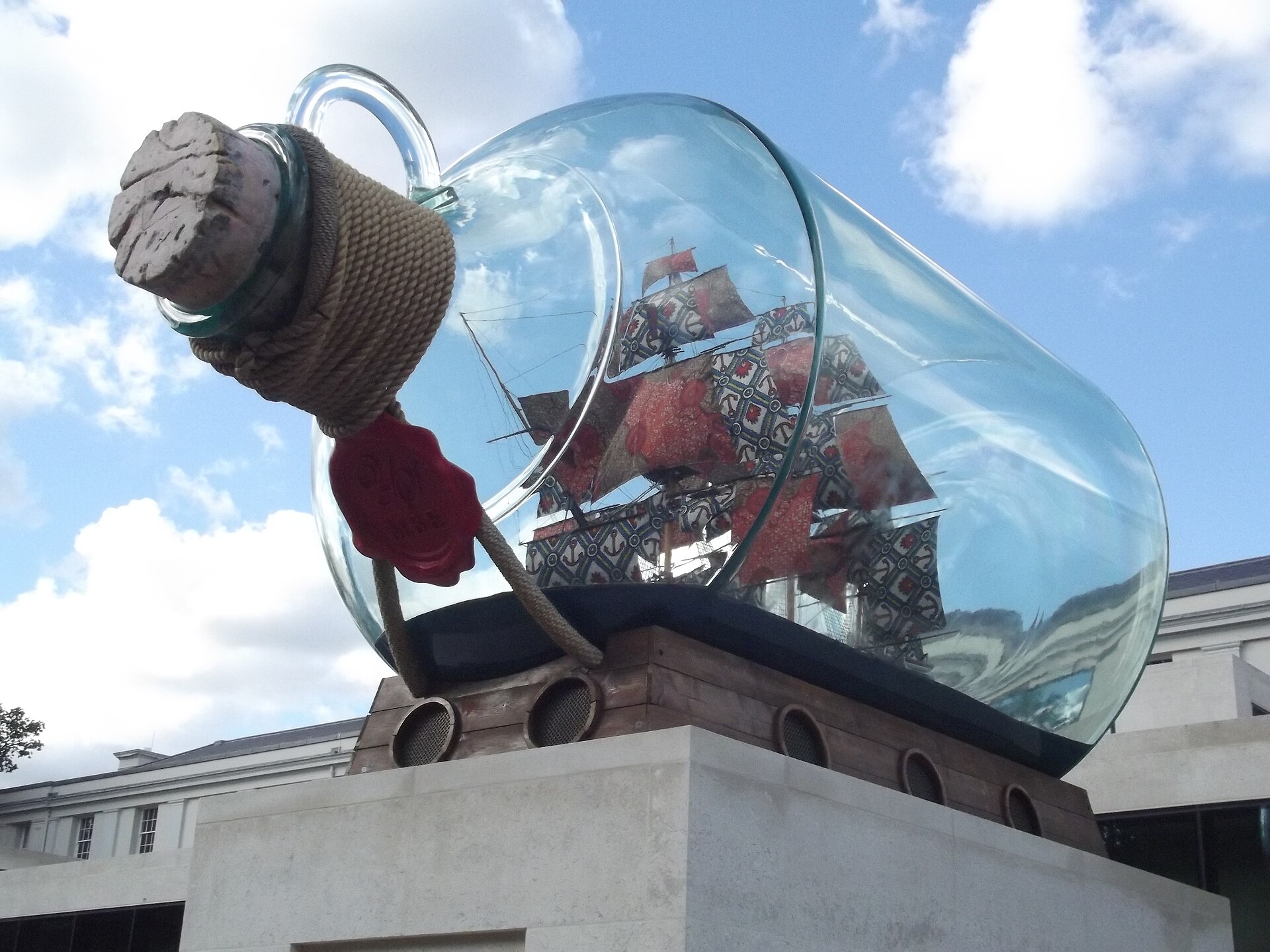
Originally the Fourth Plinth commission in Trafalgar Square, a scale model of HMS Victory in a giant bottle with sails made from Dutch wax-print textile; acquired by the museum and permanently installed outside its entrance in 2012.16
H1, 1730-1735. H2, 1737-1739. H3, begun 1740 and worked on... · H1
National Maritime Museum, Greenwich, on display at the Royal...
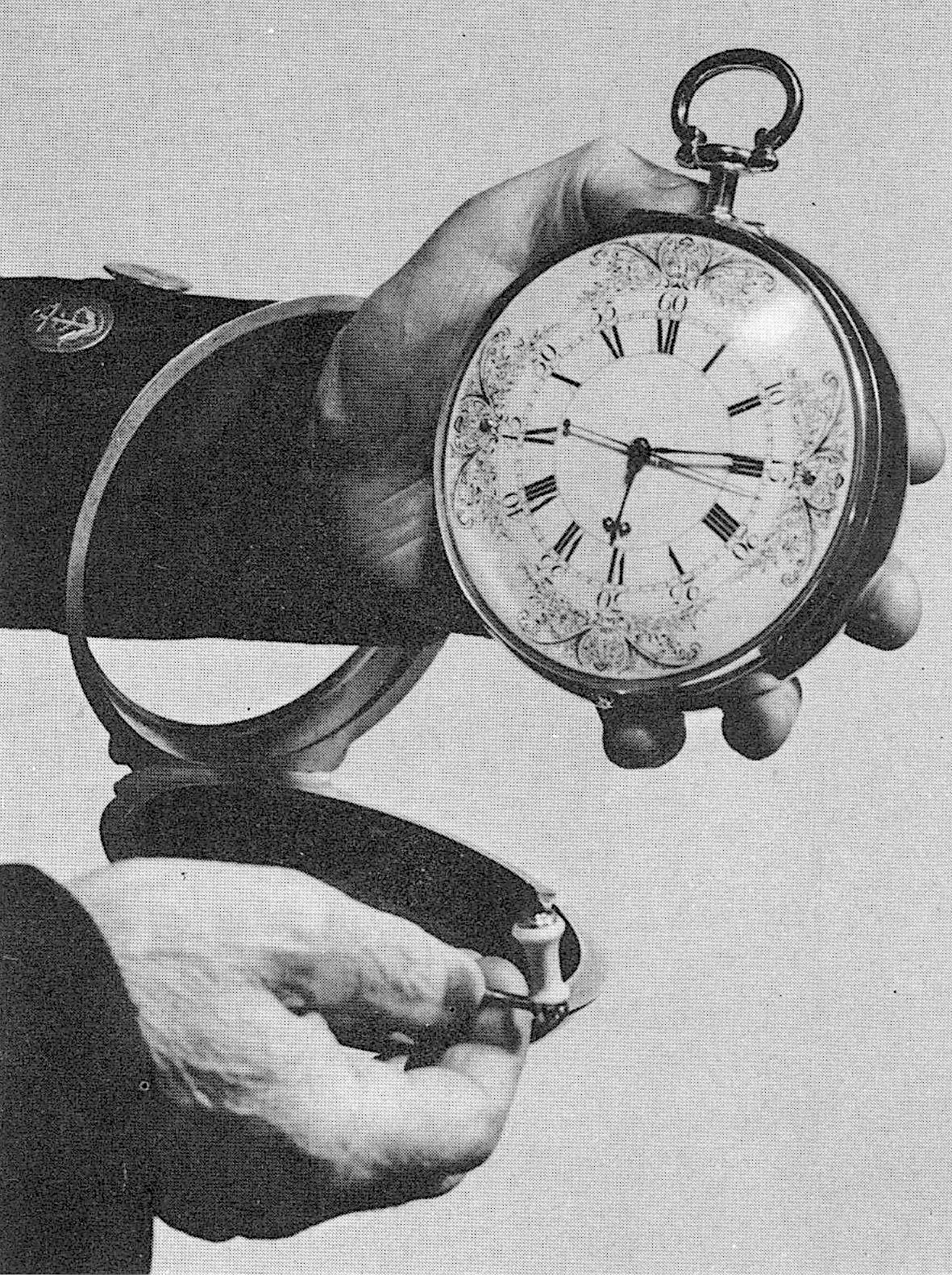
1766-1769 · Brass fusee movement with verge escapement...
National Maritime Museum, Greenwich
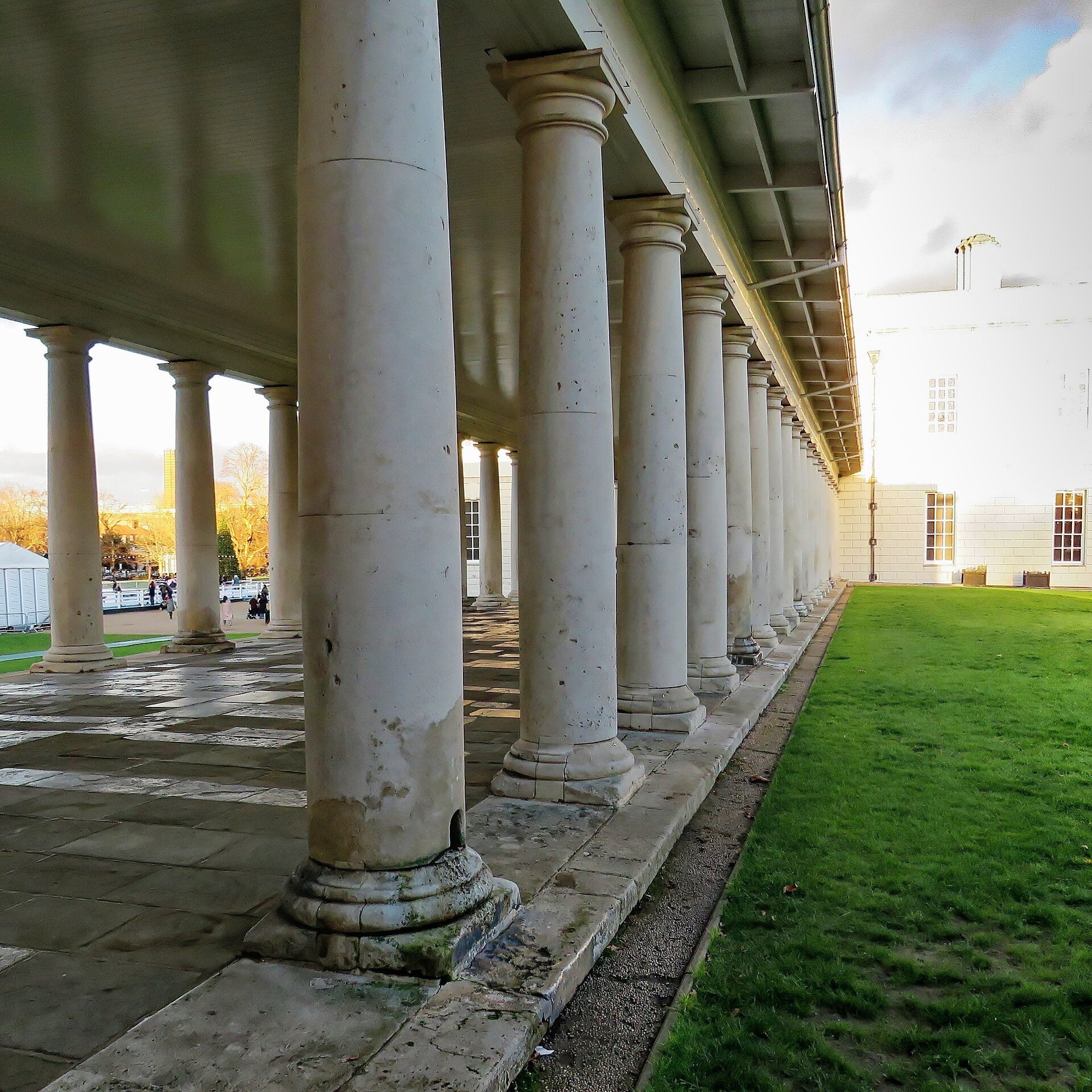
The museum's oldest fabric was not built to hold a collection. The west and east wings and the colonnades that frame the entrance were put up in 1807-1816 by the architect Daniel Alexander as an extension to the Royal Naval Asylum, a charity school for the children of seamen that had recently taken over the Queen's House next door. The school was renamed the Royal Hospital School and stayed on the site until 1933, when it moved out to Holbrook in Suffolk and freed the buildings for a different use.
That different use had already been argued for. In 1927 the Society for Nautical Research launched a public campaign for a national naval and nautical museum, and the name it settled on, the National Maritime Museum, was suggested by the writer Rudyard Kipling, a Society member. The campaign's decisive figure was Sir James Caird, a shipping magnate who bought the A. G. H. Macpherson collection of more than 11,000 maritime prints and ship models and gave it to form the core of the new museum's holdings; the museum's library and archive still carry his name. Parliament passed the National Maritime Museum Act in 1934, establishing a Board of Trustees to hold the collection in trust for the public, and on 27 April 1937 King George VI formally opened the museum, with Princess Elizabeth at his side and Sir Geoffrey Callender as its first director. The museum has occupied a former naval school for longer than the school itself did.
The National Maritime Museum is one of four sites the public body Royal Museums Greenwich runs on and around this stretch of the Thames: this museum, the Queen's House next door, the clipper ship Cutty Sark on the riverfront, and the Royal Observatory Greenwich on the hill above the park. All four sit inside the Maritime Greenwich UNESCO World Heritage Site, and the trust that runs them reports 2,198,914 visits across the group in 2024-25. Entry to the permanent collections of the National Maritime Museum and the Queen's House is free, with no conditions, and the museum only asks that a visitor book a timed slot online to help it manage numbers; the Royal Observatory and Cutty Sark are ticketed, and so is any special exhibition or the Observatory's planetarium.
The price of the ticketed sites moves with the calendar. As of August 2026 the museum's own prices page lists a summer sale running to 2 September 2026: an adult ticket to the Observatory or to Cutty Sark is GBP 18, against a standard price of GBP 24 for the Observatory and GBP 22 for Cutty Sark once the sale ends; a combined Royal Museums Greenwich Day Pass covering both is GBP 30 on sale against a standard GBP 38. Visitors receiving Universal Credit and several other named benefits can buy any ticket, to any site, for a flat GBP 3. None of this touches the museum itself, which stays free before, during and after the sale: the complication belongs entirely to its two ticketed siblings.
Until the late 1990s the space at the centre of the museum's two historic wings was an open service courtyard. Between 1996 and 1999 it was enclosed under a steel and glass roof and reopened as Neptune Court, the museum's largest single development to that date. In 2011 the museum added the Sammy Ofer Wing, named for the shipping magnate whose GBP 20 million gift, announced in 2008, paid for new galleries and public space alongside the historic courtyard. A further refurbishment replaced the courtyard's roof and reworked its ground floor through the early 2020s, finishing in 2025, when the space was renamed once more, from Neptune Court to Ocean Court, and its old walk-on floor map, the Great Map, was itself replaced and renamed the Ocean Map as part of the same refit.
Some of what stands in the court has not changed as often as its name or its floor. Prince Frederick's Barge, a gilded royal ceremonial barge built in 1732 to a design by William Kent for Frederick, Prince of Wales, has been on loan to the museum from King George VI since 1951, and the museum's own current page for the space names the stern of a Trafalgar ship among the returning objects a visitor will still find there: the reconstructed stern of HMS Implacable, a French 74-gun ship built as the Duguay-Trouin in 1800 that fought at Trafalgar under the French flag, escaped the battle, and was captured a month later in the Bay of Biscay. When the Royal Navy finally scuttled the old ship in 1947, the same James Caird who had founded the museum's collection had already paid to have her carved stern cut away and sent to Greenwich; it sat unassembled for fifty years until the Neptune Court project gave it somewhere to hang.
The Atlantic Worlds gallery opened in 2007, timed to the two-hundredth anniversary of the abolition of the British transatlantic slave trade. It sets out the triangular trade, the Middle Passage, and the resistance and abolition movements; the museum's own gallery page names Olaudah Equiano, Mary Prince, Nanny of the Maroons and Sanite Belair among the enslaved and formerly enslaved people who resisted or wrote against the trade, alongside the slave trader John Hawkins and the abolitionist campaigners William Wilberforce and Thomas Clarkson on the other sides of the argument. The museum draws on a Transatlantic Voyages database that records 485 acts of documented resistance by captive Africans aboard slave ships between 1698 and 1807, and states that British ships alone carried 3.4 million African people to the Americas over the trade's history. In its 2024-25 annual report the museum records working with an outside advisory board to update the gallery's content and interpretation again, adding a digital trail on women's roles in resistance and installing the slave voyages database on site; a separate Unlocking Collections project that year generated 250 new catalogue records naming people of colour, drawing on 25 volunteers, across the museum's historic photograph holdings.
Reviewing the gallery on its opening for the trade journal Museums Journal, Caroline Worthington, then director of the Florence Nightingale Museum, praised the museum for confronting the brutality of slavery rather than softening it, but found the gallery's layout gave no clear route through the space and judged that it tried to tell too many stories in one room for any single one to stay with a visitor. From the opposite direction, the historian David Abulafia argued in a January 2024 piece for History Reclaimed and The Spectator that the museum's rework of the neighbouring Nelson, Navy, Nation gallery imports present-day arguments about race onto an 18th-century career, and that Atlantic Worlds gives so much weight to the cruelty of slavery that it leaves too little room for how Britain came to hold its Caribbean territories in the first place. The museum's own Pacific Encounters gallery, on the same floor, raises a related and still more direct question without resolving it: a text panel there states plainly that some people question whether Pacific objects held in European museums, including this one, belong there or should be returned. The museum publishes the question. It does not publish an answer.
Not everything Royal Museums Greenwich holds is inside this building, and the clearest case is also one of the most requested. John Harrison's four marine timekeepers, H1 to H4, the clocks that solved the problem of finding longitude at sea across four decades of Harrison's working life, are displayed at the Royal Observatory Greenwich, on the hill above the park, inside the Time and Longitude gallery, not in the National Maritime Museum building this page describes. H2, H3 and H4 on show there are Harrison's originals; H1, the first and least refined of the four, is currently undergoing conservation at the museum's Prince Philip Maritime Collections Centre, and a full-scale replica, built in 1970, stands at the Observatory in its place while the work continues. A visitor who wants to see the object this archive's Harrison record describes needs a ticket to the Observatory, not to the free museum on Romney Road; the two sites are a steep walk apart inside the same park, and it is the single easiest mistake to make when planning a visit to see them.
We publish no visitor review prose and cite ratings only as a tertiary figure, so what follows is drawn from the museum's own reporting and aggregate platform data. Royal Museums Greenwich recorded 2,198,914 visits in 2024-25 across its sites, and the National Maritime Museum trades on being free where the Observatory and Cutty Sark are not: reviewers consistently single out the free entry to the main museum and the Queen's House as the best-value part of a visit that gets considerably more expensive once a visitor adds the other two sites.
Tripadvisor: 4.3 from 2,935 ratings, read 6 August 2026
A platform average is a tertiary source: it moves, it is not audited, and we quote no visitor's words.
Romney Road, Greenwich, London SE10 9NF, United Kingdom.
National Maritime Museum, Adult: free; Queen's House, Adult: free; Royal Observatory Greenwich, Adult: GBP 24; Royal Observatory Greenwich, Child 4-15: GBP 12; Cutty Sark, Adult: GBP 22. As confirmed 11 September 2026.
Daily 10:00-17:00; Daily 10:00-17:00; Daily 10:00-17:00; Daily 10:00-19:00. Closed: All Royal Museums Greenwich sites are open 362 days a year; the museum's own reporting does not itemise the 3 closed days on the public hours page. As confirmed 11 September 2026.
Rail: Greenwich station, a short walk across Romney Road and Greenwich Park; DLR: Cutty Sark for Maritime Greenwich station; Rail: Maze Hill station, close to the Park Row side of the museum; River: Greenwich Pier, on the Thames Clippers river bus route.
John Harrison's Marine Timekeepers, H1 to H4 (John Harrison, built 1730-1759); Nelson's Trafalgar uniform coat (Unknown tailor, worn by Horatio Nelson, 1805); Prince Frederick's Barge (Designed by William Kent, built by the shipwright John Hall, 1732); The reconstructed stern of HMS Implacable (Built as the French Duguay-Trouin, Rochefort, 1800); The Ocean Map (Royal Museums Greenwich, installed in the 2025 Ocean Court refit, replacing the earlier Great Map); Adi Yeta (Built by a Fijian team, 2014-2015).
One artwork and its story every Tuesday, with the picture: who owned it, what it made, and what closes soon in the exhibition calendar. No promotion, and nothing we cannot cite.
We send one email to confirm the address and keep nothing else. Every letter carries a one-click unsubscribe. How we handle your data.