K1 Marine Chronometer
Larcum Kendall · 1766-1769
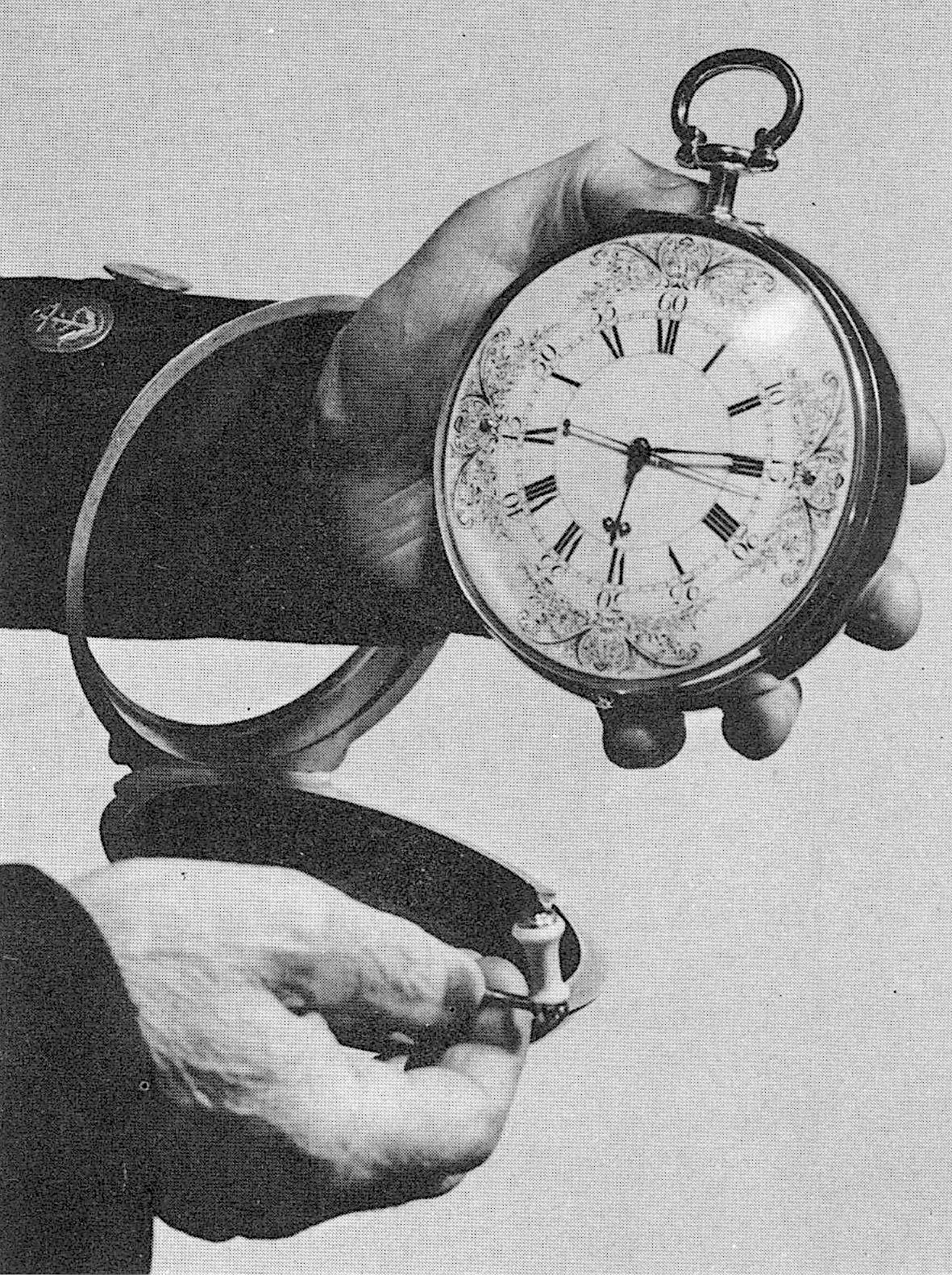
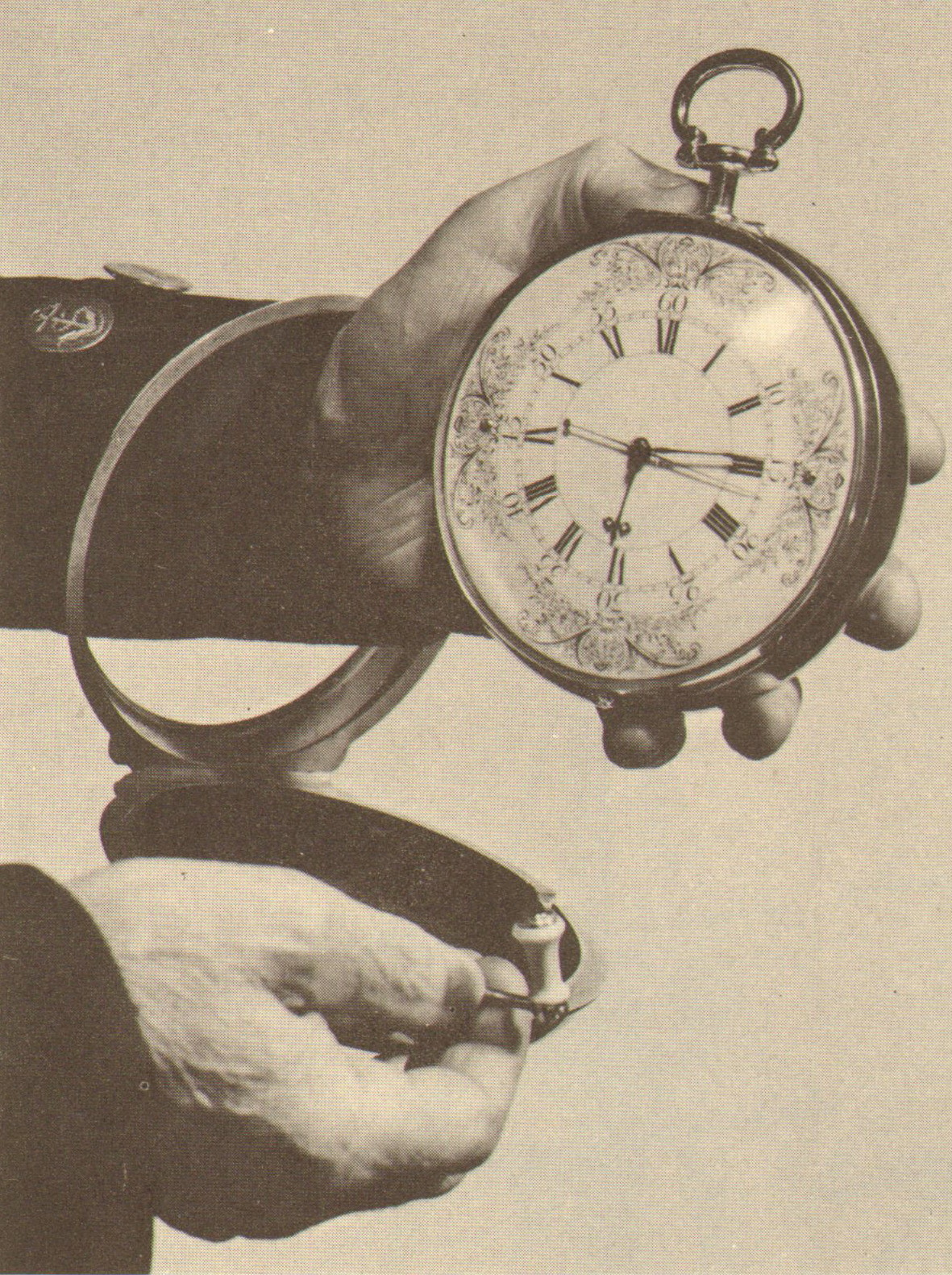
K1, photographed by staff of the National Maritime Museum around 1969 and printed in Basil Greenhill's 'James Cook: The Opening of the Pacific' (HMSO, 1970). This version has been contrast-enhanced from the original scan. UK Crown photography from before 1975 is public domain.
| Artist | Larcum Kendall |
|---|---|
| Date | 1766-1769 |
| Medium | Brass fusee movement with verge escapement and diamond pallets, in a silver pair case, with a white enamel dial |
| Dimensions | 165 x 124 x 28 mm overall (case); 102 mm dial diameter; weight approximately 1.45 kg |
| Where it is now | National Maritime Museum, Greenwich (Royal Museums Greenwich)last confirmed |
| Inventory number | ZAA0038 |
| Attribution | AcceptedSigned and dated on the movement plate, 'Larcum Kendall LONDON 1769', and documented in the surviving papers of the Board of Longitude, which commissioned it from him by name in 1766. Full note |
| Object type | Clocks and instruments |
| Period | English, eighteenth century |
| Cases | Restituted or repatriated · Has a provenance gap |
| Inscriptions | 'Larcum Kendall LONDON 1769' engraved on the movement plate. Case maker's mark 'P.M' (Peter Mournier, Frith Street, Soho). London hallmarks for 1769-70 on the silver case. |
| Owners on record | 12 links11 documented, 1 unknown |
| Sources | 18 cited |
About this record Last verified · 18 sources cited · Change log
On this page 9 sections
ContentsClose
K1 is not Harrison's watch. It is Larcum Kendall's exact paid copy of it, commissioned in 1766 by the Board of Longitude to settle a question the Board itself had raised: could anyone but Harrison build a timekeeper this accurate. Kendall's answer went to sea with Captain Cook on two Pacific voyages, sailed with the First Fleet to found the British colony at Sydney Cove, survived the wreck of its own ship on a reef at Norfolk Island, crossed the Pacific and the Atlantic to get home, then went back to sea for four more years of war service that ended at the Battle of Cape St Vincent.
K1 is routinely confused with two other objects: Harrison's own H4, which it copies and resembles by design, and Kendall's own second chronometer K2, which is the Kendall watch actually carried aboard HMS Bounty and taken to Pitcairn Island after the 1789 mutiny. This record covers K1 alone, and states plainly, at the point where the confusion usually happens, which object did which thing.
All three Kendall chronometers, and Harrison's H1 to H4, are held today by the National Maritime Museum in Greenwich. None has ever been sold; K1 was Crown and state property from the day it was handed to the Board of Longitude in January 1770, and it still is.
Provenance
Each link is graded. Documented: a cited source supports it. Disputed: the identification is argued but not established. Unknown: no owner for that span, and the gap is not smoothed into a narrative. The grades in the glossary.
- 1765 - 1766The Board of Longitudedocumented
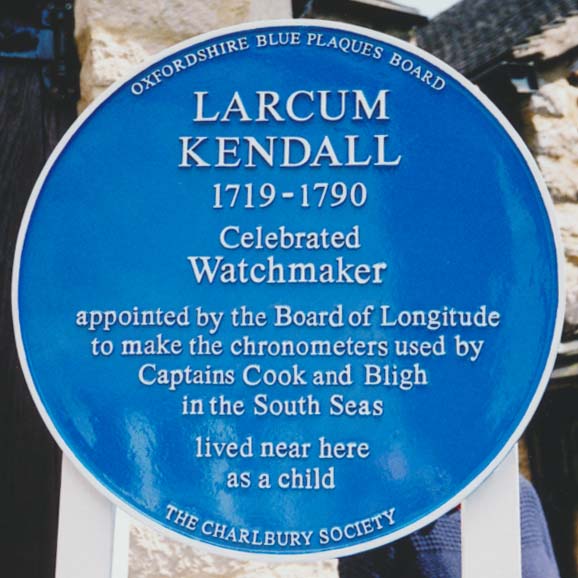
Kendall was one of six experts selected by the Board of Longitude in 1765 to examine and witness the operation of John Harrison's H4. He was subsequently commissioned to build a duplicate of it, so that the Board could establish whether H4's performance depended on Harrison alone or could be repeated by another maker.45
- 1766 - 1770-01-13The Board of Longitudedocumented
Kendall built K1 as an exact reproduction of H4 over roughly three years, engraving it 'Larcum Kendall LONDON 1769'. It was presented to the Board of Longitude on 13 January 1770. He was paid 450 pounds for the copy plus a further 50 pounds for fine adjustment and for servicing Harrison's original H4 at the same time. K1 was state property from this point on; it has never been privately owned or sold.1456
- 1772 - 1775Board of Longitude, in the custody of Captain James Cookdocumented
Issued to Cook for his second voyage of discovery aboard HMS Resolution. Astronomer William Wales used it operationally to fix longitude. Three chronometers by John Arnold carried on the same voyage all failed; K1 did not, and Cook's published praise for it settled the Navy's view of Kendall's copy.146
- 1776 - 1780Board of Longitude, in the custody of Captain James Cookdocumented
Issued again to Cook for his third voyage aboard HMS Resolution. In June 1779, off Kamchatka, its balance spring broke and the watch stopped; it was later returned to Kendall for repair. Cook was killed at Kealakekua Bay in February 1779, during this same voyage, before the repair.467
- 1787-05 - 1788-01-18Board of Longitude, in the custody of the First Fleetdocumented
Embarked on HMS Sirius, flagship of the First Fleet under Captain John Hunter, which sailed from Portsmouth on 13 May 1787 under the overall command of Governor Arthur Phillip to found a British penal colony in New South Wales. The fleet took possession of the land at Sydney Cove on 26 January 1788, on country belonging to the Gadigal clan of the Eora nation, beginning a colonisation that brought violent conflict and, within fifteen months, a smallpox epidemic that killed an estimated 50 to 90 percent of the local Aboriginal population.4689
- 1788 - 1788William Dawes, on land at Sydney Covedocumented
Used for some months on land by Lieutenant William Dawes, who built an observatory on the western point of Sydney Cove, subsequently known as Dawes Point and originally named Point Maskelyne after the Astronomer Royal, who had supplied Dawes with instruments and instructions. The observatory's stated purpose was to help fix the colony's longitude.412
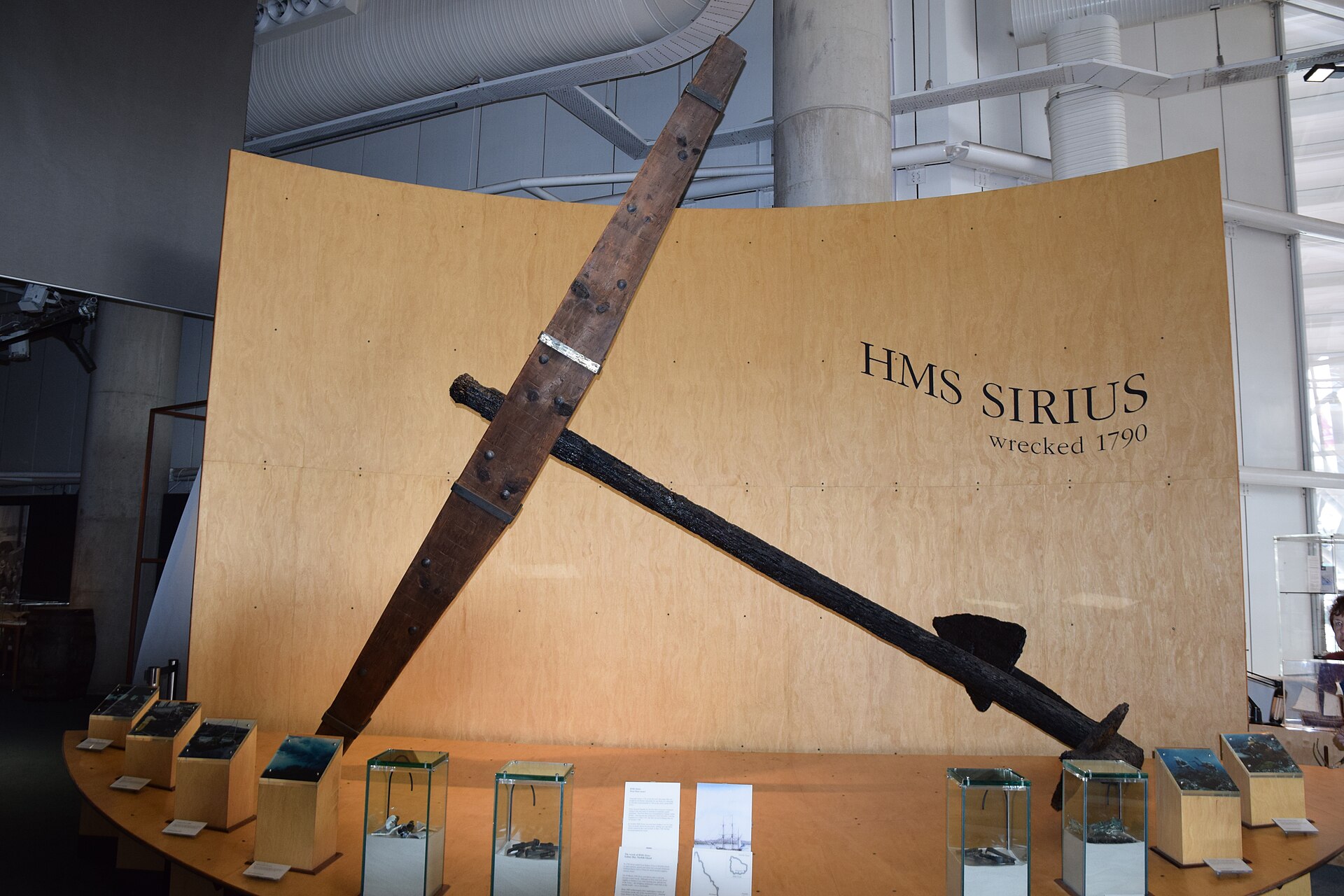
- 1788 - 1790-03-19Board of Longitude, in the custody of HMS Siriusdocumented
Rejoined HMS Sirius for a resupply voyage to Cape Town. On 19 March 1790 the ship was wrecked on a reef while landing stores at Norfolk Island. All crew reached shore safely and most of the stores, including K1, were salvaged from the wreck.4710
- 1790-03 - 1792-04Board of Longitude, in transitdocumented
Transferred to the armed tender HMS Supply, which carried it to Batavia and then home around Cape Horn, reaching Plymouth in April 1792, more than two years after the Sirius wreck.47
- 1793 - 1797-02-14Board of Longitude, in the custody of Admiral Sir John Jervisdocumented
Went back to sea with Admiral Sir John Jervis, serving in the West Indies and then the Mediterranean. Aboard HMS Victory at the Battle of Cape St Vincent, 14 February 1797.46
- 1797 - 1802Board of Longitude, in naval serviceunknown
The interval between the Battle of Cape St Vincent and K1's retirement from sea service in 1802 is not detailed in the sources consulted; a continuous naval posting is implied but not itemised.4
- 1802 - 1937Board of Longitude, then the Royal Observatory, Greenwichdocumented
Retired from active service and returned to Greenwich in 1802. It remained state property in the custody first of the Board of Longitude, which was abolished in 1828, and subsequently of the Royal Observatory, Greenwich. The precise date on which it entered what is now the National Maritime Museum's own collection, as distinct from the Observatory's, is not established in the sources consulted.4
- 1937 - presentNational Maritime Museum, Greenwich (Royal Museums Greenwich)documented
Held in the Timekeeping collection, inventory ZAA0038, credited to the National Maritime Museum, Greenwich. Not currently on display. Its silver case was rhodium plated during a conservation intervention in the 1940s; the museum records the movement as in fine, original, working condition.1
Technical evidence
| Attribution note | Signed and dated on the movement plate, 'Larcum Kendall LONDON 1769', and documented in the surviving papers of the Board of Longitude, which commissioned it from him by name in 1766. No attribution dispute exists. |
|---|---|
| Case | Silver pair case with stirrup bow, made by Peter Mournier of Frith Street, Soho (case mark 'P.M'), hallmarked London 1769-70. Rhodium plated during a 1940s conservation intervention, with minor surface scratching noted.1 |
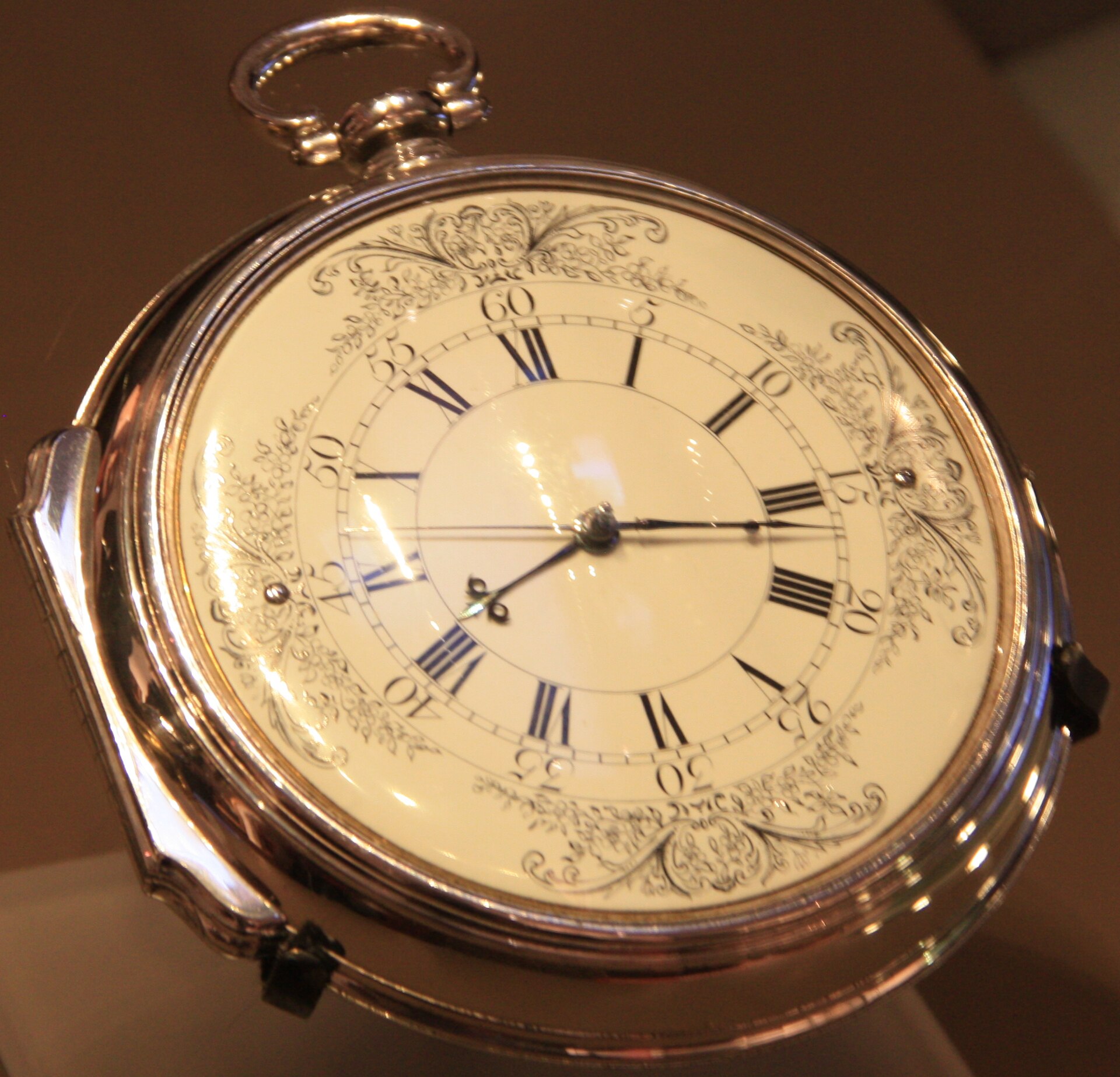
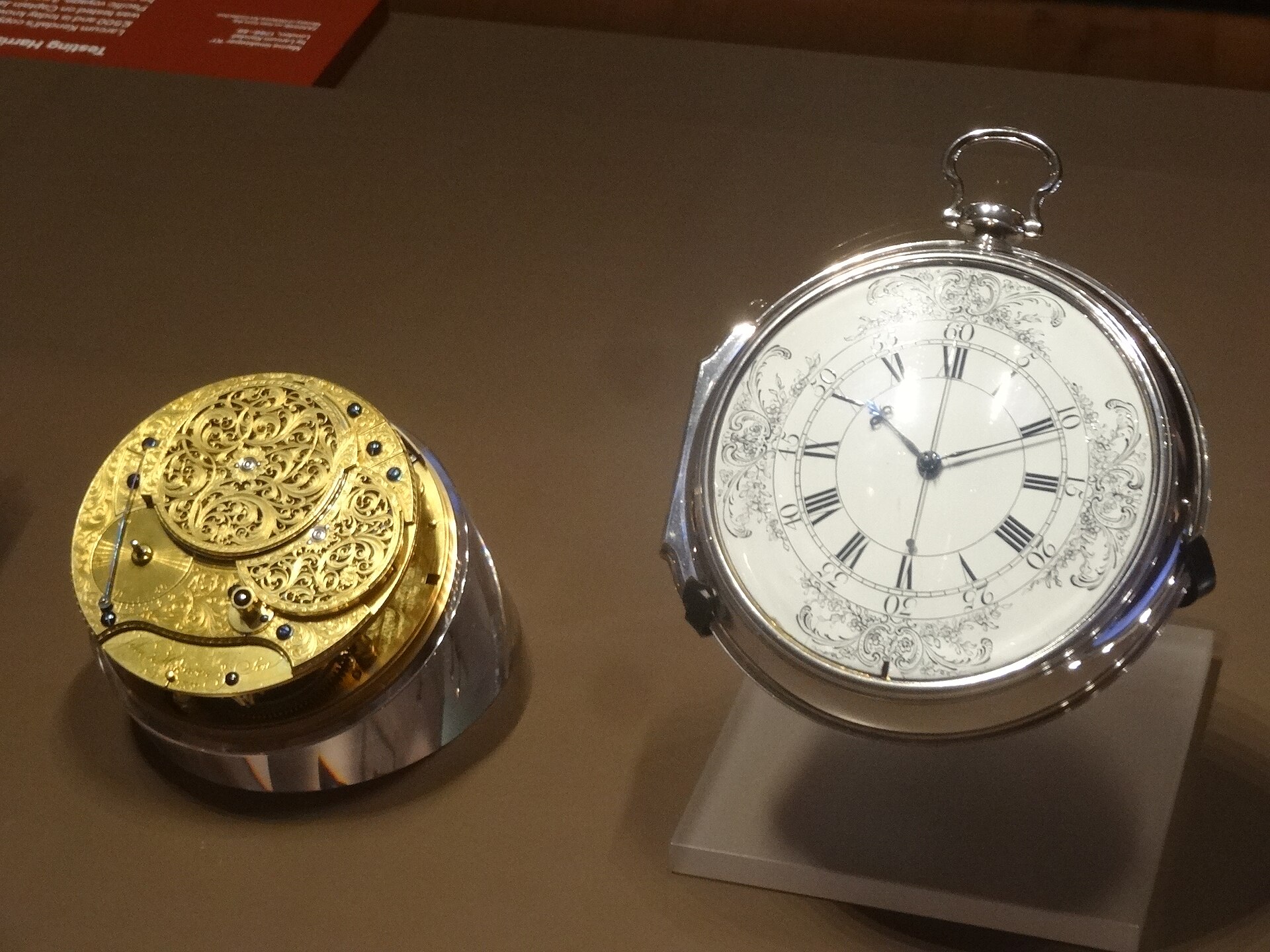
| Dial | White enamel, 102 mm diameter, with scrolling decoration at the quarters, Roman numeral hours, Arabic ten-minute markers, beetle-and-poker hands and a subsidiary seconds pointer.1 |
| Movement | Brass one-day full-plate fusee movement with four turned pillars and a highly engraved slide plate.1 |
| Escapement | Harrison's adapted verge escapement with diamond pallets, acting against a hardened steel escape wheel.1 |
| Balance | Hardened steel balance wheel carrying a three-turn blued steel spiral spring, with a diamond upper endstone.1 |
| Train and maintaining power | Four-wheel train plus great wheel, with a remontoir at the fourth wheel working alongside Harrison's maintaining power system, keeping torque to the escapement constant as the mainspring runs down.1 |
| Jewelling | Endstones fitted to the balance, escape wheel, contrate wheel and third wheel, in addition to the diamond escapement pallets.1 |
| Dimensions and weight | 165 x 124 x 28 mm overall (cased); 102 mm dial diameter; approximately 1.45 kg, matching H4's own scale.14 |
| Inscription | 'Larcum Kendall LONDON 1769' engraved on the movement plate.1 |
Images
The record in full
Chapter 1A copy, not the original, and the difference matters
K1 is a marine chronometer completed in 1769 by the London watchmaker Larcum Kendall.
K1 is a marine chronometer completed in 1769 by the London watchmaker Larcum Kendall. It is not John Harrison's H4, though it was built to look and work as much like H4 as Kendall could manage, and the two are still confused in captions and photograph credits today. Harrison built H4 himself, over decades, to answer the longitude problem in his own way. Kendall built K1 to order, for a fixed fee, on a three-year commission from the Board of Longitude, whose purpose was to find out whether Harrison's success could be repeated by somebody else.
That distinction is the whole reason K1 exists. If the Board's only question had been whether a sea watch could keep time well enough to fix longitude, H4 had already answered it on Harrison's own trials. The Board's second, harder question was whether the achievement could be turned into a trade: whether an ordinary skilled maker, working from Harrison's design rather than his intuition, could build another instrument that performed the same way. K1 is that second answer, and this record is about K1's own working life at sea, not about H4's.
Chapter 2The commission: six witnesses, one duplicate
In 1765 Kendall was one of six watchmaking and instrument-making experts selected by the Board of Longitude to examine and witness the operation of Harrison's H4 before the Board decided how, or...
In 1765 Kendall was one of six watchmaking and instrument-making experts selected by the Board of Longitude to examine and witness the operation of Harrison's H4 before the Board decided how, or whether, to reward Harrison and disclose his design. Being chosen for that panel put Kendall in the room with the mechanism itself, at a moment when very few people outside Harrison's own family had seen it run.
The Board's next step, in 1766, was to commission Kendall to build a duplicate of H4. He began work in earnest the following year and delivered the finished watch, engraved 'Larcum Kendall LONDON 1769' on its movement plate, to the Board on 13 January 1770. He was paid 450 pounds for the copy, plus a further 50 pounds for fine adjustment and for servicing Harrison's own H4 at the same time, work that put him in direct, hands-on contact with the original a second time. For comparison, the Royal Navy paid roughly 1,800 pounds around the same period for HMS Resolution, the ship K1 would go on to sail in; K1's price was of the order of a quarter of the cost of the vessel that carried it.
What the Board's written instructions actually specified about how closely Kendall had to reproduce H4, as opposed to being free to alter it, is not stated in any source available for this record. What is documented is the result: K1 came out close enough to H4 in dial, case proportions and movement layout that the two are still mistaken for each other in photographs two and a half centuries later, and Kendall was paid as though an exact copy, not a reinterpretation, was what had been ordered.
Chapter 3Cook's second voyage: the trial that mattered
K1 went to sea for the first time in 1772, issued to Captain James Cook for his second voyage of discovery aboard HMS Resolution, alongside three chronometers built by the rival maker John Arnold.
K1 went to sea for the first time in 1772, issued to Captain James Cook for his second voyage of discovery aboard HMS Resolution, alongside three chronometers built by the rival maker John Arnold. All three of Arnold's watches failed during the voyage. K1 did not. Astronomer William Wales used it operationally throughout the three-year voyage to help fix the ship's longitude, and by the time Resolution returned in 1775 Cook had come to depend on it in terms that made their way into his official reporting: he told the Admiralty that 'Kendall's watch has exceeded the expectations of its most zealous advocate', and in his own journal called it 'our trusty friend the Watch' and 'our never-failing guide the Watch'.
John Gilbert, master of the Resolution, went further, calling K1 'the greatest piece of mechanism the world has ever seen'. The praise belongs to Kendall's watch specifically, made by Kendall, tested at sea by Kendall's contemporaries, not to Harrison's watch by proxy. That is the point of the second voyage's result: it proved the Board's second question, that the achievement could be repeated by another maker, using this specific object.
Chapter 4Cook's third voyage, and a broken spring off Kamchatka
K1 went out again with Cook for his third voyage, once more aboard HMS Resolution, departing in 1776.
K1 went out again with Cook for his third voyage, once more aboard HMS Resolution, departing in 1776. In June 1779, in the North Pacific off Kamchatka, its balance spring broke and the watch stopped running; it had to wait until its return to England to be repaired by Kendall himself. Cook did not live to see that repair. He was killed at Kealakekua Bay in Hawaii in February 1779, several months before the spring failed, so the breakage happened on a voyage that had already lost the captain who had made the watch famous.
A second Kendall instrument, K3, completed in 1774 to a simplified design of Kendall's own rather than as a further H4 copy, sailed on the same third voyage aboard the companion ship HMS Discovery, and went on afterward to serve with George Vancouver on the coast of North America and with Matthew Flinders charting the Australian coast. K1 and K3 are different objects with different careers after this point; where a caption reads simply 'a Kendall chronometer on Cook's third voyage' without saying which one, it is worth checking which ship it names.
Chapter 5The First Fleet: a chronometer sent to help found a colony
In May 1787 K1 left England again, this time aboard HMS Sirius, flagship of the First Fleet under Captain John Hunter, sailing under the overall command of Governor Arthur Phillip to establish a...
In May 1787 K1 left England again, this time aboard HMS Sirius, flagship of the First Fleet under Captain John Hunter, sailing under the overall command of Governor Arthur Phillip to establish a British penal colony in New South Wales. The fleet reached Botany Bay in January 1788 and, on 26 January, took possession of the land at Sydney Cove that the Gadigal clan of the Eora nation had lived on for tens of thousands of years. The colonisation that followed brought violence between the newcomers and the Eora people, mostly over land and food, and within about fifteen months a smallpox outbreak that is estimated to have killed between 50 and 90 percent of the local Aboriginal population. K1's own presence in this story is a navigational instrument doing navigational work; the colony it helped found is not a neutral fact about it, and this record states that plainly rather than passing over it.
On land, K1 was used for some months by Lieutenant William Dawes, who built a small observatory on the western point of Sydney Cove, a site subsequently known as Dawes Point and originally named Point Maskelyne after the Astronomer Royal, Nevil Maskelyne, who had supplied Dawes with instruments and instructions before the fleet sailed. The observatory's declared purpose was to help fix the new colony's longitude relative to Greenwich, the same navigational problem K1 had already been built to solve at sea.
Chapter 6Wrecked, salvaged, and carried home the long way
K1 rejoined HMS Sirius for a resupply voyage to Cape Town, and on 19 March 1790 the ship was wrecked on a reef while landing stores at Norfolk Island.
K1 rejoined HMS Sirius for a resupply voyage to Cape Town, and on 19 March 1790 the ship was wrecked on a reef while landing stores at Norfolk Island. The crew got ashore safely through heavy surf, and most of the ship's stores, K1 among them, were salvaged from the wreck rather than lost with it. The instrument that had already crossed two hemispheres to found a colony very nearly ended its working life on a Pacific reef a few hundred metres from where it had just been landed.
Instead it was transferred to the armed tender HMS Supply, which carried it first to Batavia and then home around Cape Horn, reaching Plymouth in April 1792, more than two years after the wreck and five years after it had left England with the First Fleet. This episode, not the Bounty mutiny, is K1's own genuinely dramatic survival story, and it happened on the same voyage and to the same ship that had carried it out to Australia in the first place.
Chapter 7War service, and Cape St Vincent
K1 did not retire after Norfolk Island. In 1793 it went back to sea with Admiral Sir John Jervis, serving first in the West Indies and then in the Mediterranean, and was aboard HMS Victory at the...
K1 did not retire after Norfolk Island. In 1793 it went back to sea with Admiral Sir John Jervis, serving first in the West Indies and then in the Mediterranean, and was aboard HMS Victory at the Battle of Cape St Vincent on 14 February 1797, one of the Royal Navy's major fleet actions against Spain during the French Revolutionary Wars. The interval between that battle and K1's eventual retirement from active service in 1802 is not itemised in the sources available for this record; a continuous naval posting through those years is implied but not documented in detail here.
Chapter 8Retirement to Greenwich, and an unresolved gap in the record
K1 was withdrawn from sea service in 1802 and returned to Greenwich, ending thirty years of active use that had taken it around both the Cape of Good Hope and Cape Horn, to the Pacific twice with...
K1 was withdrawn from sea service in 1802 and returned to Greenwich, ending thirty years of active use that had taken it around both the Cape of Good Hope and Cape Horn, to the Pacific twice with Cook, to Australia with the First Fleet, and through a shipwreck. Its formal owner throughout had been the Board of Longitude, which was abolished by Act of Parliament in 1828; after that its custody passed to the Royal Observatory, Greenwich.
The National Maritime Museum itself was not established by Act of Parliament until 1934 and did not open to the public until 1937. K1 is now held in the museum's own collection, credited simply to 'National Maritime Museum, Greenwich, London', but the exact date and administrative mechanism by which it passed from the Observatory's holdings into the Museum's is not stated in any source consulted for this record. That is a real gap, not a smoothed-over one, and it is recorded as an open question below rather than bridged with a guess.
Chapter 9K2 and K3: Kendall's own designs, and where the Bounty story actually belongs
Having delivered one exact copy of H4, Kendall told the Board of Longitude that further exact duplicates would remain too expensive to produce in any number, and proposed instead a simplified design...
Having delivered one exact copy of H4, Kendall told the Board of Longitude that further exact duplicates would remain too expensive to produce in any number, and proposed instead a simplified design of his own. K2, completed in 1771-72 for around 200 pounds, was that simplified watch, not a copy of H4 but Kendall's own reworking of the problem. K3, completed in 1774 for around 100 pounds, simplified the design again, at some cost, in later assessments, to the accuracy the Board required.
K2, not K1, is the Kendall chronometer that sailed on HMS Bounty under Lieutenant William Bligh and was taken by Fletcher Christian's mutineers when they seized the ship in 1789. It went with them to Pitcairn Island and disappeared from the historical record for nearly two decades, until the last surviving mutineer, John Adams, gave it up to Captain Mayhew Folger of the American ship Topaz in 1808. From there it passed through Spanish custody at Juan Fernandez, into a private Chilean family's hands, and eventually reached England around 1840, more than fifty years after the mutiny. It is now held alongside K1 at the National Maritime Museum, which is very likely how the two watches come to be confused: they sit in the same collection, share a maker and a naming scheme, and photograph almost identically. K1 itself has no Bounty connection at all.
Chapter 10The object itself, and its casework
K1's movement is a brass one-day fusee, wound daily, built around Harrison's adapted verge escapement with diamond pallets acting against a hardened steel escape wheel, a jewelling scheme extended to...
K1's movement is a brass one-day fusee, wound daily, built around Harrison's adapted verge escapement with diamond pallets acting against a hardened steel escape wheel, a jewelling scheme extended to the balance, escape wheel, contrate wheel and third wheel, each fitted with endstones. The balance wheel itself is hardened steel, carrying a three-turn blued steel spiral spring. A remontoir mechanism at the fourth wheel, working with Harrison's maintaining power system, keeps the force reaching the escapement constant regardless of how far the mainspring has run down, the same problem every precision timekeeper of the period had to solve.
The white enamel dial is 102 millimetres across, with scrolling decoration at the quarters, Roman numeral hours, Arabic ten-minute markers, and beetle-and-poker hands with a subsidiary seconds pointer. The whole movement sits in a silver pair case with a stirrup bow, made not by Kendall himself but by the case specialist Peter Mournier of Frith Street, Soho, whose mark 'P.M' appears on it alongside London hallmarks for 1769-70. Overall the cased watch measures 165 by 124 by 28 millimetres and weighs about 1.45 kilograms, dimensions that made it a watch a man could carry rather than a clock that had to be bolted to a bulkhead, exactly as H4 had been.
The museum's own condition assessment describes the movement as in fine, original, and excellently clean working order, and records that the silver case was rhodium plated during a conservation intervention in the 1940s, leaving only minor surface scratching. No further conservation programme, technical imaging project, or open dataset for K1 was found in the sources consulted.
Chapter 11What is settled, and what is not
K1's sea career, its makers, its ship movements and its two brushes with disaster, the balance spring off Kamchatka and the wreck of the Sirius, are documented across the Board of Longitude's own...
K1's sea career, its makers, its ship movements and its two brushes with disaster, the balance spring off Kamchatka and the wreck of the Sirius, are documented across the Board of Longitude's own records and the Royal Museums Greenwich's collection catalogue, and are not in dispute. What is not documented, in any source available for this record, is the precise legal or contractual language of the Board's original 1766 instructions to Kendall on how exactly he was to copy H4, the administrative details of exactly when K1's custody moved from the Royal Observatory into the National Maritime Museum's own collection, and who specifically carried out the 1940s rhodium plating and under what conservation programme. Those gaps are recorded here as gaps.
The artist
Larcum Kendall
Larcum Kendall was not the inventor of the marine chronometer and never claimed to be. He was the maker the Board of Longitude chose to find out whether Harrison's invention could survive being handed to somebody else, and the watch he built to answer that question, K1, is the reason marine timekeeping became a trade with more than one name in it. His own later chronometers, K2 and K3, show a craftsman who knew his own strength was execution rather than invention, and who said so to the Board rather than pretending otherwise.
Related works
| Work | Relation | Where it is |
|---|---|---|
| H4 John Harrison | The object K1 was commissioned to copy. K1 and H4 are frequently confused with each other in captions; they are different objects by different makers, ten years apart. Covered on this site under the record for Harrison's H1 to H4. | National Maritime Museum, Greenwich |
| K2 Larcum Kendall | Kendall's own simplified second chronometer design, not a copy of H4. This is the Kendall watch actually carried on HMS Bounty and taken to Pitcairn Island after the 1789 mutiny, not K1. Recovered from the last surviving Bounty mutineer, John Adams, in 1808; reached England around 1840. | National Maritime Museum, Greenwich |
| K3 Larcum Kendall | Kendall's further simplified third chronometer, sailed on Cook's third voyage aboard HMS Discovery alongside K1's presence on HMS Resolution. Later used by George Vancouver on the North West American coast and by Matthew Flinders charting the Australian coast. | National Maritime Museum, Greenwich |
| Chronometers by John Arnold carried on Cook's second voyage John Arnold | Rival instruments tested alongside K1 on the same 1772-75 voyage; all three failed while K1 did not. The comparison is what made K1's performance notable to Cook and to the Board. | Not established in sources consulted |
Open questions
- What did the Board of Longitude's 1766 instructions to Kendall actually specify about how closely he had to reproduce H4, as against being free to modify it? The outcome, a very close copy, is documented; the contractual wording is not, in the sources consulted.
- When and by what administrative process did K1 pass from Royal Observatory custody into the National Maritime Museum's own collection after the museum opened in 1937? The 1802 retirement to Greenwich is documented; the transfer into the modern museum's holdings is not dated in the sources consulted.
- Who carried out the 1940s rhodium plating of K1's silver case, and does a conservation record survive beyond the museum's brief summary?
- What happened to K1 between the Battle of Cape St Vincent in February 1797 and its retirement from sea service in 1802? No detailed service record for these five years was found.
- Which specific readings taken by William Dawes at his Sydney Cove observatory in 1788 used K1, as distinct from Dawes's other instruments? He had several; the sources consulted describe K1's presence but not which observations are attributable to it specifically.
- Is there a surviving log or repair record from Kendall's own 1780 repair of the balance spring that broke off Kamchatka in June 1779, and does it establish whether any original 1769 parts were replaced at that time?
Questions about this object
What is K1 Marine Chronometer?
K1 Marine Chronometer is a clocks and instruments, dated 1766-1769. Medium: Brass fusee movement with verge escapement and diamond pallets, in a silver pair case, with a white enamel dial.
Who made K1 Marine Chronometer, and is the attribution settled?
The attribution to Larcum Kendall is recorded here as accepted. Signed and dated on the movement plate, 'Larcum Kendall LONDON 1769', and documented in the surviving papers of the Board of Longitude, which commissioned it from him by name in 1766. No attribution dispute exists.
Where is K1 Marine Chronometer now?
National Maritime Museum, Greenwich (Royal Museums Greenwich). Inventory number ZAA0038. Last confirmed 21 August 2026. Held in the museum's Timekeeping collection, not currently on display. K1 was retired from sea service and returned to Greenwich in 1802; the museum itself was not established until 1937, so the object passed through Board of Longitude and then Royal Observatory custody in the interval. The exact date and mechanism of its transfer into the National Maritime Museum's own collection is not stated in the sources consulted for this record.
What is still unknown about K1 Marine Chronometer?
What did the Board of Longitude's 1766 instructions to Kendall actually specify about how closely he had to reproduce H4, as against being free to modify it? The outcome, a very close copy, is documented; the contractual wording is not, in the sources consulted.
Sources
- 1Royal Museums Greenwich, collections object record, 'K1'. rmg.co.uk/collections/...
- 2Royal Museums Greenwich, collections object record, 'K2'. rmg.co.uk/collections/...
- 3Royal Museums Greenwich, collections object record, 'K3'. rmg.co.uk/collections/...
- 4Wikipedia, 'K1 chronometer'. en.wikipedia.org/wiki/...
- 5Wikipedia, 'Larcum Kendall'. en.wikipedia.org/wiki/...
- 6Quill & Pad, 'Larcum Kendall And K1: The Greatest Watchmaker And Watch You Have (Probably) Never Heard Of'. quillandpad.com/2016/...
- 7Gnomon Chronicles, 'K1: My Time at Sea'. gnomonchronicles.com/wiki/...
- 8National Museum of Australia, 'The First Fleet arrives at Sydney Cove', Australia's Defining Moments Digital Classroom. digital-classroom.nma.gov.au/defining-moments/...
- 9Aboriginal Heritage Office, 'A Brief Aboriginal History'. aboriginalheritage.org/history/...
- 10NSW Migration Heritage Centre, '1790 HMS Sirius Anchor and Cannon', Australia's Migration History Timeline. migrationheritage.nsw.gov.au/exhibition/...
- 11Wikipedia, 'HMS Sirius (1786)'. en.wikipedia.org/wiki/...
- 12eoas.info (Encyclopedia of Australian Science), 'William Dawes' Observatory, Sydney Cove (1788 - c. 1791)'. eoas.info/biogs/...
- 13Wikimedia Commons, file description page, 'File:Larcum Kendall chronometer K1.jpg'. commons.wikimedia.org/wiki/...
- 14Wikimedia Commons, file description page, 'File:Kendall Chronometer K1 1769.jpg'. commons.wikimedia.org/wiki/...
- 15Wikimedia Commons, file description page, 'File:K1 Chronometer at the Greenwich Observatory.jpg'. commons.wikimedia.org/wiki/...
- 16Wikimedia Commons, file description page, 'File:LarcumKendallPlaque.jpg'. commons.wikimedia.org/wiki/...
- 17Wikimedia Commons, file description page, 'File:H4 timekeeper.jpg'. commons.wikimedia.org/wiki/...
- 18Wikimedia Commons, file description page, 'File:Anchor of HMS Sirius.jpg'. commons.wikimedia.org/wiki/...


Last verified · Published
Change log
21 August 2026 - Record created at the house standard: researched narrative, technical evidence, maker dossier, graded provenance chain, prices with hammer and premium separated, related works, open questions and sources.