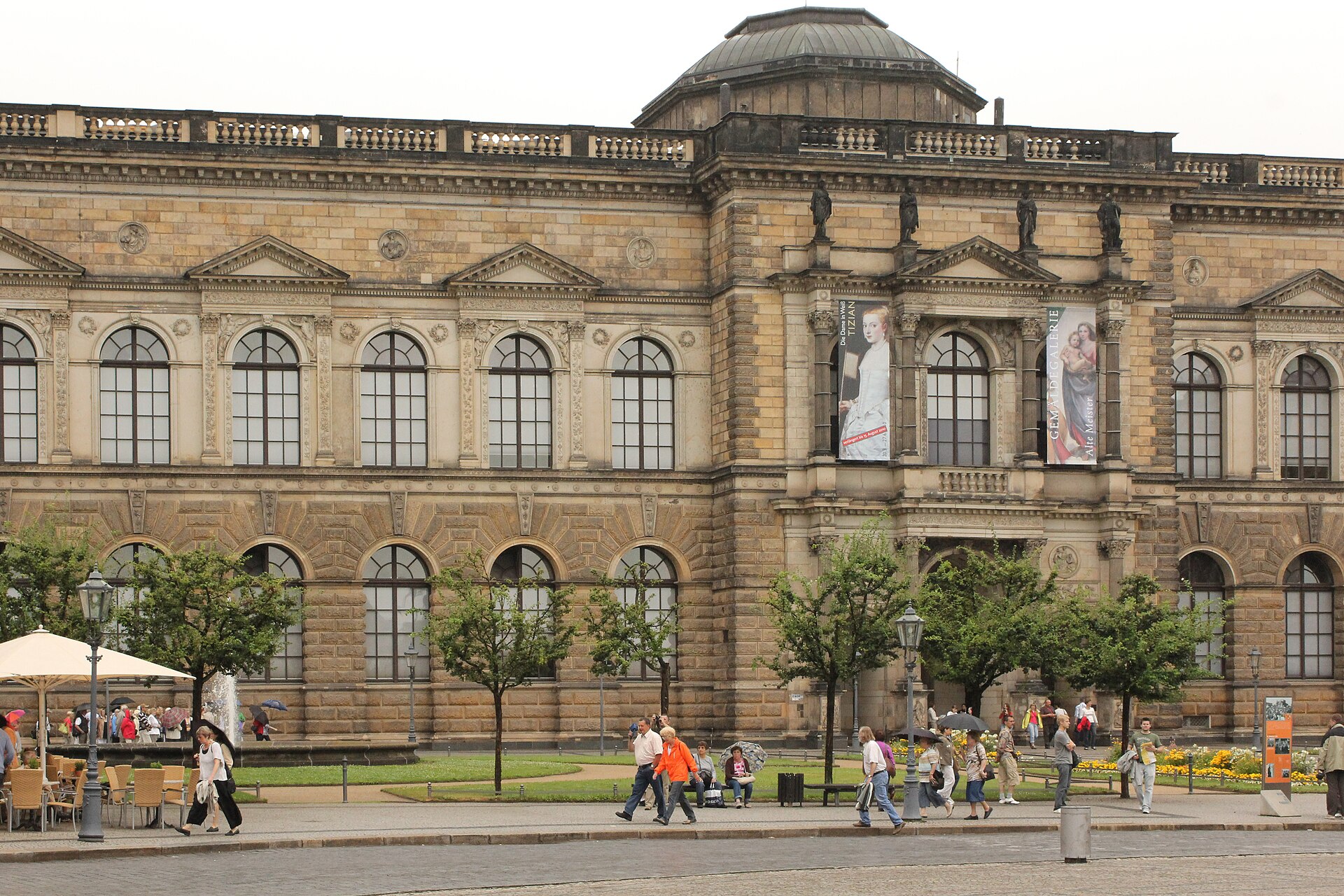
The Gemaeldegalerie Alte Meister's facade on Theaterplatz, part of Gottfried Semper's Zwinger extension, banners advertising the Titian and Alte Meister displays.
Photograph by Perituss, released CC0Gemaeldegalerie Alte Meister
Museum · Gemäldegalerie Alte Meister Dresden · Founded 1855
Open, admission and hours confirmed 21 August 2026 · 12 sources
On this page 15 sections
ContentsClose
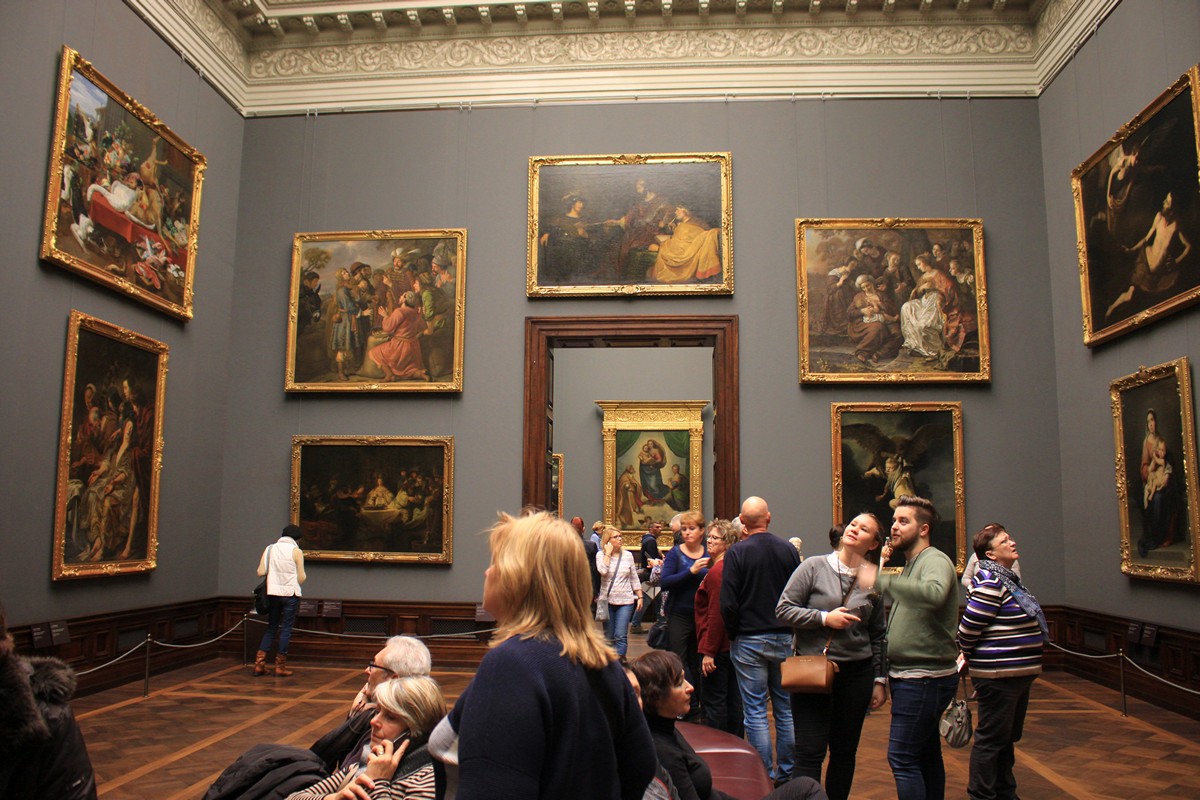
The Gemaeldegalerie Alte Meister's strength is a small number of paintings that are each, individually, among the most reproduced images in Western art - the Sistine Madonna, the Vermeer, the Chocolate Girl - set inside a broader, genuinely deep survey of Italian, Dutch, Flemish and German painting assembled almost entirely within a single 18th-century collecting spree by two Saxon electors rather than accumulated gradually over centuries.
| Local name | Gemäldegalerie Alte Meister Dresden |
|---|---|
| Kind | Museum |
| Founded | 1855 |
| City and country |  Dresden, Germany Dresden, Germany |
| Address | Theaterplatz 1, 01067 Dresden, Germany |
| Website | gemaeldegalerie.skd.museum |
| Status | Open, confirmed |
| Record last verified |
Visiting
- Hours
- MonClosed
- Tue10:00 to 17:00
- Wed10:00 to 17:00
- Thu10:00 to 17:00
- Fri10:00 to 17:00
- Sat10:00 to 17:00
- Sun10:00 to 17:00
- Closed
- Monday.
- Admission
- AdultEUR 18Zwinger ticket: covers the Gemaeldegalerie Alte Meister and Skulpturensammlung bis 1800, the Mathematisch-Physikalischer Salon and the Porzellansammlung on the same day
- ReducedEUR 13.50
- Pupils, under 20EUR 2
- Children up to school ageFreeFree
- Groups, 10 or moreEUR 16Per person
- Tickets
- gemaeldegalerie.skd.museum/en/visit The museum's own ticket page.
- Do I need to book?
- Not stated as required in the sources consulted for this page
- Address
- Theaterplatz 1, 01067 Dresden, Germany MapTram Theaterplatz or Postplatz stops, both a short walk from the Zwinger entrance
- Website
- gemaeldegalerie.skd.museum
- Telephone
- +49 351 4914 2000
Before you go how long, access, photography, bags, eating, shop
- How long to allow
- One to two hours
- Access
- Not detailed in the sources consulted for this page
- Photography
- Not detailed in the sources consulted for this page
- Bags
- Not detailed in the sources consulted for this page
- Eating
- Not detailed in the sources consulted for this page
- Shop
- Museum shop, on site, seen stocked with postcards and books of the collection
Prices and hours change. We take them from the institution's own pages and print the day we read them, and you can check the current position at the source we used. Confirm before you travel.
What is inside
Italian Renaissance and Baroque painting
The gallery's centrepiece room holds Raphael's Sistine Madonna; the same galleries hold Giorgione's Sleeping Venus, one of the earliest reclining nudes in Western painting, and Correggio's Madonna of Saint George.
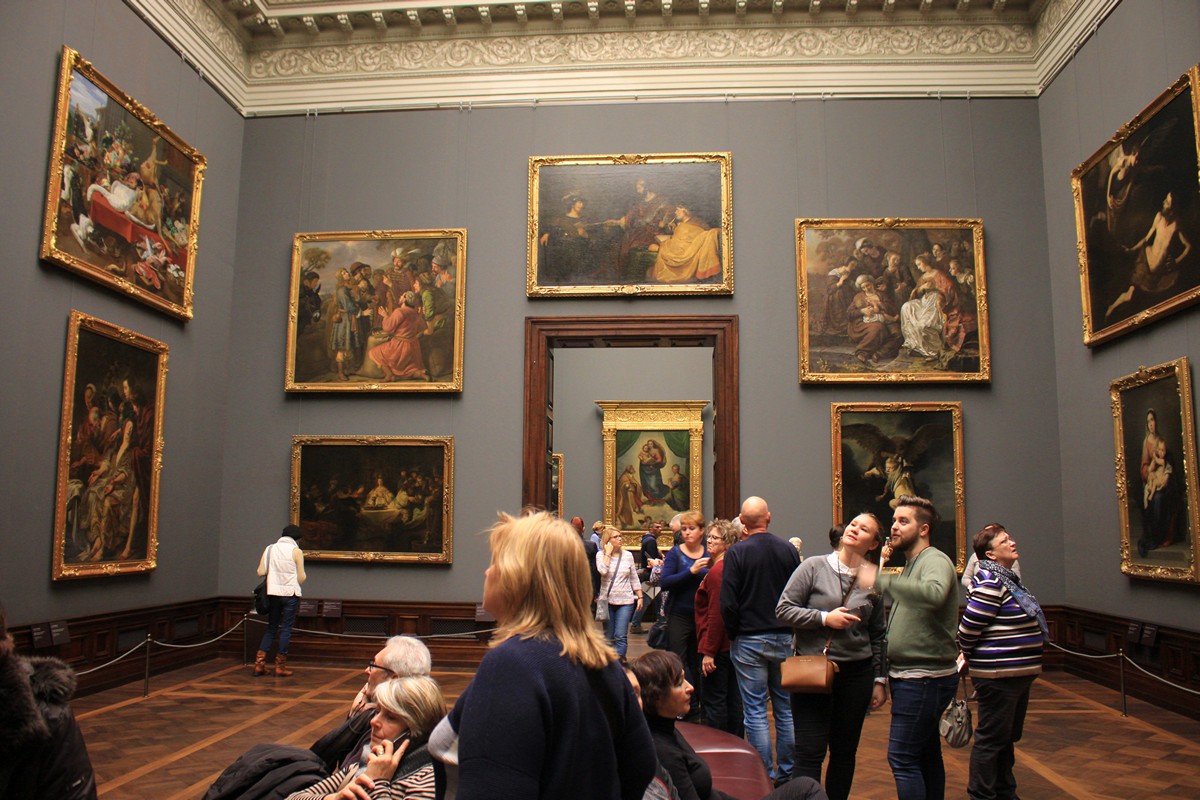
Photograph by Frank Liebig · CC BY-SA 3.0 de Dutch and Flemish painting
Vermeer's Girl Reading a Letter at an Open Window, restored between 2017 and 2021 to reveal a painted-over Cupid, hangs here alongside Rembrandt, including his early self-portrait with Saskia as the Prodigal Son and his unusually violent Abduction of Ganymede.
German painting and Cranach
German painting from Duerer's contemporaries through the Cranach workshop, including Lucas Cranach the Younger's Sleeping Hercules and the Pygmies.
18th-century French and gallant painting
Antoine Watteau's The Feast of Love and Jean-Etienne Liotard's pastel The Chocolate Girl, the gallery's best-known 18th-century work and one of the most technically celebrated pastels in European painting.
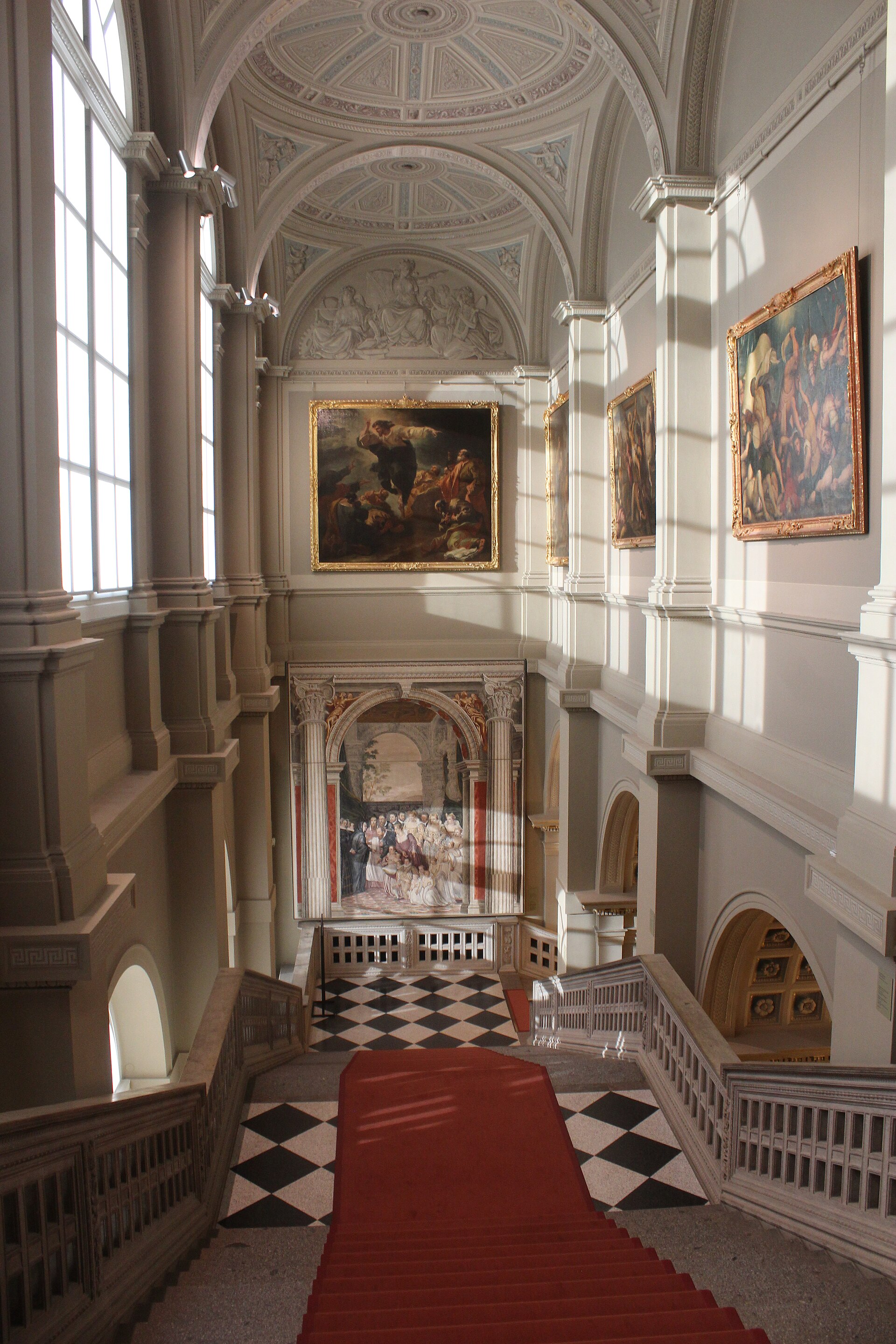
Photograph by Dguendel · CC BY 4.0 Skulpturensammlung bis 1800
The sculpture collection up to 1800 shares the renovated Semperbau with the picture gallery rather than occupying a separate building, continuing the integrated display the two departments have used since the building's most recent renovation.
What to see first
Sistine Madonna
RaphaelBought in 1754 for an extraordinary sum by Augustus III, and reportedly so admired on arrival that he moved his own seat to see it better; the gallery's single most famous painting and, since 1955, the object whose return from Soviet custody became a symbolic act of postwar reconciliation.6
Girl Reading a Letter at an Open Window
Johannes VermeerAn X-ray taken in 1979 first showed a fully painted-over Cupid hidden in the background; scientific analysis established a third party, not Vermeer, added the overpaint sometime after the artist's death, and a 2017-2021 restoration removed it, changing how the painting reads for the first time in centuries.7
Sleeping Venus
GiorgioneWidely credited as the first reclining nude in Western painting, and the model Titian's own Venus of Urbino is understood to answer; Giorgione is thought to have died before finishing it, with the landscape completed by another hand, most likely Titian's.8
The Chocolate Girl
Jean-Etienne LiotardA pastel of about 1743-44 so precisely rendered it was once mistaken for a photograph avant la lettre; the gallery's best-known single work of the 18th century.9
Self-Portrait with Saskia (Rembrandt and Saskia in the Parable of the Prodigal Son)
Rembrandt van RijnRembrandt paints himself and his wife Saskia van Uylenburgh as the prodigal son and a tavern girl, around 1635; the canvas was cut down on the left, probably by Rembrandt himself, to tighten the focus on the couple.10
Abduction of Ganymede
Rembrandt van RijnAn unusually harsh treatment of the myth: not a beautiful youth but a frightened, wailing infant, wetting himself as the eagle carries him off, one of the gallery's most-discussed departures from classical convention.5
Madonna of Saint George
Antonio da CorreggioA large altarpiece showing Correggio's soft, atmospheric handling of light at its most developed, and one of the works the gallery itself singles out from its own permanent holdings.5
Exhibitions on now
Past exhibitions here
- Closed23 May to 30 Aug 2026Confirmed · check before you travel
From a cabinet of curiosities to a public gallery
The collection now shown at the Gemaeldegalerie Alte Meister began not as a picture gallery at all but as a Kunstkammer, a princely cabinet of curiosities assembled by the Saxon electors from 1560 onward, mixing paintings with scientific instruments, natural specimens and craft objects in the way princely collections across Europe did before disciplines separated. Augustus the Strong, elector from 1694, was the collector who turned it decisively toward painting, sending agents across Italy to buy from princely and ducal collections rather than waiting for what came onto the open market. His son, Augustus III, made the single purchase that still defines the gallery's character: in 1745 he bought around 100 major paintings from Francesco III d'Este, the war-bankrupted Duke of Modena, in one transaction. Nine years later, in 1754, Augustus III paid an extraordinary sum for a single altarpiece, Raphael's Sistine Madonna, which on arrival is said to have moved him to shift his own chair so he could see it better. The gallery moved into its current building, the Semperbau on Theaterplatz beside the Zwinger, when Gottfried Semper's building opened in 1855.
Evacuated, seized, and gone for a decade
As war approached, the Gemaeldegalerie closed in 1939 and began systematically emptying its walls. The Sistine Madonna itself was taken out of its frame on 11 September 1939 and moved into secure storage; between late 1940 and mid-1942 the museum organised convoys moving hundreds of paintings to fortified sites along the Elbe, chiefly Koenigstein Fortress, along with remote castles and bunkers elsewhere in Saxony. The gallery building itself was gutted in the firebombing of Dresden on 13 February 1945. When the 1st Ukrainian Front reached Dresden that May, the Soviet military command took specific, deliberate interest in the fate of the Gemaeldegalerie's most famous works: they were gathered at Pillnitz Palace, checked against inventory, and from July 1945 shipped by rail to Moscow, with further consignments moved to Kyiv in early 1946. Soviet authorities described the operation as rescuing damaged art from a defeated and disordered country; a Russian art historian later called that framing, in blunter language, a lie. Roughly 206 Dresden paintings were destroyed during the war and a further 507 went missing outright, more than 400 of which have still not been located in the sources consulted for this page.
The paintings that did survive in Soviet hands, including the Sistine Madonna, stayed in Moscow for a decade. Only in 1955, two years after Stalin's death, did the Soviet Union return them to East Germany as a deliberate gesture of state friendship, exhibiting the restored works first in Moscow and then in Berlin before they finally reached Dresden again that October.
A cupid, painted out and then back in
The gallery's most recent headline discovery concerns a painting that never left the building at all. An X-ray taken of Vermeer's Girl Reading a Letter at an Open Window in 1979 had already shown something unexpected: a fully painted-over picture within the picture, a nude Cupid, hidden in the plain grey background the painting had shown for centuries. For decades this was read as Vermeer's own second thought, a composition he tried and then rejected. Restoration work beginning in 2017, aimed initially just at removing discoloured old varnish, produced the evidence that overturned that reading: the overpaint was applied not by Vermeer but by a third party, some time after his death in 1675, using materials and a technique inconsistent with the rest of the painting. Persuaded by that evidence, the Staatliche Kunstsammlungen Dresden decided in early 2018 to remove the later overpaint entirely rather than preserve it as part of the painting's history. The restoration finished in early 2021, and the Cupid has been visible in the painting's background ever since, changing the picture's meaning: what had read for generations as a study in quiet, private absorption now shows a young woman reading what the hidden picture implies is a love letter.
One ticket, four collections, a single renovated building
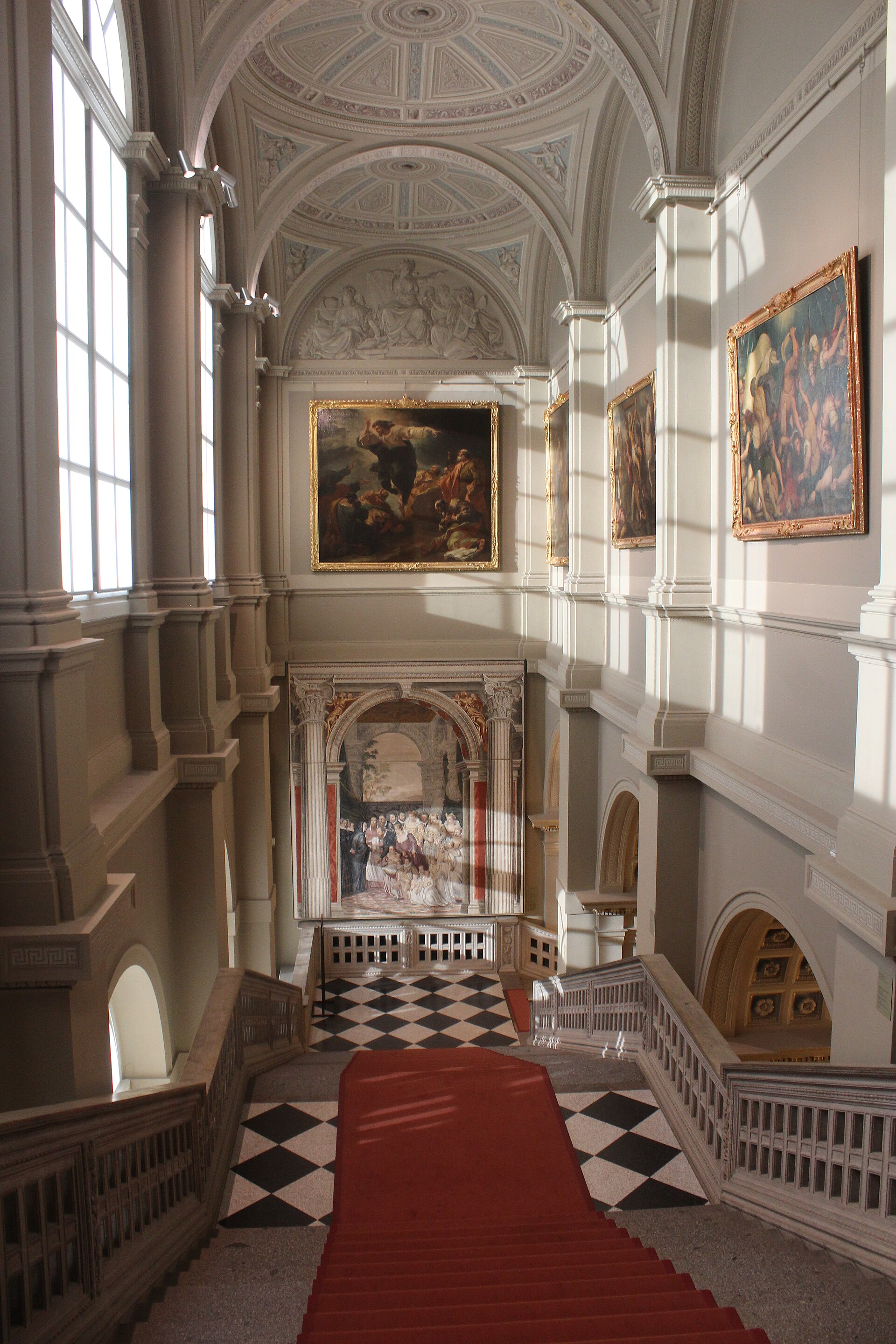
The Gemaeldegalerie's current 18-euro adult ticket does not admit to the picture gallery alone. It covers the Skulpturensammlung bis 1800, the sculpture collection sharing the same renovated Semperbau, along with the Mathematisch-Physikalischer Salon and the Porzellansammlung, the mathematical-physical instruments collection and the porcelain collection housed elsewhere around the Zwinger courtyard - a single admission price standing in for what is, architecturally, several separate museums under one historic roof. The building itself completed a seven-year renovation funded by around 50 million euros in Saxon state grants, reopening on 4 May 2020 with the integrated painting-and-sculpture display restored as originally intended.
A different museum from Berlin's Gemaeldegalerie
The name invites confusion this archive takes care to avoid: the Gemaeldegalerie Alte Meister in Dresden is an entirely separate institution from the Gemaeldegalerie at Berlin's Kulturforum, part of the Staatliche Museen zu Berlin rather than the Staatliche Kunstsammlungen Dresden, with its own building, its own collection history and its own wartime losses. Both museums lost major paintings to the Second World War, both trace their core holdings to princely collecting centuries before either building existed, and both are, separately, worth the distinction being made explicitly rather than assumed.
What visitors say
Visitors consistently rank the Gemaeldegalerie Alte Meister among the top attractions in Dresden and frequently name it the best single reason to visit the city's museums, built around the Sistine Madonna specifically but sustained by the depth of Dutch, Flemish and Italian painting around it. Weekend crowding and queueing outside before opening are the most common practical complaint.
What is praised, what is criticised
- Praised: the concentration of major, widely reproduced paintings - the Sistine Madonna, the Vermeer, the Chocolate Girl - inside a single, walkable gallery
- Praised: the quality of the recent renovation and the way the building itself, the Semperbau, is integrated with the display
- Praised: the range across Italian, Dutch, Flemish and German schools without the collection feeling padded
- Criticised: long outdoor queues on weekends and during peak season, with visitors advising against a Saturday visit without a timed ticket
- Criticised: tour groups clustering around the best-known paintings, which several visitors say disrupts viewing at busy times
Ratings on other platforms
Tripadvisor: 4.7 from 1,953 ratings, read 7 August 2026
A platform average is a tertiary source: it moves, it is not audited, and we quote no visitor's words.
Questions about Gemaeldegalerie Alte Meister
Where is Gemaeldegalerie Alte Meister?
Theaterplatz 1, 01067 Dresden, Germany.
How much does it cost to visit?
Adult: EUR 18; Reduced: EUR 13.5; Pupils, under 20: EUR 2; Children up to school age: free; Groups, 10 or more: EUR 16. As confirmed 21 August 2026.
When is it open?
Mon closed; Tue 10:00-17:00; Wed 10:00-17:00; Thu 10:00-17:00; Fri 10:00-17:00; Sat 10:00-17:00; Sun 10:00-17:00. Closed: Monday. As confirmed 21 August 2026.
How do you get there?
Tram: Theaterplatz or Postplatz stops, both a short walk from the Zwinger entrance.
What should you see first?
Sistine Madonna (Raphael); Girl Reading a Letter at an Open Window (Johannes Vermeer); Sleeping Venus (Giorgione); The Chocolate Girl (Jean-Etienne Liotard); Self-Portrait with Saskia (Rembrandt and Saskia in the Parable of the Prodigal Son) (Rembrandt van Rijn); Abduction of Ganymede (Rembrandt van Rijn).
What we could not confirm
- More than 400 of the roughly 507 Dresden paintings that went missing during and after the Second World War have still not been located, on the evidence in the sources consulted for this page; their fate remains open.
- Who applied the overpaint concealing the Cupid in Vermeer's Girl Reading a Letter at an Open Window, and exactly when after 1675, was not established by the 2017-2021 restoration - only that it was not Vermeer himself.
Images
Sources
- 1Gemaeldegalerie Alte Meister, home page (collection overview, Zwinger location) gemaeldegalerie.skd.museum/
- 2Gemaeldegalerie Alte Meister, visit page (Anfahrt/address confirmation) gemaeldegalerie.skd.museum/besuch/
- 3Gemaeldegalerie Alte Meister, Visit (hours, prices, address, phone, Zwinger combined ticket) gemaeldegalerie.skd.museum/en/visit/
- 4Staatliche Kunstsammlungen Dresden, Gemaeldegalerie Alte Meister visit page redirect skd.museum/besuchsseite/gemaeldegalerie-alte-meister/
- 5Gemaeldegalerie Alte Meister, home page, named highlight works (Correggio, Cranach the Younger, Rembrandt's Ganymede, Watteau, Palma il Vecchio and others) gemaeldegalerie.skd.museum/en/
- 6Apollo Magazine, King of the Zwinger - Dresden's most important museum is more majestic than ever (collection history, the Sistine Madonna's 1754 purchase, wartime evacuation and Soviet seizure, 1955 return, 2020 reopening) apollo-magazine.com/restored-reopened-gemaldegalerie-dresden/
- 7Staatliche Kunstsammlungen Dresden, press release: Revealing Cupid, restoration of Vermeer's Girl Reading a Letter at an Open Window completed skd.museum/en/besucherservice/presse/2021/ein-liebesgott-taucht-auf-vermeers-brieflesendes-maedchen-am-offenen-fenster-vollstaendig-restauriert/
- 8Wikipedia, Sleeping Venus (Giorgione) - current location and description en.wikipedia.org/wiki/Sleeping_Venus_(Giorgione)
- 9Wikipedia, The Chocolate Girl - current location and description en.wikipedia.org/wiki/The_Chocolate_Girl
- 10Wikipedia, The Prodigal Son in the Tavern - current location and description en.wikipedia.org/wiki/The_Prodigal_Son_in_the_Tavern
- 11Wikidata, Gemaeldegalerie Alte Meister (Q4890) wikidata.org/wiki/Q4890
- 12Tripadvisor, Gemaeldegalerie Alte Meister, Dresden, overall rating and review count, read 7 August 2026 tripadvisor.com/Attraction_Review-g187399-d207201-Reviews-Gemaldegalerie_Alte_Meister-Dresden_Saxony.html