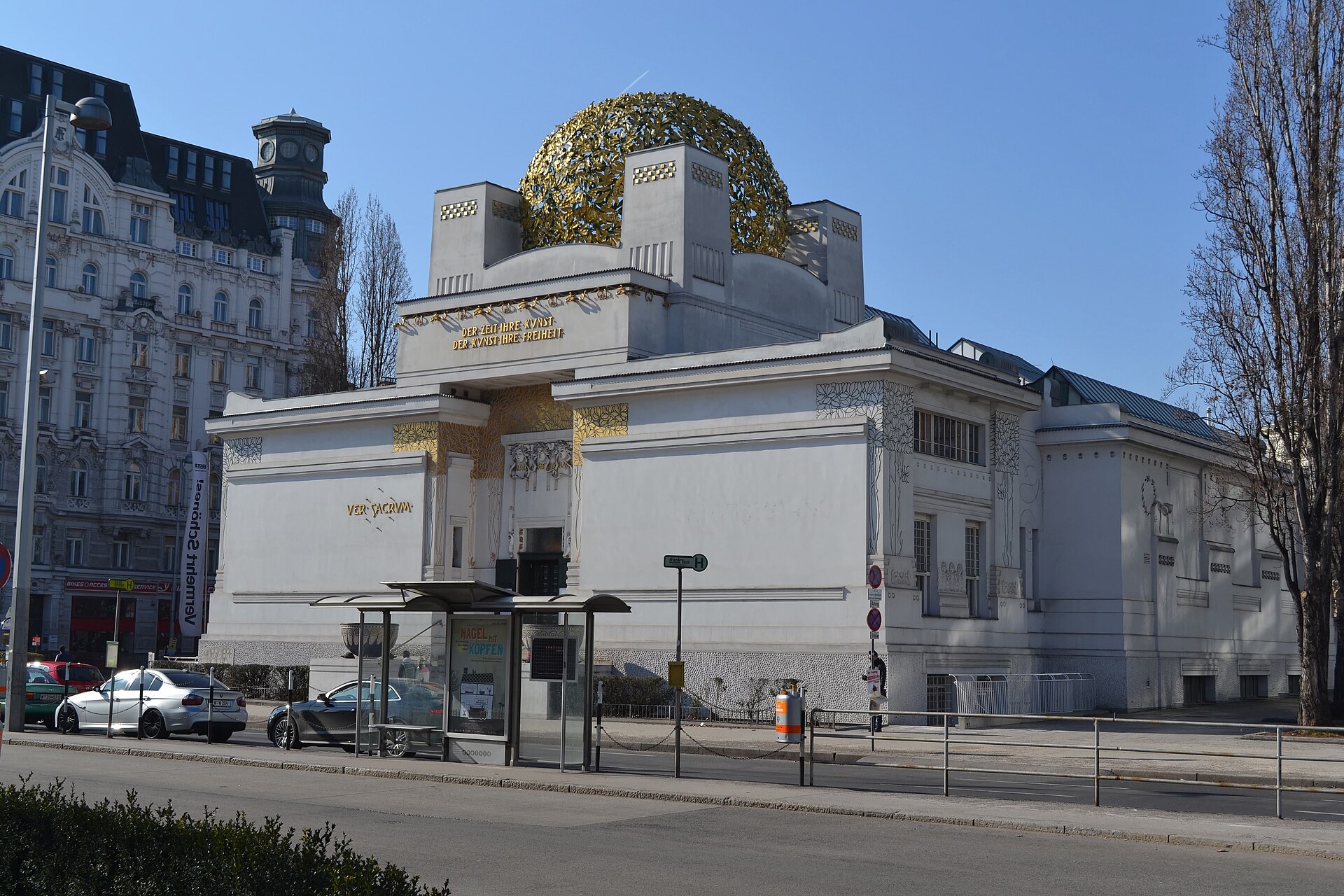
The west facade of the Secession Building, Joseph Maria Olbrich's 1898 exhibition hall for the Vienna Secession, with its gilded dome of laurel leaves.
Photograph by Slyronit, CC BY-SA 4.0Secession Building
Museum · Wiener Secessionsgebaeude · Founded 1898
Open, admission and hours confirmed 26 September 2026 · 13 sources
On this page 14 sections
ContentsClose
The Secession holds no permanent collection of its own beyond the Beethoven Frieze, which the Oesterreichische Galerie Belvedere owns and lends permanently. Everything else in the building is a changing loan exhibition chosen by the association's own artist members, several times a year, so what is on the walls beyond the frieze depends entirely on when a visit happens to fall.
| Local name | Wiener Secessionsgebaeude |
|---|---|
| Kind | Museum |
| Founded | 1898 |
| City and country |  Vienna, Austria Vienna, Austria |
| Address | Friedrichstrasse 12, 1010 Vienna, Austria |
| Website | secession.at |
| Status | Open, confirmed |
| Record last verified |
Visiting
- Hours
- Tue-Sun10:00 to 18:00
- Closed
- Monday.
- Admission
- AdultEUR 13
- Senior (65+)EUR 10
- Student / under 26 / disabled visitor plus one assistantEUR 7.50
- Child under 12Freefree
Free entry: First Wednesday of the month- Tickets
- shop.eventjet.at/secession The museum's own ticket page.
- Do I need to book?
- No advance ticket needed for an individual visit; guided tours (Saturdays, English at 11:00 and German at 14:00) and private group tours should be booked ahead through the museum
- Address
- Friedrichstrasse 12, 1010 Vienna, Austria MapU-Bahn U1, U2 and U4, Karlsplatz station, about five minutes on foot
- Website
- secession.at
- Telephone
- +43 1 587 53 07
- [email protected]
Before you go how long, access, photography, bags, eating, shop
- How long to allow
- Under an hour for the building and the Beethoven Frieze together; longer for visitors who use the audioguide over the frieze or spend real time in the changing exhibition upstairs
- Access
- A lift reaches the basement Beethoven Frieze room; the 2017-18 renovation added barrier-free access to it. Reception can be reached on the museum's own phone line for further assistance
- Photography
- A sign in the Beethoven Frieze room asks visitors not to photograph it; recent visitor accounts describe enforcement as inconsistent in practice. The exterior can be photographed freely
- Eating
- No cafe of its own; Cafe Museum, an Adolf Loos-designed coffeehouse, and the food stalls of the Naschmarkt are both a short walk away
- Shop
- A ground-floor bookshop and gift shop, open without a ticket, selling art books and catalogues alongside Secession honey harvested from bees kept under the dome
Prices and hours change. We take them from the institution's own pages and print the day we read them, and you can check the current position at the source we used. Confirm before you travel.
What is inside
Main exhibition hall (Hauptraum)
The building's largest space, planned as a basilica in miniature: a tall central nave flanked by two lower side aisles and a transept, lit from above by four glass skylights rather than from windows in the walls. It carries the Secession's rotating programme of contemporary exhibitions, changed several times a year.
Grafisches Kabinett
A smaller room on the upper floor kept for works on paper and more modestly scaled shows, used alongside the main hall for the same changing contemporary programme.
Basement gallery (three rooms)
A sequence of three rooms below the main hall, used for further contemporary exhibitions and installations that need darker or more contained spaces than the skylit hall above.
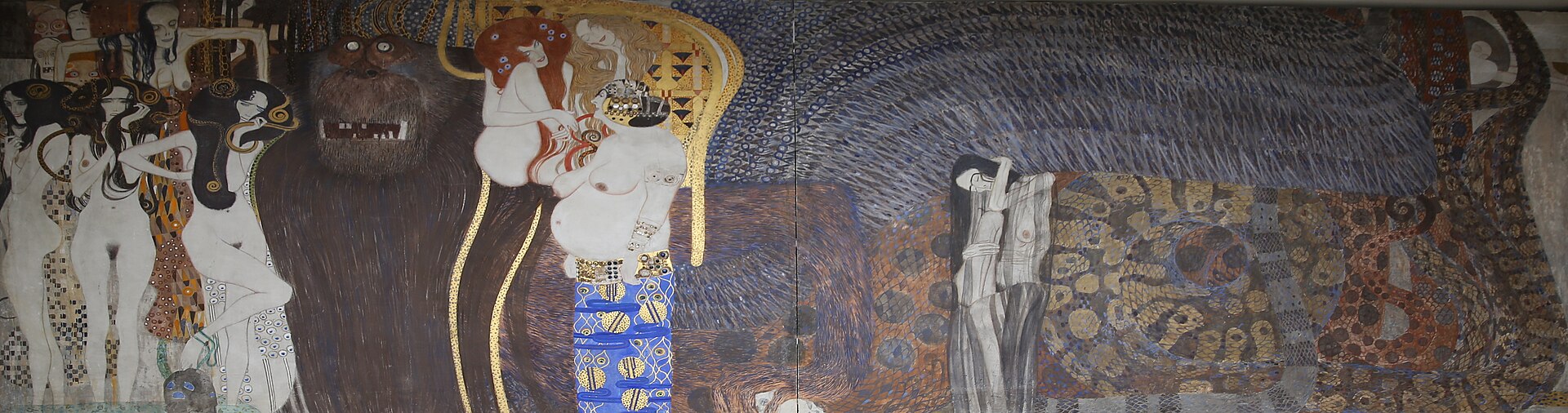
Photograph by Gustav Klimt · CC BY-SA 4.0 Beethoven Frieze room
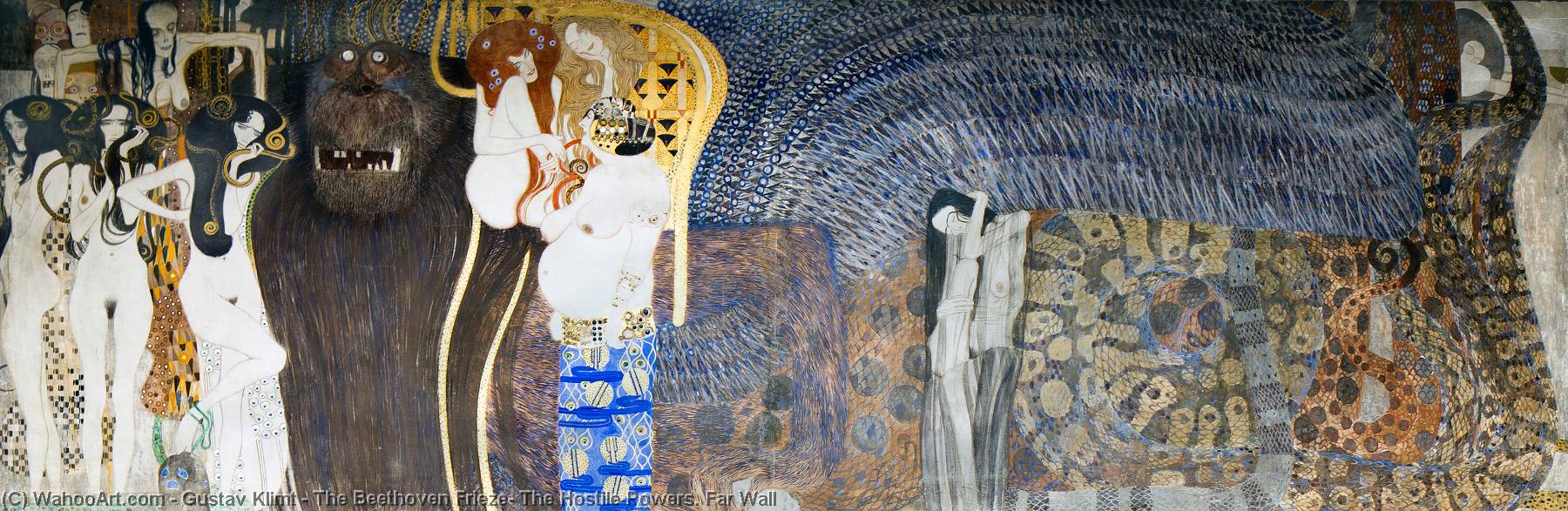
A separate, climate-controlled room on the second underground level, purpose-built in 1985 to the frieze's own dimensions. Gustav Klimt's 1902 wall cycle wraps three of its walls; an antechamber gives the history before the frieze itself, and an audioguide track plays the Beethoven passage the work interprets.
What to see first
The Beethoven Frieze
Gustav Klimt, 1902Klimt's only surviving large-scale wall cycle, worked in charcoal, casein paint, gold and silver leaf, gilt stucco, mother-of-pearl and mirror glass straight onto plaster for the Fourteenth Secession exhibition honouring Beethoven. It was built to be torn down after the show and has instead outlived almost everything else made for it.7
The gilded dome
Joseph Maria Olbrich, 1898An open iron sphere 8.5 meters across, carrying about 2,500 gilded laurel leaves and 311 berries. Vienna's architectural establishment mocked it as a golden cabbage within weeks of the opening, a jab the city has since worn down into an affectionate nickname.4
The entrance motto
Joseph Maria Olbrich, 1898Der Zeit ihre Kunst, der Kunst ihre Freiheit, to every age its art, to every art its freedom, runs in gilt lettering above the door and still stands as the association's own statement of purpose.5
The gorgon heads and owls
Koloman Moser, 1898Three carved gorgon heads flanked by owls guard the entrance, Moser's own reading of Athena, protector of the arts and of the fight the Secession's founders believed they were waging against the Kuenstlerhaus establishment they had just left.5
Karl Wittgenstein's patronage
The industrialist father of the philosopher Ludwig Wittgenstein covered much of the building's construction cost, alongside a plot of city-donated land and the proceeds of the Secession's first exhibition; without his money the building would not have gone up in six months in 1898.4
The Lederer family provenance and the 2015 restitution ruling
The Beethoven Frieze passed through the Jewish collector family August, Serena and Erich Lederer, was seized after Austria's 1938 annexation and recovered from the Altaussee salt mine in 1945. The family's heirs petitioned for its return in 2013; Austria's Advisory Board for Restitution rejected the claim in March 2015, finding no direct link between the wartime persecution and the terms of the 1972 sale that brought the frieze to the Austrian state.8
An unbroken exhibition record since 1898
The Secession has run its own changing programme of contemporary shows continuously since it opened, still chosen by its own artist members rather than by outside curators, making it one of the oldest artist-run exhibition halls anywhere still doing the job it was built for.2
A pavilion built in six months to break with the Ringstrasse
In April 1897 a group of Vienna's own painters, sculptors and architects resigned from the Kuenstlerhaus, the city's official artists association, in protest at its taste for the historicist styles that lined the Ringstrasse. They called themselves the Association of Visual Artists Vienna Secession and elected Gustav Klimt their first president. Within a year the new group had a building of its own, on a plot of city land the Vienna council donated at the edge of the Naschmarkt on Friedrichstrasse.
Money came from the group's first exhibition and from the industrialist Karl Wittgenstein, father of the philosopher Ludwig Wittgenstein, who covered much of the construction cost. The design went to Joseph Maria Olbrich, then twenty-nine years old and still an assistant in Otto Wagner's office. The foundation stone was laid on 28 April 1898 and the building was finished on 29 October the same year, six months from first stone to last.
What went up was not a monument in the Ringstrasse manner but a working exhibition hall, planned around a cross of rectangular rooms set about a central square space and lit from above through four large glass skylights rather than from windows in the walls. At roughly 1,000 square meters it is a small building. It was built to show pictures well, cheaply and fast, and it has done that job, with interruptions, for more than a century.
The facade as a manifesto
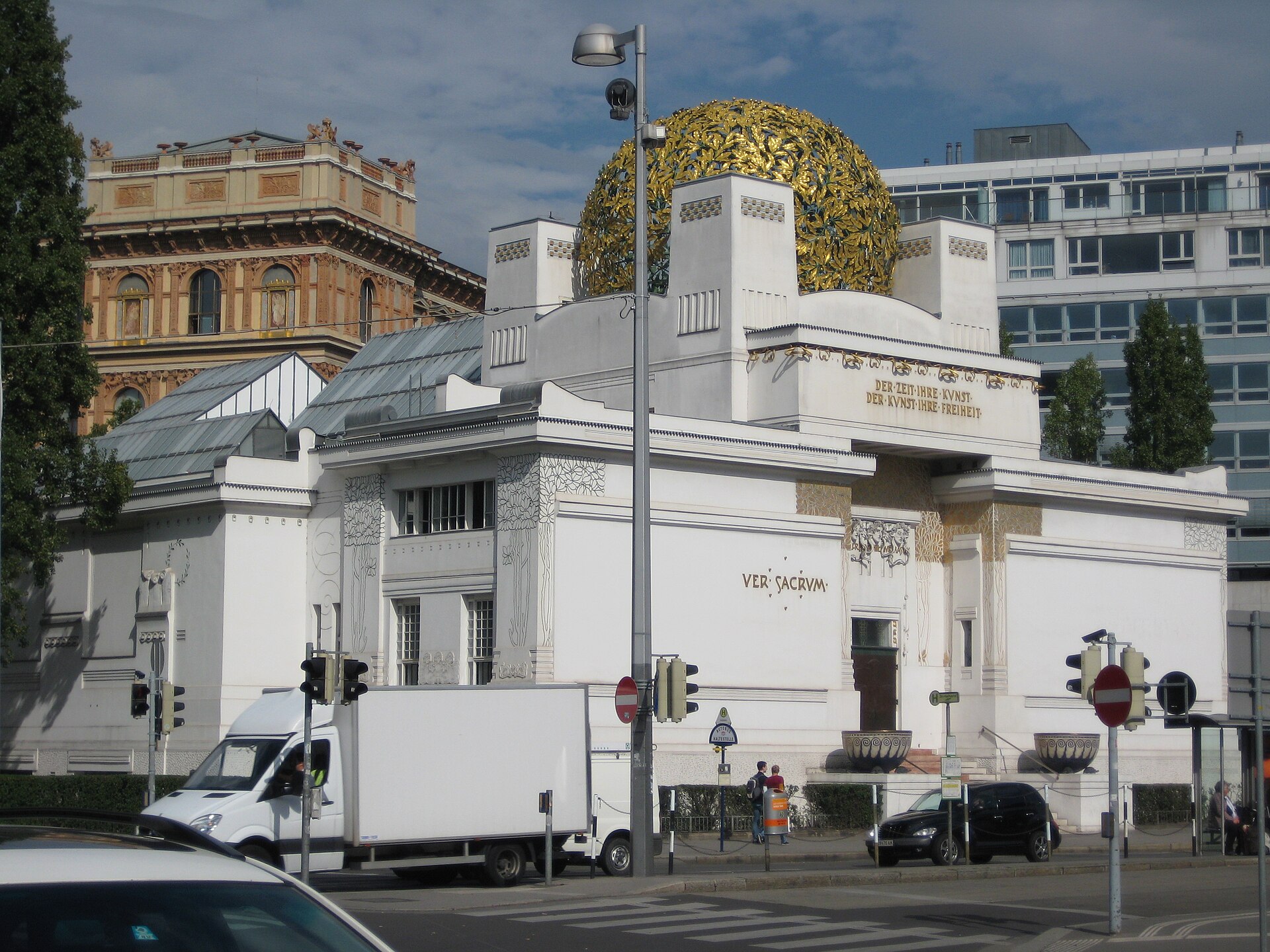
Olbrich and his collaborators treated the building's outside as a manifesto rather than decoration. Above the entrance, in gilt lettering, runs the sentence the Secession still uses to describe itself: Der Zeit ihre Kunst, der Kunst ihre Freiheit, to every age its art, to every art its freedom. Below the motto, three carved gorgon heads flanked by owls look out over the street, a design by Koloman Moser reading Athena, goddess of wisdom and patron of the arts, into a building whose founders believed they were fighting a real fight against the artistic establishment they had just left.
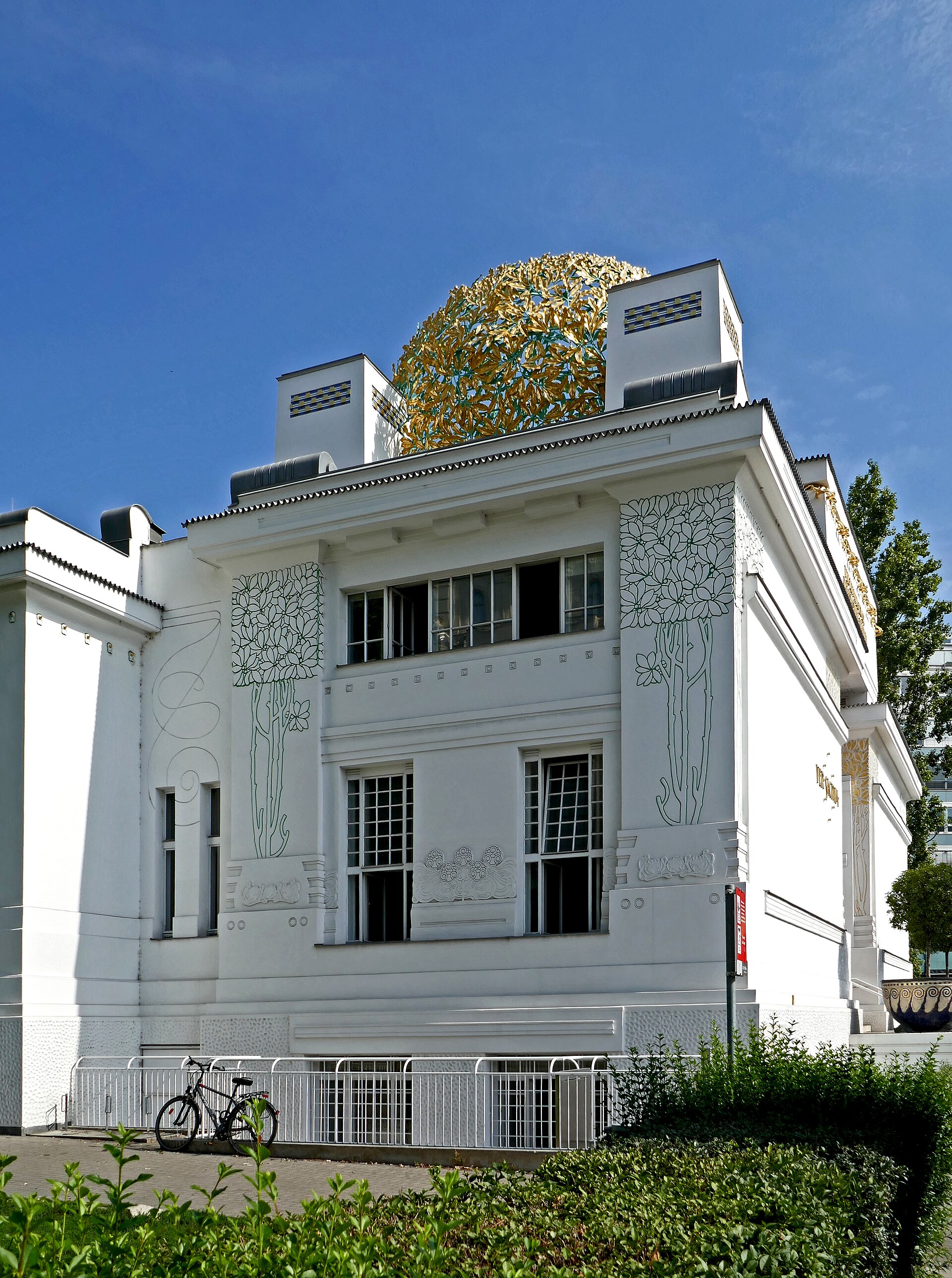
On the building's side wall, cut into the render and picked out in gold, is a second inscription: Ver Sacrum, sacred spring, the name the Secession gave its own art journal and, by extension, to the movement itself. Laurel appears everywhere on the facade, stylised into the flattened, almost vegetal ornament typical of Viennese Jugendstil, its usual meaning of victory carried lightly rather than declared outright.
The dome Vienna mocked and then adopted
The single most extravagant element sits on the roof: an open iron sphere 8.5 meters across, carrying about 2,500 gilded metal laurel leaves and 311 berries, more a piece of jewellery scaled up to building size than a conventional dome. Vienna's conservative architectural establishment mocked it from the day it opened in 1898, alongside the rest of Olbrich's stark, columnless design, and coined a nickname that has stuck for well over a century: the goldenes Krauthappel, the golden cabbage, after the market produce sold a few steps away at the Naschmarkt. The insult turned into affection long ago; nobody in Vienna today calls the dome anything else.
The dome remains valuable enough to attract thieves. On the night of 23 to 24 April 2018, someone climbed the building's maintenance scaffolding and broke six to eight gilded leaves off the sphere, causing roughly 10,000 euros of damage to recover leaves worth about 1,000 euros each. The building's most recent full re-gilding was carried out as part of the 2017-18 renovation, which also opened barrier-free access down to the Beethoven Frieze room.
The Beethoven Frieze and the family it passed through
Klimt painted the Beethoven Frieze directly onto the walls of the main hall for the Secession's Fourteenth Exhibition in 1902, a show built around Max Klinger's polychrome statue of Beethoven and staged to mark the seventy-fifth anniversary of the composer's death. The frieze, over 34 meters long and about 2 meters high, was never meant to survive the exhibition: Klimt worked in charcoal, casein paint, gold and silver leaf, gilt stucco, mother-of-pearl buttons, mirror glass and semi-precious stones applied straight onto light lath-and-plaster walls built to come down once the show closed.
It did not come down. The collector Carl Reininghaus bought it in 1903 specifically to keep it from being destroyed, trading Klimt more than a hundred preparatory drawings for the right to do so. In 1915 the frieze and many of the studies passed to the Viennese industrialist August Lederer and his wife Serena, major patrons of Klimt and of the Secession generation. After Austria's annexation by Nazi Germany in 1938, Serena Lederer, who was Jewish, was forced from her home and her collection seized; the frieze was recovered by Allied forces from the Altaussee salt mine in 1945 and returned to her son, Erich Lederer, then living in exile in Geneva.
Austria refused Lederer an export permit for the frieze, and in 1972 he sold it to the Austrian state for 750,000 dollars, well under what it could have brought on the open market with an export licence attached. In 2013 Lederer's heirs petitioned Austria's Advisory Board for Restitution, arguing the 1972 sale had been made under duress created by the state's own export policy. The board rejected the claim in March 2015, finding no direct link between the wartime persecution of the family and the terms of the later sale. The frieze itself had by then spent nearly a decade in restoration, led by Manfred Koller of the Federal Monuments Office, before a climate-controlled room was built for it in the building's basement in 1985. The Oesterreichische Galerie Belvedere, which owns the frieze, placed it on permanent loan to the Secession in 1986, back in the building it was made for.
War, fire and two renovations
The building did not survive the Second World War untouched. Allied bombing damaged the structure, and in the final days of the war in 1945 retreating German forces set part of it on fire. Reconstruction in 1963 restored the original decorative scheme where it had been lost and added a new gallery. A far more thorough renovation followed in 1984-85 under the architect Adolf Krischanitz, who modernised the exhibition infrastructure while keeping the building's original layout and proportions intact; it was this renovation that created the dedicated basement room for the Beethoven Frieze. A third campaign in 2017-18 re-gilded the dome and opened barrier-free access down to the frieze room.
The Secession today
What makes the Secession unusual among Vienna's major exhibition venues is who runs it. It remains an artist-run association, as it was in 1897, with a rotating group of Secession members deciding the programme rather than a state museum administration or an outside curator. The main hall, the smaller Grafisches Kabinett upstairs and the three-room gallery in the basement change hands several times a year, mostly for solo and group shows of living artists; the Beethoven Frieze room is the one constant.
Visitors and critics both tend to treat the building and the frieze as the reason to come, and the contemporary programme as the more uneven part of the visit; some reviewers find real substance in it, others find it the least rewarding part of the building. Both readings sit on the same ticket, which is close to the position the Secession's founders wanted for themselves: judged on the work on the walls that season, not on the reputation of the building around it.
What visitors say
Visitors and critics agree on what carries a visit: the building itself and the Beethoven Frieze in its basement room. Opinion splits hardest over the changing contemporary exhibitions that fill the rest of the building, which some find as rewarding as the permanent holdings and others find add little beyond the frieze.
What is praised, what is criticised
- Praised: The Art Nouveau facade and the gilded laurel dome, still striking at close range
- Praised: The Beethoven Frieze presentation, shown with an audioguide track keyed to the Beethoven passage it interprets
- Praised: How little time a full visit takes, a look at the building and the frieze fits inside an hour
- Criticised: The rotating contemporary exhibitions in the main hall and basement galleries, which some visitors find hard to connect with or feel add little set against the frieze
- Criticised: The admission price weighed against the building's small size and the unevenness some visitors find in the current exhibition on any given day
Ratings on other platforms
Google: 4.2 from 7,297 ratings, read 26 September 2026
TripAdvisor: 3.6 from 1,055 ratings, read 26 September 2026
A platform average is a tertiary source: it moves, it is not audited, and we quote no visitor's words.
Questions about Secession Building
Where is Secession Building?
Friedrichstrasse 12, 1010 Vienna, Austria.
How much does it cost to visit?
Adult: EUR 13; Senior (65+): EUR 10; Student / under 26 / disabled visitor plus one assistant: EUR 7.5; Child under 12: free. As confirmed 26 September 2026.
When is it open?
Tue-Sun 10:00-18:00. Closed: Monday. As confirmed 26 September 2026.
How do you get there?
U-Bahn: U1, U2 and U4, Karlsplatz station, about five minutes on foot.
What should you see first?
The Beethoven Frieze (Gustav Klimt, 1902); The gilded dome (Joseph Maria Olbrich, 1898); The entrance motto (Joseph Maria Olbrich, 1898); The gorgon heads and owls (Koloman Moser, 1898); Karl Wittgenstein's patronage; The Lederer family provenance and the 2015 restitution ruling.
What we could not confirm
- Whether the Lederer heirs pursued the Beethoven Frieze claim further after Austria's Advisory Board for Restitution rejected it in March 2015; their lawyer said at the time they would keep pursuing it by every legal means, and no later filing was found in the sources checked for this page.
- Whether the six to eight gilded leaves stolen from the dome on the night of 23-24 April 2018 were ever recovered or a suspect identified.
Images
Sources
- 1Secession, Opening Hours secession.at/en/opening-hours/
- 2Secession, homepage secession.at/en/
- 3Secession, Informationen und Tickets secession.at/informationen_tickets
- 4Secession, Gebaeude secession.at/gebaeude
- 5Wikipedia, Secession Building en.wikipedia.org/wiki/Secession_Building
- 6Wikipedia, Vienna Secession en.wikipedia.org/wiki/Vienna_Secession
- 7Wikipedia, Beethoven Frieze en.wikipedia.org/wiki/Beethoven_Frieze
- 8Centre du droit de l'art (Geneva), La Frise Beethoven, Heritiers Lederer c. Autriche (2013) plone.unige.ch/art-adr/cases-affaires/la-frise-beethoven-2013-heritiers-lederer-c-autriche
- 9Wanderlog, Secession place details (aggregated Google and TripAdvisor ratings) wanderlog.com/place/details/20379/secession
- 10Erin Caswell, Secession, Vienna, Salterton Arts Review, 5 April 2026 saltertonartsreview.com/2026/04/secession-vienna/
- 11Visiting Vienna, The Secession Building visitingvienna.com/footsteps/secession/
- 12The Geographical Cure, Guide to the Vienna Secession Museum and Klimt's Beethoven Frieze thegeographicalcure.com/post/the-vienna-secession-museum
- 13The History Blog, Gold cabbage leaves stolen from Vienna landmark thehistoryblog.com/archives/51439