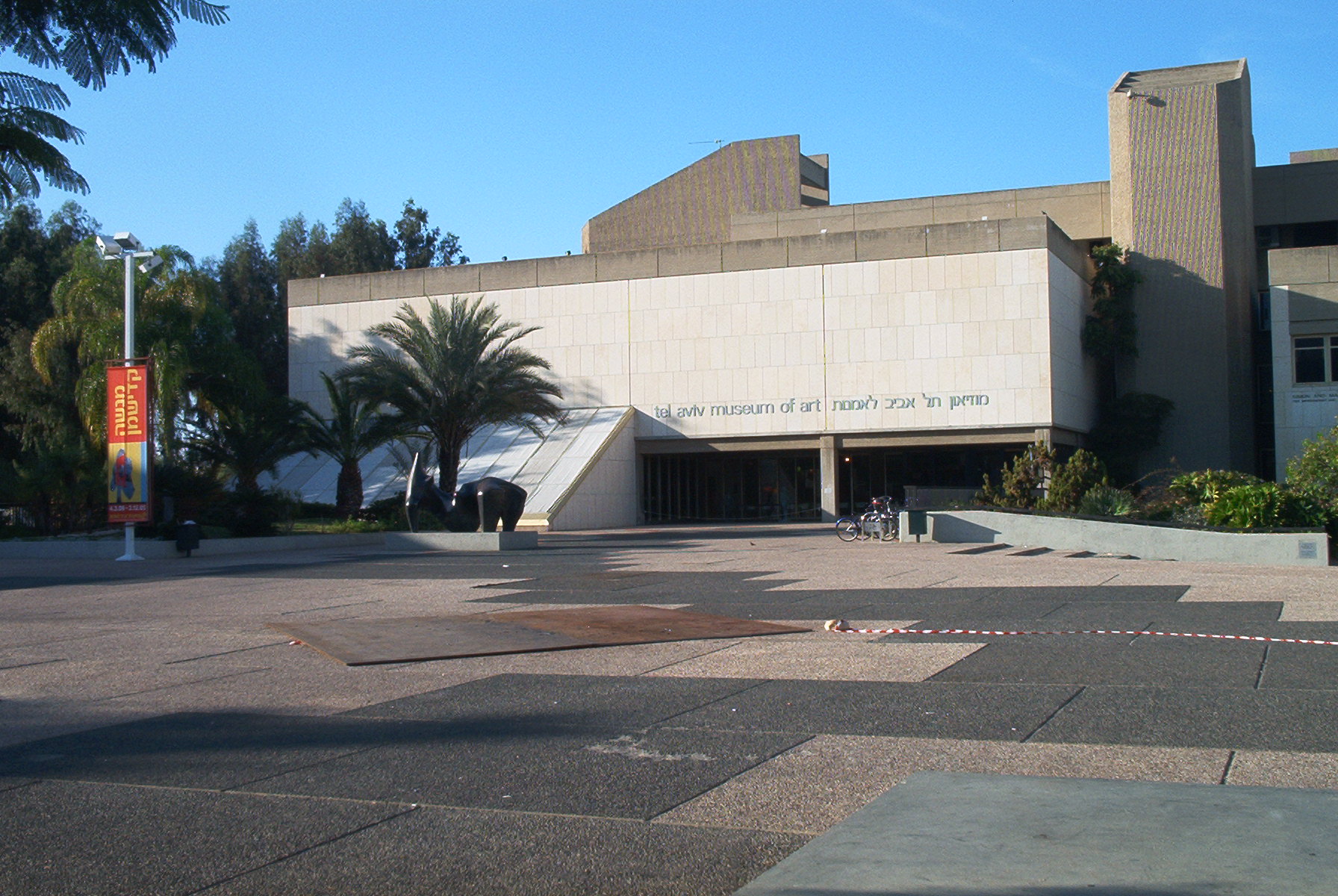
The main entrance of the Tel Aviv Museum of Art's Main Building, with the museum's name lettered in English and Hebrew above the doors.
Public domainTel Aviv Museum of Art
Museum · מוזיאון תל אביב לאמנות · Founded 1932
Open, admission and hours confirmed 5 September 2026 · 19 sources
On this page 17 sections
ContentsClose
The museum's strength is holding two full-sized collections rather than one: an Israeli art collection it describes as among the largest and most current anywhere, spanning the century since Tel Aviv itself was a new city, and a European and American collection deep enough in Impressionism, early modernism and postwar American painting to stand on its own beside dedicated European museums of similar size. Photography, prints and design collections add real depth rather than filler, each built through named single-donor gifts this record can trace to a specific act of donation rather than an unexplained institutional acquisition: the Kramer gift of Munch prints, the Guggenheim gift of Abstract Expressionism and Surrealism, and the Goeritz family's Archipenko collection, whose arrival in Tel Aviv in 1933 was itself an act of rescue rather than ordinary collecting.
| Local name | מוזיאון תל אביב לאמנות |
|---|---|
| Kind | Museum |
| Founded | 1932 |
| City and country |  Tel Aviv, Israel Tel Aviv, Israel |
| Address | 27 Shaul HaMelech Blvd., The Golda Meir Cultural and Art Center, Tel Aviv, Israel |
| Website | tamuseum.org.il |
| Status | Open, confirmed |
| Record last verified |
Visiting
- Hours
- SundayClosed
- Monday10:00 to 18:00
- Tuesday10:00 to 21:00
- Wednesday10:00 to 18:00
- Thursday10:00 to 21:00
- Friday10:00 to 14:00
- Saturday10:00 to 18:00
- Closed
- Sunday.
- Admission
- Regular PriceILS 55One-time entry to the Museum's Main Building and the Herta and Paul Amir Building
- Students / DigiTel Tel Aviv-Yafo residentsILS 45Valid student ID or DigiTel card required
- Senior citizens / visitors with disabilityILS 27On presentation of a valid certificate or card
- Members, children and youth up to 18, active-duty soldiers, national service volunteersFreeFree
- Tickets
- tamuseum.org.il/en/visit The museum's own ticket page.
- Do I need to book?
- Not required for general admission; the museum's own listing shows 17 concurrent exhibitions plus activities and lectures in a typical week, more than a single pass can absorb, so checking the current programme before travelling is worthwhile
- Address
- 27 Shaul HaMelech Blvd., The Golda Meir Cultural and Art Center, Tel Aviv, Israel Map
- Website
- tamuseum.org.il
- Telephone
- +972-3-6077020
- [email protected]
Before you go how long, access, photography, bags, eating, shop
- How long to allow
- Two to three hours to cover the Main Building and the Herta and Paul Amir Building at a comfortable pace
- Access
- Wheelchairs and folding cane chairs can be borrowed free of charge against an ID card deposit; free parking is available for holders of a disabled parking permit issued by Israel's Ministry of Transport, on presentation of a disability certificate
- Photography
- Non-flash photography is allowed for personal use; tripods, monopods and other professional or staged photography equipment are not permitted
- Bags
- Handbags up to A4 size (about 20x30 cm) are allowed in the galleries; backpacks must be worn on the front of the body; larger items go to lockers or the cloakroom
- Eating
- The Studio Cafe, in the Main Building, overlooks the Sculpture Garden with hot and cold drinks, cakes and light meals; the Pastel Restaurant overlooks the far end of the garden and is listed in La Liste, the French Foreign Ministry's ranking of the world's best restaurants; the Eyal Ofer Pavilion has its own venue, the Helena Wine Bar, styled on the pinxto bars of San Sebastian and the cicchetti tradition of Venice
- Shop
- A Museum Store keeps the same hours as the galleries
Prices and hours change. We take them from the institution's own pages and print the day we read them, and you can check the current position at the source we used. Confirm before you travel.
What is inside
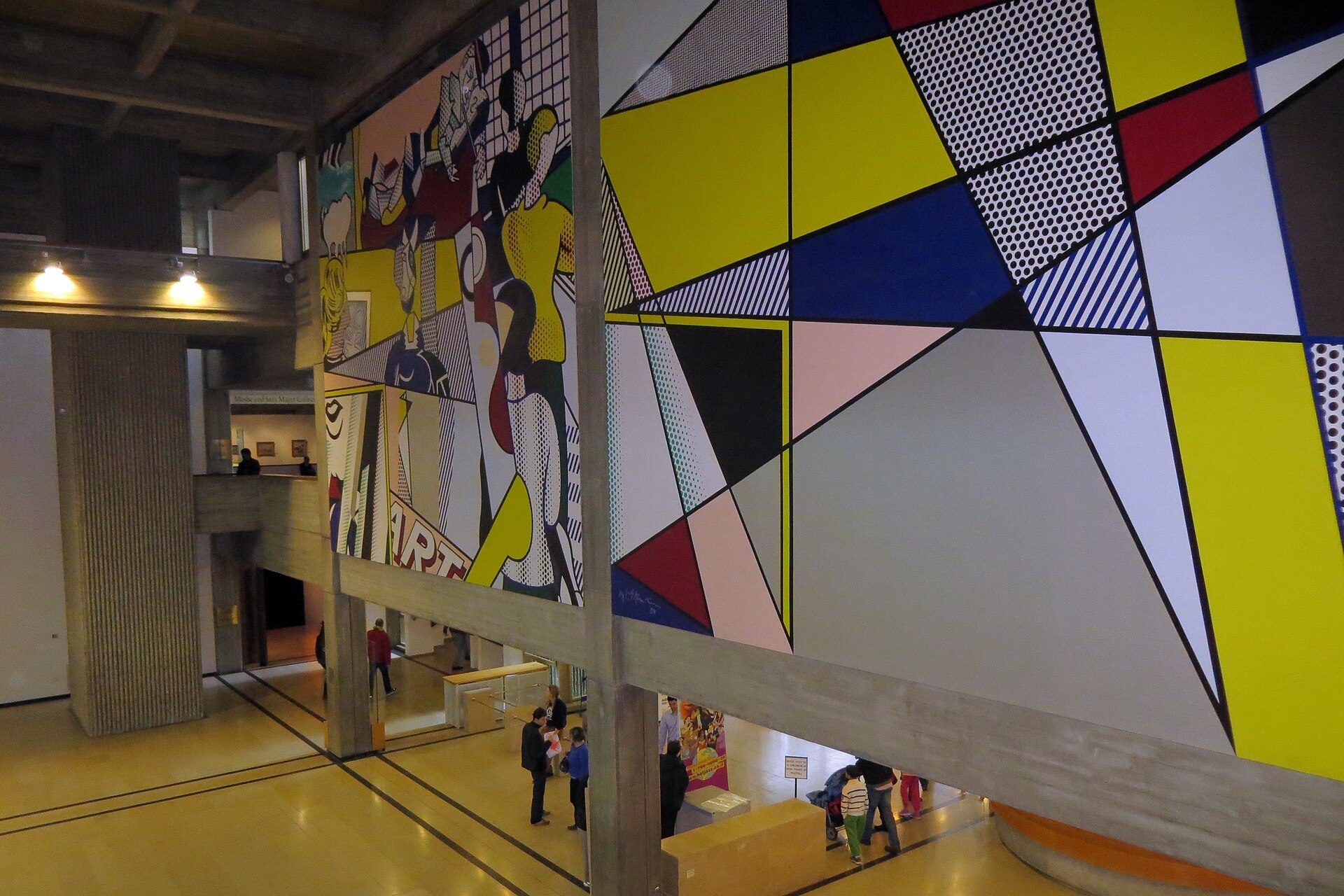
Photograph by Alan Kotok · CC BY 2.0 Main Building (Paulson Family Foundation Building)
The 1971 Brutalist building designed by Dan Eitan and Itzhak Yashar as a spiral of four galleries around a tall central atrium, reached by a ramp from the entrance hall; it holds the Old Masters collection of the sixteenth to nineteenth centuries, the Impressionist and modern galleries, and the Younes and Soraya Nazarian Family Experiential Center added in a 2018 renovation that restored the building to its original design after decades of ad hoc extensions.
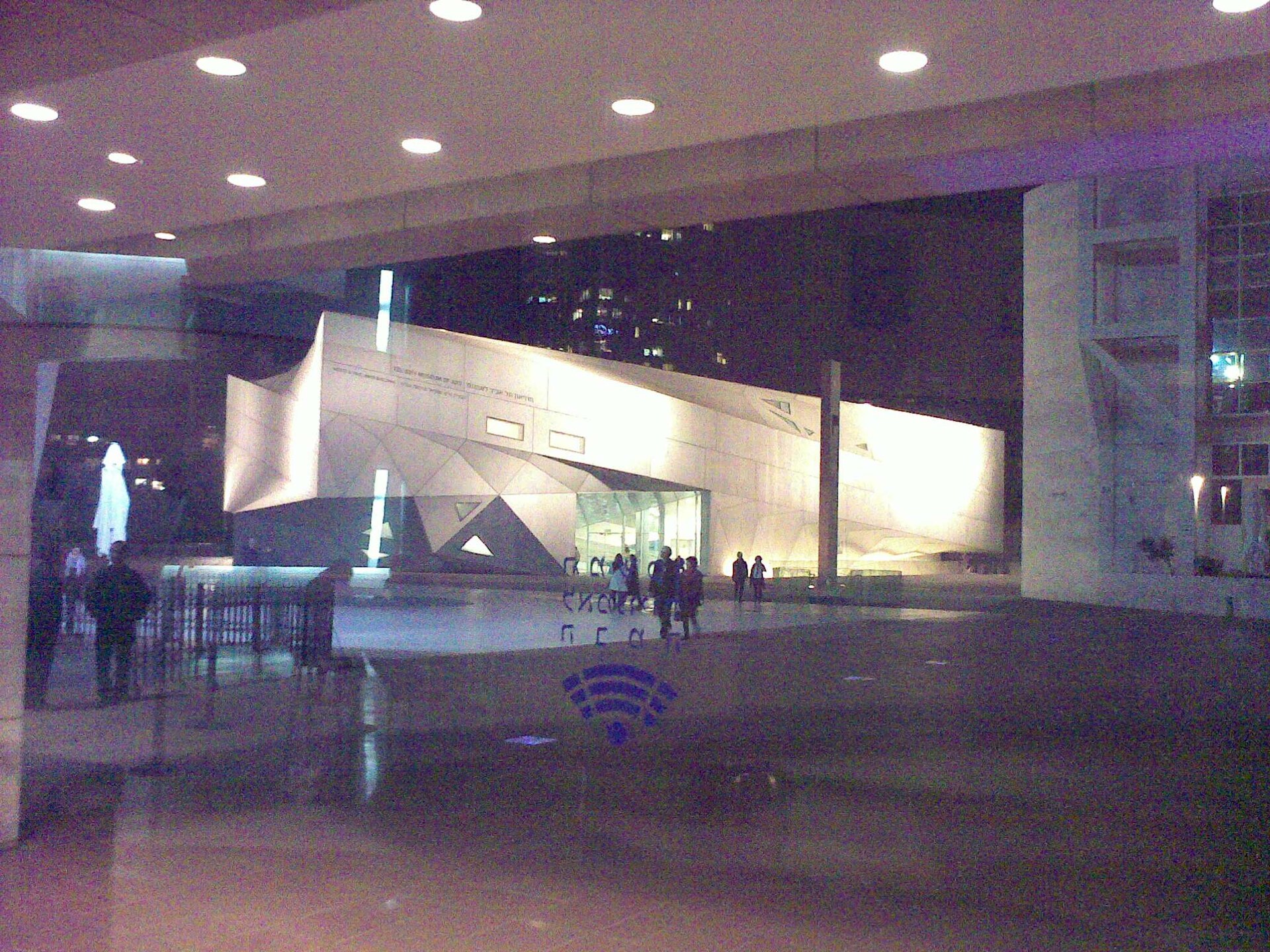
Herta and Paul Amir Building
Opened in October 2011 to a design by the American architect Preston Scott Cohen with Israeli project architect Amit Nemlich, an origami-folded concrete envelope of 465 polished panels wrapped around a 26.5-metre skylit atrium the architect calls the Lightfall; the building has three subterranean levels and holds the permanent Israeli art galleries plus dedicated spaces for photography, drawing, design and contemporary art, along with an auditorium and study workshops.
Eyal Ofer Pavilion
Originally the Helena Rubinstein Pavilion, designed by Zeev Rechter with his son Yacov Rechter and Dov Karmi and inaugurated in January 1959 as the museum's first purpose-built home, twelve years before the Main Building existed; renamed in March 2023 after a comprehensive renovation funded by the Eyal and Marilyn Ofer Family Foundation and normally given over to temporary exhibitions. As of this record's research the museum's own visit page states the pavilion is temporarily closed to the public; no reopening date is published there.
Lola Beer Ebner Sculpture Garden
A sunken, eucalyptus-shaded courtyard between the Main Building and the Amir Building, added to the museum's site by director Marc Scheps and opened in 1999 with a donation from Lola Beer Ebner, renovated after the Amir Building's construction and reopened in 2014; permanent works include Menashe Kadishman's Scream (1998), Lynn Chadwick's Two Seated Figures (1973) and Yitzhak Danziger's Sheep of the Negev (1963), crossed by Enzo Cucchi's Tel Aviv-Yafo Mosaic (1999) which forms the path between the garden's two levels.
What to see first
Jews Praying in the Synagogue on Yom Kippur
Maurycy Gottlieb, 1878Oil on canvas, 243x190 cm, given by Sydney J. Lamon of New York through the America-Israel Cultural Foundation in 1955; one of the works most closely associated with the museum's own identity and a centrepiece of the Old Masters galleries in the Main Building.8
The Peggy Guggenheim gift of Abstract Expressionism and Surrealism
Jackson Pollock, Man Ray, Max Ernst, Yves Tanguy and others, given by Peggy GuggenheimThirty-six works, sixteen oil paintings and twenty on paper, including three Pollock canvases and three Man Ray Rayographs, given after museum director Eugene Kolb visited Guggenheim's Venice palazzo following Israel's 1952 pavilion at the Venice Biennale; shown in Tel Aviv in a 1955 exhibition that drew more than 50,000 visitors, and the largest body of Guggenheim's personal collection held anywhere outside the United States.6
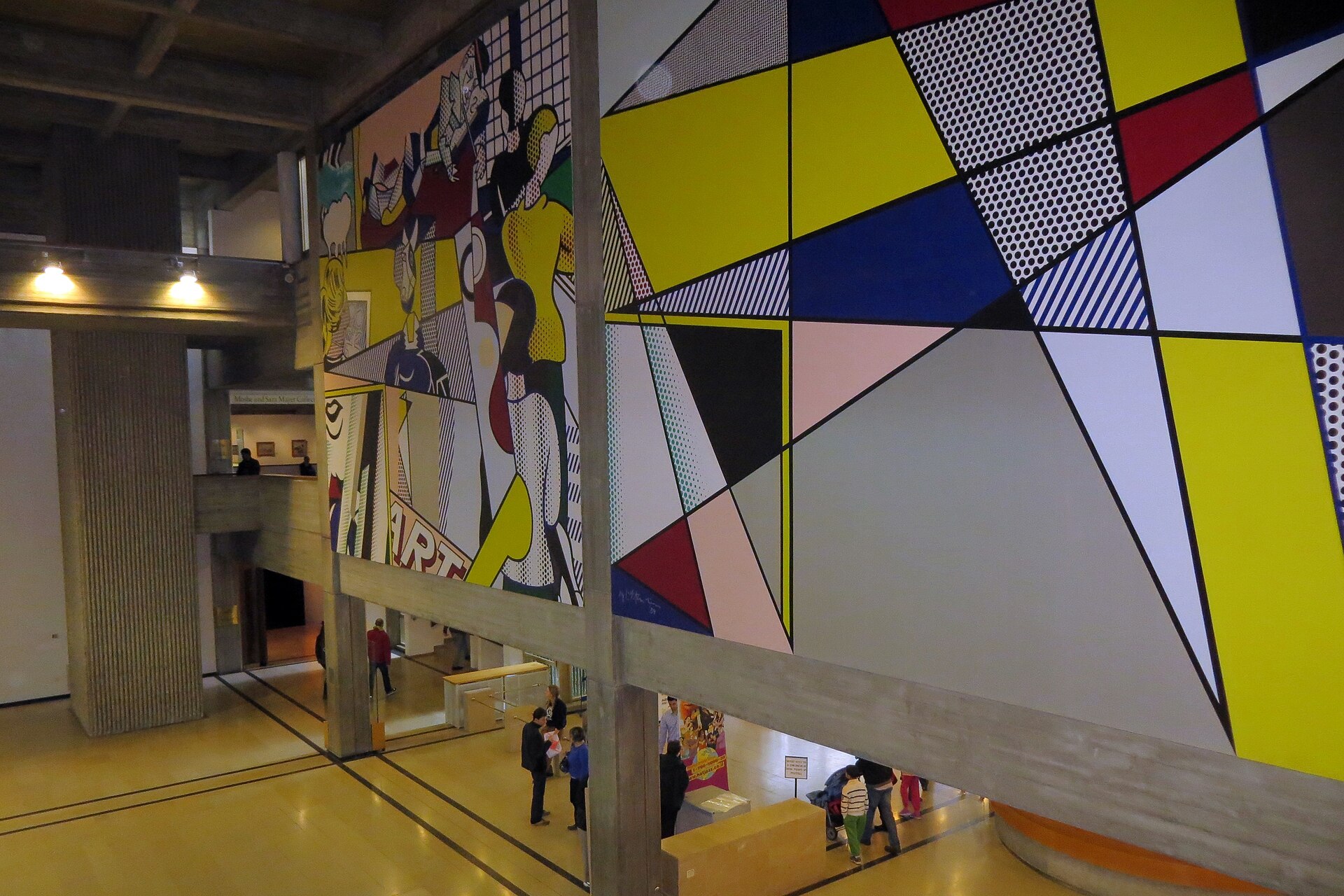
Tel Aviv Museum Mural
Roy Lichtenstein, 1989Oil on board and acrylic on canvas, each of the two panels 840x700 cm, given by the artist; fills a full atrium wall of the Main Building and is one of the first things a visitor sees on entering.9
The Lightfall atrium
Preston Scott Cohen, architect, 2011A 26.5-metre folded-concrete void at the centre of the Amir Building that is itself a display space, discussed by the critic Sylvia Lavin in Artforum as a rethinking of the museum atrium in dialogue with Frank Lloyd Wright's Guggenheim rotunda.5
The Promenade, Tel Aviv Beach
Robert Capa, 1948A gift of Edith and Cornell Capa in 1990, part of a photography collection of roughly 4,000 works that also holds prints by Henri Cartier-Bresson, Brassai, Weegee and Alexander Rodchenko.11
The Israeli art collection
Yosef Zaritsky, Reuven Rubin, Nahum Gutman, Aharon Avni, Arieh Aroch and the New Horizons group, among many othersDescribed by the museum as one of the largest and most current collections of Israeli art anywhere, anchored by the 1948 New Horizons exhibition that the museum's own history credits with reshaping Israeli abstraction, and the founding purpose the institution has kept since 1932.12
Early Archipenko sculptures and reliefs from the Goeritz collection
Alexander Archipenko, 1908-1921About thirty works sent furtively from Berlin to Tel Aviv in November 1933 by the Jewish textile manufacturer and collector Erich Goeritz, on the recommendation of the museum's first director Karl Schwarz, months after Hitler's appointment as chancellor; Goeritz's family formally gave the collection to the museum in 1956 in his memory, and it survives as a rare encapsulation of Archipenko's early work that the artist himself did not learn had reached Tel Aviv until 1947.7
150 prints by Edvard Munch
Edvard Munch, given by Charles and Evelyn Kramer of New YorkA single-donor gift that gives the prints and drawings department, a 25,000-item collection overall, an unusually deep run of one Nordic modernist's etchings, lithographs and woodcuts, alongside the same donors' gifts of German Expressionist prints by Kokoschka and Beckmann.10
Exhibitions on now
- On now11 Feb to 12 Dec 2026Confirmed , 7 weeks ago
- On now28 May to 28 Nov 2026Confirmed , 7 weeks ago
Past exhibitions here
- Closed16 Jan to 3 Oct 2026Confirmed · check before you travel
- Closed22 Nov 2025 to 29 Aug 2026Confirmed · check before you travel
- Closed10 Feb to 29 Aug 2026Confirmed · check before you travel
A museum built by a mayor for a city that did not exist yet
The Tel Aviv Museum was established in 1932 at the instigation of Meir Dizengoff, the city's first mayor, who wanted a museum of art as part of his vision of Tel Aviv as a modern cultural centre. Dizengoff donated his own home at 16 Rothschild Boulevard as the museum's first premises. The two-storey house was remodelled into fifteen exhibition spaces and a concert and lecture hall, and it opened on 2 April 1932 with an exhibition of the museum's own early acquisitions, including works by Mane Katz, Amedeo Modigliani, Marc Chagall and Chana Orloff, alongside works lent by 34 local artists including Yosef Zaritsky, Reuven Rubin and Anna Ticho. In his opening speech Dizengoff dedicated the building as a memorial to his late wife, Zina Dizengoff, saying he had donated the land and house on it 'to be forever the home of the artistic and cultural enterprise, the Tel Aviv Museum.' Dr Karl Schwarz, formerly head of the Jewish Museum in Berlin, arrived in 1933 at Dizengoff's invitation to run the museum and spent fourteen years building its early collection and its art library. On 14 May 1948 the state of Israel's Declaration of Independence was proclaimed in the same hall that had hosted the museum's concerts and lectures, a use the museum's own history still marks as the pivot between its founding period and everything that followed; that room is preserved today as Independence Hall.
Three buildings, three decades of style
The museum has moved and grown twice since Dizengoff's house became too small for it. In January 1959 it opened the Helena Rubinstein Pavilion, a modest late-modernist building on Tarsat Boulevard designed by Zeev Rechter with his son Yacov Rechter and Dov Karmi and funded by a donation from the cosmetics magnate Helena Rubinstein, who attended the opening in person; it was meant to become the museum's permanent home but proved too small for an institution with international ambitions, and for twelve years it also housed the museum's offices and library. In 1964 the government allocated a larger plot on Shaul Hamelech Boulevard after lobbying from director Haim Gamzu and mayor Chaim Levanon, and following an architecture competition the Brutalist Main Building designed by Dan Eitan and Itzhak Yashar opened there in 1971, inaugurated by Prime Minister Golda Meir, with four galleries spiralling around a tall central atrium. By 2011 the collection had again outgrown its walls, and the Herta and Paul Amir Building, designed by the American architect Preston Scott Cohen with Israeli project architect Amit Nemlich on a plot secured by former director Marc Scheps, opened beside it after an international competition and fundraising campaign led by director Mordechai Omer, doubling the museum's exhibition space with an origami-folded concrete structure built around a skylit atrium called the Lightfall. The Rubinstein Pavilion survives too, renamed the Eyal Ofer Pavilion after a 2019-2023 renovation, so a single visit today crosses three buildings representing three separate decades of architectural fashion, plus a fourth: the Dizengoff house on Rothschild Boulevard, which today stands as Independence Hall.
The Berlin-Tel Aviv route: a collection assembled ahead of catastrophe
The museum's own account of its collection, published for its ninetieth anniversary, singles out one 1933 gift as the clearest evidence of how urgently that early collection was built. On 30 January 1933 Hitler was appointed German chancellor; in March the first concentration camp opened at Dachau, followed immediately by legislation against German Jews. That November, some 500 works of art were sent, in the museum's own words, 'furtively, from Berlin to Tel Aviv, like refugees.' Among them were about thirty sculptures, reliefs, paintings and drawings by the Ukrainian-born sculptor Alexander Archipenko, who had developed his Cubist style in Paris between 1908 and 1923 before leaving most of that early work behind when he emigrated to the United States. The owner was Erich Goeritz, a Jewish textile manufacturer and collector in Berlin, who was among the first to respond to an appeal from Karl Schwarz, the museum's newly arrived director, urging Jewish collectors to send their holdings to Tel Aviv for safekeeping. Goeritz himself resettled in London, where he died in 1955; Archipenko did not learn that his early work had survived intact in a Tel Aviv museum until 1947. The Goeritz family formally gave the collection to the museum in 1956 in Erich Goeritz's memory, and it remains, in the museum's own description, the most important holding of Archipenko's early work anywhere. It is the starkest instance of a pattern that runs through the collection's first decade: donors moving art out of Europe ahead of what they could see coming, years before most of the world called it what it was.
Two collecting tracks kept side by side since 1932
From its first year the museum ran two parallel collecting tracks, local and international, and both have grown into major holdings. Its Israeli art collection runs from the New Horizons abstraction associated with Yosef Zaritsky in the years after 1948 through the figurative and conceptual work of later generations to contemporary artists such as Sigalit Landau and Yael Bartana. Alongside it sits a European and American collection built up through donation and purchase since 1932: an Old Masters collection of some 150 works strongest in Italian, Flemish and Dutch painting and nineteenth-century Jewish art; Impressionist and Post-Impressionist paintings by Monet, Renoir, Gauguin and Pissarro; and, after 1952, a decisive gift from the American collector Peggy Guggenheim. Guggenheim had been impressed by Israel's showing at that year's Venice Biennale, and when the museum's director Eugene Kolb visited her palazzo on the Grand Canal to arrange a loan, she gave outright what he had only asked to borrow: sixteen oil paintings and twenty works on paper, including three Jackson Pollock canvases and three Man Ray Rayographs, alongside work by Max Ernst, Yves Tanguy and others. It was, by her own account and by later scholarship, the only gift she made during her lifetime to an institution outside the United States, and the museum's 1955 exhibition of the collection, the first show of its kind in Israel, drew more than 50,000 visitors to a building that had never before seen crowds on that scale outside the 1948 Declaration of Independence. A photography collection of roughly 4,000 works, prints and drawings holdings of some 25,000 items including 150 prints by Edvard Munch from a single New York donor couple, and a design collection round out a museum that was never built around one story of art history.
A building that argued with itself, and an institution that argued with its own board
The Amir Building drew architectural attention before it was even finished, and the reaction ran on two separate tracks that autumn. Writing in Artforum in the January 2012 issue, the critic Sylvia Lavin read Cohen's folded-concrete Lightfall as a serious rethinking of the museum atrium, comparing it to Frank Lloyd Wright's Guggenheim rotunda and arguing the building forces art and architecture into continuous negotiation rather than the usual generic container. Haaretz's own coverage of the building's launch symposium, in October 2011, described a very different mood running alongside the celebration: the newspaper reported that the symposium's programme, and the party atmosphere around the opening generally, carried 'not even a hint' of the loud public protest that had swept Israel that summer and had reached the museum directly, in the form of an 'artists' protest' against the conduct of the museum's own board of directors and the committee then searching for a new museum director. One academic panellist quoted in the same article, asked to weigh the new building's place in Tel Aviv's architectural history, warned it was 'too early to heap academic interpretations' on a structure nobody had yet seen used, and that the celebratory framing risked writing other, less comfortable stories about the institution out of its own history. The episode is a reminder that a museum's reception is not only a matter of what critics say about its walls; in the same season this one opened its most admired building, the loudest argument about it, at least inside Israel, was about who ran it.
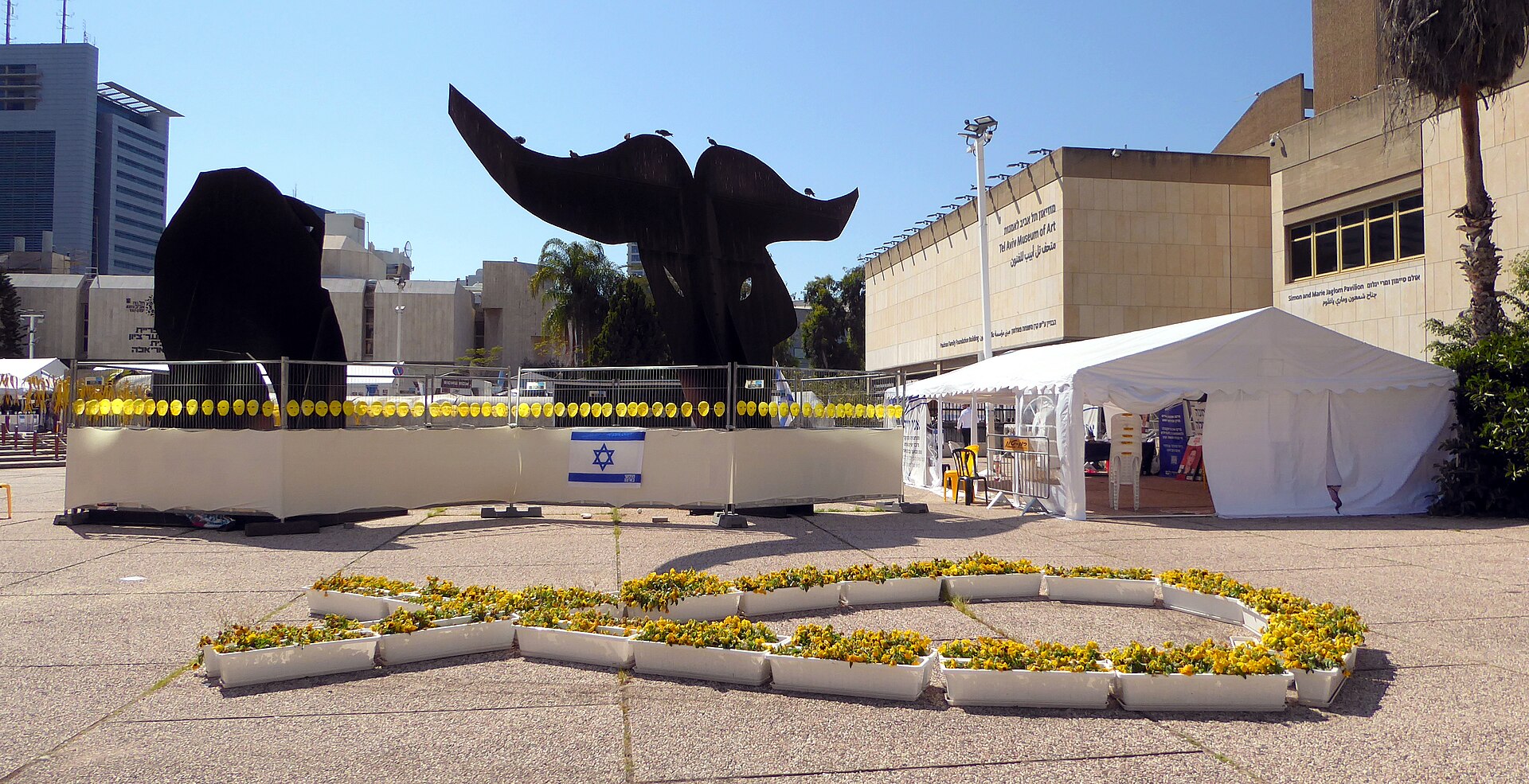
The plaza that became Hostages Square
Since the Hamas-led attack of 7 October 2023, the museum's own front plaza, previously known simply as Museum Square, has become one of the best-known public spaces in Israel under an unofficial name that the Tel Aviv municipality made official in August 2026: Hostages Square. Families of the roughly 240 people abducted that day, and later of those still missing, established an encampment there within weeks, drawn partly by its proximity to Israel's defence headquarters, and it has hosted rallies, vigils and improvised memorials ever since, including a long Shabbat table laid with an empty setting for every hostage. The museum itself was closed to the public for the plaza's first two months, reopening on 30 November 2023 with its doors initially used only for bathroom access during rallies. When it reopened its galleries in December 2023, director Tania Coen-Uzzielli told The Times of Israel that the museum could not treat the plaza outside as separate from what happened inside: 'The fact of the hostages forces us to rethink every day anew,' she said, describing the square as a 'spontaneous art space' the museum chose to leave uncurated rather than fold into its own programme. Two exhibitions opened that same month reflected the same reckoning: a long-planned Shalom Sebba retrospective, whose subject fled Nazi Berlin for pre-state Palestine in 1936, and a smaller show titled Shmini Atzeret, named for the Jewish holiday on which the attack took place, drawn entirely from the permanent collection to sit alongside the mood outside. That reckoning has not fully ended: visitor reviews from as recently as 2025 describe individual paintings, including major Impressionist works, still held in protected storage rather than on view, a change this record could not confirm or date from the museum's own current pages.
Visiting today
A visitor today buys one ticket, 55 shekels for an adult, covering both the Main Building and the Amir Building, with reduced rates for students, DigiTel Tel Aviv-Yafo residents, seniors and visitors with disabilities, and free entry for children, soldiers, national service volunteers and members. The museum keeps long Tuesday and Thursday evenings until 21:00, shorter hours the rest of the week, and closes only on Sunday. Two to three hours covers the Main Building and the Amir Building at a comfortable pace, with the Studio Cafe and the Pastel Restaurant both looking onto the sculpture garden for a break partway through. At the time of this record's research the Eyal Ofer Pavilion, the museum's third exhibition building, was stated by the museum's own visit page to be temporarily closed, with no reopening date given; a visitor planning specifically around its programme should check the museum's site before travelling. The same caution applies to individual paintings: since October 2023 several visitors have reported that well-known works, particularly from the Impressionist and modern European galleries, have at times been withdrawn from view into protected storage, a precaution the museum's own collection pages do not address directly.
What visitors say
Visitors consistently rank this among the strongest all-round art museums in Israel, praising the range of the Impressionist and modern European collection alongside the depth of the Israeli art collection, on a modern, centrally located campus most find easy to reach. Recent reviews are also the clearest evidence available that the war that began on 7 October 2023 has changed what is on view: several visitors report that major paintings have been moved into protected storage and that the museum's own pages do not mention this.
What is praised, what is criticised
- Praised: the range and quality of the Impressionist and modern European paintings, especially Monet, Renoir, Gauguin, Van Gogh, Pissarro and a large body of Chagall, shown alongside the Israeli art galleries
- Praised: the depth and clarity of the Israeli art collection for visitors with no prior background in it
- Praised: the building itself and its lighting, several reviewers singling out how well the galleries are lit compared with famous museums elsewhere
- Praised: the Studio Cafe and the sculpture garden it overlooks as a comfortable place to break up a visit
- Criticised: difficulty finding a clear route through the museum and between its buildings; more than one visitor in 2023 asked for a printed map and left without seeing everything they had come for
- Criticised: the admission price, which some visitors compare unfavourably with major museums abroad that offer free general entry
- Criticised: since October 2023, recurring visitor reports that some of the museum's best-known paintings, including its Impressionist holdings, have been moved out of the galleries into protected storage because of the war, a change the museum's own visit and collection pages do not flag; one visitor writing in 2025 called the alternate contemporary-art displays put up in their place "not especially interesting"
- Criticised: the Eyal Ofer Pavilion, one of the museum's three exhibition buildings, is currently closed, and as with the wartime storage of paintings the museum's own visit page states the fact without saying when it will reopen
Ratings on other platforms
Tripadvisor: 4.5 from 2,048 ratings, read 5 September 2026
A platform average is a tertiary source: it moves, it is not audited, and we quote no visitor's words.
Questions about Tel Aviv Museum of Art
Where is Tel Aviv Museum of Art?
27 Shaul HaMelech Blvd., The Golda Meir Cultural and Art Center, Tel Aviv, Israel.
How much does it cost to visit?
Regular Price: ILS 55; Students / DigiTel Tel Aviv-Yafo residents: ILS 45; Senior citizens / visitors with disability: ILS 27; Members, children and youth up to 18, active-duty soldiers, national service volunteers: free. As confirmed 5 September 2026.
When is it open?
Sunday closed; Monday 10:00-18:00; Tuesday 10:00-21:00; Wednesday 10:00-18:00; Thursday 10:00-21:00; Friday 10:00-14:00; Saturday 10:00-18:00. Closed: Sunday. As confirmed 5 September 2026.
What should you see first?
Jews Praying in the Synagogue on Yom Kippur (Maurycy Gottlieb, 1878); The Peggy Guggenheim gift of Abstract Expressionism and Surrealism (Jackson Pollock, Man Ray, Max Ernst, Yves Tanguy and others, given by Peggy Guggenheim); Tel Aviv Museum Mural (Roy Lichtenstein, 1989); The Lightfall atrium (Preston Scott Cohen, architect, 2011); The Promenade, Tel Aviv Beach (Robert Capa, 1948); The Israeli art collection (Yosef Zaritsky, Reuven Rubin, Nahum Gutman, Aharon Avni, Arieh Aroch and the New Horizons group, among many others).
What we could not confirm
- The museum's own visit and collection pages do not state, at the level of an individual painting, which works are currently withdrawn from view for wartime protective storage, or since when; the evidence in this record comes from visitor reports on Tripadvisor rather than a museum statement, and a reader planning to see one specific work should confirm its display status directly with the museum before travelling.
- The Eyal Ofer Pavilion's own page states it is temporarily closed but gives no reason and no reopening date; this record could not establish whether the closure is a renovation, a security measure connected to the war, or something else.
- The museum's own pages describe the Israeli art collection as among the world's largest without citing a comparison collection or a count; this record repeats the museum's own characterisation as a claim, not as an independently verified ranking.
- Full provenance histories for individual Old Masters works, such as the Rubens and Canaletto in the European collection, are not published by the museum beyond a donor's name and acquisition year; a complete prior-ownership chain for each work was not available for this record.
Images
Sources
- 1Tel Aviv Museum of Art, official site, 'Visit' page, fetched 2026-09-05. Hours, admission prices, contact details, bag/photography policy, accessibility, cafes and restaurants, notice that the Eyal Ofer Pavilion is temporarily closed. tamuseum.org.il/en/visit/
- 2Tel Aviv Museum of Art, official site, 'History' page, fetched 2026-09-05. Founding in 1932, Dizengoff, Karl Schwarz, the 1948 Declaration of Independence, the 1959 and 1971 relocations, list of directors, visitor numbers. tamuseum.org.il/en/about/history/
- 3Tel Aviv Museum of Art, official site, 'Paulson Family Foundation Building' (Main Building) page, fetched 2026-09-05. Architects Dan Eitan and Itzhak Yashar, the 1964 land allocation, 1971 inauguration, spiral gallery plan, 2018 renovation. tamuseum.org.il/en/about/buildings-and-architecture/the-main-building/
- 4Tel Aviv Museum of Art, official site, 'Eyal Ofer Pavilion' page, fetched 2026-09-05. History as the Helena Rubinstein Pavilion, 1952 architects, January 1959 opening, 2019-2023 renovation and 2023 renaming. tamuseum.org.il/en/about/buildings-and-architecture/eyal-ofer-pavillion/
- 5Tel Aviv Museum of Art, official site, 'Herta and Paul Amir Building' page, fetched 2026-09-05, and Sylvia Lavin, 'Surface Activation: The Amir Building at the Tel Aviv Museum of Art,' Artforum, January 2012 issue, fetched 2026-09-05 (characterisation only, not quoted). Architect Preston Scott Cohen with Amit Nemlich, October 2011 opening, Lightfall atrium dimensions and construction. tamuseum.org.il/en/about/buildings-and-architecture/amir-building/
- 6Tel Aviv Museum of Art, official site, 'Modern Art' collection page, fetched 2026-09-05; Karen Chernick, 'How Peggy Guggenheim helped put modern Israeli art on the map,' The Times of Israel/JTA, 10 May 2019, fetched 2026-09-05. Impressionist and modern holdings; the Guggenheim gift (36 works), the 1952 Biennale, Eugene Kolb, the 1955 exhibition and its attendance. tamuseum.org.il/en/collection/modern-art/
- 7Tel Aviv Museum of Art, official site, 'The Square' 90th-anniversary online exhibition, entry on Alexander Archipenko's 'Woman in Armchair' (1918) and the Erich Goeritz gift, fetched 2026-09-05. The November 1933 shipment from Berlin, Karl Schwarz's appeal to Jewish collectors, the 1956 gift by the Goeritz family. tamuseum.org.il/en/exhibition/the-square-19322022/
- 8Tel Aviv Museum of Art, official site, '16th-19th c. European Art' collection page, fetched 2026-09-05. Old Masters collection scope; Maurycy Gottlieb's 'Jews Praying in the Synagogue on Yom Kippur,' gift of Sydney J. Lamon through AICF, 1955. tamuseum.org.il/en/collection/european-art-16th-19th-centuries/
- 9Tel Aviv Museum of Art, official site, 'Contemporary Art' collection page, fetched 2026-09-05. Roy Lichtenstein's 'Tel Aviv Museum Mural' (1989), gift of the artist, and other contemporary holdings. tamuseum.org.il/en/collection/contemporary-art/
- 10Tel Aviv Museum of Art, official site, 'Drawings and Prints' collection page, fetched 2026-09-05, and 'Encounters in Edvard Munch's Space' exhibition page, fetched 2026-09-05; Angela Levine, 'Lightening up Edvard Munch: Israeli Artists Share His Space,' MidnightEast, 26 August 2012, fetched 2026-09-05. The 25,000-work prints and drawings collection; the 150-print Munch gift from Charles and Evelyn Kramer of New York. tamuseum.org.il/en/collection/drawing-and-printing/
- 11Tel Aviv Museum of Art, official site, 'Photography' collection page, fetched 2026-09-05. Scope of the roughly 4,000-work photography collection; Robert Capa's 'The Promenade, Tel Aviv Beach' (1948), gift of Edith and Cornell Capa, 1990. tamuseum.org.il/en/collection/photography/
- 12Tel Aviv Museum of Art, official site, 'Israeli Art' collection page, fetched 2026-09-05. Scope and named artists of the Israeli art collection, including Zaritsky, Rubin, Gutman and Aroch. tamuseum.org.il/en/collection/israeli-art/
- 13Tel Aviv Museum of Art, official site, 'Sculpture Gardens' page, fetched 2026-09-05. Lola Beer Ebner Sculpture Garden history, 1999 opening, 2014 reopening, listed works by Kadishman, Chadwick, Danziger and Cucchi. tamuseum.org.il/en/about/buildings-and-architecture/sculpture-gardens/
- 14Noam Dvir, 'What We Talk About When We Talk About Buildings,' Haaretz, 27 October 2011, fetched 2026-09-05. The Amir Building's launch symposium and the contemporaneous 2011 artists' protest against the museum's board of directors and director search committee. haaretz.com/israel-news/culture/2011-10-27/ty-article/what-we-talk-about-when-we-talk-about-buildings/0000017f-dbcf-d3a5-af7f-fbefc3450000
- 15'Hostages Square,' Wikipedia, read 2026-09-05. en.wikipedia.org/wiki/Hostages_Square
- 16Jessica Steinberg, '2 evocative exhibits go up in Tel Aviv museum, as battle for hostages is waged outside,' The Times of Israel, 25 December 2023, fetched 2026-09-05. The museum's closure from October to 30 November 2023, director Tania Coen-Uzzielli's comments, and the two exhibitions that reopened it. timesofisrael.com/2-evocative-exhibits-go-up-in-tel-aviv-museum-as-battle-for-hostages-is-waged-outside/
- 17Tripadvisor, 'Tel Aviv Museum of Art' attraction and reviews page, read 2026-09-05. tripadvisor.com/Attraction_Review-g293984-d318904-Reviews-Tel_Aviv_Museum_of_Art-Tel_Aviv_Tel_Aviv_District.html
- 18Wikidata, Tel Aviv Museum of Art (Q1267958), read 2026-09-05. wikidata.org/wiki/Q1267958
- 19Wikimedia Commons file description pages for File:TelAM.jpg, File:Herta and Paul Amir Building-Tel Aviv Museum of Art-3.jpg, File:Tel Aviv Museum of Art - Israel, March 2024 01.jpg and File:Tel Aviv Museum of Art 1 2013.jpg, read via the Commons API 2026-09-05, for licence, author and subject verification of every image used in this record. commons.wikimedia.org/wiki/Category:Tel_Aviv_Museum_of_Art