Napoleon as Mars the Peacemaker
Antonio Canova · Commissioned 1802; modelled from life in Paris in 1802; carved in Rome from 1803; completed 1806
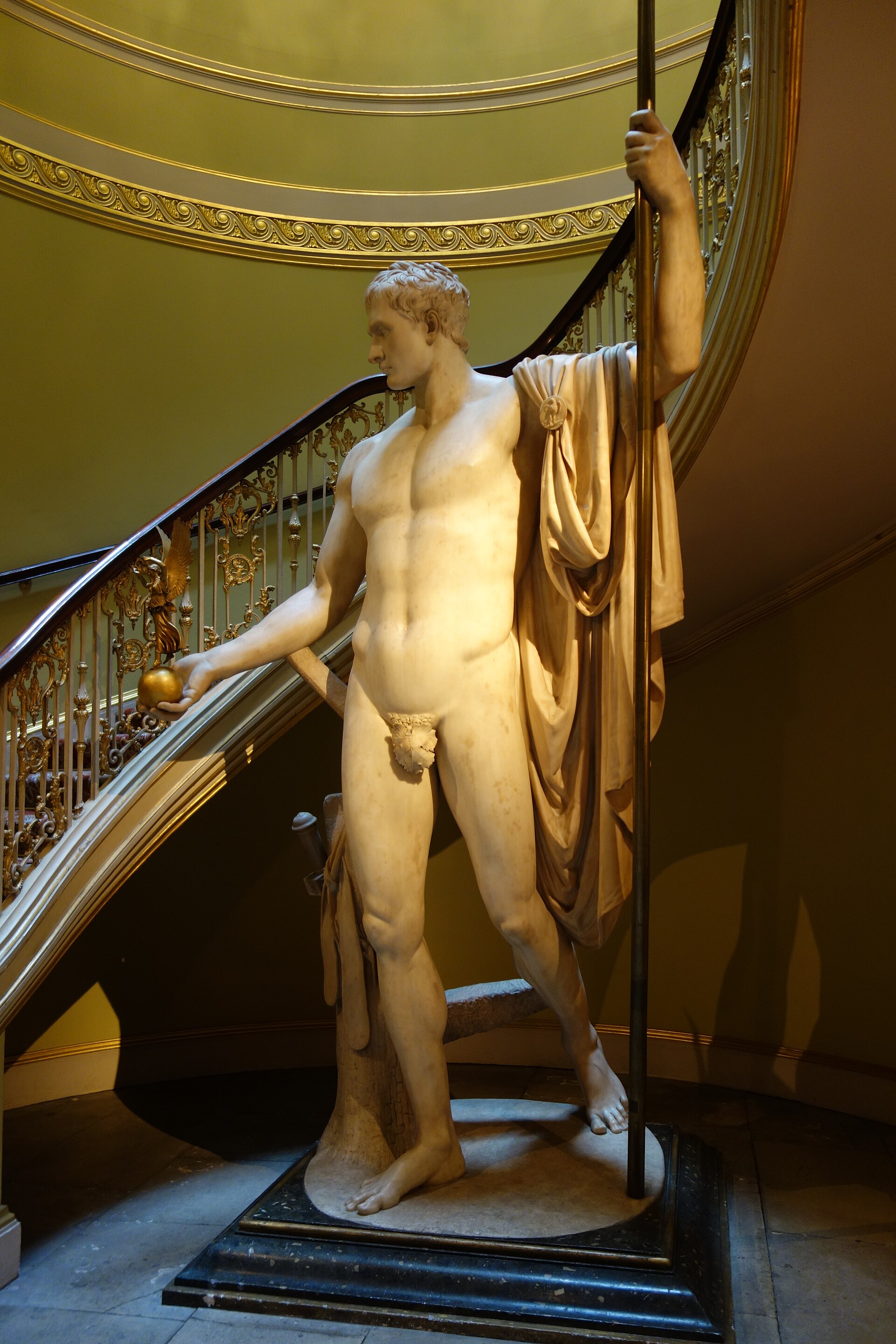
The object in this record. Verified as the Apsley House MARBLE, not a plaster or a bronze, by the setting: Robert Adam's curved stairwell with its gilded balustrade, and the white marble surface with gilt-bronze attachments. The gilded Victory is present, standing on the gilded globe in the right hand; at small scale she is easy to mistake for part of the ironwork behind her. The tree stump and scabbarded sword stand against the weight-bearing right leg, and the staff is a dark ungilded rod.
| Artist | Antonio Canova |
|---|---|
| Date | Commissioned 1802; modelled from life in Paris in 1802; carved in Rome from 1803; completed 1806 |
| Medium | Marble, with gilded bronze globe and Victory, and a gilt-bronze staff |
| Dimensions | 345 cm to the raised left hand. The Wellington Collection gives the weight as 13 tons. |
| Where it is now | Apsley House, Hyde Park Corner, London, at the foot of the principal staircaselast confirmed 4 August 2026 |
| Inventory number | The Wellington Collection; no accession number published in the sources consulted |
| Attribution | AcceptedUndisputed as Canova's design and as the marble he finished. Full note |
| Object type | Sculpture |
| Period | European Neoclassicism, 1800-1830 |
| Inscriptions | None recorded on the marble in the sources consulted. |
| Owners on record | 6 links5 documented, 1 disputed |
| Sources | 15 cited |
About this record Last verified 20 August 2026 · 15 sources cited · Change log
On this page 10 sections
ContentsClose
A colossal marble nude of Napoleon Bonaparte, 345 centimetres high and about thirteen tons, carved by Antonio Canova between 1802 and 1806 on Napoleon's own commission. Napoleon hated it. He had wanted to be shown in uniform, called the finished figure too athletic, and never allowed the public to see it: by 1814 it stood in the Louvre, which he had renamed after himself, behind a canvas screen.
In 1816, the year after Waterloo, the British government paid 66,000 francs for it and the Prince Regent gave it to the Duke of Wellington. It has stood at the foot of the staircase in Apsley House since 1817, on a floor and cellar that had to be strengthened to carry it, and it has never moved or been offered for sale.
The obvious reading is that a defeated emperor was hung in his conqueror's hall as a trophy. Julius Bryant has argued the opposite, that the placement and the collection assembled around it were a considered tribute rather than a taunt. Both readings are about the Duke, whose own view English Heritage says is unknown. The object itself is stranger than either: a sculptor who spent 1815 in Paris as the pope's envoy prising Italy's looted art back out of the Louvre had, nine years earlier, made this.
Provenance
Each link is graded. Documented: a cited source supports it. Disputed: the identification is argued but not established. Unknown: no owner for that span, and the gap is not smoothed into a narrative. The grades in the glossary.
- 1802 - 1811Antonio Canova, Rome; commissioned by Napoleon Bonapartedocumented
Commissioned in 1802, Canova refusing at first and being pressed by the papacy to accept, with Napoleon insisting that he travel to Paris; the head modelled from life in Paris in 1802; carving in Rome from 1803; completed 1806. Napoleon asked for military dress and Canova refused, holding the heroic nude to be essential to the work as art. The marble left Rome late in 1810 and reached Paris on 1 January 1811.15
- 1811 - 1814The French imperial state; Musee Napoleon, Parisdocumented
Napoleon saw the statue in April 1811, refused to accept it, called it too athletic and banned the public from seeing it. By 1814 it stood in the Salle des Hommes Illustres in the Louvre, which he had renamed the Musee Napoleon, concealed behind a canvas screen. It was never publicly displayed in his lifetime.15
- 1814 - 1816The restored French state; named in most accounts as Louis XVIIIdisputed
The seller in 1816 is not settled. The Wellington Collection and most accounts name Louis XVIII, whose government ordered that all paintings bearing the effigy of Bonaparte should disappear from the royal palaces, which is the context in which a colossal marble of the deposed emperor came onto the market. One account instead records the 66,000 francs as money the Louvre spent re-installing its Salle des Antiques, and English Heritage's house blog says the statue was purchased from the Louvre. Crown, museum or ministry, a price was paid.125
- 1816 - 1817The British government, then Arthur Wellesley, 1st Duke of Wellingtondocumented
Bought by the British government in 1816 for 66,000 francs, given in the sources as then under 3,000 pounds, and presented to the Duke of Wellington by the Prince Regent. Most sources date the presentation to 1816; English Heritage's house blog says the gift followed a year after the purchase. THIS WAS A PURCHASE, NOT A SEIZURE. In the same period Wellington was enforcing the restitution to Italy and the Netherlands of works Napoleon's armies had taken by force.12357
- 1817 - 1947The Dukes of Wellington, Apsley House, Londondocumented
Installed in 1817 at the foot of Robert Adam's principal staircase, with the floor and the wine cellar beneath strengthened to carry about thirteen tons. It has not moved since. Julius Bryant argued in Apollo in October 2005 that the position was a considered tribute rather than an insult; English Heritage states that the 1st Duke's own view is unknown.2345
- 1947 - presentThe nation; Apsley House and the Wellington Collection, managed by English Heritagedocumented
Gerald, 7th Duke of Wellington, gave the house and the most important part of the collection to the nation in 1947. The Wellington Museum Act 1947, section 3(1), makes so much of Apsley House as is not comprised in Part I of the Second Schedule available to the Duke of Wellington for the time being as a residence for himself, his family, his guests and his servants; section 3(6) ends that right if the dukedom is extinguished. The Act states no fraction. The statue stands in the public part. There is no market for it and no export question: its disposition is fixed by Act of Parliament.12
Prices realised
THIS STATUE HAS NEVER BEEN AT AUCTION AND CANNOT BE. It passed from the sculptor to the French imperial state, to the restored French regime, to the British government by purchase, to the Duke of Wellington by gift, and to the nation by statute in 1947. The single row below is the one recorded price and it was a government purchase, not a sale in a room; the figure is entered in the premium column because this table has no field for a negotiated price, and it is NOT a buyer's premium. It is recorded here because the number is constantly quoted without saying who paid whom.
| Date | Sale | Estimate | Result | Note |
|---|---|---|---|---|
| 1816 | Not an auction: a direct purchase by the British government | not applicable | Hammer not applicable; there was no auction and no hammer With premium FRF 66,000, given in the sources as then under GBP 3,000. THIS IS A PURCHASE PRICE, NOT A BUYER'S PREMIUM FRF | The buyer was the British government; the seller is named in most accounts as Louis XVIII and in others as the Louvre; the recipient was the 1st Duke of Wellington, to whom the Prince Regent presented it. Sterling conversions of period franc sums are derived and date-dependent and the under-3,000-pound figure should be treated as an order of magnitude, not a settled equivalence. No modern equivalent is offered: the methods for converting an 1816 sum differ by an order of magnitude and quoting one would be a bare assertion. |
Hammer is the price at which the bidding stopped; with premium adds the fee the house charges the buyer on top. Hammer price and buyer's premium in the glossary.
Technical evidence
| Attribution note | Undisputed as Canova's design and as the marble he finished. What autograph means in his studio is worth stating precisely: Canova modelled in clay at full size, formatori cast the model in plaster, bronze reference nails called repere were set into the plaster surface, praticiens transferred the points and roughed out the block, and Canova himself did the final carving and surface. The head, the flesh and the finish are his. The quarrying out of the block was not, and he was criticised in his own lifetime for relying on a mechanical transfer method. |
|---|---|
| Material | White marble, with a gilded bronze globe and a gilded bronze Victory in the right hand. The staff in the raised left hand is a dark, ungilded metal rod as the figure now stands; earlier descriptions of a gilt-bronze staff are not borne out by the object in its present state.1514 |
| Dimensions and weight | 345 cm to the raised left hand. The Wellington Collection gives the weight as 13 tons. The floor at the foot of the Apsley House staircase, and the wine cellar below it, were strengthened in 1817 to carry the load.125 |
| Making sequence | Full-size clay model by Canova; plaster cast taken by formatori; bronze reference nails, repere, set into the plaster at measured intervals with more prominent key points marking maximum dimensions; mechanical point transfer and roughing out of the block by praticiens; final carving and surface by Canova; cleaning and final polish by lustratori.8 |
| Surface treatment | Canova coated flesh surfaces with a thin wax to soften them and tinted lips and skin. Accounts of what he used to reduce the glare of new white marble include horse urine and dirty water. He was criticised in his own lifetime both for the mechanical transfer method and, by classical purists, for a finish held to be too sensual and painterly.8 |
| Iconography and pose | Napoleon in the guise of Mars the Peacemaker, in the heroic nude of Roman imperial portraiture. Weight on the right leg; a tree stump with a scabbarded sword propped against that same weight-bearing right leg as the structural support; a mantle over the left shoulder; a staff in the raised left hand; a gilded globe surmounted by a Nike in the extended right hand. The subject is the emperor who has made peace, conceived after the Peace of Amiens.1514 |
| The subject's objection | Napoleon wanted to be portrayed in French military dress; Canova refused on the ground that the nudity was essential to the work as art. On seeing the finished marble in April 1811 Napoleon called it too athletic, refused to accept it and banned public viewing. By 1814 it stood in the Salle des Hommes Illustres in the Louvre behind a canvas screen.15 |
| The Milan bronze | Cast in Rome by Francesco Righetti and his son Luigi, using bronze from cannon at the Castel Sant'Angelo. The English-language account dates the cast 1811; the Italian account dates the bronze 1810 and the commission to spring 1807 on Eugene de Beauharnais's orders for 5,000 French louis. In the courtyard of the Palazzo di Brera, Milan, since 1859; base redesigned 1864 by Luigi Bisi in granite, Carrara marble and bronze. Its gilded bronze Victory was stolen in 1978; the frequently repeated date of 25 October 1978 is flagged citation-needed in the source that carries it, and the replacement is given as 1980 by the Italian account and as the 1980s by the English one.115 |
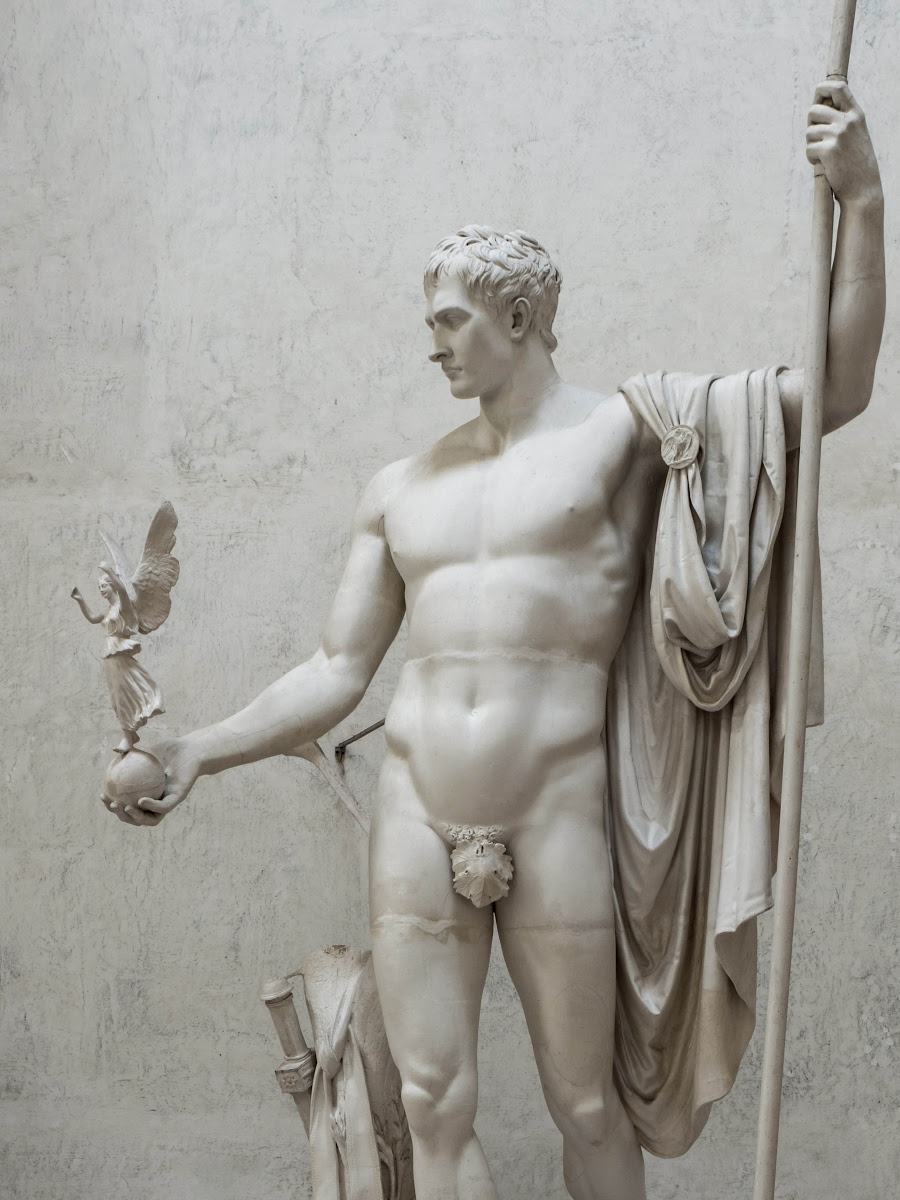
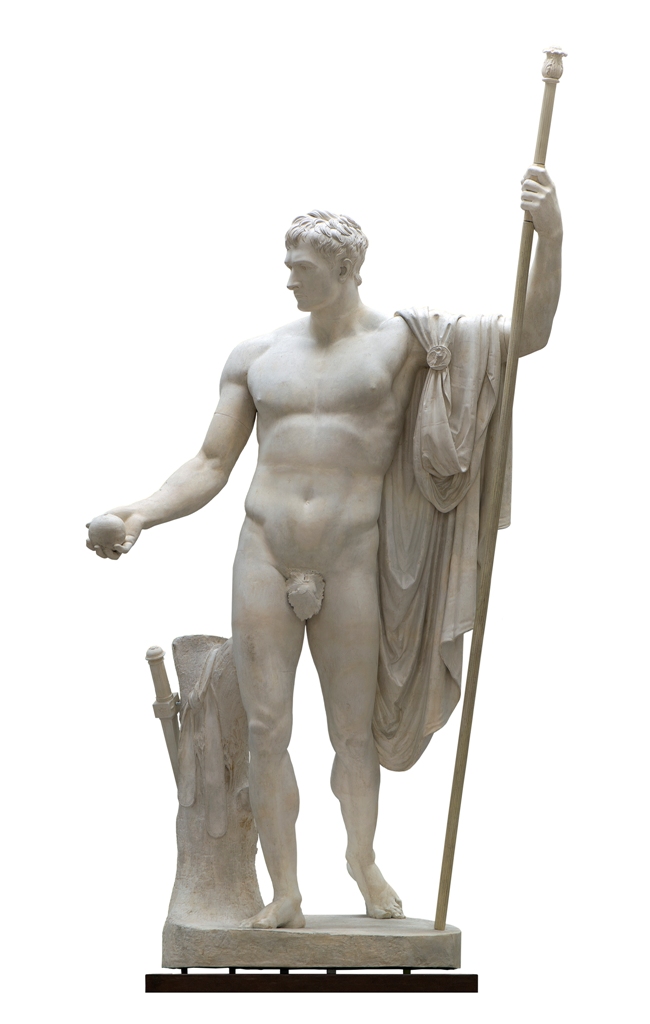
| The Milan plaster | ONE object, not two. A full-size plaster was sent to Padua in eight sections and was not paid for, and stayed in its packing cases; the Italian account adds that it was destined for the library of the University of Padua, for Canova's friend Daniele Francesconi, and was held at the Padua customs house against an unpaid duty of 330 scudi. It was then bought, on the English account by Eugene de Beauharnais and on the Italian account by the government of the Kingdom of Italy for the Royal Academy, and displayed in the Galleria Reale at the Palazzo Brera from 1809 to 1814. In the Accademia storerooms until 2008; restored and installed in the Pinacoteca di Brera in 2009. It has no Victory: the right hand holds a bare globe.115 |
| How many plasters | Five, on both accounts, but for different stated purposes. The English account says five plaster copies were commissioned for Italian academies of fine arts. Italian sources say five plasters were executed by Vincenzo Malpieri in 1808 in preparation for the lost-wax casting of the bronze. The one plaster whose destination is documented was going to a university library. A further plaster, carrying the Victory, is at the Museo Gypsotheca Antonio Canova, Possagno.1915 |
| Identification tests | Material (marble with gilt bronze at Apsley; bronze at the Brera courtyard; matte plaster at Possagno and in the Pinacoteca di Brera); setting (a curved stairwell with a gilded Robert Adam balustrade against a mid-green wall, at Apsley House only); the Victory (present and gilded at Apsley and Possagno, absent on the Brera museum plaster, a post-1978 replica on the Brera bronze); and the staff (dark ungilded metal at Apsley, a plain light rod on the Brera plaster).191015 |
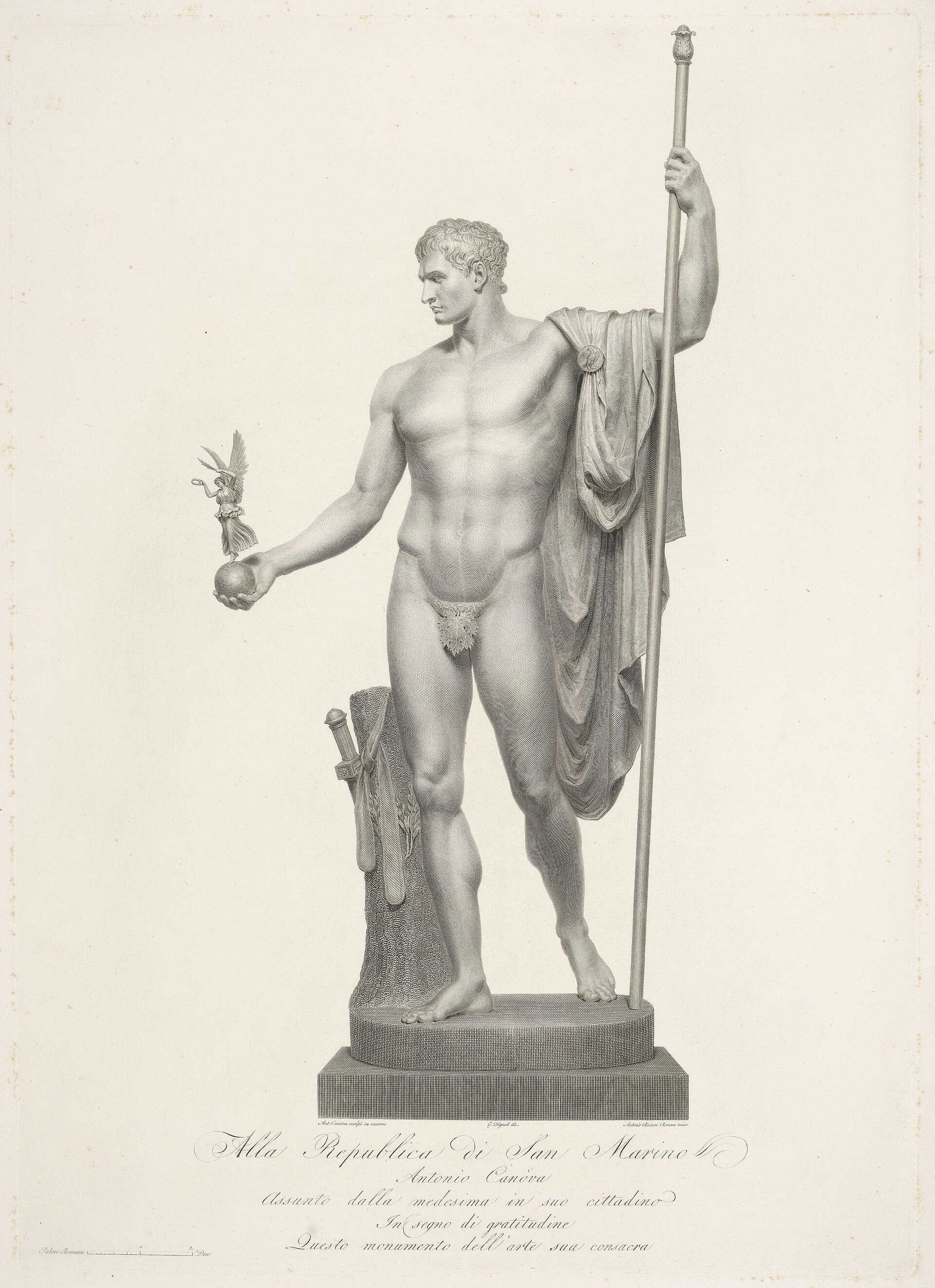
| Reproductive print | Engraving by Antonio Ricciani after a drawing by Giovanni Tognolli after Canova, Rijksmuseum RP-P-OB-39.165, catalogue reference Le Blanc 17, collector's mark Lugt 12 stamped on the verso, acquired 2006, released CC0. From a series of unknown extent reproducing Canova's sculptures by various engravers after Tognolli's drawings. The plate size is given on the Commons record as 645 x 465 mm; that field was truncated in the copy read and should be confirmed against the Rijksmuseum catalogue.10 |
Images
The record in full
Chapter 1What it is
A standing male nude in white marble, 345 centimetres to the raised left hand, weighing about thirteen tons on the Wellington Collection's figure.
A standing male nude in white marble, 345 centimetres to the raised left hand, weighing about thirteen tons on the Wellington Collection's figure. Napoleon stands in the pose of a Roman emperor in the guise of Mars: weight on the right leg, a mantle gathered at the left shoulder by a disc brooch and falling down the left side, a long staff in the raised left hand, a tree stump with a scabbarded sword propped against the weight-bearing right leg, and a small covering of carved foliage at the groin.
The right arm is extended, and in the open palm sits a gilded globe with a gilded bronze Victory standing on it, wings spread. That figure is the smallest thing in the sculpture and it carries the whole argument. She is a Nike, the personification of winged victory, and she stands on the world in the emperor's outstretched hand rather than crowning him: the composition puts victory at arm's length and makes it something he is holding out, not wearing. The title Mars the Peacemaker says the same thing. Canova was portraying not a conqueror but a conqueror who had stopped, which was the case Napoleon's own propaganda made in 1802 after the Peace of Amiens.
In photographs the Victory is easy to lose. At Apsley House she is silhouetted against the gilded ironwork of Robert Adam's staircase balustrade and reads at small scale as part of the railing. Enlarge the plate and she is unmistakably there, on the orb, wings out, turned away from the man holding her.
Chapter 2How Napoleon came to commission a nude of himself
Canova was the most famous sculptor in Europe and did not want the job.
Canova was the most famous sculptor in Europe and did not want the job. He refused at first and was pressed by the papacy to accept; Napoleon insisted he come to Paris, and in 1802 he went and modelled the head from life. The rest was carved in Rome from 1803 and finished in 1806.
The disagreement was about clothes and it was fundamental. Napoleon wanted to be shown in French military dress, as the general and head of state he was. Canova refused, on the ground that the nude was not decoration but the thing that made the work art at all: the heroic nude was the language of antiquity, and a portrait in a modern uniform was a portrait of a moment rather than of a man. He was proposing the Augustan model, the emperor as a god, and that model does not work in a coat.
Every party to this had something to gain. Napoleon was assembling a Roman visual identity for a regime four years old. Canova was the living proof that the antique could be resumed, and being commissioned by the most powerful man in Europe placed him at the head of his profession. The compromise was that there was no compromise: Canova carved the nude, and Napoleon paid for a statue he had already lost the argument about.
Chapter 3He would not let anyone see it
The finished marble left Rome late in 1810 and reached Paris on 1 January 1811.
The finished marble left Rome late in 1810 and reached Paris on 1 January 1811. Napoleon saw it in April of that year, refused to accept it, called it too athletic, and banned the public from seeing it.
By 1814 it stood in the Salle des Hommes Illustres in the Louvre, which Napoleon had renamed the Musee Napoleon, hidden behind a canvas screen. That detail is the whole story of the object in one image: the largest and most idealising portrait ever made of the man, standing in the national museum named after him, covered with a sheet on his own orders.
The usual explanation, too athletic, is the emperor's own phrase and it is probably not the whole reason. Napoleon was short and by 1811 had thickened; Canova's figure is a young athlete's body with Napoleon's head on it, and the gap between the two would have been visible to everyone who saw them in the same week. The statue also announces a peace that had collapsed: it was conceived after Amiens and delivered in the middle of the Peninsular War, a year before Russia. Whatever the reason, the effect was to make an eleven-foot marble emperor into a state secret.
Chapter 4Bought, not seized, in 1816
What happened after Waterloo is the part of the record that most accounts compress into a single misleading sentence about the statue being taken as a trophy.
What happened after Waterloo is the part of the record that most accounts compress into a single misleading sentence about the statue being taken as a trophy. It was not seized. It was bought, for a stated price, in the year the allied armies were emptying the Louvre of things that had been.
The transaction is documented and its parties are not entirely settled. The British government paid 66,000 francs in 1816, a sum the sources render as then under three thousand pounds, and the Prince Regent presented the statue to the Duke of Wellington. Most accounts, including the Wellington Collection's own, name the seller as the restored Bourbon king Louis XVIII, whose government had ordered that all paintings bearing the effigy of Bonaparte should disappear from the royal palaces. One account records instead that the 66,000 francs was money the Louvre spent on re-installing its Salle des Antiques, and English Heritage's own house blog says simply that the statue was purchased from the Louvre. Crown, museum or ministry, the point that matters is unaffected: money changed hands and a title passed.
So the chain is: commissioned by an emperor who refused it, inherited by the regime that replaced him, sold to the government whose army had beaten him, and given by that government's head of state to the general who commanded on the day. Four transfers of title in fifteen years, every one of them documented, and not one of them a sale by the maker to a collector.
Chapter 5The man who took Italy's art back out of the Louvre carved it
In 1815 Canova went to Paris as the pope's envoy, to recover the art Napoleon's armies had taken from the Papal States and from Italy generally.
In 1815 Canova went to Paris as the pope's envoy, to recover the art Napoleon's armies had taken from the Papal States and from Italy generally. He succeeded, and was created Marquis of Ischia with an income attached. The best-known account of the removal gives a convoy of 41 carts drawn by 200 horses leaving Paris on 25 October 1815 with 249 works, among them the Apollo Belvedere, the Laocoon and Raphael's Transfiguration.
The British delegation in Paris was on his side and did the enforcing. Wellington personally assisted the King of the Netherlands in reclaiming his collection from the Louvre and sent his own troops into the museum to take Flemish and Dutch pictures off the walls. Castlereagh, Wellington and the paymaster general Charles Long appear, on The Art Newspaper's careful wording, to have been in sympathy with the claims of the Italian and other states, and they later provided the impoverished Italian states with two convoys, a British frigate and 35,000 pounds towards the costs of packing and transport. Castlereagh's own case for restitution turned on the principle of property, which he called the surest and only guide to justice, and on settling the public mind of Europe.
Hold those facts against each other. In the autumn of 1815 the Duke of Wellington was emptying the Louvre of objects that had been taken by force and returning them to the states they came from. In 1816 he accepted, as a gift from his sovereign, a statue bought out of that same museum. Nobody at the time appears to have thought the two positions inconsistent, because they were not: one was restitution of stolen property, the other a purchase from a lawful owner. The distinction between seizure and purchase is the one the whole restitution debate still runs on, and both halves of it happened in the same building within twelve months.
Chapter 6The staircase, and what it means
The statue was installed at the foot of Robert Adam's principal staircase in Apsley House in 1817, and the floor beneath it had to be strengthened to take the weight; the reinforcement went into the...
The statue was installed at the foot of Robert Adam's principal staircase in Apsley House in 1817, and the floor beneath it had to be strengthened to take the weight; the reinforcement went into the wine cellar below.
The standard reading is that Wellington put his defeated enemy in the well of his own staircase so that every guest would pass him. Julius Bryant, who wrote the Apsley House catalogue and was Keeper of Word and Image at the Victoria and Albert Museum, argued in Apollo in October 2005 that this is wrong: that the position was a carefully thought-out tribute rather than a calculated insult, that Wellington admired both Canova and Napoleon, and that the care taken over the display and over the collection assembled around it indicates the statue was meant to command respect and reflection rather than to serve as a trophy.
The evidence on Wellington's own view is thin. English Heritage's blog for the house states flatly that his opinion is still unknown, while noting his respect for Napoleon as a general. What can be said is architectural. The stairwell is the only space in the house that could take a figure of this height, and a colossal nude does not fit in a drawing room. Wellington may have had no aesthetic argument to make at all; he may simply have had one room with the ceiling height and a floor that could be underpinned.
Chapter 7How Canova actually made a marble, and why that matters here
Canova modelled in clay at the full scale of the finished work.
Canova modelled in clay at the full scale of the finished work. Specialists called formatori cast the clay in plaster. Small bronze nails, repere, were then set into the plaster surface at measured intervals, with more prominent key points marking the maximum dimensions, so that the form could be transferred mechanically to the block. Praticiens did that transfer and roughed out the marble. Lustratori cleaned the dust and gave the final polish. Canova did the last carving and the surfaces himself.
He also treated the finished skin. He coated flesh with a thin wax to soften the surface and tinted lips and skin, and the accounts of what he used to knock back the glare of new white marble include horse urine and dirty water. This was controversial in his lifetime and he was criticised both for the mechanical transfer method and, by classical purists, for producing something too sensual and too painterly to count as a real inheritance from Greek sculpture.
Three consequences follow for this record. First, the full-size plaster survives as an object in its own right, with the repere still in it, which is why plasters of this composition exist in more than one museum and are routinely photographed and captioned as if they were the statue. Second, a bronze can be cast from a plaster at any later date without Canova's involvement, and one was. Third, the difference between the Apsley marble and everything else derived from the same model is not a difference of design at all. It is a difference of material and of hand, and it is invisible in a small reproduction.
Chapter 8The other Napoleons from the same model
There is one marble. Everything else is a cast, and the record has to keep them apart.The Milan bronze.
There is one marble. Everything else is a cast, and the record has to keep them apart.
The Milan bronze. Cast in Rome by Francesco Righetti and his son Luigi, with bronze taken from cannon at the Castel Sant'Angelo. The English-language account dates the cast 1811; the Italian account dates the bronze 1810 and the commission to spring 1807, placed on the orders of Eugene de Beauharnais for 5,000 French louis. The figure has stood in the courtyard of the Palazzo di Brera in Milan since 1859, on a base redesigned in 1864 by Luigi Bisi in granite, Carrara marble and bronze. Its gilded bronze Victory was stolen in 1978 and replaced by a replica; the widely repeated date of 25 October 1978 carries a citation-needed flag in the source that gives it, and the Italian account gives 1980 for the replacement.
The plaster in Milan. One full-size plaster accounts for two stories that are usually told as two objects. It was sent to Padua, divided into eight sections, and was not paid for and stayed in its packing cases; the Italian account adds that it had been destined for the library of the University of Padua, for Canova's friend Daniele Francesconi, and was stuck at the Padua customs house because the duty of 330 scudi could not be paid. It was then bought, on the English account by Eugene de Beauharnais personally and on the Italian account by the government of the Kingdom of Italy for the Royal Academy, and displayed in the Galleria Reale at the Palazzo Brera from 1809 to 1814. After Napoleon's fall it went into the Accademia storerooms and stayed there until 2008; it was restored and installed in the Pinacoteca di Brera in 2009. That plaster is missing its Victory: the right hand holds a bare globe.
How many plasters, and what for. The English account says five plaster copies were made for Italian academies of fine arts. Italian sources say five plasters were made in 1808 by Vincenzo Malpieri in preparation for the lost-wax casting of the bronze. Those are different claims about the same number and this record does not choose between them; what is certain is that the one plaster whose destination is documented was going to a university library, not to an academy of fine arts. A further plaster is in the Museo Gypsotheca Antonio Canova at Possagno, and it does carry the Victory.
The prints. The composition also circulated as an engraving. The Rijksmuseum holds a print by Antonio Ricciani after a drawing by Giovanni Tognolli after Canova, part of a series of unknown extent reproducing Canova's sculptures. Reproductive engraving is how a statue in a locked room in Paris became a famous image, and it is the reason the composition was known across Europe during the years when almost nobody was allowed to look at the marble.
Chapter 9Who owns it
Gerald, the 7th Duke of Wellington, gave Apsley House and the most important part of the 1st Duke's collection to the nation in 1947.
Gerald, the 7th Duke of Wellington, gave Apsley House and the most important part of the 1st Duke's collection to the nation in 1947. The Wellington Museum Act 1947 gave effect to the gift. Section 3(1) provides that so much of Apsley House as is not comprised within the portions described in Part I of the Second Schedule shall at all times be available to the Duke of Wellington for the time being for occupation as a residence for himself, his family, his guests and his servants; section 3(6) ends that right if the dukedom is extinguished. The Act itself states no fraction, and the commonly repeated figure of just over half is not in it.
The public part is run by English Heritage and the statue stands in it. This is a materially different position from that of most objects in this archive. There is no private owner who could sell, no export licence question, and no market. The statue is national property held under a specific Act of Parliament, in a building where the donor's family still lives.
Chapter 10The version problem, stated exactly
Every full-size figure of this composition looks the same in a photograph.
Every full-size figure of this composition looks the same in a photograph. Distinguishing them is a matter of four tests, and any caption that does not apply at least one of them is guessing.
Material. The Apsley figure is white marble with gilt-bronze attachments. The Brera courtyard figure is bronze throughout, dark, weathered and outdoors. The Possagno and Brera museum figures are plaster: matte, uniform, faintly grey-white, and characteristically shown against a plain wall or on a wooden pallet.
Setting. The Apsley marble stands in a curved stairwell against a mid-green wall, with a gilded Adam balustrade behind it. Nothing else in the group has that background.
The Victory. Present and gilded on the Apsley marble and on the Possagno plaster. Absent on the Brera museum plaster, whose right hand holds a bare globe. Present but a modern replica on the Brera bronze, the original having been stolen in 1978.
The staff. A dark, ungilded metal rod in the Apsley marble; a plain light-coloured rod, evidently a modern replacement, in the Brera plaster.
These are not fussy distinctions. A picture of a plaster of Napoleon, captioned as the statue at Apsley House, is a picture of a different object made by different people at a different date, and it appears under that caption constantly.
Chapter 11Canova's other Bonaparte, in the room this archive already knows
The Napoleonic commissions were a family programme.
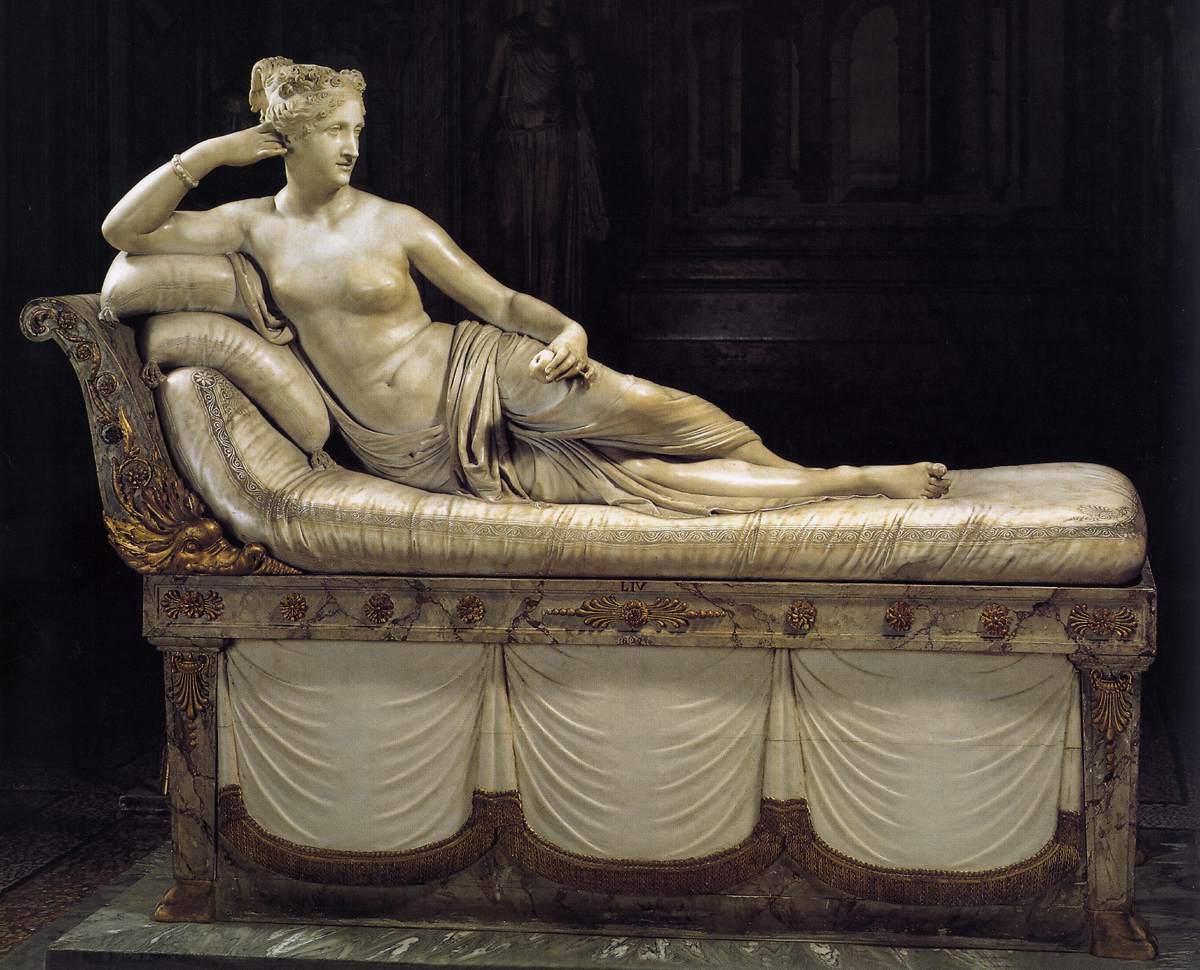
The Napoleonic commissions were a family programme. Between 1805 and 1808 Canova carved Napoleon's sister Pauline Bonaparte, by then married to Prince Camillo Borghese, as Venus Victrix: a reclining half-nude holding the apple of the judgement of Paris. It is in the Galleria Borghese in Rome, which is to say in the same building as Bernini's two busts of Cardinal Scipione Borghese, and it entered that collection as a Borghese family commission rather than a state one.
The two Canova Bonapartes make the same argument in opposite registers. The brother is Mars who has stopped fighting; the sister is Venus who has won a beauty contest. Both borrow an antique identity outright rather than alluding to one. And both were made for a dynasty that in 1806 was four years into a hereditary empire and needed, very quickly, the visual apparatus that older dynasties had accumulated over centuries. Canova supplied it, and then in 1815 went to Paris and took back the antiquities the same dynasty had stolen.
The artist
Antonio Canova, Marquis of Ischia
Canova is the last European sculptor whose reputation was continental rather than national, and the only one whose career runs straight through the political rupture of his age without breaking. He carved the Bonapartes at the height of the empire and then, in 1815, walked into the Louvre as the pope's envoy to take Italy's confiscated antiquities back. Both facts are documented and neither cancels the other. Any account of him that presents him as either a court sculptor to Napoleon or a patriot recovering stolen art has taken half the evidence.
Related works
| Work | Relation | Where it is |
|---|---|---|
| Napoleon as Mars the Peacemaker, bronze Antonio Canova, cast by Francesco and Luigi Righetti | Bronze cast from the same model, not by Canova's hand Cast in Rome from cannon bronze taken at the Castel Sant'Angelo; dated 1811 on the English account and 1810 on the Italian, which gives the commission to spring 1807 for 5,000 French louis. In place since 1859 on a base redesigned in 1864 by Luigi Bisi. The gilded bronze Victory was stolen in 1978 and is now a replica. | Courtyard of the Palazzo di Brera, Milan |
| Napoleon as Mars the Peacemaker, plaster Antonio Canova and his studio | Full-size plaster model of the same composition The plaster sent to Padua in eight sections and never paid for, held at the Padua customs house, then bought and shown in the Galleria Reale at the Palazzo Brera from 1809 to 1814, in storage until 2008, restored and installed 2009. It carries no Victory; the right hand holds a bare globe. | Pinacoteca di Brera, Milan |
| Napoleon as Mars the Peacemaker, plaster Antonio Canova and his studio | Full-size plaster model of the same composition Carries the Victory on the globe. The Possagno gipsoteca holds Canova's surviving plasters with their repere still in place and is the primary evidence for how he worked. | Museo Gypsotheca Antonio Canova, Possagno |
| Pauline Bonaparte Borghese as Venus Victrix Antonio Canova | The other Canova portrait of a Bonaparte in antique guise Marble, 1805-08, commissioned by Prince Camillo Borghese, who had married Napoleon's sister. It stands in the same building as Bernini's two busts of Cardinal Scipione Borghese. | Galleria Borghese, Rome |
| Napoleon als vredestichtende Mars, RP-P-OB-39.165 Antonio Ricciani after Giovanni Tognolli after Canova | Reproductive engraving of the composition From a series of unknown extent reproducing Canova's sculptures. Prints like this are how the composition became known while the marble itself was behind a screen. | Rijksmuseum, Amsterdam |
| Apollo Belvedere, Laocoon and Raphael's Transfiguration Various | The works Canova recovered from Paris in 1815 Among the 249 works reported to have left Paris on 25 October 1815 in 41 carts drawn by 200 horses, under the mission Canova led as papal envoy, with British enforcement and British money for the transport. | Vatican Museums, Rome |
Open questions
- Who actually received the 66,000 francs in 1816? Most accounts, including the Wellington Collection's, name Louis XVIII; one account records the sum as money the Louvre spent re-installing its Salle des Antiques, and English Heritage's house blog says only that the statue was purchased from the Louvre. Crown, museum or ministry is unresolved.
- What did Canova charge for the marble, and did he ever collect it? No fee is given in any source consulted, which is a substantial hole for a commission of this scale from a head of state.
- Who in the British government decided to buy it, and out of what vote? The 66,000 francs is recorded but the department and the parliamentary authority for the purchase are not established in the sources consulted.
- Was the presentation to Wellington in 1816 or 1817? Most sources, including the Wellington Collection and English Heritage's own page, give 1816; English Heritage's house blog says the government bought it in 1816 and gifted it a year later. The installation date of 1817 is not disputed.
- What did Wellington himself think of it? English Heritage states plainly that his opinion is still unknown. Julius Bryant's tribute reading and the older insult reading both rest on the arrangement of the house rather than on a statement by the Duke.
- Was the choice of the stairwell aesthetic or structural? It is the only space in Apsley House tall enough for a 345 cm figure, and the floor and wine cellar had to be underpinned to hold thirteen tons. No source consulted addresses whether any other position was considered.
- Were the five plasters made for academies of fine arts or as working models for the lost-wax casting? The English and Italian accounts give different purposes for the same number, and only one plaster's destination, the university library at Padua, is documented.
- Where are the remaining plasters, beyond the one in the Pinacoteca di Brera and the one at Possagno?
- On what date was the Victory stolen from the Brera bronze, and was the original ever recovered? The 25 October 1978 date carries a citation-needed flag in the source that gives it; the Italian account gives only 1978, with replacement in 1980.
- Has the Apsley marble ever been examined for Canova's wax and tinting? He is documented as treating flesh surfaces, and two centuries in a London stairwell would have consequences for any such layer. No published technical report was found.
Questions about this object
What is Napoleon as Mars the Peacemaker?
Napoleon as Mars the Peacemaker is a sculpture, dated commissioned 1802; modelled from life in Paris in 1802; carved in Rome from 1803; completed 1806. Medium: Marble, with gilded bronze globe and Victory, and a gilt-bronze staff.
Who made Napoleon as Mars the Peacemaker, and is the attribution settled?
The attribution to Antonio Canova is recorded here as accepted. Undisputed as Canova's design and as the marble he finished. What autograph means in his studio is worth stating precisely: Canova modelled in clay at full size, formatori cast the model in plaster, bronze reference nails called repere were set into the plaster surface, praticiens transferred the points and roughed out the block, and Canova himself did the final carving and surface. The head, the flesh and the finish are his. The quarrying out of the block was not, and he was criticised in his own lifetime for relying on a mechanical transfer method.
Where is Napoleon as Mars the Peacemaker now?
Apsley House, Hyde Park Corner, London, at the foot of the principal staircase. Inventory number The Wellington Collection; no accession number published in the sources consulted. Last confirmed 4 August 2026. Given to the nation by the 7th Duke of Wellington under the Wellington Museum Act 1947; the house and collection are managed by English Heritage.
What is still unknown about Napoleon as Mars the Peacemaker?
Who actually received the 66,000 francs in 1816? Most accounts, including the Wellington Collection's, name Louis XVIII; one account records the sum as money the Louvre spent re-installing its Salle des Antiques, and English Heritage's house blog says only that the statue was purchased from the Louvre. Crown, museum or ministry is unresolved.
Sources
- 1Wikipedia, 'Napoleon as Mars the Peacemaker'. TERTIARY. Used for the dimensions, the 1802 commission and Paris sittings, the arrival in Paris on 1 January 1811, Napoleon's rejection in April 1811 and the canvas screen in the Salle des Hommes Illustres by 1814, the 66,000 franc purchase and the under-3,000-pound conversion, the 1817 installation and floor strengthening, the Righetti bronze with Castel Sant'Angelo cannon metal, the Brera base of 1864 by Luigi Bisi, the theft of the Victory, and the history of the plasters. Note that its own body text gives the 66,000 francs as money the Louvre spent re-installing its Salle des Antiques, which does not sit easily with its lead's statement that the statue was purchased from Louis XVIII, and that its 25 October 1978 theft date carries a citation-needed flag. It cites Christopher M. S. Johns, 'Antonio Canova and the Politics of Patronage in Revolutionary and Napoleonic Europe' (1998), which is the work to read next and has NOT been consulted here. en.wikipedia.org/wiki/...
- 2The Wellington Collection, object entry for 'Napoleon as Mars the Peacekeeper'. The custodian's own account: the 1802 Rome commission, completion in 1806, arrival in Paris in 1811, the too athletic judgement, Louis XVIII's order that all paintings with the effigy of Bonaparte disappear from the royal palaces, the acquisition by British forces and the Prince Regent's gift in 1816, the weight of 13 tons, and the reinforcement of the wine cellar beneath the grand staircase. wellingtoncollection.co.uk/collection/...
- 3English Heritage, 'Significance of Apsley House'. Records the statue at the principal staircase as presented to Wellington in 1816 and originally commissioned from Canova by Napoleon himself, and gives the collection as over 3,000 works. english-heritage.org.uk/visit/...
- 4Julius Bryant, 'How Canova and Wellington honoured Napoleon', Apollo, vol. 162 no. 524, October 2005. The argument that the stairwell position was a carefully thought-out tribute rather than a calculated insult, and that the care taken over the display and the surrounding collection indicates the statue was meant to command respect rather than serve as a war trophy. The full text is behind a paywall on Gale, which returned HTTP 403; the citation, the argument and the author's position as Keeper of Word and Image at the Victoria and Albert Museum are taken from the published abstract and index entry, and the article itself should be read before this section is relied on in print. link.gale.com/apps/...
- 5Apsley House and Wellington Arch Blog, 'Napoleon as the Peacemaker' by Ricky Hitching. English Heritage's own house blog. Source for Canova's initial refusal and the papal pressure to accept, Napoleon's request for French military attire and Canova's refusal on the ground that the nudity was essential, the too athletic judgement and the canvas screen, the purchase from the Louvre, the statement that the gift followed a year after the 1816 purchase, and the statement that Wellington's own opinion of the statue is still unknown. apsley-arch-blog.medium.com/napoleon-as-the-peacemaker-d9...
- 6Catholic Encyclopedia (1913), 'Antonio Canova', via Wikisource. TERTIARY and dated, used only for the 1815 papal mission to Paris, the statement that a large part of the spoils was recovered, and the creation of Canova as Marquis of Ischia with an income attached. It gives no convoy figures. Flagged for replacement with Johns (1998) and with Canova's own correspondence. en.wikisource.org/wiki/...
- 7The Art Newspaper, 'The fruits of war: how Napoleon's looted art found its way home'. Source for Wellington's assistance to the King of the Netherlands and his troops in the Louvre; for Castlereagh's argument from the principle of property, the surest and only guide to justice, and settling the public mind of Europe; and for the two convoys, the British frigate and the 35,000 pounds provided to the Italian states. Note the article's careful wording that Castlereagh, Wellington and Charles Long APPEAR to have been in sympathy with the Italian claims. It does NOT contain the 41 carts, 200 horses or 249 works figures. theartnewspaper.com/2015/...
- 8The Art Institute of Chicago, 'From Rough Clay to Polished Marble: A Close Look at Canova's Process', with the National Gallery of Art's 'Who Is Antonio Canova? 10 Things to Know'. The full-size clay model, the plaster cast by formatori, the bronze repere and key points, the point transfer and roughing out by praticiens, the lustratori and the final polish, the wax and tinting of flesh surfaces, and the contemporary criticism of the mechanical method. artic.edu/articles/...
- 9Museo Gypsotheca Antonio Canova, Possagno, collection entry for Napoleon as Mars the Peacemaker. The holder of the Possagno plaster. museocanova.it/en/...
- 10Wikimedia Commons file page for Rijksmuseum RP-P-OB-39.165, wikitext read directly. Print by Antonio Ricciani after a drawing by Giovanni Tognolli after Canova, engraving on paper, collector's mark Lugt 12 stamped on the verso, catalogue reference Le Blanc 17, acquired by the Rijksmuseum in 2006, released CC0. The plate-size field was truncated in the copy read at 645 x 465 mm and should be confirmed against the Rijksmuseum's own catalogue. commons.wikimedia.org/wiki/...
- 11Wikipedia, 'Venus Victrix (Canova)'. TERTIARY, used only for the date range 1805-08, the Borghese commission and the present location of Pauline Bonaparte Borghese as Venus Victrix in the Galleria Borghese. Flagged for replacement with the Galleria Borghese catalogue entry. en.wikipedia.org/wiki/...
- 12Wellington Museum Act 1947, c. 46, section 3, on legislation.gov.uk. Section 3(1) makes so much of Apsley House as is not comprised in Part I of the Second Schedule available to the Duke of Wellington for the time being as a residence for himself, his family, his guests and his servants; section 3(6) ends the right on extinction of the dukedom. The Act states NO fraction of the house, and the commonly repeated 'just over half' does not come from it. legislation.gov.uk/ukpga/...
- 14Wikimedia Commons file page and full-resolution image for the Apsley House photograph used as plate 1, examined directly. The file is released cc-zero by the photographer with the underlying sculpture PD-old-100. A crop at full resolution confirms the gilded Victory standing on the gilded globe in the right hand, the dark ungilded staff, and the tree stump and scabbarded sword against the weight-bearing right leg. commons.wikimedia.org/wiki/...
- 15Italian Wikipedia, 'Napoleone Bonaparte come Marte pacificatore (Milano)'. TERTIARY, and it disagrees with the English article on several points recorded here: it dates the bronze 1810 and the commission to spring 1807 for 5,000 French louis on Eugene de Beauharnais's orders; it says the five plasters were executed by Vincenzo Malpieri in 1808 in preparation for the lost-wax casting rather than as copies for academies; it records the Padua plaster as destined for the university library for Canova's friend Daniele Francesconi and held at customs against an unpaid duty of 330 scudi, then bought by the government of the Kingdom of Italy for the Royal Academy; and it gives 1978 for the theft of the Victory and 1980 for the replacement. it.wikipedia.org/wiki/...
- 16Wikipedia, 'Napoleonic looting of art'. TERTIARY. The source for the convoy of 41 carts drawn by 200 horses carrying 249 works out of Paris on 25 October 1815, a figure that is NOT in The Art Newspaper article at source 7 and was wrongly attributed to it in the first version of this record. en.wikipedia.org/wiki/...
,_RP-P-OB-39.165.jpg)

Last verified 20 August 2026 · Published 4 August 2026
Change log
2 August 2026 - Record deepened to the house standard: narrative sections, technical evidence, artist dossier, related works and open questions added; provenance chain and auction results replaced with the researched versions; sources rebuilt.
4 August 2026 - Record created at the house standard: researched narrative, technical evidence, maker dossier, graded provenance chain, prices with hammer and premium separated, related works, open questions and sources.
20 August 2026 - Re-verified 2026-08-20 (record desk moat pass): checked current location, attribution, and any export/loan/dispute news since 2026-08-02. No change found. The statue remains at Apsley House at the foot of the principal staircase, in the Wellington Collection managed by English Heritage; no new loan, export application, attribution challenge or litigation was located in this search. Source URLs spot-checked (Wellington Collection, English Heritage) resolve at 200.