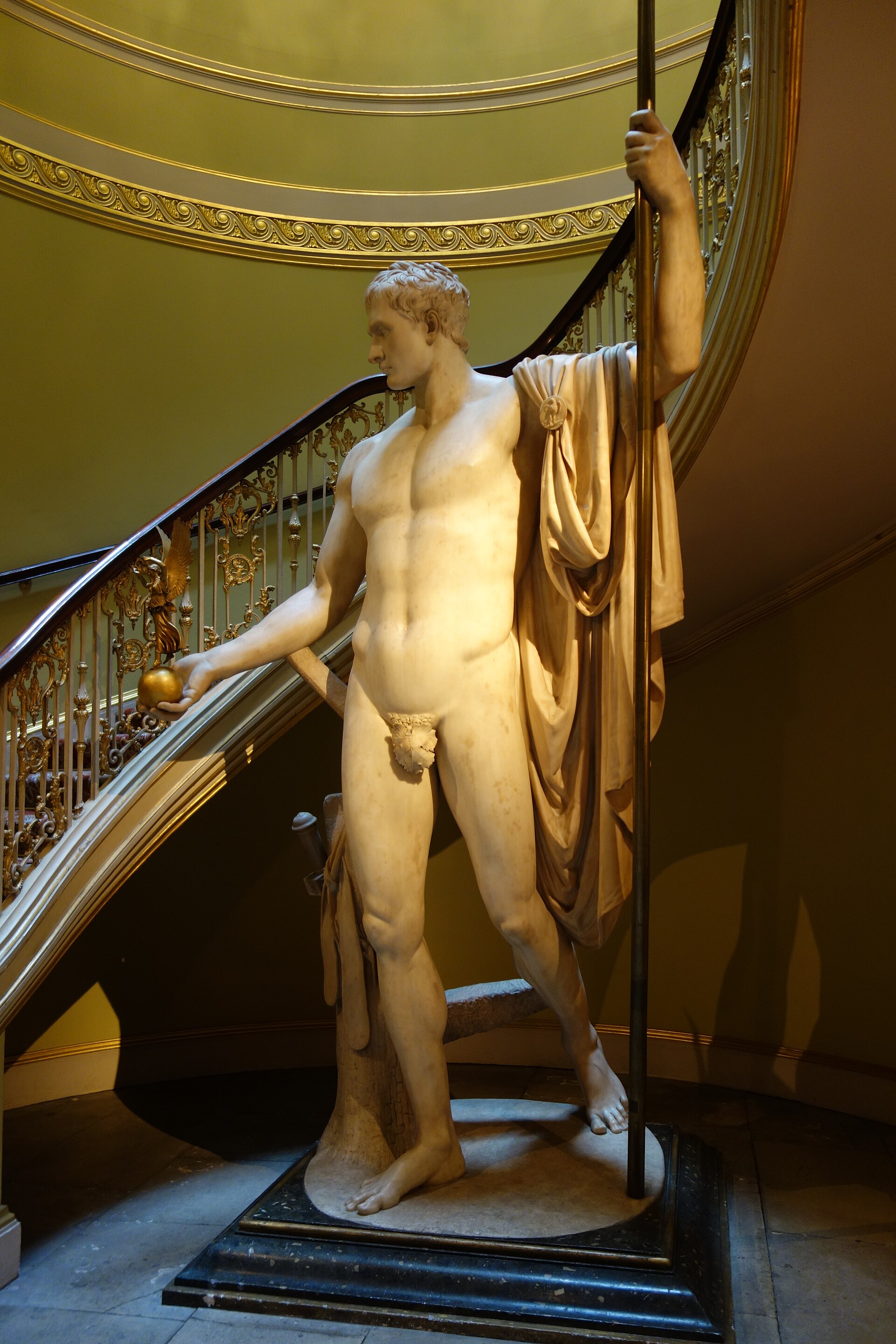
Napoleon as Mars the Peacemaker
Commissioned 1802 · Marble
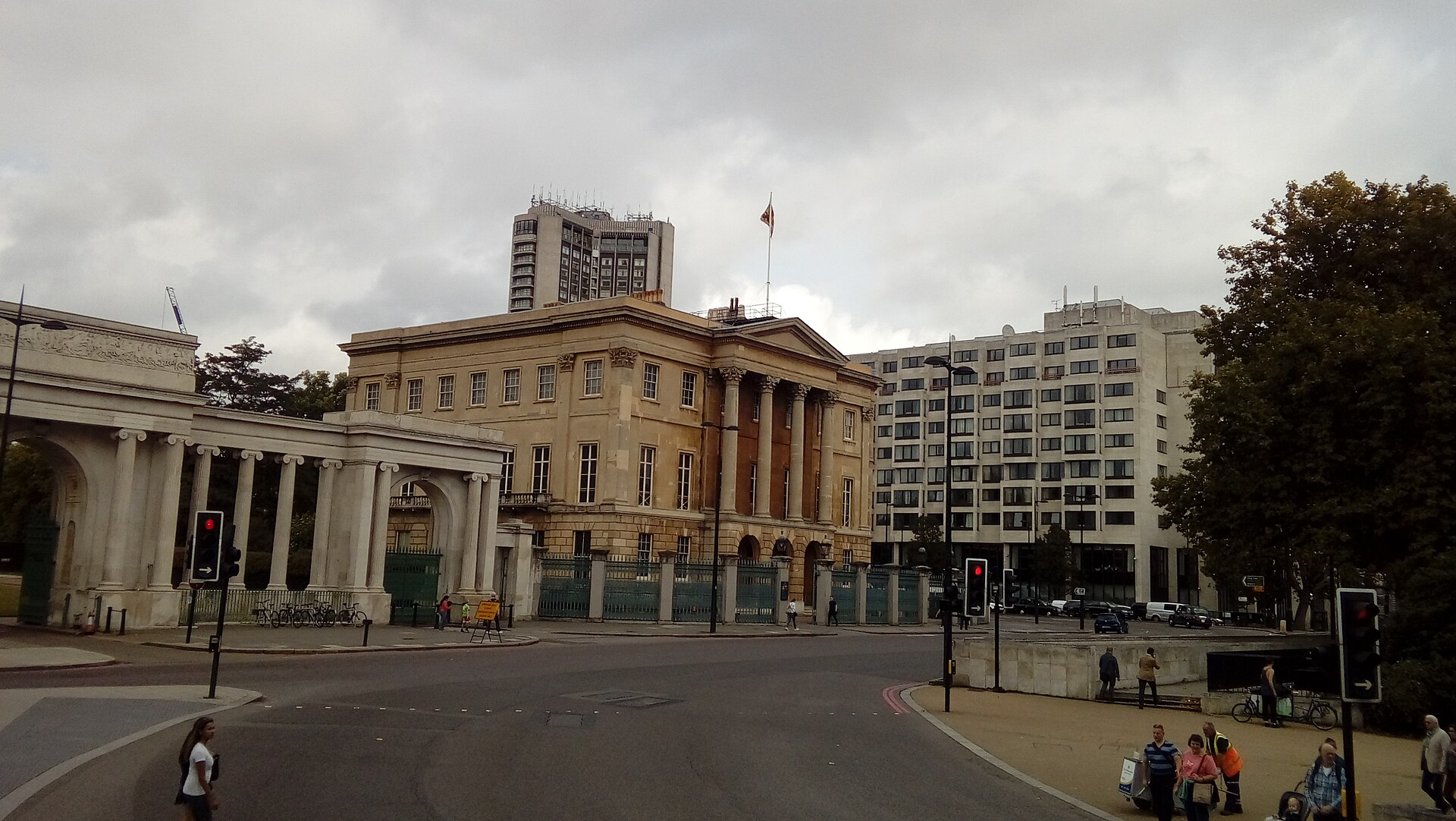
Apsley House, Hyde Park Corner, London, at the foot of the...
What makes Apsley House more than a well-preserved Regency interior is that the collection inside it is itself a primary document of the years immediately after Waterloo, not a later acquisition assembled to furnish a museum. The Spanish Royal Collection paintings, recovered from a defeated army's baggage and formally gifted by a restored Spanish king, sit alongside the Portuguese Service, the Saxon porcelain service and Russian porphyry torcheres, each a diplomatic gift from a European court thanking Wellington personally for ending Napoleonic rule in its territory. Layered over that is a run of contemporary portraiture - Goya, Lawrence, Wilkie - painted or commissioned while Wellington was alive to sit for it or pay for it, giving the house one of the most complete visual records of how a single Napoleonic-era commander was seen by his own era. Few surviving European house museums combine an intact early 19th-century state interior with a collection this explicitly tied, object by object, to one specific military and diplomatic moment.
| Kind | Museum |
|---|---|
| Founded | Built 1771-1778 by Robert Adam; remodelled for the 1st Duke of Wellington from 1819; opened to the public in part from 1853, transferred to the Crown under the Wellington Museum Act 1947, and run as a public museum since 1952 (English Heritage since 2004) |
| City and country |  London, United Kingdom London, United Kingdom |
| Address | 149 Piccadilly, Hyde Park Corner, London W1J 7NT, United Kingdom |
| Website | english-heritage.org.uk/visit/places/apsley-house |
| Status | Open, confirmed 30 August 2026 |
| Record last verified | 30 August 2026 |
Prices and hours change. We take them from the institution's own pages and print the day we read them, and you can check the current position at the source we used. Confirm before you travel.
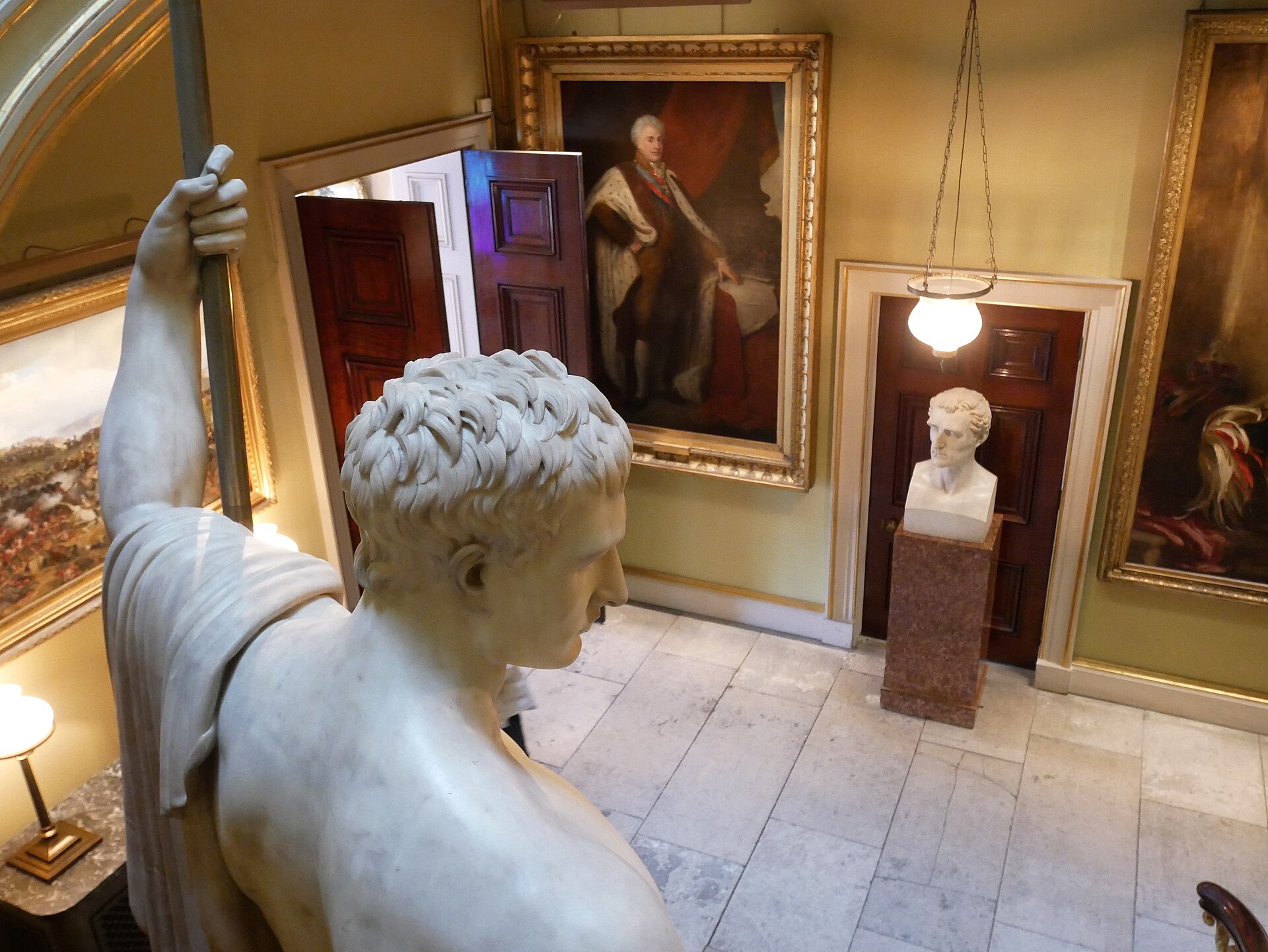
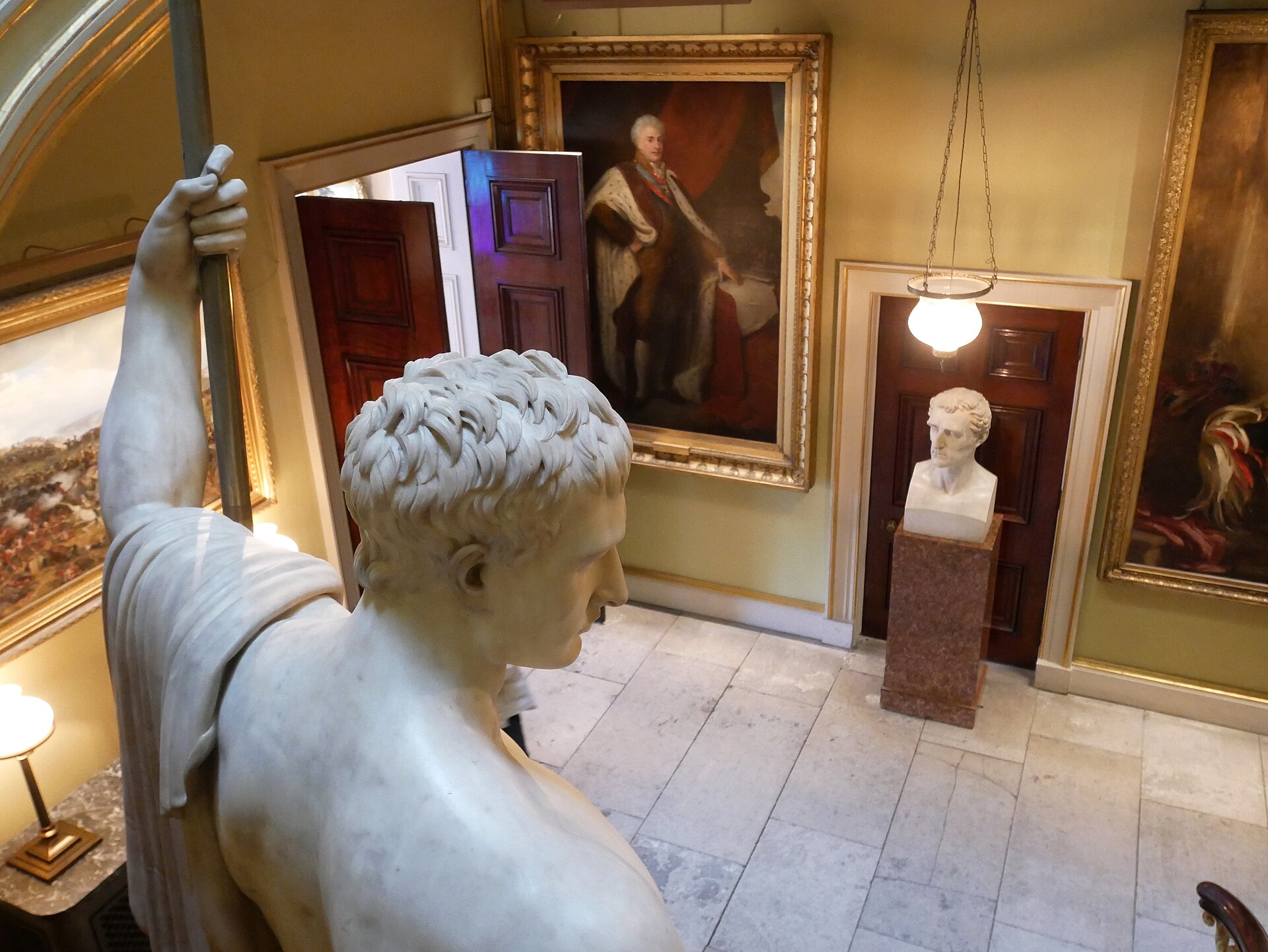
The main staircase, rebuilt as part of Benjamin Dean Wyatt's 1828-29 extension. At its foot stands Antonio Canova's colossal marble statue Napoleon as Mars the Peacemaker (1802-06); the floor beneath it was specially strengthened when the statue was installed in 1817, since it is the only part of the house strong enough to bear its weight.
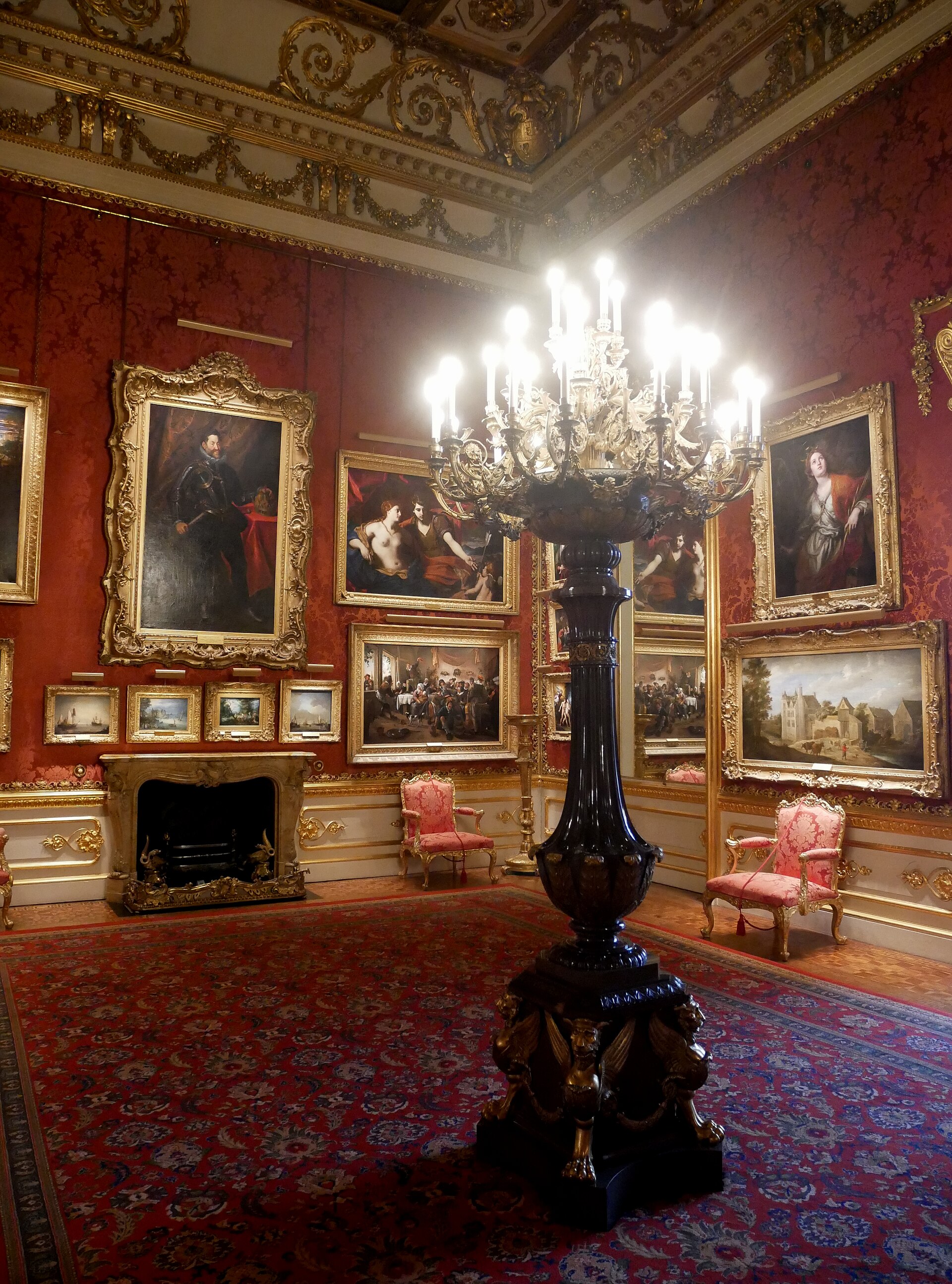
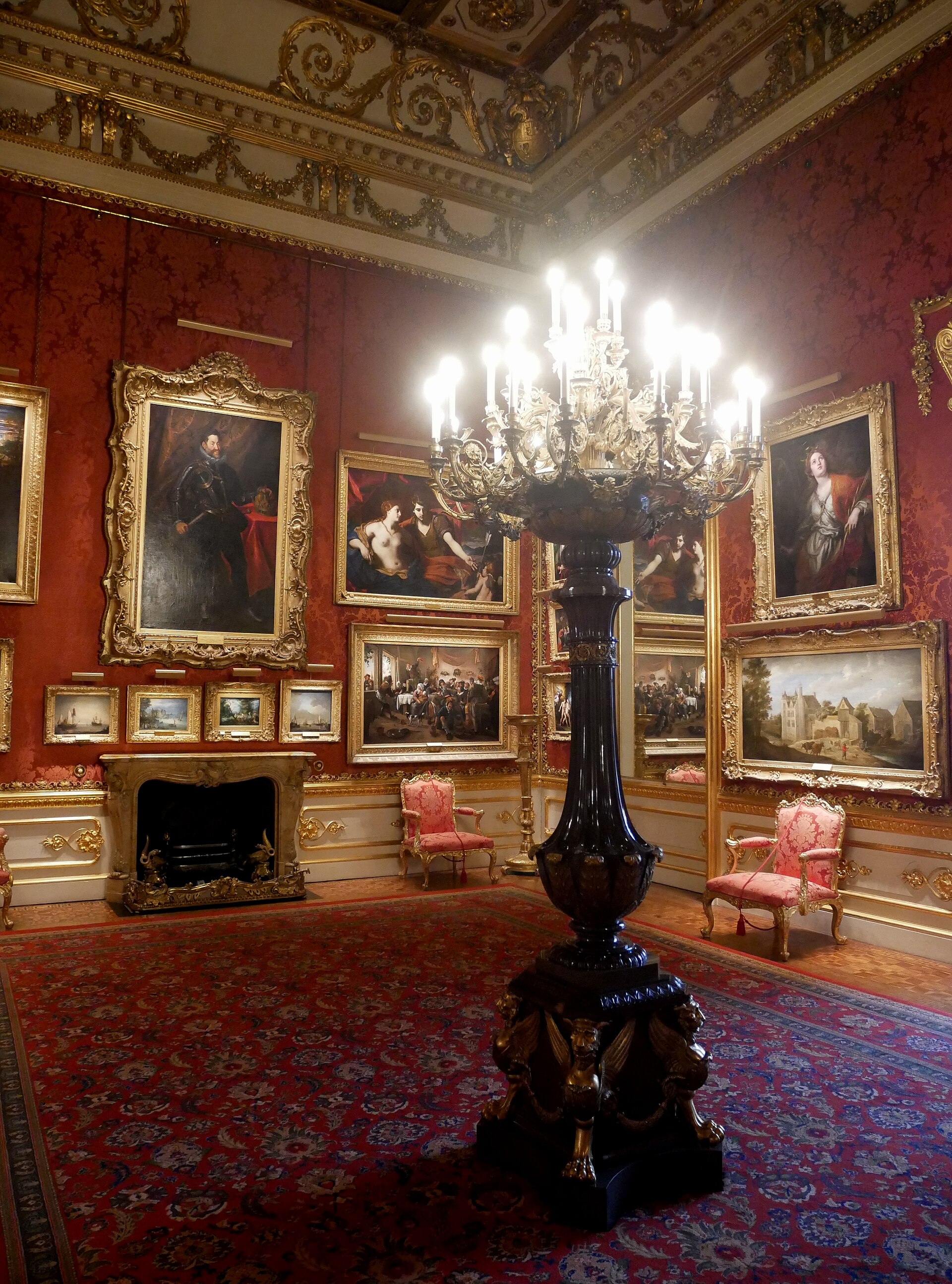
A double-height room occupying the length of the first floor of Wyatt's western extension, decorated in gilded Louis XIV style with mirrored window shutters recalling the Galerie des Glaces at Versailles. It today displays around 70 paintings, mostly from the Spanish Royal Collection gift, though more than 130 once hung there. From 1830 it was the setting for Wellington's annual Waterloo Banquet, a dinner for his surviving Peninsular War officers.
One of the rooms surviving largely as Robert Adam designed it in the 1770s, keeping its elaborate plaster ceiling, frieze and marble chimneypiece from before Wellington's ownership. It is furnished as a sitting room and hung with paintings from the Spanish Royal Collection.
Also part of Adam's original 1770s house, with its own apsidal end, decorative plasterwork and marble chimneypiece surviving from before the Wyatt remodelling.
Completed by 1819 in the first phase of Wyatt's extension. Laid out with the Portuguese Service, a 1,000-piece silver-gilt dinner and display service that took 150 men four years to make at the Lisbon Military Arsenal, presented to Wellington by the Portuguese Council of Regency in 1816.
Opened to the public by the 2nd Duke of Wellington in 1853 to display the orders, precious objects and other gifts given to the 1st Duke by grateful monarchs and governments after Waterloo, rather than paintings.
One of the principal first-floor state rooms on the visitor route, furnished for entertaining; seating is provided here for visitors, along with the Dining Room, the Piccadilly Drawing Room and the Waterloo Gallery.
An 11-foot marble statue Napoleon commissioned of himself as a nude classical god; he disliked the result and it was never displayed in France. The British government bought it after Waterloo and the Prince Regent gave it to Wellington in 1816. It stands at the foot of the grand staircase, the only part of the house reinforced to take its weight. This is the object our own archive already holds a record for.4
Full record in this archiveOne of Velazquez's best-known bodegon scenes of everyday Seville life, painted while he was still working there. It was among the Spanish royal paintings recovered from Joseph Bonaparte's baggage train at Vitoria in 1813 and given to Wellington by Ferdinand VII of Spain in 1816.4
A High Renaissance depiction of Christ at Gethsemane that had already been in the Spanish Royal Collection by the late 1650s. Vasari called it Correggio's rarest and most beautiful work, and the 18th-century British painter Benjamin West said it deserved to be framed in diamonds. It came to Wellington in the same 1816 Spanish gift as the Velazquez.4
Painted in about three weeks after Wellington entered Madrid in August 1812. X-ray analysis shows Goya reused an already-painted body and repainted only the head, evidence of how quickly the sitting had to be turned around while the war continued.4
The portrait English Heritage itself describes as the most iconic image of Wellington, originally painted as a gift for the American heiress Marianne Patterson before it entered the house's own collection.4
The most expensive painting Wellington personally commissioned, showing veteran soldiers reacting to news of victory at Waterloo. Unlike almost everything else on the walls, it was made for Wellington by a living British artist rather than acquired as war reparation or diplomatic gift.4
A silver-gilt shield showing Wellington crowned by Victory, surrounded by ten relief scenes from his campaigns, presented by the merchants and bankers of London in 1822 and paraded at every Waterloo Banquet held at Apsley House between 1820 and 1852.3
A 1,000-piece silver-gilt dinner and display service that took 150 men four years to produce, presented to Wellington by the Portuguese Council of Regency in 1816 and still laid out in the State Dining Room.4
Apsley House earned its old nickname, Number One London, because it stood as the first house past the Knightsbridge turnpike on the road into the city from the west - the sole building between open country and town. Robert Adam built it between 1771 and 1778 in neoclassical style for Henry Bathurst, 2nd Earl Bathurst, who as Lord Apsley gave the house its name. The original red-brick house was more modest than the building that stands today: a compact Adam townhouse with the apsidal Piccadilly Drawing Room and the Portico Room as its principal spaces, both keeping their Adam-period plaster ceilings, friezes and marble chimneypieces to this day.
Richard Wellesley, 1st Marquess Wellesley, bought the house in 1807. His younger brother Arthur Wellesley, already a celebrated general and soon to become the 1st Duke of Wellington, bought it from him in 1817 to give himself a London base suited to his new standing as Britain's leading soldier and, increasingly, a leading political figure. The purchase set in motion the largest single change the building would undergo.
Wellington commissioned the architect Benjamin Dean Wyatt to enlarge and remodel the house, work that proceeded in phases from 1819. The first phase added a northeast wing containing a new State Dining Room and further bedrooms and dressing rooms, completed by 1819; the dining room was immediately put to use displaying the Portuguese Service, the vast silver-gilt table service given to Wellington by the Portuguese Council of Regency in 1816. A second phase, beginning after 1828, added a new grand staircase and the Waterloo Gallery, replaced the original red brick with a Bath stone facing across the whole exterior, and added the tall four-column portico that gives the south front its present symmetrical, templelike appearance. The costs escalated badly as the work exposed structural problems in the older building, rising from an initial estimate of about 23,000 pounds to more than 61,000 pounds by completion. The elaborate cast-iron railings visible at the front of the house today were added by Wyatt around 1830, part of the same campaign to give a private Georgian townhouse a public face fit for a national hero.
The Waterloo Gallery is the single most theatrical space Wyatt added: a double-height room running the length of the first floor of the new western wing, decorated in a gilded style modelled on Louis XIV interiors, with seven mirrored window shutters that echo the Galerie des Glaces at Versailles. It was originally hung with gold damask; the red damask now on its walls was installed by the 2nd Duke of Wellington some time before 1860. The room could hold roughly double the covers of the original dining room - about 74 places against 36 - which is why, from 1828, Wellington moved his annual Waterloo Banquet there. Held every year from 1820 until 1852, the banquet gathered Wellington's surviving officers from the Peninsular War and Waterloo campaigns to mark the anniversary of the victory, with the Waterloo Shield, a silver-gilt shield presented by the merchants and bankers of London in 1822, brought out and displayed at each dinner. Pairs of Siberian porphyry torcheres, a diplomatic gift from the Tsar of Russia originally intended for the Winter Palace, were redirected to London and still stand in the gallery today. The room now displays around 70 paintings, chiefly from the Spanish Royal Collection gift, though more than 130 once hung there in Wellington's own lifetime.
The core of the painting collection at Apsley House has a specific, and specifically wartime, origin. When Joseph Bonaparte's army was routed at the Battle of Vitoria in June 1813, his retreating baggage train was captured along with more than 200 paintings he had taken from the Spanish royal palaces as he fled. Wellington's own account of events, and the position English Heritage and the Wellington Collection both take today, is that he offered more than once to return the paintings to the restored Spanish crown. It was not until 1816 that Ferdinand VII of Spain formally made Wellington a gift of the paintings his troops had recovered, on the grounds that returning several hundred canvases to a country still recovering from years of war was more trouble than it was worth to the Spanish crown. More than 80 of those paintings, including the Velazquez, the Correggio and further works by Rubens, Murillo, Van Dyck and Brueghel, remain on display at Apsley House. Whatever the legal and diplomatic tidiness of a king's formal gift, the paintings' route to a British duke's dining and drawing rooms ran directly through a defeated army's abandoned baggage, and that origin is as much a part of the collection's history as any attribution or brushstroke; a page recording this house owes that context rather than treating a royal gift as the end of the story.
The same defeat of Napoleon put the most physically dramatic object in the house on Wellington's staircase. Napoleon himself had commissioned Antonio Canova to sculpt him as a nude, idealised Mars in 1802, wanting to be shown in the manner of the Roman emperors who had themselves depicted as gods; when the eleven-foot marble arrived, Napoleon judged it too athletic and had it kept from public view. After Waterloo the British government bought the statue and the Prince Regent, later George IV, gave it to Wellington in 1816. It was installed at the foot of Apsley House's grand staircase the following year, in the only part of the building whose floor could be reinforced enough to bear its weight - a piece of engineering as much as decoration, and the object our own archive already holds a separate record for.
Apsley House began its public life gradually and on the family's own terms. The 2nd Duke of Wellington opened the Museum Room to the public in 1853, showing the medals, orders and precious gifts given to his father by grateful sovereigns after Waterloo, though the house as a whole remained a private residence for the Wellington family. That changed formally with the Wellington Museum Act 1947, under which the house and its principal collection passed into Crown ownership while preserving the family's right to continue occupying a set of ground-floor apartments spanning the northern half of the building - a right the current, 9th Duke's family still holds. Following refurbishment and the installation of electric light by the Ministry of Works, the house reopened as a public museum in 1952, initially run as a branch of the Victoria and Albert Museum. English Heritage took over its day-to-day management in 2004 and still runs it today, styled on site as the Wellington Museum. Recent redisplay work under the current Duke, reported in the specialist press in 2025, has aimed to make the rooms read more as a lived-in historic house than a static gallery, with new picture lighting and the addition of further family portraits to the walls.
Visitors consistently describe Apsley House as a quieter, overlooked alternative to London's larger museums: a genuine aristocratic townhouse rather than a converted gallery, with a collection whose importance surprises people who did not expect to find major Velazquez, Correggio and Goya paintings behind a Piccadilly facade. The multimedia guide is repeatedly credited with making the rooms make sense, since there is comparatively little wall text.
Tripadvisor: 4.5 from 1,632 ratings, read 7 August 2026
A platform average is a tertiary source: it moves, it is not audited, and we quote no visitor's words.
149 Piccadilly, Hyde Park Corner, London W1J 7NT, United Kingdom.
Adult, advance online: GBP 15.3; Concession, advance online: GBP 14.45; Child, 5-17, advance online: GBP 7.65; Family, 2 adults plus up to 3 children, advance online: GBP 38.25; Family, 1 adult plus up to 3 children, advance online: GBP 22.95. As confirmed 30 August 2026.
Wed-Sun 11:00-17:00. Closed: Monday. Tuesday. As confirmed 30 August 2026.
Underground: Hyde Park Corner station (Piccadilly line) sits immediately next to the house; follow the pedestrian subway signs to Exit 2 to come up beside Apsley House; Bus: Routes 2, 6, 9, 13, 14, 19, 22, 23, 36, 38, 52, 74, 137, 148 and 390 all stop near the house; Rail: London Victoria station is about half a mile away on foot; Car: No on-site parking; a charged public car park operates on Park Lane about a quarter mile away. A small number of free disabled parking bays, 5 to 15 metres from the entrance, must be booked in advance.
Napoleon as Mars the Peacemaker (Antonio Canova, 1802-06); The Waterseller of Seville (Diego Velazquez, c.1617-23); The Agony in the Garden (Antonio Allegri, called Correggio, c.1520-24); Equestrian Portrait of the 1st Duke of Wellington (Francisco de Goya, 1812); Arthur Wellesley, 1st Duke of Wellington (Sir Thomas Lawrence, 1817); The Chelsea Pensioners Reading the Waterloo Dispatch (Sir David Wilkie, 1822).
One artwork and its story every Tuesday, with the picture: who owned it, what it made, and what closes soon in the exhibition calendar. No promotion, and nothing we cannot cite.
We send one email to confirm the address and keep nothing else. Every letter carries a one-click unsubscribe. How we handle your data.

.jpg)
.jpg)