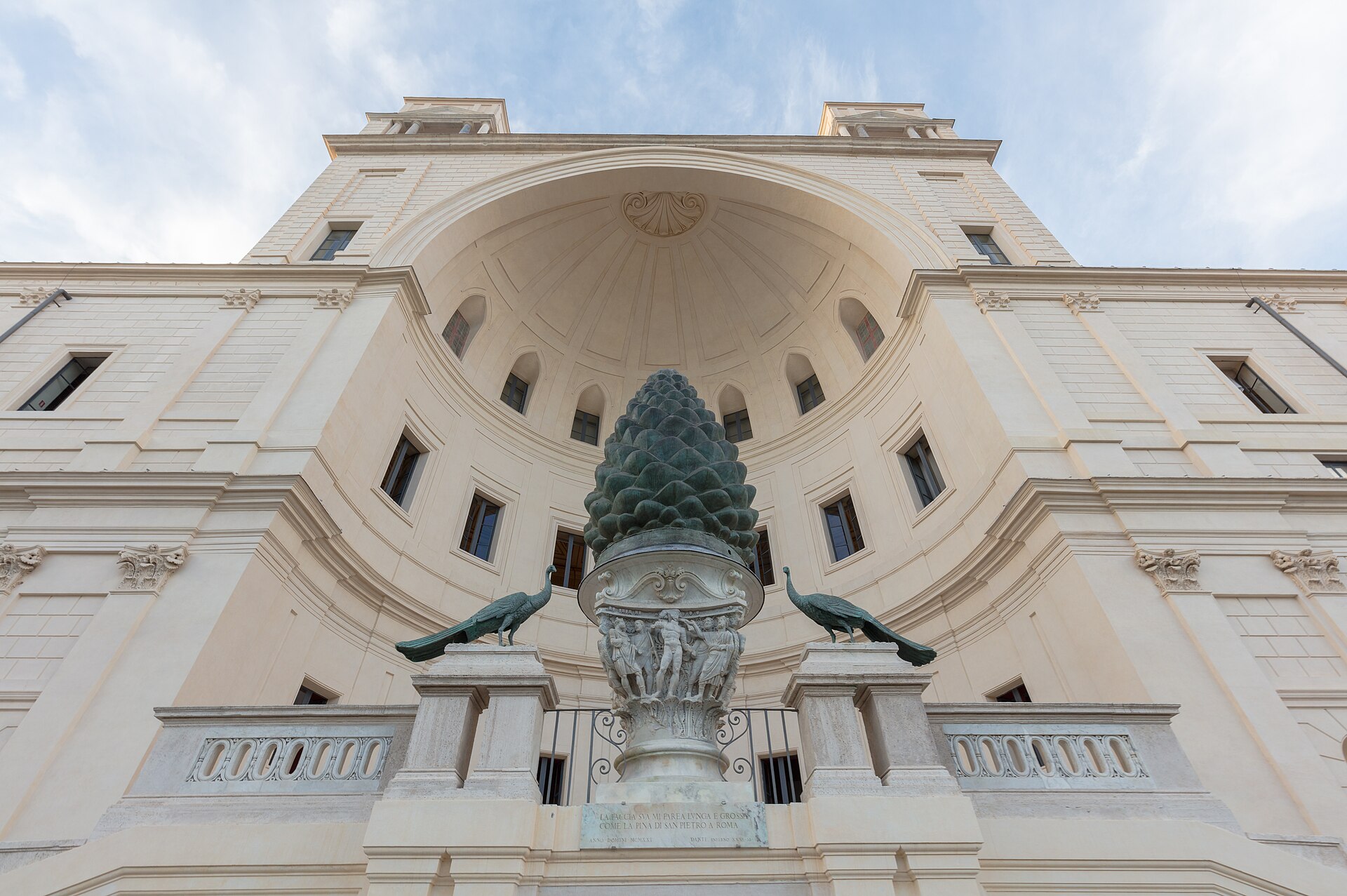
The Nicchione exedra and the bronze Fontana della Pigna in the Cortile della Pigna, the courtyard entrance area of the Vatican Museums complex
Diego Delso · CC BY-SA 4.0Vatican Museums
Museum · Musei Vaticani · Founded 1506
Open, admission and hours confirmed 9 September 2026 · 18 sources
On this page 14 sections
ContentsClose
The Vatican's strength is breadth built by continuous acquisition over five centuries rather than a single collecting era: classical Greek and Roman marble assembled from the Renaissance papacy onward, the largest single commission of High Renaissance fresco painting anywhere (Michelangelo's Sistine ceiling and Raphael's Stanze, painted at the same time one floor apart), an Egyptian and Near Eastern collection built on nineteenth-century papal excavation and purchase, and a picture gallery running from Byzantine-influenced primitives through Raphael's last painting to Caravaggio. No other single institution holds a comparable concentration of directly commissioned High Renaissance wall and ceiling painting in situ, since the Sistine ceiling and the Stanze were painted for these specific rooms and have never left them.
| Local name | Musei Vaticani |
|---|---|
| Kind | Museum |
| Founded | 1506, from Pope Julius II's purchase of the Laocoon; opened to the public in 1771 as the Museo Pio-Clementino |
| City and country |  Vatican City, Vatican City Vatican City, Vatican City |
| Address | Viale Vaticano, 00165 Rome, Italy (Vatican City) |
| Website | museivaticani.va/content/museivaticani/en.html |
| Status | Open, confirmed |
| Record last verified |
Visiting
- Hours
- Monday-Saturday08:00 to 20:00final entry 18:00
- Last Sunday of the month09:00 to 14:00final entry 12:30; free admission; suspended on the exception dates listed under admission_free_days
- Closed
- Every Sunday except the last Sunday of the month. 1 and 6 January. 11 February. 19 March. 6 April. 1 May. 29 June. 14 and 15 August. 8, 25 and 26 December.
- Admission
- Adult, full entryEUR 20at the door; the same ticket booked online at tickets.museivaticani.va carries a mandatory EUR 5 booking fee, so the online total is EUR 25
- Reduced (visitors 6 to 18, and students under 26 with ID)EUR 10EUR 15 online with the EUR 5 booking fee
- School groupsEUR 5EUR 7 online with a EUR 2 booking fee
- Seminaries and religious collegesEUR 5EUR 7 online with a EUR 2 booking fee
- Pilgrimage groups and university institutesEUR 10EUR 15 online with the EUR 5 booking fee
- Children under 7Freefree, no booking fee
- Castel Gandolfo, Papal Palace and Barberini Gardens (separate site, same directorate)EUR 12full entry; a family tariff exists for parents travelling with two or more children aged 7 to 18
Free entry: Last Sunday of every month, 09:00 to 14:00, final entry 12:30, except when that Sunday falls on Easter, 29 June, 25 or 26 December, or 31 December, when the free Sunday is suspended. Children under 7, every day. Visitors with a certified disability of at least 67 percent, plus one companion. ICOM and ICOMOS cardholders, and museum directors and heritage-protection officials on production of ID. University teachers of archaeology, art history, architecture or ethnology, with written permission requested in advance- Tickets
- tickets.museivaticani.va The museum's own ticket page.
- Do I need to book?
- Not strictly required, but the museum's own site urges online booking to skip the entrance queue, which routinely runs to a wait of an hour or more without one
- Address
- Viale Vaticano, 00165 Rome, Italy (Vatican City) MapMetro Line A to Ottaviano-San Pietro or Cipro, both a walk from the entrance on Viale Vaticano
Bus Lines 49, 32, 81, 492, 982 and 990 stop near the Museums entrance
Tram Line 19 stops at Piazza del Risorgimento
On foot The entrance is on Viale Vaticano, on the north side of the Vatican walls; St Peter's Square is a separate entrance across the city state and not connected internally for a normal visitor - Website
- museivaticani.va/content/museivaticani/en.html
- Telephone
- +39 06 69883145
- [email protected]
Before you go how long, access, photography, bags, eating, shop
- How long to allow
- Two to three hours for a direct route to the Sistine Chapel; a full circuit of the Pio-Clementino, Egyptian, Etruscan, Gallery of Maps, Raphael Rooms and Pinacoteca comfortably fills a half day
- Access
- Wheelchair-accessible routes and lifts are provided through most of the complex; some sections of the Pio-Clementino and the Vatican Gardens have steps or gravel paths flagged on the museum's own accessibility notes; wheelchairs can be borrowed at the entrance on request
- Photography
- Photography without flash is permitted throughout the galleries; it is expressly prohibited inside the Sistine Chapel, a rule enforced by guards and repeatedly announced over the public address system
- Bags
- Large bags, backpacks and suitcases must be left at the free cloakroom near the entrance; only small bags may be carried into the galleries
- Eating
- A self-service cafeteria and a coffee bar operate inside the museum complex, along Vatican-run outlets rather than concessions
- Shop
- Multiple museum shops sell publications, reproductions and souvenirs at points along the visitor route and near the exit
Prices and hours change. We take them from the institution's own pages and print the day we read them, and you can check the current position at the source we used. Confirm before you travel.
What is inside
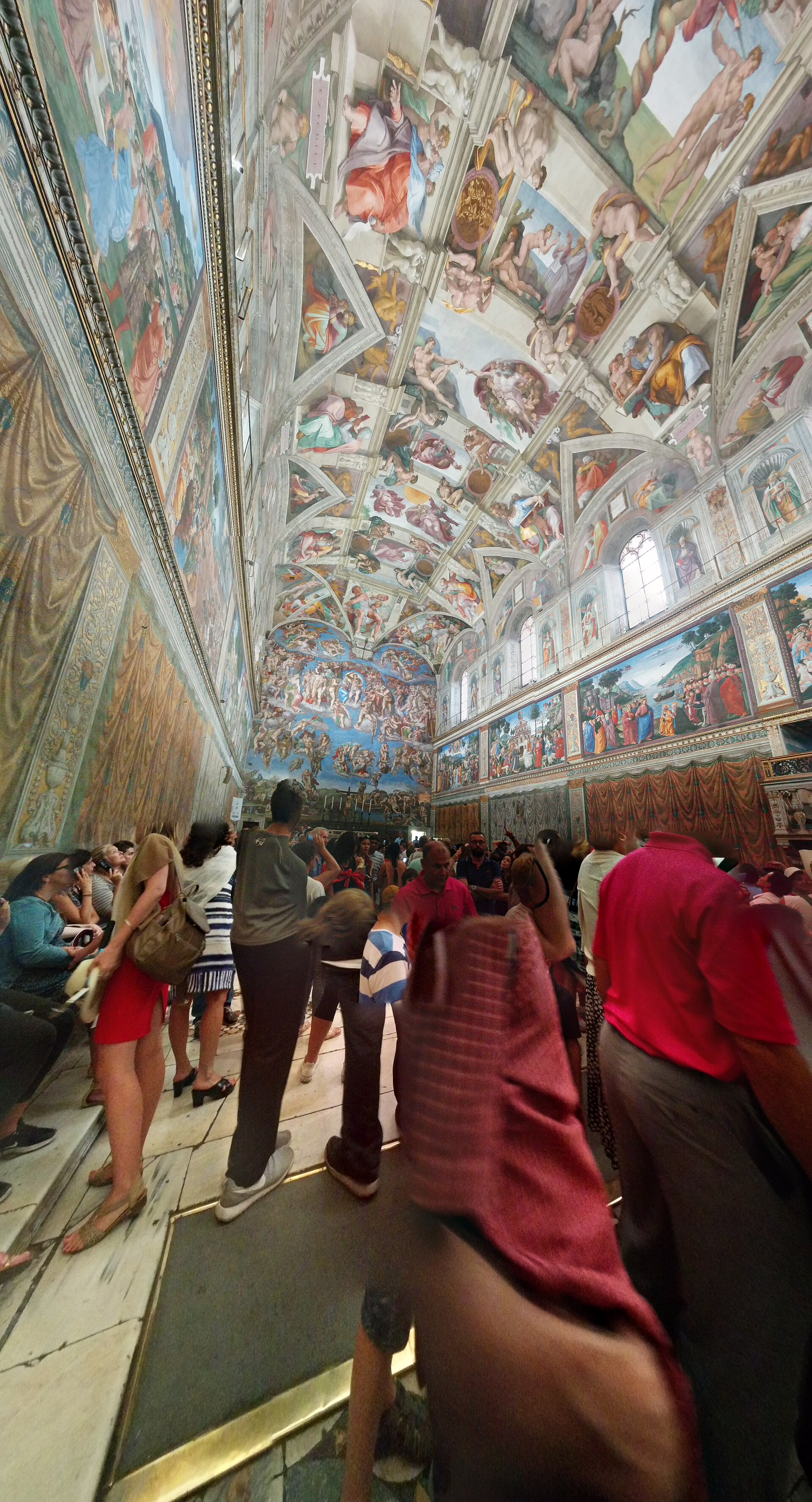
Photograph by KatieThebeau · CC BY 2.0 Sistine Chapel
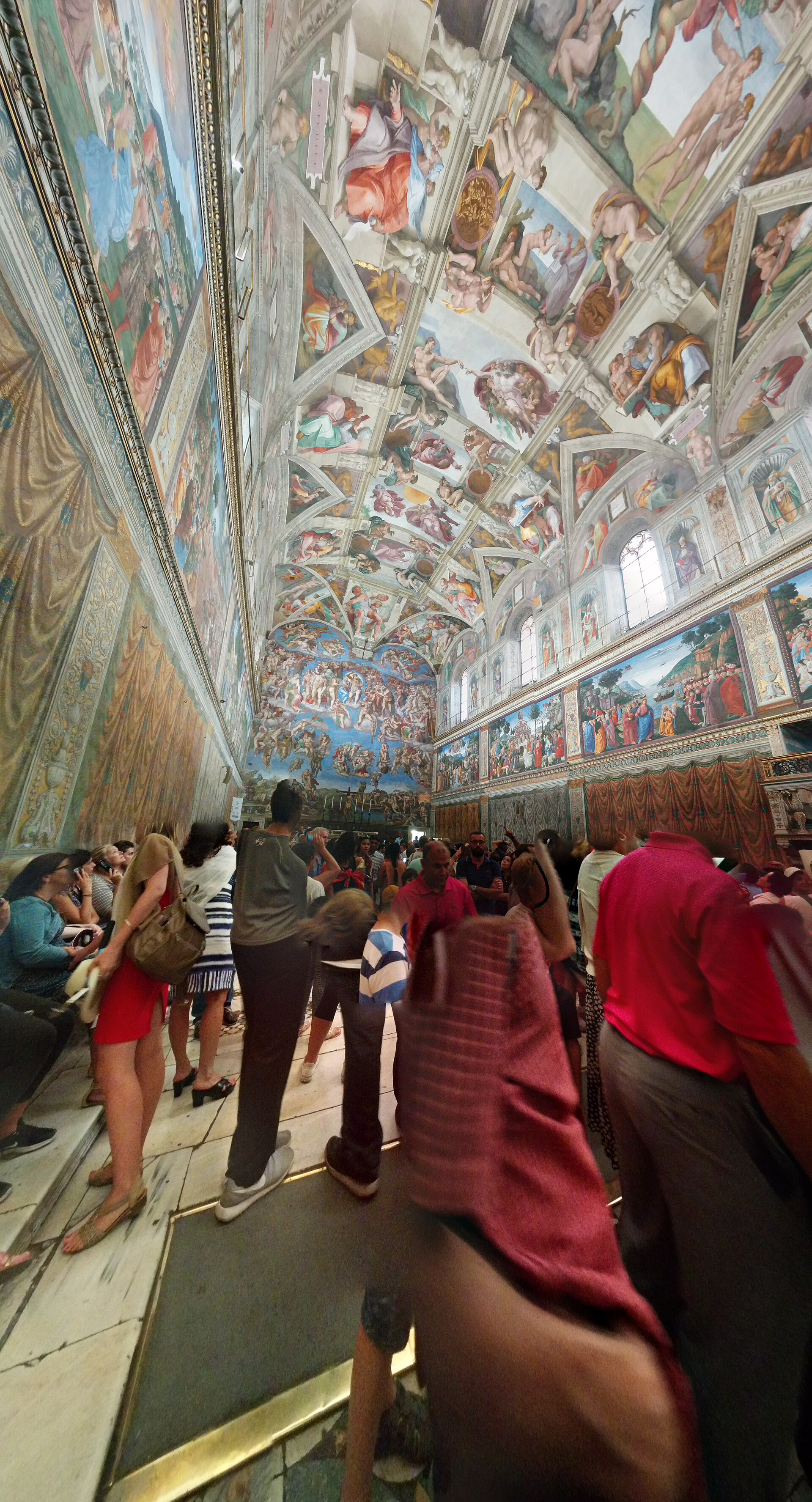
The chapel built for Pope Sixtus IV in the 1480s, its side walls frescoed by Perugino, Botticelli, Ghirlandaio and Rosselli with scenes from the lives of Moses and Christ, its ceiling and the altar wall painted by Michelangelo: the ceiling (1508-1512) with the Creation narrative and the Last Judgment on the altar wall (1536-1541). It is the final room on the standard visitor route and the point every corridor in the complex is built to lead toward.
Raphael Rooms (Stanze di Raffaello)
Four rooms of the papal apartment frescoed by Raphael and his workshop from 1508: the Stanza della Segnatura, with the School of Athens and the Disputation of the Holy Sacrament; the Stanza di Eliodoro; the Stanza dell'Incendio del Borgo; and the Sala di Costantino, largely executed by Raphael's workshop after his death in 1520.
Museo Pio-Clementino
The founding collection of classical sculpture, begun under Julius II and formally established by Popes Clement XIV and Pius VI from 1771. Ten galleries around the Octagonal Court hold the Laocoon, the Apollo Belvedere, the Belvedere Torso and the bulk of the Vatican's Greek and Roman marbles, including the Hall of Animals, the Gallery of Statues, the Hall of the Muses and the Round Hall.
Museo Gregoriano Egizio (Egyptian Museum)
Nine rooms founded in 1839 under Gregory XVI, covering Egyptian funerary and epigraphic material, a reconstruction of elements from the Serapeum of Hadrian's Villa at Tivoli, Egyptian-Roman contact objects, statuary, the Carlo Grassi collection, and Near Eastern antiquities including Assyrian palace reliefs.
Gallery of Maps (Galleria delle Carte Geografiche)
A 120-metre corridor painted 1580-1585 under Gregory XIII with forty topographical frescoes of the regions of Italy by Ignazio Danti, the ceiling gilded and stuccoed to match, one of the most-photographed single spaces in the complex and a required corridor between the Candelabra Gallery and the Raphael Rooms.
Pinacoteca Vaticana
The picture gallery, opened in its current building in 1932, arranged chronologically from the Byzantine-influenced Primitives through Raphael (including the Transfiguration, his last work) to Leonardo da Vinci's unfinished Saint Jerome in the Wilderness and Caravaggio's Entombment of Christ.
What to see first
Laocoon and His Sons
Hellenistic or Roman marble copy, sculptor disputedUnearthed on the Esquiline Hill on 14 January 1506 and bought by Julius II within weeks, the group is the object the entire museum complex grew from; Michelangelo was among those consulted at its excavation.9
Apollo Belvedere
Roman marble copy after a lost Greek bronze, attributed to LeocharesThe most influential single sculpture for European academic taste from the Renaissance to the nineteenth century, on display in the Pio-Clementino's Octagonal Court since the collection's founding.9
The ceiling of the Sistine Chapel
Michelangelo Buonarroti, 1508-1512Painted largely by Michelangelo's own hand over four years, the ceiling's nine central scenes from Genesis, including the Creation of Adam, are the single most reproduced fresco cycle in Western art.9
The Last Judgment
Michelangelo Buonarroti, 1536-1541Painted on the altar wall a generation after the ceiling, at Michelangelo's own insistence the figures were left nude; drapery was added after his death by Daniele da Volterra, following Counter-Reformation objections at the Council of Trent.9
The School of Athens
Raphael, 1509-1511The centrepiece of the Stanza della Segnatura, gathering ancient philosophers under portrait likenesses of Raphael's contemporaries, painted while Michelangelo was at work on the ceiling one floor away.9
The Gallery of Maps ceiling and frescoes
Ignazio Danti (maps), with a decorative team under Girolamo Muziano, 1580-1585Forty painted maps of Italy's regions, drawn from the best surveying knowledge of the 1580s and still used by historians of cartography as a dated record of how Italy's coastline and cities were understood before modern mapping.9
The Transfiguration
Raphael, 1516-1520, completed by his workshopLeft in Raphael's studio unfinished at his death in 1520 and carried in his funeral procession; the Pinacoteca's single most discussed painting for the split between his hand and his workshop's completion of the lower register.9
Saint Jerome in the Wilderness
Leonardo da Vinci, circa 1480An unfinished underpainting, its condition and near-total absence of colour making the drawing beneath legible in a way no finished Leonardo panel allows; acquired for the Vatican by Cardinal Joseph Fesch in the nineteenth century.9
Exhibitions on now
- On now14 Nov 2025 to 16 Oct 2026Confirmed · check before you travel
A pope's private discovery becomes the Vatican's public collection
The Vatican Museums did not begin as a museum. They began as one marble group bought by one pope. On 14 January 1506 a farmer digging in a vineyard on Rome's Esquiline Hill uncovered a large sculpture of a man and two boys being crushed by serpents. Pope Julius II sent Giuliano da Sangallo and Michelangelo to examine the find, and within a month had bought it and installed it in a garden courtyard at the Belvedere villa, the papal retreat on the hill above St Peter's. That sculpture, the Laocoon, is still on display a short walk from where it was first set down, and the courtyard built to hold it, the Cortile Ottagono, is still the heart of the museum that grew up around it.
The collection stayed a private papal one for over two and a half centuries, added to piece by piece as popes acquired classical sculpture, and was not opened to the public in any organised way until Pope Clement XIV and his successor Pius VI formally founded the Museo Pio-Clementino in 1771, building new galleries specifically to display Rome's antiquities to visiting scholars and the educated public of the Grand Tour. Everything that followed, the Chiaramonti Museum under Pius VII in the early nineteenth century, the Gregorian Etruscan Museum in 1837, the Gregorian Egyptian Museum in 1839, the Pinacoteca's move into a purpose-built gallery in 1932, the Ethnological Museum founded from a 1925 missionary exhibition, added departments to a single institution rather than creating separate ones. The Vatican Museums marked 500 years since the Pio-Clementino's founding lineage in 2006, tracing the anniversary back to the Laocoon's purchase in 1506.
What is inside: a complex of museums, not one building
The institution the public calls the Vatican Museums is, by its own count, made up of more than twenty distinct museums and galleries strung along a fixed visitor route roughly seven kilometres long, ending at the Sistine Chapel. A visitor who follows the whole route passes the classical sculpture of the Pio-Clementino and Chiaramonti museums, the Egyptian and Etruscan collections, the Candelabra Gallery, the Tapestry Gallery, the Gallery of Maps, the Raphael Rooms, the Borgia Apartments and a wing of modern religious art before reaching the chapel. The Vatican Museums' own estimate puts the total collection at roughly 70,000 works, of which about 20,000 are on public display at any time; the rest is in storage, conservation, or awaiting a gallery, a proportion typical of an encyclopaedic museum of this age but rarely stated so plainly by the institution itself.
Two collections sit apart from the main classical and Renaissance holdings and are frequently skipped by visitors on a fixed schedule. The Vatican's Collection of Modern and Contemporary Art, opened in 1973, holds work donated directly to the popes by artists including Matisse, Chagall and Francis Bacon. The Anima Mundi ethnological collection, formed from a 1925 missionary exhibition that brought more than 100,000 objects from Catholic missions worldwide to Rome, is the least visited and, as the section below sets out, the most contested part of the complex.
The route to the Sistine Chapel, and what the crowd does to it
Every corridor in the complex is built to end at the Sistine Chapel. Wikipedia's tally of visitor statistics puts the Vatican Museums at roughly 6.8 million visitors in 2024, second only to the Louvre among the world's most-visited art museums, and on a normal day a share of that traffic is funnelled down the same route toward the chapel. The consequence, described consistently by visitors rather than by the museum's own marketing, is that the final approach to the chapel, and the chapel itself, is frequently too crowded to view properly: a room built to seat a papal conclave of little more than a hundred cardinals routinely holds several hundred standing visitors at once in peak season, with guards periodically calling for silence over a public address system in a room whose acoustics were never designed for a crowd of that size.
The museum's own booking system exists in large part to manage this: online tickets are sold in timed entry slots, and the institution's own advice, repeated across its visitor pages, is to book the first slot of the day or a late-afternoon Friday slot during the extended summer opening, specifically to avoid the mid-morning peak. That the fix for the crowding is a matter of internal ticket-slot advice, rather than a cap on daily numbers, reflects that the volume of visitors is also the institution's primary source of income independent of the Holy See's own budget.
What has been given back, and how the museum describes giving it
The Vatican Museums hold two collections that have been the subject of active repatriation questions in the years immediately before this page was researched, and the museum's own language for both transfers is worth reading closely. In March 2023, three fragments of the Parthenon frieze and pediment, a bearded man's head, a boy's head, and a horse's head, that had been in the Vatican collection since the nineteenth century were formally handed to the Orthodox Archbishop of Athens for the Acropolis Museum. Pope Francis had signalled the move after a 2021 visit to Athens and announced it in December 2022; the transfer itself was structured and described by the Vatican not as a restitution but as a donation and a gesture of friendship between churches, a framing that avoided any Vatican statement on whether the fragments had been wrongly acquired and increased pressure on the British Museum, which holds a far larger set of Parthenon marbles under a different legal claim.
The second and larger case concerns the Anima Mundi ethnological collection itself. Of the more than 100,000 objects sent to Rome by Catholic missionaries worldwide for a 1925 exhibition organised under Pope Pius XI, a small number connected to Indigenous communities in Canada, including an Inuvialuit kayak, one of only five such kayaks known to survive, a Haida Gwaii face mask, wampum belts, and beaded and carved objects, have been identified for return following Pope Francis's 2022 apology for the Catholic Church's role in Canada's residential schools and the Vatican's 2023 repudiation of the Doctrine of Discovery. On 15 November 2025, under Pope Leo XIV, the Vatican announced the return of 62 such objects, again structured as what the Vatican itself called 'an act of ecclesial sharing' between the Church in Rome and the Church in Canada rather than as an admission that the objects were taken. Some Indigenous representatives involved in the process have said the church-to-church channel, run through the Canadian Conference of Catholic Bishops, has left individual First Nations, Inuit and Metis communities without a direct say in identifying or reclaiming their own objects. The returned objects, including a Metis dogsled model, embroidered leather gloves from the Athabasca Chipewyan First Nation, a birch bark sap collector from the Akwesasne, and a bowl, spoon and cradle among others, were publicly unveiled in Canada in March 2026 at a ceremony hosted by the Assembly of First Nations. They remain a small fraction of the Anima Mundi holdings; the great majority of the 1925 collection remains in Vatican storage, uncatalogued in public and not on display, and the museum's own site does not currently publish a list of what the ethnological collection holds or where each object originated.
Visiting today
The Vatican Museums are entered from Viale Vaticano, on the outer wall of Vatican City rather than through St Peter's Square; the two are a considerable walk apart and not connected for a general visitor inside the complex. A standard adult ticket bought at the door is 20 euros; the same ticket booked online, which the museum's own site recommends to avoid the entrance queue, carries a mandatory 5 euro booking fee. Reduced tickets apply to visitors aged 6 to 18 and to students under 26 with identification; children under 7 enter free at any time, and the last Sunday of most months is free to everyone from 09:00 to 14:00, though that free Sunday is suspended on several fixed dates through the year including Easter and Christmas week.
Large bags and suitcases are not permitted into the galleries and must go into the free cloakroom at the entrance. Photography without flash is allowed throughout the museum complex but is explicitly banned inside the Sistine Chapel itself, a rule enforced in person rather than only posted. A determined visitor moving directly to the Sistine Chapel can do so in under two hours from entry; seeing the Pio-Clementino's classical sculpture, the Egyptian and Etruscan collections, the Gallery of Maps and the Raphael Rooms along the way, which is how the fixed one-way route is built to work, takes closer to half a day.
What visitors say
Visitors rate the collection itself among the greatest concentrations of art anywhere, and consistently name the Sistine Chapel, the Raphael Rooms and the Gallery of Maps as the reasons to come; the same visitors just as consistently describe the walk to reach them, especially in the hour before the Sistine Chapel, as a crowded, slow-moving corridor rather than a gallery experience, and recommend the earliest available entry slot or a late-afternoon visit to avoid it.
What is praised, what is criticised
- Praised: The scale and quality of the collection: the Raphael Rooms and Gallery of Maps are repeatedly singled out as underrated relative to the Sistine Chapel that visitors came for
- Praised: Value for the ticket price relative to the volume of major works seen in a single visit
- Praised: Staff directing traffic through the busiest corridors, credited with keeping a very large daily crowd moving
- Criticised: Overcrowding on the final approach to the Sistine Chapel, described by many visitors as too dense to properly view the ceiling, especially in the middle of the day and in summer
- Criticised: Long queues for visitors who arrive without a pre-booked ticket, and confusion caused by unofficial third-party ticket resellers that the museum's own site repeatedly warns against
- Criticised: Heat and poor air circulation in the most crowded rooms during peak season
Ratings on other platforms
Tripadvisor: 4.3 from 42,030 ratings, read 11 August 2026
A platform average is a tertiary source: it moves, it is not audited, and we quote no visitor's words.
Questions about Vatican Museums
Where is Vatican Museums?
Viale Vaticano, 00165 Rome, Italy (Vatican City).
How much does it cost to visit?
Adult, full entry: EUR 20; Reduced (visitors 6 to 18, and students under 26 with ID): EUR 10; School groups: EUR 5; Seminaries and religious colleges: EUR 5; Pilgrimage groups and university institutes: EUR 10. As confirmed 9 September 2026.
When is it open?
Monday-Saturday 08:00-20:00; Last Sunday of the month 09:00-14:00. Closed: Every Sunday except the last Sunday of the month. 1 and 6 January. As confirmed 9 September 2026.
How do you get there?
Metro: Line A to Ottaviano-San Pietro or Cipro, both a walk from the entrance on Viale Vaticano; Bus: Lines 49, 32, 81, 492, 982 and 990 stop near the Museums entrance; Tram: Line 19 stops at Piazza del Risorgimento; On foot: The entrance is on Viale Vaticano, on the north side of the Vatican walls; St Peter's Square is a separate entrance across the city state and not connected internally for a normal visitor.
What should you see first?
Laocoon and His Sons (Hellenistic or Roman marble copy, sculptor disputed); Apollo Belvedere (Roman marble copy after a lost Greek bronze, attributed to Leochares); The ceiling of the Sistine Chapel (Michelangelo Buonarroti, 1508-1512); The Last Judgment (Michelangelo Buonarroti, 1536-1541); The School of Athens (Raphael, 1509-1511); The Gallery of Maps ceiling and frescoes (Ignazio Danti (maps), with a decorative team under Girolamo Muziano, 1580-1585).
What we could not confirm
- The Vatican Museums do not publish a public catalogue or inventory of the Anima Mundi ethnological collection, so the scale and origin of what remains in storage from the 1925 missionary exhibition cannot currently be verified from the museum's own site.
- The Vatican has not stated whether the 2023 Parthenon fragment transfer or the 2025-2026 Indigenous Canadian returns reflect a general policy the museum will apply to other contested holdings, or were decided case by case.
- Indigenous representatives quoted in the November 2025 reporting on the Canadian returns raised concerns that the church-to-church donation channel bypassed direct consultation with individual First Nations, Inuit and Metis communities; it is not yet established whether that process has changed for objects still to be returned.
Images
Sources
- 1Vatican Museums, official site, homepage and visitor status museivaticani.va/content/museivaticani/en.html
- 2Vatican Museums, official site, ticket prices and admission conditions museivaticani.va/content/museivaticani/en/organizza-visita/tariffe-e-biglietti.html
- 3Vatican Museums, official site, opening hours and closure dates museivaticani.va/content/museivaticani/it/info/orari-musei-vaticani.html
- 4Vatican Museums, official site, getting here and contact details museivaticani.va/content/museivaticani/en/info/come-raggiungerci.html
- 5Vatican Museums, official site, Sistine Chapel collection page museivaticani.va/content/museivaticani/en/collezioni/musei/cappella-sistina.html
- 6Vatican Museums, official site, Raphael Rooms collection page museivaticani.va/content/museivaticani/en/collezioni/musei/stanze-di-raffaello.html
- 7Vatican Museums, official site, Museo Pio-Clementino collection page museivaticani.va/content/museivaticani/en/collezioni/musei/museo-pio-clementino.html
- 8Vatican Museums, official site, Museo Gregoriano Egizio collection page museivaticani.va/content/museivaticani/en/collezioni/musei/museo-gregoriano-egizio.html
- 9Wikipedia, Vatican Museums, source for identity, founding history and object attributions en.wikipedia.org/wiki/Vatican_Museums
- 10Wikidata, Vatican Museums (Q182955), source for coordinates and identity wikidata.org/wiki/Q182955
- 11Artnet News, 'The Vatican's Parthenon Marble Fragments Have Officially Entered the Collection of the Acropolis Museum in Athens' news.artnet.com/art-world/vatican-parthenon-marble-fragments-returned-greece-acropolis-museum-2275942
- 12The Art Newspaper, 'Vatican Museums will return rare Indigenous kayak to Canada', 6 November 2025 theartnewspaper.com/2025/11/06/vatican-museums-returns-indigenous-kayak-canada
- 13CBS News, 'Pope returns 62 artifacts to Indigenous Canadians as concrete sign of dialogue, respect and fraternity', 15 November 2025 cbsnews.com/news/canada-pope-returns-indigenous-artifacts-vatican-catholic-church/
- 14Tripadvisor, Vatican Museums attraction page, aggregate rating read 11 August 2026 tripadvisor.com/Attraction_Review-g187793-d191000-Reviews-Vatican_Museums-Vatican_City_Lazio.html
- 15Wikimedia Commons, file page and licence metadata for the lead exterior photograph commons.wikimedia.org/wiki/File:Museos_Vaticanos,_Ciudad_del_Vaticano,_2022-09-14,_DD_31.jpg
- 16Wikimedia Commons, file page and licence metadata for the Sistine Chapel ceiling photograph commons.wikimedia.org/wiki/File:Ceiling_of_the_Sistine_Chapel.jpg
- 17Wikimedia Commons, file page and licence metadata for the spiral staircase photograph commons.wikimedia.org/wiki/File:Vatican_Museums_Spiral_Staircase_2012.jpg
- 18Globe and Mail / AFN, coverage of the March 2026 ceremony marking repatriation of items from the Vatican Museums' Anima Mundi collection, used only to update the narrative on the already-recorded 2025 Indigenous Canadian return, re-checked 9 September 2026 theglobeandmail.com/culture/art-and-architecture/article-afn-holds-ceremony-to-mark-repatriation-of-items-from-vatican-museums/


