Winslow Homer
 American · 1836-1910
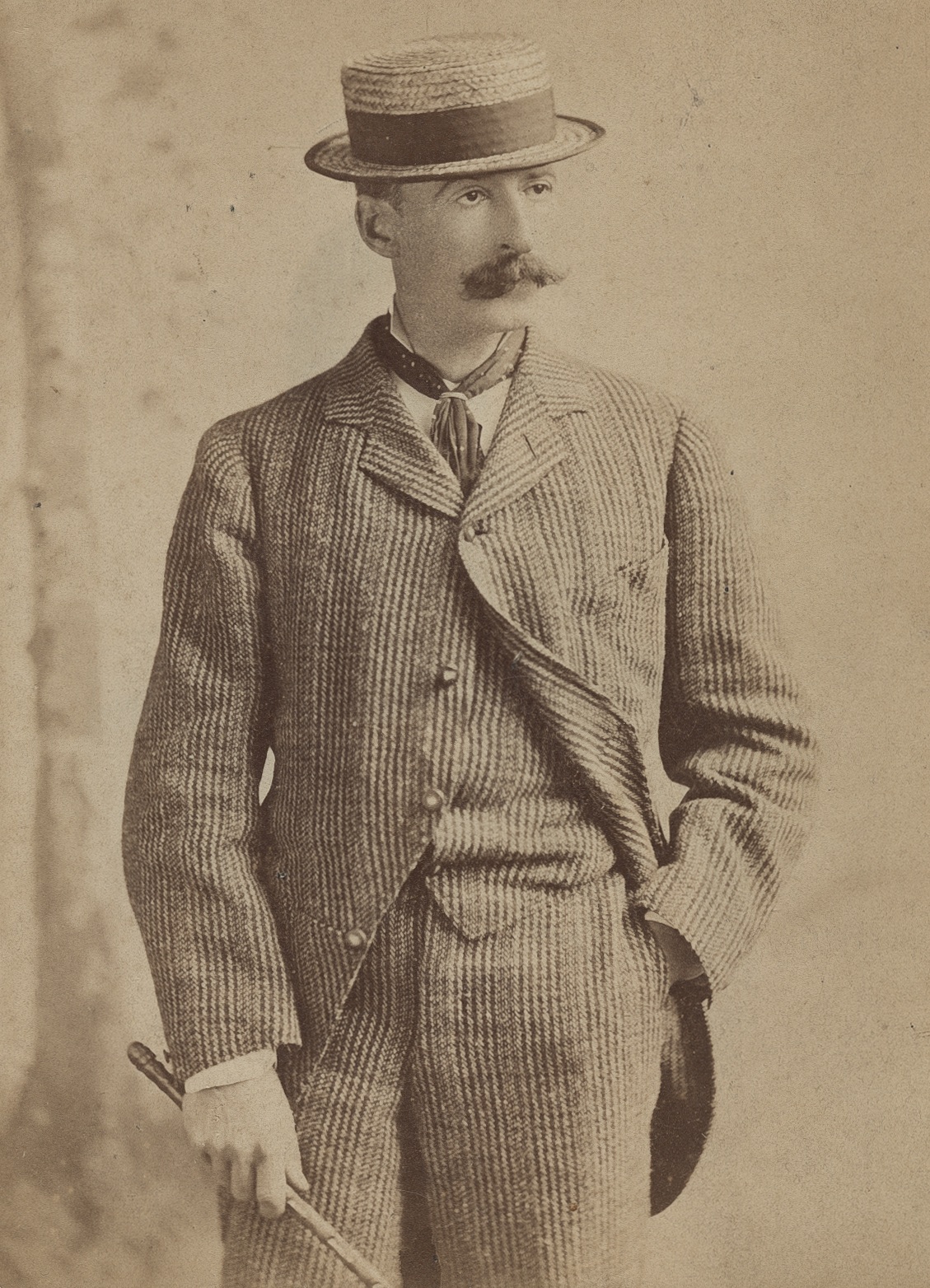
A studio photograph of Winslow Homer in a straw boater and striped tweed suit by Napoleon Sarony. Downes prints a Sarony photograph of Homer taken in 1878 at the age of forty-two, courtesy of his brother Charles S. Homer. The smaller Commons detail of this pose, File:WinslowHomer.jpeg, is credited to Bowdoin College Museum of Art, Gift of the Homer Family, and dated 1880; the Commons page for this larger file says only 'Winslow Homer, 19th century photograph' and dates it 1880. I matched the two by eye and found no catalogue record for this file, so the identification rests on that match, and I do not know whether Downes's 1878 plate and the 1880 photograph are one picture or two sittings. The date is not settled.
Napoleon Sarony (public domain; Commons credits the matching smaller detail to Bowdoin College Museum of Art, Gift of the Homer Family)| Worked as | Painter, Watercolourist, Illustrator, Etcher |
|---|---|
| Born | 24 February 1836 (derived from Downes's age at death, 74... · Boston, Massachusetts |
| Died | 29 September 1910 · Prouts Neck, Scarborough, Maine |
| Nationality | American |
| Movement | American Realism |
| Sources | 20 cited |
| Last verified |
About this page Last verified · 20 sources cited
On this page 13 sections
ContentsClose
Nobody publishes a count of accepted Winslow Homer works, and that is the first thing to know. The standard catalogue, Lloyd Goodrich's Record of Works by Winslow Homer as edited and expanded by Abigail Booth Gerdts, is a chronological register published in volumes between 2005 and 2014. Its numbering is cumulative and had passed no. 1,209 by the year 1883 alone. I found no total in any source I could open, no statement of how many entries are accepted, doubtful or lost and no authentication board that issues opinions today.
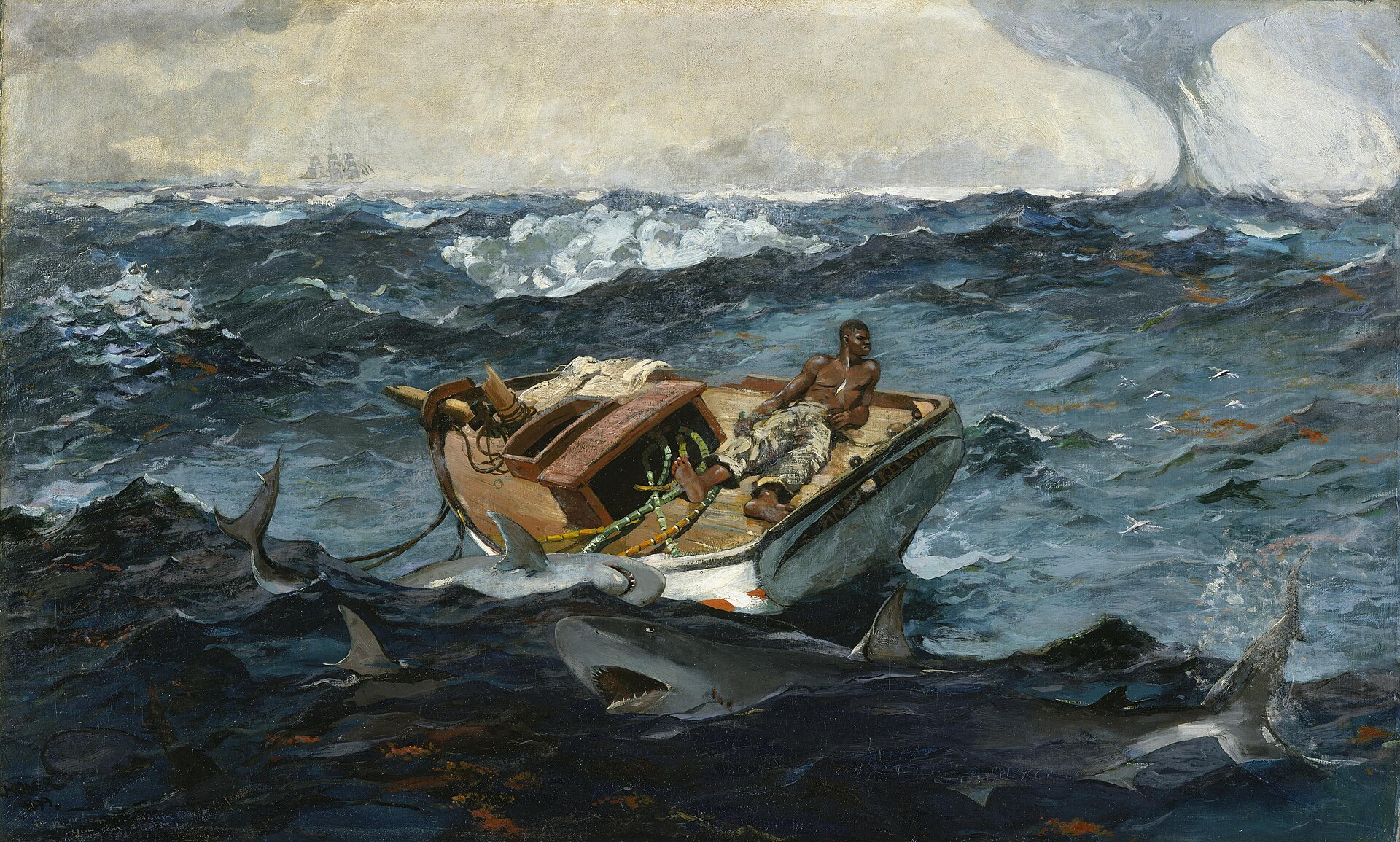
What survives instead is unusually good paper. Homer's own letters to dealers give net prices and commissions, a 1911 biography prints some of them; his estate was sworn at no more than $40,000; and the Bowdoin College Museum of Art holds a large archive of his correspondence. The most telling single document trail belongs to The Gulf Stream: Homer asked $4,000 for it in 1900 and told a Chicago dealer in March 1902 that his net price was $3,000; it stayed unsold for six years until the Metropolitan Museum reversed a refusal after a petition from artists in December 1906.
This page separates what Homer wrote from what later scholars read into him. His position on viewing distance is documented in his hand, down to a line painted on the canvas of the Gulf Stream. A reading of that picture as an allegory of the Atlantic slave trade is argued by named scholars and disputed by others. The Chevreul book on colour he wore to pieces is documented. A hidden programme, a lodge or a creed is not, and the absence is recorded as a finding.
Images
Chronology
- 1834
Charles Savage Homer Jr., Winslow's elder brother and later sole heir, is born.10
- 1836
Winslow Homer is born in Boston; the date of 24 February is derived from Downes's statement that he died aged 74 years, 7 months and 5 days on 29 September 1910.1
- 1855-1857
Apprenticed at J. H. Bufford's lithographic establishment in Boston; the fellow apprentice Joseph E. Baker gave Downes the dates. Homer later said he refused a Harper and Brothers offer of regular work because of what the apprenticeship had taught him about being bound.1
- 1861
Goes to the front as one of the Harper's Weekly artist-reporters; Yale gives about thirty such artists and roughly 6,000 images in all.15
- 1862
A Provost Marshal's pass is issued to him in Washington on 1 April; his Sharpshooter on Picket Duty runs as an illustration on 15 November.115
- 1863
The oil painting of the sharpshooter subject is shown at the National Academy of Design.15
- 1866
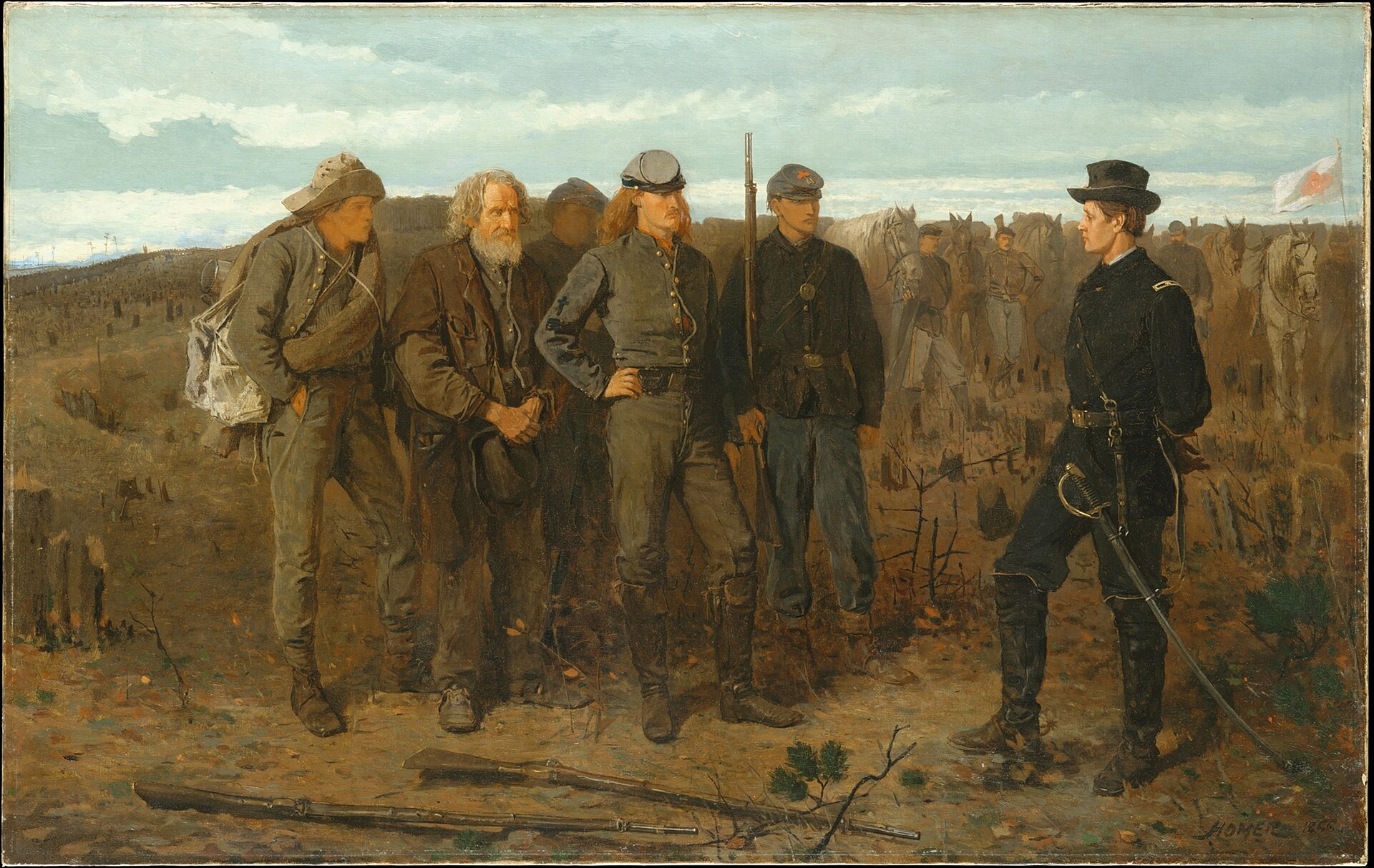
Prisoners from the Front is signed and dated; it is bought by John Taylor Johnston.118
- 1867
The picture is shown at the Paris Exposition Universelle.1
- 1875
His brother Arthur discovers Prouts Neck, Maine; the Homer family later buys much of the waterfront.1
- 1876
Breezing Up is signed and dated; Prisoners from the Front is sold from the Johnston collection to the dealer Samuel P. Avery for $1,800 (20 December, Somerville Art Gallery, lot 181, per the museum's record).118
- 1881-1882
Works two seasons at Tynemouth and Cullercoats in Northumberland; his English watercolours follow.1
- 1883
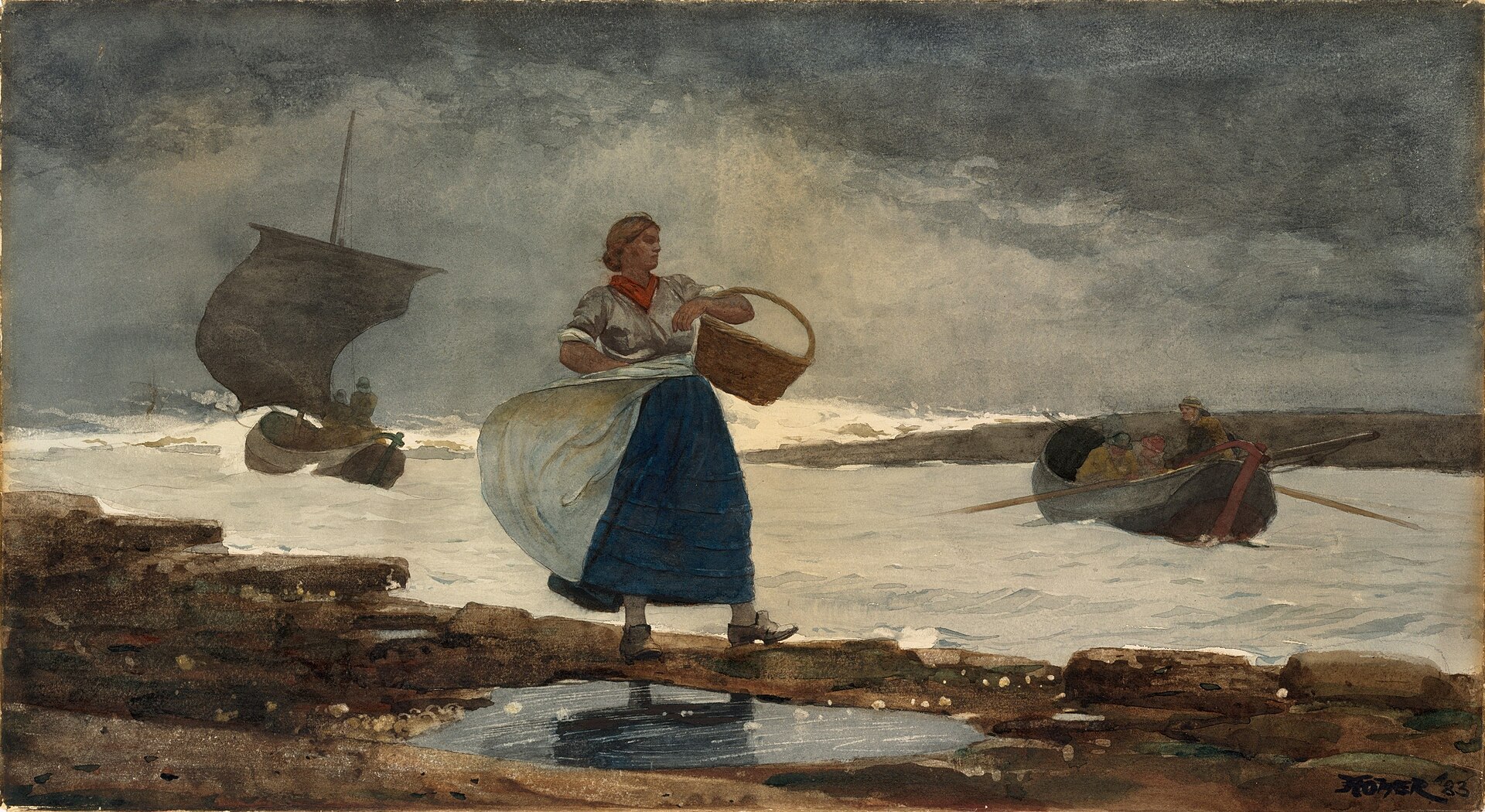
The English series is shown at the American Watercolor Society; Christie's provenance lists the watercolour Where Are the Boats? with Doll and Richards the same year.14
- 1884
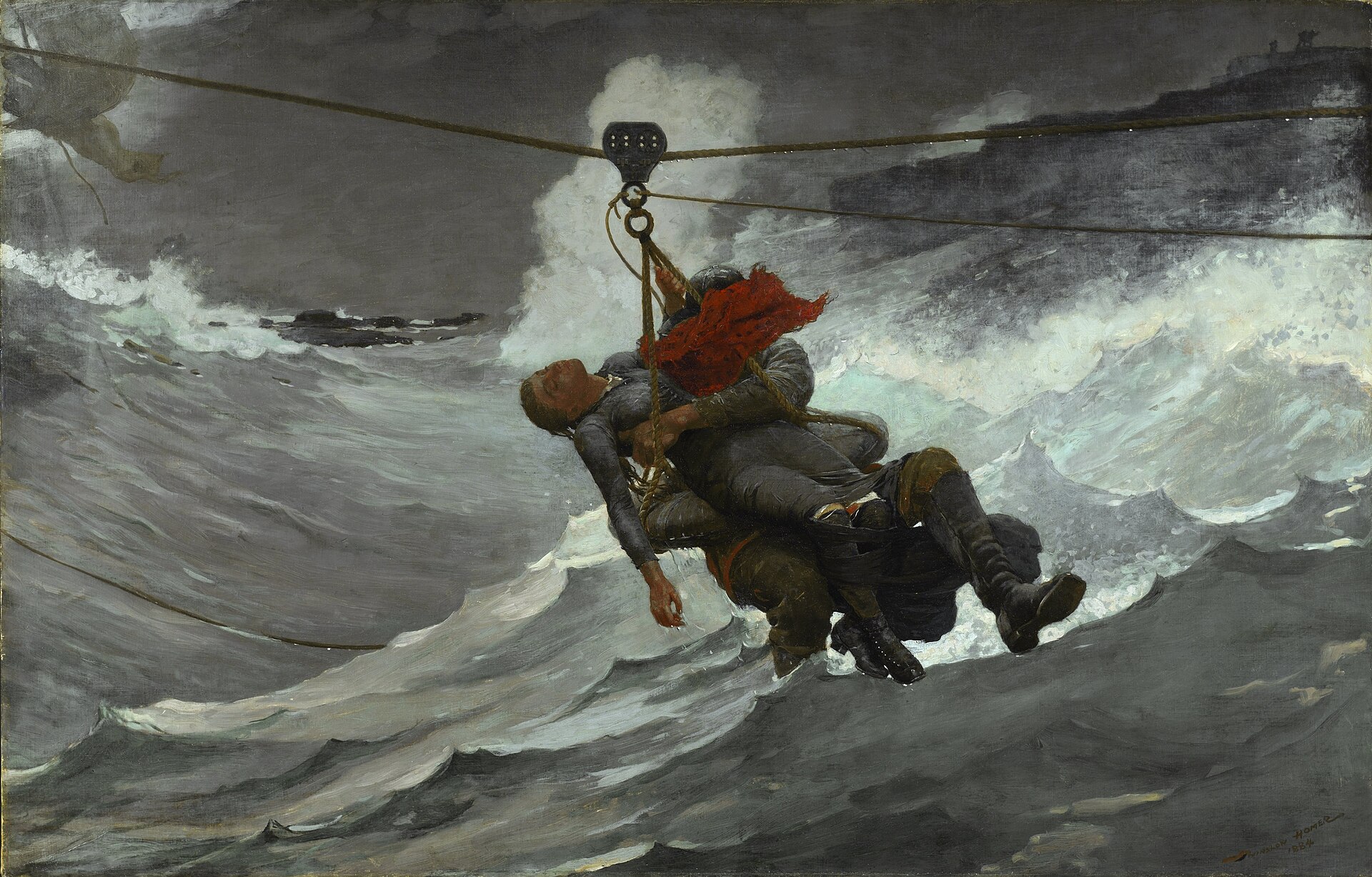
Settles at Prouts Neck by Downes's account; makes his will, leaving everything to his brother Charles; paints The Life Line; his mother dies.18
- 1885-1886
Winters in the Bahamas and Cuba; in 1886 shows fifteen Bahamian and fourteen Cuban watercolours at Doll and Richards. The watercolour Sharks (The Derelict) is dated 1885.13
- 1887
The first Klackner etching, Perils of the Sea, is made, published at $30 on parchment and $20 on Japan paper.1
- 1891
Reichard and Company shows four large 1890 pictures in New York, with two marines roped off; reviewed in the New York Times on 16 January.2
- 1898
His father, Charles Savage Homer, dies; the Mount Auburn lot marker reads 1809 to 1898.1
- 1898-1899
Winters in the Bahamas; a watercolour and chalk study for The Gulf Stream is dated these years.16
- 26 November 1899
Writes to Harrison Morris of the Pennsylvania Academy that the picture is called The Gulf Stream and the title must not be changed; also that the viewer should stand off.2
- 1900
The Gulf Stream debuts in Philadelphia in early 1900 and finds no buyer; at the Carnegie Institute Homer sets $4,000 for it; the Evans sale (31 January to 2 February) sells Storm-Beaten to Emerson McMillin for $4,000.125
- March 1902
Tells M. O'Brien and Son of Chicago his net price for The Gulf Stream is $3,000 and for High Cliff $2,000.1
- 29 October 1902
Fixes $5,000 as the dealer's price for the picture now called Early Morning after a Storm at Sea, $4,000 net to him.1
- 1903
Reworks Early Morning after a Storm at Sea after it meets critics; writes on 14 September that he has lightened the colour.2
- 8 November 1904
Writes to Knoedler that the firm's window is the one place to see a picture 'to look at and not smell of'.2
- October 1906
The Metropolitan Museum's trustees decline The Gulf Stream.2
- December 1906
After a petition from artists the trustees reverse the decision and buy it from the Wolfe Fund, the museum's first Homer painting.219
- November 1909
His last oil, Driftwood, is sent to Knoedler and sold to Frank L. Babbott of Brooklyn.1
- 29 September 1910
Dies in the Prouts Neck studio of heart failure after a stomach haemorrhage; cremated after a funeral at Mount Auburn Cemetery on 3 October.1
- October 1910
His will is filed for probate in Portland; his brother Charles swears the estate to be not more than $40,000.1
- February 1911
Memorial exhibitions open at the Metropolitan Museum (6 February) and the Museum of Fine Arts, Boston (7 February); Downes's biography appears the same year.1
- 1912
Charles Savage Homer Jr. gives the Gulf Stream study to the Cooper-Hewitt collection.16
- 1922
Prisoners from the Front is given to the Metropolitan Museum by Mrs. Frank B. Porter, a Kennedy descendant.18
- 1944
Goodrich's Winslow Homer is published by the Whitney Museum of American Art.2
- 1964
The Homer family gives archive material to Bowdoin College Museum of Art; the museum credits a gift from Doris Homer.810
- 1995
Cikovsky and Kelly's Winslow Homer is published by the National Gallery of Art with Yale University Press.316
- 1998
Bill Gates reportedly buys Lost on the Grand Banks for about $30 million; whether by auction or private treaty is not established in the source I read, and Sotheby's 2009 note on the Knoedler letters puts the sale out of the Spoor family in 1996.135
- 2005-2007
The Art Institute of Chicago studies its 25 Homer watercolours and three monochrome drawings with new analytical methods.16
- 2005-2014
The Record of Works appears: volumes 1 and 2 (2005, Spanierman), 3 (2008), 4 part 2 (2012) and 5 (2014).234620
- 2006
The Portland Museum of Art buys the Prouts Neck studio; it opens to the public in 2012 and the museum buys the land in 2014.17
- 21 May 2009
Children Under a Palm is withdrawn from Sotheby's New York when the Blake family claims it; litigation opens in 2013.12
- 2017-2018
Winterthur shows a disputed Homer seascape in Treasures on Trial; its technical report (July 2016) had found hide glue and period pigments.11
- 9 May 2018
Where Are the Boats? makes $4,572,500 at Christie's New York in the Rockefeller sale.4
- 10 September 2022
National Gallery, London opens Winslow Homer: Force of Nature, which runs to 8 January 2023.3
- 30 October 2025
Bowdoin announces Winslow Homer Online, planned for completion in early 2028.9
The market
The prices that can be proved fall into three eras. In Homer's lifetime and the decade after, an important oil changed hands for $3,000 to $5,000 and a drawing lot for hundreds; Downes's figures include $1,800 for Prisoners from the Front in 1876, $3,650 for the Clarke-sale Moonlight, Wood Island Light in 1899 and $4,000 for Storm-Beaten in 1900, which Knoedler paid $10,000 to buy back in 1911. In the late twentieth century a good early watercolour reached the mid six figures: How Many Eggs? of 1873 made $717,500 at Christie's on 4 December 1996. In the twenty-first century the one result I could verify to the dollar is $4,572,500 for the 1883 watercolour Where Are the Boats? at Christie's on 9 May 2018, against an estimate of $1.5 million to $2.5 million.
The weak points are named here. The Christie's lot page prints a single price realised and no hammer figure, so I give the price as printed and leave hammer and premium separate fields marked not published; I have not derived a hammer from a premium scale because none appears in the sources. The 1996 figure comes from a provenance note in the National Gallery's loan list that cites Christie's website, with no statement of basis. The reported $30 million for Lost on the Grand Banks in 1998 comes from a tertiary source citing a 1998 New York Times report, and whether it was a private sale is not established in what I read. I did not obtain the January 2026 Sotheby's result for the watercolour Breaking Wave (estimate $50,000 to $70,000), which the lot page hides behind a login.
No wage or cost-of-living comparison is given. I did not read a source that sets Homer's prices against period earnings, and a modern equivalent without a named method would be unreliable. The one internal benchmark Downes gives is the sworn estate of not more than $40,000 in 1910, against net prices of $2,000 to $4,000 for a major oil.
| Date | Sale | Work | Result | Note |
|---|---|---|---|---|
| 20 December 1876, New York | Johnston sale, Somerville Art Gallery (lot 181) | Prisoners from the Front, oil, 61 by 96.5 cm (bought by Samuel P. Avery) | Hammer 1,800 (as reported by Downes; basis not stated) With premium not stated US dollars | The museum's record gives the sale date and lot; Downes gives the price and buyer. |
| 14 to 18 February 1899, New York | American Art Association, Clarke sale | Moonlight, Wood Island Light, oil, 30 by 40 in. (bought by Boussod, Valadon and Co.) | Hammer 3,650 (as reported by Downes; basis not stated) With premium not stated US dollars | Dates 14 to 18 February per the National Gallery list; Downes says 14 to 17. Later owned by George A. Hearn. The same sale included Eight Bells, lot 370, price not found. |
| 31 January to 2 February 1900, New York | Evans sale, Chickering Hall | Storm-Beaten (Weather-Beaten), 1894, oil, 28 by 48 in. (bought by Emerson McMillin) | Hammer 4,000 (as reported by Downes; basis not stated) With premium not stated US dollars | McMillin sold it in 1911 to Knoedler for $10,000 according to Downes. |
| March 1902, private | M. O'Brien and Son via Knoedler (artist's net) | The Gulf Stream, oil | Hammer 3,000 net to the artist With premium dealer margin not stated US dollars | Homer's stated net price, not a sale. The picture was unsold and was bought by the Metropolitan Museum in December 1906 for a price I could not find. |
| 29 October 1902, private | M. O'Brien and Son (artist's price) | Early Morning after a Storm at Sea, oil | Hammer 4,000 net to the artist With premium dealer price 5,000 stated by Homer US dollars | Homer's stated price, not a sale. The picture is now in Cleveland per Simpson. |
Hammer is the price at which the bidding stopped; with premium adds the fee the house charges the buyer on top. Hammer price and buyer's premium in the glossary.
Recorded without a public price
- 4 December 1996, New York · How Many Eggs?, 1873, watercolour, 32.4 by 23.8 cm · Christie's (sale 8546, lot 16) · not stated The National Gallery loan list prints only a sold-for figure of $717,500 (basis, hammer or with premium, not stated). Estimate $250,000 to $350,000. Sold again at Sotheby's on 24 May 2000 (sale 7480, lot 10) to the present owners; price not given.
- 5 May 1998 (reported) · Lost on the Grand Banks, 1885, oil · Not established (auction or private sale not stated) · not stated Reported figure about $30,000,000, basis not stated. A tertiary source citing Carol Vogel in the New York Times, 5 May 1998; Sotheby's own 2009 note on the Knoedler letters (source 5) says the picture left the Spoor family in 1996, so year and route are unresolved. Treat as unverified.
- 9 May 2018, New York · Where Are the Boats?, 1883, watercolour and pencil, 34.3 by 49.9 cm · Christie's, The Collection of Peggy and David Rockefeller: Art of the Americas, evening sale (lot 438) · not published on the lot page Price realised printed on the lot page: $4,572,500 (the lot page does not split hammer and premium). Estimate $1,500,000 to $2,500,000. The lot carried a Christie's minimum-price guarantee interest. Provenance: Doll and Richards 1883, George Baty Blake, John Armory Lowell Blake, F. W. Bayley and Son 1930, John S. Ames 1930, Hirschl and Adler 1980, Sotheby's New York 3 December 1987 lot 105. Underbidder not published.
Where to see the work
| Institution | City | Holdings | Note |
|---|---|---|---|
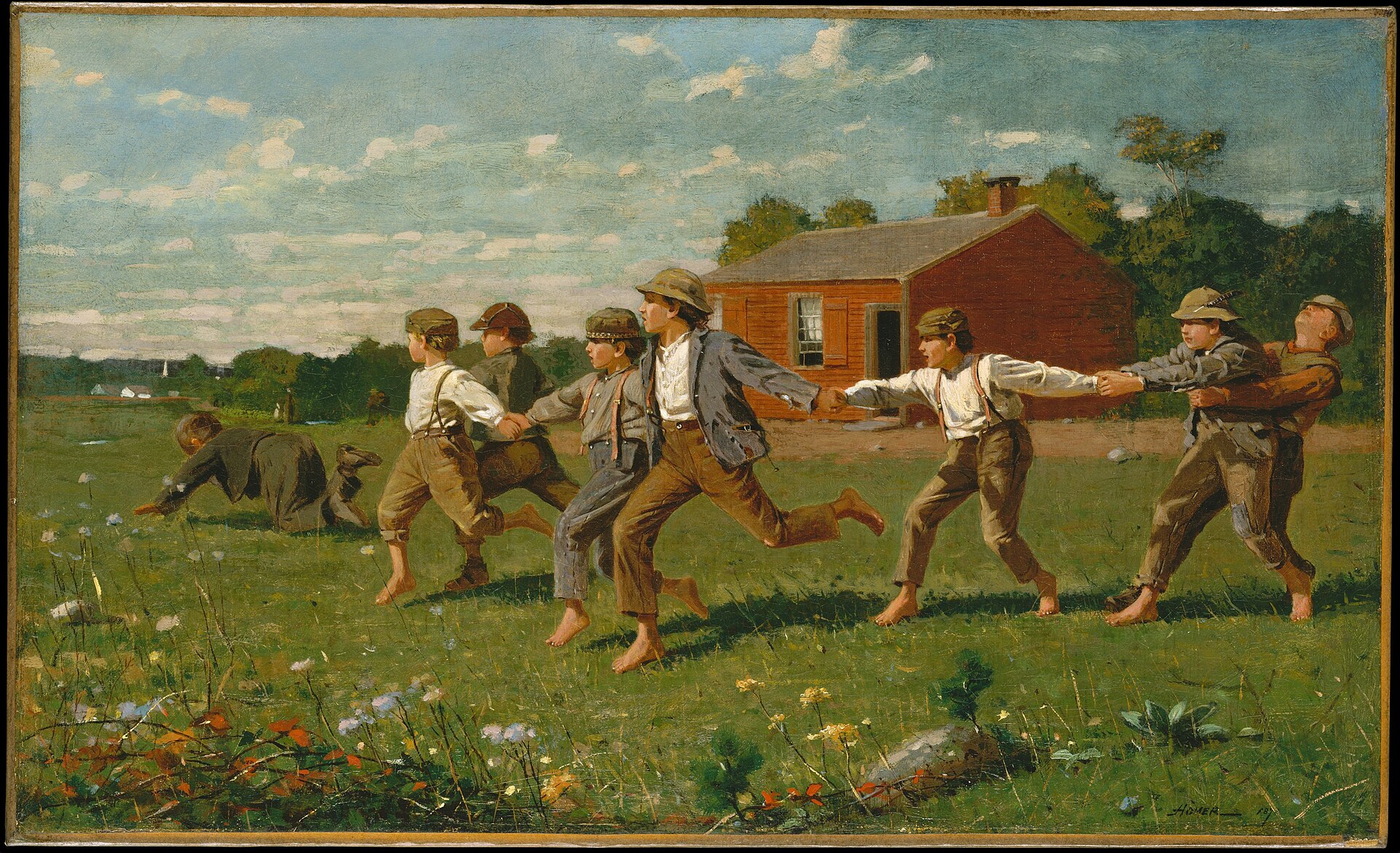
| The Metropolitan Museum of Art | New York | The Gulf Stream (06.1234), Prisoners from the Front (22.207), the 1872 oil Snap the Whip (50.41), Inside the Bar (54.183), Cannon Rock and Northeaster per Downes and the tropical watercolours. | The Gulf Stream was the museum's first Homer painting (Simpson). The museum's record dates it 1899, reworked by 1906. |
| Bowdoin College Museum of Art | Brunswick, Maine | The Winslow Homer Archival Collection: more than 300 unique items, 150 letters, a scrapbook of 393 clippings, Homer's watercolour box and brushes and nearly all of his prints. | Fully digitised per the museum in 2021. Winslow Homer Online is planned for early 2028. |
| Portland Museum of Art and the Winslow Homer Studio | Portland and Prouts Neck, Maine | The studio Homer built at Prouts Neck and the museum's Homer holdings, including the Sharpshooter oil per Yale. | The studio opened in 2012 after a six-year restoration. |
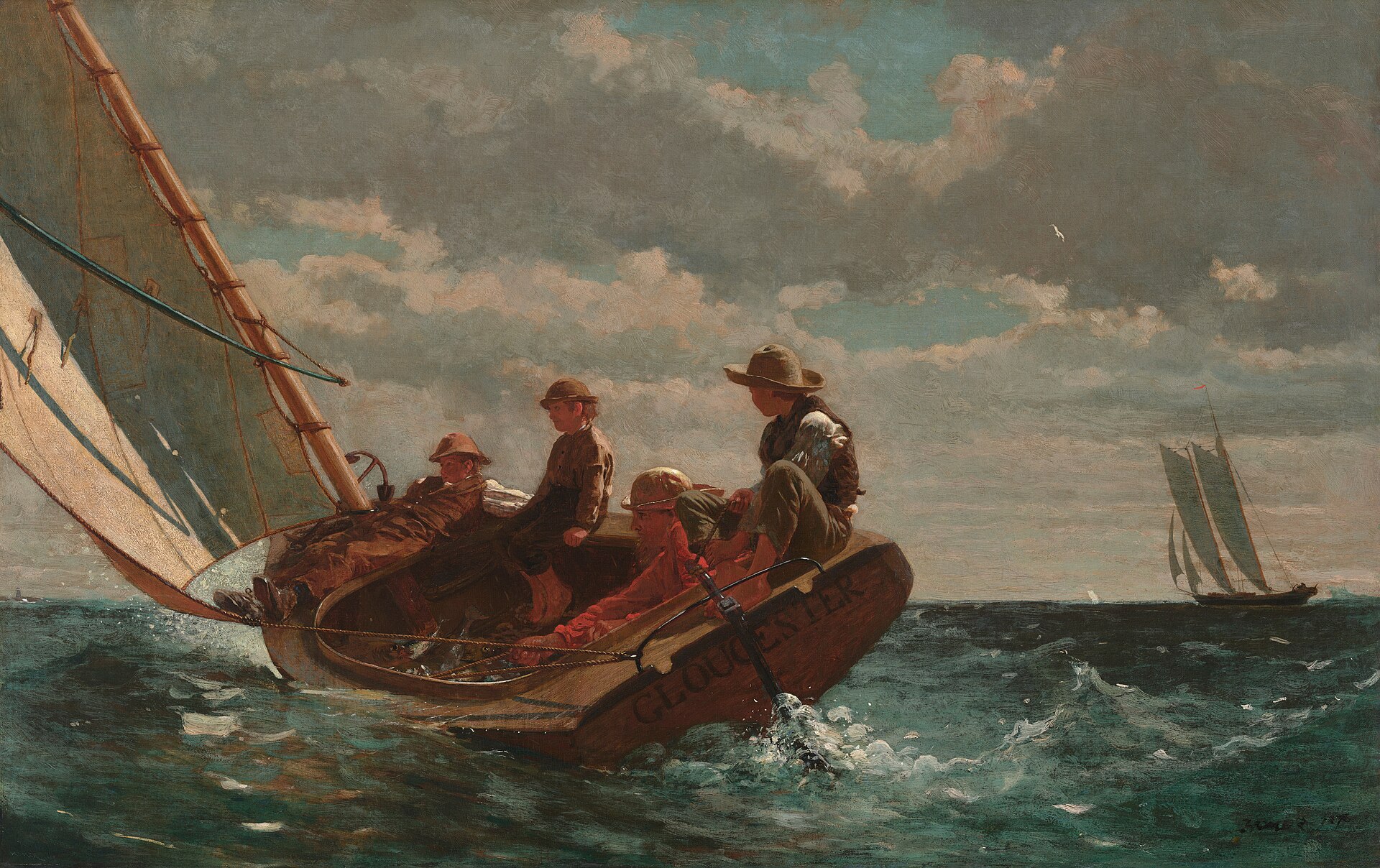
| National Gallery of Art | Washington, DC | Breezing Up (A Fair Wind), 1943.13.1, and a large group of watercolours. | The Record's volume 2 numbers Breezing Up as no. 596. |
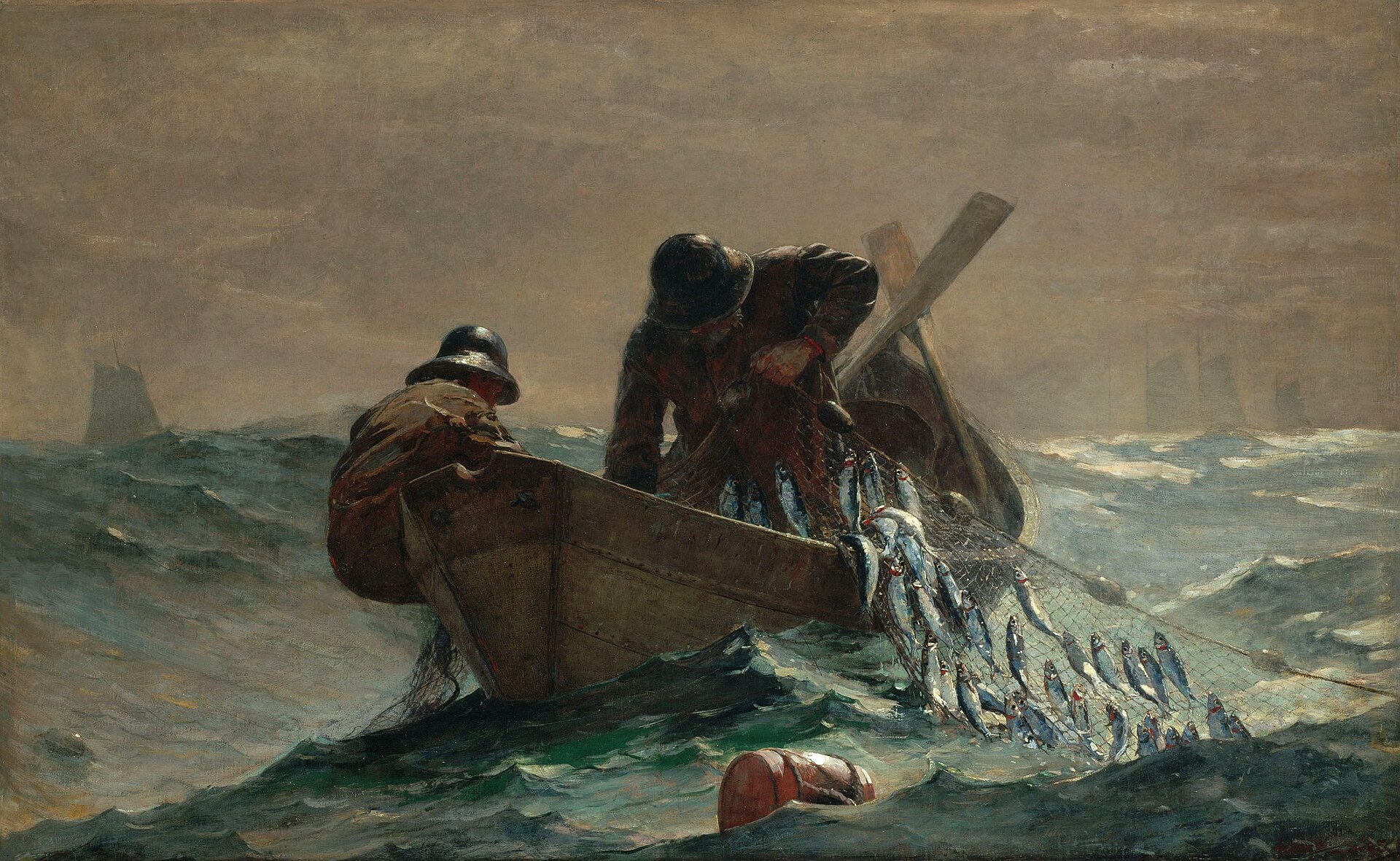
| The Art Institute of Chicago | Chicago | The Herring Net (1937.1039), twenty-five watercolours and three monochrome drawings. | The 2005 to 2007 technical study is on its research site. |
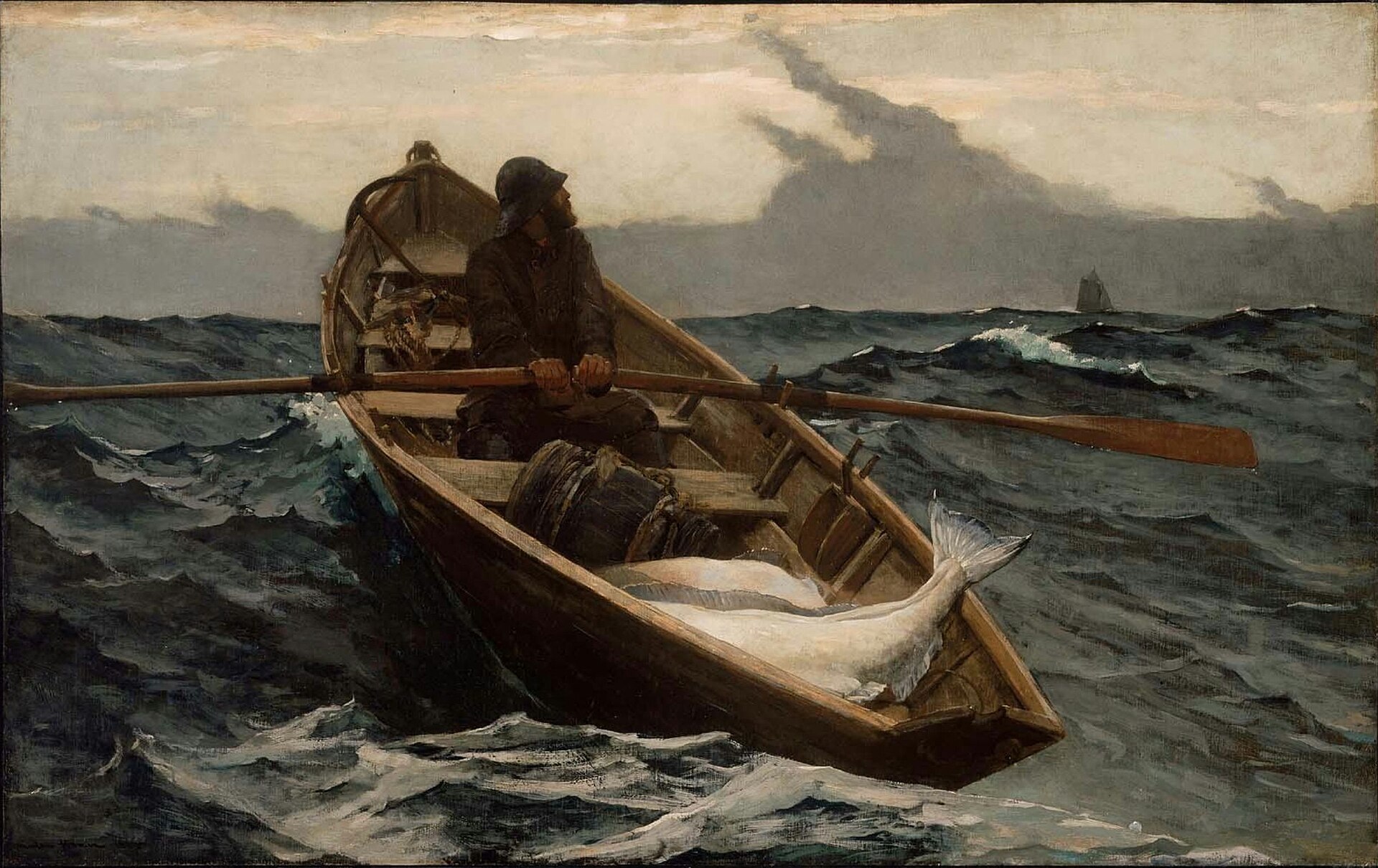
| Museum of Fine Arts, Boston | Boston | The Fog Warning (94.72). | Shown at Doll and Richards in 1886; MFA acquired it in 1894 as an anonymous gift. |
| Philadelphia Museum of Art | Philadelphia | The Life Line, signed 1884, The George W. Elkins Collection, 1924. | Klackner published an etching of it; Downes records Elkins as owner. |
| Addison Gallery of American Art | Andover, Massachusetts | Eight Bells (1930.379) and Kissing the Moon (1946.19). | Both lent to the 2022 National Gallery exhibition. |
| Brooklyn Museum | New York | The 1885 watercolour Sharks (The Derelict), 78.151.4. | Provenance: Knoedler 1905, Frank L. Babbott 1906. |
| Cooper-Hewitt, Smithsonian Design Museum | New York | The 1898 to 1899 watercolour and chalk study for The Gulf Stream. | Gift of Charles Savage Homer Jr., 1912 (1912-12-36). |
Forgeries and misattributions
- Rocky seascape signed HOMER, Winterthur Treasures on Trial, 2017 to 2018
- An oil on cross-laminate veneer panel of a rough sea breaking on cliffs, signed HOMER, bought by a private collector at a small auction house in northern Virginia in 1961. The owner has not been named. The owner suggests it is a sketch for High Cliff, Coast of Maine (1894, Smithsonian American Art Museum). Winterthur shows it as an open question and gives no verdict. Against: a leading Homer scholar working on the catalogue raisonne (unnamed) read style, brushwork and signature as false; the support is panel not canvas; thin paint with no ground; no history before 1961. For: under UV and infrared the signature appears in the paint layer and the craquelure; the backing canvas, when removed, showed a faded portrait of a white-bearded old man thought to resemble Homer's model John Gatchell; infrared spectroscopy found protein in the glue, suggesting hide glue; pigments fit the 1890s. Technical report: Jennifer L. Mass, report 1620, 12 July 2016. The experts remain at odds.11
- Children Under a Palm, 1885: an ownership dispute, not a forgery
- A watercolour and pencil of the three children of Sir Henry Blake, the governor of the Bahamas, found near a rubbish dump in Ireland in 1987 by Tony Varney, valued at 30,000 pounds on Antiques Roadshow in 2008 by Philip Mould and confirmed as Homer by Sotheby's. Sotheby's New York withdrew it from its 21 May 2009 sale when Blake's descendant Simon Murray claimed it. It was listed with the Art Loss Register. In October 2013 Murray's mother Shirley Rountree sued Sotheby's, and in November 2013 Clifford Schorer claimed it as security for a loan to Varney's daughter, Selina Rendall. The attribution was not in doubt in the account I read, which is tertiary. The dispute is over title under English and Irish law on found property. As of 2022 the tertiary source said Sotheby's still held it.12
- Engravings after Homer: the hand that cut the block
- Homer's war illustrations reached readers as wood engravings cut in the Harper's office from his mailed sketches. Yale holds more than 100 such engravings. The engravers are not named in the Yale account. A print 'after Winslow Homer' is the work of two hands. Attribution is by inscription on the block and by comparison with surviving drawings; I did not find a published count of misattributed war prints.15
The essay
Chapter 1No total exists: the Record of Works and how far its numbers run
The book every dealer and curator cites is Record of Works by Winslow Homer, by Lloyd Goodrich, edited and expanded by Abigail Booth Gerdts.
The book every dealer and curator cites is Record of Works by Winslow Homer, by Lloyd Goodrich, edited and expanded by Abigail Booth Gerdts. Goodrich's earlier monograph Winslow Homer (Whitney Museum of American Art, 1944) is still cited for Homer's letters. The published Record appeared in volumes: two in 2005 from the Spanierman Gallery, volume 3 (1877 through 1881) in 2008, volume 4 part 2 (1883 through 1889) in 2012 and volume 5 (1890 through 1910) from the Goodrich-Homer Art Education Project in 2014. A reading list published by the Art Institute of Chicago lists two volumes of 2005; the Sotheby's, Christie's and National Gallery catalogue notes I read cite the later ones.
The numbers inside show scale but not a total. Breezing Up, signed 1876, is no. 596 in volume 2. A Gloucester watercolour of 1880 is no. 911 in volume 3. Two watercolours of 1883 are nos. 1191 and 1209 in volume 4 part 2. The numbering is continuous across volumes, so the register had well over a thousand entries by the time Homer settled at Prouts Neck. I could not establish how many entries are oil paintings, how many are lost works known from records or how many are marked doubtful. That is not a gap in this page's effort. No source I could open gives it.
The practical consequence for a buyer is that attribution rests on a printed register and on named scholars, not on a body that can be asked. The one live dispute I found, the Winterthur seascape discussed below, was judged by an unnamed leading scholar working on the catalogue raisonne and was still open when the museum showed it in 2017 and 2018.
Chapter 2A lithographer who refused to be staff: Bufford, Harper's and the war
Homer was born in Boston in 1836 to Charles Savage Homer and Henrietta Benson Homer, who had married on 6 June 1833.
Homer was born in Boston in 1836 to Charles Savage Homer and Henrietta Benson Homer, who had married on 6 June 1833. The elder son, Charles Savage Homer Jr., was born in 1834 and the younger, Arthur Benson Homer, in 1841 (the Bowdoin museum's account of the family letters and the Archives of American Art names list). From 1855 to 1857 Homer was apprenticed in the Boston lithographic firm of J. H. Bufford; his fellow apprentice Joseph E. Baker gave Downes the dates. Downes also prints Homer's account to an 1878 Art Journal writer that Harper and Brothers offered him regular work and that he refused because the apprenticeship had left him unwilling to be bound again.
The freelance life that followed made him a Harper's Weekly artist without being its employee. Yale's 2015 account of the Civil War artist-reporters says he went to the front in 1861 at twenty-five, was one of about thirty artists who produced roughly 6,000 images for three New York illustrated weeklies, mailed his sketches to the Harper's office and saw them cut into wood blocks by engravers there. Downes illustrates the Provost Marshal's military pass issued to him in Washington on 1 April 1862. The Yale piece records that his illustration A Sharpshooter on Picket Duty ran on 15 November 1862 and that his oil painting of the subject was shown at the National Academy of Design in 1863.
This is the first place on the page where authorship needs care. Homer drew; someone else cut the block. The surviving printed image is a collaboration, and the Yale account does not name the engravers. Yale's art gallery holds more than 100 wood engravings Homer made for the paper. A print 'after Winslow Homer' from the war years is a different object from a Homer drawing, and the labour of the engravers has dropped out of the record.
Chapter 3Prisoners from the Front: a famous picture that nobody could find in 1911
Prisoners from the Front, signed and dated 1866, is the picture that made Homer's name as a painter.
Prisoners from the Front, signed and dated 1866, is the picture that made Homer's name as a painter. Downes records that it was bought by John Taylor Johnston, shown at the Paris Exposition Universelle in 1867 and the 1876 Centennial loan exhibition in New York and sold at the Johnston sale in 1876 to the dealer Samuel P. Avery for $1,800. The Metropolitan Museum's object history, carried in the Commons file for the image, gives the sale as 20 December 1876 at the Somerville Art Gallery, lot 181, and then names a chain of Kennedy family owners until it passed to a great-grandniece, Mrs. Frank B. Porter, who gave it to the museum in 1922.
The reason the chain matters is Downes himself. When the committee preparing the 1911 memorial exhibition tried to trace the picture it could not. Bryson Burroughs, the Met's curator of paintings, told Downes that a woman who knew the owner would not give the name, answered several enquiries the same way and addressed her reply to the committee member Charles S. Homer as 'Miss Homer'. Downes says only that Avery sold it on to a collector; the museum's own object history names the Kennedy family as owners down to the 1922 gift. On that record the 1911 committee lost the picture to a private owner's wish for anonymity, not to any break in ownership. The chain after Avery rests on the museum's record alone.
Chapter 4What Homer charged, and who he charged it through
The best evidence of what Homer asked is his own letters.
The best evidence of what Homer asked is his own letters. Downes prints a letter of 19 October 1900 offering the Chicago dealers M. O'Brien and Son a 39 by 39 inch painting, On a Lee Shore, at $2,000 net with the frame. Another, dated 15 March 1902, tells them he has ordered Knoedler to send The Gulf Stream and High Cliff, and gives the net price to him as $3,000 for the first and $2,000 for the second. On 29 October 1902 he describes the 'O'B.' picture, now known as Early Morning after a Storm at Sea, as the best sea picture he had painted and fixes the price to be charged at $5,000 with $4,000 net to him. In the same letter he tells the dealers he has rents enough to keep him out of the poorhouse. The source of the rents is not stated in the passage I read.
A Sotheby's lot description of twenty-one letters from Homer to M. Knoedler and Company, written from Prouts Neck between 30 March and 31 December 1900, adds the dealer's side. In them Homer sets $4,000 as the price of The Gulf Stream while it was in the Carnegie Institute exhibition, and offers Knoedler a 20 per cent commission if the dealer sold it elsewhere at that price. The catalogue summary also records a $2,000 price including frame for a picture called Fog, which Homer justifies by the time and study it took. I read the lot page itself and the $4,000 price, the 20 per cent commission and the $2,000 Fog price all stand in its quoted text as printed; the price realised is not shown.
The practical dealer structure was layered. Doll and Richards in Boston showed his watercolours and drawings 'year after year' in the old Park Street gallery, according to Downes, and Homer bought some of them back: in 1906 he bought The Club Canoe and sent his cheque. Reichard and Company in New York showed his first big Prouts Neck marines in January 1891 and roped off two of them, the New York Times reported, so that visitors had to stand across the gallery. By 1900 Knoedler was handling his oils. A Wikipedia timeline gives a switch from Doll and Richards to Knoedler in 1902; the 1900 letters show Knoedler already in charge of the Gulf Stream two years earlier.
Prints were a separate trade. C. Klackner in New York published Homer's own etchings after his paintings from 1887: the Perils of the Sea plate in two editions at $30 for the remarque parchment and $20 on Japan paper, and later plates including Saved (after Undertow) in 1888. The Archives of American Art holds a contract between Klackner and Homer for the sale of etchings. Bowdoin says it owns all but one of the 295 unique prints Homer made, on its count.
Chapter 5Tynemouth, Prouts Neck and the dates that sources disagree on
In 1881 Homer went to the north-east coast of England and worked for two seasons at Tynemouth, living in a walled house at Cullercoats where he had his own key to the gate.
In 1881 Homer went to the north-east coast of England and worked for two seasons at Tynemouth, living in a walled house at Cullercoats where he had his own key to the gate. Downes calls the English watercolours a turning point and dates the American Watercolor Society show to 1883 and a special Tynemouth exhibition at Doll and Richards to 1884. The Christie's provenance for the 1883 watercolour Where Are the Boats? lists Doll and Richards in 1883 and its exhibition history gives Doll and Richards, Watercolors by Winslow Homer, 1 to 15 December 1883, no. 3, so a Boston showing of the English-derived work came before Downes's 1884 date; whether that was the show Downes means is not established.
He left New York for Prouts Neck, Maine, in 1884 by Downes's account, and the Archives of American Art finding aid also says 1884. A tertiary source gives 1883. His brothers had known the place earlier: Arthur discovered the point in 1875 and the Homer family bought most of the waterfront and developed it as a summer resort, according to Downes. Winslow built a small wooden cottage-studio painted pale green near the south-west corner of the promontory. The Portland Museum of Art bought it in 2006, restored it over six years to its appearance in Homer's lifetime, opened it in 2012 and bought the surrounding land in 2014. The studio is 1,350 square feet.
Chapter 6The Gulf Stream, step by step
The documented chronology is more specific than most of the writing about the picture.
The documented chronology is more specific than most of the writing about the picture. Homer was in the Bahamas in the winter of 1898 to 1899, and the Art Institute of Chicago's research site notes that he took a twill paper there that is unusual in his oeuvre and may help date undated works. A watercolour and chalk study dated 1898 to 1899 is in the Cooper-Hewitt, Smithsonian Design Museum, a gift of his brother Charles Savage Homer Jr. in 1912. The watercolour Sharks (The Derelict), dated 1885, which the National Gallery in London listed for its 2022 exhibition, passed from Knoedler in 1905 to Dr. Frank L. Babbott in Brooklyn in 1906.
On 26 November 1899 he wrote to Harrison Morris, director of the Pennsylvania Academy of the Fine Arts, that the first shark was fifteen feet long, the boat thirty feet from it and that the viewer should not smell the picture but stand off. The picture debuted in Philadelphia in early 1900 and found no buyer there, or in the next six years in Pittsburgh, Venice, Chicago or Des Moines (Simpson). In 1900 Homer priced it at $4,000 at the Carnegie Institute. In March 1902 his net price was $3,000. Below the signature and date at lower left the canvas carries a partly overpainted line that the Met records as 'At 12 feet you can see it' and the Record of Works gives in a close variant. Simpson places it before Homer's final work on the picture.
The sale is the part most retellings smooth. Simpson reports that in October 1906 the Metropolitan Museum's trustees declined the picture, and that in mid-December, after a petition from artists, they reversed that decision and bought it from the Wolfe Fund as the museum's first Homer painting. Downes, writing five years later, gives the story from the other side: the picture was shown at the National Academy of Design in 1906, the whole jury recommended its purchase and wrote to the museum's director, and Roger Fry inspected the picture at the museum two days after the letter, with the museum's acceptance following two days later. I could not find the price the Met paid and have not guessed it. The museum's record dates the picture '1899; reworked by 1906'.
Chapter 7What he said about it, what scholars say and what the pictures that came before it show
Homer's own words are short. He told Harrison Morris that this was the last picture he would paint for fun, that the title must not be changed and that the figures were of little account in the great...
Homer's own words are short. He told Harrison Morris that this was the last picture he would paint for fun, that the title must not be changed and that the figures were of little account in the great subject of the Gulf Stream, comparing their value to the floating chain cables and the impossible limbs that the public had admired in Turner's Slave Ship. Simpson, who quotes the letter from the Goodrich and Gerdts Record, reads it as straddling meanings: either irony or extreme emotional coolness. That is documented. Anything past it is argument.
The argued readings divide. Peter H. Wood, in Weathering the Storm: Inside Winslow Homer's Gulf Stream (Athens: University of Georgia, as printed in Simpson's note), and Nicolai Cikovsky Jr. in a 1990 essay are cited by Simpson as advocates; Wood reads the picture as a comment on the Black American experience and the slave trade, a position summarised by a tertiary source. Roger Stein in 1975 condemned it as poorly painted, harsh in colour, melodramatically overstated and derivative, and Barbara Novak's earlier criticism took a similar line. The press divided too, and Downes collects the Evening Post's praise of a great dramatic picture, the Tribune's reading of a receding hope in the ship on the horizon, a Sun critic who found more shudders than in Gericault's Raft of the Medusa and a Philadelphia Item writer who called it a burlesque. None of this tells you what Homer intended.
One thing shows how the picture was made. The Brooklyn watercolour of 1885 and the Cooper-Hewitt study of 1898 to 1899 put the derelict and the sharks in Homer's work fourteen years before the oil. A tertiary summary lists resemblances to Copley's Watson and the Shark, Delacroix's Barque of Dante and Gericault's Raft of the Medusa that critics have proposed. Homer himself names only Turner.
Chapter 8Chevreul, the studio balcony and the doctrine of the right distance
The one book Homer is documented to have read to pieces is Chevreul's The Laws of Contrast of Colour.
The one book Homer is documented to have read to pieces is Chevreul's The Laws of Contrast of Colour. Downes describes the library Homer collected at Prouts Neck and says a copy of Chevreul's book on colour, given him many years earlier by his elder brother, was almost read to pieces. The Art Institute of Chicago's technical project names an 1859 English translation of Chevreul and the watercolour manuals of Penley and of Winsor and Newton as the literature of the period but does not claim Homer owned them.
His rule of viewing is better documented than any theory of colour. Simpson collects it: Homer wanted his late marines seen from about three times their width. He told Knoedler in November 1904 that the firm's window was the only place a picture could be seen properly, from the point of view from which an artist paints, 'to look at and not smell of'. He wrote of hanging his paintings on the upper balcony of the studio and going down to the sea seventy-five feet away to correct them. He told a dealer in 1907 to put furniture in front of a picture to keep people from smelling it. When Reichard and Company showed his four large pictures in January 1891 the New York Times said two were roped off.
Downes also records the method of Early Morning after a Storm at Sea in 1902: a year of waiting for the light and sea he wanted, a February morning that was too cold, with the artist painting from his window and too far away and a canvas finished at the fourth two-hour session from nature. Simpson adds that after the picture met critics in 1903 it was reworked. In September 1903 Homer wrote that he had lightened the colour 'to bring it within the range of the public', and then that it was the same thing. Several late oils were revised after the public saw them.
Chapter 9The brother, the estate and what happened to the studio
Winslow Homer's will, made in 1884, left all his real and personal estate unconditionally to his elder brother Charles Savage Homer Jr.
Winslow Homer's will, made in 1884, left all his real and personal estate unconditionally to his elder brother Charles Savage Homer Jr. Downes reports that Charles swore the estate to be not more than $40,000 in his petition for appointment as executor, and notes that Homer had given away a good deal of money in life. That figure sits beside the net prices in the letters: the Gulf Stream at $3,000 net was less than a tenth of the sworn estate (DERIVED: 3,000 divided by 40,000).
Charles was a Harvard-educated chemist who worked for the paint firm Valentine and Company, according to a tertiary source; the firm's head, Lawson Valentine, was an early collector of Homer. Downes says he intended to keep the Prouts Neck studio as a memorial, open in summer to artists, and was considering offering studies and sketches to art schools. Some of that is documented in outcomes. The 1898 to 1899 Gulf Stream study at the Cooper-Hewitt is catalogued as his gift of 1912, and the Archives of American Art lists an inventory of the collection of Mrs. Charles S. Homer Jr. among the Bowdoin papers.
Bowdoin's Winslow Homer Archival Collection began in 1964 with a gift from the family. The Archives of American Art microfilm record says the museum received the material from Homer's descendants in 1964, around 600 items: letters, notebooks, scrapbooks, photographs, a contract with Klackner, receipts for sales and a Civil War pass. Bowdoin now counts more than 300 unique items, 150 letters by the artist, a scrapbook of 393 press clippings dated 1876 to 1941 and more than fifty vintage family photographs. It also holds a Winsor and Newton watercolour box, 1964.69.191, and two sable brushes set in swan quill, 1964.69.193a and b. Twenty letters between Homer's parents from 1834 to 1849 were given in 2021 by a descendant, Brad Willauer, and Bowdoin says the collection is now fully digitised.
Chapter 10How the watercolours were made, from a 2005 to 2007 technical study
Between 2005 and 2007 curators, conservators and scientists at the Art Institute of Chicago studied its twenty-five Homer watercolours and three monochrome drawings and works on loan, with new...
Between 2005 and 2007 curators, conservators and scientists at the Art Institute of Chicago studied its twenty-five Homer watercolours and three monochrome drawings and works on loan, with new analytical methods. The published result is a research site, with a pigment chart I could not open. It shows that some of the most vivid transparent colours Homer used were prone to fading, that the colours of some works have shifted and that his practice was full of experiment, study and reworking rather than the single swift pass of the legend.
Specific findings are on the site. Graphite underdrawing visible in infrared establishes key forms. He blotted wet washes to pick up colour from the high points of a textured paper, scraped, rewet and sanded to lift highlights and tamped the end of a brush. In The Lone Boat, North Woods Club, Adirondacks the Chicago team thinks Homer used a red lake, a class that includes the cochineal types they call especially vulnerable, and the pale yellow-brown sky now seen was probably a vivid red when he painted it. Digital simulations of the original appearance of three watercolours, including For to Be a Farmer's Boy, are offered as a sense of colour balance only. Some of his watercolours were traced onto etching plates: comparing Netting the Fish with the etching Fly Fishing, Saranac Lake shows deviations of only one to four millimetres.
For a collector the usable diagnostic is paper and pigment, not signature. A twill paper that Homer used in the Bahamas in winter 1898 to 1899 and in Bermuda in 1899 to 1900 is flagged by the Chicago team as a possible dating clue for undated sheets. Two Winsor and Newton japanned tin boxes of moist cakes were found in his studio, and Bowdoin's is 1964.69.191.
Chapter 11Reputation: forgotten, honoured, memorialised
Homer's acceptance by the profession came before the public's.
Homer's acceptance by the profession came before the public's. The 1906 jury that petitioned the Met for the Gulf Stream was a jury of painters. The memorial exhibitions opened in the Metropolitan Museum on Monday 6 February 1911 and at the Museum of Fine Arts, Boston, the next day; the New York show had the larger and better-organised selection of oils under a committee chaired by John W. Alexander, president of the National Academy, with the dealer Roland F. Knoedler and Homer's brother Charles among its members. Downes also records that the Met chose a dozen tropical watercolours for its permanent collection from the best work Homer had kept for himself.
The reputation did not run in a straight line. Downes notes a New York dealer who looked at Snap the Whip in 1911 and said it reminded him of Prang's chromolithographs. The Commons category for the picture shows how widely it circulated: the Harper's Weekly engraving of 20 September 1873, a Lagarde print after Homer published in 1873 and now in the National Gallery and an 1872 oil in the Met. In 1962 the US Post Office put Breezing Up on a 4-cent stamp, as the Commons file for the stamp shows, and a 44-cent stamp of Boys in a Pasture followed in 2010 (a tertiary source).
Chapter 12Where the research stands now
The living work is in three places. The Bowdoin College Museum of Art announced on 30 October 2025 a Winslow Homer Online project, funded by the Wyeth Foundation for American Art, with completion...
The living work is in three places. The Bowdoin College Museum of Art announced on 30 October 2025 a Winslow Homer Online project, funded by the Wyeth Foundation for American Art, with completion envisaged for early 2028. It is led by Judith C. Walsh and Frank H. Goodyear and will offer a search of the archival collection, resources on the clippings scrapbook, the prints and the letters and an aim to transcribe every known letter. The National Gallery in London showed Winslow Homer: Force of Nature from 10 September 2022 to 8 January 2023, and its immunity-from-seizure list is itself a public document with provenance for several dozen works. The Portland Museum of Art runs the Prouts Neck studio.
What is not happening, as far as I could find, is a revision of the Record of Works. The Goodrich-Homer Art Education Project published its last volumes in 2014; I found no announced supplement and no published answer to the question of how a new discovery is added or an old one removed.
What is documented
Technique
The surviving work
- What is accepted
- No accepted total is published in any source I could open. The Goodrich and Gerdts Record of Works has cumulative entry numbers that reached at least 1,209 by 1883 (vol. 4 part 2, 2012). Whether an entry means accepted, doubtful or lost is not stated in the notes I read. Position as of 24 November 2026.
- What is contested
- I found one documented attribution dispute still open: the Winterthur seascape (Treasures on Trial, 2017 to 2018). A second case, Children Under a Palm, concerns ownership, not authorship, and had no reported resolution. No numbers of removed works are published.
- Who rules on attribution
- No authentication board is named in any source I could open. The Goodrich-Homer Art Education Project publishes the Record, edited by Gerdts. Winterthur says a leading Homer scholar working on the catalogue raisonne judged its disputed seascape a false attribution but does not name the scholar.
Catalogue raisonne
- Lloyd Goodrich, edited and expanded by Abigail Booth Gerdts, Record of Works by Winslow Homer, New York: Spanierman Gallery (vols. 1 and 2, 2005; vol. 3, 1877 through 1881, 2008); Goodrich-Homer Art Education Project (vol. 4 part 2, 1883 through 1889, 2012; vol. 5, 1890 through 1910, 2014). The authoritative register, cited in every auction note I read. Numbered cumulatively. It reprints letters and gives provenance and literature.234620
- Lloyd Goodrich, Winslow Homer, New York: Whitney Museum of American Art, 1944. The monograph still cited for Homer's letters, including the 1903 letters to John Beatty.2
- Nicolai Cikovsky Jr. and Franklin Kelly, Winslow Homer, New Haven and London: Yale University Press and National Gallery of Art, 1995. The exhibition catalogue and survey; its entries are cited for provenance on works such as Cape Trinity and How Many Eggs.316
- William Howe Downes, The Life and Works of Winslow Homer, Boston: Houghton Mifflin, 1911. Written with the help of both surviving brothers and prints letters and sale histories. The first source for many prices; some of its owner information is now out of date.1
- Natalie Spassky, American Paintings in the Metropolitan Museum of Art, vol. II, New York: Metropolitan Museum of Art, 1985, pp. 482 to 490 on The Gulf Stream. Simpson names it, with the Record, among the most authoritative treatments of the Gulf Stream.2
Questions about Winslow Homer
Who was Winslow Homer?
Painter; Watercolourist; Illustrator; Etcher. 1836-1910.
When did Winslow Homer live?
Born 24 February 1836 (derived from Downes's age at death, 74 years 7 months 5 days on 29 September 1910), Boston, Massachusetts; died 29 September 1910, Prouts Neck, Scarborough, Maine.
How are fakes and misattributions of Winslow Homer detected?
Rocky seascape signed HOMER, Winterthur Treasures on Trial, 2017 to 2018. An oil on cross-laminate veneer panel of a rough sea breaking on cliffs, signed HOMER, bought by a private collector at a small auction house in northern Virginia in 1961. The owner has not been named.
Where can you see work by Winslow Homer?
The Metropolitan Museum of Art (New York); Bowdoin College Museum of Art (Brunswick, Maine); Portland Museum of Art and the Winslow Homer Studio (Portland and Prouts Neck, Maine); National Gallery of Art (Washington, DC); The Art Institute of Chicago (Chicago); Museum of Fine Arts, Boston (Boston).
What does the market for Winslow Homer look like?
The prices that can be proved fall into three eras. In Homer's lifetime and the decade after, an important oil changed hands for $3,000 to $5,000 and a drawing lot for hundreds; Downes's figures include $1,800 for Prisoners from the Front in 1876, $3,650 for the Clarke-sale Moonlight, Wood Island Light in 1899 and $4,000 for Storm-Beaten in 1900, which Knoedler paid $10,000 to buy back in 1911.
What is still unresolved about Winslow Homer?
How many entries are in the Record of Works in total, and how many are marked accepted, doubtful or lost? The cumulative numbering passes 1,209 by 1883 but no source I could open gives a total or a count of rejections.
Open questions
- How many entries are in the Record of Works in total, and how many are marked accepted, doubtful or lost? The cumulative numbering passes 1,209 by 1883 but no source I could open gives a total or a count of rejections.
- Who decides attribution now? No authentication board is named. The only dispute I found, the Winterthur seascape, was judged by an unnamed scholar working on the catalogue raisonne and left open.
- What did the Metropolitan Museum pay for The Gulf Stream from the Wolfe Fund in December 1906? Homer's net price was $3,000 in 1902 and $4,000 asked in 1900; I found no figure for the purchase.
- Which engravers cut the Harper's Weekly blocks from Homer's war sketches, and how many of those blocks survive? The Yale account does not say.
- When did Homer move to Prouts Neck, 1883 or 1884, and was a first Boston showing of the English watercolours in 1883, as Christie's provenance suggests, or 1884, as Downes says?
- Where were the studio contents distributed after 1910? Charles Savage Homer Jr. gave a Gulf Stream study in 1912 and the Bowdoin archive came in 1964, but I found no inventory of what was in the studio at death.
- Is the Sarony portrait of 1878 or 1880, and are Downes's plate and the Bowdoin photograph one picture or two sittings? Downes says 1878 and age forty-two; Bowdoin and the National Gallery say 1880.
- What is the true result of the sale of Lost on the Grand Banks: year (1996 per Sotheby's 2009 note, 1998 per the tertiary source), price, venue and whether it was public?
- Who owns Children Under a Palm now? The account I read, current to 2022, has Sotheby's holding it while the courts decide.
Sources
- 1William Howe Downes, The Life and Works of Winslow Homer, Boston and New York: Houghton Mifflin, 1911 (full text, OCR; written with both brothers' help; a contemporary biography, not a modern scholarly source). archive.org/stream/...
- 2Marc Simpson, 'If You Can Read This . . .': Winslow Homer's The Gulf Stream and the Viewing of His Pictures, Panorama: Journal of the Association of Historians of American Art 4, no. 1 (Spring 2018). Peer-reviewed; read in full from the PDF. doi.org/10.24926/...
- 3National Gallery, London, Immunity from Seizure list for Winslow Homer: Force of Nature, 10 September 2022 to 8 January 2023 (provenance and Record of Works citations for about forty works; read from the PDF). nationalgallery.org.uk/media/...
- 4Christie's lot page, Winslow Homer, Where are the Boats?, lot 438, The Collection of Peggy and David Rockefeller: Art of the Americas, evening sale, New York, 9 May 2018 (price realised read from the page data; hammer not shown). christies.com.cn/lot/...
- 5Sotheby's lot description, 21 autograph letters signed from Winslow Homer to M. Knoedler and Company, 30 March to 31 December 1900, Fine Books and Manuscripts, lot 163 (read on the lot page; price realised not shown). sothebys.com/en/...
- 6Sotheby's lot page, Winslow Homer, Yacht in a Cove, Gloucester, American Art, 2018, lot 56 (provenance; Record of Works vol. 3, no. 911). sothebys.com/en/...
- 7Sotheby's lot page, Winslow Homer, Breaking Wave, Art of the Americas, 24 January 2026, lot 217 (estimate and provenance; result hidden behind login; Record of Works vol. 4 part 2, no. 1209). sothebys.com/en/...
- 8Archives of American Art, Winslow Homer and Homer family papers from the Bowdoin College Museum of Art, AAA.homewins, finding aid (about 600 items; lent for microfilming 1983; received by Bowdoin from Homer's descendants 1964). sirismm.si.edu/EADpdfs/...
- 9Bowdoin College Museum of Art, Winslow Homer Online, news item of 30 October 2025. bowdoin.edu/art-museum/...
- 10Bowdoin College Museum of Art, Letters between Winslow Homer's Parents Gifted to the BCMA, 2021. bowdoin.edu/art-museum/...
- 11Winterthur Museum, Treasures on Trial, A Painting in Question (disputed Winslow Homer seascape; Jennifer L. Mass, report 1620, 12 July 2016). treasuresontrial.winterthur.org/winslow-homer
- 12Wikipedia, Children Under a Palm ( source: court record, Rountree v Rendall, with the Sotheby's and Telegraph reports it cites). en.wikipedia.org/wiki/...
- 13Wikipedia, Lost on the Grand Banks (: cites Carol Vogel, 'Sale of Homer Seascape Sets Record', New York Times, 5 May 1998; primary). en.wikipedia.org/wiki/...
- 14Wikipedia, Winslow Homer (: used only for the stamps of 1962 and 2010, Charles Homer's employment at Valentine and Company and a reported switch from Doll and Richards to Knoedler in 1902 that the 1900 letters contradict; primary). en.wikipedia.org/wiki/...
- 15Yale News, 'Embedded artist': Winslow Homer and the Union Army, 20 April 2015. news.yale.edu/2015/...
- 16The Art Institute of Chicago, Winslow Homer: Behind the Scenes (research site, 2005 to 2007 study; resources 480, 574, 585, 589, 597, 603, 608, 624, 641, 644 and the bibliography page). archive.artic.edu/homer/...
- 17Portland Museum of Art, About the Museum (Winslow Homer Studio: purchased 2006, opened 2012, land bought 2014, 1,350 square feet). portlandmuseum.org/about
- 18Wikimedia Commons file pages and wikitext for the plates and portrait (object histories, accession numbers, dimensions and Record of Works no. 596 as printed on the Breezing Up page). commons.wikimedia.org/wiki/...
- 19Metropolitan Museum of Art open access record, The Gulf Stream, 06.1234, 1899; reworked by 1906. collectionapi.metmuseum.org/public/...
- 20The Art Institute of Chicago, Winslow Homer: The Color of Light, Recommended Reading (lists the 2005 two-volume Record of Works from Spanierman). archive.artic.edu/homer_exhb/...
Last verified