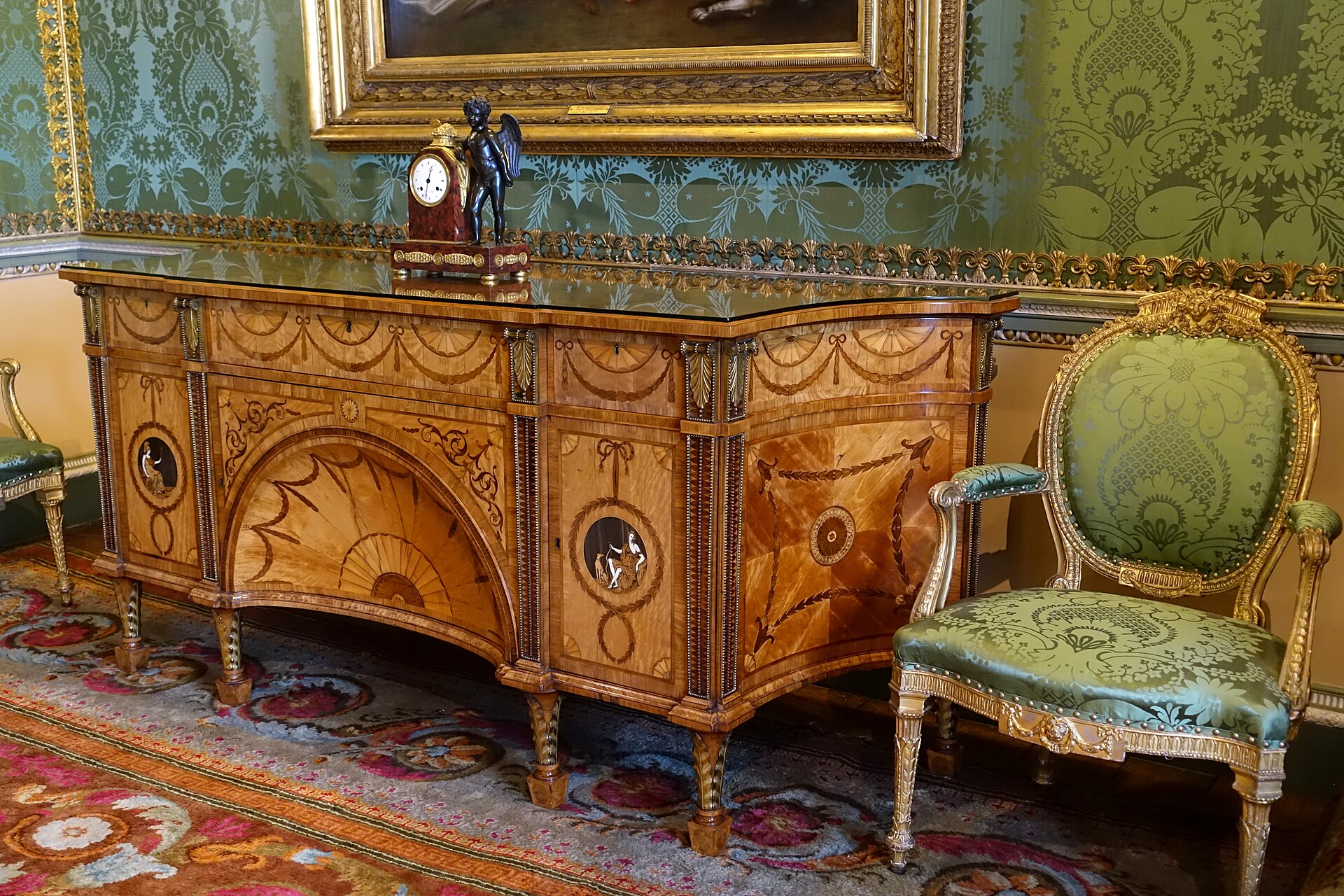
The Diana and Minerva Commode
1773 · Marquetry of satinwood
Harewood House, West Yorkshire
 British · 1718-1779
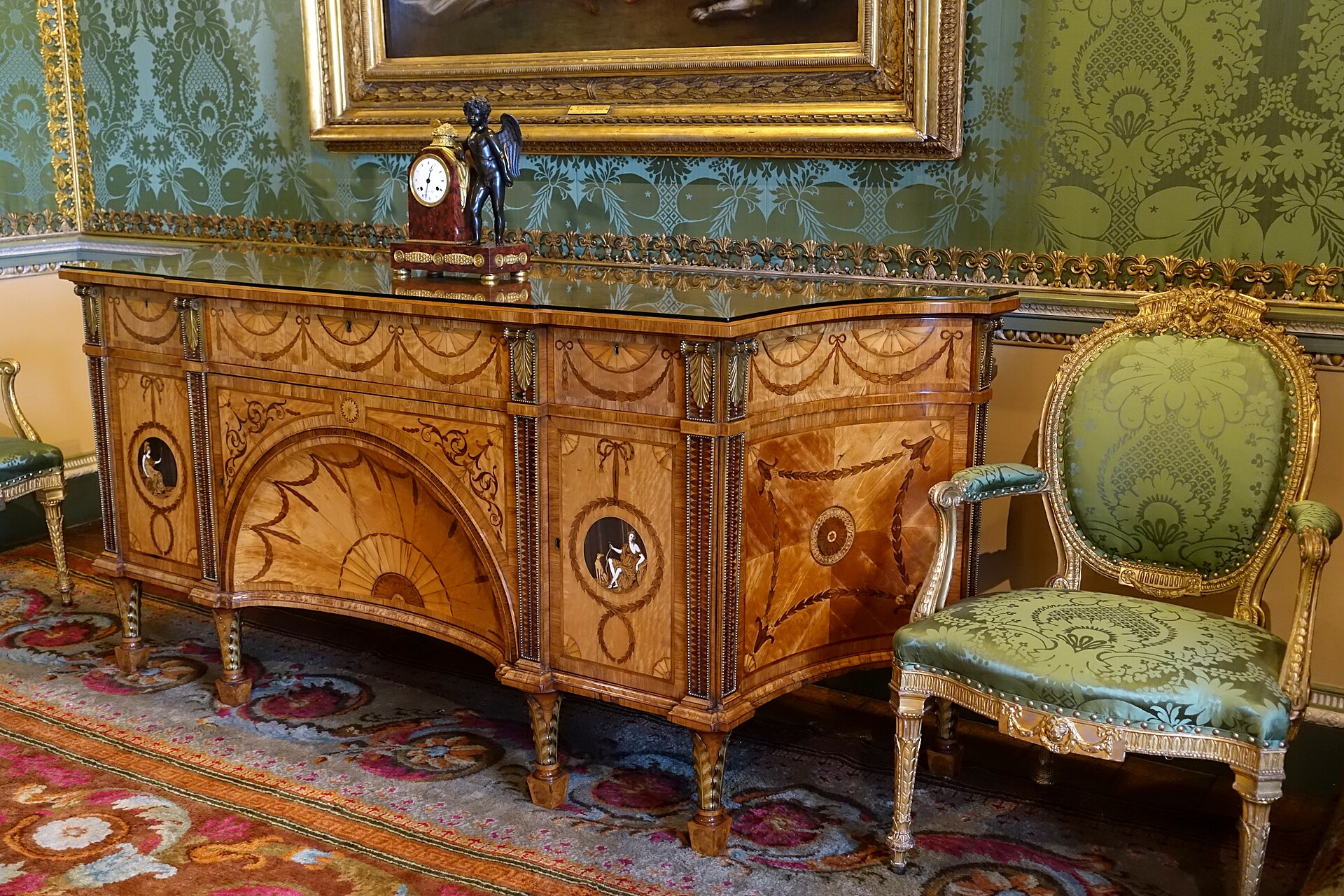
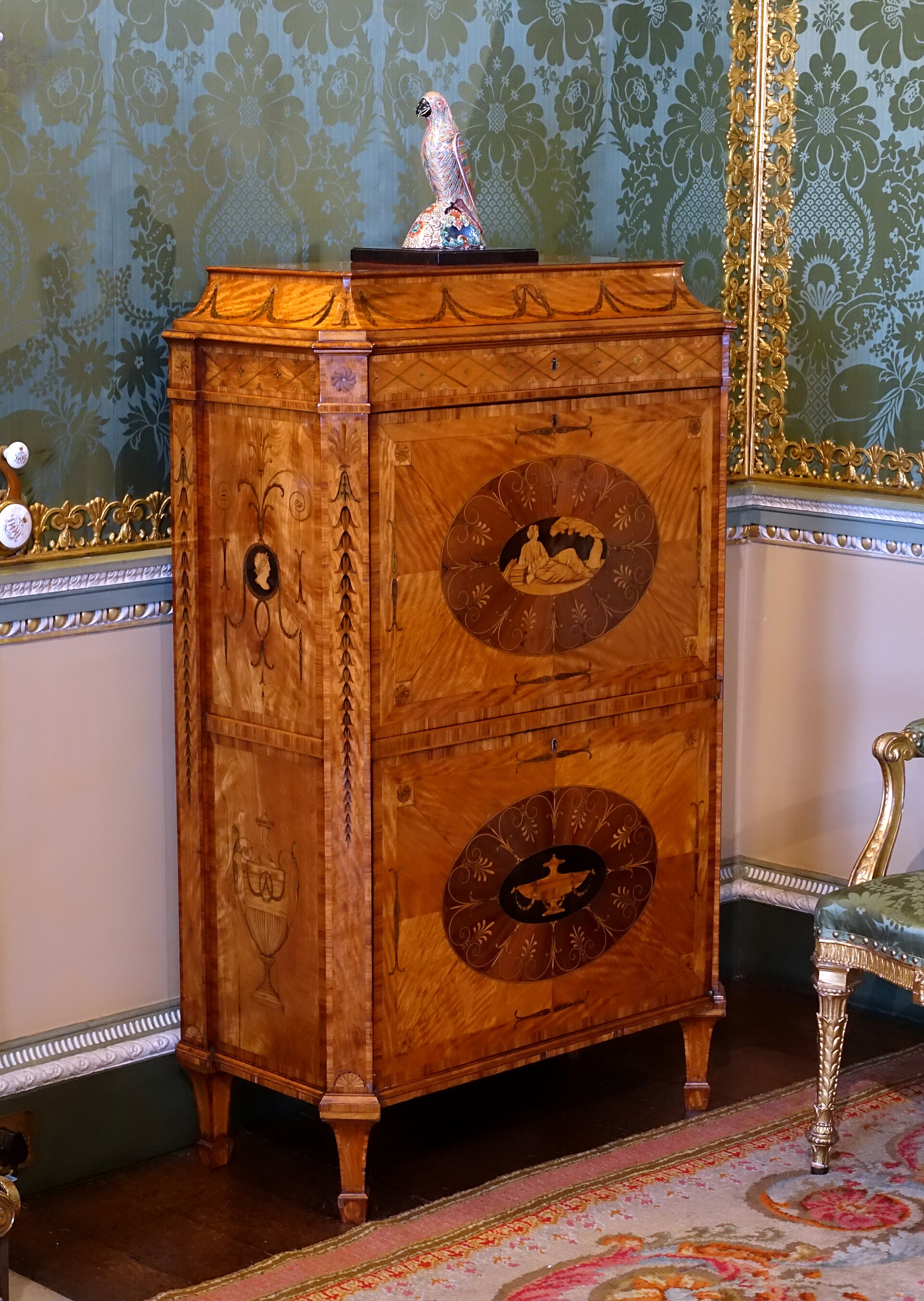
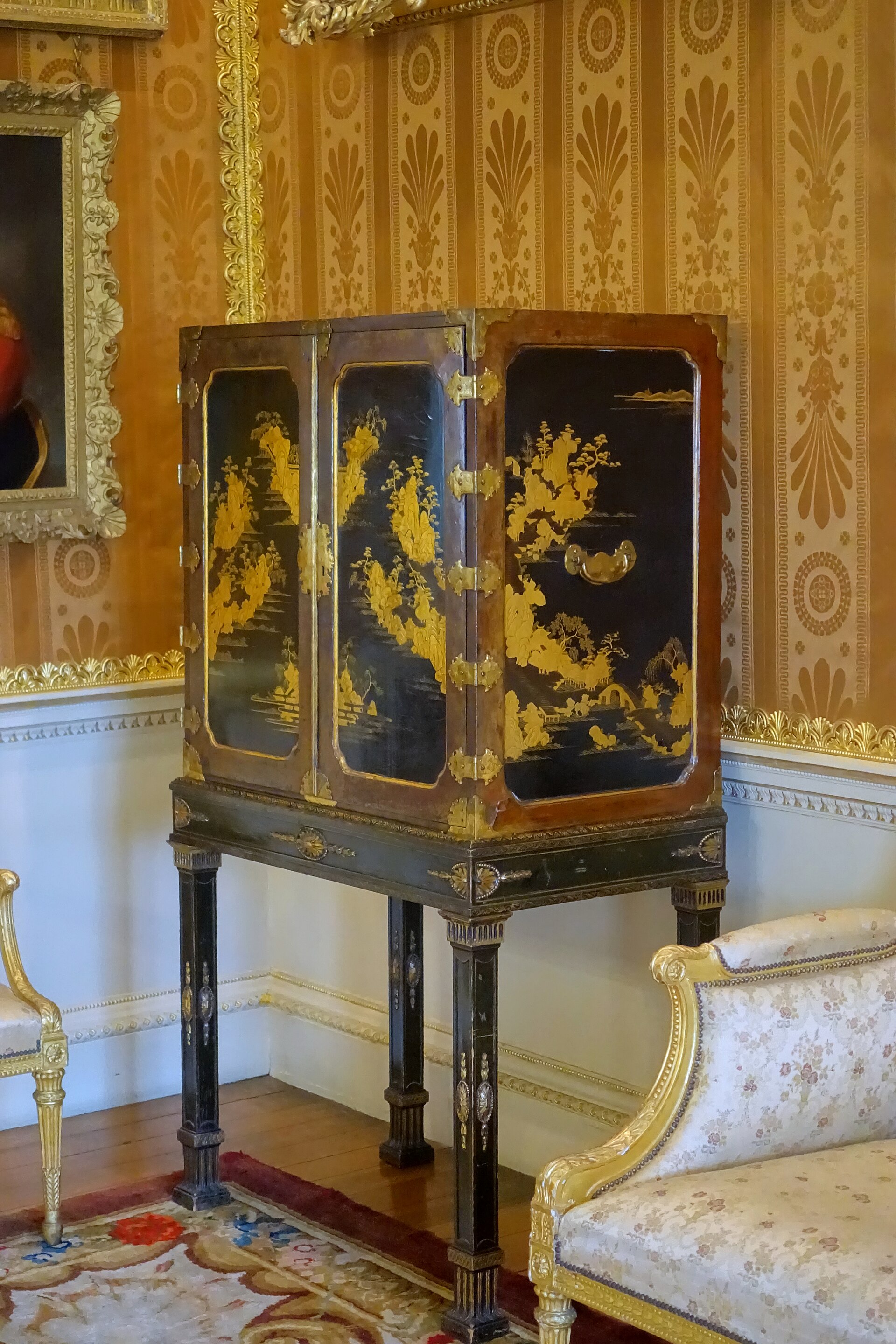
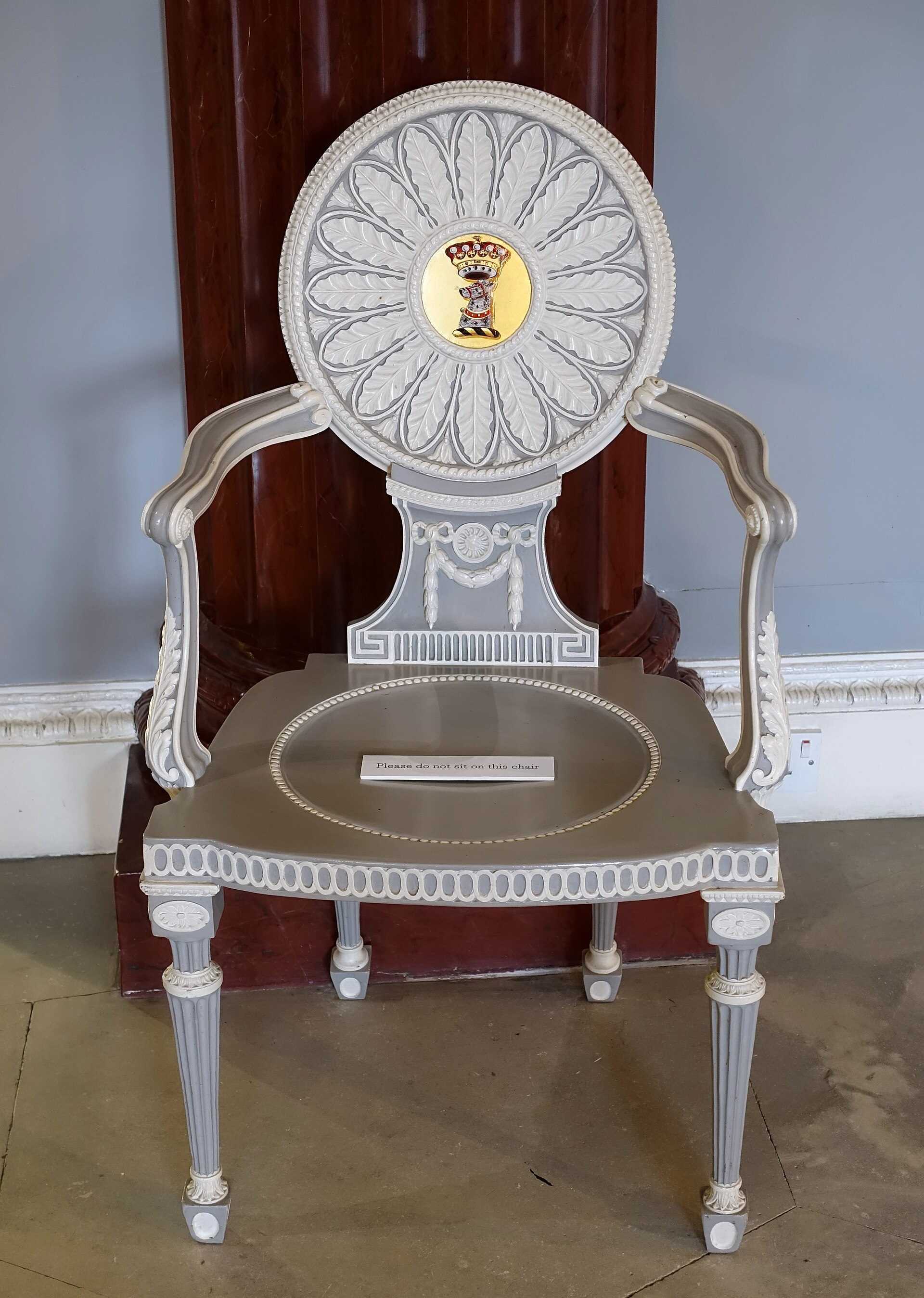
The Diana and Minerva commode, Harewood, 1773 The object the archive's backlog names. Delivered to Harewood House in 1773 at a cost of 86 pounds for the State Dressing Room, the same space now called the Spanish Library, and invoiced as a very large rich commode with exceeding fine antique ornaments, curiously inlaid with various fine woods, with Diana and Minerva and their emblems curiously inlaid and engraved. The marquetry is satinwood, rosewood, tulipwood, ebony and other woods with engraved ivory inlay and gilt-brass mounts, and the original dye colours have been taken out by light, so this is not the object as delivered. No dimensions for it are published by the house or in any source consulted. Photographed in the State Bedroom, where it now stands. The date and maker are the photographer's transcription of the house label, corroborated here against Harewood House's own published object record. No verified portrait. No securely identified likeness of this maker is known under a free licence. We do not publish a face we cannot verify.
Photograph by Daderot, released under CC0, via Wikimedia Commons| Full name | Thomas Chippendale, cabinet maker and upholsterer, of St Martin's Lane, London |
|---|---|
| Worked as | Cabinet maker, Upholsterer, Furniture designer, Author and publisher of a pattern book |
| Born | Baptised 5 June 1718 · Otley, a market town in Wharfedale, Yorkshire. |
| Died | Buried 13 November 1779. He died of consumption at Hoxton. · London |
| Nationality | British |
| Movement | English rococo, the Gothic and Chinese tastes of the 1750s, and from the middle 1760s the... |
| In this archive | 1 artwork |
| Sources | 43 cited |
| Last verified | 17 September 2026 |
About this page 1 artwork in the archive · Last verified 17 September 2026 · 43 sources cited
The word Chippendale does three different jobs in a saleroom and the trade routinely lets them blur. It can mean a piece of furniture documented to his workshop by a surviving bill. It can mean furniture in the style of his pattern book, made by anybody in Britain, Ireland or America, then or since. And it can mean the work of his eldest son, Thomas Chippendale the Younger, who ran the same firm at the same address for more than forty years after his father's death. The three are separated by evidence, not by connoisseurship, and the gap between the first meaning and the second is the largest single price differential in the English furniture market.
What makes the separation possible is unusual. Chippendale never used a maker's label, a stamp or a brand. The Dictionary of British and Irish Furniture Makers states the consequence without qualification: unless a piece carries a label, and Chippendale never used that form of advertisement, the only sure way of identifying the author is by tracing the original bill or equivalent documentation. Matching a piece exactly to a plate in his book proves nothing, because hundreds of working cabinet makers bought the book in order to copy from it. In furniture the documentation is the provenance, and for this maker the documentation happens to survive in quantity: bills, letters, estimates, memoranda and day books for Harewood, Nostell Priory, Dumfries House, Paxton House, Mersham-le-Hatch, Petworth and a long list of lesser accounts, mostly still in the family and county archives where they were written.
The second thing worth knowing before anything else is that his fame rests on a book rather than on a workshop. The Gentleman and Cabinet-Maker's Director, published by subscription in March 1754 with 161 engraved plates on the Furniture History Society's count and 160 on Sotheby's, was the first pattern book in England devoted wholly to furniture and issued under one cabinet maker's name. It made the name a style. It also made the name useless as an attribution, because the style it named could be executed by anyone who could afford one pound seventeen shillings for a set of sheets. Every documented commission in his career postdates the book.
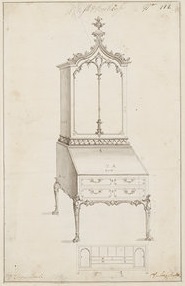
Baptised at Otley in Wharfedale, Yorkshire, on 5 June, the son of a joiner. The birth date is not recorded.1
R. Campbell's London Tradesman records the cabinet-maker's wage: a journeyman who knows his business may have a guinea a week, and on piecework thirty shillings and some weeks two guineas. The women in the upholstery trade, if good for any thing, get a shilling a day.32
Marries Catherine Redshaw at St George's Chapel, Mayfair. She bore him five boys and four girls and died in 1772.1
Thomas Chippendale the Younger baptised at St Paul's, Covent Garden, on 23 April. At Christmas the elder Chippendale takes a house in Conduit Court, off Long Acre.12
Moves at midsummer to Somerset Court, next to the Earl of Northumberland's house.1
Works through the year with Matthias Darly on the plates for the Director.1
Moves to nos 60 to 62 St Martin's Lane and forms a partnership with the Scottish investor James Rannie. The Gentleman and Cabinet-Maker's Director is published in March, by subscription, with 161 engraved plates on the Furniture History Society's count and 160 on Sotheby's collation of a first edition, dedicated to Hugh, Earl of Northumberland. Every known commission to supply furniture dates from after its appearance.1
In April fire destroys the cabinet shop and the tool chests of twenty-two journeymen; 847 pounds is paid in compensation and the partners help organise a public appeal. The premises are rated at 124 pounds and Chippendale takes Sun Insurance fire cover for 3,700 pounds. A slightly revised second edition of the Director is printed.1
The main Dumfries House bill, May and July, amounts to 647 pounds 14 shillings 1 penny. The third edition of the Director begins to appear in parts.1
The London Chronicle of 12 December reports bills of indictment found against the rebellious journeymen cabinet-makers, who had combined to raise their wages and lessen their hours. Seven years after the Director, in the same trade and the same city.33
The third edition of the Director is completed, enlarged and revised with neoclassical elements, dedicated to Prince William Henry, Duke of Gloucester. A French edition appears at the same date.1
Makes a suite of seat furniture to Robert Adam's design for Sir Lawrence Dundas: the only one of Adam's furniture designs he is known to have executed.1
Rannie dies in January; the partnership is dissolved and the entire stock in trade, including all the unwrought mahogany, plank, board, veneer and wainscot, is auctioned on the premises in March and April to satisfy the executors. The Nostell Priory commission for Sir Rowland Winn begins. In June Thomas Chippendale the Younger signs his first surviving receipt in the business.12
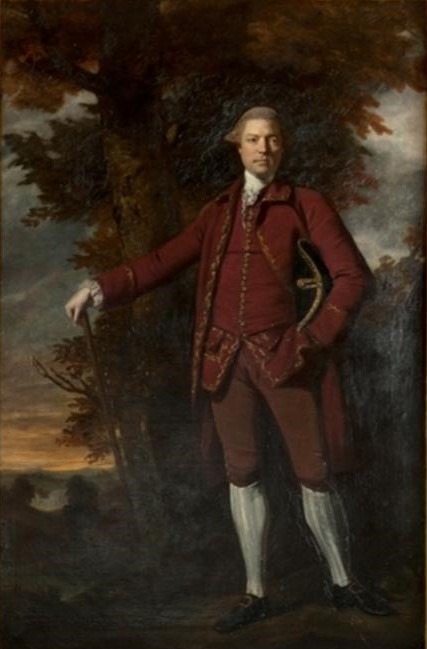
Sir Joshua Reynolds paints Edwin Lascelles full length. Harewood dates the portrait to these years and hangs it in the Cinnamon Drawing Room. The Chippendale commission begins in 1767.19
The Harewood House commission for Edwin Lascelles begins. It runs across both Chippendales; the last Harewood bill recorded on this page is of 5 August 1796.1
Visits Paris. Begins furnishing three houses for David Garrick, work continuing to 1778.1
Caught attempting to import sixty unfinished French chair frames illegally. Contracts to supply looking-glass plates for two library mirrors at Kenwood whose frames were made by William France to Adam's design.1
To stave off bankruptcy, Rannie's book-keeper Thomas Haig and another executor, Henry Ferguson, each buy a third share. The firm becomes Chippendale, Haig and Co.1
The Diana and Minerva commode is delivered to Harewood at a cost of 86 pounds, for the State Dressing Room. The state bed, at over 400 pounds, is the most expensive piece of furniture he ever made.313
The Paxton House account for Ninian Home totals 405 pounds 6 shillings 10 pence. Six lantern pedestals are supplied to Harewood, one of them to a design by Thomas Chippendale the Younger identified from a drawing found in 2019.12
The Building Act classifies London houses into four rates by value: first rate above 850 pounds, second 300 to 850, third 150 to 300, fourth under 150. The commode of the previous year cost 86 pounds, which places it inside the fourth rate, under 150 pounds; the statute does not define what it means by value, so the comparison places the sum without pricing a house.38
Retires to Derry Street, Kensington, probably on account of his health. From this point the son is likely to have been almost entirely responsible for directing the firm's output. The Mersham-le-Hatch commission for Sir Edward Knatchbull begins.1
Marries Elizabeth Davis. The Petworth bill of 1777 to 1778, in four sections, invoices goods amounting to 764 pounds 19 shillings 10 pence.1
Dies of consumption at Hoxton and is buried at St Martin-in-the-Fields on 13 November. No will; administration granted to his widow. Household goods valued at 28 pounds 2 shillings 9 pence and his one third share of the business at 288 pounds 19 shillings 8 pence. No obituary appears. The firm becomes Haig and Chippendale.1
Ninian Home of Paxton House, who had settled the firm's account of 1774, acquires the Waltham estate in the parish of St Mark, Grenada, on a TERTIARY account. Paxton records approximately 247 enslaved people at Waltham; the same tertiary account puts over 400 across his two Grenadian plantations, growing coffee, cocoa and sugar.1621
Most of the furniture supplied to Sir Rowland Winn's London house at 11 St James's Square is sold. The Nostell furniture stays; the London furniture does not.14
By this year the Lascelles family of Harewood hold more than 27,000 acres in the Caribbean, according to the Harewood West Indian Archive project at the Borthwick Institute.15
The London Cabinet-Makers' Book of Prices is printed for the London Society of Cabinet-Makers, a piece-rate schedule whose purpose is to settle disputes between journeymen and their employers.34
On a TERTIARY account not yet replaced with a primary record, Ninian Home is appointed Governor of Grenada on 17 November and is killed during Fedon's rebellion in 1795, having been taken hostage with about fifty others. The same source gives both a capture in March 1795 and a death about 6 April, so no single death date is printed here.21
Thomas Haig retires as senior partner. The last part of the Harewood commission is documented in a bill of 5 August 1796 totalling 564 pounds 15 shillings 2 pence.2
Thomas Chippendale the Younger is declared bankrupt, unable to meet the bonds securing over 10,000 pounds of legacies left by Haig on his death in 1803. Six public auctions are held between 25 July and 2 August.2
A further auction disperses furniture at Nostell Priory after the death of the sixth Baronet.4
A second bankruptcy in March; the manufactured stock at No 60 St Martin's Lane is sold at auction over five days in late April and early May.2
Unable to renew the lease, the son leaves 60 St Martin's Lane at Michaelmas after fifty-nine years of the firm at that address.2
Thomas Chippendale the Younger dies, probably in mid January. His will is dated 22 December 1822 and addressed from 61 Regent Street; a letter from Sir Richard Colt Hoare shows him alive at the beginning of 1823.2
The Victoria and Albert Museum buys an unprovenanced portfolio of 144 furniture drawings ascribed to Chippendale.1
Herbert Cescinsky's third volume of English Furniture of the Eighteenth Century prints a register giving three men named Thomas Chippendale, including a picture-frame maker of Worcester who does not exist in the modern record, and states openly that undocumented pieces will be treated as being in the manners of Chippendale because their authorship cannot be established.23
The Metropolitan Museum of Art acquires two albums of drawings formerly owned by the Foley family, containing nearly all the drawings for the first edition of the Director.1
The Shrager furniture case is heard in the English courts. Herbert Cescinsky appears as principal witness for the plaintiff; furniture sold at very large prices is afterwards resold at a London auction room for the prices of bad second-hand goods. The collection included a panelled room said to come from a Royston Hall that never existed.24
Cescinsky publishes The Gentle Art of Faking Furniture, dedicated to the memory of Adolph Shrager, and sets out the anatomy of the marriage and the improved piece that the trade still uses.24
Margaret Jourdain publishes a brief account of seven of the Dumfries House pieces in the Country Life Annual. It becomes the source for every subsequent account of the commission for twenty years.27
The Victoria and Albert Museum acquires a pair of torcheres designed by Thomas Chippendale the Younger about 1795, W.27-1951 and W.27A-1951, from Harewood House.18
The Reviewing Committee on the Export of Works of Art is established following the Waverley Committee's report of that year.40
The Victoria and Albert Museum is given a wax portrait bust of Thomas Chippendale the Younger, A.18-1964, by Mr Alex Lewis. It is the only portrait object of anyone of the name in the museum, and it is the son.26
The Chippendale Society is founded at a public meeting on 26 January, with Sir Malcolm Stoddart Scott as President, Major Austin Hughes as Chairman and Thomas Pickles as Secretary.17
Christopher Gilbert publishes Thomas Chippendale at Dumfries House in the Burlington Magazine, establishing nearly fifty documented items, locating four bills at D.H. 34/58 to 34/61, and recording a side table of 1759 by Alexander Peter of Edinburgh in the same house that repeats a design from the first edition of the Director.27
The Chippendale Society acquires a first edition of the Director, a portrait of Chippendale junior and the family Bible. It has never acquired a portrait of the father.17
A pier table by Chippendale of about 1771 to 1772, made for the Circular Dressing Room at Harewood, is acquired at a total cost of 8,800 pounds with an Art Fund grant of 1,400, and is on long-term loan from the Chippendale Society.44
Christopher Gilbert publishes The Life and Work of Thomas Chippendale in two volumes, Studio Vista in association with Christie's, London. It remains the standard work and no second edition or supplement has been traced.1
Charles W. R. Shillito of Otley paints Thomas Chippendale and Sir Joshua Reynolds, an imagined scene now in the Chippendale Society collection. It is the nearest thing to a portrait of the elder Chippendale that exists, and it is an invention.17
A pair of the younger Chippendale's torcheres is sold from Harewood in Christie's attic sale of 3 October, and passes to the dealer Carlton Hobbs in New York. The Victoria and Albert Museum's pair had left the same house in 1951.18
A lady's secretaire by Thomas Chippendale is deferred for export and purchased by the National Trust for 512,887.50 pounds, with 261,500 from the National Heritage Memorial Fund and 75,000 from the National Art Collections Fund. The property that received it is not named in the report and this case appears in no secondary literature located here.40
A lady's secretaire by Chippendale of 1773, supplied for the State Bedroom at Harewood and charged at 26 pounds, is deferred for export and bought by Leeds Museums and Galleries for Temple Newsam House for 650,000 pounds, with 329,000 from the Heritage Lottery Fund and 70,000 from the National Art Collections Fund. Sold privately through Hotspur, not at auction. Leeds records the date as 1999 and the accession as 1999.0018.4042
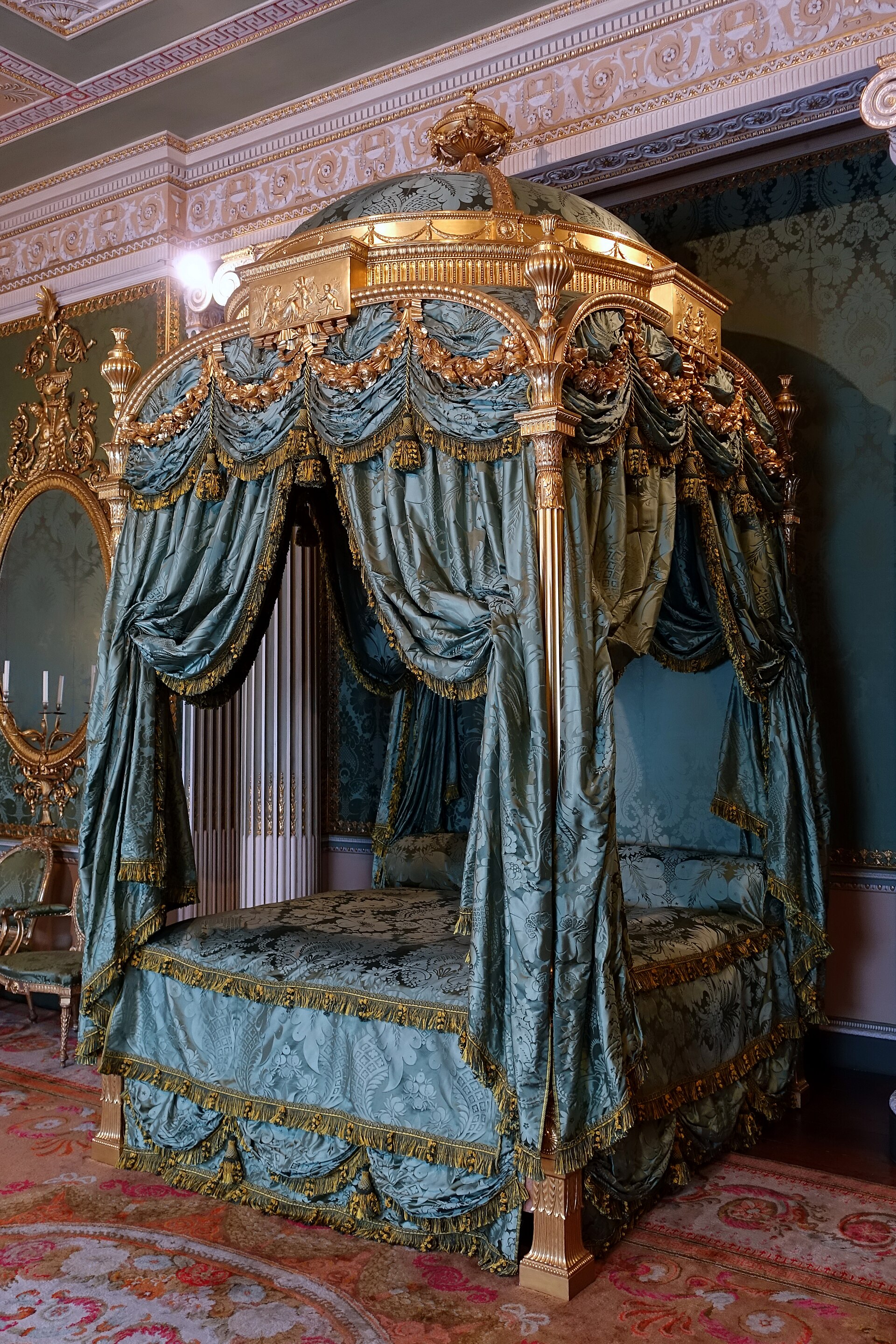
The Harewood state bed, dismantled in the nineteenth century, is reconstructed and restored with Heritage Lottery Fund support, the reconstruction resting on tacking marks and screw holes read against Chippendale's own accounts.13
Seven boxes of the Harewood West Indian Archive are conserved and catalogued at the Borthwick Institute for Archives, University of York, with Heritage Lottery Fund support. Five further boxes are added in 2017.15
The Christie's sale of the Dumfries House contents, catalogued as Dumfries House: A Chippendale Commission, is called off on 27 June when a consortium led by the then Prince of Wales secures the house, estate and contents together. The total is 45 million pounds on the National Heritage Memorial Fund's figure and 40,000,000 on the Art Fund's; the published breakdown of contributions sums to 43.25 million, which is a floor and favours the higher figure. The furniture was already crated and being driven south.78
The Harrington commode, catalogued as almost certainly by Thomas Chippendale and carrying no documentation, is sold at Sotheby's London on 7 December against an estimate of 600,000 to 1,000,000 pounds. The reported result of 3,793,250 pounds is premium-inclusive; hammer not published.56
The tercentenary of the baptism. Furniture from the Chippendale Society collection moves to Temple Newsam for exhibition, and the trade press reports a market much reduced from a decade earlier but holding for authenticated pieces.517
Thomas Chippendale 1718-1779: a celebration of British craftsmanship and design runs at Leeds City Museum from 9 February to 9 June, with loans from the Royal Collection, Paxton House, Newby Hall and Dumfries House. Leeds states in its own press material that there is no known portrait of Thomas Chippendale. Harewood, Nostell and Paxton mount parallel displays and the Chippendale Society publishes the catalogue.1725
A pair of Chippendale pier tables and a pair of pier glasses of about 1771 are accepted in lieu of inheritance tax from the Trustees of the 7th Earl of Harewood's Will Trust, judged pre-eminent under all four criteria, and allocated to the Victoria and Albert Museum with a loan agreement to the Harewood House Trust. The fourth such offer since the in situ arrangements of 2016.43
Four drawings by Thomas Chippendale the Younger and two by his father are found in a Canadian collection; one of the son's is a design for a lantern pedestal answering to six supplied to Harewood in 1774.2
Binding option agreements take effect on 1 January, giving a matched buyer a contractual right to purchase at fair market price during the second deferral period, which is now capped at six months except for exceptionally expensive items.40
A first edition of the Director, collated by Sotheby's as 160 engraved plates with 56 further plates from the 1759 to 1761 edition, is offered in New York on 18 June as lot 1045 against an estimate of 3,000 to 5,000 US dollars. The result is not published without a login.20
The Chippendale pier tables and glasses return to display at Harewood after conservation at the Victoria and Albert Museum.43
The market divides along the same line the page opens with. Documented or firmly attributed pieces from the St Martin's Lane workshop occupy a market of at most a few hundred objects, most of which are in houses that will never sell them. Director-style furniture, which is what the word usually means in commerce, is a market of tens of thousands of objects and moves with the general market for eighteenth-century English furniture, which fell heavily in the two decades to 2018 and has not recovered its former level.
Almost every published Chippendale price is a premium-inclusive total presented as though it were a price. This record separates hammer from premium where a source permits and states hammer not published where it does not, which on the two headline results below is in both cases.
Two structural features distort any price series. The population of great objects is small and the same pieces reappear at intervals of a decade or two, so an apparent series for the maker is often a series for a dozen objects. And the highest values in the field attach to things that are not for sale: the Dumfries House commission, whose withdrawal from a prepared Christie's sale in 2007 is the clearest published statement anyone has made about what a documented commission is worth intact.
| Date | Sale | Work | Result | Note |
|---|---|---|---|---|
| 1759 | Direct commission, not auction | The main Dumfries House commission for the fifth Earl of Dumfries | Hammer NOT A HAMMER PRICE. Invoice total: GBP 647 14s 1d With premium Not applicable. This is a bill, not a sale GBP | The main bill of May and July 1759, followed by lesser accounts of 1763 and 1766. Nearly all the furniture survives and it is the best documented collection of Director-period work anywhere. |
| 1773 | Direct commission, not auction | The Diana and Minerva commode, Harewood House | Hammer NOT A HAMMER PRICE. Invoice price: GBP 86 With premium Not applicable. This is a bill, not a sale GBP | The delivered price to Edwin Lascelles for the State Dressing Room. Quoted by Harewood House from the firm's invoice. |
| 1773 | Direct commission, not auction | The state bed, Harewood House | Hammer NOT A HAMMER PRICE. Invoice price: over GBP 400 With premium Not applicable. This is a bill, not a sale GBP | Described by Harewood as the most expensive piece of furniture Chippendale ever made. Supplied with three mattresses. It is the internal benchmark against which every other price in his account book should be read: the celebrated commode cost roughly a fifth of it. |
| 1767-1796 documented | Direct commission, not auction | The Harewood House commission in total | Hammer NOT A HAMMER PRICE. Surviving bill: GBP 6,838 19s 1d. The figure of over GBP 10,000 often quoted beside it is the Furniture History Society's ESTIMATE of the commission total and is not a document With premium Not applicable. These are bills, not sales GBP | The largest documented commission of the career, running from 1767 and continuing under the son; the last Harewood bill recorded on this page is of 5 August 1796 and the date of 1805 is not supported by any document reached here. The estimate of over 10,000 pounds is the Furniture History Society's, not a figure from a document. |
| 1779 | Probate valuation, not a sale | Chippendale's own estate | Hammer NOT A HAMMER PRICE. Probate valuation: GBP 28 2s 9d household goods, and GBP 288 19s 8d for his one third share in the business With premium Not applicable. This is a valuation for probate, not a sale GBP | An independent valuation of what the most famous name in English furniture was actually worth on the day he died, arrived at by a process with no interest in the market. |
| 18 June 2008 | Christie's, London, 18 June 2008, lot 8 | A George II parcel-gilt padouk cabinet on stand, circa 1755 to 1760, attributed to Thomas Chippendale, from Kenure House, County Dublin (Sir Roger Palmer). Reported as 283.5 cm high, 163.5 cm wide, 66.5 cm deep | Hammer Not published. UNVERIFIED RECONSTRUCTION of the hammer: about GBP 2,400,000, see note With premium GBP 2,729,250 reported, premium-inclusive GBP | The world record for English furniture at auction until December 2010. Attributed, not documented. The lot reference is given in the Furniture History Society's entry for Kenure House, which describes an undocumented and elaborate chinoiserie cabinet of about 1760 attributed to Chippendale. The premium-inclusive figure of 2,729,250 pounds comes from press reporting and has not been verified against a Christie's record, because Christie's could not be reached by any method available for this page. ON THE RECONSTRUCTED HAMMER: it is obtained by inverting the SOTHEBY'S schedule reported for December 2010 and applying it to a CHRISTIE'S sale of June 2008. Nothing establishes that the two houses' schedules were identical, or that either was unchanged across the thirty months between the sales, so this figure is weaker than the one reconstructed for 2010 and is published only as an indication of order. It ignores VAT on the premium. The sale number is not established. |
| 7 December 2010 | Sotheby's, London, Important Furniture, Silver and Ceramics, sale L10305, lot 69 | An important George III gilt-lacquered brass mounted fustic, rosewood, tulipwood and marquetry commode, circa 1770, almost certainly by Thomas Chippendale. 89 cm high, 140 cm wide, 65 cm deep | Hammer Not published. Sotheby's own result line reads: LOT SOLD. 3,793,250 GBP (Hammer Price with Buyer's Premium). UNVERIFIED RECONSTRUCTION of the hammer: about GBP 3,350,000, see note With premium GBP 3,793,250 reported, premium-inclusive GBP | The Harrington commode, sold by order of the Trustees of the 10th Earl of Harrington's Will Trust; provenance the Earls of Harrington, formerly at Elvaston Castle, Derbyshire, thence by descent. Estimate 600,000 to 1,000,000 pounds. Exhibited as no. 111 of Treasures of the North at Christie's King Street, 13 January to 13 February 2000, and at the Whitworth Art Gallery, Manchester, 25 February to 9 April 2000. The lot carried Sotheby's restricted species symbol. No document connects it to Chippendale; the attribution is by comparison with the Panshanger cabinets, the Nostell commode, the Melbourne House commode and the Lady Lever example, and the catalogue's own wording, almost certainly, is the honest measure of the evidence. ON THE RECONSTRUCTED HAMMER, AND ITS LIMITS: inverting the buyer's premium schedule reported to have been in force at Sotheby's London in December 2010, 25 per cent to 25,000, 20 per cent from 25,001 to 500,000 and 12 per cent above 500,000, returns a hammer of 3,350,000 exactly. THAT IS AN UNVERIFIED RECONSTRUCTION AND MUST NEVER BE QUOTED AS A PUBLISHED HAMMER. The printed schedule itself has not been obtained, so the rates are taken on report; the archived capture cited here is of this lot alone and cannot corroborate the arithmetic against other lots in the sale, and an earlier claim on this page that it did so was withdrawn. The reconstruction also ignores VAT: buyer's premium in the United Kingdom attracts VAT, and the restricted species symbol on this lot implies import formalities of its own, so the sum a buyer actually paid was higher than either figure printed here. |
| 2018 | Dealer market, tercentenary reporting | Chippendale and Chippendale-period furniture offered by London dealers | Hammer NOT A HAMMER PRICE. Dealer asking prices: GBP 28,000 to GBP 200,000 for pieces then on offer With premium Not applicable. Asking prices are what a dealer wants, not what anyone paid GBP | Reported by Apollo at the tercentenary, alongside dealers' accounts of a market much smaller than a decade earlier, holding for authenticated pieces and weak for generic work. Included because it is the range a real buyer meets, against which the two seven-figure results are outliers. |
| 5 December 1991 | Christie's, London, lot 130 | The Messer commode, a George III marquetry commode supplied to Sir Rowland Winn for Nostell Priory | Hammer Not published in the sources consulted With premium GBP 935,000 reported. BASIS NOT STATED: no source reached here says whether this figure is a hammer price or a premium-inclusive total, so it belongs in neither column with confidence and is recorded as reported GBP | Cited in Sotheby's 2010 catalogue apparatus as a benchmark and then a record for English furniture. Whether the reported figure is a hammer price or a premium-inclusive total is not stated in any source reached here. NOT IDENTIFIED WITH THE 2018 LOT: a commode supplied to Sir Rowland Winn was offered at Christie's in July 2018 and is described there as mahogany and Indian ebony, where this one is described as marquetry. Nostell received more than one commode from the firm and this record has not established whether the two descriptions are of one object catalogued differently or of two objects. They are kept apart here rather than merged. |
| 1759 | Direct commission, from the Dumfries House bills | The rosewood bookcase, Dumfries House | Hammer NOT A HAMMER PRICE. Invoice price: GBP 47 5s 0d With premium Not applicable. This is a bill, not a sale GBP | Priced from the bills by Christopher Gilbert in 1969, who ranks the piece with the finest at Nostell or Harewood and notes that rosewood is an unusual choice at this date. Set it against the 86 pounds of the Diana and Minerva commode fourteen years later and the 400 pounds of the Harewood state bed: the finest object in the best documented Director-period commission cost about a ninth of a state bed. |
Hammer is the price at which the bidding stopped; with premium adds the fee the house charges the buyer on top. Hammer price and buyer's premium in the glossary.
| Institution | City | Holdings | Note |
|---|---|---|---|
| Harewood House | Harewood, West Yorkshire | The largest and most outstanding surviving concentration of the mature neoclassical work, despite heavy twentieth-century sales. The Diana and Minerva commode of 1773; the state bed of 1773 with its 2000 reconstruction; the giltwood mirrors and armchairs of the State Bedroom; the japanned cabinets of the Cinnamon Drawing Room; furniture in the Gallery by Thomas Chippendale the Younger. | The commission ran from 1767 across both Chippendales, its last bill recorded here being of 1796. One bill of 6,838 pounds 19 shillings 1 penny survives, with a Day Work Book of 1769 to 1776, ledger payments, letters and drawings. This is the deepest documentary base for any Chippendale house and the reason a record on a single object here can be built to a standard nothing else in English furniture supports. VERSION SAFETY: at least three different secretaires are associated with this maker and they must not be run together. The fall-front secretaire of 1773 veneered in Chinese lacquer, supplied for the State Bedroom here and charged at 26 pounds, LEFT HAREWOOD: it was deferred for export and bought by Leeds Museums and Galleries for Temple Newsam in 1998 to 1999, accession 1999.0018. A lacquer secretaire at Osterley Park is a separate object, attributed to the workshop by construction. And a secretaire is photographed in the State Bedroom here on a house label of the 1770s. Whether that third object is a replacement, a related piece or something else is not established by this record, and no holding of a secretaire is claimed here. |
| Dumfries House | Cumnock, East Ayrshire | The finest ensemble of Director-period furniture in existence, nearly all of it surviving from the 1759 commission and still in the house. | Bought for the nation in 2007 after the prepared Christie's sale was called off. The package total is given as 45 million pounds by the National Heritage Memorial Fund and as 40,000,000 by the Art Fund; the published breakdown sums to 43.25 million as a floor. Now the headquarters of the King's Foundation. The account also includes a French tortoiseshell and brass inlaid commode which was evidently bought in rather than made. |
| Nostell Priory, National Trust | Wakefield, West Yorkshire | One of the two best collections illustrating the transition to neoclassical taste, the majority of it still in situ from the commission begun in 1766. Marquetry, japanned and solid timber furniture, together with rare secondary pieces probably made for servants' rooms. | The archive is exceptional: letters, estimates, memoranda, accounts and drawings running to 1785, in the West Yorkshire Archive Service. The correspondence records delays, disputes and unpaid bills, and the surviving letters to Sir Rowland Winn contain Chippendale's own statements of fear of arrest for debt. |
| Paxton House | Berwick-upon-Tweed, Scottish Borders | The reference collection for the plainer manner: well made mahogany furniture without display, supplied to Ninian Home under an account of 1774 totalling 405 pounds 6 shillings 10 pence, with drawing room furniture supplied later by the son. | Documented also in fourteen copy letters to Haig and Chippendale of 1789 to 1791. Useful precisely because it is not spectacular: it shows what the workshop's ordinary output looked like. The house now runs a dedicated Sugar and Slavery exhibition in the Old Billiard Room and a trail through the rooms that names individual objects, several of them Chippendale objects, and states where the money and in one case the timber came from. Paxton was built between 1758 and 1795. |
| Victoria and Albert Museum | London | An unprovenanced portfolio of 144 furniture drawings ascribed to Chippendale, bought in 1906, and seven Director designs in the Matthias Lock archive bought in 1862. Most of the identified green and white japanned furniture made for David Garrick's villa at Hampton. | The Lock material is the origin of the 1920s proposal that Lock and Copland ghosted the Director plates, a case since closed by letters and drawings found in country house archives. |
| The Metropolitan Museum of Art | New York | Two albums of Chippendale drawings acquired in 1920 from the Foley family, containing nearly all the preparatory drawings for the first edition of the Director, a number for the third edition, and some unpublished designs. Also a set of fourteen mahogany dining chairs made for Goldsborough Hall about 1772. | The albums are the primary material behind the book, and the Museum publishes them under an open-access programme. |
| Petworth House, National Trust | Petworth, West Sussex | Three beds complete with their original cut velvet hangings, documented in a bill of 1777 to 1778 in four sections invoicing 764 pounds 19 shillings 10 pence. | Original textile hangings on a Georgian bed are rarer than the bed frames and are the least replaceable element of any state bed. |
| Burton Constable Hall | East Yorkshire | The sumptuous saloon suite supplied to William Constable, with the great drawing room furnished in 1778 for over 1,000 pounds and further sofas added later. Documented in the Burton Constable papers at Hull University. | One of the commissions that runs across the father's death and into the son's period, so dates matter here more than usual. |
| Temple Newsam House | Leeds | The Chippendale Society Collection, including drawings by both Chippendales, the family Bible with the pedigree, the invitation card designed for Caesar Crouch, and the coffin hardware from Lady Bridget Heathcote's funeral. | The Society's own holdings are documentary as much as they are furniture, which is the right shape for this maker. |
| Wilton House | Salisbury, Wiltshire | A smaller anthology of Director-period furniture: three bookcases, a library table and two drawings for torcheres ascribed to the firm. Receipts from 1763 to 1773 total 1,500 pounds. | The Earl of Pembroke is named in a prefatory note to plate 46 of the 1762 Director, which is itself a form of documentation: the book advertises its own customers. |
| Stourhead, National Trust | Wiltshire | The principal documented body of work by Thomas Chippendale the Younger. Seventeen bills between July 1795 and April 1820, with bank payments, amount to over 6,000 pounds. | Listed here because it is the control group. Anyone testing whether they can tell father from son should look at Stourhead and Dumfries House in the same week. |
| Borthwick Institute for Archives, University of York | York | The Harewood West Indian Archive, also called the Lascelles Slavery Archive: business papers, property records, wills, bonds and orders for the sale of enslaved people, running from 1677 into the nineteenth century, with a further accession covering 1745 to 1891 added in 2017. | Not a furniture collection, and the most important archive on this page after the Chippendale bills themselves. Seven boxes arrived in 2005 and were conserved and catalogued to 2007 with Heritage Lottery Fund support; digital images of that accession are published through the University's Discover platform. Anyone writing on a Harewood object can read the cabinet maker's bill and the plantation bond in the same county. |
This is the most useful thing on this page and it governs every record the archive will ever write on an object bearing the name.The first sense is documented Chippendale.
This is the most useful thing on this page and it governs every record the archive will ever write on an object bearing the name.
The first sense is documented Chippendale. A piece for which a bill, an estimate, a letter, a day-book entry or an inventory in the firm's hand connects that object to that commission. The bill is the whole of the proof. Chippendale used no label, no stamp, no signature and no shop mark, and the trade card issued by Chippendale and Rannie at the Cabinet and Upholstery Warehouse was never applied to the goods. Where the paper survives and the object has stayed in the house it was made for, the attribution is as secure as anything in decorative arts. Where the paper survives and the object has left the house, the chain has to be rebuilt from sale catalogues, and it usually cannot be rebuilt to the same standard.
The second sense is Director-style furniture. Any piece made anywhere in the English-speaking world to a design published in the book, or in its manner. This is what the word means in nine cases out of ten in general trade usage, and the Dictionary of British and Irish Furniture Makers says plainly that the name has in the past been freely used as a convenient generic label for all Director-style furniture. American colonial furniture of the 1760s and 1770s is catalogued as Chippendale as a period term with no implication of authorship whatever. So is Irish work, and so is the Victorian and Edwardian revival furniture that copies the plates a century and a half later. A record that lets this sense stand next to the first without saying which it means has failed at the first hurdle.
The third sense is Thomas Chippendale the Younger, baptised at St Paul's Covent Garden on 23 April 1749, the eldest of his father's nine children by his first marriage. He signed a receipt in the business in June 1766, at seventeen. He was providing designs for the firm's neoclassical furniture at Harewood from the early 1770s, while his father was still alive and still in charge. After the father retired to Kensington in about 1776 the son was, on the Furniture History Society's reading, almost entirely responsible for directing the firm's output, and after 1779 he ran it in partnership with Thomas Haig for another quarter of a century. Furniture invoiced by the firm in the 1780s and 1790s is Chippendale furniture in every legal and commercial sense and is not by the man whose name sells it.
The practical test, in order. Is there a bill, and does the bill describe this object rather than a similar one. What is the date of the bill, and was the father alive, in the business and not yet retired at that date. If the piece is dated after about 1776, whose design is it, and is there a drawing. If there is no bill, is there a house at which the firm is documented to have worked, and does the piece have an unbroken descent in that house. If there is neither bill nor house, the piece is Director-style unless somebody can say otherwise, whatever the catalogue heading says.
Nothing on this page shows Thomas Chippendale, and nothing can.
Nothing on this page shows Thomas Chippendale, and nothing can. No contemporary likeness of him has been located, and the strongest evidence for that is not an absence in a search but the holdings of the body that exists to collect him.
The Chippendale Society was founded at a public meeting on 26 January 1965 and has been buying ever since: a first edition of the Director, the family Bible, four original ink and wash drawings bought in 1975 after a campaign that raised 7,000 pounds, fire screens and a carved crane and a collage of Chinese wallpapers from Harewood in the 1980s and 1990s, and a writing or music stand from Nostell bought in 1999 in memory of the curator Christopher Gilbert. The collection is held at Temple Newsam House in Leeds. Its published list carries exactly two portraits. One is a portrait of a man, reputedly Thomas Chippendale junior, by an unknown artist, after Thomas Proctor, about 1795: the son, and the identification is hedged with reputedly even so. The other is a painting of Thomas Chippendale and Sir Joshua Reynolds by Charles W. R. Shillito of Otley, dated 1984, which is a scene imagined two centuries after both men were dead.
Sixty years of acquisition by the one organisation that wanted a portrait of him has produced a doubtful likeness of his son and a modern invention. The reason is the same reason there is no obituary and no entry in the diaries and journals of the period. He was a tradesman with an aristocratic clientele, not a member of it, and the people who sat for Reynolds in the 1760s were the people who bought the furniture.
What does exist is commemoration, and it should not be mistaken for evidence. There is a modern statue at Otley, where he was baptised, a modern statue at the Victoria and Albert Museum, blue plaques in Otley and in London, and photographs of the site of the workshop. All of them are twentieth or twenty-first century objects, and the photographs of them carry their own modern copyright. Any image captioned Thomas Chippendale is a statue, a plaque, the son, or an invention. This archive does not publish invented images of real people, and to fill the space at the top of this page would be to commit exactly the error the publication exists to correct.
An eighteenth-century cabinet maker's bill is not a receipt.
An eighteenth-century cabinet maker's bill is not a receipt. It is an itemised description written by the maker, usually in the maker's own commercial language, listing each object supplied, the materials, the labour, sometimes the room it was destined for, and the price in pounds, shillings and pence. The Harewood invoice for the Diana and Minerva commode calls it a very large rich commode with exceeding fine antique ornaments, curiously inlaid with various fine woods, with Diana and Minerva and their emblems curiously inlaid and engraved. That sentence does three things at once. It identifies the object beyond argument, because no other object answers to it. It fixes the date, because the bill is dated. And it fixes the price the patron actually paid, which was 86 pounds.
The effect on attribution is absolute where the object and the bill can be matched, and the matching is the hard part. A bill that says a mahogany commode with brass mounts describes a hundred objects. A bill that names two goddesses inlaid on the front describes one. This is why the best-documented Chippendale objects are the most elaborate ones, and why the ordinary furniture the firm supplied in bulk, the servants' beds and the kitchen tables and the loose covers, is almost never identifiable even where the bill for it survives.
The effect on price runs the same way and is very large. The Apollo report on the tercentenary market quotes a Christie's director on the point: provenance is gold dust. The same report gives about six hundred as the number that can be definitively attributed to the workshop, which is the figure the Chippendale Society publishes on its own website as attributable on documentation or convincing stylistic affinity, against the Furniture History Society's count of over seven hundred items identified as coming out of it, and against a market in which the word Chippendale is applied to tens of thousands of objects. Documented pieces have held their prices through a period in which the general market for eighteenth-century English furniture fell heavily. Undocumented Director-style furniture has not.
Two cautions belong on the same page. First, a bill proves that the firm supplied the object; it does not prove that anyone named Chippendale made it, and on the firm's own scale nobody sensible thinks he did. The Furniture History Society's judgement is that it is highly unlikely he ever worked at the bench after setting up in St Martin's Lane, that the business employed up to fifty specialist tradesmen, and that only a handful of their names are recorded. Second, an unpaid bill is still a bill. Several of the best-documented commissions are documented precisely because the patron did not pay and the correspondence about the debt survived.
The archive of a Georgian cabinet maker survives, when it survives at all, in the patron's papers rather than the maker's.
The archive of a Georgian cabinet maker survives, when it survives at all, in the patron's papers rather than the maker's. Nothing of the firm's own accounts is known to survive in bulk. What exists is the other half of each transaction, kept by the customer, and it is the reason this maker can be studied at all.
Harewood House, Yorkshire. Edwin Lascelles. The commission ran from 1767. The Furniture History Society describes the firm as involved for nearly forty years; what the documents on this page actually reach is 1796, the date of the last Harewood bill recorded here, at 564 pounds 15 shillings 2 pence, which is twenty-nine years, and the Victoria and Albert Museum places Thomas Chippendale the Younger at Harewood and in Hanover Square from 1796 to 1804. The long figure covers both Chippendales; the father died in 1779. One bill survives amounting to 6,838 pounds 19 shillings 1 penny, and the Furniture History Society's estimate is that the final figure probably exceeded 10,000 pounds. There is also a Day Work Book covering 1769 to 1776 which records how the firm's outworkers spent their time, many ledger payments, letters, and a group of drawings supplied at large to local tradesmen. This is the largest and most outstanding surviving concentration of the mature neoclassical work, despite heavy sales in the twentieth century. The papers are divided between the Leeds archives and the house.
Nostell Priory, Yorkshire, and 11 St James's Square, London. Sir Rowland Winn. Begun 1766 and continuing to 1785, documented by letters, estimates, memoranda, accounts and drawings, which the Furniture History Society calls impressively documented and the National Trust describes as revealing delays, disputes and unpaid bills. Most of the furniture made for Nostell survives in the house; most of what went to the London house was sold in 1785. The papers are in the West Yorkshire Archive Service.
Dumfries House, Ayrshire. The fifth Earl of Dumfries. The main bill of May and July 1759 amounts to 647 pounds 14 shillings 1 penny, with smaller accounts of 1763 and 1766. Nearly all the furniture survives. It is the best documented collection of the Director-period work anywhere, and because the house was barely used for long periods the furniture is also unusually unaltered.
Paxton House, Berwickshire. Ninian Home. One account of 1774 totalling 405 pounds 6 shillings 10 pence, with later letters. Numerous furnishings survive. Paxton is the reference collection for what the trade calls the neat and substantially good manner: well made mahogany furniture without display, which is what most of the firm's output actually looked like.
Mersham-le-Hatch, Kent. Sir Edward Knatchbull. Letters, estimates, memoranda and bills from 1776 to 1781, in the Kent archives. Comparatively little of the furniture has been identified, which makes it the clearest demonstration that a full archive and a surviving collection are two different assets.
Others carry documentation without a surviving group: Petworth, where a bill of 1777 to 1778 in four parts totals 764 pounds 19 shillings 10 pence and three beds survive with their original hangings; Burton Constable, where the firm supplied the great drawing room in 1778 for over 1,000 pounds and the furniture is still there; Denton Hall, where an undated summary of money spent on furniture for the new house simply records Chippendale's bill at 551 pounds; and Appuldurcombe on the Isle of Wight, where the bank ledgers show 2,638 pounds paid between 1776 and 1778 and almost nothing has been identified.
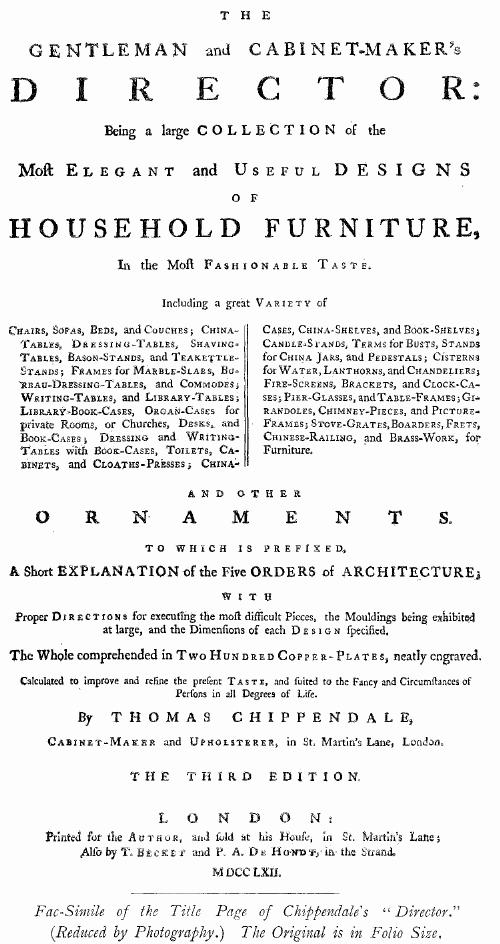
The Gentleman and Cabinet-Maker's Director, Being a Large Collection of the Most Elegant and Useful Designs of Household Furniture in the Gothic, Chinese and Modern Taste was published in March 1754...
The Gentleman and Cabinet-Maker's Director, Being a Large Collection of the Most Elegant and Useful Designs of Household Furniture in the Gothic, Chinese and Modern Taste was published in March 1754, by subscription, as a folio of engraved plates, 161 of them on the Furniture History Society's count and 160 on Sotheby's collation of a copy sold in 2024. It was the first English book devoted entirely to furniture design and published under a single cabinet maker's name, and it is the reason there is a page about Thomas Chippendale rather than about any of the half dozen London makers of comparable ability.
Three editions exist and they are not interchangeable. The first is 1754. The second, of 1755, is a slightly revised reissue. The third was published in parts between 1759 and 1762 and is substantially enlarged, with plates carried over from the first two and new ones introducing neoclassical elements that had not existed in England when the first edition appeared; a French edition was issued at the same date. A record that cites a Director design has to say which edition and which plate, because a design present in 1762 and absent in 1754 dates the furniture that copies it.
The mechanism was a subscription. Buyers put their names down in advance, the list was printed in the book, and the sheets sold at one pound seventeen shillings unbound. The dedications were aimed upward: the first two editions to Hugh, Earl of Northumberland, a notable patron of the arts, the third to Prince William Henry, Duke of Gloucester. Both men subsequently bought furniture. But the striking fact about the subscribers is that most of them were not patrons at all. The majority were practising tradesmen, and a high proportion were Scots, which the Furniture History Society attributes to the network of Chippendale's partner James Rannie. The book was marketed through London and provincial newspaper advertisements, and it reached Ireland and the American colonies.
The plates were engraved by Matthias Darly, a professional designer, engraver and drawing master, working with Chippendale through 1753. The preparatory drawings for almost all of the first edition are in the Metropolitan Museum of Art in New York, which bought two albums formerly owned by the Foley family in 1920; the albums also contain a number of drawings prepared for the third edition and some unpublished designs. A separate portfolio of 144 furniture drawings ascribed to Chippendale was bought by the Victoria and Albert Museum in 1906 without a provenance, and seven Director designs turned up in the archive of the carver Matthias Lock which the same museum bought in 1862. That last fact produced a scholarly quarrel in the 1920s, when it was proposed that Lock and his associate Copland had ghosted the plates; the case was closed by the discovery of letters and drawings in country house archives showing Chippendale designing perfectly competently on his own account.
The book did what pattern books are for. It sold the designs and it sold the designer. The Furniture History Society notes the sequence that matters: every known commission to supply furniture dates from after the book appeared. He was thirty-six, he had been in London perhaps a decade, and he had no recorded aristocratic client. Within five years he was furnishing Dumfries House.
A pattern book is a set of instructions to other people.
A pattern book is a set of instructions to other people. That is its purpose and it was Chippendale's purpose. The consequence, two hundred and seventy years later, is that the strongest visual evidence a cataloguer has is the weakest evidence of authorship in the field.
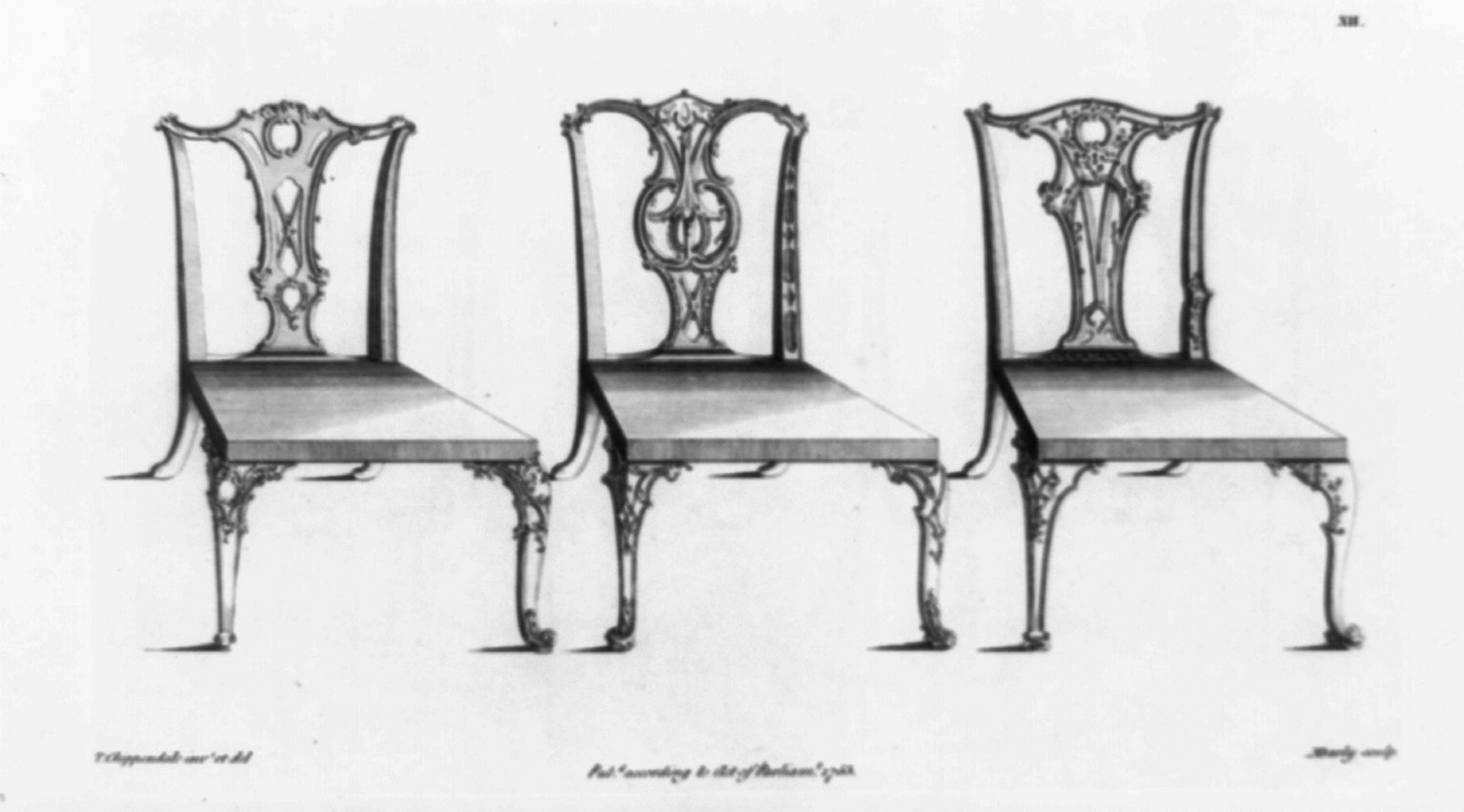
The Furniture History Society states the rule flatly: even if an item corresponds exactly to one of Chippendale's published designs, this does not amount to proof, since many practising cabinet makers bought the Director in order to copy from the engravings. A chair that matches plate twelve of 1754 tells you that whoever made it had access to the book. Given that the majority of subscribers were tradesmen, and given that the book went through three editions and crossed the Atlantic, the population of people with access to the book is very large and the population of people in Chippendale's workshop is very small.
The same society sets out the two circumstances in which an attribution without a bill is nonetheless acceptable. The first is post-Director furniture of superlative quality, displaying striking stylistic and technical affinities with the firm's proven work for other patrons, found in a house where Chippendale is documented to have worked, even if the itemised bills do not survive; Newby Hall and Brocket Hall are the named examples. The second is unprovenanced furniture displaying features unique to the workshop. Both of these are arguments from the object, made by specialists, and both are weaker than a bill. Neither has the standing of the first sense of the word.
There is a further complication that the trade tends to leave out. The firm did not necessarily make everything it invoiced. The Furniture History Society considers it likely, though not yet proven, that at busy times specialist work such as marquetry, carving, gilding and brass work was farmed out to other firms to be executed to Chippendale's designs, and probable that common backstairs articles were bought in and simply invoiced on. Two specific items are named as probably bought in: a combination backgammon and chess board supplied to Ninian Home in 1774, and a French tortoiseshell and brass inlaid commode listed in the Dumfries House account. That second one is worth holding on to. A documented Chippendale bill can describe an object that is neither by Chippendale nor English.
Christopher Gilbert published the Dumfries House commission in the Burlington Magazine in 1969, nine years before his two-volume life, and that article is still the sharpest statement of what the...
Christopher Gilbert published the Dumfries House commission in the Burlington Magazine in 1969, nine years before his two-volume life, and that article is still the sharpest statement of what the house proves. His judgement was categorical: the only fully documented Chippendale furniture of the Director period is at Dumfries House, and the collection is the outstanding monument to his early rococo phase. He also made, in 1969, the observation this entire page is built on. It is not generally realised, he wrote, that Chippendale's popular reputation for the style that bears his name flows mainly from his designs and not from his executed work.
The scale of the documentation is nearly fifty items. The scale of the previous literature was seven: Margaret Jourdain's brief account in the Country Life Annual for 1949 discussed that many and, as Gilbert notes, thereby became the source for every subsequent account for twenty years. That is how a field with abundant primary material can run for two decades on a summary of one seventh of it.
The archive references matter and belong in any record on a Dumfries object. Four bills have been located under D.H. 34/58 to 34/61, with correspondence and related papers at D.H. 34/6, 34/7, 34/51 and 34/63. Gilbert prices individual objects from them: the rosewood bookcase, which he ranks with the finest things at Nostell or Harewood, was charged at 47 pounds 5 shillings, and he notes that rosewood is an unusual choice at that date.
Then the thing that makes this house indispensable. The fifth Earl did not buy only from London. He bought heavily in Edinburgh, where he kept a town house, from Young and Trotter as upholsterers, from William Mathie as carver and from Alexander Peter as wright, and in London from George Mercer and Samuel Smith as well as from Chippendale and Rannie. And among the Edinburgh furniture at Dumfries House there is a side table by Alexander Peter, dated 1759, which repeats a design from the first edition of the Director.
Read that again, because it is the whole argument in one object. In the house that a saleroom catalogued as A Chippendale Commission, in the same year as Chippendale's own bill, stands a piece of furniture executed from a Chippendale plate by a different maker in a different city. Any test that says a Director design proves Chippendale's authorship fails on the floor of the best documented Chippendale interior in the world. The counter-example is not hypothetical, not modern and not a fake. It is contemporary, honest, documented, and it has been sitting there since 1759.
Gilbert makes the same point negatively about Wilton, where the bankers' drafts record unspecified payments to Chippendale between 1763 and 1773. Without itemised accounts, he writes, the relevant pieces can be identified only on the rather tenuous grounds of stylistic analogy with plates in the Director. A payment proves a relationship. It does not identify an object.
The tercentenary exhibition made the same demonstration physically. At Leeds City Museum in 2018 two mahogany chair backs after plate twelve of the Director were shown side by side: one from Nostell Priory, first invoiced in June 1766, and one by an anonymous provincial maker of about 1765 belonging to Leeds Museums and Galleries. The design is the same. The carving is not. That is what connoisseurship can and cannot do, hung on a wall.
Fame is manufactured, and for this maker the manufacture is unusually easy to document, because the instrument of it was a printed book that has never gone out of circulation.The original engravings...
Fame is manufactured, and for this maker the manufacture is unusually easy to document, because the instrument of it was a printed book that has never gone out of circulation.
The original engravings were made by Matthias Darly through 1753. The preparatory drawings for almost all the first edition are in the Metropolitan Museum of Art, bought in 1920 in two albums formerly owned by the Foley family, and published under the Museum's open-access programme; a separate portfolio of 144 sheets ascribed to Chippendale went to the Victoria and Albert Museum in 1906 without a provenance. Those two purchases, fourteen years apart, put the primary material behind the book into two public collections on two continents, and that is where a student should start.
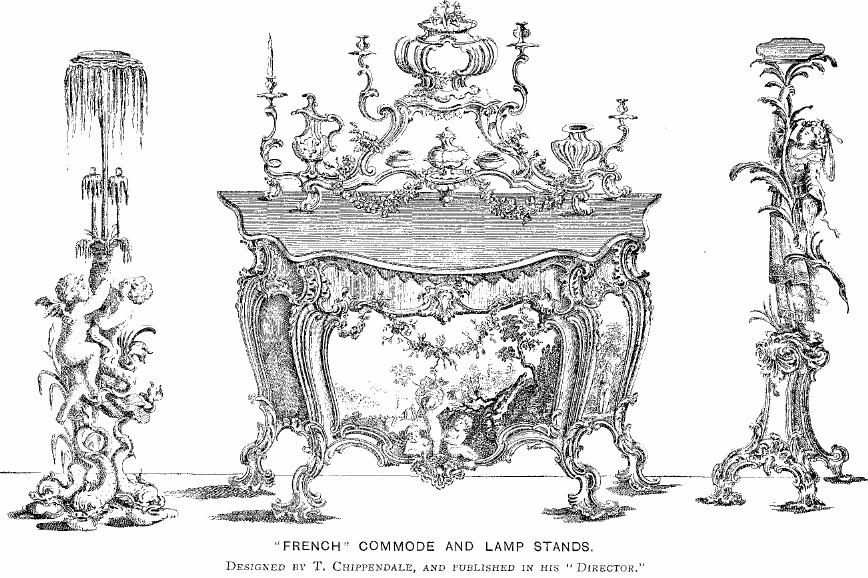
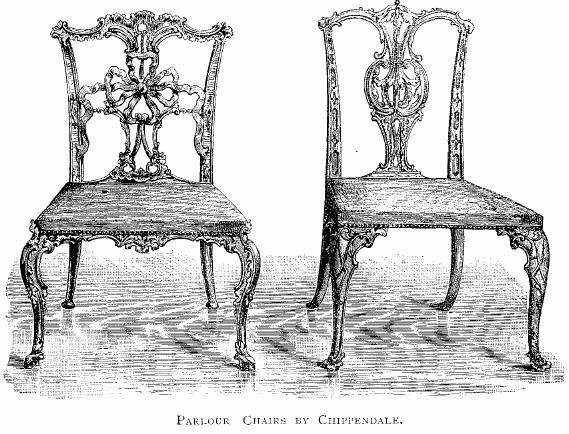
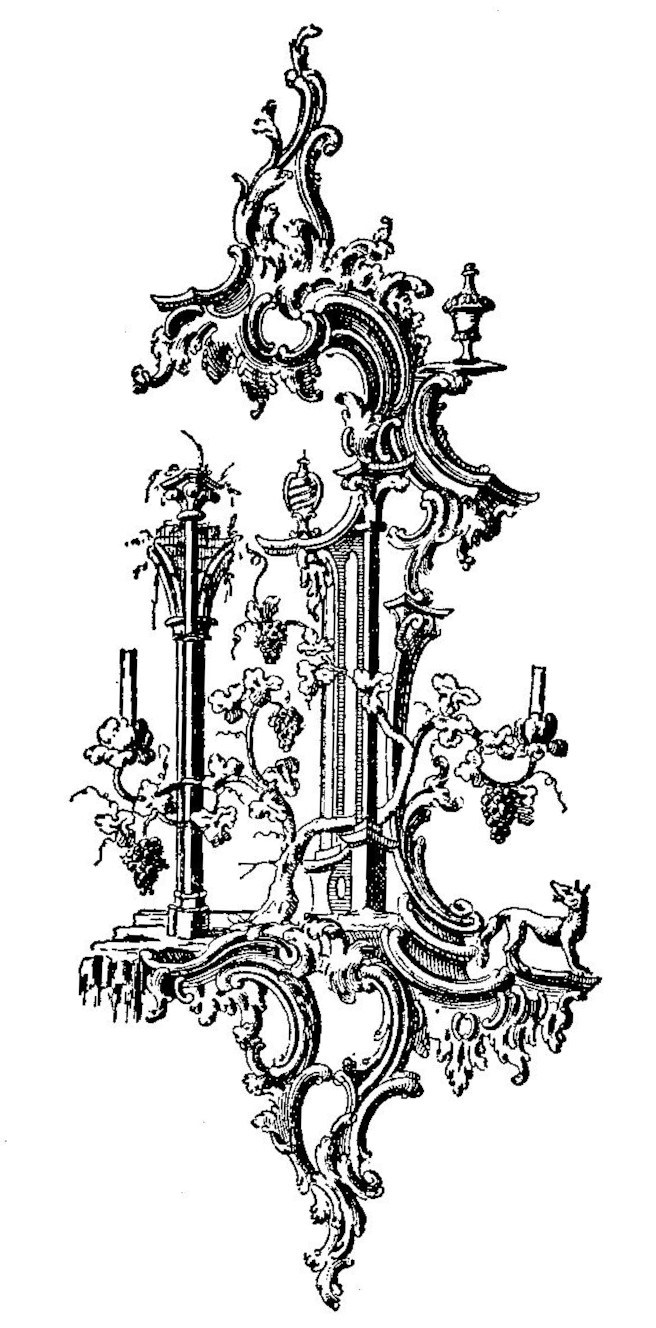
The plates themselves then had a second life as reproductions. Three of the engravings on this page are not first-edition sheets at all: they are reproductions printed in Frederick Litchfield's Illustrated History of Furniture of 1893 and now circulating through Project Gutenberg, and the captions say so rather than letting a Victorian reprint pass for a Georgian plate. That distinction matters commercially as well as bibliographically, because the nineteenth-century revival that made Chippendale a household word in Britain and America ran on exactly such reproductions, and so did the furniture made to copy them.
The book has a market of its own and the numbers are instructive. At Sotheby's, in Provenance and Patina: Important English Furniture from a West Coast Collection on 18 June 2024, lot 1045 was a first edition folio with half-title, title in red and black, engraved dedication, subscriber list and 160 engraved plates, together with 56 further plates from the later edition of 1759 to 1761, bound in later tree calf with a gilt spine in six compartments, with marginal restoration, some loss to text especially to the title, and splitting spine ends. The estimate was 3,000 to 5,000 US dollars. The result is not displayed on the public lot page without a login, so hammer is not published here and no total is printed.
Read that estimate against the rest of this page. The book that turned a name into a style carries a low four-figure estimate, while an undocumented commode attributed to the man who wrote it made a reported 3,793,250 pounds. The book is cheap because it worked: it was printed in quantity, sold to tradesmen, reprinted, translated, reproduced in Victorian histories and put online, and the scarcity was never in the instructions. It was always in the furniture.
One collation detail from that lot should be recorded rather than reconciled. Sotheby's describes the first edition as carrying 160 engraved plates. The Furniture History Society gives 161. Both figures appear on this page and neither has been adjusted to fit the other.
He arrives in the record late and thinly.
He arrives in the record late and thinly. Nothing certain is known of his training. It has been suggested that after a family apprenticeship he spent time with Richard Wood, a York joiner and cabinet maker, but the evidence is weak. In 1748 he married Catherine Redshaw at St George's Chapel, Mayfair. At Christmas 1749 he took a house in Conduit Court, off Long Acre, on the fringe of the fashionable furniture-making district. At midsummer 1752 he moved to Somerset Court, next to the Earl of Northumberland's house. Throughout 1753 he and Darly were working on the plates.
In 1754, the year the book came out, he moved to numbers 60 to 62 St Martin's Lane and formed a partnership with James Rannie, a Scot with capital and a network of potential clients. The two of them called the establishment the Cabinet and Upholstery Warehouse and took a chair as their shop sign. In 1755 the property was rated at 124 pounds and Chippendale took fire cover with the Sun Insurance Office for 3,700 pounds. Several early policies survive, from 1755, 1756 and 1767, and a detailed plan of the premises survives attached to the son's insurance schedule of 1803, which is the best record of how the workshop was laid out.
In April 1755 fire ravaged the cabinet shop and destroyed the chests of twenty-two journeymen. Compensation of 847 pounds was paid, and the partners helped organise a public appeal to replace the men's tools; one of the people nominated to receive donations was Caesar Crouch, a cabinet maker who had subscribed to the Director and for whom Chippendale designed an ornamental invitation card. The twenty-two chests are the single best measure of the size of the cabinet shop at that date, because a journeyman's tool chest is a personal possession and the count is a head count. The firm at its height employed up to fifty specialist tradesmen.
Rannie's Scottish connections explain the firm's early success in Scotland: the Earls of Dumfries and Morton, Lord Arniston, the Duke of Atholl. Rannie died in January 1766. The next month the press announced the dissolution of the partnership and that the trade would in future be carried on by Mr Chippendale on his own account. Rannie's executors wanted the capital out, and to raise it the entire stock in trade was auctioned on the premises in March and April 1766, including all the unwrought stock of mahogany and other woods in plank, board, veneer and wainscot. Selling a cabinet maker's timber is selling his ability to work.
What that crisis did to him is on the record in his own words, because he was writing to Sir Rowland Winn at the time. He feared he would be arrested for debt, ruined, or driven out of his mind by money problems. The trouble was aggravated by patrons who did not pay. In 1771, to stave off bankruptcy, Rannie's book-keeper Thomas Haig, who had stayed with the firm, and another executor, Henry Ferguson, each bought a third share. From that point the firm traded as Chippendale, Haig and Co, and after Chippendale's death as Haig and Chippendale. Chippendale himself was never made bankrupt. His son was, twice.
He retired to Derry Street, Kensington, in about 1776, probably because of his health.
He retired to Derry Street, Kensington, in about 1776, probably because of his health. Catherine had died in 1772 and in 1777 he married Elizabeth Davis; they had three children, and of all his offspring only four were still alive in 1784. He died of consumption at Hoxton and was buried at St Martin-in-the-Fields on 13 November 1779. There was no will, so administration went to his widow.
The probate figures are the most quietly devastating thing in the record. His household goods were valued at 28 pounds 2 shillings 9 pence. His one third share in the business was worth 288 pounds 19 shillings 8 pence. The man who had invoiced a single Yorkshire patron for nearly seven thousand pounds died with a household worth about a fourteenth of the price of the one bed he had made for that patron, and the Furniture History Society draws the obvious inference, that the couple lived quite simply.
Two structural facts sit behind those numbers. He was a tradesman and was treated as one. He did not have the social standing of a fashionable architect or artist, which is why he barely appears in diaries and journals, and why no obituary was printed. And the business he had a third of was a business whose capital was tied up in other people's unpaid accounts. Sir Edward Hales was notoriously bad at paying, and his account with the firm carried three years of interest at 72 pounds 18 shillings inside a single bill. Sir Richard Worsley owed the partners a further 250 pounds in 1779, gave a bond for it, and the bond was not due for repayment until 1790 at five per cent. Georgian luxury trade ran on credit extended by the tradesman to the aristocracy, and the tradesman carried the risk.
The standard popular account has Robert Adam designing interiors and Chippendale executing Adam's furniture designs inside them.
The standard popular account has Robert Adam designing interiors and Chippendale executing Adam's furniture designs inside them. The Furniture History Society calls this a myth in as many words. Chippendale frequently furnished interiors designed by Adam, but he is known to have executed exactly one of Adam's furniture designs, a commission for Sir Lawrence Dundas in 1765. What actually happened was the reverse of a subordination: where an owner did not want Adam to produce furniture drawings, Adam appears frequently to have recommended Chippendale as the most accomplished exponent of neoclassical furniture and left him to it.
Architects nonetheless expected to be consulted about rooms they had designed, and at least one insisted. Sir William Chambers vetted Chippendale's proposals for the principal apartments at Melbourne House, Piccadilly, in what the record describes as a high-handed manner. The furniture that resulted is dispersed: the commode, apparently costing 140 pounds, is at Renishaw in Derbyshire, and a pair of cabinets are at Firle Place in Sussex, while only the saloon mirrors and pelmets and the library bookcases remain in place at Brocket Hall.
The more consequential question is internal. From the early 1770s the drawings for the firm's distinctive mature neoclassical furniture at Harewood are by Thomas Chippendale the Younger, and the Furniture History Society states that the surviving drawings indicate this without doubt. In 2019 four further drawings by the son and two by the father were found in a Canadian collection; one of the son's is a design for a lantern pedestal, one of six supplied by Chippendale, Haig and Co to Harewood in 1774. The conclusion drawn from them is that by the early 1770s the son was already directly shaping the firm's neoclassical style.
This is not a footnote. It means that the most famous objects associated with the name, the Harewood neoclassical masterpieces of the 1770s, sit inside a period when authorship of the design is documented to the son and responsibility for the firm still rested with the father. A catalogue entry that says designed and made by Thomas Chippendale for one of these is asserting something the drawings do not support. The honest formulation is that the object was supplied by Chippendale, Haig and Co under Thomas Chippendale senior, to a design attributed on the surviving drawings to Thomas Chippendale the Younger.
He was baptised at St Paul's, Covent Garden on 23 April 1749 and lived next door to the workshop.
He was baptised at St Paul's, Covent Garden on 23 April 1749 and lived next door to the workshop. A receipt signed Thos Chippendale Junr and dated 4 June 1766 is the earliest evidence of him in the business. He had some artistic training and exhibited five genre scenes at the Royal Academy between 1784 and 1801. In 1779 he published a modest suite of six decorative designs on six plates called Sketches of Ornament. He joined the Royal Society of Arts in December 1793 and remained a member to January 1808.
After his father's death he continued the business with Haig, who became senior partner until retiring in 1796. Haig died in 1803 leaving over 10,000 pounds in legacies, directing that they be paid out of monies secured on bonds of Thomas Chippendale, his successor in business. Chippendale could not meet the obligations and was declared bankrupt in 1804. The trustees held six public auctions, on 25, 26, 27 and 31 July and 1 and 2 August 1804, disposing of manufactured stock in trade, timber and veneers, upholstery materials and finally his household goods; the advertisements described many articles of great taste and of the finest workmanship. A second failure came in March 1808, with a further sale of the stock of Mr Thomas Chippendale, cabinet-maker and upholsterer, No 60, St Martin's-lane, a bankrupt, on 26, 27 and 28 April and 2 and 3 May 1808.
Neither bankruptcy ended him. He kept the St Martin's Lane premises until Michaelmas 1813, when he could not renew the lease and moved to 17 Haymarket, then in 1818 to 42 Jermyn Street. His will is dated 22 December 1822 and addressed from 61 Regent Street; a letter from Sir Richard Colt Hoare shows him still alive at the beginning of 1823, and he probably died in mid January. His major documented commissions are at Burton Constable, Harewood, Paxton and Stourhead, where seventeen bills between July 1795 and April 1820 amount to over 6,000 pounds.
The commercial consequence is straightforward. Furniture by the son is worth a fraction of furniture by the father, and the two are separated by date rather than by quality. Two habits protect a buyer. Check the date of the bill against the father's retirement in about 1776 and his death in 1779. And check the trading name on the paperwork, because the firm's style changed as the partnership changed: Chippendale and Rannie to 1766, Chippendale alone to 1771, Chippendale, Haig and Co from 1771 to 1779, Haig and Chippendale thereafter, and Thomas Chippendale alone again after Haig's retirement. The name on the bill dates the bill.
The commission at Harewood for Edwin Lascelles was the most notable of his career and the firm was involved from 1767 for what the Furniture History Society calls nearly forty years, a span that...
The commission at Harewood for Edwin Lascelles was the most notable of his career and the firm was involved from 1767 for what the Furniture History Society calls nearly forty years, a span that covers both Chippendales and whose last documented bill on this page is of 1796. One surviving bill amounts to 6,838 pounds 19 shillings 1 penny and the total probably exceeded 10,000 pounds. Alongside the bills there is a Day Work Book for 1769 to 1776 recording how the firm's outworkers spent their time, ledger payments, letters, and drawings supplied at large to local tradesmen. It is the deepest documentary base for any Chippendale house, and it is why a record on a single Harewood object can be built to a standard nothing else in English furniture supports.
The Diana and Minerva commode was delivered in 1773 at a cost of 86 pounds. It was made for the State Dressing Room, which is the same physical space as the room now called the Spanish Library, and it is a dressing commode rather than a display piece: the top drawer contained a mirror and the equipment of the morning toilette. The invoice describes a very large rich commode with exceeding fine antique ornaments, curiously inlaid with various fine woods, with Diana and Minerva and their emblems curiously inlaid and engraved. The two goddesses appear in dark roundels flanking the central section, Diana with the crescent moon, bow and whippet, Minerva with helmet, spear, shield and owl. The marquetry uses satinwood, rosewood, tulipwood, ebony and other woods, with engraved ivory inlay and gilt-brass mounts, and it was originally coloured with natural dyes that light has since taken out. WHERE IT STANDS NOW IS NOT SETTLED HERE: the room it was made for, the State Dressing Room, is the same physical space as the room now called the Spanish Library, and the house places the commode there; the photograph reproduced on this page was taken in the State Bedroom. Both cannot be current, and no source consulted resolves which is. NO DIMENSIONS ARE PUBLISHED for this object by the house or in any source consulted, which for the most famous piece of English furniture in existence is itself worth recording.
Alongside it in the same room stands the state bed of 1773, which Harewood describes as the most expensive piece of furniture Chippendale ever made, costing over 400 pounds and originally supplied with three mattresses. The bed was taken apart in the nineteenth century because it was so little used; it had accommodated two guests, the Grand Duke Nicholas of Russia and Princess Victoria. It was reassembled and restored with Heritage Lottery Fund support in 2000, the reconstruction resting on tacking marks and screw holes in the frame read against Chippendale's own accounts, with new damask woven from a surviving scrap found inside the canopy dome.
A record on the commode therefore has to carry the following, in this order. The invoice text and its date, quoted, because it is the attribution. The price of 86 pounds, in the currency and the terms of the bill, against the 400 pounds of the bed in the same room in the same year, which is the only honest way to convey what 86 pounds meant. The room it was made for and the function it was made for, because a dressing commode with a fitted mirror drawer is a piece of equipment and not an ornament. The iconography, which is not decorative filler: Diana for the hunt and the moon, Minerva for learning, the arts, war and justice, on a piece of furniture made for a woman's dressing room in a house built on a specific kind of eighteenth-century money. The condition question, because the colours are gone and the object as seen is not the object as delivered. And the authorship question, because the date of 1773 falls inside the period when the drawings for the firm's mature neoclassical furniture at Harewood are attributed to Thomas Chippendale the Younger.
That last point is the one most catalogue entries omit and it is the one a specialist will check.
The two commissions that make this maker studiable at all were paid for out of Caribbean slavery, and both houses now say so themselves, in their own words, on their own websites.
The two commissions that make this maker studiable at all were paid for out of Caribbean slavery, and both houses now say so themselves, in their own words, on their own websites. A record that quotes the invoice and stops there has taken the last line of a long transaction and called it the beginning.
Harewood is explicit. The house publishes that Edwin Lascelles was one of the wealthiest men in England, and that Edwin, his father and subsequent generations of the family were Caribbean sugar merchants who actively exploited thousands of enslaved African people. It publishes that the family purchased the combined estates of Harewood and Gawthorpe using enormous profits made from the transatlantic trafficking in enslaved people; that the fortune came from selling sugar and rum made by enslaved people and from owning sugar plantations in Barbados, Jamaica, Grenada and Tobago; and that Henry Lascelles, Edwin's father, was the first of the family directly involved in the trade. It also publishes what happened at abolition: plantation owners including the Lascelles were given money to cover the loss of their enslaved workforce, and the people who were freed received nothing. The bill for 6,838 pounds 19 shillings 1 penny is drawn on that account.
The documents are open, which is unusual and worth knowing. The Harewood West Indian Archive, also called the Lascelles Slavery Archive, is at the Borthwick Institute for Archives at the University of York. It records the family's ownership of plantations and of enslaved people in the eighteenth and early nineteenth centuries through business transactions, property records, wills, bonds, and orders for the sale of enslaved people as a result of the debt or bankruptcy of their owners. Seven boxes were delivered in 2005 and conserved and catalogued between 2005 and 2007 with Heritage Lottery Fund support; five further boxes were added in 2017. The material runs from 1677 into the nineteenth century, the later accession covering 1745 to 1891, and by 1787 the family held more than 27,000 acres. Digital images of the 2005 accession are published through the University's Discover platform. A researcher can therefore read the cabinet maker's bill in one Yorkshire archive and the plantation bond in another, which is exactly the pairing most decorative arts scholarship never makes.
Paxton House does the harder thing and attaches the money to named objects. Ninian Home, 1732 to 1795, the patron of the account of 1774 totalling 405 pounds 6 shillings 10 pence, is described by the house as an enslaver in the Caribbean and the second owner of Paxton. Ninian and Penelope Home enslaved hundreds of African people on their estates, approximately 247 at Waltham alone, which is Paxton's own figure. The remaining specifics of his holdings rest on a tertiary source and are given as such: an encyclopaedia entry, not yet replaced with a primary record, has him holding the Waltham estate in the parish of St Mark in Grenada from 1780 and Paraclete in the parish of St Andrew, with land on Mustique and shares in trading vessels, and puts over 400 enslaved people across the two plantations growing coffee, cocoa and sugar. An attempt to replace it from University College London's Legacies of British Slavery database, which this page uses for Harewood, failed because that database's search interface did not resolve. The house's Sugar and Slavery Trail states that the entrance hall lantern was commissioned in 1774 to 1776 just after the Homes purchased their Scottish home with profits derived from enslaved labour, and that the clothes press in the West Bedroom was commissioned just after they purchased Paxton House with a 2,000 pound down payment derived from profits from enslaved labour and a 10,000 pound loan. The same tertiary source has him appointed Governor of Grenada on 17 November 1792 and killed during Fedon's rebellion in 1795, having been taken hostage with about fifty others; it also gives two different dates for his death, a capture in March and a death about 6 April, so this record prints no single death date. Paxton, built between 1758 and 1795, now runs a Sugar and Slavery exhibition in its Old Billiard Room and a trail through the house identifying the objects connected to that money.
Then the timber, which is the part specific to this craft. Paxton's own trail entry on the Morning Room secretaire reads that it is made from the highest quality dark brown mahogany cut down by enslaved people in Jamaica. That is a house stating, on a single object in a room it furnished through Chippendale, what the whole English furniture trade of the period rested on. It does not attribute that secretaire to Chippendale and neither does this record. Mahogany is the structural and show timber of the Director period; the firm bought it in plank, board, veneer and wainscot, as the categories in the 1766 stock auction show; and it came out of the Caribbean and Central America.
What this record cannot yet do is trace a particular log to a particular object. Nothing in the surviving Chippendale bills records where the timber came from, and this page does not claim otherwise. What a museum can say for one secretaire at Paxton it cannot yet say for the Diana and Minerva commode. That gap is a finding and it belongs in the open questions rather than in a smooth sentence. But the direction of the evidence is not in doubt, and a provenance chain on any object of this class that begins with the invoice has begun two transactions too late.
Every price on this page is meaningless without a frame, and the frame the trade normally supplies, a single sum in today's money, is worse than none.
Every price on this page is meaningless without a frame, and the frame the trade normally supplies, a single sum in today's money, is worse than none. This section gives the period comparisons first, because they are what a contemporary would have understood, and then shows exactly how far apart the modern conversions are.
What a London cabinet-maker earned. R. Campbell's London Tradesman of 1747, written seven years before the Director and describing the trade Chippendale was about to enter, is precise: a journeyman who knows his business may have a guinea a week, and if he works piece-work and applies with tolerable diligence may earn thirty shillings and some weeks two guineas. So 21 shillings on day rate, 30 shillings on piece, and up to 42 shillings in a good week. The same chapter puts that in its trade context: an upholder's best hands at 12 to 15 shillings a week, and the women, if good for any thing, a shilling a day; chair-carvers on piece at 30 to 40 shillings; journeyman carpenters at 12 to 15 shillings; a grocer's journeyman at 15 to 20 pounds a year. Cabinet-making sat near the top of the artisan range, and the women in the workshops sat at the bottom of it at six shillings a week for six days.
Dorothy George's figures agree and extend into the relevant decade: before 1765 labourers took 9 to 12 shillings a week and journeymen in the less well-paid trades 12 to 15, rising to 15 shillings and upwards in the 1770s. London masons petitioned Parliament in 1775 that their wages had been fixed nearly seventy years earlier at 15 shillings, out of which their tools cost about a shilling. The Chamberlain's Court heard in 1780 that a badly taught apprentice could earn ten or twelve shillings where a properly instructed one would earn thirty or more.
The trade organised, and was prosecuted for it. This belongs on the page because it is the same trade, in the same city, seven years after the Director. The London Chronicle of 12 December 1761 reported that bills of indictment were preferred and found before the Grand Inquest against the rebellious journeymen cabinet-makers, who had lately combined together to raise their wages and lessen their hours of working, and called the combination among journeymen peruke-makers, shoemakers, tailors and cabinet-makers a growing evil. George notes in the same passage that the masters' combination was much greater. The men who made the furniture on this page were being indicted for asking for more money while the book that made their master's name was in its third edition.
Their answer, a generation later, was to write the prices down. The London Cabinet-Makers' Book of Prices, first printed for the London Society of Cabinet-Makers in 1788, is a piece-rate schedule whose stated purpose was to settle disputes: its own introduction complains that many articles in the first edition were not clear enough to prevent different constructions being put on them by journeymen and their employers, as their different interests might suggest, which had caused frequent and almost irreconcilable disputes. Rates run per item and per foot, a dining table at one shilling and twopence a foot. That is why a piecework week beat a day-rate week: it was an accumulation of piece prices, and the schedule is the closest thing the trade has to a published labour cost.
A live scholarly dispute, which changes every day-count on this page. The standard wage series is Elizabeth Gilboy's of 1934: London building craftsmen at 2 shillings 6 pence to 3 shillings a day, carpenters to 3 shillings 4 pence, labourers at 2 shillings from 1735, with money wages for labourers unchanged from 1735 to 1790. Judy Stephenson argues that this overstates what workers actually received by twenty to thirty per cent, because the recorded day wages are the rates contractors charged clients rather than the pay of the men: Pain's Builder's Companion of 1761 gives a top bricklayer rate of 3 shillings with the rest twenty per cent below it, Campbell gives building journeymen half a crown, and the London Bridge accounts show the master Land Carpenter still on 16 shillings a week in 1788 with labourers averaging 11 to 12 pence a day through the 1750s and 1760s. Robert Allen's published response calls that conclusion unpersuasive. Both positions are in the Economic History Review and this record does not arbitrate. The consequence is concrete and it is arithmetic, not rhetoric. A wage 20 to 30 per cent below the series divides into a given sum 1.25 to 1.43 times as often, so if Stephenson is right every statement of the form this object cost X days of a craftsman's wage is understated by 25 to 43 per cent.
What made a gentleman. Massie's social table of 1759, as revised by Allen, gives average annual family income by rank: temporal lords 12,177 pounds, baronets 3,044, knights 1,522, esquires 1,218, gentlemen 472, greater clergy 113, shopkeepers and tradesmen 51, manufacturers 35, building trades 29, labourers and outservants 20, domestic servants 10, cottagers and paupers 7. Average annual income per earner in 1759 was 13.58 pounds for workers and 23.14 pounds for all earners. Allen cautions that servants' income was largely paid in kind, and the servant figure is England-wide for 1759 rather than London in the 1770s, so it is the weakest line in that table and is used here as an order of magnitude only.
What a house cost. The Building Act of 1774 classified London houses into four rates by value: first rate above 850 pounds, second rate 300 to 850, third rate 150 to 300, fourth rate under 150. The statute does not define what it means by value, and secondary accounts that gloss the figures as ground rent are describing something else; this record says the term is undefined rather than picking a number. On rents, George gives the standard rent of a London artisan before the price rise after 1795 as about 2 shillings and sixpence a week, roughly 6 pounds 10 shillings a year; a furnished room in a poor district 2 to 3 shillings and sixpence; one parish with 555 houses let at under 10 pounds a year; and Johnson told before 1737 that a man might live in a garret at eighteenpence a week.
Now the sums, in period terms. The Diana and Minerva commode at 86 pounds was about 1.6 years of a London journeyman cabinet-maker's pay at Campbell's guinea a week, or about 2.2 years at the 15 shillings George reports for the 1770s. It was 860 days of a skilled tradesman's wage on the National Archives series. It was more than four times the 20 pounds a year Massie's revised table gives the average family of a labourer or outservant. Against the Building Act's classes it falls between the fourth rate, under 150 pounds, and the third, 150 to 300 pounds, though the statute never says what it means by value, so that is a placing and not a valuation. It was about thirteen years of an artisan's lodging at half a crown a week. In 1770 commodity terms, on the dataset behind the National Archives converter, it was of the order of eighteen cows or fifty-two quarters of wheat; those conversions are this record's arithmetic on that dataset's prices and are not published figures.
The surviving Harewood bill of 6,838 pounds 19 shillings 1 penny was about 125 years of one journeyman cabinet-maker's wage at a guinea a week, or 68,380 days of a skilled tradesman's wage, which is about 219 man-years. It was 18.5 per cent of the 37,000 pounds that University College London's Legacies of British Slavery database records Harewood House as having cost to build, excluding Robert Adam's fees. It was about 14.5 times the 472 pounds a year Massie's revised table gives an average gentleman. And the same database records that Chippendale's sum was matched by an almost identical sum paid to Capability Brown: the cabinet maker and the landscape gardener cost the house the same.
Then the modern equivalents, and the reason this record refuses to print one. Run 86 pounds of 1773 through MeasuringWorth's five measures and the answers are 14,740 pounds by real price, 196,500 by labour value, 222,000 by income value, 1,751,000 by economic share and 13,970 by real cost. Run the Harewood bill of 6,838 pounds and they are 1,172,000, 15,620,000, 17,650,000, 139,200,000 and 1,111,000. The spread between the lowest and highest measure is 125-fold in both cases. Real price is a fixed bundle of consumer goods. Labour value is the multiple of the average worker's wage, which is to say how much work the sum represents. Income value is the multiple of average income, which is to say status. Economic share is the sum as a proportion of national output, which is to say influence. Real cost uses the GDP deflator and is the right measure for a project. MeasuringWorth's own guide says there is no single correct measure and that the retail price index is used far too often without consideration of its consequences.
The calculators also disagree with each other. The National Archives converter, which runs in decade steps so that 1773 must be entered as 1770, gives 86 pounds as about 7,503.96 pounds in 2017 and 6,838 pounds as about 596,651.74. Its implied multiplier for 1770 to 2017 is 87.3 times; MeasuringWorth's retail price measure for 1773 to 2024 is 171.4 times. Different base years, different indices, different sources, and roughly a factor of two between them. The Bank of England's calculator uses a composite price index and the Bank itself calls it designed for illustrative and general reference purposes only. And the National Archives converter's skilled tradesman rate for 1770 is 2 shillings a day, which is precisely the institutional figure Stephenson argues is twenty to thirty per cent too high, so its day-counts inherit the dispute.
A single modern equivalent for a Georgian price is therefore not a fact but a choice of index, made silently. This record gives the period comparisons, names the measures, prints the range and leaves the choice to the reader.
Dumfries House in Ayrshire was built for the fifth Earl of Dumfries and furnished by Chippendale and Rannie under a main bill of May and July 1759 amounting to 647 pounds 14 shillings 1 penny, with...
Dumfries House in Ayrshire was built for the fifth Earl of Dumfries and furnished by Chippendale and Rannie under a main bill of May and July 1759 amounting to 647 pounds 14 shillings 1 penny, with lesser accounts in 1763 and 1766. Nearly all of that furniture survived, in the house, unaltered, which makes it the best documented and most complete surviving Director-period commission there is.
In 2007 it was to be broken up. The contents were catalogued by Christie's for a sale set for 12 and 13 July 2007 under the title Dumfries House: A Chippendale Commission, with the estate to be sold separately. The seller was John Bute, the seventh Marquess of Bute. The sale did not happen. On 27 June 2007 a consortium assembled by the then Prince of Wales, including charities and the Scottish government, secured the house, the estate and the contents together. The total is recorded as 45 million pounds by the National Heritage Memorial Fund and as 40,000,000 by the Art Fund, which acted as the legal purchaser, and the two have not been reconciled. A substantial part of the money was a 20 million pound loan taken by the Prince's Charities Foundation, disclosed at the time and subsequently refinanced and partly repaid. Clarence House's own later statement is that the preservation of the collection for future generations was only made possible by that contribution. The furniture was already crated; the account given afterwards, by the Prince himself and years later, is that three pantechnicons carrying it south were stopped on the motorway at one in the morning and turned round. No contemporaneous source describes that, and the further detail that it happened in Cumbria, printed in an earlier version of this page, is unsupported and has been withdrawn.
What that establishes is not a price for Chippendale furniture. It is something more useful: a documented instance of the difference between the value of a commission whole and the value of its parts. A sale had been prepared by a major house, every lot catalogued, and the whole was withdrawn on the argument that the assemblage, the house and the paperwork together were worth more than the sum of the individual hammer prices. No hammer prices were ever published because no hammer ever fell. Any figure quoted for what the Chippendale contents would have made in July 2007 is an estimate that was never tested, and this record does not print one.
The negative result matters as much. The total, whether 45 million or 40 million, bought a house, a 2,000 acre estate and the contents in one transaction, and it is not divisible into a furniture figure. It is quoted here as what it is, an acquisition total for a mixed asset, not as a valuation of the furniture.
The rescue is the most quoted episode in the modern history of this maker and most of what is quoted about it is later retelling.
The rescue is the most quoted episode in the modern history of this maker and most of what is quoted about it is later retelling. The contemporaneous documents say the following and no more.
The National Heritage Memorial Fund announced on 27 June 2007 that the house, its contents and adjoining land had been secured by a group brought together by the then Prince of Wales: the Prince's Charities Foundation, the Scottish government, the Art Fund, the Garfield Weston Foundation, the Monument Trust, the National Heritage Memorial Fund and SAVE Britain's Heritage. The seller was John Bute, the seventh Marquess of Bute, who held the house by descent from the Earls of Dumfries. The descent is collateral rather than lineal: the fifth Earl, who commissioned the house and the furniture, died without issue in 1768 and the earldom passed to his nephew Patrick McDouall-Crichton as sixth Earl, whose daughter Lady Elizabeth Penelope Crichton married into the Bute line, and the two titles were afterwards merged, the Bute heir apparent being styled Earl of Dumfries to this day. So the man who put the contents into a saleroom in 2007 was the descendant of the man who ordered them, by a route that goes sideways once. Christie's announced that the sale of the contents, set for 12 and 13 July, would not proceed. An independent body, the Great Steward's Dumfries House Trust, was established to run the house.
On the money there is an unreconciled conflict between two of the funders and this record prints both. The National Heritage Memorial Fund's release of 27 June 2007 states that the Prince's Charities Foundation borrowed a considerable proportion of the 45 million pound total cost of the project. The Art Fund, which acted as the legal purchaser and then transferred the property to the trust, records the total cost as 40,000,000 pounds. Neither figure has been adjusted. But the page can go further than printing two numbers, because the Reviewing Committee published a breakdown, and it adds up: 20 million from the Prince's Charities Foundation, 9 million from the Monument Trust, 7 million from the National Heritage Memorial Fund, 5 million from the Scottish administration and 2.25 million from the Art Fund is 43.25 million. THAT IS A FLOOR AND NOT A TOTAL, because the breakdown names five contributors and the Fund's own release names seven, omitting the Garfield Weston Foundation and SAVE Britain's Heritage from the arithmetic. A floor of 43.25 million is incompatible with a 40 million total and sits comfortably under 45 million. The weight of the evidence is therefore with 45 million, and the 40,000,000 on the Art Fund's project page is most likely a rounded or partial figure. This record still prints both, because neither funder has corrected the other. What is documented on both sides is the Art Fund's own grant: 2 million pounds committed in May 2007, its largest ever, raised to 2.25 million by June.
The story of the lorries needs handling honestly, because this record printed it once already in a stronger form than the evidence supports. Nothing in the contemporaneous record of 27 June 2007 mentions lorries; the Fund and the broadcasters describe a negotiated outcome. The account of furniture already loaded and turned round on the motorway in the middle of the night enters the record later and comes, in its vivid form, from the Prince's own retelling years afterwards, in which three pantechnicons carrying the furniture were stopped on the motorway at one in the morning and sent back. The detail that this happened in Cumbria, which appeared in an earlier version of this page, is not supported by any source located here and has been removed. The episode is reported here as what it is: a participant's recollection, given years later, of an event the contemporary documents do not describe.
One correction of emphasis matters more than any of the numbers. Dumfries House is not a Chippendale house. The Fund's own release names William Mathie, Alexander Peter and Francis Brodie, contemporary Edinburgh makers, alongside Chippendale, and calls the Scottish group unmatched anywhere in the world. Gilbert's article of 1969 sets out the same division of the commission across Edinburgh and London firms. The saleroom title A Chippendale Commission was a marketing decision about a house in which Chippendale supplied a minority of the furniture, and any record on a Dumfries object must establish which maker it belongs to before anything else.
Two figures anchor the modern market and both need reading carefully.The higher is the Harrington commode, sold at Sotheby's in London on 7 December 2010, lot 69 in the sale Important Furniture...
Two figures anchor the modern market and both need reading carefully.
The higher is the Harrington commode, sold at Sotheby's in London on 7 December 2010, lot 69 in the sale Important Furniture, Silver and Ceramics, sale number L10305. The catalogue heading is an important George III gilt-lacquered brass mounted fustic, rosewood, tulipwood and marquetry commode, circa 1770, almost certainly by Thomas Chippendale. The estimate was 600,000 to 1,000,000 pounds. The reported result was 3,793,250 pounds, and every published version of that figure is a premium-inclusive total; the hammer is not published. It was reported as a world record for a piece of English furniture at auction.
Three things about that lot are worth more than the number. Its provenance was the Earls of Harrington, by descent, formerly at Elvaston Castle in Derbyshire. No bill or document connects it to Chippendale, and the Furniture History Society's own entry for Elvaston records that no documents have been traced. The attribution rests on stylistic and technical comparison with documented pieces, the Panshanger cabinets, the Nostell commode, the Melbourne House commode and the example in the Lady Lever Art Gallery, from which the cataloguer concluded that the piece almost certainly originated in the St Martin's Lane workshops. The record price for English furniture was therefore paid for an attributed object, not a documented one, and the wording of the catalogue heading says so honestly.
The figure it displaced was 2,729,250 pounds, again premium-inclusive with the hammer not published, paid at Christie's in June 2008 for a George II parcel-gilt padouk cabinet on stand attributed to Chippendale. Attributed, again.
Against that, the documented end. The Apollo report on the 2018 tercentenary quotes dealers describing a market for eighteenth-century English furniture much smaller than a decade earlier but still holding for authenticated pieces, with the strengthening concentrated on work that can be firmly attributed and generic work struggling. Dealer offerings in that report ran from 28,000 to 200,000 pounds. The distance between 28,000 pounds for a good undocumented piece and 3.8 million for a great attributed one is the whole of the argument for doing the archival work.
Four cautions apply to any Chippendale price. Published figures are almost always premium-inclusive totals presented as prices, and this record separates hammer from premium wherever a source permits and says hammer not published where it does not. The population of great pieces is small and the same objects reappear, so an apparent price series for the maker is often a price series for a dozen objects. Prices in the general Director-style market and prices for documented or firmly attributed pieces have moved in opposite directions and cannot be averaged. And the highest values in the field are attached to objects that never come to market at all, because the best documented groups are in houses that are now charitable trusts.
British furniture leaves the country under a licensing system that almost nothing published on Chippendale describes, and the published record of that system is itself incomplete in a way this record...
British furniture leaves the country under a licensing system that almost nothing published on Chippendale describes, and the published record of that system is itself incomplete in a way this record was able to demonstrate.
The mechanism. The Reviewing Committee on the Export of Works of Art advises the Secretary of State whether a cultural object intended for export is a national treasure. It is independent, and it was established following the report of the Waverley Committee, which gives the criteria their name. Its own annual reports carry appendices setting out its terms of reference, its membership, the composition of the advisory council and the list of independent assessors who attended meetings in the year, so the structure is documented in the reports themselves. A research desk gives the establishment as 1952 with eight permanent members and three independent assessors per case and Arts Council England as secretariat; the reports read for this page confirm the use of independent assessors and the existence of a standing membership but do not carry those three numbers, and they are reported here as unverified. The three Waverley criteria, in the wording printed in the Committee's own reports, are: is the object so closely connected with our history and national life that its departure would be a misfortune; is it of outstanding aesthetic importance; is it of outstanding significance for the study of some particular branch of art, learning or history. Meeting one is enough. Where one is met the Committee recommends that the licence decision be deferred, giving United Kingdom institutions and individuals a final opportunity to raise the money at a recommended fair market price. The first deferral period begins once the owner agrees to accept a matching offer. For the second period the owner enters a legally binding option agreement giving the potential buyer a contractual right, though not an obligation, to buy at the fair market price; binding option agreements took effect on 1 January 2021 and the second period is now capped at six months except for exceptionally expensive items. The department's public explainer gives indicative lengths of three months and three months.
The case everyone cites. The Committee's own narrative reports use, as their standing example of furniture saved, a lady's secretaire by Thomas Chippendale of 1773. The appendix row reads: 1998-99, a lady's secretaire by Thomas Chippendale, 1773, Leeds Museums and Galleries for Temple Newsam House, 650,000, Heritage Lottery Fund 329,000, National Art Collections Fund 70,000, nil. The object is a fall-front secretaire of pine veneered with Chinese lacquer and japanned, supplied for the State Bedroom at Harewood House, from the same commission as the great bill discussed above, and Chippendale charged 26 pounds for it. It is accession 1999.0018 and was bought in memory of Christopher Gilbert, Keeper at Temple Newsam from 1961 to 1983, the man who wrote the standard work on the maker.
Two precisions matter and are usually lost. The 650,000 pounds is the price paid by the purchasing institution under the matching-offer procedure. It is not a hammer price and it is not a premium-inclusive total: the object was sold privately, through the dealer Hotspur, not at auction, and Leeds City Council describes it as having been the subject of an export ban preventing its sale to a private individual in New York. And the date is given two ways: the Committee dates the case 1998-99 and its own summary list says 1998, while Leeds Museums, Leeds Art Fund and Leeds City Council all say 1999 and the accession number is 1999.0018. The likely reconciliation is that the deferral fell inside the Committee's year running from 1 May 1998 and the transfer completed in calendar 1999, but that is a reconstruction and this record prints both. The length of the deferral period is not established: the 1998-99 report is not on the government website, whose online series begins at 2004-05, and the appendix records no durations.
The case nobody cites, and how it was found. The same appendix, in the same report, carries a second row: 1995-96, a lady's secretaire by Thomas Chippendale, National Trust, 512,887.50, National Heritage Memorial Fund 261,500, 75,000, nil. That is a separate Chippendale export case, three years earlier, for a different object, saved for a National Trust property the table does not name. It appears in no secondary literature located here, because the Committee's own illustrative list mentions only the 1998 case and the illustrative list is what everyone reads.
That is a finding in its own right about how this archive should work. The published summary of a public body's own work is incomplete, and the completeness only becomes visible if the annual report PDFs are downloaded and their text extracted locally rather than read through a summarising tool. Which National Trust property received the 1995-96 secretaire is not established: the collections database serves an automated bot challenge, and this record did not attempt to defeat it.
A different instrument, often conflated. In 2018-19 a pair of George III marquetry and giltwood pier tables by Chippendale of about 1771, and a pair of George III giltwood pier glasses of about 1771, were accepted in lieu of inheritance tax. The Panel considered them pre-eminent under all four criteria. In 2018, the tercentenary year, they were allocated to the Victoria and Albert Museum, which entered a loan agreement with the Harewood House Trust; the museum's credit line on pier table W.6-2019 reads that it was accepted in lieu of inheritance tax in 2019 by Her Majesty's Government from the Trustees of the 7th Earl of Harewood's Will Trust, and the report notes that this was the fourth such offer since the new in situ arrangements were introduced in 2016. They returned to display at Harewood in 2024 after conservation. Acceptance in Lieu applies a pre-eminence test, not the Waverley criteria; it is a tax settlement, not an export case, and no licence was involved. And one figure must not be misused: the 5,600,000 pounds in the report's appendix is the amount of inheritance tax settled, not the agreed value of the objects and not a price. The agreed value is not stated separately anywhere reached here.
A price series across forty-two years. The Art Fund's own grant record shows a pier table by Chippendale of about 1771 to 1772, made for the Circular Dressing Room at Harewood, acquired in 1976 at a total cost of 8,800 pounds with an Art Fund grant of 1,400, now on long-term loan from the Chippendale Society. Set that against the 650,000 pounds of the 1998-99 secretaire and the 2018 acceptance in lieu, and there is a real series for Harewood Chippendale passing through public hands: 8,800 pounds in 1976, 650,000 in 1998-99, and a tax settlement of millions in 2019. None of those three figures is an auction price and none is directly comparable to another, which is the point.
What the Committee said about Dumfries House, which is the best single statement of what a rescue prevents. Its 2007-08 report records under philanthropy that in July 2007, only days before its intended sale, Dumfries House and its contents were acquired by a charitable trust, and that but for this there can be little doubt that the Committee would have had a much busier year, as Dumfries House contains some of the most important Thomas Chippendale and eighteenth-century Scottish furniture in the country. The same passage gives the funding breakdown: 20 million pounds from the Prince's Charities Foundation, 9 million from the Monument Trust, 7 million from the National Heritage Memorial Fund, 5 million from the Scottish administration and 2.25 million from the Art Fund. The 9 million pound Monument Trust figure appears only there and no second source for it was found. The Committee also holds the date as July, where the Fund's own release is dated 27 June and the sale was set for 12 and 13 July; those are compatible if the deal was announced days before the sale, which is exactly what the Committee says. A separate editorial account adds that the Scottish Executive initially refused the 5 million at the end of May before the final package came together.
And now the absences, which are worth as much as the cases. The full text of every Committee annual report published on the government website, from 2004-05 through 2024-25, together with the standalone control tables, was searched. No Chippendale commode and no Chippendale bookcase has ever been deferred for export. No Chippendale case appears in any report from 2010-11 through 2024-25, so the most recent Chippendale export case in the published record remains that of 1998-99. No departmental press release mentions Chippendale. Nostell Priory is sometimes cited as a Chippendale export or tax case and that is not supported: the 2007-08 report lists acceptance-in-lieu chattels from National Trust properties including West Wycombe, Nostell Priory, Sissinghurst and Dunham Massey, but does not say they were by Chippendale. Nothing was found for Paxton House, Burton Constable, Firle Place, Mersham-le-Hatch, Wilton, Aske Hall or Brocket Hall in any Chippendale export context, and no private treaty sale of a Chippendale piece to a United Kingdom museum is documented anywhere reached. Each of those is recorded as not found rather than as does not exist.
The structural reason is the last finding. There is no searchable database of Committee cases. Arts Council England's page carries current deferrals, case hearing documents, monthly minutes and annual reports, and then says that for queries regarding any earlier cases not detailed on the website one should email. The Committee is telling the public that its own online record is incomplete for older cases. The narrative report series begins at 2004-05, which makes the 2004-05 report disproportionately valuable, because its appendix carries the retrospective decade table that holds both Chippendale rows. A researcher who reads only the current website will conclude that one Chippendale object has been stopped at the border. Two have.
The paper stays with the family and the object walks.
The paper stays with the family and the object walks. That asymmetry is the reason so much documented Chippendale furniture is now unmatched to its documentation, and the reason a sale catalogue is frequently the only surviving link between the two.
Nostell shows the first mechanism, which is the dispersal of a second house. Sir Rowland Winn's London house at 11 St James's Square was furnished by the firm alongside the Yorkshire seat, and most of what went to London was sold in 1785. A further auction followed after the sixth Baronet's death in 1807. Most of the Nostell furniture survives in the house; almost none of the London furniture does, and the same commission, the same bills and the same maker produced two entirely different survival rates for reasons that have nothing to do with the furniture.
Harewood shows the second, which is the slow sale. The Furniture History Society describes the surviving group there as the largest and most outstanding concentration of the mature neoclassical work despite heavy sales in the twentieth century, and one of those sales can be followed in a museum record. The Victoria and Albert Museum holds a torchere, museum number W.27-1951, designed by Thomas Chippendale the Younger about 1795: pine painted in imitation of bronze and porphyry, a circular gadrooned top on a fluted shaft, a triangular base with three winged sphinxes, laurel wreaths and crossed spears, standing on three lion paws. It came from Harewood and entered the museum in 1951 with its pair, W.27A-1951. The museum's own record then notes that a matching pair was sold from Harewood in Christie's attic sale of 3 October 1988 and was afterwards with the dealer Carlton Hobbs in New York. The same model therefore left the same house twice, thirty-seven years apart, once into a national collection and once into the trade, and only the first of those two departures is easy to follow today.
Dumfries shows the third, which is the wholesale clearance that nearly happened. The contents were catalogued, crated and loaded before the sale was called off in June 2007.
The practical consequence for anyone building a record is unglamorous. For a documented object that has left its house, the chain runs bill, house, sale catalogue, dealer, buyer, and the sale catalogue is the weakest link because auction records go offline and dealer stock books are private. Where a museum publishes its own provenance note, as the Victoria and Albert does on the torchere, that note is worth more than any secondary account, because it was written by the institution that took the object in.
The archive's own object backlog lists the Badminton Cabinet next to the Harewood commode, and the two belong to different countries, different crafts and different centuries of taste.
The archive's own object backlog lists the Badminton Cabinet next to the Harewood commode, and the two belong to different countries, different crafts and different centuries of taste. The Badminton Cabinet is Florentine pietre dure work of the second quarter of the eighteenth century, made in the Grand Ducal workshops for the Duke of Beaufort of Badminton House. It has no connection to Chippendale beyond the house.
The connection that does exist is documentary and it is small enough to be instructive. The Badminton papers contain a bill from Chippendale dated 3 March 1764 for a mahogany frame, at ten shillings and sixpence. That is the whole of his recorded work for the Duchess of Beaufort. A ten and sixpenny frame recorded in the same house as the Badminton Cabinet is a reminder of what a cabinet maker's ledger actually contains. No price for the cabinet is asserted here.
The point of naming this here is version safety. Badminton House holds objects that are Chippendale, and holds one object that is not and is far more famous. Any record on either must state which it is.
The name attaches to state beds and marquetry commodes.
The name attaches to state beds and marquetry commodes. The business was a complete house-furnishing contract, and the bills prove it. The partners supplied everything from the most opulent beds, mirrors and cabinets down to cheap domestic wares for the staff quarters. They regularly provided curtains, carpets, wallpapers, chimney-pieces, loose covers and bell systems. They undertook repairs and removals. They hired furniture out. They compiled inventories. They packed and shipped pictures. And they were prepared to direct and furnish funerals for respected customers, which is not a flourish: Lord Clifford's funeral charges of 279 pounds and Master Southwell's of 47 pounds 8 shillings appear in the same bank account as the furniture, and a bill for Lady Bridget Heathcote's funeral is documented, the coffin having been photographed in 1972 with the hardware now owned by the Chippendale Society.
Versatility ran the other way too. Beyond furniture he designed wallpapers, carpets, needlework, cast-iron stoves, silverware, decorative ormolu, trade cards and complete room schemes. He supplied looking-glass plates for mirrors whose frames were made by another firm to another man's design, which is what happened at Kenwood in 1769, where William France made the frames to Adam's design and Chippendale supplied the glass. A record that treats such an object as a Chippendale mirror has inverted the evidence.
The National Trust's account of Nostell makes the same point from the collection side: the firm supplied not only furniture but textiles and wallpapers, and arranged for men to clean and mend furniture, and the surviving group there includes secondary pieces probably made for servants' rooms. The plain furniture is rarer than the grand furniture today, because nobody kept it.
He visited Paris in 1768. In 1769 he was caught attempting to import sixty unfinished French chair frames illegally.The episode is worth a paragraph because of what it implies rather than what it was.
He visited Paris in 1768. In 1769 he was caught attempting to import sixty unfinished French chair frames illegally.
The episode is worth a paragraph because of what it implies rather than what it was. It is direct evidence that a leading London workshop was prepared to buy French carcase work and finish it in England, which is exactly the practice that makes eighteenth-century attribution hard, and it is contemporary with the period in which the firm was probably subcontracting marquetry, carving, gilding and brass work out to other London firms. An object may be entirely genuine, entirely documented on a Chippendale bill, and still have been made in another country by other hands.
The Dumfries House account contains a French tortoiseshell and brass inlaid commode, which was plainly bought in rather than made. That object is documented Chippendale in the strict sense, appearing on his bill, and it is not his work in any sense a modern buyer means by the word. Both statements are true simultaneously, and a record that carries only one of them is wrong.
Most objects offered as Chippendale have no bill and never will.
Most objects offered as Chippendale have no bill and never will. The question a specialist asks is not whether it is by Chippendale but what class of evidence exists, and there is a hierarchy.
Strongest: a bill or estimate in the firm's hand describing this object, with the object still in the house the bill was sent to. Next: a bill describing this object where the object has left the house, with an unbroken sale record connecting the two. Next: no bill, but the object is at a house where the firm is documented to have worked and has descended there, and the quality and construction match proven work; this is the Newby and Brocket class, and the Furniture History Society accepts it. Next: no bill and no house, but construction features specific to the workshop; this is an argument only a small number of people can make and it belongs to them. Weakest, and not evidence of authorship at all: correspondence to a Director plate.
Three further checks belong on every piece. Bank ledgers and household account books frequently record payments to Chippendale where no bill survives, and those payments prove a relationship without proving an object; the Furniture History Society's list is full of them, many for sums under 100 pounds and many for unspecified work. Family descent through a house that later sold up is a weaker chain than it looks, because the great houses sold repeatedly through the twentieth century and the catalogues are the only record. And the same object may appear in the literature under more than one house, as with the pair of commodes at Harewood formerly thought to have come from Goldsborough Hall, an attribution now discounted.
An eighteenth-century carcase is not a fixed object.
An eighteenth-century carcase is not a fixed object. It can be carved a century after it was made, married to a top that belongs to something else, cut in half to make a pair, or embellished into a more expensive class of goods, and all of that can be done to genuinely old wood by genuinely skilled hands. In a field with no maker's mark, this is the second half of the attribution problem and it is the half that catalogues discuss least.
The clearest published anatomy of it is a century old and is in the public domain, which is why this record uses it directly rather than at second hand. Herbert Cescinsky devoted a chapter of the third volume of English Furniture of the Eighteenth Century, published by Routledge between 1909 and 1911, to forgeries. His definition is exact and still the working one: a reproduction only becomes a forgery when an attempt is made to artificially impart an appearance of age to a piece which does not properly belong to it, with or without an intention on the part of its maker to deceive. Intention is deliberately left out, because a thing honestly sold as a reproduction by one dealer is sold as an antique by the next.
He divides the field in three, and the division still works. First, furniture made outright, whether from new timber or from old. Second, genuine old furniture embellished by the addition of carving, inlay, painting or gilding that formed no part of the maker's intention. Third, pieces constructed out of parts of other pieces to make something different in nature from anything any of the parts originally belonged to. The second is the improved piece; the third is the marriage. Cescinsky separates all three from restoration, which he defines as replacing what is missing or mending what is broken, not making something else out of the ruins. And he is severe about the consequence: where a piece has been structurally altered, or embellished with added carving, inlay, painting or gilding, it is no longer a genuine example, whether or not the addition improved it, and the integrity of that particular example is gone as much as if a new chair were constructed to fit an old set of castors.
How the improved piece is caught. The forger overshoots. Bleaching with caustics, alkalies and acids destroys the life of the wood and swells the fibre, where a century of sunlight leaves a golden depth of colour; old mahogany in original state has a peculiar metallic look. Time and long gentle friction round off the inner edges of carving as well as the outer, while brick dust and pumice reach only the surfaces a rag can touch, so a piece whose outside is worn and whose interior angles are crisp is telling you when the carving was cut. Tools date work absolutely: chisels and gouges in ordinary use today did not exist in the eighteenth century and were introduced for specific effects, so the effect proves the date; the traces of a long trying plane, a short smoother, a wooden or an iron plane, a single or a double iron, a scraper or a sanding machine can all be read off the surfaces nobody polished.
How the marriage is caught. Look for construction that does not belong to the object in its present state. Cescinsky's own example is a bookcase or china cabinet door hinged on the end of the carcase and covering its edge: if the stiles are narrower than the rails, the doors were probably hinged between the ends of another piece, and the difference is the width planed away where the old hinges were cut in. Filled holes that once were tenon holes, and that now have no function to perform, say the same thing. To that the modern trade adds the tests of physics: end-grain shrinkage across two centuries turns a circular top oval, so a genuinely old round top that is still round is a question; oxidation, dust and colour inside a carcase must agree between top and base; and the timber, the patination and the shrinkage of two halves of a married object rarely agree once they are compared instead of admired.
Surfaces have their own tests. On gilding, Cescinsky looks for toning, which he says can be smelled as turpentine, and notes that original gold has a pale lemon colour as though alloyed with silver, and that early nineteenth-century patching with gold paint is both common and easy to imitate. On japanned and lacquered work he gives a physical test that costs nothing: press a milled-edge coin through a white handkerchief onto an inconspicuous part of the surface, and if the handkerchief takes a stain the finish is modern, because oil paint takes years to harden. On painted satinwood he says the usual trick is not to make the piece but to decorate it, adding garlands and medallions to plain genuine satinwood, and that under a glass the edges of original painting are never quite sharp because the colour has sunk unevenly into the pores over a century: they look, he says, like a photographic image thrown slightly out of focus.
Where this bites on Chippendale specifically. The pieces attributed to this workshop are mahogany, marquetry and gilt furniture of the highest value in the field, which is precisely the class Cescinsky says is worth a forger's time, since the market value is far in excess of the cost of reproduction. The plain, well made mahogany furniture of the neat and substantially good sort is not usually worth faking outright, but it is exactly the class worth improving: a plain Georgian commode with rococo carving added is a cheap piece converted into an expensive one, and the timber, the joints and the wear are all genuinely old. The Victorian and Edwardian revival that made the name a household word also created a large population of honest copies which have since aged, and the difference between a well-worn honest copy of 1880 and an improved original of 1770 is a question about surfaces and tools, not about style.
Two things follow, and they are the practical answer to the question this section exists to ask. There is no statutory body in furniture equivalent to an assay office, so unlike hallmarked silver there is nothing to appeal to and no register of decisions; the judgement is made by individuals and is contestable. And no published count exists of how many objects on the market as Chippendale are marriages, improved pieces or assembled sets. This record does not print an estimate, because every figure encountered was an impression rather than a survey.
The sequence of descriptions is the attribution history, and for this maker the sequence can be laid out cleanly, because the standard reference of a century ago is in the public domain and the...
The sequence of descriptions is the attribution history, and for this maker the sequence can be laid out cleanly, because the standard reference of a century ago is in the public domain and the standard reference of today is online.
Cescinsky's register of makers, printed in 1911, gives three men of the name. Thomas Chippendale the first appears there as a joiner and picture-frame maker of Worcester who migrated to London between 1720 and 1727, of whom little or nothing is definitely known. Thomas Chippendale the second has an unknown date of birth, is said to have begun business about 1735, to have moved to 60 St Martin's Lane in 1753 and to have joined the Society of Arts in 1760, with the Director appearing in 1754, 1759 and 1762. Thomas Chippendale the third continued the business as Haig and Chippendale or Chippendale and Haig and went bankrupt in 1805.
Set that against the Furniture History Society's entry of 2024. There is no Worcester picture-frame maker: the father was a joiner in Wharfedale and the son was baptised at Otley on 5 June 1718. The business did not begin about 1735; every documented commission postdates the book. The move to St Martin's Lane was 1754, not 1753, and to numbers 60 to 62. The second edition of the Director is 1755, not 1759; 1759 is when the third began to appear in parts. And the bankruptcy of the son is 1804, with a second in 1808, not 1805. Almost every specific in the 1911 entry is wrong, and it was wrong because in 1911 nobody had systematically read the country house archives.
The same volume shows the genericisation happening in print, stated openly and for reasons its author thought sound. Because the source of manufacture is not known in the majority of instances, Cescinsky writes, he will treat undocumented objects as being in the Adam style, in the same way as the pieces in his previous volume were referred to as specimens of the various manners of Chippendale. A leading authority is telling his readers, in the standard work of the day, that he is using the name as a style label because authorship cannot be established. That is the origin of the second sense of the word, and it was not a trade abuse but a scholarly expedient.
He also makes, flatly, the assertion the Furniture History Society now calls a myth: that Thomas Chippendale certainly worked under Robert Adam's direction at Harewood and Nostell Priory. Two authorities, a century apart, in direct contradiction on the central relationship of the man's later career. This record prints both and names who holds each, because the disagreement is the finding.
What Cescinsky gets right is methodological and it has not dated. The date of a design feature, he writes, gives the maximum but by no means the minimum age of a piece: a cabinet in the Sheraton manner cannot have been made before that manner existed, and nothing about the design tells you how long after. That is the argument against Director-plate matching, made in 1911, and it is the same argument the Furniture History Society makes now with the added evidence that most of the book's subscribers were tradesmen. He is equally sharp on how attributions enter the literature, observing of the Gillow legends that it is surprising on what meagre evidence discoveries are admitted and given a spurious life in print.
And he says something about timber that is worth carrying into every technical examination. The knowledge of woods, he writes, is one of the most reliable weapons in the armoury of the expert, and, he adds, of the forger. The mahogany of Cuba, Tabasco, Honduras and the Bahamas can be told apart, which allows exact opinions supported on unmistakable evidence; and by 1911 he could already write that the districts and even the countries from which eighteenth-century mahogany was imported were cleared of timber. The material that dates the furniture is the material the trade exhausted.
One line from that volume belongs on this page for a different reason. On the relative standing of the architect and the cabinet maker, Cescinsky wrote that Adam had the entree of the drawing room while Chippendale was lucky to be allowed to wait in the antechamber. It is a nineteenth-century snobbery reported as an eighteenth-century fact, and it is also, on the probate figures, true.
Cescinsky returned to the subject twenty years after the chapter quoted above and gave it a whole book, The Gentle Art of Faking Furniture, published by Chapman and Hall in London in 1931.
Cescinsky returned to the subject twenty years after the chapter quoted above and gave it a whole book, The Gentle Art of Faking Furniture, published by Chapman and Hall in London in 1931. He wrote it from the inside: he had been the principal witness for the plaintiff in the Shrager furniture case, heard in the English courts in 1923, in which furniture sold at very large prices was afterwards resold at a well known London auction room for the prices of bad second-hand goods, with the trade in attendance. He dedicated the book to Adolph Shrager, who, he wrote, acquired a second-hand but first-rate knowledge of both English law and antique furniture by the ample process of paying for it.
Three things in that book bear directly on any object offered as Chippendale.
The improvement is the normal fraud, not the exception. The faker, on Cescinsky's account, rarely makes outright; he looks for a plain piece he can alter or embellish. The economics are simple and they have not changed: a plain, genuine, well-made Georgian carcase is cheap, an ornate one is not, and the difference can be added with a gouge. His generic list of what a thing may have been before is worth reproducing because it is a checklist. A commode may have been a plain chest of drawers. A hanging wardrobe may have been a bedstead. A Chippendale armchair may have been a commode chair with the apron cut away. A writing desk may have been a plain dressing knee-hole table with mouldings added or carved up. A tripod table may be a marriage between a tray and the base of a pole screen.
The marriage is very difficult to detect and the best cases are not detectable by eye at all. His own example: a dealer acquired two finely carved mahogany floral pendants and went round the trade hunting for a serpentine-fronted chest of drawers with splay corners of the right width. He found one in a shop Cescinsky visited weekly, and Cescinsky next saw the same chest in a West End window, transformed. The handles, he noted drily, had also greatly improved in the interim. Both the chest and the pendants were genuine and of nearly the same period; the only modern part of what he called a chest of drawers promoted to commode status was the glue, and one cannot smell glue. He is explicit that only a high degree of technical knowledge and an almost microscopical examination can catch a marriage of that quality, and equally explicit about the experts who claim to do it at a glance.
The physical opening is that two parts not made together will rarely marry without alteration to one of them and often to both, so the expert looks for the alteration rather than for the join. Sets carry their own version of the problem: with a set of chairs there is always the probability that some were made later to make up the number, and an exact copy made to complete a genuine set is the hardest object in the field to condemn.
Provenance itself can be manufactured, and Cescinsky watched it happen. The Shrager collection included a celebrated panelled room said to have come from a house called Royston Hall. There was no Royston Hall and there never had been. The room began, and as far as its genuine character went ended, with a few scraps of panelling taken out of a dairy in Royston. That is the single most useful thing in the book for this archive, because it is the exact failure mode a provenance record exists to catch: not a forged object with no history, but a real object given a history that was written to fit it.
Applied to this maker the conclusion is uncomfortable and worth stating plainly. Chippendale attribution runs on documents because there is no mark. Documents can be invented. The defence is not the existence of a bill but the location of the bill: a bill in the West Yorkshire Archive Service or in the Dumfries House muniments, catalogued under an archive reference, in a series with other business papers, is a different class of evidence from a bill produced by a vendor. A record should always say where the document is, not merely that it exists.
A record is worth more than a news story only if the present tense is filled in, so here is where the evidence on this maker currently stands and who is moving it.The documentary base is still...
A record is worth more than a news story only if the present tense is filled in, so here is where the evidence on this maker currently stands and who is moving it.
The documentary base is still growing. Four drawings by Thomas Chippendale the Younger and two by his father surfaced in a Canadian collection in 2019, one of them a design for a lantern pedestal answering to six supplied to Harewood in 1774. Discoveries of that kind change attributions rather than adding decoration, and they arrive without warning from private hands.
The reference works are live rather than fixed. The Furniture History Society's dictionary entry for the father was last updated on 15 February 2024 and the entry for the son on 14 December 2020, which means the standard reference is a dated document that can be cited by version, and should be.
The Chippendale Society, founded in 1965, holds its collection at Temple Newsam House in Leeds under Leeds Museums and Galleries, supports research and publishes a newsletter. Its holdings are documentary as much as they are furniture: drawings by both Chippendales, the family Bible carrying the pedigree, the invitation card designed for the cabinet maker Caesar Crouch, and the coffin hardware from Lady Bridget Heathcote's funeral.
Two houses are actively reinterpreting the money. Harewood publishes its Legacy of the Caribbean programme and states in its own words that the family were Caribbean sugar merchants who exploited thousands of enslaved African people, and points readers to the Harewood West Indian Archive at the Borthwick Institute in York, which was conserved and catalogued between 2005 and 2007 and enlarged in 2017. Paxton House runs a Sugar and Slavery exhibition in its Old Billiard Room and a trail through the house that names individual objects, including Chippendale objects, and states where the money and in one case the timber came from. This is the most consequential change in the interpretation of English eighteenth-century furniture in a generation, and it is being made by the houses rather than by the trade.
Dumfries House is now the headquarters of the King's Foundation, which means the best documented Director-period commission in existence is held by a charity and is not a market asset. Nostell and Petworth are National Trust properties and Harewood is a charitable trust. The practical consequence for a collector is that the top of this market is permanently out of supply, and the objects that do come up are, with rare exceptions, the undocumented ones.
What is not being done is as important. No published census of surviving workshop output exists beyond the Furniture History Society's count of over 700 identified items. No systematic timber survey of the corpus has been found. No authentication authority exists and none is proposed. And Christopher Gilbert's two volumes of 1978 remain the base text on which every later account, including this page, ultimately rests.
Three hundred years after the baptism at Otley, four institutions mounted exhibitions and a catalogue was published, and the sum of it is the best snapshot of the field since 1978.The principal...
Three hundred years after the baptism at Otley, four institutions mounted exhibitions and a catalogue was published, and the sum of it is the best snapshot of the field since 1978.
The principal exhibition, Thomas Chippendale 1718-1779: a celebration of British craftsmanship and design, ran at Leeds City Museum from 9 February to 9 June 2018, with loans from the Royal Collection, Paxton House, Newby Hall and Dumfries House. Harewood opened Thomas Chippendale: Designer, Maker, Decorator on 22 March 2018; Nostell showed Chippendale, the Man and the Brand from May; Paxton showed The Paxton Style: Thomas Chippendale's Scottish Achievement. The catalogue is Adam Bowett and James Lomax, Thomas Chippendale 1718-1779: A Celebration of British Craftsmanship and Design, published by the Chippendale Society in Bradford in 2018, 208 pages with about 280 illustrations, covering 95 exhibits with essays. The journal Furniture History carried the scholarly cluster in the same year.
Two exhibits did more work than the catalogue essays. The pair of chair backs after Director plate twelve, one documented to Nostell and one by an anonymous provincial maker, is described above. And the reattribution of purpose proposed for the Melbourne, or Panshanger, cabinets, that they were built to display a Sevres service of 1770 to 1771 rather than books, changes what those objects are while leaving their authorship untouched, which is a useful reminder that attribution is only one of the questions a record has to answer.
What the tercentenary did not settle is the corpus. The Chippendale Society states on its own website that about 600 pieces of furniture can be attributed to his workshop on the basis of documentation or convincing stylistic affinities, substantially more than any of his contemporaries or rivals. The Furniture History Society gives over 700 identified items. The two bodies use different tests and this record prints both figures without averaging them, and now names the source of the smaller one, which earlier versions of this page attributed only to trade reporting.
The same Society page carries a plainer conflict. It states that Chippendale senior died in 1778, having remarried the previous year and fathered another two children. The Furniture History Society records the burial at St Martin-in-the-Fields on 13 November 1779 and three children by the second marriage, and Leeds Museums uses 1779 in its own exhibition material. The learned society devoted to the man gives a death date a year out on its public page. This record follows 1779 and prints the discrepancy rather than quietly correcting it, because a reader who finds 1778 elsewhere is entitled to know where it comes from.
Cabinet maker; Upholsterer; Furniture designer; Author and publisher of a pattern book; Complete house-furnishing contractor. Baptised at Otley, Yorkshire, 5 June 1718; died of consumption at Hoxton and buried at St Martin-in-the-Fields on 13 November 1779.
Born Baptised 5 June 1718; the birth date is not recorded, Otley, a market town in Wharfedale, Yorkshire. His father was a joiner, and a pedigree traces four generations of the family in the Wharfedale timber trade; died Buried 13 November 1779. He died of consumption at Hoxton. No will was found and administration was granted to his widow, London; buried in the graveyard of St Martin-in-the-Fields. No obituary notice appeared.
The generic label, which is not forgery but does most of the damage. Because the name became a style, furniture made by anyone to a Director design has been sold and catalogued as Chippendale for two centuries, with no intent to deceive and no legal problem. The Furniture History Society records that the name has been freely used as a convenient generic label for all Director-style furniture.
Harewood House (Harewood, West Yorkshire); Dumfries House (Cumnock, East Ayrshire); Nostell Priory, National Trust (Wakefield, West Yorkshire); Paxton House (Berwick-upon-Tweed, Scottish Borders); Victoria and Albert Museum (London); The Metropolitan Museum of Art (New York).
The market divides along the same line the page opens with. Documented or firmly attributed pieces from the St Martin's Lane workshop occupy a market of at most a few hundred objects, most of which are in houses that will never sell them.
How much of the furniture invoiced by the firm was made in its own workshops. The Furniture History Society considers subcontracting of marquetry, carving, gilding and brass work likely but explicitly not proven, and the 1769 seizure of sixty French chair frames shows that carcase work was also being imported.
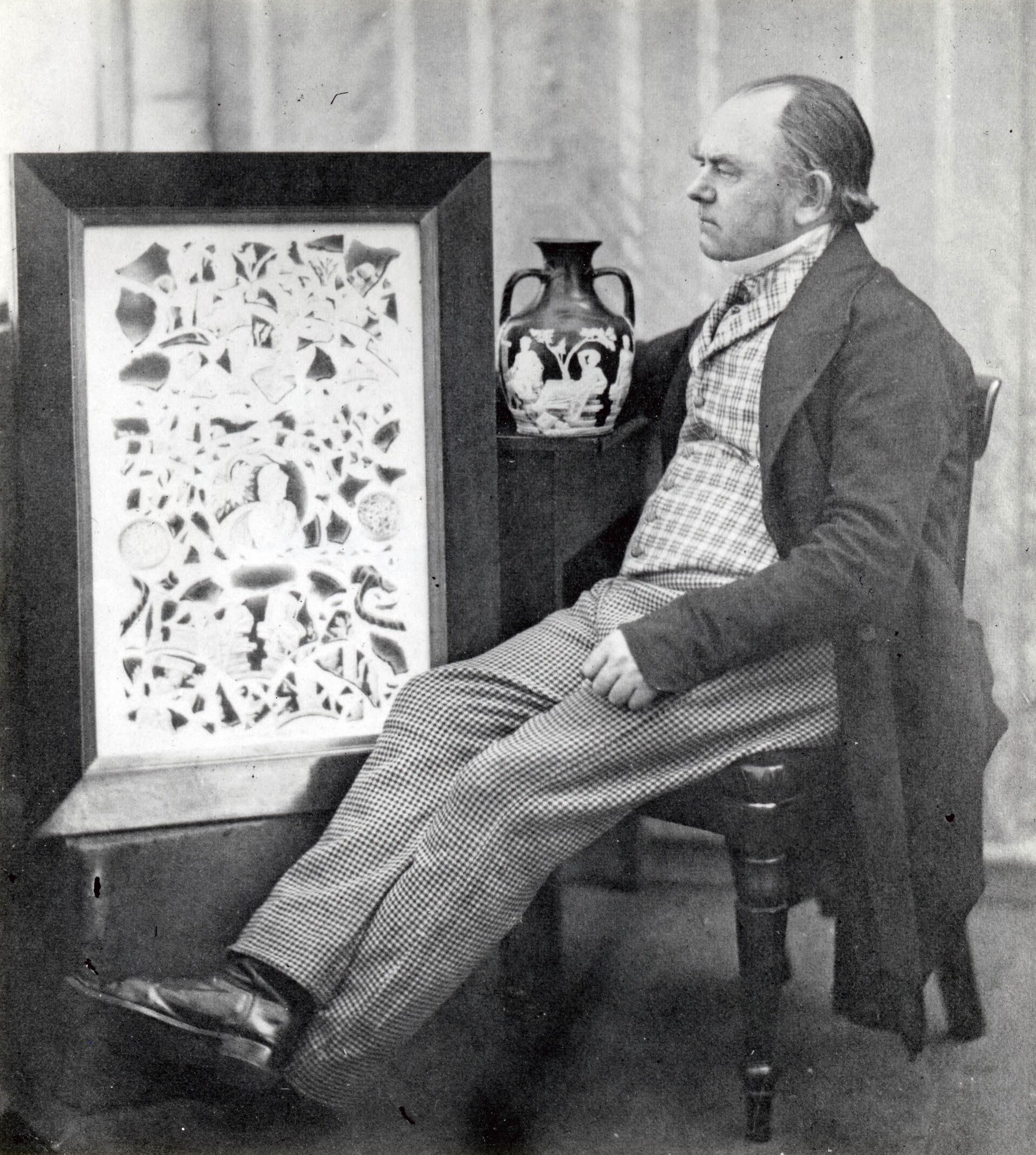
Of 204 published records in this archive, 85 state that no price for the object exists.
9 min read
A maker's bill, workbook or memoir is the only provenance document that fixes date, cost and first owner at once.
10 min read
Last verified 17 September 2026
One artwork and its story every Tuesday, with the picture: who owned it, what it made, and what closes soon in the exhibition calendar. No promotion, and nothing we cannot cite.
We send one email to confirm the address and keep nothing else. Every letter carries a one-click unsubscribe. How we handle your data.