The Diana and Minerva Commode
Thomas Chippendale · 1773
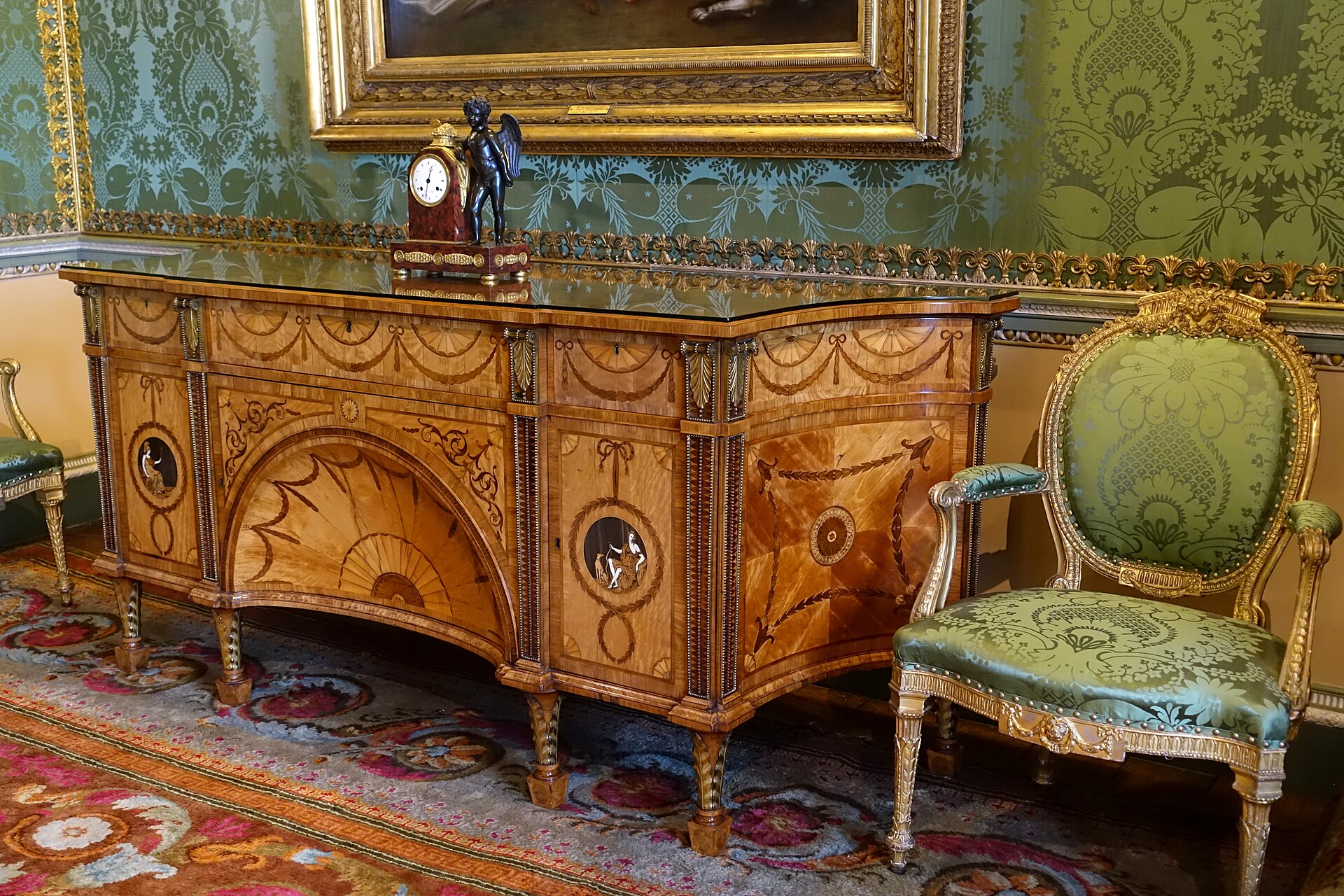
The record subject, photographed in Harewood House in June 2016. The colours are not the delivered colours: the dyes in the marquetry have faded. The Commons file title calls the object mahogany and places it in the State Bedroom; Harewood's own record gives a satinwood ground and the State Dressing Room, now the Spanish Library.
| Artist | Thomas Chippendale |
|---|---|
| Date | 1773 |
| Medium | Marquetry of satinwood, rosewood, tulipwood, ebony and other woods over a carcase, with engraved ivory inlay and gilt-brass mounts |
| Dimensions | Not stated by Harewood House Trust and not published in any source consulted for this record. |
| Where it is now | Harewood House, West Yorkshirelast confirmed 4 August 2026 |
| Inventory number | No inventory number published by Harewood House Trust |
| Attribution | AcceptedDocumented, not attributed. Full note |
| Object type | Furniture |
| Period | English, eighteenth century |
| Inscriptions | None recorded in the sources consulted. |
| Owners on record | 4 links4 documented |
| Sources | 8 cited |
About this record Last verified 17 August 2026 · 8 sources cited · Change log
On this page 11 sections
ContentsClose
A marquetry dressing commode delivered to Harewood House in 1773 and billed by Thomas Chippendale at GBP 86. It is routinely called his greatest single object, and it is one of the few pieces of eighteenth-century English furniture whose maker is proved by an invoice rather than argued from style.
It has never been sold. There is no hammer price for it, no premium, no estimate and no auction record of any kind, because in two hundred and fifty-three years it has changed hands only by inheritance. That is unusual enough to be the first thing worth saying about it, and it is why a price database has nothing on this object at all.
The commode on display is also not the commode that was delivered. Its marquetry was originally coloured with natural dyes that light has since taken out, so the golden object photographed today is a faded version of a brightly coloured one. Published captions get it wrong in the other direction too: the Wikimedia Commons plate used on this page calls it mahogany and places it in the State Bedroom, and Harewood's own record says satinwood ground and State Dressing Room.
Provenance
Each link is graded. Documented: a cited source supports it. Disputed: the identification is argued but not established. Unknown: no owner for that span, and the gap is not smoothed into a narrative. The grades in the glossary.
- 1773 - 1795Edwin Lascelles, 1st Baron Harewood (1713-1795)documented
Commissioned as part of the furnishing of the new house at Harewood and delivered in 1773 for the State Dressing Room. Chippendale's bill prices it at GBP 86. The commission was not a single order but a running account: Samuel Popplewell's Day Book records the cabinet maker Samuel James arriving in October 1769 and the upholder William Reid making repeated visits between 1771 and 1776, spending 856 days in total at Harewood laying carpets, hanging wallpaper, upholstering and arranging furniture. The commode arrived in the middle of a seven-year fit-out, not as a delivery on its own.12
- 1795 - presentThe Lascelles family, Earls of Harewood, at Harewood Housedocumented
By inheritance in one family and in one house since delivery. The commode has never been offered for sale, and no loan or exhibition away from Harewood is recorded in the sources consulted. The date on which administration passed to the Harewood House Trust is not stated in any source that could be fetched for this record and is deliberately not asserted here.12
- 1971 - 1972Retained at Harewood while the collection around it was brokendocumented
Survival in place is contingent and the contingency is history. In 1971 the trustees of the 7th Earl of Harewood sold Titian's Death of Actaeon at Christie's for a hammer price of GBP 1,680,000. The dealer Julius Weitzner resold it at once to the J. Paul Getty Museum for GBP 1,763,000, an export licence was required, the Reviewing Committee on the Export of Works of Art suspended approval for a year, and the National Gallery bought the picture for the nation in 1972. The commode was not among the property sold. A record that treats its presence at Harewood as inevitable has missed that the house was selling at the top of the market in exactly those years.6
- present -Harewood House Trust, West Yorkshiredocumented
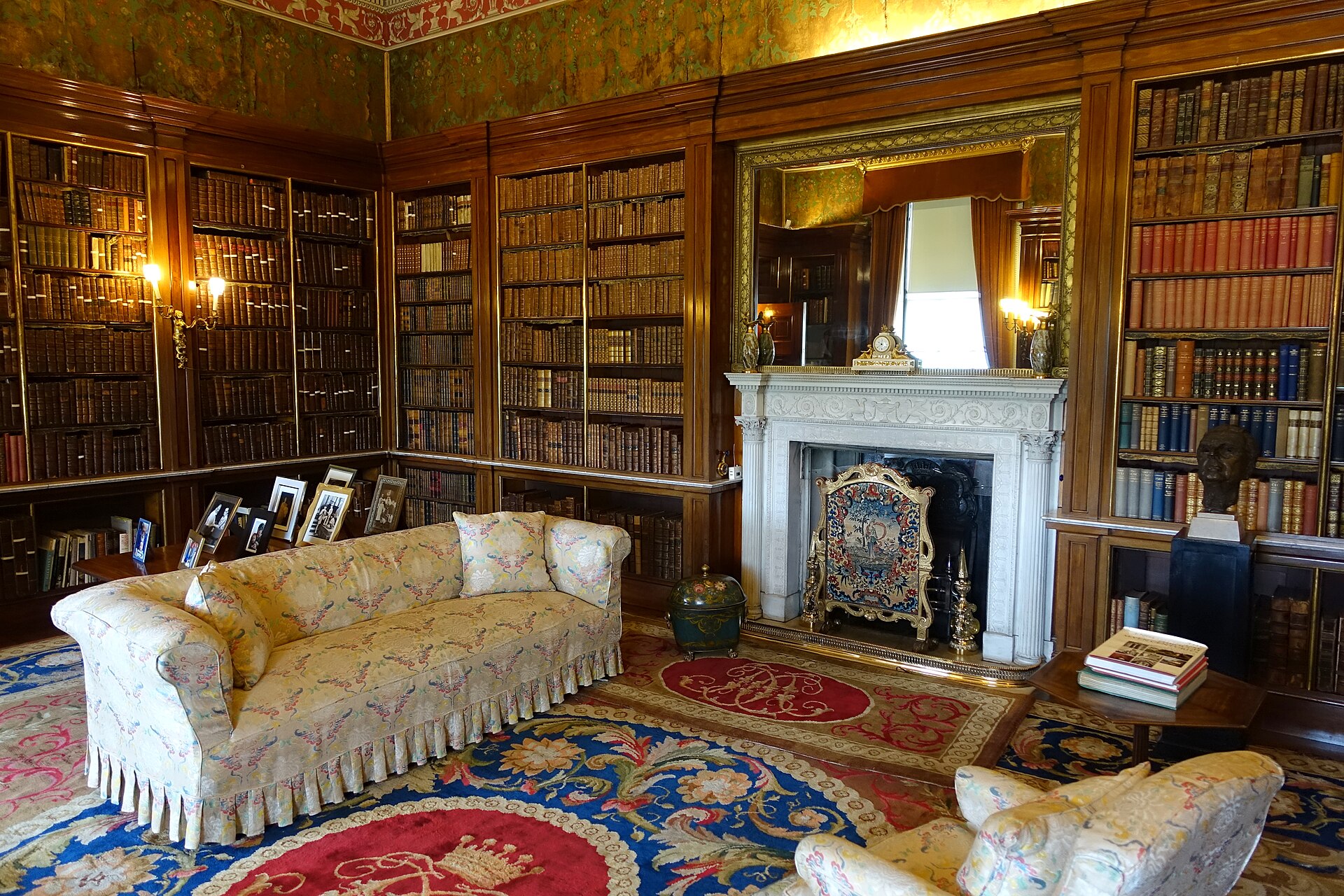
On public display in the Spanish Library. The room is the same room the commode was made for, renamed: it was the State Dressing Room in 1773. No accession or inventory number is published for the object.1
Prices realised
THIS OBJECT HAS NEVER BEEN AT AUCTION. There is no hammer price, no premium-inclusive total, no estimate and no private-treaty figure for the Diana and Minerva Commode, because it has passed only by inheritance since 1773. The only price attached to it is the GBP 86 on Chippendale's own bill, which is a MAKER'S INVOICE FIGURE and not a market price of any kind - it is what the maker charged the first owner, not what a buyer would pay. It is recorded in the technical block rather than here, deliberately, so that it can never be read as a hammer. The GBP 1,680,000 hammer recorded in the provenance chain for 1971 is the price of Titian's Death of Actaeon, a different object sold out of the same house, and is not a price for this commode.
Technical evidence
| Attribution note | Documented, not attributed. Chippendale's own bill to Edwin Lascelles describes the object and prices it at GBP 86, which puts this commode in the small minority of eighteenth-century English furniture whose maker is established by paperwork rather than by connoisseurship. What the paperwork does NOT establish is who inside the workshop cut and engraved the marquetry. The firm's name is documented; the hand is not. |
|---|---|
| Date and cost | Delivered 1773. Billed by Thomas Chippendale at GBP 86. This is a MAKER'S INVOICE FIGURE, not a market price, not an estimate and not a valuation. It is recorded here rather than in the auction block so that it cannot be mistaken for a hammer price.1 |
| Ground and veneers | Marquetry on a ground of golden satinwood, inlaid with rosewood, tulipwood, ebony and other woods. Note that the Wikimedia Commons file title for the lead plate calls the object mahogany; the holding institution does not.123 |
| Ivory | Ivory is used as inlay. Neither the species nor the quantity is stated by Harewood House Trust, and no source consulted addresses the object's position under the UK Ivory Act 2018 or any exemption or registration under it.1 |
| Ornament | Swags of husks, repeated garlands of flowering acanthus leaves, radiating fans, and two dark roundels containing Diana and Minerva. The ornament is inlaid and engraved, not merely cut to shape.12 |
| Colour, as delivered and as now | The inlaid patterns were originally brightly coloured with natural dyes. Much of that colour has faded through exposure to light. The object as photographed today is materially different in appearance from the object delivered in 1773. No analysis of the original dyestuffs was found in the sources consulted.1 |
| Form and function | A dressing commode. The front carries a central concave recess so that a user could sit in to it and reach the drawers; the top drawer was fitted with a mirror and the items of the morning toilette. It is bedroom furniture, not state furniture.12 |
| Iconography | Diana with a crescent moon, bow and whippet; Minerva with helmet, spear, shield and owl. Both identified by Harewood House Trust. No document recording the patron's reason for choosing them has been found.1 |
| Room | Made for the State Dressing Room at Harewood, which is now the Spanish Library, and displayed there. The Commons plate that heads this record places it in the State Bedroom, which the holding institution's record does not support.13 |
| Dimensions | Not published. Harewood House Trust gives no measurements on its object page and none were found in any other source consulted.1 |
| Workshop record | Samuel Popplewell's Day Book, 1769-1776, survives at Harewood and documents the fit-out: the cabinet maker Samuel James from October 1769, and the upholder William Reid across 1771-1776 totalling 856 days on site.2 |
Images
The record in full
Chapter 1The maker is proved by paperwork, which is rare
Almost every important piece of eighteenth-century English furniture is attributed.
Almost every important piece of eighteenth-century English furniture is attributed. The maker is argued from construction, from timber, from a shared moulding profile, from a design in a pattern book. Very little of it is documented, because bills were working papers and working papers were thrown away.
This commode is documented. Chippendale invoiced it, and the invoice describes it: a very large rich Commode with exceeding fine Antique Ornaments curiously inlaid with various fine woods, with Diana and Minerva and their Emblems Curiously inlaid and Engraved. The price on the bill is GBP 86. The object and the paper match, which is why this commode carries an attribution status of accepted rather than attributed, and why it is used as a fixed point against which undocumented furniture is measured.
What the bill does not do is name a hand. It names a firm. That distinction runs through the rest of this record.
Chapter 2It has never been sold, and that is the finding
This object has no auction history. None.
This object has no auction history. None. It has not been offered, withdrawn, bought in or privately treated. It has changed hands exactly by inheritance since 1773, and it is still in the room it was made for, under a different name.
The consequence is that nobody knows what it is worth, and every published figure that appears to be a price for it is not one. The GBP 86 on Chippendale's bill is a maker's invoice figure - what the craftsman charged the first owner - and it is not a market price. This record keeps it out of the auction block entirely and puts it in the technical data, because an invoice figure sitting in a table of results is exactly how an invoice becomes a hammer price in the third source that copies it.
For an object this famous, that is a genuinely strange position. The comparable name pieces of English furniture have all been tested: they have hammer prices, premium-inclusive totals, underbidders and a market cohort. This one has a bill and a house.
Chapter 3The object on display is a faded copy of the object delivered
Harewood states it plainly on its own object page: the inlaid patterns were originally brightly coloured with natural dyes, and much of that colour has now gone through exposure to light.This is not...
Harewood states it plainly on its own object page: the inlaid patterns were originally brightly coloured with natural dyes, and much of that colour has now gone through exposure to light.
This is not a quibble about tone. Eighteenth-century marquetry used greens and blues that were dyed into the wood, and those dyes are fugitive. What survives is the substrate: golden satinwood, warm rosewood, the ebony reading as it always did. What has gone is most of the chromatic scheme that the marquetry was designed around. Every photograph of this commode, including the one at the head of this record, shows an object in a state its maker never saw and its first owner did not pay for.
No published analysis of the original dyestuffs was found in the sources consulted, which means the specific colours are not recoverable from any account this record could reach. That is an unresolved question, not a settled one, and it is recorded as such below.
Chapter 4Even the captions get it wrong
The photograph used as the lead plate here is titled, on Wikimedia Commons, Diana and Minerva Commode by Thomas Chippendale, 1773, mahogany and exotic woods, State Bedroom.
The photograph used as the lead plate here is titled, on Wikimedia Commons, Diana and Minerva Commode by Thomas Chippendale, 1773, mahogany and exotic woods, State Bedroom. Two of those facts are wrong. Harewood's own record gives a satinwood ground, not mahogany, and places the commode in the State Dressing Room, now the Spanish Library, not the State Bedroom.
This is worth stating in the record rather than quietly correcting, because it is the general condition of published data on famous objects. Institution, room, material and date fields on image repositories are user-entered, they are copied outward faster than they are checked, and the only field on a Commons file that is authoritative is the licence. The object here is one of the most photographed pieces of English furniture in the world and its principal free-licence photograph misdescribes its material.
This record follows the holding institution on material and room, and the file page only on licence.
Chapter 5What it is, physically
A dressing commode: a piece of bedroom furniture for a woman, not a display object for a state room, whatever its scale suggests.
A dressing commode: a piece of bedroom furniture for a woman, not a display object for a state room, whatever its scale suggests. The front is broken by a central concave recess, executed so that a woman could sit in to it and reach the drawers, and the top drawer was fitted with a mirror and the equipment of the morning toilette.
The decoration is marquetry - veneers cut and laid to make pattern and picture - worked on a ground of golden satinwood and inlaid with rosewood, tulipwood, ebony and other woods, with ivory used for inlay and with the ornament engraved rather than only shaped. Harewood describes swags of husks, repeated garlands of flowering acanthus and radiating fans. Two dark roundels carry the figures that name the object.
Neither Harewood nor any other source consulted publishes the commode's measurements. For an object of this standing that absence is itself notable, and it is one reason this record does not print a dimension line.
Chapter 6Diana and Minerva, and what the sources will actually support
The two roundels show Diana, goddess of the hunt, with a crescent moon, a bow and a whippet; and Minerva, goddess of learning, the arts, war and justice, with helmet, spear, shield and owl.
The two roundels show Diana, goddess of the hunt, with a crescent moon, a bow and a whippet; and Minerva, goddess of learning, the arts, war and justice, with helmet, spear, shield and owl. Harewood identifies both and lists their attributes, and the attributes are conventional: anyone reading eighteenth-century decoration would have named these two figures without effort.
What no source consulted supplies is a statement of why these two goddesses were chosen for this room and this owner. The pairing of the huntress with the goddess of learning and the arts, on the dressing furniture of a country house being built by a man making a public case for his own taste, invites reading. It does not license one. No contract, letter or memorandum has been found that records anybody's intention, and the difference between what a programme evidently is and what a patron demonstrably meant is a difference this archive keeps.
The honest position is that the iconography here is ordinary, competent and unmysterious, and that the absence of a hidden programme is a finding rather than a gap to be filled.
Chapter 7The timber came from the empire that paid for the house
Satinwood, tulipwood and ebony are not English woods.
Satinwood, tulipwood and ebony are not English woods. Harewood House Trust states on its own pages that the timbers used to decorate this commode came from various parts of the British Empire and were often logged by enslaved people, and that such woods functioned as status symbols reflecting the family's wealth.
That is the holding institution's own language and it is quoted here because the euphemism it avoids - exotic, imported, from the colonies - is the standard register for describing this object elsewhere. The Lascelles fortune that built Harewood and paid Chippendale came out of the West Indies. The wood in the object and the money that bought the object come from the same system, and a description of the marquetry that treats the timber purely as a colour choice has left out how it arrived.
This record does not attempt to quantify the Lascelles slave-trade interests, because no source giving figures, estate names or compensation claims could be fetched during the research for this record. That work is unfinished and is flagged for the editor rather than guessed at.
Chapter 8Who actually made it
Thomas Chippendale did not cut this marquetry.
Thomas Chippendale did not cut this marquetry. He ran a firm at 60-62 St Martin's Lane in London, in partnership with the Scottish merchant James Rannie and later with Rannie's bookkeeper Thomas Haig, and the workshop employed cabinet makers, carvers, gilders, upholders and specialist marquetry cutters whose names are almost entirely lost.
At Harewood the surviving record is unusually good, and it is administrative rather than artistic. Samuel Popplewell's Day Book covering 1769 to 1776 records the cabinet maker Samuel James arriving in October 1769. It records the upholder William Reid coming repeatedly between 1771 and 1776 and spending 856 days at the house, laying carpets, hanging wallpaper, upholstering and arranging furniture. That is more than two working years of one man's life inside a single commission, and it is preserved because someone was counting days for payment.
The person who cut and engraved the Diana and Minerva roundels is not named in that day book or in any source consulted. The most skilled work on the most celebrated object in the commission is anonymous, while the man who laid the carpets is not. That inversion is the ordinary condition of workshop attribution and it is worth naming rather than smoothing.
Chapter 9The commission, not the object
The commode is a single item on a running account.
The commode is a single item on a running account. Edwin Lascelles was furnishing a new house and Chippendale was engaged not as a supplier of individual pieces but as what the eighteenth century called an upholder and what Harewood's own 2018 exhibition title calls a decorator: designer, maker and fitter-out of complete rooms.
That is why the day book matters more than the invoice. The invoice tells you what one object cost. The day book tells you that the firm had men living at the house for years, that the work was sequenced room by room, and that the commode arrived into a scheme already partly installed. Reading the commode as a stand-alone masterpiece delivered to an empty room misdescribes how it was made and how it was meant to be seen.
Harewood retains the Chippendale bills and the Popplewell day book. Very few English houses can produce both the furniture and the paperwork for it, and that survival, more than any quality of the marquetry, is what makes this object load-bearing for the whole study of English furniture.
Chapter 10It is not the only Chippendale dressing commode in the house
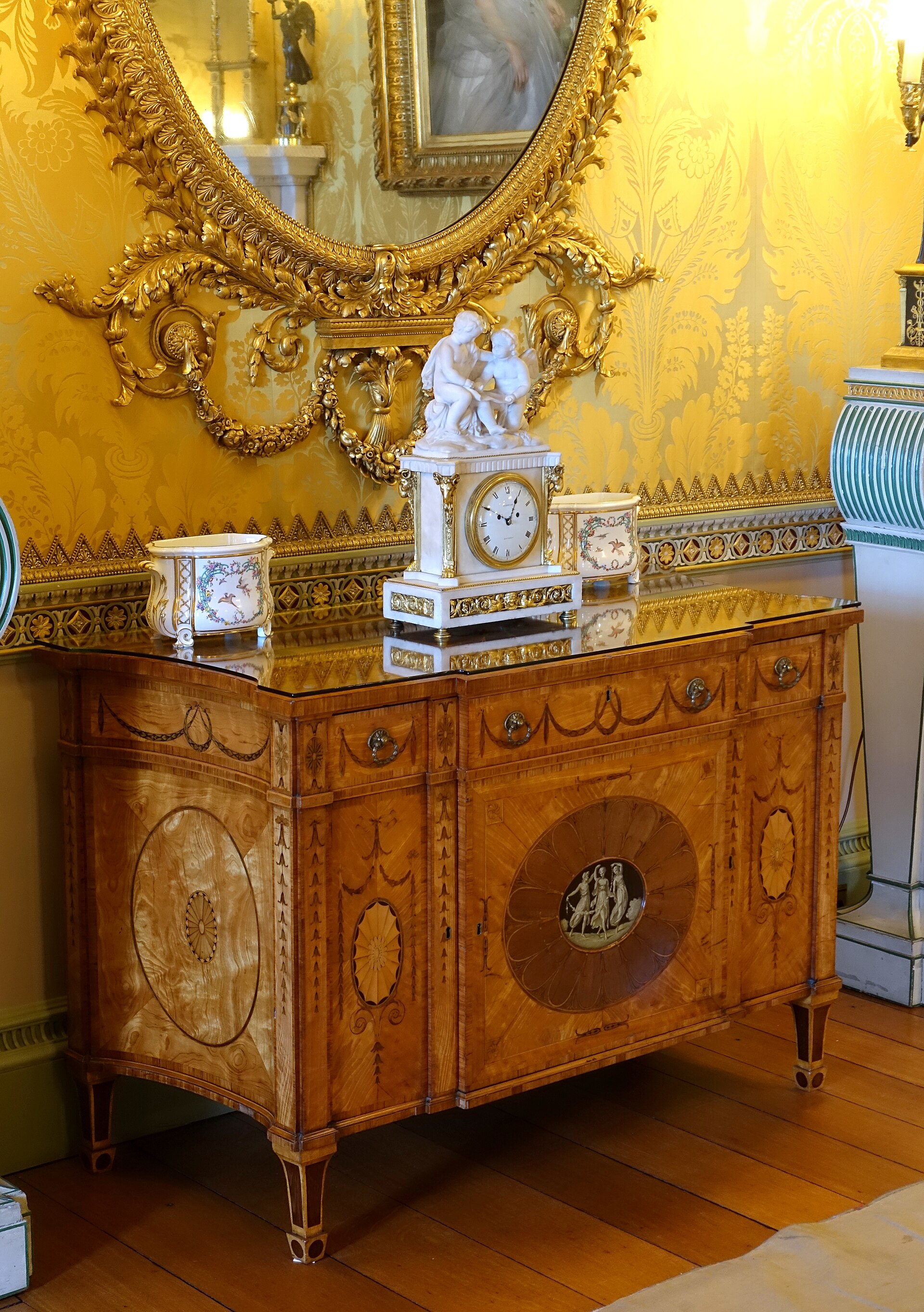
Harewood holds a second marquetry dressing commode by the same firm, in the Yellow Drawing Room, decorated with the Three Graces and worked in marquetry on satinwood with rosewood insets.
Harewood holds a second marquetry dressing commode by the same firm, in the Yellow Drawing Room, decorated with the Three Graces and worked in marquetry on satinwood with rosewood insets. It is a close cousin in material, technique and function, and it is a different object.
The distinction matters because the two are photographed in the same house on the same day by the same photographers and captioned loosely afterwards. A record that shows one and describes the other is the exact error this publication exists to prevent, and the second commode appears in the gallery below labelled as what it is.
Chapter 11Survival was not guaranteed
Harewood sold. In 1971 the trustees of the 7th Earl put Titian's Death of Actaeon into Christie's, where it made a hammer price of GBP 1,680,000.
Harewood sold. In 1971 the trustees of the 7th Earl put Titian's Death of Actaeon into Christie's, where it made a hammer price of GBP 1,680,000. The dealer Julius Weitzner resold it immediately to the J. Paul Getty Museum for GBP 1,763,000, which triggered an export licence application. The Reviewing Committee on the Export of Works of Art suspended approval for a year to let a British buyer match the price, and the National Gallery raised the money and bought the picture in 1972.
None of that touched the commode, which is the point. Great houses meet obligations by selling, and what stays is partly a matter of what the market wanted in a given decade. English furniture in 1971 could not have raised what a Titian raised. The commode is still at Harewood in part because it was worth less than the pictures at the moment the house needed money.
Chapter 12What this record does not claim
This object has no reattribution, no rediscovery, no restitution claim and no authenticity dispute.
This object has no reattribution, no rediscovery, no restitution claim and no authenticity dispute. Nobody contests that Chippendale's firm made it, nobody contests when, and it has never left the family that ordered it. Measured against the usual test for a record here - that an object must have at least one moment of genuine dispute - this one earns its place on narrower ground: a documented commission that can be read against surviving workshop accounts, a physical state that has changed materially since delivery, a market history that is empty, and published descriptions that are demonstrably wrong.
Saying that plainly is better than manufacturing a controversy. The editor should know that this is the weakest of the three furniture records in this batch on the dispute criterion, and the strongest on documentation.
The artist
Thomas Chippendale
Chippendale is the only English cabinet maker whose name became a style, and the cost of that is that most furniture called Chippendale has nothing to do with him. He published a pattern book that any competent workshop in Britain or America could buy and copy, so the word now describes a look rather than a maker. The documented output of the actual firm is small, concentrated in a handful of great houses, and Harewood holds the best of it together with the paperwork that proves it. Reading this dossier, hold the distinction: the Director made the name, the bills made the record, and they are not the same thing.
Exhibited
- 2018Thomas Chippendale: Designer, Maker, DecoratorHarewood House, West Yorkshire
Related works
| Work | Relation | Where it is |
|---|---|---|
| Dressing commode with the Three Graces Thomas Chippendale | A second Chippendale marquetry dressing commode in the same house, frequently confused with this one Marquetry on satinwood with rosewood insets. Same maker, same house, same furniture type, different object. | Yellow Drawing Room, Harewood House, West Yorkshire |
| The Gentleman and Cabinet-Maker's Director Thomas Chippendale | The maker's published pattern book, the basis of his reputation The Director made Chippendale's name a style rather than a firm, which is why so much furniture he never touched is called Chippendale. | Editions of 1754, a near reprint in 1755, and a revised and enlarged edition in 1762 |
| The Death of Actaeon Titian | The Harewood object that did leave, sold while this one stayed Sold by the trustees of the 7th Earl at Christie's in 1971 at a hammer price of GBP 1,680,000, exported to the Getty, held by an export licence deferral and bought for the nation in 1972. | The National Gallery, London, NG6420 |
Open questions
- What are the commode's dimensions? Harewood House Trust publishes none, and no source consulted gives a measurement.
- Who cut and engraved the marquetry? The firm is documented by invoice; the hand inside the workshop is not named in Popplewell's day book or anywhere else consulted.
- What were the original colours? Harewood states the dyes have faded but no analysis of the dyestuffs, and therefore no reconstruction of the delivered appearance, was found.
- What ivory is it, and what is its legal position? Neither species nor quantity is published, and no source addresses the UK Ivory Act 2018 or any exemption.
- Does the GBP 86 on the bill cover the whole object, or only part of the work on it? The invoice wording quoted in the sources is partial and the full bill text was not obtained.
- When did administration pass to the Harewood House Trust, and does the trust or the family own the commode today? No source consulted states either.
- Has the commode ever left Harewood for loan, exhibition or conservation? No off-site movement is recorded in the sources consulted, which is not the same as none having happened.
Questions about this object
What is The Diana and Minerva Commode?
The Diana and Minerva Commode is a furniture, dated 1773. Medium: Marquetry of satinwood, rosewood, tulipwood, ebony and other woods over a carcase, with engraved ivory inlay and gilt-brass mounts.
Who made The Diana and Minerva Commode, and is the attribution settled?
The attribution to Thomas Chippendale is recorded here as accepted. Documented, not attributed. Chippendale's own bill to Edwin Lascelles describes the object and prices it at GBP 86, which puts this commode in the small minority of eighteenth-century English furniture whose maker is established by paperwork rather than by connoisseurship. What the paperwork does NOT establish is who inside the workshop cut and engraved the marquetry. The firm's name is documented; the hand is not.
Where is The Diana and Minerva Commode now?
Harewood House, West Yorkshire. Inventory number No inventory number published by Harewood House Trust. Last confirmed 4 August 2026. On display in the Spanish Library, the room that was the State Dressing Room the commode was made for.
What is still unknown about The Diana and Minerva Commode?
What are the commode's dimensions? Harewood House Trust publishes none, and no source consulted gives a measurement.
Sources
- 1Harewood House Trust, object page, 'Diana and Minerva Commode'. The holding institution's own record: date 1773, maker Thomas Chippendale, cost GBP 86, made for the State Dressing Room now the Spanish Library, marquetry with ivory inlay, satinwood and tulipwood and ebony from the British Empire, the two roundels and their attributes, and the statement that the original dyed colours have faded. harewood.org/object/...
- 2Harewood House Trust, 'Thomas Chippendale's Tercentenary'. Source for the invoice wording, the satinwood ground with rosewood and tulipwood, the central concave recess, the statement that the timbers were often logged by enslaved people, Samuel Popplewell's Day Book 1769-1776, the cabinet maker Samuel James from October 1769, the upholder William Reid and his 856 days between 1771 and 1776, and the 2018 exhibition opening on 22 March. harewood.org/stories/...
- 3Wikimedia Commons file page for the lead plate, DSC01815 by the user Daderot. Licence verified at fetch time: LicenseShortName 'Public domain'; the wikitext carries {{PD-old-100}} for the object and {{self|cc-zero}} for the photograph, so the photographer has waived his own copyright in the image of a three-dimensional object. Also the source of the two errors discussed in the record, the file title calling the commode mahogany and placing it in the State Bedroom. commons.wikimedia.org/wiki/...
- 4The Chippendale Society, article on Chippendale's clandestine first marriage: Catherine Redshaw, 19 May 1748, the New Chapel near Hyde Park Corner, the irregular handwritten licence noted by the member Peter White, the likely reason of a bride under 21, the Hardwicke Marriage Act of 1753, and the second marriage to Elizabeth Davis on 17 July 1777. thechippendalesociety.co.uk/thomas-chippendale
- 5The Decorative Arts Trust, Attingham Summer School post, recording the furniture historian Adam Bowett teaching from the Diana and Minerva Commode at Harewood House. Cited for the fact that the object is used as a teaching piece by named scholars; the substance of Bowett's remarks is not printed on the page and is NOT relied on here. decorativeartstrust.org/zimmerman-attingham-post/...
- 6TERTIARY. Wikipedia, 'The Death of Actaeon', for the 1971 Harewood sale at Christie's at a hammer price of GBP 1,680,000, the Weitzner resale to the Getty at GBP 1,763,000, the export licence deferral by the Reviewing Committee, and the National Gallery purchase in 1972 as NG6420. Flagged for replacement with the Reviewing Committee's own annual report and the National Gallery catalogue entry. en.wikipedia.org/wiki/...
- 7TERTIARY. Wikipedia, 'Thomas Chippendale', for the baptism at Otley on 5 June 1718, the burial at St Martin-in-the-Fields on 16 November 1779, the training under his father John Chippendale and under Richard Wood of York, the move to 60-62 St Martin's Lane in 1754 and the family firm's occupation of it until 1813, the partners James Rannie, Thomas Haig and Henry Ferguson, the Director editions of 1754, 1755 and 1762, and the son Thomas the younger (1749-1822) and his 1813 bankruptcy. Flagged for replacement with Christopher Gilbert, The Life and Work of Thomas Chippendale (1978). en.wikipedia.org/wiki/...
- 8Wikimedia Commons file page for the Three Graces dressing commode plate, DSC01891 by Daderot. Licence verified at fetch time: LicenseShortName 'Public domain', wikitext {{PD-old-100}} plus {{self|cc-zero}}. Source for the identification of a SECOND Chippendale dressing commode at Harewood, in the Yellow Drawing Room, with marquetry on satinwood with rosewood insets. commons.wikimedia.org/wiki/...


Last verified 17 August 2026 · Published 4 August 2026
Change log
2 August 2026 - Record deepened to the house standard: narrative sections, technical evidence, artist dossier, related works and open questions added; provenance chain and auction results replaced with the researched versions; sources rebuilt.
4 August 2026 - Record created at the house standard: researched narrative, technical evidence, maker dossier, graded provenance chain, prices with hammer and premium separated, related works, open questions and sources.
17 August 2026 - Re-verified 2026-08-17: current location, attribution and all 6 source URLs re-checked live (all resolve 200). No change to location, attribution, litigation or export status found. The commode's 2018 tercentenary exhibition context already reflected in the record remains accurate; no newer exhibition or sale event found.