Nicolas Poussin
 French (worked mainly in Rome) · 1594-1665
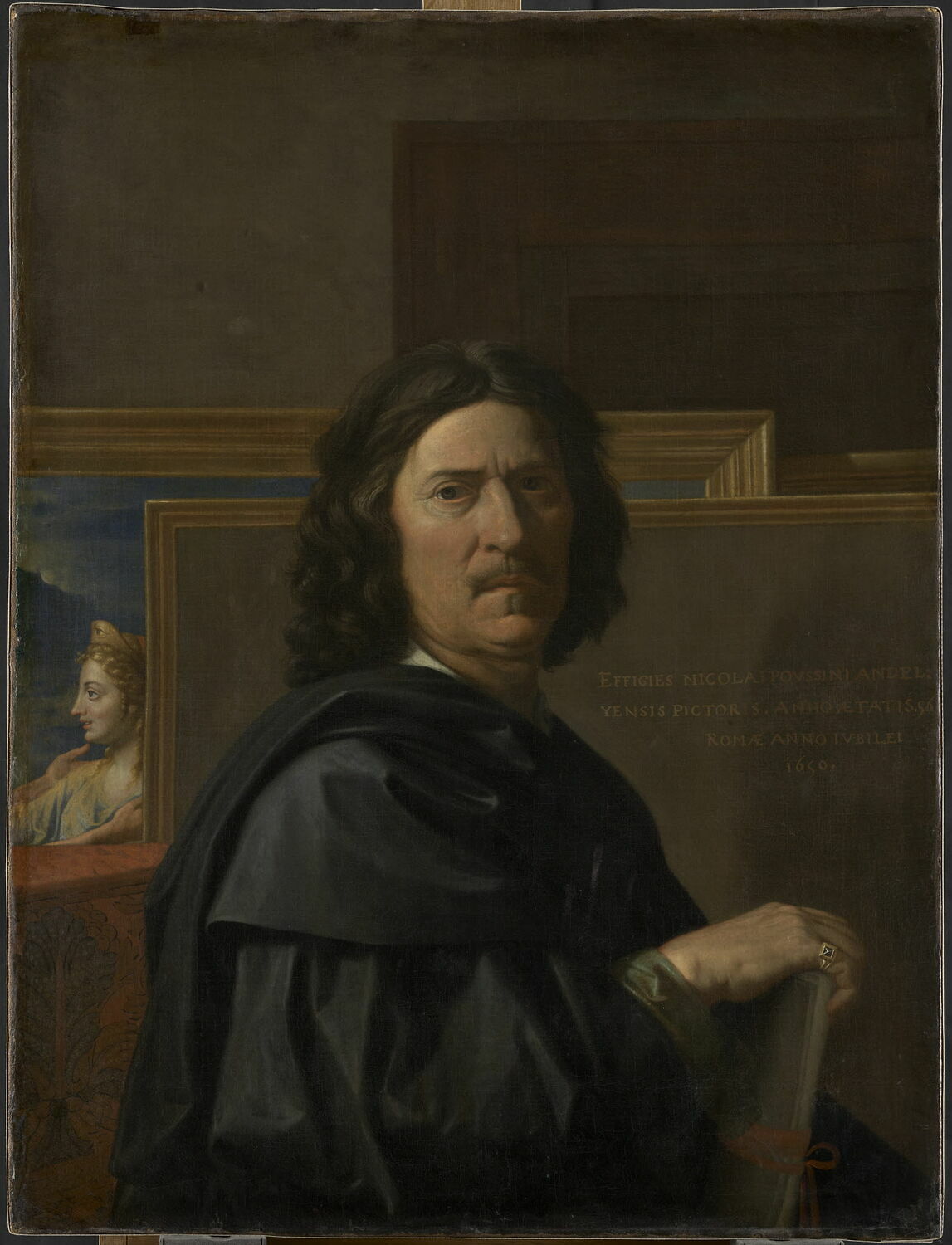
Self-portrait, oil on canvas, Musee du Louvre (inv. 7302; MR 2329 in the Commons file title), the inscription on the canvas including the year 1650. The identification as a self-portrait rests on that inscription and long museum attribution; Green records that Chantelou owned the portrait now in the Louvre by the time of Bernini's visit in 1665. Wikipedia says Chantelou and Pointel each asked for a portrait in 1647 and gives the pair as completed together in 1649, which differs from the 1650 on this canvas; the difference is unresolved. Public domain, verified on the file page and wikitext (PD-art, PD-old-100-expired).
Musee du Louvre, Paris (public domain)| Worked as | Painter, Draughtsman, Illustrator (title-pages and drawings) |
|---|---|
| Born | 15 June 1594 (as given in the National Gallery's 2024 note) · near Les Andelys, Normandy |
| Died | 19 November 1665 · Rome |
| Nationality | French (worked mainly in Rome) |
| Movement | French Classicism |
| Sources | 32 cited |
| Last verified |
About this page Last verified · 32 sources cited
On this page 13 sections
ContentsClose
Poussin is the painter against whom French art was measured for two centuries, and the count of what he actually painted is still moving. Jacques Thuillier's restrictive list of 1994 gave 224 uncontested autograph paintings and 33 doubtful ones, and Pierre Rosenberg's four-volume catalogue raisonne of the paintings was described by The Art Newspaper in March 2026, as due that spring, as engaging with and sometimes correcting Anthony Blunt's catalogue of 1966. No accepted total for Blunt or for Rosenberg could be taken from a source read in full; a bookseller's listing for Rosenberg is reported under the corpus heading.
After an altarpiece for St Peter's that met official displeasure, he painted in Rome mainly small and mid-sized pictures for a select few collectors (the National Gallery's wording); the exception was the Paris post of First Painter in 1640-42. The picture sets that made his name were private commissions, and the best documented of them, the first Seven Sacraments painted for Cassiano dal Pozzo, has been breaking up for two centuries: one lost in a fire in 1816, one sold to Washington, and since 2011 one to Fort Worth, one to Cambridge, one sold abroad in 2023 and one bought by the National Gallery in 2024, with the seventh, Marriage, still on loan from the Rutland trustees.
The thing a reader probably doesn't know is how recently the ground has shifted. A National Gallery picture catalogued as a copy since at least 1946 was returned to Poussin in 2021, a Louvre picture Rosenberg had long taken for a copy was cleaned and accepted after 2012, and the two largest figures documented here were a lot that failed at auction and a private sale that never had a hammer price.
Images
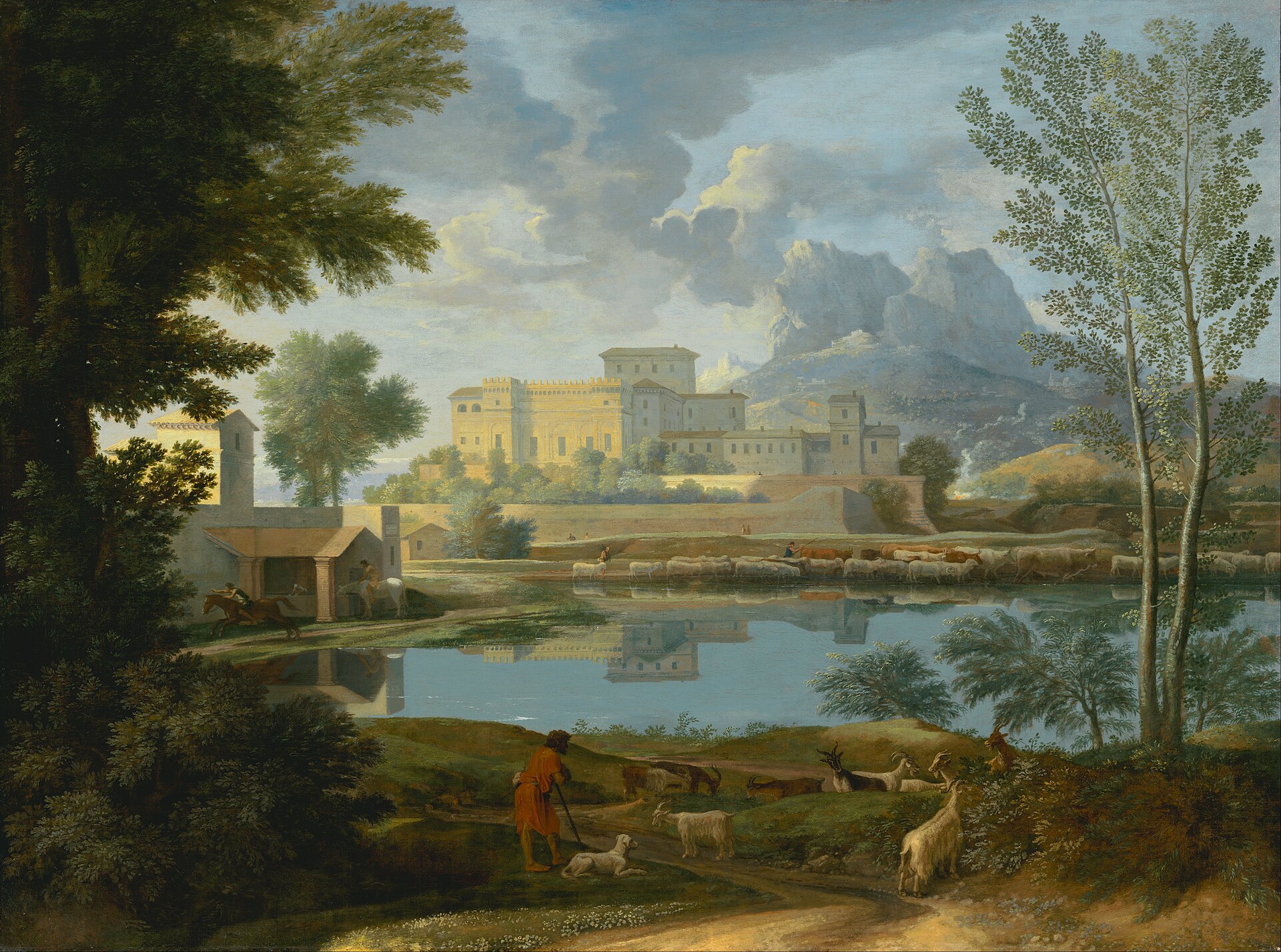
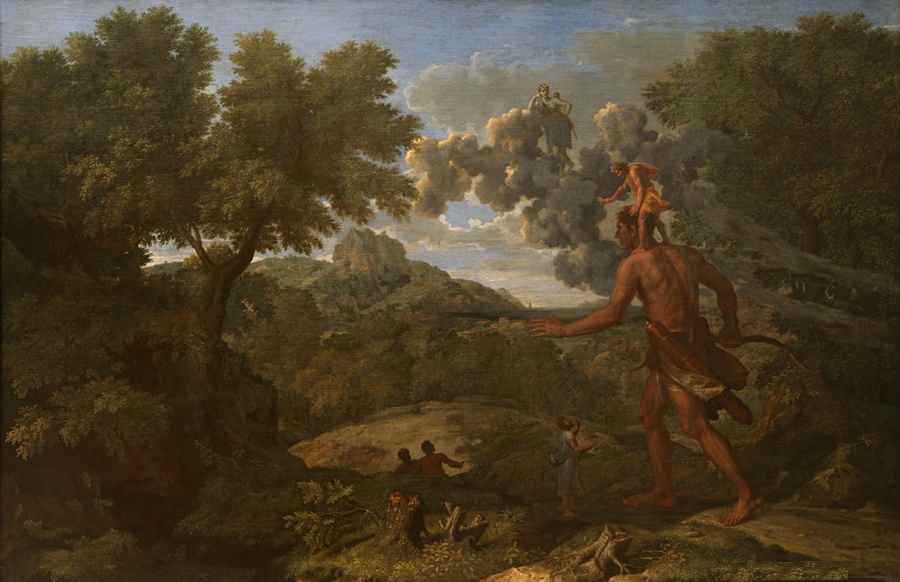
Chronology
- 1594
Born near Les Andelys in Normandy; the National Gallery's 2024 note gives 15 June 1594.714
- c. 1612
Runs away to Paris, per Wikipedia; works briefly for Ferdinand Elle and Georges Lallemant and sees royal collections.14
- 1624
Reaches Rome in the spring; Marino, who invited him, has just left for Naples.14
- 1627
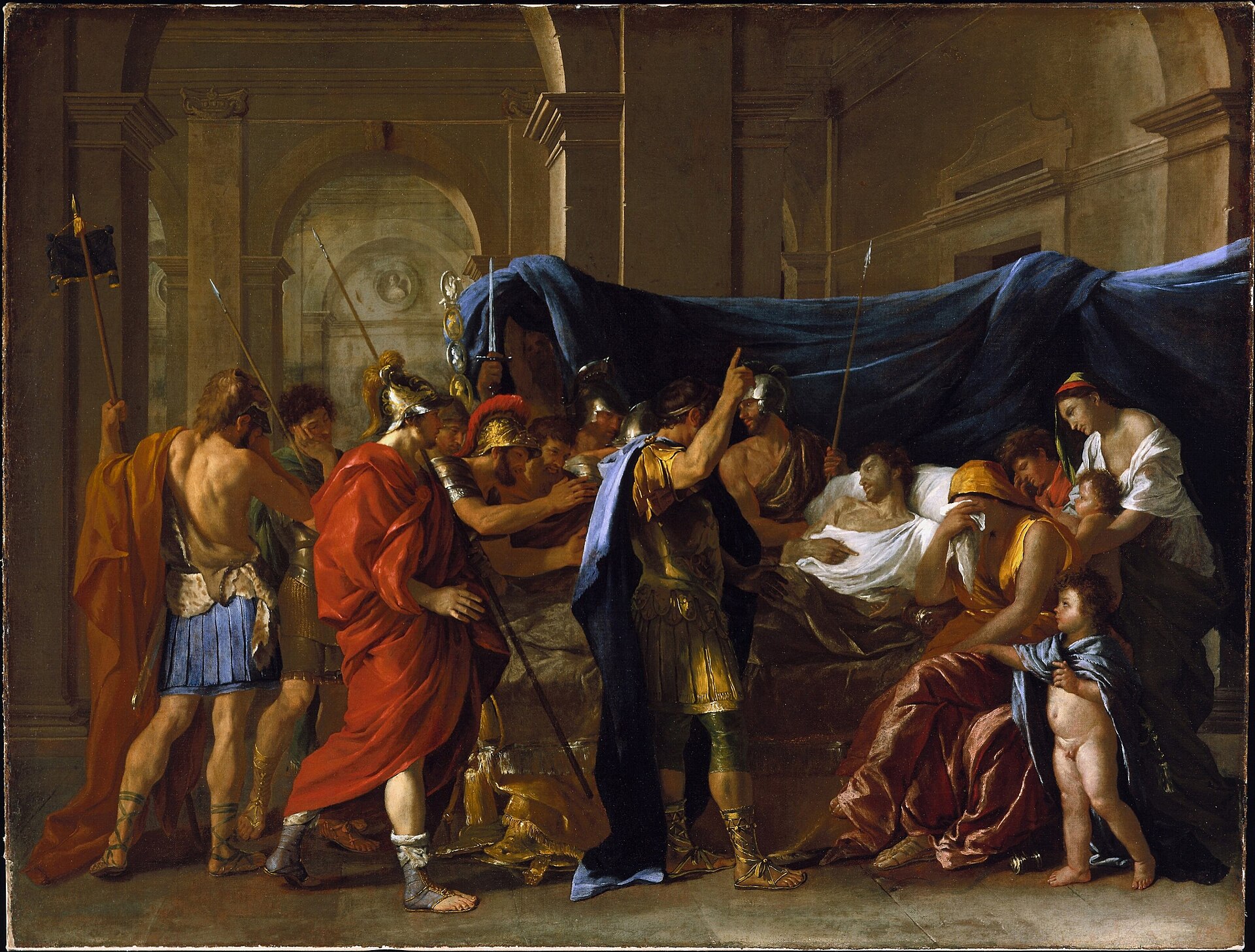
Paints The Death of Germanicus for Cardinal Barberini (Minneapolis); the first Et in Arcadia ego at Chatsworth dates to about the same year.1416
- 1628
Wins the altarpiece of the Martyrdom of Saint Erasmus for St Peter's, which is poorly received; turns to private patrons.14
- 1 September 1630
Marries Anne-Marie Dughet, daughter of the cook who had nursed him.14
- 1636
The Triumph of Pan is painted for Cardinal Richelieu, probably by May of that year.9
- 1636-42
Cassiano dal Pozzo's first Seven Sacraments painted in Rome (the Kimbell gives 1636-42; other sources 1637-40).117
- December 1640
Arrives in Paris as First Painter to Louis XIII; leaves permanently for Rome in autumn 1642.14
- 1644-48
Second Seven Sacraments painted for Paul Freart de Chantelou.3
- 24 November 1647
Writes Chantelou the letter on the modes, defending different manners for different subjects.2122
- 1655
Louis Fouquet obtains official recognition of Poussin's title of First Painter and payment for past work.14
- 19 November 1665
Dies in Rome; buried in San Lorenzo in Lucina.14
- 1785
James Byres sells the first Sacraments to the 4th Duke of Rutland.111
- 1787
The first Sacraments are shown at the Royal Academy, London.5
- 1816
- 2010
Ordination fails to sell at Christie's London; the Rutland set is taken off show at the National Gallery.1015
- 2011
Export bar on Ordination in May; the Kimbell announces its purchase in September.511
- 2021
The National Gallery returns The Triumph of Silenus to Poussin.8
- 2023
Export licence issued for Confirmation in January; it is sold abroad.67
- 2024
The National Gallery acquires Eucharist through Acceptance in Lieu on 22 March.7
- 2026
The Art Newspaper (4 March 2026) reports Rosenberg's four-volume catalogue raisonne of the paintings as due that spring; publication wasn't checked after that.12
The market
No single Poussin result could be separated into hammer and premium from the sources used, and no record price is named. What the rows do show is that the two largest recent figures are not auction results: a lot that failed at Christie's in 2010 and a private sale a year later. Recommended export prices (GBP 15,000,000 in 2011 and GBP 19,000,000 in 2022) are valuations that frame the Reviewing Committee's deferral, not sales.
The spread in the rows is wide: USD 24.3 million for one first-series Sacrament in a private sale against GBP 60,000 for an early satyr picture whose attribution scholars supported before the sale. For scale, the 1785 offer for the whole first set was GBP 2,000, and no period wage comparison is given because no sourced method was found.
| Date | Sale | Work | Result | Note |
|---|---|---|---|---|
| 1741-42 | Samuel Paris sale | The Triumph of Pan (Richelieu commission of 1636; later National Gallery NG 6477) | Hammer Not stated; price printed by Wine as lot 49 is garbled in the page read With premium Not recorded GBP | Lot 49, to Peter Delme. The price is garbled in the online text and is not used. |
| 13 February 1790 | Christie's, London (Delme sale) | The Triumph of Pan | Hammer Not stated; price printed by Wine as GBP 950 5s With premium Not stated in the source GBP | Lot 62, to Rupile(?) for the 2nd Earl of Ashburnham. |
| 20 July 1850 | Christie and Manson, London (Ashburnham sale) | The Triumph of Pan | Hammer Not stated; price printed by Wine as GBP 1,239 With premium Not stated in the source GBP | Lot 64, to Hume for James Morrison. Bought by the National Gallery in 1982 with National Heritage Memorial Fund help; price not found. |
| 1785 | Private sale via James Byres, Rome | First Seven Sacraments (all seven) | Hammer No hammer; the Duke's offer was GBP 2,000 for the set With premium None GBP | Offer reported by the Fitzwilliam; the final price is not in the sources used. |
| December 2010 (7 or 8 December in different sources) | Christie's, London (Old Master sale) | Ordination, first series | Hammer None: unsold. Estimate GBP 15-20 million; reserve GBP 15 million per O'Brien's account With premium None GBP | Bids taken to just under reserve; no phone bidder moved (O'Brien, the vendor's adviser). Pre-sale reports give the sale date as 7 December and Wikipedia as 8 December. |
| September 2011 | Private sale, Kimbell Art Museum (advised by Robert Holden Ltd and Sotheby's) | Ordination, first series | Hammer No hammer exists (private sale) With premium Not stated; USD 24.3 million reported as the price USD | Price as given by O'Brien and Wikipedia, not by the Kimbell. Export licence issued August 2011. |
| 18 April 2024 | Sloane Street Auctions, London | Satyr with a nymph on his back, c. 1626-27 (Wright and Standring support Poussin) | Hammer GBP 60,000 as reported; hammer or total not stated With premium Not stated GBP | Double the top estimate. |
Hammer is the price at which the bidding stopped; with premium adds the fee the house charges the buyer on top. Hammer price and buyer's premium in the glossary.
Recorded without a public price
- 2022-2023 · Confirmation, first series · Private sale abroad after UK export bar · No hammer; price not published Recommended price under the export bar GBP 19,000,000; licence issued January 2023; buyer not named in sources opened.
- November 2024 · Venus Spied on by Two Satyrs · Ader, Paris · Result not found Pre-sale estimate up to EUR 1 million; research assisted by Eric Turquin.
Where to see the work
| Institution | City | Holdings | Note |
|---|---|---|---|
| Musee du Louvre | Paris | The second Et in Arcadia ego (1637-38, 85 by 121 cm), the Louvre Rape of the Sabine Women (INV 7290), the 1650 self-portrait (inv. 7302), the Finding of Moses painted for Pointel, Mars and Venus (c. 1625) and the late Seasons. | The Poussin rooms are in the Richelieu wing; The Art Newspaper reports that most visitors keep clear of the Poussin corner; Rosenberg's own words in it are that Poussin is a very difficult painter. |
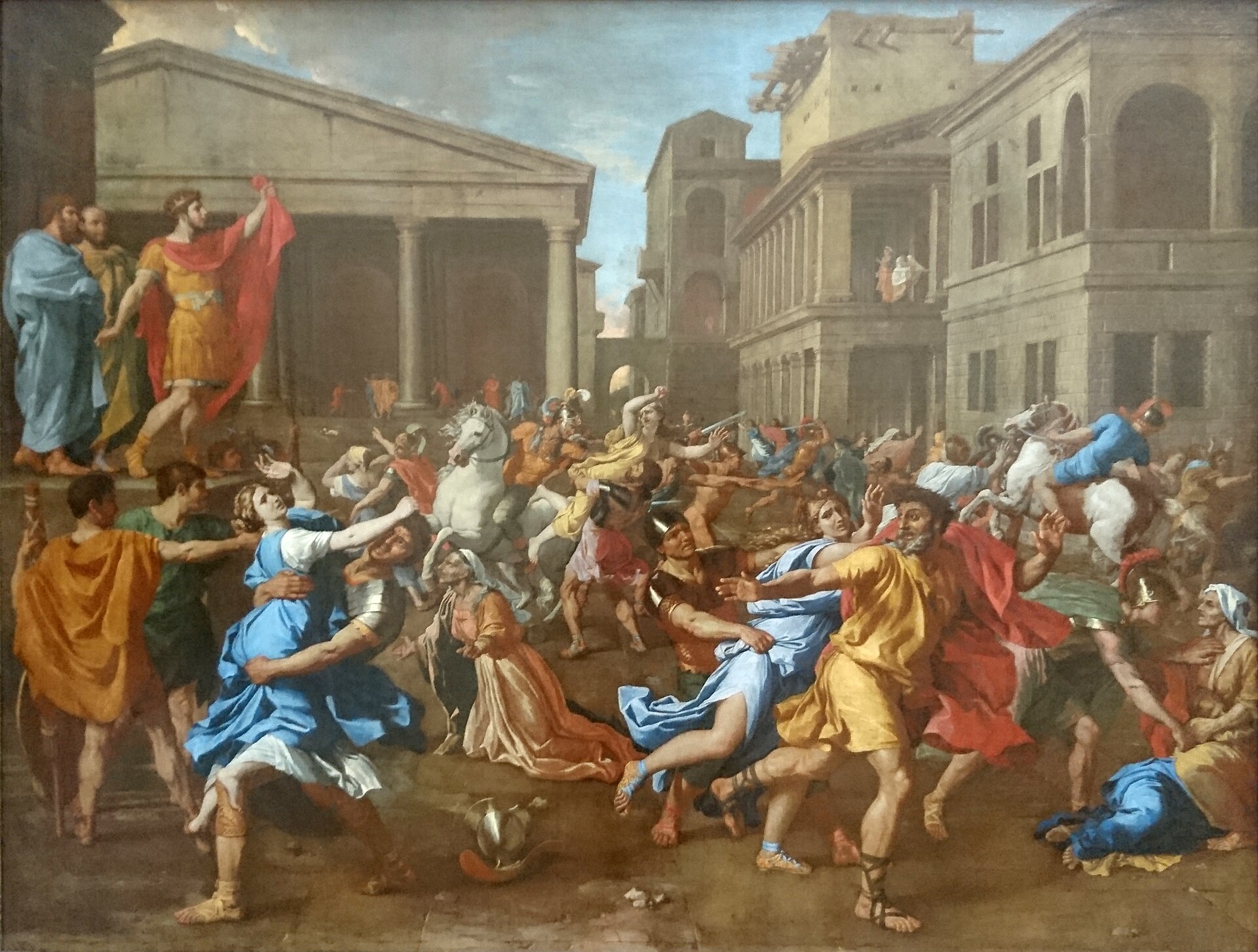
| The Metropolitan Museum of Art | New York | Blind Orion (24.45.1), The Abduction of the Sabine Women (46.160, probably 1633-34), Saints Peter and John Healing the Lame Man (24.45.2), Midas Washing (71.56), The Companions of Rinaldo (1977.1.2) and The Agony in the Garden on copper (2021.378). | Which version of the Sabine Women: the Met's is the earlier one. |
| The National Gallery | London | The Triumph of Pan (NG 6477), The Triumph of Silenus (NG 42) and Eucharist from the first Sacraments, with Marriage on loan; 14 autograph pictures in 2021 before Eucharist. | Eucharist hung in Room 31 from 22 March 2024. |
| Scottish National Gallery | Edinburgh | The second Seven Sacraments of 1644-48, on loan. | The Ordination in this set is the one in the Chantelou letter, not the Kimbell's. |
| Kimbell Art Museum | Fort Worth | Ordination from the first Sacraments (c. 1636-40, 95.9 by 121.6 cm) and Venus and Adonis. | On view since 14 September 2011. |
| The Fitzwilliam Museum | Cambridge | Extreme Unction from the first Sacraments. | Acquired 2012 on the Museum's page and 2013 on the National Gallery's. |
| National Gallery of Art | Washington, DC | Baptism from the first Sacraments. | Acquisition dated 1939 or 1946 depending on the source. |
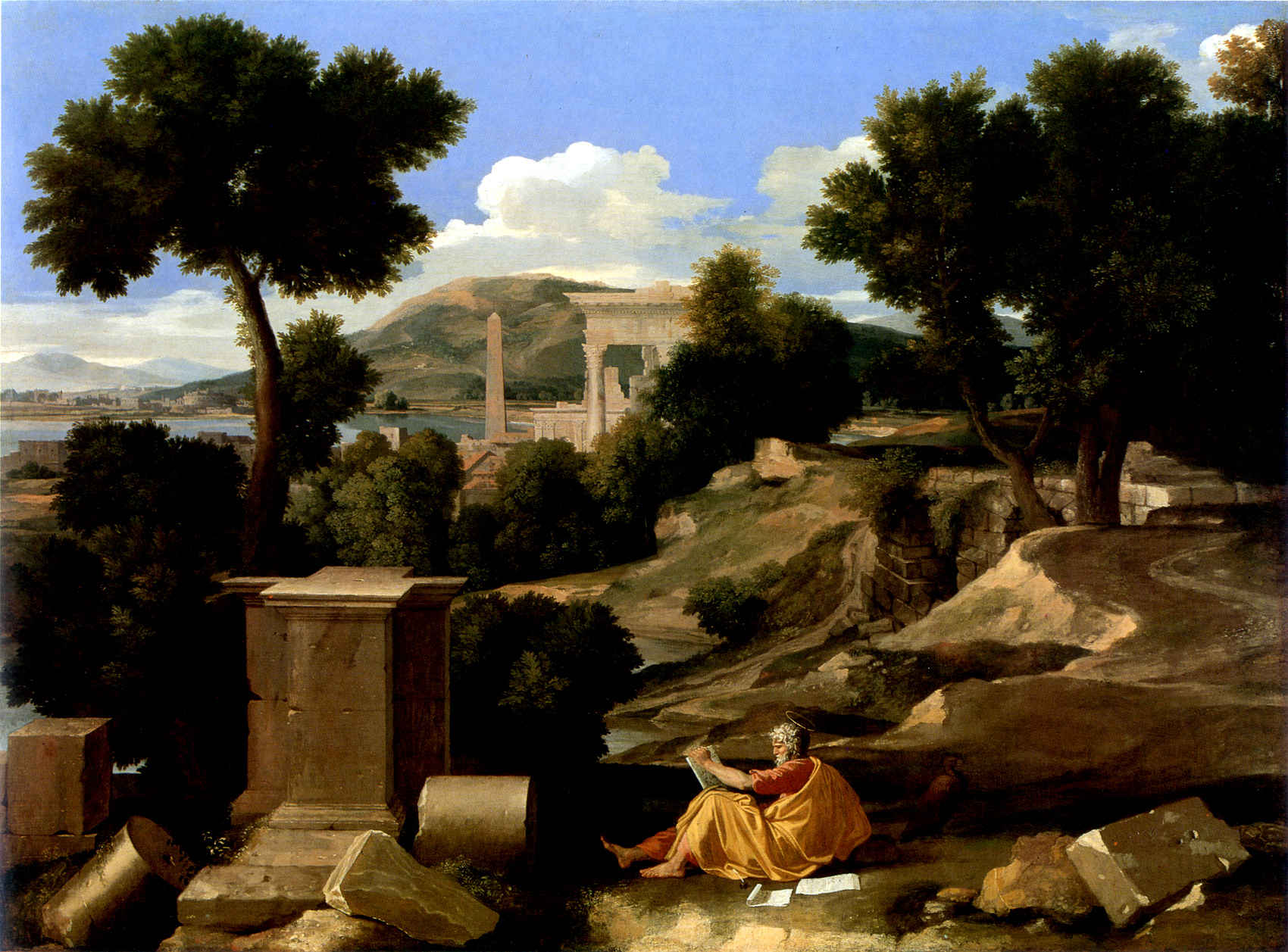
| Art Institute of Chicago | Chicago | Landscape with Saint John on Patmos (1640). | |
| Minneapolis Institute of Art | Minneapolis | The Death of Germanicus (1627). | |
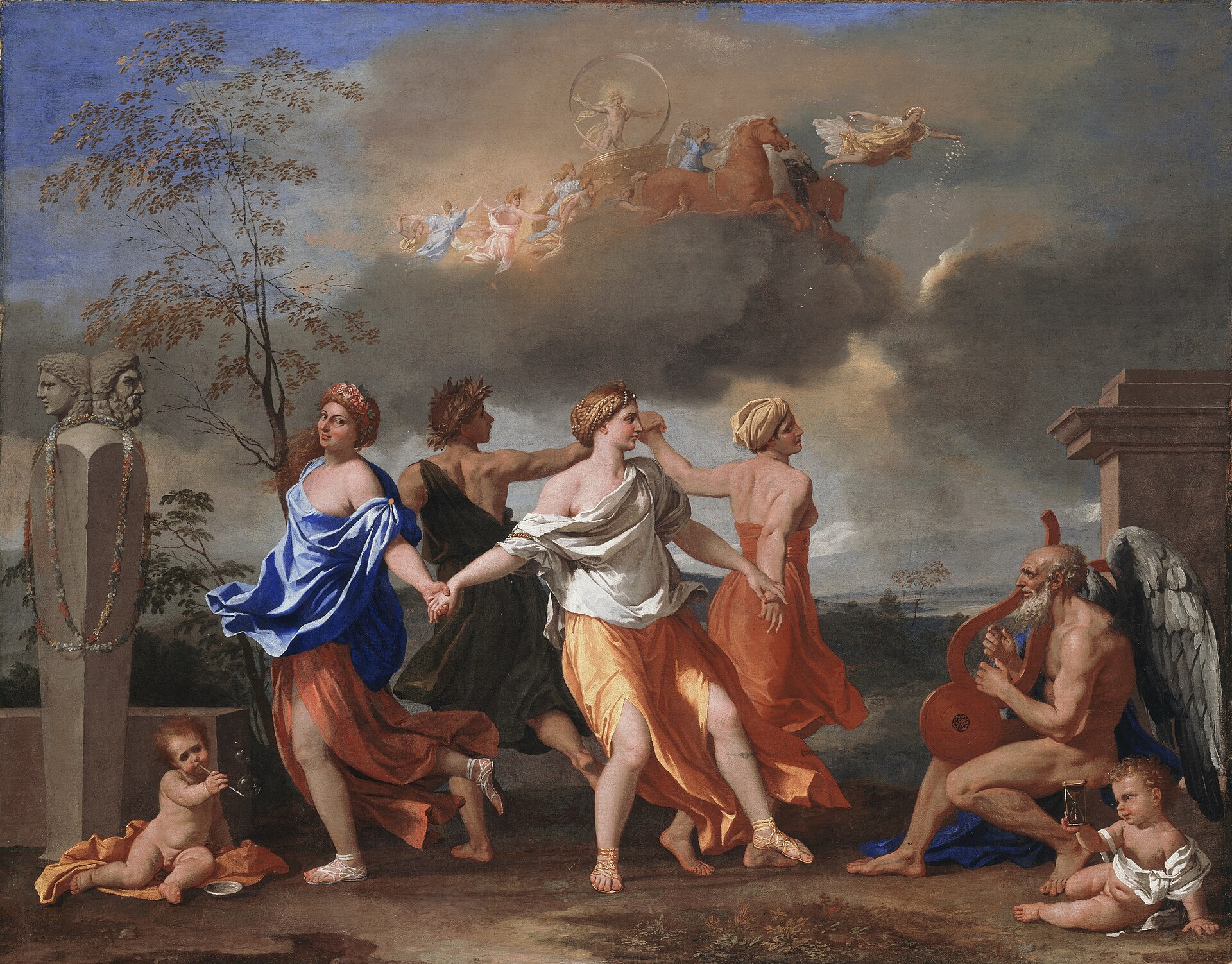
| The Wallace Collection | London | A Dance to the Music of Time (1634-36 per Wikipedia). | |
| Chatsworth House | Chatsworth (England) | The first Et in Arcadia ego (about 1627). | Not the Louvre version. |
| Nelson-Atkins Museum of Art | Kansas City | The Triumph of Bacchus, one of the three Richelieu Triumphs. | Copies of all three are in Tours. |
Forgeries and misattributions
- Replica proposal, not a forgery: the Byres copies scheme, 1785
- The agent proposed in a letter to the 4th Duke of Rutland to replace the first Sacraments with convincing replicas so the originals could leave Rome. The Fitzwilliam reports the scheme; the Duke consulted Reynolds before accepting the offer. The replicas themselves haven't been examined. Documented in the correspondence, not by examination of the pictures.110
- Copies, not forgeries: the Richelieu Triumphs replaced before 1741
- All three bacchanals for the Cabinet du Roi at Richelieu (Pan, Silenus, Bacchus) were replaced with copies, now in the Musee des Beaux-Arts at Tours, and the originals went to England. Provenance: the National Gallery's press note and Wine's entry both record the substitution.89
- Misattributed copy: Lord Fitzwilliam's supposed Poussin
- The founder of the Cambridge museum believed he had acquired a Poussin; later scholarship showed it was a copy by an unknown hand of Rebecca and Eliezer of 1648 in the Louvre. Comparison with the Louvre picture; the method isn't stated in the source.1
- Downgrade reversed: The Triumph of Silenus, 'after Poussin' since at least 1946
- A reverse case: a picture downgraded as a copy and restored to the artist in 2021. The doubt rested on uneven finish and discoloured varnish. Cleaning, imaging that found pentimenti, matching pigments with the Pan and a canvas from the same bolt as the Pan and the Bacchus.8
The essay
Chapter 1Counting Poussin: 224 uncontested, 33 doubtful and an unconfirmed figure from the new catalogue
The one set of numbers traceable to a named scholar is Jacques Thuillier's list of 1994, which Wikipedia describes as one of the most restrictive: 224 uncontested autograph paintings and 33 with...
The one set of numbers traceable to a named scholar is Jacques Thuillier's list of 1994, which Wikipedia describes as one of the most restrictive: 224 uncontested autograph paintings and 33 with minor or major doubts. That is a tertiary report of the figure and it should be replaced with the book. Thuillier's earlier 1974 catalogue and Doris Wild's of 1980 are cited in the literature, but neither was opened and what they accepted isn't stated here.
Anthony Blunt's catalogue of 1966 is still the reference in the English-speaking world. The Art Newspaper's interview with Pierre Rosenberg, who was 89 at the time and director of the Louvre from 1994 to 2001, calls it a single-volume catalogue and says his own four volumes, announced in March 2026 for that spring, absorb Louis Marin's reading of the pictures while engaging with and sometimes correcting Blunt. The interview names two reversals. The Kimbell's Venus and Adonis of about 1628-29 was rejected by Blunt and is accepted by Rosenberg; the Toledo Museum's Holy Family with Saint John of about 1627 was accepted by Blunt and is rejected by Rosenberg.
Between those two catalogues the disagreement isn't confined to marginal pictures. The Louvre's Mars and Venus of about 1625 had been a copy in Rosenberg's own eyes until a chance look in 2012 at the dirty picture in strong sunlight; after cleaning and study he says he is sure, and Blunt had given it to an unnamed French painter he called the Hovingham Master. The Art Newspaper doesn't print Rosenberg's total. A bookseller's listing gives one (see the corpus entry), unchecked against the volumes, whose publication after March 2026 wasn't confirmed.
Chapter 2Who decides now
No authentication board for Poussin was found, and no single body whose opinion the market treats as final.
No authentication board for Poussin was found, and no single body whose opinion the market treats as final. Attribution rests on catalogue authors and museum scholars, and the recent decisions show who they are. At the National Gallery, Francesca Whitlum-Cooper published in the Burlington Magazine the technical case that The Triumph of Silenus, long labelled 'after Poussin', is his lost original, and the Gallery counted 14 autograph pictures once the Silenus was back (Eucharist in 2024 was the 15th Poussin to enter the collection).
On the market side the name that carries weight is Christopher Wright, whose catalogue raisonne is the one cited in the April 2024 Sloane Street Auctions sale of a satyr and nymph picture: he assessed it as Poussin before the sale, Timothy Standring dates it to 1626-27 and calls it the prime version, the British Museum holds what appears to be a preparatory drawing of about 1626 and a later treatment of 1629 is in Kassel. It made GBP 60,000, double the top estimate. The early Venus Spied on by Two Satyrs, which the Paris house Ader put up in November 2024, was researched with the assistance of Eric Turquin; the estimate was up to EUR 1 million with an estimate of up to EUR 1 million.
That is a market of individual scholars whose opinions agree at times and don't at others. Where they split, this page names who holds which position instead of averaging them.
Chapter 3The man in the record
Poussin was born near Les Andelys in Normandy; the National Gallery's 2024 note gives 15 June 1594 and 19 November 1665 as his dates.
Poussin was born near Les Andelys in Normandy; the National Gallery's 2024 note gives 15 June 1594 and 19 November 1665 as his dates. Wikipedia, summarising his early biographers, says he ran away to Paris around 1612, failed twice to reach Rome (Florence in 1617 or 1618, Lyon in 1622) and arrived in the spring of 1624; the poet Marino, who had invited him, left for Naples shortly afterwards. His early years in Rome were hard, with a serious illness in the later 1620s from which he was nursed in the family of the cook Jacques Dughet, whose daughter Anne-Marie he married on 1 September 1630.
The patrons who mattered arrived through Marino: Cardinal Francesco Barberini and the cardinal's secretary Cassiano dal Pozzo. The Death of Germanicus (Minneapolis) for Barberini established him, and in 1628 he won the altarpiece of the Martyrdom of Saint Erasmus for St Peter's, a commission that seems to have met official displeasure and led to no more papal work. After that he painted for private collectors.
In December 1640 he went to Paris as First Painter to Louis XIII at the urging of Sublet de Noyers and left permanently for Rome in autumn 1642, overwhelmed by the workload and the intrigue. His Paris patrons kept buying: Chantelou and Pointel above all, and later the Abbe Louis Fouquet, who in 1655 obtained official recognition of his old title and payment for his earlier French work. His wife died in 1664, he dictated his will on 21 September 1665 and he died in Rome on 19 November 1665, buried in San Lorenzo in Lucina. All of this is from Wikipedia and the National Gallery's note; the dated details should be checked against Bellori and the documents in Rosenberg.
Chapter 4Working alone, with a family next door
Wikipedia reports that Poussin spent three months with Ferdinand Elle and perhaps a month with Georges Lallemant in Paris, found the studio system, in which several painters worked on one picture...
Wikipedia reports that Poussin spent three months with Ferdinand Elle and perhaps a month with Georges Lallemant in Paris, found the studio system, in which several painters worked on one picture, uncongenial, and preferred thereafter to work slowly and alone. That fits a career spent on small and mid-sized pictures for named buyers. No studio inventory, apprentice contract or record of an assistant paid by Poussin turned up in the sources used.
The family matters more than any pupil. Gaspard Dughet, the brother of his wife, is described in the Wikipedia article on him as Poussin's pupil from about 1631 to 1635 and was widely known as Gaspard Poussin; No contract setting the terms of that training was found. Charles Le Brun joined Poussin in Rome for about three years and took the example home. Andre Felibien, secretary at the French embassy, became his friend and student of painting in 1647 and wrote the first book devoted wholly to him. Another Dughet, Jean, engraved the Penance of the first Sacraments, and that engraving is now the only record of the picture after the Belvoir fire of 1816.
What the sources used don't establish is whether anyone painted part of a Poussin. The question isn't idle. A picture that looks like Poussin and isn't him can come from this circle, and the two clear modern reversals described on this page, Mars and Venus and The Triumph of Silenus, were both decided by technical study of a single picture instead of by any workshop record.
Chapter 5The wax stage, the pinhole and the grounds
The Fitzwilliam Museum, which reconstructed the method for its Extreme Unction, describes from contemporary accounts how Poussin modelled small nude figures in soft wax, set them on dowels on a stage...
The Fitzwilliam Museum, which reconstructed the method for its Extreme Unction, describes from contemporary accounts how Poussin modelled small nude figures in soft wax, set them on dowels on a stage inside a box with controlled openings for light, and drew from a single eye-hole at the front. The figurines were draped with wet cloth to study the folds and the drawings were then translated into colour. The Museum believes he used the box in the 1630s and early 1640s. The National Gallery adds that in Eucharist a pinpoint hole in the fanlight above Christ marks the perspective point and the tile grid is rigorously planned, which 'may suggest' the box.
The evidence for the method inside the paint is stronger than the evidence for the box. Infra-red images of Extreme Unction show that the body of the dying man had been painted before the anointing priest, whose limbs appear under the drapery. In the Melbourne Crossing of the Red Sea the three primary figures were painted nude and clothed afterwards, according to the Gallery of Victoria's conservator, as part of building harmony between figures; and in the National Gallery's Triumph of Silenus imaging found pentimenti that argue against its being a copy of a finished picture.
For grounds there is one catalogue statement. Humphrey Wine's entry on The Triumph of Pan (National Gallery, painted for Richelieu in 1636) records a double ground 'typical of Poussin', a lower reddish-brown one and an upper buff one, on canvas made of two pieces joined across the centre. The 2021 reattribution of the Silenus rests partly on pigment mixtures like those of the Pan and on the finding by Nelson-Atkins scientists that the Pan, the Silenus and the Kansas City Triumph of Bacchus were painted on canvas from the same bolt. A claim that Poussin used brown grounds in his first Roman years and red ochre after 1642 appeared only in a search abstract, and it is not verified and not stated as fact. When asked how he had reached his rank among the artists of Italy, the Fitzwilliam reports, he replied that he had neglected nothing.
Chapter 6Cassiano, the Paper Museum and the first Sacraments
Cassiano dal Pozzo (1588-1657) was secretary to Cardinal Francesco Barberini, a member with the Cardinal of the Accademia dei Lincei, a physician with interests in alchemy as Wikipedia puts it, and...
Cassiano dal Pozzo (1588-1657) was secretary to Cardinal Francesco Barberini, a member with the Cardinal of the Accademia dei Lincei, a physician with interests in alchemy as Wikipedia puts it, and the compiler of the Museo Cartaceo, the Paper Museum: hundreds of drawings after the antique and of natural history, classified, in Wikipedia's wording, by what they showed of ancient cult, customs, dress and architecture. Poussin made studies of antiquities in it, and wrote that he was 'a disciple of the house and the museum' of the Cavaliere dal Pozzo (quoted by Wikipedia from a letter not seen here). The Kimbell says Cassiano and his brother eventually owned about 50 Poussin paintings, and Wikipedia says Cassiano commissioned from him an illustrated manuscript of Leonardo's Treatise on Painting.
For the Sacraments the documented facts are these. Cassiano commissioned seven pictures, one for each sacrament, from the second half of the 1630s; the Kimbell gives 1636 to 1642 and the Fitzwilliam says the order in which they were painted is unknown. They hung in a room of his palace in Rome, the Stanza de' Sagramenti. The subject was almost unprecedented as seven separate pictures, as the National Gallery puts it, and the Fitzwilliam's teaching pages read it as answering Protestant denial of the sacraments and promoting Counter-Reformation decrees, alongside Cassiano's interest in classical antiquity. Those are the museums' readings; No statement of Cassiano's own intention was found.
The imagery follows its texts. Penance shows the Magdalene washing Christ's feet at Simon's house on a Roman triclinium, a couch; the Fitzwilliam says Poussin made several copies of similar scenes from drawings and paintings in Cassiano's museum. Confirmation and Extreme Unction draw on the liturgy of the early Church instead of scripture. Eucharist is built, in the Fitzwilliam's words, on Leonardo's Last Supper, Ordination on Raphael's tapestry cartoon of the keys. The National Gallery points to the archaeologically exact triclinium in Eucharist as a sustained effort to paint events the way the early Church would have seen them, and links the commission to the intellectual circle around Cassiano and its interest in the early Church. No price paid by Cassiano for any picture appears in the sources used.
Chapter 7What he wrote: the letter on the modes, and the Stoic question
The letter of 24 November 1647 to Paul Freart de Chantelou, called the letter on the modes, is documented text.
The letter of 24 November 1647 to Paul Freart de Chantelou, called the letter on the modes, is documented text. Nigel Saint explains the occasion: Chantelou, who was receiving the second series of Sacraments, had found the Finding of Moses that Poussin painted for his rival collector Jean Pointel (now in the Louvre) more attractive than the Ordination that had just reached him (now in Edinburgh), and Poussin answered at length that the nature of the subject was the cause of the effect, not greater love. In the line Glanville prints from Jouanny's 1911 edition he adds that good judging is very hard without great theory and practice joined. The passage that gave the letter its name begins, in the English on one enthusiast site, with the Greeks, 'inventors of all beautiful things', who found modes by which they produced marvellous effects.
What the letter proves is that Poussin defended differences of manner between pictures by subject. Whether he understood the Greek modes as a musician would, Saint says, hasn't quite convinced modern critics, and Louis Marin quoted the letter mostly for variation and for what it says about judgment. Readings that attach a specific mode to a specific picture, such as the hypolydian for the Ecstasy of Saint Paul painted for Paul Scarron in 1649-50, are later interpretations; the one found is on an enthusiast website (source 29), where Poussin himself is recorded only as having resisted Scarron's request for years before agreeing.
The Stoic question is an argued one. Anthony Green's 1968 thesis reports that Gaudibert, in 1959, tied Poussin's letters to the neo-Stoic movement and found nothing else in his philosophy, a view that Green calls one-sided. Green's thesis accepts that Poussin expressed Stoic views, citing a letter of consolation to Chantelou of 22 June (1648 in Green's text, read from a poor scan) in which Poussin wished the Seven Sacraments could be turned into seven subjects showing virtuous men withstanding the tricks of Fortune, and Green argues that Fortitude and Patience are not exclusively Stoic and that the right word is Christian-Stoic. Green's thesis also reports that Kauffmann, choosing between a Stoic and a Christian meaning for the diamond ring in the Louvre self-portrait, excluded the Christian one without argument. Neither side has a document that settles it.
Chapter 8Et in Arcadia ego, twice
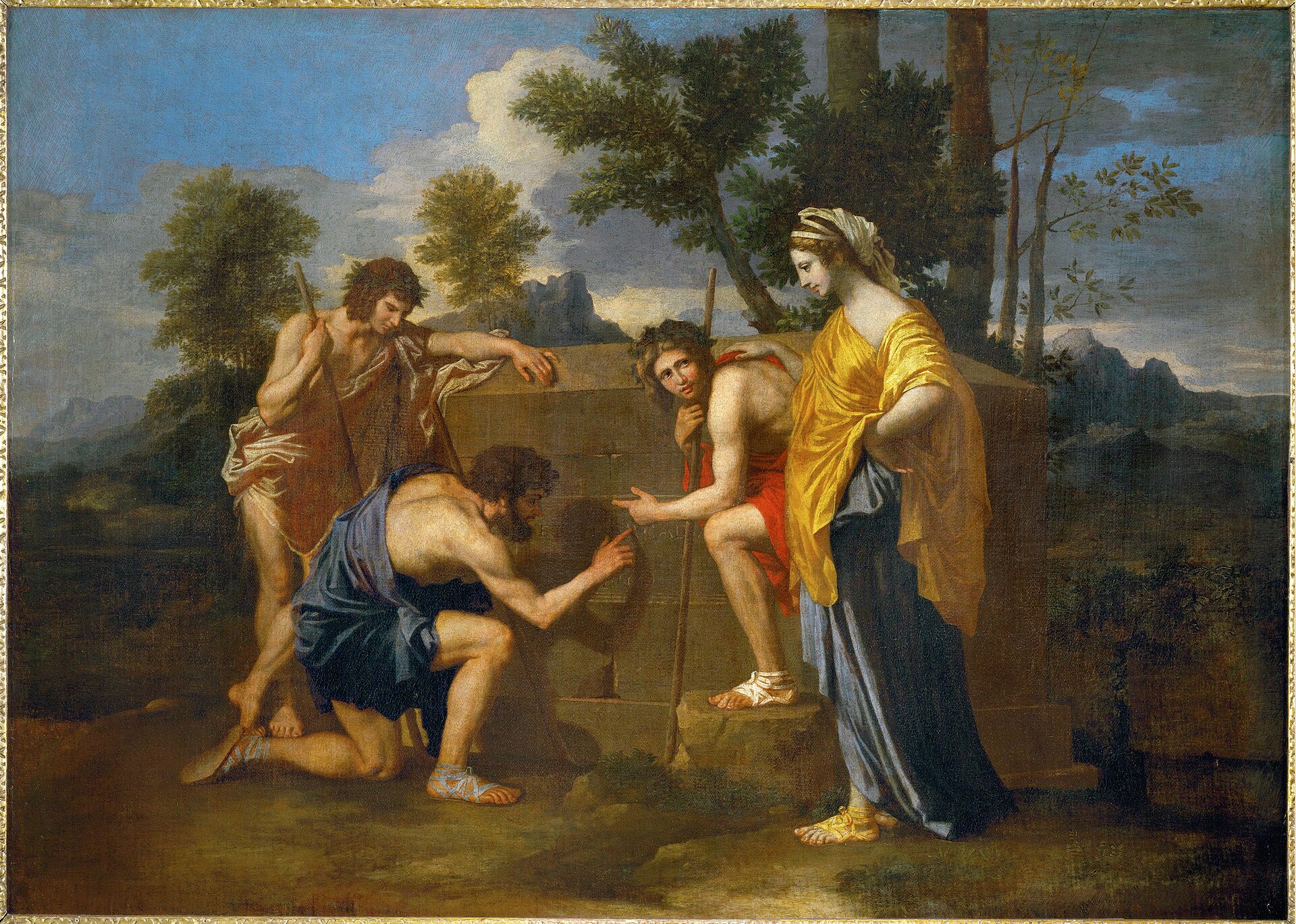
Poussin painted the subject twice, and the two pictures say different things.
Poussin painted the subject twice, and the two pictures say different things. The first, at Chatsworth, dates to about 1627 (Wikipedia) and shows shepherds discovering a half-hidden tomb with a skull on top, in a more baroque idiom and with a woman posed in a way Wikipedia calls suggestive. The second, in the Louvre, is dated 1637-38, measures 85 by 121 centimetres and is far calmer; the woman is drawn from an antique statue known as the Cesi Juno, and one shepherd traces with his finger the shadow of another on the tomb. Wikipedia says the Louvre version was painted for Cardinal Giulio Rospigliosi.
The inscription is where the readings divide. Bellori, Poussin's first biographer, took the speaker to be Death, so that the picture reminds the viewer that death exists even in Arcadia. Felibien took the speaker to be the occupant of the tomb. Erwin Panofsky argued in a famous essay that in the second version the speaker is no longer Death but the dead, so that the sense becomes 'I too was in Arcadia', a contemplation of what has been lost. Each is a position held by a named writer, and none rests on a note in Poussin's hand that has been found. The Plantard motto, which borrowed the phrase for the Priory of Sion hoax, is a twentieth-century use and has nothing to do with the painter.
Chapter 9Two sets of Sacraments, not one
Poussin made two Seven Sacraments, and they mustn't be confused.
Poussin made two Seven Sacraments, and they mustn't be confused. The first was painted in Rome for Cassiano dal Pozzo from the later 1630s. After Chantelou saw it he asked for another, and the second, painted between 1644 and 1648, is a new set rather than copies (Fitzwilliam, Wikipedia). Green's thesis gives the line: bought in 1716 by the Abbe Dubois for the Regent of France, in the Orleans collection until it was sold in 1792, acquired by the Duke of Bridgewater and by Green's time owned by the Duke of Sutherland by descent, on loan to the National Gallery of Scotland. The National Gallery's 2024 note says the second series is on loan to the National Galleries of Scotland. The Fitzwilliam's page says they came to England in 1798 with sixty-four pictures it describes as formerly in the collection of Louis XVI, which sits oddly with Green's Orleans history; the discrepancy is recorded here, not resolved.
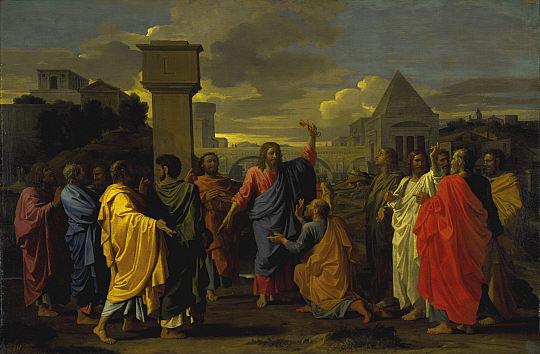
The Ordination in the Edinburgh set (plate on this page) is the 1647 picture that Chantelou found less attractive than Pointel's Moses. The Ordination bought by the Kimbell in 2011 belongs to the first set. A caption, a catalogue number or a sale report that says only 'Poussin's Ordination' is ambiguous, and so is a claim about a price.
Chapter 10The first set, from 1657 to 2024
After Cassiano's death in 1657 the series passed through his family to Maria Laura dal Pozzo Boccapaduli.
After Cassiano's death in 1657 the series passed through his family to Maria Laura dal Pozzo Boccapaduli. Green's thesis reports, from letters, that in the 1720s the set had been pledged to the Marchese del Bufalo for a debt of six thousand crowns run up by Cosimo Antonio dal Pozzo, a gambler, and that it was redeemed by early 1730; the GOV.UK notice says February 1730 or 1732. That notice says the set was offered to Louis XV in 1729 when the Marchese ran into difficulties, and the Fitzwilliam, which names Louis XIV, believes the king declined. Sir Robert Walpole then bought all seven in the mid-1740s, but the Pope refused the export licence and the sale was annulled; the Kimbell says the pope of the day thought them too important to leave Rome.
In 1785 the agent James Byres sold the set to Charles Manners, 4th Duke of Rutland. The Fitzwilliam reports a letter in which Byres proposed replacing the originals with convincing replicas so that they could leave Rome unnoticed and that the Duke offered two thousand pounds for the set, after consulting Sir Joshua Reynolds. They were shown at the Royal Academy in 1787 (the exhibition history in the GOV.UK notice), and the Fitzwilliam says Reynolds took George III round. The Kimbell quotes Reynolds on the Ordination as 'the greatest work of Poussin', and the Fitzwilliam quotes him telling the Duke that such a set 'will really & truly enrich the nation'.
The Penance was destroyed in the fire at Belvoir Castle in 1816. Baptism went to Washington: the Fitzwilliam and the National Gallery say Samuel Kress bought it in 1939, the Kimbell says the National Gallery of Art acquired it in 1946, and the two dates are unresolved. The remaining five stayed at Belvoir, were on loan to the National Gallery from 2003, and were taken off show in November 2010 for the Ordination sale.
The Ordination was offered at Christie's London in December 2010 at GBP 15-20 million and didn't sell. Phil O'Brien, the adviser who sat in the room for the estate, writes that bids were taken up to but not including the GBP 15 million reserve and that none of three telephone bidders moved. The Reviewing Committee recommended deferral of the export decision in May 2011 at a recommended price of GBP 15,000,000 and gave it a starred rating, meaning every effort should be made to keep it. The Kimbell bought it privately for a price Wikipedia and O'Brien give as USD 24.3 million, took an export licence in August 2011 and put it on view on 14 September 2011.
Extreme Unction was bought by the Fitzwilliam, in 2012 on the Museum's own page and 2013 on the National Gallery's. In 2022 an export bar was placed on Confirmation at a recommended price of GBP 19,000,000, with deferral to 9 January 2023; an export licence was issued in January 2023 and the picture was sold abroad, with no buyer or price in the sources used. In March 2024 the National Gallery acquired Eucharist through a hybrid Acceptance in Lieu from the Trustees of the Duke of Rutland's 2000 Settlement with a legacy from Mrs Martha Doris and Mr Richard Hillman Bailey, and showed it beside Marriage, which is on long-term loan from the same trustees. The Gallery doesn't give the sum, and a hybrid acceptance is not a market price.
Chapter 12Reputation: Le Brun, the Rubenists and a French school
The quarrel of the Poussinistes and Rubenistes began at the French Academy in 1671.
The quarrel of the Poussinistes and Rubenistes began at the French Academy in 1671. The Poussinistes, led by Charles Le Brun, held that drawing mattered more than colour and took Raphael, the Carracci and Poussin as their models; the Rubenistes held that colour was truer to nature. Le Brun's official statement of 1672 that colour satisfies the eye and drawing the mind didn't end it, Roger de Piles carried the colourists' case in print in 1673 and 1677, and Watteau's reception piece in 1717 is read as the sign that the Rubenists had won. Neither Poussin nor Rubens was alive, and Wikipedia adds that the quarrel carried a strong national flavour, French against Flemish.
In Britain the opposite happened. The Fitzwilliam says that by the end of the eighteenth century nearly half of Poussin's paintings were in British collections, imported by agents and shown in sales, while its note on the first Sacraments says the French king who was offered the set in 1729 declined it amid a decline in Poussin's reputation in France and a taste for Rubens. In 1785 Reynolds called it a real national object. For later artists the National Gallery names David, Cezanne, Picasso and Francis Bacon as men he influenced. In the 2026 interview Rosenberg says Poussin is a very difficult painter; the journalist notes that Louvre visitors tend to speed past the room, and that in France he is still associated with Louis Marin and in the English-speaking world with Blunt.
Chapter 13Copies, substitutions and reattributions
No forgery scandal on the scale of those that follow some other painters turned up.
No forgery scandal on the scale of those that follow some other painters turned up. What the record shows instead is copying and substitution. Poussin's three Triumphs for Richelieu (Pan and Silenus in London, Bacchus in Kansas City) were replaced with copies, now in Tours, before 1741 and taken to England. The 1785 Rutland scheme proposed copies of the Sacraments so the originals could leave Rome. Lord Fitzwilliam, the founder of the Cambridge museum, believed he had bought a Poussin that later scholarship showed to be a copy by an unknown hand of the Louvre's Rebecca and Eliezer of 1648.
The detection tools in those cases are the ordinary ones. At the National Gallery, conservation removed a discoloured varnish, imaging found pentimenti that a copyist wouldn't make, pigment analysis matched the Pan and the canvas came from the same bolt. At the Louvre a cleaning in 2012 changed Rosenberg's mind. No case turned up in which a picture was made to pass as a Poussin for sale.
Chapter 14What is still open
The numbers will move as Rosenberg's catalogue is read, and the Blunt-era rejections are the first thing to check against it.
The numbers will move as Rosenberg's catalogue is read, and the Blunt-era rejections are the first thing to check against it. The prices Cassiano and Chantelou paid for their sets aren't recorded in anything reached for this page.
What is documented
Technique
The surviving work
- What is accepted
- No settled figure. Thuillier, 1994: 224 uncontested autograph paintings and 33 doubtful (tertiary report). Blunt (1966): total not found in the sources read. Rosenberg: a bookseller's listing (source 32, unchecked against the book; the set's due date is in source 31) gives 293 accepted, 10 unexecuted and 319 rejected, in a four-volume set of 1,656 pages from Flammarion; The Art Newspaper in March 2026 announced the set for that spring and publication wasn't checked after that.
- What is contested
- Blunt rejected the Kimbell Venus and Adonis (accepted by Rosenberg) and accepted the Toledo Holy Family with Saint John (rejected by Rosenberg); Rosenberg reversed himself on the Louvre Mars and Venus in 2012; the National Gallery moved The Triumph of Silenus from 'after Poussin' to autograph in 2021. Wild (1980) and Thuillier (1974) are cited in the literature but were not opened.
- Who rules on attribution
- No single authority found. Attribution rests on the catalogues named above and on museum scholars such as Whitlum-Cooper at the National Gallery; no authentication board was found.
Catalogue raisonne
- Anthony Blunt, The Paintings of Nicolas Poussin: A Critical Catalogue, 1966 The reference catalogue of the English-speaking world, described by The Art Newspaper as single-volume. Its total isn't in the sources read.1213
- Jacques Thuillier, Poussin, 1994 A restrictive list: 224 uncontested autograph paintings and 33 with doubts, as reported by Wikipedia's list page.13
- Christopher Wright, Poussin Paintings: A Catalogue Raisonne Named as the catalogue raisonne by Wright's role in the 2024 Sloane Street sale; date from the literature, not from a source opened for this page; drop the year unless confirmed.25
- Pierre Rosenberg, Nicolas Poussin 1594-1665: catalogue raisonne des peintures, four volumes Described by The Art Newspaper in March 2026 as due that spring and as engaging with and correcting Blunt. Not seen; the interview gives no total. A bookseller's listing reports 293 accepted, 10 unexecuted and 319 rejected (source 32).123132
Questions about Nicolas Poussin
Who was Nicolas Poussin?
Painter; Draughtsman; Illustrator (title-pages and drawings). 1594-1665.
When did Nicolas Poussin live?
Born 15 June 1594 (as given in the National Gallery's 2024 note), near Les Andelys, Normandy; died 19 November 1665, Rome.
How are fakes and misattributions of Nicolas Poussin detected?
Replica proposal, not a forgery: the Byres copies scheme, 1785. The agent proposed in a letter to the 4th Duke of Rutland to replace the first Sacraments with convincing replicas so the originals could leave Rome. The Fitzwilliam reports the scheme; the Duke consulted Reynolds before accepting the offer.
Where can you see work by Nicolas Poussin?
Musee du Louvre (Paris); The Metropolitan Museum of Art (New York); The National Gallery (London); Scottish National Gallery (Edinburgh); Kimbell Art Museum (Fort Worth); The Fitzwilliam Museum (Cambridge).
What does the market for Nicolas Poussin look like?
No single Poussin result could be separated into hammer and premium from the sources used, and no record price is named. What the rows do show is that the two largest recent figures are not auction results: a lot that failed at Christie's in 2010 and a private sale a year later.
What is still unresolved about Nicolas Poussin?
What does Rosenberg's catalogue accept, and how does that compare with Thuillier's 224 and Blunt's number? A bookseller's listing gives 293 accepted, 10 unexecuted and 319 rejected; that wasn't checked against the volumes, and the Blunt, Wild and Thuillier 1974 totals were not found.
Open questions
- What does Rosenberg's catalogue accept, and how does that compare with Thuillier's 224 and Blunt's number? A bookseller's listing gives 293 accepted, 10 unexecuted and 319 rejected; that wasn't checked against the volumes, and the Blunt, Wild and Thuillier 1974 totals were not found.
- What did Cassiano dal Pozzo pay for the first Sacraments, and what did Chantelou pay for the second? No sourced price for either set was found.
- Who bought Confirmation in 2023, and at what price? The export licence is documented; the buyer and the price are not in the sources used.
- When did Baptism enter the National Gallery of Art, in Washington: 1939 (the Fitzwilliam and the National Gallery) or 1946 (the Kimbell)? And did Extreme Unction reach the Fitzwilliam in 2012 or 2013?
- Which king was offered the first Sacraments in 1729? The Fitzwilliam's page names Louis XIV, who died in 1715; the GOV.UK notice says Louis XV, and this page follows the notice.
- Was the second set of Sacraments in the Orleans collection, as Green says, or in the collection of Louis XVI, as the Fitzwilliam says, before it came to Bridgewater in 1798?
- Did anyone besides Poussin paint on his pictures? No studio record was found, and the Dughet training reported by Wikipedia has no contract behind it.
- What was the result of the Ader sale of November 2024, and did the early Venus Spied on by Two Satyrs find a buyer at its estimate?
- Which 1647 or 1649 dating belongs to which self-portrait, the Louvre canvas inscribed 1650 or the pair that Wikipedia places together in 1649?
Sources
- 1The Fitzwilliam Museum, 'Poussin in Britain' (Extreme Unction project site, archived). The 1785 Byres scheme, the 1729 offer (this page names Louis XIV; GOV.UK says Louis XV) and the later holdings of the first Sacraments. extreme-unction.fitzmuseum.cam.ac.uk/in-britain
- 2The Fitzwilliam Museum, 'Cassiano dal Pozzo's Seven Sacraments' (archived). Iconography of the first set. extreme-unction.fitzmuseum.cam.ac.uk/seven-sacraments
- 3The Fitzwilliam Museum, 'The artist' (archived). Cassiano, the Stanza de' Sagramenti and Chantelou's second series of 1644-48. This page calls Chantelou the French ambassador to the papal court, which other sources do not support; that detail is not used. extreme-unction.fitzmuseum.cam.ac.uk/the-artist
- 4The Fitzwilliam Museum, 'Poussin's working methods' (archived). The wax figures, the box and the infra-red evidence from Extreme Unction. extreme-unction.fitzmuseum.cam.ac.uk/working-methods
- 5GOV.UK (DCMS), 'Nicolas Poussin's remarkable painting, Ordination, under export threat', 23 May 2011. Primary: the Reviewing Committee's recommendation, the GBP 15,000,000 recommended price, the deferral dates and the provenance. gov.uk/government/...
- 6GOV.UK, 'Nicolas Poussin painting worth GBP 19 million at risk of leaving UK' (Confirmation, 2022). Primary: recommended price GBP 19,000,000, deferral to 9 January 2023, condition notes and provenance. gov.uk/government/...
- 7The National Gallery, London, press release 'The National Gallery acquires Poussin's Eucharist', 22 March 2024. Primary for the Acceptance in Lieu acquisition, the fate of all seven first-series pictures and the technical notes on the picture. nationalgallery.org.uk/about-us/...
- 8The National Gallery, London, press release 'Poussin reattribution', April 2021 (The Triumph of Silenus). Primary for the reattribution, the pentimenti, the shared canvas bolt and the Richelieu commission. nationalgallery.org.uk/about-us/...
- 9Humphrey Wine, The Seventeenth Century French Paintings (National Gallery Company and Yale, 2001), entry for The Triumph of Pan (NG 6477), online edition. Primary for the ground and the sale history of that picture. nationalgallery.org.uk/paintings/...
- 10Phil O'Brien, 'The Duchess, the Scouser and the $23.4 million Poussin' (personal site). First-person account by the adviser who watched the Christie's sale for the Belvoir estate; secondary and self-interested, used for the December 2010 sale-room events only and flagged. The price in the title differs from the text, which says USD 24.3m. philobrien.com/projects/...
- 11ArtDaily, 'Poussin masterpiece from the celebrated Sacraments series acquired by the Kimbell Art Museum' (reproduces the Kimbell's September 2011 announcement). Source for Ordination's dimensions, the 1785 purchase, Reynolds, the export licence in August and the advisers. artdaily.com/news/...
- 12Pierre Rosenberg interview on his four-volume Poussin catalogue raisonne, The Art Newspaper, 4 March 2026, read on the copy at October Gallery Museum. octobergallery.com/former-louvre-president-pierre-rosenbe...
- 13Source for Thuillier's 1994 figures of 224 uncontested paintings and 33 doubtful. Replace with Thuillier 1994 itself. en.wikipedia.org/wiki/...
- 14Biography, patrons, Paris 1640-42, Dughet marriage, Fouquet, death and burial. Replace with Bellori, Felibien and the Rosenberg catalogue entries. en.wikipedia.org/wiki/...
- 15Cross-check on the dispersal of the first series; each statement used was also found in sources 1, 5, 6 or 7. en.wikipedia.org/wiki/...
- 16The two versions, Bellori, Felibien and Panofsky as summarised there, and the Plantard motto. Replace with Panofsky's essay and the Louvre catalogue entry. en.wikipedia.org/wiki/...
- 17Dughet as Poussin's pupil c. 1631-35 and his use of the name Poussin. en.wikipedia.org/wiki/...
- 18Cassiano's career, the Lincei, the Paper Museum and Poussin's phrase about the house and museum. en.wikipedia.org/wiki/...
- 19The quarrel of 1671 to 1717. Replace with Roger de Piles and the Academy conferences. en.wikipedia.org/wiki/...
- 20Anthony Green, Nicolas Poussin and the Seven Sacraments, PhD thesis, University of Edinburgh, 1968 (scanned, OCR errors in places). Used for the Stoic debate, the provenance of the second series and the 1720s pledge of the first set. era.ed.ac.uk/bitstreams/...
- 21Nigel Saint, 'Legacies of Sublime Poussin: Louis Marin's plea for Poussin as a painter', Early Modern French Studies 38 (2016), accepted manuscript, University of Leeds. Context of the letter of 24 November 1647. eprints.whiterose.ac.uk/96935/...
- 22Helen Glanville, article in Studi di Memofonte 30 (2023), note 13 quoting Poussin's letter of 24 November 1647 from Jouanny's 1911 edition, p. 372. memofonte.it/files/...
- 23The Metropolitan Museum of Art Open Access API, object records 437326 (Blind Orion), 437329 (Abduction of the Sabine Women), 437330, 437328, 437327 and 442488 (Agony in the Garden). Primary for titles, dates, media, dimensions and credit lines. collectionapi.metmuseum.org/public/...
- 24Art Law and More (Boodle Hatfield), 'Rare Poussin painting generously donated to the Metropolitan Museum of Art', 25 January 2022. Secondary report of the Landau gift, the copper support and the Wildenstein purchase. artlawandmore.com/2022/...
- 25ArtDaily, 'Poussin scholars confirm GBP 60,000 painting sold by Sloane Street Auctions is primary work by the artist', April 2024. artdaily.com/news/...
- 26Art History News, 'Early Rediscovered Poussin coming up at Ader', 1 October 2024 (advance notice only; no result found). arthistorynews.com/articles/...
- 27MR 2329.jpg and the eight plates listed on this page. Tested 18 November 2026. commons.wikimedia.org/wiki/...
- 28Art Institute of Chicago API, artwork 5848, Landscape with Saint John on Patmos, dated 1640, public domain flag true. api.artic.edu/api/...
- 29nicolas-poussin.com, 'The ecstasy of Saint Paul - painted for Paul Scarron (1649-1650)' (secondary, enthusiast site). Used for the Scarron episode and the English rendering of the opening of the modes letter; its reading of the hypolydian mode in the picture is that site's own. nicolas-poussin.com/en
- 30National Gallery of Victoria, 'The Poussin Project', conservation diary for The Crossing of the Red Sea (1632-34). ngv.vic.gov.au/essay/...
- 31Art History News, 'Pre-order Upcoming Nicolas Poussin Catalogue Raisonne', 26 September 2025: Flammarion, four volumes, 1,656 pages, due March 2026. arthistorynews.com/articles/...
- 32Livre-rare-book bookseller listing for Rosenberg's Nicolas Poussin catalogue raisonne (Flammarion, dated 2025): its description gives 293 accepted, 10 unexecuted and 319 rejected works. livre-rare-book.com/book/...


Last verified