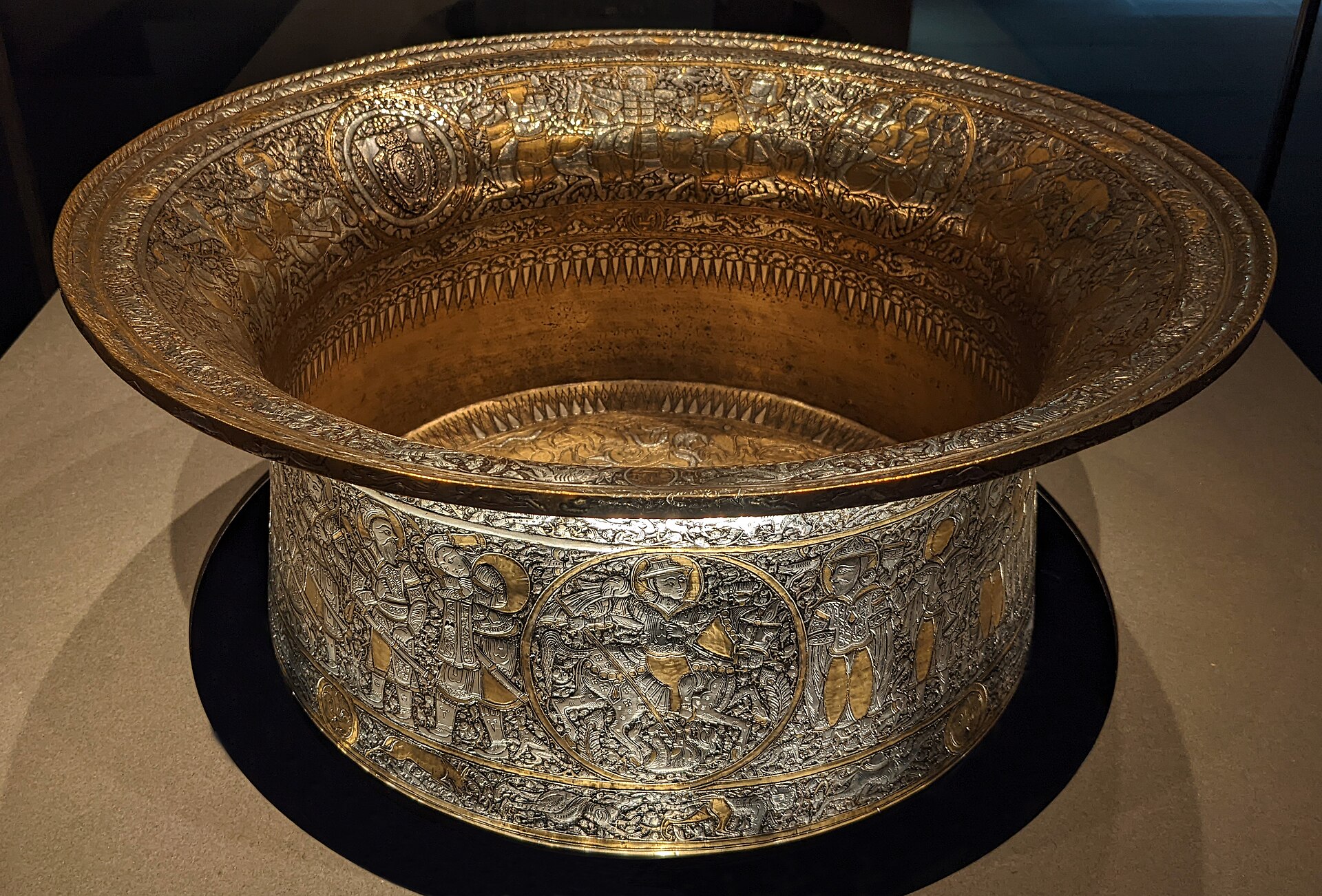
Basin known as the Baptistere de Saint Louis
First half of the 14th century · Hammered brass
Musee du Louvre
1330-1340
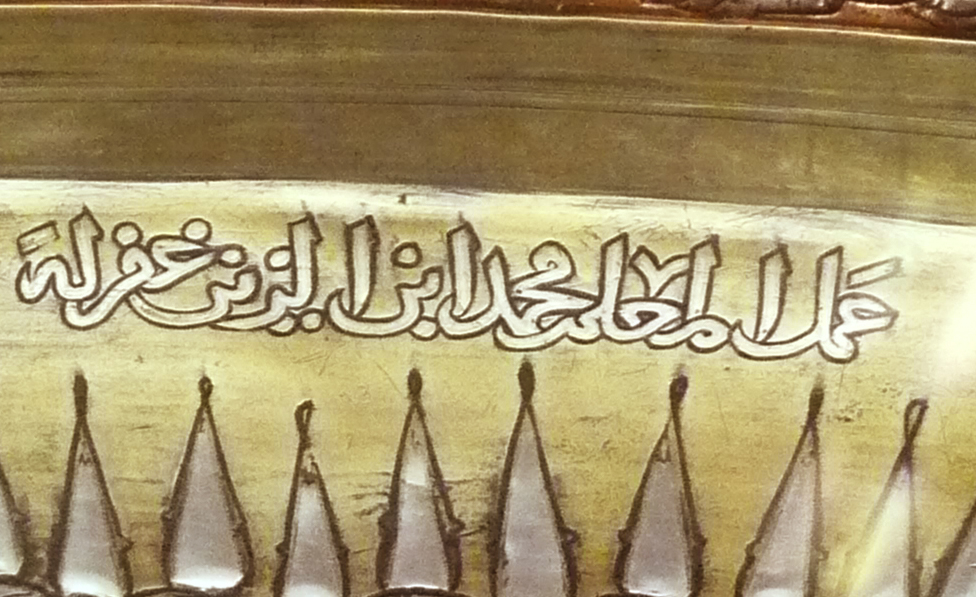
No portrait of this maker exists or ever did, and nothing about his appearance was ever recorded by anyone. This is the closest thing to one this page can honestly offer: his own principal signature, in silver letters, reading the work of the master Muhammad ibn al-Zain, may he be forgiven. It is one of six times he wrote his name into this single object, the most direct trace of the man that survives.
Photograph by Calame, via Wikimedia Commons; object Musee du Louvre, Paris| Full name | Muhammad ibn al-Zain (also transliterated ibn al-Zayn |
|---|---|
| Worked as | Metalworker, Inlayer (brass, gold and silver) |
| Nationality | Mamluk Egypt or Syria (his own two signed objects do not say which... |
| Movement | Mamluk courtly inlaid metalwork, Cairo or Damascus workshop tradition |
| In this archive | 1 artwork |
| Sources | 18 cited |
| Last verified |
About this page 1 artwork in the archive · Last verified · 18 sources cited
Muhammad ibn al-Zain is known from exactly two objects that carry his own name, and from nothing else. No chronicle mentions him, no tax or guild register names him, and no source consulted for this page gives a birth year, a death year or a place of training. What survives instead is a signature, repeated with a density that has no parallel anywhere in surviving Mamluk metalwork: six times on one brass basin, once in silver letters where no visitor could miss it, five more times hidden inside the decoration itself, worked onto objects held by the figures he engraved. Scholars going back to David Storm Rice's foundational 1951 monograph have treated that repetition as an act, not a habit: a craftsman, on a piece carrying no patron's name to lend it authority, supplying his own instead, over and over, as though daring a viewer to miss it.
He signed one other object, a small bowl now called the Vasselot Bowl after a former owner rather than after him, held in the same museum under a different inventory number from the famous basin. A name that may be his also appears once more, on an iron grille in Jerusalem, in a 1996 study that asks directly whether the same man could have worked at a master's level in both iron and inlaid brass, and does not answer its own question. That is the entire, honestly stated corpus: two certain objects, one contested third, and a craftsman who put more of himself into that record than almost any other Mamluk metalworker whose name survives at all.
The fact most readers will not already know is what happened to his best-known object afterward. It left Mamluk lands for France by around 1440, without a single document recording how, and was used from 1606 to baptize French royal children, including the future Louis XIII, under a Christian name that has nothing to do with its Muslim maker. Everything on this page follows from those two half-known facts: a man who insisted on being named, and an object of his that outlived every memory of him for the better part of five centuries.
The working window during which both of Muhammad ibn al-Zain's certain objects were made, on the range of dates proposed by different scholars; no source narrows his active career further than this.12567
The basin later called the Baptistere de Saint Louis is made and signed six times; the Louvre's own current label gives c. 1330-1340, while Rice's earlier reading placed it c. 1290-1310 and Ward's c. 1325-1360.156
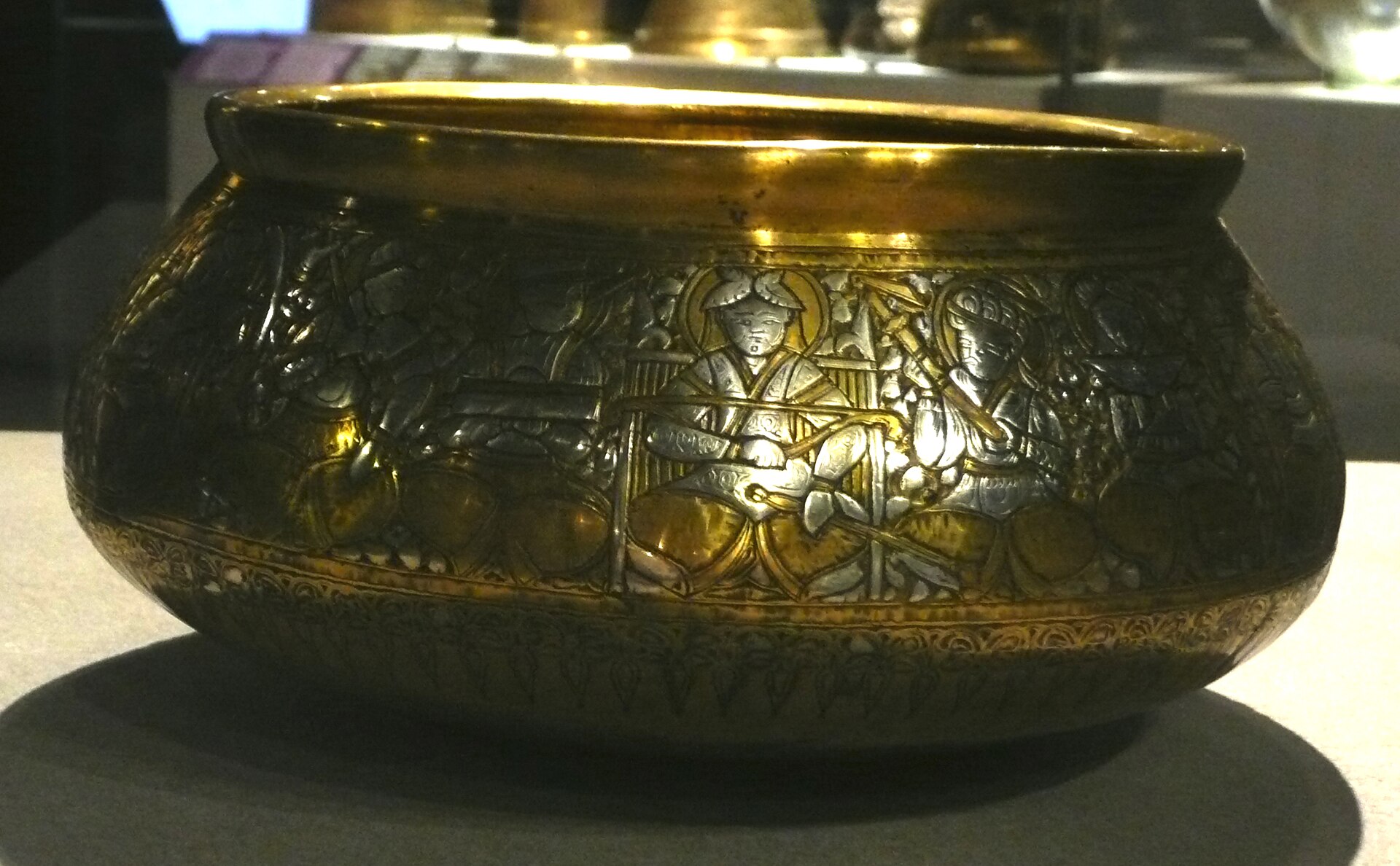
The small bowl later called the Vasselot Bowl is made and signed once, on the Louvre's own dating for the object, Louvre inventory MAO 331.89
The basin is first securely recorded, already in French hands, in the treasury of the Sainte-Chapelle de Vincennes; no document explains how it arrived.24
The basin is used to baptize the future Louis XIII at Fontainebleau, the first of three documented royal baptismal uses; the maker's name plays no part in this ceremonial life.24
Gaston Migeon discusses the basin in the Gazette des Beaux-Arts, evidence the object was already known to Paris specialists half a century before Rice's dedicated study of its maker.10
Migeon discusses the basin again in his Manuel d'art musulman.10
Jean-Jacques Marquet de Vasselot works at the Louvre, later directing the Musee de Cluny from 1926 to 1933; the bowl now named for him entered the Louvre from his collection at an unconfirmed date within or after this span.1112
David Storm Rice publishes Le Baptistere de Saint Louis, the founding monograph, the first study to treat the six signatures as connected evidence about the maker rather than incidental decoration.5
Doris Behrens-Abouseif reads the basin's decorative cycle as furusiyya, the martial and courtly culture of the Mamluk elite, without naming an individual patron.24
James W. Allan publishes Muhammad ibn al-Zain: Craftsman in Cups, Thrones and Window Grilles? in Levant, raising, without resolving, the question of whether the maker of the basin and bowl is also the craftsman named on an iron grille in Jerusalem.13
Rachel Ward argues for a European Christian patron, possibly Hugh IV of Lusignan, in a paper delivered at a Warburg Institute colloquium.246
Sophie Makariou publishes the current standard Louvre monograph on the basin, developing Ward's Lusignan hypothesis and the reading of the maker's signature density as deliberate self-assertion.247
Anna Klosowska publishes a literary and postcolonial reading of the basin's later reception in Literature Compass.14
Carine Juvin publishes a chapter on how the basin came to be treated as a historical monument, tracing its collecting and scholarly history rather than its patron.15
Nothing paid to Muhammad ibn al-Zain personally is recorded in any source consulted for this page, and neither of his two certain objects has ever been sold at auction or on the open market in any period covered by the sources consulted. The basin has been French royal or state property continuously since it is first securely recorded around 1440, with no auction, private sale, insurance valuation, dation or export application documented at any point. The Vasselot Bowl came to the Louvre from the personal collection of Jean-Jacques Marquet de Vasselot; no source consulted gives a purchase price, gift valuation or sale record for it, only that it entered as part of his collection.
| Institution | City | Holdings | Note |
|---|---|---|---|
| Musee du Louvre, Departement des Arts de l'Islam | Paris | Both of the maker's certain signed objects: the basin (LP 16), on permanent display in Room 186 and lent for temporary exhibitions across 2025-2026, and the Vasselot Bowl (MAO 331), a smaller and less frequently illustrated object held in the same department. | This page could not confirm whether the Vasselot Bowl is on permanent public display; the basin's display status is confirmed and documented in this archive's own record for that object. |
| L.A. Mayer Memorial Institute for Islamic Art | Jerusalem | An unfinished basin attributed to ibn al-Zain on style alone, with no signature. | Attribution graded argued, not documented, in this record. |
The whole of what can be attributed to Muhammad ibn al-Zain with certainty is two pieces of inlaid brass, both in the Musee du Louvre's Departement des Arts de l'Islam, in two different inventory...
The whole of what can be attributed to Muhammad ibn al-Zain with certainty is two pieces of inlaid brass, both in the Musee du Louvre's Departement des Arts de l'Islam, in two different inventory series. The first is the large basin now called the Baptistere de Saint Louis, inventory LP 16, signed six times. The second is a much smaller bowl, about 10.3 centimetres high and 17.2 centimetres across, inventory MAO 331, signed once. Both are hammered brass, engraved, and inlaid with gold and silver wire and sheet, finished with a black compound to set the finer lines against the bright metal, the standard luxury technique of Mamluk Egypt and Syria in this period.
Signing work at all was unusual in this trade. The great majority of surviving Mamluk inlaid metalwork, including basins made for named sultans and emirs, carries no maker's name at all, only a patron's dedication. Ibn al-Zain's two objects run the other way: neither carries a surviving patron's name, and both carry his. That inversion, a maker's name standing in for a patron's, is the single fact that everything else about him has to be read through.
On the basin, one signature is set in a prominent band in silver letters, reading in translation the work of the master Muhammad ibn al-Zain, may he be forgiven, using the honorific al-mu'allim...
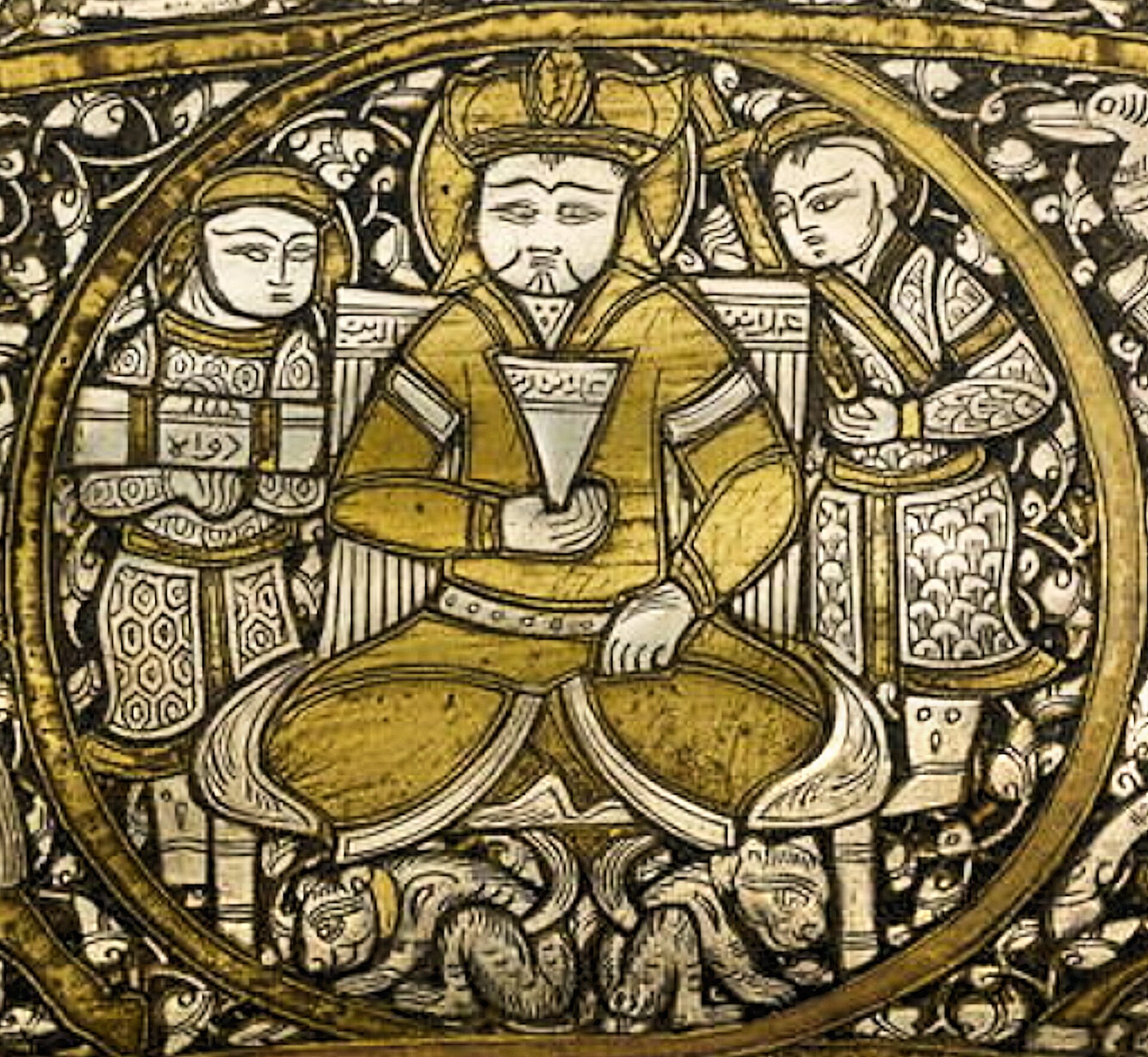
On the basin, one signature is set in a prominent band in silver letters, reading in translation the work of the master Muhammad ibn al-Zain, may he be forgiven, using the honorific al-mu'allim, master, a title Mamluk craft guilds reserved for a senior practitioner. Five further occurrences, in smaller script, are worked into the decoration itself: not added afterward, but engraved onto objects that the depicted figures are themselves holding, a pen case here, a vessel there, so that finding them means reading the picture closely rather than glancing at a border.
Rice's 1951 monograph, the founding technical study of the object, was the first to treat this density as evidence rather than decoration, and Sophie Makariou's 2012 catalogue for the Louvre develops the same reading: a maker working without a named patron's dedication to vouch for the piece supplied his own name instead, repeatedly, as the guarantee of quality the object otherwise lacked. No source consulted records ibn al-Zain's own explanation in his own words: this is a scholarly argument about a pattern in the object, not a documented statement of intent, and this page states it as such.
The bowl now called the Vasselot Bowl entered the Louvre from the collection of Jean-Jacques Marquet de Vasselot, a Louvre curator and later director of the Musee de Cluny from 1926 to 1933, a...
The bowl now called the Vasselot Bowl entered the Louvre from the collection of Jean-Jacques Marquet de Vasselot, a Louvre curator and later director of the Musee de Cluny from 1926 to 1933, a specialist in medieval enamels who was himself, with Raymond Koechlin, responsible for naming an anonymous French sculptor the Master of Chaource after a statue rather than a signature. The bowl he once owned needed no such invented name: it carries ibn al-Zain's own signature once, in the same technique as the basin, dated by the Louvre's own record to the end of the 13th or the first half of the 14th century.
It is nonetheless known today by its former owner's name rather than its maker's, an ordinary and telling case of the naming confusion this kind of record exists to untangle. The Louvre's own object record gives the bowl as a bequest from Mme Marquet de Vasselot, Jeanne, almost certainly Jean-Jacques's widow, formalised a decade after his 1946 death: approved by the acquisitions committee on 26 April 1956 and by the museum council a week later, with the acquisition decree issued 8 February 1961.
In 1996 the scholar James W. Allan published a paper in the journal Levant with a title that states the problem outright: Muhammad ibn al-Zain: Craftsman in Cups, Thrones and Window Grilles?
In 1996 the scholar James W. Allan published a paper in the journal Levant with a title that states the problem outright: Muhammad ibn al-Zain: Craftsman in Cups, Thrones and Window Grilles? Allan's starting point is that a name read as Muhammad ibn al-Zain also appears on an iron grille in the khanqa, a Sufi lodge, and madrasa of Majd al-Din Iscardi in Jerusalem, a building rather than a portable luxury object. His paper asks whether the ironworker and the master of the Louvre's two signed brass vessels were the same man, and does not resolve the question either way.
The difficulty is not the name, which is common enough that a shared reading proves little on its own; it is the trade. Iron grillework and gold-and-silver-inlaid brass are different specialisms in Mamluk craft practice, ordinarily learned and practiced separately, and no other Mamluk craftsman is known to have signed work at a master's level in both. This page could not read Allan's paper at source, only its own abstract and later citations of it, and has not confirmed a precise date for the Jerusalem grille; a separately published account, cited elsewhere in this archive's own record for the basin, instead describes the disputed identification as a Damascus ironworker active between 1340 and 1359. The two descriptions, a Jerusalem grille and a Damascus ironworker, may refer to the same disputed evidence differently summarized, or to two different claims conflated somewhere in the secondary literature; this page has not been able to reconcile them and states both rather than silently choosing one.
Neither of ibn al-Zain's two certain objects carries a surviving dedication naming the person who paid for it, and the basin's decoration has been read as evidence for at least three incompatible...
Neither of ibn al-Zain's two certain objects carries a surviving dedication naming the person who paid for it, and the basin's decoration has been read as evidence for at least three incompatible answers to who that person was. Rice, in 1951, identified one of the enthroned figures as the specific Mamluk emir Salar and dated the basin accordingly to around 1290 to 1310. Doris Behrens-Abouseif, in 1989, read the same cycle as generalised furusiyya, the equestrian and martial culture of the Mamluk military elite, naming no individual patron at all. Rachel Ward, in 1999, argued instead for a European Christian buyer, proposing Hugh IV of Lusignan, the crusader-era king of Cyprus, on the strength of a blank heraldic shield left ready for a coat of arms that was never added in Mamluk lands; Makariou's 2012 monograph develops Ward's case further with a reading of a second heraldic element.
For a page about the maker rather than the object, the point worth holding onto is narrower: whoever commissioned this basin left no name on it, and that absence sits directly behind the argument that ibn al-Zain filled the gap with his own name instead. A comparable Mamluk basin in the same museum, made for Hugh IV of Lusignan and carrying his name and titles in six cartouches of formal script, shows what a dedicated commission of this kind normally looked like; ibn al-Zain's basin conspicuously does not look like that, and the difference is part of the evidence in Ward's and Makariou's argument, not incidental to it.
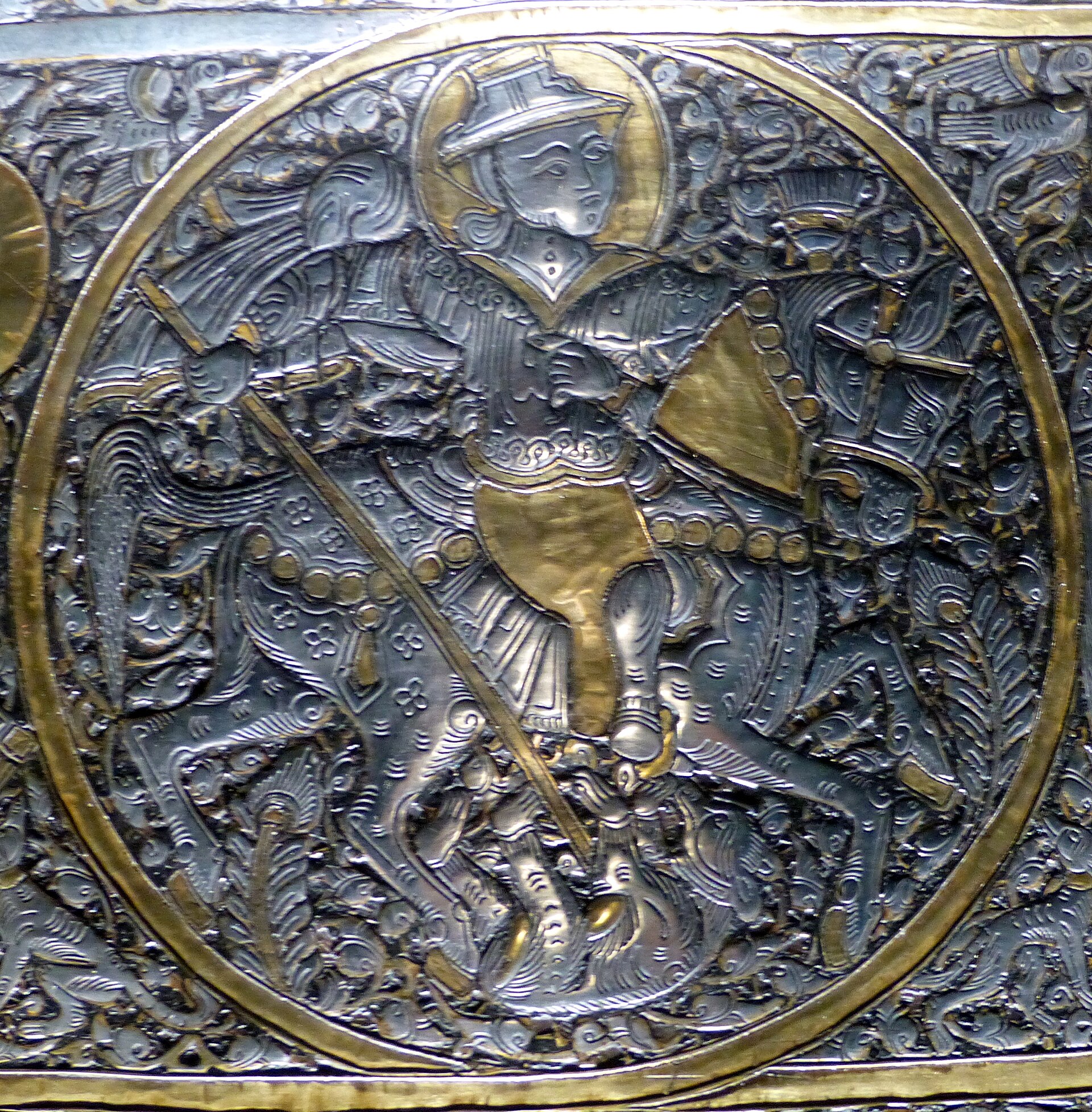
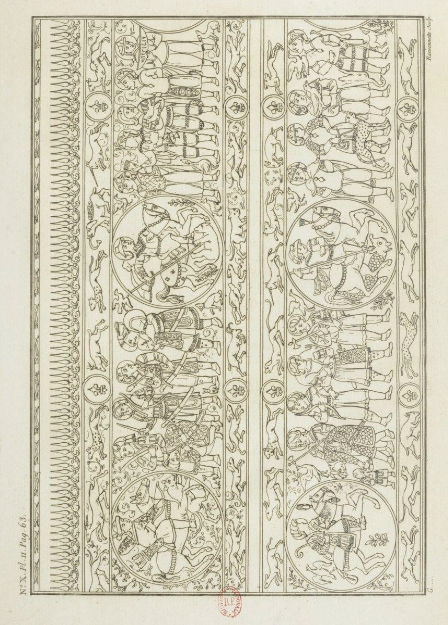
The basin's outer wall carries riders hunting bear, dragon and lion and playing polo, standing figures in mixed costume, some in turbans consistent with Mongol-influenced eastern court fashion and...
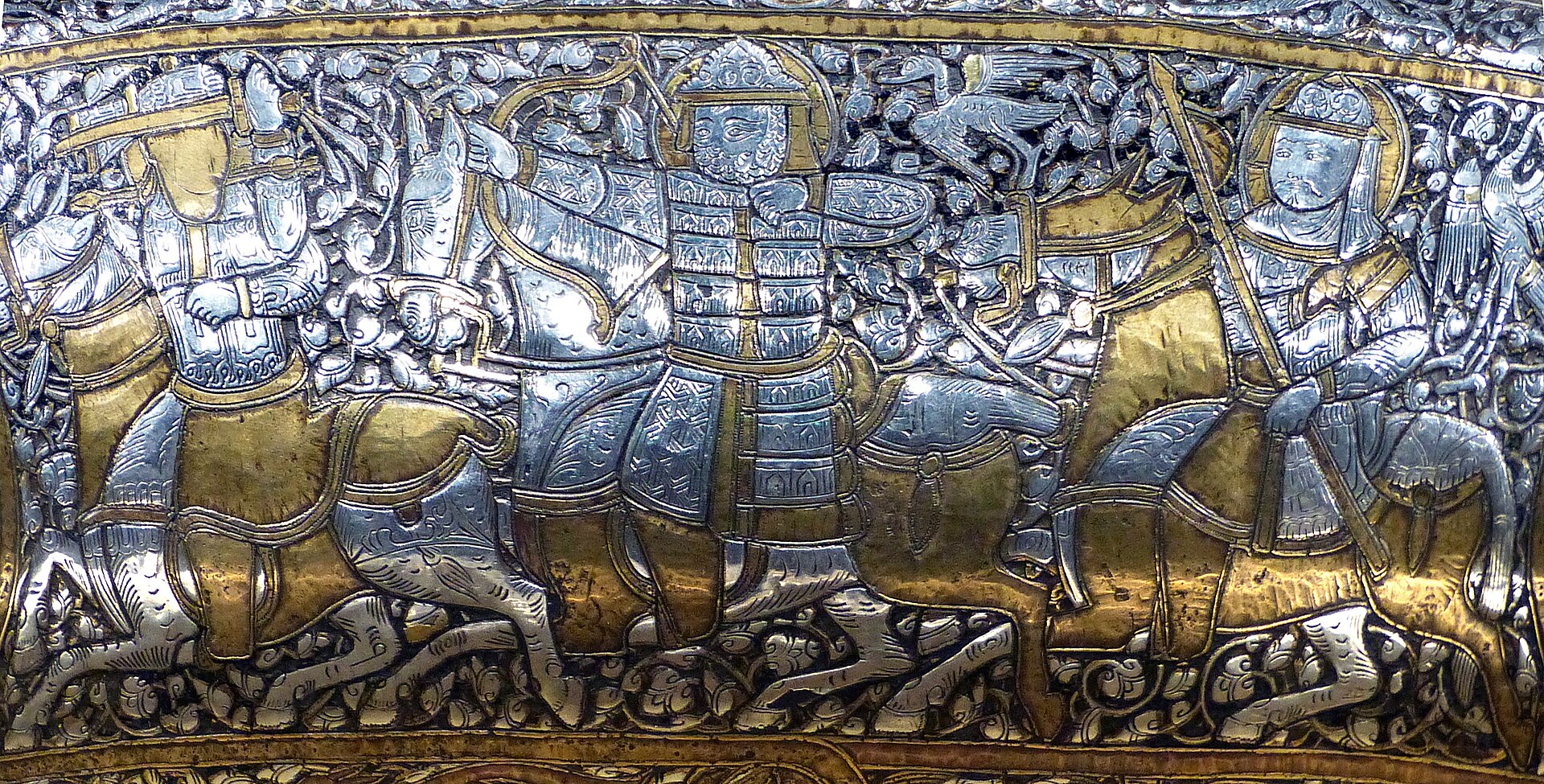
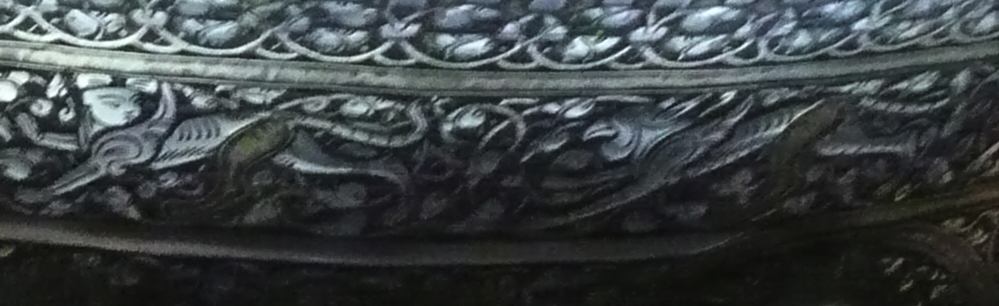
The basin's outer wall carries riders hunting bear, dragon and lion and playing polo, standing figures in mixed costume, some in turbans consistent with Mongol-influenced eastern court fashion and others in a different, non-Mamluk register of dress; the inner wall pairs enthroned rulers attended by courtiers with scenes of battle and hunting. Behrens-Abouseif reads the whole cycle as furusiyya, a visual statement of the martial and courtly virtue, horsemanship and command that legitimised Mamluk military rule, rather than as an illustration of any single named event or person. No inscription on the object names the ruler shown in any of the four throne medallions, and this page does not identify any of them, including the one a popular caption online sometimes labels with the name of the historical sultan Baybars; no scholarly source consulted here makes that identification, and it is treated as unverified rather than repeated as fact.
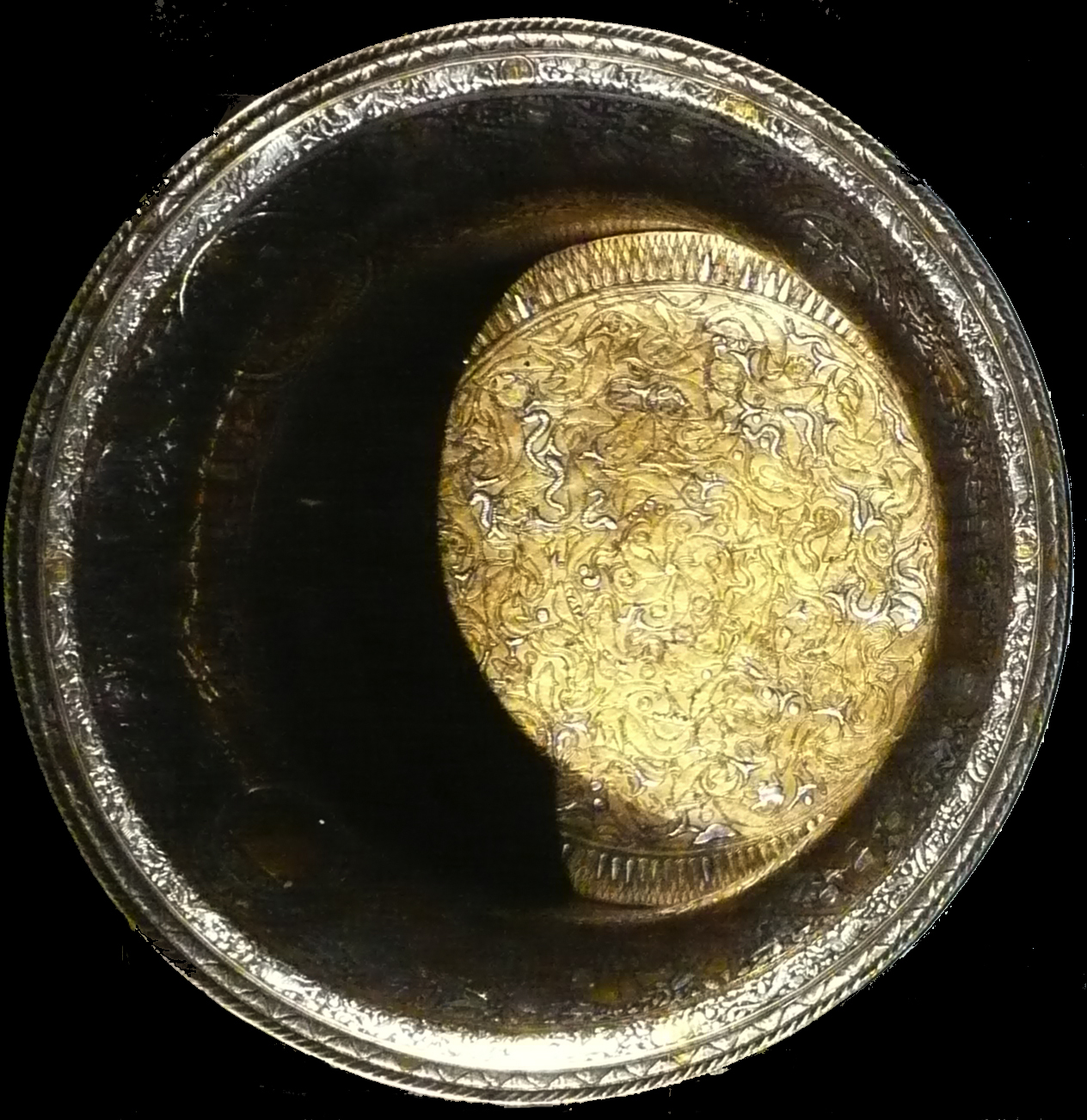
The interior floor is a separate composition from the walls: fish radiating in concentric rings, with ducks, crabs, frogs, a crocodile and a pelican worked among them, and a border of fantastic creatures, griffins, sphinxes, unicorns and dragons, drawn from a bestiary current across the Mongol-influenced eastern Mediterranean and Iranian world in this period rather than from any single named text. A design like this is meant to be seen through standing water, so the fish and the animals around them are also a functional choice, not only a decorative one. None of this is inscribed as a program with a stated meaning; it is an argument this page states as furusiyya self-presentation on the evidence of the imagery itself, following Behrens-Abouseif, not as the maker's own declared intention.
Beyond the wording of the signature itself, ibn al-Zain's work is described in the literature by a recognisable stylistic profile: bold, large-scale figures set off against silver plaques carrying...
Beyond the wording of the signature itself, ibn al-Zain's work is described in the literature by a recognisable stylistic profile: bold, large-scale figures set off against silver plaques carrying finely chased detail, a scale and confidence in the figural engraving that specialists use to propose attributions even where no signature survives. An unfinished basin in the L.A. Mayer Memorial Institute for Islamic Art in Jerusalem, reportedly abandoned after a crack developed in the metal during working, is attributed to him on exactly this basis, style rather than signature, and this page grades that attribution argued, not documented.
The hidden signatures are themselves part of the technical signature. Placing his name inside an object held by a depicted figure, rather than in a border or a dedicatory band, means the signature had to be planned into the design before the engraving began, not added afterward as a separate act; that level of premeditation, repeated five times beyond the one prominent instance, is treated in the literature as a mark of a specific hand and working method as much as the figure style is.
The basin is first securely recorded in French hands around 1440, already in the treasury of the Sainte-Chapelle de Vincennes, with no document explaining how a Mamluk vessel got there.
The basin is first securely recorded in French hands around 1440, already in the treasury of the Sainte-Chapelle de Vincennes, with no document explaining how a Mamluk vessel got there. From 1606 it was used three times across two hundred and fifty years to baptize French royal and imperial children, including the future Louis XIII, the Bourbon claimant later known as the Comte de Chambord in 1821, and the Prince Imperial son of Napoleon III in 1856, under a Christian ceremonial function its Muslim maker did not design it for and a name, Baptistere de Saint Louis, that has nothing to do with the sainted King Louis IX and was only attached in the eighteenth century.
Avinoam Shalem's study of Islamic portable objects in medieval Latin church treasuries describes a general pattern into which this reuse fits: such objects were typically reinterpreted, given a Christian liturgical purpose and meaning, with their earlier history and any Arabic inscription obscured rather than explained, an erasure of origin Shalem calls a kind of cultural colonialism. This page follows Shalem in treating that as a documented pattern of European reception, not as anything the object's own maker intended or could have foreseen; ibn al-Zain's insistence on his own name did nothing to stop three centuries of French royal use in which nobody who touched the object needed, or apparently wanted, to know whose work it was.
The basin was already known to Islamic art specialists in Paris well before anyone treated ibn al-Zain's signature as a subject in its own right.
The basin was already known to Islamic art specialists in Paris well before anyone treated ibn al-Zain's signature as a subject in its own right. Gaston Migeon discussed it in the Gazette des Beaux-Arts around 1899 to 1900 and again in his Manuel d'art musulman in 1907, decades after the object had entered the Louvre's collections and long after its royal baptismal use had ended. It took Rice's dedicated 1951 monograph, more than fifty years later, to set out the six signatures as a connected body of evidence about the maker rather than a curiosity of the object's decoration.
Everything written about ibn al-Zain since follows that reordering of attention: Behrens-Abouseif in 1989, Allan raising the ironworker question in 1996, Ward's patron hypothesis in 1999, Makariou's monograph in 2012, and Carine Juvin's 2022 chapter on how the basin came to be treated as a historical monument in its own right, tracing the object's own changing status rather than its patron. A 2019 essay by Anna Klosowska reads the basin's later reception through a literary and postcolonial lens, as a case study in how a medieval object accrues meanings its maker never intended; this page records that as a documented later interpretation, not as evidence about what ibn al-Zain himself meant or knew.
No source consulted for this page gives a birth date, a death date, a place of training, or a workshop scale for this maker: whether he engraved and inlaid an object of this size and density of...
No source consulted for this page gives a birth date, a death date, a place of training, or a workshop scale for this maker: whether he engraved and inlaid an object of this size and density of decoration entirely by his own hand, or with assistants working under his name and signature, is not addressed anywhere in the literature this page could reach. The date of both his certain objects is argued rather than fixed, tied to which patron theory a given scholar accepts. The identity of the patron who commissioned the basin has been argued over for more than seventy years without agreement. And whether the name on the Jerusalem iron grille belongs to this same craftsman, in a second trade entirely, remains an open question in the one paper that has asked it directly.
Metalworker; Inlayer (brass, gold and silver). active first half of the 14th century (the Louvre dates his best-known object to c. 1330-1340; other scholarship has proposed a working life as early as c. 1290-1310).
Musee du Louvre, Departement des Arts de l'Islam (Paris); L.A. Mayer Memorial Institute for Islamic Art (Jerusalem).
Nothing paid to Muhammad ibn al-Zain personally is recorded in any source consulted for this page, and neither of his two certain objects has ever been sold at auction or on the open market in any period covered by the sources consulted. The basin has been French royal or state property continuously since it is first securely recorded around 1440, with no auction, private sale, insurance valuation, dation or export application documented at any point.
Where was Muhammad ibn al-Zain trained, and where did he work? No source consulted gives a birthplace, a training history or a documented workshop location; the epithet al-Zain does not securely resolve to a place, a family name or an honorific.
Across this archive the objects that carry a personal name are almost never named for their makers.
9 min read
The profession defines provenance as a chain running from creation to the present.
8 min read
Five objects in this archive were taken by the French state between 1789 and 1810.
8 min read
The Louvre did not buy the most famous Vermeer in France. It accepted it against a death duty, and the acquisition price is not...
13 min read
Last verified
One artwork and its story every Tuesday, with the picture: who owned it, what it made, and what closes soon in the exhibition calendar. No promotion, and nothing we cannot cite.
We send one email to confirm the address and keep nothing else. Every letter carries a one-click unsubscribe. How we handle your data.