Johann Friedrich Bottger
 German (Saxon) · 1682-1719
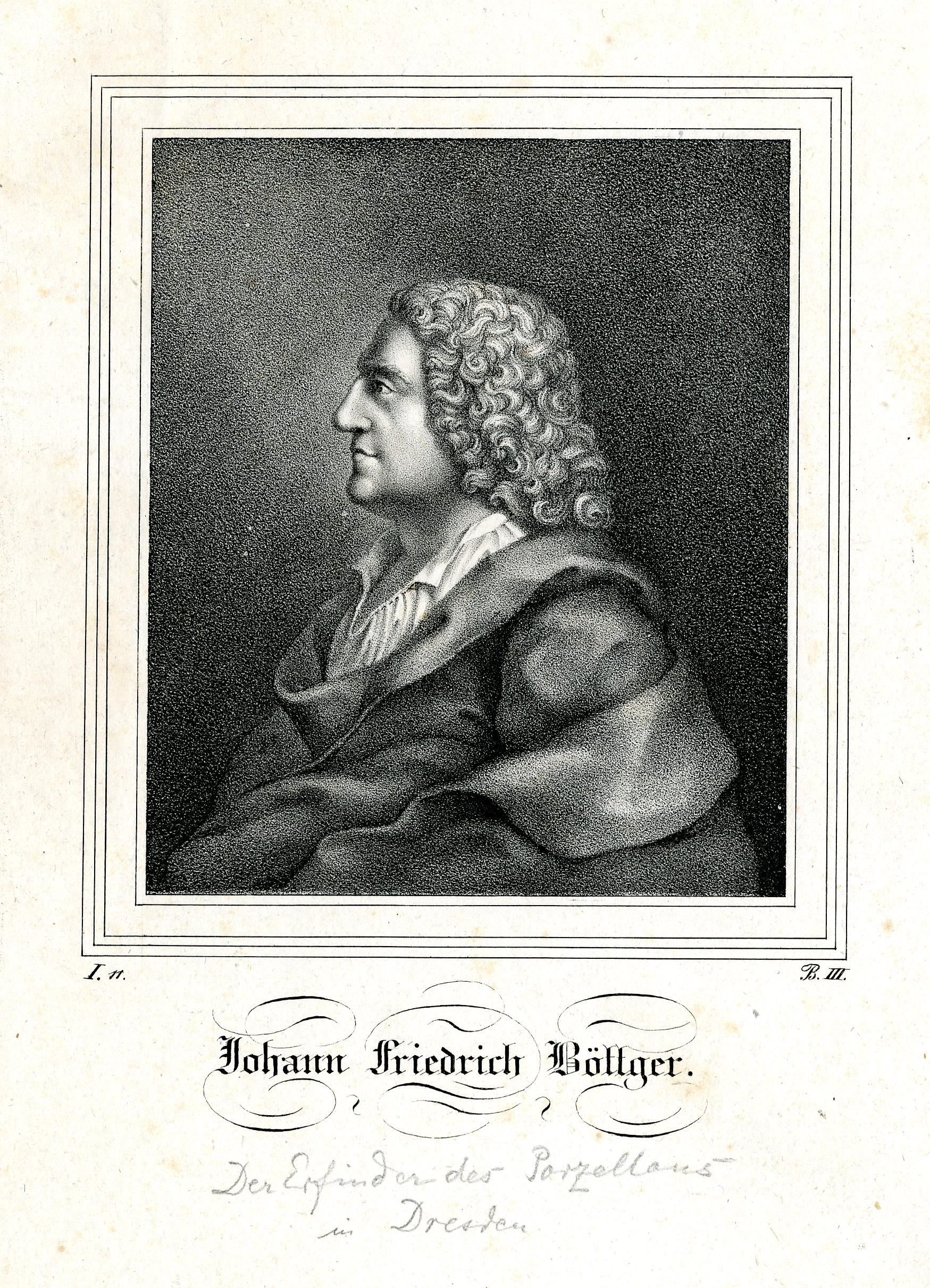
A hand-colored lithographic portrait of Bottger in profile, from an unidentified early nineteenth-century publication, held by the British Museum. No portrait of Bottger survives from a sitting in his own lifetime. German-language scholarship on Bottger states that only one image made close to his own era is now claimed, a 1723 relief on a Bottgersteinzeug plaque by the court sculptor Francois Coudray, held at the Herzogliches Museum Gotha, from which this print and every other circulating likeness of Bottger is said to descend. That underlying claim was not independently confirmed by this desk; see notes_for_editor and open_questions.
British Museum, London (museum number 1929,0608.45), via Wikimedia Commons| Worked as | Alchemist, Ceramicist, Manufactory leaseholder |
|---|---|
| Born | 4 February 1682 · Schleiz, Principality of Reuss-Schleiz, Holy Roman Empire |
| Died | 13 March 1719 · Dresden, Electorate of Saxony |
| Nationality | German (Saxon) |
| Sources | 30 cited |
| Last verified |
About this page Last verified · 30 sources cited
On this page 13 sections
ContentsClose
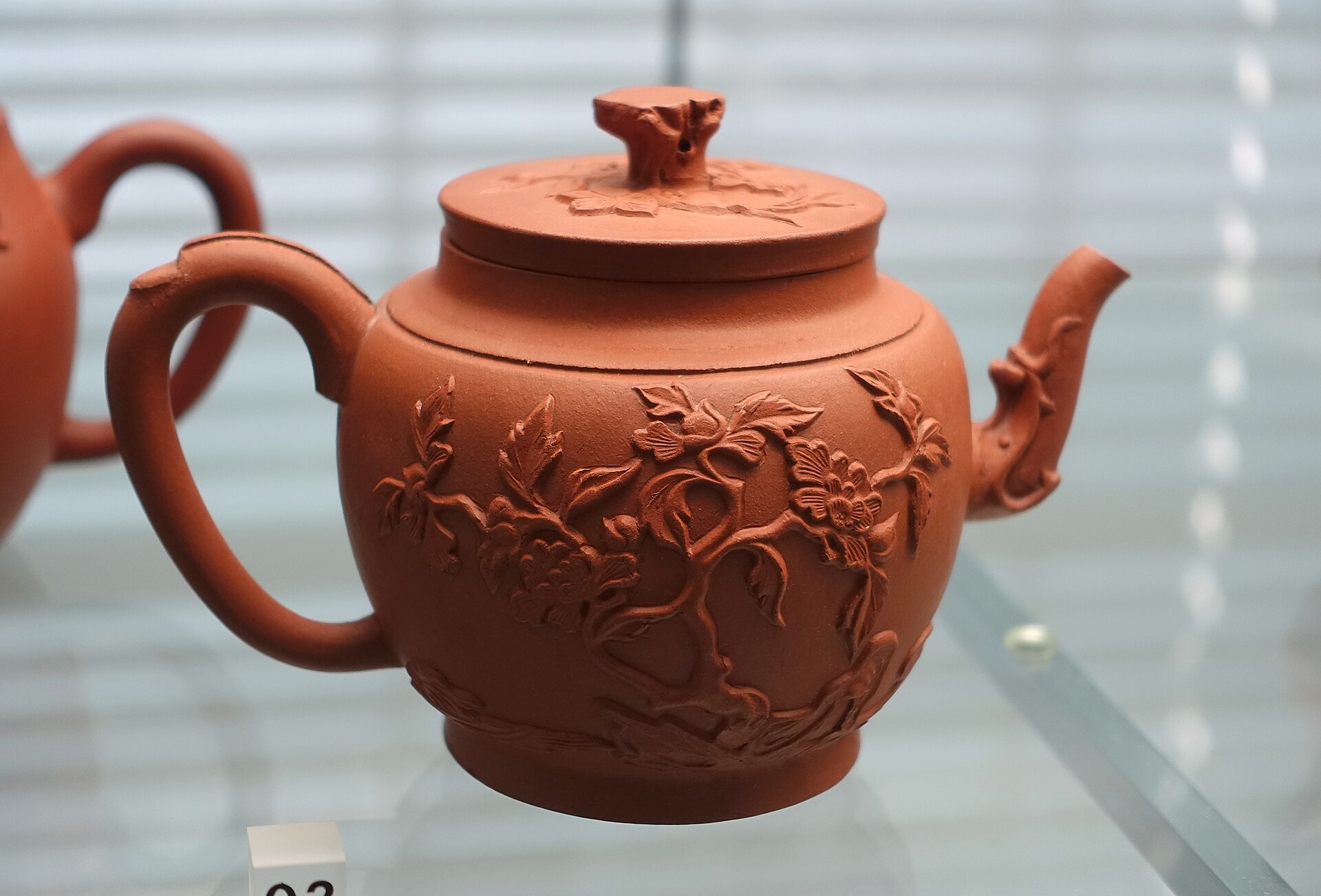
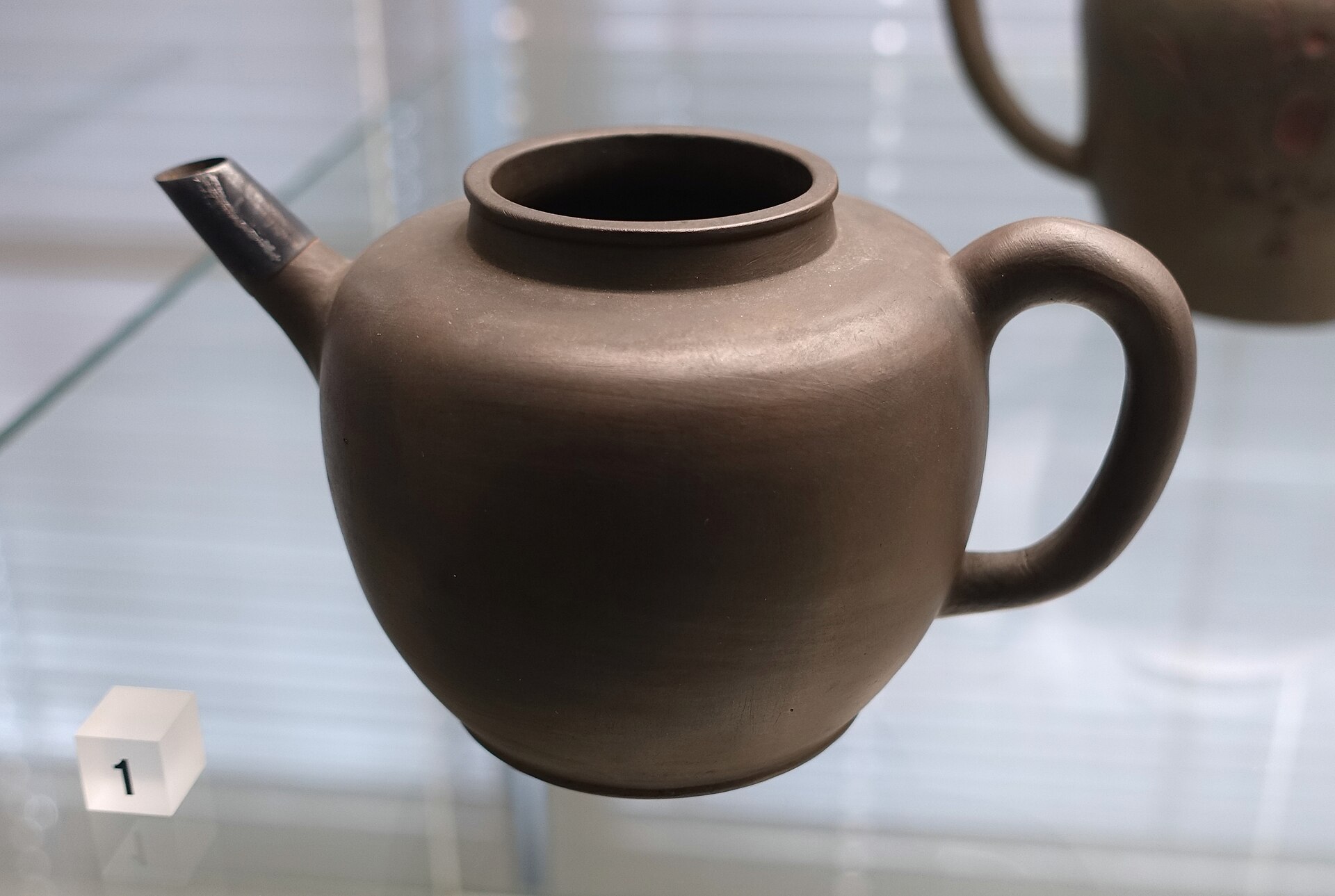
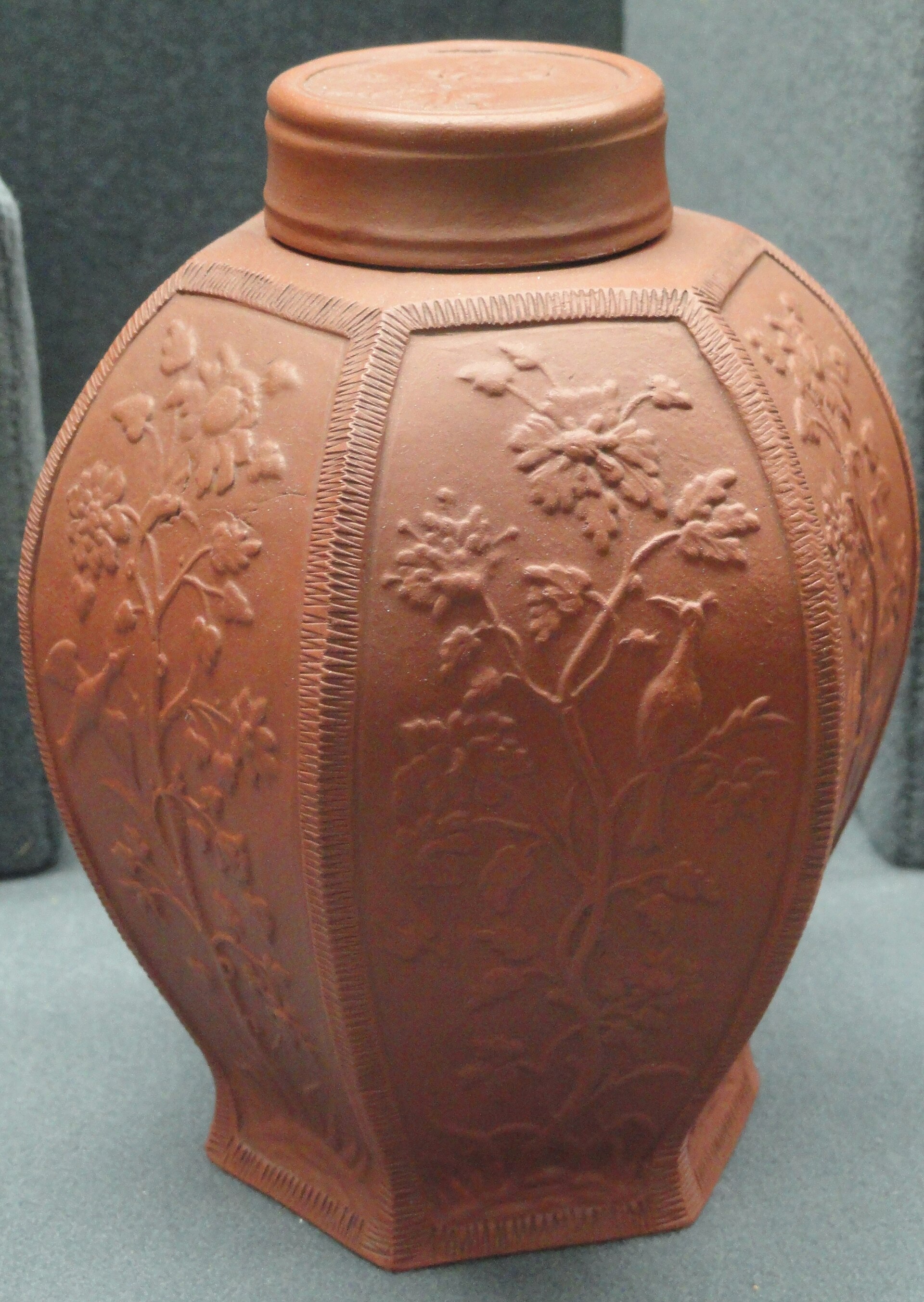
Johann Friedrich Bottger is remembered as the inventor of European porcelain, and that description is true and misleading in the same breath. He was an alchemist, not a potter, held under guard from the age of nineteen because he had boasted he could turn base metal into gold. The porcelain came out of that failure, not out of any ambition to make ceramics. He never made gold. He made, instead, in May 1706, a hard red stoneware, and by 1708-9 a true hard-paste white porcelain, and in doing so broke a monopoly that Chinese and Japanese kilns had held over Europe for centuries.
What a reader most needs to know and usually does not: there is no portrait of Bottger made from life. Every image of him now in circulation, including the one on this page, is argued to descend from a single stoneware relief modelled four years after his death. He was never simply freed, either. Formal release came only in 1714, on condition of silence, and he remained watched until he died in debt in 1719, worn out by illness and by the same alcohol and chemicals that had been part of his working life since his teens. The secret he had been made to guard with his life did not even outlast him: a defector had already carried it to Vienna in January 1719, about two months before Bottger's own death that March, and from Vienna it reached Venice about two years later, in 1721.
Images
Chronology
- 1682
Born 4 February in Schleiz, son of the town's mint master, who died the same year; the family later moved to Magdeburg.1114
- 1701
As an apothecary's apprentice in Berlin, demonstrates a purported silver-to-gold transmutation using materials from a travelling Greek monk; flees when the Prussian elector demands he repeat it at court, and is arrested instead in Saxon territory by Augustus the Strong.1114
- 1702
Held under guard at the fortress of Konigstein, February to May.13
- 1703
Attempts to escape in June, is recaptured near Enns in Upper Austria, and is later moved to the Goldhaus laboratory in Dresden, where by this point Augustus has spent some 40,000 taler on the failed gold project.111314
- 1706
In May, Bottger and Tschirnhaus succeed in firing a hard red stoneware resembling Chinese Yixing ware, later called Bottger stoneware; the same year Samuel Stoltzel joins the Meissen workforce as a miner.1124
- 1706-1707
Imprisoned again at Konigstein, September to September, during the Swedish occupation of Saxony in the Great Northern War.13
- 1707
The team turns to perfecting both the red stoneware and a workable white porcelain recipe; a breakthrough in white porcelain composition is achieved in October or November.1113
- 1708
A laboratory protocol of 15 January records the porcelain composition that German-language scholarship treats as the exact date of the European invention; Tschirnhaus dies suddenly on 11 October, before the project is complete.131114
- 1709
Melchior Steinbrueck arrives in March to administer the works and obtains Bottger's formula; around 28 March, Bottger tells Augustus he can make porcelain 'as good as that of the Chinese, if not better,' a claim that proves premature.1411
- 1710
Augustus establishes the royal manufactory at the disused Albrechtsburg castle in Meissen; stoneware and porcelain samples shown at the Leipzig Easter fair sell only about half the exhibited stock.11
- 1711
The Meissen works employs more than thirty men and has produced upward of twelve thousand pieces, nearly all red stoneware; kaolin from Aue begins arriving in crates marked with crossed swords and the letters AR, for Augustus Rex.11
- 1713
White porcelain can be fired reliably for the first time, and the first porcelain sales of real consequence take place at the Leipzig fair.1112
- 1714
Bottger is formally released from confinement, on condition he remain in Saxony and keep the arcanum secret; he continues to be watched by Augustus's agents.11
- 1715
Becomes leaseholder of the manufactory on a nominal salary of 50 taler a month, while frequently too ill, or too affected by drink, to visit the works.11
- 1719
Dies in Dresden on 13 March, personally in debt by 8,564 taler, with the manufactory owing roughly three times that; within the same year the arcanist Samuel Stoltzel defects to the new Vienna porcelain works of Claudius Innocentius du Paquier, carrying the formula with him.1116
- 1720
In April, Stoltzel returns to Meissen bringing the Vienna enamel painter Johann Gregor Horoldt, whose color palette becomes the foundation of Meissen's later painted porcelain.24
- 1721
Christoph Conrad Hunger, who had also carried Meissen knowledge to Vienna, is by this year a partner in Giovanni Vezzi's new porcelain works in Venice, the third factory in Europe to achieve true hard-paste porcelain.21
- 1722
Manufactory inspector Johann Melchior Steinbrueck proposes the crossed swords of the Saxon electoral arms as the mark to identify genuine Meissen porcelain.16
- 1723
The image now claimed as the only likeness made close to Bottger's own era, a relief on a Bottgersteinzeug plaque, is modelled by the court sculptor Francois Coudray, four years after Bottger's death; the sole surviving original is said to be held at the Herzogliches Museum Gotha.1322
- 1919
Under director Max Adolf Pfeiffer, Meissen revives production of Bottgersteinzeug for new sculptural work, using the historical recipe for factory-authorized modern pieces that must be told apart from Bottger-era originals by model and mark rather than by the clay itself.1517
The market
Bottger-period stoneware reaches auction only occasionally, most often through the periodic specialist Meissen sales that Bonhams in London has run under titles such as Important Meissen Porcelain from a Private Collection. In every priced result found for this page, a documented line of ownership back to a named earlier collector or a royal inventory number is doing real work on the price, not merely the object's rarity.
Two further lots seen in the course of this research, a lacquered octagonal coffee pot estimated at GBP 40,000 to 60,000 at Bonhams in December 2018 and a mounted tankard estimated at GBP 10,000 to 15,000 at Bonhams in December 2016, are not included in the results below because the source consulted for each does not publish a sale result.
| Date | Sale | Work | Result | Note |
|---|---|---|---|---|
| 2 July 2019 | Bonhams, London | Bottger stoneware teapot and cover, circa 1710-13 | Hammer Not published in the source consulted With premium GBP 35,062.50 GBP | Provenance to the castrato singer Francesco Bernardi, called Senesino, recorded as having acquired the piece in London between 1717 and 1719 while performing in Handel's operas; descended in his family since. |
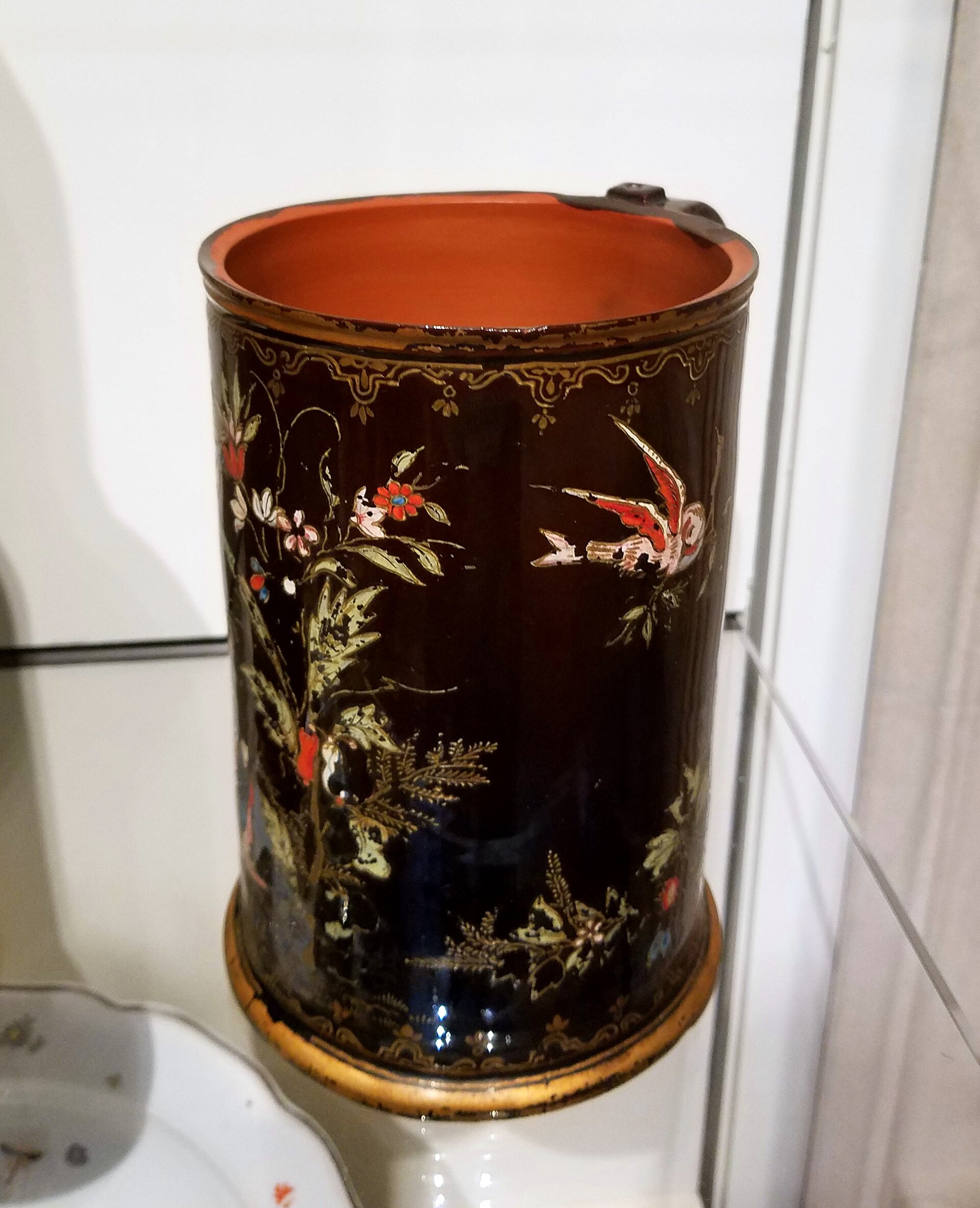
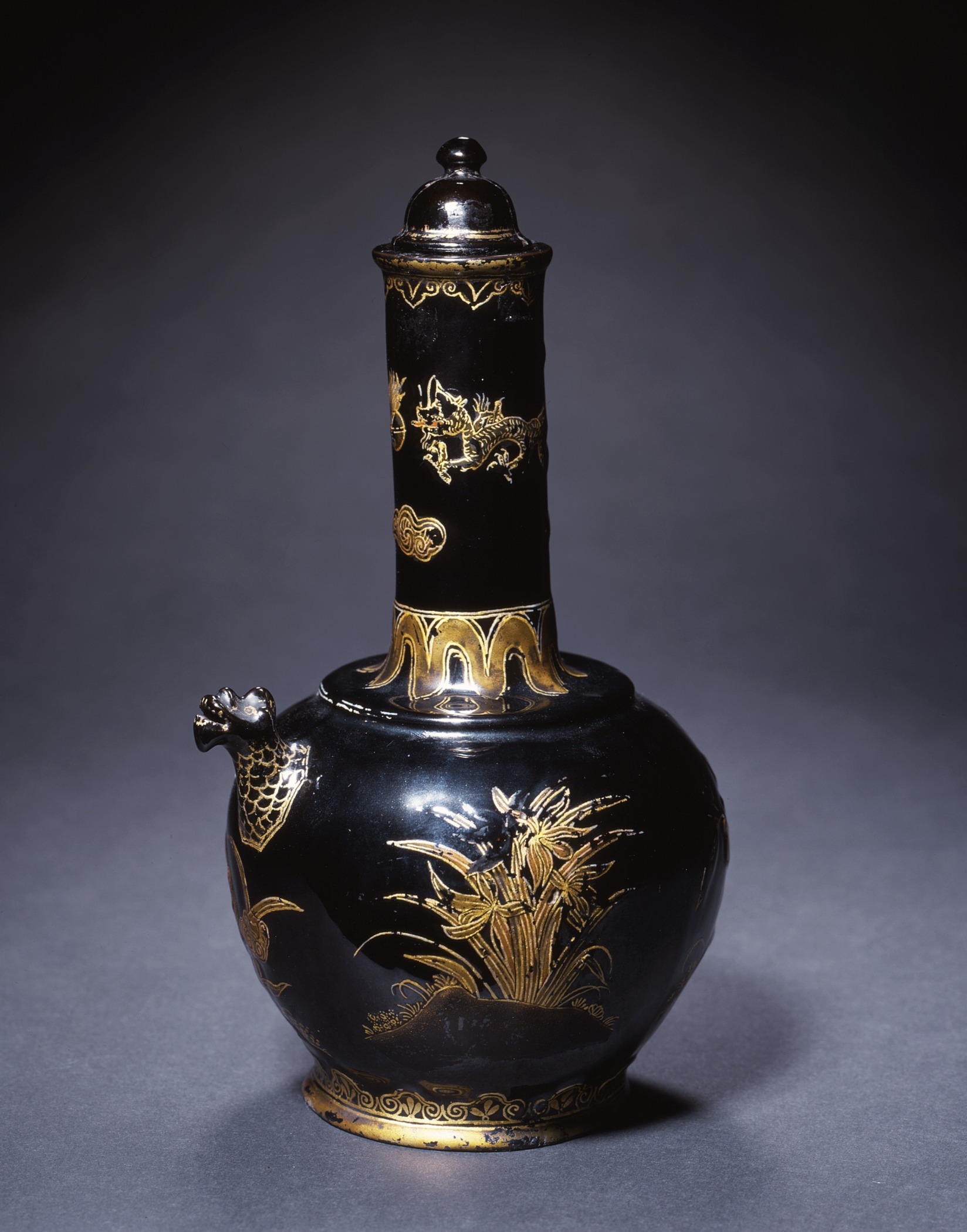
| 2 July 2019 | Bonhams, London | Bottger stoneware black-glazed kendi, circa 1710-13, Japanese Palace inventory number 64./P, decorated in Martin Schnell's Dresden workshop | Hammer Not published in the source consulted With premium GBP 82,562.50 GBP | The same object as the Iconotheca record on the Johanneum kendi 64./P, held pending a photograph: former royal Saxon collection, delivered 1733; deaccessioned at the Lepke sale, Dresden, 1920; Siegfried Salz collection; previously sold at Christie's London in 2011 (no price for that sale is published in the source consulted). |
| 5 December 2012 | Bonhams, London | Bottger stoneware teabowl and saucer, circa 1710-13, black-glazed and gilded in Martin Schnell's workshop | Hammer Not published in the source consulted With premium GBP 25,000 GBP | Provenance to Margravine Sibylla Augusta of Baden-Baden (1675-1733) and the Baden royal collections, later loaned successively to the Zahringer Museum in Karlsruhe (1879-1919), the Zahringer Museum, Neues Schloss, Baden-Baden (circa 1960-1990), and the Museum fur Kunst und Gewerbe, Hamburg (1999-2009), the piece already being the property of the Hoffmeister collection during that third, Hamburg loan, before this sale. |
Hammer is the price at which the bidding stopped; with premium adds the fee the house charges the buyer on top. Hammer price and buyer's premium in the glossary.
Where to see the work
| Institution | City | Holdings | Note |
|---|---|---|---|
| Metropolitan Museum of Art | New York | Multiple Bottger-period red stoneware and porcelain pieces, including a teabowl and saucer of about 1708-9, among the earliest datable examples of the material. | Open access; images and data released public domain. |
| J. Paul Getty Museum | Los Angeles | A Bottger stoneware teapot (1715-20) and a standing cup and cover (about 1710-15), both catalogued as jointly the work of Bottger and the Meissen manufactory. | Images released CC0 under the Getty's Open Content Program. |
| Staatliche Kunstsammlungen Dresden, Porzellansammlung (Zwinger) | Dresden | The core of the former royal Japanese Palace collection assembled by Augustus the Strong, including Bottger-period stoneware and porcelain that retain their Johanneum inventory numbers. | The collection this page's inventory-number evidence is drawn from. |
| Victoria and Albert Museum | London | Bottger red stoneware including a cut and wheel-polished teapot (1710-15) and a silver-gilt-mounted tankard (about 1710-13). | Images are released for non-commercial use only, not public domain, and were not used in this page's gallery for that reason. |
| British Museum | London | An early nineteenth-century lithographed portrait print of Bottger, Department of Prints and Drawings, museum number 1929,0608.45. | The portrait source used on this page. |
| Herzogliches Museum Gotha | Gotha | Said in secondary literature to hold the sole surviving original of the 1723 Bottgersteinzeug relief portrait attributed to Francois Coudray, the image from which all other likenesses of Bottger are argued to descend. | Not independently confirmed by this desk beyond the secondary citation; see notes_for_editor. |
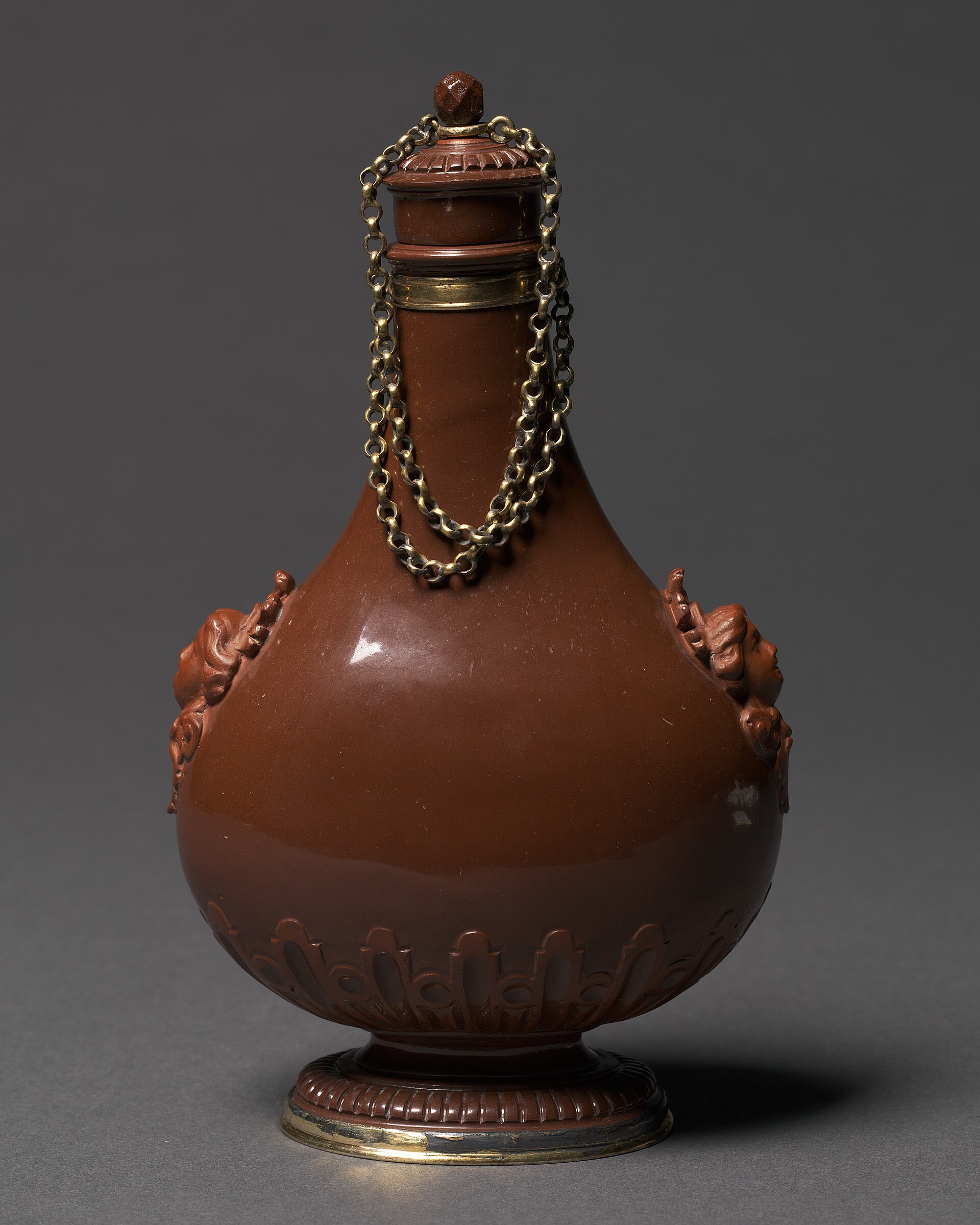
| Cleveland Museum of Art | Cleveland | A polished Bottger stoneware pilgrim bottle with silver-gilt mounts, about 1715. | Images released CC0. |
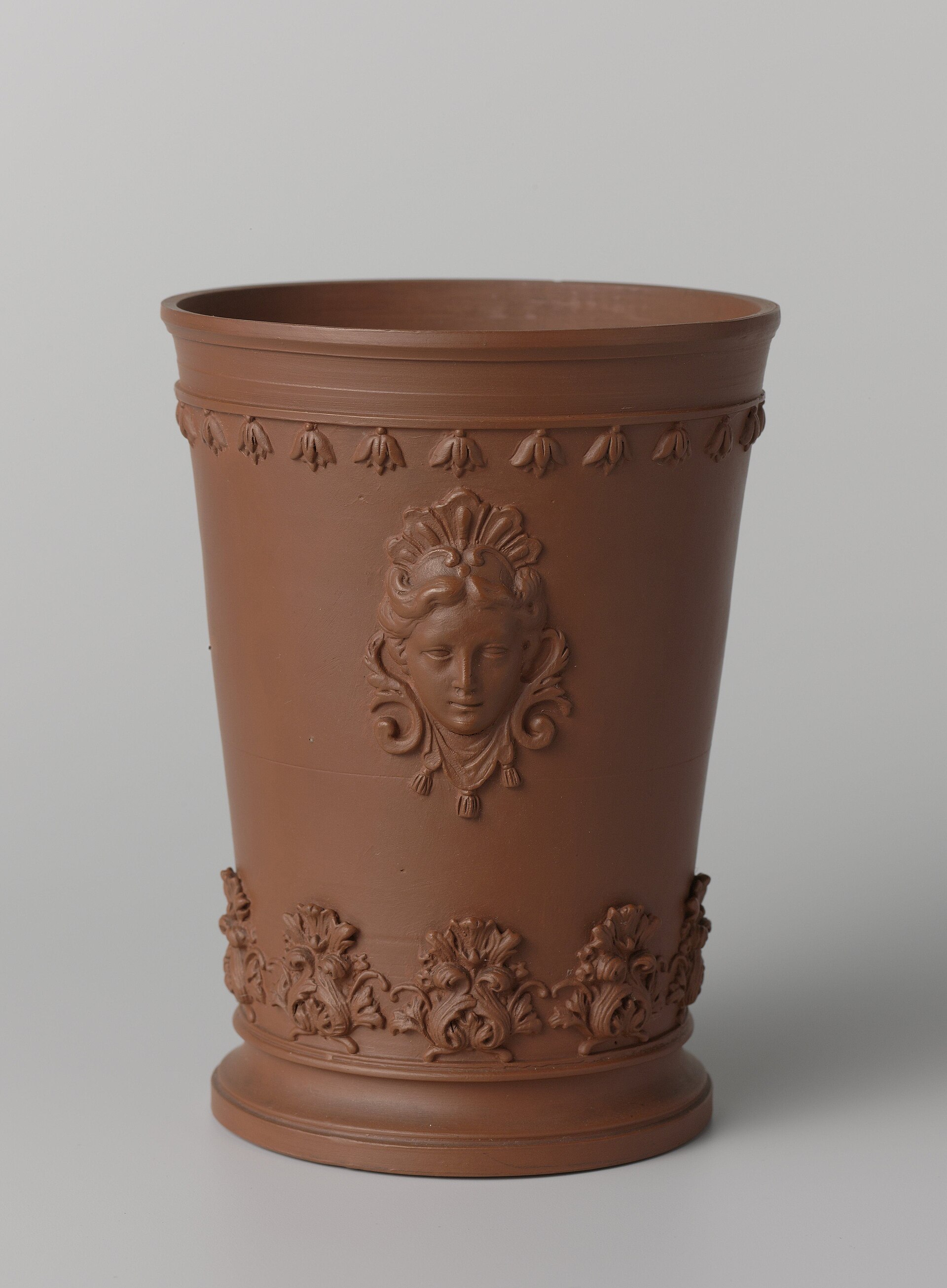
| Rijksmuseum | Amsterdam | Bottger stoneware including a beaker vase with women's heads in relief, about 1715, attributed to the modeller Johann Jakob Irminger. | Images released CC0. |
| Los Angeles County Museum of Art | Los Angeles | A wine ewer and cover, about 1712-15, red stoneware with glaze and gilding, catalogued by LACMA under Bottger's own name alongside the Meissen manufactory. | Image released public domain. |
Forgeries and misattributions
- The 1919 factory revival
- Under director Max Adolf Pfeiffer, Meissen itself resumed making Bottgersteinzeug from 1919 for new sculptural work by outside artists, using the historical recipe and, on some models, a visual language close to the original wares. Not a fraud: pieces are the manufactory's own factory-marked, dated production. The genuine risk is innocent confusion rather than deception, since chemical analysis of the paste alone cannot separate a piece from the 1710s from one made in the 1920s; the model, the mark, and the object's documented history have to do that work instead.1517
- No mark to fake
- Bottger red stoneware made between 1708 and 1719 was never marked. The crossed-swords mark now associated with Meissen was proposed only in 1722, three years after Bottger's death, and was applied to porcelain rather than to stoneware. The absence cuts both ways. It means there is no mark for a forger to counterfeit convincingly, which is very likely one reason this desk found no documented case of deliberate, marked forgery of Bottger-period stoneware specifically, in contrast to the well-documented nineteenth and twentieth century forging of Meissen's later crossed-swords porcelain mark. It also means attribution of any unmarked piece rests entirely on form, paste, and provenance, exactly the evidence this page has had to rely on throughout.16
The essay
Chapter 1An alchemist first, a potter only by accident
Bottger was born in Schleiz, a small Thuringian principality, the son of the town's mint master, who died the same year.
Bottger was born in Schleiz, a small Thuringian principality, the son of the town's mint master, who died the same year. His mother remarried an engineer and town official, Johann Friedrich Tiemann, who gave the boy what was for the time a good bourgeois education and paid for his apprenticeship to an apothecary in Berlin. It was there, as a teenager, that Bottger fell in with men pursuing the philosopher's stone, the substance alchemical theory held could turn base metal into gold. Having received ingredients and instructions from a travelling Greek monk, he made a demonstration in Berlin in 1701 that convinced onlookers, or at least convinced enough of them that word reached the Prussian elector, soon to be crowned Frederick I, King in Prussia.
This was not the fringe pursuit it now sounds. Alchemy in 1701 still counted as a science, pursued by figures as serious as Isaac Newton, and a state gold-maker was, on paper, a rational thing for an indebted court to want. Frederick summoned Bottger to Berlin. Fearing punishment when he could not deliver, Bottger fled instead, straight into the territory of Saxony's elector, Augustus the Strong, who had exactly the same debts and exactly the same interest in a gold-maker. Augustus had him arrested before Prussian agents could reclaim him, and the arrest amounted to a change of jailer, not a rescue.
Chapter 2Augustus the Strong's prisoner
The confinement was comfortable in its furnishings and absolute in its terms.
The confinement was comfortable in its furnishings and absolute in its terms. Bottger was given books, a laboratory, good meals, and the right to entertain the court's scholars, but he could not leave. He was held for a period at the fortress of Konigstein in 1702, attempted an escape in June 1703, and was recaptured near Enns in Upper Austria. Later, during the Swedish occupation of Saxony in the Great Northern War, he was moved back to Konigstein between September 1706 and September 1707, kept out of reach of an occupying army that might otherwise have taken an interest in a court alchemist.
By 1703 the gold project had already cost Augustus roughly 40,000 taler, on one scholarly estimate the equivalent of a year's wages for about four thousand men, and had produced nothing. That year Bottger was moved to the Goldhaus, a fully equipped laboratory a short walk from the Dresden palace, given apartments, a billiards room, and the freedom of the palace gardens, on the understanding that guards had orders to shoot at him with a blowpipe if he came too near the gate. It was at the Goldhaus that he was placed in regular contact with Ehrenfried Walther von Tschirnhaus, the courtier and scholar who would do more than anyone else to turn a fraud investigation into a scientific one.
Chapter 3Tschirnhaus, and who actually deserves the credit
Tschirnhaus was everything Bottger was not: a trained mathematician and chemist, educated at Leiden, formerly tutor to the son of Louis XIV's finance minister Colbert in Paris, a student of burning...
Tschirnhaus was everything Bottger was not: a trained mathematician and chemist, educated at Leiden, formerly tutor to the son of Louis XIV's finance minister Colbert in Paris, a student of burning mirrors capable of melting materials at very high temperatures, and, since at least 1694, an experimenter who had used those mirrors on delftware and imported Chinese porcelain in pursuit of its recipe. Augustus tasked him with overseeing Bottger's work. Tschirnhaus resented the diversion from his own projects but recognised, once the two had produced a hard red ceramic in May 1706, that a white porcelain recipe was within reach, and it was Tschirnhaus who is credited with steering both Bottger and the elector toward that more achievable goal.
Tschirnhaus died suddenly on 11 October 1708, before the porcelain project was complete, and the question of whose achievement it really was did not wait for a decent interval. In 1719, the year of Bottger's own death, the manufactory's arcanist Samuel Stoltzel argued that Tschirnhaus, not Bottger, had found the recipe; a 1731 report by Peter Mohrenthal repeated the claim, crediting Tschirnhaus with the underlying discovery and Bottger only with working out the practical, repeatable process afterward. This is argued, not settled: the modern consensus divides credit rather than assigning it outright, giving Tschirnhaus the theoretical insight and Bottger the kiln-building, the firing trials, and the sheer persistence that turned an insight into a product a court could sell. No document from either man's own hand resolves the question, and none is likely to.
Chapter 4Two materials, two years apart, and three different dates
The Bottger workshop produced two distinct materials, and the record of when each was achieved is itself layered.
The Bottger workshop produced two distinct materials, and the record of when each was achieved is itself layered. The red stoneware, later called Bottgersteinzeug, was successfully fired in May 1706: a dense, iron-rich body that could be cut and polished like a hardstone, modelled at first on the Chinese Yixing wares already in Augustus's collection. The white hard-paste porcelain came later and is dated three different ways depending on what is being measured. German scholarship treats a laboratory protocol of 15 January 1708, recording the composition that finally worked, as the exact date of the invention, following breakthrough experiments in October and November 1707. Bottger's own announcement to Augustus, however, came later still, on or around 28 March 1709, when he claimed he could now make porcelain 'as good as that of the Chinese, if not better.' That claim was premature: reliable firing of white porcelain in quantity was not achieved until 1713, and the first porcelain sales of any real consequence took place at the Leipzig fair that same year.
Keeping these three dates distinct matters, because popular accounts routinely collapse them into a single 'porcelain in 1709' story. The laboratory success, the public boast, and the commercially reliable product were three different moments, four to six years apart, and only the first is a matter of a written protocol rather than a claim.
Chapter 5What the imitation was for
Neither material was invented in a vacuum of taste.
Neither material was invented in a vacuum of taste. Augustus the Strong was, by his own court's account, obsessed with East Asian porcelain, buying it in quantity and, on one notorious occasion, trading six hundred of his own dragoons to the King of Prussia for a collection of Chinese vases. His unbuilt plan for a Japanese Palace across the Elbe from his Dresden residence called for at least eighteen rooms, the lower level wallpapered floor to ceiling in imported Chinese and Japanese porcelain, the upper level in Meissen's own products, room by room in celadon and gold, purple and gold, gray and blue, with a menagerie of life-sized porcelain animals on the top floor. Bottger's stoneware and porcelain were made, first and explicitly, to imitate what Augustus already owned and could not make: Yixing red stoneware, Chinese blanc de chine devotional figures, and Japanese and Chinese export porcelain forms, at a fraction of the cost of importing them and without depending on a foreign supplier.
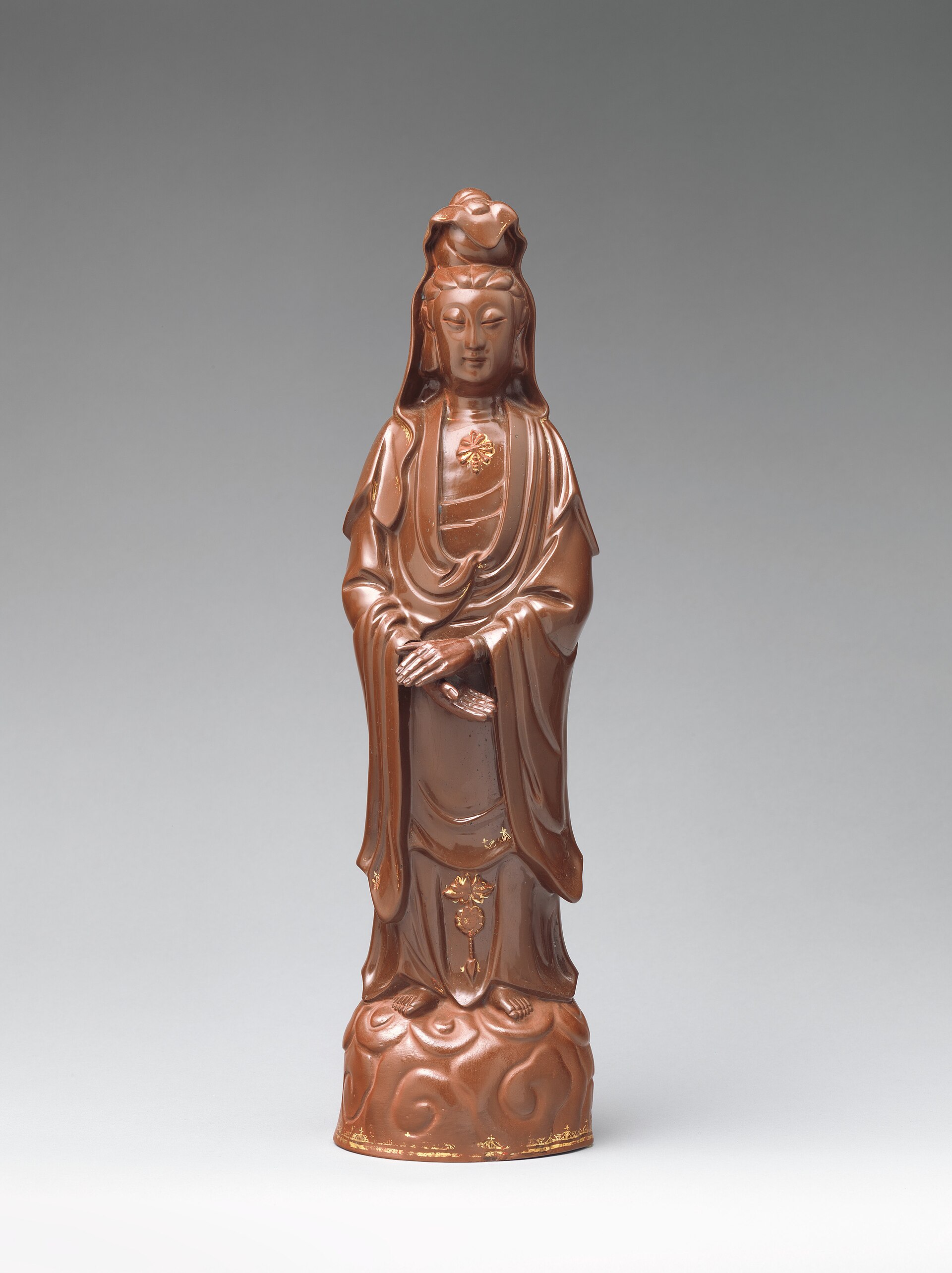
A red stoneware figure of Guanyin, the Buddhist bodhisattva of compassion widely reproduced in Chinese export porcelain of the period, made at Meissen in 1710-13 and now in the Metropolitan Museum, is a plain example of the mechanism: a Saxon workshop reproducing an East Asian devotional image because the image, not any doctrine behind it, was what the European market and the Saxon court wanted to own. There is no evidence any Bottger-period workshop piece was made to serve an actual devotional or ritual function in Saxony; the imitation was aesthetic and competitive, aimed at Augustus's collecting habit and at import substitution, not at replicating the belief the original object carried in China. That the meaning did not travel with the form, only the form did, is itself the finding worth recording, rather than any hidden programme behind it.
Chapter 6Meissen, and a life that was never really his own
In 1710 Augustus established the royal manufactory and moved production to the disused Albrechtsburg castle at Meissen, about fifteen miles from Dresden.
In 1710 Augustus established the royal manufactory and moved production to the disused Albrechtsburg castle at Meissen, about fifteen miles from Dresden. Both stoneware and porcelain samples were shown at the Leipzig Easter fair that year, though, tellingly, only about half the exhibited stock actually sold. Production scaled quickly regardless: by 1711 the Meissen works employed more than thirty men and had produced upward of twelve thousand pieces, almost all of them red stoneware, and the exclusive kaolin clay from Aue was shipped to the works in crates marked with crossed swords and the letters AR, for Augustus Rex, the first use of a mark that would eventually evolve into Meissen's trademark.
None of this made Bottger a free man. He was formally released from confinement only in 1714, on condition that he stay in Saxony and keep the arcanum secret, and Augustus's agents continued to watch him afterward. From 1715 until his death he held the manufactory as its leaseholder, on a nominal salary of 50 taler a month, while his health and his drinking worsened and he visited the works only irregularly. He died in Dresden on 13 March 1719, in debt to the amount of 8,564 taler personally, with the manufactory itself owing roughly three times that figure, not counting wages owed to its own workers. The man who had ended a centuries-long European dependence on imported porcelain died owing money to the institution he had founded.
Chapter 7The secret did not survive the year
Meissen's arcanum, the porcelain recipe and firing method, was treated as a state secret precisely because it was worth stealing, and it was stolen almost immediately.
Meissen's arcanum, the porcelain recipe and firing method, was treated as a state secret precisely because it was worth stealing, and it was stolen almost immediately. Samuel Stoltzel, who had joined the Meissen works as a miner in January 1706 and risen to arcanist and kiln master by 1719, defected to Vienna that same year, reportedly after getting a woman pregnant and needing money he did not have. Vienna's new porcelain works, chartered to the court agent Claudius Innocentius du Paquier and already employing another Meissen man, the gilder Christoph Conrad Hunger, used Stoltzel's knowledge to become only the second factory in Europe to make true hard-paste porcelain.
The story then runs in a direction the standard telling usually skips. In April 1720 Stoltzel returned to Meissen, apparently under a negotiated amnesty, and brought with him the Vienna enamel painter Johann Gregor Horoldt, whose color palette became the technical foundation of all later Meissen painted porcelain: Stoltzel's defection ended up delivering Meissen its most important decorator. Hunger, meanwhile, moved on from Vienna to Venice, where by 1721 he was a partner in Giovanni Vezzi's new porcelain works, the third factory in Europe to achieve true porcelain, which depended on him for technical expertise and on continued kaolin supplies from Saxony that dried up once he left Venice again in 1724. Two years after Bottger's death, in 1722, the manufactory inspector Johann Melchior Steinbrueck proposed the crossed swords from the Saxon electoral arms as the mark that would finally distinguish genuine Meissen porcelain from its rivals and its imitators, an admission that the secret Bottger had died guarding was already loose across three courts.
Chapter 8A corpus without a catalogue
Painters accumulate a catalogue raisonne; Bottger-period ceramics never have.
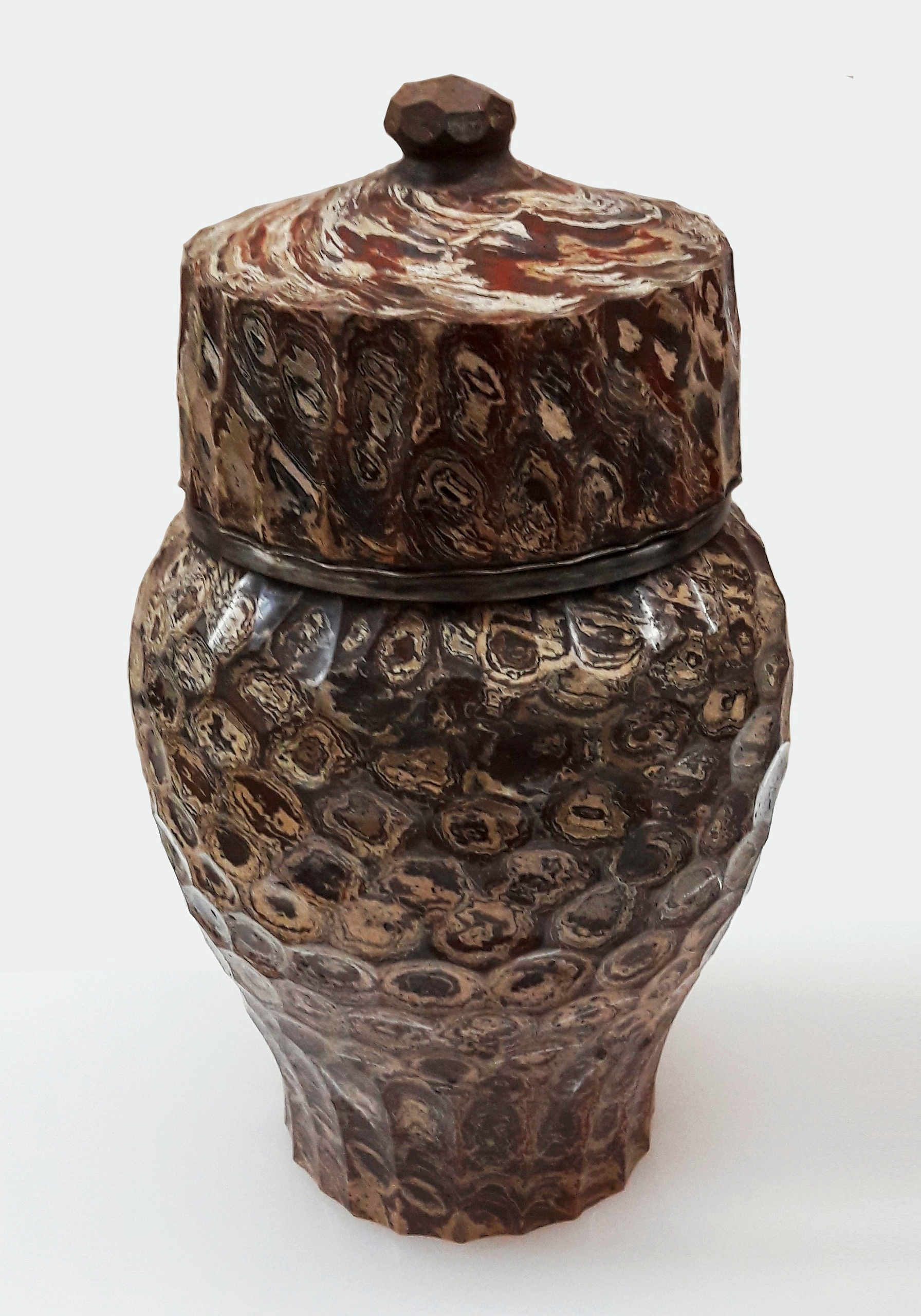
Painters accumulate a catalogue raisonne; Bottger-period ceramics never have. The closest equivalent is institutional rather than scholarly: from 1721 the royal Saxon collection at the Japanese Palace was marked piece by piece with an inventory number, and roughly 1,500 pieces of Meissen porcelain and Bottger stoneware from that collection can still be matched to a surviving inventory line, out of nearly 10,000 originally recorded. That figure covers only the former royal collection in Dresden. No comprehensive count exists of Bottger-period pieces held elsewhere, in other museums, in the trade, or in private hands, and this page did not find one.
Attribution outside the royal inventory falls to the specialist ceramics departments of the major museums and auction houses, working from paste, form, finish, and comparison with published exemplars, since no connoisseurship board rules on the question the way one might for a painter's oeuvre. The task is complicated further by Meissen's own 1919 revival of Bottgersteinzeug, begun under director Max Adolf Pfeiffer using the historical recipe for new sculptural work by outside artists. Because the clay body is the same, chemical analysis of the paste alone cannot separate a piece made in Bottger's own lifetime from one made two hundred years later; only the model, the mark, and the object's documented history can do that. Bottger stoneware, notably, was never marked at all during his lifetime; the crossed-swords mark dates to 1722, three years after his death, and was applied to porcelain, not stoneware. There being no mark to counterfeit is very likely one reason this desk found no documented case of deliberate, marked forgery of Bottger-period stoneware specifically, in contrast to the well-documented nineteenth and twentieth century forging of Meissen's later crossed-swords porcelain mark. The absence of that particular fraud is itself worth recording, though it leaves misattribution, rather than forgery, as the live risk on every unmarked piece.
Chapter 9What the market pays, and what moves it
Bottger-period stoneware reaches auction only occasionally, most often through the periodic specialist Meissen sales that Bonhams in London has run under titles such as Important Meissen Porcelain...
Bottger-period stoneware reaches auction only occasionally, most often through the periodic specialist Meissen sales that Bonhams in London has run under titles such as Important Meissen Porcelain from a Private Collection. Three results with a published price are recorded below. In July 2019 a Bottger stoneware teapot with provenance to the castrato singer Francesco Bernardi, known as Senesino, who is recorded as having acquired it in London between 1717 and 1719 while performing in Handel's operas, made GBP 35,062.50 premium-inclusive. In the same sale a black-glazed kendi bearing the Japanese Palace inventory number 64./P, the same object already catalogued elsewhere on this site as a held record awaiting a photograph, made GBP 82,562.50 premium-inclusive; no separate hammer price is published in the source consulted. The same object had previously been sold at Christie's London in 2011, but the source consulted for the 2019 sale gives only the date and lot number for that earlier sale, not a price. In December 2012 a teabowl and saucer with a documented line of descent from Margravine Sibylla Augusta of Baden-Baden, through the Baden royal collections and three later German museum loans, the last of them while the piece already belonged to the Hoffmeister collection, made GBP 25,000 premium-inclusive.
Two further lots seen in the course of this research, a lacquered octagonal coffee pot estimated at GBP 40,000 to 60,000 at Bonhams in December 2018 and a mounted tankard estimated at GBP 10,000 to 15,000 at Bonhams in December 2016, are not included in the table because the source consulted for each does not publish a result. What the three priced results share is that in every case a documented line of ownership back toward a named collector or a royal inventory number, not just the object's rarity, is doing real work on the price; an unprovenanced piece of the same form and quality would be expected to make less.
Chapter 10The single image, and the man behind it
No portrait of Bottger survives from a sitting in his own lifetime.
No portrait of Bottger survives from a sitting in his own lifetime. The image now used to represent him across encyclopedias, postcards, and museum labels is argued, in the German-language scholarship on him, to descend from a single source: a relief portrait on a Bottgersteinzeug plaque modelled in 1723, four years after his death, by Francois Coudray, a French sculptor who held the position of first sculptor at the Saxon court from before Bottger's death until his own in 1727. The sole surviving original casting is said to be held at the Herzogliches Museum Gotha; every later engraving, lithograph, and print of Bottger, including the nineteenth-century lithograph used on this page, is claimed to trace back to that one relief. This desk was not able to independently confirm the Gotha attribution beyond the secondary citation, and it is recorded as an open question below rather than a settled fact.
What is not in question is the disproportion between the man and his afterimage. Bottger spent most of his adult life as a prisoner of one degree or another, was never permitted to leave Saxony even after his nominal freedom, died owing money to an institution that would outlive him by three centuries, and left behind, so far as this research found, not one securely documented likeness made while he was alive to sit for one. The porcelain survived. The face did not.
What is documented
Technique
The surviving work
- What is accepted
- There is no single accepted total for surviving Bottger-period work, unlike the small closed corpora used for a painter. The nearest institutional count is the Japanese Palace inventory system: from 1721 the former royal Saxon collection was marked piece by piece, and around 1,500 Meissen porcelain and Bottger stoneware pieces from that collection can still be matched to a surviving inventory line, out of nearly 10,000 originally recorded there. That figure covers only the former royal collection now mostly in Dresden. No comprehensive count of Bottger-period pieces in other museums, in the trade, and in private hands worldwide was found in the sources consulted for this page.
- What is contested
- Two separate disputes travel under the name Bottger. The first is over credit rather than authenticity: within the year of Bottger's own death in 1719 the arcanist Samuel Stoltzel argued that Tschirnhaus, not Bottger, had found the porcelain recipe, and a 1731 report by Peter Mohrenthal repeated the claim, crediting Tschirnhaus with the underlying discovery and Bottger only with the practical development that followed Tschirnhaus's death in 1708. The modern account generally divides the credit rather than settling it outright. The second dispute is chronological rather than personal: a claim associated with Baron van Verschuer that the Delft potter Ary de Milde had already produced a comparable red stoneware before Bottger was examined and rejected on technical grounds in Ernst Zimmermann's 1908 study of the invention, still the source cited against it.
- Who rules on attribution
- No connoisseurship board or single authority rules on Bottger attribution. Pieces carrying a Japanese Palace inventory number are anchored to a documented royal-collection entry; unnumbered pieces are attributed by the specialist ceramics departments of the major auction houses and museums on the evidence of paste, form, finish, and comparison with published exemplars in institutional collections such as Dresden, the Metropolitan Museum, the Getty, and the Victoria and Albert Museum, the same evidence this page has relied on throughout.
Catalogue raisonne
- No single catalogue raisonne exists for Bottger-period wares. The nearest published equivalent, not consulted directly for this page, is the Staatliche Kunstsammlungen Dresden's own exhibition literature on its Bottgersteinzeug holdings. Named here for a future editor to verify against; it catalogues the Dresden Porzellansammlung's own holdings, not a worldwide corpus, and covers the stoneware, not the white porcelain Bottger's workshop also produced from 1708-9.
Questions about Johann Friedrich Bottger
Who was Johann Friedrich Bottger?
Alchemist; Ceramicist; Manufactory leaseholder. 1682-1719.
When did Johann Friedrich Bottger live?
Born 4 February 1682, Schleiz, Principality of Reuss-Schleiz, Holy Roman Empire; died 13 March 1719, Dresden, Electorate of Saxony.
How are fakes and misattributions of Johann Friedrich Bottger detected?
The 1919 factory revival. Under director Max Adolf Pfeiffer, Meissen itself resumed making Bottgersteinzeug from 1919 for new sculptural work by outside artists, using the historical recipe and, on some models, a visual language close to the original wares.
Where can you see work by Johann Friedrich Bottger?
Metropolitan Museum of Art (New York); J. Paul Getty Museum (Los Angeles); Staatliche Kunstsammlungen Dresden, Porzellansammlung (Zwinger) (Dresden); Victoria and Albert Museum (London); British Museum (London); Herzogliches Museum Gotha (Gotha).
What does the market for Johann Friedrich Bottger look like?
Bottger-period stoneware reaches auction only occasionally, most often through the periodic specialist Meissen sales that Bonhams in London has run under titles such as Important Meissen Porcelain from a Private Collection. In every priced result found for this page, a documented line of ownership back to a named earlier collector or a royal inventory number is doing real work on the price, not merely the object's rarity.Two further lots seen in the course of this research, a lacquered octagonal coffee pot estimated at GBP 40,000 to 60,000 at Bonhams in December 2018 and a mounted tankard estimated at GBP 10,000 to 15,000 at Bonhams in December 2016, are not included in the results below because the source consulted for each does not publish a sale result.
What is still unresolved about Johann Friedrich Bottger?
Whether Francois Coudray's 1723 stoneware relief at the Herzogliches Museum Gotha really is the only portrait made close to Bottger's own lifetime has not been independently confirmed beyond a German Wikipedia citation to a Dresden print-room record of a later copy; a specialist check against the Gotha museum's own catalogue is needed.
Open questions
- Whether Francois Coudray's 1723 stoneware relief at the Herzogliches Museum Gotha really is the only portrait made close to Bottger's own lifetime has not been independently confirmed beyond a German Wikipedia citation to a Dresden print-room record of a later copy; a specialist check against the Gotha museum's own catalogue is needed.
- No comprehensive worldwide count of surviving Bottger-period stoneware and porcelain has been published in the sources reachable for this page; the only quantified figure found, around 1,500 pieces, covers the former royal Saxon collection alone.
- Whether credit for the porcelain recipe belongs primarily to Bottger or to Tschirnhaus remains argued rather than settled; the dispute began within months of Bottger's own death and has never been closed by any body with the standing to close it.
- What became of Bottger's personal papers, laboratory notebooks, and correspondence after his death in 1719 is not established in the sources consulted for this page.
- Whether any Bottger-period piece has ever been definitively exposed as a later fake passed off as genuine, as opposed to merely optimistically dated, was not found in the sources consulted; the absence may reflect a genuinely low incidence, given the lack of a mark worth forging, or simply a gap in what is published in the English- and German-language sources reachable without a specialist archive visit.
Sources
- 1J. Paul Getty Museum, object record for 'Teapot' (accession 85.DI.287), Meissen Porcelain Manufactory and Johann Friedrich Bottger, about 1715-1720. getty.edu/art/...
- 2J. Paul Getty Museum, object record for 'Standing Cup and Cover' (accession 85.DI.286), Meissen Porcelain Manufactory and Johann Friedrich Bottger, about 1710-1715. getty.edu/art/...
- 3J. Paul Getty Museum, person record for Johann Friedrich Bottger. getty.edu/art/...
- 4Metropolitan Museum of Art, object record for 'Teabowl and saucer' (accession 42.205.19, .20), Meissen, about 1708-9. metmuseum.org/art/...
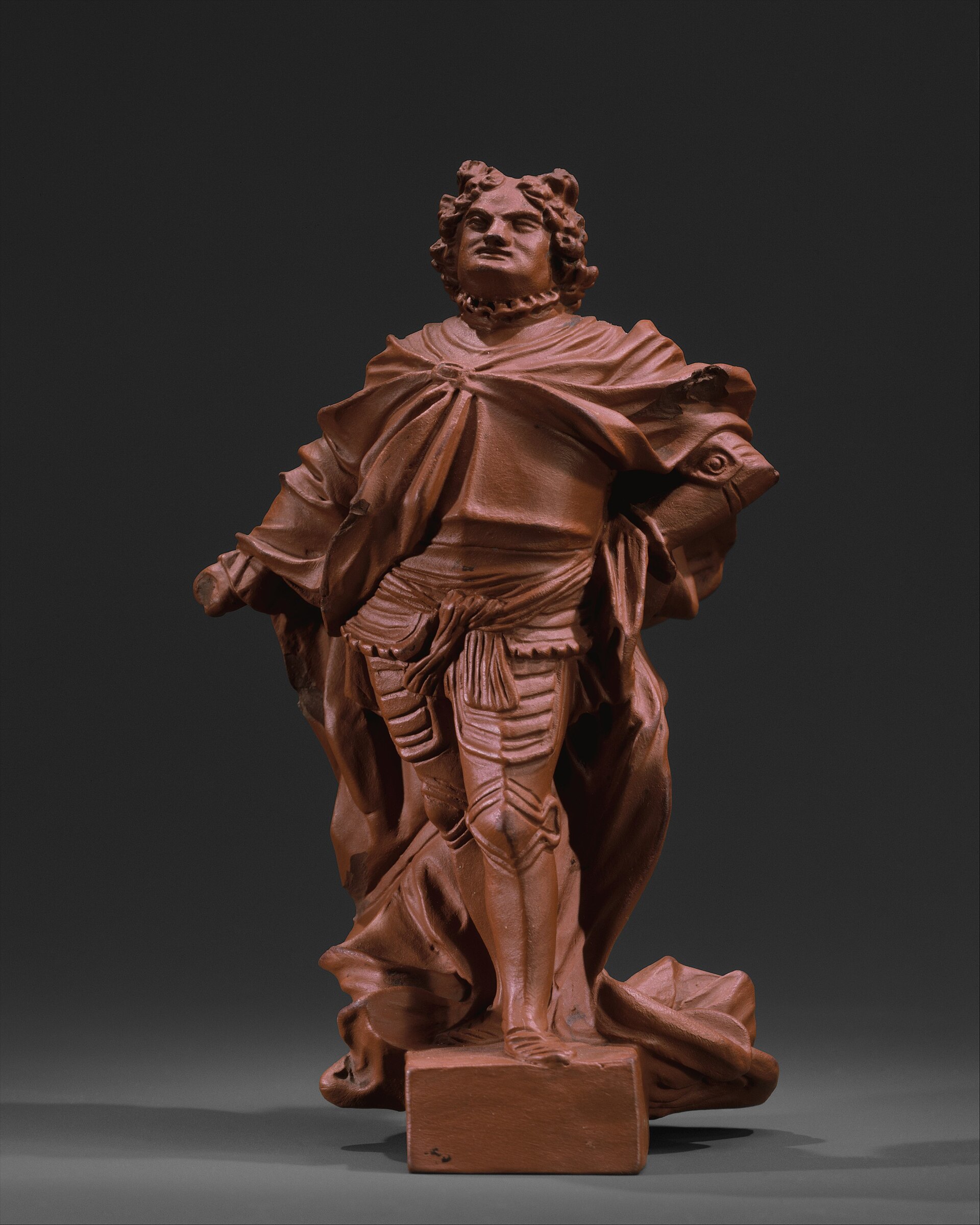
- 5Metropolitan Museum of Art, object record for 'Augustus the Strong' (accession 1982.60.318), Meissen, about 1713. metmuseum.org/art/...
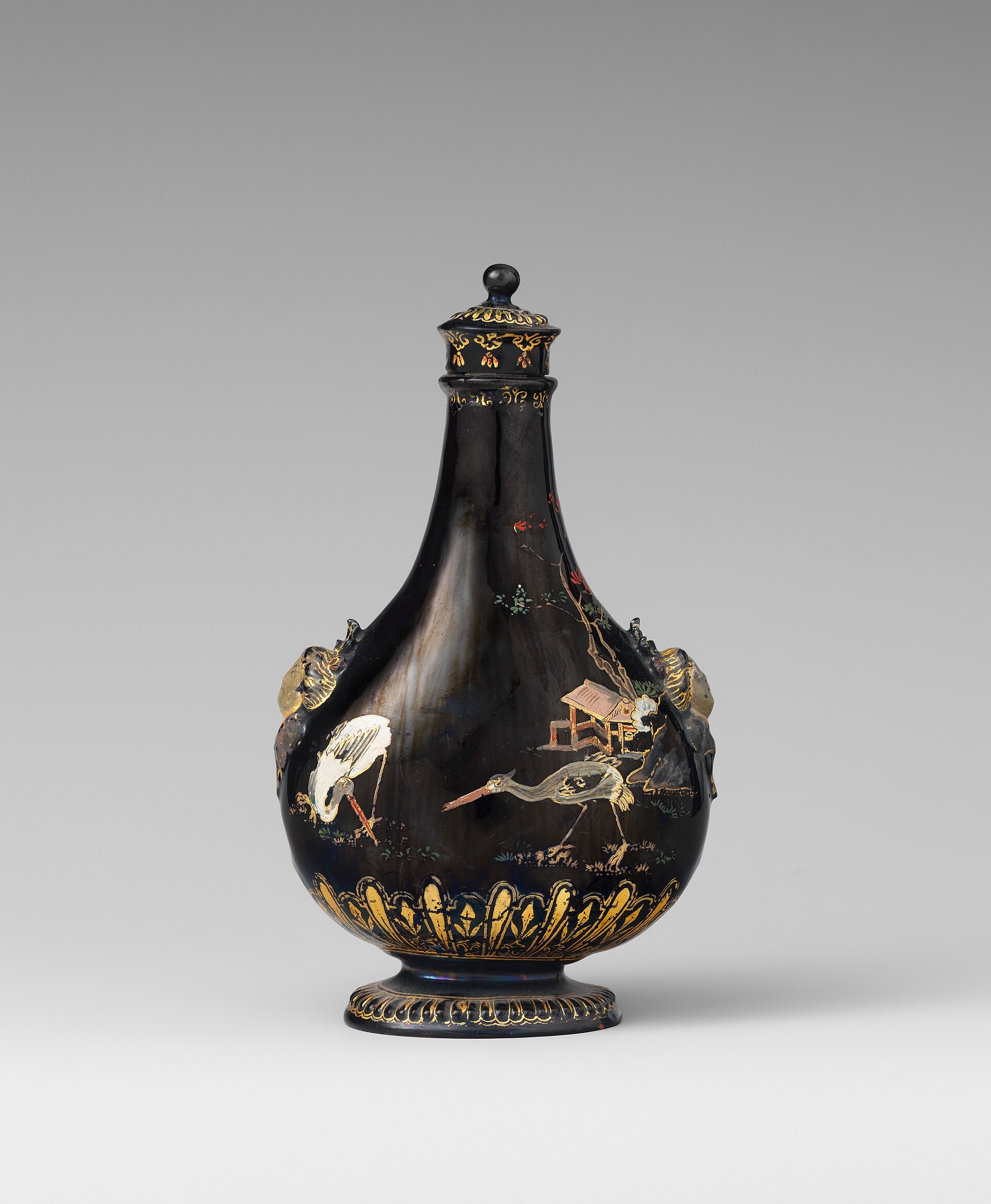
- 6Metropolitan Museum of Art, object record for 'Pilgrim bottle with cover' (accession 43.100.38a, b), Meissen, about 1710-15. metmuseum.org/art/...
- 7Metropolitan Museum of Art, object record for 'Guanyin' (accession 1974.356.319), Meissen, 1710-13. metmuseum.org/art/...
- 8Metropolitan Museum of Art, object record for 'Four-sided bottle' (accession 1974.356.499), Meissen, about 1713-20. metmuseum.org/art/...
- 9Metropolitan Museum of Art, object record for 'Pantaloon' (accession 64.101.86), Meissen, about 1710-13. metmuseum.org/art/...
- 10Wikimedia Commons, portrait file sourced from the British Museum, museum number 1929,0608.45, lithograph of Bottger, about 1800-1850. commons.wikimedia.org/wiki/...
- 11Suzanne L. Marchand, 'Real-Life Rumpelstiltskin,' Lapham's Quarterly, 30 June 2020, excerpted from Porcelain: A History from the Heart of Europe (Princeton University Press, 2020). laphamsquarterly.org/roundtable/...
- 12Encyclopaedia Britannica, entries on 'Arcanist,' 'Pottery,' and 'Stoneware' referencing Johann Friedrich Bottger. britannica.com/biography/...
- 13Wikipedia (German), 'Johann Friedrich Bottger.' ; with the Staatsarchiv Dresden primary records and the Dresden Porzellansammlung's own publications it cites. de.wikipedia.org/wiki/...
- 14Wikipedia (English), 'Johann Friedrich Bottger.' ; with the monographs it cites, including Hildyard's European Ceramics. en.wikipedia.org/wiki/...
- 15RDK Labor (Reallexikon zur Deutschen Kunstgeschichte), 'Bottgersteinzeug.' rdklabor.de/wiki/...
- 16Meissen Porcelain Manufactory, '300 Years of Swords,' official company history. meissen.com/int/...
- 17Meissen Porcelain Manufactory, 'Boettger Stoneware' series history page. meissen.com/net/...
- 18Bonhams, 'Important Meissen Porcelain from a Private Collection, Part II,' London, 2 July 2019, lot 4. bonhams.com/auction/...
- 19Bonhams, 'Important Meissen Porcelain from a Private Collection, Part II,' London, 2 July 2019, lot 7. bonhams.com/auction/...
- 20Bonhams, 'The Marouf Collection, Part I: highly important 18th century Meissen porcelain,' London, 5 December 2012, lot 1. bonhams.com/auction/...
- 21Wikipedia, 'Vezzi porcelain,' on Christoph Conrad Hunger's partnership in the Venice factory. en.wikipedia.org/wiki/...
- 22Wikipedia, 'Francois Coudray,' French sculptor at the Saxon court, circa 1678-1727. en.wikipedia.org/wiki/...
- 23Staatliche Kunstsammlungen Dresden, online collection record for an 1830 copper engraving of Bottger by W. Hohneck, Kupferstich-Kabinett. skd-online-collection.skd.museum/Details/...
- 24Deutsche Biographie, entry for 'Horoldt, Johann Gregor.' deutsche-biographie.de/sfz32941.html
- 25Bonhams, 'Important Meissen Porcelain from a European Private Collection,' London, 6 December 2018, lot 223 (coffee pot; estimate only, no result published in the source consulted). bonhams.com/auction/...
- 26Bonhams, 'Fine European Ceramics,' London, 14 December 2016, lot 8 (tankard; estimate only, no result published in the source consulted). bonhams.com/auction/...
- 27Cleveland Museum of Art, object record for 'Pilgrim Bottle' (accession 1951.451), about 1715, for the dimensions, credit line and the museum's own note that Bottger's red stoneware was hard enough to be polished on a lapidary's wheel. clevelandart.org/art/...
- 28Rijksmuseum, Amsterdam, object record for 'Bekervaas' (accession BK-15222), about 1715, for the dimensions, the attribution of the model to Johann Jakob Irminger, and the provenance through the Rudolph Lepke sale of the royal Saxon collections, Berlin, 7-8 October 1919, lot 22, to the Mainz family and the museum's 1938 acquisition. rijksmuseum.nl/en/...
- 29Los Angeles County Museum of Art, object record for 'Wine Ewer and Cover' (accession 87.5.1a-b), about 1712-1715, for the medium, dimensions, credit line and the attribution to Johann Friedrich Bottger by name alongside the Meissen Porcelain Manufactory. The live LACMA collections page for this object could not be resolved directly; accessed via the Wayback Machine archive of the object's former page. web.archive.org/web/...
- 30Cited for the division of early Meissen into the Bottger, Horoldt and Kaendler periods and the approximate years of each. chinese-porcelain-art.com/pages/...
.jpg)
Last verified