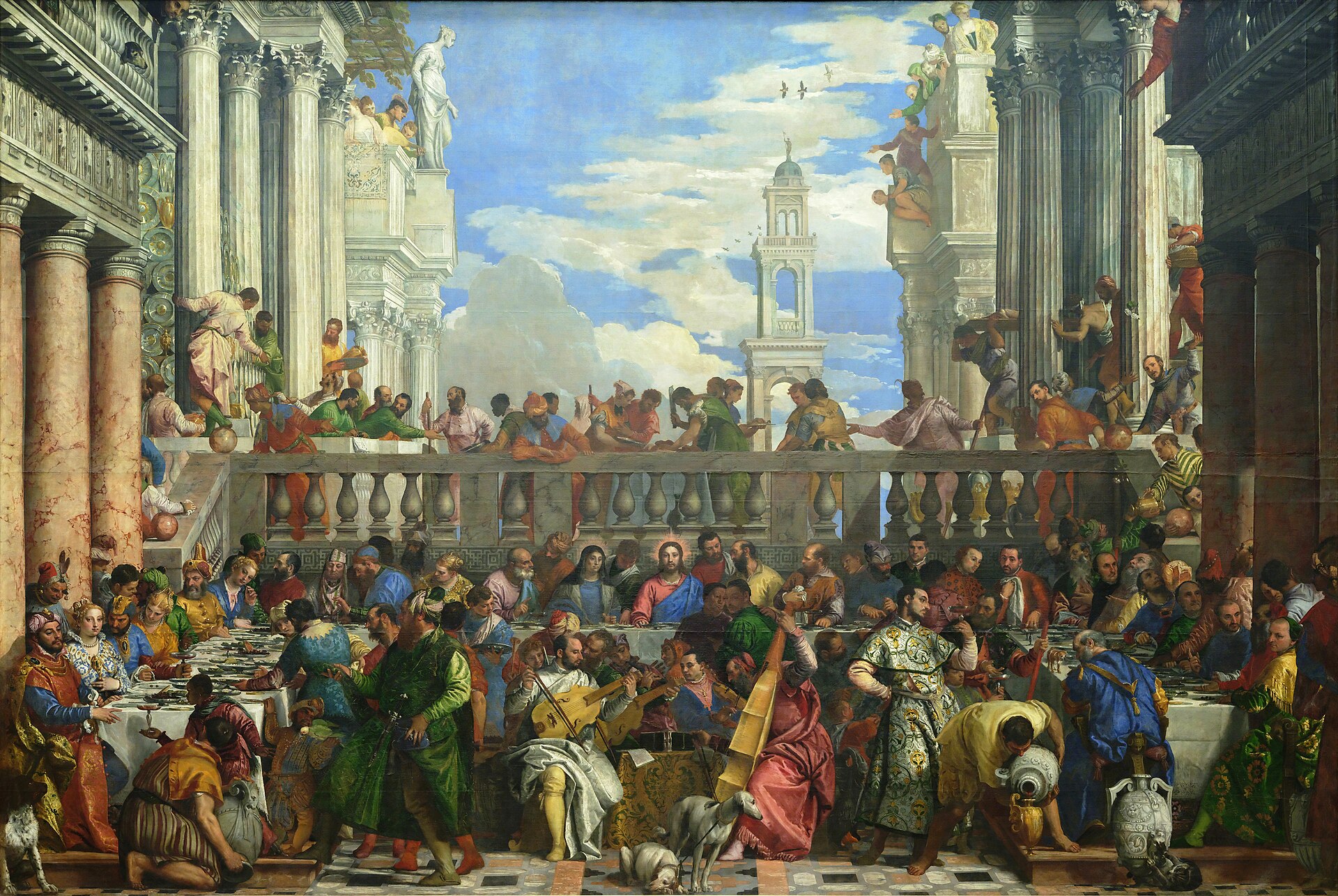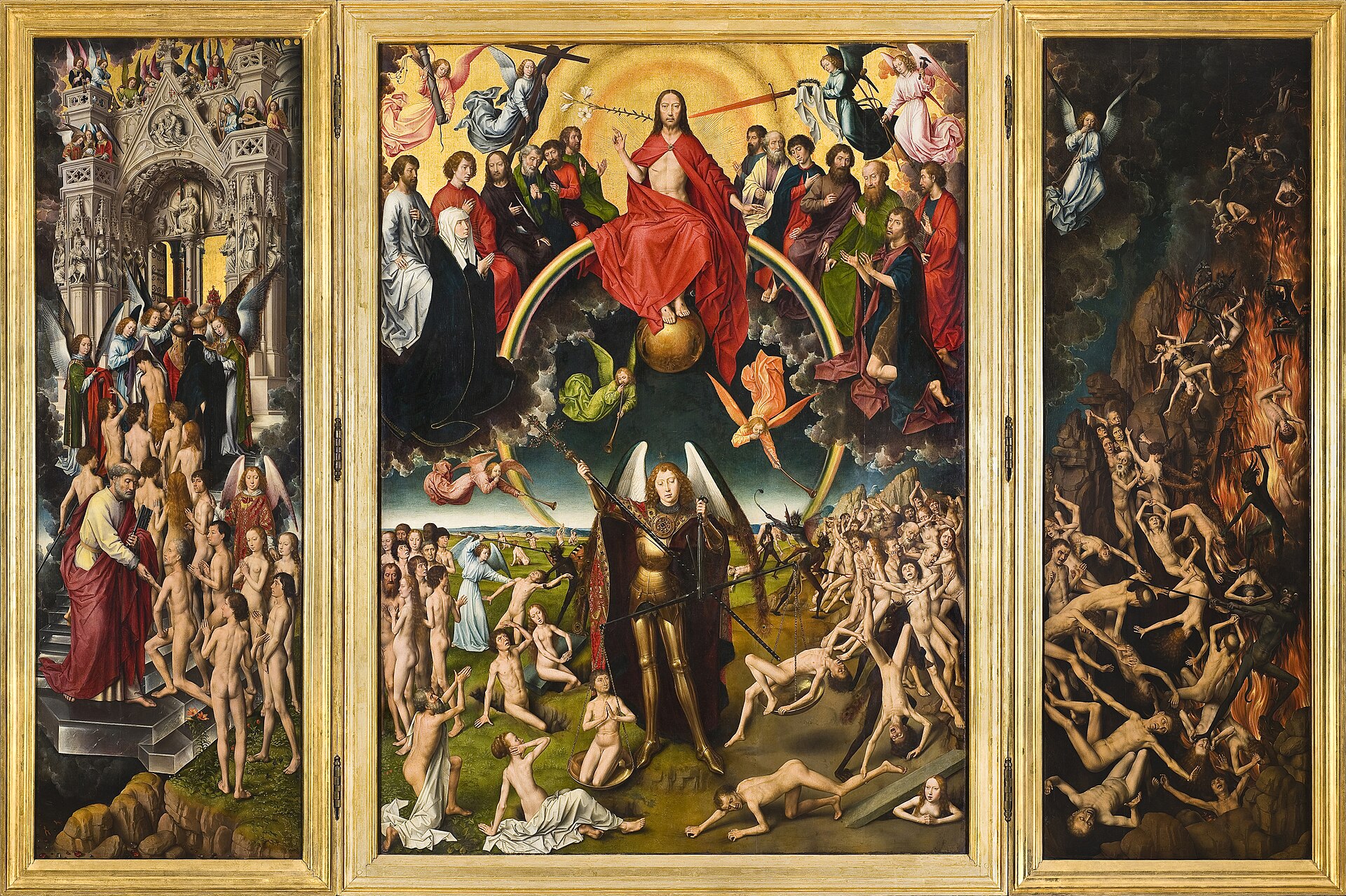
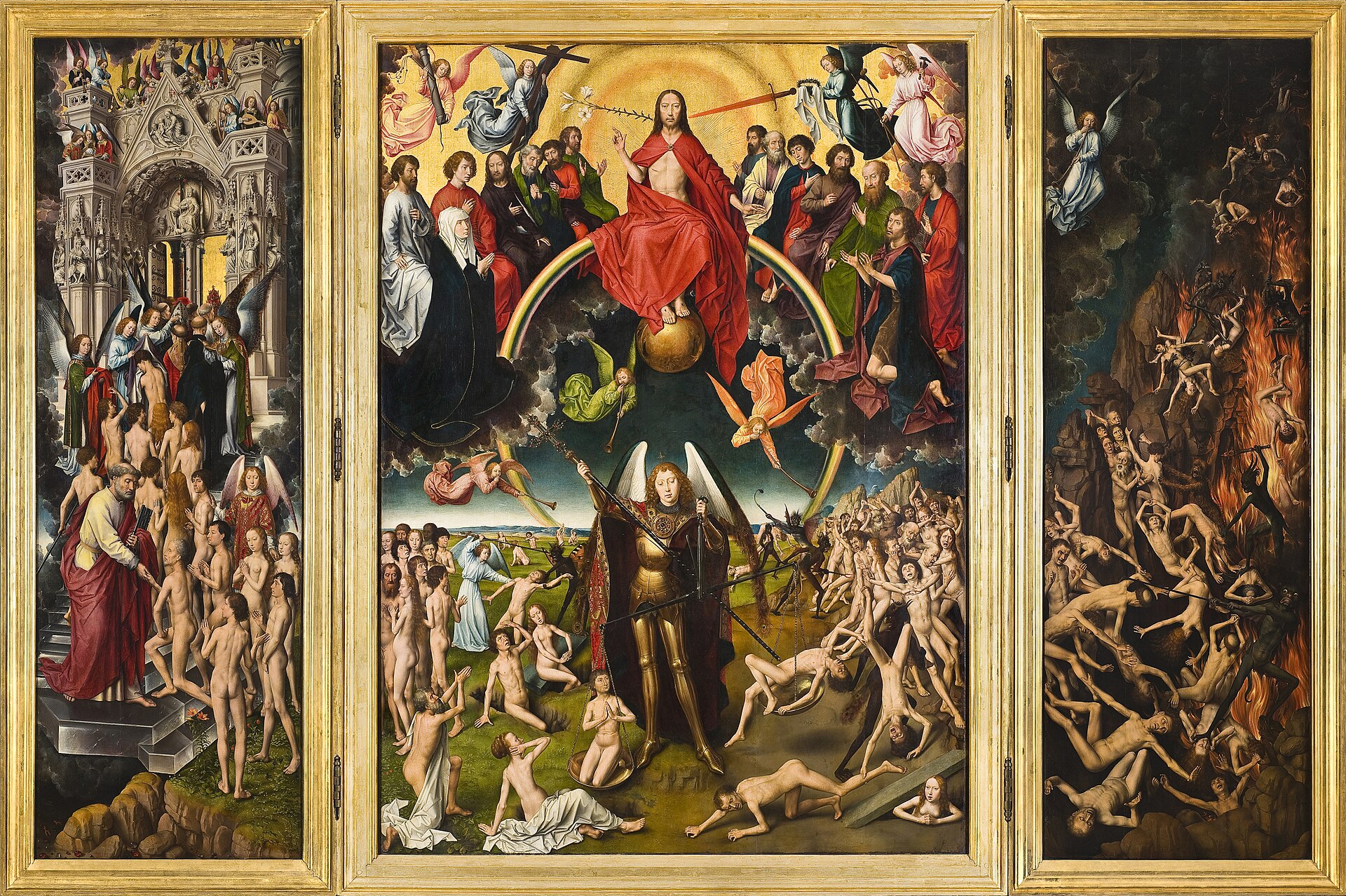
The Last Judgment Triptych
c. 1467-1473 · Tempera and oil on oak panel
National Museum in Gdansk
 1435-1494
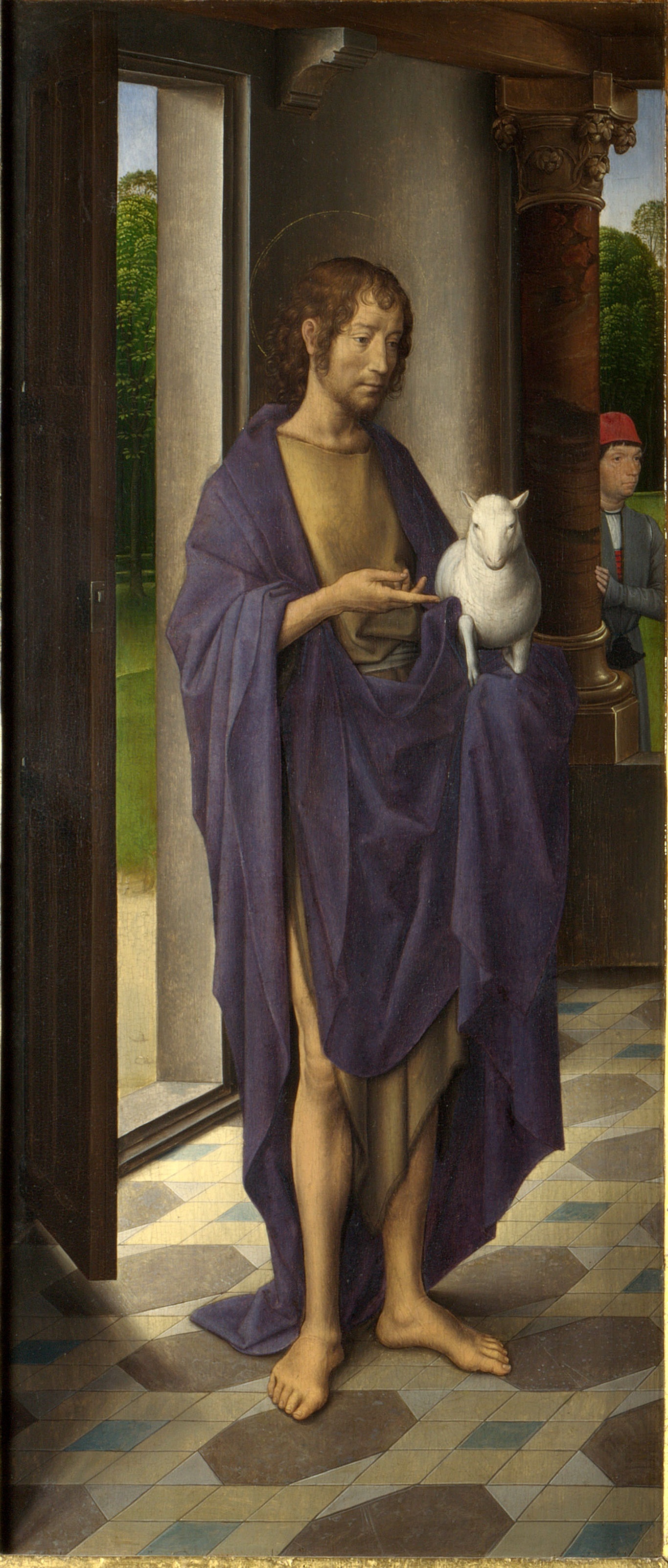
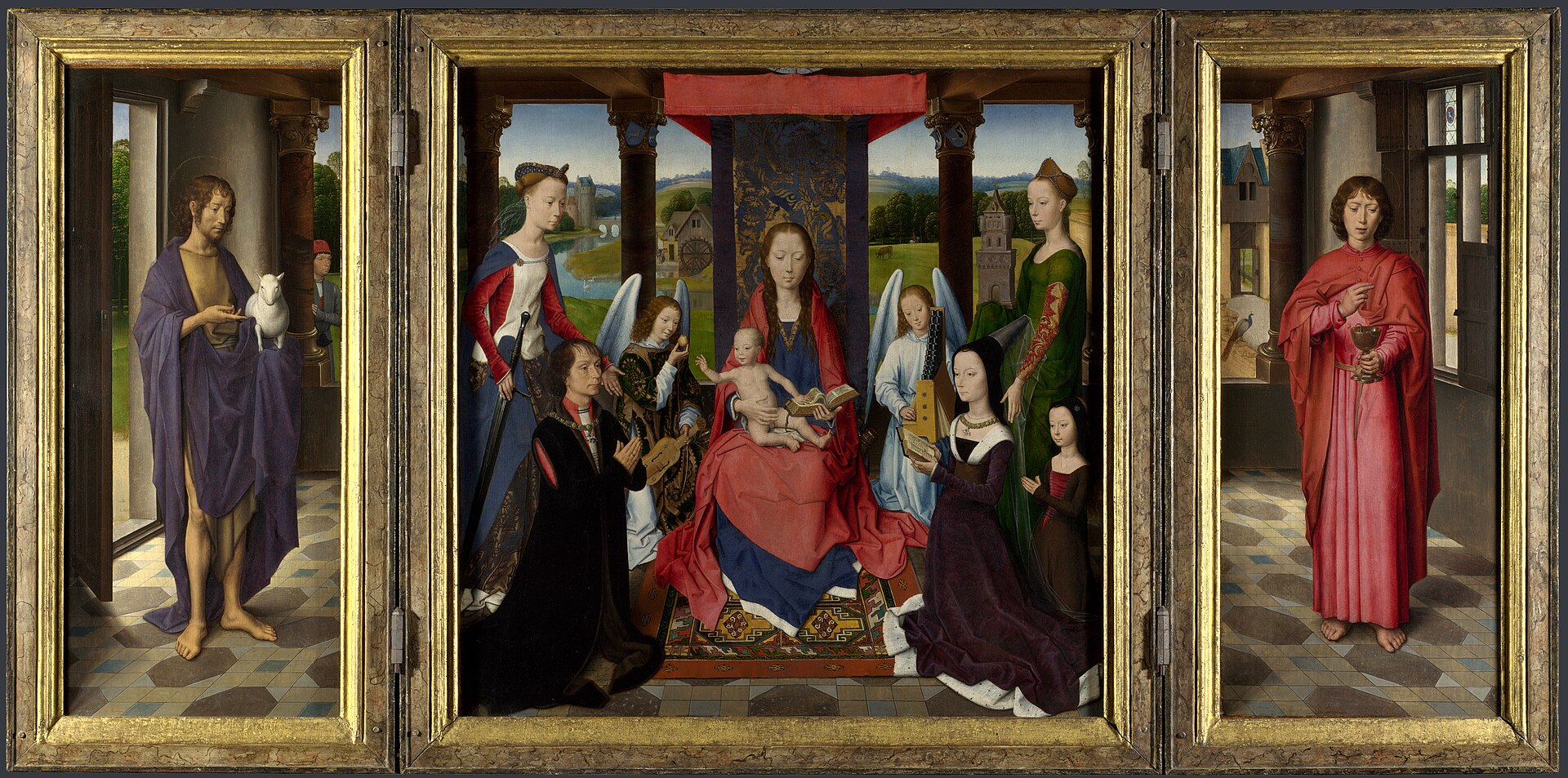
The St John the Baptist wing of the Donne Triptych (National Gallery, London, about 1478). At the right edge a man in a red cap looks in from behind a column; Conway proposed in 1887 that he is Memling, Weale replied in 1901 that painters of the day liked to put figures looking in from behind a pillar, and the Gdansk museum today calls it a probable self-portrait. No document identifies him, so this is a disputed tradition, not a verified likeness. No other portrait of Memling is secure.
National Gallery, London; Yorck Project scan via Wikimedia Commons (Public domain)| Full name | Hans Memling (Memlinc |
|---|---|
| Worked as | Painter, Portraitist, Workshop master |
| Born | c. 1435 (estimates run from c. 1430 to c. 1440 · Seligenstadt, near Frankfurt am Main (the 1465 Bruges... |
| Died | 11 August 1494 · Bruges, buried in the churchyard of Saint Giles |
| Nationality | German-born, active in Bruges (County of Flanders, Burgundian... |
| Movement | Early Netherlandish painting, Bruges |
| In this archive | 1 artwork |
| Sources | 22 cited |
| Last verified |
About this page 1 artwork in the archive · Last verified · 22 sources cited
Hans Memling was a German-born painter who bought citizenship of Bruges on 30 January 1465 and ran a productive and well-organised workshop until his death in 1494. The Flemish Primitives biography credits him with some one hundred altarpieces, devotional triptychs and diptychs and about thirty portraits, and his clients were as often foreign as local: Medici bankers, an English courtier, Spanish and Italian merchants, a hospital and a Hanseatic family from Lubeck.
The number is the first thing to distrust. Nobody has published a census that scholars share. Dirk de Vos's 1994 catalogue is the baseline, and in 2009 Barbara Lane accepted 75 of its attributions, disputed 14 and rejected 4. Only a handful of frames carry his name and a date. No drawing by him survives, and the nearest thing to a document for most of the corpus is a coat of arms in the corner of a donor panel.
What most readers don't know is how little of the standard biography is documented and how much of the famous story was invented. The tale of the wounded soldier nursed back to health in Saint John's Hospital, who painted its altarpieces in gratitude, was published in 1753, embroidered in the nineteenth century and dismantled in 1861 from the Bruges archives. What replaced it is thinner and better: a citizenship entry, a tax list, two apprentices, a house purchase, a guardianship file and a diary line by a notary who called him the most skilful painter in Christendom.
Birth in or near Seligenstadt, estimated; no baptism or parent record has been found beyond the later Bruges entry naming his father Hamman.126
Earliest date the Gdansk museum suggests for his arrival in Brussels, as one of several assistants in Rogier van der Weyden's workshop; no document proves it.6
Buys citizenship of Bruges as Jan van Mimnelinghe from 'Zaleghen Stat': the first archival trace of him in Flanders.15
Rents two stone houses on the Vlamingdam and the Jan Miraelstraat.1
The Last Judgment, ordered by Angelo Tani and now attributed to him with dissent, is under way; shipped in April 1473 and taken at sea, it ended in Danzig.16
'Meester Hans, Painter' enters the Brotherhood of Our Blessed Lady of the Snow.1
Saint John Altarpiece mounted in the hospital church, signed 'Opus Iohannis Memling 1479'; the Floreins triptych is completed in the same year.12
Hannekin Verhanneman registered as his apprentice; Passchier van der Meersch follows in 1483.12
Taxed in the forced loan for Archduke Maximilian; the sources disagree on how many citizens were on the list and where he ranked.1218
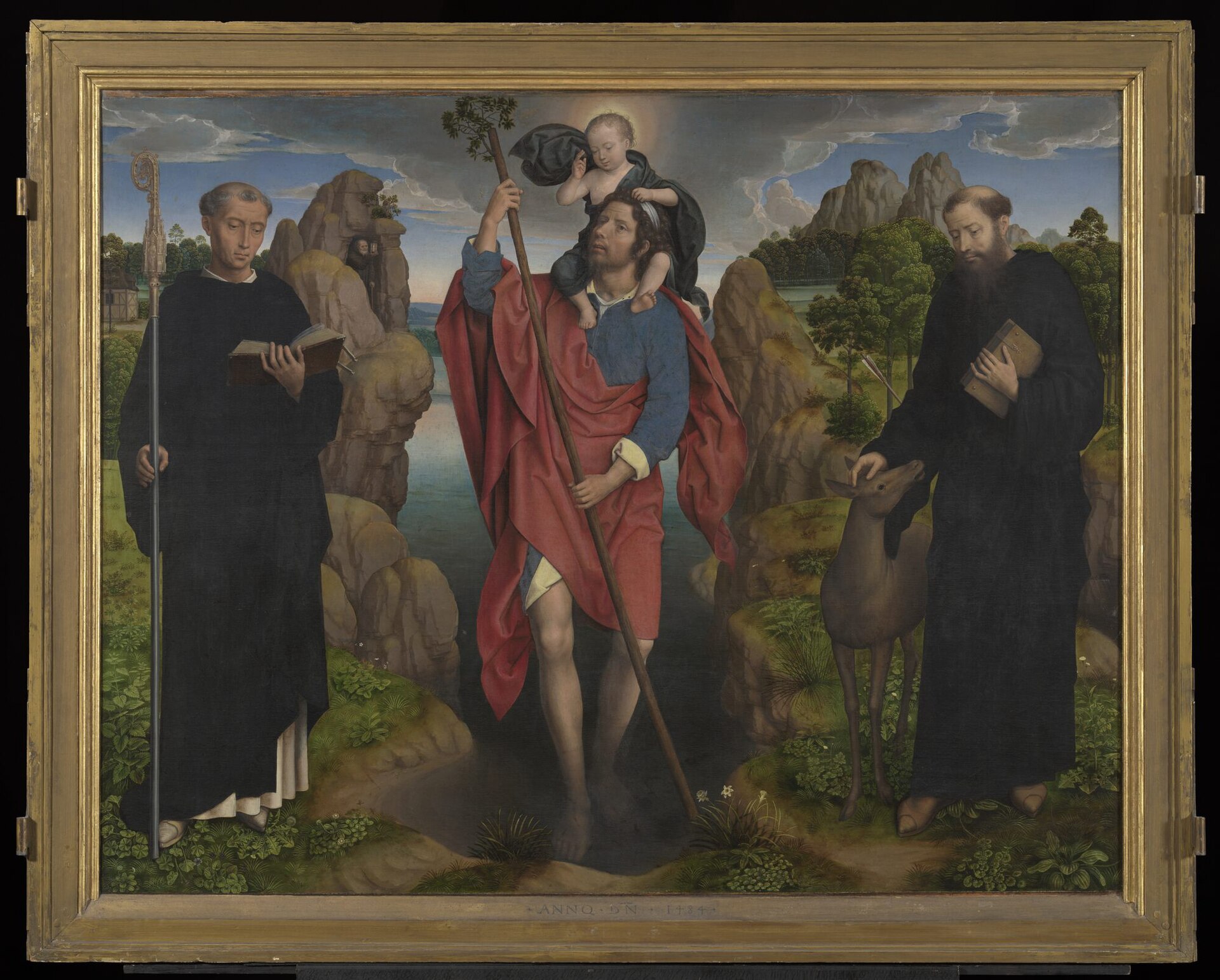
Moreel triptych completed for the chantry chapel in the church of Saint James; the original frame bears the date.12
His wife dies, leaving three minor children; the Nieuwenhove diptych is dated the same year.12
Relics deposited in the finished Ursula Shrine by Giles de Bardemaker, bishop of Sarepta.2
Najera altarpiece commission for Spain; the Greverade altarpiece for Lubeck is dated 1491, probably the date of the commission.1
Dies in Bruges; Rombout de Doppere notes the death in his diary; he is buried at Saint Giles.12
Guardians of his three minor sons bring the proceeds of the sale of his chattels into court.2
His houses and land pass to the painter Louis Boels.2
Weale's archival discoveries begin the dismantling of the nineteenth-century legend of the wounded soldier in the hospital.2
Dirk de Vos publishes the catalogue of the complete works, the baseline for every later count.39
Barbara Lane's monograph accepts 75 of de Vos's attributions, disputes 14 and rejects 4.3
A newly discovered Christ Blessing sells at Sotheby's New York for USD 4,114,500 including premium.1112
Szmelter, Walter and Rousseliere publish the proposal that Rogier van der Weyden designed and drew the Gdansk Last Judgment.5
Musea Brugge and KIK-IRPA photograph and image its nine Memlings in macro and infrared reflectography; results to be published online.1415
The 17.2 cm tondo of the Virgin nursing the Christ Child sells at Sotheby's London for GBP 3.51 million including premium, a record.79
The record is small and the sample thin. The two highest results are a 2026 tondo of 17.2 cm (GBP 3.51 million, premium-inclusive) and a 2013 discovery panel (USD 4,114,500, premium-inclusive). Hammer prices were not published in any source opened. Attribution weighs heavily: the same tondo was a 1978 lot 'as attributed to', was estimated at USD 6 to 8 million in 2012 and made less than that in 2026, and a workshop Nativity made a reported EUR 1.1 million in 2016.
| Date | Sale | Work | Result | Note |
|---|---|---|---|---|
| 1 July 2026 | Sotheby's, London | The Virgin Mary Nursing the Christ Child, tondo, oil and gold on oak, 17.2 cm; Old Master and 19th Century Paintings and Sculpture Evening Auction, lot 2 | Hammer not published in sources opened With premium GBP 3,510,000 premium-inclusive total (USD 4.64 million), estimate GBP 3,000,000-4,000,000 GBP | Record. Provenance includes Christie's 1978 lot 111, the Cartin Collection (2007) and Christie's 2015 lot 11. HENI states its results include premiums. |
| 31 January 2013 | Sotheby's, New York | Christ Blessing, oak panel 34.5 x 26.3 cm | Hammer not published in sources opened With premium USD 4,114,500 premium-inclusive total (EUR 3,034,438), estimate USD 1-1.5 million USD | Newly discovered; auctioned in Paris in 1859 as 'J. Memling' and in one family's hands since. Previous record until 2026. |
| 2016-04 | Dorotheum, Vienna | Nativity, workshop of Hans Memling | Hammer EUR 1.1m as reported; the source does not say hammer With premium EUR 1.2m with premium as reported (a difference of only about EUR 0.1m) EUR | Sold to a European private buyer by telephone; The Art Newspaper called it stylistically different from Memling's works and not yet attributed. |
| 11 December 1992 | Christie's, London | The Virgin and Child enthroned with two angels | Hammer not published in sources opened With premium not published; HENI gives USD 264,900 as a converted figure including fees; sterling figure not found GBP (sold in London; USD is a HENI conversion) | From HENI's table of Memling results; the attribution basis was not checked. |
| 1 December 1978 | Christie's, London | The Virgin Mary Nursing the Christ Child (same tondo as 2026), lot 111 | Hammer not published in sources opened With premium not published; HENI gives USD 93,000 as a converted figure including fees; sterling figure not found GBP (sold in London; USD is a HENI conversion) | Sold 'as attributed to Hans Memling' from the Mount Trust Collection. |
Hammer is the price at which the bidding stopped; with premium adds the fee the house charges the buyer on top. Hammer price and buyer's premium in the glossary.
| Institution | City | Holdings | Note |
|---|---|---|---|
| Musea Brugge (Sint-Janshospitaal and Groeningemuseum) | Bruges | Nine works: the Saint John Altarpiece, the Floreins triptych, the Moreel triptych, the Ursula Shrine, the Crabbe Annunciation, the Reyns Lamentation, the Nieuwenhove diptych, the Sibylla Sambetha portrait and a De Rojas portrait. | The second-largest Memling collection in the world, according to the museum. |
| National Museum in Gdansk | Gdansk | The Last Judgment triptych. | Unsigned; attribution the subject of the 2015 Rogier proposal. |
| The National Gallery | London | The Donne Triptych and other Memling and workshop panels. | The gallery documents the workshop's reuse of figures. |
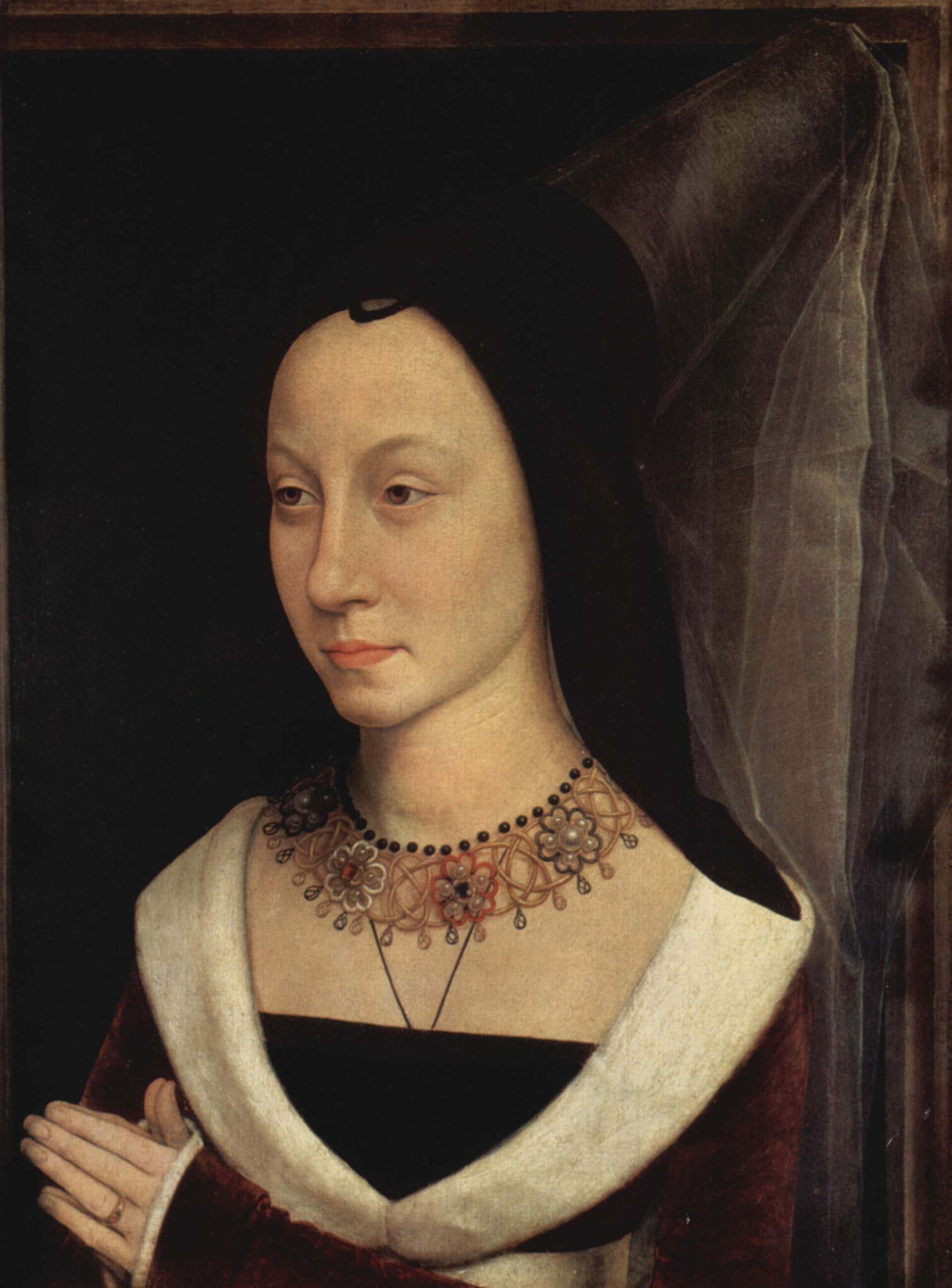
| The Metropolitan Museum of Art | New York | The Tommaso and Maria Portinari portraits. | Show Memling's landscape-backed portrait type. |
| The Morgan Library and Museum | New York | Inner wings of the Crabbe Triptych (centre in Vicenza, exterior in Bruges). | Reunited for a Morgan Library exhibition. |
| Royal Museum of Fine Arts (KMSKA) | Antwerp | The Najera angel panels and the man with the Roman coin. | The Najera panels were partly painted by studio hands. |
| Galleria Sabauda; Alte Pinakothek; Sankt Annen-Museum; Uffizi and Gemaldegalerie | Turin; Munich; Lubeck; Florence and Berlin | The Passion; the Seven Joys of the Virgin; the Greverade altarpiece; the Benedetto Portinari triptych. | Locations as given in the Flemish Primitives biography. |
| Museu de Arte de Sao Paulo (MASP) | Sao Paulo | The Virgin lamenting with Saint John and the holy women of Galilee, dated 1485-90. | Part of a diptych known through copies. |
The Flemish Primitives biography, written by Mieke Parez, gives the archival spine.
The Flemish Primitives biography, written by Mieke Parez, gives the archival spine. The Bruges burgess book of 30 January 1465 records 'Jan van Mimnelinghe', son of Hamman, from 'Zaleghen Stat', which is read as Seligenstadt. That is the first archival trace of him in Flanders. In 1466 and 1467 he rented two stone houses on the Vlamingdam and the Jan Miraelstraat. In 1473 'Meester Hans, Painter' joined the Brotherhood of Our Blessed Lady of the Snow. On 8 May 1480 he took Hannekin Verhanneman as apprentice and in 1483 Passchier van der Meersch. Between 1479 and 1480 he bought the larger of the two houses he lived in.
W. H. James Weale, who dug these documents out of the Bruges archives from 1861, listed in 1901 everything he considered certain and noted that Memling's name occurs forty-nine times in contemporary Bruges documents, thirty-two of them ending -inc. He died on 11 August 1494. The notary Rombout de Doppere recorded it in his diary and added that Memling came from the ecclesiastical principality of Mainz, which the Flemish Primitives text reads as the archbishopric and not the city. Weale thought his wife Anne, daughter of Louis de Valkenaere, married him between 1470 and 1480 and died in 1487. The Flemish Primitives biography names the three children left behind as Hannekin, Neelkin and Claykin. The Gdansk museum, which summarises the same record, says he owned three houses.
Where the sources disagree is on his wealth. Weale wrote that in 1480, out of the 247 wealthiest citizens, 106 were taxed at the same amount as Memling and only 140 at higher rates. The Flemish Primitives text puts him among the richest ten percent of Bruges for the forced loan raised for Archduke Maximilian. Wikipedia, a tertiary source, says his name appears on a list of 875 of the richest citizens. These figures come from three different accounts of the 1480 loan. Whether they describe one roll or several was not checked, and the roll itself, which none of the sources reproduces, is the page to consult.
A century after his death Bruges had forgotten him so completely that Karel van Mander could learn only that he was a celebrated master who flourished before Pieter Pourbus.
A century after his death Bruges had forgotten him so completely that Karel van Mander could learn only that he was a celebrated master who flourished before Pieter Pourbus. Weale tells the rest. A seventeenth-century Bruges tradition, recorded by Canon James de Damhouder, said that Memling painted a picture for the Hospital of Saint John in gratitude for services the brethren had done him. That was the only seed. In 1753 the French author Descamps published an elaborated legend, and Viardot and Alfred Michiels piled on detail, until Memling appeared as a sick wounded soldier, a drunkard and a debauchee. Hedouin in 1847, Crowe and Cavalcaselle in 1857 and Waagen in 1860 were the first to doubt it. In 1861 Weale's archive finds rehabilitated him as a pious and prosperous craftsman.
The legend came with faces attached, and Weale traces them. A seventeenth-century etching by James van Oost took the Saint John the Baptist on the Floreins shutter for a self-portrait. In 1753 Descamps read a stubbly man in an orange cap looking in at a window as the painter in a sick inmate's dress. In 1833 Passavant found a portrait with a wounded arm and the date 1462 and took it for Memling in the hospital; Weale says it is now National Gallery no. 943, is by Dirk Bouts, that the wounded arm is imaginary and that the picture is fifteen years older than the battle of Nancy the story required. In 1887 Conway argued that the red-capped workman on the left wing of the Donne Triptych 'must be' a self-portrait, and Weale answers that Memling, like many contemporaries, was fond of introducing figures looking in at windows or from behind a pillar. Every identification rests on resemblance.
The hospital's real role is well documented and quite different. The Flemish Primitives biography says Memling completed no fewer than four commissions for Saint John's Hospital, although he apparently never worked for the Bruges city administration. Their dates run from the Saint John Altarpiece and the Floreins triptych in 1479 through the Reyns Lamentation in 1480 to the Ursula Shrine in 1489.
Vasari and Guicciardini both call him a pupil of Rogier van der Weyden, as Weale notes, and Weale adds that Rogier went to Rome in 1449 and returned late in 1450, so Memling cannot have entered the...
Vasari and Guicciardini both call him a pupil of Rogier van der Weyden, as Weale notes, and Weale adds that Rogier went to Rome in 1449 and returned late in 1450, so Memling cannot have entered the Brussels workshop before the autumn of 1450 at the earliest, and most probably did so later. Rogier died in June 1464. The Gdansk museum states that there are no documents proving Memling was Rogier's student and that one may suspect only that he came to Brussels around 1459 or 1460 as one of several assistants. The Sao Paulo Museu de Arte entry calls him a student and collaborator of Rogier in Brussels without qualification, which shows how the claim travels.
Lane, in her 2009 monograph as summarised by Henry Luttikhuizen in Historians of Netherlandish Art, argues there is no proof of an apprenticeship under Rogier, and that the sixteenth-century sources are too ambiguous to carry it. She still has him travelling to Brussels as a journeyman, by way of Leuven, in the hope of working with Rogier. She places his early training in Cologne, with a route through Leuven, and speculates that he may have worked in Petrus Christus's Bruges shop before opening his own. Luttikhuizen calls this part of her argument puzzling and thinks she underestimates the ways he could have imitated Van Eyck and Christus without that. Whatever the training, the first document is January 1465, half a year after Rogier's death, which is the hinge on which the Gdansk dispute below turns.
The Flemish Primitives biography says an exceptionally large number of his panels survive: some one hundred altar pieces, devotional triptychs and diptychs and around thirty portraits.
The Flemish Primitives biography says an exceptionally large number of his panels survive: some one hundred altar pieces, devotional triptychs and diptychs and around thirty portraits. That is a headline, not an agreed list. The working baseline is Dirk de Vos, Hans Memling: The Complete Works (1994), whose numbering reaches at least no. 82 for a small tondo. Lane's 2009 monograph, according to the Historians of Netherlandish Art review, accepts 75 of de Vos's attributions, disputes 14 and rejects 4, The reviewer calls the assessment reasonable and thinks Lane too tough on the Nelson-Atkins Madonna and Child Enthroned. The 1928 volume of Max Friedlander's Early Netherlandish Painting sits under both as the older benchmark.
The attribution can also move while the picture stays put. A small roundel of the Virgin nursing the Christ Child was catalogued by Friedlander and Bialostocki as possibly a workshop replica, accepted by de Vos as no. 82, listed by Lane under her catalogue number B12 as 'Hans Memling (?)', and offered by Sotheby's in 2026 simply as Hans Memling. No single board rules on any of this. The catalogue is the authority and the catalogue has three authors who don't agree.
The Flemish Primitives biography records two inscriptions in his own name.
The Flemish Primitives biography records two inscriptions in his own name. The Saint John Altarpiece, mounted on the main altar of the hospital church in 1479, is dated and signed 'Opus Iohannis Memling 1479'. The Floreins triptych bears 'ANNO MCCCCLXXIX - OPUS JOHANIS MEMLING'. Weale lists a further group of works whose original frames bear dates, among them the Moreel triptych (1484), the Reyns triptych (1480), the Sibyl portrait (1480) and the Nieuwenhove diptych (1487).
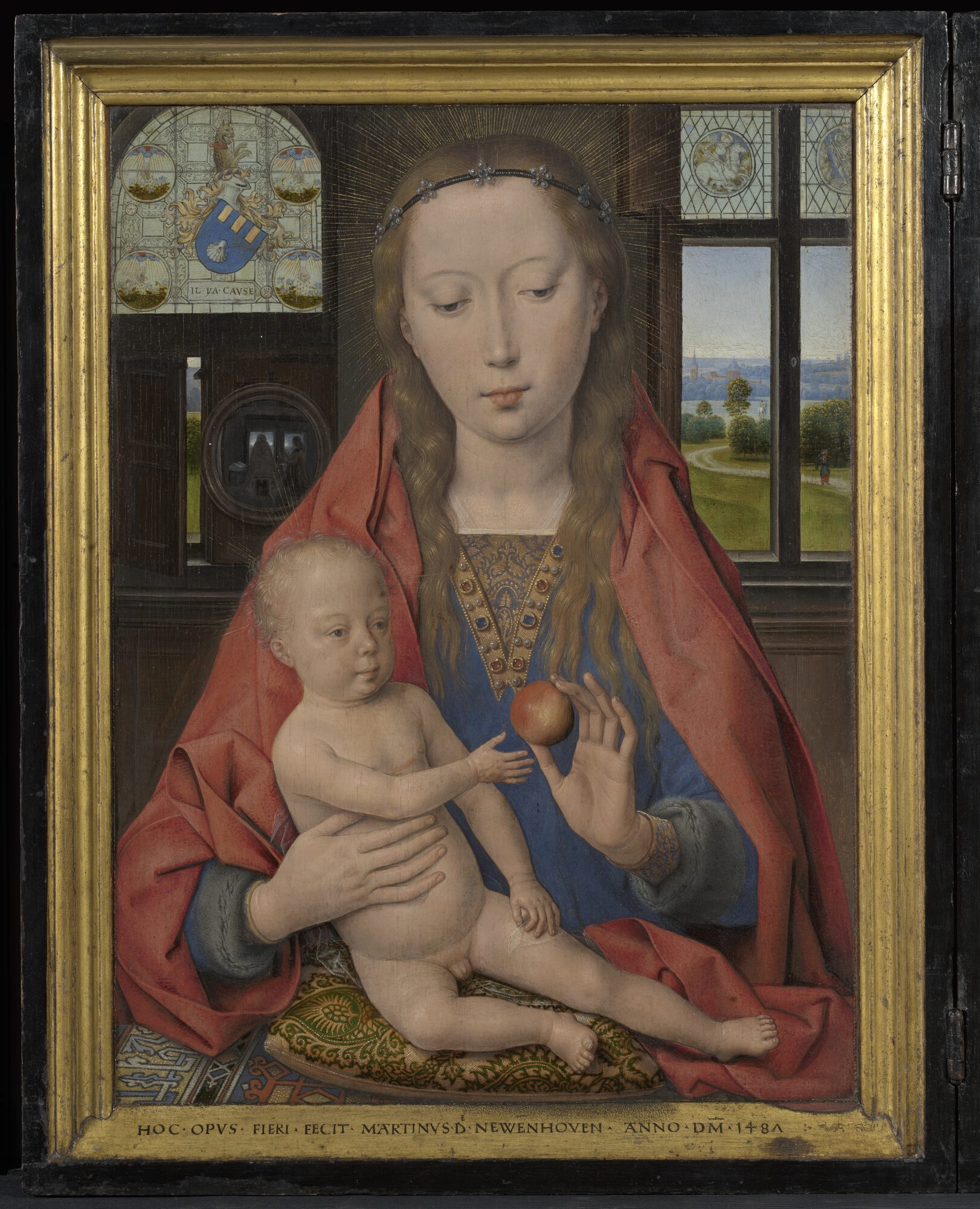
A date on a frame is not a signature. The Nieuwenhove diptych states that Martin van Nieuwenhove had the work made in 1487, at the age of twenty-three, and names no painter. Wikipedia, a tertiary source, says it has invariably been attributed to Memling since the middle of the nineteenth century. The Gdansk museum says its Last Judgment bears no signature and was credited in turn to Jan van Eyck, Rogier van der Weyden, Hugo van der Goes, Albert van Ouwater and Michael Wolgemut before Gustav Hotho named Memling in 1843. Weale records that in 1821 Professor Busching took a mark on the Gdansk picture for the monogram of the Van Eycks, and that Waagen read the date CCCLXVII on a gravestone in it as proof that Jan van Eyck was still alive in 1467.
The Morgan Library exhibition review adds a second hard limit: we have no extant drawings by him. Everything we know of how he drew comes from the infrared underdrawings beneath the paint, which is where the best new evidence now lies.
The National Gallery in London is blunt about it.
The National Gallery in London is blunt about it. Memling, it says, was a businessman as well as an artist who ran an efficient workshop and recycled and reused existing compositions and figures with skill. All the figures in the Donne Triptych except the donors, and many of the objects, recur in other pictures by him or from his workshop, and even members of the Donne family were probably partly painted from patterns. Lady Donne's clothes are better suited to a Burgundian aristocrat than the wife of a minor Welsh nobleman, and her face and hat were adapted at a late stage. The triptych is so close to his Triptych of the Two Saints John that Donne may have seen it in the workshop and asked for something similar.
Division of hands is now being read in the underdrawing. Maryan Ainsworth, in the Morgan catalogue summarised by the Historians of Netherlandish Art reviewer, attributes the underdrawing of the Crabbe Triptych's exterior to Memling himself and agrees that the paint layers are by assistants. For the Najera angels in Antwerp, the Flemish Primitives biography reports recent scholarship that the three panels, which differ in technique, were painted separately in Spain by members of his studio. Lane goes further and proposes, on stylistic grounds, that Martin Schongauer, Michael Sittow, the Master of the Saint Bartholomew Altarpiece and Albrecht Durer may all have worked in the shop as journeymen. Luttikhuizen finds it quite a stretch that they demonstrably did.
Copies circulated for foreign clients. The Sao Paulo Museum of Art's Virgin lamenting with Saint John and the holy women is described by the museum as possibly the right half of a separated diptych, the Lachovsky-Bardi Diptych. A copy of the other half in the Groeninge Museum bears the arms of the Genoese merchant Andrea della Costa, another copy is in the Bargello, and a triptych in the Palazzo Durazzo-Pallavicini in Genoa is a faithful copy of the whole. A workshop that sold images to Italian buyers also generated the copies that confuse the corpus today.
The largest unresolved attribution question in the corpus is the Last Judgment in Gdansk.
The largest unresolved attribution question in the corpus is the Last Judgment in Gdansk. Weale, in 1901, rejected the attribution to Memling outright, arguing that the composition was unlike anything he drew and that a work with more than one hundred and fifty figures could not be his. In a 2015 paper in Opuscula Musealia, Iwona Szmelter, Philippe Walter and Helene Rousseliere report from infrared reflectography, XRD and XRF that the triptych was probably begun by Rogier van der Weyden, who supplied the design, the drawing and some underpainting, and completed by Memling. They read the dendrochronology as placing the oak support toward the end of 1460. The infrared images show a first composition with angels carrying the instruments of the Passion where the apostles now sit, drawn in delicate brushstrokes in a dilute liquid medium whose 'T' lines, hatches and dots they say are consistent in one hand.
The authors state their own limit: at this stage it was still unclear whether the draughtsman and the painter were one and the same. The donor portraits on the outside of the wings were painted without underdrawing, which the paper reads as an alla prima proto-Renaissance manner. The same paper reports that the saved man in Michael's scales was painted on a separate tin plate and glued in, which it reads as a portrait of Tommaso Portinari. No independent test of the Rogier proposal turned up in the sources opened for this page, and the museum still presents the picture as Memling's, writing that the vast majority of researchers confirm that attribution. The patron is a Medici banker, Angelo Tani, and the 1473 capture of the ship carrying it is the subject of its own record in this archive.
The Flemish Primitives text notes that a noticeably large share of Memling's commissioners were foreigners, mostly Italian and Spanish merchants and bankers, with Bruges patricians also coming for...
The Flemish Primitives text notes that a noticeably large share of Memling's commissioners were foreigners, mostly Italian and Spanish merchants and bankers, with Bruges patricians also coming for portraits and altarpieces. Lane, as reported by Luttikhuizen, counts nearly as many Italians among his patrons as Flemings. The Portinari portraits in New York, the Passion in Turin, the Tani Last Judgment and the Benedetto Portinari triptych of 1487, split between Berlin and the Uffizi, are the Italian line. The Spanish line is the Najera altarpiece of 1490, for the church of Santa Maria la Real in Najera.
The English line is the Donne Triptych. The National Gallery notes that Sir John Donne and his wife wear the king's livery collars of suns and roses with white lions, a sign of Yorkist allegiance, and that Donne was in Bruges in 1468 for the wedding of Edward IV's sister Margaret to Charles the Bold. His parents had obtained papal permission in 1443 for a portable altar, and the gallery thinks the little triptych may have served a household altar. The National Gallery suggests that for a courtier close to the royal household, art was perhaps a way of emphasising that closeness as well as his piety.
Hospital commissions sit apart because they were collective. On the exterior of the Saint John Altarpiece Weale identifies the kneeling donors as Brothers Anthony Seghers and James de Kueninc and Sisters Agnes Casembrood and Clare van Hulsen, each protected by their patron saint, and the Floreins and Reyns triptychs carry the names of single brothers. The Moreel triptych, ordered by the grocer, banker and burgomaster William Moreel for his chantry chapel in the church of Saint James, shows sixteen of the eighteen children on the wings according to the Flemish Primitives text, some added after the panels were finished.
Some of the meaning is documented in the object.
Some of the meaning is documented in the object. Weale records that the Ursula Shrine, an oblong gabled casket with fourteen paintings, was completed in 1489 and that on 21 October that year the relics it was made for were deposited in it by Giles de Bardemaker, bishop of Sarepta. The Flemish Primitives biography adds that within the cloister community it was said Memling travelled to Cologne for the work at the cost of Adriaan Reyns, a report of what was said, not a document. A reliquary is a function, not a subject: it was made to hold relics of the eleven thousand virgins and other saints, and Ursula's legend is painted on its sides.
The Nieuwenhove diptych is the best-studied case. Silvio Savarese, Ron Spronk, David Stork and Andrey DelPozo, in a 2008 SPIE paper, report that it was recently discovered that the convex mirror behind the Virgin was not part of the original design but was added by Memling later. Their computer model finds two significant deviations between the mirror's reflection and what a model setting would predict, which they take to support the idea that it was an afterthought painted without a model. They say this bears on the viewing angle at which the hinged panels were used in devotion, which they leave open. Wikipedia adds, as a tertiary claim to be replaced by the catalogue entry, that the window at upper left was first clear glass with a landscape and was changed to show Van Nieuwenhove's arms, ringed by four hands sowing seed, a pun on the name meaning 'from the new garden'.
The ordinary meaning is the whole meaning on present evidence. A donor aged twenty-three, soon a city councillor and by 1498 mayor, prays to the Virgin in a room that unites two panels. Lane, via Luttikhuizen, groups his major commissions as funerary altarpieces, pictures that guide an imaginary pilgrimage, and hospital altarpieces, and reads them as advocating the art of dying well and care of Christian bodies and souls. That is an argued reading by one scholar. No hidden or private programme has been shown in any source opened for this page, and that absence is a finding.
The Gdansk team's pigment study, over more than 350 point analyses, found lazurite, the mineral of lapis lazuli and ultramarine, only in the Virgin's blue mantle and in the blue gems on Michael's...
The Gdansk team's pigment study, over more than 350 point analyses, found lazurite, the mineral of lapis lazuli and ultramarine, only in the Virgin's blue mantle and in the blue gems on Michael's cope, and azurite in all the other blue areas. Even the reflection of the Virgin's mantle in the globe at Christ's feet is azurite only. The authors link this to the high cost of ultramarine and to what the painter could afford to use. Each blue was a matter of price as much as taste.
On gold the voice is Till-Holger Borchert, writing for Musea Brugge about a Christ Blessing. He says that gold there is the symbol of the divine nature of heaven and that Memling repeatedly combined a gold ground with dark grey clouds, a pairing he sees first in the Gdansk Last Judgment, drawn from Rogier's Beaune polyptych, then in the Strasbourg polyptych of 1485, in two small angels in Paris and London and in the three Najera panels in Antwerp. The Gdansk museum's own account says the rainbow in that picture separates the divine, symbolised by the golden background, from the earthly. Both are curators' readings of the pictures, not statements by the patrons.
Survival was not assured. Weale's catalogue records that the Moreel triptych, moved from the Calvinist-occupied church of Saint James to the Hospice of Saint Julian, was seized by the French on 23...
Survival was not assured. Weale's catalogue records that the Moreel triptych, moved from the Calvinist-occupied church of Saint James to the Hospice of Saint Julian, was seized by the French on 23 August 1794 and carried to Paris, and was recovered in 1815 and deposited in the Academy. The Nieuwenhove diptych made the same journey, from the warden's room of the Hospice of Saint Julian to Paris in August 1794 and back in 1815, and has belonged to the Old Saint John's Hospital since then, according to Weale.
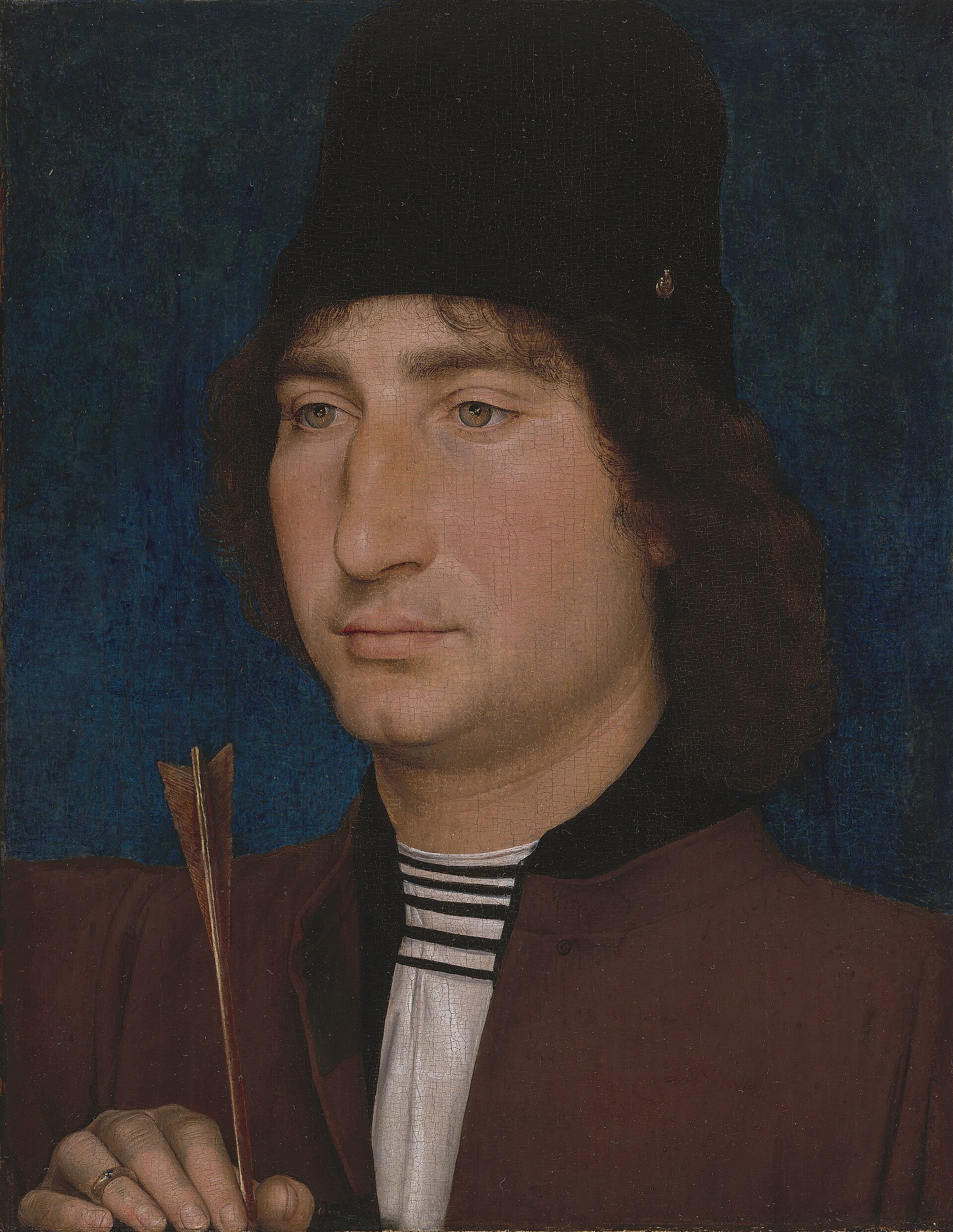
The nineteenth-century recovery of the name came in two moves. Weale published the archive documents from 1861. The Flemish Primitives text credits him too with recognising a portrait of a man holding a Roman coin, once given to Antonello da Messina, as Memling's. Attribution moved the other way too. The Gdansk museum notes that Hotho gave its Last Judgment to him in 1843 and that Aby Warburg consolidated the thesis in 1901 and 1902, after centuries under other names.
Authentic panels almost never come to auction, so the record is set by small pictures.
Authentic panels almost never come to auction, so the record is set by small pictures. On 1 July 2026 at Sotheby's London a circular panel of the Virgin nursing the Christ Child, 17.2 centimetres across in oil and gold on oak, made GBP 3.51 million (USD 4.64 million) according to HENI, against an estimate of GBP 3 to 4 million. It beat the previous record, set when a newly discovered Christ Blessing, auctioned in Paris in 1859 as by 'J. Memling' and held in one family afterwards, sold at Sotheby's New York on 31 January 2013 for USD 4,114,500, or EUR 3,034,438, on an estimate of USD 1 to 1.5 million. Both are premium-inclusive totals. HENI states that its results include fees and premiums, and no source opened for this page gives either hammer price.
The tondo's history shows how attribution and price travel together, though the sales span 48 years and the 2012 and 2015 outcomes are unknown. Christie's sold it on 1 December 1978, lot 111, 'as attributed to Hans Memling', for USD 93,000 by HENI's table. In 2007 a New York collection bought it from an Antwerp private collection. Christie's New York offered it on 25 January 2012 at USD 6 to 8 million, describing it in the pre-sale release as one of two works by the artist in private hands. Christie's London listed it again on 8 December 2015, lot 11. The outcomes of those two sales were not found, and the Sotheby's provenance says only that the present owner acquired it before the 2015 sale. It sold in 2026 at a total below the 2012 low estimate.
The next tier is the workshop. At the Dorotheum in Vienna in April 2016 a Nativity from Memling's workshop, which The Art Newspaper described as stylistically different from his works and not yet attributed, made a reported EUR 1.1 million (EUR 1.2 million with premium). Works held by museums do not come to market. The Musea Brugge holds nine, which it calls the second-largest Memling collection in the world, and in 2023 it announced an investment of EUR 1.2 million in new technical research on them.
On 10 December 1495, according to Weale, the guardians of his three sons John, Cornelius and Nicolas, still minors, brought into court the sum of ten pounds groat in cash, the proceeds of the sale of...
On 10 December 1495, according to Weale, the guardians of his three sons John, Cornelius and Nicolas, still minors, brought into court the sum of ten pounds groat in cash, the proceeds of the sale of their father's chattels. The houses and land they inherited carried annual charges of about one pound nine shillings and tenpence groat, and passed in 1509 to another painter, Louis Boels, who became dean of the guild in 1513 and died in 1522. The scan of Weale's text is clear on the dates and charges and only partly legible on the symbols for the sums, which should be checked against the printed page. Wikipedia says the trustees appeared before the court of wards on 10 December 1495 and that records indicate considerable property. No inventory of the studio, no drawings and no will text turned up in the sources opened.
Of the workshop afterwards the documents say almost nothing. The two apprentices registered in the guild, Verhanneman and van der Meersch, are the only named pupils, and Weale notes that van der Meersch died in 1501. Where Memling's patterns went, and who finished work after August 1494, is open.
Painter; Portraitist; Workshop master. c. 1435-1494 (birth year estimated c. 1430-1440).
Born c. 1435 (estimates run from c. 1430 to c. 1440; no baptismal record), Seligenstadt, near Frankfurt am Main (the 1465 Bruges citizenship entry gives 'Zaleghen Stat'); died 11 August 1494, Bruges, buried in the churchyard of Saint Giles.
Copies and workshop replicas, not a documented forger. No forgery by a named hand turned up in the sources opened. The documented problem is copies made for his own clients.
Musea Brugge (Sint-Janshospitaal and Groeningemuseum) (Bruges); National Museum in Gdansk (Gdansk); The National Gallery (London); The Metropolitan Museum of Art (New York); The Morgan Library and Museum (New York); Royal Museum of Fine Arts (KMSKA) (Antwerp).
The record is small and the sample thin. The two highest results are a 2026 tondo of 17.2 cm (GBP 3.51 million, premium-inclusive) and a 2013 discovery panel (USD 4,114,500, premium-inclusive).
Where did he train? The Gdansk museum suspects a stay in Rogier's Brussels workshop around 1459-1460, Lane denies proof of an apprenticeship and places the training in Cologne, and no document settles it.
Last verified
One artwork and its story every Tuesday, with the picture: who owned it, what it made, and what closes soon in the exhibition calendar. No promotion, and nothing we cannot cite.
We send one email to confirm the address and keep nothing else. Every letter carries a one-click unsubscribe. How we handle your data.