Museu de Arte de Sao Paulo
Museum · Museu de Arte de São Paulo Assis Chateaubriand · Founded 1947
Open, admission and hours confirmed 1 September 2026 · 15 sources
On this page 17 sections
ContentsClose
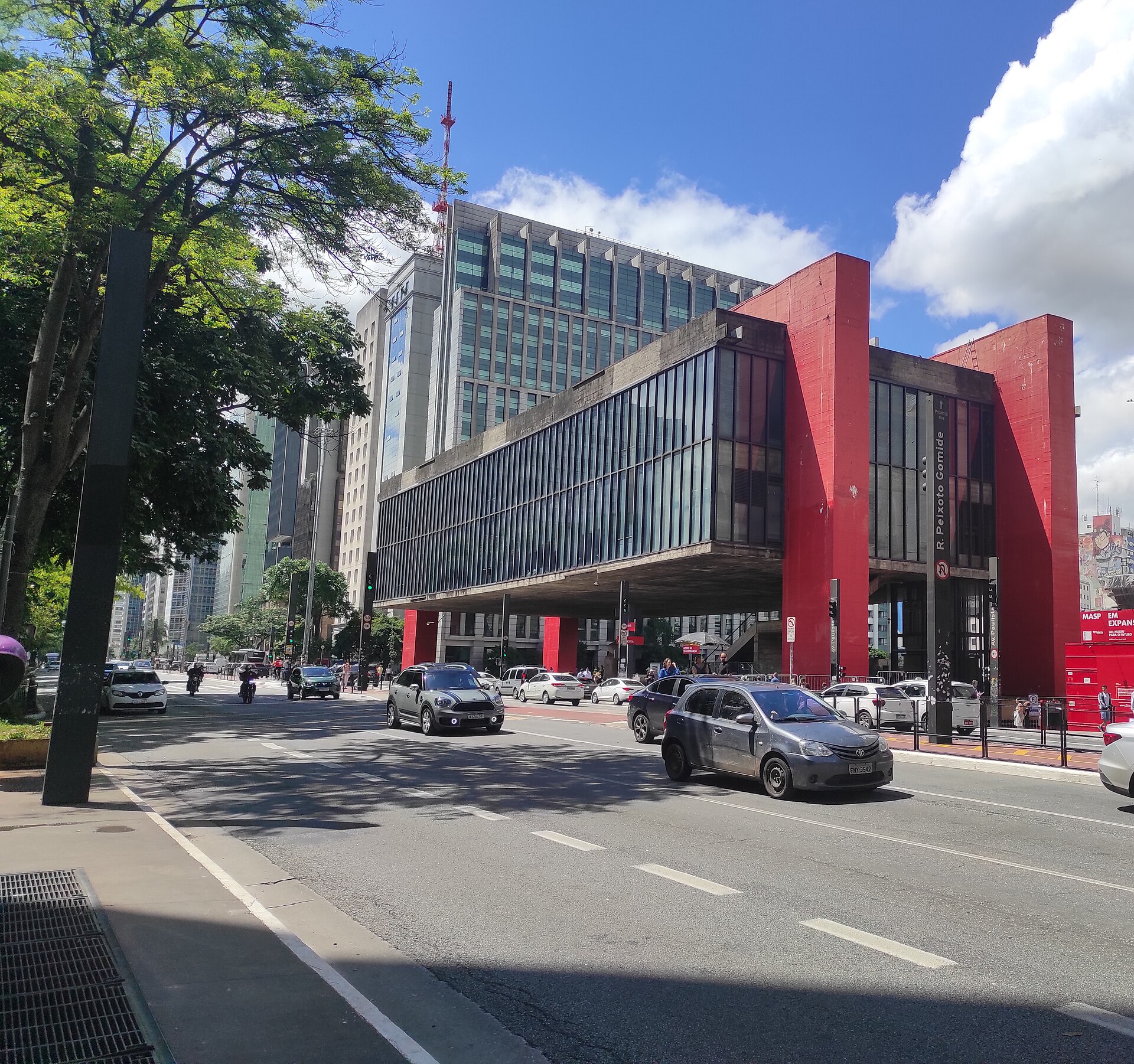
Roughly ten thousand objects on the museum's own Portuguese count, and more than eleven thousand on its English one, spanning African, Asian, American, Brazilian and European art from antiquity to the twenty-first century, and including painting, sculpture, drawing, photography and clothing. The European pictures are the reason the museum is known abroad, and MASP's claim to hold the most important collection of European art in the southern hemisphere is not seriously contested: Raphael, Titian, Tintoretto, Botticelli, Poussin, Ingres, Murillo, Magnasco, Manet, Monet, Degas, Cezanne, Renoir, Van Gogh, Toulouse-Lautrec, Matisse and Picasso are all here, and for most of the museum's history they have been shown in a single undivided room. The collection is listed by IPHAN, the national historic and artistic heritage institute, which constrains what can leave the country. Two qualifications belong beside all of that. Only a little over one per cent of it can be displayed at once, and only just over two thousand works had been catalogued online when this entry was written. The holdings that matter most to this archive are the five paintings by Frans Post, four of whose records were read for this page: they came in by donation between 1951 and 1961, one of them from Chateaubriand personally in 1958, and MASP's own catalogue discusses their provenance with the doubt intact.
| Local name | Museu de Arte de São Paulo Assis Chateaubriand |
|---|---|
| Kind | Museum |
| Founded | 1947 as an institution; the Avenida Paulista building opened in 1968 |
| City and country |  Sao Paulo, Brazil Sao Paulo, Brazil |
| Address | Avenida Paulista 1578, Bela Vista, 01310-200 Sao Paulo, SP, Brazil |
| Website | masp.org.br |
| Status | Open, confirmed 1 September 2026 |
| Record last verified | 8 August 2026 |
Visiting
- Hours
- Tuesday10:00 to 20:00Terca Gratis Nubank; last entry 19:00; free to everyone
- Wednesday and Thursday10:00 to 18:00last entry 17:00
- Friday10:00 to 21:00Sexta B3; last entry 20:00; free from 18:00
- Saturday and Sunday10:00 to 18:00last entry 17:00
- MondayClosed
- Closed
- Monday, every week. 24 and 25 December, and 31 December and 1 January. The museum opens normally on every other public holiday, and says changes are announced on its social media rather than on the site.. The ticket desk keeps its own hours, shorter than the museum's: 10:00 to 19:00 on Tuesdays, 10:00 to 20:00 on Fridays, 10:00 to 17:00 Wednesday to Sunday.
- Admission
- AdultBRL 85inteira. One ticket admits the holder to every exhibition showing on the day of the visit, across both buildings.
- Student, teacher or 60 and overBRL 42meia-entrada, on production of current identification
- Children 10 and underFreefree, but the courtesy must be requested at the MASP ticket desk with proof of identity. Under-14s may not enter unaccompanied.
- Visitor with a disability and one companionFreefree
- Amigo MASP memberFreefree, but an online reservation is still mandatory
Free entry: Every Tuesday, free to every visitor, sponsored by Nubank. The museum states explicitly that you do not have to be a Nubank customer.. Every Friday from 18:00 to 21:00, free, sponsored by B3, the Brazilian exchange. Free tickets are valid only from 18:00.. Online booking is mandatory on the free days as well as the paid ones, and the museum recommends booking online in any case- Tickets
- masp.org.br/ingressos The museum's own ticket page.
- Do I need to book?
- Effectively yes. The museum states that online booking remains mandatory, including on the free days, and including for Amigo MASP members holding free entry. Tickets cannot be rescheduled: to move a date you must cancel the purchase and buy again.
- Address
- Avenida Paulista 1578, Bela Vista, 01310-200 Sao Paulo, SP, Brazil MapMetro Green Line, Trianon-MASP station, which is named after the museum and opens onto Avenida Paulista
Bus Avenida Paulista is one of the most heavily served corridors in the city; the museum directs visitors to the SPTrans network site for routes rather than listing them
Car Discounted parking at Car Park, Alameda Casa Branca 41, BRL 25 for up to twelve hours, but only if the parking ticket is stamped at MASP reception. Progress Park at Avenida Paulista 1636 and Multipark Wall Street at Rua Itapeva 636 are nearby and are not discounted. - Website
- masp.org.br
- Telephone
- +55 11 3149 5959
- [email protected]
Before you go how long, access, photography, bags, eating, shop
- How long to allow
- The picture gallery on the second floor of the Lina Bo Bardi building can be walked in under an hour because it is one undivided room, but the collection now spans two buildings connected by an underground passage, and the Pietro Maria Bardi building added five galleries over fourteen floors. Budget half a day if the temporary programme interests you.
- Access
- Entry is free for a visitor with a disability and one companion. Guide dogs are admitted under Brazilian federal law 11.126/2005 and decree 5.904/2006, which the museum cites by number on its own visit page. The Pietro Maria Bardi building is fully climate-controlled and lift-served.
- Photography
- The museum publishes no photography rule on the pages consulted for this entry; ask on the day.
- Bags
- No published cloakroom or bag rule was found on the pages consulted.
- Eating
- MASP Cafe on the first floor, 11:30 to 17:00 Tuesday to Sunday, and on the first basement level 10:00 to 20:00 on Tuesdays and 10:00 to 18:00 Wednesday to Sunday. The restaurant MASP A Baianeira is on the second basement level under the chef Manuelle Ferraz, 11:30 to 15:00 Tuesday to Friday and 11:30 to 16:00 at weekends, closed Mondays. These catering hours are published ONLY on the museum's English visit page, which is demonstrably out of date on admission prices, so treat them as needing confirmation on the day.
- Shop
- MASP Store, on site, with the museum's own art editions and publications
Prices and hours change. We take them from the institution's own pages and print the day we read them, and you can check the current position at the source we used. Confirm before you travel.
What is inside
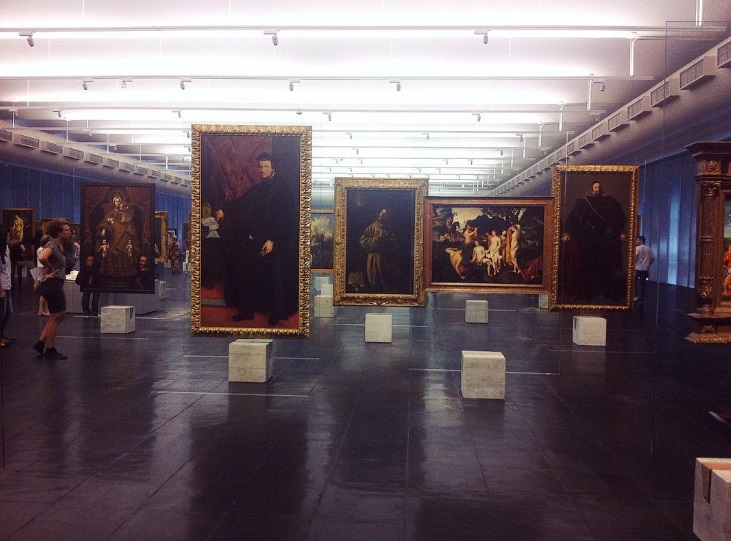
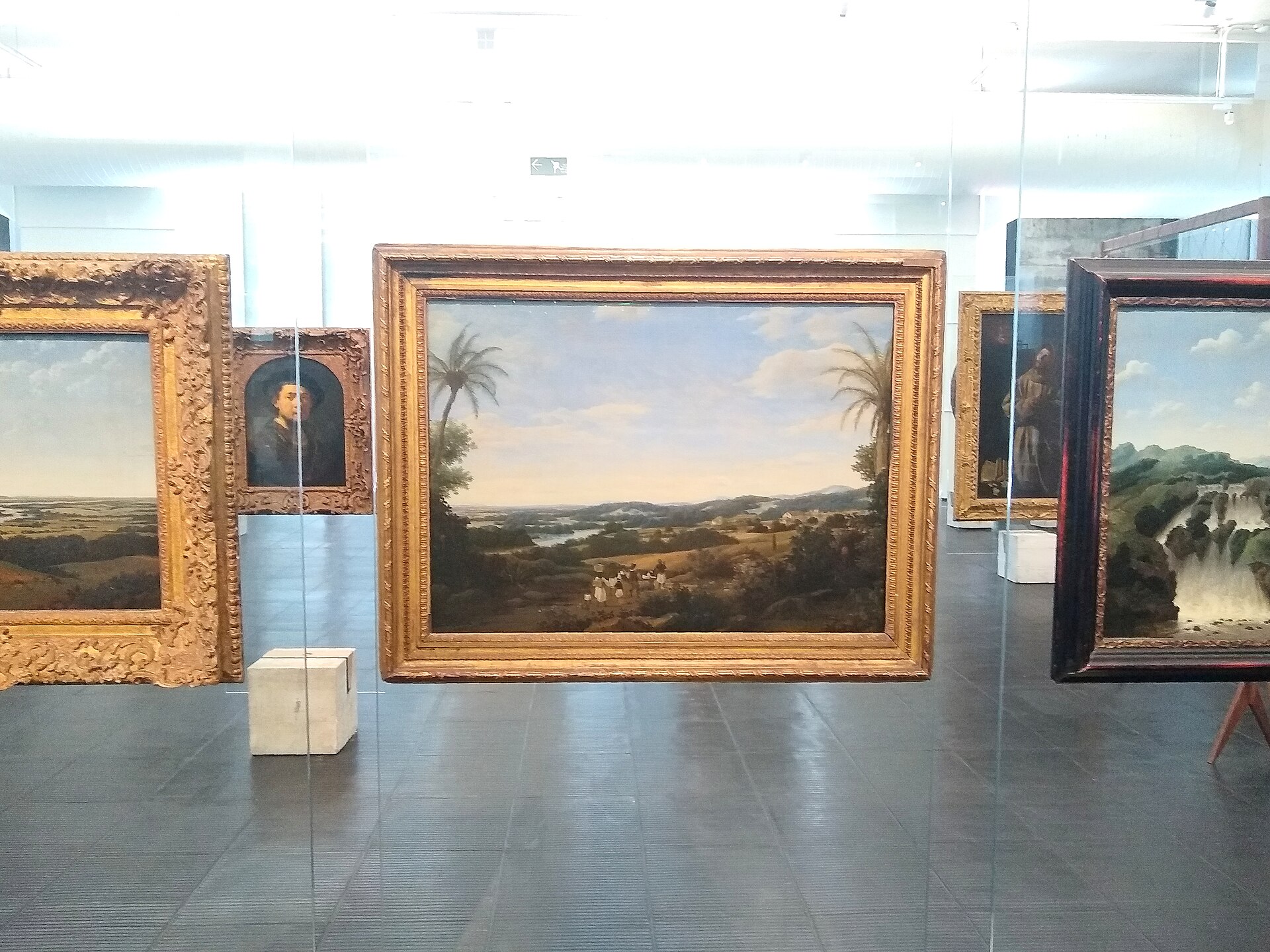
Photograph by Victor Santos Silva · CC BY-SA 4.0 The picture gallery and the glass easels
The second floor of the Lina Bo Bardi building is one undivided hall, and the collection stands in it on cavaletes de cristal: sheets of glass rising out of cubes of rough-cast concrete, each holding a single painting clear of any wall. There is no route. Visitors walk between the pictures rather than past them, and the label is printed on the back of the glass, so reading it means walking round the painting and looking at its stretcher, its panel joins and its old repairs. It is the reason this archive treats the room as an argument rather than a fixture.
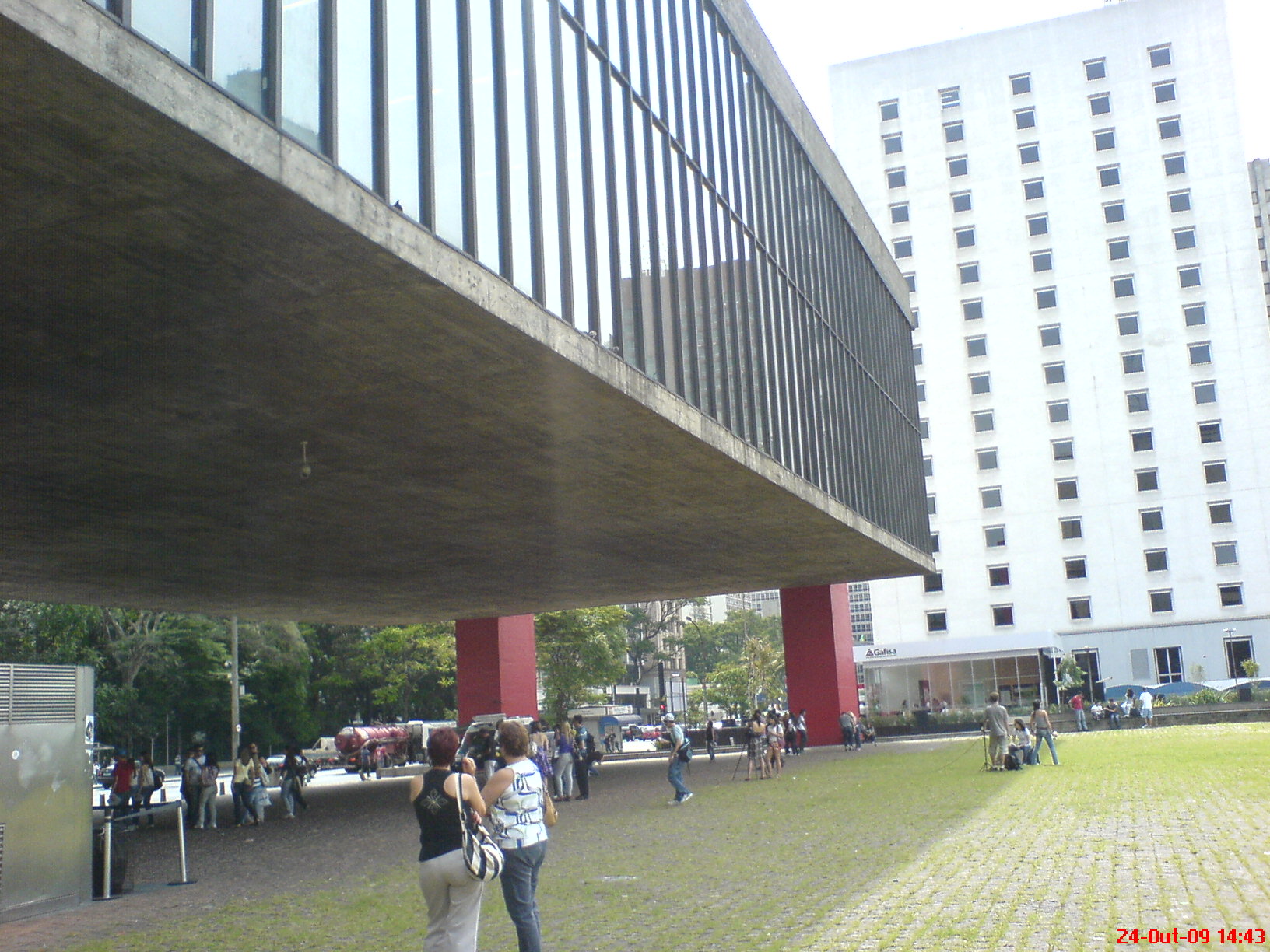
Photograph by Paulo Humberto · CC BY-SA 3.0 The vao livre
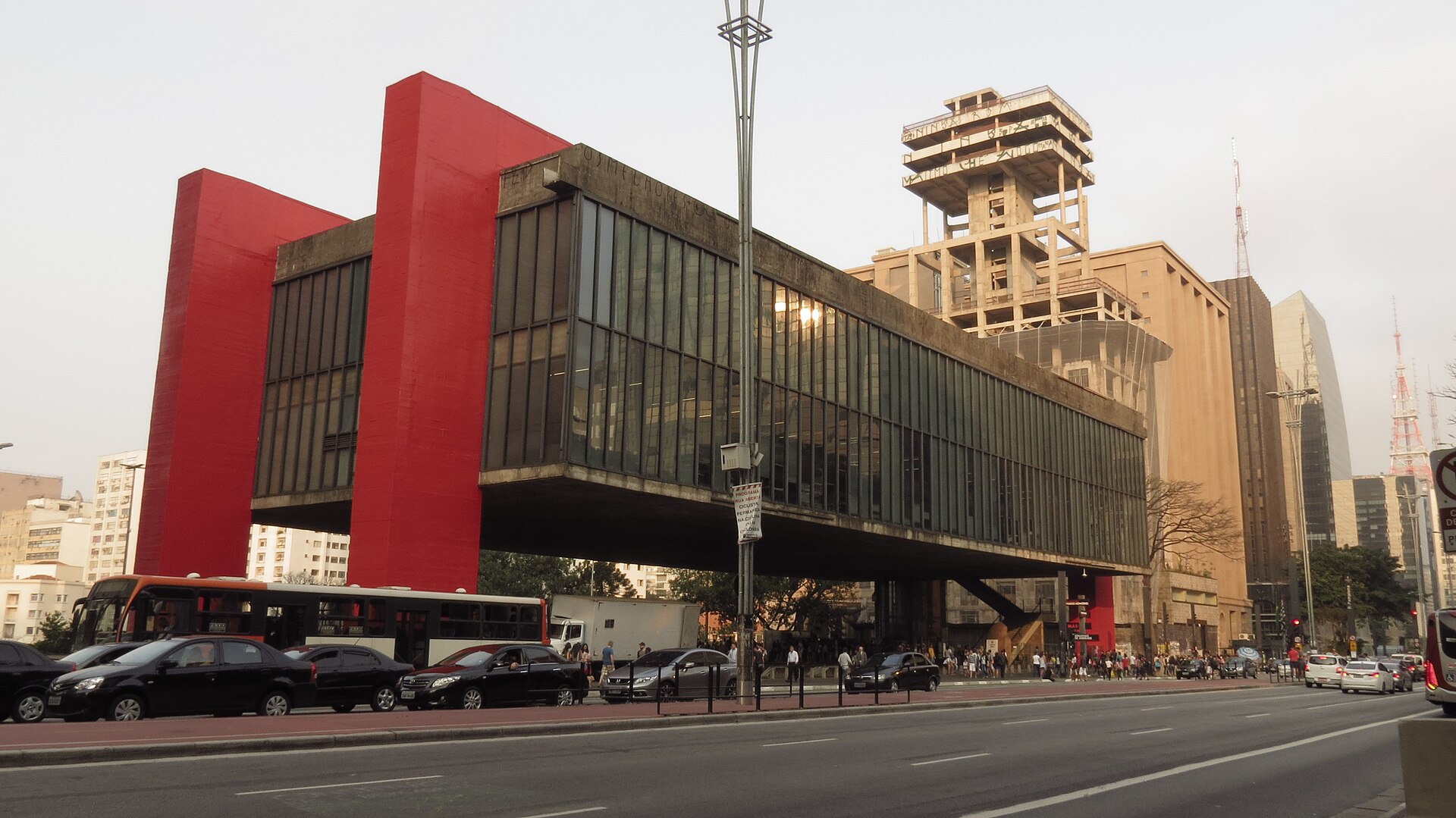
The ground plane under the suspended box, which Lina Bo Bardi left open rather than build on. The gallery block is carried on four red-painted piers so that the terrain passes beneath it, and the museum describes the plaza this creates as having been designed as a multipurpose public square. Sao Paulo City Hall has more recently granted the museum permission to use the open space beneath the old building for its own activities.
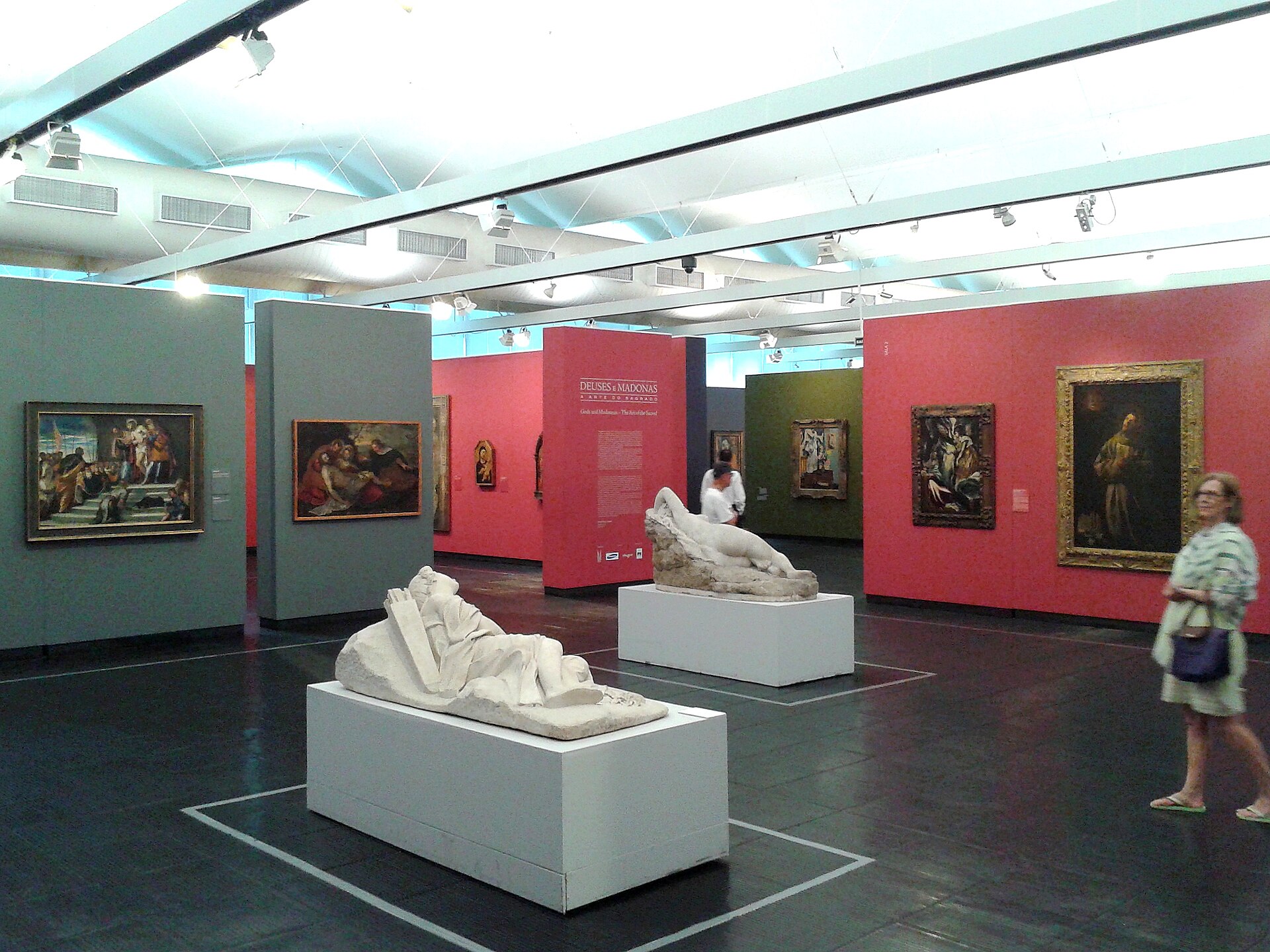
Photograph by Dornicke · CC BY-SA 4.0 The Sala Georges Wildenstein and the temporary galleries
The below-grade exhibition hall where MASP mounts the shows that have made its recent reputation: the thematic Histories cycles, and the Monet exhibition that helped double the museum's attendance in 2025. It is a conventional partitioned gallery, coloured walls and plinths, and the contrast with the easel floor above it is the clearest statement on the premises of what Bo Bardi was arguing against.
Photograph by andresumida · CC BY 2.0 The auditorium
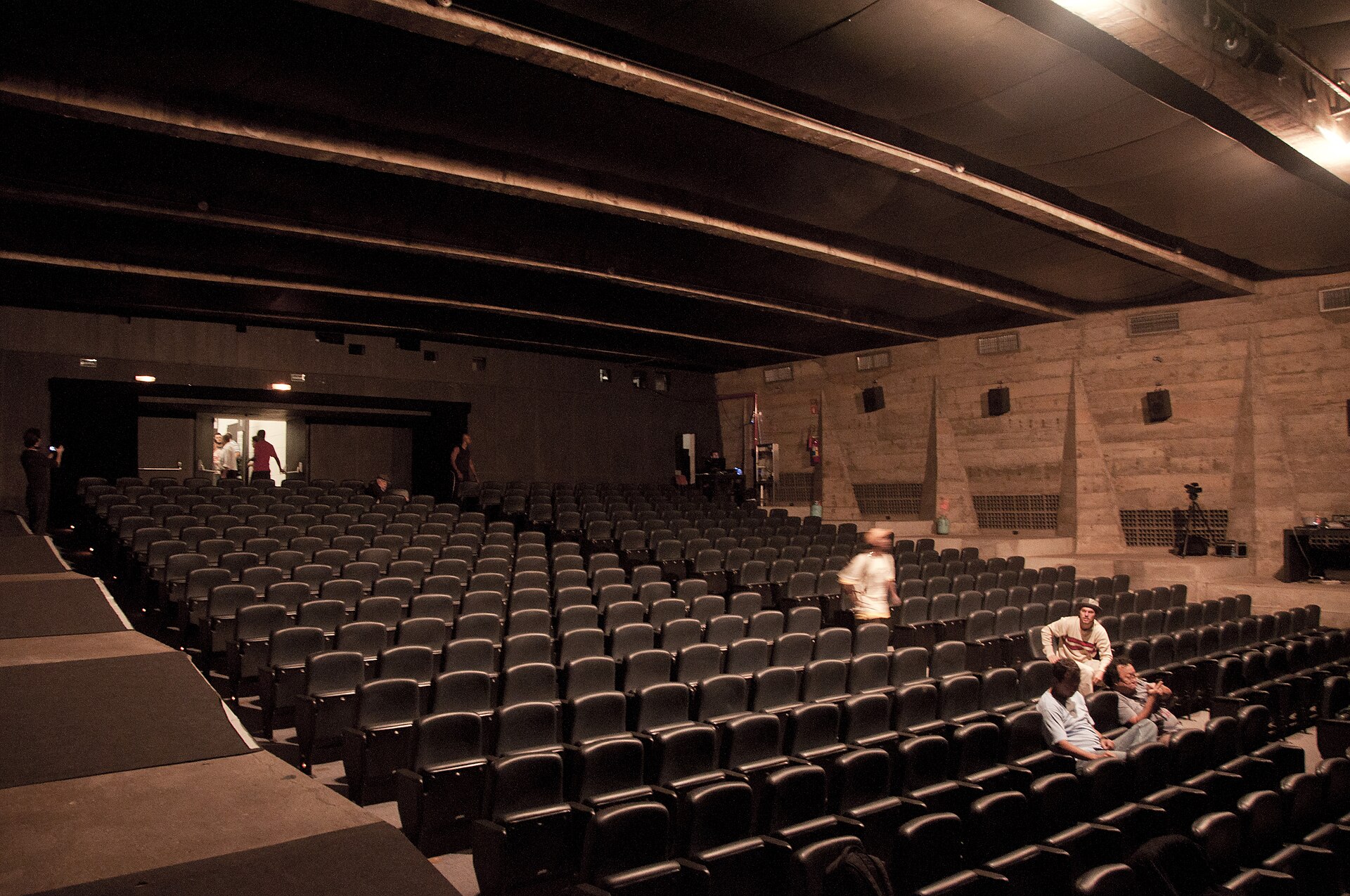
A raked hall in board-marked concrete on the lower levels, where the museum runs its seminar programme, the lectures held on the first Saturday of each month, the MASP Teachers programme and its film and video screenings. The concrete is left as it came out of the formwork, which is the same decision as the exposed beams overhead in the gallery.
Photograph by seier+seier · CC BY 2.0 The basement levels, the library and the research centre
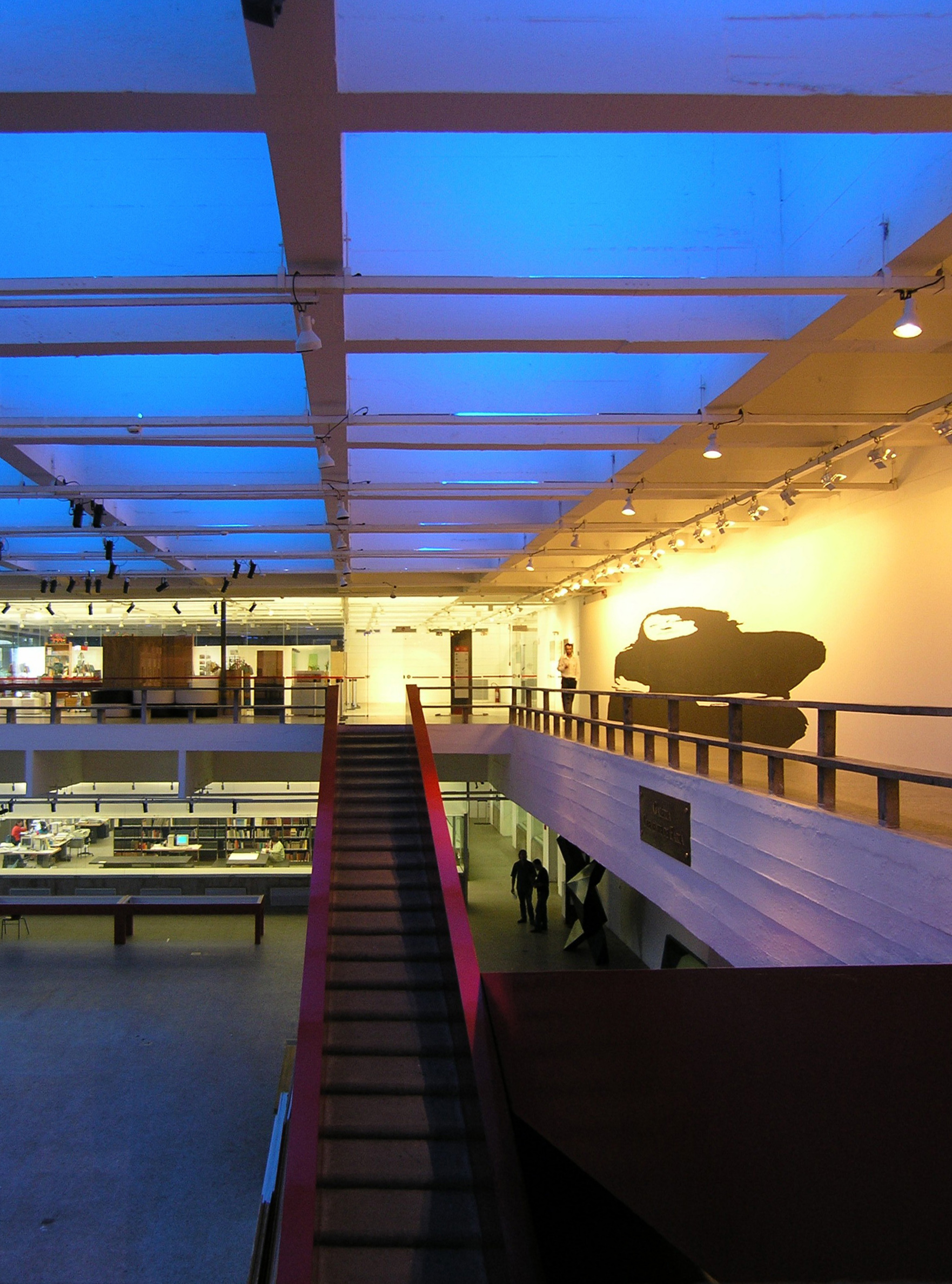
Below the plaza sit the library and the Centro de Pesquisa, the restaurant, and the circulation that ties the two buildings together. The library is among the strongest art-historical collections in Brazil. The museum's own research apparatus is unusually exposed to the public for an institution of this size, and its catalogue entries are signed and dated by their authors, which is why they are usable as sources rather than as labels.
Photograph by Boaventuravinicius · CC BY 4.0 The Edificio Pietro Maria Bardi
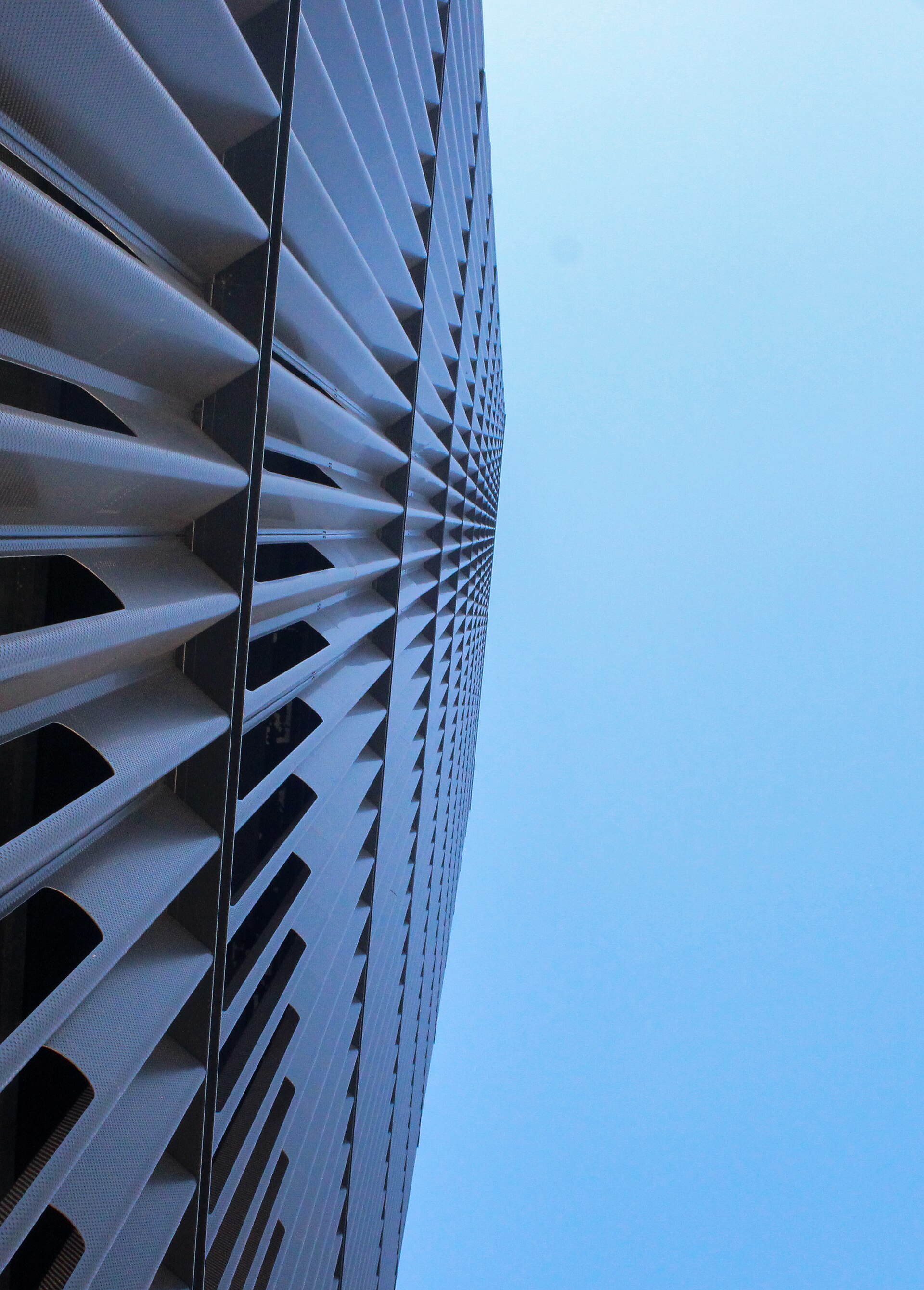
The annexe on the neighbouring corner, opened to the public in March 2025 and named for the museum's first director, at which point the 1968 building was formally renamed the Edificio Lina Bo Bardi. Fourteen floors, about 7,680 square metres, five new galleries, two multipurpose spaces, classrooms, a conservation laboratory, storage and loading docks, joined to the old building by an underground walkway. It was designed by Metro Arquitetos Associados under Martin Corullon and Gustavo Cendroni, built on the site of the Dumont-Adams residential block of 1954 to 1956 and reusing much of its structure, and it raised MASP's exhibition space by sixty-six per cent.
The belvedere and the Trianon terrace
The building stands on the site of the old Belvedere Trianon, and the suspended gallery block reads as floating over a belvedere that holds open the long view towards the Anhangabau valley. There is no free-licence photograph on Commons that could be verified as this terrace, so it carries none.
What to see first
Paisagem em Pernambuco com casa-grande
Frans Post, 1665, oil on panel, 59 x 94.5 cm, MASP.00223The direct tie to this archive's own Frans Post record. MASP's catalogue records it as a gift from Assis Chateaubriand himself in 1958, which makes it a documented instance of the founder buying Dutch Brazil back into Brazil.5
Paisagem com jiboia
Frans Post, c. 1660, oil on canvas, 119 x 173.5 cm, MASP.00225The largest of the five Posts here, and the one with a real provenance problem attached: MASP's own catalogue essay by Luciano Migliaccio weighs, and declines to accept, the suggestion that it came out of Johan Maurits's gift of Brazilian pictures to Louis XIV.6
Paisagem com tamandua
Frans Post, c. 1660, oil on panel, 58 x 80.5 cm, MASP.00224A gift from Antenor Rezende in 1951. The museum's own entry does not soften what is in the picture: an anteater, a toad and an armadillo in the foreground, and behind them a party of a white couple with enslaved people and children.7
Paisagem pernambucana com rio
Frans Post, 1668, oil on panel, 47 x 55 cm, MASP.00222The smallest and latest of the four Posts whose records were read for this entry, and a gift of the Club do Canguru Mirim in 1951: evidence of how broadly Chateaubriand and Bardi spread the solicitation for donations.8
Resurrection of Christ, the Kinnaird Resurrection
RaphaelBought on Bardi's authentication after Chateaubriand saw it in New York, with no precise documentation to go on. The attribution has since been debated and tested repeatedly and is now generally accepted, which makes the picture a case study in a connoisseur's eye standing in for a paper trail.11
The European picture holdings
Raphael, Titian, Tintoretto, Botticelli, Poussin, Ingres, Murillo, Magnasco, Manet, Monet, Degas, Cezanne, Renoir, Van Gogh, Toulouse-Lautrec, Matisse, PicassoMASP describes its own holdings as the most important collection of European art in the southern hemisphere, and the concentration is the reason the museum matters outside Brazil. No other institution south of the equator hangs this range in one room.3
The self-taught Brazilian painters
Maria Auxiliadora, Agostinho Batista de Freitas, Albino Braz, Jose Antonio da Silva, Rafael Borjes de OliveiraThe museum names these artists on its own collection page as figures who worked outside the academy and the gallery circuit and are routinely left out of art history, and hangs them alongside Malfatti, Di Cavalcanti, Portinari and Meirelles rather than in a separate room.4
The non-European holdings
VariousAfrican, Asian and American material from antiquity to the twenty-first century, including a pair of Chinese warriors and a sculpture of the Yoruba deity Exu, which the museum lists among the things that stop the collection being read as a European cabinet with local additions.4
The cavaletes de cristal themselves
Lina Bo Bardi, 1968, reconstructed by Metro Arquitetos in 2015The architects who rebuilt them argue the easels should be counted as part of the museum's collection and heritage in their own right, both for their place in the history of display and for their inseparability from the rooms Bo Bardi designed around them.10
Exhibitions on now
- On now3 Jul to 4 Oct 2026Confirmed 31 Aug 2026 · check before you travel
- Opening soon30 Oct 2026 to 31 Jan 2027Confirmed 31 Aug 2026, 2 weeks ago
- Opening soon30 Oct 2026 to 4 Apr 2027Confirmed 31 Aug 2026, 2 weeks ago
Past exhibitions here
- Closed15 May to 13 Sep 2026Confirmed 31 Aug 2026 · check before you travel
A gallery hung from beams, over a square it refused to build on
MASP was not founded in the building it is famous for. Assis Chateaubriand, the press magnate behind the Diarios Associados, established the museum in 1947 on the second floor of a commercial building on rua Sete de Abril in central Sao Paulo, and it was the first modern art museum in Brazil. He had met the Italian dealer and critic Pietro Maria Bardi in Rio de Janeiro the year before, at an exhibition of old Italian painting Bardi had brought over to sell, and invited him to build and direct the museum. Bardi worked on it with his wife, the architect Lina Bo Bardi, and named it the Museu de Arte de Sao Paulo without qualification, refusing in the title itself the distinction between ancient and modern that would have told visitors what to expect.
The Avenida Paulista building opened in 1968. Bo Bardi built over the terrace of the former Belvedere Trianon, and the gallery block reads as floating above a belvedere that keeps open the long view over the Anhangabau valley. The gallery block is hung from four great beams on four piers, painted red, with the ground plane running clear underneath it, so that the museum's most valuable square metres are the ones it declines to occupy. The space below, the vao livre, was designed as a multipurpose public square, in the museum's own words, and has served as one ever since. It is the rare case of a museum whose civic contribution is measurable in what it did not build.
The easels are an argument, not a fixture
Inside, on the second floor, Bo Bardi did to the hang what she had done to the site. Instead of rooms, one undivided hall. Instead of walls, cavaletes de cristal: a sheet of toughened glass rising out of a cube of rough-cast concrete, held by a wooden wedge and a screw, each carrying one painting standing free in space. There is no sequence and no imposed route. The label is on the back of the glass, so a visitor who wants to know what they are looking at has to walk around the picture and confront its reverse, its panel, its cradling and its repairs.
The museum states the argument in its own words on its own about page: by taking the works off the wall, the easels question the traditional European museum model in which the visitor is led along a linear narrative set by the order of the rooms. Bo Bardi was blunter in her lifetime, writing that she had designed the museum to destroy the aura that surrounds a museum and to present a work of art as work. She had rehearsed the principles at Sete de Abril from 1947 - works off the wall, no display adornment, plain frames, no chronology - and radicalised them on Paulista. Sabrina Moura's account adds a corrective that matters: archive photographs show the Bardis did group certain runs of pictures deliberately, so the total randomness sometimes claimed for the 1968 hang was never quite true. The refusal of hierarchy was real; the refusal of all curatorial intent was not.
A collection bought fast, in a buyer's market, with money raised by threat
This is the part of MASP that belongs to this archive's subject rather than to architectural history. The collection was assembled in about fifteen years, from 1947, at the one moment in the twentieth century when European pictures were both cheap and moving. Bardi knew the international trade and had the eye; Chateaubriand had the money and the leverage. The result was a holding that would be unassembleable at any later date, and the speed is legible in MASP's own accession record, which lists 1947, 1950, 1953, 1958 and 1966 among its years of new acquisitions.
Where the money came from is documented and it is not creditable. New City Brazil, reporting as the new annexe opened in March 2025, records that Chateaubriand raised funds by threatening businessmen, industrialists, landowners and wealthy politicians with gossip in his own newspapers unless they paid, and that he described this as a reeducation of the bourgeoisie. The same account quotes Time's verdict of 1954, that he was the man who robs Cezannes from the rich to give to the poor. It puts the sum raised at a little over one million dollars of the day and cites a Sotheby's view that the resulting collection would now exceed 1.2 billion. Provenance research on a MASP picture therefore has two distinct questions to answer: how the object reached the European market, and which Brazilian fortune was squeezed to buy it.
The connoisseurship carried the same risk profile as the fundraising. The museum's Raphael, the Resurrection of Christ known as the Kinnaird Resurrection, was bought after Chateaubriand saw it in New York and Bardi flew up to judge it; Bardi authenticated it without precise documentation and endorsed the purchase. Debate and testing over the following decades have brought the attribution to general acceptance. It was still a picture bought on an eye rather than a paper trail, and this publication exists to keep that distinction visible even when the eye turns out to have been right.
1996: the easels come down and the museum goes dark
Lina Bo Bardi died in 1992. Four years later, under the direction of the architect Julio Neves, the crystal easels were taken out of the picture gallery and replaced with compartmentalised galleries built inside her open hall. The stated grounds were conservation - the risk to the works from too much light - together with the argument that a randomised hang was particularly hostile to the appreciation of non-contemporary art. Bo Bardi's transparency went opaque, facades included. The easels had been in use for close to thirty years and stayed out for about twenty.
Moura's account is that the removal opened a conceptual and financial crisis rather than settling a display question, and that the institution fell to a secondary position in the city's art scene: paintings stolen, electricity cut off, too little staff and too little money to keep the programme running. The reconstruction record published by Metro Arquitetos, the firm that later rebuilt the easels, adds a careful sentence worth reading twice. The main dispute around the easels, it says, was of a different nature; the technical and safety concerns became the official arguments for dismantling them. Neither source names what the real dispute was, and this entry does not either.
2015: the easels go back up, and the argument is not the same argument
Adriano Pedrosa took over the museum in 2014, Bo Bardi's centenary year, and in 2015 the easels returned, rebuilt, under the long-term display Acervo em Transformacao. The reconstruction was a genuine act of research: with the exception of a single sketch by Bo Bardi, no design records for the originals survive in MASP's documentation centre or in the Lina Bo and P. M. Bardi Institute, so the architects worked from photographs of a prototype and of thirty years of changing gallery configurations, from surveys of surviving easels, and from the recollections of museum staff who had installed them. The original principle and materials were kept and the failures engineered out: a steel frame inside the concrete cube to stop it splitting, levelling shims for an uneven floor, standard glass sizes and drilling so a painting can be changed without changing the glass, since in the original each sheet was drilled for one picture only.
What changed was the argument. Pedrosa presented the easels as a decolonising device, a way of telling histories around a rich European collection without reproducing a European model of history or of the museum. The trouble, as Moura sets out, is that the more than one hundred works in the 2015 hang are arranged in strict chronological order - the single principle Bo Bardi's display existed to reject - with numbered sequences on the floor plan. Moura is not hostile: she reads the juxtapositions the chronology produces as genuinely productive, an Ingres beside a Vitor Meirelles beside a Cezanne, a Van Gogh released from the mad-genius frame. But she is clear that a decolonial reading is being projected backwards onto 1968, when the opposition Bo Bardi actually faced was internal, local elitism, in a building that opened in one of the darkest years of the military dictatorship. The essayist Francesco Perrotta-Bosch goes further, and Moura characterises his position as the harshest criticism of the 2015 reassembly: a mismatch of eras that sacralises a museum its creators built to desacralise, and gives Bo Bardi a heroic aura that risks freezing her work into heritage.
Frans Post, and the colony this archive already keeps a record on
MASP holds five paintings by Frans Post, and that is the reason this venue connects directly to a record in this archive. Our own file is on the 1666 Olinda panel sold at Sotheby's New York in May 2025, a picture with a 189-year gap in its history and a Cardinal Fesch attribution this publication grades disputed. MASP's Posts are a different set of objects entirely, and its own catalogue treats them with the same care.
Four were read for this entry. Paisagem pernambucana com rio, 1668, oil on panel, came as a gift of the Club do Canguru Mirim in 1951. Paisagem com tamandua, about 1660, oil on panel, was given by Antenor Rezende the same year. Paisagem com jiboia, about 1660, is the outlier: oil on canvas and much larger, at 119 by 173.5 centimetres, given by Max Lowenstein in 1961. And Paisagem em Pernambuco com casa-grande, 1665, oil on panel, was a gift from Assis Chateaubriand personally in 1958 - the founder buying images of Dutch Brazil back into Brazil, with money raised in the manner described above.
The museum's catalogue entry on the jiboia landscape, by Luciano Migliaccio, is the kind of writing this archive is built to cite. It traces a 1959 letter from the Copenhagen auctioneer Arne Bruun Rasmussen suggesting the Holstein family acquired the picture around 1773 from the estate sale of G. H. M. Morell, dealer and keeper of the Danish royal collections, where a canvas catalogued as a West Indian scene carried the same measurements. It records that Larsen, on the strength of those measurements alone, proposed the painting belonged to the group of Brazilian subjects Johan Maurits gave Louis XIV - and then states flatly that no trace of the picture exists in any French collection, and that Johan Maurits's 1654 gift to Frederick III of Denmark is the likelier route. A museum publishing the weaker of two hypotheses about its own picture, with the reason it is weaker, is doing our job for us. It is worth noting one discrepancy against our own Post record, which dates the gift to Louis XIV to 1679 where MASP's entry gives 1678; neither is settled here.
MASP's curatorial text is also unsentimental about what these pictures are. Post reached Brazil in 1637 aged twenty-five in the retinue of Johan Maurits, lived in Recife until 1644, and painted eighteen landscapes there of which only seven are located today. He was the first European to paint the Brazilian landscape from observation. And the museum's own description of Paisagem com tamandua names what is in the middle distance behind the anteater and the armadillo: a party of a white couple with enslaved people and children. The jiboia entry notes that the unroofed church in the picture records the Dutch destruction of the city's Catholic buildings. This is a museum describing a colonial image as a colonial image on its own object page.
The annexe, what it cost, and where the museum stands now
The chronic problem behind all of this is that MASP has never been able to show its collection. On the estimate New City Brazil published in 2025, only a little over one per cent is on display at any time, and the failure has run across administrations since Pietro Maria Bardi's. The answer was a second building. The Edificio Pietro Maria Bardi opened to the public in March 2025 on the neighbouring corner, at which point the 1968 building was renamed the Edificio Lina Bo Bardi - the couple finally separated into two addresses. Metro Arquitetos Associados, under Martin Corullon and Gustavo Cendroni, produced a fourteen-storey vertical block of about 7,680 square metres, deliberately set against the horizontality of Bo Bardi's box: five new galleries, two multipurpose spaces, classrooms, a conservation laboratory, storage, loading docks, a restaurant and cafe, and an underground walkway to the old building. Exhibition space rose by sixty-six per cent. It was built on the site of the Dumont-Adams residential block of 1954 to 1956 and reuses much of its structure, and it is LEED certified. The construction was funded by BRL 250 million in donations, and the donors' names are set in metal letters on a ground-floor wall above the lifts.
Not everyone is pleased. The building has been called a graceless black monolith with no relation to the grandeur of what stands next to it, and the cost was attacked as exorbitant against Brazil's economic circumstances, before the question of what it will cost to run. The counter-argument is the attendance. ARTnews, reporting the 2025 most-visited survey in March 2026, put MASP at about 1.2 million visitors for 2025, more than double the year before, crediting the annexe and a popular Monet exhibition, and naming Brazil with Mexico among the year's sharpest climbs.
What a reader should take from this page is that MASP is not a European collection that happens to sit in Brazil. It is a museum whose building argues about how pictures should be looked at, whose collection was bought at speed with money extracted under threat, whose most radical gallery was dismantled for twenty years and rebuilt from photographs and staff memory, and which now publishes catalogue entries that leave its own provenance doubts standing. That last habit is why this archive treats it as a source and not only as a location.
What visitors say
This entry publishes no visitor prose and cites no platform average. What follows is drawn from the museum's own published figures and from named journalism and scholarship that were read in full. MASP drew about 1.2 million visitors in 2025, more than double the previous year, a rise ARTnews attributes to the opening of the long-delayed annexe and to a popular Monet exhibition. Access is the museum's strongest public argument: it is free to everyone on Tuesdays and free from six on Friday evenings, sponsored in both cases by named financial institutions. Its weakest is capacity against holdings. On the estimate published by New City Brazil, only a little over one per cent of the collection is on show at any time, and the museum's own site concedes that just over two thousand of roughly ten thousand works have been catalogued online so far.
What is praised, what is criticised
- Praised: the picture gallery on the glass easels, where the paintings stand free of any wall, the visitor picks their own route, and the label on the back of the glass means the reverse of a picture is part of what is shown
- Praised: the vao livre, the covered public square left under the building, which has functioned as civic space in central Sao Paulo since 1968 and is not gated behind a ticket
- Praised: free entry to every visitor on Tuesdays and free entry from 18:00 every Friday, unusually generous for a museum of this rank, and free entry at all times for a visitor with a disability and one companion
- Praised: a concentration of European painting the museum can fairly call the most important in the southern hemisphere, hung in the same room as Brazilian modernists and self-taught Brazilian painters rather than in a separate wing
- Praised: catalogue entries on the collection site that are signed and dated by their authors and discuss provenance and doubt openly, which is rarer than it should be
- Criticised: only a little over one per cent of the collection can be shown at once, on the estimate published by New City Brazil, and MASP's inability to display its holdings has persisted across administrations since Pietro Maria Bardi
- Criticised: the 2015 reinstatement of the easels arranges the paintings in strict chronological order, which Sabrina Moura points out is precisely the principle Lina Bo Bardi's display was built to refuse
- Criticised: the essayist Francesco Perrotta-Bosch, as characterised by Moura, reads the reinstatement as a mismatch of eras that sacralises a museum its own creators set out to desacralise, and turns Bo Bardi into heritage
- Criticised: the collection was assembled with money Assis Chateaubriand raised by threatening businessmen, industrialists, landowners and politicians with gossip in his own newspapers, which he called a reeducation of the bourgeoisie
- Criticised: the new annexe has been called a graceless black monolith by some critics, and its cost of BRL 250 million was attacked as exorbitant at a time of economic difficulty, before any account of what it will cost to run
- Criticised: the museum's own English visit page is out of date and internally impossible: it still advertises BRL 75 admission and a Free Friday from 18:00 to 22:00 on a day it says closes at 18:00, while the ticket page charges BRL 85. A visitor budgeting a trip from the English site will be wrong.
- Criticised: the easels were taken out in 1996 on stated grounds of lighting damage and of a hang hostile to older art, and the architects who rebuilt them note that technical and safety concerns became the official arguments for a dispute that was really about something else
Questions about Museu de Arte de Sao Paulo
Where is Museu de Arte de Sao Paulo?
Avenida Paulista 1578, Bela Vista, 01310-200 Sao Paulo, SP, Brazil.
How much does it cost to visit?
Adult: BRL 85; Student, teacher or 60 and over: BRL 42; Children 10 and under: free; Visitor with a disability and one companion: free; Amigo MASP member: free. As confirmed 1 September 2026.
When is it open?
Tuesday 10:00-20:00; Wednesday and Thursday 10:00-18:00; Friday 10:00-21:00; Saturday and Sunday 10:00-18:00; Monday closed. Closed: Monday, every week. 24 and 25 December, and 31 December and 1 January. The museum opens normally on every other public holiday, and says changes are announced on its social media rather than on the site. As confirmed 1 September 2026.
How do you get there?
Metro: Green Line, Trianon-MASP station, which is named after the museum and opens onto Avenida Paulista; Bus: Avenida Paulista is one of the most heavily served corridors in the city; the museum directs visitors to the SPTrans network site for routes rather than listing them; Car: Discounted parking at Car Park, Alameda Casa Branca 41, BRL 25 for up to twelve hours, but only if the parking ticket is stamped at MASP reception. Progress Park at Avenida Paulista 1636 and Multipark Wall Street at Rua Itapeva 636 are nearby and are not discounted.
What should you see first?
Paisagem em Pernambuco com casa-grande (Frans Post, 1665, oil on panel, 59 x 94.5 cm, MASP.00223); Paisagem com jiboia (Frans Post, c. 1660, oil on canvas, 119 x 173.5 cm, MASP.00225); Paisagem com tamandua (Frans Post, c. 1660, oil on panel, 58 x 80.5 cm, MASP.00224); Paisagem pernambucana com rio (Frans Post, 1668, oil on panel, 47 x 55 cm, MASP.00222); Resurrection of Christ, the Kinnaird Resurrection (Raphael); The European picture holdings (Raphael, Titian, Tintoretto, Botticelli, Poussin, Ingres, Murillo, Magnasco, Manet, Monet, Degas, Cezanne, Renoir, Van Gogh, Toulouse-Lautrec, Matisse, Picasso).
What we could not confirm
- MASP's English and Portuguese pages disagree on the size of the collection: about ten thousand pieces in Portuguese, more than eleven thousand in English. The basis of each count is not published.
- The real dispute behind the 1996 removal of the easels. Metro Arquitetos states that technical and safety arguments were the official grounds and that the main discussion was of a different nature, without naming it, and Moura's account of the following crisis does not name it either.
- Whether MASP's Paisagem com jiboia passed through the 1654 gift from Johan Maurits to Frederick III of Denmark. MASP's own entry prefers that route to the Louis XIV gift but does not document it.
- Our Frans Post record dates Johan Maurits's gift of Brazilian pictures to Louis XIV to 1679; MASP's catalogue entry gives 1678. Neither has been checked against a primary document for this entry.
- The English visit page at masp.org.br/en/visit is stale, advertising BRL 75 and an impossible Friday evening. Re-check on the next cycle; if it has not been corrected, the divergence is worth a note to the museum.
- How much of the collection the annexe has actually put on view. The sixty-six per cent increase in exhibition space is published; the resulting share of roughly ten thousand objects on display is not.
Images
Sources
- 1MASP, Visite: opening hours by day with last entry, ticket prices in reais, the free Tuesday and free Friday schemes, ticket-desk hours, the no-rescheduling rule, the under-14 rule, guide dogs under law 11.126/2005, address, telephone, parking, and the restaurant and cafe hours. Read as raw HTML on 5 August 2026. The identical page is served at /ingressos. masp.org.br/visite
- 2MASP, Collection (English): the English-language price and hours block, which agrees with the Portuguese pages at BRL 85 and 42 and on the Tuesday-to-Sunday schedule, and lists the current exhibition programme. Used to corroborate the Portuguese figures against the stale English visit page. masp.org.br/en/collection
- 3MASP, About MASP: foundation in 1947 by Assis Chateaubriand (1892-1968), Pietro Maria Bardi (1900-1999) as director and Lina Bo Bardi (1914-1992) as architect, the claim to the most important collection of European art in the southern hemisphere, more than eleven thousand works, the original rua Sete de Abril premises, the 1968 move, the museum's own statement of what the glass easels argue against, the Histories exhibition cycles, and the mission adopted in 2017. masp.org.br/en/about
- 4MASP, Acervo: about ten thousand pieces spanning African, American, Asian, Brazilian and European art from antiquity to the twenty-first century, the named European painters, the Chinese warriors and the Exu sculpture, the self-taught Brazilian artists the museum names as excluded from art history, the IPHAN listing of the collection, the statement that just over two thousand works are catalogued online, and the list of accession years including 1947, 1950, 1953, 1958 and 1966. masp.org.br/acervo
- 5MASP, Frans Post, Paisagem em Pernambuco com casa-grande, 1665: oil on wood, 59 x 94.5 x 1 cm, inventory MASP.00223, acquisition recorded as a donation from Assis Chateaubriand in 1958. masp.org.br/acervo/obra/paisagem-em-pernambuco-com-casa-grande
- 6MASP, Frans Post, Paisagem com jiboia, c. 1660: oil on canvas, 119 x 173.5 x 3 cm, inventory MASP.00225, donation of Max Lowenstein 1961; the MASP curatorial text of 2015 from Adriano Pedrosa (org.), MASP de bolso (2020), recording five Post works in the collection, eighteen landscapes painted in Brazil of which seven are located; and Luciano Migliaccio's 1998 catalogue entry from Luiz Marques (org.), Catalogo do Museu de Arte de Sao Paulo Assis Chateaubriand (MASP, 1998, reissued 2008), on the Bruun Rasmussen letter of 27 May 1959, the Morell estate sale of 1773, Larsen's Louis XIV hypothesis and its rejection for want of any French trace, and the alternative 1654 gift to Frederick III of Denmark. masp.org.br/acervo/obra/paisagem-com-jiboia
- 7MASP, Frans Post, Paisagem com tamandua, c. 1660: oil on wood, 58 x 80.5 x 1.5 cm, inventory MASP.00224, donation of Antenor Rezende 1951; the curatorial text on Post's three phases, his arrival in 1637 aged twenty-five in Johan Maurits's retinue, his residence in Recife to 1644, and the description of the anteater, toad and armadillo with a party of a white couple, enslaved people and children behind them. masp.org.br/acervo/obra/paisagem-com-tamandua
- 8MASP, Frans Post, Paisagem pernambucana com rio, 1668: oil on wood, 47 x 55 x 0.5 cm, inventory MASP.00222, donation of the Club do Canguru Mirim 1951. masp.org.br/acervo/obra/paisagem-pernambucana-com-rio
- 9Sabrina Moura, 'Alike but not the same', Stedelijk Studies, on the reenactment of Lina Bo Bardi's display for MASP 1968-2015: the 1947 Sete de Abril display principles, the 1968 crystal easels and the labels on their reverse, evidence that the Bardis did group some sequences deliberately, the 1996 removal under Julio Neves and its stated grounds, the ensuing crisis of thefts and power cuts, Pedrosa's appointment in 2014 and his decolonising reading, the strict chronological order of the 2015 hang and the works named in its juxtapositions, and Francesco Perrotta-Bosch's criticism of the reassembly as a mismatch of eras that sacralises a desacralised museum. stedelijkstudies.com/journal/reenactment-lina-bo-bardis-display-sao-paulo-museum-art-1968-2015/
- 10Metro Arquitetos Associados, cavaletes de cristal, Sao Paulo, 2015: the reconstruction of the easels, the statement that technical and safety aspects became the official arguments for a dismantling whose main discussion was of a different nature, nearly thirty years in use and nearly twenty out, the absence of any design record beyond one sketch by Lina Bo Bardi in the MASP documentation centre or the Lina Bo and P. M. Bardi Institute, the concrete base, glass panel, wooden wedge and screw, the steel frame added inside the cube, the levelling shims, the standardised glass drilling, and the argument that the easels are part of the museum's collection and heritage. metroarquitetos.com.br/en/project/cavaletes-de-cristal-sao-paulo-2015-3/
- 11New City Brazil, 'MASP's Massive Rebirth: Lina Bo Bardi's Masterpiece Gets a Companion', 19 March 2025: Chateaubriand's extraction of donations by threatening businessmen, industrialists, landowners and politicians with gossip in his newspapers, described by him as a reeducation of the bourgeoisie; Time's 1954 characterisation of him; the Kinnaird Resurrection authenticated by Bardi without documentation; the figure of a little over one million dollars raised and Sotheby's view that the collection would now exceed 1.2 billion; the estimate that only a little over one per cent of the collection is displayed; the Pietro Maria Bardi building's fourteen floors, 7,680 square metres, five galleries, sixty-six per cent increase in exhibition space, underground walkway, LEED certification, the Dumont-Adams site of 1954-1956, Metro Arquitetos under Martin Corullon and Gustavo Cendroni, the BRL 250 million in donations and the donor wall, Heitor Martins as president since 2014, and the criticism of the annexe as a graceless black monolith at exorbitant cost. newcitybrazil.com/2025/03/19/masps-massive-rebirth-lina-bo-bardis-masterpiece-gets-a-companion/
- 12Brian Boucher, 'What Were the Most Visited Museums in 2025?', ARTnews, 31 March 2026: MASP more than doubling attendance to about 1.2 million visitors in 2025 after the reopening of a long-delayed expansion and a popular Claude Monet exhibition, named with Mexico City's National Museum of Anthropology among the year's sharpest risers. artnews.com/art-news/news/most-visited-museums-2025-survey-1234779528/
- 13Wikidata, Museu de Arte de Sao Paulo (Q82941): coordinates, inception 1947, official website, telephone and email, used as the machine identity and cross-checked against the museum's own address and telephone. No dissolution date (P576) is recorded. Tertiary. wikidata.org/wiki/Q82941
- 14Wikimedia Commons, Category:Museu de Arte de Sao Paulo and its subcategories, including Interior of Museu de Arte de Sao Paulo and Museu de Arte de Sao Paulo from the west and from the south: the plates on this page, each licence read per file from extmetadata LicenseShortName and each image vetted by eye before use. commons.wikimedia.org/wiki/Category:Museu_de_Arte_de_S%C3%A3o_Paulo
- 15MASP, Visit (English): cited ONLY for the MASP Cafe and MASP A Baianeira opening hours and for the chef's name, which were not found on any other page. This page is STALE on the facts it shares with the Portuguese pages - it advertises BRL 75 and 37, a Free Friday from 18:00 to 22:00 on a day it says closes at 18:00, and free entry for under-11s where the Portuguese page says 10 and under - and its HTML additionally carries a commented-out older price block reading BRL 45 and 22. Recorded here so the divergence is on the record and re-checkable. masp.org.br/en/visit