The Last Judgment Triptych
Hans Memling · c. 1467-1473
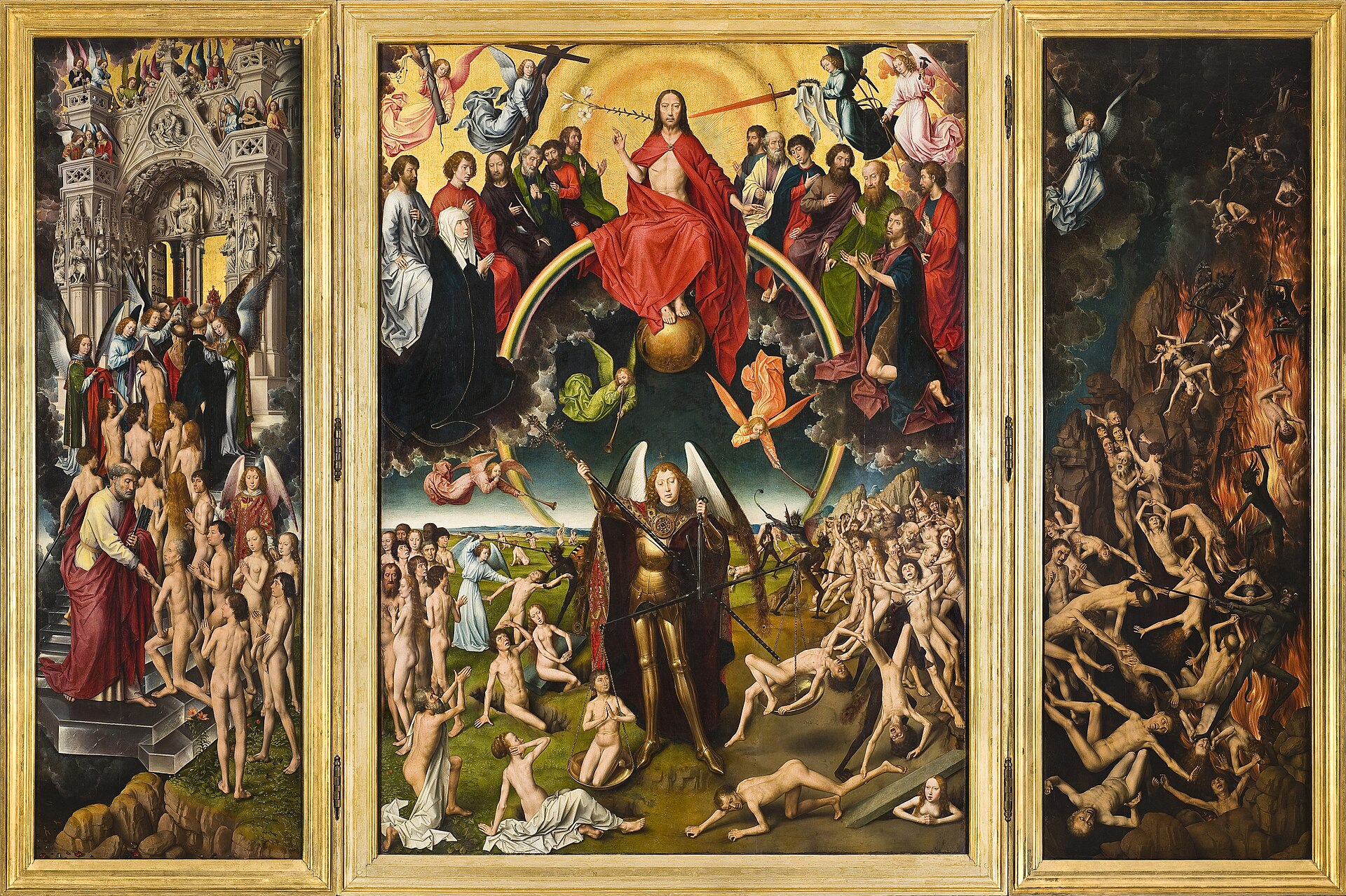
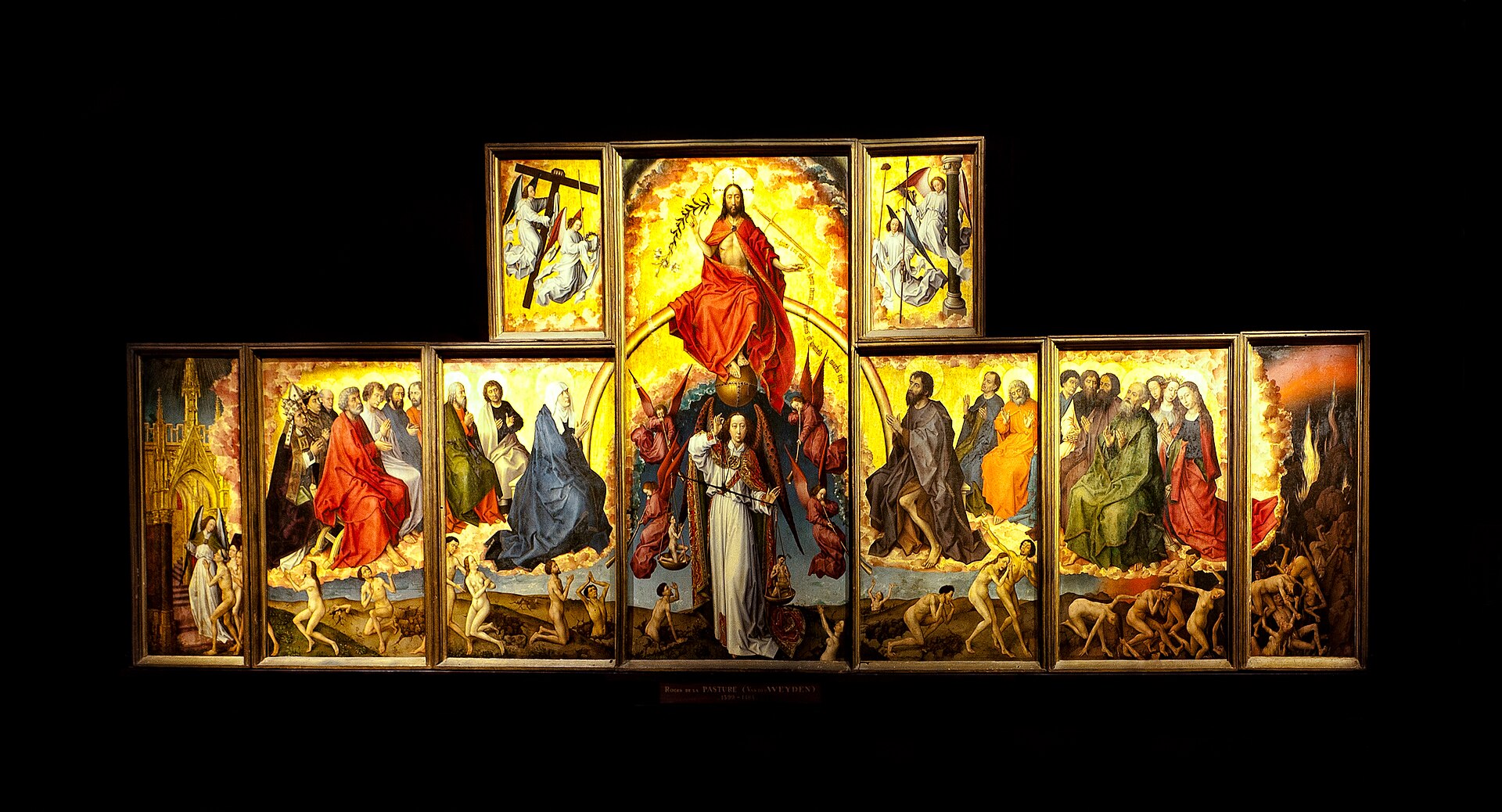
This IS the picture described in this record: Memling's Last Judgment triptych in the National Museum in Gdansk, open, with Heaven on the left, the resurrection and weighing of souls in the centre and Hell on the right. Public domain.
| Artist | Hans Memling |
|---|---|
| Date | c. 1467-1473 |
| Medium | Tempera and oil on oak panel (Baltic oak) |
| Dimensions | Central panel 242 x 180.8 cm, each wing 242 x 90 cm (museum figures, apparently framed); painted surface about 224 x 162 cm centre and 223.5 x 72.5 cm per wing per mp.pl |
| Where it is now | National Museum in Gdansk (Muzeum Narodowe w Gdansku), Department of Historical Artlast confirmed |
| Inventory number | MNG/SD/413/M |
| Attribution | DisputedAccepted as Memling's by most scholars since the nineteenth century (Hotho 1843, Passavant 1847 and later Warburg), but the work is unsigned and no document names the painter. Full note |
| Object type | Painting |
| Period | Netherlandish, fifteenth century |
| Cases | Disputed attribution · Seized, looted or confiscated |
| Inscriptions | Fragmentary tombstone in the central panel: a coat of arms, ANNO DOMINI and a date read as CCCLXVII (1467), and the letters IC IAC (read as the end of 'hic iacet'; older writers read them as a signature). Donors' coats of arms on the exterior plinths. |
| Owners on record | 12 links3 documented, 9 disputed |
| Sources | 39 cited |
About this record Last verified · 39 sources cited · Change log
On this page 9 sections
ContentsClose
Hans Memling's Last Judgment is a triptych of tempera and oil on Baltic oak, painted at Bruges for Angelo Tani, a Medici banker, and meant for a chapel near Florence. It never got there. On 27 April 1473 the galley carrying it, loaded with alum, cloth of gold and the goods of Tommaso Portinari, was taken in sight of the English coast by the Danzig privateer Paul Beneke and the picture ended in St Mary's Church in Danzig.
Portinari's own list of losses, drawn up at the Utrecht diet of 1473, values the two altar tables at 100 pounds groat out of a total of 6,540; Portinari's own valuations, recited in a 1496 sentence of the Great Council of Malines, put them at 360 florins. The lawsuit against the Hansa was still being argued at the Hansa diet of 1511, and no document seen contains a demand for the painting by name. Danzig refused Rudolf II and Peter the Great, lost the picture to Napoleon's Louvre in 1807 and to Berlin in 1815 and got it back in 1816 or 1817.
Hidden in Thuringia in 1944, taken to the Hermitage in 1946 and returned to Poland in 1956, it hangs in the National Museum in Gdansk. The attribution has moved from van Eyck to Memling, and since 2015 a team has argued that Rogier van der Weyden began it. The Getty has just reported its condition as excellent and its case as due for replacement.
Provenance
Each link is graded. Documented: a cited source supports it. Disputed: the identification is argued but not established. Unknown: no owner for that span, and the gap is not smoothed into a narrative. The grades in the glossary.
- c. 1466-1473 - April 1473Angelo di Jacopo Tani, Florentine banker, formerly manager of the Medici bank at Bruges; painted by Hans Memling's workshop at Brugesdisputed
Tani and his wife Caterina Tanagli are shown with their arms on the exterior, identified by Warburg in 1902. The date and the circumstances of the order are inferred; Szmelter and colleagues say there are no data on the commission, and the 2015 study reads the oak of the central panel as a support made toward the end of 1460. Whether the triptych was meant for the Badia Fiesolana (museum: the family chapel in the church of St Bartholomew; mp.pl: the chapel of St Michael) or for Orsanmichele, as Przybyszewski proposed, is open. The 2015 paper proposes Rogier van der Weyden as the originator of the design.567111439
- April 1473 - 27 April 1473Shipped with the cargo of Tommaso Portinari, Medici manager at Bruges, on a Burgundian-flag galley (St Thomas or San Matteo)disputed
The galley was fitted out in Zeeland with the arms of Charles the Bold and chartered by Portinari and associates. Portinari's list of losses, handed in at Utrecht in July 1473, includes 'both the altar tables' at 100 pounds groat, and the editor of the Hanserecesse identifies one of the two with the Memling triptych; the 1496 recital values 'two altar tables' at 360 florins. That the triptych was aboard rests on an editor's identification of two undescribed altar tables in the claimant's lists (Schaefer 1888, Ropp 1892) and on Danzig tradition; Przybyszewski says Tani used the sailing to send his triptych with Medici and Portinari goods, without giving a source. The galley and her cargo are documented; the triptych's presence is not.125
- 27 April 1473 - 1473Paul Beneke, captain of the carvel Peter von Danzig, and its three Danzig owners (names given as Sidinghusen, Balandt or Valandt and Niederhof or Niederhoff)disputed
Taken in sight of the English coast, before the truce with England. The mercenaries took the prize to the Elbe; Hamburg gave only a conditional escort; the owners settled the prize at Stade. Hamburg and Luebeck forbade any dealing with the ship. The identification of the three owners by name is not seen in a primary text. The capture of the galley is documented; that the triptych passed to Beneke's owners rests on the same editorial identification and on Danzig tradition. The capture of the galley is documented; that the triptych passed to Beneke's owners rests on the same editorial identification and on Danzig tradition. The capture of the galley is documented; that the triptych passed to Beneke's owners rests on the same editorial identification and on Danzig tradition. The capture of the galley is documented; that the triptych passed to Beneke's owners rests on the same editorial identification and on Danzig tradition. The capture of the galley is documented; that the triptych passed to Beneke's owners rests on the same editorial identification and on Danzig tradition.147152937
- 1473 - 1807Brotherhood of St George, Danzig, and the Basilica of St Mary (Marienkirche), Danzigdisputed
Reported by the museum, with no primary document seen: the museum says the three owners, members of the Brotherhood of St George, gave the triptych to the church, where it hung on a pillar by the chapel of St George as the brotherhood's private property. The date of the gift is not given. Demands for its return from Charles the Bold, Portinari, the Four Members of Flanders and, by repute, Pope Sixtus IV did not succeed; no document seen contains a demand for the painting by name.17817
- 1473 - 1511Claim of Tommaso Portinari against the Hansa merchantsdocumented
Great Council of Malines sentence of 5 August 1496; Bruges took over the German merchants' liability for the condemned sum, reported as about 52,000 gulden not counting damages and interest, as recorded at the Luebeck diet of 1511. De Roover notes that Tani is not mentioned in the lawsuit documents.2311
- Before 1635 - 1717Offers of Emperor Rudolf II (40,000 thalers, per Ogier in 1635) and Tsar Peter I (1717)disputed
Reported by the museum from Ogier's account of 1635 and later records, not from a document seen. Reported by the museum from Ogier's account of 1635 and later records, not from a document seen. Reported by the museum from Ogier's account of 1635 and later records, not from a document seen. Reported by the museum from Ogier's account of 1635 and later records, not from a document seen. Reported by the museum from Ogier's account of 1635 and later records, not from a document seen. The Danzig council refused both. No auction sale of the triptych has ever been recorded. The offer of 50,000 thalers attributed to the elector of Brandenburg appears only in a popular account.7817
- 1807 - 1815Musee Napoleon (Louvre), Paris, inventory no. 563, as Jan van Eyckdocumented
The French commandant asked the church wardens to hand it over on 3 June 1807 and they did (German Wikipedia); the museum says Denon came to seize the best works in the conquered cities.7815
- 1815 - December 1816Held in Berlin on the authority of the Prussian statedocumented
Per the museum, the first work taken out of the Louvre. Schadow and Berlin artists argued for keeping it; the Danzig council and preachers refused every substitute.7815
- 17 December 1816 - 1942Basilica of St Mary, Danzigdisputed
The date of return varies: 17 December 1816 arrival and 18 January 1817 re-installation (German Wikipedia), January 1817 (museum), 1816 (Memling Research Center, Gerson). Hung in the chapel of St Dorothy from 1817 and moved to the chapel of St Reinhold after 1934. Gluszko alone says it was restored in Danzig in 1718, cleaned in Berlin before its return and restored again there in 1851.7810151617
- 1942 - 1946Danzig city museum under Willi Drost (evacuation), Meiserwalde (Mierzeszyn) church, then a village church in the Rhon, Thuringiadisputed
Per the museum's history page, hidden in the Evangelical church at Meiserwalde in 1942 and taken to Thuringia in September 1944; mp.pl says German troops took it into the Reich in 1945. The steps rest on the museum's summary page, not on a document.78
- 1946 - 1956Soviet authorities; State Hermitage Museum, Leningraddisputed
The museum says the Red Army found it in 1946 and sent it to the Hermitage; mp.pl dates the Soviet capture to 1945; Przybyszewski (1979) mentions no Hermitage stay and says it was placed in the Pomeranian Museum in 1946. The Memling Research Center and the PAP reports call it seized or exhibited at the Hermitage. The legal basis is not stated in any source seen.781018
- 1956 - presentPomeranian Museum, Gdansk, from 1972 the National Museum in Gdanskdisputed
Returned from the USSR in 1956 and shown at the National Museum in Warsaw; the museum says Warsaw research and restoration came first. Gluszko says it returned to Gdansk on 22 September 1956; Niezla Sztuka and Pomorskie.travel say 1958. Inventory MNG/SD/413/M. The Memling Research Center describes ownership as disputed between the state and the Church; no ruling was found.7810172636
Technical evidence
| Attribution note | Accepted as Memling's by most scholars since the nineteenth century (Hotho 1843, Passavant 1847 and later Warburg), but the work is unsigned and no document names the painter. K. B. Mac Farlane doubted it in 1971, and since 2014 Szmelter, Walter and Rousseliere have argued from dendrochronology, infrared reflectography and XRF/XRD that Rogier van der Weyden made the design and underdrawing and Memling finished the painting. No independent test of that proposal was found. The Memling Research Center says the debate over attribution continues. |
|---|---|
| Support | Oak, in the 2015 study identified as Baltic oak. The central panel is made of six vertical boards, 180 cm wide in total. Dendrochronology by the Institute for the Study, Conservation and Restoration of Cultural Heritage, Nicolaus Copernicus University, Torun, carried out in 2003 after the panel was removed from its frame; Szmelter et al. combine it with Rogier's death date to place the making of the support toward the end of 1460 and print no fell dates. Baltic oak reached Bruges by several routes, one of them, according to Haneca and colleagues, probably through Gdansk.622 |
| Medium | Tempera and oil on oak panel; the museum, the Getty and the 2015 paper all give tempera and oil paints. Gold appears in the highlights.6914 |
| Dimensions | Central panel 242 x 180.8 cm (Szmelter et al.; 242 x 180 per German Wikipedia and mp.pl) and wings 242 x 90 cm each (apparently framed). Painted surfaces given by mp.pl as about 224 x 162 cm for the centre and 223.5 x 72.5 cm per wing, in frames 242 x 180 and 242 x 90 cm; Italian Wikipedia gives 221 x 161 cm and 223.5 x 72.5 cm. Wikipedia's open size is 223.5 x 306 cm.6143132 |
| Structure | Three panels, wings painted on both faces, the interior a single Last Judgment spread over the three; the exterior with two grisaille statues and the donors with their arms. The Gdansk count is 62 figures on the central panel, 24 saved on the left wing and 32 damned on the right.514 |
| Pigments | MOLAB XRD and XRF, more than 350 point analyses in 2012 and 2013: vermilion (cinnabar), red earth, lead white (hydrocerussite and cerussite), lead-tin yellow type I, lazurite (ultramarine), azurite and gold; madder lake for St Peter's red mantle; amorphous copper green; carbon black and earths.6 |
| Ultramarine used sparingly | Lazurite is found only in the Virgin's blue mantle (mixed with azurite) and the blue gems of St Michael. All other blues are azurite, including the reflection of the mantle in the globe. The authors tie this to the cost of lapis; potassium and diopside in the lazurite are said to fit Afghan lapis, an inference not proved.6 |
| Ground | Calcite and two types of lead white; no gypsum, unlike the ground of Memling's late panel of singing and music-making angels in Antwerp.6 |
| Underdrawing | Scanning multispectral infrared reflectography (INO Florence, MOLAB 2013) and earlier infrared images (Warsaw 2010) show a fine fluid brush underdrawing, modelling by hatching and chalk corrections. The first composition showed angels with the Arma Christi where the apostles now sit. The donor portraits on the exterior show no underdrawing.618 |
| Tin insert | The head of the man in the pan of St Michael's scales is painted on a separate sheet of tin and was glued into the panel. XRF shows tin; XRD shows romarchite and cassiterite, corrosion products of metallic tin. The authors compare Rogier van der Weyden's Seven Sacraments in Antwerp, where eleven portraits are on tin. They consider the head a portrait of Tommaso Portinari.6 |
| Inscription | A fragmentary tombstone in the central panel carries a coat of arms, the words ANNO DOMINI and a date read as CCCLXVII, understood as 1467, with a few letters partly hidden, IC IAC, read as the end of 'hic iacet'. Older writers took these letters for a signature.5 |
| Condition | The Getty reports a condition 'amazingly good' at the earlier study and a 2025 re-examination with a 3D microscope scanner (90x over the whole surface, up to 2,500x in chosen areas) that found minimal change; panels well joined, glue bonds secure, no active lifting. The display case, over twenty years old, no longer seals properly and is to be replaced.9 |
| Inventory numbers | MNG/SD/413/M (Getty); Gerson Digital gives SD/413/M - M/568/MPG. In the Louvre 1807-1815 it was number 563, as Jan van Eyck.9167 |
Images
The record in full
Chapter 1Three oak panels, one revolving judgment
The 2015 technical paper by Szmelter and her colleagues gives the central panel as 242 by 180.8 centimetres and each wing as 242 by 90, figures that appear to include the frames; German Wikipedia and...
The 2015 technical paper by Szmelter and her colleagues gives the central panel as 242 by 180.8 centimetres and each wing as 242 by 90, figures that appear to include the frames; German Wikipedia and mp.pl give 242 by 180 for the centre. The Polish medical portal mp.pl, drawing on museum material, gives the painted surfaces as about 224 by 162 centimetres for the centre and 223.5 by 72.5 for each wing, with the 242 by 180 and 242 by 90 figures as the framed sizes. Wikipedia gives 223.5 by 306 centimetres for the open triptych. The medium is tempera and oil on oak.
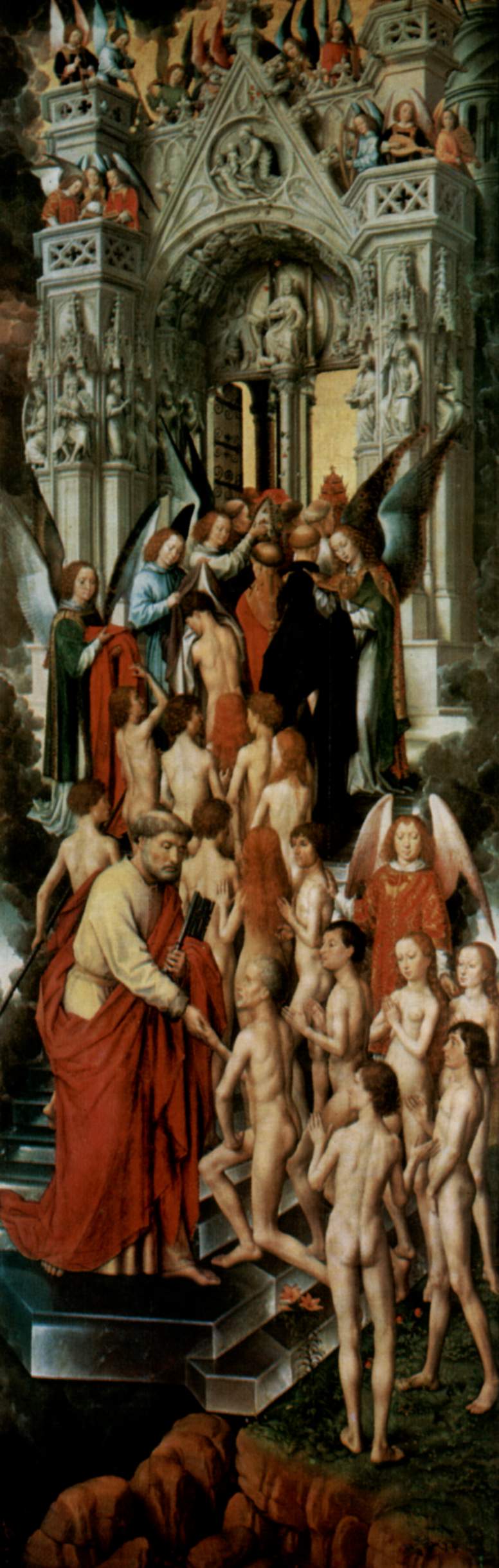
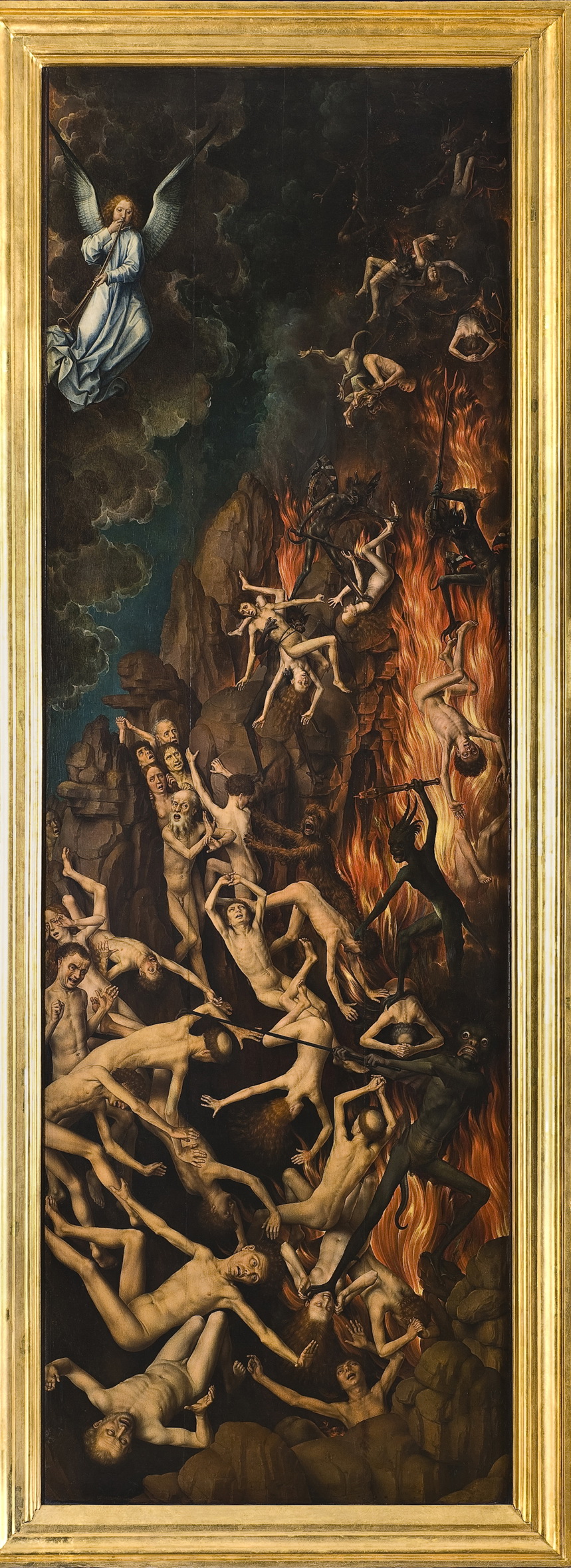
Opened, the work shows Christ seated on a rainbow with his feet on a globe, the Virgin and John the Baptist kneeling before him, the twelve apostles in a half circle behind and four angels carrying the instruments of the Passion. Four more angels blow trumpets over a plain of open graves. Below Christ stands the archangel Michael in a gold-and-red armour that mirrors the whole valley, holding a pair of scales. The left wing is Heaven: the saved climb crystal stairs past St Peter to a Gothic portal. The right wing is Hell: a cavern of fire, Beelzebub on its rim and falling bodies above. The count given by mp.pl and by Przybyszewski is 62 figures on the central panel, 24 saved on the left wing and 32 damned on the right.
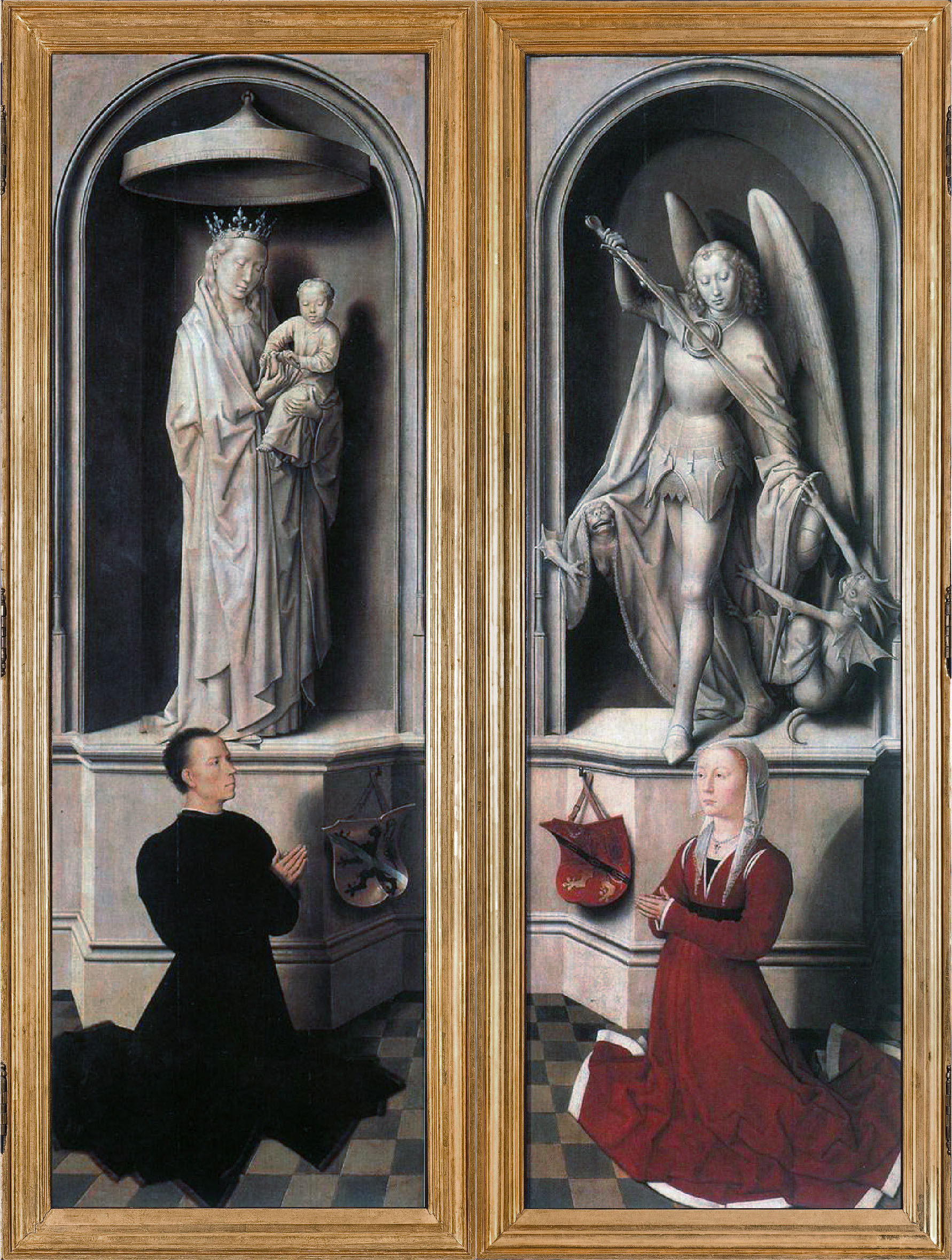
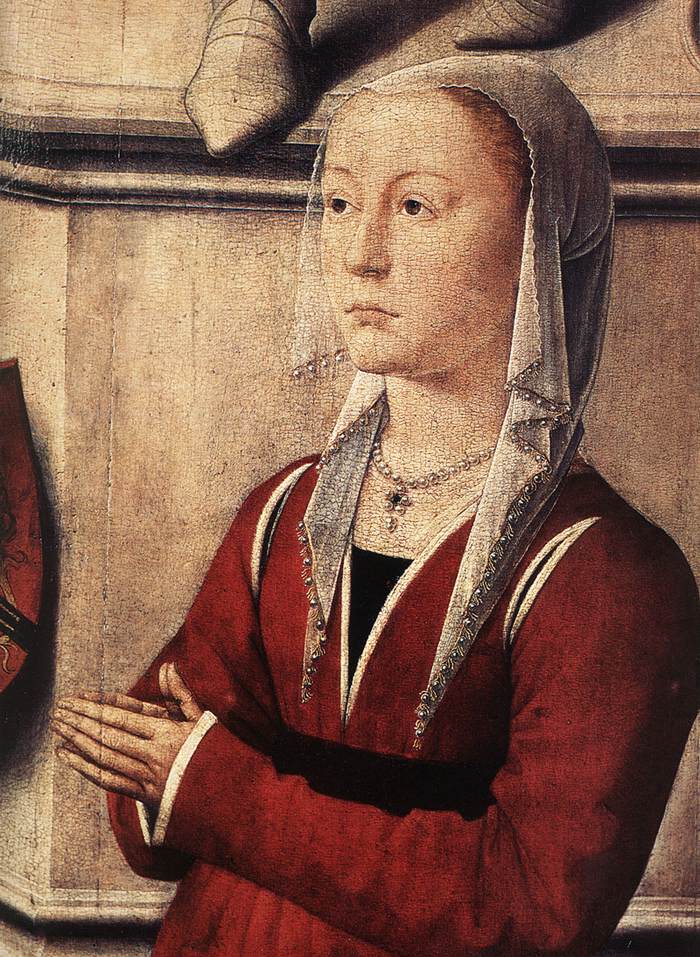
Closed, the wings show two grisaille statues on stone plinths, the Virgin with the Child on the left and Michael striking at a devil with his sword on the right, and below them the kneeling donors: Angelo di Jacopo Tani before the Virgin and his wife Caterina di Francesco Tanagli before Michael, each with a coat of arms hung on the plinth. That exterior is the only part of the picture that shows its patron, and it is how the patron was found.
Chapter 2The commission rests on a coat of arms, not on a contract
No contract, payment or letter for the Last Judgment is known.
No contract, payment or letter for the Last Judgment is known. Szmelter, Walter and Rousseliere state it flatly in 2015: they have no data related to the commission. Przybyszewski, writing in 1979, noted that no archival record names the painter at all, although the robbery of 1473 was discussed across Europe. The Flemish Primitives chronology lists the booksellers' altarpiece made for the illuminator Willem Vrelant, now lost, as the only Memling commission documented in contemporary sources.
What identifies the patron is the heraldry. Aby Warburg named the donors in 1902 from the arms beside them, as Przybyszewski and de Roover's footnotes both record. Tani was a Florentine banker who ran the Bruges branch of the Medici bank. German Wikipedia gives his tenure as 1455 to 1465 and his life as 1415 to 1482; the museum's English text calls him head of the branch. Przybyszewski adds that Tani left Bruges in 1465, married the eighteen-year-old Caterina Tanagli in Florence in 1466 when he was about fifty, drew up the will customary at a marriage in 1467 and returned north.
The date therefore comes from circumstance, and the sources do not agree. The mp.pl text, following museum arguments, lists the chain: the 1466 marriage; the completion in the same year of the Medici church at the Badia Fiesolana, where the managers of the bank's four branches each endowed a chapel and Tani's, by mp.pl's account, was dedicated to St Michael; Tani's mission in 1467 to reorganise the London branch, which took him to London by January 1468; his will of 1467; and a fragmentary inscription on a tombstone in the central panel that scholars read as the Roman numerals for 1467. The altarpiece was shipped in April 1473, so it was finished by then, and two to four years of work would put its start at about 1467. The Flemish Primitives site dates the order to about 1467; the Inside the Vatican report of the 2014 Rome exhibition says it was ordered for the 1466 wedding; the Getty gives 1467 to 1473; the museum gives 1467 to 1473 and Wikipedia 1467 to 1471. The oak gives an early limit: the dendrochronology discussed below is read by its authors as placing the making of the support toward the end of 1460.
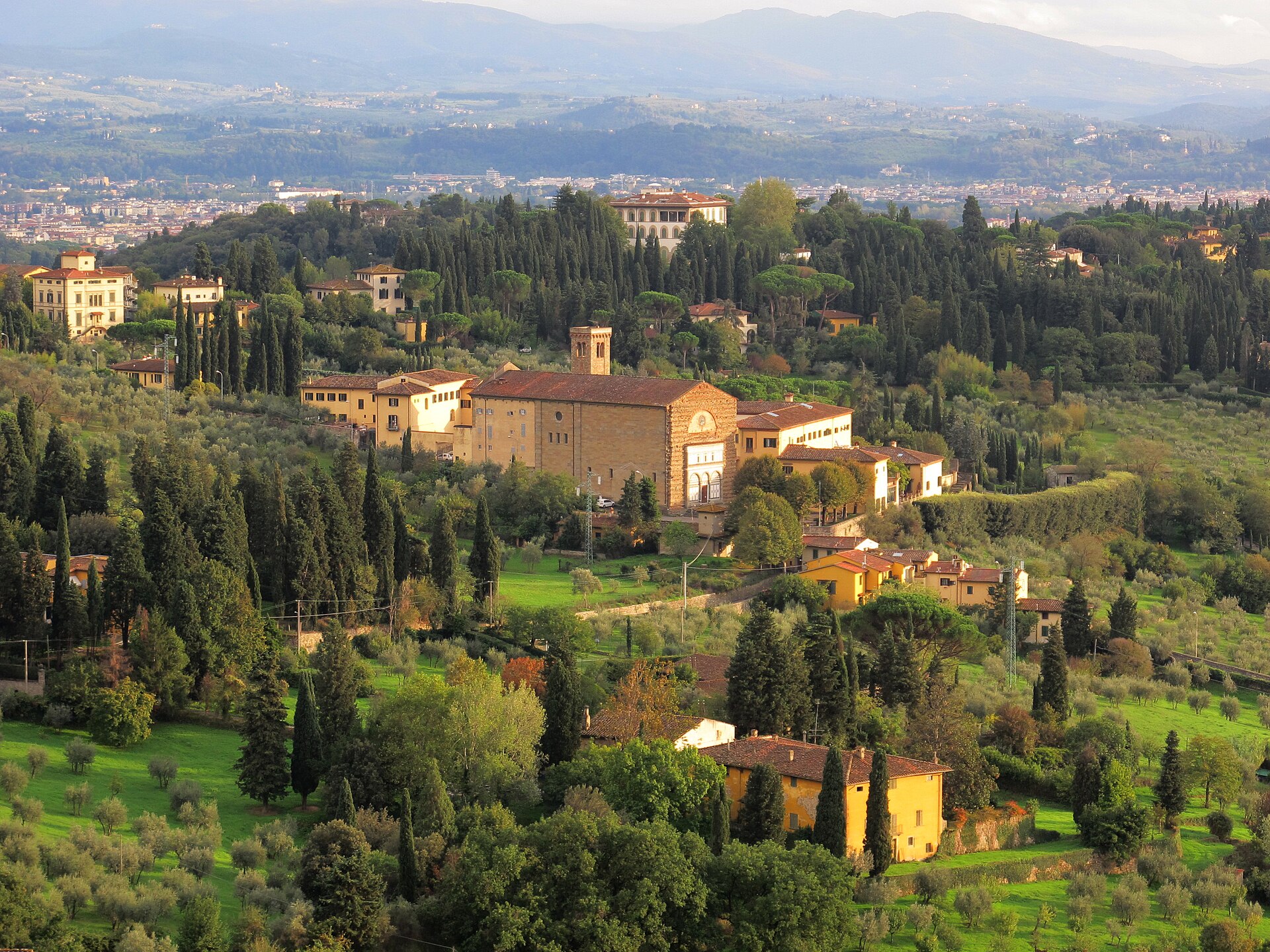
Przybyszewski also floated a different destination. He read the two exterior saints as patrons of Orsanmichele in Florence and suggested the triptych was meant for a pillar near the Orcagna tabernacle there. Every other source consulted names the Badia Fiesolana, the monastery near Florence that Cosimo de' Medici had rebuilt in the years 1456 to 1467 according to English Wikipedia; mp.pl, Inside the Vatican and German Wikipedia say the chapel of St Michael there, while the museum's own history page says the family chapel in the church of St Bartholomew in the Badia. His reading is recorded here as a proposal that did not take hold.
Chapter 3A judgment for merchants: what the subject was for
Everything said about meaning in this section is graded.
Everything said about meaning in this section is graded. What is documented is the setting: a private chapel, a banker with a will freshly made, a long and dangerous journey ahead. What is argued is the reason for the subject. Przybyszewski suggested that Last Judgments were usually hung on courtroom walls to call bankers and merchants to honesty, and that a banker would have chosen the theme for that reason. The Gdansk curator Alicja Andrzejewska, interviewed by Weranda, says the work was ordered to secure eternal life and belongs to the individual piety of the devotio moderna. Another Polish summary, on the Niezla Sztuka site, calls it probably a votive offering tied to Tani's will before his journey, and adds the guess that it was also meant to ease his rivalry with Tommaso Portinari, who took his place at the bank. That last point has no document behind it.
A 2025 seminar in Rome, reported by the Polish Academy of Sciences, included a paper by Melis Avkiran on pious merchants in the triptych and on the idea of Christ as a merchant of wisdom, set against Italian merchant imagery such as Benozzo Gozzoli's frescoes. Only the abstract was seen and no printed argument, so it is listed as work in progress, not as a finding.
The programme itself is the standard late medieval one: the Second Coming of Matthew 24 and 25, the twelve thrones of Matthew 19:28, the Deesis of Mary and John interceding, the trumpets of the resurrection, the Arma Christi, the book of life, the heavenly city of Revelation. Przybyszewski's long iconographic reading follows each element to scripture and the liturgy. A hidden or private programme has not been demonstrated in any source seen, and that absence is itself the finding. One speculative proposal is recorded for completeness: the Warsaw scholar Witold Krassowski suggested, in a paper printed in 1976, that Memling built the composition on a stereographic projection of the celestial sphere for the 53rd parallel, which he says runs through Ghent and Bruges, and Przybyszewski notes that an X-ray photograph shows a curved line in the area of the heavenly gate that resembles the twilight line on an astrolabe. Przybyszewski himself concludes that it may simply be a compositional line. The hypothesis rests on resemblance and is not accepted here.
Chapter 4Michael's scales: the centre of the central panel
Przybyszewski describes the composition as an ellipse turning clockwise around the globe at Christ's feet, with Michael and Christ forming the vertical axis and the hinges of the wings dividing the...
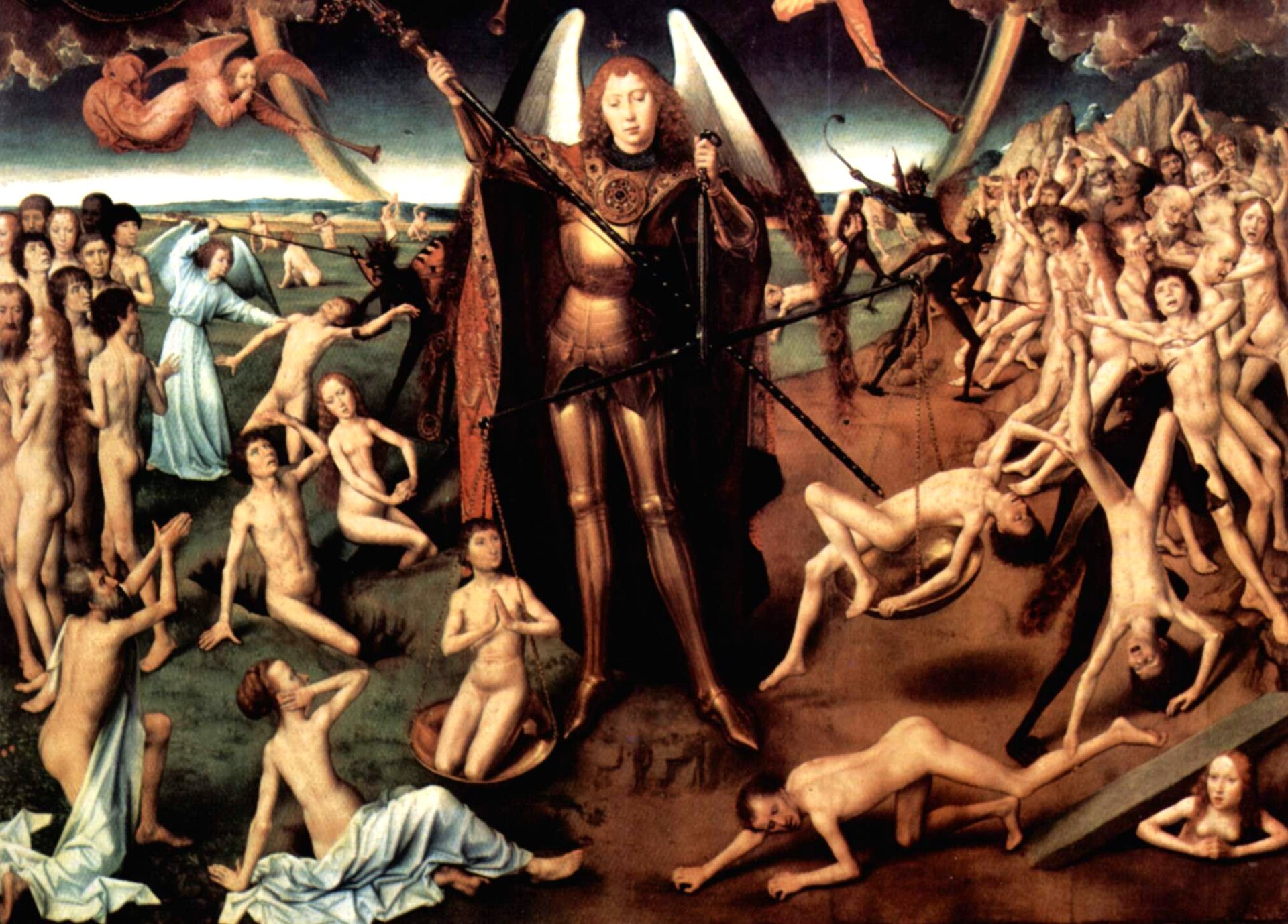
Przybyszewski describes the composition as an ellipse turning clockwise around the globe at Christ's feet, with Michael and Christ forming the vertical axis and the hinges of the wings dividing the field into four near-equal parts. Figures at the left of the plain rise towards the saved and those at the right are driven down, like a wheel turning clockwise. Michael is larger than Christ, which Przybyszewski reads as the servant's scale: the archangel executes the judge's sentence. On the globe, as in Michael's polished breastplate, the whole valley is reflected, once as God sees it and once as the viewer would, a device Przybyszewski traces back to Jan van Eyck.
Christ's gestures are the old ones: the right hand lifted in blessing, the left lowered towards the damned. A lily grows from one side of his head and a sword from the other, signs of justice and mercy, an arrangement Przybyszewski says Memling took from Rogier van der Weyden's Last Judgment at Beaune. The four angels with the Passion instruments are, Przybyszewski argues, taken from an engraving by the Master E.S., and he stresses that medieval theology did not mean them to terrify the damned. The twelve apostles carry no attributes. The Gdansk museum states that the face of one apostle is a portrait of Charles the Bold, an identification asserted by the museum and not seen argued in a catalogue.
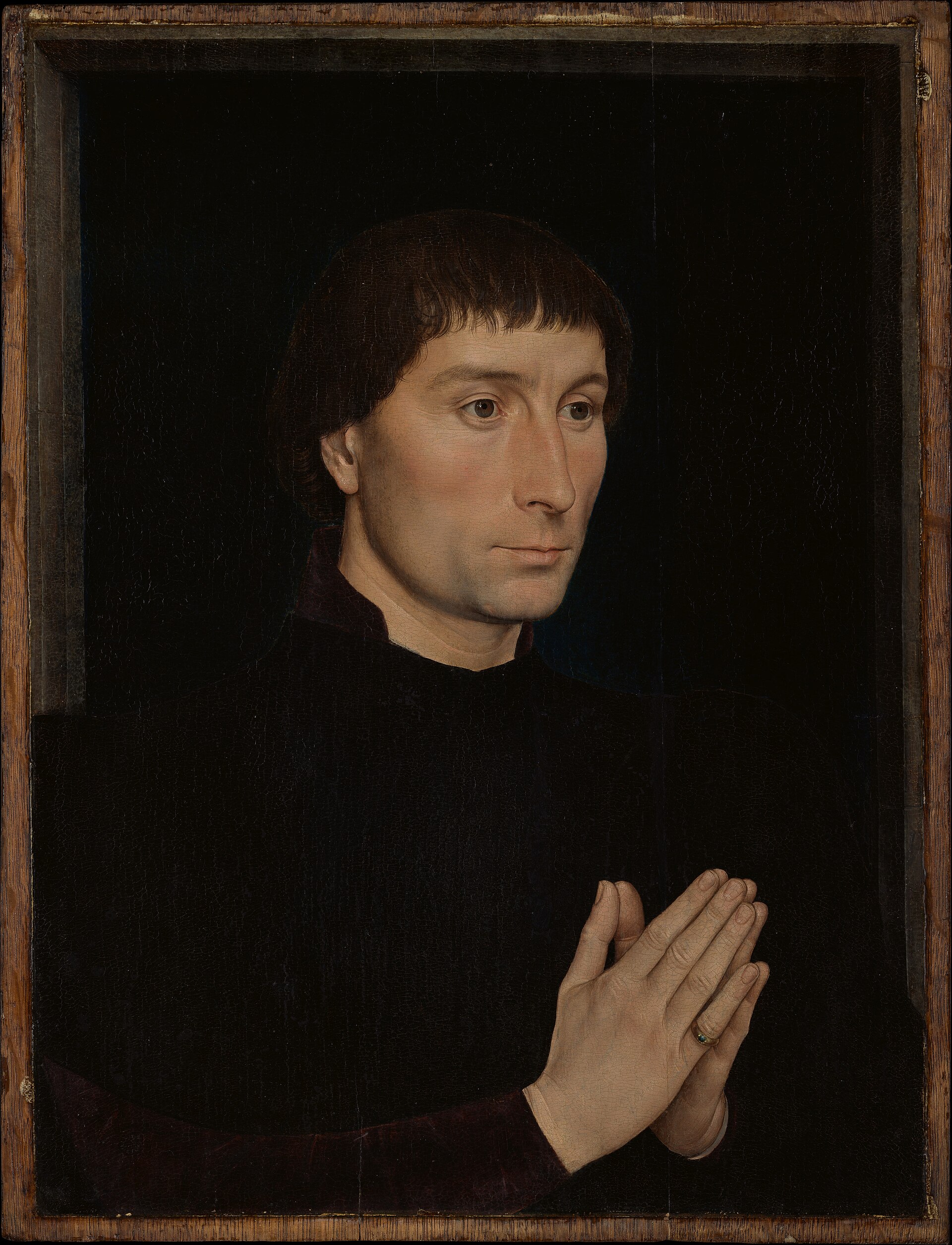
The scales are the part most discussed. In the pan that has sunk to the ground a young man kneels with his hands joined; in the raised pan a figure writhes while a small devil with a hawk's beak lifts him by the hair. Przybyszewski reads the kneeling man as saved and, with the tradition he follows, calls him Portinari. The English Wikipedia article instead describes the portrait as a sinner. Szmelter and her colleagues report that the head of this figure was painted first on a separate sheet of tin and then glued into the panel, and that they consider it a portrait of Portinari, who in their account replaced Tani at the head of the Bruges bank in 1471; Przybyszewski gives 1465. No document seen confirms the identification, and the sources do not say what it rests on; Memling's separate portrait of Portinari is now in New York. The same paper, in two places, calls the figure first the saved and then the Redeemer, so its wording on this figure is inconsistent.
Przybyszewski and mp.pl count 62 persons on the central panel, among them 13 risen, 13 saved, 29 damned, two angels and five devils. Only eight graves are visible. All the risen are adults. The fragmentary tombstone on which the woman in the foreground sits carries a coat of arms and the letters ANNO DOMINI and a date read as CCCLXVII, with a few more letters partly hidden by her hand. For centuries the letters IC IAC were taken as the painter's signature, 'Eyck Jacob'; Przybyszewski follows Bialostocki in reading them as the end of the formula hic iacet.
Chapter 5Heaven as a Gothic gate, Hell sorted by sin and the pictures behind both
On the left wing the saved climb crystal stairs, are clothed by angels and received by St Peter.
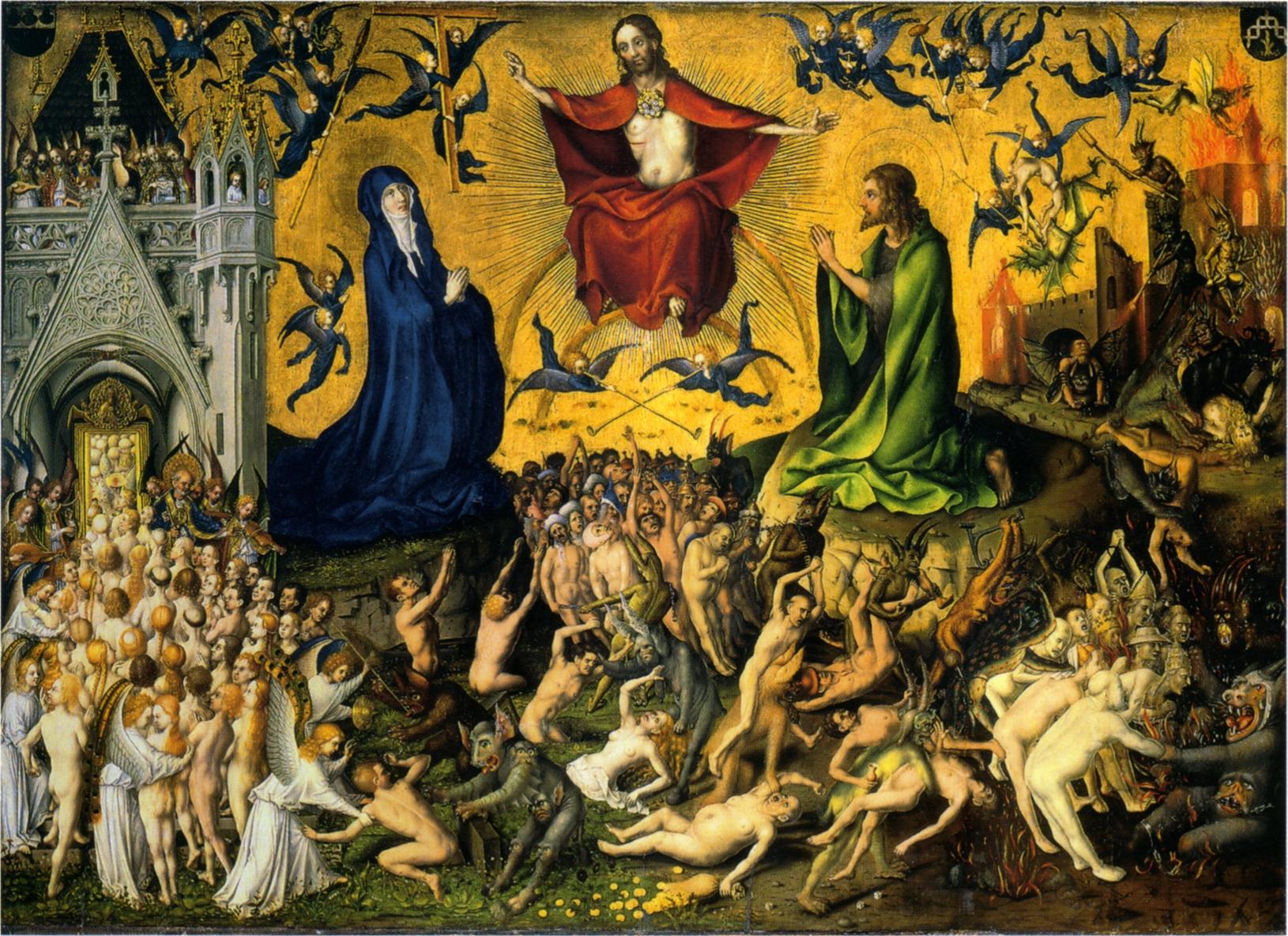
On the left wing the saved climb crystal stairs, are clothed by angels and received by St Peter. On a platform before the gate they receive the signs of their earthly callings: a pope's tiara shows in the gateway, a cardinal in a red hat walks behind two clerics, one angel fits a mitre on a bishop and another drapes a theologian in a professor's gown. Przybyszewski reads this as an acceptance of tasks and offices in the world. The gate itself is a Gothic portal with a Maiestas Domini in the tympanon, the creation of Eve in the gable, rows of crowned elders in the niches and angels singing and playing on the galleries. Przybyszewski records that Stefan Lochner had set the heavenly gate as a Gothic portal in his Cologne Last Judgment of about 1435, and that the sky behind Memling's gate is empty, the glory having been carried out in front of the door.
The right wing is a dark crater. Przybyszewski counts seven groups of the damned and ties them to the seven capital sins: the proud and the lustful whirled down by devils in the upper storm, then the slothful in the rocky defile, then the angry and envious, and at the bottom the gluttons and the avaricious. Beelzebub stands on the edge with his foot on a sloth. Lucifer glides like a bat under the top frame. A fourth trumpeting angel is placed high on the wing, away from his three fellows at Christ's feet; Przybyszewski says Memling lifted him to show that the cavern had been raised artificially to fit the triptych form. He also notes that 24 saved against 32 damned might suggest an artist who thought more would be lost than saved, which is his inference and not a documented belief of Memling's.
Rogier van der Weyden's Last Judgment at the Hotel-Dieu in Beaune was commissioned in 1443 by Nicolas Rolin, chancellor of Burgundy, for the hospice he founded, and was ready by 1451. It is a polyptych of fifteen paintings on nine panels with the dead rising across a continuous lower register. Przybyszewski, writing from the Gdansk work, says Memling's central group of Christ and Michael is so close to Rogier's that he probably used a drawing left in Rogier's Brussels workshop. Memling then abandoned the horizontal bands that even his master could not leave and made one turning field. The Niezla Sztuka summary adds that in Memling the pan sinks for the person with more good deeds, whereas in Rogier's picture it is the sins that weigh the pan down.
Szmelter's team compared infrared reflectograms of the Gdansk central panel and of Beaune and found what they call remarkable similarities in the design and the underlayers. Lochner's Cologne picture matters for the heavenly city. Dieric Bouts was painting a Last Judgment for the town hall at Leuven in 1468 to 1470, which survives only as two wings in Lille and a fragment of Christ in Stockholm; it ran parallel to Memling's work and was not a source for it.
Chapter 6Who painted it: Jacob, van Eyck, Memling or Rogier and Memling
The attribution has moved more than any other fact about the picture.
The attribution has moved more than any other fact about the picture. A supplement to the Danzig chronicle, written in the second half of the sixteenth century according to Przybyszewski, says the triptych was signed with the name Jacob and dated 1467. From the second half of the seventeenth century it was given to Van Eyck, and when Dominique Vivant Denon's museum hung it in the Louvre between 1807 and 1815 it was inventory number 563 and labelled Jan van Eyck's. It was also attributed to Rogier van der Weyden, Hugo van der Goes, Albert van Ouwater and Michael Wolgemut at various times.
Heinrich Gustav Hotho named Memling in 1843 in his history of German and Netherlandish painting, according to Przybyszewski, Szmelter and Italian Wikipedia; German Wikipedia credits Johann David Passavant in 1847 with the first convincing arguments. The Memling Research Center says Warburg published a thesis ascribing the work to Memling in the late nineteenth century, while Warburg's study is dated 1902 in the sources seen. James Weale published on the Danzig Last Judgment in The Burlington Magazine in 1909 to 1910. In 1971 K. B. Mac Farlane doubted Memling's authorship and linked the work generally with Rogier's school, leaving it anonymous. Bialostocki's infrared study of 1970 argued that the long, sharp drawn lines in the folds match Memling's own drawing in the Mystic Marriage of St Catherine.
The newest proposal is the sharpest. Between 2010 and 2013 the Warsaw Academy of Fine Arts conservators and the European MOLAB team examined the panel, and in 2014 and 2015 Szmelter and colleagues published the conclusion that the design, drawing and some underpainting are by Rogier van der Weyden and that Memling completed the work. The argument has three legs. Szmelter and colleagues, combining the 2003 Torun tree-ring work with the date of Rogier's death, place the making of the support toward the end of 1460, four years before June 1464; the paper prints no fell dates. The infrared images show a first composition with angels carrying the Arma Christi where the apostles now sit, and a fine brush underdrawing whose lines they say are consistent in a single hand. And Memling is first recorded in Bruges on 30 January 1465. They propose that Rogier's sudden death left the work unfinished in his Brussels workshop and that Memling took it on. Szmelter told PAP at the time that this did not question Memling as principal author of the painted work. Their paper itself says the donor portraits on the exterior were painted without any underdrawing, alla prima.
This is one team's reading of its own data, published by that team, and the paper admits that it was unclear whether draughtsman and painter were the same. No independent test of it was found. A 2025 Rome seminar heard a separate paper by Gianluca Poldi on Memling's underdrawing, with the Gdansk triptych one of the objects, and its conclusions were not seen. The record therefore keeps Memling as the accepted attribution and registers the Rogier proposal as argued.
Chapter 7Cost shaped the palette, and the wood was Baltic oak
The 2012 and 2013 MOLAB campaigns made more than 350 point analyses on the wings and the central panel.
The 2012 and 2013 MOLAB campaigns made more than 350 point analyses on the wings and the central panel. The pigments identified by X-ray diffraction were vermilion (cinnabar), red earth, lead white, lead-tin yellow of type I, ultramarine from lapis lazuli (lazurite), azurite and gold, with madder lake for the red mantle of St Peter, an amorphous copper green and some carbon black and earths. The ground contains calcite and two types of lead white; the ground of Memling's later Antwerp panel of music-making angels also contains gypsum, which this one does not.
The blues are the telling evidence. Lazurite, the lapis blue, appears only in the Virgin's blue mantle and in the blue gems of Michael's cope. Every other blue is azurite, and the Virgin's mantle itself is a mixture of lazurite and azurite. Szmelter's team ties this to the price of ultramarine and to what the painter could afford to use. Even the reflection of the Virgin's mantle in the globe under Christ's feet is azurite only, which they read as an economy that suited the lesser value of a reflection. The lapis contains a notable amount of potassium and a little diopside, which they say fits the Afghan source regarded as the finest; the azurite carries a trace of barium whose origin is unknown. This is an interpretation of trace elements, not a proven provenance.
The support is oak, six vertical boards for the centre with a total width of 180 centimetres, and the 2015 paper's abstract calls it Baltic oak without giving the evidence in its text. Haneca and colleagues say that merchants of the Hanseatic League organised a large timber trade from the Baltic and that trees from the forests along the Vistula seem to have been exported through Gdansk, first to Bruges and later to Antwerp. Whether these boards took that route is not established, since the paper says only Baltic oak and Baltic timber also reached the west by other ports.
Chapter 8The galley, the capture and the three owners at Stade
The Anglo-Hanseatic war of 1470 to 1474 brought Hanseatic privateers into the Channel.
The Anglo-Hanseatic war of 1470 to 1474 brought Hanseatic privateers into the Channel. The three-masted ship Peter von Danzig, an ex-Atlantic vessel that reached Danzig in 1462 and was converted to a warship in 1469 after the Hansa declared war on England, was commanded by Paul Beneke from the summer of 1472. Koppmann's biography in the Allgemeine Deutsche Biographie says the ship had by then been sold to private owners and so was a privateer rather than a city warship.
The best documentary edition is the Hanserecesse volume of 1892. Its editor, Goswin von der Ropp, writes that Beneke sailed from the Elbe at the start of April 1473 in company with Hamburg warships and on 27 April took, in sight of the English coast, the richly laden Florentine vessel under the Burgundian flag. This was before the truce with England began. The mercenaries aboard, rightly fearing that Danzig would not endorse an attack on the Burgundian flag, made Beneke take the booty to the Elbe. Hamburg would offer only a conditional escort, and at Stade the crews settled the prize with the three Danzig owners of the carvel. Ropp calls the vessel the galley of the Florentine Thomas Portinari 'of the Medici bank'. Koppmann calls it the St Thomas and says it was bound for London; the museum and the Memling Research Center call it the San Matteo, St Matthew, and say Italy, and Przybyszewski also says San Matteo and goods for Florence, though he has it steering for the English coast; the St Mary's Basilica's own page gives St Matthew or St Andrew and Italian Wikipedia gives San Tommaso. German Wikipedia puts the departure on 14 April and the capture near the English coast soon after. Przybyszewski adds that Tani used the sailing of the Italian galleon with the goods of the Medici and Portinari to send his triptych with them.
The injured side acted at once. Portinari went to the court of Charles the Bold, whose councillor he was. Ropp notes that Portinari obtained an arrest order against the German merchant at Bruges but at first kept it secret, and the Great Council of Malines later recited that the duke wrote on 30 May 1473 from Maastricht to his officers in Bruges to demand restitution from the German merchants and to arrest their goods. Lubeck and Hamburg tried in vain to make the mercenaries give back what had been taken from the duke's subjects and finally forbade any dealing with the ship or any purchase of goods taken from her. The Gdansk museum adds that the triptych itself was handed to three Gdansk patricians, owners of Beneke's ship and members of the Brotherhood of St George, who gave it to St Mary's Church, where it hung on a pillar by the chapel of St George as the brotherhood's private property. English Wikipedia names the three as Sidinghusen, Balandt and Niederhof; German Wikipedia as Johann Sidinghusen, Tideman Valandt and Reinhold Niederhoff. The spellings vary and the names are not seen in a primary text. The museum gives no date for the gift.
Chapter 9The cargo and what the pictures were worth
The most detailed list of what was lost is in the Hanserecesse.
The most detailed list of what was lost is in the Hanserecesse. At the Utrecht diet in July 1473 Portinari's agent Cristoffels de Spiny handed over a specification of the losses of Thomas Portinari and his associates, a Middle Dutch document found in the Danzig city archive. Its twenty items sum to 6,540 pounds groat, and the sum agrees with the printed total. The largest are the freight on the alum, 4,000 ducats, which the list reckons at 1,000 pounds; 800 pounds for the galley and her artillery; 750 pounds for two chests and a pack of silk and gold cloths; and 600 pounds for three gold cloths and some bales of spices. Item 17 reads 'of both the altar tables, 100 pounds'. A second group of costs and interest, including 2,000 pounds for the freight of goods loaded in England for Pisa, brings a further 4,200. Spini added that the sums do not include the many other parcels belonging to friends of the Hansa, Florentine merchants and others, which he estimated at 35,000 to 40,000 ducats. Ropp's footnote says one of the two is the Memling Last Judgment in the Danzig Marienkirche. Schaefer's note to the 1496 recital, printed four years earlier, calls it Memling's famous Last Judgment, and Ropp thinks Hirsch had overlooked item 17 when he treated the matter in 1855.
Koppmann's 1875 biography gives a different and larger figure, a cargo valued at 60,000 pounds Flemish, and the Gdansk popular account by Gluszko repeats 60,000 pounds groat as Portinari's figure. The 1892 list does not reach it. The 1511 diet record says the German merchant at Bruges had been condemned to pay about 52,000 gulden, not counting damages and interest.
A second inventory comes from the end of the lawsuit. The Great Council of Malines, in its sentence of 5 August 1496 as printed in the Hanserecesse, recited the cargo. Alum was 1,250 charges, each then worth more than four pounds groat, strong money, about 30,000 gold florins in all. Cloth of gold was 2,800 florins for the first three pieces and 3,360 for a further group. A bale of Armentieres cloth of 24 pieces was 870 florins. The galley with her gear and artillery was 8,000 florins, and the master's cash 1,660. Of the altar pieces the recital says 'two altar tables, very beautiful and rich, in value 360 florins of gold', with a footnote from the editor identifying one of the two as Memling's Last Judgment. Florence Edler de Roover's 1945 article in the Business History Review cites this page for a figure of 870 florins for the altar tables. The printed page gives 870 for the Armentieres cloth and 360 for the tables, and this record follows the page. The identification of the Memling with the 'altar tables' is the work of the two editors; the documents do not name painter or subject.
For scale, Munro's wage series for Antwerp master masons, in Brabant money, gives 11.25 pence groot a day in 1451 to 1475 (his base figure, a summer-wage rate), with 210 paid days a year as his standard. His note 11 gives the conversion from 1435: one Flemish groot equals one and a half Brabant groots. A mason's day was therefore 7.5 Flemish pence, and 100 pounds groat Flemish, which is 24,000 pence, equals 3,200 mason-days or about fifteen years of a master mason's paid work. On the same method the 6,540 pounds of the first list come to roughly a thousand mason-years. The method uses a single craft in a neighbouring city and the claimant's valuations, and it is only an order of magnitude. Memling himself stood, by the Flemish Primitives chronology, among the richest tenth of the citizens of Bruges when the forced loan for Maximilian was levied in 1480, and Wikipedia says his name appears on a list of the 875 richest.
No price paid to Memling is known, and none of the sources consulted records an auction sale of the triptych. The only recorded prices are offers. According to the French diplomat Charles Ogier, who was in Gdansk in 1635, Emperor Rudolf II wished to buy it for 40,000 thalers, and the city council refused; the museum repeats this. Gluszko's popular account adds a further offer of 50,000 thalers from the elector of Brandenburg, which was not seen elsewhere.
Chapter 10A lawsuit that outlived everyone who started it
The Hanseatic side held that the cities were not responsible.
The Hanseatic side held that the cities were not responsible. At Utrecht the delegates of the cities, the Danzig delegates included, said the taking had been by private Danzig owners, were willing only to write in support of restitution to Danzig and the owners, and asked for protection against a repeated arrest of the German merchants' goods in Flanders in Portinari's favour. Koppmann says the damage done to the English helped bring seriousness to the peace talks, which ended in the Peace of Utrecht of 28 February 1474 and restored the Hansa's privileges. The Burgundian side kept up the pressure through late 1474: Charles the Bold wrote to Danzig that autumn to ask it to hear his councillor Jan Colbrant, and the Four Members of Flanders sent Colbrant to Danzig in December. Ropp's summary of no. 134 records that the Bruges merchants stood under the arrest Portinari had obtained, which the Four Members of Flanders had had suspended only until 24 June 1474. A letter signed Pawel Beneken, written at Danzig on the feast of Simon and Jude 1473, is printed in the same volume.
Popular accounts say Pope Sixtus IV issued a bull against Danzig in 1478 and threatened excommunication, and the Italian Wikipedia article says both Sixtus IV and Lorenzo de' Medici asked for the return. The Polish medical portal mp.pl says the Pope issued a bull to the Danzigers in 1478 on the unlawful attack. These statements were not found in a primary text for this record, and the 1478 bull is listed as unverified.
The documented end of the matter is long and commercial. De Roover's footnotes say that Portinari seems to have run the case in his own name because the Medici had left their partnership with him in 1481, and that other possible claimants, Tani and Francesco Sassetti among them, are not mentioned in the lawsuit documents. English Wikipedia puts the Medici's break with Portinari at 1478. On 5 August 1496 the Great Council of Malines gave Portinari a sentence and mandate of execution against the German merchant at Bruges, the galley being set at 6,000 gold florins and Portinari allowed to swear to the value of the goods and damages up to 40,000 ecus of 48 groats (page 507 of the printed volume). The merchant sought a postponement, and the Hansa cities debated reprisals. In 1511 the Hansa diet at Luebeck heard Pawel vam Velde report that Bruges, hoping the merchants would keep their residence in the town, had taken the matter on itself, the German merchant having been condemned to about 52,000 gulden not counting damages and interest. The Gdansk popular account cites Dollinger for the claim that the process ended only after forty years. No document seen contains a demand for the return of the painting by name. The only trace in the claims is the pair of undescribed 'altar tables' in Portinari's loss list and in the 1496 recital, which two editors, Schaefer in 1888 and Ropp in 1892, identify with it, and Ropp notes that Hirsch in 1855 had already explained why the Danzig records say nothing of the picture.
Chapter 11Four centuries in Danzig, then the Louvre and Berlin, 1473 to 1817
In Danzig the triptych became the city's best painting.
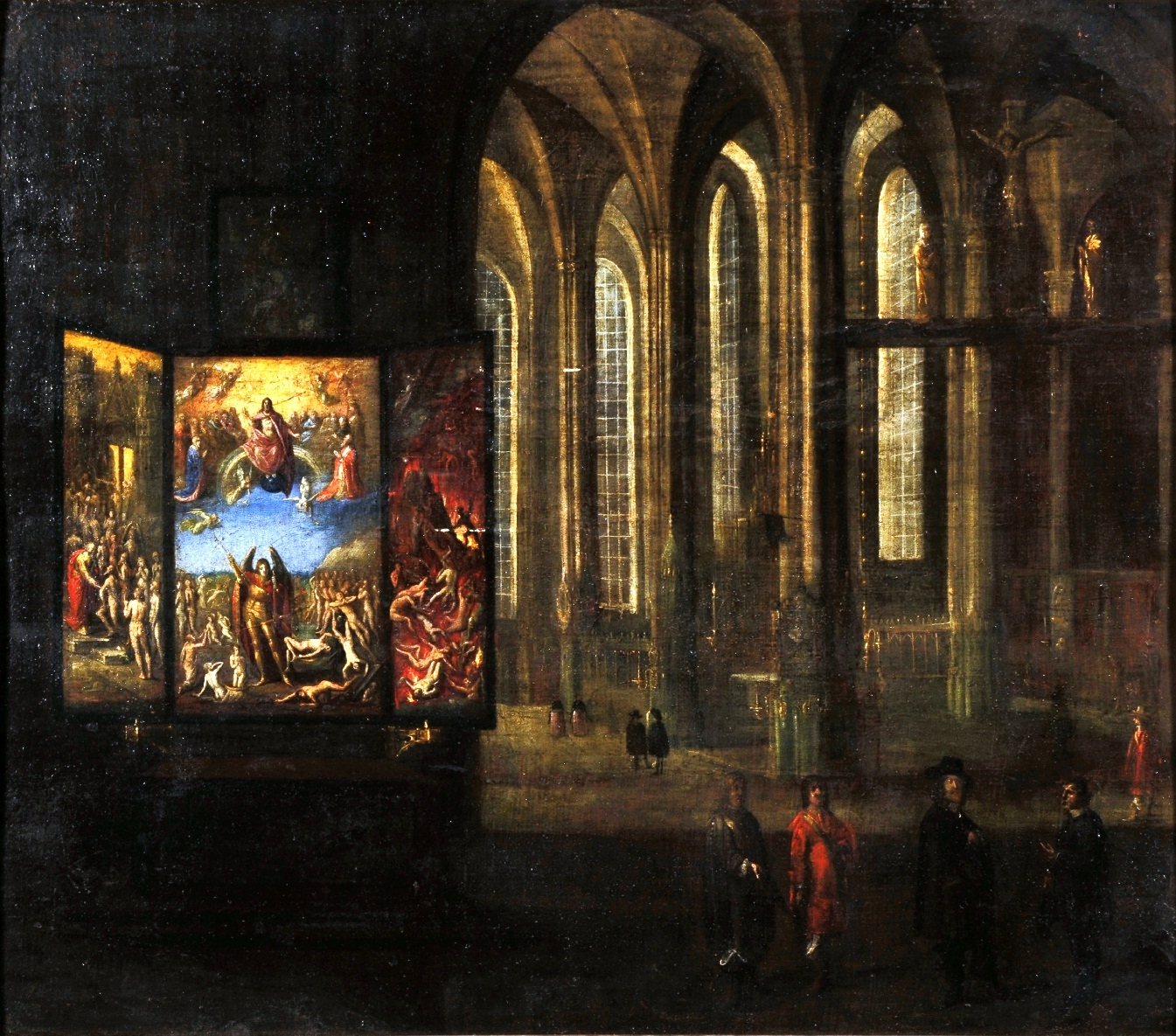
In Danzig the triptych became the city's best painting. The museum and Przybyszewski record that it hung on the pillar beside the chapel of St George. A view of the church interior of about 1635 attributed to Bartholomaeus Miltwitz, listed by Gerson Digital, shows the triptych there. Gluszko adds that Danzig painters trained by looking at it, which is his inference from the picture's size and quality. The French diplomat Charles Ogier, who stayed in the city in 1635, is reported by mp.pl to have noticed the likeness of some of its figures to those of a Crucifixion in Luebeck, and mp.pl adds that scholars later showed that both were Memling's. The Luebeck work is probably the Greverade Crucifixion, dated 1491 and ordered by a family of that Hanse city, according to the Flemish Primitives chronology; that match is this record's inference, since mp.pl does not name the altarpiece.
The rulers who asked for it are recorded on the museum's history pages. Rudolf II is reported by Ogier to have wanted it for 40,000 thalers. Peter the Great visited Danzig in 1716 and 1717 during the Great Northern War. After the convention of 19 September 1717, which set the city's contribution at 140,000 thalers and required it to break trade with Sweden and open the port to Russian ships, the tsar's side asked for the triptych as a token of thanks, then argued that a Lutheran church ought not to care for such a picture. The city refused and the negotiation ended, according to the museum. Gluszko says the council's reply called it daring to sell or give away something dedicated to the church three hundred years before, and that the city then commissioned Christopher Krey to restore the picture, a job finished, by Gluszko's account, rather unskilfully on 29 July 1718. These details come from the popular article and have not been checked against Danzig archives.
After Danzig fell to the French in 1807, the French commandant Jean Rapp asked the church wardens on 3 June 1807 to give the triptych to Dominique Vivant Denon, director of the Musee Napoleon, according to German Wikipedia, which cites Simson's 1916 study; the Gdansk museum says Denon came to seize the best works he could find in the conquered cities. For the first time in 330 years the picture left Danzig. It hung in the Louvre for eight years as number 563 and as a Jan van Eyck.
When the Prussians entered Paris in 1815 the repossession of looted art began, and the museum says the Last Judgment was the first piece taken out of the Louvre. It did not go straight home. It went to Berlin, where it was shown to the public. Johann Gottfried Schadow, head of the Berlin Academy, asked King Frederick William III to break an earlier promise to return it to St Mary's, and German Wikipedia adds that the Berlin artists' association argued for keeping it for a future national museum. Offers were made: mp.pl and Gluszko say the Berlin side proposed a copy of Raphael's Sistine Madonna, three scholarships and a new altarpiece. The Danzig council refused every time. The preachers of St Mary's petitioned the king on 28 May 1816, and Johann Adam Breysig, head of the Danzig school of fine arts, is credited by the museum with the return along with the council's persistence.
The date of the return depends on the source. German Wikipedia, citing Simson, has the picture arrive in Danzig on 17 December 1816 and be re-installed with a service on 18 January 1817 in the chapel of St Dorothy, because the light there was thought better than at the old pillar. The museum, mp.pl, Przybyszewski and the PAP reports say 1817; the Memling Research Center and the Gerson Digital entry say 1816. Under the middle panel the grateful citizens hung an inscribed tablet. De Roover's footnote prints the German verse and gives its sense, that when the last judgment was taken from the robbers of the jewel the just monarch gave back to the city what had been won by arms. German Wikipedia says the verse was fixed under the centre panel. The Berlin print room holds outline tracings of the triptych in St Mary's by Johann Carl Schultz of Danzig, an early record of the picture in its church; the museum record gives no date. Gluszko says the picture was cleaned in Berlin before its return and went back to Berlin in 1851 for another restoration, and that it was moved after 1934 to the chapel of St Reinhold, a move the museum also records.
Chapter 12War, the Hermitage and the road back to Gdansk, 1942 to 1972
Willi Drost, director of Danzig's city museum, led the evacuation of the town's art.
Willi Drost, director of Danzig's city museum, led the evacuation of the town's art. According to the museum's history, the triptych was taken out of the city in 1942 and hidden in the Evangelical church at Meiserwalde, now Mierzeszyn. After the first carpet bombings of German cities Drost picked three works from Pomerania for evacuation deep into the Reich, and the Memling was one. In September 1944 it was taken to Thuringia and hidden in a village church in the Rhon hills. The museum says the Red Army found it there in 1946 and sent it to the Hermitage in Leningrad. The sources do not agree on when the Soviets took it: mp.pl says German troops took it into the Reich in 1945 and it then fell to the Red Army and went to the Hermitage as a trophy; Przybyszewski in 1979 says only that it was found by the Soviet army and placed in 1946 in the Pomeranian Museum in Gdansk, with no Hermitage stay; the Getty gives no year; and the PAP reports say it was shown in the Hermitage before 1956. The sources do not agree on when the Soviets took it: mp.pl says German troops took it into the Reich in 1945 and it then fell to the Red Army and went to the Hermitage as a trophy; Przybyszewski in 1979 says only that it was found by the Soviet army and placed in 1946 in the Pomeranian Museum in Gdansk, with no Hermitage stay; the Getty gives no year; and the PAP reports say it was shown in the Hermitage before 1956. The sources do not agree on when the Soviets took it: mp.pl says German troops took it into the Reich in 1945 and it then fell to the Red Army and went to the Hermitage as a trophy; Przybyszewski in 1979 says only that it was found by the Soviet army and placed in 1946 in the Pomeranian Museum in Gdansk, with no Hermitage stay; the Getty gives no year; and the PAP reports say it was shown in the Hermitage before 1956. The sources do not agree on when the Soviets took it: mp.pl says German troops took it into the Reich in 1945 and it then fell to the Red Army and went to the Hermitage as a trophy; Przybyszewski in 1979 says only that it was found by the Soviet army and placed in 1946 in the Pomeranian Museum in Gdansk, with no Hermitage stay; the Getty gives no year; and the PAP reports say it was shown in the Hermitage before 1956. The sources do not agree on when the Soviets took it: mp.pl says German troops took it into the Reich in 1945 and it then fell to the Red Army and went to the Hermitage as a trophy; Przybyszewski in 1979 says only that it was found by the Soviet army and placed in 1946 in the Pomeranian Museum in Gdansk, with no Hermitage stay; the Getty gives no year; and the PAP reports say it was shown in the Hermitage before 1956. The Gdansk popular account says the Hermitage restored it with no documentation known; the Polish PAP reports say it was exhibited there.
It returned to Poland ten years later. The Memling Research Center says it came back in 1956 with about 150 paintings, some 4,500 prints and drawings, several dozen sculptures and the Missiva letter registers of the Danzig authorities. The museum says it went first to Warsaw for research and restoration and then to the Pomeranian Museum in Gdansk. On the rest the sources differ. Gluszko says it was shown at the National Museum in Warsaw in 1956 and went back to Gdansk on 22 September that year. The Niezla Sztuka summary says it was shown in Warsaw in 1956 at an exhibition of works of art secured by the USSR, reached Gdansk in 1958 and was moved in 1972 to its permanent place in the National Museum in Gdansk, the successor of the Pomeranian Museum. The Pomorskie regional tourist board also says 1958. The record does not settle the year, and no source seen names the legal instrument of the Soviet transfer.
After the war a reduced copy hung in St Mary's, which Przybyszewski places in the entrance hall in 1979. German Wikipedia says the copy now in the basilica is attributed to the Danzig painter Louis Friedrich Sy, with a rival attribution to Eugen Groth in a blog it cites. Neither attribution was checked.
Chapter 13Who owns it, and who has asked for it back
The Memling Research Center lists restitution among the questions it was set up in 2022 to study, together with the problem of ownership of the triptych, which it calls disputed between the state and...
The Memling Research Center lists restitution among the questions it was set up in 2022 to study, together with the problem of ownership of the triptych, which it calls disputed between the state and the Church, the legality of the raid in the law of its day, letters of marque and whether Beneke should be called a privateer or a pirate. A 2023 conference of that centre and the National Museum asked for papers on the legal aspects of restitution of art and on documents and written arguments in medieval and modern disputes. No ruling, claim or filing on the triptych was found in the sources consulted.
The Polish side is not one voice and sources must be kept apart. The museum's account says the triptych was donated to St Mary's Church and hung on a pillar by the chapel of St George as the brotherhood's private property. A separate and better-documented dispute, reported by PAP in 2011, concerns other medieval works, eighteen according to a newspaper quoted by PAP, from the basilica's historical fittings, which the National Museum in Warsaw says became Treasury property under the 1946 decree on abandoned and former German property and which the parish refuses to return under loan agreements that ran out in 2004. That dispute does not name the Memling, and it is not treated here as being about it.
No Italian claim in the modern sense was found. Italian Wikipedia says the Pope and Lorenzo de' Medici asked for it back after 1473 and it was never returned. The 2014 Scuderie del Quirinale exhibition in Rome had been meant to include the triptych. Inside the Vatican says that at the last minute a commission judged it too fragile to travel, and the Getty says the museum concluded after a condition study that the risk of moving it was too great. A 2025 seminar in Rome, organised from Silesia, Parma and Gdansk, reconsidered Memling's work in its Polish and Italian settings. De Roover's footnote says Tani is not named among the claimants in the lawsuit papers. A claim by Tani's heirs, if any was ever made, has not been located.
Chapter 14Condition, conservation and what is happening now
The Getty's 2026 report says the triptych's condition was 'amazingly good', in the words of Michal Lukomski, when a team from the museum, the Haber Institute of the Polish Academy of Sciences and the...
The Getty's 2026 report says the triptych's condition was 'amazingly good', in the words of Michal Lukomski, when a team from the museum, the Haber Institute of the Polish Academy of Sciences and the National Museum in Krakow examined it about twelve years ago, using visible and ultraviolet photographs, thermography, speckle interferometry, ultraviolet fluorescence, infrared reflectography and X-rays. The boards were well joined, the glue bonds secure and no active lifting was found. That examination was made when a loan to Rome was under consideration. The Szmelter paper lists the earlier work: ultraviolet, visible, near and mid infrared, SERS, XRD, XRF and multispectral infrared reflectography, collected between 2010 and 2013. The panel was taken out of its frame for the Torun dendrochronology in 2003, and no source seen says whether the present frame is original.
In 2025 the museum asked for a new evaluation because the display case, now more than twenty years old, no longer sealed properly. The Haber Institute's cultural heritage group, led by Lukasz Bratasz, used a 3D digital microscope scanner to document the whole surface at 90 times magnification and selected areas up to 2,500 times, and found only minimal change. The old case had kept humidity steady with no mechanical climate control. The risk they identified as largest was not damp but evacuation in an emergency, since the three heavy panels sit in a historic former monastery with many corners and stairs, and the wings would have to be dismounted. The Getty Conservation Institute, the museum and the Haber Institute held a workshop on risk assessment at the museum in autumn 2025. A replacement case is still to be decided, and conservation work continues in the gallery in view of visitors, with a detailed report promised. The museum's head of conservation, Catia Viegas Wesolowska, tells the Getty that the monastery setting resonates with the triptych's original function, though the picture never experienced it, since it never reached its destination.
The picture hangs in the museum's Department of Historical Art, in a former Gothic monastery, and the Niezla Sztuka summary dates its permanent place there to 1972. According to PAP the museum announced a Year of Memling in January 2023, counting 550 years from the start of the painting; the Memling Research Center and the museum held a conference on the 'Artists, bankers, sailors' theme on 20 to 22 April 2023 for the 550th anniversary of the capture, and PAP reports a comic on Memling and the triptych by Lukasz Pawlak published by the Gdansk public library.
The artist
Hans Memling (Memlinc), born Jan van Mimnelinghe in the register at Bruges
Memling was born around 1435 in Seligenstadt near Frankfurt, became a citizen of Bruges in January 1465 and stayed there until his death in 1494. Almost nothing of his early life is documented, and nothing in the surviving paper about the Gdansk Last Judgment names him: the attribution to him rests on a nineteenth-century argument from style that no archive has confirmed. The painter who fits the Gdansk triptych best is therefore the Memling reconstructed from other pictures, and the 2015 proposal that Rogier van der Weyden began the work shows that this reconstruction is still being tested.
Related works
| Work | Relation | Where it is |
|---|---|---|
| Last Judgment polyptych (Beaune Altarpiece) Rogier van der Weyden | Principal model; Szmelter and colleagues compare its infrared images with the Gdansk underdrawing Commissioned in 1443 by Nicolas Rolin and ready by 1451; fifteen paintings on nine panels with the dead rising across a continuous lower register. | Hotel-Dieu, Beaune |
| Last Judgment Stefan Lochner | Earlier Cologne picture Przybyszewski links to the Gothic heavenly gate and the idea of Heaven as a city About 1435; the wings are in Frankfurt and Munich according to Przybyszewski. | Wallraf-Richartz Museum, Cologne (central panel) |
| Last Judgment altarpiece (wings: Road to Paradise and Fall of the Damned) Dieric Bouts | Contemporary Last Judgment, made for the town hall at Leuven Dated 1468 to 1470 by Wikipedia; it parallels Memling's work and is not a source for it. | Musee des Beaux-Arts, Lille (wings); fragment of Christ in the Nationalmuseum, Stockholm |
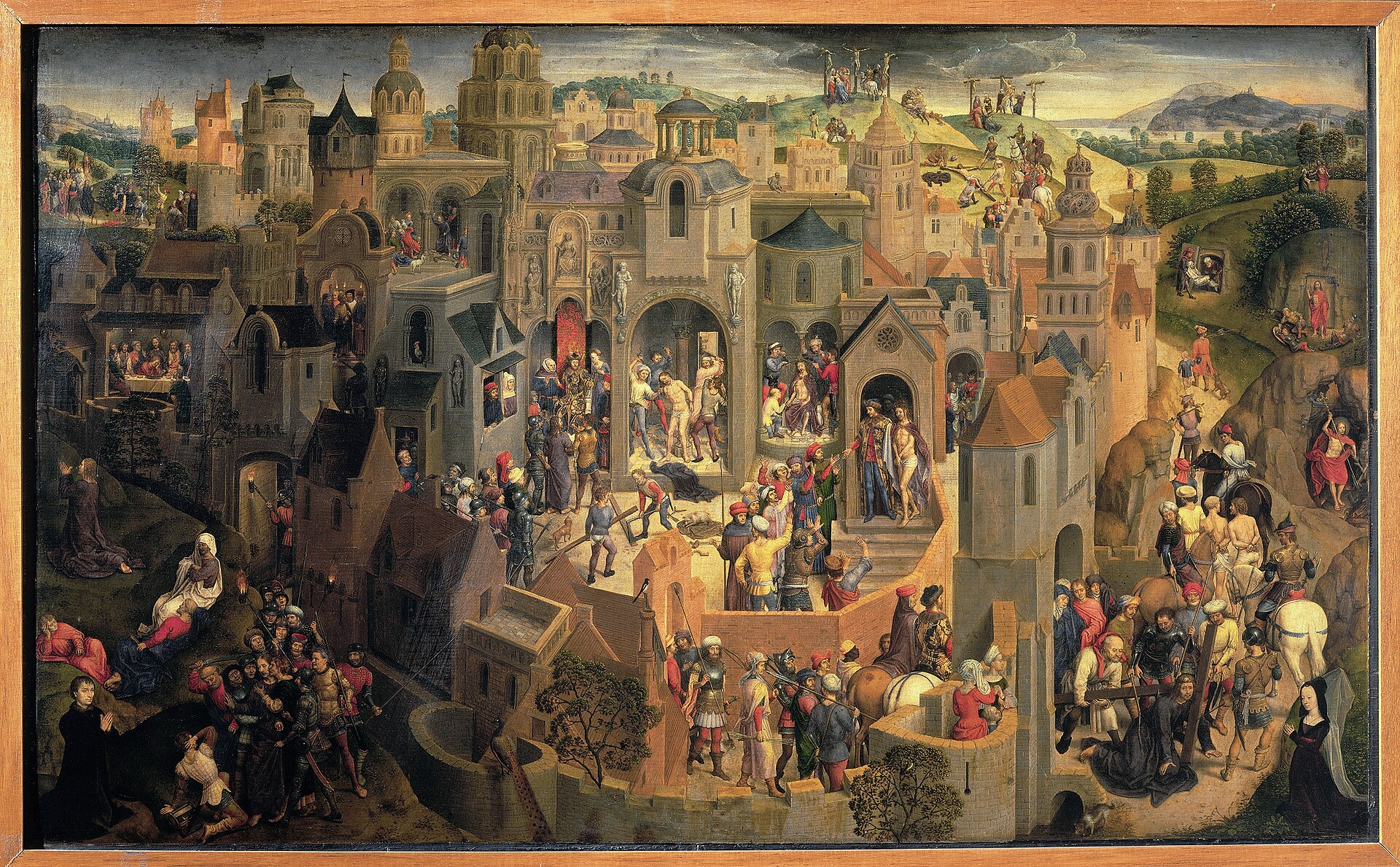
| Scenes from the Passion of Christ Hans Memling | Commissioned by Tommaso Portinari, the man usually named as the figure on the scales About 1470; Portinari and his wife appear as donors. | Galleria Sabauda, Turin |
| Portrait of Tommaso di Folco Portinari and Portrait of Maria Portinari Hans Memling | Reference for the identification of the weighed head as Portinari About 1470; part of a devotional triptych for the banker. | Metropolitan Museum of Art, New York |
| Portinari Altarpiece Hugo van der Goes | Portinari's other altarpiece, ordered about 1476 and delivered safely to Florence Przybyszewski contrasts its safe arrival in Santa Maria Nuova with the loss of Tani's triptych. | Uffizi, Florence |
| Greverade Crucifixion triptych Hans Memling | The painter's Hanse commission, dated 1491 Ordered by a Lubeck family for the cathedral of the Hanse city. | St Annen-Museum, Lubeck |
| Copies of the Last Judgment in St Mary's After Memling; the larger church copy is attributed to Louis Friedrich Sy | Stand-ins hung in St Mary's in place of the original The attribution comes from German Wikipedia, which also mentions a rival proposal; neither was verified. | Basilica of St Mary, Gdansk |
Open questions
- Who ordered the triptych and when? No contract, payment or letter survives, and Szmelter's team says there are no data on the commission. Dates between 1466 and 1473 all appear in print and the donors are identified only by the coats of arms.
- Was the destination the Badia Fiesolana (chapel of St Michael per mp.pl and Inside the Vatican; family chapel in the church of St Bartholomew per the museum) or a pillar in Orsanmichele, as Przybyszewski suggested in 1979?
- Who is the head on the scales? The identification with Tommaso Portinari rests on resemblance, and the sources disagree on whether the figure is saved or damned. Why was the head painted on a tin sheet and inserted, and when?
- Did Rogier van der Weyden make the design and underdrawing, as Szmelter, Walter and Rousseliere argue from the dendrochronology and the infrared images? No independent test or rebuttal was found, and the 2015 paper itself leaves open whether draughtsman and painter were one.
- Is Ropp's identification of Portinari's two 'altar tables' with the Gdansk triptych correct? The 1473 list and the 1496 recital describe two altar tables and name neither painter nor subject, and the valuations given, 100 pounds groat and 360 florins, were the claimant's.
- What was the name and destination of the ship? St Thomas bound for London, San Matteo bound for Italy, St Matthew or St Andrew (the basilica's own page) and San Tommaso are all given, the Memling Research Center calls the vessel a Medici-owned galley, English Wikipedia's Beneke article calls it English-owned with Portinari as registered owner, and the date is 27 April in most sources and about 14 April in one.
- Did Pope Sixtus IV issue a bull against Danzig in 1478, and did Lorenzo de' Medici intervene? The statements are repeated in modern summaries and no primary text for them was seen.
- When did the triptych reach Gdansk after the Soviet return: 22 September 1956 or 1958? No source seen names the legal instrument of the transfer from the Hermitage.
- Who owns it in law? The Memling Research Center describes ownership as disputed between the state and the Church, and no ruling was found. Has Italy, the Medici line or any Tani descendant ever made a formal claim? None was found.
- Is the frame original, and what happened to the Danzig tablet of 1817? No source says.
Questions about this object
What is The Last Judgment Triptych?
The Last Judgment Triptych is a painting, dated c. 1467-1473. Medium: Tempera and oil on oak panel (Baltic oak).
Who made The Last Judgment Triptych, and is the attribution settled?
The attribution to Hans Memling is recorded here as disputed. Accepted as Memling's by most scholars since the nineteenth century (Hotho 1843, Passavant 1847 and later Warburg), but the work is unsigned and no document names the painter. K. B. Mac Farlane doubted it in 1971, and since 2014 Szmelter, Walter and Rousseliere have argued from dendrochronology, infrared reflectography and XRF/XRD that Rogier van der Weyden made the design and underdrawing and Memling finished the painting. No independent test of that proposal was found. The Memling Research Center says the debate over attribution continues.
Where is The Last Judgment Triptych now?
National Museum in Gdansk (Muzeum Narodowe w Gdansku), Department of Historical Art. Inventory number MNG/SD/413/M. Last confirmed 8 October 2026. Returned from the Hermitage to Poland in 1956 and held first by the Pomeranian Museum, then the National Museum in Gdansk; the Memling Research Center describes ownership as disputed between the state and the Church.
What is still unknown about The Last Judgment Triptych?
Who ordered the triptych and when? No contract, payment or letter survives, and Szmelter's team says there are no data on the commission. Dates between 1466 and 1473 all appear in print and the donors are identified only by the coats of arms.
Sources
- 1Hanserecesse, Zweite Abtheilung (1431-1476), Siebenter (Schluss-)Band, ed. Goswin Frhr. von der Ropp (Leipzig: Duncker & Humblot, 1892): editor's introduction on the taking of Thomas Portinari's galley, Utrecht diet of 1473, no. 41 (Portinari's specification of losses, pp. 115-117, with the editor's footnote identifying one of the two altar tables as Memling's Last Judgment), and nos. 134, 270, 272. Page images read from the Internet Archive scan. archive.org/details/...
- 2Hanserecesse von 1477-1530, Dritte Abtheilung, Dritter Band, ed. Dietrich Schaefer (Leipzig: Duncker & Humblot, 1888): no. 676 (Hansa diet at Luebeck, 12 January 1497), pp. 503-507, the Great Council of Malines recital of the cargo and sentence of 5 August 1496 in Portinari's favour, with the editor's footnote on the altar tables. Page images read from the Internet Archive scan. archive.org/details/...
- 3Hanserecesse von 1477-1530, Dritte Abtheilung, Sechster Band, ed. Dietrich Schaefer (Leipzig: Duncker & Humblot, 1899): Hansa diet at Luebeck, 16 June - 5 July 1511, no. 188 paragraph 120, p. 144, the Portinari judgment and the Bruges assumption of the debt. Text read from the Internet Archive OCR. archive.org/details/...
- 4Karl Koppmann, 'Beneke, Paul', Allgemeine Deutsche Biographie vol. 2 (Leipzig 1875), pp. 329-330, on Wikisource (Beneke's career, the capture of 27 April 1473, the cargo valued at 60,000 pounds Flemish). de.wikisource.org/wiki/...
- 5Boleslaw Przybyszewski (Ks.), 'Sad Ostateczny Jana Memlinga w Muzeum Pomorskim w Gdansku', Nasza Przeszlosc 52 (1979), pp. 107-166. Full text read from the open PDF (OCR). Iconography, history of the triptych, attribution history, the Krassowski astrolabe hypothesis. ojs.academicon.pl/np/...
- 6Iwona Szmelter, Philippe Walter and Helene Rousseliere, 'New Information Provided by Multidisciplinary and Combined Studies, Including Radiography, XRD and XRF, of the triptych the Last Judgement from National Museum in Gdansk: Rogier van der Weyden and Hans Memling co-authorship', Opuscula Musealia 23 (2015), pp. 61-73. Full text read from the open PDF. Dendrochronology (Torun, 2003), MOLAB campaigns 2012-2013, pigments, underdrawing, tin insert. ejournals.eu/czasopismo/...
- 7National Museum in Gdansk, 'The History of the Painting', official Last Judgement site (English). sadostateczny.mng.gda.pl/en/...
- 8National Museum in Gdansk, 'Historia obrazu', official Last Judgement site (Polish). sadostateczny.mng.gda.pl/historia-obrazu
- 9Lilibeth Garcia, 'Art Worth the Risk', Getty News, 24 June 2026 (the condition study made about twelve years before 2026, when a Rome loan was considered, and the 2025 re-examination, the ageing display case, evacuation planning; inventory number MNG/SD/413/M). getty.edu/news/...
- 10Memling Research Center, University of Gdansk, 'Our mission' (summary of the capture, the return from the USSR in 1956, research agenda including ownership and the legality of the raid). mrc.ug.edu.pl/our-mission
- 11Florence Edler de Roover, 'A Prize of War: A Painting of Fifteenth Century Merchants', Business History Review 19.1 (February 1945), pp. 3-12. Only the abstract and the footnotes were visible on the Cambridge Core page (article text is behind access); footnotes 7, 8, 10, 11 and 12 used with the caveat given in notes_for_editor. resolve.cambridge.org/core/...
- 12Flemish Primitives (Flemish Art Collection), 'Hans Memling' biography and chronology. vlaamseprimitieven.vlaamsekunstcollectie.be/en/...
- 13Inside the Vatican, 'Rome's First Tribute to Hans Memling' (report on the 2014 Scuderie del Quirinale exhibition, 1 November 2014; carries the 1494 Rombout de Doppere phrase). Journalistic; used for the exhibition and for the quotation. insidethevatican.com
- 14'Medyczne tajemnice Sadu Ostatecznego Hansa Memlinga', mp.pl, 8 May 2017 (description of the work and the circumstantial chain for the commission; draws on museum material). Secondary. mp.pl/pacjent/...
- 15Used for the 1807 to 1817 chronology and the Danzig tablet of 1817. To be replaced by Simson (1916). de.wikipedia.org/wiki/...
- 16Hanna Benesz, 'Early Netherlandish, Dutch and Flemish paintings in Polish collections', Gerson Digital: Poland (RKD). gersonpoland.rkdstudies.nl/6-early-netherlandish-dutch-an...
- 17Tadeusz T. Gluszko, article from the monthly 30 Dni republished by the City of Gdansk, 'Juz 550 lat od dnia, w ktorym gdanscy kaprowie zdobyli na morzu Sad Ostateczny Hansa Memlinga', gdansk.pl, April 2023 (popular account; contains details not found elsewhere, used only where attributed). gdansk.pl/wiadomosci/...
- 18PAP via dzieje.pl, ''Sad Ostateczny' moze byc dzielem zespolowym' (Iwona Szmelter on the infrared scan and Rogier van der Weyden). dzieje.pl/kultura-i-sztuka/...
- 19PAP via dzieje.pl, ''Sad Ostateczny' Memlinga zbadaja zagraniczni naukowcy' (announcement of the MOLAB examination, 31 January - 4 February). dzieje.pl/node/...
- 20PAP via dzieje.pl, 8 February 2011, on the National Museum in Warsaw's dispute with St Mary's Basilica over eighteen other medieval works (does not concern the Memling). dzieje.pl/node/...
- 21John H. Munro, 'Real Wages and the Malthusian Problem in Antwerp and South-Eastern England, 1400-1700', University of Toronto Working Paper 27 (2006), tables 2 and 4 and note 11. economics.utoronto.ca/public/...
- 22K. Haneca, T. Wazny, J. Van Acker and H. Beeckman, 'Provenancing Baltic timber from art historical objects: success and limitations', Journal of Archaeological Science 32.2 (2005), pp. 261-271 (abstract). experts.arizona.edu/en/...
- 23Polish Academy of Sciences Scientific Centre in Rome, report on the seminar 'Collecting and Displaying Hans Memling in Poland and Italy', 25 September 2025. rzym.pan.pl
- 24English Wikipedia, 'Beaune Altarpiece' (; commission and layout of Rogier van der Weyden's polyptych). en.wikipedia.org/wiki/...
- 25English Wikipedia, 'Dieric Bouts' (; the Last Judgment altarpiece of 1468-1470 for Leuven town hall and its surviving wings in Lille). en.wikipedia.org/wiki/...
- 26'Burzliwe losy dziela - Hans Memling Sad Ostateczny', Niezla Sztuka (secondary, popular; used only for the 1956 Warsaw exhibition and the 1958 and 1972 dates, attributed). niezlasztuka.net/o-sztuce/...
- 27Kupferstichkabinett, Staatliche Museen zu Berlin, record of Johann Carl Schultz's outline tracings of the Last Judgment in St Mary's, Danzig (museum-digital). smb.museum-digital.de/object/...
- 28English Wikipedia, 'Tommaso Portinari' (; cites de Roover and Koster 2003). en.wikipedia.org/wiki/...
- 29English Wikipedia, 'Paul Beneke' (). en.wikipedia.org/wiki/...
- 30German Wikipedia, 'Paul Beneke' (; cites NDB 1955 and ADB 1875). de.wikipedia.org/wiki/...
- 31English Wikipedia, 'Hans Memling' (). en.wikipedia.org/wiki/...
- 32Italian Wikipedia, 'Giudizio universale (Memling)' (; dimensions and the Lorenzo de' Medici request). it.wikipedia.org/wiki/...
- 33Memling Research Center and National Museum in Gdansk, call for papers for the conference 'Artists, Bankers, Sailors' (20-22 April 2023). mrc.ug.edu.pl
- 34English Wikipedia, 'Peter von Danzig' (; the ship's history). en.wikipedia.org/wiki/...
- 35'Interview with Alicja Andrzejewska, curator at the National Museum in Gdansk', Weranda (magazine), 'Arcydziela w Polsce: Sad Ostateczny Hansa Memlinga'. weranda.pl/sztuka-zycia/...
- 36Pomorskie.travel (regional tourist board), 'The Last Judgment. The most valuable image in Gdansk' (tourist text; used only for the 1958 date, attributed; it also repeats the older Van Eyck attribution). pomorskie.travel
- 37Basilica of St Mary, Gdansk, QR page 'Sad Ostateczny' (the basilica's own text; names the galley St Matthew / St Andrew and says the triptych was taken as war booty). bazylikamariacka.gdansk.pl/qr/...
- 38PAP via dzieje.pl, report on the comic 'Hans Memling. Malarz tego drugiego renesansu' by Lukasz Pawlak (Gdansk public library) and the museum's announcement of the Year of Memling. dzieje.pl/node/...
- 39English Wikipedia, 'Badia Fiesolana' (; the rebuilding of 1456-1467 for Cosimo de' Medici). en.wikipedia.org/wiki/...
Last verified · Published
Change log
8 October 2026 - Record created at the house standard: researched narrative, technical evidence, maker dossier, graded provenance chain, prices with hammer and premium separated, related works, open questions and sources.