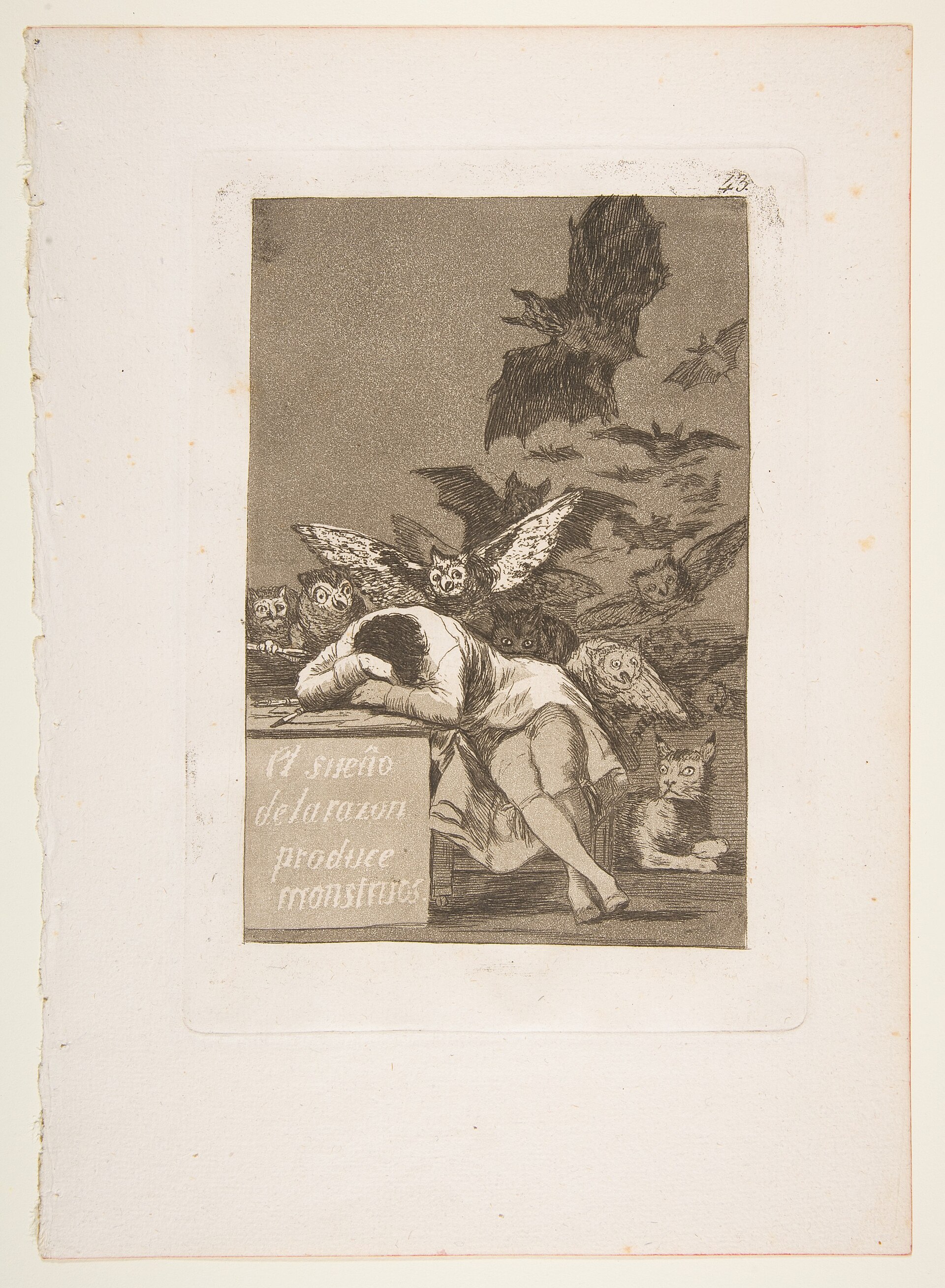
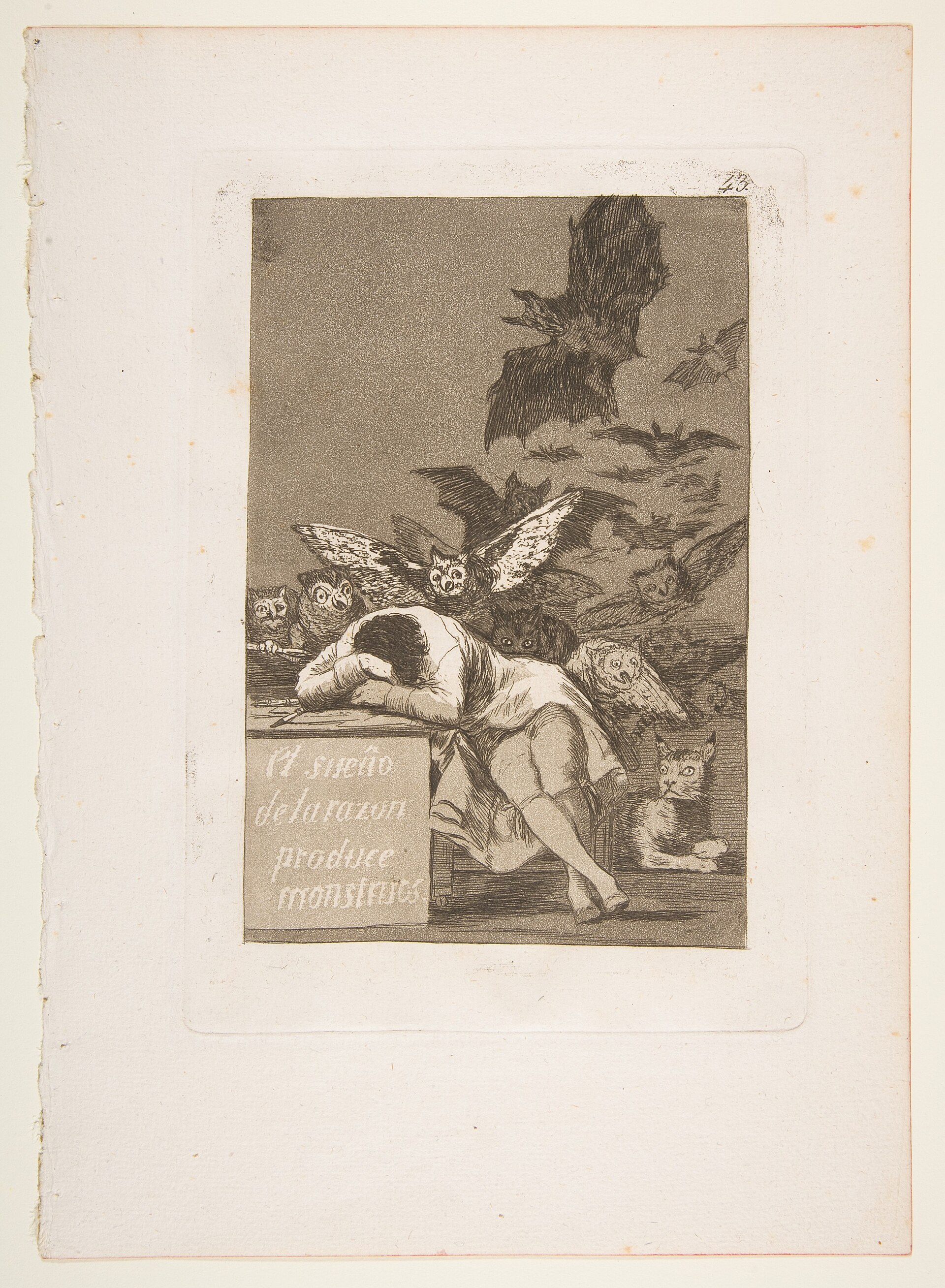
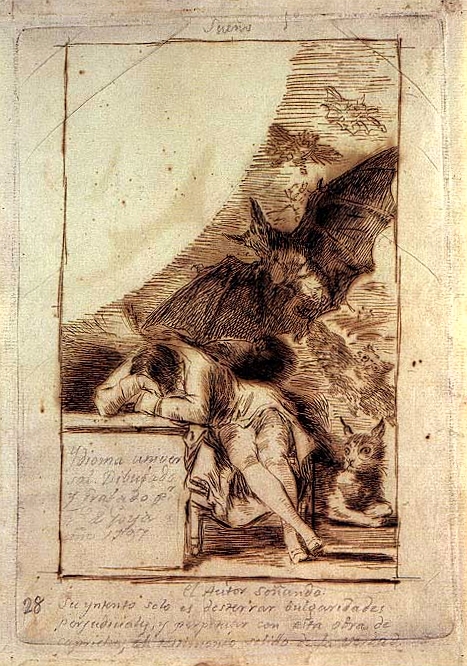
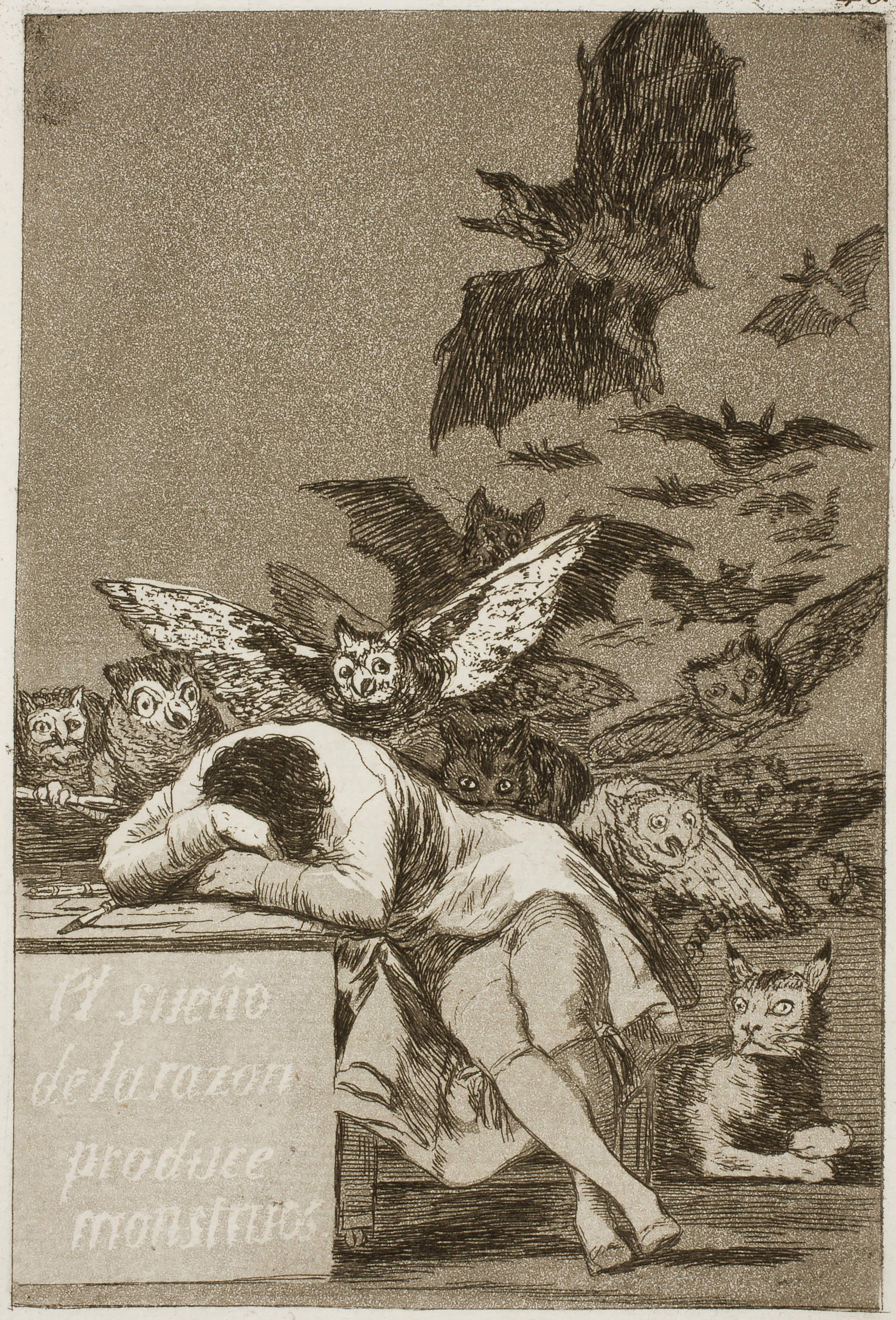
Plate 43 from Los Caprichos: The Sleep of Reason Produces Monsters (El sueno de la razon produce monstruos)
1797-1799 · Etching
The Metropolitan Museum of Art, New York
 Spanish · 1746-1828
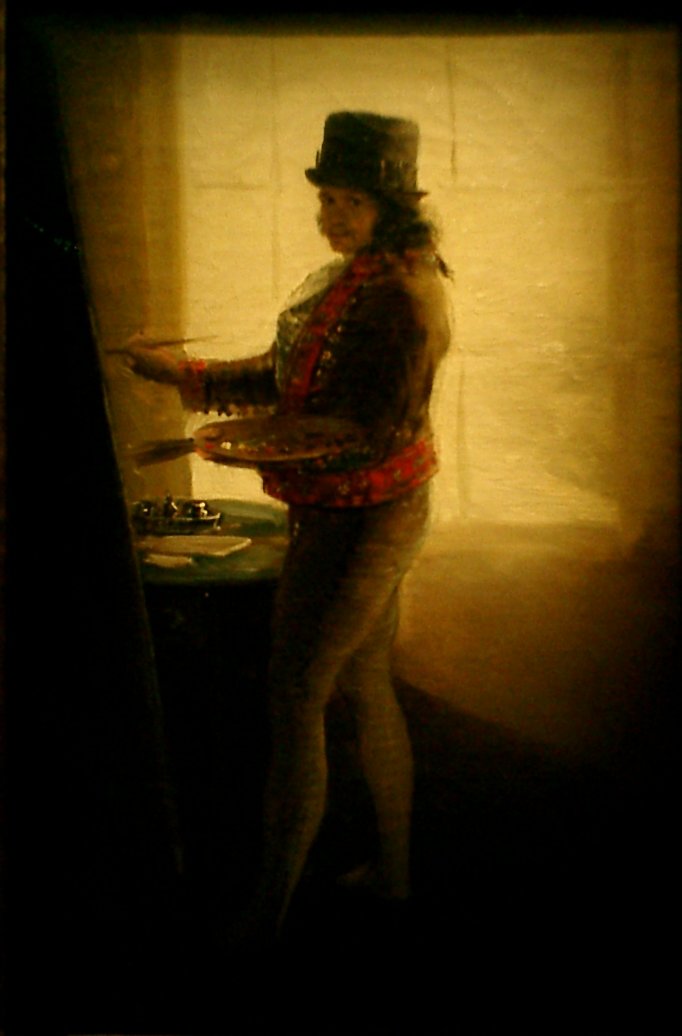
Self-Portrait in the Studio, oil on canvas, c. 1795, Real Academia de Bellas Artes de San Fernando, Madrid. Painted by Goya himself in his late forties, shortly before or around the onset of his deafness. The sitter's identity as Goya is not disputed in the sources consulted for this record.
Real Academia de Bellas Artes de San Fernando, Madrid| Full name | Francisco Jose de Goya y Lucientes |
|---|---|
| Worked as | Painter, Printmaker, Etcher |
| Born | 30 March 1746 · Fuendetodos, Aragon, Spain |
| Died | 16 April 1828 · Bordeaux, France |
| Nationality | Spanish |
| Movement | Spanish Enlightenment |
| In this archive | 3 artworks |
| Sources | 20 cited |
| Last verified |
About this page 3 artworks in the archive · Last verified · 20 sources cited
Goya spent forty years as the most successful portrait painter at the Spanish court and, in the same years, produced the print series and the private paintings that make him read, in retrospect, as the first modern artist: a satirist of his own society, an unflinching witness to a war fought around him, and in old age the maker of paintings so bleak that he never named, dated or exhibited them. Both bodies of work are real and neither cancels the other. He kept his position under three reigns, a French occupation and a restoration, painting the people in power while making, mostly in private, the harshest record of what that power cost.
The single fact a reader needs before anything else: Goya went completely deaf in his mid-forties after an undiagnosed illness in the winter of 1792-93, and the two halves of his output split cleanly across that date. What came after is darker, freer of court convention and increasingly made for no patron at all, including a set of murals painted directly onto the walls of his own house that he never explained to anyone and that were not moved to canvas, or seen by the public, until decades after he died.
He is also, more than most artists of his rank, an unstable attribution. The catalogue that still anchors the field is fifty years old, at least one major Prado painting has had its attribution stripped and then partly restored inside the last twenty years, and the institution best placed to resolve the remaining cases only opened a dedicated research center in 2024.
1797-1799 · Etching
The Metropolitan Museum of Art, New York
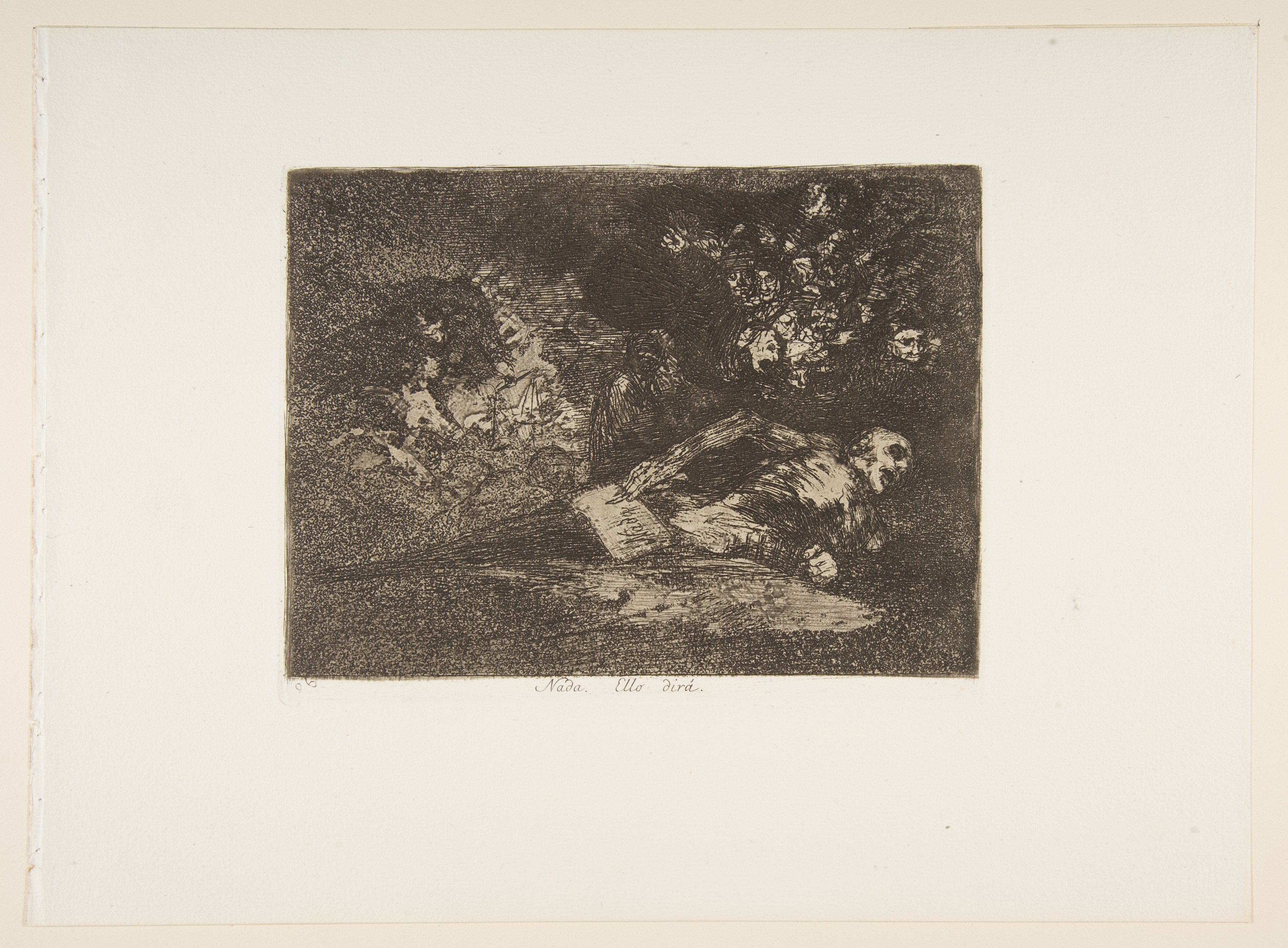
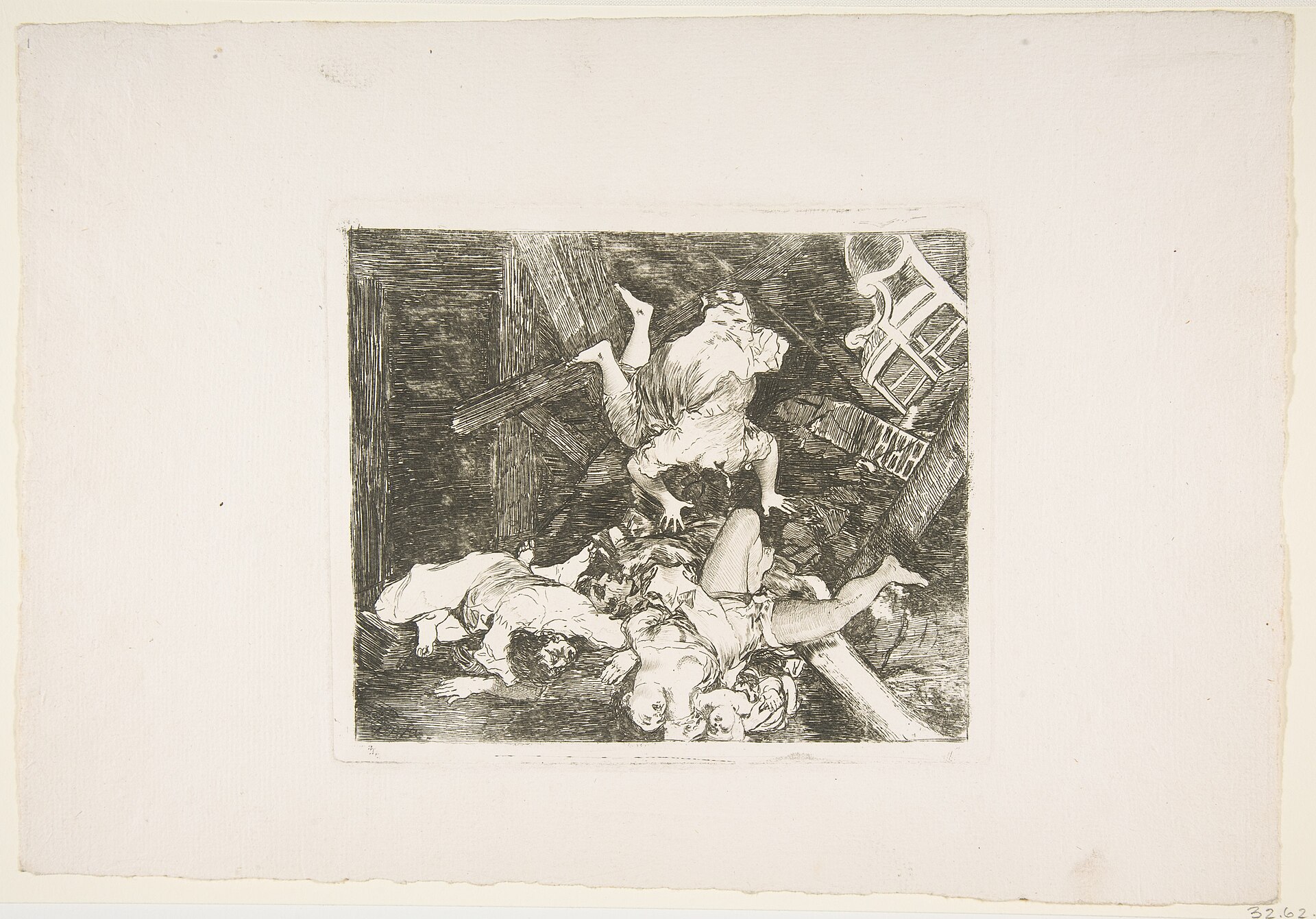
c. 1814-1815 · Etching
Metropolitan Museum of Art, New York
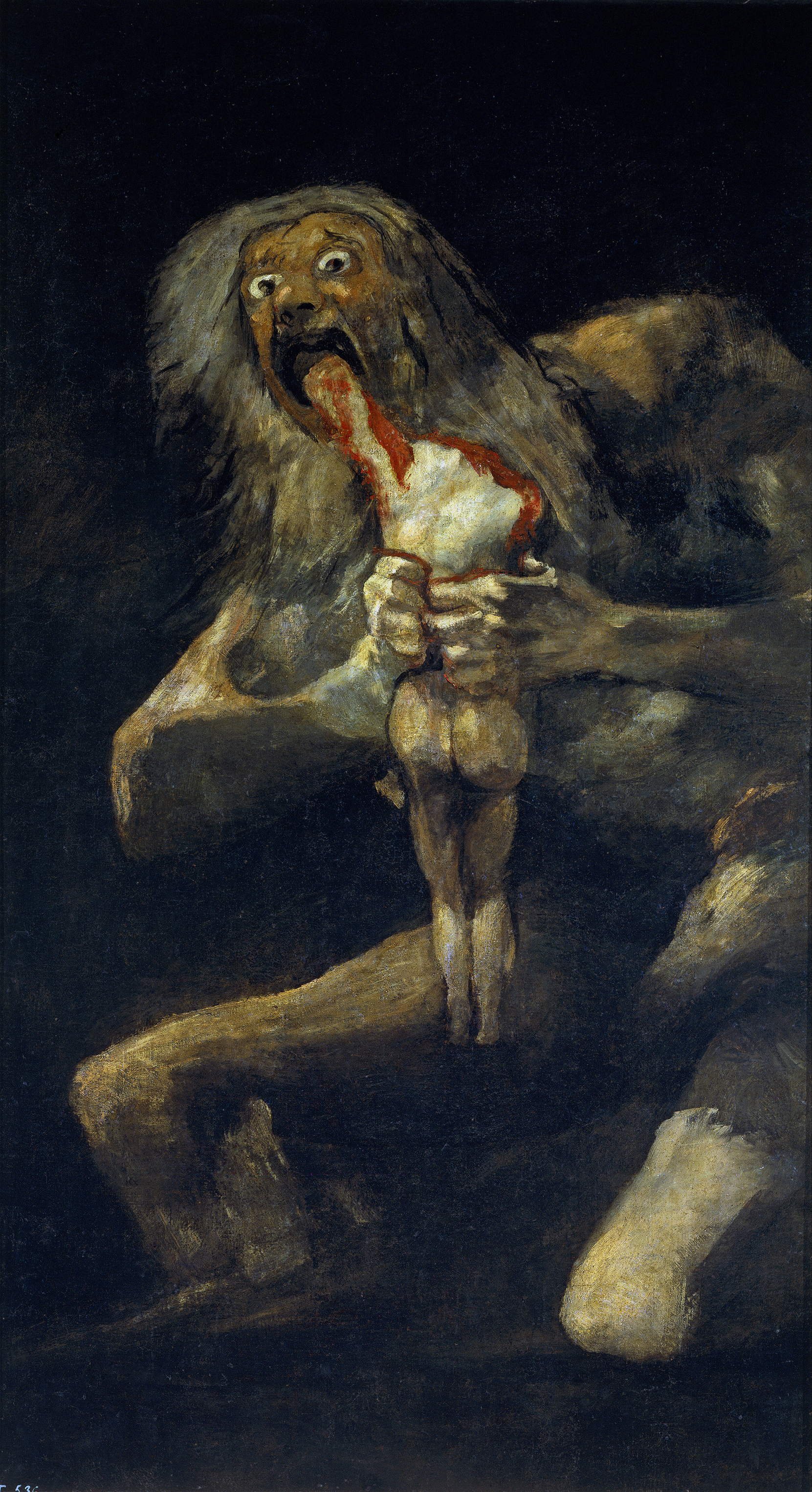
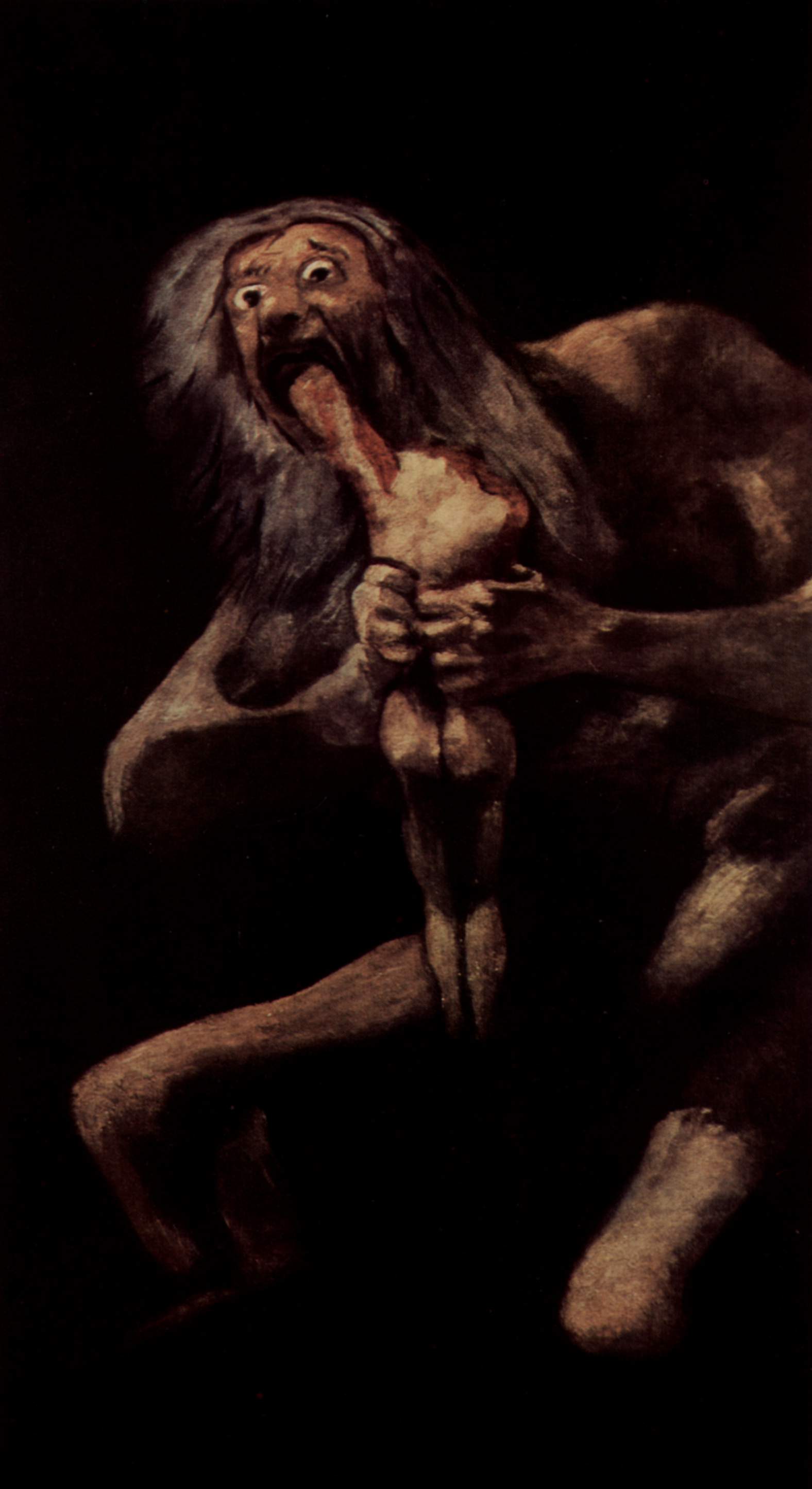
c. 1820-1823 · Oil on plaster
Museo Nacional del Prado, Madrid
Born 30 March in Fuendetodos, Aragon, son of the gilder Jose Benito de Goya y Franque.1
Marries Josefa Bayeu, sister of the court painter Francisco Bayeu, 25 July.1
Appointed salaried painter to King Charles III.1
Appointed court painter to Charles IV.1
Falls seriously ill over the winter of 1792-93; left permanently deaf.1
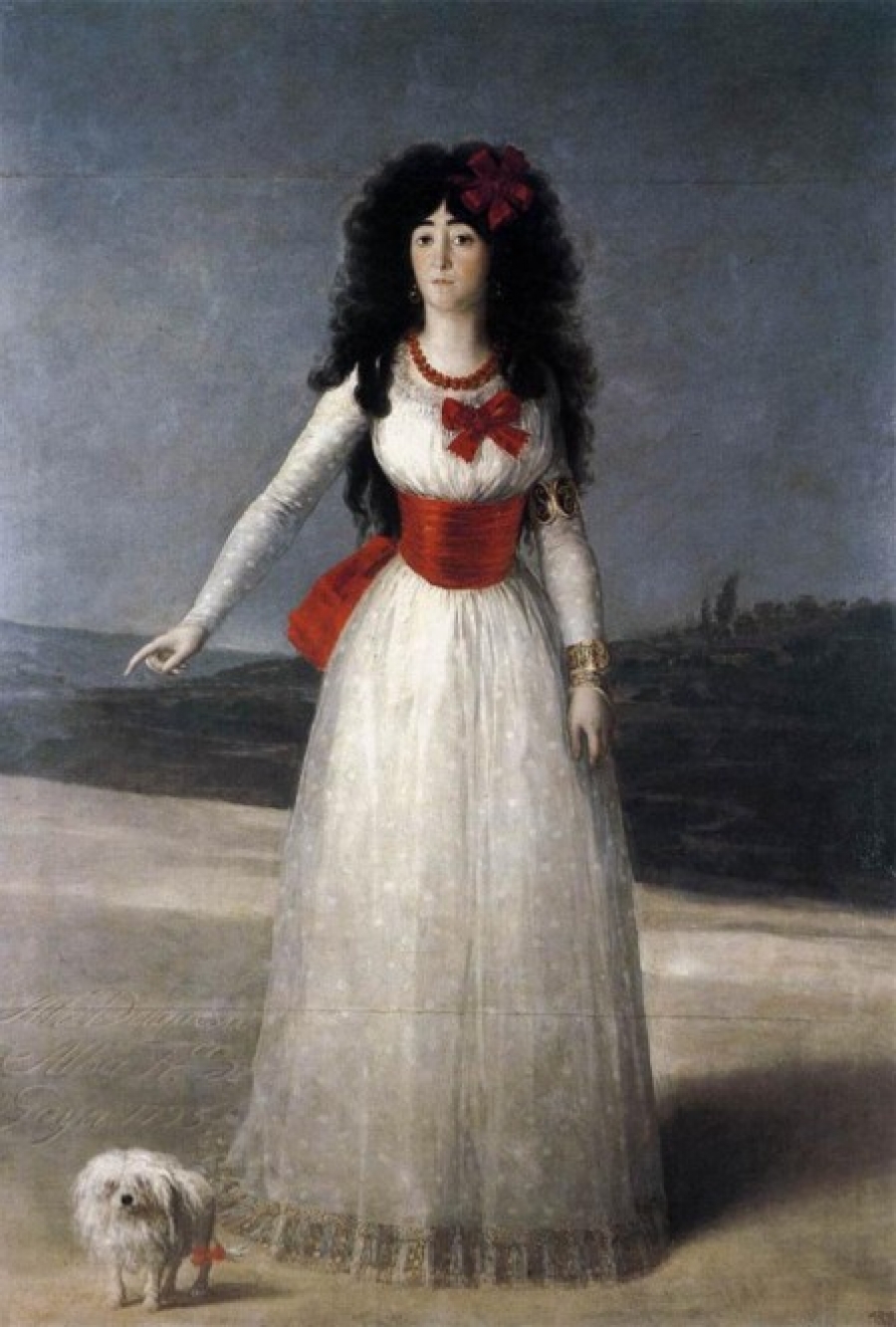
Named director of painting at the Royal Academy of Fine Arts of San Fernando; paints the first Duchess of Alba portrait, The White Duchess.19
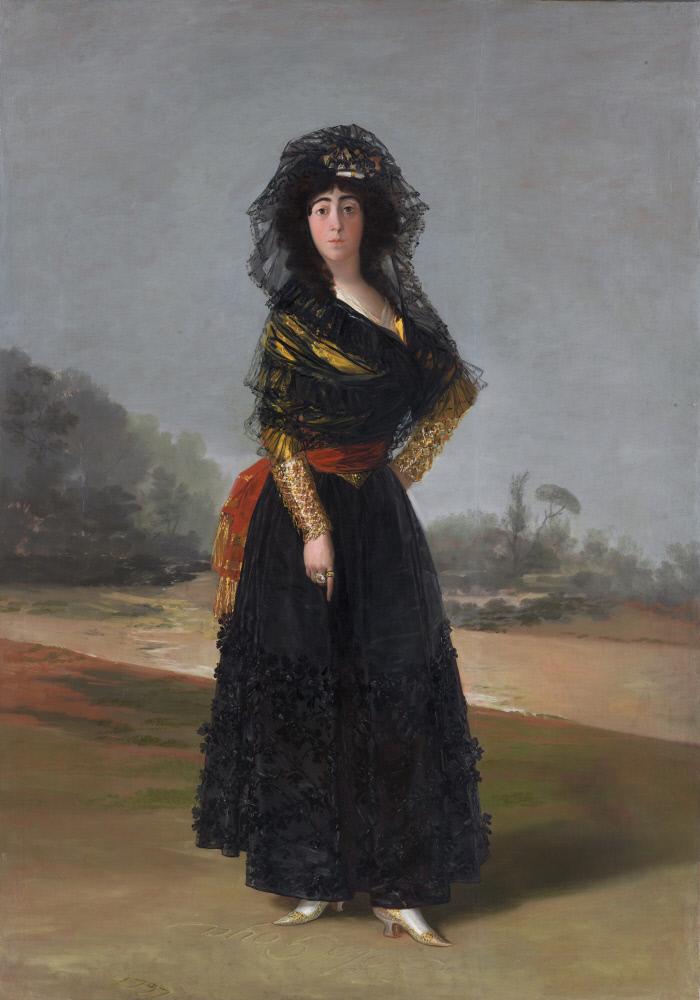
Paints the second Duchess of Alba portrait, the Black Duchess, inscribed Solo Goya in the sand at her feet.9
Primer Pintor de Camara, the highest court rank. Los Caprichos advertised for sale in February; withdrawn from sale after roughly two weeks.14
Begins Charles IV and His Family, completed the following summer.7
Death of the Duchess of Alba at Sanlucar la Mayor, 23 July, aged 40; official cause tuberculosis and fever, poisoning rumours never resolved.9
Cedes the Caprichos copperplates and 240 unsold sets to the Royal Calcography for a lifetime pension for his son Javier.4
Godoy's property, including the two Maja paintings, seized after his fall from power.3
Begins the plates of Los Desastres de la Guerra during the Peninsular War (continues to c. 1820).1
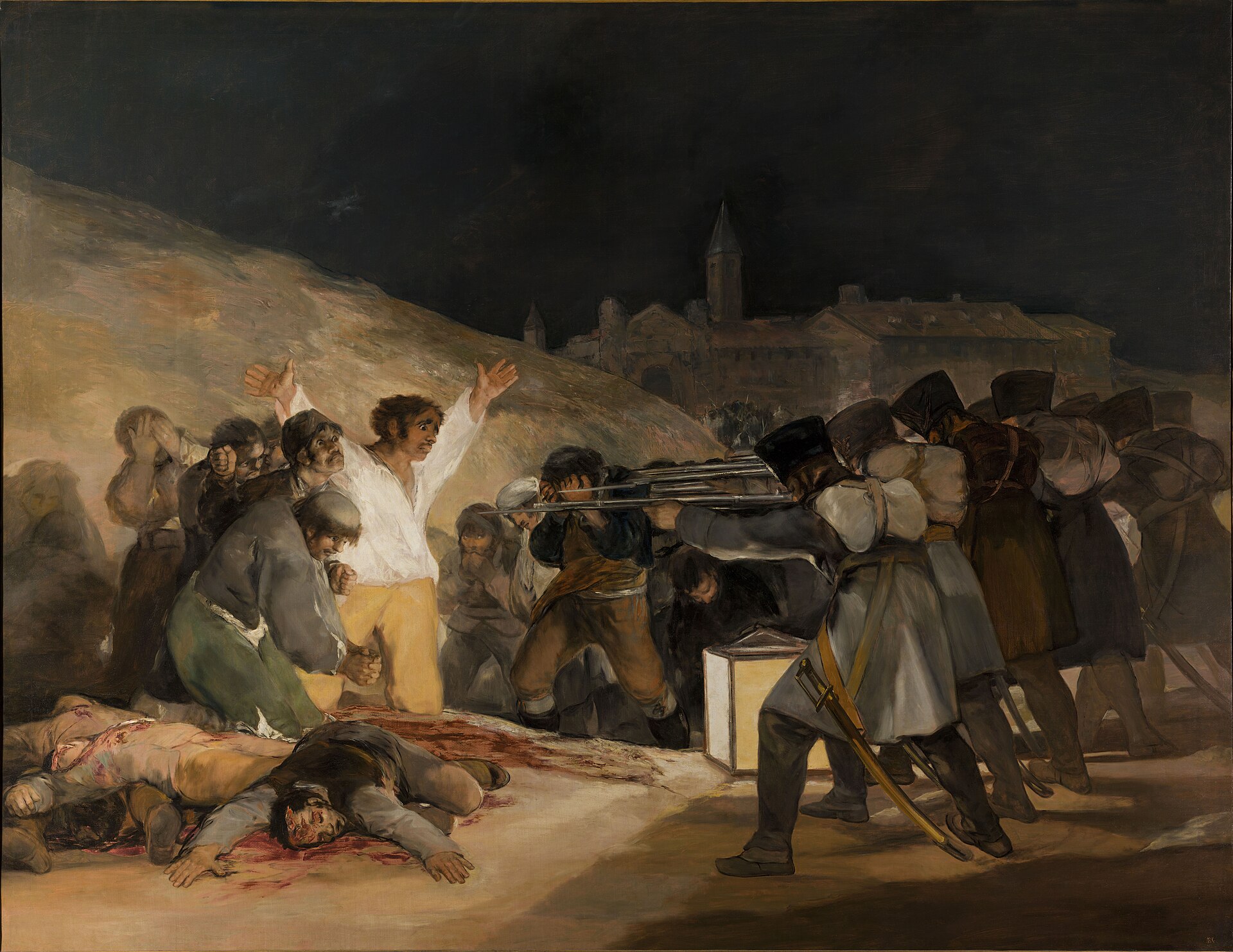
Proposes and paints The Third of May 1808 for the restored government of Ferdinand VII.6
Summoned before an Inquisition tribunal to answer for the two Maja paintings; not prosecuted.3
Buys the property near Madrid already known locally as the Quinta del Sordo.1
Begins painting the Black Paintings directly onto the plaster walls of the house (to c. 1823).2
Leaves Spain for Bordeaux, disillusioned with the restored Ferdinand VII regime.1
Dies in Bordeaux, 16 April, following a stroke. Antonio Brugada makes the first documented listing of the Black Paintings the same year.12
The two Maja paintings pass from Inquisition sequestration to the Academy of Fine Arts of San Fernando.3
The Academy of San Fernando publishes the first public edition of Los Desastres de la Guerra, 35 years after Goya's death.10
Salvador Martinez Cubells transfers the Black Paintings from plaster to canvas for owner Baron Frederic Emile d'Erlanger.2
D'Erlanger donates all fourteen Black Paintings to the Spanish state; they enter the Prado.2
The two Maja paintings enter the Museo del Prado.3
Goya's remains repatriated to Madrid; the skull is found missing from the coffin.1
Pierre Gassier and Juliet Wilson-Bareau publish the standard catalogue raisonne (French edition; English translation 1971).11
Juan Jose Junquera publishes research questioning the authenticity of the Black Paintings' attribution.212
Manuela Mena strips the Goya attribution from The Colossus at the Prado, attributing it to the apprentice Asensio Julia.13
Fundacion Botin and the Museo del Prado agree a new five-volume catalogue raisonne of Goya's drawings.16
The Prado quietly relabels The Colossus 'attributed to Goya', without a public statement.13
25 January: a pair of 1805 Goya portraits sells at Christie's New York for a reported record 16.4 million dollars with premium.8
The Hispanic Society Museum and Library opens a Goya Research Center in New York, ahead of the 2028 bicentenary of his death.14
The clearest recent Goya benchmark is a paired 1805 portrait sale, hammer separated from premium and both reported. Older headline figures circulating in the trade press for a bullfight scene, a single portrait and a drawing are carried here as reported, not independently confirmed against primary sale records, and are flagged for that reason.
| Date | Sale | Work | Result | Note |
|---|---|---|---|---|
| 25 January 2023 | Christie's | Portrait of Dona Maria Vicenta Barruso Valdes and Portrait of her mother Dona Leonora Antonia Valdes de Barruso (pair, 1805) | Hammer USD 14,000,000 With premium USD 16,400,000 USD | Old Masters sale, New York. Reported as a new auction record for Goya. Sold with a third-party guarantee, meaning a party had already contracted to buy at a set minimum before the sale. |
| 9 December 1992 | Sotheby's | Bullfight scene | With premium USD 7,400,000 USD | Bought by the J. Paul Getty Museum. Reported figure from secondary trade coverage; hammer/premium split not confirmed in the sources consulted and should be checked against Sotheby's own sale record. |
| 2009-07 | Sotheby's | Portrait (unspecified sitter in sources consulted) | With premium USD 4,300,000 USD | Reported figure from secondary trade coverage, not independently confirmed. Sitter and exact date not established in the sources consulted. |
| 2011 | Christie's | Drawing (unspecified subject in sources consulted) | With premium USD 3,600,000 USD | Reported figure from secondary trade coverage, not independently confirmed. |
Hammer is the price at which the bidding stopped; with premium adds the fee the house charges the buyer on top. Hammer price and buyer's premium in the glossary.
| Institution | City | Holdings | Note |
|---|---|---|---|
| Museo Nacional del Prado | Madrid | The core Goya collection: the Black Paintings, both Majas, Charles IV and His Family, The Third of May 1808, The Colossus, and around 620 drawings including the Italian Sketchbook. | Goya galleries (rooms 32-38) and the eighteenth-century rooms have been under a phased reorganization since 2025. |
| Hispanic Society Museum and Library | New York | Four paintings including the 1797 Duchess of Alba portrait, thirteen drawings, some 800 prints. | Home to the Goya Research Center, opened 2024. |
| Metropolitan Museum of Art | New York | Over 500 Goya works across paintings, drawings and prints, including complete or near-complete Caprichos, Desastres and other print series in CC0-released photography. | Source of the CC0 plates reproduced in this maker's gallery. |
| Real Academia de Bellas Artes de San Fernando | Madrid | Self-Portrait in the Studio, c. 1795, reproduced as this maker's portrait below. | |
| Frick Collection | New York | Goya portraits. | Staff represented on the Hispanic Society's Goya Research Committee. |
Goya was born in Fuendetodos, a small village in Aragon, on 30 March 1746, the son of Jose Benito de Goya y Franque, a master gilder who worked on retables and other religious and decorative...
Goya was born in Fuendetodos, a small village in Aragon, on 30 March 1746, the son of Jose Benito de Goya y Franque, a master gilder who worked on retables and other religious and decorative commissions. The family later lived in Zaragoza, where Goya trained from about age fourteen under the painter Jose Luzan before studying with the court painter Anton Raphael Mengs in Madrid.
On 25 July 1773 he married Josefa Bayeu, sister of the established court painter Francisco Bayeu, who had taught him and who used his position to help place Goya's early work. The marriage connected an ambitious provincial painter directly to the Madrid academy and the royal tapestry works, and it is Bayeu's patronage, as much as any single painting, that explains how quickly Goya's court career accelerated in the 1780s. Of eight children born to the marriage only one, Francisco Javier Goya, survived to adulthood; Josefa died in 1812.
Goya's rise through the royal painting establishment is documented step by step: designer to the Royal Tapestry Factory from the mid-1770s, painter to King Charles III from 1786, court painter to...
Goya's rise through the royal painting establishment is documented step by step: designer to the Royal Tapestry Factory from the mid-1770s, painter to King Charles III from 1786, court painter to Charles IV from 1789, director of painting at the Royal Academy of Fine Arts of San Fernando from 1795, and Primer Pintor de Camara, the highest rank at court, in 1799. He held that rank through the French occupation, the restoration of Ferdinand VII in 1814, and the reactionary purges that followed it, which is itself a fact worth sitting with: the painter of the Black Paintings and the Disasters of War etchings was, on paper, a compliant royal servant for most of his working life.
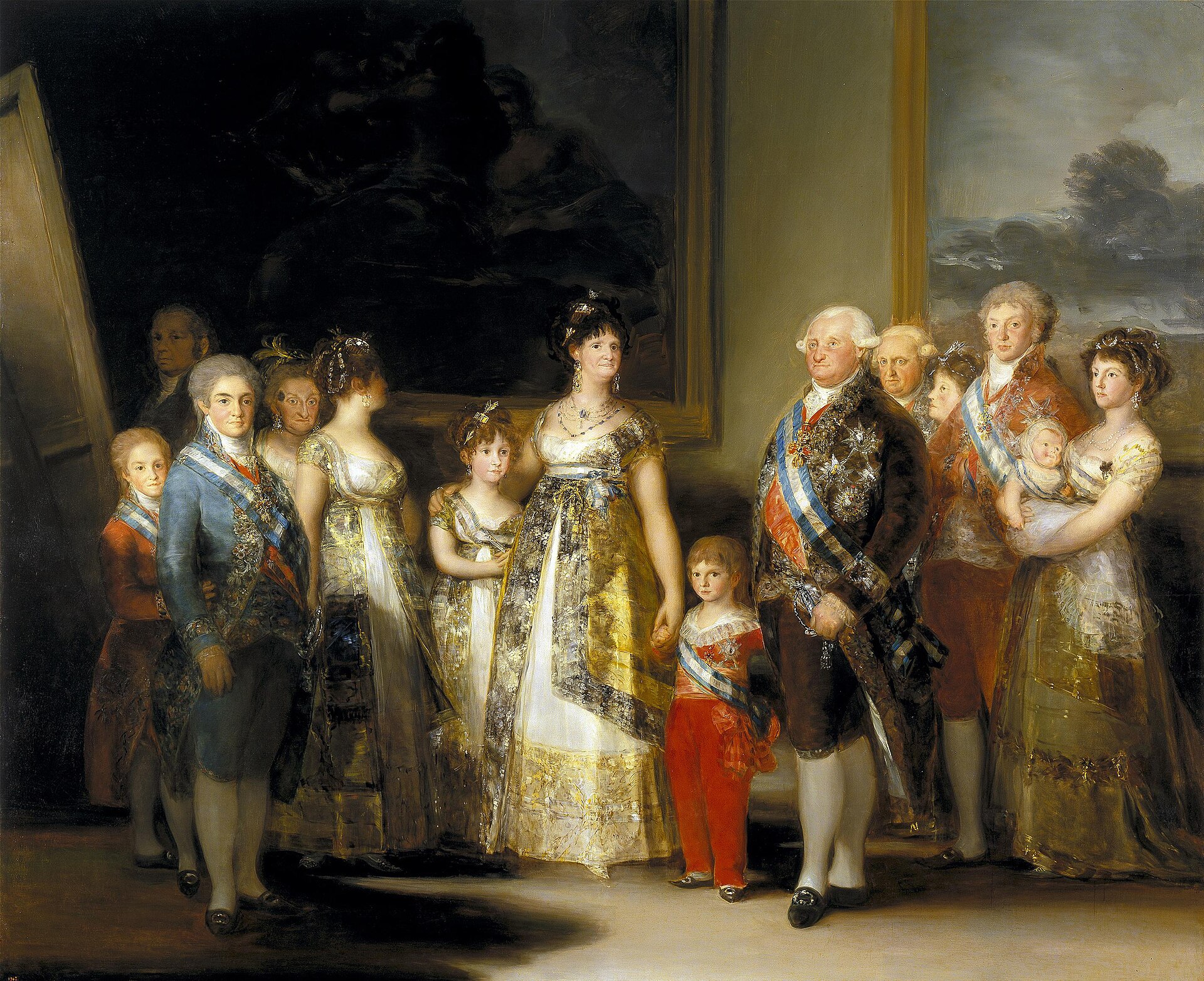
The single most disputed painting from this court period is Charles IV and His Family (1800-1801), 280 by 336 cm, showing fourteen life-sized figures including the king, Queen Maria Luisa, their children, and Goya himself in shadow at the left edge, modeled on Velazquez's Las Meninas. The nineteenth-century French writer Theophile Gautier called it a picture of the corner grocer who has just won the lottery, reading it as covert mockery of an unattractive royal family. The critic Robert Hughes rejected that reading directly, arguing that a working court portraitist did not keep his position by satirizing his patrons and that the picture is closer to an act of respect verging on flattery. Both readings are current in the literature and this record takes neither side; the picture is unusual enough, and famous enough, to have generated a genuine and unresolved dispute about intention.
In the winter of 1792 into 1793 Goya suffered an undiagnosed illness that left him permanently deaf.
In the winter of 1792 into 1793 Goya suffered an undiagnosed illness that left him permanently deaf. Contemporary accounts describe noises in his head and severe balance problems during the acute phase; later medical writers have proposed viral encephalitis, lead poisoning from his own paint materials, Meniere's disease and a series of small strokes, and none of these has been confirmed against the surviving record. What is not disputed is the outcome: a working court painter in his mid-forties lost his hearing entirely and never recovered it, and the private work he made afterward is markedly darker and more pessimistic than what came before.
The house he bought in 1819 on the outskirts of Madrid was already known locally as the Quinta del Sordo, the deaf man's villa, after an earlier deaf owner, before Goya moved in and made the name inescapably his own.
Los Caprichos, eighty aquatint and etching plates satirizing superstition, clerical corruption, arranged marriage and social folly, was advertised for sale in the Diario de Madrid in February 1799.
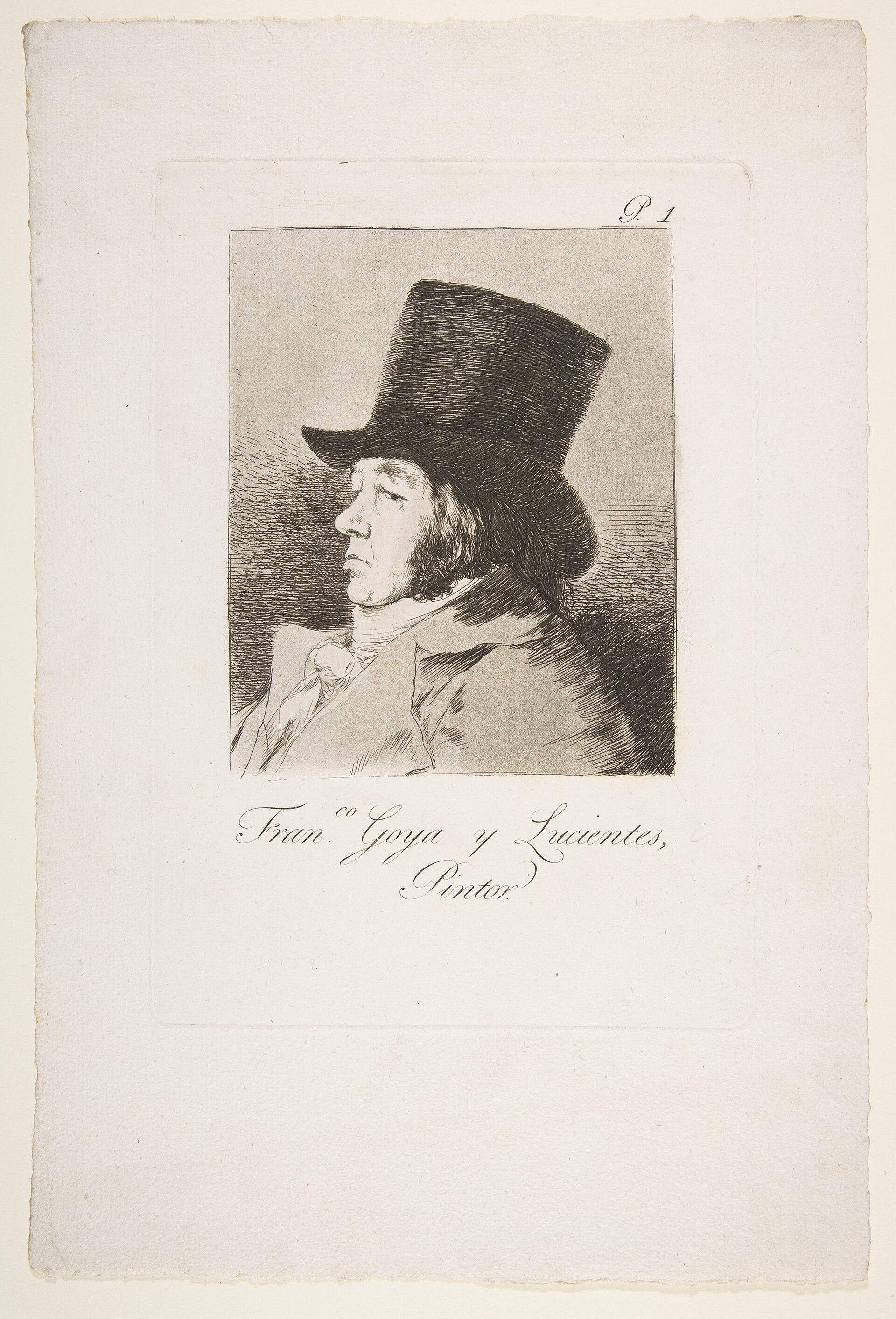
Los Caprichos, eighty aquatint and etching plates satirizing superstition, clerical corruption, arranged marriage and social folly, was advertised for sale in the Diario de Madrid in February 1799. Goya withdrew the unsold stock from sale after roughly two weeks, out of concern that the series would draw the attention of the Inquisition; of an edition of around 300 sets printed, only about 27 had sold to the public in that window, leaving some 240 unsold. This record's parent object, Plate 43, The Sleep of Reason Produces Monsters, was originally planned as the frontispiece of the whole series before Goya rearranged the sequence and put a self-portrait, Plate 1, in that position instead - a plate held in this maker's own gallery below.
In 1807 Goya arranged to give the plates themselves, along with the 240 unsold impressions, to the Royal Calcography in exchange for a lifetime pension of twelve thousand reales a year for his son Javier. That transaction is the reason Los Caprichos exists today in two entirely different markets: a small number of rare 1799 first-edition sets on laid paper in sepia ink, printed before the aquatint grounds began to wear, and a long run of posthumous editions - the Calcografia issued further editions through the nineteenth and twentieth centuries on wove paper, thirteen documented official editions in total between 1799 and 1970 - pulled from the same worn and eventually steel-faced plates. The two are not interchangeable as objects and a cataloguer who does not separate them is missing the single fact print specialists check first.
Los Caprichos did not come out of nowhere.
Los Caprichos did not come out of nowhere. Goya was a documented friend of Gaspar Melchor de Jovellanos, the statesman and man of letters who was one of the central figures of the Spanish Enlightenment; Jovellanos sat for a portrait by Goya shortly after his own appointment to the Royal Academy of San Fernando, and their friendship is treated in the scholarly literature as a real channel through which Enlightenment ideas about superstition, clerical abuse and arranged marriage reached the print series - the same targets Los Caprichos actually satirizes. One specialist study reads Capricho 43 itself, this maker's parent plate, against a second, later Goya portrait of Jovellanos, arguing the two works comment on each other as the Spanish Enlightenment project came under political pressure in the 1790s; this record cites that argument as a named scholarly position and has not verified its detail beyond the citation, since the article sits behind a paywall this research could not get past.
A separate and more speculative claim concerns Freemasonry. The scholar Reva Wolf has argued, in a 2020 essay reviewed in the journal Nineteenth-Century Art Worldwide, that pictographic symbols in Goya's letters to his lifelong friend Martin Zapater - a thumb to the nose, an eye, ear and mouth lined up in a row - parallel Masonic hand signs and imagery of the period, and that Goya moved in Masonic and Enlightenment circles. The reviewer calls the essay well researched but is explicit about what is missing: no lodge register, membership list or other document naming Goya as a Mason has ever surfaced, and the case rests entirely on circumstantial resemblance in his correspondence. This record follows the same line the reviewer draws - the friendship with Jovellanos and Goya's presence in Enlightenment circles are documented; a specific Masonic membership is argued by a named scholar and unproven, not documented, and is stated here as exactly that.
The eighty plates of Los Desastres de la Guerra were made during and immediately after the Peninsular War, roughly 1810 to 1820, recording French army atrocities, famine in Madrid, and the violence...
The eighty plates of Los Desastres de la Guerra were made during and immediately after the Peninsular War, roughly 1810 to 1820, recording French army atrocities, famine in Madrid, and the violence of the Spanish resistance with no attempt to flatter either side. Goya never published the series. When he left for Bordeaux around 1824 the copperplates stayed with his son Javier; after Javier's death in 1854 they passed to the Royal Academy of San Fernando, which prepared and issued the first public edition in 1863, thirty-five years after Goya's death, in a run of roughly 500 sets on wove paper carrying JGO and palmette watermarks. A handful of trial proofs pulled before that official edition survive and are the most sought-after impressions of the series; nothing in the sources consulted for this record establishes how many.
La maja desnuda and its pendant La maja vestida, both oil on canvas, roughly 97 by 190 cm, were painted between about 1797 and 1800 for Manuel Godoy, the royal favourite and chief minister who...
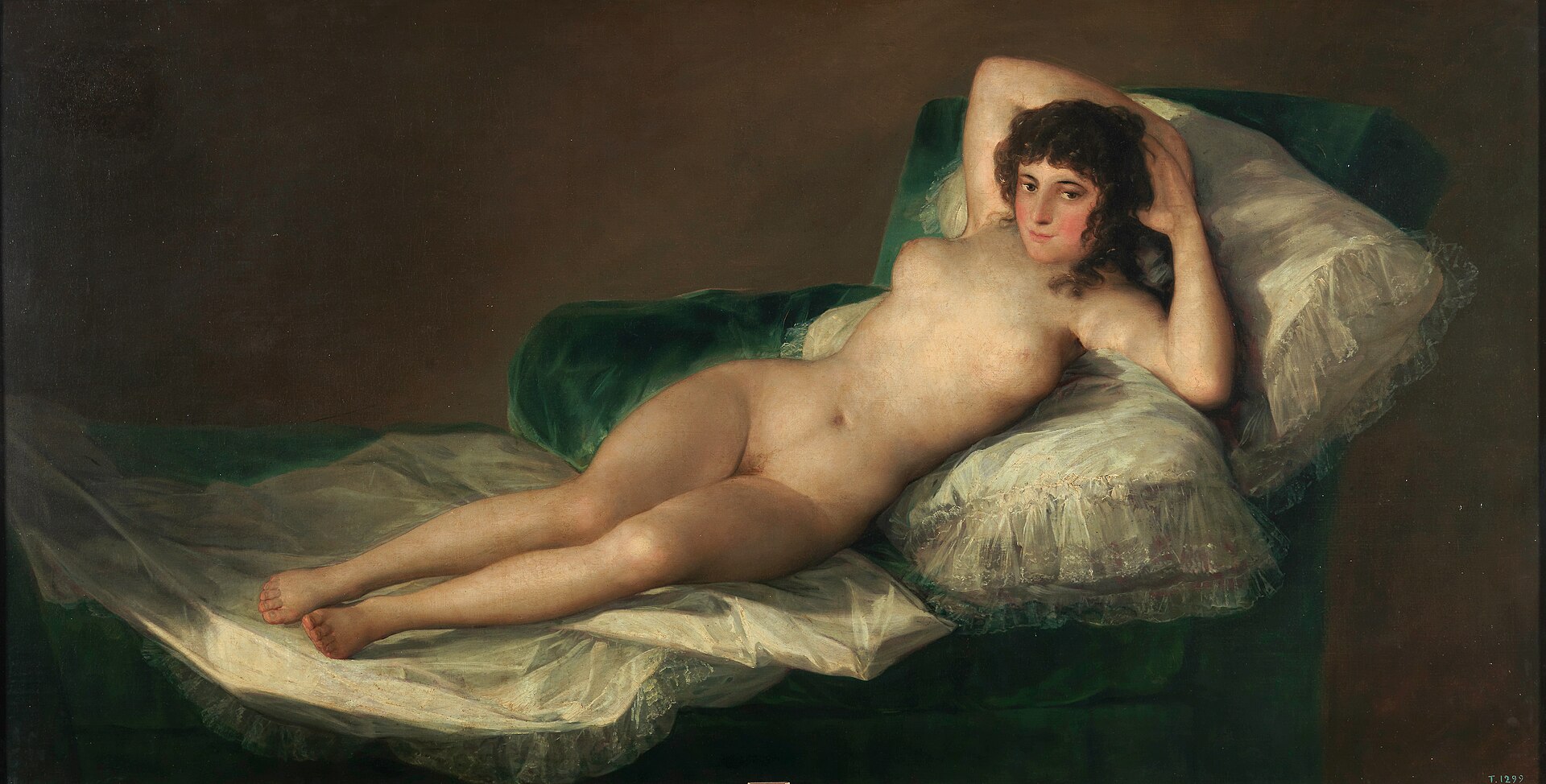
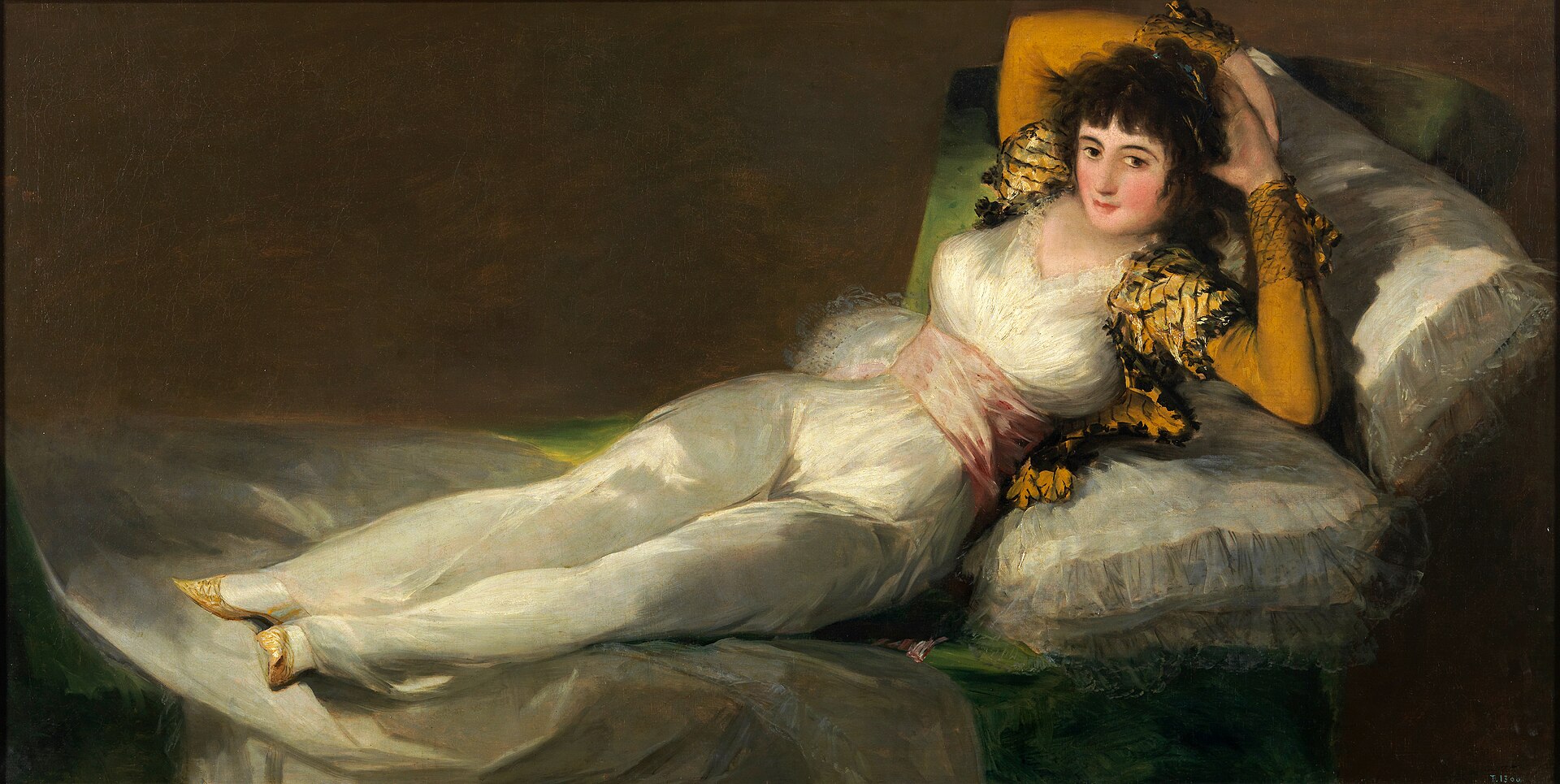
La maja desnuda and its pendant La maja vestida, both oil on canvas, roughly 97 by 190 cm, were painted between about 1797 and 1800 for Manuel Godoy, the royal favourite and chief minister who effectively ran Spain under Charles IV. After Godoy's fall from power in 1808 his collection, including the two Majas, was seized. In 1815 the Spanish Inquisition, which had confiscated the paintings as obscene works, summoned Goya to explain them: an Inquisition record states that he was asked why he had painted them and at whose commission. Goya's defence, as the surviving account of the hearing has it, rested on precedent - that royally and ecclesiastically sanctioned collections already held nude paintings by Titian and Velazquez - and he was not prosecuted. The paintings themselves remained under Inquisition sequestration until 1836, when they passed to the Academy of Fine Arts of San Fernando; they entered the Prado in 1901 and hang there today as a pair.
Who modeled for the nude Maja has never been settled. The Duchess of Alba is the identification most often repeated in popular accounts, but the Prado's own scholarship and the critic Robert Hughes both reject it; the likelier candidate on the documentary record is Pepita Tudo, Godoy's own mistress, though a number of specialists treat the figure as an idealized composite rather than a portrait of any one sitter. This record states the dispute rather than choosing a side, because no source consulted resolves it.
Maria del Pilar Teresa Cayetana de Silva, 13th Duchess of Alba (10 June 1762 - 23 July 1802), sat for Goya on at least two occasions that survive: a 1795 full-length portrait in white now known as...
Maria del Pilar Teresa Cayetana de Silva, 13th Duchess of Alba (10 June 1762 - 23 July 1802), sat for Goya on at least two occasions that survive: a 1795 full-length portrait in white now known as The White Duchess, held at the Palacio de Liria in Madrid, and a second full-length portrait of 1797, the so-called Black Duchess, now at the Hispanic Society of America in New York and reproduced in this maker's gallery below. In the second picture the Duchess wears two rings, one inscribed Alba and the other Goya, and points down at an inscription in the sand at her feet reading Solo Goya, only Goya - a passage that a later restoration is reported to have partly re-revealed after old varnish had obscured the word Solo. Goya stayed at her household in Sanlucar de Barrameda in 1796-97 following the death of her husband, and the surviving letters and drawings from that stay, together with the intimacy of the two portraits, have fed a persistent rumour of a love affair between the painter and one of the richest women in Spain. No document proves it, and this record does not assert it as fact; the paintings, the inscriptions and the visit are documented, the romance is not.
The Duchess died at forty in 1802. The stated cause was tuberculosis and fever; a persistent alternative account holds that she was poisoned, and an inquiry ordered by Charles IV is reported to have reached no conclusive finding. The sources consulted for this record do not establish who, if anyone, was formally suspected, and the poisoning claim should be read as an enduring rumour rather than an established fact.
Goya proposed the painting himself to the restored government of Ferdinand VII in 1814, offering, in his own written request, to perpetuate by means of his brush the most notable and heroic actions...
Goya proposed the painting himself to the restored government of Ferdinand VII in 1814, offering, in his own written request, to perpetuate by means of his brush the most notable and heroic actions of the insurrection against Napoleon's occupation. The result, The Third of May 1808, oil on canvas, 268 by 347 cm, shows the mass execution of Madrid civilians and rebels by a French firing squad on 3 May 1808, the night after the city's uprising. The central victim, lit in white and yellow against the dark of the firing squad, raises his arms in a pose read since as a deliberate echo of the crucifixion, his palm marked in a way commentators have compared to a stigma; a lantern set on the ground between the condemned and the soldiers lights the scene from an angle no natural source could produce, doing symbolic rather than descriptive work.
Despite the commission, the picture did not become the celebrated national image it is now for decades. It surfaces in a Prado inventory only in 1834 and was not formally catalogued until 1872, a gap consistent with the more conventional taste of Ferdinand VII's restored court and its discomfort with a painting that memorializes a popular insurrection rather than royal authority. Its later influence is well documented and specific: Manet's Execution of Emperor Maximilian and Picasso's Guernica both work from its composition directly.
Between about 1819 and 1823, in the house he had bought on the outskirts of Madrid, Goya painted directly onto the plaster walls of two ground-floor rooms: fourteen compositions, unsigned, undated...
Between about 1819 and 1823, in the house he had bought on the outskirts of Madrid, Goya painted directly onto the plaster walls of two ground-floor rooms: fourteen compositions, unsigned, undated, untitled by him and never explained in any surviving letter, that later cataloguers named the Black Paintings. Saturn Devouring His Son, reproduced in this maker's gallery below, is the best known of the set. Goya's own contemporary Antonio Brugada made the first documented listing of the murals in 1828, the year of Goya's death.
The murals stayed on the walls for half a century. In 1874 the restorer Salvador Martinez Cubells carried out the technically difficult transfer of the paintings from plaster to canvas for the property's then-owner, Baron Frederic Emile d'Erlanger; the process caused real and visible losses, and the set was shown at the 1878 Paris World's Fair before d'Erlanger donated all fourteen to the Spanish state in 1881. They have hung at the Prado since.
In 2003 the art historian Juan Jose Junquera published research arguing that the paintings cannot all be Goya's own work in the form usually assumed. His case rests on contemporary property deeds for the Quinta del Sordo, which he reads as describing a single-storey house at the time Goya owned it; if the upper floor - which carried seven of the fourteen murals - was added only after Goya's death, Junquera argues, someone other than Goya must have painted at least that portion, and he has proposed Goya's son Javier as the likelier author, with Goya's grandson Mariano responsible for presenting the work as his grandfather's. The Prado has not revised its attribution and continues to catalogue all fourteen as autograph. The scholar most identified with the rebuttal is Nigel Glendinning, who challenged Junquera's reading of the property documents in print and in lectures in Madrid; this record has not been able to consult Glendinning's rebuttal directly and flags it, alongside Junquera's own 2003 book, for a reader who wants the primary exchange rather than the secondary account relied on here.
Goya left Spain for France in 1824, settling in Bordeaux disillusioned by the reactionary turn of Ferdinand VII's restored monarchy after 1814.
Goya left Spain for France in 1824, settling in Bordeaux disillusioned by the reactionary turn of Ferdinand VII's restored monarchy after 1814. He lived there with Leocadia Weiss, some thirty-five years his junior, and her daughter Rosario, until his death on 16 April 1828 at eighty-two, following a stroke. When his remains were repatriated to Madrid in 1919 the skull was found to be missing from the coffin; the Spanish consul in Bordeaux cabled the fact to Madrid and was told to send Goya, with or without the head. The remains, headless, were reinterred at the Ermita de San Antonio de la Florida, the chapel Goya himself had frescoed decades earlier.
The standard reference for Goya's full output remains Pierre Gassier and Juliet Wilson-Bareau's The Life and Complete Work of Francisco Goya, with a catalogue raisonne of the paintings, drawings and...
The standard reference for Goya's full output remains Pierre Gassier and Juliet Wilson-Bareau's The Life and Complete Work of Francisco Goya, with a catalogue raisonne of the paintings, drawings and engravings, published in French in 1970 and in English translation in 1971 - now over half a century old in a field where several major attributions have moved since. A separate, more recent scholarly project addresses the drawings specifically: the Fundacion Botin and the Museo del Prado signed a collaborative agreement in 2014 to produce a new catalogue raisonne of Goya's roughly 850 surviving drawings, issued in five volumes as Francisco de Goya: Dibujos. The Prado alone holds some 620 of those drawings, including the Italian Sketchbook, the largest single collection of Goya works on paper anywhere.
No single figure in the sources consulted states an exact current count of paintings accepted as autograph against those historically attributed to him; this is itself the finding recorded in open_questions below, and it is the reason the Colossus case and the Hispanic Society research committee, both covered in this record, matter as much as they do.
The Colossus, a painting of a giant looming over a fleeing crowd, entered the Prado in 1931 from the estate of Pedro Fernandez Duran and was long read as Goya's own response to the French occupation.
The Colossus, a painting of a giant looming over a fleeing crowd, entered the Prado in 1931 from the estate of Pedro Fernandez Duran and was long read as Goya's own response to the French occupation. In 2008 Manuela Mena, then the Prado's Goya specialist, argued in print that the painting was, in her words, a botched job by Asensio Julia, an obscure apprentice, citing the initials A.J. that she identified in one corner of the canvas; the museum removed Goya's name from the label. The change was controversial from the outset - the attribution to Goya had already been questioned as early as 1992, after conservation work, but never formally reversed until Mena's 2008 intervention - and after Mena retired in 2018 other Prado curators pressed to restore it.
In 2021, without a public statement, the Prado quietly relabelled the painting attributed to Goya, a phrasing chosen, according to a museum source quoted by the Independent, to reflect ongoing debate rather than to reinstate a full autograph attribution. Mark McDonald, curator of the Metropolitan Museum's 2021 exhibition Goya's Graphic Imagination, argued publicly around the same date that there is no consensus on the picture's authorship but growing support for returning it to Goya, on the reasoning that Goya's related aquatint print Seated Giant is more plausibly the source for a studio copy than the reverse. The critic Peio H. Riano criticized the Prado in El Diario for making the change, in his words, without giving any explanation, folding it into an unrelated gallery reorganization rather than announcing it. This record states what each named party said and does not resolve the dispute; none of the sources consulted does.
In July 2024 New York's Hispanic Society Museum and Library opened a Goya Research Center inside its library reading room, ahead of the bicentenary of Goya's death in 2028.
In July 2024 New York's Hispanic Society Museum and Library opened a Goya Research Center inside its library reading room, ahead of the bicentenary of Goya's death in 2028. Its director, Guillaume Kientz, formerly nine years a curator of Spanish and Latin American art at the Louvre, framed the need for it in blunt terms: there are, he said, some seventy Goya paintings in United States museum collections alone, a corpus on the scale of Leonardo, Michelangelo or Rembrandt, served by what he called just a handful of scholars. The center's founding Goya Research Committee draws on New York museum staff by name - Dorothy Mahon of the Metropolitan Museum of Art, John Marciari of the Morgan Library and Museum, Xavier F. Salomon of the Frick Collection and Lisa Small of the Brooklyn Museum - and Kientz has named contested attribution, including paintings in the Hispanic Society's own collection no longer believed autograph, as one of the committee's first priorities, alongside provenance research. The center runs on an annual budget of 200,000 dollars.
The Hispanic Society's own Goya holdings - four paintings, thirteen drawings and around 800 prints, including the 1797 Duchess of Alba portrait reproduced in this maker's gallery - make it one of the largest concentrations of Goya's work outside Spain, and the frank admission that some of its own paintings are ripe for reevaluation is a useful corrective to any assumption that a major institution's own attributions are settled simply because they hang on its walls.
Two brothers from Girona, Catalonia, bought a painting in 2003 described to them as a genuine Goya portrait of the Spanish painter Antonio Maria Esquivel, backed by a certificate of authenticity.
Two brothers from Girona, Catalonia, bought a painting in 2003 described to them as a genuine Goya portrait of the Spanish painter Antonio Maria Esquivel, backed by a certificate of authenticity. In 2006 experts examined it at the request of a Girona court and found it to be a nineteenth-century forgery, not a work by Goya at all; the court allowed the brothers to keep the picture for the 20,000 euros they had already paid on deposit rather than requiring the full 270,000 euros originally agreed. In December 2014, still holding the same painting and the same certificate, the brothers attempted to sell it to a supposed buyer for 4 million euros; an intermediary took a 300,000-euro commission from them in Turin and paid them in counterfeit Swiss francs, discovered only when they tried to bank it in Geneva. Both the buyer and the intermediary vanished; the brothers were arrested on returning to Spain and the painting was confiscated. No party in the reporting consulted is named as convicted of anything beyond the original fraud attempt, and the case is documented here as a forgery-detection story, not as an accusation against any living person.
A second, unrelated case in April 2023 is more typical of how careless Goya forgery can be: Valencia's regional Historic Heritage police seized five paintings, four of them offered as Goya portraits, that suspects were attempting to sell for a combined 76 million euros. Two of the supposed Goyas turned out to be simple cropped copies of full-length portraits actually painted in 1765 by the German court painter Anton Raphael Mengs - Goya's own teacher - of the future Charles IV and his bride; specialists who examined the other two, religious scenes, judged one stylistically closer to Italian painters active a century before Goya's birth and doubted a trained hand made the other at all. No arrests had been made in the reporting consulted, and the suspects are not named in this record.
The clearest recent benchmark for Goya at auction is the 25 January 2023 Christie's Old Masters sale in New York, where a pair of 1805 portraits - Dona Maria Vicenta Barruso Valdes, seated with a...
The clearest recent benchmark for Goya at auction is the 25 January 2023 Christie's Old Masters sale in New York, where a pair of 1805 portraits - Dona Maria Vicenta Barruso Valdes, seated with a lapdog, and her mother Dona Leonora Antonia Valdes de Barruso, seated with a fan - sold together on a hammer of 14,000,000 dollars, or 16,400,000 dollars with premium, a price reported as a new auction record for the artist. The lot carried a third-party guarantee, meaning a private party had contracted before the sale to buy at a minimum price regardless of the room, which typically indicates the house's own confidence in the estimate rather than genuine open bidding risk; this record notes the mechanism rather than treating the headline price as an unassisted market result. Earlier benchmarks reported in the trade press - a Bullfight scene bought by the J. Paul Getty Museum for 7.4 million dollars at Sotheby's in December 1992, a portrait at 4.3 million dollars at Sotheby's in July 2009, and a drawing at 3.6 million dollars at Christie's in 2011 - are carried here as reported figures from secondary trade sources and flagged for confirmation against the auction houses' own primary sale records, which this research did not directly consult.
Painter; Printmaker; Etcher. 1746-1828.
Born 30 March 1746, Fuendetodos, Aragon, Spain; died 16 April 1828, Bordeaux, France.
The Girona 'Portrait of Antonio Maria Esquivel'. Two brothers bought the painting in 2003 as a genuine Goya, backed by a certificate of authenticity, for an agreed 270,000 euros.
Museo Nacional del Prado (Madrid); Hispanic Society Museum and Library (New York); Metropolitan Museum of Art (New York); Real Academia de Bellas Artes de San Fernando (Madrid); Frick Collection (New York).
The clearest recent Goya benchmark is a paired 1805 portrait sale, hammer separated from premium and both reported. Older headline figures circulating in the trade press for a bullfight scene, a single portrait and a drawing are carried here as reported, not independently confirmed against primary sale records, and are flagged for that reason.
No source consulted for this record gives a current, dated count of paintings now accepted as autograph against the total historically attributed to Goya. The Hispanic Society's 2024 Goya Research Center exists specifically because this number is unsettled.
Last verified
One artwork and its story every Tuesday, with the picture: who owned it, what it made, and what closes soon in the exhibition calendar. No promotion, and nothing we cannot cite.
We send one email to confirm the address and keep nothing else. Every letter carries a one-click unsubscribe. How we handle your data.