Plate 69 from "The Disasters of War" (Los Desastres de la Guerra): "Nothing. It will say so" (Nada. Ello dira)
Francisco de Goya y Lucientes · Etched c. 1814-1815; plate first published 1863
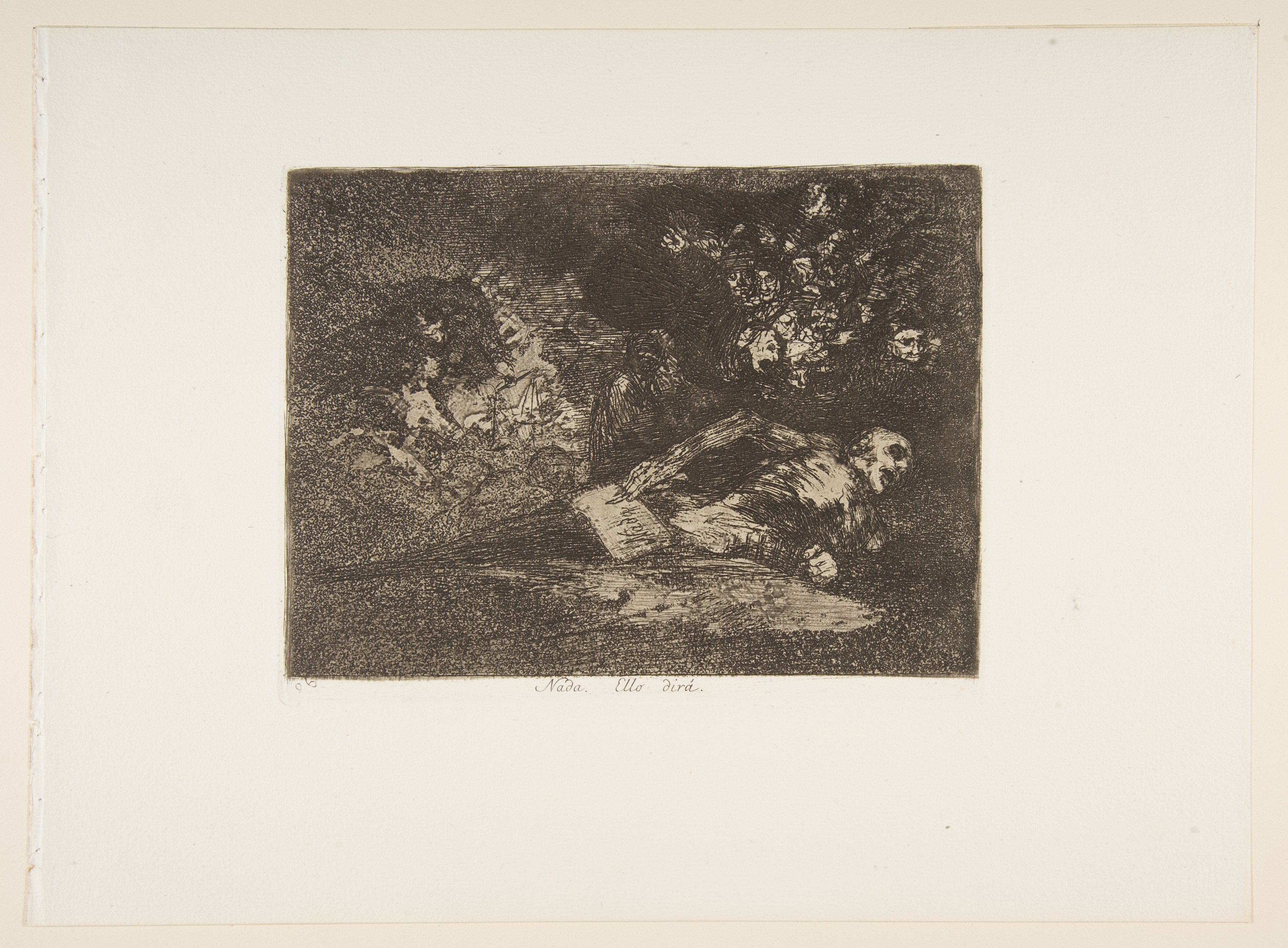
The record subject. Etching, burnished aquatint, lavis, drypoint and burin, plate 15.3 x 19.9 cm. Purchased by the Metropolitan Museum in 1922 with funds from the Jacob H. Schiff bequest.
| Artist | Francisco de Goya y Lucientes |
|---|---|
| Date | Etched c. 1814-1815; plate first published 1863 |
| Medium | Etching, burnished aquatint, lavis, drypoint and burin |
| Dimensions | Plate: 15.3 x 19.9 cm (6 x 7 13/16 in.); Sheet: 25.2 x 34.5 cm (9 15/16 x 13 9/16 in.) |
| Where it is now | Metropolitan Museum of Art, New York (Department of Drawings and Prints)last confirmed 18 September 2026 |
| Inventory number | 22.60.25(69) |
| Attribution | AcceptedUndisputed autograph work. Full note |
| Object type | |
| Period | Spanish, early nineteenth century |
| Cases | Has a provenance gap |
| Inscriptions | Engraved caption below the image, "Nada. Ello dira", and the plate number "69" within the series as issued by the Real Academia de Bellas Artes de San Fernando in 1863. |
| Owners on record | 6 links4 documented, 2 unknown |
| Sources | 12 cited |
About this record Last verified 18 September 2026 · 12 sources cited · Change log
On this page 9 sections
ContentsClose
A corpse rises just far enough to write a single word, "Nada", and the Real Academia de Bellas Artes de San Fernando engraved it, in 1863, as a promise: "Nothing. It will say so." Goya's own handwritten caption, on the one complete set of proofs he gave a friend in his lifetime, says something narrower and more finished: "Nothing. That is what it says." The difference between those two tenses is documented, not invented, and this plate, the sixty-ninth of eighty etched during and after the Peninsular War and withheld from publication until thirty-five years after Goya's death, is one of the places scholars point to it.
This impression entered the Metropolitan Museum of Art in 1922, bought with funds from the estate of the banker Jacob H. Schiff, two years after his death. It is a separate, later printed sheet, not the artist's own proof, and the strongest evidence available ties it to the Academy's first, 1863 edition only by way of a companion plate from the same purchase lot, not by a catalogue number recorded for this plate itself.
Read against the plate immediately before it and the plate that closes the series, plate 69 sits at the hinge between the Disasters' documentary plates and its final, allegorical argument about what survived the war. Goya gave that argument a single unresolved word, and the record here holds the two forms its caption has taken and the scholarship built on the difference, rather than fold them into one.
Provenance
Each link is graded. Documented: a cited source supports it. Disputed: the identification is argued but not established. Unknown: no owner for that span, and the gap is not smoothed into a narrative. The grades in the glossary.
- c. 1814-1815 -Francisco de Goya (the artist)documented
Plate etched, aquatinted and worked in drypoint and burin by Goya as part of the larger, unpublished series later known as Los Desastres de la Guerra.15
- c. 1820 - 1828Goya, then his estatedocumented
Goya gave a complete set of proofs of the series, with his own handwritten titles including his caption for this plate, to his friend Juan Agustin Cean Bermudez. He kept the copperplates themselves and never published from them. He died in Bordeaux in 1828 with the series still unpublished.56
- 1828 - 1862Javier Goya (the artist's son), then unclear custodyunknown
The 80 copperplates passed to Goya's son, Javier. The exact custody of the plates between Javier Goya's death, usually dated to 1854, and the Real Academia's documented 1862 acquisition is not detailed in the sources consulted; this interval is recorded as a gap.511
- 1862 - 1863Real Academia de Bellas Artes de San Fernando, Madriddocumented
The Academy acquired the 80 surviving copperplates in 1862 and published the first edition, of about 500 sets, in 1863, thirty-five years after Goya's death.511
- 1863 - 1922unknown intermediate owner(s)unknown
How this specific sheet moved from a Real Academia printing into the market that supplied the Metropolitan Museum in 1922 is not documented in the Museum's own record or in the other sources consulted for this record.1
- 1922 - presentMetropolitan Museum of Art, New Yorkdocumented
Purchased in 1922 using funds from the bequest of the banker and philanthropist Jacob H. Schiff, who died in 1920. The dealer or auction house that supplied the sheet, if any, is not named in the Museum's own online catalogue record.17
Technical evidence
| Attribution note | Undisputed autograph work. The plate is one of the 80 copperplates etched by Goya that passed after his death to the Real Academia de Bellas Artes de San Fernando, which published them under his name in 1863. Goya's own hand is further documented by his manuscript caption for this exact plate, in present tense, on the album of proofs he gave in his lifetime to his friend Juan Agustin Cean Bermudez, now in the British Museum. Nothing about authorship is disputed here; what is genuinely unsettled is the plate's meaning, addressed in the narrative below. |
|---|---|
| Medium | Etching, burnished aquatint, lavis, drypoint and burin.1 |
| Dimensions | Plate 15.3 x 19.9 cm (6 x 7 13/16 in.); sheet 25.2 x 34.5 cm (9 15/16 x 13 9/16 in.).1 |
| Inscription | Engraved caption "Nada. Ello dira" below the image, as set by the Real Academia's 1863 first edition; Goya's own manuscript caption on the Cean Bermudez proof album reads "Nada. Ello lo dice", present tense.18 |
| Series position | Plate 69 of 80 published plates in the portfolio "The Disasters of War" (Los Desastres de la Guerra); one of the closing group of allegorical plates (65-82) known as the caprichos enfaticos.15 |
| Edition | Not stated as such in the Met's own record for this sheet. Inferred, not confirmed, as an impression of the Real Academia's 1863 first edition (approximately 500 sets printed), on the evidence of the companion sheet from plate 66 in the same accession lot and 1922 purchase, catalogued elsewhere as Harris 186.III.1, a first-edition impression.211 |
| Credit line and accession | Purchase, Jacob H. Schiff Bequest, 1922. Accession 22.60.25(69). Met Open Access API confirms isPublicDomain: true.112 |
| Subject classification | Classified by the Met under "Prints", Department of Drawings and Prints, with the subject tag "Corpses".1 |
Images
The record in full
Chapter 1What the print shows
A corpse, half risen from the ground and already decomposing, props itself up on one arm and writes a single word, "Nada" (Nothing), on a sheet of paper.
A corpse, half risen from the ground and already decomposing, props itself up on one arm and writes a single word, "Nada" (Nothing), on a sheet of paper. Behind it, figures with mask-like, indistinct faces emerge from darkness. At the left edge, in the final printed state, a female figure can just be made out holding a set of scales, an attribute of Justice, largely swallowed by the surrounding black aquatint.
The sheet is small, a plate of only 15.3 by 19.9 centimetres on a sheet of 25.2 by 34.5 centimetres, consistent with the other 79 plates of the series: an object made to be looked at closely, one print at a time, not displayed at a distance.
Chapter 2How it was made
The Metropolitan Museum's own catalogue record lists the technique as etching, burnished aquatint, lavis, drypoint and burin, the same combination Goya used across most of the Desastres plates in...
The Metropolitan Museum's own catalogue record lists the technique as etching, burnished aquatint, lavis, drypoint and burin, the same combination Goya used across most of the Desastres plates in their final stage of work. Aquatint gives the broad tonal darkness that swallows the background figures; burnishing lets Goya selectively lighten small areas within that darkness, such as the paper the corpse is writing on; drypoint and burin add the sharper linear work in the foreground figure. It is a printmaking technique built for exactly the kind of image this is: a small patch of legible information isolated inside an otherwise engulfing dark.
Chapter 3A war Goya spent a decade recording and never published
Napoleon's invasion of Spain in 1808 and the uprising and reprisals of the Dos de Mayo touched off the Peninsular War, which Goya lived through as a salaried court painter in a country under...
Napoleon's invasion of Spain in 1808 and the uprising and reprisals of the Dos de Mayo touched off the Peninsular War, which Goya lived through as a salaried court painter in a country under occupation. He began etching the plates that became Los Desastres de la Guerra around 1810 and continued working on them, on the evidence of the plates themselves, until close to 1820, well after the war's end in 1814.
He never published them. He died in Bordeaux in 1828, in self-imposed exile from Ferdinand VII's restored absolutist monarchy, with the 80 finished plates still unpublished. His own manuscript title for the complete album of proofs he assembled reads: "Fatal consequences of Spain's bloody war with Bonaparte, and other emphatic caprices." The plates now grouped as the caprichos enfaticos, including this one, take that second half of the title directly from Goya's own hand.
Chapter 4The famine, and the shape of the series
Los Desastres de la Guerra falls into three parts.
Los Desastres de la Guerra falls into three parts. Plates 1 to 47 record combat and its atrocities: executions, mutilation, rape, reprisal, without consistently assigning blame to either the French or the Spanish side. Plates 48 to 64 record the famine that struck Madrid from August 1811 until the city's liberation by Wellington's forces in August 1812, a famine caused in part by French requisitioning and in part by Spanish guerrilla and bandit activity blocking supply roads into the capital, and that killed an estimated 20,000 people in the city in a single year.
Plate 69 belongs to neither of those groups. It falls in the final section, plates 65 to 82, usually called the caprichos enfaticos, or emphatic caprices, where the series stops documenting specific events and turns allegorical.
Chapter 5The caprichos enfaticos: satire turned on the peace
The war's end in 1814 did not end what Goya had to say.
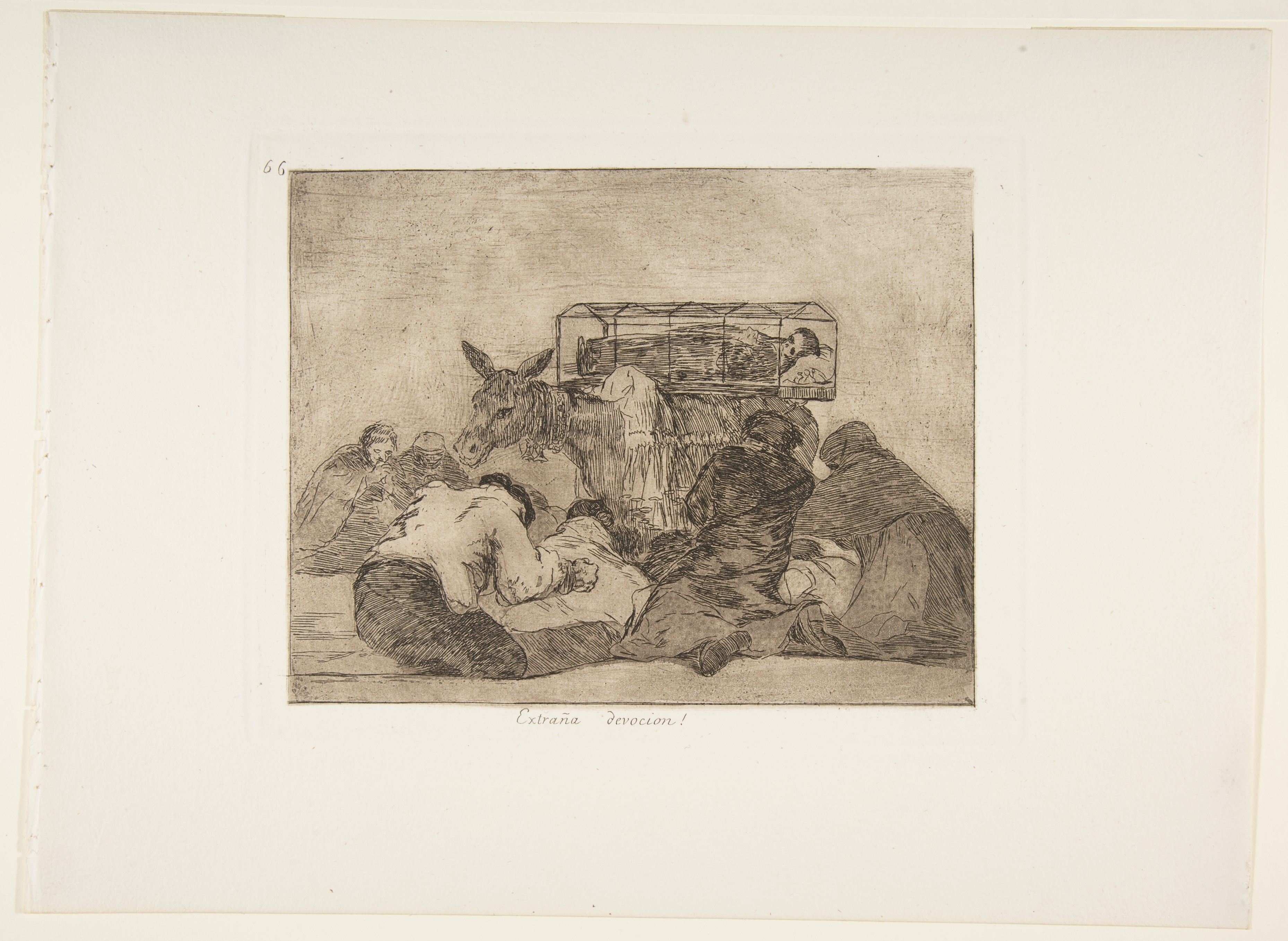
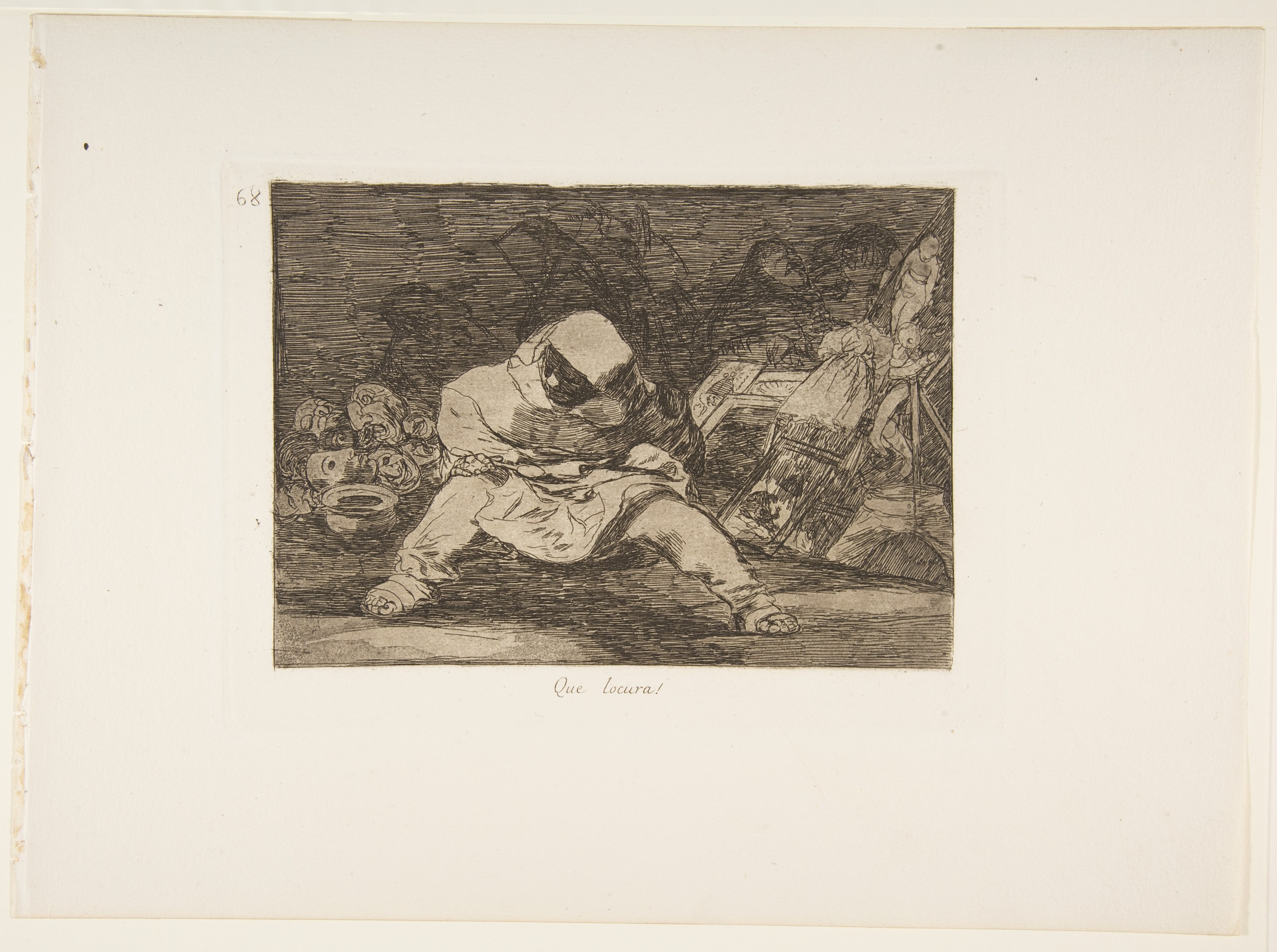
The war's end in 1814 did not end what Goya had to say. Ferdinand VII's restoration brought back absolutist government and the apparatus of the Inquisition, and the final eighteen plates of the Desastres turn their attention there: judicial torture, the clergy, and the political and religious currents of the restored Old Regime, rendered through masked, animal and fable-like imagery rather than reportage. Plate 66, "Strange devotion!", and plate 68, "What madness!", both from this same closing sequence, mock the ceremonial handling of church statuary and devotional practice; plate 69 follows immediately after them.
Chapter 6Two titles for one plate
The plate carries two documented captions, and they are not the same sentence.
The plate carries two documented captions, and they are not the same sentence. On the album of proofs Goya gave in his lifetime to his friend Juan Agustin Cean Bermudez, now in the British Museum, Goya's own handwritten title for this plate is in the present tense: "Nada. Ello lo dice", roughly "Nothing. That is what it says." The engraved caption on the plate as published by the Real Academia de Bellas Artes de San Fernando in 1863 is in the future tense: "Nada. Ello dira", "Nothing. It will say so" or "Nothing. The event will tell."
According to the Fundacion Goya en Aragon's catalogue entry for this plate and the Art Institute of Chicago's own catalogue note, the change from present to future tense is documented by comparing the Cean Bermudez album against the 1863 engraved edition, and it is one of at least two such title changes made between Goya's manuscript captions and the Academy's published text; a comparable change is recorded elsewhere in the series, where plate 36's caption moved from "Tan poco" to "Tampoco". Neither source consulted here assigns a motive to the Academy for the change, and this record does not supply one either. The Met's own catalogued title for this sheet, "Nothing. The event will tell", reflects the 1863 engraved wording, not Goya's manuscript one.
Chapter 7How scholars have read it
The image's meaning is argued, not settled.
The image's meaning is argued, not settled. The art historian Valeriano Bozal reads plate 69 as the culmination of the anti-clerical sequence running through plates 66 to 68, on the view that the corpse's "Nada" answers, and rejects, a promise of an afterlife that Bozal takes the preceding plates to be mocking. The Hispanist Nigel Glendinning connects the composition instead to the Baroque tradition of vanitas imagery, by way of Otto van Veen's Theatro Moral, and to the decomposing figures and justice scales in Juan de Valdes Leal's seventeenth-century vanitas paintings, a visual lineage that runs through Spanish religious art independent of any specific anti-clerical target.
A first-state proof of this plate, held by the Museum of Fine Arts, Boston, preserves an earlier stage of the composition in which the allegorical female figure at the left, holding the scales, is brightly lit rather than nearly erased by darkness as she appears in the final published state. Goya darkened her deliberately between states. Read against that change, the final print does not merely juxtapose the corpse's word with a dim figure of Justice; it shows Goya visually extinguishing her. That reading is argued from the physical evidence of the two states, not from resemblance alone, but it remains an argument, advanced by named scholars, and not a caption Goya himself is recorded as having given the image.
Chapter 8From the Academy's plates to five separate editions
The 80 copperplates passed after Goya's death to his son, Javier Goya, and eventually to the Real Academia de Bellas Artes de San Fernando in Madrid, which acquired them in 1862 and published the...
The 80 copperplates passed after Goya's death to his son, Javier Goya, and eventually to the Real Academia de Bellas Artes de San Fernando in Madrid, which acquired them in 1862 and published the first edition the following year, in a printing of about 500 sets. The Academy went on to reissue the plates at least four more times, in 1892, 1903, 1906 and 1937, and the plates wore measurably between printings; the 1892 edition is associated with steel-facing intended to slow further wear. Because the same 80 plates were reprinted across more than seventy years, an impression of plate 69 dated only to "1863" without specifying which pull it is can belong to any of five separate editions with visibly different tonal quality.
The Met's own catalogue record for this sheet does not state which of the five editions it belongs to. The strongest available evidence points to the first, 1863 edition: the companion sheet from plate 66, held under the same accession lot and acquired in the same 1922 purchase, is catalogued elsewhere with the Tomas Harris catalogue-raisonne number 186.III.1 and described as a first-edition impression. That is evidence about a sibling sheet from the same lot, not a Harris number recorded for plate 69 itself, and this record treats the first-edition attribution for this specific sheet as inferred rather than confirmed.
Chapter 9This impression, from the Real Academia's edition to the Met
The Cean Bermudez album, the object that carries Goya's own handwritten caption for this plate, is a different physical object from the sheet described in this record.
The Cean Bermudez album, the object that carries Goya's own handwritten caption for this plate, is a different physical object from the sheet described in this record. That album is a single, complete set of proofs that Goya gave to a friend in his own lifetime; it also contains two compositions, numbered 81 and 82, that were never included in the 1863 published edition and were not recovered and added to the Academy's set until 1870. It has been in the British Museum since the twentieth century, by way of the dealer and collector Tomas Harris's collection. This Met sheet is a separate, later, printed impression pulled from the Academy's own copperplate and published edition, not Goya's proof.
The Met acquired this sheet, along with the rest of its 22.60.25 set, in 1922, using funds from the bequest of Jacob H. Schiff, the German-born New York banker and head of Kuhn, Loeb and Company, who died in 1920 and who had supported the Museum during his lifetime as well. Neither the Met's own online catalogue record nor the other sources consulted for this record name the dealer, auction house or individual from whom the Museum purchased the set in 1922.
The artist
Francisco Jose de Goya y Lucientes
By the time Goya began work on the plates that became the Disasters of War, he was in his mid sixties, profoundly deaf for nearly two decades, and had already spent a lifetime as a salaried painter to the Spanish crown. The series he made from that position is not a court commission. It is a private, unpaid act of witness to a war fought around him, kept from publication for the rest of his life because publishing it was not safe, and only released by an institution thirty-five years after he died.
Related works
| Work | Relation | Where it is |
|---|---|---|
| Plate 66, "Strange devotion!" (Extrana devocion!) Francisco de Goya y Lucientes | Same portfolio and same 1922 accession lot; part of the anti-clerical sequence (66-68) that Valeriano Bozal reads plate 69 as culminating. Mocks the ceremonial handling of church statuary. | Metropolitan Museum of Art, New York, accession 22.60.25(66) |
| Plate 68, "What madness!" (Que locura!) Francisco de Goya y Lucientes | Same portfolio and same 1922 accession lot; immediately precedes plate 69 in the caprichos enfaticos sequence. Part of the same closing critique of post-war Spanish religious and political life. | Metropolitan Museum of Art, New York, accession 22.60.25(68) |
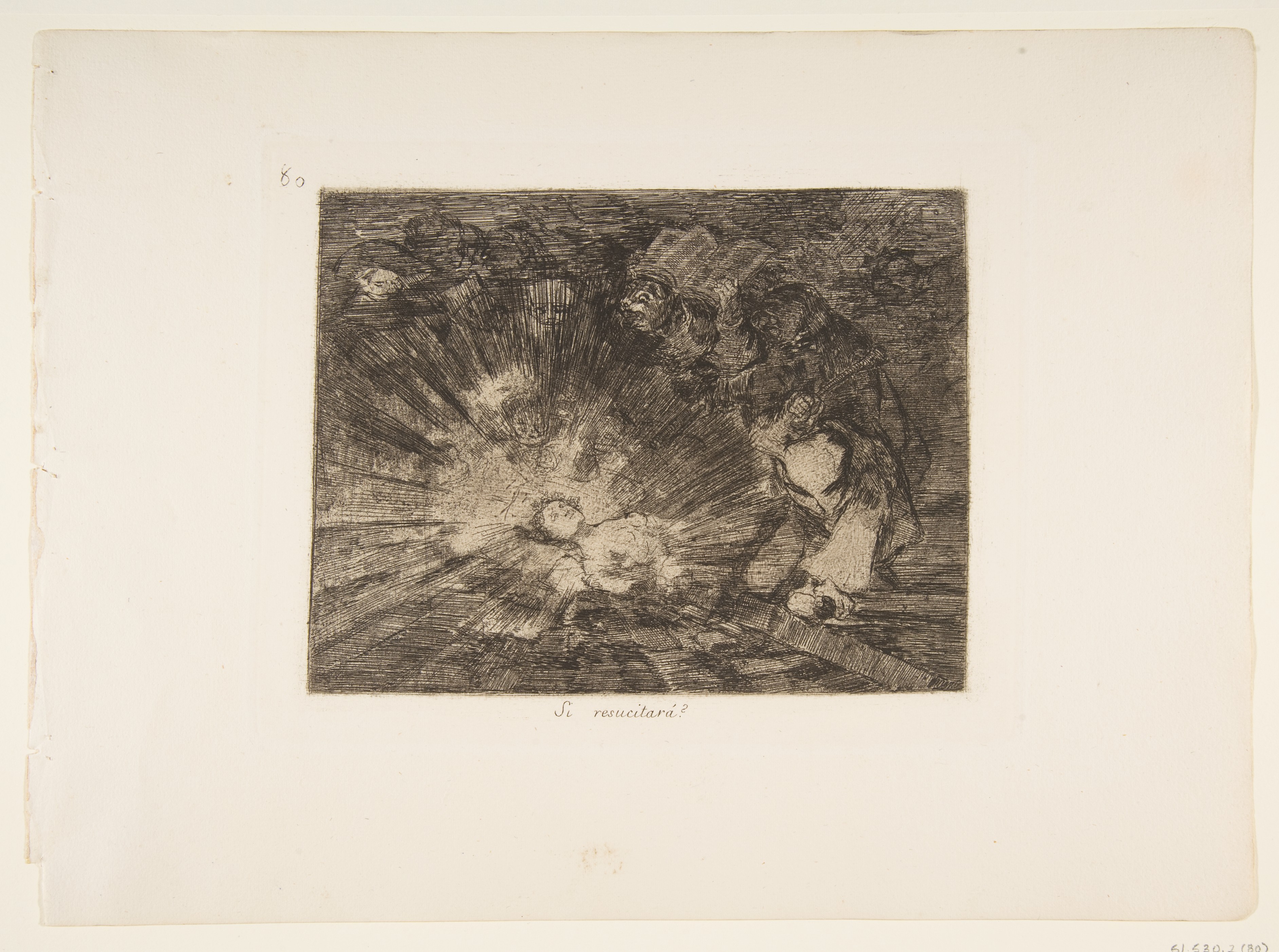
| Plate 80, "Will she rise again?" (Si resucitara?) Francisco de Goya y Lucientes | Final plate of the same series; a different sheet, a different Met accession lot, and not the object described in this record. Personifies Truth or the Constitution of 1812 as a woman questioning her own resurrection, a direct thematic echo of plate 69's death-and-negation imagery. | Metropolitan Museum of Art, New York, accession 51.530.2(80) |
| The Cean Bermudez album of proofs Francisco de Goya y Lucientes | The manuscript source for Goya's own caption on this plate, and a different physical object from the printed sheet described in this record. The only complete surviving set of Goya's own proofs, with his handwritten titles; also contains two compositions, numbered 81 and 82, never included in the 1863 published edition. | British Museum, London |
| Los Caprichos, plate 43, "El sueno de la razon produce monstruos" (The Sleep of Reason Produces Monsters) Francisco de Goya y Lucientes | Earlier satirical print series by the same artist, catalogued separately in this archive; a different series, published a decade and a half before the Desastres plates were even begun. See the separate Iconotheca record for that print (goya-los-caprichos-el-sueno-de-la-razon); this record does not repeat its material. | Metropolitan Museum of Art, New York |
Open questions
- From whom did the Met purchase this sheet in 1922? The Museum's own catalogue record names only the funding source, the Jacob H. Schiff bequest, and no dealer or auction house.
- Is this specific sheet a true first-edition (1863) pull, or from one of the four later Real Academia re-editions (1892, 1903, 1906, 1937)? The first-edition attribution here rests on a sibling sheet from the same accession lot, not on a Harris catalogue number recorded for plate 69 itself.
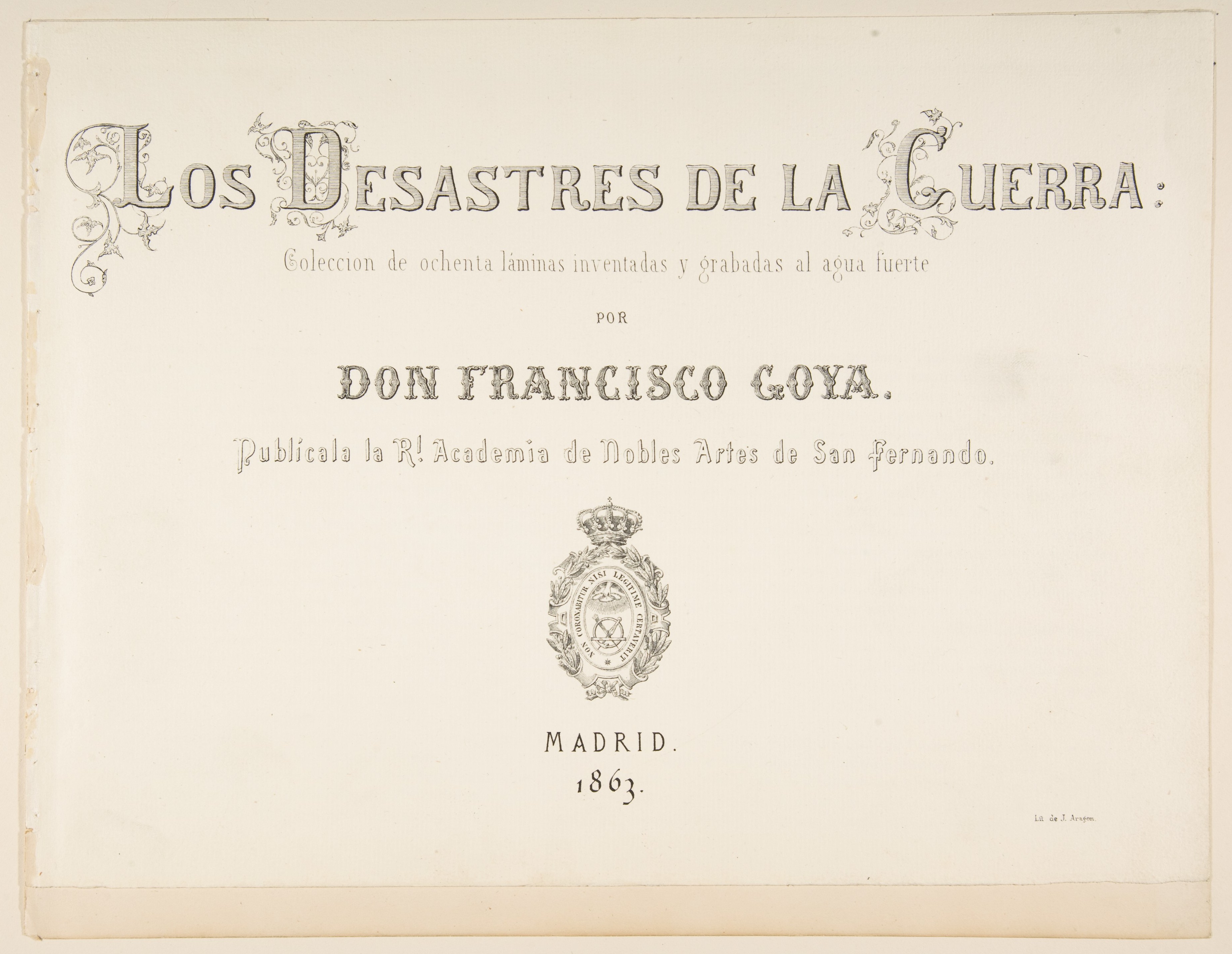
- The Met catalogues the accompanying title-page sheet for this set (object 851888) as an offset lithograph, a commercial printing process that postdates 1863 by decades. Whether that particular leaf is a later replacement bound into an otherwise first-edition set is not addressed in the Museum's own record.
- What did Goya intend by "Nada"? Valeriano Bozal reads it as the culmination of an anti-clerical critique running through plates 66 to 69; other accounts read it more broadly as a verdict on the political aftermath of the war. No consensus in the sources consulted resolves which, if either, is closer to Goya's own intention.
- What was the exact custody of the 80 copperplates between Javier Goya's death, usually dated to 1854, and the Real Academia's documented 1862 acquisition of them? The sources consulted do not detail this interval.
- Does any other first-state proof of plate 69, showing the brighter, undarkened allegorical figure of Justice recorded in the Museum of Fine Arts, Boston impression, survive elsewhere?
Questions about this object
What is Plate 69 from "The Disasters of War" (Los Desastres de la Guerra): "Nothing. It will say so" (Nada. Ello dira)?
Plate 69 from "The Disasters of War" (Los Desastres de la Guerra): "Nothing. It will say so" (Nada. Ello dira) is a print, dated etched c. 1814-1815; plate first published 1863. Medium: Etching, burnished aquatint, lavis, drypoint and burin.
Who made Plate 69 from "The Disasters of War" (Los Desastres de la Guerra): "Nothing. It will say so" (Nada. Ello dira), and is the attribution settled?
The attribution to Francisco de Goya y Lucientes is recorded here as accepted. Undisputed autograph work. The plate is one of the 80 copperplates etched by Goya that passed after his death to the Real Academia de Bellas Artes de San Fernando, which published them under his name in 1863. Goya's own hand is further documented by his manuscript caption for this exact plate, in present tense, on the album of proofs he gave in his lifetime to his friend Juan Agustin Cean Bermudez, now in the British Museum. Nothing about authorship is disputed here; what is genuinely unsettled is the plate's meaning, addressed in the narrative below.
Where is Plate 69 from "The Disasters of War" (Los Desastres de la Guerra): "Nothing. It will say so" (Nada. Ello dira) now?
Metropolitan Museum of Art, New York (Department of Drawings and Prints). Inventory number 22.60.25(69). Last confirmed 18 September 2026. Metropolitan Museum of Art online collection record and Open Access API, object 381410, which confirms isPublicDomain: true for this accession.
What is still unknown about Plate 69 from "The Disasters of War" (Los Desastres de la Guerra): "Nothing. It will say so" (Nada. Ello dira)?
From whom did the Met purchase this sheet in 1922? The Museum's own catalogue record names only the funding source, the Jacob H. Schiff bequest, and no dealer or auction house.
Sources
- 1Metropolitan Museum of Art, collection record and Open Access API, Plate 69 from "The Disasters of War": "Nothing. The event will tell" (Nada. Ello dira), accession 22.60.25(69), object 381410. Confirms medium, dimensions, credit line, and isPublicDomain: true. metmuseum.org/art/...
- 2Metropolitan Museum of Art, collection record, Plate 66 from "The Disasters of War": "Strange devotion!", accession 22.60.25(66), object 381417. metmuseum.org/art/...
- 3Metropolitan Museum of Art, collection record, Plate 68 from "The Disasters of War": "What madness!", accession 22.60.25(68), object 381415. metmuseum.org/art/...
- 4Metropolitan Museum of Art, collection record, title page and letterpress description to "The Disasters of War", accession 22.60.25, object 851888. metmuseum.org/art/...
- 5Wikipedia, "The Disasters of War", for the publication history, the Cean Bermudez album, the three-part structure of the series, the caprichos enfaticos, and the title change on plate 69 and the comparable change on plate 36. Tertiary source, flagged for replacement with Tomas Harris's catalogue raisonne or a peer-reviewed monograph. en.wikipedia.org/wiki/...
- 6Wikipedia, "Francisco Goya", for the artist's biography: birth and death, court career, deafness, the Peninsular War, the Black Paintings and the Bordeaux exile. Tertiary source, flagged for replacement with a scholarly biography. en.wikipedia.org/wiki/...
- 7Wikipedia, "Jacob Schiff", for Schiff's dates, career and philanthropy, including support for the Metropolitan Museum of Art. Tertiary source, flagged for replacement with the Museum's own donor records or a Schiff biography. en.wikipedia.org/wiki/...
- 8Fundacion Goya en Aragon, catalogue entry for "Nada. Ello dira", plate 69 of Los Desastres de la Guerra, for the title history (Goya's manuscript caption versus the 1863 engraved caption) and interpretive discussion. fundaciongoyaenaragon.es/eng/...
- 9Art Institute of Chicago, catalogue entry, "Nothing. The Event Will Tell, plate 69 from The Disasters of War", for the composition description, the title-change note, and the scholarly readings attributed to Nigel Glendinning and Valeriano Bozal. artic.edu/artworks/...
- 10Yale University Art Gallery, catalogue entry, "Nada. [Ello dira] (Nothing. The Event Will Tell)", plate 69, Arthur Ross Collection, for confirmation of the 1st-edition designation used by other institutions and the medium and dimensions of a comparable impression. artgallery.yale.edu/collections/...
- 11Museum Boijmans Van Beuningen, "Goya's Disasters of War", in-depth collection essay, for the Real Academia's 1862 acquisition of the copperplates, the 1863 first edition of about 500 sets, and the series' three-part structure. boijmans.nl/en/...
- 12Wikimedia Commons, file record for "Plate 69 from 'The Disasters of War' (Los Desastres de la Guerra)- 'Nothing. The event will tell.' (Nada. Ello dira) MET DP817471.jpg", confirming CC0 licence via extmetadata.LicenseShortName, donated by the Metropolitan Museum of Art. commons.wikimedia.org/wiki/...
-_%27Nothing._The_event_will_tell.%27_(Nada._Ello_dir%C3%A1)_MET_DP817471.jpg)
Last verified 18 September 2026 · Published 18 September 2026
Change log
18 September 2026 - Record created at the house standard: researched narrative, technical evidence, maker dossier, graded provenance chain, prices with hammer and premium separated, related works, open questions and sources.