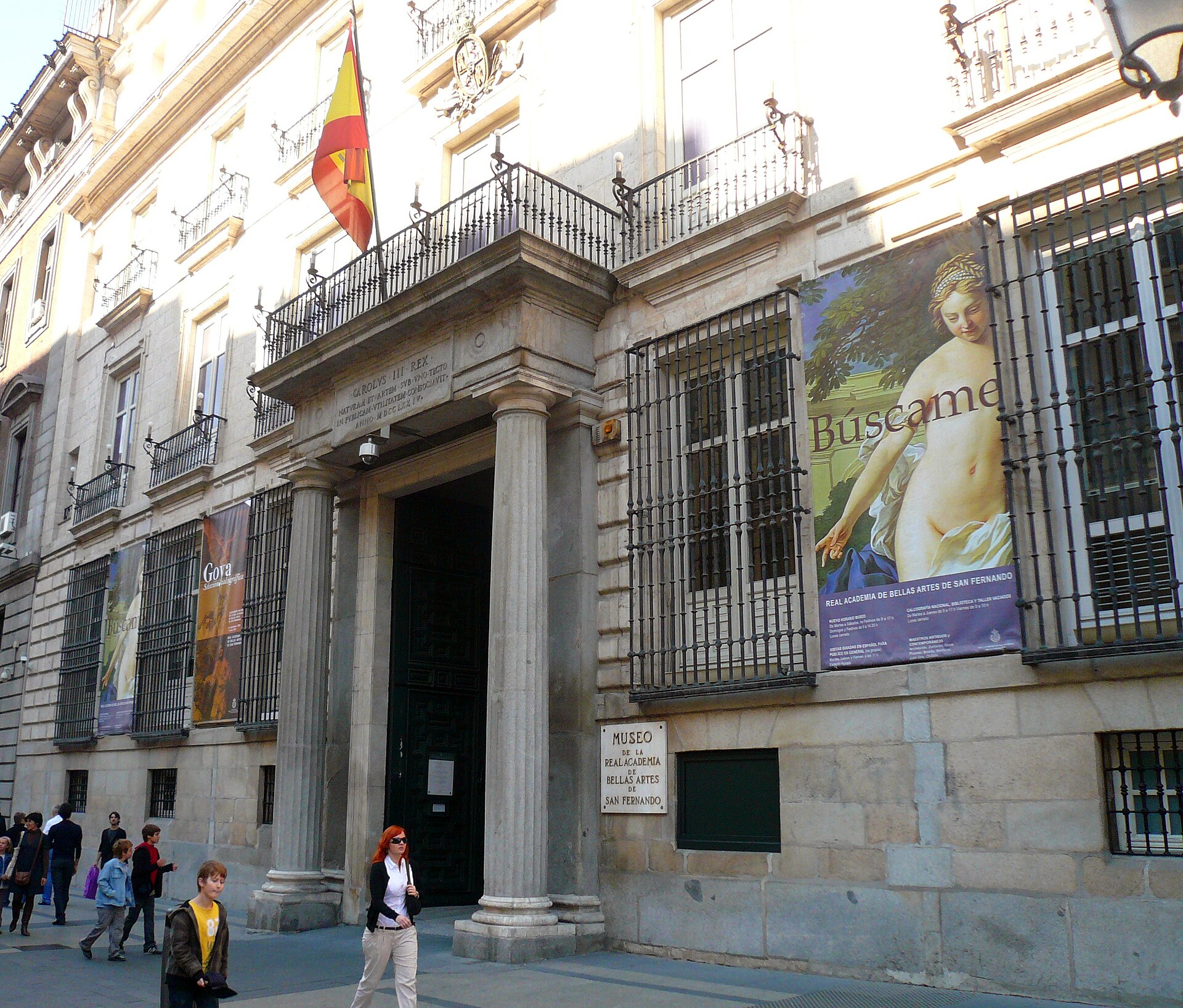
The Academy's facade on Calle de Alcala, with exhibition banners hung between the ground-floor windows and the museum's entrance visible at street level.
Stanislav Kozlovskiy · Photograph by Ctac · CC BY-SA 3.0Real Academia de Bellas Artes de San Fernando
Museum · Founded 1752
Open, admission and hours confirmed 26 August 2026 · 14 sources
On this page 14 sections
ContentsClose
A working academy's own teaching collection, not a museum built to a acquisitions plan, which is why it holds both major paintings and the academic copies students made after them side by side. Its thirteen Goya paintings, held by the institution he served as an academician and later a director, are the draw that would justify the admission price alone; El Greco, Ribera, Zurbaran and a run of Spanish Golden Age painting sit around them, and a small group of non-Spanish holdings, including a rare Arcimboldo, extend the range further than the building's size suggests. The National Chalcography's Goya printing plates, shown with the prints pulled from them, are a specific strength few other institutions can match.
| Kind | Museum |
|---|---|
| Founded | 12 April 1752, by royal decree of Ferdinand VI; moved into its current building, the former Goyeneche Palace, after Charles III bought it and had it converted, completed 1774 |
| City and country |  Madrid, Spain Madrid, Spain |
| Address | Calle de Alcala, 13, 28014 Madrid, Spain |
| Website | realacademiabellasartessanfernando.com |
| Status | Open, confirmed |
| Record last verified |
Visiting
- Hours
- Tuesday-Sunday, including public holidays10:00 to 15:00permanent collection
- MondayClosed all year
- Closed
- 1 and 6 January, 1 and 30 May, all of August, 9 November, 23, 24, 25 and 31 December. The museum's own site still notes the second floor is closed from 2 May 2026 until further notice, for internal reasons, so part of the collection may be unavailable on any given visit. Temporary-exhibition hours can differ from the permanent-collection hours above and vary in holiday periods.
- Admission
- General (museum, Goya Cabinet and temporary exhibitions)EUR 10
- Reduced, permanent collection only, accreditation requiredEUR 5Over 65, retirees and pensioners, students over 25, international student card holders, FEAM members, members of large families
- Free, permanent collection only, accreditation requiredFreeUnder 18, university students 18-25, unemployed, museum professionals, ICOM/ANABAD/IAC/MAV members, official tourist guides, journalists, teachers, disability cardholders and one accompanying person, Academy Archive-Library researchers, qualifying large-family groups
Free entry: Tuesday to Friday (non-holiday), 13:30 to 15:00, permanent collection. 18 May (International Museum Day). 12 October (Spanish National Day). 6 December (Spanish Constitution Day)- Tickets
- realacademiabellasartessanfernando.com/visita... The museum's own ticket page.
- Do I need to book?
- No
- Address
- Calle de Alcala, 13, 28014 Madrid, Spain MapMetro Sevilla and Sol, both a short walk along Calle de Alcala from the Puerta del Sol end of the street
- Website
- realacademiabellasartessanfernando.com
- Telephone
- +34 91 524 08 64
Before you go how long, access, photography, bags, eating, shop
- How long to allow
- One to two hours, by outside estimate, across a building most visitors report seeing with little to no queue
- Access
- Not detailed on the pages read for this research
- Photography
- Not stated on the pages read for this research
- Bags
- Not stated on the pages read for this research
- Eating
- Not confirmed for this research
- Shop
- Academy shop on site, open Tuesday-Friday and Sunday 10:00-15:00, Saturday 10:00-19:00, closed Monday
Prices and hours change. We take them from the institution's own pages and print the day we read them, and you can check the current position at the source we used. Confirm before you travel.
What is inside
The Goya rooms
Thirteen works by Francisco Goya, who served the Academy as an academician and later as one of its directors: two self-portraits, his portrait of the minister Manuel Godoy, a portrait of his friend the playwright Leandro Fernandez de Moratin, and the carnival scene El entierro de la sardina (Burial of the Sardine). The Academy's own Goya page, re-read for this check, still puts the thirteen paintings in the palace's principal hall, remodelled for the 250th anniversary of Goya's birth.
Gabinete Goya (National Chalcography)
The Academy's own collection of Goya's printing plates and prints, including the Caprichos, the Desastres de la guerra, the Tauromaquia and the Disparates, shown together with the copper plates themselves rather than the prints alone.
Spanish Golden Age and Baroque rooms
Paintings by El Greco, Jose de Ribera, Zurbaran and others from the fifteenth to seventeenth centuries, alongside academic copies made by students after Murillo and Titian as part of the Academy's own teaching collection.
The founding and self-portrait rooms
The Academy's own founding allegory painting, and a collection of artists' self-portraits including Carlo Maratta's, a genre the Academy collected as part of building an institutional identity around its members rather than only their finished works.
European and later galleries
Works spanning the fifteenth to twentieth centuries beyond the Spanish core, including Giuseppe Arcimboldo's Spring (1563) and paintings attributed to or associated with Giovanni Bellini, in a collection the Academy itself describes as running across 58 rooms.
What to see first
El entierro de la sardina (Burial of the Sardine)
Francisco Goya, 1812-1814A carnival scene painted in the middle of the Peninsular War, read by historians as an early sign of the darker, more grotesque register Goya's later work would take; one of the Academy's thirteen Goya paintings, reconfirmed still on the Academy's own Goya page as of this check.8
Self-portraits
Francisco GoyaTwo self-portraits held here, part of the same thirteen-work Goya group that makes this the Academy Goya himself once directed rather than merely exhibited in.8
Portrait of Manuel Godoy
Francisco GoyaA portrait of Carlos IV's chief minister and one of the most powerful, and most resented, men in Spain in his own lifetime, painted by the court's own painter.8
San Jeronimo
El GrecoOne of the Academy's Spanish Golden Age holdings, shown alongside the Academy's Ribera and Zurbaran paintings in the same run of rooms.4
Asuncion de la Magdalena
Jose de RiberaA Baroque religious painting representative of the Academy's seventeenth-century Spanish holdings, part of the collection assembled specifically to give the Academy's own students works to study and copy.4
Spring
Giuseppe Arcimboldo, 1563A composite portrait built from flowers and foliage, by an artist whose paintings are rare outside Vienna and a handful of other collections; not a work most visitors expect to find in a Madrid academy building.6
Alegoria de la fundacion de la Real Academia de Bellas Artes de San Fernando
Academy painters, 18th centuryThe Academy's own painted account of its founding, kept and shown rather than treated as an administrative record, which sets the tone for an institution that collects its own history as deliberately as it collects other artists' work.4
Exhibitions on now
An academy before it was a museum
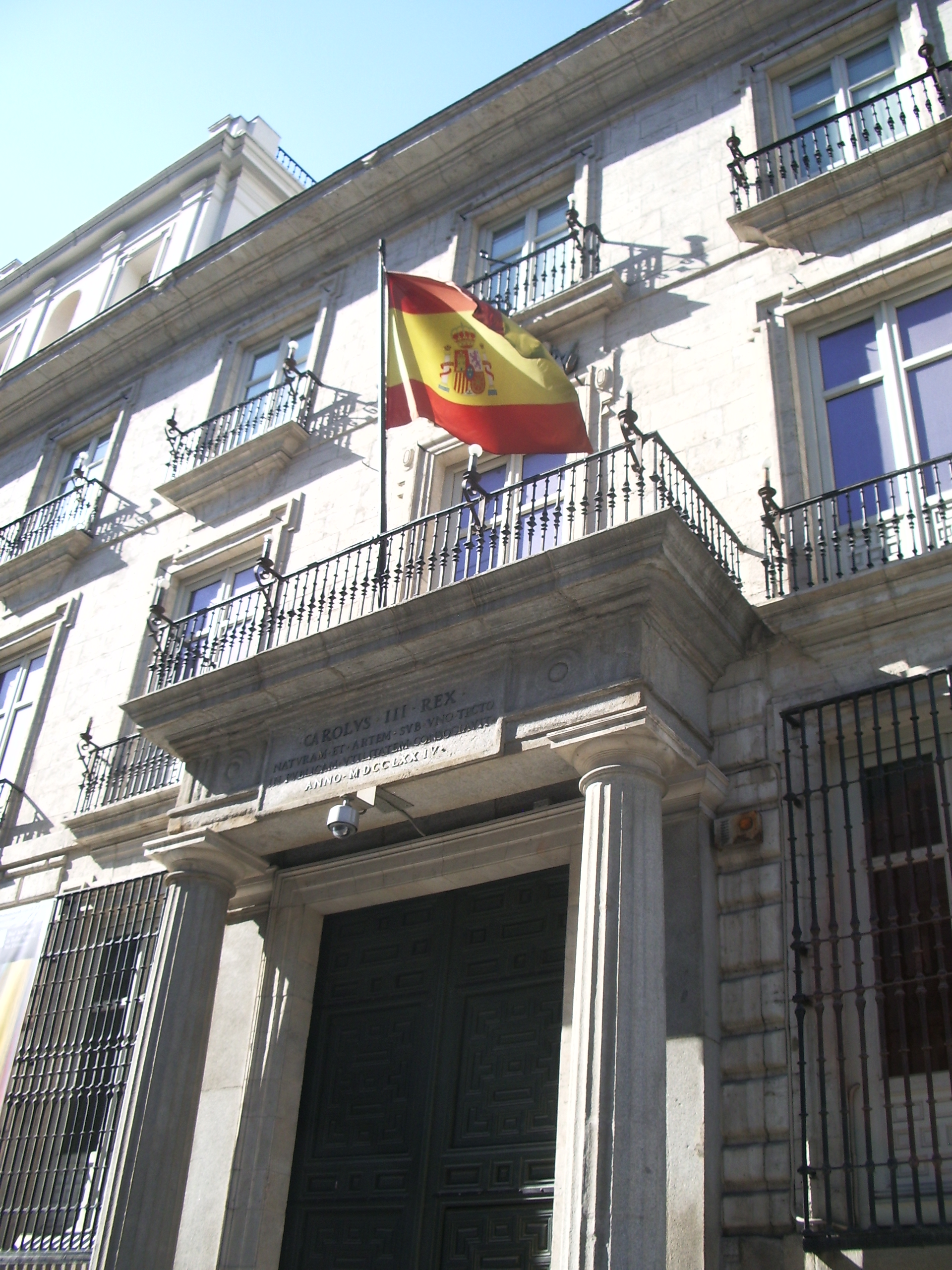
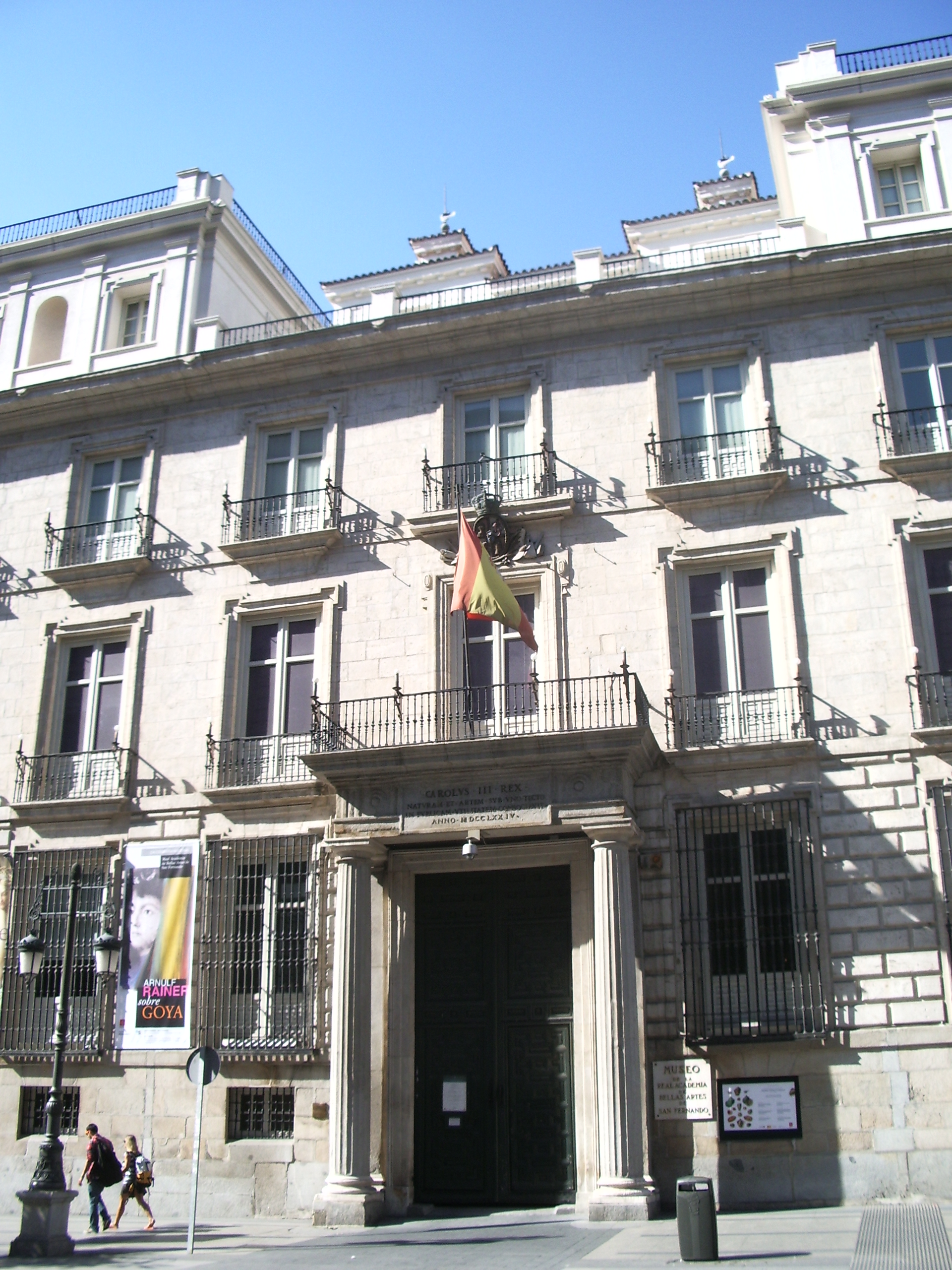
The Real Academia de Bellas Artes de San Fernando was established by royal decree of Ferdinand VI on 12 April 1752, one of the Bourbon monarchy's Enlightenment-era institutions built to professionalise and standardise the arts in Spain the way equivalent academies had already done in Paris and Rome. It did not begin in the building it occupies now. About twenty years after the founding decree, Charles III bought a palace on Calle de Alcala that the architect Jose Benito de Churriguera had built for the Goyeneche family in the Baroque manner, and commissioned Diego de Villanueva to convert it for academic use in the newer neoclassical style the crown favoured. The inscription still cut into the entrance facade, CAROLVS III REX, dates the completed conversion to 1774, two decades after the Academy itself was founded.
The result is a working academy that happens to run a museum, not a museum built from scratch. The paintings on the walls were assembled to teach from as much as to display, which explains why several rooms mix major paintings with academic copies students made after Murillo and Titian: both kinds of object served the same institutional purpose before either was treated as a visitor attraction.
Goya's academy
Francisco Goya's relationship with the institution went well beyond having work in its collection. He was elected an academician and went on to serve the Academy as a director, giving the thirteen Goya paintings held here a different weight than a comparable group bought later by an outside museum: these are the paintings of a man who helped run the place. They include two self-portraits, a portrait of Carlos IV's minister Manuel Godoy, a portrait of Goya's friend the playwright Leandro Fernandez de Moratin, and El entierro de la sardina, a carnival scene from 1812 to 1814 that historians read as an early sign of the grotesque, unsettled register his later work would take further.
The Academy's National Chalcography adds a second Goya holding most visitors do not expect: the actual copper printing plates for the Caprichos, the Desastres de la guerra, the Tauromaquia and the Disparates, kept and shown alongside prints pulled from them. Few institutions anywhere hold both a painter's finished paintings and the physical plates behind his most famous print series in the same building.
Madrid's most overlooked major collection
The comparison to the Prado and the Reina Sofia, both a short walk away, is unavoidable and the museum loses it on visitor numbers by a wide margin. TripAdvisor's own count puts the Academy at a few hundred ratings against tens of thousands for its larger neighbours, and outside coverage returns to the same observation so often that it has become the standard way of describing the place: one visitor review is simply titled the most overlooked museum in Madrid. This is presented in almost all outside coverage as a practical advantage - an uncrowded building holding thirteen Goyas and a rare Arcimboldo - but it is worth stating plainly rather than only as a selling point: a national academy with a collection of this quality operates well below the public attention its holdings would justify elsewhere, and the museum's own marketing has not closed that gap.
The museum's own site carries a second, more concrete sign of an institution running on a tighter footing than its larger neighbours: the second floor has been closed since 2 May 2026 until further notice, with no reason or reopening date given to visitors beyond an apology for the inconvenience - still true on a direct re-check nearly four months later.
Beyond the Spanish core
Because the Academy collected as an institution building its own identity rather than as a museum filling gaps in a national narrative, its holdings run past the expected Spanish Golden Age names - El Greco, Ribera, Zurbaran - into material a visitor would not necessarily plan a trip around. Giuseppe Arcimboldo's Spring, painted in 1563, is the clearest example: his composite portraits survive in only a handful of collections worldwide, and finding one in a Madrid academy building rather than in Vienna is the kind of fact the Academy's own visit pages do not make much of. A room of members' self-portraits, including one by the Italian painter Carlo Maratta, extends the same logic: the Academy collected its own membership as deliberately as it collected outside masters, which is not the acquisitions pattern of a conventional survey museum.
58 rooms, and what a visitor actually walks through
The Academy describes its own galleries as running to 58 rooms, a figure that says more about the building's continuous use since 1774 than about the density of any single display. Alumni of the teaching academy itself include Pablo Picasso and Salvador Dali, both of whom passed through its benches before either became known for work that owed nothing to the neoclassical training the Academy was built to enforce - an irony the institution's own history acknowledges rather than avoids. A visitor moving through the building today is moving through both a museum and a still-functioning academy, the Archive-Library keeping researcher hours on weekday mornings while the galleries keep public hours in the afternoon.
What visitors say
We publish no visitor review prose and cite no invented consensus. TripAdvisor's own aggregate for the attraction, re-read on the date below, still puts it at 4.4 of 5 from 494 ratings, now ranked 44th of 1,595 things to do in Madrid - a fraction of the review count of the Prado or the Reina Sofia a few streets away, which is itself the recurring theme in how this museum gets discussed.
What is praised, what is criticised
- Praised: the thirteen Goya paintings and the Gabinete Goya print and plate collection, held by an institution Goya himself once directed
- Praised: the absence of crowds, repeatedly framed by outside coverage as the museum's main practical advantage over the Prado
- Praised: the range of the wider collection for a single building, from El Greco and Ribera to a rare Arcimboldo
- Criticised: the museum is consistently described in outside coverage as Madrid's most overlooked major collection, and one visitor review used exactly that phrase as its title; low visitor numbers relative to its holdings is the single most repeated observation about the place
- Criticised: the museum's own site still reports the second floor closed since 2 May 2026 until further notice, without giving visitors a reason or a reopening date, nearly four months into the closure as of this check
- Criticised: some visitors report the display and interpretation feel dated next to Madrid's larger museums, even where the underlying collection is not in dispute
Ratings on other platforms
TripAdvisor: 4.4 from 494 ratings, read 26 August 2026
A platform average is a tertiary source: it moves, it is not audited, and we quote no visitor's words.
Questions about Real Academia de Bellas Artes de San Fernando
Where is Real Academia de Bellas Artes de San Fernando?
Calle de Alcala, 13, 28014 Madrid, Spain.
How much does it cost to visit?
General (museum, Goya Cabinet and temporary exhibitions): EUR 10; Reduced, permanent collection only, accreditation required: EUR 5; Free, permanent collection only, accreditation required: free. As confirmed 26 August 2026.
When is it open?
Tuesday-Sunday, including public holidays 10:00-15:00; Monday closed. Closed: 1 and 6 January, 1 and 30 May, all of August, 9 November, 23, 24, 25 and 31 December. The museum's own site still notes the second floor is closed from 2 May 2026 until further notice, for internal reasons, so part of the collection may be unavailable on any given visit. As confirmed 26 August 2026.
How do you get there?
Metro: Sevilla and Sol, both a short walk along Calle de Alcala from the Puerta del Sol end of the street.
What should you see first?
El entierro de la sardina (Burial of the Sardine) (Francisco Goya, 1812-1814); Self-portraits (Francisco Goya); Portrait of Manuel Godoy (Francisco Goya); San Jeronimo (El Greco); Asuncion de la Magdalena (Jose de Ribera); Spring (Giuseppe Arcimboldo, 1563).
What we could not confirm
- Why the second floor has been closed since 2 May 2026 and when it is expected to reopen; the Academy's own site still gives neither reason nor date on a re-check nearly four months later.
- Whether the Academy has any active plan to close the visitor-numbers gap with its larger Madrid neighbours, given how consistently outside coverage frames this as the museum's defining characteristic.
- The exact current total number of works in the collection; sources used for this research describe the range (fifteenth to twentieth century, dozens of named artists) without giving a single agreed count.
Images
Sources
- 1Real Academia de Bellas Artes de San Fernando, Horario: full opening hours for the museum, Academy offices, Archive-Library, National Chalcography, casting workshop and shop, and the 2026 closed-day list. Read in the in-app browser, 7 August 2026. realacademiabellasartessanfernando.com/visitas/horario/
- 2Real Academia de Bellas Artes de San Fernando, Tarifas y reservas: every admission tier and every free and reduced-price qualifying condition. Read in the in-app browser, 7 August 2026. realacademiabellasartessanfernando.com/visitas/tarifas-y-reservas/
- 3Real Academia de Bellas Artes de San Fernando, Contacto: postal address and telephone number. Read 7 August 2026. realacademiabellasartessanfernando.com/visitas/contacto/
- 4Wikipedia, Academia de Bellas Artes de San Fernando: collection scope (15th-20th century paintings), named artists including Bellini, Velazquez, Rubens, Murillo, Ribera and Zurbaran, and Giuseppe Arcimboldo's Spring (1563). en.wikipedia.org/wiki/Academia_de_Bellas_Artes_de_San_Fernando
- 5Wikipedia, Royal Academy of Fine Arts of San Fernando: 1752 founding decree under Ferdinand VI, the Goyeneche Palace building history (Churriguera's original design, Charles III's purchase, Diego de Villanueva's neoclassical conversion), Goya's role as a director, and alumni including Picasso and Dali. en.wikipedia.org/wiki/Royal_Academy_of_Fine_Arts_of_San_Fernando
- 6Wikidata, Royal Academy of Fine Arts of San Fernando (Q1322403): coordinates, country, inception date (12 April 1752) and official website, used as the and cross-checked against the Academy's own address. wikidata.org/wiki/Q1322403
- 7TripAdvisor, Museo de la Real Academia de Bellas Artes de San Fernando attraction page: hours and the aggregate rating, first read 7 August 2026 (4.4 from 494 reviews) and re-read 26 August 2026 (unchanged at 4.4 from 494 reviews, ranked 44th of 1,595 things to do in Madrid). tripadvisor.com/Attraction_Review-g187514-d244289-Reviews-Museo_de_la_Real_Academia_de_Bellas_Artes_de_San_Fernando-Madrid.html
- 8Museum-guide coverage of the permanent collection (cross-checked across sources) for the Academy's thirteen Goya paintings, including the two self-portraits, the Godoy and Moratin portraits, and El entierro de la sardina (1812-1814); and the search-result listing headed 'Most overlooked museum in Madrid' for a Tripadvisor review of this venue, used here only as evidence that the phrase is how outside visitors characterise the museum, not quoted as review prose. tripadvisor.com/ShowUserReviews-g187514-d244289-r49406120-Museo_de_la_Real_Academia_de_Bellas_Artes_de_San_Fernando-Madrid.html
- 9Wikimedia Commons, search results for 'Real Academia de Bellas Artes de San Fernando': the plates on this page, each from .LicenseShortName and each image downloaded and inspected before use. commons.wikimedia.org/w/index.php?search=intitle%3A%22Real+Academia+de+Bellas+Artes+de+San+Fernando%22&title=Special:MediaSearch&type=image
- 10Real Academia de Bellas Artes de San Fernando, Horario, re-read 26 August 2026 to re-confirm the visit facts on this page: hours, closed-day list and the second-floor closure notice all unchanged word-for-word from the 7 August 2026 read. realacademiabellasartessanfernando.com/visitas/horario/
- 11Real Academia de Bellas Artes de San Fernando, Tarifas y reservas, re-read 26 August 2026: all admission tiers, qualifying conditions and free-entry windows unchanged from the 7 August 2026 read. realacademiabellasartessanfernando.com/visitas/tarifas-y-reservas/
- 12Real Academia de Bellas Artes de San Fernando, Contacto, re-read 26 August 2026: telephone unchanged (+34 91-524 08 64); the page's contact form again names only a data-protection address ([email protected]), so contact.email is left blank rather than asserted. realacademiabellasartessanfernando.com/visitas/contacto/
- 13Real Academia de Bellas Artes de San Fernando, homepage, read 26 August 2026: institution operating normally with a live events programme running into September 2026 (a presentation on 17 September, a lecture on 22 September, a concert on 30 September) and recent news items dated as late as 13 July 2026 - no sign of closure, merger, rename or a shuttered wing beyond the already-noted second floor. realacademiabellasartessanfernando.com/
- 14Real Academia de Bellas Artes de San Fernando, Goya en el Museo de la Academia, read 26 August 2026: confirms the Academy still holds thirteen Goya paintings in the palace's principal hall, including El entierro de la sardina and Goya's self-portraits, matching this page's highlights with no work reported as having left. realacademiabellasartessanfernando.com/goya/goya-en-el-museo-de-la-academia/